
Landscaping & Lawn Care12 min read
TikTok for Hardscape and Design-Build Landscapers: The $12,000 Decision
A plain guide to landscaping company marketing on TikTok for hardscape and design-build companies: why selling a patio is different from selling a weekly mowing spot, how a homeowner makes a $12,000 decision, the six videos that help her make it (the project series, the design walk-through, the price explainer, the question videos, the one-year-later visit and the honest week), the written permission a three-week project needs, when to post so the calendar fills in winter, the page and the replies that turn a view into a site visit, the four numbers to track, and when paying to promote a video is worth it.
By Ryan MitchellHead of Creator Success at Viryze
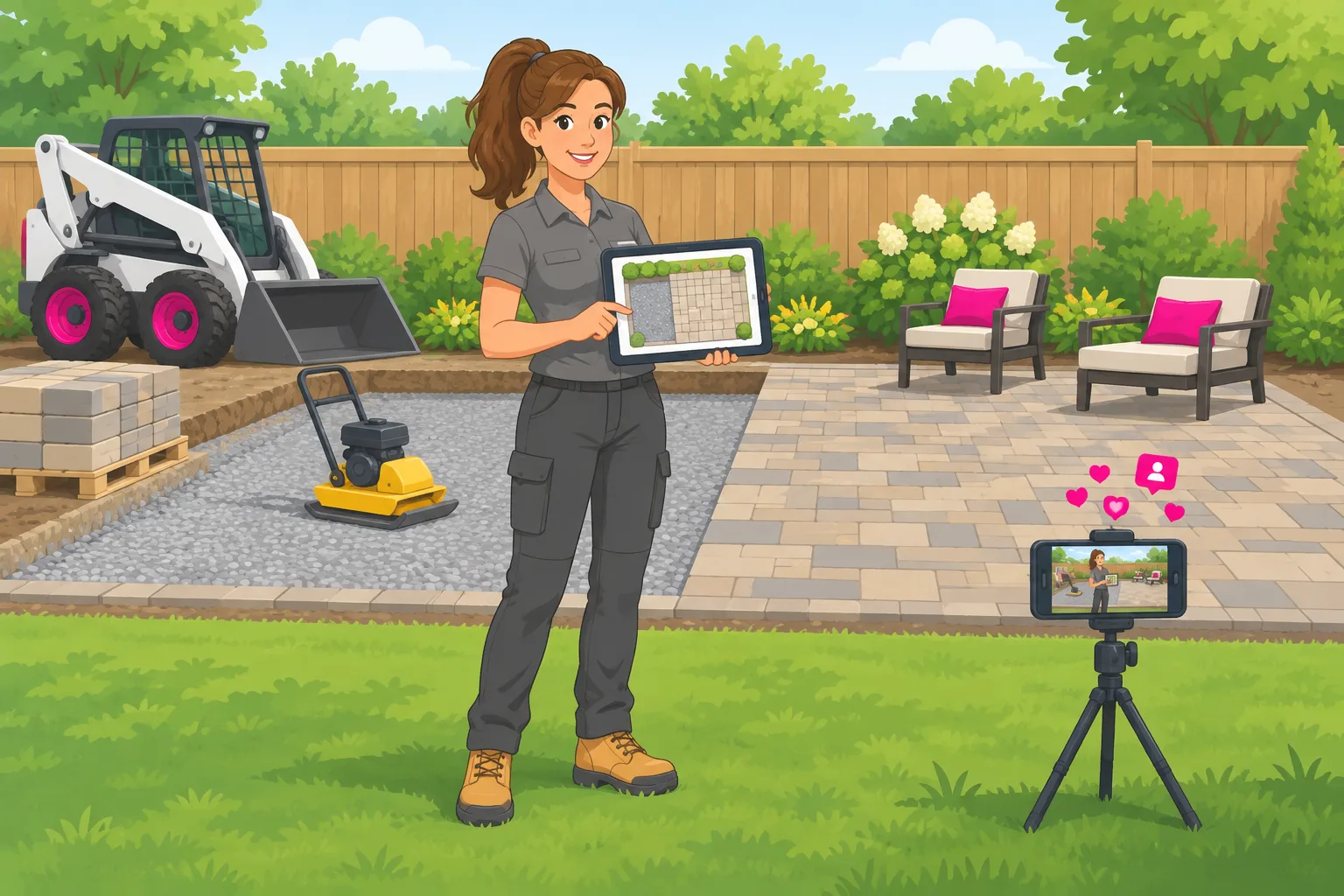
Most landscaping company marketing advice is written for the mowing side of the business: fill the route, keep the weekly customers, add a few stops each spring. A company that builds patios and walls has a different problem.
You do not need sixty customers. You need a small number of homeowners to each make one large decision, and to make it months before the work starts. A patio is not an impulse buy. It is planned in winter and built in spring.
This guide is about using TikTok for that kind of sale. The short version: show how the work is done, say what one real project cost, and post it in the months when homeowners are planning, not the months when you are building.
It is one part of our complete TikTok guide for landscapers and lawn care companies. That guide is built around a mowing route. This part covers what changes when the job is a one-time build. The last section explains when paying to promote a video makes sense.
The honest summary:
- A patio is a slow decision. Expect months between the first video someone watches and the day she asks for a price.
- The finished photo is not enough. Every company has one. What a homeowner cannot see is what is under the stone.
- A big number needs an explanation. Say what one project cost and where the money went.
- Sell in winter. The projects you build in May are mostly decided between January and March.
What's Inside
- 1. Why a Build Is a Different Sale Than a Route
- 2. How a Homeowner Makes a $12,000 Decision
- 3. The Project Series: Dig, Base, Stone, Reveal
- 4. The Design Walk-Through
- 5. The Price Video: What $12,000 Buys
- 6. Six Questions to Answer on Camera
- 7. The One-Year-Later Visit
- 8. The Honest Week
- 9. Permission: The Homeowner, the Neighbor, the Plan and the Drone
- 10. The Calendar: Sell in January, Build in May
- 11. From a View to a Site Visit
- 12. The Neighbor Who Watched for Three Weeks
- 13. The Four Numbers to Track
- 14. When Paying to Promote a Video Is Worth It
- Frequently Asked Questions
1. Why a Build Is a Different Sale Than a Route
The rest of this series follows a mowing company owned by a man named Luis. He sells a weekly spot on a route: $55 a cut, every Thursday, April to November. His customer decides once and then sees him thirty times a year.
This guide follows a different example company. It is a design-build company: an owner and two crew members who design and build patios, walkways and retaining walls. This kind of work is often called hardscaping. They work within about thirty minutes of their shop.
Their typical project is a paver patio of about 400 square feet with a low seat wall. It costs about $12,000 and takes about three weeks. One crew can build roughly eight projects like it between May and October. Your prices and your pace will be different. Swap in your own numbers as you read.
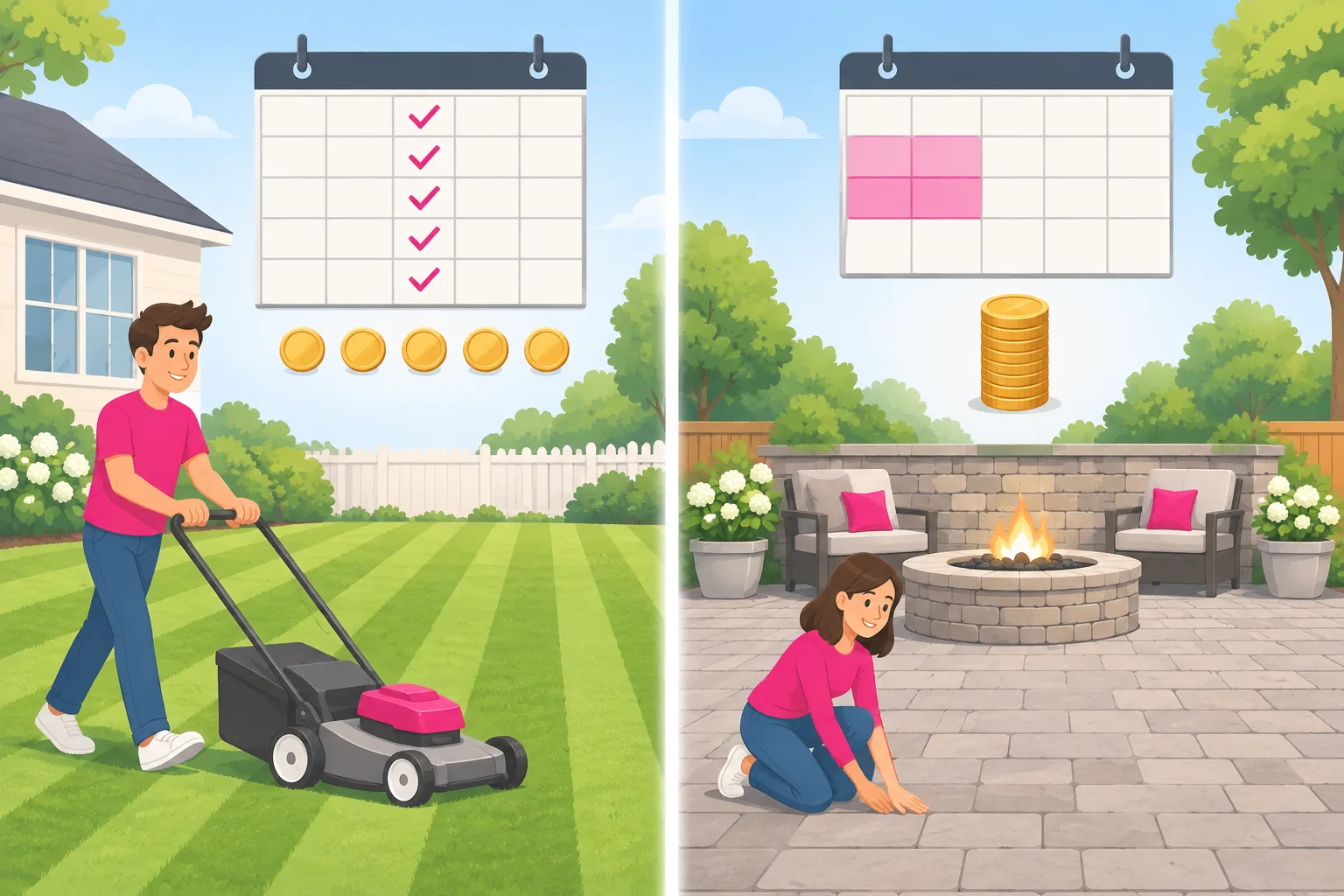
Put the two companies side by side and four things change.
- How many customers you need. Luis needs sixty stops on a Thursday. The design-build company needs about eight yeses a year.
- How long the decision takes. A mowing customer can decide in a day. A patio customer often takes months, and usually two people have to agree.
- What the customer is afraid of. A mowing customer worries about whether you will show up. A patio customer worries about paying a large sum for something that cannot be undone.
- When the sale happens. A mowing customer can sign up in March and get her first cut in April. A patio needs a site visit, a design and a contract first, so the decision is usually made months before the work starts.
The two businesses also help each other. Luis does not build patios. When a mowing customer asks for one, he sends her to a design-build company he trusts, and the finished yard comes back to him as a weekly stop. The guide to making money as a landscaper on TikTok covers that arrangement from the mowing side.
If you do both, treat them as two kinds of video on one account. The route videos sell the weekly spot. The videos in this guide sell the build.
2. How a Homeowner Makes a $12,000 Decision
Before choosing what to film, it helps to picture the person watching. She and her partner have talked about a patio for two summers. This winter they finally start looking.
She does what most people do. She looks at photos, asks two or three companies to come out, and waits for the prices. Then she tries to compare three numbers that may be thousands of dollars apart, with no way to tell why.
While she compares, she has five questions in her head:
- What will it really cost? Will the final bill match the number on the quote?
- Why is one quote so much higher than another? Is the cheaper company skipping something she cannot see?
- Will it last? She has seen patios that sank, shifted or filled with weeds after two winters.
- What will the three weeks be like? Will the crew come every day? What happens to the lawn, the sprinklers and the driveway?
- Can she trust these people in her yard? They will be behind her house, with machines, while she is at work.
A photo of a finished patio answers none of these. That is the opening for video. Each of the six videos in the next sections answers at least one of the five questions.
Keep one more thing in mind. Two people usually make this decision. The video that matters most is often the one she sends to her partner with the message "this is what I meant." Make videos that still make sense when someone watches them cold.
3. The Project Series: Dig, Base, Stone, Reveal
A mowing company films a before and an after on the same day. Your before and after are three weeks apart. That gap is useful. It lets you turn one project into a short series that people follow to the end.
Pick one project a month whose owner has agreed in writing (section 9 covers how). Film it in four parts.
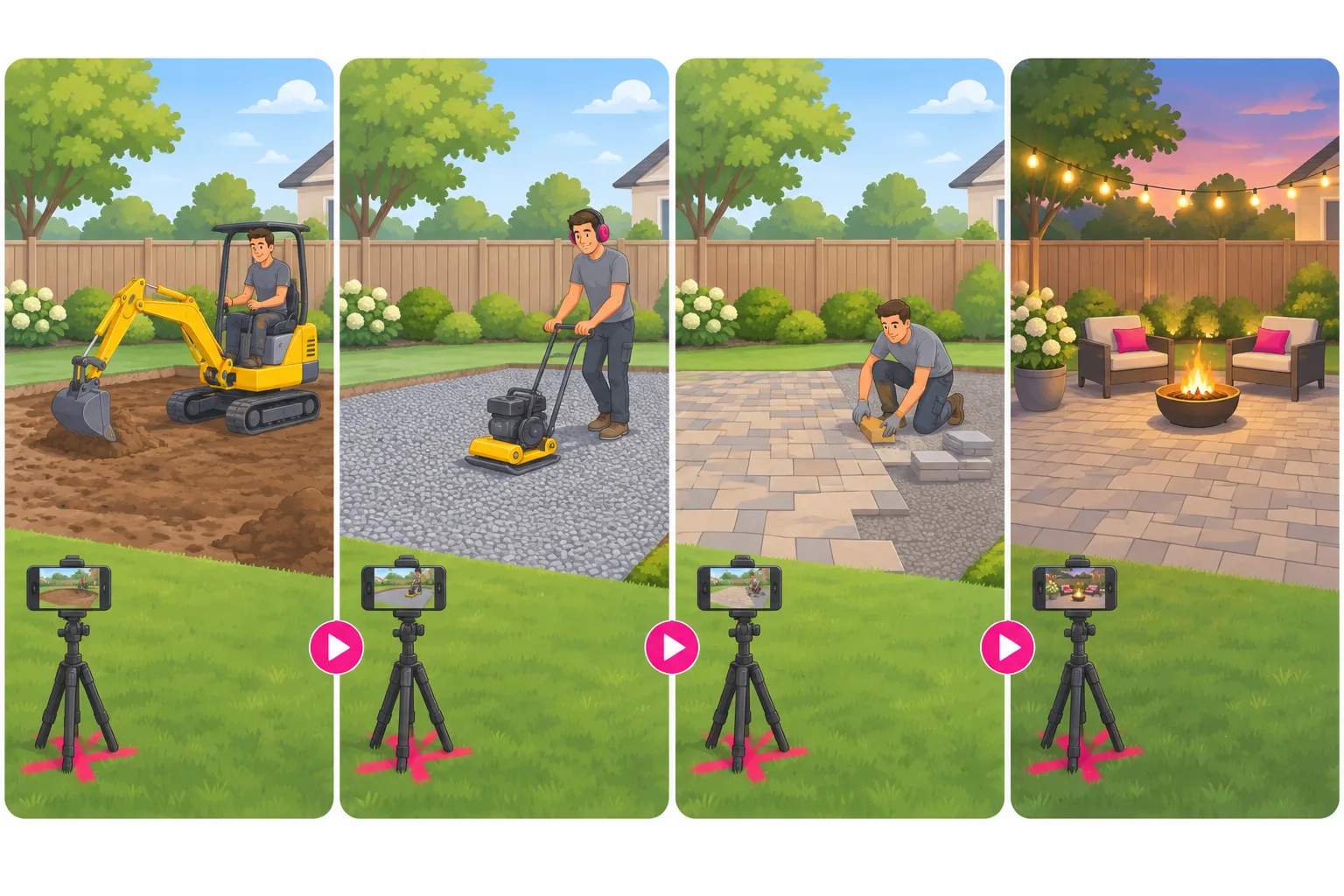
- The dig. Show the yard as it is, then the area marked out and dug. Say how deep you dig and why. Say where the soil goes.
- The base. Show the gravel going in and being packed down in layers. This is the least pretty video and the most important one. It is the part many companies never show.
- The stone. Show the pavers going down, the cuts along the edge, and the sand swept into the joints. This is the part people enjoy watching.
- The reveal. Show the finished patio from the same spot where you filmed the first day. Say the size, how long it took, and what it cost.
Three habits make the series work.
- Film from the same spot every time. Put a stake or a paint mark in the lawn on day one and stand the phone there for every part. The change is much easier to see when the view does not move.
- Start each part with where you are. "Day four of this patio. Today is the base." A viewer who missed part one should still understand part two.
- Keep the reveal honest. Same yard, same angle, your own work, no filter that makes the stone look richer than it is. The filming guide's before-and-after rule applies here too.
You do not need to film every project. One series a month during the build season gives you about six series a year. That is enough to post from all winter. For time-lapse settings and phone mounts on a job site, see how to film job-site videos.
4. The Design Walk-Through
Most homeowners cannot read a plan drawing. They also cannot picture 400 square feet. The design walk-through fixes both.
Stand in the yard where the patio will go, before any work starts. Hold the tablet with the design on it. Then walk the outline and explain it the way you would to the owner.
- Show the size with your feet. "The patio starts at this door and ends here. That is room for a table for six and a grill."
- Explain one choice. "The seat wall is on this side because that is where the wind comes from." One reason is enough. It shows the design was thought through.
- Say where the water goes. "The patio tips slightly this way, away from the house, toward that bed." This answers a worry most homeowners do not know how to ask about.
- End with what happens next. "We start digging here on the twelfth." Then the walk-through becomes the first part of the project series.
Be careful with what the drawing shows. A plan often includes the address, the lot lines and the owner's name in a corner. Crop those out or cover them before filming. Section 9 has more on this.
Film this one with the owner's written yes, like any other video in her yard. She does not need to be in it. Your voice, the tablet and the grass are enough.
5. The Price Video: What $12,000 Buys
Many build companies never say a price in public. The reason is fair: every yard is different. But silence has a cost. A homeowner with no idea of the number either never calls, or calls expecting a third of the real price.
You do not have to quote a stranger's yard. You only have to say what one finished project cost and where the money went. Film it standing on that patio.
Here is how the example company breaks down its $12,000 patio. These are example numbers. Use your own.
| Part of the job | Example cost |
|---|---|
| Digging out the area and hauling the soil away | $1,800 |
| The gravel base, packed down in layers | $2,400 |
| Pavers, edging and joint sand (materials) | $3,000 |
| Laying, cutting and finishing the pavers (labor) | $3,300 |
| The low seat wall | $1,500 |
| Total | $12,000 |
Look at the first two rows. Together they are $4,200, about a third of the price. That money is spent before a single paver goes down, and none of it shows in the finished photo.
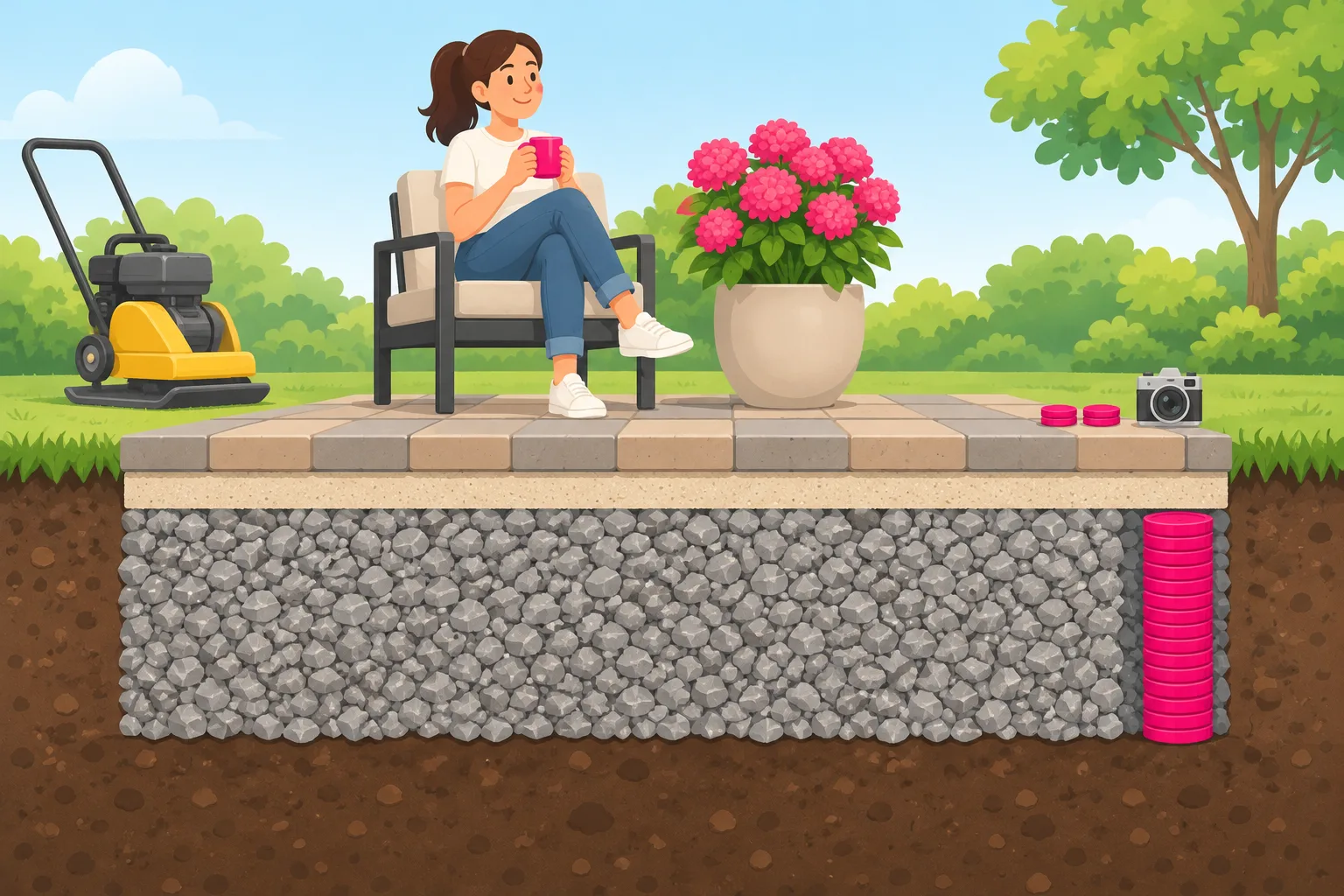
That is the most useful thing a price video can teach. The stone is what people see. The ground under it is what decides whether the patio stays flat. When one quote is much lower than another, the difference is often in the part nobody can see once the job is done.
Say this plainly, and without running down anyone else. You are not telling her a competitor is cutting corners. You are giving her a question she can ask all three companies: how deep is the base, and what is it made of?
A price video has four parts:
- The total, in the first five seconds.
- The size and what was included.
- Where the money went, in three or four pieces.
- The two or three things that would make the same patio cost more or less.
For the example company, the things that move the price are size, how easily a machine can reach the backyard, and walls or steps. Say yours. Then say the range most of your projects fall in. For this company it is $8,000 to $20,000.
One rule: only use a real project's price with that owner's permission. Some people do not want the neighbors to know what they spent.
6. Six Questions to Answer on Camera
Every site visit brings the same questions. Each one is a video. Answer it once on camera, in the place where the answer is, and you can send that video to every homeowner who asks again.
- "Do I need a permit?" It depends on the town and the project. A ground-level patio often does not need one. Taller retaining walls often do, and may need an engineer. Say that you check with the town for every job, and who pulls the permit.
- "Where does the water go?" Film this with a level on a finished patio. Show the slight tilt away from the house and where the water ends up.
- "How long will it take?" Give the real number and say what changes it. "About three weeks. Rain adds days. We tell you by seven in the morning if we are not coming."
- "Will the crew be here every day?" This is the question behind a lot of bad reviews in the trade. If you finish one job before starting the next, say so. It is a strong selling point.
- "What about my sprinkler lines?" In the United States, calling 811 before digging gets the public utility lines marked for free. It does not mark private lines such as sprinklers, yard lighting or a buried dog fence. Explain how you find those and what happens if one is cut.
- "What will happen to my lawn?" Show the boards or mats the machines drive on and what the path looks like after you repair it.
Keep each answer under a minute. Start with the question in the homeowner's words. Give the answer in the first sentence and the reason after it.
Rules on permits, licenses and deposits differ from place to place. Say what applies where you work, and check with your town or state if you are not sure. Do not present your local rule as true everywhere.
For more question ideas, the landscaping content ideas list has ten written for the mowing side. Most can be adapted.
7. The One-Year-Later Visit
Every patio looks good on the day it is finished. The homeowner's real question is what it looks like after a winter. Very few companies show that. It may be the most convincing video you can make.
Go back to a project a year after you built it. Ask the owner first. Film three things.
- The surface. Lay a long level or a straight board across the patio and show that it is still flat.
- The edges and joints. Show that the border has not spread and the joints are still full.
- Whatever was not perfect. If something needed fixing, show it and show the fix.
The third one matters most. Suppose two pavers near a downspout settled a little, and the crew lifted and reset them in twenty minutes at no charge. Saying so does not hurt you. It shows what your promise looks like in practice.
This video also gives you a reason to visit a past customer. That visit is often when she mentions the walkway she has been thinking about, or the friend who asked who built the patio.
8. The Honest Week
Outdoor building does not always go to plan. A homeowner knows this. What she wants to know is how you behave when it does not.
Take a week when it rained for nine days with a patio dug out and waiting. That is a real problem: a hole full of water, a schedule slipping, and the next customer waiting to start.
Make one short video about it. Say what happened, what you did about it, and what you told the people affected.
An honest-week script
"It has rained for nine days. This patio was dug out when it started. We covered it, pumped it out twice, and we will not put the base in until the ground is dry, because a base on wet ground does not hold. The owners got a text from me every morning. The next project starts a week late, and that family already knows."
Three rules keep this kind of video safe.
- It is about your work, never about a customer. No stories about difficult clients, late payments or changed minds.
- It does not ask for sympathy or for business. Say it and stop.
- It is rare. Once or twice a season. An account full of problems tells a different story.
9. Permission: The Homeowner, the Neighbor, the Plan and the Drone
A mowing crew is in a yard for about twenty minutes. You are there for three weeks, right behind the house, with a camera. Permission matters more here, and it has more parts.
The homeowner
Ask before the project starts, in writing. The simplest way is a short section in the contract with a box to tick. It should say five things:
- What you will film. The yard, the work and the finished project.
- What you will never show. Faces, children, the house number, the street, and the inside of the house.
- That she sees the reveal first. She watches the final video before it is posted and can ask for changes.
- Whether you may say the price. A separate yes or no.
- That she can change her mind. One text, and the videos come down.
Paid promotion needs its own yes. Agreeing to a regular post is not agreeing to appear in an ad. Ask again, later, for the specific video you want to promote.
A patio sits against the back of the house, so a glass door or a kitchen window is in almost every shot. Ask the owner to close the blinds on filming days, or choose an angle that looks away from the house. The filming guide has sample wording for the permission line. Its address rule applies in full.
The neighbor
The people next door live with three weeks of trucks, noise and dust that they did not ask for. They are also the most likely next customer. Treat them well for both reasons.
- Before day one, knock on the doors on both sides. Leave a card with the dates, the working hours and your phone number.
- Never film their yard, their house or them. Choose angles where their property is out of the frame.
- Keep the street clear and sweep it at the end of every day.
The plan
The design is your work, and showing it is good marketing. But a plan drawing can identify a home. Before it appears on camera, remove the address, the owner's name and anything that shows where the lot is. A view of the patio layout alone is enough.
The crew
The people building the patio will be on camera more than anyone. Get their agreement in writing too, and let anyone who prefers to stay off camera do so. The filming guide has a one-page crew agreement you can adapt.
The drone
An overhead shot of a finished patio is tempting, and it does look good. In the United States, flying a drone for any business purpose requires an FAA remote pilot certificate, even if nobody paid for the flight. A video on a company account counts.
A drone also sees over fences into the neighbors' yards. Get the certificate first, and frame the shot so only the project is in it. Or skip the drone and film from an upstairs window with the owner's permission. The drone section of the filming guide has the details.
10. The Calendar: Sell in January, Build in May
Here is the trap in this business. You have the most to film when you have the least time to post, and homeowners are most ready to plan when you have nothing new to film.
The answer is to split the two jobs. Film in the build season. Post in the planning season.
- May to October: film. Record one project series a month. Post the parts as they happen if you can, but the filming is what matters. Save everything.
- November and December: look back. Post the one-year-later visits and the best reveals of the season. Ask this year's customers for permission to use their prices.
- January to March: sell. This is when next spring's projects are planned. Post the price video, the design walk-throughs, the question videos and the full project series again, one part every few days.
- April: say what is left. "May and June are full. We are booking July." A full calendar said out loud is good advertising. It also tells late planners the honest wait.
Many homeowners only start looking in late spring, when they want to use the yard. Those homeowners are real, and you should answer them. But most of them will be building in midsummer or later. The homeowner who gets a May start is usually the one who started watching in the fall.
Two or three posts a week is plenty. In the build season, one of them can simply be the next part of the current project. If you miss a week in June, nothing is lost. A silent February costs more.
11. From a View to a Site Visit
A video does not sell a patio. It earns a site visit. What happens between the video and the visit decides whether the right people ask.
The profile
Four lines and one link:
- What you build: patios, walkways, retaining walls.
- How far you travel, described by area or drive time.
- That you are licensed and insured, if both are true.
- What you are booking now: "Booking July and August builds."
Pin three videos at the top: one reveal, the price video and the one-year-later visit.
The page behind the link
The link should go to one page that helps a homeowner decide whether to ask you out. In this order:
- Three finished projects with real prices. A small one, a typical one and a large one. Each with its size, what was included and what it cost.
- The range and what moves it. "Most of our projects are between $8,000 and $20,000. Size, machine access and walls change the price most."
- How it works, in five steps. Photos, site visit, design, contract, build. Say how long each one takes.
- What the site visit and design cost. If the visit is free, say so. If you charge for a design and credit it toward the build, say that.
- The easy first step. "Send three photos of your yard and a rough size. We will send you a price range within a day."
- "How did you find us?" One field on the form. It is how you will know whether the videos are working.
The photos-first step protects your time. A site visit can take two hours with the drive. A price range by text takes ten minutes, and it filters out the homeowner whose budget is far from the real number before either of you spends an afternoon. The guide to getting lawn care customers covers the same page for a mowing company.
The reply to save
The most common comment will be "how much is a patio like that?" Answering "it depends" and nothing else ends the conversation. Save a reply like this one in your phone:
Reply to "how much is a patio?"
"That one is about 400 square feet with a seat wall, and it was about $12,000. Most of our patios land between $8,000 and $20,000. Size, how easily we can get a machine into the yard, and walls move it most. Send me three photos of your yard and a rough size, and I will send you a range by tomorrow."
Other contractors will also comment, usually asking about your compactor or your paver brand. Answer them kindly and briefly. They are not your customers, and a comment section full of trade talk tells TikTok to show your videos to more contractors.
12. The Neighbor Who Watched for Three Weeks
Your best advertisement is not online. It is a job site that the whole street walks past for three weeks.
The neighbors see whether the crew arrives every morning. They see whether the street is swept. They see the finished patio over the fence. By the end, the people next door know more about how you work than any video could tell them.
Four small habits turn that into the next project.
- The card before day one. The one from section 9. It makes the first contact a polite one.
- A small sign, with the owner's permission. Company name and how to find your videos. Take it down when the job ends, unless she offers to keep it up.
- A thank-you on the last day. Knock again, thank the neighbors for their patience, and leave it there. No pitch.
- A link the owner can share. Send her the reveal video. When a friend asks who built the patio, she has something to forward.
A thank-you gift to a customer who sent you a referral is a kind thing to do after the fact. Do not offer anything in exchange for a review. In the United States, paying for reviews or offering rewards for positive ones can break federal rules on reviews.
Mowing companies are the other source of referrals. A lawn care owner like Luis is in hundreds of yards a year and gets asked about patios he does not build. Introduce yourself to two or three of them. Send their customers back to them when the job is done.
13. The Four Numbers to Track
With fewer than ten projects a year, view counts and follower counts tell you very little. One video with four hundred views can bring the homeowner who signs. Count these four things instead, once a month.
- Requests that mention a video. From the "how did you find us?" field. This is the clearest sign that the account is doing its job.
- Site visits that became signed projects. If homeowners who found you through video sign more often than others, the videos are doing some of the selling before you arrive.
- Weeks booked ahead. How far out is your next open start date? In March, this is the number that tells you whether winter worked.
- Projects from a neighbor or a referral. Count the jobs that came from someone who saw or heard about a past project.
Write them as one sentence each month. For example: "Five requests mentioned a video, two became site visits, one signed for June, and we are booked nine weeks out."
Be patient with these numbers. With so few projects, one month means little. Compare this winter with last winter. For the earlier signs, such as saves and sends, see the growth guide's section on signals.
14. When Paying to Promote a Video Is Worth It
Paid promotion shows a video to more people. It does not shorten a decision that takes months, and it does not fix a page with no prices on it. Get the videos and the page right first.
Promotion starts to make sense when three things are true:
- A video has already brought a request on its own.
- Your page shows real prices and an easy first step.
- You have open start dates and know which months.
Then five rules for a build company:
- Promote for followers, not instant requests. Almost nobody asks for a $12,000 quote seconds after seeing a company for the first time. A follower who watches three project series over the winter is the one who sends photos in February.
- Promote the proven video. Usually a reveal, the price video or the one-year-later visit.
- Keep the area close to where you work. Aim at your service area as closely as the ad tools allow. They cannot always match a thirty-minute drive, so expect some reach outside it.
- Spend in the planning season. Late fall through March. Spending in May mostly reaches people you cannot fit in until later.
- Change the message when you are full. If the season is booked, pause, or promote a video that says which months are open.
The math is different from a mowing route. One signed project is worth about $12,000 in this example, so a promotion budget only has to help with one or two decisions a year to pay for itself. It is also harder to prove, because months pass between the ad and the contract. That is why the "how did you find us?" field matters so much.
Three cautions. A promoted before-and-after must be honest: your own work, the same yard, no editing that changes how it looks. A promoted video from a customer's yard needs her separate yes. And a promoted drone shot is a public record that you flew for business.
This is where our TikTok promotion service fits. Viryze takes a video you choose, tests it with different audiences, and moves the budget toward whichever one is bringing followers for the least money. It is built for owners who would rather be on the job site than in an ads dashboard. It does not replace the steps above. It brings more people to them.
The main guide's promotion section has the full rules for promoted videos. For the mechanics of promoting a post you have already published, see the Spark Ads guide. For how other one-job trades handle the same pipeline, see the TikTok guide for contractors.
Frequently Asked Questions
Does TikTok work for hardscape and design-build landscaping companies?
It can, and it works differently than it does for a mowing company. A patio or a retaining wall is a large purchase that most homeowners think about for months. Video suits that kind of decision because it lets a homeowner watch how you dig, build the base and finish the job before she ever calls. Expect it to work slowly. The goal is to be the company a local homeowner has already been watching when she is finally ready to ask for a price.
What should a hardscape company post on TikTok?
Post the things a homeowner cannot see from a finished photo. Show one project from the first day of digging to the finished patio, in several short videos. Walk through a design in the yard where it will be built. Explain one real price and what it pays for. Answer the common questions about permits, drainage, timing and sprinkler lines. Go back to a job a year later and show how it held up. A finished-patio photo shows what you built. These videos show how you work.
Should a hardscape company say prices in its videos?
Yes, as one real example and an honest range. Every yard is different, so you cannot price a project in a video. You can say what one finished project cost, how big it was, and what was included. Then give the range most of your projects fall in and the two or three things that move the price. A homeowner who knows the rough number before she calls is a better use of your site-visit time than one who does not.
When should a design-build company post and promote its videos?
All year, with the most effort in winter. Many homeowners start searching for a landscaping company in late spring, when they want to use the yard. By then a busy company is often booked for weeks or months. The projects built in May are usually planned and signed between January and March. Film during the build season, and post the project series, the price explainer and the design walk-through during the planning season.
Do I need permission to film a customer's patio project?
Yes. Ask in writing before the project starts, and make it part of the contract. Say what you will film, such as the yard and the work, and what you will never show, such as faces, children, the house number or the inside of the home. Agree that the homeowner sees the final video before it is posted. Ask again, separately, before you pay to promote a video from her yard. Let her change her mind at any time.
How long does it take for TikTok to bring in a patio or hardscape job?
Usually months. A homeowner may follow a company in the fall, ask for a price in January, and have the patio built in May. That is normal for a purchase this size. Judge the first year by smaller signs: requests for a site visit that mention a video, and homeowners who arrive already knowing your price range and how you work. If you need projects on the calendar next month, a paid lead service or a search ad is faster.
Videos working and start dates still open?
If your page shows real prices and one of your project videos has already brought a request, the next step is more of the right viewers during the planning season. Viryze can put that video in front of more people, test which audience responds, and shift the budget to what is working - so more viewers become followers and, in time, homeowners who ask you out to the yard.
Related Reading
- TikTok for Landscapers and Lawn Care Companies: The Complete 2026 Guide - the full strategy and the rules behind this guide.
- How to Film Landscaping Videos for TikTok (The Yes-Card Yard, the Address Rule, the Kids, the Crew & the Drone) - written permission and what never goes on camera.
- How Landscapers Make Money on TikTok: The Route Math, the Install, the Equipment Deal, and the Course - how installs and mowing routes send work to each other.
- Getting Lawn Care Customers: Turn TikTok Views Into Route Stops and Renewals - the quote page and the saved replies for the mowing side.
- Landscaping TikTok Content Ideas: 50+ Video Concepts That Fill the Route - 52 ideas, many of which adapt to a build company.
- Growing a Landscaping TikTok: From 0 to 10K Followers in the Right Two Towns - how to grow a local following from zero.
- TikTok for Contractors & Home Service Pros: The Complete 2026 Guide - the same approach for remodelers and other one-job trades.
- How to Film Job-Site Videos for TikTok (Phone, Framing & Timelapse) - time-lapse and phone setup on a working site.