
Landscaping & Lawn Care11 min read
Growing a Landscaping TikTok: From 0 to 10K Followers in the Right Two Towns
The 90-day landscaping marketing plan for TikTok, written for lawn care and landscaping companies that sell a weekly spot on a route: why followers three towns over do not fill a Thursday, the two scoreboards (the homeowner and the feed), the profile line that says which side of town you mow on which day, the pinned visit and the quote page with the price said out loud, the late-January start that lands day 90 on the first cut of spring, the five series that compound, the three-hours-a-week role that survives the spring rush, the growth signals that predict new stops (sends to the street group chat, quote requests that mention a video, renewals), honest milestones from 0 to 10K, the seven plateaus every lawn account hits, and when paying to promote a proven video is arithmetic instead of hope.
By Ryan MitchellHead of Creator Success at Viryze

Most landscaping marketing advice measures success in reach: more views, more followers, more people who have heard of you. A lawn care company is one of the few businesses where that number can go up for a year while the business stays exactly the same size.
The reason is the route. You do not sell cuts. You sell a weekly spot on a day the truck is already in the neighborhood, and a follower who lives three towns over cannot buy one. A thousand of them is the same Thursday you had last year.
So this guide measures growth differently. The goal is followers who live on the streets you already drive, counted in stops, not in views. "0 to 10K" is the headline because that is what people search for. The real target is smaller and worth more: a few hundred neighbors who have watched you work and know what it costs.
Below is the 90-day plan to get there, the handful of numbers that tell you it is working, the role that keeps the account alive through the spring rush, and the point where paying to promote a video starts to make sense. It builds on our complete TikTok guide for landscapers and lawn care companies. If you have not read that yet, start there for the overall strategy and the rules, then come back here for the growth plan.
The honest summary:
- Measure against the route, not the count. If your Thursday needs twenty more stops, you need a few hundred followers in your own towns, not ten thousand everywhere.
- Pick your scoreboard before you post. A company that sells mowing counts quote requests, renewals and new stops near existing ones. A company that sells a course or works with an equipment brand counts follows, saves and sales. Most companies should fill the route first.
- Start in late January if you can. Day 90 then lands on the first cut of spring, and the account is already warm in March, when most homeowners choose a lawn company.
- Promote proof, not hope, and pause when the day is full. Put money only behind a video that has already brought quote requests, aim it at your service area, and stop it the day that side of town fills.
What's Inside
- 1. Why Landscaping Growth Is Different (the Route Is the Yardstick)
- 2. The Foundation: the Profile Line, the Pinned Three & the Quote Page
- 3. Days 1-30: Choose the Audience, Stay in One Lane & Keep a Question Log
- 4. Days 31-60: Five Series, a Small Cast & One Company Phone
- 5. Days 61-90: Make It Easy to Get a Price & Build Toward the First Cut
- 6. The Growth Signals That Actually Matter
- 7. Milestones: What Changes at 100, 500, 2K & 10K
- 8. The Role: Three Hours a Week and One Sentence a Month
- 9. The Seven Plateaus Every Lawn Account Hits
- 10. The Growth Mistakes That Stall Landscaping Accounts
- 11. Speeding It Up: Promote Proof, Not Hope
- Frequently Asked Questions
1. Why Landscaping Growth Is Different (the Route Is the Yardstick)
To keep this concrete, the whole guide follows one example company. Luis owns it. He has one truck, one trailer, a zero-turn mower, and a helper named Teo who runs the trimmer. They mow one side of town on Thursdays and the other side on Tuesdays.
A quarter-acre lawn is $55 a cut, weekly, and takes the two of them about twenty-three minutes. His Thursday has thirty-eight stops. It needs sixty to be a full day. Your numbers will be different, but the shape is probably the same: a route with room on it.
That shape changes four things about how you grow.
- Your target is small and exact. Luis does not need an audience. He needs twenty-two more Thursday stops. A stop is worth more than $1,600 a season (about thirty cuts at $55) and tends to stay for years, so twenty-two of them is a different business. Almost no other kind of account can name its finish line this precisely.
- Where a follower lives matters more than how many there are. A new stop three doors from an existing one costs almost nothing to serve. A new stop twenty minutes across town costs a truck and two people every week. A follower outside your towns is not a weaker lead. For a mowing route, they are not a lead at all.
- You have two possible audiences, and they want different videos. One is the homeowner in your towns, who wants to know if you will show up and what it costs. The other is the national audience that loves watching a lawn get striped. The second one is far bigger and buys only things that ship: a course, a hat, the blades you recommend. The main guide's section on the two audiences covers both in detail.
- The decision happens once a year. Most homeowners pick a lawn company in late winter and do not think about it again until the next one. Growth in June does not fill June. It fills next March. That is why the timing of this plan matters as much as the content.
There is a trap on the other side of this, and it is worth naming early. Picture a lawn account with a million followers, a striping video with three million views, comments full of other lawn guys asking about the mower - and the same thirty-eight stops on Thursday. Nothing went wrong with the videos. They never said which town, never said the price, and never showed a homeowner what a visit looks like.
So hold one yardstick through everything below: followers in your towns, measured against open spots on your route.
2. The Foundation: the Profile Line, the Pinned Three & the Quote Page
A viewer becomes a follower in one place: your profile. They finish a video, tap your name, and decide in a few seconds. Set up four things before you post anything.
- The "which side of town" line. Your bio should tell a neighbor that you are theirs. Luis's reads: "Weekly mowing, cleanups and mulch. This side of town Thursdays, the other side Tuesdays. Licensed and insured. You don't have to be home." With the real town names in it, that line does three jobs. It tells the viewer you serve their street, it tells them which day, and it answers the most common worry. "Premium lawn care solutions" does none of them.
- A face, not a logo. People follow a person they would trust in their yard. Use a photo of whoever appears in the videos, and put the company name in the bio.
- The pinned three. Pin one full visit (the truck at the curb, the gate latched, the mow, the trim, the edge, the walk blown clean, and the time and price said at the end). Pin one price explainer ("why a quarter-acre lawn here is fifty-five dollars a cut"). Pin one answered question ("do I have to be home?"). The visit does most of the work, because it answers the question every homeowner is really asking: will they show up, and what happens when they do?
- The quote page, one tap away. The link in your bio should open a single page with the weekly price for a typical yard, what makes that number go up or down (size, slope, a fence, every-other-week service), the towns you serve, your face, and one line: "text a photo of your yard and get a number within the hour." Add a "how did you find us?" field. You will need it in section 6.
One note on the price. Many owners leave it off because every yard is different. That is true, and it is also why the homeowner is nervous. A real number for a typical yard, plus the two or three things that change it, is more honest than "it depends" and far more useful than a "starting at" price nobody actually pays.
3. Days 1-30: Choose the Audience, Stay in One Lane & Keep a Question Log
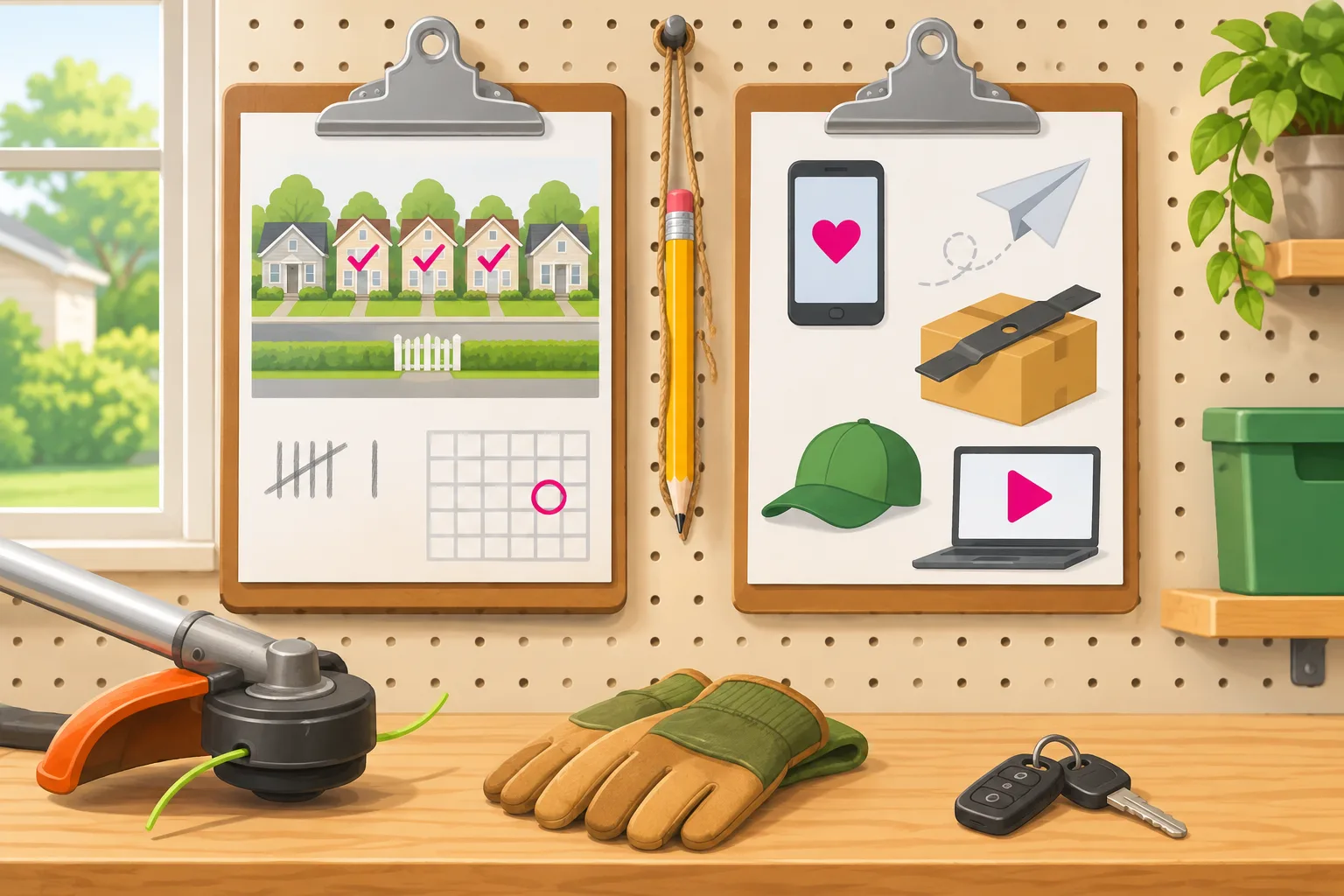
A scheduling note first. If you can choose when to start, start in late January. Month one is quiet, so you build the profile and post from last season's footage. Month two is late February and March, when homeowners are choosing. Month three ends at the first cut of spring, when there is more to film than you can post.
The plan works from any start date. The FAQ covers what to do if it is fall or already April.
The first month has three jobs, and going viral is not one of them.
Choose the audience, in writing. Write one line at the top of a note on the company phone: "This year the account is for homeowners in our two towns." Or, if you already sell a course or have an equipment partnership, "this year it is for the national lawn care audience." If the honest answer is both, write the order. For most companies it is the route first. If you do not choose, the platform chooses for you, and it will choose the national audience, because a striping video travels and a price explainer does not.
Stay in one lane. TikTok learns who to show you to from your first fifteen or twenty videos. If those are all transformations with no town in them, it files you under "satisfying lawn videos" and shows you to people who like those everywhere. That is hard to undo later. So a route-first account makes month one deliberately local: the visit, the price explainer, answered questions, and a short clip of a finished lawn from the street, each with the town said out loud. The videos that travel nationally come in month two, once the account is anchored. Our algorithm guide explains why those early videos carry so much weight.
Keep a question log. Every question a homeowner asks goes into a running note, in their words: the quote request, the text the night before the first visit, the "wait, do you..." comment. Each one is a video people have already asked for. Open the video with the question exactly as it was asked, then answer it where the answer is: the gate question at a gate, the clippings question at the mower deck. The content ideas guide shows how the log and the route together produce more ideas than you can film.
The month-one routine:
- Post three times a week, 30 to 60 seconds each. Tuesday, Thursday and Saturday works well: one for the homeowner, one for the wider audience, one finished lawn or countdown. Plan the schedule for your worst week, not your best.
- Film on the route, at the yards that said yes. The footage already exists every Thursday. Film only at the yards whose owners agreed in writing, with the phone pointed down the lawn and never at the house. The filming guide's section on written permission has the exact wording, and its route-day capture list shows what twenty minutes of filming produces.
- Say the town and the day out loud. Once per homeowner video, in words, not only in a hashtag: "Thursday route, this side of town." Local viewers tend to watch longer when a video is clearly about where they live, and the platform notices who stays. Say the town, never the street or the house number.
- Open on the yard, never the customer. "Twenty-three minutes, start to finish, and here is where every one of them goes" grows a local account. A clip mocking a customer who wanted it cheaper grows an audience of other lawn companies and tells every homeowner watching that she could be next. The main guide's hook section has five opening lines that work.
- Reply to every comment, daily. Ten minutes. "How much?" gets the price for a typical yard and the link. "Are you taking new customers?" gets a yes or no and the day that has room.
- Judge nothing before day 30. Early videos swing wildly while the platform tests them on different viewers. You need twelve or more posts before the pattern is readable.
4. Days 31-60: Five Series, a Small Cast & One Company Phone
By day 30 you have a dozen or more videos and a first look at what your towns respond to. Month two turns the winners into series. A single video gets a view. A series gets a habit, and the habit is what a homeowner is following when she finally needs a lawn company.
Sort your month-one videos by who they reached, not by views. Which ones brought a click on the quote page or a message from someone local? Those become your main series. Which ones traveled far? Those become your secondary series. A route-first account gives the local series two of its three weekly slots.
These are the five series most lawn accounts end up running. Luis's names are in quotes. Use your own.
- "Thursday route" - one full visit, cut to about forty seconds, with the time and the price said at the end. This is the series that turns viewers into quote requests. Film a new one each spring.
- "What it costs" - one price explained per episode, filmed in a driveway with the trailer behind you: the weekly cut, the spring cleanup (about $350 for Luis), the mulch install, aeration and overseeding. This is the one people save and send to a spouse.
- "Do I have to be home?" - one question from the log, answered where the answer is. The dog and the gate. Rain weeks. Bagging or mulching the clippings. What you spray, including "we don't, and here is who we send people to."
- "Teo's edge" - the craft series: the trim around the maple, the edge along the walk, the stripes appearing. This is the one that travels, which is exactly why it names the town in the first line.
- "First cut of spring" - the countdown series: twelve seconds of a finished lawn from the street, "fall cleanups start when the maple turns," "first cut is the week of the fifteenth." This is the one a customer forwards when a neighbor asks who does her lawn.
The cast. Accounts that grow have recurring people, and yours is small: the owner, and a helper who has agreed in writing to be on camera. Customers are never in the cast. Neither are their kids, their neighbors or their house numbers. Two familiar people on camera for a year will do more for you than fifty customers who never agreed to be filmed. The filming guide's crew agreement covers what the helper's one-page yearly agreement should say.
One company phone. Month two is where many accounts quietly stop. The footage is on three phones, nobody is sure who posts, and every clip waits for an opinion. The fix is one page. One person owns the company phone and posts routine videos without asking. One other person looks at anything with a price, a neighbor's property, a customer's words or a hard week in it, and answers within a day. Nobody else approves anything. The nine-line truck card in the filming guide is a ready-made version.
Keep your personal account separate. Mower reviews, "how I priced my route" and advice for other owners belong on the owner's own account. The company account stays about yards in your towns. Mixing the two is how a route-first account turns into an equipment channel by accident.
The first "I saw your video." Somewhere in this stretch a quote request will mention TikTok. Write down the date. It is the first entry in the count that section 6 is built on.
5. Days 61-90: Make It Easy to Get a Price & Build Toward the First Cut
By day 60 people are watching. The question now is whether watching turns into a stop, and whether the stop is still yours next year.
Work backward from the next window. The landscaping year has a few short selling windows, and each one is sold in the weeks before it. The route is sold in late February and March. Fall work (aeration, overseeding, leaf cleanup) is sold in August. Renewals are asked for in the last week of the season. Find the nearest window and count back four to six weeks. That is when its videos go up. The main guide's calendar section lays out the whole year, and the ideas guide's timing section matches specific videos to each month.
Make it easy to get a price. Read your quote page as a stranger would. Is the weekly price the biggest thing on it? Are the towns named? Can she text a photo and get a number? Then answer every request within the hour. A homeowner collecting three quotes often goes with the first company that gave her a clear number and a day.
Deliver the visit exactly as filmed. If the video shows a text before the gate opens, the gate latched behind you and a photo of the finished lawn sent from the driveway, the first real visit has to include all three. The video is a promise. Keeping it every week is what earns the renewal.
Say it when a day fills. "Thursday on this side of town is full. Tuesday has four spots." Many owners go quiet when the route fills. Saying it out loud is the strongest ad a lawn company has, and it points the next homeowner at the day you still need.
Film next year's videos this year. The first-cut footage you shoot in April is February's countdown video. June's stripes are August's "this is what aeration buys you." The quiet months are when homeowners decide, and you can only show them a green lawn in February if you filmed it in June.
By day 90, a healthy route-first account has a few hundred followers (sometimes more), a quote link that gets clicked every week, a few quote requests a month that mention a video, and - the real milestone - a new stop within three doors of one you already had.
6. The Growth Signals That Actually Matter
Views tell you a video was shown. They do not tell you whether anyone in your towns is closer to hiring you. These signals do, roughly in order from earliest to most important.
- Saves on the price explainer and the visit. A save usually means "I'll need this later." For a lawn company, later is next spring.
- Sends. A send is a homeowner forwarding your video to a spouse or to the neighborhood group chat when someone asks "who does your lawn?" A lawn company is usually chosen by one household and recommended to several. Sends are that happening.
- Profile visits and clicks on the quote link. Count the clicks weekly. This is the first number that belongs on your scoreboard.
- Quote requests that mention a video. This is what the "how did you find us?" field is for. Count them monthly.
- New stops within three doors of an existing one. The most profitable growth a route can have, and proof that the neighbors are watching.
- Renewals, when asked. In the last week of the season, message every customer: "Your Thursday spot is yours for next year until the fifteenth of February. Want to keep it?" Count the yeses. In November this is the growth number that matters most, because every renewed stop is one you do not have to win again in April.
How to tell where your followers live. TikTok's analytics show where your followers are, but usually not in fine enough detail to separate your two towns from the rest of the region. So read the map the route way: look at the addresses on your quote requests. If most come from your towns, the account is pointed correctly. If they come from an hour away, or the messages are from other lawn companies, your recent videos have been made for the wider audience.
Those four numbers - quote-page clicks each week, quote requests each month that mention a video, renewals when asked, and new stops within three doors - are the whole scoreboard. They fit on an index card in the truck.
7. Milestones: What Changes at 100, 500, 2K & 10K
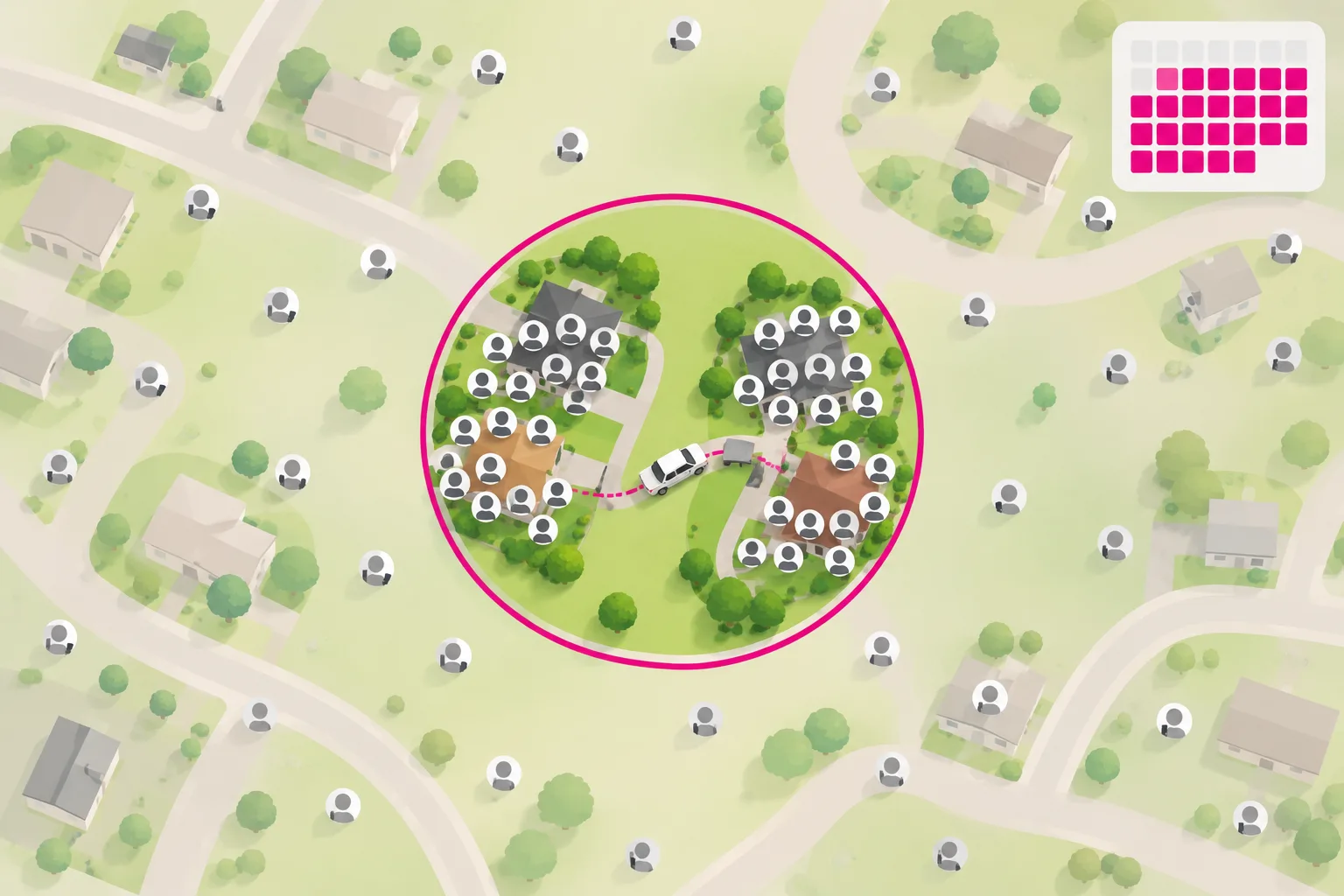
Growth is uneven, and each stage is useful for something different. These are rough expectations for a route-first account, not promises.
- 0 to 100: your own customers. The first hundred followers should be people you already mow for, and their neighbors. Tell every customer the account exists. They are the ones who will forward a video when the street asks who does their lawn, which makes them the most valuable followers you will ever have.
- 100 to 500: the first proof. Somewhere in here a quote request usually mentions a video for the first time. The account is small and already doing its job. For a one-truck company, this stage alone can add several stops in a season.
- 500 to 2,000: the series take hold. Viewers start asking for the next episode, the question log fills itself from the comments, and renewals get easier because customers have been watching you all year. This is also the stage where one promoted video in late February can do real work (section 11).
- 2,000 to 10,000: local recognition. In two or three towns, a few thousand local followers means people recognize the truck. For most mowing companies this is the ceiling of the local audience, and it is plenty. The route may be full well before you reach it. If so, the account's job changes to renewals, add-on services and hiring.
- Beyond 10,000: a different business. Past this point most new followers live somewhere else. That is worth pursuing if you sell something that ships. If you only sell mowing, a big number is fine to have and not worth chasing. A large account with the same thirty-eight stops is a warning sign, not a trophy.
Nobody should wait for a big number to call this working. The account is working the first time a neighbor of a current customer asks for a price.
8. The Role: Three Hours a Week and One Sentence a Month
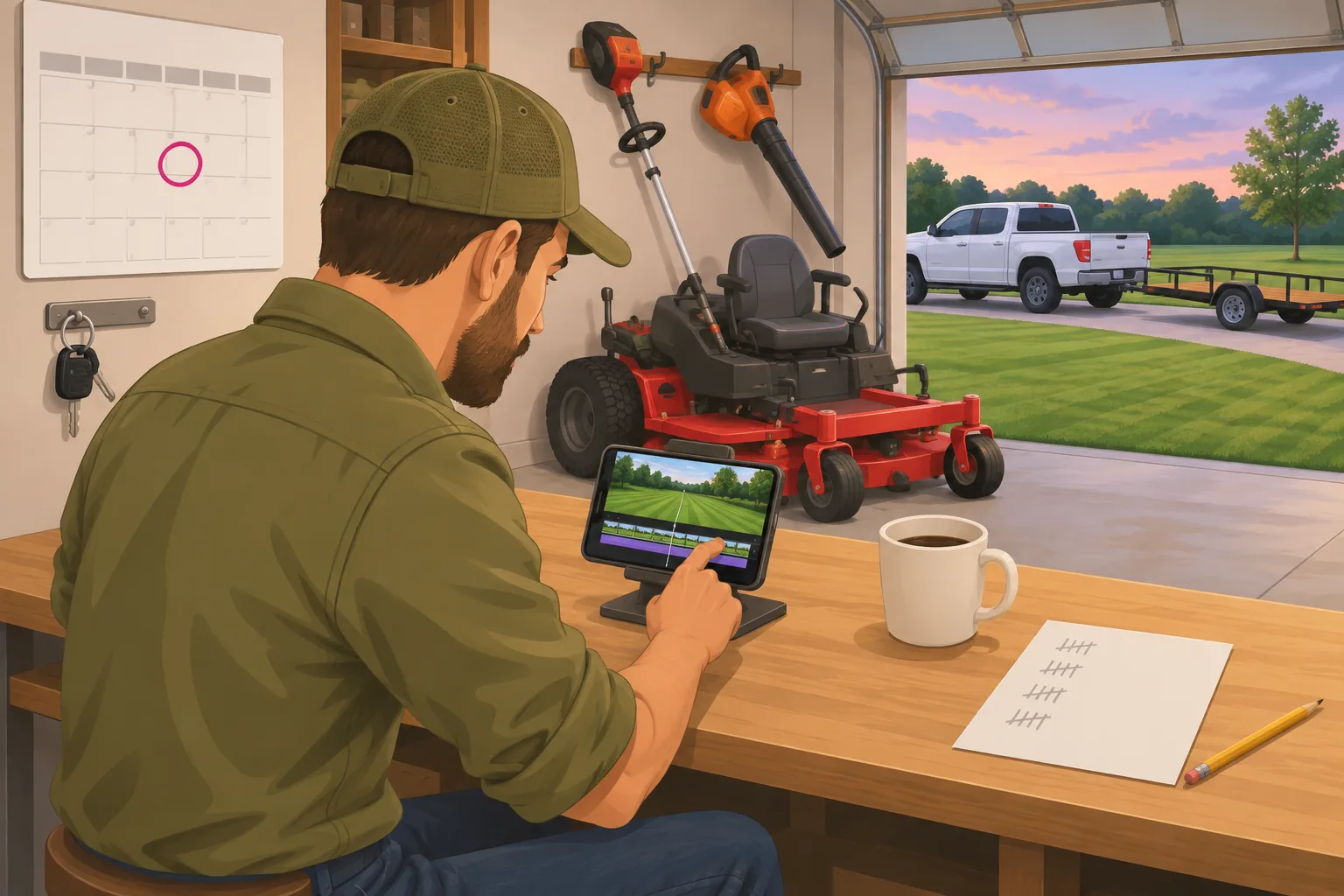
Most lawn accounts do not fail because the videos were bad. They stop in April, when the owner is on a mower from seven to five and posting becomes the first thing to drop. The fix is to treat the account as a small job with set hours.
For a one-truck company, the job is about three hours a week:
- Twenty minutes of filming on the route. The phone goes on the trailer gate before the mower comes off, at the yards that said yes. Nothing is staged.
- About an hour on Sunday night. Cut three videos from the week's footage and schedule them for Tuesday, Thursday and Saturday.
- Ten minutes a day. Reply to comments and answer quote messages.
- Half an hour a month. Count the four numbers from section 6.
Pay the hour. If the helper does the filming or the Sunday edit, that time is paid at the route rate. Filming at three yards adds a few minutes to Thursday, and that is route time too. An account that runs on favors lasts until the first busy week.
Write down who owns the account. Register it to a company email, with two people holding the login. Put in writing that the handle and the followers stay with the company if the person who posts moves on. By the second season the account may be worth more than the trailer, and it should not leave in someone's pocket.
Plan for rain and for the rush. A rain week that quiets the account is fine. Say so once. The first-cut week is for filming everything and posting short clips of finished lawns, not for posting daily. A silent February is the one gap that costs you, because that is when homeowners are choosing. The main guide's cadence section has the full schedule.
The sentence, counted in stops. Once a month, write one sentence for whoever shares the truck payment with you - a spouse, a partner, or just yourself. For Luis it might read: "This month the account brought nine quote requests that mentioned a video and four new Thursday stops, two of them within three doors of a yard we already mow." There is no follower count in that sentence. If you cannot write it yet, the next month's videos should be about the visit and the price.
9. The Seven Plateaus Every Lawn Account Hits
Every account stalls. In this business the stalls are predictable enough to plan for.
- The first-cut week. Every lawn needs you at once and posting stops. What to do: film everything, and post only the twelve-second clip of a finished lawn. Edit the rest in May.
- The rain week. No route, no footage, and Thursday moves to Friday or Monday. What to do: one honest video saying so, then one answered question you filmed earlier. Keep a few of those in reserve for exactly this.
- The full Thursday. The day fills, and the account keeps advertising it. Requests arrive that you have to turn down. What to do: say it is full, name the day that still has room, and point the next month's local videos at that side of town.
- The July heat. Lawns go brown, the work looks worse on camera, and nobody is choosing a lawn company. What to do: one honest video about what heat does to a lawn, then start selling fall work in August with the green footage you saved from June.
- The helper who quits. The person on camera, or the person who posted, leaves in June. What to do: this is why the account is registered to the company and the agreement is on paper. Take down his clips if he asks, say one kind sentence, and keep the schedule with the owner on camera until someone new agrees to be.
- The viral video. One transformation reaches a huge audience, and the temptation is to make ten more like it. Followers jump, quote requests do not. What to do: enjoy it, pin nothing new, and go back to the local series. If the wider audience keeps growing, decide on purpose whether you want to sell it something.
- The mower review. The comments fill with other owners asking about your equipment, and answering them feels like engagement. Each reply teaches the platform to show you to the trade. What to do: answer once, kindly, and point them to your personal account.
10. The Growth Mistakes That Stall Landscaping Accounts
- Never naming the towns. Without them, the platform cannot tell who your videos are for, and neither can a neighbor.
- Counting followers instead of stops. The count rewards the videos that travel, which are the ones least likely to fill a route.
- Hiding the price. "It depends" loses to the company that said a number, almost every time.
- Making content about customers. Complaints about cheap customers, neglected yards or the neighbor's bad stripes tell every homeowner how you will talk about her.
- Filming a yard without a written yes. It risks the customer, and it is not yours to post. The same goes for anyone's children, a neighbor's property and anything that shows an address. The main guide's rules section covers these, along with licensing and drone rules.
- Going silent in February. It is the quietest month on the route and the busiest month for decisions.
- Never asking for the renewal. A season of happy customers who were never asked to keep their spot means spending April winning back your own route.
11. Speeding It Up: Promote Proof, Not Hope
Run the plan for ninety days and one or two videos will clearly outperform the rest. People watch them to the end, save them, send them, and click through to the quote page. Those videos have passed the only test that matters: real homeowners watched and felt comfortable enough to ask for a price.
That is when paying to promote a video stops being a gamble. Putting money behind an untested video is hope. Putting it behind a proven one is arithmetic. Four rules keep it that way for a route business.
- Promote for followers, not for an instant quote. A stranger will not hand over a gate code seconds after first seeing your truck. A follower who watches the Thursday route for six weeks will text you in February.
- Keep the map tight. Aim the promotion at your service area, as closely as the ad tools allow. Ad platforms cannot always target a single small town, so expect some reach outside it and keep the area as small as you can. Do not target the whole metro area.
- Time it to the window. Late February and March for the route, August for fall work. Avoid the first warm weekend in April, when every lawn company is advertising at once.
- Pause when the day fills. A promoted video for a full Thursday buys requests you have to decline. Switch it to the side of town that still has room, or stop.
The math is worth doing against what you already pay for. Leads from online marketplaces often cost somewhere around ten to thirty dollars each for mowing, are usually sold to several companies at once, and close only some of the time. A weekly stop is worth more than $1,600 a season and can stay for three or four seasons. A promoted video that adds even a handful of stops near ones you already have compares well with that. Track it the same way you track everything else: in stops.
That is the idea behind our TikTok promotion service: Viryze promotes videos that have already earned it, tests them against different audiences, and moves the budget toward whichever one is bringing followers for the least money. You choose the video. Whatever tool you use, keep the area as close to your route as it allows. A few rules are stricter for a promoted video than for an ordinary post, including a separate yes from the customer whose yard is in it. The main guide's promotion section lists them.
For the mechanics of promoting a post you have already published, see the Spark Ads guide. For how local targeting works in general, see the local business TikTok marketing guide. And for the fundamentals underneath all of this, the ultimate TikTok growth guide covers what applies to every kind of account.
Frequently Asked Questions
How long does it take a landscaping TikTok account to grow?
It depends which audience you are counting. The national lawn care audience can show up quickly, because stripes, edges and overgrown-yard rescues are videos people already love to watch. The audience that fills a route grows more slowly, at the pace of your own towns. As a rough expectation, a company posting three times a week with the towns said out loud, the visit video pinned and a quote page one tap away can reach a few hundred followers in 60 to 90 days and hear the first "I saw your video" on a quote request somewhere along the way. Measure it against the size of the route instead of the follower count: if Thursday needs twenty more stops, a few hundred followers who live on the streets you already drive is a full day.
How many TikTok followers does a lawn care company need?
Far fewer than most owners think, as long as they live where the truck goes. A route is a small thing. A one-truck company might need twenty or thirty more weekly stops to fill its week, so a few hundred local followers who have watched a full visit and know the price can be enough. The numbers worth tracking are clicks on the quote page each week, quote requests each month that mention a video, customers who renewed when asked, and new stops within three doors of one you already had. A very large following is only a good sign if you sell something that ships, like a course or an equipment partnership.
Why is my lawn care TikTok getting views but no customers?
The videos are working and none of them is pointed at a homeowner in your towns. Check four things in order. First, the place: say the towns and the route day out loud in the video and put them in the bio. Second, the fear: pin a full visit, from the truck at the curb to the gate latched behind you, with the time and the price said at the end, because the question under every quote that never happens is "will they show up, and what does it cost?" Third, the path: the link should open one page with the weekly price for a typical yard, what moves it, the towns you serve and a way to text a photo for a number. Fourth, the map: look at where your quote requests come from. If they come from other states or other lawn companies, your recent videos have been made for the trade, so give the visit, the price explainer and the drive-by the next six slots.
Who should run the TikTok for a landscaping company?
One named person who is already on the route, with the job written down. For most small companies that is the owner or the helper, at about three hours a week: twenty minutes of filming on the route at the yards whose owners agreed in writing, about an hour on Sunday night to cut and schedule three posts, ten minutes a day for comments and quote messages, and half an hour a month to count four numbers. If anyone other than the owner does it, pay the time at the route rate. Register the account to a company email with two logins, and write down that the handle and the followers stay with the company if that person leaves. Hire outside help only when you can state how many stops the account has added and the bottleneck is editing time.
When is the best time of year to start a landscaping TikTok?
Late January, so that day 90 lands near the first cut of spring. Month one builds the profile, the quote page and the first series from last season’s footage. Month two is late February and March, when most homeowners choose a lawn company and the account says which days still have room. Month three is the first cut, when you film everything. If it is fall, start now anyway: ask every customer to keep their spot for next year before the season ends, film the last cuts and the leaf cleanups, and save that footage for the winter. If it is already April, film everything, post the finished lawns, and build the full plan after the rush.
Should a lawn care company try to go viral?
Only if you sell something a person in another state can buy. A video that reaches millions of people is mostly watched by people who will never be on your route, and by other lawn companies asking which mower you run. That is a real audience if you sell a course, merchandise or a partnership with an equipment brand. If you sell weekly mowing in two towns, a video seen by two thousand of your neighbors is worth more than one seen by two million strangers. Post the videos that travel, but name the town in the first line so the local viewers know you are theirs.
Found the video your neighbors already trust?
The 90-day plan finds your best videos. Promotion decides how many more people see them. Viryze takes a video that has already proved itself, tests it against different audiences and shifts the budget to what is working, so the trust you have built reaches more people who could become followers - and, in time, stops on your route.
Related Reading
- TikTok for Landscapers and Lawn Care Companies: The Complete 2026 Guide - the full strategy and the rules this growth plan sits on.
- Landscaping TikTok Content Ideas: 50+ Video Concepts That Fill the Route - 52 ideas sorted by format, with the timing laid over the landscaping year.
- How to Film Landscaping Videos for TikTok (The Yes-Card Yard, the Address Rule, the Kids, the Crew & the Drone) - the kit, the written permission, the capture list and the truck card.
- Contractor Growth on TikTok: From 0 to 100K Followers - the growth plan for the one-job trades, where a wider audience helps more.
- Growing a Salon TikTok: From 0 to 10K Local Followers - another local business that grows on repeat customers.
- The Ultimate Guide to TikTok Growth in 2025 - the fundamentals that apply to every account.
- Understanding TikTok's Algorithm: What Really Matters - why your first twenty videos decide who sees the rest.
- Spark Ads on TikTok: Creator's Complete Guide - how to promote a post you have already published.