
Landscaping & Lawn Care13 min read
Getting Lawn Care Customers: Turn TikTok Views Into Route Stops and Renewals
A plain, step-by-step guide to how to get lawn care customers from TikTok: the three places a local lawn care or landscaping company loses people between a view and a weekly stop, the nine steps from a video to a renewal, what goes on the quote page and in what order, four replies written out word for word, the first visit, the text to send after the first cut, the renewal message that keeps the route full for next year, how to earn the neighbor three doors down, an honest comparison with paid lead sites, the four numbers to track, and when paying to promote a video is worth it.
By Ryan MitchellHead of Creator Success at Viryze
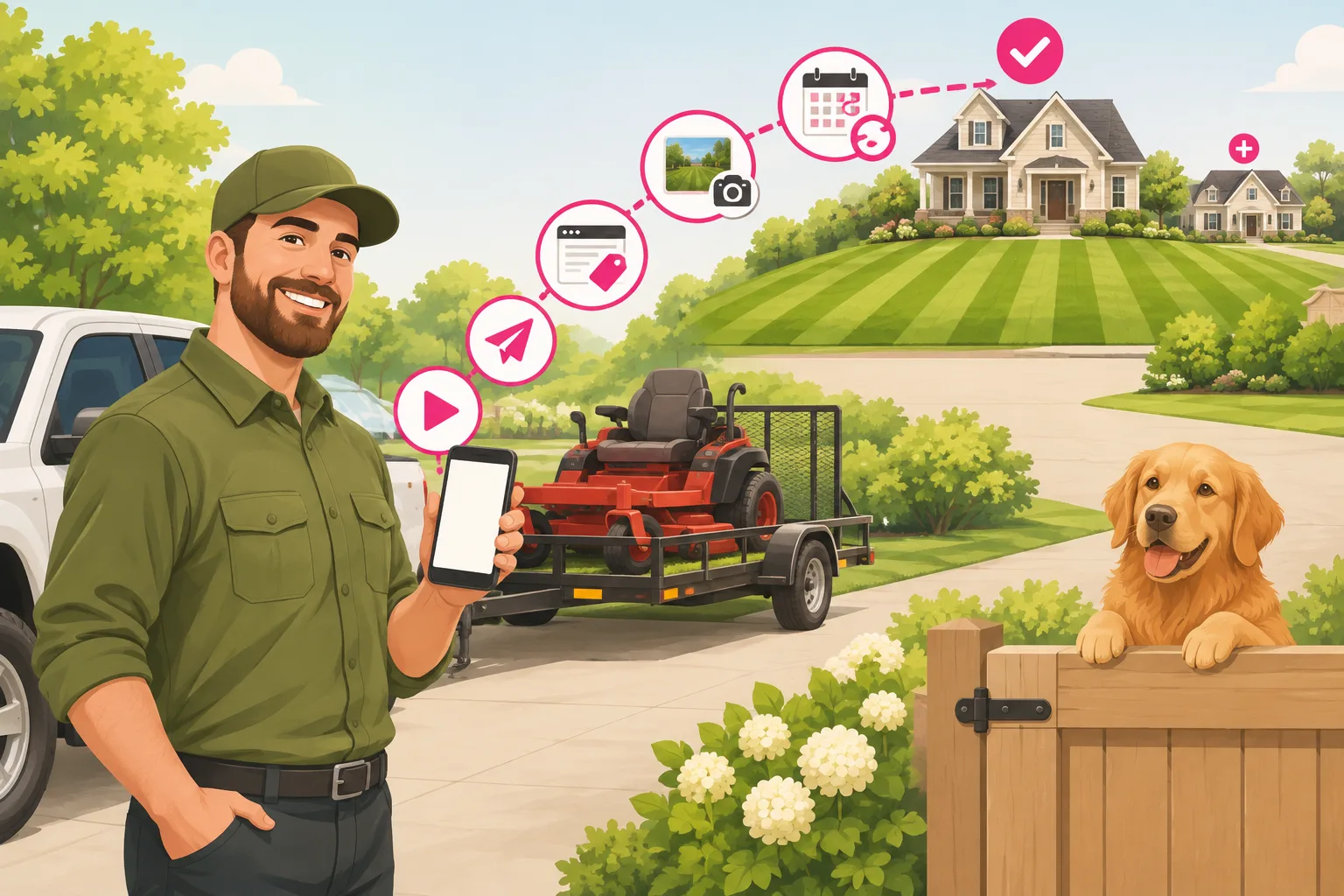
Most advice on how to get lawn care customers is about being seen: more flyers, more ads, more views. Being seen is the easy part. The hard part is everything that happens between someone seeing you and that person paying you every week.
A lawn care video can get ten thousand views and add nothing to the route. Usually the video is fine. What is missing is the next step: a price, a page, a fast answer, a first visit that matches what was shown, and a question in the fall about next year.
This guide walks through those steps in order. The short version: say the price, answer within the hour, do the visit the way you filmed it, and ask every customer to keep their spot before the snow.
It is one part of our complete TikTok guide for landscapers and lawn care companies, which covers what to post and the rules. This part starts after the video is up. The last section explains when paying to promote a video makes sense.
The honest summary:
- Views do not mow lawns. A view becomes a customer only if the next step is obvious and takes one tap.
- The price does most of the selling. The company that says a number beats the company that says "it depends."
- Speed beats polish. A plain answer within the hour wins more work than a perfect one tomorrow.
- The cheapest customer is the one you already have. One text in the fall keeps a stop you would otherwise have to win again in April.
What's Inside
- 1. The Three Places You Lose People
- 2. The Nine Steps From a View to a Neighbor
- 3. The Save and the Send
- 4. The Profile: Five Lines and One Link
- 5. The Quote Page, in Order
- 6. Four Replies to Save in Your Phone
- 7. Seven Messages That Mean Someone Is Ready
- 8. The Quote and the First Visit
- 9. The Text After the First Cut
- 10. The Season: Four Rules That Earn the Renewal
- 11. The Renewal Message
- 12. The Regular and the Neighbor
- 13. How This Compares With Paid Lead Sites
- 14. The Four Numbers to Track
- 15. When Paying to Promote a Video Is Worth It
- Frequently Asked Questions
1. The Three Places You Lose People
To keep this concrete, the guide follows one example company. Luis owns it. He has one truck, one trailer, a zero-turn mower, and a helper named Teo who runs the trimmer. They mow one side of town on Thursdays and the other side on Tuesdays.
A quarter-acre lawn is $55 a cut, every week, from April to November. His Thursday has thirty-eight stops and needs sixty to be a full day. Your prices and your route will be different. Swap in your own numbers as you read.
Between a video and a paying customer, people drop out in three places. Think of it as a hose with three leaks.
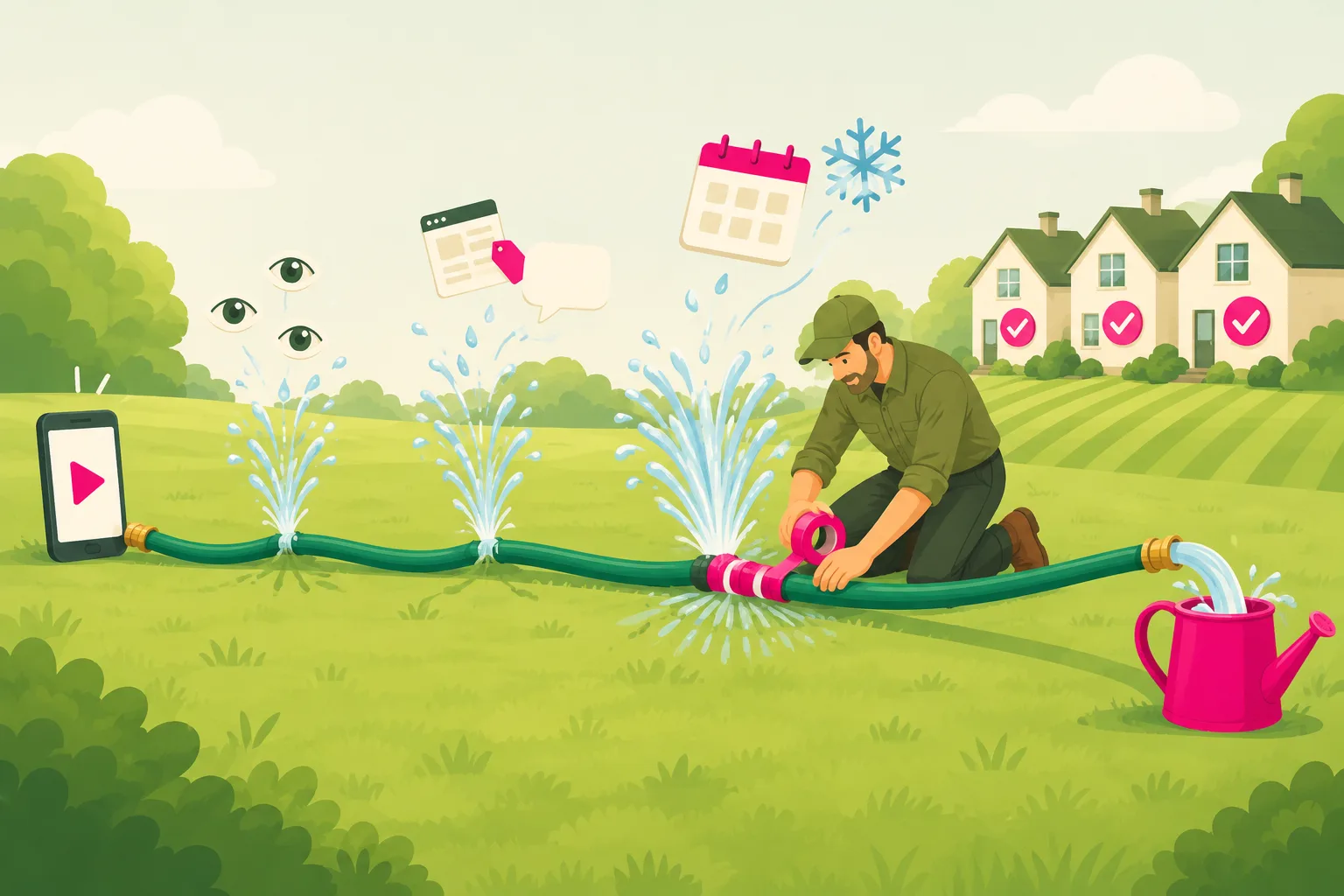
- Leak one: they saw it and never clicked. The video was good, but it did not say which towns you work in, what it costs, or what to do next. A homeowner two streets away watched it and kept scrolling, because nothing told her it was for her.
- Leak two: they clicked and never asked. She tapped your profile and found a phone number and a logo. Or she found a form with twelve fields. Or she asked "how much?" in a comment and got an answer two days later.
- Leak three: they had a season and never renewed. She was a happy customer from April to November. Nobody asked about next year. In March a door hanger from another company arrived first.
The third leak is the most expensive, and it is the one almost nobody looks at. You already paid to win that customer. You already know the gate, the dog and the slope by the driveway. Losing her costs a full season of income, and replacing her costs the same effort all over again.
So this guide fixes the leaks in the order a customer meets them, and spends the most time on the last one.
2. The Nine Steps From a View to a Neighbor
Here is the whole path. Each step has one job: get the person to the next step. If you know which step people stop at, you know what to fix.
- The view. A homeowner in your towns sees one of your videos.
- The follow. She wants to see more. She is not ready to hire anyone yet.
- The save and the send. She saves a video for later, or sends it to her husband or a neighbor. This is the first sign of a real decision.
- The profile. She taps your name to see who you are and where you work.
- The quote page. She taps your link and sees a price.
- The quote and the first visit. She asks for a number for her yard, gets it fast, and you show up on the day you said.
- The season. Thirty or so visits that go the way the video promised.
- The renewal. She keeps her spot for next year.
- The regular and the neighbor. She stops thinking about it, and the house three doors down asks who does her lawn.
The first two steps are covered in the growth guide. This guide starts at step three.
One thing to notice before going on. Steps one to five happen on a phone, and you are not there. Steps six to nine happen in a yard and in text messages, and you are. Most companies put all their effort into the phone half. Most of the money is in the other half.
3. The Save and the Send
Likes feel good and mean very little. For a local lawn company, two other actions matter more.
- A save means "next spring." She is not hiring today. She is keeping your video so she can find you when she is.
- A send means "what do you think?" She forwarded it to the other person who decides, or to the neighbors' group chat. Lawn care is often chosen by one household and then recommended up and down the street.
Three kinds of video earn saves and sends. You may already be making them.
- The visit. One stop from start to finish: the truck at the curb, the gate checked, the mow, the trim, the edge, the walk blown clean, the gate latched again. End with the time and the price. This is the video people send to a spouse.
- The price explainer. "Why a quarter-acre lawn here is fifty-five dollars a cut," said in a driveway. This is the video people save.
- The finished lawn from the street. Twelve seconds, no talking. This is what a customer forwards when a neighbor asks who does her lawn.
The content ideas guide has eight versions of the visit and several versions of the finished-lawn clip.
Close leak one with one sentence. End every one of these videos by saying where and when: "We mow this side of town on Thursdays and the other side on Tuesdays. The link in our profile has the price." Name the towns. Never show or say a customer's address. The filming guide's address rule explains how to do both.
4. The Profile: Five Lines and One Link
Someone who taps your name gives you a few seconds. In that time she is checking three things: do you come to my street, do you do what I need, and are you a real business.
Luis's profile answers all three in five lines:
Weekly mowing, cleanups and mulch.
[Town one] on Thursdays. [Town two] on Tuesdays.
Licensed and insured.
You don't have to be home.
Price and quotes at the link.
Use your real town names. Only write "licensed and insured" if both are true today.
Then two more things:
- One link. It goes to the quote page in the next section. Not to a home page, and not to a menu of five links. Every extra choice loses people.
- Three pinned videos. The visit, the price explainer, and one that answers "do I have to be home?" A stranger who watches those three knows what you do, what it costs and what happens at her gate.
The growth guide's setup section covers the rest of the profile.
5. The Quote Page, in Order
The quote page is where leak two is won or lost. It is one page on your website, built for a phone, and it does not need to be pretty. It needs eight things, in this order.
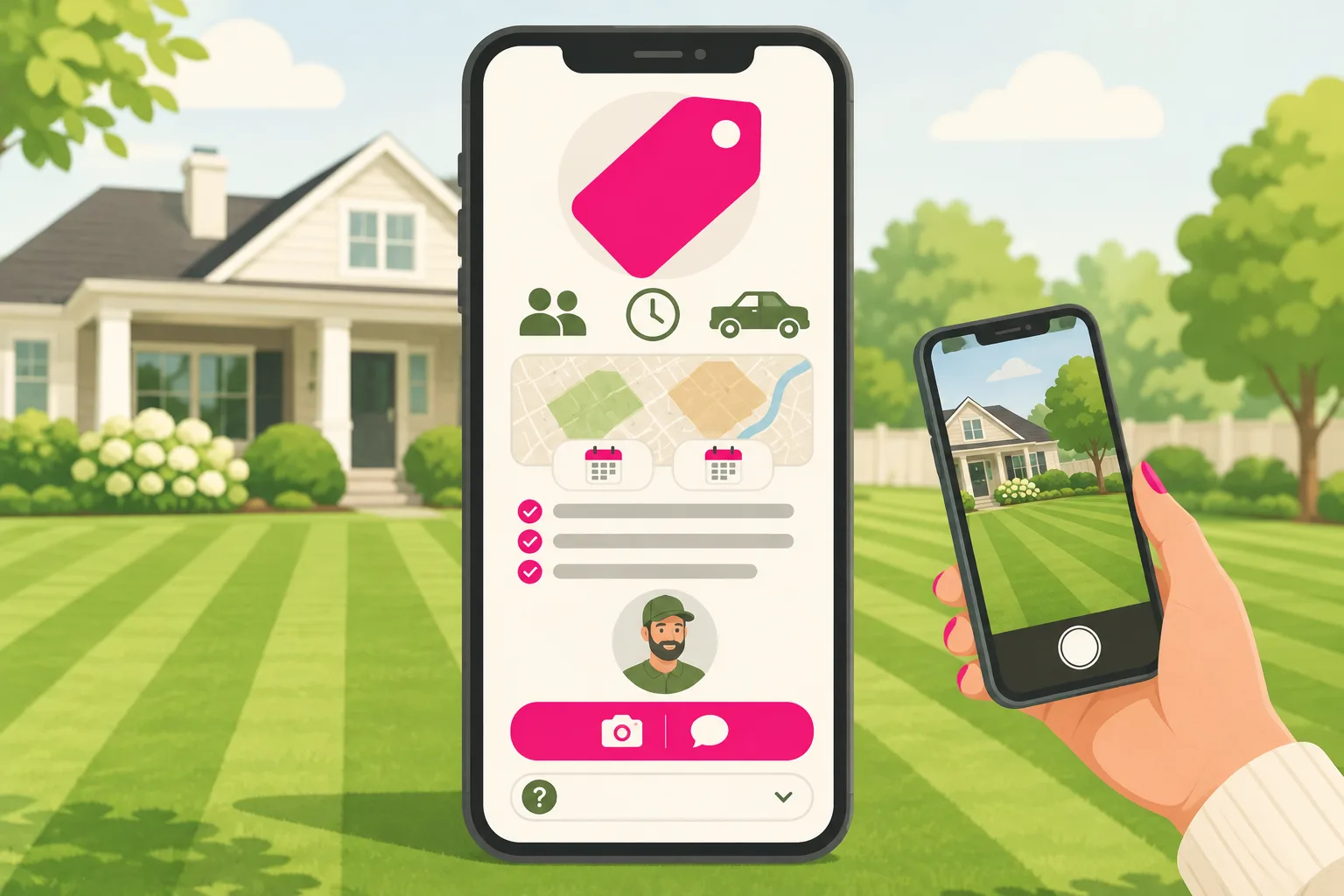
- The price, first and biggest. "A quarter-acre lawn is $55 a cut, every week, April to November." This is the first thing she sees, before any photo or slogan. It is the question she came with.
- What the number is made of, in one breath. "That is two people for about twenty-three minutes, the truck and the equipment, and the insurance that covers your window if a rock ever hits it." One sentence. It makes the price feel fair instead of made up.
- What moves it. "Bigger yards, steep slopes and fenced back yards cost a little more. Every-other-week costs more per visit, because the grass is longer." Now she can guess her own price before she asks.
- Where and when. The towns you serve and the day for each. If a day is full, say so here: "Thursday is full. Tuesday has four spots."
- What is included, and your two rules. Mow, trim, edge, blow off the walk and the driveway. Then the rules, said like a person: "We text before the gate opens. We mulch the clippings, except on the first and last cut of the year."
- Your face and one sentence. A photo of the owner and a line such as "I'm Luis. This is my eleventh spring, and Teo and I are the two people who will be in your yard." She is letting strangers through her gate. Show her who.
- One way to ask. "Text a photo of the front and the back of your yard to this number and get your price within the hour." A photo is easier for her than a form, and it lets you quote without driving over.
- "How did you find us?" One question at the end of the form, or asked in your first reply. It is the only way you will ever know which videos work.
What to leave off. A "starting at $29" price that almost nobody pays. A long form. A photo gallery above the price. A list of every service you have ever done. Anything that makes her scroll before she sees a number.
"But my prices vary." Everyone's do. You are not pricing her yard on the page. You are showing one honest example so she knows roughly where she stands, and then offering an exact number in an hour. That is very different from "call for a quote."
Only promise the hour if you can keep it. If you cannot answer while you are mowing, say "by seven tonight" instead. A promise you keep is worth more than a faster one you miss.
6. Four Replies to Save in Your Phone
The same four messages will arrive again and again, in comments, in direct messages and by text. Write your answers once and save them as text shortcuts. Then answering takes one tap between stops.
Here are Luis's, word for word. Change the numbers and the days to yours.
Reply 1: "How much to mow my yard?"
"Thanks for asking! A quarter-acre lawn is $55 a cut, weekly. A bigger yard or a fenced back yard moves it a little. Text me a photo of the front and the back at [number] and I'll have your exact price to you within the hour."
It gives a number, says what changes it, and tells her the next step. Never answer "it depends" and stop there. That reply loses to any company that named a price.
Reply 2: "Are you taking new customers?"
"Yes. Which side of town are you on? Thursday on the [town one] side is nearly full. Tuesday on the [town two] side has four spots. The price and the details are at the link in our profile."
Say yes or no plainly, then name the day that has room. If you are full, say that too, and offer to add her to the list for next spring.
Reply 3: "Can you do it for thirty?" or "Can you also take down a tree and spray the weeds?"
"I can't do it for thirty. It is $55 because it takes two of us and the truck has to get there. If every other week fits your budget better, I can price that for you."
"We don't take down trees or spray. The tree needs a climber, and weed control needs a state license we don't have. I'm happy to tell you who I would call."
Be kind and specific. Give the reason in one sentence, the way you would say it in her driveway. Do not lecture, and do not say yes to something you will regret in July.
Reply 4: Another lawn care owner asks which mower you run
"Good question. I talk about equipment on my own account, [handle]. See you over there."
One warm line, once. Long equipment conversations in your comments teach TikTok to show the company account to other lawn care owners instead of to homeowners near you. The monetization guide explains why equipment talk belongs on a personal account.
One rule covers all four. Answer in public when the question was asked in public. Other homeowners read the comments, and one clear price reply answers twenty people who did not ask.
7. Seven Messages That Mean Someone Is Ready
Not every comment is worth dropping the trimmer for. These seven usually are. Each one comes from a person who is close to choosing a lawn company. Answer them first, and the same day.
- "How much?" Use reply 1.
- "Do you come to [town]?" Say yes or no and name the day.
- "Are you taking new customers?" Use reply 2.
- "Do I have to be home?" "No. We text before the gate opens and send a photo when we are done."
- "What about my dog?" or "my gate?" She is picturing you in her yard. Tell her exactly what you do: the text first, the gate latched behind you, checked again when you leave.
- "When do you start in the spring?" Give the week, and say when the route usually fills.
- "My lawn guy stopped showing up." This person needs someone now. Do not comment on the other company. Give your price, your day, and how soon you can start.
Every one of these is also a video idea. If three people ask about the dog, film the answer at a gate. The ideas guide's question-video section has ten common questions with the answer to film for each.
8. The Quote and the First Visit
She sent the photos. Now the videos stop doing the work and you start.
The quote. Send it within the hour, as one message she can say yes to:
"Thanks for the photos. Your yard is $60 a cut because of the fenced back. That covers the mow, trim, edging, and blowing off the walk and driveway. You are on the Thursday side, so your first cut would be this Thursday. Want me to put you on the route?"
It has the number, the reason for any difference from the example price, what is included, the day, and a yes-or-no question. If you have not asked yet, add: "By the way, how did you find us?"
The night before. Send one short text: "We'll be there tomorrow morning. Is the side gate the best way in? Anything we should know about the dog?" This answers the worries she had not said out loud.
The first visit. Do it exactly the way your visit video shows it. That video was a promise, and she watched it closely.
- The text before the gate opens.
- The gate latched behind you.
- The mow, the trim, the edge.
- The walk and the driveway blown clean.
- The gate checked again on the way out.
- A photo of the finished lawn, sent from the driveway.
If the video showed two people, send two people. If it showed a photo at the end, send the photo. Small differences on the first visit feel large to a new customer.
Do not film it. A first visit is not content. Customers' yards appear in your videos only when the owner has agreed in writing, and a brand-new customer has not been asked yet. The filming guide has the wording for that permission.
9. The Text After the First Cut
The message you send right after the first visit sets the tone for the whole season. It has three parts: the photo, one useful thing, and nothing to buy.
"All done, photo attached. The gate is latched. One thing to know: the grass was long, so we cut it a little high today to keep from stressing it. It will be at the normal height by the second or third visit. See you next Thursday."
- The photo proves you came and shows the result, which matters most when she was not home.
- One useful thing shows that someone looked at her yard in particular. A sprinkler head that sits high. A low spot that holds water. Why the cut looks the way it does today.
- Nothing to buy. No mulch offer, no review request, no referral ask. Not yet. The first message is only about her lawn.
The offers come later, once she trusts you. The monetization guide's section on add-ons covers when and how to offer a cleanup, mulch or aeration.
10. The Season: Four Rules That Earn the Renewal
A renewal is not won in November. It is won on thirty ordinary visits. Four rules cover most of it.
- The same people. She agreed to Luis and Teo. If someone new is coming, tell her before he arrives.
- The same day. Thursday means Thursday. When rain moves it, text the night before and say which day instead.
- The gate, every time. Latched behind you, checked when you leave. One loose dog undoes a year of good work.
- No surprise charges. If the video and the quote said edging was included, it is included in week twenty as well. If something really is extra, ask first and give the price.
None of these is about video. That is the point. The videos bring a customer to the first visit. What you do on the other twenty-nine is what keeps her.
When something goes wrong, say so first. A sprinkler head gets clipped. A visit gets missed. Text her before she finds it, say what happened, and say what you are doing about it. Customers forgive mistakes they hear about from you. They remember the ones they discover.
11. The Renewal Message
This is the most valuable message a lawn care company sends all year, and it is one text long. Send it to every customer in the last week of the season, before the snow.
The renewal message
"That was the last cut of the year. Thank you for a good season. Your Thursday spot is yours for next year until the fifteenth of February. Same day, same crew. Want to keep it?"
Three things make it work.
- It says the spot is hers. She is not being sold something new. She is being asked whether to keep something she already has.
- It has a date. The fifteenth of February gives her a reason to answer and gives you time to fill any gaps before spring.
- It is a yes-or-no question. She can answer with one word from the couch.
If your price is changing next year, say so in the same message. A customer who learns the new price in November renews. One who learns it on the first invoice in April feels tricked.
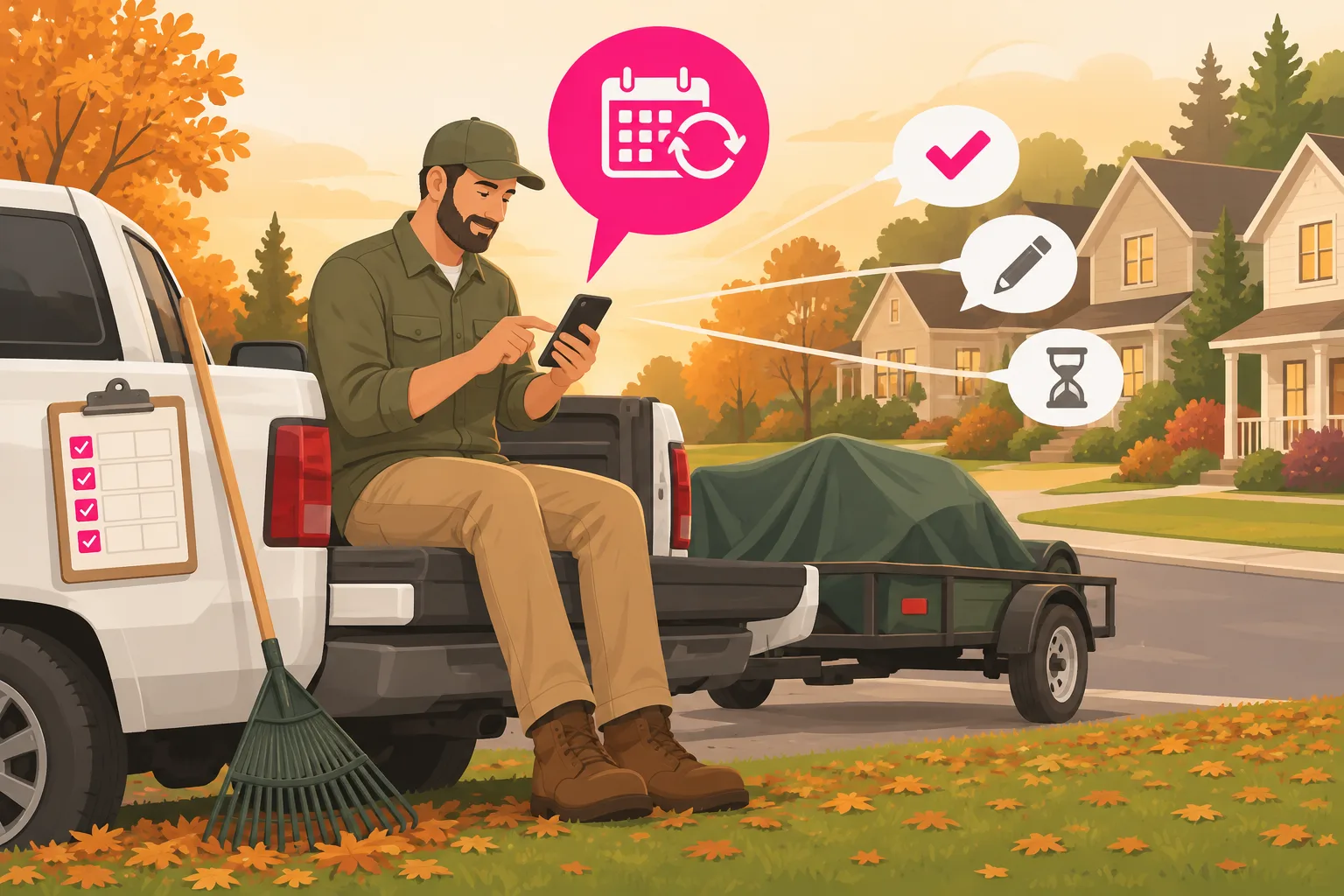
You will get three kinds of answer. Here is what to do with each.
- "Yes." That is a renewal. Reply with the day and roughly when the first cut will be: "You're on Thursdays. First cut is around the week of April fifteenth, depending on the weather." Mark her down.
- "Let me check" or "probably." Mark her down in pencil and hold the spot. Send one reminder on the fifteenth of February: "Holding your Thursday spot through today. Still want it?" One reminder, not three.
- "We'll see" or no answer. Leave it alone until the date. On the sixteenth, the spot goes back on your quote page as open. If she comes back in April and there is room, welcome her back without a word about it.
A pencil counts as a renewal. When you plan next year's route, count the "probably" answers as stops. Most people who say "let me check" are checking with a spouse, not shopping around. Treat them as customers and most of them will be.
Why before the snow? In November she has just had a good season and the lawn looks great. In March she has not thought about you for four months, and every lawn company in the area is at her door. Ask when you are the only one asking.
What this is worth. One stop at $55 for about thirty cuts is roughly $1,650 a season. If asking keeps even five customers who would have drifted away, that is more than $8,000 for a few minutes of texting. The monetization guide has the full math on what a stop is worth.
Then tell everyone. Once renewals are in, you know exactly how many spots are open on each day. Say it in a video: "Thursday has nine spots for next season. Tuesday has fourteen." A real number is a reason for a new customer to decide now.
12. The Regular and the Neighbor
The last step has two parts, and neither one looks like marketing.
The regular is the customer who has stopped deciding. Luis's first customer has been on Thursdays since 2019. She does not compare prices each spring. She answers the renewal text with a thumbs-up.
Do not take her for granted. Send her the renewal message like everyone else. Tell her about a price change before anyone else hears it. Once a year, thank her in a way that costs you little, such as a handwritten note left at the door with the last cut.
The neighbor is the house three doors down. They have watched your truck pull up every Thursday for a season. They have seen the lawn. They are the most likely new customer you have, and the most profitable, because you are already parked on their street.
Three things help that neighbor take the last step.
- Give your customer something to forward. When a neighbor asks "who does your lawn?", your customer wants an easy answer. A twelve-second clip of a finished lawn, with your towns and days in the caption, is that answer. Film it at a yard whose owner has agreed in writing, never from an angle that shows a house number.
- Say the sentence that makes it easy. When the neighbor gets in touch, lead with it: "We're already on your street on Thursdays, so we can start this week." It tells them you are close, you are reliable, and there is no wait.
- Ask once, at the right time. In the renewal reply to a happy customer, add one line: "If a neighbor ever asks who does your lawn, we have room on your street." That is all. Do not ask for names, and do not knock on doors with her name as your introduction.
About thank-you gifts. Thanking a customer who sent you a neighbor is fine: a note, a company hat, a free cut. Keep it a thank-you after the fact. Reviews are different. Never offer anything in exchange for a review. The FTC's rule on consumer reviews treats that as a violation.
13. How This Compares With Paid Lead Sites
Many lawn care companies get customers from lead sites, where you pay for each homeowner who requests a quote. They are a reasonable tool, and it helps to compare the two honestly.
A mowing lead often costs somewhere between ten and thirty dollars, and a landscaping lead more. Prices vary by site and by area. The same request is usually sent to several companies at once, so the first one to reply has a big edge. If a company wins about one shared lead in four, a $20 lead works out to roughly $80 for each new customer.
Against a stop worth about $1,650 a season, $80 is still a good deal. So the question is not which one is cheaper. It is what each one is good at.
- Lead sites are fast. If you need ten stops this month, they can deliver requests today. You must answer in minutes, and you cannot choose which street the customer lives on.
- Videos are slow and local. They take weeks to work. But the people who get in touch have watched you work, already know your price, and are more often near the streets you named.
- The steps in this guide help with both. A lead from any source still needs a fast quote, a first visit that matches the promise, and a renewal message in the fall.
A sensible approach is to use both for a season and compare. Ask every new customer how they found you, and at the end of the year count three things for each source: what a customer cost, how far they are from your other stops, and how many renewed.
For how the one-job trades handle the same pipeline, see getting local jobs from TikTok.
14. The Four Numbers to Track
Views and followers will not tell you whether this is working. These four numbers will. Each one measures a leak from section 1. Count them once a month. It takes about half an hour.
- Quote-page visits per week. This measures leak one. If views are up and visits are flat, your videos are not saying where you work or what to do next.
- Quote requests per month that mention a video. This measures leak two. It comes from the "how did you find us?" answer. If visits are up and requests are flat, the page is the problem. Check that the price is at the top.
- Renewals, out of customers asked. This measures leak three. Count only the customers you actually sent the message to. If you asked forty and thirty-four said yes or probably, that is your number. If you asked nobody, you have no number yet.
- New stops within three doors of one you already had. This measures the neighbor. It is the clearest sign that your local videos and your customers are doing the selling for you.
Write them as one sentence each month. For example: "Nine quote requests mentioned a video, and four became Thursday stops, two of them within three doors of a yard we already mow." That sentence tells you more than any view count.
How to find the weak step. Look for the biggest drop between one number and the next. Fix that one step and leave the rest alone for a month. The growth guide's section on signals covers the earlier signs, such as saves and sends.
15. When Paying to Promote a Video Is Worth It
Paid promotion puts a video in front of more people. It does not fix a leak. If the quote page hides the price or replies take two days, more viewers only means more people lost at the same step.
So fix the steps first. Promotion starts to make sense when three things are true:
- A video has already brought quote requests on its own.
- The quote page shows the price and you answer within the hour.
- You have open spots on a route day and know which day.
Then five rules for a route business:
- Promote for followers, not instant quotes. People rarely hire a lawn company seconds after first seeing it. A follower who watches for a few weeks is the one who texts you in February.
- Promote the proven video. Usually the visit or the price explainer. Those are the ones that answer "will they show up, and what does it cost?"
- Keep the area small. Aim at your service area as closely as the ad tools allow. They cannot always target one small town, so expect some reach outside it.
- Spend before the window. Late February and March for weekly mowing. August for fall work.
- Pause by route day. When Thursday fills, stop promoting the Thursday side of town and move the budget to the day that still has room.
One more: a customer who agreed to have her lawn in a regular post has not agreed to have it in an ad. Ask again before you promote a video filmed in her yard.
This is where our TikTok promotion service fits. Viryze takes a video you choose, tests it with different audiences, and moves the budget toward whichever one is bringing followers for the least money. It is built for owners who would rather be on the mower than in an ads dashboard. It does not replace the steps above. It sends more people into them.
The main guide's promotion section has the extra rules for promoted videos. For the mechanics of promoting a post you have already published, see the Spark Ads guide.
Frequently Asked Questions
How do I get lawn care customers from TikTok?
Make it easy for a homeowner near you to go from a video to a price. Post videos that name your towns and your days, show one full visit from start to finish, and say the price out loud. Put one link in your profile that goes to a quote page with the price at the top and a way to text you a photo of the yard. Answer every price question within the hour. Then do the visit exactly the way the video showed it, and ask every customer before winter whether they want to keep their spot next year.
How long does it take to get lawn care customers from TikTok?
Expect weeks, not days. People rarely hire a lawn company the first time they see it. Most watch for a while and get in touch when they are ready to decide, which for weekly mowing is usually late winter and early spring. A realistic plan is to start posting in late January, expect the first quote requests that mention a video within a month or two, and judge the result at the first cut of spring. If you need customers this week, a paid lead site or a search ad is faster. TikTok is slower, but the customers tend to be closer to your route and to arrive already knowing your price.
Should a lawn care company put prices on its website?
Yes, at least one real example. A homeowner comparing three companies picks from the ones that gave her a number. You do not have to price every yard in advance. State one honest example, such as your weekly price for a quarter-acre lawn, list the two or three things that raise or lower it, and offer an exact number by text if she sends a photo of the yard. Avoid a low "starting at" price that almost nobody actually pays. It brings requests you cannot win and makes the real quote feel like a bait-and-switch.
How fast should I answer a quote request?
Within the hour during working hours, if you can. The homeowner who asks you for a price has usually asked two other companies in the same sitting, and the first clear answer has a large advantage. You do not need to answer from the mower. Save your most common replies in your phone so that answering takes one tap at the next stop, and say on your quote page when people can expect to hear back.
How do I ask lawn care customers to renew for next year?
Send one short text in the last week of the season, before the snow, and give a date. For example: "Your Thursday spot is yours for next year until the fifteenth of February. Want to keep it?" A yes is a renewal, so confirm the day. A "let me check" is still a renewal for planning purposes: hold the spot and send one reminder on the date. Only an open "we will see" releases the spot, and only after the date has passed. Most customers who are happy say yes when asked. Most companies never ask.
Are lawn care lead sites better than TikTok for getting customers?
They are faster, and they solve a different problem. A lead site sends you a homeowner who wants a price today, usually for a fee per lead, and often sends the same request to several companies at once. That works when you need stops quickly and can respond in minutes. TikTok is slower and costs time instead of a fee per lead, but people arrive having already watched you work, and you can aim your videos at the streets you already drive. Many companies use both: lead sites to fill gaps this month, and videos to build a route that renews itself.
Steps in place and spots still open?
If your quote page shows the price, your replies go out within the hour and one of your videos already brings requests, the next step is more of the right viewers. Viryze can put that video in front of more people, test which audience responds, and shift the budget to what is working - so more viewers become followers and, in time, stops on your route.
Related Reading
- TikTok for Landscapers and Lawn Care Companies: The Complete 2026 Guide - the full strategy and the rules behind this guide.
- Growing a Landscaping TikTok: From 0 to 10K Followers in the Right Two Towns - how to get the views and followers this guide starts from.
- How Landscapers Make Money on TikTok: The Route Math, the Install, the Equipment Deal, and the Course - what a stop is worth and what to sell after the first season.
- Landscaping TikTok Content Ideas: 50+ Video Concepts That Fill the Route - 52 ideas, including the visit, the price explainer and the question videos.
- How to Film Landscaping Videos for TikTok (The Yes-Card Yard, the Address Rule, the Kids, the Crew & the Drone) - written permission and what never goes on camera.
- Getting Local Jobs from TikTok: Turn Views Into Booked Estimates - the same pipeline for the one-job trades.
- Getting Clients Into the Chair: Turn TikTok Views Into Rebooks - another local business built on repeat customers.