
Landscaping & Lawn Care17 min read
TikTok for Landscapers and Lawn Care Companies: The Complete 2026 Guide
The 2026 TikTok playbook for landscapers, lawn care companies, and the one-truck owner who runs the company phone - turning videos of the visit, the transformation, and the drive-by into homeowners who sign up for the route, stay on it, and send the neighbor three doors down. Covers the six video formats that grow landscaping accounts, the hook that opens on the yard instead of the customer, the route-day content engine, the homeowner-path vs.
By Ryan MitchellHead of Creator Success at Viryze

Every homeowner has a version of the three-quotes week. The grass is past her ankles, the neighbor's lawn across the street looks like a golf course every Thursday, and she has texted three companies off a search. One sent a number with no explanation and never followed up. One said "it depends" and asked to come look at it. One never answered. Inside her head she is running the list: Will they actually show up every week, or mow twice and disappear like the last guy? What does it really cost? Do I have to be home? Who are these people with machines in the yard where my kids and my dog are? Will they leave the gate open? Will they scalp the lawn and blame the heat? What are they spraying? She closes the search. Then she keeps mowing it herself, badly, on Saturdays, and tells herself she will deal with it next spring.
Every question on that list can be answered in sixty seconds of video. Almost no landscaper answers them. Somewhere on the next street, a one-truck company films a Thursday visit - the truck at the curb at ten past eight, the gate checked and latched behind the dog, the mow, the trim, the edge, the walk blown clean, the gate latched again, the photo of the finished lawn texted from the driveway, twenty-three minutes start to finish, and "fifty-five dollars, every Thursday, April to November, you don't have to be home" said out loud. Forty thousand people watch it. A few thousand of them live in the two towns the truck already drives through, and some of them live three doors down from a lawn it already cuts.
This guide is the complete 2026 playbook for landscapers and lawn care companies - the owner with one truck and a helper, the two-crew company with a shop, the solo operator with a push mower and a Saturday route, the design-build crew that installs patios, and the person who got handed the company phone because they are the one who "does TikTok": the six video formats that grow landscaping accounts fastest, the hook that opens on the yard instead of the customer, the route-day content engine, the homeowner-path-or-feed-path choice and the two audiences behind it, the calendar that sells the route in February and fall cleanup in August, the 90-day plan from an empty account to the company a street thinks of, the customer ladder from first view to renewal, the license, privacy, price, and platform rules that protect your company, and when paid promotion fills the route versus burns the truck payment. Pair it with our TikTok algorithm guide for the ranking-signal frame and the TikTok growth strategy guide for the cross-niche fundamentals.
The honest summary:
- A landscaping company has two audiences on TikTok. The homeowner audience lives in the two or three towns your truck already drives through and buys the one thing you sell - a spot on the route. The feed audience lives anywhere, loves the stripes, and buys only what fits in a box. Decide which one each video is for, or you will build a famous truck with a half-empty Thursday.
- The fear under every unanswered quote is "will they show up, and what does it cost?" The visit video - from the truck at the curb to the gate latched to the price said out loud - answers it, and it is the single video most landscapers never make.
- The route is the content. You do not need to make videos. You need a phone on a magnetic mount on the trailer gate, the thirty-eight yards you are already in every Thursday, and the handful of customers who said yes in writing.
- Use paid promotion as selective amplification on proven videos, aimed at followers rather than a one-time quote, pointed at the towns the truck already drives through and never at the whole metro, timed in the weeks before the spring sign-up window and paused the day Thursday fills - inside the honest before-and-after rule, the applicator-license rule, and the customer's written yes, because the ad money came out of the same account as the truck payment.
What's Inside
- 1. Why TikTok Works So Well for Landscapers in 2026
- 2. The Six Video Formats That Grow Landscaping Accounts Fastest
- 3. The Visit Hook: Open on the Yard, Never the Customer
- 4. The Route-Day Content Engine
- 5. Homeowner Path or Feed Path: The Two Audiences
- 6. The Landscaping Calendar: Why You Sell the Route in February
- 7. A Posting Cadence That Survives the Spring Rush
- 8. The 90-Day Plan to Becoming the Company a Street Thinks Of
- 9. The Customer Ladder: Turning Viewers Into Renewals
- 10. When Paid Promotion Fills the Route vs. Burns the Truck Payment
- 11. Licenses, Privacy, Prices, Platforms, and the Mistakes That Cap Landscaping Accounts
- Frequently Asked Questions
1. Why TikTok Works So Well for Landscapers in 2026
Landscapers have found customers the same way for a generation: the yard sign at the corner in April, the door hanger on the two streets around a good lawn, the lead marketplace that sells the same homeowner's request to four companies at once, the search ad that costs more every spring, the woman who has been on Thursdays since 2019, and the slow hope that her neighbors will notice. That model works right up until it does not - the marketplace raises its lead price, the search ad gets outbid by a national franchise, the guy with the new truck undercuts you on two streets, and the one week of spring when every homeowner decides is the same week every company in the county is shouting. TikTok is the most efficient answer available right now, for five specific reasons.
The first is that there are more lawn companies than ever and the homeowner is on her phone. Industry analysts count more than half a million landscaping businesses in the United States, and almost all of them are small - a truck, a trailer, a few people. That is not a market where the best company wins. It is a market where the company the homeowner has already seen working wins, and the person deciding is a thirty-five-year-old who searched "lawn care near me" on a Saturday, got three answers that told her nothing, and will pick whichever company she trusts to show up. Surveys keep finding that something like four in ten younger adults now start that kind of search on TikTok. She is going to hire the truck she has already watched pull up.
Second, the business is the route, and the route is a repeat business sold once a year. A mowing company does not sell cuts. It sells a weekly spot on a route, and the spot is decided in a six-week window in late winter and almost never changes until the next one. Every owner knows the customer who renews is worth five quotes: no sales call, no price haggling, no windshield time learning a new yard, and a Thursday on the calendar before the grass wakes up. A quarter-acre lawn at fifty-five dollars a cut, roughly thirty cuts a season, is more than sixteen hundred dollars a year, and a stop that stays three or four seasons is a five-thousand-dollar customer who found you once. TikTok is the only channel that can show her the first visit before she has it.
Third, and this is the one almost no other local business gets: you already own what the platform rewards. A before. An after. A line of stripes. An overgrown yard going to clean in forty seconds. The lawn-care genre - the edge, the first cut of spring, the knee-high lot rescued - is one of the most watched kinds of video on the platform, and the best-known creators in it have audiences in the millions and have raised six figures for the people whose yards they cleared. A company selling insurance has to invent a reason for anyone to watch. You have thirty-eight every Thursday. And yet the typical landscaping account is a drone flyover set to a trending song, a logo with a phone number on it, and a photo of the truck - three things that tell the algorithm nothing and tell the woman with the three quotes even less.
Fourth, the lane is empty where your customers are. The famous lawn accounts are famous to other lawn guys - the man with six crews explaining his software, the creator who mows overgrown lots for free and sells hats - and nearly none of them will ever cut a lawn in your town. The handful of local companies that post are scattered across the map, which means the first company in a given pair of towns to show what a Thursday visit, the gate, and the price actually look like does not compete with anyone for the "who do you use for your lawn?" question. It answers it, for those towns, alone. The ranking signals reward exactly what a working route produces every week: real grass, real hands, a complete watch.
Fifth, the price is the whole decision, and nobody says it. The woman who balks at fifty-five dollars a week has never seen that it is two people for twenty-three minutes, a truck and a trailer and a mower that cost more than her car, the insurance that covers the window if a rock goes through it, and the drive from the last stop. "It depends" is the sentence that loses her, every time, to a company that said a number. Landscapers lose the customer at the price, every spring, to a homeowner who would gladly have paid it if anyone had shown her where the money goes. A sixty-second video in the driveway is the explanation, and it is the easiest piece of marketing a lawn company has ever been able to make. We will count saves and sends, not views, for the rest of this guide - because the woman who saves "why a quarter acre here is fifty-five a cut" is deciding, and the one who sends it to her husband has decided.
And one thing to say plainly about size. A one-truck company cannot out-advertise a national franchise with a call center. It does not need to. It can show the one thing the franchise cannot: the same two people, every Thursday, by name, who know that the gate on the side yard sticks and that the dog is friendly but fast. That is a video. It is, in fact, the best video.
2. The Six Video Formats That Grow Landscaping Accounts Fastest
Across the landscaping accounts that grow in 2026 - the one-truck mowing company, the two-crew outfit with a shop, the solo operator with a Saturday route, the design-build crew that sells patios, the lawn treatment company with a spray rig - the same six formats keep working. Every video you make should be one of them, and the order is deliberate. They are cousins of the six job-site formats in our contractor guide, rebuilt for a business that comes back every week.
Format 1: The visit (the conversion video)
The truck at the curb at ten past eight. The gate checked, and latched behind the dog, and said out loud: "gate's latched." The mower coming off the trailer. The mow, time-lapsed, the stripes appearing. The trim around the maple. The edge along the walk. The walk and the driveway blown clean. The gate latched again. The photo of the finished lawn, texted from the driveway. Then: "Twenty-three minutes. Fifty-five dollars, every Thursday, April to November. You don't have to be home." This is the parallel to the drive-in a vacation rental films and the walk-through a nervous first-time client needs at a salon, and it is the video that converts because it answers, in one take, every question on the three-quotes list. One per service - the weekly visit, the spring cleanup, the mulch install - re-filmed each spring, pinned to the top of the profile. If you make one video this year, make this one.
Format 2: The transformation (the volume source)
The overgrown first cut of a new customer's yard. The spring cleanup - the beds raked, the edges cut back in, the mulch going down. The hedge that had not been touched in three years. The stripes. Filmed from the phone on the trailer gate while the work happens, cut to forty seconds, with the sound of the mower. Strangers across the country watch the lawn genre the way they watch pressure washing, and it is the format that earns follows from people who will never be on your route. That is fine; it is the engine. Every cleanup is one. One rule that is non-negotiable: the before and the after are the same yard, from the same spot, in the same light, on the same day. The "after" shot a week later when the grass greened up is a lie the platform calls misleading and the homeowner calls a reason not to trust you.
Format 3: What it costs and why
"Why a quarter-acre lawn here is fifty-five dollars a cut." Two people for twenty-three minutes. The truck, the trailer, the mower, the trimmer, the blower, and what they cost to keep running. The insurance that covers the window. The drive from the last stop - which is why the house three doors down from a current customer gets the same price and the house across town gets asked to wait for a day when the truck is already there. Why weekly costs less per visit than "whenever you can" - because a lawn that is cut every Thursday takes twenty-three minutes and a lawn that waited three weeks takes forty and clogs the deck. Filmed in a customer's driveway with the trailer behind you. This video is saved by the person deciding and sent by the person who has decided, and no quote form can do what it does, because the form can only show the number.
Format 4: The question answered (the trust builder)
"Do I have to be home?" No - here is exactly what happens when you are not, and here is the text you get. "What about the dog?" Here is the gate, here is what we do when the dog is out, and here is why we text before we open it. "Do you bag the clippings?" Here is what mulching does for the lawn and the two times a year we bag instead. "What happens when it rains?" Here is the rain-day rule and when your Thursday becomes a Friday. "What are you spraying?" Here is the honest answer - including, if it is true, "we don't, and here is who we send people to." "When does the season start?" The first cut is the week of the fifteenth, give or take the weather. Every one of these is thirty seconds, filmed where the answer is - at the gate, at the trailer, at the clippings bag. Together they are the reason a stranger hands a gate code to a company she has never met.
Format 5: The drive-by (the share source)
Twelve seconds of the finished lawn from the street, the way a neighbor sees it. The stripes. The edge line along the walk. The sidewalk blown clean. The truck pulling away. Almost no words. It is the video a customer sends when the street group chat asks "who does your lawn?" - and that question, in that chat, is how most lawn companies on most streets actually get hired. A lawn service is chosen by one household and recommended to six, and "these guys, every Thursday" with the drive-by attached is the sale. It is also the countdown format - the first cut of spring, "fall cleanups start when the maple turns," the first frost on the stripes.
Format 6: The honest week (last on purpose)
The belt that snapped on the zero-turn with nineteen lawns left and the Saturday you spent catching up. The rain week when Thursday became Monday and how you told everybody. The lawn you burned with fertilizer in your second year, and what you do differently now. The helper who quit in June and the six weeks you ran the route alone. Said, not shown; never a customer's story; never an ask. This is the format that makes the account a company with a name instead of a truck with a logo, and it is last on purpose - without the other five it is a diary, and nobody hires a diary.
Retire the drone flyover set to a trending song, the logo-and-phone-number graphic, the photo of the truck, and the equipment-review account that thinks it is the company account. And never, under any circumstances, post the customer-shaming clip - the next section explains why.
3. The Visit Hook: Open on the Yard, Never the Customer
The first two seconds of a landscaping video decide whether a stranger stays, and the most common hook on lawn care accounts is the one that quietly caps them. It is the customer-shaming clip: the "wanted me to do it for thirty dollars" rant, the "look at the yard they let go" reveal, the "asked us to move the trampoline" skit, the dramatic reading of the text from the one who did not pay. It performs. It performs because other lawn guys love it, and it fills the comments with other lawn guys, and it trains the algorithm to show the next video to the trade instead of to the woman three streets away deciding who gets her gate code. She saw the thirty-dollar rant. She now believes that if she hires your company her yard, her questions, and her budget will be content. She mows it herself.
Its two cousins are the neighbor-shaming clip - "our stripes versus the guy next door's" - which insults a homeowner you have never met in front of the one you have, and the grievance post: gas prices, the homeowners' association, "nobody wants to work anymore." All of it may be true. None of it makes anyone want your truck in their driveway. Hook on the yard, never the customer, and five hook shapes do it:
- The price named first: "A quarter-acre lawn here is fifty-five dollars a cut, every week. Here is what is in it." No number hidden, no "it depends."
- The clock: "Twenty-three minutes, start to finish, and here is where every one of them goes."
- The honest answer: "Do you have to be home? No - and here is exactly what happens when you are not, including the text you get from the driveway."
- The person: "I mowed my first lawn for twenty dollars when I was sixteen. This is the eleventh spring. Teo has run the trimmer around that maple for four of them."
- The permission: "You do not have to move the hose. You do not have to pick up the dog toys. You do not have to be home. Here is what we actually need from you, and it fits in one text."
The last one is the hook most landscapers never consider, and it is the strongest one you have. Every homeowner who has ever hired a lawn company arrives braced for a list of things she is supposed to do first, a lecture about the sprinkler heads, and a judgment about the state of the beds. The video that says "you are the customer, not the crew" is the one that gets sent to the street chat with the words "these guys."
4. The Route-Day Content Engine
The reason landscaping accounts go quiet is not that there is nothing to film. It is that the owner is on a mower from seven to five, thinks of each post as a project, and projects lose to a route. The system is simple: the route is the content calendar. The footage exists every Thursday, on a schedule, in thirty-eight yards you are already in, with the one other person who has already agreed to be on camera and the handful of customers who said yes in writing. You do not make videos. You film the visit you were going to do anyway, and you cut it on Sunday night.
The route-day capture list
- The phone goes on the magnetic mount on the trailer gate before the mower comes off: at the two or three yes-card yards on the route - the customers who said yes in writing, more on that below - framed vertical, pointed at the lawn and never at the house. Twenty minutes of capture, spread across the day, is enough for a week.
- One visit, start to finish: the mount running the whole stop at one yes-card yard. You will cut forty seconds from twenty-three minutes. Say one sentence when the truck stops and one when the photo gets texted; the middle can be the sound of the mower.
- One drive-by from the street: twelve seconds, the finished lawn as the neighbor sees it, no words. Shoot it at every yes-card yard because the light is never the same twice, and this is the share source.
- One "what it costs and why" in forty seconds: in the driveway with the trailer behind you, once a season, re-filmed when the price changes.
- One question, one answer: "Somebody asked this week whether we bag the clippings. Here is the answer." Thirty seconds, filmed at the clippings bag.
- Ninety seconds of the first cut: the first Thursday of the season, every yard, from the mount. The spring countdown video for next February is built from this.
That is a week of posts from one route day, and the honest week fills in when it comes. Behind it sits the question log: a note on the phone where every quote request, every "quick question" text the night before the first visit, every comment that starts with "wait, do you," and your own "people always ask" list goes. Each entry is a Format 4 video waiting. An owner who keeps the log through one season never again wonders what to post. Our job-site filming guide covers the timelapse and framing craft; the rest of this section is about who and what is allowed in the frame.
The engine runs on a faces rule, and for a landscaper the rule is stricter than most lawn care accounts treat it: customers are never content, and neither is their property without a yes. A yard is private property. The family that hired you to mow it did not hire a film crew, and the doorbell camera pointed at your truck is theirs, not yours. So the yards on camera are the ones whose owners said yes in writing - one line in the service agreement is enough, with a box to check - and the yes says what can be filmed (the lawn, the beds, the dog if they want), what never can (their faces, their kids, the house number, the inside of the house through a window), and that they can take it back with a text and the clips come down within the week. Call them the yes-card yards and film nothing anywhere else. The crew on camera - Teo, on the trimmer - signed a one-page agreement once a year that says what he appears in, what he is paid for it, and names paid promotion on its own line. The neighbor's yard is never in frame without the neighbor's yes, which means the mount points down the lawn, not across the fence. A customer's own video of your stripes is hers; thank her in the comments and ask before you repost. Her review is quoted only in her words, never with her name or her street. And the address is never on the platform: name the two towns and the day of the week, show the lawn and the truck, keep the house number, the street sign, and the mailbox out of every frame.
One practical note on the set: a customer's driveway with the trailer behind you is the best studio on the platform, and you own it every Thursday. The explainers get filmed where the thing happens - the price explainer in the driveway, the dog answer at the gate with the latch in your hand, the clippings answer at the bag. Never from the truck cab with a slide over your shoulder, and never, ever at seven in the morning with the blower running behind you as the joke.
5. Homeowner Path or Feed Path: The Two Audiences
This is the section that matters most, and it is the one lawn care accounts get wrong almost universally - not by doing something badly, but by never deciding what the account is for.
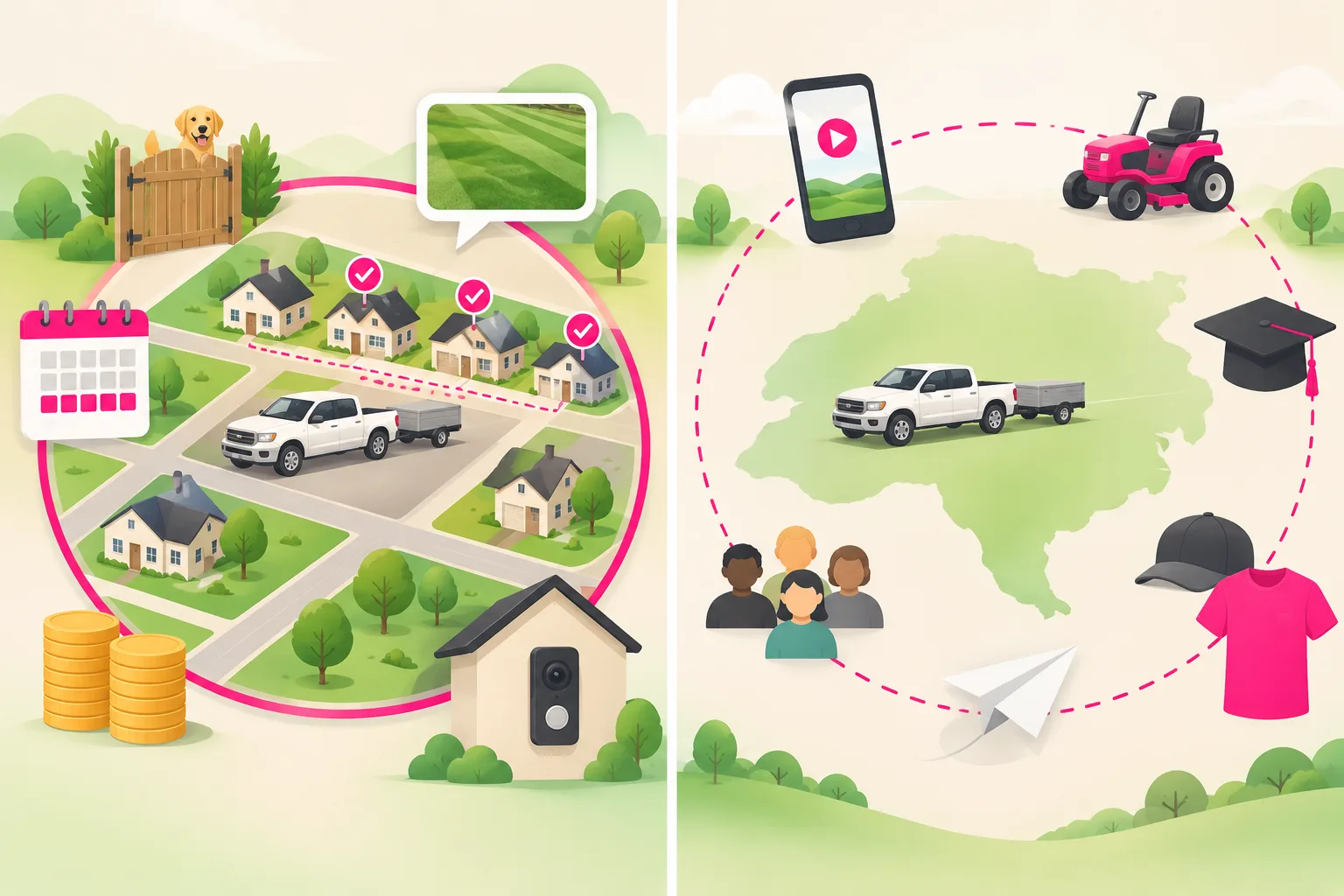
A landscaping company is the most local business in this entire series. A cabin can take a guest from three hours away; a salon can take a client from across the city. A mowing route cannot. The money in a route is density: the stop three doors down from a current customer costs almost nothing to serve, and the stop twenty minutes across town costs twenty minutes of a truck and two people, every week, forever. So the customers you actually want live on the streets the truck is already on, on the day it is already there. And a landscaping company is also a business whose weekly work strangers across the country genuinely want to watch. So every landscaping account is speaking to two audiences at once: the homeowner audience, who lives in the two or three towns on the route and can only come from there, and the feed audience, who is anywhere, loves the stripes, and will never see your truck.
The homeowner path
The homeowner path is local in the tightest sense the platform allows. It is the family three streets over who is tired of Saturdays and does not know you exist. The account names the two towns and the days out loud - "this side of town is Thursdays, the other side is Tuesdays" - pins the visit video to the top, and sends one link to a page that shows the price for a quarter-acre weekly cut, what is included, the service area by town, your face with your name, and a "text a photo of your yard and get a number within the hour" line. It is measured in clicks to that link, in quote requests that mention a video, in a "how did you find us?" line on the quote form, and above all in the renewal - the customer who keeps her Thursday spot next February - and the neighbor - the house three doors down that signed up because it watched your truck for a season. The local-discovery mechanics apply with one twist: the place you want to be discovered is not your town, it is your route.
The feed path
The feed path is borderless. It is the man in another state who watches every overgrown-lot rescue, the new lawn guy who wants to know which blades you run, the homeowner nowhere near you who saves every striping video. He follows everything and buys only what fits in a box or a download: the trimmer line you swear by with the affiliate link, the hat, the "how I built a sixty-stop route" course, the brand deal with the equipment maker. It is measured in follows, saves, sends, storefront clicks, and seats sold. For a company that already sells to other lawn companies, or that wants an equipment sponsorship, it is real money. For a company with one truck and a half-empty Thursday, it is applause.
The famous-and-idle truck
The trap looks like success for a year. A million followers from every state. Comments full of other lawn guys asking what mower you run and whether the striping kit is worth it. A striping video with three million views. And a Thursday route with thirty-eight stops that needs sixty to be a full day, a spring that filled slower than last year's, and an owner who concludes "TikTok doesn't get customers." It is true, and it is true only because every video was for the feed and none was for the homeowner. The striping clip never said which town. The price was never said. The visit was never filmed. The account grew a national audience of people who will never see the truck, and the two towns on the route never heard of the company. Our salon guide tells the same story about a chair, and our vacation rental guide about a cabin; the truck version is the cruelest, because the audience that would have hired it lives three doors from a lawn it already cuts.
So decide, per video, which audience it is for. The visit, the price explainer, the question answered, and the drive-by are homeowner-path videos: name the towns, name the day, show the link. The transformation is a feed-path video that quietly serves the homeowner path if it ends with one sentence about where the truck was. Build the homeowner path first - the route is the money - unless you already sell to other lawn companies, in which case build both and keep the accounts honest about which is which. For most companies, the right shape is a homeowner-path account with one feed-path format feeding it followers. The what-fits-in-a-box side can wait until Thursday is full.
6. The Landscaping Calendar: Why You Sell the Route in February
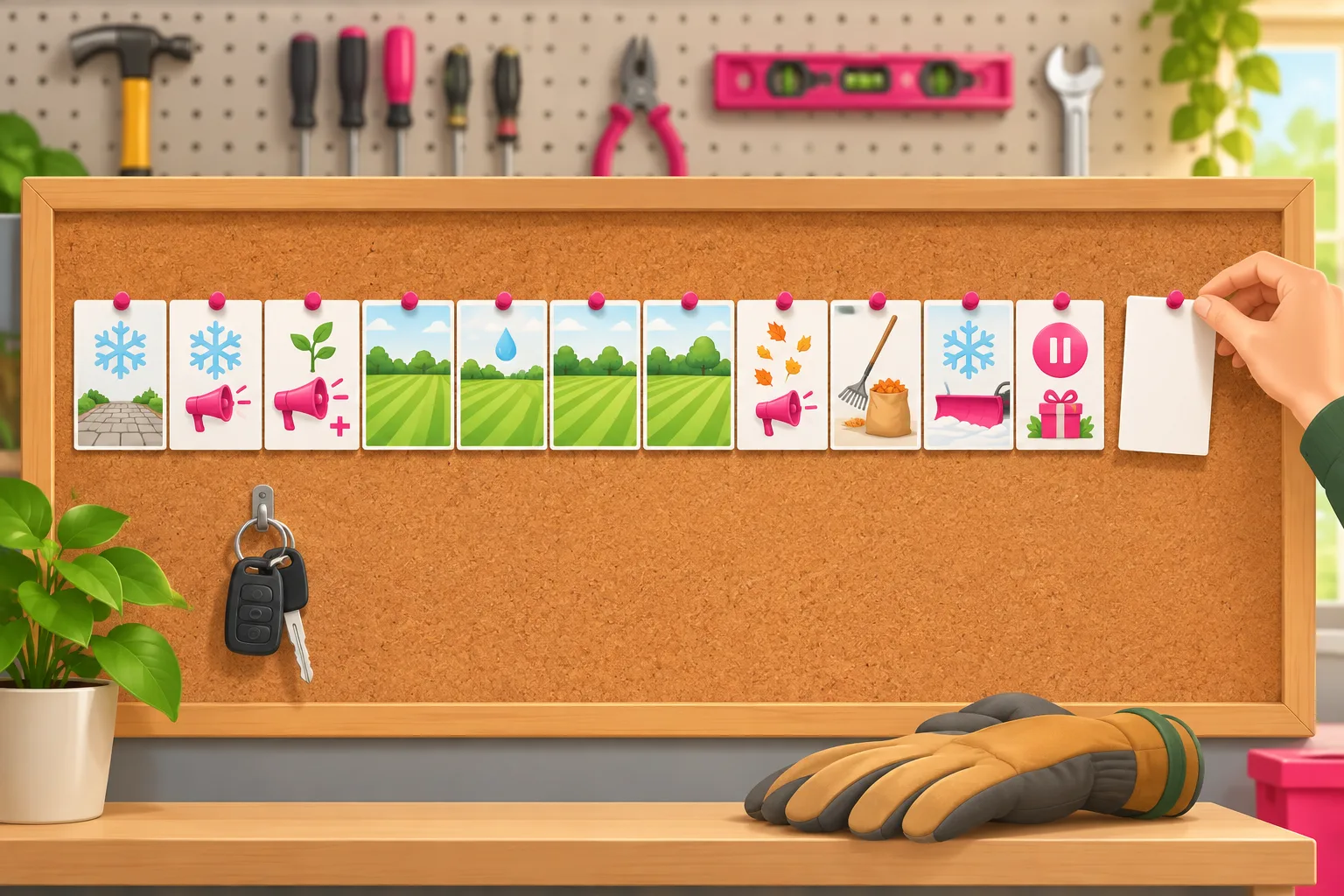
Every lawn company's year is a handful of short windows known a year out, and the whole trick of the calendar is this: sell in the weeks before the window, not during it. Homeowners decide who mows the lawn in the six weeks before the first cut, and almost nobody switches companies in July. Searches for lawn care advertising and landscaping marketing peak in March for a reason - that is when every company realizes the route is being decided right now. The company that was already on a homeowner's phone in February does not have to shout in April.
- Late February and March - sell the route. The paid month, if there is one. The visit video re-filmed from last season's footage, "here is what the first cut of spring looks like" shot last April and posted now, the price explainer, and the sentence said out loud: "Thursdays on this side of town still have room; the first cut is the week of the fifteenth." Spring cleanups and mulch get their own visit video the same month, because the homeowner who wants the beds done wants them done before the lawn wakes up.
- April through June - the rush. Film everything. Post transformations, first cuts, and drive-bys. The homeowner-path asks slow down and the feed path carries the account, because Thursday is filling and the videos that matter are the ones you are banking for next February. The day Thursday fills, say so: "Thursday on this side of town is full. Tuesday has four spots." A full route said out loud is the best advertisement a lawn company has.
- July and August - the heat, and sell the fall. The honest week about the drought and the raised deck. Then, in August, the fall work: aeration and overseeding, the leaf cleanup series, "here is what your lawn looks like in May if we do this in September." Fall is sold in August the way summer is sold in January for a rental.
- September through November - the fall work and the renewal. Aeration videos, the first leaf cleanup, the last cut said out loud. And the message that matters more than any video: in the last week of the season, every customer gets "your Thursday spot is yours for next year until the fifteenth of February - want to keep it?" The route is renewed before the snow, not fought over in April.
- December and January - the quiet months. Snow, where it snows, and the plow videos. The install and design work where it does not - January is when a homeowner plans the patio she will have built in May, so the design-build crew sells in January. For a mowing company, this is the feed-path season: the equipment maintenance series, the year-end receipt with the one thing you changed because a customer asked, and the countdown to the first cut.
Film "here is what next season looks like" during the season and post it in the quiet one. The first-cut footage from April is the February countdown. The knee-high-to-clean cleanup from March is the January "book your spring cleanup now." The stripes from June are the August "this is what aeration in September buys you." The most common failure in the vertical is a full summer of happy customers nobody asked to renew, and an April spent re-selling a route that was already yours.
And the unplannable moment - the hailstorm, the mower that died, the week the whole county flooded, the bad review in the town group - gets one video, one person, in the driveway, no transformation clip, no sale, said once. Our farm guide covers the same season-window logic for a business that lives by the weather; the lawn version just has more windows and a shorter fuse.
7. A Posting Cadence That Survives the Spring Rush
Three posts a week is the sustainable number for a company that mows ten hours a day, and the capture list above produces it from one route day. Tuesday, Thursday, Saturday. One homeowner-path video (the visit, the explainer, the question), one feed-path video (the transformation), one drive-by or countdown. Twenty minutes of capture on the route, an hour on Sunday night to cut and schedule. Series beat singles - "Thursday route," "What it costs," "Do I have to be home?," "Teo's edge," "First cut of spring" - because the homeowner who liked one wants the next one, and the algorithm learns who to show the series to. The small-business playbook covers the general cadence; three things are specific to a lawn company.
One person owns the company phone, and it is written down: who posts, what goes up without asking (the transformation at a yes-card yard, the drive-by), what gets a look first (any price, anything with a neighbor's property in the background, anything a customer said, the honest week, anything that shows a street sign), and what never goes up (a customer, a kid, a house number, a yard without a yes, a review with a name). Write down who owns the handle and the followers if the helper who posts moves on or the company is sold, because the account is worth more than the trailer by the second season.
The owner's own account is not the company's. The mower reviews, the "how I priced my route" videos, the opinions about the trade - those live on the owner's account, where other lawn guys can follow them. The company account is for the homeowner three streets over, who does not care which blades you run and does not want to hear what you think of the competition.
Rain mode is a real setting. A rain week that silences the account is fine - say so in one post and come back when the grass dries. A silent February is not fine; it is the one month the account exists for. And the week in April when every customer wants the first cut on the same Thursday is not a week to post daily. It is a week to film everything and post the drive-bys.
8. The 90-Day Plan to Becoming the Company a Street Thinks Of
Ninety days is long enough to go from an empty account to the company a street group chat names when someone asks "who do you use for your lawn?" It is not long enough to go viral, and that is the point. Start it in late January so day ninety lands on the first cut. The milestones below are counted in quote requests that mention a video, not followers.
Days 1-30: Fix the quote page before you film it
The bio says what the company does in plain words, the two towns, the day for each side of town, and the two things people ask most - "weekly mowing, cleanups, and mulch; this side of town Thursdays, the other side Tuesdays; licensed and insured; you don't have to be home." The link goes to one page that shows the price for a quarter-acre weekly cut said out loud, what is included and what moves it (size, slope, a fence, every-other-week), the service area by town, your face with your name, and a "text a photo of your yard and get a number within the hour" line. The quote form gets a "how did you find us?" field, because without it you will never be able to prove any of this worked. Then twelve posts: the visit first, three explainers, three questions answered, three transformations, two drive-bys. Nothing is promoted. Everything is measured by one number - clicks to the link - and one field on the form.
Days 31-60: Find the series
By now a few videos have outperformed. Sort them by audience: which traveled (feed) and which brought a click to the link or a quote that said "we saw your Thursday videos" (homeowner). Build a weekly series from the best of each. Count the first customer who says "we found you on TikTok" and write down the date and the street; it is the sentence that wins the argument with the partner who thinks the phone is a toy. Watch the saves and the sends above everything - a woman saving the price explainer in February is a Thursday stop in April - and make the drive-by a weekly habit. Answer every quote request within the hour with a warm saved reply, and keep the "how much" reply separate from the "are you taking new customers" reply.
Days 61-90: Compound toward the first cut
Lay the calendar from section 6 over the next ninety days and work backward from the first cut. The visit video is re-filmed from last season's footage and posted six weeks before it. The spring-cleanup visit goes up the same week. If one visit video has already proven itself organically and the first cut is inside eight weeks, this is the first moment paid promotion makes sense, and section 10 says how. By day 90 a healthy account has a few thousand followers with a real share of them in the two towns, a link that gets clicked every week, a quote form that says "TikTok" a few times a month, and - the real milestone - a new stop you can name that is three doors from one you already had.
9. The Customer Ladder: Turning Viewers Into Renewals
A view is not a customer, and the distance between them is a ladder with nine rungs. Most landscaping accounts build the first two and wonder why Thursday is half empty. Our local-jobs guide walks the general estimate pipeline; this is the version for a business that comes back every week.
- The view. A stranger three streets over sees the transformation or the drive-by. She knows nothing yet except that the truck exists.
- The follow. The series and the countdown earn it. She is now going to watch your company for a season, which is the whole point of the next seven rungs.
- The save and the send. The save is "next spring." The send is the drive-by to her husband, or to the street group chat when someone asks "who does your lawn?" - which is the only customer that actually exists, because a lawn company is chosen by one household and recommended to six, and your video is the recommendation.
- The profile. The two towns, the days, what you do, licensed and insured, you don't have to be home, one link. Thirty seconds of reading that answers her first three questions.
- The quote page. The price for a quarter-acre weekly cut said out loud, what is included, what moves it, the service area by town, your face, and "text a photo of your yard and get a number within the hour." No "starting at" number that nobody actually pays - make the real number the proudest one on the page.
- The quote and the first visit. Answered within the hour, warmly, with the day said out loud. The form asked "how did you find us?" The first visit is exactly as filmed - the text before the gate opens, the gate latched, the photo from the driveway.
- The season done the way the video promised. The same two people. The same Thursday. The gate latched every time. No surprise charge for the thing the video said was included. This rung is where the renewal is actually earned.
- The renewal. The real conversion. In the last week of the season, one message: "Your Thursday spot is yours for next year until the fifteenth of February - want to keep it?" A surprising share of the customers who had a good season say yes if anyone asks before the snow, and almost nobody asks; they wait for April and compete for their own customers.
- The regular and the neighbor. The woman who has been on Thursdays since 2019, and the house three doors down that watched your truck for a season and signed up in February - the most profitable customer a route can add, because the truck was already on the street.
Three saved replies carry most of the ladder. "How much to mow my yard?" gets the price for a quarter acre said out loud, the two things that move it (the size, a fence or a slope), and "text me a photo of the front and the back and I'll have a number to you within the hour" - never "it depends" followed by silence. "Are you taking new customers?" gets a yes or a no said out loud, the day that has spots if Thursday does not ("Thursday on your side of town is full; Tuesday has four"), and the link, within the hour. "Can you do it for thirty?" - or "can you also take the dead tree down and spray the weeds?" - gets a kind, specific answer and the rule said like a person: a quarter acre is fifty-five because it takes two people twenty-three minutes and the truck has to get there; the tree needs a climber and here is who I would call; the weeds need a licensed applicator, and if you are not one, you say so and send her to one. Never a yes you will regret in July, and never a lecture.
One scoreboard, four numbers, looked at monthly: clicks to the quote page per week, quote requests per month that mention a video or say TikTok, the number of customers who renewed when asked, and - the one specific to your business - new stops within three doors of a stop you already had. Views are not on it.
10. When Paid Promotion Fills the Route vs. Burns the Truck Payment
Paid promotion on TikTok is not advertising in the way landscapers usually think about it. It is not the lead marketplace that sells the same homeowner to four companies and charges you whether or not she answers, the search ad that costs more every March, or the door hanger on two streets. It is taking a video that has already earned attention and showing it to more of the right people. And for you there is one extra sentence: the money came out of the same account as the truck payment and the insurance, so the standard for spending it is higher.
The proven-video rule: only promote videos that have already performed organically. Strong completion, real saves and sends, a visible bump in profile visits and clicks to the link. Promotion amplifies signals the algorithm is already reading. It cannot manufacture interest in a video people scroll past, and it will not make a logo with a phone number into content.
The follower rule, which is specific to your business: promote for followers, not for a one-time quote. A stranger asked to hand over a gate code nine seconds after meeting your truck mostly will not. A follower watches your company for six weeks - the visit, the honest answer, the transformation, the drive-by, the countdown - and by the time she texts you in February she already knows your Thursday. You are not buying a quote. You are buying the chance to show two towns your truck for a season.
The map rule, drawn tighter than anywhere else in this series: organic reach goes wherever the algorithm sends it; promoted reach goes exactly where you point it, and a stop twenty minutes from the route is a stop you lose money on every week. So the visit, the price explainer, and the spring countdown go to the two or three towns the truck already drives through - the smallest area the ad tools will let you choose, never the whole metro. If a town is not on the route, it is not in the campaign. The transformation clip can go wider, to people who already engage with lawn and home content, only if you sell to other lawn companies and the feed path is a goal this year.
The timing rule: amplify in the weeks before the window, not during it. Late February and March for the route, August for aeration and fall cleanup, January for installs - the weeks when homeowners are quietly deciding. The first warm weekend in April is when every lawn company, franchise, and marketplace in the county is bidding for the same woman, the cost of reaching anyone climbs, and you pay more to be one of fifty flyers. And the rule that sounds strange until you have lived it: pause the day Thursday fills - per day of the route, not per account. A promoted visit video running the week Thursday is full on that side of town buys you nothing but "do you have anything on Thursdays?" messages and a stranger's first impression that your company never has room. Switch the campaign to the Tuesday side, or pause it and bank the footage for August.
The math deserves honesty, because the partner will ask. Compare it to what you already pay: the lead marketplaces, where a mowing lead runs somewhere from ten to thirty dollars and a landscaping lead more, is sold to several companies at once, and closes maybe one time in four, so the real cost per customer lands far above the sticker; the search ad; the door hangers and the yard signs. Then track the promoted visit like any other cost - cost per new follower in the two towns, per click to the quote page, per quote that says TikTok, per new stop, per renewal - and report it next to the marketplace invoice. Remember what a stop is worth: a quarter acre at fifty-five dollars, roughly thirty cuts, is more than sixteen hundred dollars a season, and stops stay three or four seasons. If a modest budget on a proven visit video in late February brings eleven new weekly stops by the first cut, six of them within three doors of a stop you already had, plus two spring cleanups and a mulch job, the partner can do the arithmetic without your help.
Four cautions that are stricter for you than for most. First, a promoted before-and-after is an advertised claim: same yard, same angle, same light, same day, your work - the "after" shot a week later when the grass greened, the saturation pushed until the lawn glows, or a patio someone else installed is a video the platform rejects for misleading content or, worse, runs. Second, a promoted video that says "weed control" or "fertilization" is an advertised service, and in most states applying either for pay requires a pesticide applicator license - so the license exists before the word does, and its number goes where your state says it goes. Third, a promoted "we're hiring" video is an employment ad, and TikTok treats employment ads in the United States and Canada as a special category that has to be declared and loses age, gender, and ZIP-code targeting; write it about the job, declare it, and never about who should apply. Fourth, the customer whose yard is in the video said yes to being on your account; putting money behind it is a separate yes, and so is the drone shot - flying a drone for any business purpose, even an unpaid one, requires the FAA's remote pilot certificate, and a promoted video is a public record that you flew. The once-a-year agreement with your crew should name paid promotion on its own line too. Fix the bio, the quote page, and the saved replies first - promotion multiplies what already exists.
The format worth defaulting to is Spark Ads, which promotes your existing organic post rather than a separate ad creative - so the engagement accrues to your real account and the video keeps looking like your truck instead of a commercial. Our Spark Ads guide walks through the setup. If you would rather not run Ads Manager yourself from the cab between stops, a TikTok promotion service built around follower growth and selective amplification handles the targeting and the timing for you.
11. Licenses, Privacy, Prices, Platforms, and the Mistakes That Cap Landscaping Accounts
Everything above is about growth. This section is about the four things that can undo it, in a business where every video is a public record of where you work, what you charge, whose yard you were in, and what you sprayed on it.
1. The license, the label, and the drone
Mowing needs a business license and liability insurance, and "licensed and insured" in the bio means both are true and the certificate is in the truck. Anything you put on a lawn for pay is different. In most states, applying fertilizer with weed control in it, a pre-emergent, or any pesticide for hire requires a state applicator license - some states license the company separately from the person holding the sprayer - and a video of your helper treating a bed is evidence of what you did and whether you were allowed to. So the license comes before the service, the label is the law and the video follows it, the license number goes where your state wants it, and if you do not spray, the honest answer is "we don't, and here is who we send people to." The drone is the other one landscapers forget: flying for any business purpose - a flyover of a finished install, even one nobody paid you to film - is commercial under the FAA's rules and requires the remote pilot certificate. The shot is beautiful. Get the certificate first, or keep the phone on the trailer gate.
2. The customer, the kids, the neighbor, and the address
Customers are never content - not their faces, not their cars, not their names, not what was in the yard when you got there. Their kids are never content, full stop, even in the background, even waving. A yard is filmed only with the owner's written yes, and only the parts the yes covers. The neighbor's yard is never in frame without the neighbor's yes, and the neighbor is never in frame at all - a man on his porch in your video is a complaint to the town the week the noise ordinance comes up. A customer's tagged video is reposted only after asking; a review is quoted only in her words. And the address is never on the platform: no house number on the post, no street sign in the drive-by, no mailbox, no "the blue house by the school." Name the two towns and the day, show the lawn and the truck, and let the quote page carry the rest.
3. The price, the before-and-after, and the review
Three rules sit under a landscaper's marketing, and all three are easy to follow if you decide to. The price you say in the video is the price - a "starting at twenty-nine" that nobody actually pays is the bait that turns the quote call into an argument, and the quarter-acre number said out loud with what moves it is the one that books. The FTC's consumer-reviews rule, in effect since October 2024, bars fake or bought reviews, suppressing honest negative ones, and offering anything in exchange for a review that has to be positive - so "leave us five stars for a free cut" is not a marketing idea, it is a violation. And TikTok's own misleading-content rules apply to the before-and-after: same yard, same angle, same light, same day, your work. The homeowner who hires you off the transformation and gets exactly that is the one who renews.
4. The equipment brand and the music
The day a dealer offers you a mower for the videos, or a blade company sends a box, the account becomes an advertiser for someone else, and the FTC's endorsement rules apply: a free or discounted product in exchange for showing it is a material connection, and it is disclosed in the video, every time, in words a homeowner understands - not a hashtag buried in the caption. The affiliate link to the trimmer line is disclosed the same way. And the music: a business account's in-app sound picker is limited to the Commercial Music Library - the trending song on a striping clip is a muted or removed video - so use the library, original sound, or the sound of the mower, which is what people came for anyway.
The mistakes that cap accounts
- Never naming the towns. The striping video with three million views that never said where the truck was. The feed loved it; the two towns on the route never heard of you.
- The customer-shaming clip. It grows an audience of lawn guys and tells every homeowner her yard will be content.
- "It depends." The sentence that loses the quote to the company that said a number. Say the quarter-acre price and what moves it.
- The address in the frame. The house number in the drive-by, the street sign at the corner, the mailbox. One frame is enough.
- Posting the route full. The visit video in June, when no one who sees it can have a Thursday. The same video in February is a sale, and "Thursday is full; Tuesday has four" fixes June.
- Never asking for the renewal. A season of happy customers and an April spent re-selling your own route because the one message never went out before the snow.
- The drone shot without the certificate. A promoted flyover is a public record that you flew for business. Get the card or skip the shot.
Frequently Asked Questions
Is TikTok worth it for a one-truck lawn care or landscaping company in 2026?
For a company with open spots on its route - and outside of the first six weeks of spring almost every company has them - yes, and the smaller and more local the company, the better the odds. Industry analysts count more than half a million landscaping businesses in the United States, and almost none of them show a homeowner what a visit actually looks like: the truck pulling up, the gate being latched behind the dog, the twenty-three minutes, the photo texted from the driveway, and the price said out loud. The homeowner you most want has three quotes that never came back and a neighbor whose lawn she admires every Thursday. You do not need a viral account. You need a few thousand people in the two or three towns your truck already drives through to watch your company for a season, and a quote page that tells them the price for a quarter acre, what is included, and that they do not have to be home.
What should a landscaper or lawn care company post on TikTok?
Six formats grow landscaping accounts fastest in 2026: the visit (the truck at the curb, the gate latched, the mow, trim, edge, and blow-off, the gate re-latched, the finished photo texted from the driveway, and the price said out loud - the conversion video, filmed once per service), the transformation (the overgrown first cut, the spring cleanup, the mulch bed before and after, the stripes - the volume source and the format strangers follow), the "what it costs and why" explainer (why a quarter acre is fifty-five dollars a cut, what the twenty-three minutes buy, why weekly costs less per visit than whenever), the question answered (do I have to be home, what about the dog, do you bag the clippings, what happens when it rains, what do you spray), the drive-by (twelve seconds of the finished lawn from the street - the share source, because it is what a customer sends when the street group chat asks "who does your lawn?"), and the honest week (the belt that snapped with nineteen lawns left, the rain week, the lawn you burned in your second year - last on purpose, with rules). Retire the drone flyover set to a trending song, the logo-and-phone-number graphic, and the equipment-review account pretending to be the company. Never post the customer-shaming clip - the "wanted it for thirty dollars" rant, the "look at this yard they let go" reveal - because it grows an audience of other lawn guys and tells every homeowner she will be on camera.
Can a landscaping company actually get customers from TikTok?
Yes, but mostly not the way the famous lawn care accounts do. A landscaping company has two audiences on TikTok. The homeowner audience lives in the two or three towns the truck already drives through and buys the one thing you actually sell - a weekly spot on the route, a cleanup, an install. The feed audience lives anywhere, loves the stripes and the overgrown-yard rescues, and buys only what fits in a box - the blades you run, the hat, the "how I built my route" course, the equipment brand deal. The trap is the famous-and-idle truck: a million followers from every state, comments full of other lawn guys asking which mower you run, and a Thursday route with thirty-eight stops that needs sixty to be a full day. Decide which audience each video is for, build the homeowner path first unless you already sell to other lawn companies, add a "how did you find us?" line to your quote form, and treat the renewal in February - the same customer keeping the same Thursday spot - and the neighbor three doors down as the real conversions.
Can I film my customers' yards for TikTok?
Only with a written yes, and the rule is stricter than most lawn care accounts treat it. A yard is private property, and the family that hired you to mow it did not hire a film crew. So the yards on camera are the ones whose owners said yes in writing - one line in the service agreement is enough - and the yes names what can be filmed (the lawn, the beds, the dog if they want), what never can (their faces, their kids, the house number, the inside of the house through a window), and that they can take it back with a text. The crew on camera signed a once-a-year agreement that says what they appear in and what they are paid for it. The neighbor's yard is never in frame without the neighbor's yes, the street sign and the mailbox are never in frame, and the house number is never in frame - name the two towns and the day of the week, show the lawn and the truck, and keep the address off the platform entirely. A customer's own video of your stripes is theirs; thank her and ask before you repost it.
Should a lawn care company pay to promote TikTok videos?
Only videos that have already proven themselves organically - strong completion, real saves and sends, and a visible bump in profile visits and clicks to your quote page - and only with a few landscaping-specific rules. Promote for followers rather than a one-time quote: a stranger asked to hand over a gate code nine seconds after meeting your truck mostly will not, while a follower watches your Thursday route for six weeks and texts you in February. Point the visit video and the price explainer at the two or three towns your truck already drives through - never the whole metro, because a stop twenty minutes from the route is a stop you lose money on - and the transformation clip wider only if you sell to other lawn companies. Amplify in the weeks before a window - late February and March for the route, August for fall cleanup and aeration, January for installs - and pause the day Thursday fills. Keep the rules in mind: any before-and-after in a promoted video has to be honest (same angle, same light, your work), a promoted video that mentions weed control or fertilizer is an advertised service that needs the applicator license behind it, a promoted hiring post is an employment ad under TikTok's special-category rules, and the customer whose yard is in the video gave a separate yes for paid promotion. Services like Viryze are built around this kind of selective amplification, promoting a proven video to the right towns instead of boosting every upload.
Ready to turn your best visit video into a full Thursday?
The landscaping companies growing fastest in 2026 pair a simple route-day content system with selective paid amplification on their best videos - aimed at followers rather than a one-time quote, pointed at the towns the truck already drives through instead of the whole metro, and timed in the weeks before the spring sign-up window rather than during the noise of the first warm weekend. Viryze is built for exactly that: we focus on follower growth, and you pick the videos that have already cleared the organic signal threshold for us to promote, so your budget compounds your best work instead of rescuing your weakest. And because a follower watches your company for a season before she texts, every person you reach is someone who already knows your Thursday.
Related Reading
- Understanding TikTok's Algorithm - the ranking signals a transformation clip and a visit video both earn.
- The Ultimate Guide to TikTok Growth - the cross-niche fundamentals under every section above.
- TikTok for Contractors and Home Service Pros - the job-site cousin: six formats for a trade that does one job and moves on.
- Getting Local Jobs from TikTok - the estimate pipeline from a local view to a booked job.
- TikTok for Salons and Barbershops - two audiences, one phone, and the trap of a famous account with an empty chair.
- TikTok for Airbnb Hosts and Vacation Rentals - the business whose map rule runs the opposite way from yours.
- Local Business TikTok Marketing - the local-discovery mechanics under the homeowner path.
- TikTok Spark Ads Guide - the format worth defaulting to for amplifying a proven post.