
Landscaping & Lawn Care16 min read
Landscaping TikTok Content Ideas: 50+ Video Concepts That Fill the Route
A vault of 52 landscaping and lawn care TikTok content ideas, sorted into the six formats that fill a route and keep a national audience watching: the visit videos that answer "will they show up, and what does it cost?", the transformation clips that are the volume source, the "what it costs and why" explainers that are the whole decision, questions answered word for word from the quote requests, the drive-bys and countdowns that get sent to the street group chat, and the honest weeks told once - every one filmed at a yard whose owner said yes in writing, with the kids, the neighbors and the address out of frame - plus the route-day capture system that means you never run dry, the month-by-month timing laid over the landscaping year (the route sold in late February and March, fall sold in August, the renewal asked before the snow), and which ideas travel to anyone anywhere versus fill the two towns your truck already drives through.
By Ryan MitchellHead of Creator Success at Viryze
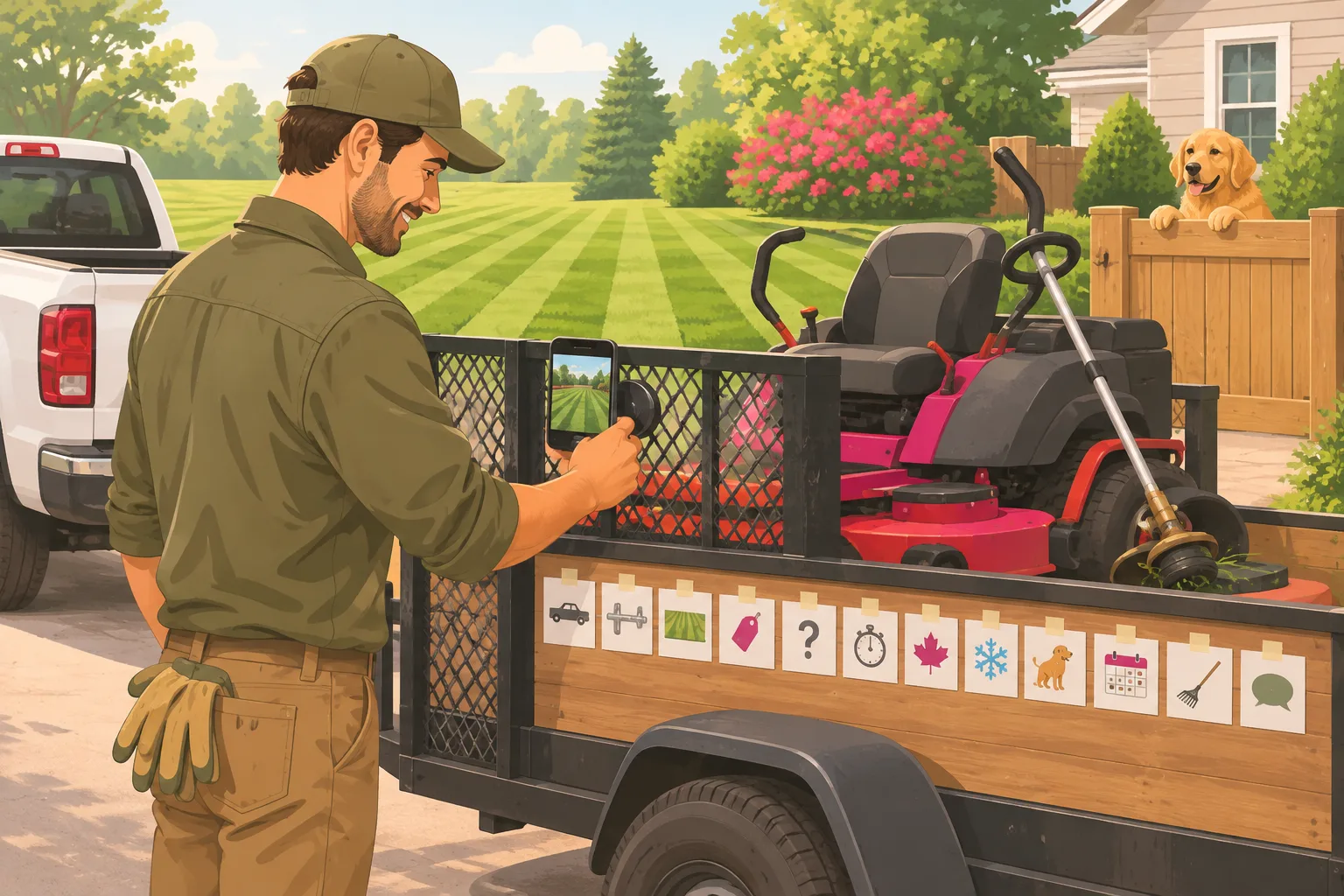
Most landscaping accounts die the same way. Someone posts the drone flyover set to a trending song, a graphic with the logo and the phone number, and a photo of the truck. It gets forty views, eleven of them from other lawn guys. Meanwhile, that same week in March, a woman three streets from your Thursday route collected three quotes. One was a number with no explanation. One was "it depends." One never called back. She picked the number, because it was the only thing anyone told her. The ninety-second video that shows what a visit looks like and says what it costs would have won her before the other two picked up the phone, and added a stop three doors from one you already have.
You don't have a content problem. You have a capture problem - you are on a mower from seven to five - and a worry, which is a correct one, that the families who hired you to cut the grass did not hire a film crew. Both are true. But the route you run every week, the questions people ask before they sign up, the year that turns on a few short windows, and the price nobody in the trade has ever explained are an endless video supply. Every idea below is filmed at a yard whose owner said yes in writing, by you and the one other person who agreed to be on camera, with the kids, the neighbors and the address out of frame.
This guide is the vault: 52 landscaping and lawn care TikTok content ideas, sorted into the six formats that actually fill a route - the visit, the transformation, the "what it costs and why" explainer, the question answered, the drive-by, and the honest week. It also covers the hooks that open on the yard instead of the customer, the route-day capture system that keeps the well full, the timing laid over the landscaping year, and which ideas travel to anyone anywhere versus which ones bring the house three doors down. New here? Start with our complete TikTok guide for landscapers and lawn care companies for the full strategy, then come back for the ideas.
Three rules before you film any of these
- One yard, one video. "A day in the life of a lawn crew" is a montage nobody finishes. "Why a quarter-acre lawn here is fifty-five dollars a cut" is a video. Narrow always wins, and it means one Thursday route becomes a week of posts instead of one.
- The yes, the kids, the neighbor, and the address. That is the whole consent test. Customers are never content, and neither is their property without a yes. The yards on camera are the two or three whose owners ticked a box in the service agreement - call them the yes-card yards. The box says what can be filmed (the lawn, the beds, the dog if they want) and what never can (their faces, their kids, the house number, anything through a window), and it can be taken back with a text. Kids are never in a video, even waving in the background. The neighbor's yard and the neighbor are never in frame. And the address is never on the platform: no house number, street sign or mailbox, and no "the blue house by the school." Every one of the 52 ideas below passes that test.
- Hook on the yard, never the customer. "Twenty-three minutes, start to finish. Here is where every one of them goes" brings the homeowner three streets away to your quote page. The "wanted me to do it for thirty dollars" clip, the "look at the yard they let go" reveal, and the dramatic reading of the non-payer's text fill your comments with lawn guys who will never hire you, and teach the woman collecting quotes that her yard, her questions and her budget will be content. Conviction can be the fourth sentence. The first one is the yard.
What's Inside
- 1. The Route and the Question Log (Why You Never Run Out)
- 2. Hooks First: The Yard, Never the Customer
- 3. Visits: The Format That Answers "Will They Show Up?" (8 Ideas)
- 4. Transformations: The Volume Source (10 Ideas)
- 5. "What It Costs and Why": The Format That Is the Whole Decision (10 Ideas)
- 6. Questions Answered: The Format That Earns the Trust (10 Ideas)
- 7. Drive-Bys and Countdowns: The Share Source (8 Ideas)
- 8. Honest Weeks: Last on Purpose (6 Ideas)
- 9. The Capture System: A Week of Posts From One Route Day
- 10. Timing: Which Ideas to Post in Which Month
- 11. Which Ideas Travel, Which Ideas Fill the Route, and What to Do When One Takes Off
- Frequently Asked Questions
1. The Route and the Question Log (Why You Never Run Out)
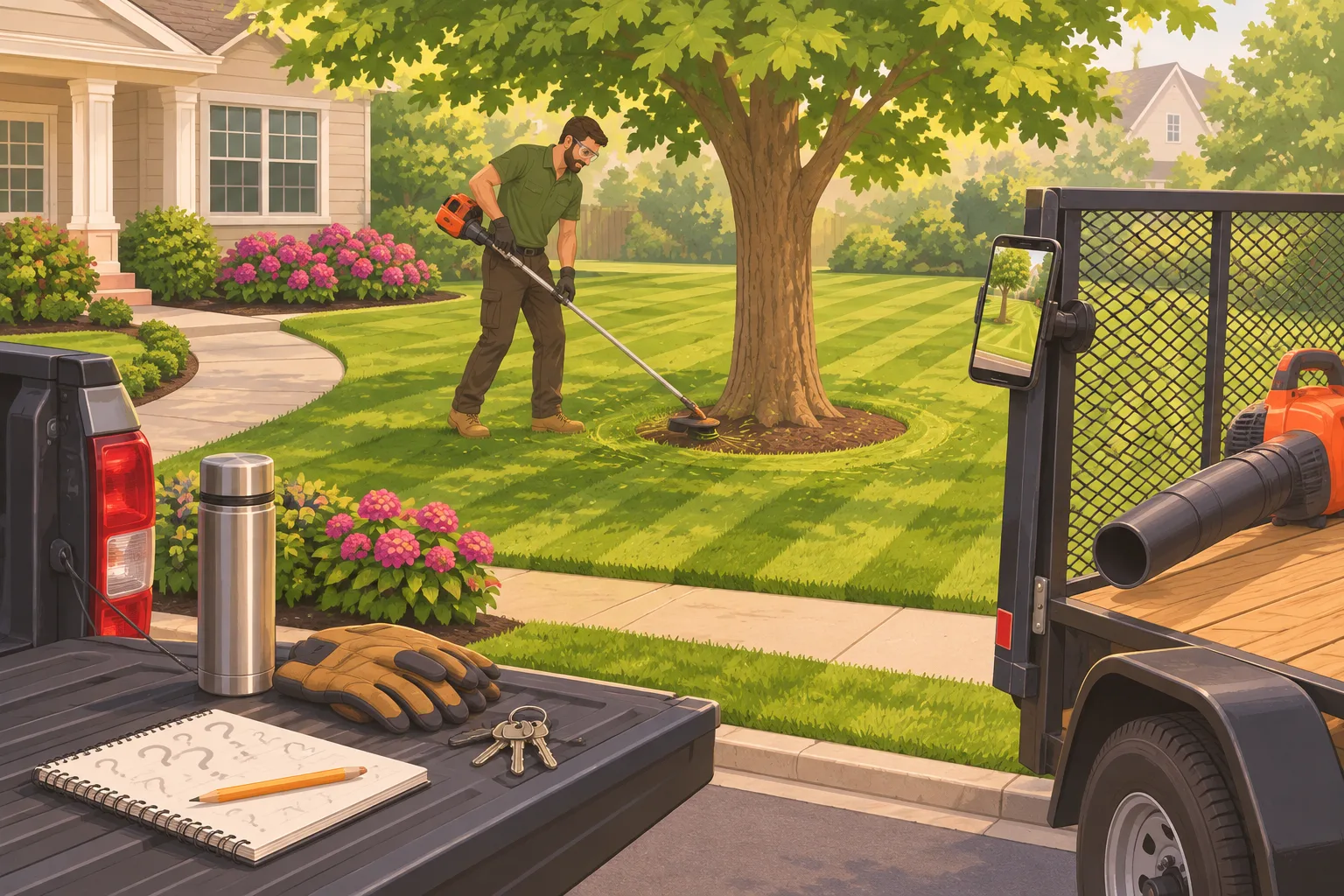
Nearly every idea in this guide comes from two sources, and you already own both. The first is the route. Every Thursday the truck is in the same yards, in the same order, doing the same work: the gate, the mow, the trim, the edge, the blower, the gate again. It happens on a schedule, and a handful of those yards belong to customers who have already said yes to a camera. You do not make videos. You film the route you were going to run anyway, and cut it on Sunday night.
The second is the questions people ask you. In the quote request, in the half-second before they decide whether fifty-five dollars is too much. In the "quick question" text the night before the first visit. In the comment that starts "wait, do you." And in the owner's own head, where there is a list called "people always ask me" that has never once been written down.
Each of those questions has already passed the only test that matters. A real person cared enough to ask it. For every one who asked, dozens stood at the window, watched a truck go past, wondered the same thing, and hired whoever said a number first. The company that answers plainly and kindly becomes the one they picture when the grass starts growing - and in most towns, no company answers at all.
So before the lists below, build the habit that makes them infinite: the question log. One running note on the company phone. Every time a customer, a commenter, or a caller asks something, write it down word for word - "do I have to be home?" - not in your framing - "service access policy." Their phrasing is your hook. Your framing is the answer. One line in the note next to it: the question is content, and the person who asked it never is.
Thirty logged questions is roughly a quarter of content. And the log refills faster than you can empty it, because answering questions on camera fills your comments with new ones. That loop - answer, harvest, answer - is why some companies post easily for years while the competitor across town runs dry by the second week of April.
Use the 52 ideas below as your starter log. The examples lean on one company because it is easy to picture: one truck, one trailer, a zero-turn, a trimmer and a blower. Luis owns it. He mowed his first lawn for twenty dollars at sixteen, this is his eleventh spring, and he runs the company phone. Teo has run the trimmer for four of those springs, and agreed to be on camera on a one-page agreement they sign every year. They work two towns - one side on Thursdays, the other on Tuesdays - and do weekly mowing, spring cleanups and mulch. They do not spray. The Thursday route has thirty-eight stops and needs sixty to be a full day. A quarter-acre lawn is fifty-five dollars a cut and takes the two of them twenty-three minutes.
Every number in that paragraph is an illustration, and every idea adapts - to a solo operator with a push mower, a five-crew company, a design-build shop, or a snow-and-lawn outfit. Swap in your own route and your own prices, then let your real question log take over.
2. Hooks First: The Yard, Never the Customer
A great idea with a weak first two seconds is a video nobody sees. For a lawn company the first two seconds carry extra weight, because the person you most want to reach is wary. She is wary about whether you will show up, about what it really costs, about strangers with machines where the dog is, and about the guy who mowed twice last year and vanished. The hook either disarms that or confirms it. Never open with the company name, the logo, or how many years you have been in business. Those belong in your bio and at second twelve, once someone has a reason to care who is talking.
Hook patterns that work for every idea below
- The price, named first: "A quarter-acre lawn here is fifty-five dollars a cut. Here is where every dollar goes." You said the thing she was going to ask in the comments. She exhales, and she watches.
- The clock: "Twenty-three minutes, start to finish, and here is where every one of them goes." A number of minutes is a promise a homeowner can check from her window, which is exactly why it works.
- The honest answer: "Do you have to be home? No - and here is exactly what happens when you are not." The family that has been burned by a no-show and the one that has never hired anyone both keep watching.
- The person: "I mowed my first lawn for twenty dollars at sixteen. This is my eleventh spring. Teo has run the trimmer around that maple for four of them." One owner, one yard, one question. Never a montage.
- The permission: "You do not have to move the hose, pick up the dog toys, or be home. Here is what we actually need from you, and it fits in one text." The strongest opening in the trade, because every homeowner arrives braced for a list of things she is supposed to do first and a judgment about the flower beds.
And the hook your account must retire, no matter how well it performs: the clip that is really about the customer. "Wanted me to do it for thirty dollars." "Look at the yard they let go." The "asked us to move the trampoline" skit. It travels. It gets numbers. It also fills your comments with other lawn guys who came to commiserate, and trains the algorithm to show your next video to the trade instead of to the homeowner. Its cousin, the neighbor-shaming clip - "our stripes versus the guy next door's" - insults a homeowner you have never met in front of the one you have. And the grievance post - gas prices, the HOA, "nobody wants to work anymore" - reads as a warning taped to the truck. Our pillar guide covers why the yard beats the customer in full.
Then answer fast. Give the point in the first eight seconds and spend the rest on the why, the exception, and the part people get wrong. Completion rate is the signal that decides whether the algorithm carries your video past your existing followers. And never tease: "DM for pricing" reads as a pitch and kills the video. Say the number. The homeowner who wants a quote will still find the link, and she will arrive already trusting you. For the full mechanics, see our TikTok algorithm guide.
3. Visits: The Format That Answers "Will They Show Up?" (8 Ideas)
The conversion video of the trade, and the one almost no lawn company has ever filmed. A homeowner with three quotes on the counter runs the list: will they actually come? what do they do when they get here? what about the dog? do I have to be home? what does it cost? The visit - the truck at the curb, the gate, the mow, the trim, the edge, the blower, the gate again, ending with the time and the price said out loud - answers all of it in ninety seconds. It is the lawn version of what the one-job trades build with their estimate walk-through, except your customer is not buying one job. She is buying every Thursday until November.
Make one per service and re-film it each spring, at a yes-card yard, so there is nothing in the frame that the owner did not agree to. Pin the weekly one. Two rules travel with every visit video. The phone points down the lawn, never at the house and never across the fence. And the frame never holds a house number, a street sign or a mailbox. Name the two towns and the day. Show the lawn and the truck. These are the videos worth money in late February, because they only make sense to someone who lives where your truck already drives - which is exactly who fills the route.
- 1. The visit, from the curb to the text. The truck at the curb at ten past eight. The gate checked and latched behind the dog, said out loud. The mow in time-lapse with the stripes appearing. Teo around the maple. The edge along the walk. The walk and the driveway blown clean. The gate latched again. The photo of the finished lawn texted from the driveway. Then: "twenty-three minutes. Fifty-five dollars, every Thursday, April to November. You don't have to be home." Pin it. Everything else in this section is a variation.
- 2. The spring cleanup visit. The same structure for the once-a-year job: the beds raked out, the sticks and the leaves that wintered under the hedge, the edges re-cut, the first mow. End on the time and the number - "about two and a half hours for the two of us; a yard this size is about three hundred fifty dollars." The visit video that sells the job most new customers start with.
- 3. The mulch visit. The pile on the driveway at eight, the wheelbarrow, the beds edged first, the mulch going down three inches deep and pulled back from the trunks, the driveway swept at the end. "Twelve yards, delivered and spread, is about twelve hundred dollars. Here is what twelve yards looks like." Nobody outside the trade knows what a yard of mulch is until they watch this.
- 4. Your first Thursday. What happens at a brand-new stop: the text the night before, the walk around the yard before the mower comes off, the three things Luis looks for (the gate, the sprinkler heads, anything the dog left), the first cut, the photo from the driveway. "This is what the first visit looks like. The second one is faster." The video for the person who has never hired anyone to do anything.
- 5. The visit when nobody is home. Because that is most visits. The text before the gate opens. The gate latched behind the truck. The work. The gate latched again, with a hand on it for the camera. The photo sent from the driveway. "You were at work. Here is everything that happened in your yard." The answer to the fear nobody types into the quote form.
- 6. The visit with the dog. Filmed at the yes-card yard with the sticking side gate and the golden retriever who is friendly and fast. The text, the wait for "he's in," the latch lifted and dropped, the latch checked twice on the way out. "The gate is the most important thing we do here, and it takes four seconds." Plenty of quote requests mention a dog. This is the video that answers them.
- 7. The fall visit: aeration and overseeding. The machine, the plugs on the lawn, the seed going down, what the lawn will look like for two weeks and why that is fine. "About an hour; about three hundred dollars for a quarter acre. Here is what it buys you in May." Film it in September and post it the next August, when people are deciding.
- 8. What we need from you, and it fits in one text. The permission hook as a whole video. In a driveway, with the trailer behind you: "You do not have to move the hose. You do not have to pick up the dog toys. You do not have to be home. We need the gate unlocked and the dog inside on Thursdays, and that is the whole list." Post it the week before the route opens.
4. Transformations: The Volume Source (10 Ideas)
The format every lawn company already has the raw material for, and the one most ruin by turning it into a montage with a song or a jab at whoever let the yard go. A transformation clip is forty seconds of real work, filmed as it happens from the phone on the trailer gate, framed vertical, pointed down the lawn. One sentence to the camera when you start, one when you finish. The middle can be silent, or it can be the sound of the mower. Our job-site filming guide covers the time-lapse and framing craft.
This is the feed-path workhorse. It travels anywhere, it is what strangers and other lawn companies follow, and it is cheap, because the footage exists every route day. Strangers across the country watch the mowing genre the way they watch pressure washing. Two rules travel with every clip. The before and the after are honest: the same yard, the same spot, the same light, the same day, your work. A greened-up "after" shot a week later is a different lawn, and the platform calls it misleading. And the clip is about the grass, never about the person who owns it.
- 9. The first cut of spring, start to finish. The lawn that has not been touched since November, the first pass, the stripes arriving one lane at a time. Forty seconds cut from twenty-three minutes. The foundational clip, and the one that teaches you the format: mount it, mow it, cut it Sunday night. Save the footage - it is also next February's countdown.
- 10. The overgrown first cut. A new stop where the grass got ahead of the owner. Ask before the mower comes off, tick the box, and say one sentence about the grass and none about the person: "three weeks of growth takes forty minutes instead of twenty-three, and here is why we go over it twice." The clip that travels furthest, and the one where the tone decides everything.
- 11. Teo's edge. The line along the front walk, thirty seconds, the trimmer turned on its side, the strip of turf peeling back. Then the blower. A series, not a single - people follow for the edge the way they follow for a clean fade at a barbershop.
- 12. The stripes, and how they happen. The pattern from the street, then the reason: the mower bends the grass one way going out and the other way coming back, and the light does the rest. "Nothing is painted. Nothing is cut shorter." Travels to anyone who has ever looked at a ballpark.
- 13. The beds, before and after. One bed at a spring cleanup. Same spot, same hour: the leaves and the dead stems, then the raked soil and the cut edge. Two shots from one tripod position. The honest before-and-after in its simplest form.
- 14. Mulch going down. The time-lapse of one long bed going from grey to dark brown, wheelbarrow by wheelbarrow. No words needed until the last second: "that was two yards of the twelve."
- 15. The hedge, three years running. The same hedge, the same angle, the same week of June, three years in a row. The slow transformation nobody else has the patience to film, and the proof that you are still on the same street three years later.
- 16. The leaf cleanup. A whole lawn under leaves, the blower lines, the pile, the tarp, the lawn underneath. The most-watched fall clip in the genre and the easiest one to film, because the before is impossible to miss.
- 17. Around the maple. Teo and the trimmer, the circle at the base of the tree, never touching the bark. "The trimmer line never hits the trunk. Here is what happens to a tree when it does." Forty seconds that tell a homeowner the crew is careful without anyone saying the word.
- 18. The blades, sharpened. Six-forty in the morning at the shop, before the route. The blade off, the grinder, the balance check, the blade back on. "A dull blade tears the grass and the tips go brown. A sharp one cuts it." It travels to the trade and it quietly tells the customer why her lawn looks the way it does.
5. "What It Costs and Why": The Format That Is the Whole Decision (10 Ideas)
Nobody has ever explained a lawn price to her. She has been handed a number on a door hanger, an "it depends" on the phone, and a silence. No one has stood in a driveway with the trailer behind them and said why. Forty seconds, one thing, explained with the plainness of someone who remembers not knowing it. "It depends" is the sentence that loses the quote, every time, to the company that said a number.
Film every explainer where the thing happens - the mowing price in a customer's driveway, the mulch price next to the pile, the insurance explainer with the certificate in your hand - never from the cab with a slide. And count the right thing. A save means she is deciding. A send means she decided and is forwarding it to her husband or to the street group chat. Views are the metric that matters least here.
- 19. Why a quarter-acre lawn here is fifty-five dollars a cut. Two people for twenty-three minutes. The truck, the trailer, the mower, the trimmer and the blower, and what they cost to keep running. The insurance that covers the window if a rock goes through it. The drive from the last stop. Said in the driveway, number first. The single most important video in this vault: it is the whole decision, and it is the one she sends to whoever said "fifty-five dollars for twenty minutes?"
- 20. Why weekly costs less per visit than "whenever you can." A lawn cut every Thursday takes twenty-three minutes. One that waited three weeks takes forty and clogs the deck. Show both. The explainer that turns the weekly schedule from an upsell into arithmetic.
- 21. Why the house three doors down gets the same price. And why the house across town is asked to wait for a day the truck is already there. The drive is the cost nobody sees. "If we are already on your street on Thursdays, you are the easiest customer we could have." The explainer that makes a neighbor do the math herself.
- 22. What moves the number. Size, slope, a fence with a narrow gate, and every-other-week. Four things, shown on four real stretches of lawn at a yes-card yard. "Text me a photo of the front and the back and I will have a number to you within the hour." This is the honest version of "it depends."
- 23. What a spring cleanup costs, and what is in it. About three hundred fifty dollars for a yard this size: two people, two and a half hours, the beds, the edges, the hauling, the first cut. And what is not in it - the mulch, the pruning of anything taller than Teo. Said standing in the bed.
- 24. What twelve yards of mulch costs. About twelve hundred dollars delivered and spread. What a yard is. How far twelve of them go - roughly thirteen hundred square feet of beds at three inches deep. Why three inches and not six. Said next to the pile, with a shovel in it for scale.
- 25. What "licensed and insured" actually means. The business license and the liability certificate, held up, with the numbers covered. What it pays for when a rock leaves the mower. And the plain sentence most companies skip: "we do not apply weed control or fertilizer, because in most states that takes a separate license, and here is who we send people to."
- 26. Why aeration is about three hundred dollars, and why September. The machine, the hour, the seed, and the reason the calendar matters for the cool-season lawns most of the northern half of the country grows: warm soil, cool air, fewer weeds competing. If your region grows warm-season grass, say what yours needs and when. The explainer that sells the fall in August.
- 27. Why we ask "how did you find us?" and "same Thursday next year?" The renewal explainer. The last week of the season, one message: "your Thursday spot is yours for next year until the fifteenth of February - want to keep it?" Said in the driveway as the plan it is, not an upsell. It makes the most important message of the year feel like care, because it is.
- 28. The whole season on one page. About thirty cuts from April to November at fifty-five dollars is a little over sixteen hundred dollars. Add the cleanup if you want it, and the aeration if you want it. "Here is the entire year, added up, before you sign anything." The explainer for the customer who budgets, which is most of them.
6. Questions Answered: The Format That Earns the Trust (10 Ideas)
Real questions from the quote requests, the night-before texts and the comments, answered honestly in your own voice by the person who actually answers them. This is the format that earns the trust instead of asserting it. "Reliable, professional service" is a door hanger. "What happens when it rains on Thursday? Here is the text you get" is a company. Film them where the answer lives - the dog question at the gate with the latch in your hand, the clippings question at the mower deck, the season question on the lawn - and take one question per video, never a list.
The first ten are below. Your real log will overtake them by Memorial Day. Three of them are also your saved replies, which the pillar guide's customer ladder covers - once the video exists, the reply is a link and a sentence, inside the hour.
- 29. "Do I have to be home?" No. The text before the gate opens, the work, the gate, the photo from the driveway. Thirty seconds at the gate. The most-asked question in the inbox deserves the most literal video on the account.
- 30. "What about my dog?" The text, the wait, the latch. What happens if the dog is out when the truck arrives - you skip the back, text, and come back at the end of the street. Filmed at the gate with the retriever on the other side of it. The single most trust-building thirty seconds a lawn company can post.
- 31. "Do you bag the clippings?" Mulched back into the lawn, except the first cut and the last, and here is why - the clippings are free fertilizer when they are short and a mat when they are long. Filmed at the deck with the chute in your hand.
- 32. "What happens when it rains?" Thursday becomes Friday, or Monday if the week is a washout, and you get a text either way. Why you do not mow wet - the ruts, the clumps, the torn grass. Filmed on a damp morning, with the trailer still loaded.
- 33. "What do you spray?" "We don't." Then the reason, said without apology: in most states, putting down weed control or fertilizer for pay takes a state applicator license, and you would rather send people to someone who holds one than guess. Name the kind of company to call. The answer that sounds like a limitation and reads as honesty.
- 34. "When does the season start?" The week of the fifteenth of April, give or take the weather, and here is what decides it - the grass, not the calendar. When the last cut usually is. Filmed on the brown March lawn, pointing at it.
- 35. "How much to mow my yard?" The quarter-acre number, the two things that move it, and "text me a photo of the front and the back." This is the video form of your first saved reply. It is the one you link when the question arrives at nine on a Sunday night.
- 36. "Are you taking new customers?" Yes or no, out loud, and the day that has room: "Thursday on this side of town has spots. Tuesday on the other side has more." Re-film it the day the answer changes. A company that says where it has room sounds like a company that is busy.
- 37. "Can you also take down the dead tree?" No, kindly, and here is who can: a tree that size needs a climber and different insurance. The same shape answers "can you do it for thirty?" - fifty-five, because two people and twenty-three minutes and the truck has to get there. Never a yes you regret in July. Never a lecture.
- 38. "Will it be the same people every week?" Luis and Teo, every Thursday, and what happens the one week a year one of them is out. Both of them in the frame, at the trailer. The question behind every other question: who, exactly, is going to be in my yard?
7. Drive-Bys and Countdowns: The Share Source (8 Ideas)
The drive-by is twelve seconds of the finished lawn the way the neighbor sees it - the stripes, the edge line, the sidewalk blown clean, the truck pulling away - with almost no words. It is the share source of the whole trade. A lawn company is chosen by one household and recommended to six. When the street group chat asks "who does your lawn?", the drive-by is what your customer sends with "these guys." Shoot one at every yes-card yard, every week, because the light is never the same twice.
The countdown lives here too, because a lawn with a date attached is a reason to follow: "the route opens Monday," "fall cleanups start when the maple turns." One rule for both: frame the lawn and the truck, and keep the house number, the mailbox and the street sign out of the shot. If you cannot get the lawn without them, shoot from the driveway instead of the street.
- 39. The drive-by. Twelve seconds from the truck window or the curb as you pull away: stripes, edge, clean walk. No voice, or one line - "Thursdays, this side of town." Every yes-card yard, every week. The clip your customers will send for you.
- 40. One lawn, four seasons. The same lawn from the same spot: the brown of March, the first stripes of April, the deep green of June, the leaves of October. Four clips shot across a year and cut into fifteen seconds. The series strangers follow, and the one that shows a homeowner you will still be here in the fall.
- 41. "The route opens Monday." The countdown that matters most. Late February, last April's first-cut footage behind your voice: "Thursdays on this side of town still have room. The first cut is the week of the fifteenth." Re-post it weekly until the day fills. If one video in this vault is worth money, it is this one or idea 1.
- 42. "Thursday is full. Tuesday has four spots." Posted the day it becomes true, from the driveway of the last stop. A full route day said out loud is the best advertisement a lawn company has, and it moves the people who were waiting onto the day that still has room.
- 43. "Fall cleanups start when the maple turns." The same maple Teo trims around, filmed the first week its top goes orange. "When this tree is bare, we are on your street with the blowers. The list is open." A countdown with a tree for a clock.
- 44. "Here is what May looks like if we do this in September." Last September's aeration footage, then this May's lawn, the same yes-card yard, the same spot. Posted in August. The countdown that sells a job nobody thinks about until it is too late to book.
- 45. "Your Thursday spot is yours." The last week of the season, the last drive-by of the year, and the renewal said to the camera: "if we mowed for you this year, your day is yours for next year until the fifteenth of February. Check your texts." The public half of the most important message you send.
- 46. The December receipt. What this year actually did, said once, in the empty shop: how many lawns, how many Thursdays it rained, the one thing you changed because a customer asked. No ask. The video that makes next February's countdown land with people who already know you keep count.
8. Honest Weeks: Last on Purpose (6 Ideas)
The format that makes a company a person, and the one to use least. An honest week is the thing that went wrong, told once, after it is fixed: said, not shown, in a driveway or at the shop, by the owner. It is never a customer's story. It is never an ask. And it is last on this list on purpose - one of these every month or two is plenty, and an account made of them is a complaint.
Why bother at all? Because the wound in this trade is the guy who mowed twice and vanished. A company that says "the mower broke on Thursday, here is what we did about it" is answering that fear directly. Nobody expects a lawn company never to have a bad week. They expect to be told.
- 47. The belt that snapped with nineteen lawns left. What broke, what time it was, who got a text, and the Saturday you spent catching up. "Every one of those nineteen was cut by Saturday at noon." Told the week after, never during.
- 48. The week Thursday became Monday. Four days of rain, the route pushed twice, the texts that went out each morning. What a washout week does to a schedule, and what you would rather do than rut a wet lawn. The honest companion to idea 32.
- 49. The lawn I burned in year two. Luis, in first person: the fertilizer he put down in the heat before he knew better, what it did, what he paid to fix it, and why the company has sent that work to a licensed applicator ever since. The story is his and the lawn is not shown. It is also the best possible answer to idea 33.
- 50. The June I ran the route alone. The summer a helper quit with no notice - no name, no blame - and what a full Thursday looks like with one person. "That is the year I learned to hire for October, not for April." Tell it only about a season that is long over.
- 51. The winter I almost sold the trailer. The year the numbers did not work, the job offer, and the reason he said no. One take, at the shop, in January. The video that the customers who have been on Thursdays for years will answer in the comments, which is the point of it.
- 52. The day the town needs a straight answer. The hailstorm, the flood, the windstorm that put a tree across every third street. One video, one person, in a driveway: what you are doing, which streets you will reach on which day, and nothing for sale. No transformation clip that week. Decide now who posts it.
9. The Capture System: A Week of Posts From One Route Day
Fifty-two ideas is a year of weekly posts, or four months at three a week - before a single new question lands in the log. But notice how few of them need a new plan. The Thursday route is ideas 1, 5, 6, 9, 11, 17 and 39 before anyone has had to invent anything. A price change is 19 re-filmed. A new question in the inbox is a thirty-second answer at the gate. The route is the content calendar.
Then the route-day capture list, which takes about twenty minutes spread across a day you were already working. The phone goes on the magnetic mount on the trailer gate before the mower comes off, at the yes-card yards only. One visit, start to finish. One drive-by at each of those yards as you pull away. One explainer in the driveway, once a season or when the price changes. One question from the log, one answer, filmed where the answer lives. And every spring, ninety seconds of the first cut, which is next February's countdown. Sunday night, one hour, is when it all gets cut. The pillar guide has the full route-day capture list.
Once a season, on a rain day when the route is pushed anyway, stand Luis in the shop with the trailer behind him and film ten answers from the question log back to back. Same spot, same thermos, one take each. Together that is roughly five weeks of posting from one wet morning.
Last, one person owns the company phone, and the rule is written down. Who posts. What goes up without asking: the transformation at a yes-card yard, the drive-by. What gets a look first: any price, anything with a neighbor's property in the background, anything a customer said, the honest week, anything that shows a street sign. What never goes up: a customer, a kid, a house number, a yard without a yes, a review with a name. And the line that matters most on the day it matters - who owns the handle and the followers when the helper who posts moves on or the company is sold.
Two more lines belong in that rule. The owner's own account is not the company's: the mower reviews and "how I priced my route" live on Luis's account, and a homeowner looking for the Thursday price should never have to scroll past a video about deck sizes to find it. And rain mode is a real setting. A rain week that silences the account is fine - say so once. The first-cut week in April is a week to film everything and post the drive-bys, not to post daily. A silent February is the one thing the account cannot afford.
The rule that keeps all of this safe: the yes, the kids, the neighbor, and the address. Customers are never content, and neither is their property without a yes in writing - one line in the service agreement with a box, covering the lawn and the beds and never their faces, their kids, the house number or anything through a window, and revocable with a text, with the clips down within the week. The doorbell camera pointed at your truck is theirs, not yours. A customer's own video of your stripes is hers - ask before reposting it, and ask again before promoting it. A review is quoted only in her words, never her name or her street. Teo is on camera because of a one-page agreement signed every year that says what he appears in, what he is paid, and, on its own line, whether his footage can be promoted. Kids are never in a frame. The neighbor's yard and the neighbor are never in a frame. If you fly a drone for the business, the FAA treats that as commercial flying that needs a remote pilot certificate, paid or not. A business account's in-app sound picker only offers the Commercial Music Library, so use it, or the sound of the mower. This is a general overview, not legal advice - the pillar guide's compliance section has the license, privacy, price and platform rules in detail, and when in doubt, leave the person and the property out. Every one of the 52 ideas can be filmed at a yard that said yes, by the two people who chose to be on the account.
10. Timing: Which Ideas to Post in Which Month
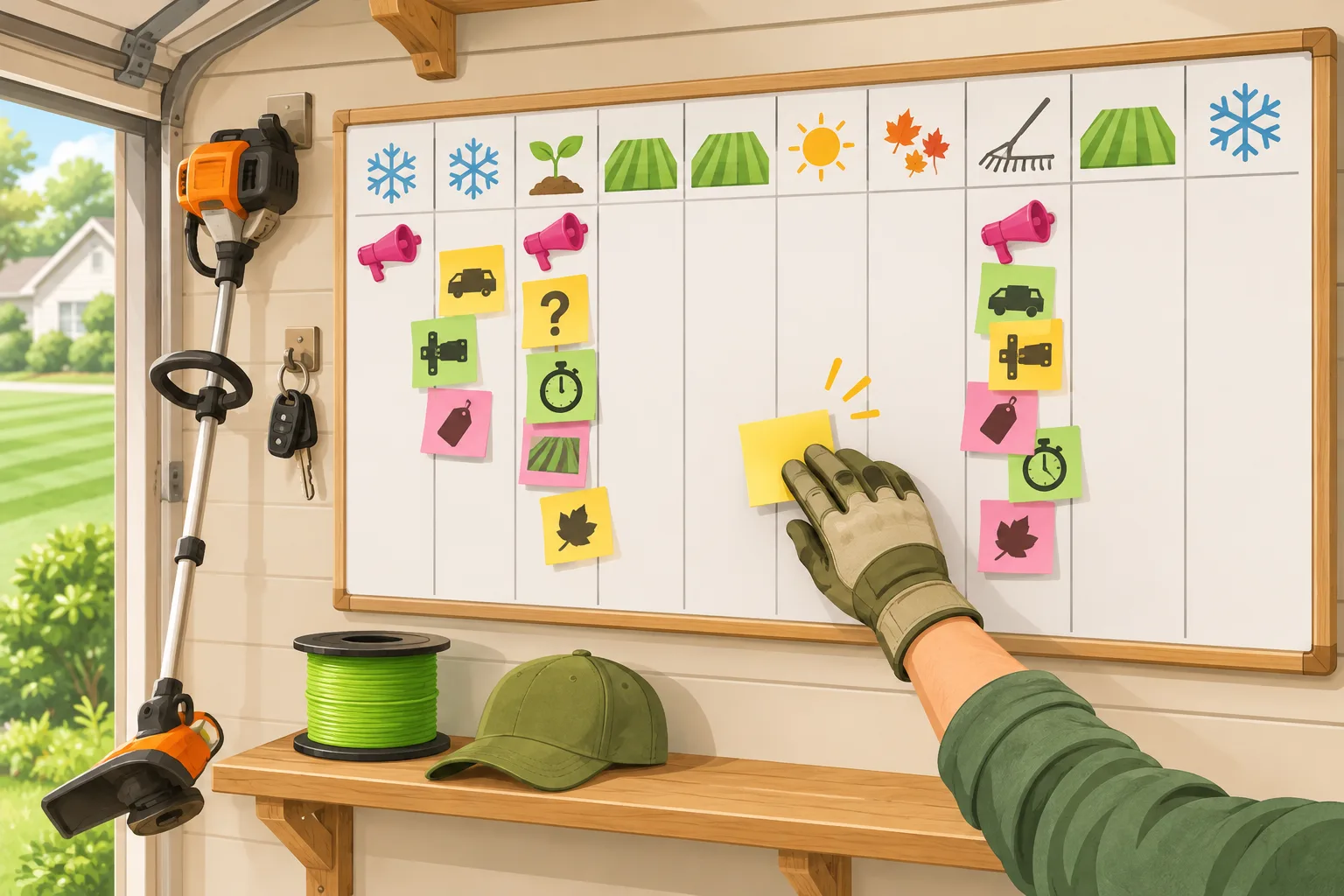
Almost nobody hires a lawn company on a random Tuesday in July. They decide at a moment - the last grey weeks of winter, the first warm weekend, the August evening when the lawn looks tired - and the difference between this trade and nearly every other is that your moments are on the calendar a year out, they are short, and people decide before them. Search interest for nearly every landscaping and lawn care term peaks in March. The route is decided once a year, in about six weeks, and almost never changed until the next spring.
So the video that fills the route is not posted in May, when the truck is already full and every company in the county is posting stripes at once. It is posted in late February. Build in the quiet weeks for the full ones. Here is the vault laid over the landscaping year, by idea number.
The vault, month by month
- Late February to March: sell the route. Ideas 8 and 29 the week before the route opens - the permission video and the "do I have to be home?" answer - so homeowners arrive at the countdown already trusting you. Then 41 on the day the route opens and once a week until the day fills. Idea 1 re-cut from last season's footage and re-pinned, 19 with 20, 21 and 22 behind it, and 28 for the people who budget. Ideas 35 and 36 so every quote request can be answered with a link within the hour, and 34 because everyone asks. Ideas 2 and 3, with 23 and 24, for the cleanup and mulch jobs that book in the same weeks. If there is a paid month, this is it - section 11.
- April to June: the rush. Film everything. Ideas 9 through 14 and 17 as the work happens, 39 at every yes-card yard every week, and the first frames of 15 and 40. Idea 4 as the new stops start, then 5, 6, 30, 31, 32 and 38 as their questions come in, and 33 the week the dandelions arrive. The day Thursday fills, post 42 - and stop asking for Thursday. The first-cut footage you shoot now is next February's 41.
- July to August: the heat, and selling the fall. July is the slow month for sign-ups, so it is the month for 25, and for one honest week - 49 or 50. In August, sell the fall: 44 first, then 26, and 7 cut from last September's footage. Idea 43 goes up the week the maple starts to turn, which in some years is the last week of August.
- September to November: the fall work, and the renewal. Film 7 and 16 as they happen and post 16 the same week. Idea 37 after the first windstorm, when the tree questions arrive. Idea 27 in October, so the renewal message is expected before it lands. Then the last week of the season: 45 on the account the same day the renewal text goes to every customer, and the fourth frame of 40.
- December to January: the quiet months. Idea 46 the last week of the year. Then the feed-path season: 18 as the equipment gets its winter service, 12 and 15 from the summer's footage, and 51 once, in January. Batch the question answers on a cold morning at the shop. On the sixteenth of February, any spot that was not renewed goes into the countdown.
- The week it happens, and not before. Ideas 47 and 48 the week after the belt snaps or the rain ends. Idea 10 only when a new customer with an overgrown lawn has said yes. And 52 on the day the town needs it, and no other.
The pillar guide's landscaping calendar explains the reasoning behind each stretch. The short version: sell the route in late February and March, film everything from April to June, sell the fall in August, ask for the renewal before the snow, and film "here is what next season looks like" during the season so you have it in the quiet one. The most common failure is a year of happy customers nobody asked to renew, and an April spent re-selling your own route.
11. Which Ideas Travel, Which Ideas Fill the Route, and What to Do When One Takes Off
Here is the question most businesses never have to ask about their content ideas. A lawn company has two audiences, and they could not be further apart. The route is the most local business there is: the stop three doors down from a current customer costs almost nothing to serve, and the stop twenty minutes across town costs a truck and two people every week, forever. But the striping clip can reach a lawn guy in another state, a retiree who finds mowing videos calming, and a nineteen-year-old starting a route of his own - none of whom will ever be on your Thursday, and any of whom might buy the blades you run, the hat, or the course on how you built the route.
So the ideas above sort into two piles. Your far-away viewers are not wasted - they just buy a different thing, and they need a different scoreboard. What has to be decided is the order.
The anchors: the homeowner path
The visits (1-8), the price explainers (19-24, 26, 28), the questions about actually hiring you (29, 30, 32, 34, 35, 36, 38), the drive-by (39), the countdowns that name a day (41-45), and the receipt (46). They only make sense to someone who lives where your truck already drives, and that person is the one who fills the route.
Say the two towns and the days out loud. Point them at a quote page with the quarter-acre price, what moves it, the service area by town, your face, and "text a photo of your yard." Measure them in quote-page clicks, quotes that mention a video, renewals when you ask, and new stops within three doors of one you already had - never views. Our local business guide covers the drive-radius mechanics; for a route, draw the radius as tight as it will go.
The ones that travel: the feed path
The transformations (9-18), the explainers anyone anywhere finds interesting (25, 27), the questions with a general answer (31, 33, 37), the four-seasons series (40), and the honest weeks (47-52). They make sense to a viewer in another state, and that viewer buys only what fits in a box or a download: the blades through an affiliate link, the hat, the course, the attention of an equipment brand.
Put what ships and what teaches on the owner's own account, not the company's. Measure it in follows, saves, sends, storefront clicks and seats. If a dealer gives you a mower or a discount for the videos, say so in the video, every time, in plain words. Our TikTok Shop guide covers the shipping side.
Three habits keep the two piles from blurring. Give each video one ask, or none - most should have none. Count saves and sends, not views, because the woman who saved the visit is deciding and the one who sent the drive-by to the street chat already did. And decide which pile leads this year by answering one question: does this company need the route full, or do you already sell something to other lawn companies? The pillar guide walks through how to choose, and for most companies the honest answer is homeowner path first.
The cautionary tale is the famous-and-idle truck: a million followers from every state, comments full of lawn guys asking which mower you run, a striping video with three million views, and a Thursday route still stuck at thirty-eight stops. Every video was made for the feed. None of them named the towns, said the price, or filmed the visit. A homeowner-first account still posts Teo's edge. It just posts the visit more.
And when one takes off - because one will, usually a first cut or a price explainer - resist the urge to boost every upload afterward. The move is selective amplification: take the one video that already proved itself and pay to show it to more of the right people.
For a lawn company that means five things. Promote for followers, not a one-time quote, because a stranger will not hand over a gate code nine seconds after meeting your truck, and a follower watches the Thursday route for six weeks and texts you in February. Keep the map tight: the visit, the price explainer and the countdown belong in front of the towns the truck already drives through, as closely as the tools you use allow, because a stop twenty minutes off the route is a stop you lose money on. Do it in the weeks before the window - late February and March for the route, August for the fall - and never the first warm weekend in April, when every company, franchise and lead marketplace in the county is bidding for the same homeowner. Pause the day Thursday fills, per route day and not per account, and move the money to the Tuesday side. And measure it against what you already buy: the shared marketplace lead, the door hangers, the yard signs. The ad money came out of the same account as the truck payment and the insurance.
The arithmetic is on your side if the video is right. One weekly stop is a little over sixteen hundred dollars a season, and a customer who is asked to renew tends to stay for several. That is worth far more than a single mowing lead that was sold to four other companies the same minute. This is what Viryze is built for: it focuses on follower growth, and you pick the videos that have already cleared the organic threshold, so the money compounds your best video instead of rescuing a weak one.
Our Spark Ads guide covers the format to default to, since it promotes your real post with its comments intact. Four limits come with you. A before-and-after in a promoted video is an advertised claim, so it is the honest one: same yard, same angle, same light, same day, your work. A promoted video that mentions weed control or fertilizer is advertising a service that needs the applicator license behind it. A promoted "we're hiring" post is an employment ad, which TikTok treats as a special category in the US: you declare it, you lose age, gender and ZIP-code targeting, and you write about the job, never about who should apply. And the customer whose yard is in the video gives a separate yes before a dollar goes behind it, the same way Teo's agreement names promotion on its own line. The safest videos to amplify are the visits and the explainers filmed at a yes-card yard with nobody in them but the two of you, which is most of this vault.
Frequently Asked Questions
What should a landscaping or lawn care company post on TikTok?
Six formats cover nearly everything that grows a landscaping account and fills a route: the visit, filmed from the truck at the curb to the photo texted from the driveway, ending with the time and the price said out loud (the conversion video - one per service, re-filmed each spring, pinned); the transformation, the first cut, the cleanup or the edge filmed from a phone on the trailer gate (the volume source); the "what it costs and why" explainer in a customer's driveway with the trailer behind you ("why a quarter-acre lawn here is fifty-five dollars a cut"); the question answered word for word from your quote requests ("do I have to be home? No, and here is exactly what happens when you are not"); the drive-by, twelve seconds of the finished lawn the way the neighbor sees it, which is the video a customer sends when the street group chat asks who does her lawn, plus the countdown ("the route opens Monday"); and, last and least often, the honest week told once - said, not shown, never a customer's story, never an ask. Retire the drone flyover with a trending song, the logo-and-phone-number graphic, the photo of the truck, and every clip that is really about a customer.
How does a lawn care company come up with TikTok content ideas without filming customers?
By treating the route as the content calendar and keeping a question log. You are in dozens of yards every route day, and the footage exists on a schedule - but only two or three of those yards are on camera: the ones whose owners ticked a box in the service agreement that says the lawn and the beds can be filmed and their faces, their kids and the house number never can. The phone goes on a magnetic mount on the trailer gate before the mower comes off, pointed down the lawn and never at the house or across the fence, and one route day is a week of posts: a visit start to finish, a drive-by, a price explainer in the driveway, and one question answered where the answer lives. The question log is a note on the company phone where every quote request, every "quick question" text the night before a first visit and every comment that starts "wait, do you" goes, word for word - each one is a pre-validated video because a real person cared enough to ask. Every one of the 52 ideas here can be filmed at a yard that said yes, by the two people who chose to be on the account.
Can I film a customer's yard for TikTok?
Only with a yes in writing, and only the parts the yes covers. A yard is private property, and the family that hired you to mow it did not hire a film crew. The simplest version is one line in the service agreement with a box: the lawn and the beds can be filmed, the dog if they want; their faces, their kids, the house number and anything through a window never can; and the yes can be taken back with a text, with the clips down within the week. Kids are never in a video, even waving in the background. The neighbor's yard is never in frame without the neighbor's yes, and the neighbor himself never is. The address is never on the platform - no house number, street sign or mailbox, and no "the blue house by the school." Name your two towns and the day you are there, and show the lawn and the truck. If you ever want to put money behind a video, that is a separate yes. This is a general overview, not legal advice.
Should a landscaper say prices on TikTok?
Yes - the price is the whole decision, and almost nobody in the trade says it. A homeowner collecting quotes usually gets one number with no explanation, one "it depends," and one silence. The company that says "a quarter-acre lawn here is fifty-five dollars a cut, weekly, and here is where every dollar goes" wins the comparison before the other two have called back. Say the number for a typical yard, say the two or three things that move it (size, slope, a fence, every-other-week), and tell people to text a photo of the front and the back for an exact number within the hour. The price in the video has to be a price people actually pay - a "starting at" number nobody gets is bait, and in a promoted video it is an advertised price. The numbers in this guide are illustrations; national guides put a quarter-acre mow at very roughly forty to fifty-five dollars a visit and more in expensive regions, so say your own.
When is the best time of year for a landscaping company to post on TikTok?
In the weeks before each window, not during it. Search interest for nearly every landscaping and lawn care term peaks in March, because a mowing route is decided once a year in a short late-winter window. So the route is sold in late February and March: the visit video re-cut from last season's footage, "here is what the first cut of spring looks like" shot last April, the price explainer, and the countdown with the date said out loud. April through June is the rush: film everything, post transformations and drive-bys, and the day a route day fills, say so - "Thursday is full; Tuesday has four spots." Fall work - aeration, overseeding, leaf cleanup - is sold in August. The last week of the season, every customer gets the renewal message: "your Thursday spot is yours for next year until the fifteenth of February - want to keep it?" December and January are the quiet months: the receipt, the equipment series, and the first-cut countdown.
How often should a lawn care company post on TikTok?
Three posts a week from the route you were already running - Tuesday, Thursday, Saturday: one for the homeowner path, one for the feed, one drive-by or countdown - sustained through the year, beats a burst of daily posting that dies the first full week of May. Twenty minutes of capture on a route day and one hour on Sunday night is a week of posts. One person owns the company phone and the rule is written down: who posts, what goes up without asking (the transformation at a yard that said yes, the drive-by), what gets a look first (any price, anything with a neighbor's property in the background, anything a customer said, the honest week, anything that shows a street sign), what never goes up (a customer, a kid, a house number, a yard without a yes, a review with a name), and who owns the handle and the followers when the helper who posts moves on or the company is sold. Rain mode is a real setting: a rain week that silences the account is fine. A silent February is not.
Ready to turn your best visit video into customers who keep their Thursday?
Somewhere in these 52 ideas is the video that becomes your company's breakout - the visit from the curb to the text, or the "why a quarter-acre lawn here is fifty-five dollars a cut" explainer that half a neighborhood ends up forwarding. When it happens, Viryze helps you put that one proven video in front of more people, aimed at followers rather than a one-time quote, and timed for late February and August instead of the first warm weekend in April. Your route supplies the content. Selective amplification helps the best of it reach the homeowner who watches your Thursday for a season, texts you a photo of her yard, and keeps her spot next year.
Related Reading
- TikTok for Landscapers and Lawn Care Companies: The Complete 2026 Guide - the full strategy these ideas plug into.
- Understanding TikTok's Algorithm: What Really Matters - the ranking signals that decide which of these ideas travels.
- Contractor TikTok Content Ideas: 50+ Job-Site Video Concepts That Win Local Jobs - the sister vault for the one-job trades, from remodels to plumbing.
- Salon TikTok Content Ideas: 50+ Video Concepts That Fill the Chair - another vault built around a local audience, a national one, and a customer who comes back on a schedule.
- Airbnb TikTok Content Ideas: 50+ Video Concepts That Fill the Calendar - the vault where the map runs the other way, toward cities hours from home.
- Local Business TikTok Marketing: Get Customers in Your Area - the drive-radius mechanics behind the homeowner-path ideas.
- TikTok for Small Business: Complete 2025 Guide - the closest parallel for a one-phone operation with no marketing department.
- Spark Ads on TikTok: Creator's Complete Guide - the amplification format for the ideas that take off.