
Landscaping & Lawn Care12 min read
How Landscapers Make Money on TikTok: The Route Math, the Install, the Equipment Deal, and the Course
A plain guide to where the money is when a lawn care or landscaping business markets itself on TikTok: the six income streams ranked by what they are actually worth, why one weekly route stop is worth more than $1,600 a season, the density math that makes the house three doors down the best customer you can add, the add-on services sold to the route you already have (spring cleanup, mulch, aeration and overseeding), what to do when a follower asks for a patio, the rules for a free mower or an affiliate link, when a course makes sense and when it does not, the December receipt video, the four numbers to track, and when paying to promote a proven video is worth it.
By Ryan MitchellHead of Creator Success at Viryze

Search for lawn care business marketing advice about TikTok and most of it talks about the creators with millions of followers, brand deals and merchandise. That is a real business. It is probably not yours.
If you run a truck and a trailer in two or three towns, the money TikTok can bring you is much plainer. It is a homeowner nearby who watches you work, asks for a price, and then pays you every week for years.
This guide ranks six ways a landscaping or lawn care company can earn from TikTok, in order of what they are actually worth to a small company. The short version: the route comes first, the customers you already have come second, and everything that needs a national audience comes last.
It is one part of our complete TikTok guide for landscapers and lawn care companies, which covers the overall strategy and the rules. The last section here explains when paying to promote a video is worth the money and when it is not.
The honest summary:
- One weekly stop is the product. At $55 a cut for about thirty cuts, a single yard is roughly $1,650 a season, and a good customer stays for years.
- Where the stop is matters as much as the price. A new customer three doors from an existing one pays the same and costs you almost no driving.
- The second-best money is already on your route. Cleanups, mulch and aeration sold to current customers need no new audience at all.
- Deals, courses and merchandise are for later, if ever. They need a national audience, and they come with disclosure rules.
What's Inside
- 1. The Six Streams, Ranked by What They Are Worth
- 2. Stream 1: The Route Stop (and Why the House Three Doors Down Is Worth More)
- 3. Stream 2: Add-Ons Sold to the Route You Already Have
- 4. Stream 3: The Install (Refer It or Grow Into It)
- 5. Stream 4: The Equipment Deal and the Affiliate Link
- 6. Stream 5: The Course and the Consulting Call
- 7. Stream 6: The Hat
- 8. The Money You Do Not Spend: Hiring
- 9. The Rules When Money Is Involved
- 10. The December Receipt
- 11. What to Add, and When
- 12. The Four Numbers to Track
- 13. The Money Mistakes
- 14. When Paying to Promote a Video Is Worth It
- Frequently Asked Questions
1. The Six Streams, Ranked by What They Are Worth
To keep the numbers concrete, this guide follows one example company. Luis owns it. He has one truck, one trailer, a zero-turn mower, and a helper named Teo who runs the trimmer. They mow one side of town on Thursdays and the other side on Tuesdays.
A quarter-acre lawn is $55 a cut, weekly, and the season runs about thirty cuts from April to November. His Thursday has thirty-eight stops and needs sixty to be a full day. Your prices and your season will differ. Swap in your own numbers as you read.
Here are the six streams, in the order they matter for a company like his.
- The route stop. A new weekly customer. About $1,650 a season each, for as many seasons as you keep them.
- Add-ons sold to the route. The spring cleanup, the mulch, the aeration and overseeding, sold to people who already trust you.
- The install. The patio, the wall, the new beds. A big one-off job that you either pass to a company you trust or grow into.
- The equipment deal and the affiliate link. A dealer or brand gives you something, or pays a commission, for showing what you use.
- The course and the consulting call. Teaching other owners how you built the route.
- Merchandise. The hat.
Notice where the line falls. Streams one and two are paid by homeowners in your towns. Streams four, five and six are paid by people everywhere, mostly other lawn care owners. Those are two different audiences, and they watch different videos. The main guide's section on the two audiences explains how to choose between them.
What about TikTok paying you directly? It exists. At the time of writing, the creator payout program needs at least ten thousand followers and only pays on videos longer than a minute, and the rules change often. For a local company it is a small bonus, not a plan. One new Thursday customer is usually worth more.
2. Stream 1: The Route Stop (and Why the House Three Doors Down Is Worth More)
Start with the arithmetic, because most owners have never written it down.
- One stop, one season: $55 × 30 cuts = $1,650.
- One stop, three seasons: about $5,000, before any extra work.
- Luis's Thursday today: 38 stops × $55 = $2,090 for the day.
- Luis's Thursday full: 60 stops × $55 = $3,300 for the day.
- The gap: 22 stops. That is $1,210 more every Thursday, or about $36,000 over a thirty-week season, with the same truck and the same two people.
That last line is the whole reason to be on TikTok. No brand deal a one-truck company is likely to be offered comes close to it.
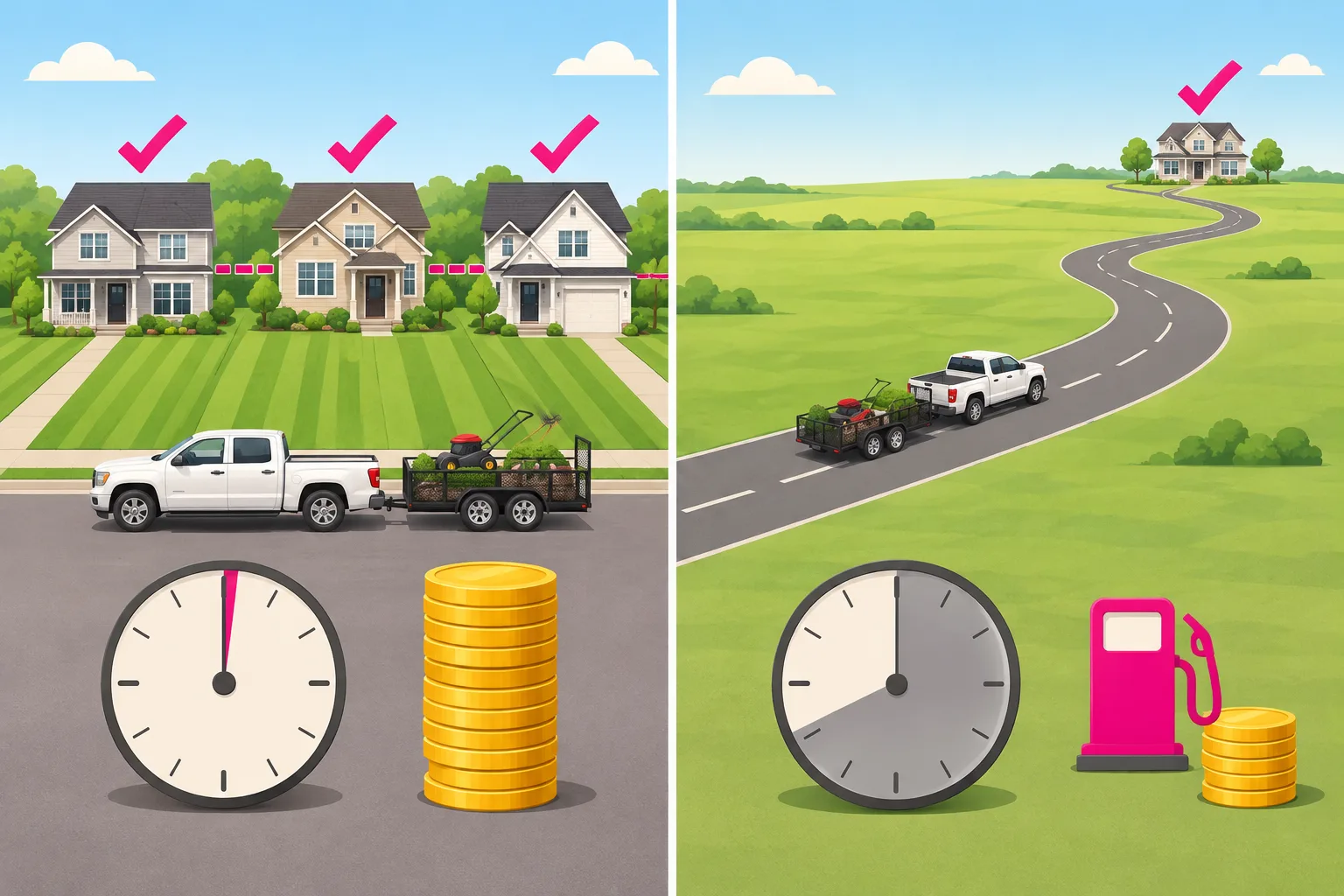
Not every stop is worth the same. Two new customers can pay the same $55 and be very different money.
- The house three doors down. The truck is already parked on the street. Adding this yard costs you the mowing time and nothing else.
- The house twenty minutes across town. Say it adds forty minutes of driving to the day, there and back to the route. Over thirty weeks that is twenty hours with two people sitting in the truck, plus the fuel, to earn the same $1,650.
This is why a lawn company's videos should name the towns and the day out loud. You are not trying to reach everyone. You are trying to reach the neighbors of the people you already mow for.
What sells a stop. Three videos do most of the work, and you may already have them.
- The visit. One full stop from the truck at the curb to the gate latched behind you, with the time and the price said at the end. It answers the question every homeowner has: will they show up, and what does it cost?
- The price explainer. "Why a quarter-acre lawn here is fifty-five dollars a cut," filmed in a driveway. The content ideas guide has ten versions of it.
- The finished lawn from the street. Twelve seconds, no talking. This is the clip a customer forwards when a neighbor asks who does her lawn.
The renewal is the cheapest stop you will ever sell. In the last week of the season, message every customer: "Your Thursday spot is yours for next year until the fifteenth of February. Want to keep it?" A customer who says yes in November is $1,650 you do not have to win again in April. Most companies never ask.
The main guide's customer ladder walks through every step from a view to a renewal.
3. Stream 2: Add-Ons Sold to the Route You Already Have
The second stream needs no new followers. It is the extra work a yard needs a few times a year, sold to the people who already let you through the gate every week.
Luis offers three. His prices, for a quarter-acre yard:
- Spring cleanup, about $350. Two people, about two and a half hours. Beds raked out, edges cut, winter debris gone.
- Mulch, about $1,200. Twelve yards delivered and spread three inches deep.
- Aeration and overseeding, about $300. About an hour, in early fall.
Here is what that can add up to. Suppose that out of his thirty-eight Thursday customers, ten take the cleanup, four take the mulch and eight take the aeration.
- 10 cleanups × $350 = $3,500
- 4 mulch jobs × $1,200 = $4,800
- 8 aerations × $300 = $2,400
- Total: $10,700, or about $280 extra for every stop on the Thursday route.
That is revenue, not profit. The mulch and the seed have to be paid for. But there was no advertising, no quote visit and no new drive. The truck was already going there.
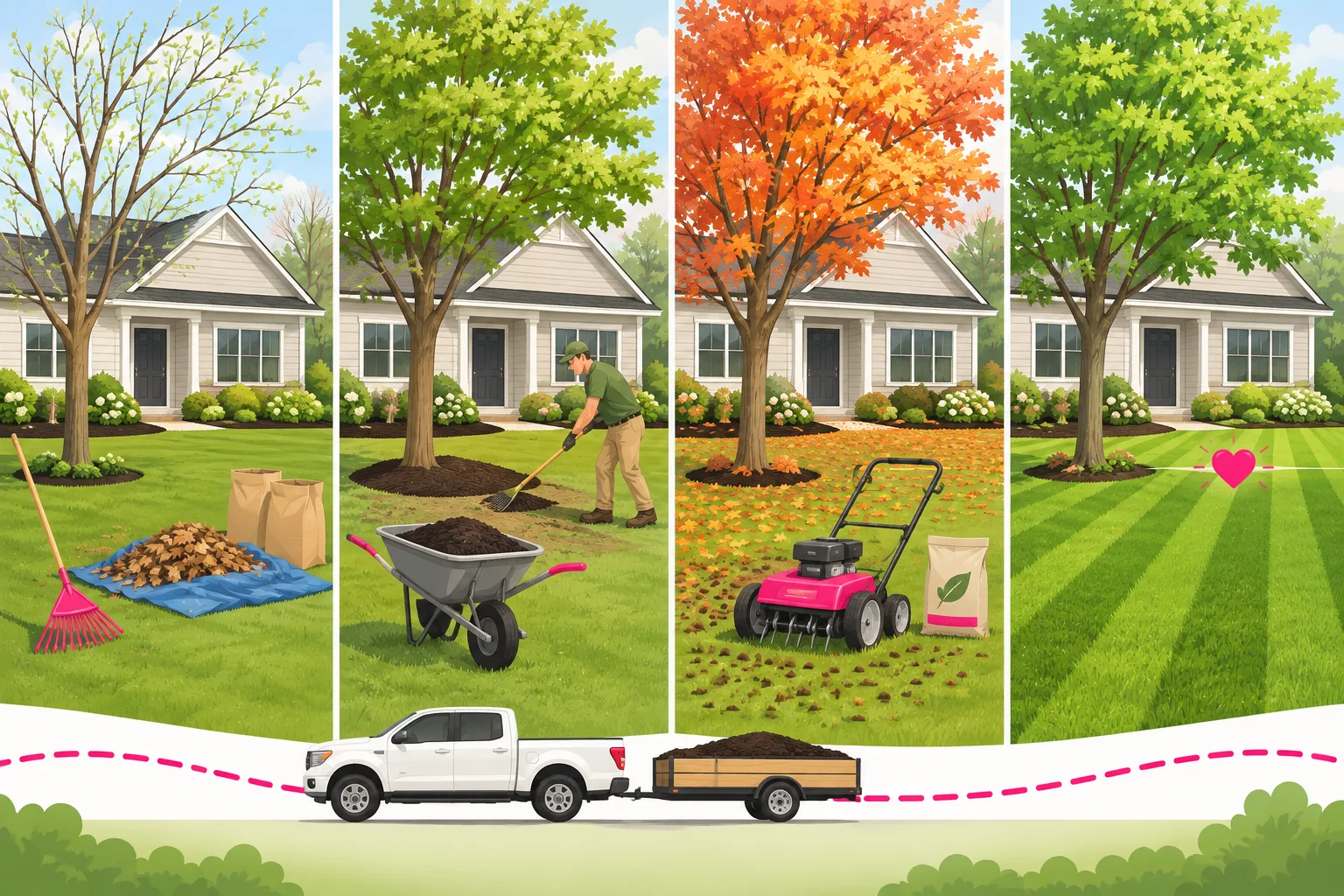
How the videos sell it. Each add-on gets its own short visit video, the same way the weekly cut does. Show the job from start to finish at a yard whose owner agreed in writing, say how long it took, and say the price.
The trick is timing. Homeowners decide on these jobs a few weeks before the yard needs them, so the video has to be filmed the year before.
- The cleanup is filmed in April and posted the following late February and March.
- The mulch is filmed in May and posted the following March and April.
- The aeration is sold in August with footage of a thick green lawn from June: "here is what your lawn looks like in May if we do this in September."
The ideas guide's timing section lists which videos to post in which month.
Then ask directly. A video warms people up. A text closes it. Two weeks after the video goes up, send each customer one message with the price for their yard and a yes-or-no question. Customers who have watched the job done on a yard like theirs tend to answer quickly.
One add-on to be careful with. Weed control and fertilizer look like the obvious fourth service. In most states, applying them for pay requires a state applicator license. Luis does not have one, so he does not offer it. He tells customers who he sends people to. If you are licensed, it belongs on this list. If you are not, do not sell it and do not film it.
4. Stream 3: The Install (Refer It or Grow Into It)
Once your videos show good work, someone will ask for something bigger. A paver patio. A retaining wall. The whole front yard redone. These jobs can run into five figures, and they are a different business from mowing.
You have two honest options.
Option one: refer it. Find one design-build company you would hire for your own yard, and send install questions to them by name. This costs you nothing and keeps the customer happy with you.
Whether you take a referral fee is your call. If you do, put it in writing, tell the customer you receive one, and check your state's rules first. Some states limit who can be paid for bringing in home-improvement work.
Many owners skip the fee and ask for something better: the installer sends the finished yard back to them for weekly mowing. A patio customer who becomes a Thursday stop is worth about $1,650 a season. That usually beats a one-time fee.
Option two: grow into it. Installs are planned in winter and built in spring, when a mowing crew is busiest. They need different equipment, different insurance, and in many states a contractor's license for hardscape or for jobs above a certain size. That is a second company, even if it shares your name.
If you want that company, start small, with new beds and plantings for customers you already have. Give install work its own series so the mowing videos keep doing their job. And do not let one patio video convince you. Three install requests in one winter is a signal. One is a compliment.
For how the one-job trades turn videos into booked work, see how contractors make money on TikTok.
5. Stream 4: The Equipment Deal and the Affiliate Link
Lawn care videos reach a lot of other lawn care owners, and they all ask the same thing: which mower, which blades, which trimmer line? That attention is worth something to the companies that make those products.
It usually arrives in one of three forms.
- The local dealer. A discount on your next mower, a loaner for the season, or free service in exchange for showing the machine. This is the most likely deal for a small account, and often the most useful.
- The affiliate link. You link to the blades or the line you already buy, and earn a small commission when someone orders through it.
- The brand deal. A manufacturer pays for videos. This mostly goes to accounts with large national audiences.
Four rules keep this stream from costing you more than it pays.
- Only what you already run. If you would not buy it with your own money, do not promote it. Other owners will buy on your word.
- Say it every time. "The dealer gave me this mower to use this season" goes in the video, out loud, near the start. Section 9 covers the rule behind this.
- Keep the right to be honest. If the deck clogs in wet grass, you get to say so. Walk away from any deal that requires praise.
- Put it on your personal account. Equipment videos attract other owners. On the company account, they teach TikTok to show you to the trade instead of to homeowners in your towns. The growth guide explains how that stalls a local account.
Keep the size in proportion, too. A commission on a set of blades is a few dollars. It takes a great many of those to equal one new Thursday stop.
6. Stream 5: The Course and the Consulting Call
Sooner or later another owner will message you: "How did you fill your route?" Enough of those and a course starts to look like easy money.
It can be real money. It has three conditions.
- The route is actually full. "How I built a sixty-stop route" is only worth buying from someone with sixty stops. If Thursday is at thirty-eight, the hours a course takes are better spent on the twenty-two.
- People are already asking. Keep a list of the questions other owners send you. When the same five keep coming, you have an outline and proof that someone wants it.
- You make no income promises. Show your own numbers and say they are yours: your towns, your prices, your seasons. Never tell a buyer what they will earn. Income promises are the fastest way to get a course in trouble with regulators and with buyers.
Start smaller than a course. A paid one-hour call is the cheapest test. Offer five of them. If they fill and the same questions come up on every call, write those answers down. That document is your course.
Like the equipment videos, this lives on the owner's personal account. A homeowner choosing a lawn company does not need to see a pitch for a pricing spreadsheet.
7. Stream 6: The Hat
Merchandise is last on the list because, for a local company, it is closer to applause than income. A few dozen hats a year is a nice thing and not a line in the budget.
Two uses do make sense.
- As a gift. A hat for the customer who has been on the route since the beginning, or for the neighbor who sent you three stops, costs a few dollars and gets worn around the towns you work in.
- As a real product, if the national audience is your business. If you have chosen to build for viewers everywhere, merchandise is one of the few things they can buy from you. Use a print-on-demand service so you are not storing boxes in the garage.
If you are still filling a route, skip it for now. It will be just as easy to add in two years.
8. The Money You Do Not Spend: Hiring
One stream never shows up as income, and it may be worth more than streams four through six combined. It is finding your next helper.
When a helper quits in June, the owner runs the route alone or pays for job ads and hopes. Either way it costs weeks. An account that has spent a year showing what the work is really like changes that.
The video is simple: "Here is what Thursday looks like." The start time. The thirty-eight yards. Who runs what. What it pays and when the day ends. Teo, if he has agreed, saying what he likes about it and what is hard.
People who apply after watching that already know the job. They tend to stay longer, because nothing about the first week surprises them.
One caution. If you pay to promote a hiring video, TikTok treats it as an employment ad, which has its own rules. You have to declare it, and you cannot aim it by age, gender or ZIP code. Write about the job, never about who should apply.
9. The Rules When Money Is Involved
Once a video is selling something, a few rules apply that do not apply to an ordinary post. None of them is hard. This is general information, not legal advice, so check anything that affects your business with someone qualified in your state.
- Disclose anything you were given. A free or discounted mower, a box of blades, a commission on a link: the FTC calls each of these a material connection. Say it in the video, in plain words, every time the product appears. A hashtag buried in the caption is not enough. Also switch on TikTok's content disclosure setting for that post.
- The price you say is the price. If the video says a cleanup is $350 for a quarter-acre yard, that is what the customer with a quarter-acre yard pays. No "starting at" number that nobody actually gets.
- Never trade for a review. "Five stars for a free cut" breaks the FTC's rule on consumer reviews. Ask every customer for an honest review and offer nothing in return.
- Show honest before-and-afters. Same yard, same spot, same day, your own work. An "after" photographed a week later, once the lawn greened up, is misleading, and more so in a video that sells a service.
- Get a separate yes for anything sponsored or promoted. A customer who agreed to have her lawn in a regular post has not agreed to have it in an ad or a brand deal. Ask again. The same goes for your helper: his agreement should name paid promotion and sponsored videos on their own line. The filming guide's section on written permission and its crew agreement have the wording.
- Use music you are allowed to use. A business account should pick from TikTok's Commercial Music Library, or use original sound. The sound of the mower works fine.
The main guide's rules section covers the rest, including licensing and drone footage.
10. The December Receipt
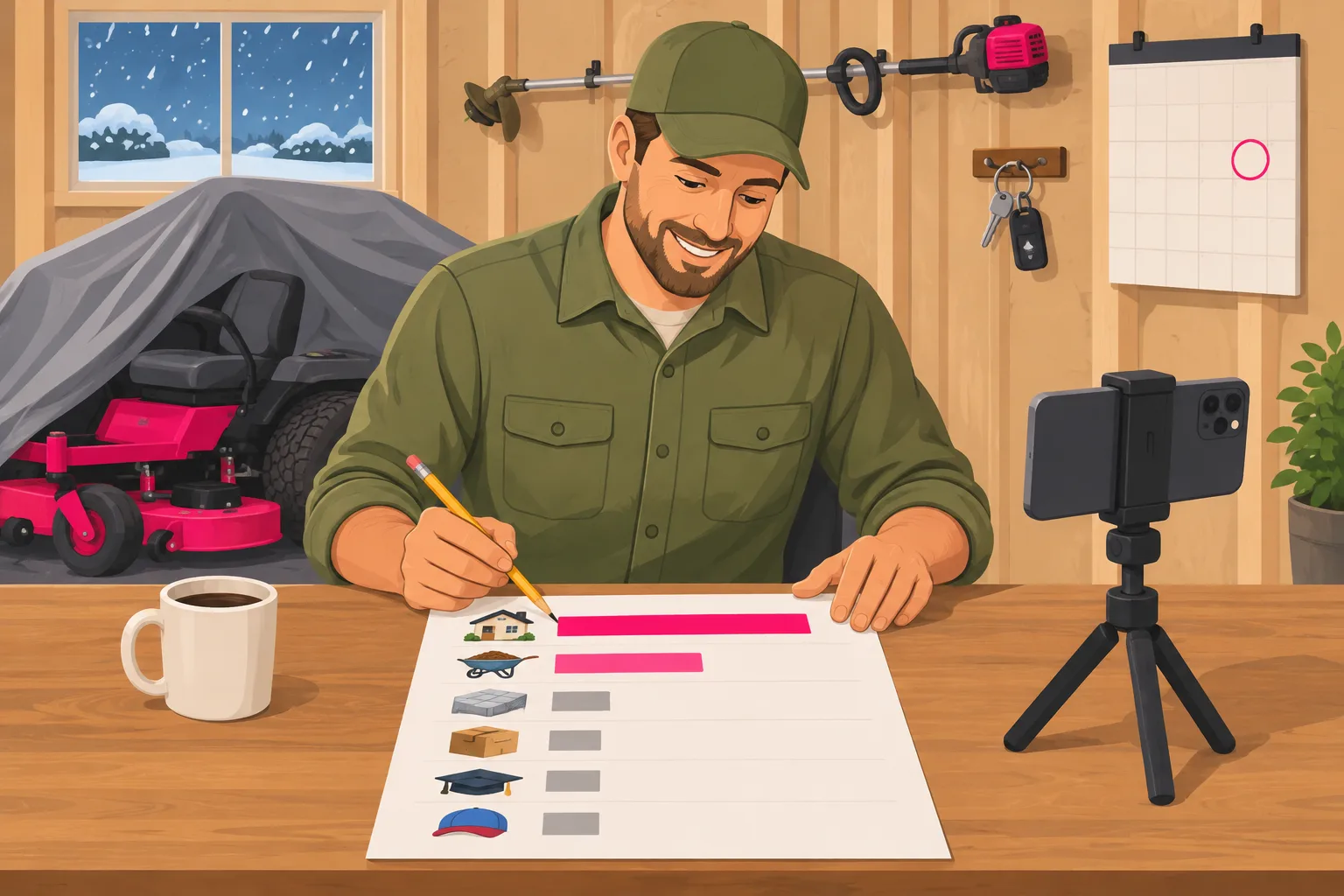
Once a year, in the quiet month, make one video that tells your customers what the year added up to. Call it the receipt. It is the most trust-building video a small company can post, and almost nobody makes it.
Film it in the garage or the driveway, one person, no music. Luis's might go something like this:
"Here is our year. Thursday started the season with thirty-eight yards and ended with fifty-one. Seven of the new ones are within three doors of a yard we already mowed."
"We did twelve spring cleanups, four mulch jobs and nine aerations. We sent two people who asked about patios to an installer we trust."
"The dealer gave us a box of blades this year, which I told you about each time they were in a video. That is the only free thing we took."
"One thing we changed because a customer asked: when rain moves your day, we now text you the night before."
"Your spot is yours for next year until the fifteenth of February. Thank you."
Four things make it work.
- It counts work, not followers. Yards, jobs and changes. No view counts.
- It names what you were given. Saying it once more, in one place, shows you have nothing to hide.
- It includes one change a customer asked for. That tells every other customer you listen.
- It ends on the renewal. The last line is next year's first sale.
Share your numbers at whatever level you are comfortable with. Yard counts are enough. You do not need to post your revenue.
11. What to Add, and When
The most common mistake with these six streams is starting several at once. Each one has a point where it makes sense.
- From day one: the route and the renewal. The visit video pinned, the price said out loud, a quote page one tap away, and the renewal message at the end of the season. Do nothing else until quote requests mention your videos. The growth guide has the 90-day plan for this stage.
- After one full season: the add-ons. You now have last year's footage of a cleanup, a mulch job and an aeration. Post each one in the weeks before its window and follow up by text.
- When a day fills: say so, and point to the other day. "Thursday on this side of town is full. Tuesday has four spots." A full route is also the moment to look at your price for new customers.
- When installs are asked for more than once: pick a referral partner. One company, by name, with the arrangement written down.
- When a dealer or brand you already use asks: consider it. On your personal account, disclosed every time.
- When the route is full and other owners keep asking: test a paid call. Then decide about a course.
- Whenever you like, as a gift: the hat.
Most one-truck companies will get the large majority of their TikTok money from the first two steps. That is a good result, not a small one.
12. The Four Numbers to Track
Views and followers do not tell you whether any of this is paying. These four numbers do. Count them once a month. It takes about half an hour.
- Stops per route day. Thursday is at thirty-eight and needs sixty. This is the number the whole account exists to move.
- Revenue per stop. Everything a customer paid you this season, mowing plus add-ons, divided by the number of stops. In the example above it would be about $1,650 from mowing plus about $280 from add-ons.
- Add-on take rate. Of the customers you offered a cleanup, how many said yes? Track each add-on separately. A low number usually means the video went up too late or nobody followed up by text.
- The neighbor count. How many new stops this year are within three doors of one you already had. These are your most profitable customers and the clearest sign the local videos are working.
To connect any of these to TikTok, add a "how did you find us?" field to your quote form and read it. The growth guide's section on signals covers the earlier signs, such as saves and sends, that come before the money.
13. The Money Mistakes
- Chasing the national audience with an empty route. A million views from other states do not add a stop. Fill the route first, then decide whether you want the second audience.
- Taking the stop across town at the same price. It pays the same and costs far more. Ask that customer to wait for a day you are already nearby, or price the drive in.
- Never asking for the renewal. Every customer you did not ask is one you may have to win again in April.
- Selling add-ons the week they are needed. By then the homeowner has decided. Post the video four to six weeks earlier.
- Hiding the price. "It depends" loses to the company that said a number, for mowing and for every add-on.
- Promoting equipment you do not use, or not saying it was free. The first costs you credibility with other owners. The second breaks a rule.
- Selling a course before the route is full. People can tell.
- Counting TikTok's payout as the plan. It is a bonus for accounts with a large audience. It is not how a local company gets paid.
14. When Paying to Promote a Video Is Worth It
The math in section 2 also tells you when advertising makes sense. If one new weekly stop is worth about $1,650 a season and stays for several seasons, you can afford to spend real money to add one. The question is which video to spend it on.
The answer is a video that has already worked without help. If your visit video or your price explainer has brought quote requests on its own, more of the right people seeing it should bring more. Promoting a video that has not been tested is a guess.
Four rules for a route business:
- Promote for followers, not instant quotes. A homeowner rarely hires a lawn company seconds after first seeing it. A follower who watches for a few weeks is the one who texts you in February.
- Keep the area small. Aim the promotion at your service area, as closely as the ad tools allow. They cannot always target one small town, so expect some reach outside it.
- Spend in the weeks before a window. Late February and March for the route. August for fall work.
- Stop when the day fills. Paying to advertise a full Thursday buys requests you have to turn down.
That is the idea behind our TikTok promotion service. Viryze takes a video you choose, tests it with different audiences, and moves the budget toward whichever one is bringing followers for the least money. It is built for people who would rather be on the mower than in an ads dashboard. Whatever tool you use, keep the area as close to your route as it allows.
The main guide's promotion section has the full comparison with lead marketplaces and the extra rules for promoted videos. For the mechanics of promoting a post you have already published, see the Spark Ads guide.
Frequently Asked Questions
Can a lawn care business actually make money from TikTok?
Yes, but almost never from TikTok paying you. The money comes from what the videos sell. For a mowing company that is mostly a weekly spot on the route: one quarter-acre stop at $55 a cut, about thirty cuts a season, is roughly $1,650 a year, and a good customer stays for several years. After that come the extra jobs sold to customers you already have, such as a spring cleanup, mulch, or aeration and overseeding. Equipment deals, affiliate links, a course and merchandise are real but much smaller for most companies, and they depend on a national audience instead of a local one.
Does TikTok pay landscapers for views?
It can, but do not plan around it. At the time of writing, TikTok’s creator payout program requires at least ten thousand followers and a large number of recent views, and it only pays on videos longer than a minute. The requirements change, so check the current rules in the app. For a company that sells mowing in two towns, a payout for views is a small bonus at best. One new weekly customer is usually worth more than a month of it.
How much is one new lawn care customer worth?
More than most owners count. Multiply your weekly price by the number of cuts in your season. In the example used in this guide, $55 a cut for about thirty cuts is roughly $1,650 a season. Then multiply by how long customers usually stay. Three seasons is about $5,000 from one yard, before any cleanup, mulch or aeration. A stop next to one you already mow is worth more again, because you earn the same price with almost no extra driving.
Should I accept a free mower or free products in exchange for TikTok videos?
Only for equipment you would use anyway, and only if you say so every time. A free or discounted mower, a box of blades or a commission on a link is what the FTC calls a material connection. You have to disclose it clearly in the video itself, in plain words, each time the product appears, and switch on TikTok’s content disclosure setting. Put those videos on the owner’s personal account if you can, so the company account stays about yards in your towns. And keep the right to say what you really think. A deal that requires praise is not worth the trust it costs.
Should a landscaper sell a course on TikTok?
Not until the route is full and other owners keep asking how you did it. A course about building a route is only believable from someone who built one. If your Thursday still has open spots, the hours a course takes are better spent filling them. When you do sell one, sell it from your personal account, show your own numbers, say plainly that they are yours, and never promise what a buyer will earn.
What should a lawn care company sell first on TikTok?
The weekly visit, then the renewal, then the add-ons. First show a homeowner in your towns exactly what a visit looks like and what it costs, so the route fills. Second, ask every customer before the season ends whether they want to keep their spot next year. Third, offer the customers you already have the jobs their yard needs in the weeks before it needs them: the spring cleanup in March, mulch in April, aeration and overseeding in August. Everything else can wait until those three are working.
Have a video that already brings quote requests?
That video has done the hard part. Viryze can put it in front of more people, test which audience responds, and shift the budget to what is working, so more of the right viewers become followers - and, in time, stops on your route.
Related Reading
- TikTok for Landscapers and Lawn Care Companies: The Complete 2026 Guide - the full strategy and the rules behind this guide.
- Growing a Landscaping TikTok: From 0 to 10K Followers in the Right Two Towns - the 90-day plan that fills the route.
- Landscaping TikTok Content Ideas: 50+ Video Concepts That Fill the Route - 52 ideas, including the price explainers and the add-on videos.
- How to Film Landscaping Videos for TikTok (The Yes-Card Yard, the Address Rule, the Kids, the Crew & the Drone) - written permission, the crew agreement and the capture list.
- How Contractors Make Money on TikTok in 2026 - the same question for the one-job trades.
- How Salons Make Money on TikTok: Retail, Education, and the Booking Link - another local business built on repeat customers.
- Spark Ads on TikTok: Creator's Complete Guide - how to promote a post you have already published.