
Landscaping & Lawn Care14 min read
How to Film Landscaping Videos for TikTok (The Yes-Card Yard, the Address Rule, the Kids, the Crew & the Drone)
The complete filming guide for landscaping and lawn care companies on TikTok in 2026: the truck kit under $75 with a magnetic mount for the trailer gate, a clamp for the mower, a dash mount for the drive-by and a mic that survives the wind, the four angles that keep the house and the neighbors out of the shot, the honest before-and-after filmed from the same spot on the same day, the yes-card line in the service agreement that says which yards can be filmed, why customers and kids are never on camera, the neighbor rule and the address rule (no house number, street sign, mailbox or license plate), the once-a-year crew agreement with paid promotion on its own line, what the FAA requires before a drone flies for the business, the route-day capture list, the nine-line card that lives in the truck and says who posts and who owns the account, and the two-minute frame check that runs before every post.
By Ryan MitchellHead of Creator Success at Viryze
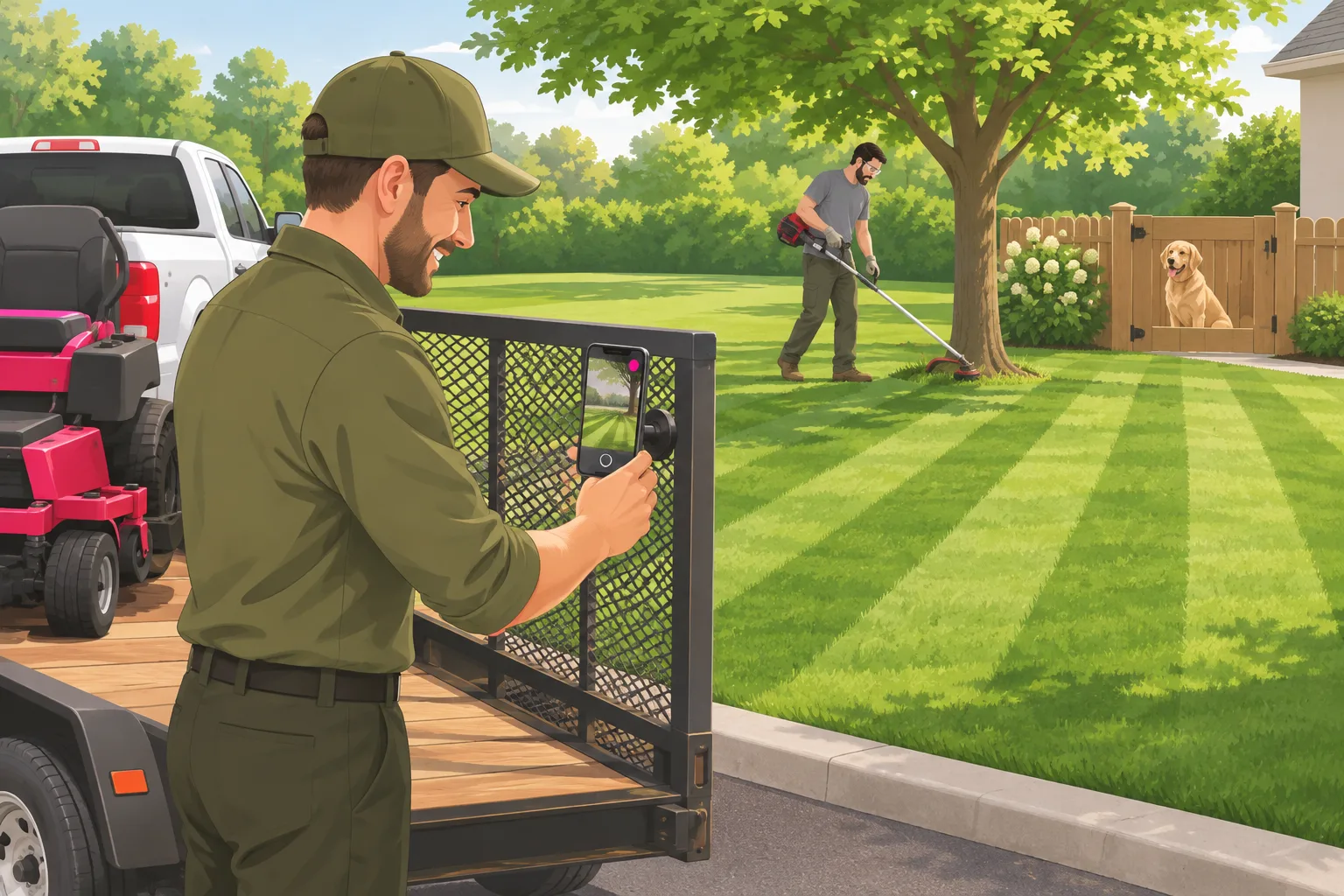
Ask a lawn care owner why the company isn't on TikTok and the answer is rarely "there's nothing to film." You are in dozens of yards every week. The answer is the practical wall. Who holds the phone when both of you are on a machine? Is it okay to film her yard? The house number is in the shot - now what? The neighbor's kids are in the background of the best clip of the week. And whose account is it the day the helper who posts takes another job?
Those are the right questions, and each one has a short answer. This guide is the filming manual for a landscaping or lawn care account: the kit, the four angles, the honest before and after, the yes-card, the rules for kids, neighbors and the address, the crew agreement, the drone, the route-day capture list, the card that lives in the truck, and the check you run before anything posts.
One thing makes your filming different from a salon's or a restaurant's. Your set is somebody else's private property, a different one every half hour, with another family's property on both sides of it. So every choice below runs on one test: the yes, the kids, the neighbor, and the address.
If you haven't read our complete TikTok guide for landscapers and lawn care companies yet, start there for the strategy. If you're short on what to film, our 52 landscaping content ideas supply the list. This article is about getting those ideas onto a phone on one route day without spending money, filming a yard that did not agree, showing a stranger where a customer lives, or starting an argument about who owns the account.
The one-sentence version:
Stick the phone to the trailer gate before the mower comes off and point it down the lawn, film only at the two or three yards whose owners ticked the box in the service agreement, keep every customer, kid, neighbor, house number, street sign, mailbox and license plate out of the frame, take the before and the after from the same spot on the same day, sign one page a year with the helper who is on camera, leave the drone in its case until someone holds the certificate, put the nine-line card in the truck - then run the two-minute check and post. Everything below is detail on those instructions.
What's Inside
- 1. The Truck Kit (Under $75)
- 2. The Four Angles: Point the Phone Down the Lawn
- 3. The Honest Before and After (Same Spot, Same Day)
- 4. The Yes-Card: Which Yards Can Be Filmed
- 5. Customers and Kids Are Never on Camera
- 6. The Neighbor Rule (and the Noise Rule)
- 7. The Address Rule
- 8. The Crew Agreement: One Page, Once a Year
- 9. The Drone: Get the Certificate First
- 10. The Route-Day Capture List, the Wind, and the Music
- 11. The Nine-Line Card in the Truck
- 12. The Pre-Post Frame Check, and What to Do When a Video Works
- Frequently Asked Questions
1. The Truck Kit (Under $75)
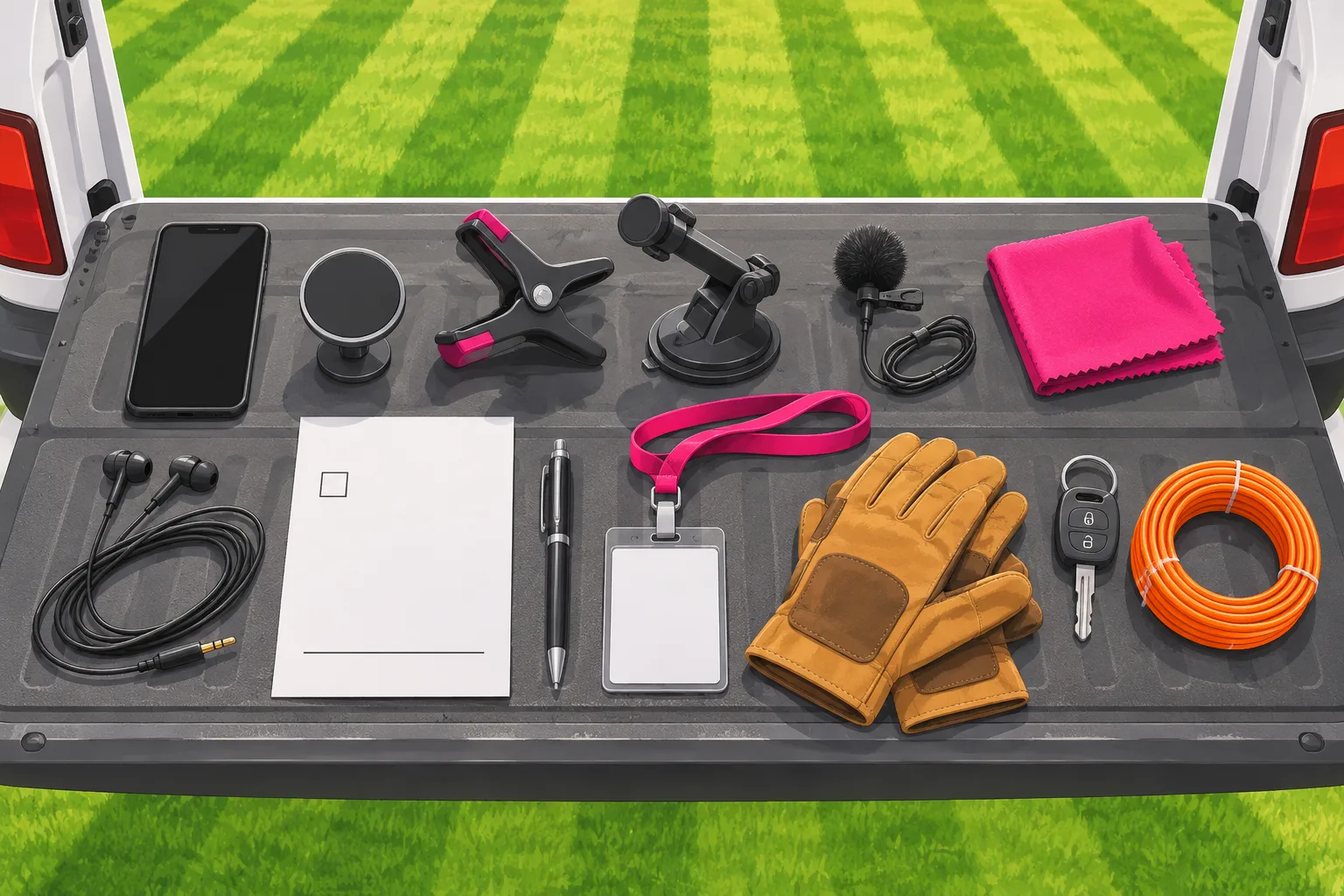
The equipment question has a shorter answer than most owners expect. Everything the account needs fits in the door pocket of the truck, and you already own the expensive part.
- A phone. Any phone from the last four or five years is enough. Use the rear camera, film vertically, and wipe the lens every time it comes out of a pocket. A lawn crew's lens collects grass dust and two-stroke haze, and half the "soft" lawn footage online is a thumbprint.
- A magnetic phone mount ($15-20). This is the one essential purchase. Both of you have your hands on a machine for the whole visit, so the phone has to film by itself. A strong magnetic mount sticks to the steel frame of the trailer gate in two seconds, sits about chest height, and looks straight down the lawn. Put a short tether on it the first week. A phone that falls off a trailer lands on a driveway.
- A spring clamp mount ($10-15). For the places a magnet won't hold: the roll bar on the zero-turn for five seconds of stripes from the seat, the handle of the wheelbarrow on a mulch day, the rail of the trailer. Clamp it only to things you own. Mower footage shakes, so use it in short pieces.
- A suction-cup dash mount ($10-15). For the drive-by, the twelve seconds of finished lawn as the truck pulls away. It has to be filmed with both hands on the wheel, so the phone rides low on the passenger side of the windshield and records by itself.
- A clip-on microphone with a foam windscreen ($15-25). The one non-negotiable for anything with a voice in it. A phone six feet away in a driveway records the wind, the idling truck and the crew two houses down. A $20 mic on your collar makes you sound like you are standing next to the viewer.
- A microfiber cloth ($3) and the wired earbuds you already own. The cloth for the lens. The earbuds for the habit that saves more clips than any gear: listen to the first ten seconds before the real take, because earbuds hear the wind and the phone speaker does not.
Then add three things no camera store sells, and all three are paper. The yes-card line in your service agreement (section 4), the one-page crew agreement (section 8), and the nine-line card that lives in the truck (section 11). They cost nothing, and they are the three pieces of equipment most lawn accounts are missing.
One rule about whose phone it is. The pillar's cadence rule is that one person owns the company phone. In the one-truck company this series follows, that is Luis, the owner, who mowed his first lawn for twenty dollars at sixteen and is heading into his eleventh spring. If Teo, his helper, catches a good clip on his own phone, it moves to the company phone that evening and comes off his. Footage of customers' yards should not live in a camera roll that leaves when a helper does.
2. The Four Angles: Point the Phone Down the Lawn
Here is the principle that makes yard filming safe: don't try to spot the problem shot by shot. Choose angles where the things that should not be seen cannot be seen - the front door, the house number, the windows, the yard next door - and keep a short list of places the camera never points. When privacy is built into the direction of the lens, you stop worrying about it. The worrying is what keeps most owners from ever pressing record.
The good news is that the best-looking thing in your video is on the ground. Stripes, a clean edge and a blown-off walk all film better from chest height looking slightly down. That angle happens to cut the house off at the foundation. Four angles cover almost everything:
- The gate mount, down the lawn. The phone goes on the trailer gate before the mower comes off, pointed along the length of the lawn, away from the house. This is the workhorse. It films the mow, the trim and the edge while both of you work, and it needs nobody's face.
- The time-lapse from the trailer. Same mount, same spot, the phone's built-in time-lapse setting running for the whole visit. Twenty-three minutes becomes about forty seconds, with the stripes appearing one pass at a time. Our job-site filming guide covers the time-lapse settings in detail, so we won't repeat them here.
- The drive-by, from the street. The phone on the dash mount as the truck pulls away: the stripes, the edge line, the clean sidewalk. Frame it low, on the grass and the curb. Start recording after the mailbox is behind you and stop before the next driveway, so the clip holds one lawn and nothing that says where it is.
- The driveway explainer. You, standing in the driveway of a yes-card yard with the trailer behind you, the mic on your collar, the phone on the gate mount or held by Teo. The trailer fills the background, which means the house and the street do not. This is where "why a quarter-acre lawn here is fifty-five dollars a cut" gets filmed.
Where the phone never points
At the front of the house. At any window. Across a fence. Down the street. At a car in the driveway. Into the back yard through an open gate, unless the back lawn is the job and the yes covers it. If you have to think about whether an angle is okay, turn the phone until it is looking at grass.
3. The Honest Before and After (Same Spot, Same Day)
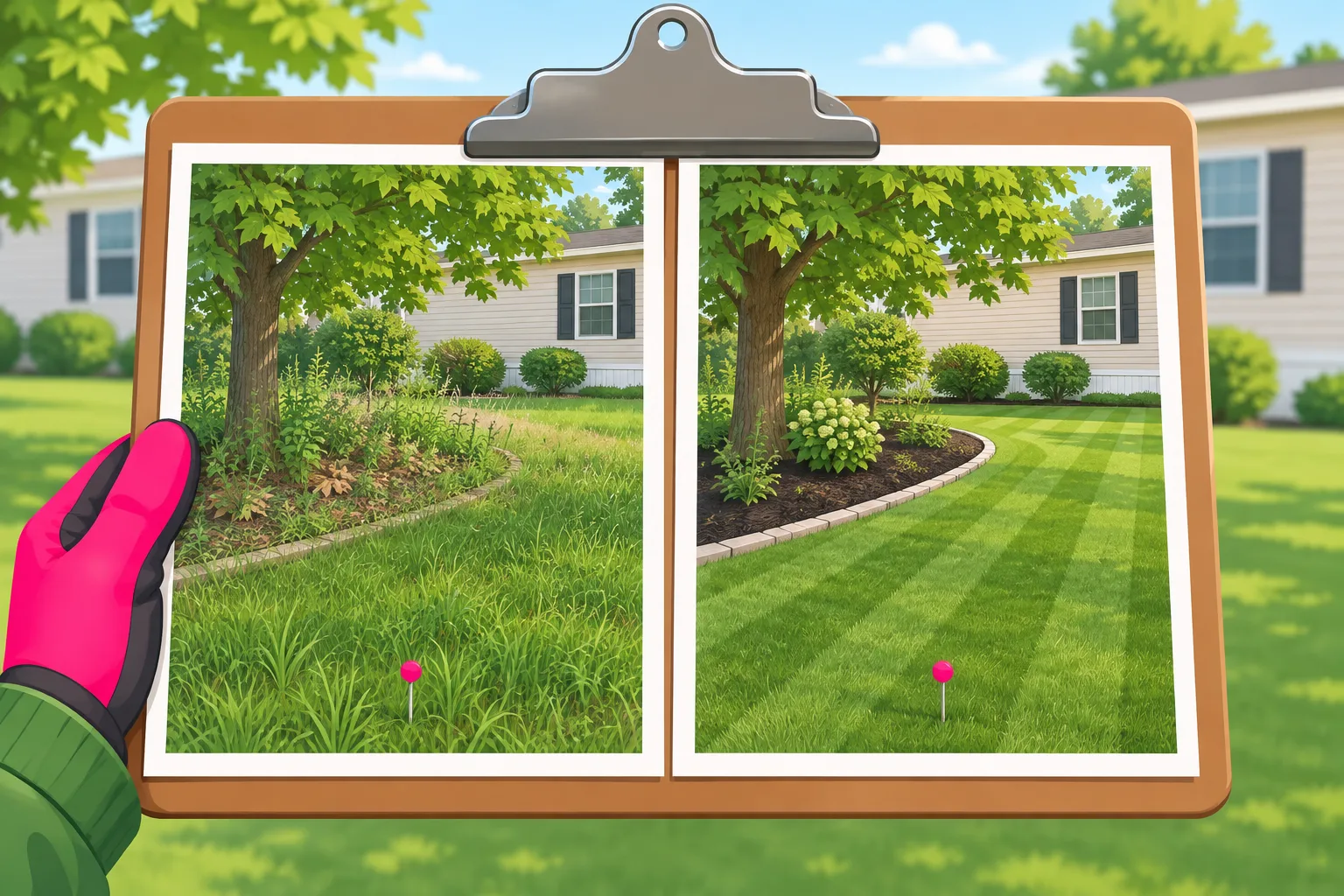
The transformation is the most-watched thing a lawn company can post. The overgrown first cut, the spring cleanup, the bed that goes from weeds to fresh mulch. It is also the easiest video to fake by accident, and a faked one costs you the customer who stands in the yard and compares.
The rule is five things that stay the same and one that is yours:
- Same yard. It sounds obvious. It stops being obvious the week you have a great "after" and no "before" for it.
- Same spot. Pick a mark you can find again - a seam in the driveway, the corner of the walk - and stand on it both times. Hold the phone at chest height.
- Same lens. The normal one. The wide setting makes a small lawn look like a field in the "after" and nobody believes it.
- Same light. Take the before when you arrive and the after before you load the trailer. On a two-and-a-half-hour cleanup the sun moves a little. That is fine. Noon against sunset is not.
- Same day. The lawn that greened up a week later, after rain, is not what you did. If you want to show it a month on, make that a separate video and say the date out loud.
- Your work. No patio someone else built, no beds the last company planted, no pushed color. The clip shows what your crew did between the two photos and nothing else.
Luis keeps it simple. Before the mower comes off, he stands on the mark and takes one photo and five seconds of video. When the walk is blown clean, he stands on the mark again. Those two photos side by side are the "two-photo card" - the cover image of the video and the picture he texts the customer from the driveway.
This matters more once money is involved. A before and after in a promoted video is an advertised claim, and TikTok's rules on misleading content apply to it. The pillar covers that in its compliance section. The short version: slightly less dramatic and completely true wins.
4. The Yes-Card: Which Yards Can Be Filmed
A yard is private property. The family that hired you to mow it did not hire a film crew, and most of them have never thought about whether their lawn might be on the internet. So the rule is simple: customers are never content, and neither is their property without a yes.
You do not need a yes from all thirty-eight stops. You need two or three. This series calls them the yes-card yards - the customers who ticked a box in writing. Two or three yards with decent light and a lawn that stripes well will carry an account for a whole season.
The yes-card is not a separate form. It is one optional line in the service agreement you already send:
The yes-card line (copy it into your service agreement):
Photos and video (optional). We sometimes film our work for our social media accounts. May we film the lawn and the beds at this address?
☐ Yes ☐ Yes, and the dog too
We will never show your face, your family, your house number, your street, your car or anything through a window. Text us "take it down" at any time and every clip of your yard comes down within the week. Saying no changes nothing about your price or your day.
If we ever want to pay to promote a video of your yard, we will ask you first, separately.
A few things make this line work in real life:
- Ask on paper, not at the gate. A customer asked in her driveway with a phone already out says yes to be polite and regrets it by dinner. The box on the agreement lets her decide alone. The natural time is when the agreement goes out - at sign-up, or with the renewal message at the end of the season.
- Blank means no. An unticked box is a no, and you do not ask again until next year's agreement.
- Take-downs happen fast and without questions. The line promises a week. Do it the same day when you can, and never ask why.
- Keep the list where the phone is. A note on the company phone with the yes-card yards on it, so nobody has to remember on a busy Thursday. In Luis's case it is three yards, including the one with the side gate that sticks and the golden retriever who is friendly but fast.
- A paid promotion is a second yes. Being in an organic post and being in an ad are different things to most people. Ask again, in a text, and keep the reply.
Our salon filming guide uses the same idea for the person in the chair. The lawn version is easier, because the yes is for the grass. This is a general overview and not legal advice; if your state or town has its own rules, those come first.
5. Customers and Kids Are Never on Camera
The yes-card covers a lawn. It does not cover a person. Even at a yes-card yard, the customer is not in the video - not her face, not her voice calling the dog, not her car in the driveway.
Kids are a harder line: never. Not at a yes-card yard, not in the next yard over, not waving from a window, not riding past on a bike in the background of a time-lapse. A parent's yes for the lawn is not a yes for a child, and you are not going to ask for one. If a kid walks into frame, the clip gets cut at that second or deleted.
In practice this is a timing rule as much as a framing one. The time-lapse that runs at ten on a Thursday morning in April is usually empty. The one that runs at four on a Saturday in June is not. Film the yes-card yards on the weekday stops.
Three smaller rules sit under the same heading:
- The doorbell camera is theirs. If a customer sends you a doorbell clip of the crew working, it is a nice text. It is not your footage, and it shows her front door. Say thank you and leave it there.
- Her own video is hers. If a customer posts your stripes and tags you, ask before you repost, and take it down the day she changes her mind.
- A review is quoted in her words, never with her name or her street. "A customer on our Thursday route" is enough. The woman who has been on Luis's Thursdays since 2019 has never been named in a video, and she is the reason half her street hired him.
And one thing that is not a filming rule but belongs here: the clip that mocks a customer. "Look at the yard they let go." "Wanted it done for thirty dollars." You can film those without showing a face and they are still about a customer. The pillar's hooks section explains what they cost. Hook on the yard, never the person who owns it.
6. The Neighbor Rule (and the Noise Rule)
Every yard you film has a yard on each side of it that nobody asked about. The neighbor rule is two sentences. The neighbor's yard is never in frame without the neighbor's own yes. The neighbor is never in frame at all.
This is the rule lawn accounts break by accident, because a wide shot of a front lawn usually includes a slice of the one next door. Fix it with the mount, not in the edit:
- The phone never looks across a fence or a property line. Point it along the lawn you were hired to cut, lengthwise, so the edges of the frame are that lawn's own beds.
- Never compare. "Our stripes against the guy next door's" insults a homeowner you have never met, in front of the one who pays you. He may be your next stop.
- A person on a porch ends the take. A man who finds himself in a lawn company's video is a complaint waiting for the week the town talks about noise.
- If a neighbor asks, it comes down. Same day, no argument. It is cheaper than being right.
The neighbor three doors down who watches your truck for a season is the most valuable person on the route. He signs up in February because of what he saw from his own window. Do not give him a reason to remember you for something else.
The noise rule. Never post the joke about firing up the blower at seven in the morning. Plenty of towns have rules about when powered equipment can run, and plenty of people have strong feelings about lawn crews and early mornings. A video that makes a joke of it tells every homeowner watching what kind of neighbor your truck will make them. If a clip shows a clock, a sunrise or a phone screen, make sure the time on it is one you would be happy to defend.
7. The Address Rule
The address is never on the platform. A lawn video tells strangers a lot without meaning to: which house, what the side gate looks like, that a crew comes on Thursdays, and that "you don't have to be home." None of that is a problem while nobody can tell where the house is. So nobody gets to tell.
Six things never appear in a frame:
- The house number - on the house, the curb, the mailbox, a porch post or a trash bin.
- A street sign, including the one at the far end of a drive-by.
- The mailbox, even with no number showing. Mailboxes are easier to recognize than most people think.
- A license plate - the customer's car in the driveway, or the neighbor's at the curb.
- Your own paperwork. The route sheet on the dash, the map app on the truck's screen, a work order on a clipboard. Each one is a list of addresses.
- A description that does the same job. "The blue house by the school," "the corner lot across from the park." If a local could find it from the sentence, the sentence is an address.
What you say instead is the thing that actually sells a route: the towns you serve and the day you are there. "This side of town is Thursdays, the other side is Tuesdays" tells a homeowner everything she needs to know and tells a stranger nothing. When you add a location to a post, pick the town, never a pin.
The same goes for comments. "Where is this?" gets the two towns and the route day. "Is that the house on such-and-such street?" gets no answer, and if the comment names the street, it gets deleted. Our vacation rental filming guide has the same rule for an empty house; yours is for a house with a family in it, which makes it more important, not less.
8. The Crew Agreement: One Page, Once a Year
The person holding the trimmer is going to be in a lot of videos. Teo has run the trimmer around the same maple for four springs, and viewers ask about him by name. That is good for the account. It also means his face is part of how the company makes money, and that deserves one page of plain writing.
Sign it once a year, before the season starts. It says seven things:
The crew agreement (one page, signed each February):
- Where the videos go. The platforms by name, and that posts are public and can be shared by anyone.
- What he appears in. The trim, the edge, the visit, the question answered. Not the honest week, unless he asks to be.
- What he is paid. Time on camera is time on the clock. If you pay anything extra for an explainer he fronts, the amount is written here.
- Paid promotion, on its own line. A separate checkbox. Appearing in a post and appearing in an ad are two different agreements.
- How long it lasts and how it ends. One year. A text withdraws it, and his face comes down from existing clips if he asks.
- That saying no changes nothing. Not his hours, not his rate, not his spot on the truck. Some good workers do not want to be on the internet.
- Who owns the account. The company owns the handle, the followers and the footage. His own account, if he has one, is his and goes with him.
That last line is the one owners skip, and it is the one that matters in two years. If the helper who posts is also the only one who knows the password, the day he leaves is the day the account leaves. The login belongs to the company email, on the company phone. By the second season, the account is worth more than the trailer.
If you ever post a "we're hiring" video with Teo in it and put money behind it, that is a job ad, and TikTok handles those under a special category with its own targeting limits. The pillar's promotion section walks through it.
9. The Drone: Get the Certificate First
The overhead shot of a striped lawn is beautiful, and that is the problem. It is the first thing most lawn accounts want to post and the one piece of filming in this guide that needs a federal credential.
In the United States, the FAA treats any drone flight that serves a business purpose as a commercial flight under its Part 107 rules. It does not matter that nobody paid you for the video. A clip on the company's account is for the company. In plain terms, that means:
- The pilot holds a remote pilot certificate. That means passing a knowledge test at an FAA-approved testing center. Whoever is at the controls needs it - you, not just "the company."
- The drone is registered and carries its registration number.
- Some airspace needs permission first. A lot of suburbs sit inside controlled airspace around an airport. Authorization usually comes through a system called LAANC, inside an approved app, before the flight.
- There are limits on flying over people. A residential street has people on it, and yards on every side that are not yours to fly over.
The exception people quote is for recreational flying, and it covers flying purely for fun. A lawn company filming a customer's lawn for its account is not that. A posted video is also a public record that the flight happened, and a promoted one even more so.
The drone also breaks every other rule in this guide at once. From above, the frame holds the whole house, the neighbors' yards on both sides, the street, the cars and anyone outside. If you do get the certificate, fly only over a yes-card yard, straight down, low enough that the frame is one lawn, and get the neighbors' yes before their roofs are in it.
Honestly, most route companies do not need it. The gate mount down the lawn shows the stripes almost as well, costs twenty dollars and needs no test. This section is a general overview, not legal advice - check the FAA's current rules before you fly.
10. The Route-Day Capture List, the Wind, and the Music
You are on a mower from seven to five. Nobody is asking you to become a filmmaker on top of that. The pillar's content engine makes the route the content calendar: the footage already exists every Thursday, at the yes-card yards, and all you add is the mount. One route day covers a week of posts:
- One visit, start to finish. The time-lapse from the gate at one yes-card yard. Forty seconds from twenty-three minutes.
- One drive-by at each yes-card yard. Twelve seconds, dash mount, as you pull away.
- One before and after. Two photos and two five-second clips from the same mark.
- One question, one answer. From the question log, filmed where the answer is: the gate latch in your hand, the clippings at the deck, the trailer.
- One price explainer a season. In the driveway, mic on, trailer behind you. This one is worth a second take.
That is about twenty minutes of extra effort across the day, most of it sticking a phone to a gate. The cutting happens Sunday night in about an hour.
The question log is a note on the company phone. Every quote request, every "quick question" text the night before a first visit, and every comment that starts "wait, do you" goes in it, word for word. "Do I have to be home?" "What happens when it rains?" "Do you bag the clippings?" Each one is a video somebody already asked for.
Sound: the wind and the mower
Outdoor sound has two modes, and each one has a fix.
- When someone is talking, the engines are off. Not idling - off. Clip the mic to your collar with the foam on, turn your back to the wind, and check ten seconds in the earbuds before the real take. If a crew is running two houses down, wait or move to the next yes-card yard.
- When nobody is talking, the mower is the soundtrack. The sound of a zero-turn laying a stripe, a trimmer along a walk and a blower clearing a driveway is the reason a lot of people watch lawn videos at all. Leave it in.
Music
A company account should be a business account, and a business account's sound picker is limited to TikTok's Commercial Music Library. The trending pop song from a personal account is the fastest way to get a business video muted. Use the library, use your own voice, or use the mower. Check the earbuds for the truck radio, too - a song playing in the cab counts.
Light
You do not need a light. You need the sun behind the phone or off to one side. Stripes show best in the morning and late afternoon, when the light is low and comes across the grass. At noon they nearly vanish. If the best yes-card yard is a ten o'clock stop, that is the one that gets the time-lapse.
11. The Nine-Line Card in the Truck
Every rule in this guide fits on one card. Write it once, laminate it, and keep it on the visor. It is for the Thursday in May when you are forty minutes behind, the best clip of the week has a mailbox in it, and nobody has time for a discussion.
The truck card (fill in the names and laminate it):
- Who posts. One name. Everyone else sends footage to the company phone by Friday night.
- What goes up without asking. A transformation or a drive-by at a yes-card yard. A question answered from the log.
- What the owner looks at first. Any price. Anything with a neighbor's property in the background. Anything a customer said. The honest week. Anything that is going to be promoted.
- What never goes up. A customer. A kid. A house number, street sign, mailbox or license plate. A yard without a yes. A neighbor. A review with a name. Doorbell footage. A clip that mocks a customer or a neighbor. A trending song. A drone shot without the certificate.
- Where the phone points. Down the lawn. Never at the house, never across the fence.
- How consent works. The yes-card yards are listed on the company phone. A "take it down" text is done that day. The crew page is signed each February.
- Who answers, and how fast. Comments and quote texts get a reply within the hour, from the company phone, with the saved replies. Never "it depends."
- Rain mode. A rain week that quiets the account is fine - say so once. A silent February is not. First-cut week: film everything, post the drive-bys.
- Who owns the account. The company owns the handle, the followers and the footage. That holds when a helper leaves and when the company is sold. The login is the company email.
Read it again each February, when the crew page is signed and the service agreements go out. Most years nothing changes. The year something does - a second truck, a new helper who wants to run the account, a buyer asking what comes with the business - is the year the card was worth writing. Our farm filming guide keeps the same kind of page on a fridge. Yours rides on a visor, because your business moves.
12. The Pre-Post Frame Check, and What to Do When a Video Works

Choosing the right angle prevents almost every problem. The frame check catches the rest: the mailbox at the edge of the drive-by, the neighbor's porch in the corner of the time-lapse, the number painted on the curb you have driven past two hundred times and never noticed.
Run it on every video before it posts. Two minutes each. It is the job of whoever is posting.
- Pause on every cut. Each time the picture changes, stop and look at the whole frame, not the lawn.
- Check the edges. House number, curb number, mailbox, street sign, license plate, route sheet on the dash. Zoom in on anything rectangular.
- Check for people. A customer at a window, a neighbor on a porch, a kid anywhere. In a time-lapse, scrub through slowly - a person can be there for six frames.
- Check the property line. Is the yard next door in the shot? Is anything through a window readable?
- Listen with earbuds. A customer's voice, a neighbor's voice, the truck radio, a name called across a yard.
- Check the yes. Is this yard on the list? Is everyone in the video someone who signed a page?
- Check the claim. Is the price you said the price people pay? Is the before and after the same day, from the same mark?
If a clip fails, cut the bad seconds or crop tighter. If it still fails, it does not post. There is another Thursday next week.
When a video works
Sooner or later one of these gets a hundred times your usual views. It is usually a transformation or a visit. Three things to do that day:
- Run the frame check again. A video seen by four hundred people and a video seen by four hundred thousand are held to different standards, mostly by the people in the comments trying to work out where it is.
- Text the customer whose yard it is. "The video of your lawn is getting a lot of views - still okay with you?" Almost everyone says yes, and they remember being asked.
- Answer the comments like the saved replies. The towns, the days, the price for a typical yard, and where to text a photo. Never the street.
If you decide to put money behind it, check three more things first: the customer's separate yes for promotion, the promotion checkbox on the crew page, and - if there is a single aerial frame in it - the certificate. Then aim it at the people who can actually hire you. That is where a service like Viryze helps: it takes a video that has already proven itself, tests it against different audiences, and puts the budget behind the ones that turn viewers into followers. Our Spark Ads guide covers the format most companies should start with, because it promotes your real post with its comments intact. Our local business TikTok guide covers the filming choices that build recognition in one place, and the algorithm guide explains why a forty-second visit gets shown to more people than a four-minute tour of the trailer.
Frequently Asked Questions
What equipment do I need to film lawn care videos for TikTok?
The phone you already own, a magnetic phone mount that sticks to the steel frame of the trailer gate ($15-20), a spring clamp mount for the mower or a fence post you own ($10-15), a suction-cup dash mount for the drive-by ($10-15), a clip-on lavalier microphone with a foam windscreen for anything with a voice in it ($15-25), a microfiber cloth and the wired earbuds you check the sound with - under $75 total, and it lives in the door pocket of the truck. The magnetic mount matters most, because both people on the crew have their hands on a machine for the whole visit and the phone has to film by itself. Keep the footage on the company phone, not in a helper’s camera roll, because a helper’s phone leaves when he does.
Do I need permission to film a customer’s yard?
Get a yes in writing, and film only what the yes covers. A yard is private property, and the family that hired you to mow it did not hire a film crew. The simplest version is one optional line in the service agreement with a box to tick: the lawn and the beds can be filmed, the dog if they want; their faces, their family, the house number, the street and anything through a window never can; a text takes every clip down within the week; and saying no changes nothing about the price or the day. Two or three yards with a ticked box are enough to run an account for a season. Putting money behind a video of someone’s yard is a separate question, asked separately. This is a general overview, not legal advice.
Can I show kids, neighbors, or the house in a landscaping video?
No to all three. Kids are never in a video - not playing in the next yard, not waving from a window, not in the background of a time-lapse - and if a child walks into frame the clip is cut or deleted. The neighbor’s yard is never in frame without the neighbor’s own yes, and the neighbor himself never is; point the phone down the lawn you were hired to cut and never across the fence. The house is kept out as far as the angle allows, and the address is never on the platform: no house number, street sign, mailbox, license plate in the driveway, or a description like "the blue house by the school." Name the towns you serve and the day you are there, and show the lawn and the truck.
Do I need a license to fly a drone for my landscaping company’s TikTok?
In the United States, yes. The FAA treats any flight that serves a business purpose as a commercial flight under its Part 107 rules, even if nobody paid you for that particular video. The person at the controls needs a remote pilot certificate, which means passing a knowledge test at an FAA-approved testing center; the drone has to be registered; flights in controlled airspace near many airports need authorization first, usually through the LAANC system in an approved app; and there are limits on flying over people, which a residential street is full of. The recreational exception covers flying purely for fun, and a video on the company account is not that. Get the certificate first, then get the shot. This is a general overview - check the FAA’s current rules before you fly.
How do I film an honest before and after of a yard?
Same yard, same spot, same lens, same light, same day, and your own work. Stand somewhere you can find again - a seam in the driveway, the corner of the walk - hold the phone at chest height on the normal lens, and take the before. When the job is done, stand on the same mark and take the after before you load the trailer. Do not push the color, do not swap in an "after" from a week later when the lawn has greened up, and do not show a patio or a bed somebody else built. If you want to show the lawn a month on, make that its own video and say the date out loud. A before and after that is slightly less dramatic and completely true is the one that survives a customer standing in the yard looking at it.
What should a landscaping company’s social media policy include?
One laminated card in the truck with nine lines, decided once: who posts (one name); what goes up without asking (a transformation or a drive-by at a yard that said yes, a question answered from the log); what the owner looks at first (any price, anything with a neighbor’s property in the background, anything a customer said, the honest week, anything that will be promoted); what never goes up (a customer, a kid, an address, a yard without a yes, a neighbor, a review with a name, doorbell footage, a clip that mocks a customer, a trending song, a drone shot without the certificate); where the phone points (down the lawn, never at the house, never across the fence); how consent works and where the list of yes yards is kept; who answers comments and quote texts and how fast; what rain mode means; and who owns the account, the followers and the footage when a helper leaves or the company is sold. Read it again each February when the crew agreement is signed.
Ready to turn your best yard video into stops on the route?
Film the way this guide describes and one of your clips - probably a visit from the curb to the text, or a cleanup filmed from the same mark - will eventually break out. When it does, Viryze helps you put that one proven video in front of more people, aimed at followers rather than a one-time quote and pointed at your service area as closely as the tools you use allow. The best time is the weeks before the spring sign-up window, not the first warm weekend in April. Your route supplies the footage, a phone on a trailer gate captures it, and selective amplification helps the best of it reach the homeowner three streets from a stop you already have.
Related Reading
- TikTok for Landscapers and Lawn Care Companies: The Complete 2026 Guide - the full strategy this filming guide plugs into.
- Landscaping TikTok Content Ideas: 50+ Video Concepts That Fill the Route - what to film, now that you know how.
- How to Film Job-Site Videos for TikTok (Phone, Framing & Timelapse) - the time-lapse and framing craft for longer jobs like a mulch install.
- How to Film Salon Videos for TikTok (The Yes Card, Minors, the Mirror & the Break-Room Rule) - where the yes-card comes from.
- How to Film Airbnb Videos for TikTok (The Empty House, the Address Rule, the Cohost Agreement & the Property-Phone Rule) - the sister guide on keeping an address off the platform.
- Understanding TikTok's Algorithm: What Really Matters - why short, specific videos get distributed.
- Spark Ads on TikTok: Creator's Complete Guide - the amplification format for the video that takes off.