
Landscaping & Lawn Care13 min read
TikTok Advertising for Landscapers: Fill the Route Without Burning the Truck Payment
A plain guide to landscaping advertising and lawn care advertising for a small company: an honest comparison of lead sites, search ads, mailers, door hangers, yard signs and a promoted TikTok video, what one weekly route stop is worth, why a promoted video should aim for local followers and not instant quotes, the three ways to pay for one, how small to draw the map, the four videos worth paying for and the four that are not, a worked $420 example, when to spend and when to pause, the rules a paid video has to follow, and the numbers to check each week.
By Ryan MitchellHead of Creator Success at Viryze
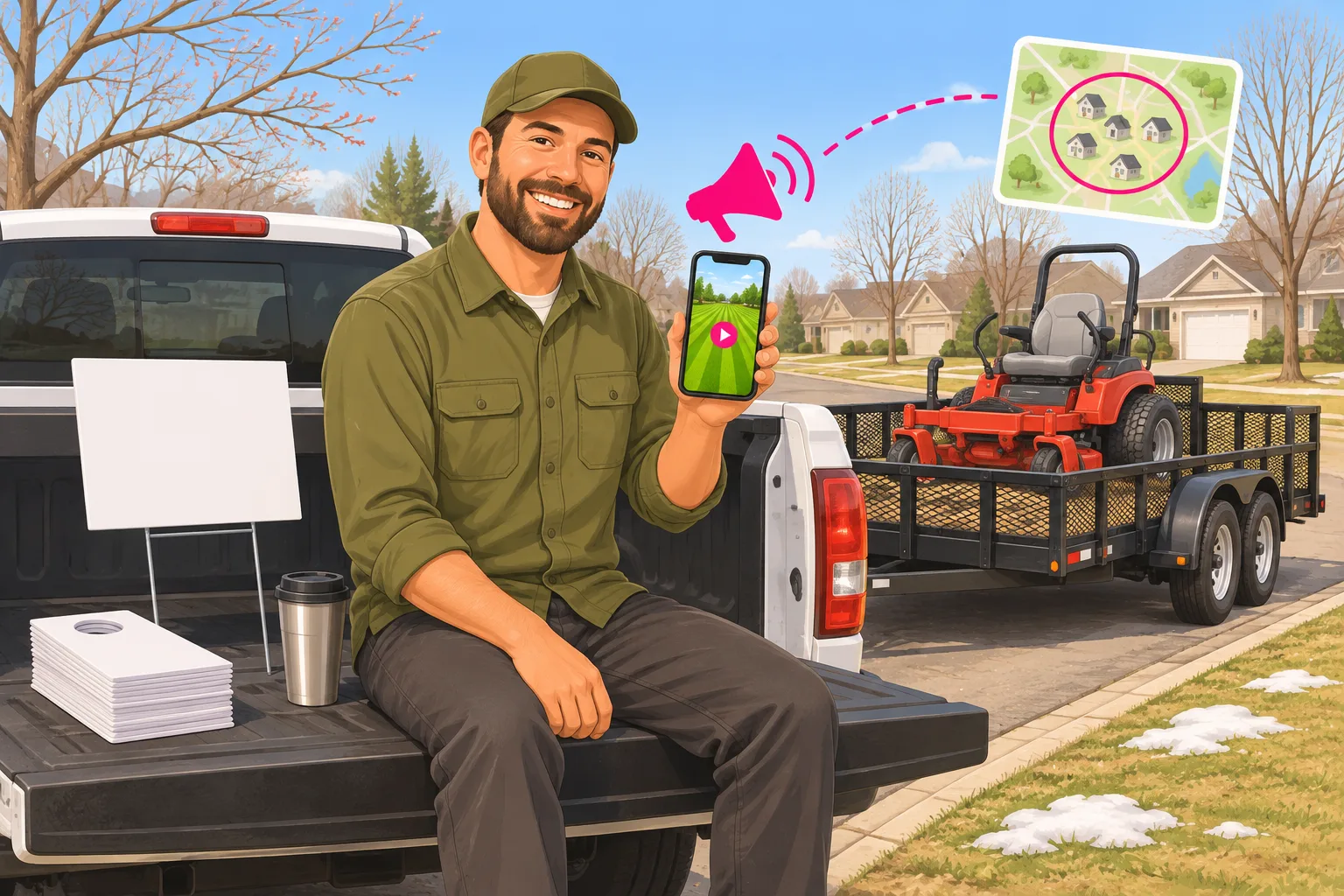
Most landscaping advertising is sold the same way: pay now, and hope the phone rings. Lead sites, search ads, mailers and door hangers all work some of the time. All of them cost real money, and for a small company that money comes out of the same account as the truck payment.
This guide covers one more option: paying to show a TikTok video to homeowners near your route. It starts with an honest look at what you may already be paying for, because a promoted video is not better than those tools at everything.
The short version: lead sites and search ads find the homeowner who needs someone today. A promoted video introduces you to the homeowner who will need someone next month. Use it in the weeks before the spring rush, keep the area small, and stop when the route day is full.
It is the last part of our complete TikTok guide for landscapers and lawn care companies. You do not need to have read the rest. The last section explains where a TikTok promotion service fits and where it does not.
The honest summary:
- Need customers this month? A lead site or a search ad is faster than any video.
- A promoted video is slow and local. It works over weeks, and it only pays off inside the area your truck already covers.
- Pay for followers, not for quotes. A follower nearby keeps seeing your work for free.
- Only promote a video that already works. Money makes a good video reach further. It does not fix a weak one.
- Pause when the day is full. An ad for a route day with no room buys requests you have to turn down.
What's Inside
- 1. What Landscapers Already Pay For
- 2. What One Route Stop Is Worth
- 3. What a Promoted Video Actually Buys
- 4. Three Ways to Pay for It
- 5. The Map: Two Towns, Not the Whole Metro
- 6. Four Videos Worth Paying For, and Four That Are Not
- 7. How Much to Spend: A $420 Example
- 8. When to Spend and When to Pause
- 9. The Rules a Paid Video Has to Follow
- 10. The Numbers to Check, and Who Should Run It
- Frequently Asked Questions
1. What Landscapers Already Pay For
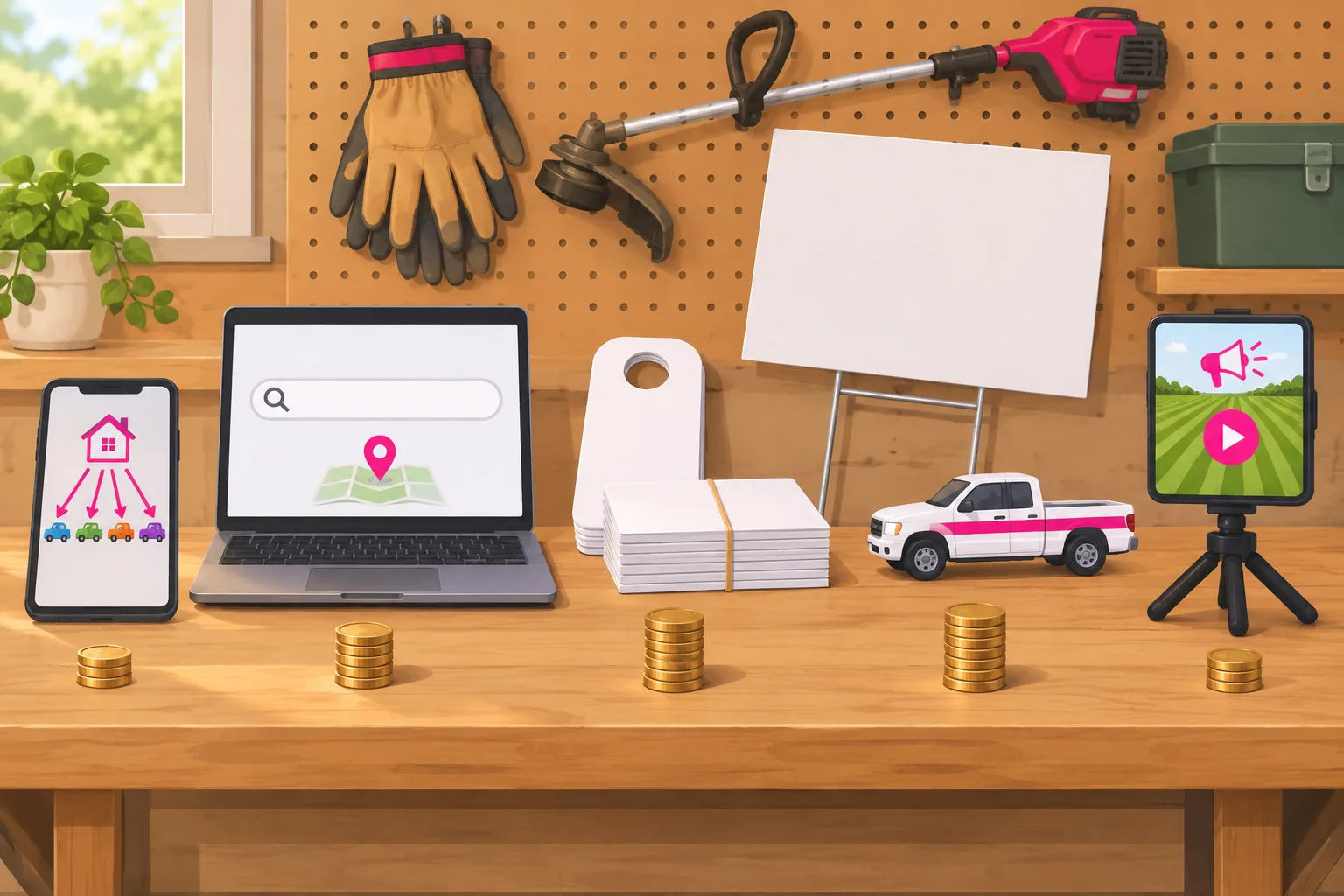
Before adding anything new, look at what the usual options are good at. Each one below is a reasonable tool. The prices are rough figures for the United States and they vary a lot by area, so check your own.
Lead sites
A lead site sends you a homeowner who has asked for a quote, and charges you for the request. A mowing lead often costs somewhere between ten and thirty dollars. A landscaping lead costs more.
The same request usually goes to several companies. If you win about one in four, a $20 lead works out to roughly $80 for each new customer. Lead sites are fast, and that is their strength. Their weakness for a route business is that you cannot choose which street the customer lives on.
Search ads
A search ad shows your company when someone types something like "lawn care near me." You pay for each click. In Google's own figures for November 2026, a click on that phrase averaged about nine dollars across the United States. Not every click becomes a request, so the cost of one real lead is usually several times the cost of a click.
Google also sells local ads where you pay for each lead, not each click. Published figures for lawn care and landscaping often fall between $25 and $60 a lead.
Search is the best tool for reaching someone who is ready to hire right now. It also gets crowded in spring. Searches for "lawn care near me" in March 2026 were more than three times what they were in January, and every company in the county is bidding on them.
Mailers, door hangers and yard signs
These are the oldest tools, and for a route they are still some of the best. The reason is simple. They let you choose the exact streets.
- Mailers. The post office will deliver a postcard to every door on a mail route for about 26 cents each in postage. Two thousand doors is about $520, plus printing.
- Door hangers. The cheapest and most exact. Hang one on the five houses on each side of a yard you already mow. It costs a little printing and someone's afternoon.
- Yard signs. Ask the customer first, and check the town or neighborhood rules. A sign on a freshly cut lawn is seen by the right people.
- The truck. Lettering or a wrap is a one-time cost, and it is on your route every week.
Their weakness is that paper cannot show your work. A door hanger says you exist. It does not show the gate being latched or say why the price is what it is.
A promoted video
Paying to promote a TikTok video means paying to show a video you already posted to more people in an area you choose. You pay for views, not for leads. Nobody is asking for a quote when they see it.
That makes it the slowest option on this list. It is also the only one where a homeowner can watch a whole visit, hear the price, and keep seeing you for weeks without you paying again.
| Option | Best at | Weak at |
|---|---|---|
| Lead sites | Requests today | Shared with other companies; any street |
| Search ads | People ready to hire right now | Costs most in spring |
| Mailers and door hangers | Choosing exact streets | Cannot show your work |
| A promoted video | Showing how you work, for weeks | Slow; no instant requests |
These are not rivals. A homeowner who has watched your videos for a month is more likely to pick up your door hanger, and more likely to choose your name from a list of four on a lead site. The guide to getting lawn care customers has a longer comparison with lead sites.
2. What One Route Stop Is Worth
You cannot judge any advertising without knowing what a customer is worth. This series uses one example company to make the numbers concrete. Swap in your own as you read.
The company belongs to a man named Luis. He has one truck, one trailer and one helper, Teo. He mows in two towns: one side on Thursdays, the other on Tuesdays. A quarter-acre lawn costs $55 a cut, weekly, from April to November.
- One season. $55 times about 30 cuts is $1,650.
- Three seasons. Customers who are happy tend to stay. Over three seasons, one stop is about $5,000.
- The gap. Luis has 38 stops on Thursday. A full day is 60. The 22 empty spots are worth about $36,000 a season.
Those figures are sales, not profit. Fuel, wages, insurance and the truck all come out of them.
But they show the size of the prize, and they give you a ceiling. If a new stop is worth $1,650 in its first season, paying $40 or even $80 to win it is a sound trade. Paying $400 is not.
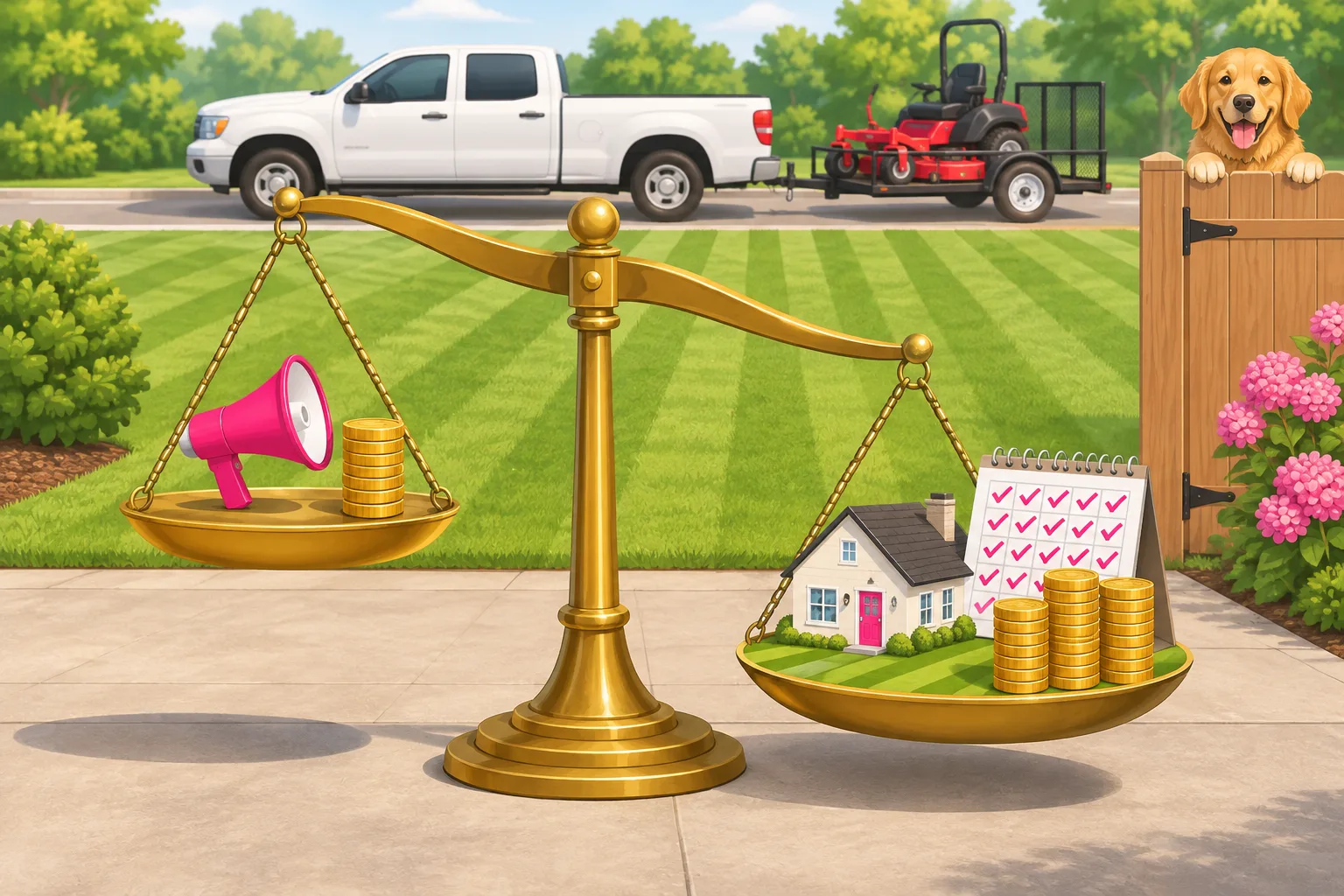
One more thing changes the math for a route. Not every stop is worth the same. A new customer three doors from a yard you already mow costs almost nothing extra to reach. A new customer twenty minutes across town costs driving time every week, all season.
So the right question for any ad is not only "what did a customer cost?" It is also "where does she live?" The guide to making money as a landscaper on TikTok works through the route math in full.
3. What a Promoted Video Actually Buys
A lead site sells you a request. A promoted video sells you attention. If you expect one to behave like the other, you will be disappointed.
Think about what hiring a lawn company means for a homeowner. She is letting strangers with machines into her yard every week, often while she is at work, with the dog in the back. That is not a decision people make nine seconds after seeing a company for the first time.
So do not aim a promoted video at instant quote requests. Aim it at followers in your towns. A follower costs you once. After that she sees your next video, and the one after that, for free.
Here is how it usually goes:
- In late February she sees your promoted video of one full visit. She follows.
- Over the next few weeks she sees your price video, a spring cleanup, and a short clip that says Thursdays still have room.
- In mid-March the grass starts to grow. She taps the link in your profile.
- She already knows the price and the day. She sends a photo of her yard.
The ad paid for step one. Your regular videos and your quote page did the rest. That is why promotion only works when the rest is in place.
Before you spend anything, check three things:
- A video has already worked without money. People watched it to the end, saved it or sent it, and at least one person asked for a price because of it.
- Your quote page shows the price. If the page hides the number, you are paying to send people to a dead end. The quote page checklist has the eight parts in order.
- You have room, and you know which day. Advertise the route day that has open spots.
If any of the three is missing, fix it first. It costs nothing, and it will help every other kind of advertising you buy.
4. Three Ways to Pay for It
There are three ways to put money behind a TikTok video. They differ in how much control you get and how much time they take.
The Promote button in the app
Promote is a button on your own videos. You pick a goal, an audience and a budget, and it runs. It takes a few minutes and needs no extra account.
It is fine for a small first test. Its limit is control. You get fewer choices about where the video is shown, and for a route business the "where" is most of what matters.
TikTok Ads Manager
Ads Manager is TikTok's full advertising tool. It lets you choose locations more exactly, show the same video to two different groups, and see which group responds.
It also takes time to learn. There are goals, ad groups, bids and daily minimums to set. At the time of writing, the minimum is about twenty dollars a day for each ad group, and more for a whole campaign. That is why a self-run test usually costs a few hundred dollars.
Inside Ads Manager, the format to use is called a Spark Ad. A Spark Ad promotes a video that is already on your account. The video keeps your name, its comments and its follow button. When someone follows, they follow your real account.
Our Spark Ads guide explains the setup, and this comparison of Promote and Ads Manager covers the differences in more detail.
A promotion service
The third way is to pay a service to run the promotion. You choose the video and the budget. The service sets it up, tests audiences, and moves the money toward what is working. Section 10 covers when that makes sense, and what to ask before you sign up.
Whichever way you pick, choose a goal built around followers or profile visits. Do not choose a goal built around website sales. Your sale happens weeks later, by text.
5. The Map: Two Towns, Not the Whole Metro
This is the rule that matters most for a route business. A regular post goes wherever TikTok sends it. A paid video goes where you point it. Point it at the smallest area that covers your route.
The reason is in section 2. A follower two towns away cannot become a stop you want. If she asks for a quote, you either say no or you add a long drive to every week of the season. Either way the money was wasted.
Three things help keep the map small:
- Pick the smallest area the tool offers. In the United States, Ads Manager lets you choose locations in many cases down to the city. Choose your towns by name if they are listed.
- Expect it to be imperfect. Very small towns are not always listed, and a very small area can be too small for an ad to run well. You may need to include the next town over. Do not include the whole metro area.
- Let the video do the rest. Say your towns and your days in the first few seconds. "We mow this side of town on Thursdays." People outside the area will scroll past, which is what you want.
There is one exception. Some lawn care owners also sell things to other lawn care owners: a course, a hat, a link to the blades they use. That audience is national.
If that is part of your business, run it as a second, separate campaign with a wide map, and keep it on your personal account. Never mix the two. The main guide's section on the two audiences explains the difference.
For most one-truck companies, there is only one campaign: the local one. For more on how location targeting works for any neighborhood business, see the local business TikTok marketing guide.
6. Four Videos Worth Paying For, and Four That Are Not
Most of your videos should never have money behind them. A few should. The ones worth paying for all answer the same two questions a homeowner has: will they show up, and what does it cost?
Four worth paying for
- The visit. One whole visit in about forty seconds. The truck arrives, the gate is checked, the lawn is mowed, trimmed and edged, the walk is blown clean, the gate is latched. Then the facts: "Twenty-three minutes. Fifty-five dollars. Every Thursday. You do not have to be home." This is the first video to promote.
- The price video. You, in a driveway, saying what a quarter-acre lawn costs and what the money pays for. Homeowners save this one and send it to each other.
- The spring countdown. Last April's first cut, posted in late February. "The first cut is the week of the fifteenth. Thursdays on this side of town still have room."
- The drive-by with room. Twelve seconds of a finished lawn from the street, ending with the day that has open spots.
The content ideas list has several versions of each. Whichever you pick, promote it only after it has done well with no money behind it.
Four not worth paying for
- Anything that complains about a customer. "She wanted it for thirty dollars" gets comments from other lawn companies. It tells every homeowner watching that her yard and her budget could be your next video.
- The grievance post. Gas prices, the weather, people who will not work. You may be right. It is still not a reason to hire you.
- The logo and phone number. A still picture with your name on it is a door hanger that costs more. On paper it works. In a video feed people scroll past it.
- The video about who should hire you. "Perfect for busy professionals" describes a person. Describe the visit and let people decide for themselves.
One more that needs care: the big transformation. An overgrown yard cut back to stripes is the most-watched kind of lawn video. It travels far, mostly to people who will never be on your route. Post it. Do not put local ad money behind it unless it also says where you work.
7. How Much to Spend: A $420 Example
Start with a test, not a season's budget. A test should be small enough that losing all of it would be annoying and nothing worse.
Here is an example for Luis. These numbers are an illustration of how to do the arithmetic. They are not a promise, and your results will differ.
The example
- The video: the visit, which had already brought three quote requests on its own.
- The budget: $20 a day for three weeks, starting the last week of February. $420 in total.
- The area: his two towns, as closely as the tool allowed.
- The goal: followers.
By the first cut in mid-April, Luis counts what happened:
- About 260 new followers.
- 58 visits to the quote page.
- 19 quote requests where the answer to "how did you find us?" was TikTok or a video.
- 11 new weekly stops. Six of them are within three doors of a yard he already mowed.
- Two spring cleanups and one mulch job along the way.
Now the arithmetic:
- Cost per new stop: $420 divided by 11 is about $38.
- First-season sales from those stops: 11 times $1,650 is $18,150.
- The same 11 customers from a lead site: at roughly $80 each, about $880.
Three honest notes about this example. First, the ad did not do this alone. His regular videos, his quote page and his fast replies did most of the work, and some of these customers might have found him anyway.
Second, a weaker result is still worth knowing. If the same $420 had brought five stops, the cost would be $84 each. That is about the same as the lead site, with one difference worth checking: how many of the five live near a yard he already mows.
Third, if it had brought none, the test did its job. It told him the video, the page or the area needs work before he spends more.
Three budget rules
- Set the total before you start. Write it down. Do not add to it because the first few days look good or bad.
- One video, one area, one goal. If you change three things at once, you will not know which one mattered.
- Judge it in stops, six weeks later. Followers and views arrive in days. Customers arrive in weeks. Wait for the number that pays the bills.
8. When to Spend and When to Pause
Lawn care has a short selling season. Most homeowners choose a company once, in late winter or early spring, and keep it until the next year. That makes timing worth more than budget.
The rule is to spend in the weeks before people decide. By the time everyone is searching, you want to be the company they already follow.
- Late February and March: the route. This is the main window. Promote the visit, then the countdown to the first cut.
- The first warm weeks of April: hold back. Every lawn company, franchise and lead site is advertising at once. Reaching anyone costs more. Your followers from March are already watching for free.
- May to July: usually nothing. You are busy, and most people have chosen. Film everything. Spend little or nothing.
- August: fall work. Aeration, overseeding and leaf cleanup are decided in late summer. Promote one video that shows what a lawn looks like in May when the work is done in September.
- January to March: installs. If you build patios or walls, this is when those projects are planned. The guide for hardscape and design-build companies covers that calendar.
Ads are reviewed before they run, and review can take a day or more. Set the campaign up a few days before you want it to start.
Pause by route day, not by account
This rule sounds odd until you have lived it. When Thursday reaches sixty stops, stop advertising Thursday. Do not stop everything. Tuesday may still have fourteen open spots.
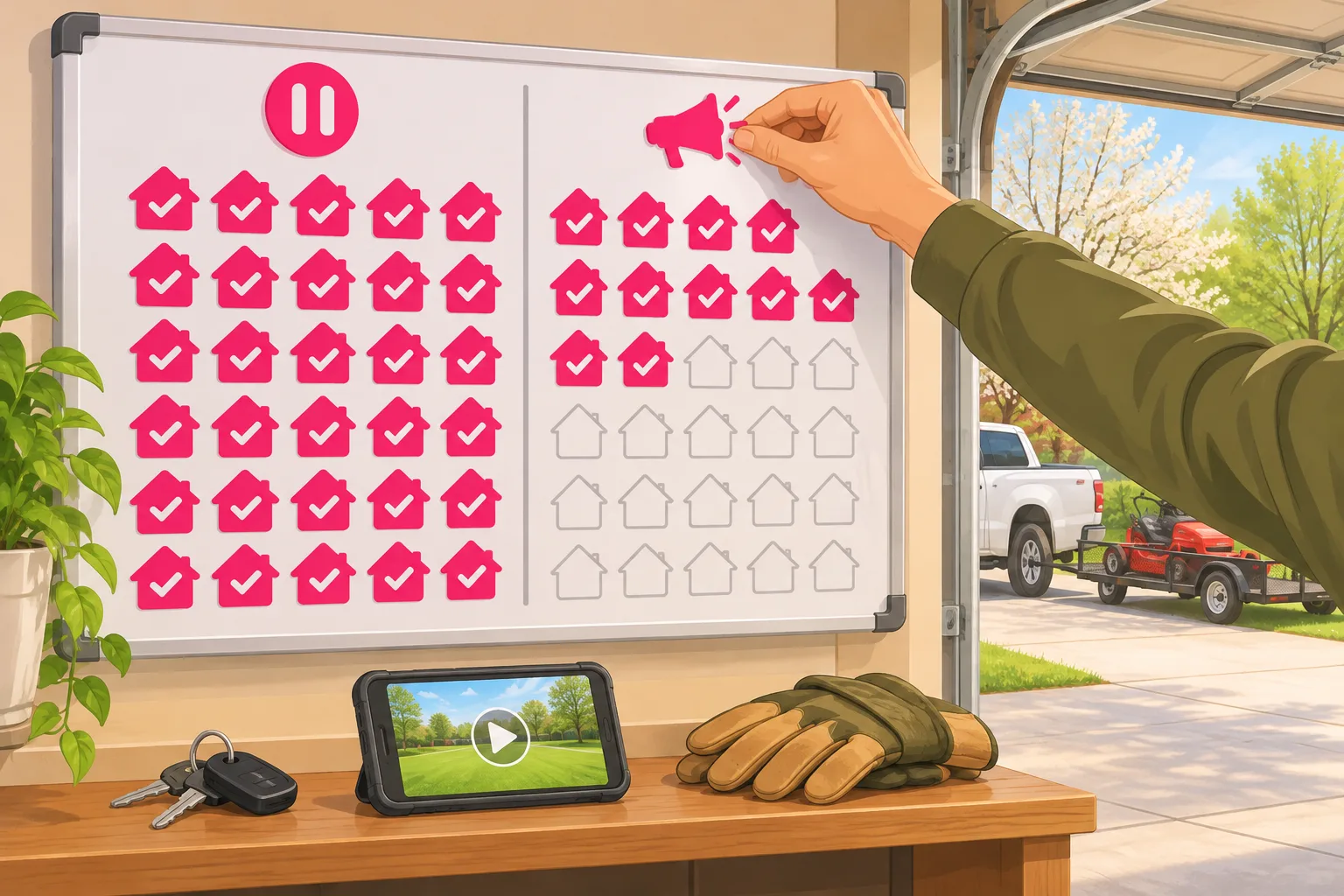
An ad for a full day is worse than no ad. It brings requests you have to decline, and it teaches new people that you never have room. So when one day fills, do one of three things:
- Switch to a video that names the day and the side of town that still has spots.
- Pause, and save the money for August.
- Post a plain update: "Thursday on this side of town is full. Tuesday has four spots." A full route said out loud is good advertising, and it costs nothing.
The cheapest way to fill next year's route is not an ad at all. It is asking this year's customers to keep their spot before winter. The renewal message takes one text per customer. Send it first, and then advertise only the spots that are really open.
9. The Rules a Paid Video Has to Follow
A paid video is an advertisement. It is held to a higher standard than a regular post, by TikTok and by the law. None of these rules is hard to follow, but each one is easier to handle before the ad runs than after. This is general information, not legal advice, and rules differ by state.
Permission
- The customer. Saying yes to a regular post is not saying yes to an ad. Ask again, in writing, for the one video you want to promote. No faces, no children, no house number, no street sign. The filming guide has wording you can use.
- The crew. Anyone who works for you and appears in the video should agree in writing to be in paid promotion, on its own line. The one-page crew agreement covers it.
- The neighbors. Keep their houses and yards out of the frame. An ad is seen by far more local people than a regular post.
Honest claims
- The before and after. Same yard, same spot, same day, your own work. No "after" filmed a week later when the grass has greened up, and no editing that makes the lawn glow. TikTok can reject ads it finds misleading. The before-and-after rule has the details.
- The price. The price in the ad is the price people pay. If $55 is for a quarter acre, say so. Do not advertise a "starting at" number that almost nobody gets.
- Reviews. In the United States, federal rules do not allow paying for reviews or offering rewards for positive ones. If you quote a customer's review in an ad, use her words, ask first, and leave out her name and street.
Licenses
- Weed control and fertilizer. In most US states, applying weed control or other pesticides for pay requires a state applicator license. An ad that offers the service is public proof that you sell it. Have the license first. If you do not spray, leave those words out of the ad.
- "Licensed and insured." Say it only if both are true today.
- The drone. In the United States, flying a drone for any business purpose requires an FAA remote pilot certificate. A drone shot in a paid ad is clearly for business. The drone section of the filming guide explains what is needed.
Two TikTok rules
- A hiring video is a job ad. If you pay to promote "we are hiring," TikTok treats it as an employment ad in the United States and Canada. You have to declare it when you set it up, and some targeting choices, such as age, gender and ZIP code, are switched off. Write it about the job, the pay and the hours. Do not write it about what kind of person should apply.
- Music. A song that is fine in a regular post may not be allowed in an ad. Use TikTok's library of music cleared for business use, or use the sound of the mower. The mower is usually better.
Platform rules change. Check TikTok's current advertising policies before each campaign. The main guide's rules section covers the same ground for regular posts.
10. The Numbers to Check, and Who Should Run It
An ad dashboard shows dozens of numbers. You need five. Three come from the dashboard and two come from your own records.
- Cost per follower. From the dashboard. It tells you whether the video is working as an ad. Compare it week to week, not against anyone else's number.
- Profile visits. From the dashboard. People who tap through to see who you are.
- Quote-page visits. From your link tool or website. If followers rise and page visits do not, the video is not telling people what to do next.
- Quote requests that mention TikTok or a video. From the "how did you find us?" question. Ask it every time, on the form or by text.
- New stops, and how many are near a stop you already had. This is the only number that matters at the end. Divide what you spent by the new stops to get the cost per stop.
Check the first two once a week while the ad runs. It takes five minutes. Check the last three once, about six weeks after the ad ends. Then put the cost per stop next to what you paid for lead sites, mailers and search ads in the same season.
That comparison is the whole point. It turns "I think the videos are working" into a number you can show a partner or a bookkeeper. The four numbers in the customers guide use the same records.
Run it yourself, or use a service?
Both are reasonable. The choice is about time.
Running it yourself makes sense if you like this kind of work, or someone in the family does. You get the most control over the map. The cost is the learning curve, and it arrives in late February, when you are also servicing equipment and answering quote requests.
Using a service makes sense if you would rather spend those hours on the route. That is what Viryze is built for. You choose a video that has already worked. Viryze shows it to several different audiences, sees which one follows for the least money, and moves the budget there. The promotion runs on your real post, so the followers land on your real account.
Be clear about what a service can do for a route business. Before you pay for any promotion service, ours included, look at the location choices it offers and ask how closely they match the area you work in. If a service cannot keep a campaign close to your towns, use it for videos meant for a wider audience, and run the local campaign another way.
Whichever you choose, the rules in this guide stay the same. Promote a video that has already worked. Keep the map small. Spend before the window. Pause when the day is full. Ask every new customer how they found you.
For how other local businesses handle the same decision, see the TikTok advertising guide for salons, which pauses when the appointment book is full. The TikTok guide for contractors covers trades that sell one job at a time.
Frequently Asked Questions
What is the best advertising for a landscaping or lawn care business?
It depends on how soon you need the work. Lead sites and search ads reach homeowners who are ready to hire today, so they are the fastest. Door hangers and mailers let you choose the exact streets, which matters for a route. A promoted TikTok video is slower. It builds a local audience that watches you work for a few weeks and then asks for a price. Many small companies use one fast tool and one slow tool, ask every new customer how they found the company, and compare the cost per customer at the end of the season.
Do TikTok ads work for landscapers and lawn care companies?
They can, if you use them for the right job. A promoted video is good at showing nearby homeowners how you work and what you charge before they need you. It is not good at producing quote requests the same day. Expect it to take a few weeks. It works best when the video has already done well on its own, the quote page shows your price, and the promotion is limited to the area your truck already covers.
How much should a lawn care company spend on TikTok advertising?
Start small. A first test of a few hundred dollars over two or three weeks is enough to learn whether a video brings quote requests. If you run TikTok Ads Manager yourself, expect a minimum of about twenty dollars a day for each ad group at the time of writing, so a three-week test is about $420. Compare that with what one new weekly customer is worth to you over a season before you decide whether it paid off.
When should a landscaping company advertise?
In the weeks before homeowners decide, not during the rush. For weekly mowing in most of the United States, that means the last week of February and the first weeks of March. For aeration, overseeding and fall cleanup, it means August. For patios and other installs, it means January through March. Advertising costs tend to rise in the first warm weeks of spring, when every company in the area is advertising at once.
Should I promote a video for followers or for quote requests?
For a route business, followers are usually the better goal. Very few people hire a lawn company seconds after seeing it for the first time, because hiring one means letting strangers into the yard every week. A local follower sees your next several videos for free. By the time she needs a lawn company, she already knows your price and your day in her part of town.
Can I show a TikTok ad only to people in my town?
Partly. TikTok Ads Manager lets you choose locations in the United States, in many cases down to the city. Very small towns are not always listed, and a very small area can be too small for an ad to run well. Choose the smallest area the tool offers that covers your route, and expect some viewers outside it. Then say the names of your towns in the first seconds of the video, so people outside your area know it is not for them.
Which video should a lawn care company promote first?
The video of one complete visit, from the truck arriving to the gate being latched, with the price and the day said out loud. It answers the two questions most homeowners have: will they show up, and what does it cost. Promote it only after it has done well without money behind it. The second choice is a short video that explains your price and what it pays for.
Do I need permission to use a customer's yard in a paid ad?
Yes, and it is a separate permission. A customer who agreed to let you film her lawn for a regular post has not agreed to appear in an advertisement. Ask again, in writing, for the specific video you want to promote. Keep her face, her children, the house number and the street out of the shot, and take the ad down promptly if she changes her mind.
A video that works and a route day with room?
If one of your videos has already brought a quote request, your quote page shows your price, and you know which day has open spots, the next step is more of the right viewers before spring. Viryze can put that video in front of more people, test which audience responds, and shift the budget to what is working - so more viewers become followers and, in time, some of them become stops on the route.
Related Reading
- TikTok for Landscapers and Lawn Care Companies: The Complete 2026 Guide - the full strategy this guide is part of.
- Getting Lawn Care Customers: Turn TikTok Views Into Route Stops and Renewals - the quote page, the replies and the renewal message to fix before you spend.
- How Landscapers Make Money on TikTok: The Route Math, the Install, the Equipment Deal, and the Course - what a stop is worth and why nearby stops are worth more.
- Growing a Landscaping TikTok: From 0 to 10K Followers in the Right Two Towns - the 90-day plan that produces a video worth promoting.
- How to Film Landscaping Videos for TikTok (The Yes-Card Yard, the Address Rule, the Kids, the Crew & the Drone) - permission, privacy and the honest before-and-after.
- Landscaping TikTok Content Ideas: 50+ Video Concepts That Fill the Route - 52 ideas, including the visit and the price video.
- TikTok for Hardscape and Design-Build Landscapers: The $12,000 Decision - the same questions for patios, walls and other one-time projects.
- Spark Ads on TikTok: Creator's Complete Guide - how to promote a post that is already on your account.