
Vacation Rentals17 min read
TikTok for Vacation Rental Managers and Cohosts: Thirty Doors, One Phone
A vacation rental marketing guide for the property manager and the cohost who run thirty doors from one phone: the three audiences a manager has (guests for every house, owners who might hand over a key, cleaners to hire) and the one account for the town that serves them, the arrival filmed per neighborhood instead of per door, the "which of our houses is right for you" explainer that sorts the group chat, the owner video (a turnover at scale, the monthly statement said like a person, the three things owners lose sleep over - damage, empty weeks, the neighbor), the hiring video with the pay said out loud, the owner's written yes per house, revocable, never named with the owner, the permit and tax posture across thirty permits, the saved replies and the rebook message at scale, the rule that promotion pauses per house and not per account when a holiday week sells out, and the mistakes that empty a manager's calendar.
By Ryan MitchellHead of Creator Success at Viryze

Everything in this series so far has been written for one house: the two-bedroom cabin on the lake, June who drives up every other Friday, Rosa who resets it, the family that has booked the second week of July since 2021. The property manager reading along has been doing arithmetic the whole time. Thirty doors. Eleven turnovers on a Saturday in July. Three hours of highway between the houses and the people who rent them, and one phone that has to answer within the hour for all of it. The arrival video, re-filmed every season and pinned, is the conversion video of this whole series - and there is no world in which one person re-films thirty of them.
This is the manager's and the cohost's guide in the TikTok for Airbnb hosts series - the sub-vertical slot, the way the barbershop guide is to the salon series and the agritourism guide is to the farm series. It is written for a thirty-door company in a resort town about three hours from the same two cities June sells to, and for the cohost who runs three houses for three owners who live somewhere else. The rules of the one-house playbook all still hold. What changes is that a manager has three audiences instead of two, one account has to carry all three, and a phone that was a hobby at one house is a job at thirty. We will keep June and Rosa in the room as the contrast, because the difference between one door and thirty is the whole guide.
What's Inside
- 1. Why a Manager's Account Is Not a Host's: Three Audiences, One Phone
- 2. One Account for the Town: The Arrival per Neighborhood, Not per Door
- 3. "Which of Our Houses Is Right for You": The Explainer That Sorts the Group Chat
- 4. The Owner Video: A Turnover at Scale and the Statement Said Like a Person
- 5. The Hiring Video: The Saturday Crew and the Pay Said Out Loud
- 6. The Owner's Written Yes: Per House, Revocable, Never Named With the Owner
- 7. Thirty Permits, Thirty Tax Lines, One Company Name on the Exhibit
- 8. One Phone for Thirty Doors: Within the Hour, Thirty Times
- 9. Promotion Pauses per House, Not per Account
- 10. The Mistakes That Empty a Manager's Calendar
- 11. Amplify the Neighborhood Arrival, and Pause the House That Sold
- Frequently Asked Questions
1. Why a Manager's Account Is Not a Host's: Three Audiences, One Phone
The pillar's central idea is that a rental has two audiences: the guest audience in the two or three cities within a Friday-after-work drive, who buys the weekend, and the feed audience everywhere else, who buys only what fits in a box. A manager has a third, and it is the one the whole business is built on. Call her the owner: the woman three hours from her own cabin who has never seen her cleaner work, who cannot explain her own calendar, and who is deciding - slowly, over months, mostly by watching - whether to hand somebody a key. The money guide calls cohosting the quietest stream on June's list. For a manager it is the business, and the account has to serve it without ever turning into a management company's feed, because a family in the city does not book a cabin from a management company's feed.
There is a fourth group that is really a third audience in work clothes: the people you need to hire. A one-house host has Rosa. A thirty-door company has a Saturday crew of five, a lead, a maintenance contractor and a seasonal problem every May when two of them take restaurant jobs. The account is the best hiring page the company will ever have, for the same reason it is the best owner pitch - it shows the work - and it has rules of its own.
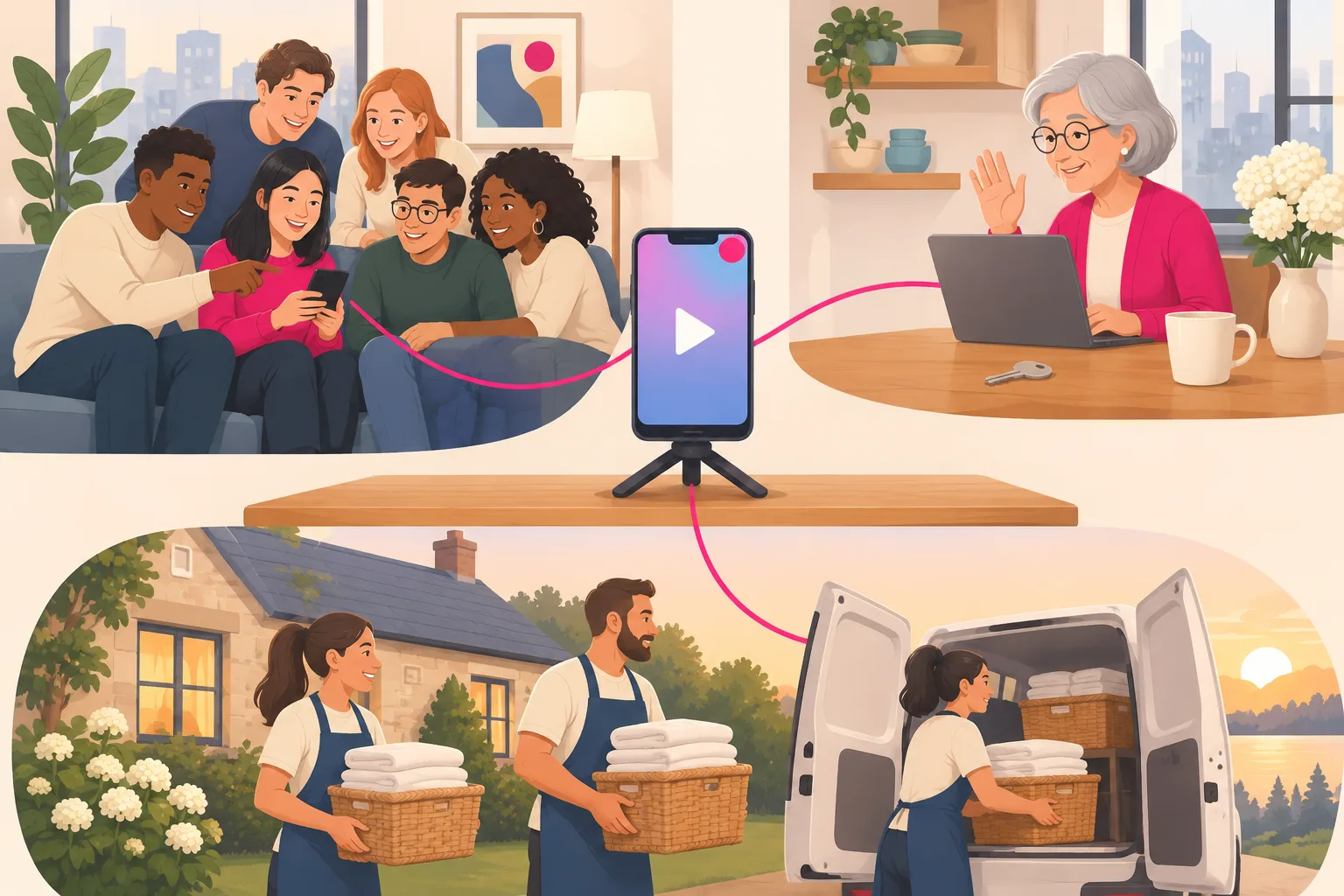
So the manager's account carries three series for three people who want three different things from it, and the design problem is keeping it the guest's account first. Here is the split that works at thirty doors:
- The guest gets most of the feed. The arrival per neighborhood, the "which of our houses" explainer, the price explainer per house with the total on, the question answered, the first morning from whichever house turned over that week. Two of the three weekly posts, every week, and the pinned trio.
- The owner gets one post a month, and watches all the others. The turnover at scale, the statement said like a person, the three things she loses sleep over. She is not the audience the account is written for, and that is why she trusts it: she is watching how you treat the houses you already have.
- The crew gets one post a season. "Here is what Saturday looks like," from the van, with the pay in the caption. Promoted toward home, which makes it the one video on the account that ever points at the county the houses are in.
One phone holds all three, and the phone is no longer four hours a week. At June's cabin the cohost role is twenty minutes of capture on turnover day and an hour on Sunday night. At thirty doors the capture is spread across a crew, the Sunday hour is a Monday morning for someone on payroll, and the inbox is a shift rather than a habit. The rest of this guide is what each of those changes actually looks like.
2. One Account for the Town: The Arrival per Neighborhood, Not per Door
The first decision is the one most companies get wrong in one of two directions. Thirty accounts for thirty houses is thirty inboxes, thirty audiences in the same two cities, and thirty arrivals that need re-filming every season; the per-door account dies by the second summer and takes the owner's goodwill with it. One account that is the company - the logo, the drone montage of every roof, the "trusted by owners since" voice - grows an audience of other managers and tells the woman with twelve tabs open nothing about which house she is standing in. The answer is in between: one account for the town, built from the guest's question rather than the company's. Her question is "where should we go?" and then "which house?", in that order, and the account is organized the same way.
The arrival per neighborhood. The arrival is the conversion video of this series because it answers "is it really like the photos?" - the highway exit, the road, the door, the code, the light coming on, the total said out loud. Thirty of them cannot be kept current, but a resort town has three or four neighborhoods, and the drive in is the same for every house in each: the exit, the lane of cottages by the water, the village with the bakery, the ridge road with the switchbacks. Film one arrival per neighborhood, re-filmed each season, that ends not at a door but at the lane - "our six lake-side cabins are the next quarter mile" - and then cuts to one door opening, a different one each season. The viewer gets the thing the arrival is for, which is the feeling of the drive and the proof that the place exists, and the booking site carries one current arrival per house for the family who has already narrowed it down.
The profile is the sign at the town line, not at the turn. June's four-line profile names the lake, the town, the drive time from each city, "sleeps six, dogs yes, a dock" and one link. The manager's names the town, the drive time from each city, and the range in one breath - "thirty houses, sleeps two to fourteen, dogs welcome at eleven of them" - and one link to a page that sorts, which is the next section. The face on the profile is the person who answers the phone, not a logo, for the same reason June's face is on hers: the twelve-tabs minute includes "is this a scam?", and a company name does not answer it.
The exceptions are few and written down. The fourteen-sleeper on the ridge that books for reunions and corporate weeks is a different product with a different buyer, and it can carry its own account if someone is paid the hours to run it. An owner who wants her house to have its own handle can have one, on the same terms. In both cases the handle, the login and the footage are the company's by the agreement in section 6, the house is never named with the owner, and the account is cross-posted to the town account rather than competing with it. Everything else is a house on the town account, and the town account is the one the crew's phone is logged into.
3. "Which of Our Houses Is Right for You": The Explainer That Sorts the Group Chat
A one-house host has one answer to every inquiry and the only question is whether the dates are open. A manager's most expensive hour is the one spent sorting - six friends who want to be near the village, a family with a dog who wants a fence, two couples who want quiet, eight people who want one table - and the account can do most of it before anyone writes. The explainer format in the ideas vault is the price-and-why video for one house. The manager's version is the sort, and it is a series, not a video.
- "You are six friends and you want to walk to dinner." Forty seconds, filmed from the village cottage's porch: the bakery two doors down, the two bedrooms plus the loft, the one bathroom said plainly, the walk to the water at nine minutes, and the total for a two-night weekend with the cleaning fee and the lodging tax on. One video per group shape, five or six shapes, re-filmed when the house changes.
- "You have a dog and you want a fence." The lake-side cabins sleep six like June's, and the one with the fenced yard is the dog house; say which one, show the gate, say the dog fee as a number, and say the dock is yours. The person asking this question books the first house that answers it in the video instead of in the fine print.
- "You are eight people and you want one table." The ridge house, and the honest version: fourteen sleeps, the long table, the switchbacks on the drive, the two-night minimum that becomes three on holiday weeks, and a two-night weekend that is about fourteen hundred all in because fourteen beds take eight hours of the crew to reset. Said once, like a person, with the total biggest, and the number that would have produced the "for two nights?" argument in the group chat is now the reason the group chose it.
- "You want quiet, and you work Fridays." The two couples, the desk by the window, the speed test on camera, the midweek rate said out loud. This is the video that sells March, and it is filmed in August when the house is full and the light is good.
The link in the profile opens the same sort as a page: four or five questions a family can answer in a minute, each one ending at two or three houses with the total for a sample weekend first and biggest, the rules said like a person, check-in described, a map to the town, and the face of the person who answers the phone - the booking-page anatomy from the conversion guide, once per house, behind one sorting page. Nobody with twelve tabs open will read a list of thirty houses. Four of them will click "we have a dog."
The pillar's hook rule does not change at thirty doors: open on the house, never on the guest. The sorting series describes the group by what they want from the weekend - a fence, one table, a desk - never by who they are. That is a kindness, and in section 11 it is also the law.
4. The Owner Video: A Turnover at Scale and the Statement Said Like a Person

The money guide's cohosting pitch is already written for June: the pitch is not a video that says "I cohost," it is the turnover series watched by an owner who recognizes a system when she sees one. At thirty doors the system is the whole show, and the manager's version of the turnover is the thing no single host can film - Saturday. Eleven checkouts at ten, eleven check-ins at four, five people, one van, a schedule on a clipboard. Film it from the van at seven in the morning with the crew lead who agreed to be on camera - the bins loaded by color, three houses on one lane done in sequence, the lead walking a finished room with a hand on the folded towel, the key going back on the hook at the office at three forty - and say nothing about management at all. An owner who has been improvising for three years will watch that four times.
The statement said like a person is the one owner video a month, and it is the hardest one to make honestly because it is about money that is not yours. Do it with the total structure the price explainer uses, with a real house and the owner's yes to use her numbers, and never her name. "Here is what the ridge house did in July. It grossed about eighty-four hundred in nightly money across eight stays. The cleaning fees were twenty-two hundred and forty - eight resets at two-eighty - and they went straight to the crew; they are not revenue. Our share was about a fifth of the nightly money, roughly seventeen hundred. The lodging tax was collected and sent to the county. What landed in the owner's account was about sixty-seven hundred, on the fifth, with this one-page statement." Management fees run somewhere from a tenth to a third of a house's revenue depending on what the manager takes on, so say yours and what it buys; the owner comparing you to a cheaper number needs to hear what the cheaper number does not include. That video is the pitch. It is also, said out loud once a month, the thing that stops the owner who already hired you from wondering.
The three things owners lose sleep over get one video each, and they are the three questions every owner inquiry contains whether or not it is asked:
- Damage. Not a guest-shaming clip - the pillar's rule against them is absolute, and it applies with more force when the house is someone else's. The damage video is the system: the room walked on camera at checkout by the lead, the photo set that goes in the file every Saturday, the deposit and the insurance said like a person, the one time something broke and how the owner heard about it within the hour. "Here is what happens when a lamp breaks" sells more management than any before-and-after of a trashed kitchen ever has.
- Empty weeks. The answer is the calendar the pillar builds - summer sold in January, fall color in August, the holidays in September, the midweek in March - said as what the company does for every house, with the tablet showing the grid filling. The owner does not know that calendar exists. Her empty Octobers were nobody's plan.
- The neighbor. The one the owner fears most and the one a manager can answer best: the quiet hours in every house's rules said like a person, the property phone that a neighbor can call at eleven at night and reach a person, the occupancy that matches the permit, and the line that the manager goes to the town meeting so the owner does not have to. The neighbor rule from the filming guide - never in frame, never in the story - holds for all thirty.
The pitch itself is one sentence, said once, where the growth roadmap says the cohost says it: who answers the phone, what gets a look before it posts, how the owner hears from you every month. One of the platforms now runs a network that introduces owners to cohosts, and the owner who finds you there will go look at the account before she writes. Make sure what she finds is Saturday from the van and the statement said like a person, and not a logo.
5. The Hiring Video: The Saturday Crew and the Pay Said Out Loud
Every May the same thing happens to every manager in every resort town: the season opens, two of the crew take restaurant jobs, and the job board produces nine applicants who have never seen a Saturday with eleven turnovers and quit after one. The hiring video fixes the one thing the job board cannot, which is showing the day. "Here is what Saturday looks like" - the van at seven, the bins, the lane, the lead checking a room, lunch at noon in the office, the last key on the hook at three forty - with the pay per turnover and the hours in the caption as numbers. People who message after watching that have already decided they can do that day, and the ones who could not have sorted themselves out for free.
The hiring video follows four rules, and the first two are the same rules every video on the account follows:
- Nobody in it who has not signed. The crew lead and anyone else who appears on purpose has signed the same yearly page Rosa signs at June's - section 6 has it - and a new hire filmed on her first Saturday has not signed anything. Hands and the van are fine; faces are the page.
- Never a word about who left. The barbershop guide gives a barber who leaves one kind sentence. A cleaner who left gets none, because a hiring video that mentions the last person is a grievance post in work clothes, and the applicant watching it hears how she will be talked about.
- The pay as a number, or not at all. "Competitive pay" in a caption is the amenity-list graphic of hiring. Say the per-turnover rate or the hourly, say the Saturday hours, say whether the Sunday rebook-message hour is paid, and say it the same way the price explainer says seven hundred: first and biggest.
- If it is promoted, it is an employment ad. TikTok's special category for housing, employment and credit ads covers the hiring video exactly as it covers the arrival, so it is declared, and targeting by age, gender or ZIP is off the table. Write it about the day, not about who should want it.
The hiring video is also the single exception to the pillar's inverted map. Every guest video points away from home, at the two cities; the crew lives in the county, so the hiring video is the one post a year that points at it. Section 11 has the mechanics.
6. The Owner's Written Yes: Per House, Revocable, Never Named With the Owner
The filming guide's once-a-year agreement covers the people who appear on the account on purpose - the cleaner, the cohost, the handyman - and a manager's crew lead and anyone else on camera signs that page each January exactly as Rosa does, with the same separate line for paid promotion and the same right to withdraw with a text. A manager has a second agreement a single host never needs, and it is the one that keeps the company in business: the owner's written yes to put her house on the account, per house, before the first clip.
The owner page - one sheet per house, signed before the first post, kept in the house file
- What can be filmed: the empty house by the crew, the exterior with nothing that locates it, the view, the arrival up to the lane. What cannot: the address in any form, the keypad, the mailbox, anything with the owner's name on it in the house, any guest, the neighbor.
- The house is never named with the owner. "The ridge house" and "the cabin with the fence" are fine. The owner's name, her town, her job, the fact that she is "a nurse in the city who comes up twice a year" - never, in a video, a caption or a reply. A public record of whose empty house this is and when she is not in it is a safety problem before it is a privacy one.
- Her numbers need a second yes. The statement video in section 4 uses a real house's month only with that owner's written yes for that video, and it is allowed to be no.
- Paid promotion is its own line. She agrees that the house's clips may run with money behind them to the two cities, or she does not, and she is told which ones did. The same line the cleaner has, for the same reason.
- Revocable with a text. After which the house's clips come down within the week, no argument. A manager who makes an owner ask twice has told every other owner something.
- The handle, the followers and the footage are the company's while the house is in the portfolio, and when the house leaves - sold, or the owner moves to another manager - its clips come down and its page on the sorting site goes dark the same week. The owner does not take the account with her, and the company does not keep posting a house it no longer answers the phone for.
The cohost running three houses for three owners has three of these pages, not one, and her own cast agreement with each owner says which account she posts from - the house's or the company's, never her own, for anything about the house - and what happens to the handle when she stops. The growth roadmap's line is written for her: the account survives the person with the phone leaving only if it was never theirs to begin with.
And the guest, at thirty doors as at one, is never content. The filming guide's rule is the same: the house is filmed empty by the cast, a guest's tagged video is reposted only after asking, a review is quoted in her words and never her name. Indoor cameras have been banned by the largest platform since April 2024, outdoor ones must be disclosed, and a crew of five with phones in eleven houses on a Saturday has eleven chances to forget that a checkout is a guest's last ten minutes in the house. The lead carries the rule; the phone on the porch tripod starts recording when the car is gone.
7. Thirty Permits, Thirty Tax Lines, One Company Name on the Exhibit
The pillar's compliance section puts the permit and the tax first because a promoted arrival is a public record that you operate, and the city that enforced its registration law in the fall of 2023 took most of its listings off the map in weeks. June has one permit to check. A manager has thirty, in thirty owners' names, under rules that in many resort towns cap how many a single owner may hold, require a local contact who can be at the house within a drive, and set an occupancy per house that the advertised occupancy has to match. The account puts the company's name on every one of them. The money guide's line for a cohost - "an arrival for an unpermitted house has put her own name on the exhibit" - is, for a manager, the business plan.
So the permit roster comes before the content calendar, and it is a column in the same spreadsheet the house cards hang from:
- Permit, number, renewal date, per house. No house posts until its row is filled in. Where the town requires the registration number in advertising, it goes in that house's caption and on its page on the sorting site, and the company's own license goes in the bio.
- Occupancy in the video equals occupancy on the permit. "Sleeps fourteen" on the ridge house is the permitted number, the insured number and the number in the sort video, and no video ever shows more. The pillar's line about fourteen people in a hot tub rated for six is the video the insurer finds first; at thirty doors it is the video the town finds first, and it costs the other twenty-nine.
- Who remits the lodging tax, per house, in writing. On the platforms it is often collected for you; on the company's own sorting site it is the company's, and the statement video says so out loud. The owner does not know the difference and should not have to.
- The HOA letter and the insurance rider in the file before the first clip, because "the association did not know" is a sentence that ends on the account being named at a meeting.
- The total price everywhere. The federal fee rule in force since May 2025 binds the platforms, the company's site and every video: the number said first and biggest is the all-in total for a sample weekend, not the nightly. Thirty price explainers is thirty chances to get this wrong once, which is why the sort videos say the total and the nightly is a footnote.
The honest week, said not shown, is a manager's format too, and the version that belongs to this section is the one about the meeting: "The town is voting on a cap in March. Here is what we told them, here is what our houses' quiet hours are, and here is the number a neighbor can call at eleven at night." Said once, by the person whose face is on the profile, with no neighbor in it. The owner three hours away watches that one twice, and so does the town.
8. One Phone for Thirty Doors: Within the Hour, Thirty Times
The conversion guide's nine-rung ladder does not change shape at thirty doors; every rung just happens thirty times, and the hour it has to happen inside is the same hour. The property-phone rule that is one page in June's binder is, for a company, a shift schedule: a named person on the inbox in every hour it is open, a named person on the night line, the two logins and the recovery codes in the office safe rather than a kitchen drawer, and the rule written down for what gets a look before it posts - a price, a neighbor, the road, an owner's anything. The crew's phone captures; one phone posts; one person at a time answers.
The three saved replies grow a first line. June's saved replies answer "how much for a weekend in October?", "is it open the second weekend of June?" and "can we bring ten people and a boat?" with the total, the open-or-not said out loud and the kind specific no. The manager's have the same bodies and a first line that sorts: "Happy to - which house were you looking at, or tell me how many of you and whether there is a dog and I will point you at the right two." Then the total for that house, that weekend, with the fees and tax on; then the nearest open weekend if it is a no, which at thirty doors is almost always a yes somewhere - "the village cottage is full that weekend, the lake-side cabin with the fence is open, here is the total for it." A manager who answers "check our website" has thrown away the one advantage thirty doors has over one, which is that the answer to "is it open?" is usually "yes, next door."
The welcome message and the rebook message run per house. "How did you find us?" goes in every welcome message, and the answer is written on the booking with the house's name, because the question the owner report has to answer is not "does TikTok work?" but "does it work for the ridge house?" The rebook message two weeks after checkout - "the same week next year is open until the fifteenth, want me to hold it?" - goes out from the same phone for every family in every house, with the same fifteenth, and it is the one task on the account that a company can actually schedule, because checkouts are known a year ahead. A house whose rebook messages never went out is a house whose owner is going to ask in September why October is empty.
The off-platform line governs every reply on every house. The money guide's rules section has it in full: a family who booked a house through a platform is answered in that platform's inbox with no link, no code and no "text me," and the rebook message to them is the date and the platform's own link. At thirty doors the temptation is a company-wide template that puts the sorting site in every message, and the penalty is not one listing - it is thirty, in thirty owners' names. The sorting site lives on TikTok and in the welcome book on every island, where it has always lived.
The scoreboard is per house and has a fourth number. June's three numbers - link clicks a week, inquiries a month that mention a video, stays that became a rebook when asked - are kept per house, and the monthly owner statement carries that house's three in one sentence under the money: "Four inquiries for the ridge house this month mentioned a video, and two of them are holding next July." The company keeps a fourth for itself: owner inquiries that mention a video. "I watched your Saturday videos" at the start of an owner call is counted the day it happens, separately, because it is the number that decides whether the account is a marketing cost or the sales department.
9. Promotion Pauses per House, Not per Account
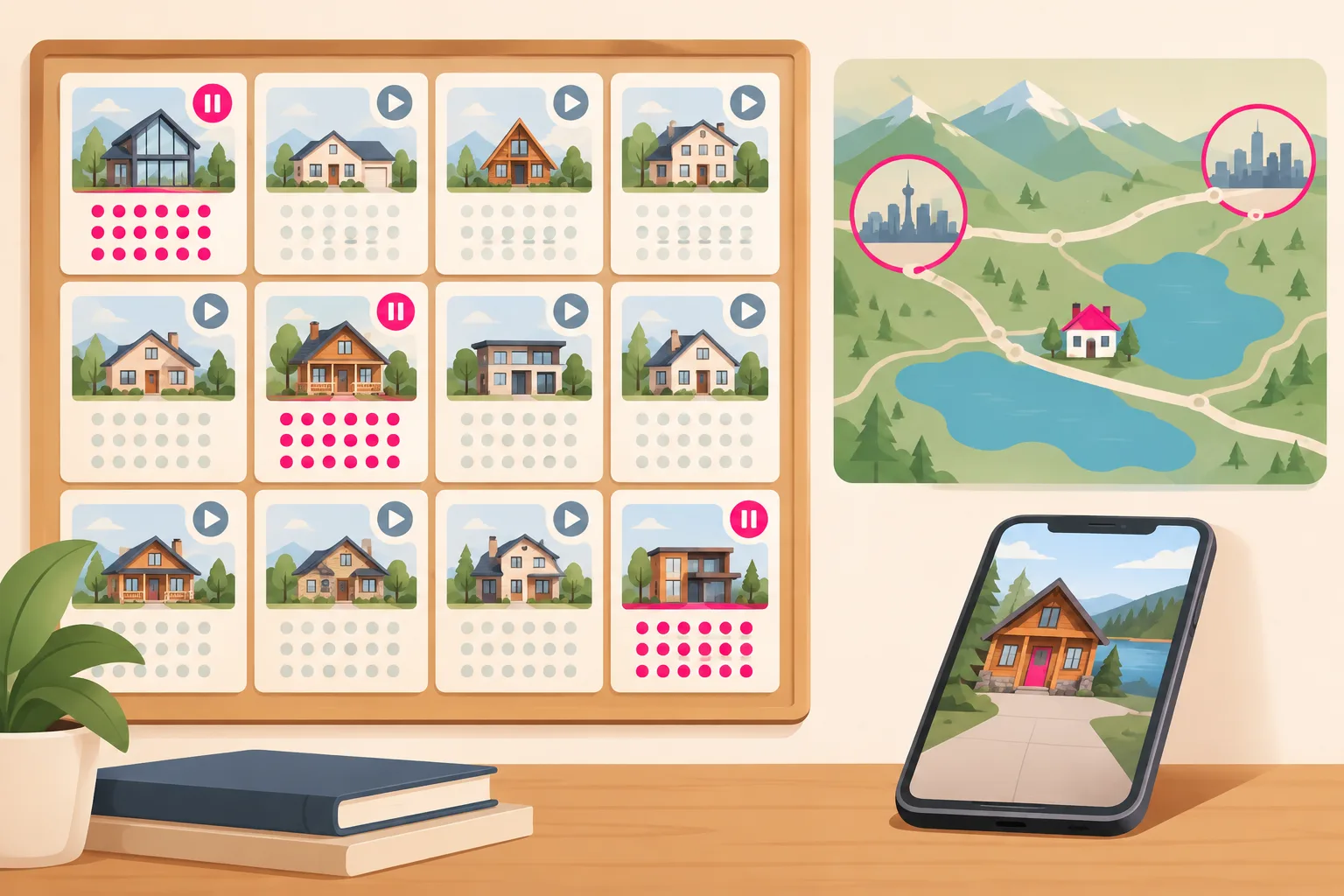
The pillar's promotion rule has two halves: build in the empty weeks for the full ones, and pause the day the calendar fills. The cadence section adds holiday mode - silent on the Fourth is fine, silent in January is not. At one house all three rules are about one calendar. At thirty they are about thirty calendars that fill on different days, and the mistake almost every company makes is applying them to the account. The ridge house sells its Fourth of July on a Thursday in February; the village cottage has two July weekends open until May. Pausing the account the day the ridge house fills starves the cottage. Leaving the account running at full volume into the holiday week because the cottage is open means the ridge house's arrival keeps getting money behind it for a week nobody can book.
So the rule is kept per house, and the house cards on the office wall are how. Each card has its calendar; the day a house's holiday week sells out, that house's videos come out of promotion and its sort video gets a one-line caption edit - "July is full; fall color weekends are open now" - while the account keeps posting and the other houses keep running. The account itself never pauses, because at thirty doors there is always a house in a quiet week, and the quiet-week calendar becomes a stagger: the ridge house's summer is promoted in January, the lake-side cabins' midweeks in March, the village cottage's fall in August. The company's holiday mode is real too - on the Fourth the feed carries a first morning from whichever house turned over, a guest's tagged video reposted with her yes, and the inbox within the hour, and nothing else is required of anyone - but it is the posting cadence that rests, never the inbox and never the one house that still has a week open.
The two scoreboards from the growth roadmap are what make this possible without a meeting. The number that says a house is done for the holiday is its calendar, not its views, and the person on the Monday hour reads thirty calendars before she reads a single analytics screen.
10. The Mistakes That Empty a Manager's Calendar
Every mistake in the pillar's list is available at thirty doors, thirty times. These are the ones a manager makes that a single host cannot:
- The company account. The logo as the profile picture, the drone montage of every roof in the portfolio, the "trusted by owners" voice. It is the famous-and-empty cabin of this sub-vertical: an audience of other managers, and a family with twelve tabs open who learned nothing about which house.
- Thirty accounts. The other direction, and the one well-meaning companies take because the owner asked. Thirty inboxes, thirty audiences, thirty arrivals to keep current, and by the second summer twenty-six of them have not posted since March while the owners wonder what they are paying for.
- Naming the owner. "Our newest owner, a retired teacher from the city, just handed us the keys to her lake house" is a warm caption and a map to an empty house with a named absent owner. Section 6, every time.
- The damage reel. The checkout rant was always the worst video a host could post; a manager posting a trashed kitchen has posted an owner's kitchen, told every other owner how their worst day will be used, and told every guest they will be policed. The damage video is the system, never the mess.
- The hiring post that shames the last crew. "Looking for people who actually show up" is the grievance post in work clothes. The people who show up read it too.
- The manager as the only face. At one house the cast is the house. At thirty the temptation is for the account to become the owner-manager's personal brand, which grows a following of people who want to be managers and sells no weekends. The face on the profile is the one who answers the phone; the videos are the houses, the lane and the crew.
- Four hours a week. June's cohost role works at four hours because one turnover day is the content calendar. A manager who gives the account the same four hours is running a thirty-door inbox as a hobby, and the first January it goes unanswered for a weekend costs more than the Monday-morning hire would have.
- Promoting a house that is sold out. Section 9. It is the most common paid-media mistake in this sub-vertical and the easiest to catch with a wall of cards.
- The site in every message. The company-wide template that puts the sorting site in the platform inbox, thirty times a week, in thirty owners' names.
11. Amplify the Neighborhood Arrival, and Pause the House That Sold
The pillar's promotion section and the growth roadmap's inverted map are the rules: promote for followers in the two or three cities within a Friday-after-work drive, never the home county, with the videos that have already proved themselves, in the quiet weeks, and pause the day the calendar fills. A manager runs the same rules with three changes, one per audience.
- Guests: the neighborhood arrival and the sort video, per house, with the owner's yes. The arrival per neighborhood is the account's best promoted video because it works for six houses at once; the "which house" explainer for the house with the open weeks is the second. Each runs only to the two cities, only in that house's quiet window - the ridge house in January, the midweek cabins in March, the cottage in August - and each one comes out of promotion the day that house's calendar fills. No clip of a house runs with money behind it unless its owner's page has the promotion line signed, and she is told which ones ran.
- Owners: never, directly. The owner watches the guest videos. A promoted "we manage properties" video is the company account with a budget, and it reaches other managers. If the turnover-at-scale video is ever promoted, it is promoted to the two cities as a guest video - a family deciding between twelve tabs also likes a house that is reset like that - and the owner finds it the way she finds everything, by watching.
- Crew: the hiring video, toward home, once a year. The only promotion that points at the county. It runs for two weeks in April, before the May exodus, declared under the housing, employment and credit category, with no targeting by age, gender or ZIP, written about the day.
The four cautions from the conversion guide hold, and two of them get sharper at scale. The promoted sort video says the total - fourteen hundred, not four hundred and ninety a night - because the fee rule binds the ad as it binds the site. Every guest video is a housing ad under TikTok's special category, so it is declared and written about the house, never about who should rent it - "sleeps six, fenced yard, dogs welcome" and not "perfect for young families." The lens does not make the ridge house sleep sixteen. And a guest's tagged first morning needs a separate yes before it runs with money behind it, from the guest and, at a manager's house, from the owner's page too. Our local business guide has the general version of these, and the Spark Ads guide explains why the promoted post is the organic post with money behind it rather than a separate ad.
This is the work our TikTok promotion service was built for, and a manager's version of it has a shape that a one-house host's does not: several houses in several quiet windows, each pointed at the same two cities, each paused on its own day. The budget per house is small and comes out of the owner's statement as a line she can read - "promotion of the ridge house arrival to the two cities, January, paused the eleventh when July filled" - and the return is counted in her sentence, not the company's: inquiries for her house that mentioned a video, and the two that are holding July. The company's own return is the owner call that starts "I watched your Saturday videos."
Frequently Asked Questions
How do you market a vacation rental management company on TikTok?
With one account for the town, not thirty accounts for thirty houses and not a company feed of logos and drone shots. The account answers the question a family in a city three hours away is actually asking - "where should we go, and which house?" - so it is built from the arrival filmed per neighborhood (the lane of cottages by the water, the village, the ridge), the "which of our houses is right for you" explainer that sorts a group of six from a family with a dog from eight people who want one table, the price explainer per house said with the total on, and the first morning from whichever house turned over that week. The same account carries two quieter series for the other two audiences a manager has: the turnover at scale and the monthly statement said like a person for owners who might hand over a key, and the Saturday-crew video with the pay said out loud for cleaners. Followers from everywhere are not the measure; inquiries per house that mention a video, rebooks when asked, and owner calls that start with "I watched your turnover videos" are.
Should a property manager have one TikTok account or one per property?
One, for the town, with a handful of exceptions. A one-house host can re-film the arrival every season and pin it; a manager with thirty doors cannot keep thirty arrivals current, cannot answer thirty inboxes within the hour, and cannot grow thirty audiences in the same two cities, so the per-door account dies by the second summer and takes the owner's goodwill with it. The town account films the arrival per neighborhood, sorts guests with the "which house" explainer, and lets each house have one current arrival on the booking site rather than on the feed. The exceptions are the genuinely distinct property - the fourteen-sleeper on the ridge that books for reunions, the one house an owner wants its own account for and will pay the hours to run - and even then the login, the handle and the footage belong to the company by the written agreement, and the house is never named with the owner.
How do vacation rental managers get more owners from TikTok?
By letting owners watch the work. The owner who hands a manager a key has usually never seen their own cleaner work and cannot explain their own calendar, and what they recognize on the account is a system: a Saturday with eleven turnovers running on a schedule from a crew van, the same house reset the same way, the key on the hook, the tripod on the porch. Then one video a month says the monthly statement like a person - what the house grossed, what the cleaning fees were and that they passed through, what the management share was, what landed in the owner's account - and three more answer the three things owners lose sleep over: damage, empty weeks and the neighbor. The pitch itself is one sentence said once: who answers the phone, what gets a look before it posts, how the owner hears from you every month. An owner inquiry that starts "I watched your turnover videos" is the measure, and it is counted separately from guest inquiries.
Do I need the owner's permission to post videos of a house I manage?
Yes, in writing, per house, and it has to be revocable. A manager posting an owner's living room is posting someone else's property to a public record, so every house on the account has a one-page agreement signed by its owner that says what can be filmed (the empty house by the crew, the exterior with no address, the view), what cannot (the address, the keypad, anything that names the owner, any guest), that the owner may be told which videos run with money behind them and gets a separate line for that, that the agreement can be withdrawn with a text after which the house's clips come down within the week, and that the handle, the followers and the footage belong to the company while the house is in the portfolio and the house's clips come down when it leaves. The owner is never named with the house - "the ridge house" is fine, "Mrs. So-and-so's ridge house" is a privacy and a safety problem - and the cleaners and crew lead who appear on purpose sign their own yearly page, the same one a single-house cleaner signs.
Can a cohost run a TikTok account for a rental they do not own?
Yes, and for an owner with a day job in another city it is often the only way the account exists. The cohost runs the turnover, so she already has the content calendar and the phone; what makes it work is the paper. The property-phone rule names her as the person who posts and the owner as the one who gets a look at anything with a price, a neighbor or the road in it; the account is registered to the house's own email with two people holding the login and the recovery codes in the binder; the agreement says the handle and the footage stay with the house if she stops cohosting; and her Sunday hour is paid like a turnover hour or the account dies in week six. The permit, the tax and the insurance are the owner's and are checked before the first arrival is filmed, because a cohost who posts an arrival for an unpermitted house has put her own name on the exhibit. A cohost who runs three houses for three owners has three of these pages, not one.
Does TikTok work for hiring cleaners for a vacation rental company?
Better than the job board, in the one place the job board is weakest: showing what the day actually is. A forty-second "here is what Saturday looks like" from the crew van - the schedule, the linen bins, three houses on one lane, the lead checking a room, lunch at noon, done by four - with the pay per turnover and the hours said out loud in the caption does the sorting a listing never does, and the people who message have already decided they can do that day. The rules: nobody in the video who has not signed the yearly page; never a word about the last person who quit; the pay said as a number or not at all; and if the hiring video is ever promoted it is an employment ad under TikTok's housing, employment and credit category - declare it, and know that targeting by age, gender or ZIP is off the table. The hiring video is also the one video a manager promotes toward home instead of away from it, because the crew lives in the county and the guests do not.
Thirty calendars, two cities, one arrival that already works?
The wall of house cards tells you which house has a quiet week and which arrival the group chats already send each other - amplification decides how many more families in the two cities see it, and when. Viryze promotes the videos that have already proved themselves, putting a neighborhood arrival or a "which house" explainer in front of thousands more people within a Friday-after-work drive, in each house's quiet window, and pausing the house that sold while the rest keep running - so the line on the owner's statement reads as inquiries that mentioned a video and a family holding next July, and the company's own return is the owner who calls because she watched Saturday from the van.
Related Reading
- TikTok for Airbnb Hosts and Vacation Rentals: The Complete 2026 Guide - the two-audience strategy, the calendar, the cadence and the compliance framework this guide scales to thirty doors.
- Growing an Airbnb TikTok: From 0 to 10K Followers in the Right Cities - the inverted map, the two scoreboards and the cohost role with hours, as it works at one house.
- How Airbnb Hosts Make Money on TikTok: Direct Bookings, the Host Course, and the Storefront - the cohosting pitch, the fee that stays home and the off-platform line in full.
- Getting Guests to Book: Turn TikTok Views Into Airbnb Bookings and Rebooks - the nine-rung ladder, the booking page, the saved replies and the rebook message this guide runs thirty times.
- How to Film Airbnb Videos for TikTok (The Empty House, the Address Rule, the Cohost Agreement & the Property-Phone Rule) - the cast agreement the crew lead signs, the address rule and the guest who is never on camera.
- Airbnb TikTok Content Ideas: 50+ Video Concepts That Fill the Calendar - the arrivals, explainers and first mornings the town account is built from.
- TikTok for Barbershops: The Chair in the Back, the Line, and the Walk-In - the sister sub-vertical guide: whose account it is when the people in it leave.
- TikTok for Agritourism: Filling the U-Pick, the Pumpkin Patch, and the Farm Stay - the other sub-vertical that sells a date to a family from a city, and pauses when the gate is full.