
Vacation Rentals17 min read
TikTok for Airbnb Hosts and Vacation Rentals: The Complete 2026 Guide
The 2026 TikTok playbook for Airbnb hosts, vacation rental owners, and the cohost who runs the property phone - turning videos of the arrival, the turnover, and the first morning into guests who book, come back, and ask for the same week next year. Covers the six video formats that grow rental accounts, the hook that opens on the house instead of the guest, the turnover-day content engine, the guest-path vs.
By Ryan MitchellHead of Creator Success at Viryze
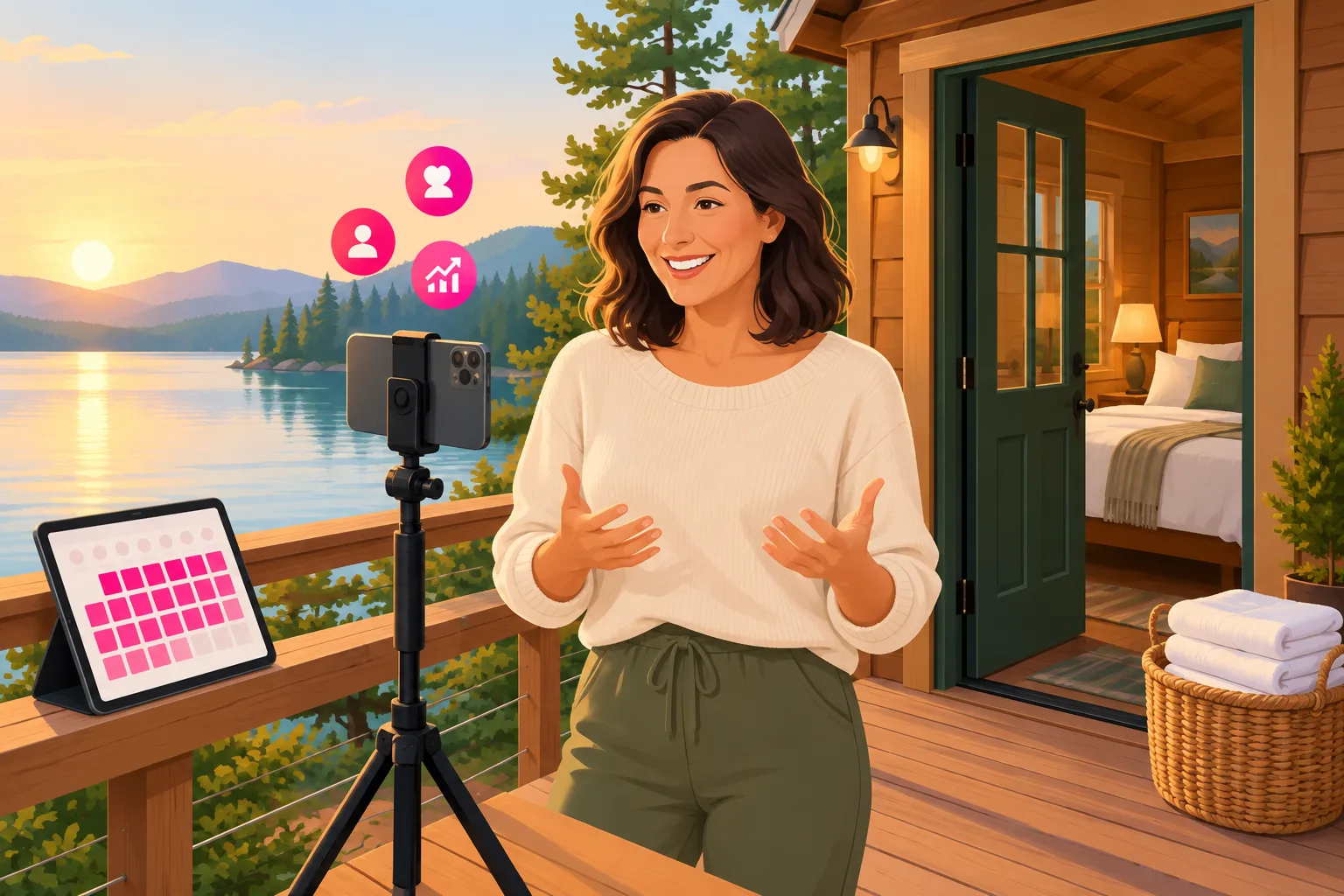
Every rental has a version of the twelve-tabs minute. A woman is planning a weekend for six people who have been "meaning to get away" since March, and she has twelve listings open on her phone at ten at night. They all have the same wide-angle photo of the same gray sectional. Inside her head she is running the list: Is it really that nice? What is the total once the fees are on? Is it actually ten minutes from the lake or ten minutes from the exit? Will there be a chore list taped to the fridge? What is the check-in like - a code, a lockbox, a stranger with a key? Are the neighbors going to call someone when we laugh on the deck? Is this a scam? She closes eleven tabs. Then she books the hotel by the highway, where nobody has to wonder anything and nobody will remember her name.
Every question on that list can be answered in sixty seconds of video. Almost no host answers them. Somewhere three hours from her, a two-bedroom cabin on a lake films the drive in - the exit, the forty minutes past the last gas station, the gravel, the green door, the code going in, the kitchen light, the view from the deck, and the total for a two-night weekend said out loud. Sixty thousand people watch it. A few thousand of them live in the two cities within a Friday-after-work drive and have not had a weekend away in a year. Some of them send it to the group chat.
This guide is the complete 2026 playbook for Airbnb hosts and vacation rental owners - the owner with one cabin and a day job two hours away, the couple with a beach condo, the host with three doors in a mountain town, the cohost who manages other people's houses, and the person who got handed the property phone because they are the one who "does TikTok": the six video formats that grow rental accounts fastest, the hook that opens on the house instead of the guest, the turnover-day content engine, the guest-path-or- feed-path choice and the two audiences behind it, the calendar that sells summer in January and fall in August, the 90-day plan from an empty account to the house a city thinks of, the guest ladder from first view to rebook, the permit, privacy, price, and platform rules that protect your listing, and when paid promotion fills the calendar versus burns the mortgage money. Pair it with our TikTok algorithm guide for the ranking-signal frame and the TikTok growth strategy guide for the cross-niche fundamentals.
The honest summary:
- A rental has two audiences on TikTok. The guest audience lives in the two or three cities within a few hours' drive and buys the one thing you sell - the weekend. The feed audience lives anywhere, follows everything, and buys only what fits in a box. Decide which one each video is for, or you will build a famous cabin with open weekends in October.
- The fear under every empty weekend is "is it really like the photos?" The arrival video - from the highway exit to the door code to the total price said out loud - answers it, and it is the single video most hosts never make.
- Turnover day is the content. You do not need to make videos. You need a phone on a small tripod on the one day a week you are in the house, an empty house, and twenty minutes of filming the reset you were already going to do.
- Use paid promotion as selective amplification on proven videos, aimed at followers rather than a one-time booking, pointed at the cities within a drive and never at your own town, timed in the quiet weeks before a window and paused the day the calendar fills - inside the total-price rule, the housing-ad rules, and your own permit, because the ad money came out of the same account as the mortgage.
What's Inside
- 1. Why TikTok Works So Well for Vacation Rentals in 2026
- 2. The Six Video Formats That Grow Rental Accounts Fastest
- 3. The Arrival Hook: Open on the House, Never the Guest
- 4. The Turnover-Day Content Engine
- 5. Guest Path or Feed Path: The Two Audiences
- 6. The Rental Calendar: Why You Sell Summer in January
- 7. A Posting Cadence That Survives a Holiday Weekend
- 8. The 90-Day Plan to Becoming the House a City Thinks Of
- 9. The Guest Ladder: Turning Viewers Into Rebooks
- 10. When Paid Promotion Fills the Calendar vs. Burns the Mortgage Money
- 11. Permits, Privacy, Prices, Platforms, and the Mistakes That Cap Rental Accounts
- Frequently Asked Questions
1. Why TikTok Works So Well for Vacation Rentals in 2026
Rentals have found guests the same way for a decade: the listing on a platform that takes a cut of every booking and then shows her ten other houses on the same lake, the search ranking that rewards whoever answers fastest and discounts deepest, the one family who has come the second week of July since 2021, and the slow hope that a five-star review will do the rest. That model works right up until it does not - the platform raises its fee, the ranking slips the month you went on vacation yourself, the lake fills up with new listings that all look like yours, and the city passes a rule that makes half the competition illegal and the other half nervous. TikTok is the most efficient answer available right now, for five specific reasons.
The first is that the houses have stopped multiplying and the guests are on their phones. The platforms count millions of hosts and listings worldwide, and for three years every host's fear was the flood of new ones. Industry analysts now say the wave slowed to a trickle in 2025 - supply grew a few percent, not a third - so the competition is no longer the next listing, it is the ten that already exist and look exactly like yours. The person deciding between them is a thirty-year-old with twelve tabs open at ten at night, and surveys keep finding that something like four in ten younger adults start that kind of search on TikTok rather than on a search engine. She is going to pick the house she has already been inside.
Second, the business is repeat business, and the first stay is the whole fight. Every host knows the family that comes back is worth five first-timers: no questions, no damage, no price haggling, and a booking on the calendar nine months out. A guest who had a good weekend and never came back was never really a guest; she was a reservation. The entire economics of a rental come down to getting the right stranger to drive out once and treating her so well she asks for the same week next year before she leaves. TikTok is the only channel that can show her the first stay before she has it.
Third, and this is the one almost no other local business gets: you already own what the platform rewards. A view. A door opening. A room being made perfect. A morning. The reset-the-house genre - beds, towel folds, the hot tub being balanced - is one of the most watched kinds of video on the platform, and a cabin on a lake is a set that a hotel chain would pay a crew to build. A company selling insurance has to invent a reason for anyone to watch. You have one every Friday. And yet the typical rental account is a drone flyover set to a trending song, an amenity-list graphic, and a photo of the welcome basket - three things that tell the algorithm nothing and tell the woman with twelve tabs open even less.
Fourth, the lane is empty where your guests are. The famous host accounts are famous to other hosts - the man with forty doors explaining his pricing tool, the couple with the viral A-frame who now sell a course - and nearly none of them are the house a family in your nearest city would actually book. The handful of rentals that post consistently are scattered across the map, which means the first cabin on a given lake to show what the drive in, the door, and the first morning actually look like does not compete with anyone for the "where should we go?" question. It answers it, for that lake and those two cities, alone. The ranking signals reward exactly what a working rental produces every turnover: a real room, real hands, a complete watch.
Fifth, the total price is the whole booking, and nobody explains it. The woman who balks at seven hundred dollars for two nights has never seen that it is two nights for six people, a cleaning fee that buys four hours of a real person's work, a lodging tax the county set, and a platform fee that is not yours. Since the FTC's fee rule took effect in May 2025, the platforms have to show her the total up front anyway - which means the host who explains the total before she sees it wins, and the host who still hopes she will not notice the cleaning fee loses twice. Rentals lose the booking at the price, every day, to a guest who would gladly have paid it if anyone had shown her where the money goes. A sixty-second video is the explanation, and it is the easiest piece of marketing a rental has ever been able to make. We will count saves and sends, not views, for the rest of this guide - because the woman who saves "why a weekend here is seven hundred dollars" is deciding, and the one who sends it to the group chat has decided.
And one thing to say plainly about size. A one-cabin host cannot out-list a management company with two hundred doors. It does not need to. It can show the one thing the company cannot: the same person, every time, by name, who remembers that your kid liked the top bunk. That is a video. It is, in fact, the best video.
2. The Six Video Formats That Grow Rental Accounts Fastest
Across the rental accounts that grow in 2026 - the lake cabin, the beach condo, the three doors in a mountain town, the farmhouse an hour from the city, the cohost with other people's keys - the same six formats keep working. Every video you make should be one of them, and the order is deliberate.
Format 1: The arrival (the conversion video)
The highway exit. The forty minutes past the last gas station, said out loud. The gravel. The green door, the code going in - with your hand covering the keypad - the kitchen light, where the coffee is, the bedrooms with the bunks, the deck, the dock. Then the total for a two-night weekend, with the fees and the tax on, said like a person. This is the parallel to the no-judgment walk-through a nervous dental patient needs and the road-to-the-gate walk-through a farm films for first-time visitors, and it is the video that converts because it answers, in one take, every question on the twelve-tabs list. One per property, re-filmed each season, pinned to the top of the profile. If you make one video this year, make this one.
Format 2: The turnover (the volume source)
Rosa stripping the beds. The hospital corners. The towel fold. The hot tub being tested and balanced. The fridge being wiped. The welcome basket being set. Filmed from a phone on a small tripod in the corner of the room while the work happens, cut to forty seconds, with the sound of the house. Strangers across the country watch the reset-the-house genre the way they watch pressure washing, and it is the format that earns follows from people who will never book. That is fine; it is the engine. Every clean is one, and the cleaner who agreed to be on camera is the star.
Format 3: What it costs and why
"Why a two-night weekend here is about seven hundred dollars." Two hundred forty a night for a house that sleeps six, so a hundred and twenty a couple. A hundred and forty cleaning fee, which is four hours of Rosa, and here is what four hours of Rosa looks like. The county lodging tax, which you did not set. The platform's fee, which is not yours. Why the two-night minimum - because a one-night stay costs the same four hours to reset. Filmed at the kitchen island with the welcome book in your hand. This video is saved by the person deciding and sent by the person who has decided, and no listing page can do what it does, because the listing can only show the number.
Format 4: The question answered (the trust builder)
"Is it really ten minutes from the lake?" Here is the drive, timed. "Can we bring the dog?" Yes, two, and here is the fenced bit of yard. "Is the wifi good enough to work?" Here is the speed test and the desk by the window. "Are there stairs?" Four to the deck, none inside. "What is check-in actually like?" A code, texted the morning of, no one to meet. "What if it rains all weekend?" Here is the closet of board games and the two things in town worth a wet afternoon. Every one of these is thirty seconds, filmed where the answer is. Together they are the reason a stranger trusts a house she has never seen.
Format 5: The first morning (the share source)
The view from the deck at seven. The coffee. The mist on the water. The dock. A dog on the step. Fifteen seconds and almost no words. It is the video the guest sends to the group chat, and the group chat is who actually books. A weekend away is planned by one person and sold to five, and "look at this" with the first-morning clip is the sale. It is also the countdown format - the first snow on the deck, "the summer calendar opens Thursday," the first leaf turning on the far shore.
Format 6: The honest week (last on purpose)
The pipe that burst in January and the plumber who drove out on a Sunday. The weekend you had to cancel and how you made it right. The town meeting about rental rules, said plainly and without a villain. The cleaner who had a baby and the three weeks you did the turnovers yourself. Said, not shown; never a guest's story; never an ask. This is the format that makes the account a person instead of a listing, and it is last on purpose - without the other five it is a diary, and nobody books a diary.
Retire the drone flyover set to a trending song, the amenity-list graphic, the welcome basket photo, and the logo-only account. And never, under any circumstances, post the guest-shaming clip - the next section explains why.
3. The Arrival Hook: Open on the House, Never the Guest
The first two seconds of a rental video decide whether a stranger stays, and the most common hook on host accounts is the one that quietly caps them. It is the guest-shaming clip: the "look what they left" checkout reveal, the "guests who ask for early check-in" skit, the dramatic reading of a two-star review, the lecture about stripping the beds. It performs. It performs because other hosts love it, and it fills the comments with other hosts, and it trains the algorithm to show the next video to the trade instead of to the woman three hours away deciding where to spend her one weekend off. She saw the checkout rant. She now believes that if she stays at your house she will be judged, filmed, and posted. She books the hotel.
Its quieter cousin is the grievance post: "the fees aren't mine," "here is why we charge for late checkout," "the platform is killing small hosts." All of it may be true. None of it makes anyone want to sleep in your house. Hook on the house, never the guest, and five hook shapes do it:
- The price named first: "Two nights on the lake for six people is about seven hundred dollars, all in. Here is where it goes." No number hidden, no suspense.
- The drive: "Three hours from the city, forty minutes past the last gas station, and this is what you see when you get out of the car."
- The honest answer: "Can you work from here? Yes - here is the speed test, the desk, and the one corner where the signal dies."
- The person: "I bought this cabin in 2019 and I still drive up every other Friday. Rosa has reset it two hundred times. We know where the good blanket is."
- The permission: "You do not have to strip the beds. You do not have to run the dishwasher. Here is what we actually ask, and it fits on an index card."
The last one is the hook most hosts never consider, and it is the strongest one you have. Every guest arrives braced for a chore list, a camera, and a rule about shoes. The video that says "you are a guest, not an employee" is the one that gets sent to the group chat with the words "this one."
4. The Turnover-Day Content Engine
The reason rental accounts go quiet is not that there is nothing to film. It is that the host lives two hours away, is in the house one day a week at most, and thinks of each post as a project. Projects lose to a day job. The system is simple: turnover day is the content calendar. The footage exists every Friday, on a schedule, in a house you control, empty, with the one other person who has already agreed to be on camera. You do not make videos. You film the reset you were going to do anyway, and you cut it on Sunday night.
The turnover-day capture list
- The phone goes on the small tripod before the first bed is stripped: in the corner of whichever room is being reset, framed vertical. Twenty minutes of capture, spread across the clean, is enough for a week.
- One reset, start to finish: the tripod running the whole bedroom or the whole kitchen. You will cut forty seconds from it. Say one sentence when you start and one when you finish; the middle can be the sound of the sheets.
- One "first morning" from the deck: fifteen seconds, the view, the coffee, no words. Shoot it every turnover because the light is never the same twice, and this is the share source.
- One "what it costs and why" in forty seconds: at the island with the welcome book, once a season, re-filmed when the rate changes.
- One question, one answer: "Somebody asked this week if the dock is deep enough to swim off. Here is the answer." Thirty seconds, filmed on the dock.
- Ninety seconds of the drive in: from the exit, with the phone on the dash mount, once a season. The arrival video is built from this plus the walk to the door.
That is a week of posts from one turnover, and the honest week fills in when it comes. Behind it sits the question log: a note on the phone where every pre-booking inquiry, every "quick question" message the night before check-in, every comment that starts with "wait, is it actually," and your own "people always ask" list goes. Each entry is a Format 4 video waiting. A host who keeps the log through one summer never again wonders what to post.
The engine runs on a faces rule, and for a rental the rule is simpler and stricter than for any other business in this series: guests are never content. Airbnb has banned indoor security cameras in every listing since April 30, 2024, outdoor cameras have to be disclosed before booking, and a guest who rented a private house did not rent a film set - so there is no guest footage, and there should never be. The house is filmed empty, on turnover day, by the cast who chose to be on it: you, and the cleaner or cohost who signs a one-page agreement once a year that says what they are willing to appear in and what they are paid for it. The guest's own content is hers; if she posts your dock, thank her in the comments and ask before you repost. Her review is quoted only in her words, never with her name or her profile photo. Nothing a guest told you in a message is ever content. The neighbors are never in frame - not the house across the road, not the man on his mower - because in a town arguing about rental rules at the next meeting, a neighbor's face in your video is an exhibit. And the address is never on the platform: name the town and the drive time, show the inside and the view, keep the street sign, the house number, the mailbox, and the keypad out of every frame. Our salon filming guide covers the written-rule-on-the-wall model - who posts, what gets a look, who owns the account - that a host and a cohost should adopt wholesale.
One practical note on the set: the room with the view is the best studio on the platform, and you own it every Friday. The explainers get filmed where the thing happens - the price explainer at the island with the welcome book, the wifi answer at the desk with the speed test running, the dog answer in the fenced yard with the gate latched. Never from the car with a slide.
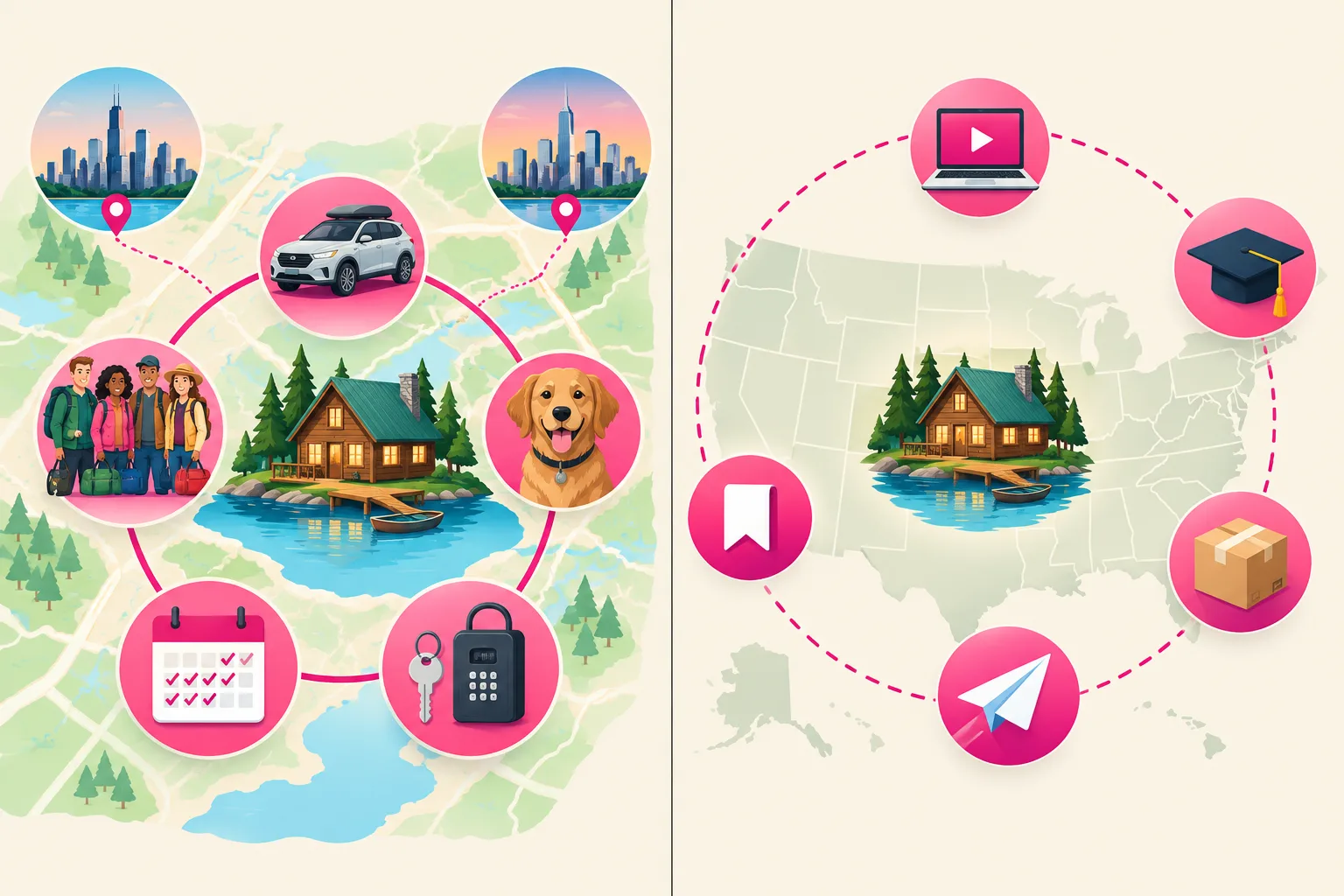
5. Guest Path or Feed Path: The Two Audiences
This is the section that matters most, and it is the one rental accounts get wrong almost universally - not by doing something badly, but by never deciding what the account is for.
A vacation rental is a strange kind of local business. It is tied to one piece of ground - the house does not ship, and the guest has to drive to it - but the guest, by definition, does not live nearby. Nobody rents a cabin in their own town. Your customers live in the two or three cities within a Friday-after-work drive, three hours away, and they are deciding from a couch there. And a rental is also a business whose weekly work strangers across the country genuinely want to watch. So every rental account is speaking to two audiences at once: the guest audience, who lives in those cities and can only come from the drive radius, and the feed audience, who is anywhere, follows everything, and will never spend a night in your house.
The guest path
The guest path is local in an inverted way: the house is here, the audience is there. It is the family in the city who wants a lake weekend and does not know this lake exists. The account names the lake, the town, and the drive time from each city out loud - "three hours from the city, two and a half from the other one" - pins the arrival video to the top, and sends one link to a page that shows the total price for a sample weekend, the house rules said like a person, what check-in is like, the map to the town and not the house, and the host's face with a name. It is measured in clicks to that link, in inquiries that mention a video, in a "how did you find us?" line in the welcome message, and above all in the rebook - the guest who asks for the same week next year. The local-discovery mechanics apply, with one twist: the place you want to be discovered is not where you are.
The feed path
The feed path is borderless. It is the woman in another state who loves the turnover videos, the aspiring host who wants to know your pricing tool, the design-obsessed viewer who saves every room reveal. She follows everything and buys only what fits in a box or a download: the host course, the design guide, the storefront link to the sheets and the towel rack, the cohosting pitch, the brand deal with the mattress company. It is measured in follows, saves, sends, storefront clicks, and seats sold. For a host who already sells to other hosts, or who manages other people's houses and wants more owners, it is real money. For a host with one cabin, it is applause.
The famous-and-empty cabin
The trap looks like success for a year. Four hundred thousand followers from every state. Comments full of other hosts asking what pricing software you use. A turnover video with two million views. And open weekends in October, a summer calendar that did not fill until May, and an owner who concludes "TikTok doesn't book anybody." It is true, and it is true only because every video was for the feed and none was for the guest. The turnover clip never named the lake. The price was never said. The arrival was never filmed. The account grew a national audience of people who will never drive out, and the two cities three hours away never heard of the house. Our salon guide tells the same story about a chair; the cabin version is lonelier, because the audience that would have booked was never even in the room.
So decide, per video, which audience it is for. The arrival, the price explainer, the question answered, and the first morning are guest-path videos: name the lake, name the drive, show the link. The turnover is a feed-path video that quietly serves the guest path if it ends with one sentence about where the house is. Build the guest path first - the weekend is the money - unless you already sell to hosts or manage for owners, in which case build both and keep the accounts honest about which is which. For most hosts, the right shape is a guest-path account with one feed-path format feeding it followers. The what-fits-in-a-box side can wait until the calendar is full.

6. The Rental Calendar: Why You Sell Summer in January
A rental's year is a handful of short windows you know a year out, and the entire posting calendar follows from one rule: build in the empty weeks for the full ones. People plan summer in the dead of winter, so the summer calendar is sold in January. Fall color is sold in August. The holiday week is sold in September. The April midweek that never fills is sold in March, to the people who can work from a deck. The host who posts the first-morning video in July, when the house is already full, is posting to people who cannot have it; the host who posts it in January, with "the summer calendar opens Thursday," is selling.
The rental year, on one card
- January - February: sell summer. The arrival video re-filmed in the snow, the "here is what July looks like" shot last July, the price explainer for a summer week, the summer calendar opening with a date said out loud. The paid month, if there is one.
- March - April: the shoulder gap. Sell the midweek to people who can work from the deck - the wifi video, the desk, the quiet. Sell Memorial Day in April.
- May - July: the rush. Film everything because the light is the best of the year, post the turnovers and the first mornings, and shoot the "here is what July looks like" video you will post next January. Full weekends mean the guest-path videos pause and the feed-path videos carry the account.
- August: sell fall color - the far shore turning, the fire pit, the two-night weekend price for October.
- September - October: sell the holidays. Thanksgiving week and the week between Christmas and New Year's book in the fall; the "eight people around this table" video goes up in September.
- November - December: the holiday rush and the receipt. Post the "here is what January looks like" - the quiet, the snow, the rate - in early December, and the year-end thank-you with the one thing you changed because a guest asked.
The most common calendar failure is a house that was full all summer with people who never came back, because nobody asked. The "here is what next season looks like" video is filmed during the busy season, when the house is at its best, and posted in the quiet one. And the one video that is filmed on turnover day during the rush and posted the week the guests get home is the first morning, with one line: "same week next year is open until the fifteenth."
The unplannable moment - the pipe, the storm that closes the road, the bad review in the town group, the council meeting that makes the news - gets one video, from one person, at the island, no reset clip, no sale, said once. A rental that handles a cancelled weekend on camera with grace books three more from the people who watched.
7. A Posting Cadence That Survives a Holiday Weekend
Three posts a week - say Tuesday, Thursday, and Sunday - is the cadence that compounds and survives a day job. One guest-path video, one feed-path video, one first morning or countdown. Twenty minutes of capture on turnover day and an hour on Sunday night to cut. The one-phone, no-marketing-department playbook a small business runs is exactly the one a single-cabin host runs, with three rules that are specific to a house two hours away.
One person owns the property phone. The host or the cohost, decided once, written down: who posts, what goes up without asking (the turnover, the first morning), what gets a look first (any price, any neighbor in the background, anything a guest left behind, the honest week, anything that shows the road), what never goes up (a guest, a review with a name, the address, the keypad), and who owns the handle and the followers when the cohost moves on or the house is sold. The last line is the one that matters in two years.
The host's own account is not the property's. If you are the kind of host who also wants to talk to other hosts - the pricing tool, the course, the cohosting business - do it from your own account and let the property account stay a house with a view. The property account posts the house and tags you; you post the business and tag the house. A guest who finds the property account should never have to scroll past a video about dynamic pricing to find the dock.
Holiday mode is a real setting. On a full holiday weekend the right amount of posting is a first morning, a repost of a guest's tagged video with her yes, and the inquiry replies within the hour - nothing else. Silent during the Fourth of July is fine. Silent in January is not.
Series beat singles. "The drive in," "Why it costs that," "Can you work from here?," "Rosa resets the lake house," "First morning" - five recurring titles a follower learns to expect are worth more than fifty clever one-offs, and they are what a group chat scrolls back through the night before they decide.
8. The 90-Day Plan to Becoming the House a City Thinks Of
Ninety days is long enough to go from an empty account to the house a group chat in a city three hours away names when someone asks "where should we go?" It is not long enough to go viral, and that is the point. The milestones below are counted in inquiries that mention a video, not followers.
Days 1-30: Fix the link before you film it
The bio says the lake, the town, the drive time from each city, what the house is in plain words, and the two things people ask most - "two bedrooms on the lake, three hours from the city, sleeps six, dogs yes." The link goes to one page - your own direct site if you have one, the listing if you do not - that shows the total price for a sample weekend with the fees and tax on, the house rules written the way you would say them, what check-in is like, a map to the town and not the house, and your face with your name. The welcome message gets a "how did you find us?" line, because without it you will never be able to prove any of this worked. Then twelve posts: the arrival first, three explainers, three questions answered, three turnovers, two first mornings. Nothing is promoted. Everything is measured by one number - clicks to the link - and one line in the welcome message.
Days 31-60: Find the series
By now a few videos have outperformed. Sort them by audience: which traveled (feed) and which brought a click to the link or an inquiry that said "we saw the drive-in video" (guest). Build a weekly series from the best of each. Count the first guest who says "we found you on TikTok" and write down the date; it is the sentence that wins the argument with the spouse who thinks the phone is a toy. Watch the saves and the sends above everything - a woman saving the price explainer in February is a summer week in July - and make the shareable first morning a weekly habit. Answer every inquiry within the hour with a warm saved reply, and keep the "how much is" reply separate from the "is it open" reply.
Days 61-90: Compound toward the next window
Lay the calendar from section 6 over the next ninety days and work backward from the nearest window. The arrival video for that window is re-filmed now and posted four to six weeks before the calendar opens. The "here is what next season looks like" is filmed during the busy weekend itself. If one arrival video has already proven itself organically and the window is inside eight weeks, this is the first moment paid promotion makes sense, and section 10 says how. By day 90 a healthy account has a few thousand followers with a real share of them in the right two cities, a link that gets clicked every week, an inbox that hears "TikTok" a few times a month, and - the real milestone - a rebook you can name.
9. The Guest Ladder: Turning Viewers Into Rebooks
A view is not a booking, and the distance between them is a ladder with nine rungs. Most rental accounts build the first two and wonder why the calendar is empty.
- The view. A stranger in the city sees the turnover or the first morning. She knows nothing yet except that the house exists.
- The follow. The series and the countdown earn it. She is now going to see the house for a season, which is the whole point of the next seven rungs.
- The save and the send. The save is "our next weekend." The send is the first morning to the group chat, which is the only customer that actually exists - a weekend away is decided by committee, and your video is the motion on the floor.
- The profile. The lake, the town, the drive time, sleeps six, dogs yes, one link. Thirty seconds of reading that answers the committee's first three questions.
- The booking page. The total for a sample weekend with everything on it, the rules said like a person ("quiet after ten because the lake carries sound; the dock is yours; please do not feed the ducks, they remember"), what check-in is like, the map to the town, your face. Under the FTC's fee rule the total has to be the biggest number on the page anyway - make it the proudest one.
- The inquiry and the booking. Answered within the hour, warmly, with the next open weekend said out loud. The welcome message asks "how did you find us?" The arrival is exactly as filmed - the code texted the morning of, the kitchen light on a timer, the welcome book on the island.
- The stay done the way the video promised. No chore list that was not in the video. No surprise rule. No camera. The first morning looks like the first-morning video. This rung is where the rebook is actually earned.
- The rebook. The real conversion. Two weeks after checkout, one message: "The same week next year is open until the fifteenth - want me to hold it?" On your own site the hold is yours to give; on a platform it is the date said out loud and the link. A surprising share of the families who had a good week say yes if anyone asks, and almost nobody asks.
- The regular and the referral. The family who has come the second week of July since 2021, and the sister-in-law they sent, who found the arrival video pinned exactly where the first family said it would be.
Three saved replies carry most of the ladder. "How much for a weekend in October?" gets the total for a sample two-night weekend with the fees and tax on, the one thing that moves it (a third night, a holiday), and the link - never "check the listing" followed by silence. "Is it open the second weekend of June?" gets a yes or a no said out loud, the nearest open weekend if it is a no, and the link, within the hour. "Can we bring ten people and a boat?" gets a kind, specific answer and the rule said like a person - the house sleeps six and the insurance is written for six, the dock takes a boat up to a size, and here is the marina for the rest - never a yes you will regret on a Saturday night, and never a lecture.
One scoreboard, three numbers, looked at monthly: clicks to the booking link per week, inquiries per month that mention a video or say TikTok, and the number of stays that turned into a rebook. Views are not on it.
10. When Paid Promotion Fills the Calendar vs. Burns the Mortgage Money
Paid promotion on TikTok is not advertising in the way hosts usually think about it. It is not the promoted placement some listing sites sell to put you above the house next door, the search ad that costs more every spring, or the listing site's commission that takes its cut and then shows your guest three other cabins. It is taking a video that has already earned attention and showing it to more of the right people. And for you there is one extra sentence: the money came out of the same account as the mortgage and the plumber, so the standard for spending it is higher.
The proven-video rule: only promote videos that have already performed organically. Strong completion, real saves and sends, a visible bump in profile visits and clicks to the link. Promotion amplifies signals the algorithm is already reading. It cannot manufacture interest in a video people scroll past, and it will not make an amenity list into content.
The follower rule, which is specific to your business: promote for followers, not for a one-time booking. A stranger asked to book a seven-hundred-dollar weekend nine seconds after meeting your house mostly will not. A follower watches your house for six weeks - the arrival, the honest answer, the turnover, the first morning, the countdown - and by the time the summer calendar opens she already knows the lake and the drive. You are not buying a reservation. You are buying the chance to show a city your house for a season.
The map rule, inverted: this is the one vertical in this series where you point promotion away from home. Organic reach goes wherever the algorithm sends it; promoted reach goes exactly where you point it, and nobody rents a cabin in the town they live in. The arrival, the price explainer, and the calendar-opening countdown go to the two or three cities within a Friday-after-work drive - the metro areas, not your county. The turnover clip can go wider, to people who already engage with home and travel content, only if you sell to other hosts and the feed path is a goal this year.
The timing rule: amplify in the quiet weeks before the window, not during it. January for summer, August for fall color, September for the holidays, March for the work-from-the-deck midweek - the weeks when families are quietly deciding. The week before a holiday is when every hotel and travel site is bidding for the same woman, the cost of reaching anyone climbs, and you pay more to be one of fifty invitations. And the rule that sounds strange until you have lived it: pause the day the calendar fills. A promoted arrival video running the week you are booked out buys you nothing but "do you have anything in July?" messages and a stranger's first impression that your house is never available.
The math deserves honesty, because the spouse will ask. Compare it to what you already pay: the platform's host fee - around three percent on the old split model and roughly fifteen on the host-only fee most listings have moved to - the promoted placement, the listing-site subscription. Then track the promoted arrival like any other cost - cost per new follower in the right cities, per click to the link, per inquiry that says TikTok, per booking, per rebook - and report it next to the commission. If a modest budget on a proven arrival video in January brings nine weekends in six weeks, four of them booked direct on your own site with no commission at all, and two families already asking for the same week next year, the spouse can do the arithmetic without your help.
Four cautions that are stricter for you than for most. First, any price in a promoted video is an advertised price, and since May 2025 the FTC's fee rule makes it unlawful to advertise short-term lodging without the total price - fees included - as the most prominent number, so the promoted explainer says seven hundred, not two forty. Second, TikTok treats housing ads in the United States and Canada as a special category that has to be declared, that loses gender and ZIP-code targeting, and that can only be shown to adults; whether a weekend at a cabin counts as "housing" is a question Ads Manager answers with a checkbox, so assume the strict reading and write every ad about the house, never about who should rent it - "sleeps six, dogs welcome," not "perfect for young couples." Third, the misleading-content rules apply to the lens: a promoted arrival shot on a wide-angle lens that makes the bedroom look twice its size, a "steps from the beach" that is a ten-minute walk, or a hot tub that is "seasonal" in the fine print is an ad that gets rejected or, worse, runs. Fourth, a promoted video is a public record that you operate, shown to thousands of people in your own state. If the town requires a permit, the permit comes first and its number goes where the town says it goes. And one more: a guest's tagged video is hers. Reposting it with her yes is one thing; putting money behind it is a separate yes, and the once-a-year agreement with your cleaner should name paid promotion on its own line. Fix the bio, the booking page, and the saved replies first - promotion multiplies what already exists.
The format worth defaulting to is Spark Ads, which promotes your existing organic post rather than a separate ad creative - so the engagement accrues to your real account and the video keeps looking like your house instead of a commercial. Our Spark Ads guide walks through the setup. If you would rather not run Ads Manager yourself from a day job in another city, a TikTok promotion service built around follower growth and selective amplification handles the targeting and the timing for you.
11. Permits, Privacy, Prices, Platforms, and the Mistakes That Cap Rental Accounts
Everything above is about growth. This section is about the four things that can undo it, in a business where every video is a public record of where you operate, what you charge, who was in the house, and what you promised.
1. The permit and the tax
A video of your house, posted under an account that names the lake, is evidence that you operate a short-term rental there. Cities and counties know this, and some of them look. New York City began enforcing its registration law in September 2023 and short-term listings there fell by more than eighty percent within weeks; hundreds of smaller towns have permit, cap, or registration rules of their own, and more are on the next council agenda. So the permit comes before the account, the lodging tax is being collected and remitted, the HOA has said yes in writing, the insurance policy says "short-term rental" on it, and the occupancy you advertise is the occupancy the permit and the policy allow. A video of fourteen people in a hot tub rated for six is the one your insurer finds first. Where the town requires a permit number on advertising, your bio is advertising.
2. The guest, the neighbor, and the address
Guests are never content - not their faces, not their cars, not their names, not what they left behind. Indoor cameras have been banned on the biggest platform since April 2024, outdoor cameras must be disclosed before booking, and a doorbell camera is for the door, not for a video. The house is filmed empty, on turnover day, by the people who agreed in writing. A guest's tagged video is reposted only after asking; a review is quoted only in her words. The neighbors are never in frame, ever, because the next council meeting is where they will bring it up. And the address is never on the platform: no street sign, no house number, no mailbox, no keypad, no "the second cabin past the bridge." Name the town and the drive time, show the inside and the view, and let the booking page and the welcome message carry the rest.
3. The price, the photo, and the review
Three federal rules now sit under a rental's marketing, and all three are easy to follow if you decide to. The FTC's fee rule, in effect since May 12, 2025, makes it an unfair practice to advertise short-term lodging without the total price - mandatory fees included - displayed more prominently than any other number; it binds the platforms and it binds your own site and your own videos. The FTC's consumer-reviews rule, in effect since October 2024, bars fake or bought reviews, suppressing honest negative ones, and offering anything in exchange for a review that has to be positive - so "leave us five stars for a discount on your next stay" is not a marketing idea, it is a violation. And TikTok's own misleading-content rules apply to the photo and the lens: the wide-angle shot that doubles the bedroom, the "lakefront" that is lake-view, the hot tub that is closed from November to April. Say what the house is. The guest who arrives and finds it exactly as filmed is the one who rebooks.
4. The platform's rules and the music
Your TikTok account and your direct-booking site are yours, and a video that says "book direct at the link in my bio" is your marketing on your channel. The line is the platform's inbox: Airbnb's off-platform policy, tightened in 2025, bars links, discounts, and requests for contact details that steer a guest off the platform inside a listing or a message, and bars using a guest's contact information for marketing. So the direct site lives on TikTok and on the welcome book in the kitchen, never in the listing text or the message thread, and the guest who found you through the platform is not added to a mailing list she did not join. And the music: a business account's in-app sound picker is limited to the Commercial Music Library - the trending pop song on a turnover clip is a muted or removed video - so use the library, original sound, or the sound of the lake.
The mistakes that cap accounts
- Never naming the lake. The turnover video with two million views that never said where the house was. The feed loved it; the two cities three hours away never heard of you.
- The guest-shaming clip. It grows an audience of hosts and tells every guest she will be policed.
- The hidden fee. A nightly rate in the video and a total on the page that is forty percent higher. Since May 2025 it is also a federal problem.
- The address in the frame. The house number on the post, the street sign in the drive-in, the keypad with the code visible. One frame is enough.
- Posting the house full. The first-morning video in July, when no one who sees it can have it. The same video in January is a sale.
- Never asking for the rebook. A summer of happy families and an empty July next year because the one message was never sent.
Frequently Asked Questions
Is TikTok worth it for a single Airbnb or vacation rental in 2026?
For a rental with open weekends on the calendar - and outside of peak season almost every rental has them - yes, and the more specific the house, the better the odds. Industry analysts say the wave of new short-term rental supply slowed to a trickle in 2025, so the competition is no longer a flood of new listings; it is the ten other cabins on the same lake with the same wide-angle photos. The guest you most want is a thirty-year-old with twelve listing tabs open at ten at night, deciding by phone, and surveys keep finding that something like four in ten younger adults now start that kind of search on TikTok. Almost no host shows her what the drive in, the door code, the kitchen, and the total price for a two-night weekend actually look like. You do not need a viral account. You need a few thousand people in the two or three cities within a Friday-after-work drive to watch your house for a season, and a link that tells them the total price, the house rules said like a person, and what the first morning looks like.
What should an Airbnb host post on TikTok?
Six formats grow rental accounts fastest in 2026: the arrival (from the highway exit to the lockbox to the kitchen light switch - the conversion video, filmed once per property), the turnover (the beds, the towel fold, the hot tub chemistry, the reset filmed from a phone on a tripod in the corner - the volume source and the format strangers follow), the "what it costs and why" explainer (why a two-night October weekend is about seven hundred dollars all in, what the cleaning fee buys, why the two-night minimum), the question answered (is it really ten minutes from the lake, can we bring the dog, is the wifi good enough to work, are there stairs), the first morning (the view from the deck at seven, the coffee, the dock - the share source, because the guest sends it to the group chat that decides the weekend), and the honest week (the burst pipe, the cancelled booking, the town meeting - last on purpose, with rules). Retire the drone flyover set to a trending song, the amenity-list graphic, and the logo-only account. Never post the guest-shaming clip - the "look what they left" checkout rant, the early-check-in skit - because it grows an audience of other hosts and makes the woman with twelve tabs open feel like she will be policed.
Can a vacation rental actually get bookings from TikTok?
Yes, but mostly not the way the famous host accounts do. A rental has two audiences on TikTok. The guest audience lives in the two or three cities within a few hours' drive and buys the one thing you actually sell - the weekend. The feed audience lives anywhere, follows everything, and buys only what fits in a box or a download - the host course, the design guide, the storefront link, the cohosting gig. The trap is the famous-and-empty cabin: four hundred thousand followers from every state, comments full of other hosts asking about your pricing tool, and open weekends in October, because every video was for the feed and none was for the guest. Decide which audience each video is for, build the guest path first unless you already sell to hosts, add a "how did you find us?" line to your welcome message, and treat the rebook - the same family asking for the same week next year - as the real conversion.
Can I film my guests for TikTok?
No - and the rule is simpler than it is for almost any other business. Airbnb has prohibited indoor security cameras in every listing since April 30, 2024, outdoor cameras have to be disclosed before booking, and a guest who rented a private house did not rent a film set. So the house is filmed empty, on turnover day, by the people who agreed to be on camera - you and the cleaner or cohost who signs a once-a-year agreement. The guest's own content is theirs: if she posts your dock, thank her and ask before you repost it. Her review is quoted only with her words, never her name or her photo. The neighbors are never in frame, the street sign and the house number are never in frame, and the door code is never on camera. Name the town and the drive time, show the inside and the view, and keep the address off the platform entirely.
Should an Airbnb host pay to promote TikTok videos?
Only videos that have already proven themselves organically - strong completion, real saves and sends, and a visible bump in profile visits and clicks to your booking link - and only with a few rental-specific rules. Promote for followers rather than a one-time booking: a stranger asked to book a weekend nine seconds after meeting your house mostly will not, while a follower watches your house for six weeks and knows the day the summer calendar opens. Point the arrival video and the price explainer at the two or three cities within a few hours' drive - never your own town, because nobody rents a cabin where they live - and the turnover clip wider only if you sell to other hosts. Amplify in the quiet weeks before a window - January for summer, August for fall color, September for the holidays - and pause the day the calendar fills. Keep the rules in mind: any price you show has to be the total price under the FTC's 2025 fee rule, TikTok treats housing ads as a special category with restricted targeting, so write the ad about the house and never about who should rent it, and a promoted video is a public record that you operate, so the permit comes first. Services like Viryze are built around this kind of selective amplification, promoting a proven video to the right cities instead of boosting every upload.
Ready to turn your best arrival video into guests who rebook?
The rentals growing fastest in 2026 pair a simple turnover-day content system with selective paid amplification on their best videos - aimed at followers rather than a one-time booking, pointed at the cities within a drive instead of the town the house sits in, and timed in the quiet weeks before a window rather than during the noise of the holiday rush. Viryze is built for exactly that: we focus on follower growth, and you pick the videos that have already cleared the organic signal threshold for us to promote, so your budget compounds your best work instead of rescuing your weakest. And because a follower watches your house for a season before the calendar opens, every person you reach is someone who already knows the drive.
Related Reading
- Understanding TikTok's Algorithm - the ranking signals a turnover clip and an arrival video both earn.
- The Ultimate Guide to TikTok Growth - the cross-niche fundamentals under every section above.
- TikTok for Salons and Barbershops - two audiences, one phone, and the trap of a famous account with an empty chair.
- TikTok for Agritourism - the farm stay, the road-to-the-gate walk-through, and the visit page that converts.
- TikTok for Travel Creators - the other side of the booking: the creators your guests watch while they plan.
- TikTok for Wedding Venues - filling open dates on a property, the way a rental fills open weekends.
- Virtual Tours on TikTok - the room-by-room walk-through craft the arrival video borrows from real estate.
- TikTok Spark Ads Guide - the format worth defaulting to for amplifying a proven post.