
Salon17 min read
TikTok for Barbershops: The Chair in the Back, the Line, and the Walk-In
The barbershop-specific TikTok playbook for the shop that sells a walk-in instead of an appointment: why the customer is a man who has gone to the same chain for ten years and a parent with a seven-year-old, how to say out loud whether you take walk-ins and what the wait is, the fade clip as the feed workhorse and the famous-and-empty chair it builds, the "how to ask for it" explainer (the numbers, the taper, the photo, and "just clean it up"), why a cut is $35 here when the chain charges $19, the first haircut and the parent's yes, the Saturday rush and the Tuesday book, the barber's own account versus the shop's, the policy on the wall, minors and the school logo, the radio on the clamp, the mistakes that empty a chair, and the rule that promotion pauses the day Saturday sells out.
By Ryan MitchellHead of Creator Success at Viryze
There is a man in a parked car behind the pharmacy who has gone to the same chain for ten years. He is not there because he loves the chain. He is there because he has never once known what to ask for, the chain never asked him to, and the last time he tried a real barbershop he stood in the doorway for a full minute not knowing whether he needed an appointment, whether the bench was a line, how long it would take, or what to say when he finally sat down. He drove to the chain. He has been driving to the chain ever since.
Two cars over, a parent is deciding where to take a seven-year-old who screamed through the last haircut. Those two people are most of what barbershop marketing is, and almost none of the barber content on TikTok is for either of them. It is for other barbers. The fade filmed from behind, the line appearing out of nothing, the clipper sound, two million views, and comments from barbers in three time zones asking which guard. That clip is real and it works, and it has built a thousand famous chairs with a Saturday bench that is not full.
This is the barbershop edition of our TikTok for Salons and Barbershops guide. Everything in the pillar holds: the two audiences, the hook on the hair and never the client, the book as the content calendar, the yes card, the quiet weeks. But a barbershop sells something different from a salon. A salon sells an appointment; a barbershop, most of the time, sells a walk-in, a bench, a wait, and a man who comes back every three weeks for the rest of his life if the first visit was not embarrassing. The examples live in one place because it is easy to picture: Marcus, who has the barber chair at the back of the four-chair salon next to the pharmacy on Main, where walk-ins are Tuesdays for the salon and all week for Marcus when the chair is empty. If your shop is a shop - three barbers, a bench, a sign on the glass - every word here applies. The chair in the back is only the example.
What's Inside
- 1. Why a Barbershop Is Not a Salon With Clippers
- 2. The Walk-In, the App, and the Line: Say How the Wait Works
- 3. The Fade Clip: The Feed Workhorse and the Famous-and-Empty Chair
- 4. "How to Ask for It": The Explainer for the Man Who Never Knew the Words
- 5. Why It's $35 Here When the Chain Charges $19
- 6. The First Haircut: The Parent's Yes and the Parent as the Viewer
- 7. The Saturday Rush and the Tuesday Book
- 8. The Barber's Own Account vs. the Shop's
- 9. The Policy on the Wall, Minors, the License, and the Radio on the Clamp
- 10. The Mistakes That Empty a Barber Chair
- 11. Amplify the Walk-Through, and Pause the Day Saturday Sells Out
- Frequently Asked Questions
1. Why a Barbershop Is Not a Salon With Clippers
The pillar guide's two audiences are the same in a barbershop - the chair path within a twenty-minute drive that buys the haircut, and the feed path anywhere that buys only what fits in a box - but four things about the chair path are different, and each one changes what you film.
- The customer is a man who does not know he is deciding. The woman in the salon's parking lot has watched the reveal three times and is working up the nerve. The man in yours has not been deciding at all; he has been going to the chain on autopilot for a decade, and the job of the first video is to make him think about it once. He is less nervous about the price than she is, and more nervous about not knowing the words, about the bench, and about being the stranger in a room where everyone else seems to know each other.
- The cycle is three weeks, not six. A fade grows out in two to four weeks, so a barber on a three-week cycle cutting ten heads a day, five days a week, has room for about a hundred and fifty regulars - and the size of the book is even smaller than the salon's. A few hundred local followers is a full chair. A regular who comes seventeen times a year is also worth more than a salon regular who comes eight or nine, which is why the first visit matters so much and the clip that mocks his chain cut costs so much.
- The product is a walk-in. Most barbershops sell a bench and a wait, or an app with a waitlist, or both, and the single most useful thing a barbershop account can say is how that actually works. The salon's parking-lot minute is "what do I ask for?" The barbershop's is "do I just walk in, and how long will I be here?"
- The barber is the brand. A customer follows a barber across town when he changes chairs in a way that salon clients rarely do, which makes the question of whose account this is - the barber's or the shop's - the first thing to write down rather than the last. Section 8 is about that.
And one thing is the same as the salon, more so: the barbershop is the business whose most viral format is for the wrong audience. The salon's process clip of foils going in grows the feed; the barbershop's fade clip grows the feed harder and faster than anything in hair, and almost nobody who watches it will ever sit in the chair. Decide which audience each video is for before you film it, or you will build the most famous chair in the county with a Tuesday that is wide open.
2. The Walk-In, the App, and the Line: Say How the Wait Works
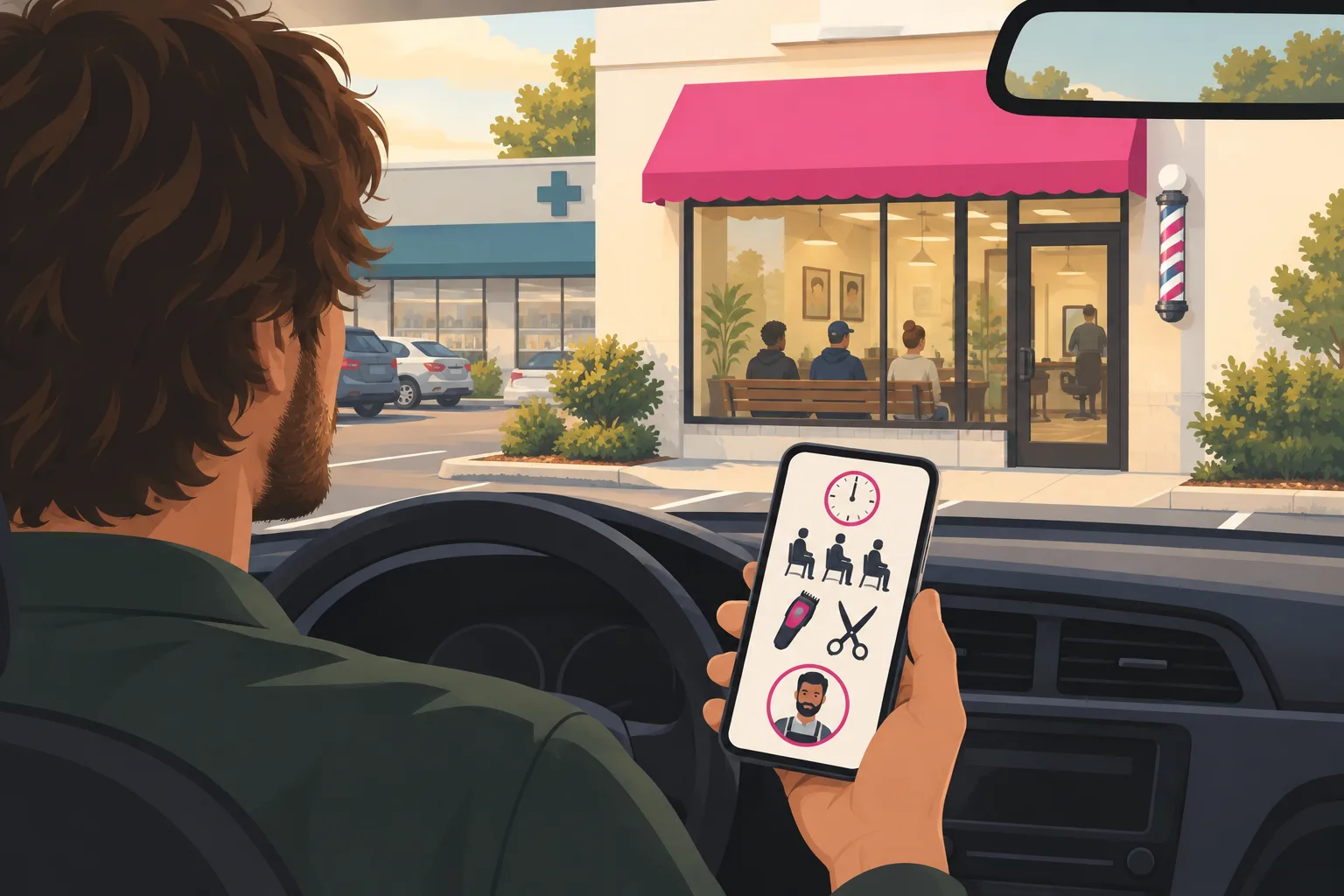
The salon pillar calls the moment before a first visit the parking-lot minute, and the walk-through is the video that answers it. A barbershop walk-through answers a different list, and it has to answer the first item in the first five seconds or he scrolls:
- Do I just walk in? Said first, plainly, in the video and in the bio and on the page. "Walk in any day. If the chair's empty you're in it; if not, the bench is right there." Or, if you run an app: "Put your name on the list from the parking lot, and it'll tell you when to come in." Or both. What never works is the shop that takes walk-ins but acts like you should have known, and the shop with an app it never mentions, so the man on the bench watches three people with phones go ahead of him.
- How long will I be here? The honest shape of the wait, by day. "Saturday morning is a wait - forty minutes to an hour, and the bench is a good one. Tuesday through Thursday you're usually straight in." This is the sentence that fills Tuesday, and it is the one the chain can never say, because the chain does not know its own wait.
- Is this the right door? For Marcus, this is the whole video: "Park behind the pharmacy, it's a shared lot, the door with the pink awning. Yes, it's a salon. Walk past the four chairs; the barber chair is in the back, and it's mine." Plenty of men in town have a wife who comes here and have never known there was a barber in the building. For a standalone shop, it is the sign, the bench through the glass, and whether the place is cash-only.
- What do I say when I sit down? One sentence here, and then the whole of section 4 as its own video: "You can say a number, you can show me a photo, or you can say 'just clean it up,' and all three are fine."
- What does it cost, and when do I find out? "A cut is $35, a beard trim is extra, and I say the number before the cape goes on." The booking-page anatomy from the clients guide is the same for a barbershop, only shorter: the prices, the wait by day, walk-in or list, where to park, cash or card, and the tip said once and never as a lecture.
- Will anyone say anything about the chain cut? No, and the video never says "no" - it simply shows a man sitting down with a grown-out chain cut and a barber who says "good to see you, what are we doing?" and nothing else.
Film the empty pass before opening and a second pass on a Saturday from behind the desk, the way the filming guide scripts it, so you can cut between "here is the room" and "here is what it feels like when the bench is full." Pin it. Re-film it every September, because the wait changes when a chair is added and the price changes when the rent does.
The bench is the cast, and the bench is in the mirror
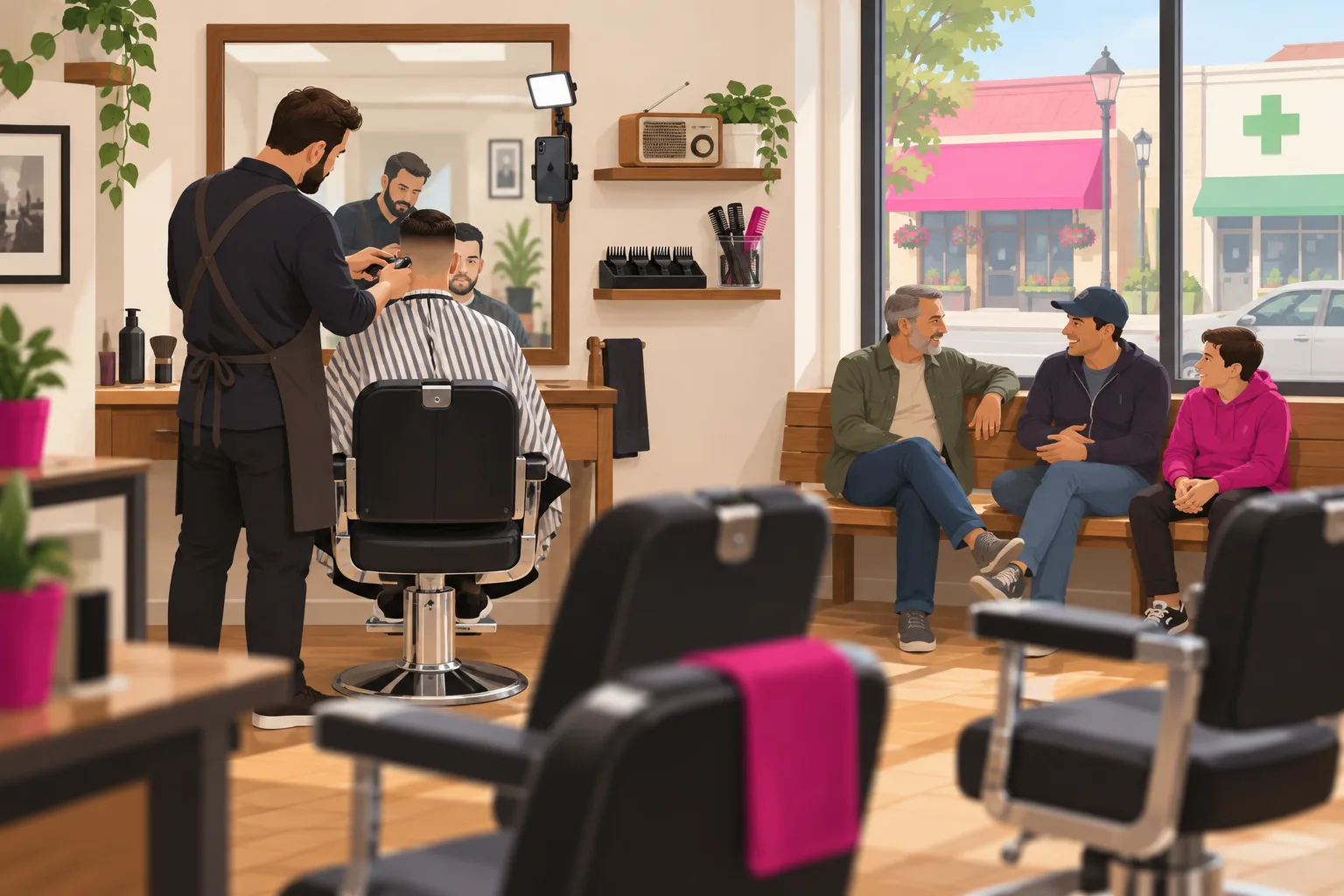
A barbershop has something a salon does not: a room full of men talking, and some of them have been talking in that room every third Saturday for twenty years. They are the best thing about the place and the best thing in the video, and they are also the thing the salon filming guide calls the next chair - the person in the frame who did not agree to be. The pillar's rule is that the mirror shows the whole room, and in a barbershop the mirror shows the bench. So the regulars who hold court are cast, not background: the ones who want to be in it agree once a year like Marcus and the front-desk kid do, the ones who do not are a back or a cape or out of the reflection, and a stranger on the bench is never in a video at all. Angle the clamp so the mirror reflects the window and the wall, run the three-second mirror check, and when the Saturday regular says something worth a clip, ask him after, not with the phone already up.
The Saturday-morning wait, said once and kindly
The most useful recurring post a walk-in shop can make is also the shortest: nine o'clock Saturday from the desk, the bench in frame as backs and caps, one sentence. "Bench is full, about forty-five minutes, and Tuesday's wide open." It is honest, it sends the man who was about to drive over to the app instead, it tells the man who was not coming that Tuesday exists, and it is the barbershop's version of a full book said kindly. What it is never: a complaint about the people who did not put their name on the list.
3. The Fade Clip: The Feed Workhorse and the Famous-and-Empty Chair
The process clip is the volume source in every salon account, and in a barbershop it is a monster. The fade clip - the guards changing, the line appearing out of nothing on the side of a head seen from behind, the real clipper sound, fifteen seconds of silence and then one sentence - is the most reliably watched thing in hair content. It needs no face, so it is allowed by the "yes but not my face" box most customers check. It needs no setup, because it is filmed from the clamp on the mirror during a cut that was happening anyway. And it is the format strangers follow. Film one every working day and you will never run out.
Here is the trap in it, and it is worse than the salon's. The man who watches a fade clip twice and follows is, more often than not, another barber or a sixteen-year-old in another state. He is real, he is generous, and he will never sit in your chair. The pillar calls the result the famous-and-empty chair: three hundred thousand followers, comments full of barbers asking which guard, and a Tuesday nobody walked in on. The barbershop version is more common because the fade clip is so much better at the feed than the foil clip, and because a barber who is good at fades is rightly proud of them and would rather film that than the bench.
So the rule: the fade clip is the Thursday post, the one for the feed, and it ends with a sentence for the chair. "This is the part people pay for" is the pillar's line. "Walk-ins all week, back of the salon next to the pharmacy" is the other half. A fade clip with no place in it grows a following in Manila; a fade clip that says the street grows one in your town, smaller and worth more. If you have chosen the feed path on purpose - you sell a class, a guide, a clipper deal, or you are building toward brand work - the fade clip is your whole business and the chair funds it. If you have not, it is one post in three, and the other two are below.
Real sound, radio down. The fade clip wants the sound of the place - clippers, the guard click, the shop - and the pillar's music rule is the reason to want it: a business account's sound picker is limited to the commercial music library, and the shop radio playing a consumer streaming account into the clamp is a video you may lose. Turn the radio down for the clip. The clippers are the song.
4. "How to Ask for It": The Explainer for the Man Who Never Knew the Words
The salon pillar's fifth hook is the permission - "you do not have to know what to ask for" - and in a barbershop it is not a hook, it is the single most important video you will make, because not knowing the words is the whole reason he is at the chain. The chain has a picture menu. You have a conversation, and a man who has never had one assumes he will fail it. "How to ask for it" is an explainer filmed at the chair, two minutes, Marcus talking to the camera with the clippers in his hand, and it teaches five things in order:
- The numbers. "When a guy says 'a two on the sides,' the number is the guard on the clipper, and lower is shorter. That is all it means. You do not need to know yours - I'll tell you what I used, and next time you'll have a number."
- Taper, fade, skin fade. Shown on the front-desk kid's head on a Tuesday morning or on a mannequin head, never on a customer who did not agree: "a taper is short at the neck and ears and leaves the rest alone; a fade blends from short to long up the side; a skin fade starts at nothing. Most guys who say 'fade' want the middle one."
- The photo is welcome. "Show me a picture. I will tell you what in it is your hair and what in it is his, and we'll do the version that is yours." The salon pillar says the Pinterest photo is never mocked; in a barbershop the photo is a screenshot of an athlete, and the rule is the same.
- "Just clean it up" is a complete sentence. "If you sit down and say 'same thing, shorter,' or 'I don't know, just clean it up,' that is a full set of instructions and I have heard it a thousand times. The first cut is a conversation; the second one takes thirty seconds."
- How often. "A fade looks like the day it was cut for about two weeks and respectable for a third. Most guys come every three weeks. Some every two. Nobody is judged for six." This is the rebook, said as information in the middle of the explainer, which is exactly where the clients guide says it should live.
Post it December 26, the day the pillar posts the permission video, pin it next to the walk-through through January, and make it the first episode of a series the pillar already named: "Ask the barber." Every question from the chair is an episode - what the lineup is, why the back of the neck matters, what to do about a cowlick, how to grow out a chain cut without the awkward month - and the man who asked is standing in for a few hundred who did not. Film them where the answer lives, one question per video, never a list.
5. Why It's $35 Here When the Chain Charges $19
The pillar's "what it costs and why" explainer is the whole booking for a salon, and the barbershop has the hardest version of it, because the man in the car already knows the other number. The chain is $19. You are $35. He has decided those sixteen dollars are for nothing, and the video's job is not to tell him he is wrong. It is to show him what they buy, said at the chair, by the barber, without a single word against the chain.
Marcus does it like this. "A cut here is $35, a beard trim is extra, and the chain down the road is $19. Here is the difference. I ask you what you like about it right now before I touch it. I cut the back of your neck so it grows out straight instead of in a line. I check the sides against each other in the mirror with you looking. And when you come back in three weeks I already know what we did, so you don't have to explain it twice. Sixteen dollars buys you not having to explain it twice." Then he goes back to the cut. The number is said, the reason is shown, and the chain is a fact in the sentence, not an enemy.
The money guide's rule is that the price explainer is the sale, and that the actions it produces are the save, which means a man is deciding, and the send, which means he decided and is forwarding it to the friend who said thirty-five dollars for a haircut was crazy. Put the same number on the wall, on the booking page, and in the bio, in that order, and never in a price-list graphic. A price on a wall in a video is a shop with nothing to hide; a price-list graphic is a flyer, and nobody follows a flyer.
The beard oil is the retail shelf. Barbershop retail is small and it ships: the beard oil Marcus uses, the pomade, the clipper he will not switch from. The money guide's beard-oil clip is the model - he names the oil, says the shop earns a little on the link, shows the two drops - and the gift card the two weeks before Father's Day is the barbershop's one retail window. Say whether it expires, never "never expires" unless that is true in your state.
6. The First Haircut: The Parent's Yes and the Parent as the Viewer
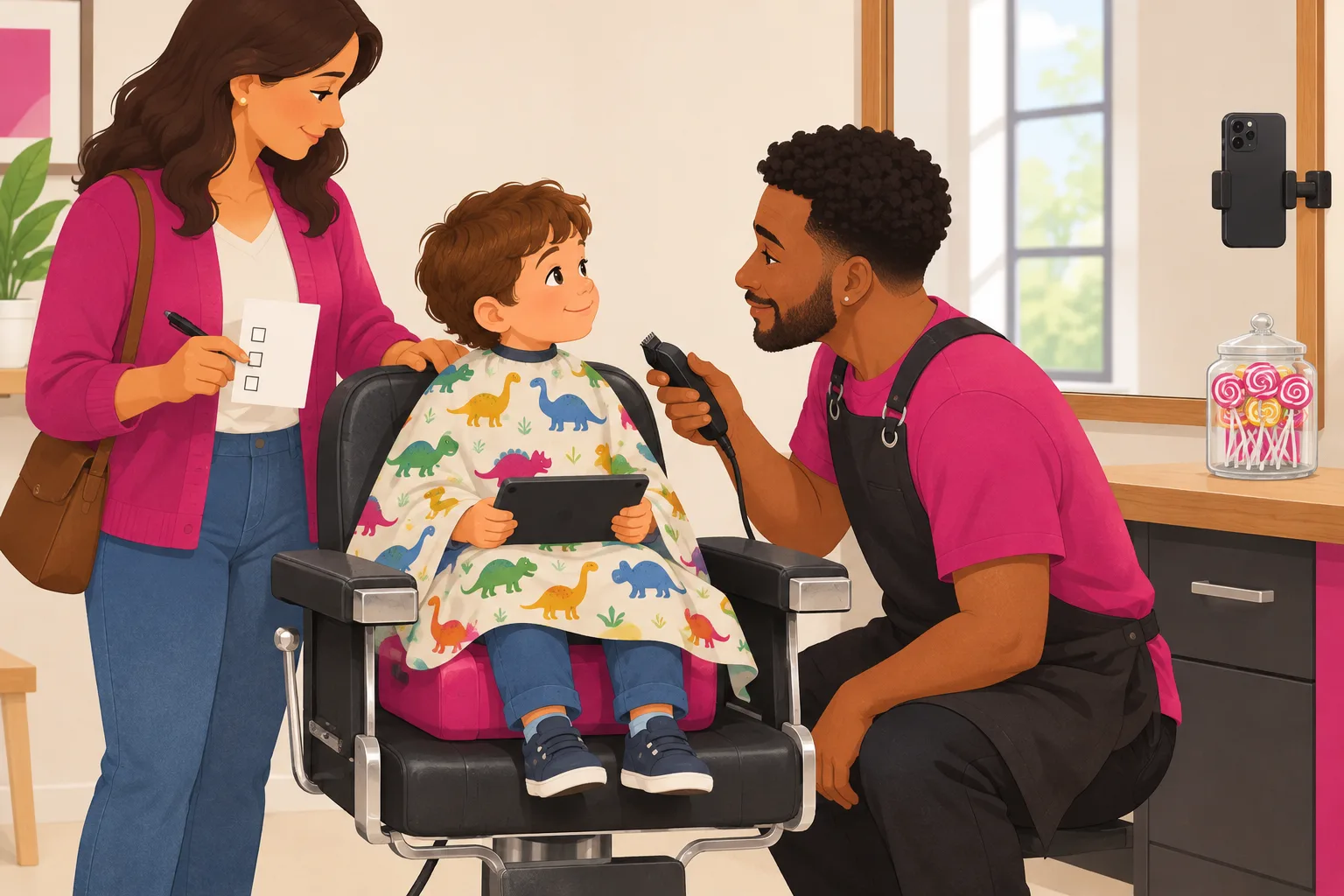
The second customer in the parking lot is the parent, and the parent is deciding something the man is not: whether this is a place where a seven-year-old who screamed through the last haircut will be rushed, shamed, or handed a lollipop and a tablet and talked to like a person. The first-haircut video is one of the best videos a barbershop can post, and it is also the one with a minor in it, so it is worth doing exactly right.
The best version has no child in it at all. The filming guide's kids'-chair walk-through is filmed empty on a Tuesday morning: the booster seat clipped onto Marcus's chair, the tablet, the cape with the dinosaurs, "a kids' cut is $22," and Marcus explaining how a nervous four-year-old gets through it. "We have done a thousand first haircuts and we are not in a hurry. If he needs to stop, we stop. If he needs to sit on you, he sits on you. Bring the tablet." That video answers every question the parent has, goes up the first week of August when parents are deciding, and is what the pillar's calendar means by selling back-to-school in the quiet week before it.
When a child is in a video, the rules are the parent's per-visit yes, decided with the parent in the room and the child asked too, on the same card every customer gets, with its three boxes and the separate line for the before. Most first-haircut reveals are filmed from behind, into the mirror, with the parent's hand in the frame, and the one filmed from the front is the one where the parent checked "yes to everything" and said the first name out loud. Three things are never in the frame, in any box: the school logo on a shirt, a jersey, a backpack or a letterman jacket; the pickup line or the bus through the window at ten past three; and the child's full name. And the parent takes it back by texting the shop the same day, no reason needed. The parent is the viewer of this video, and the parent who sees you protect someone else's kid is the parent who books.
One more thing the barbershop has that the salon mostly does not: the second son. The man whose two boys now sit in Marcus's chair every three weeks is the pillar's regular, and he is three regulars. The first-haircut video is how that family started, which is why it earns its place in a shop that otherwise films men.
7. The Saturday Rush and the Tuesday Book
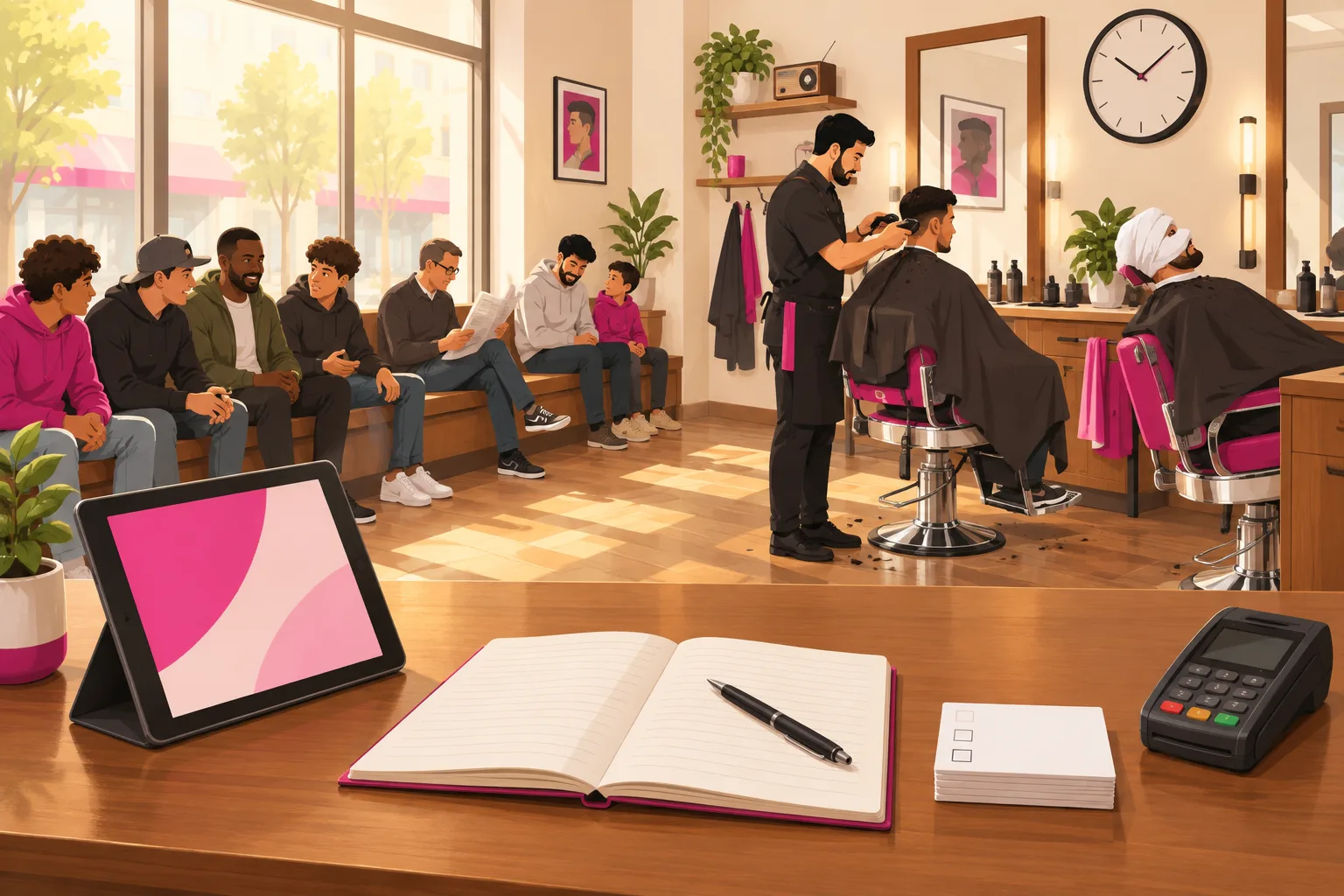
The salon's year has a holiday book that opens October 1 and prom in March. The barbershop's year has a Saturday, every week, and the whole content problem of a walk-in shop is that the day with the best footage is the day with no time to film it and no need for the customers it would bring. The fix is the salon pillar's rule turned sideways: build in the quiet weeks for the busy ones becomes film on Saturday, post for Tuesday.
Saturday at ten, the front-desk kid puts the phone on the shelf behind the desk and gets ninety seconds of the room: the bench as backs and caps, two chairs going, the clock, the sound. That is the honest-day footage and the walk-through's busy pass, and it is also the raw material for the barbershop's version of the salon's best December video. The clients guide scripts "here is what January looks like" from the busiest Saturday of the year; the barbershop films "here is what Tuesday looks like" from any Saturday at all. Cut from the full bench to Tuesday at two with the chair empty and Marcus reading, one sentence: "Saturday is like this. Tuesday is like this. Same cut, same chair, no bench." Pin it under the walk-through. It is the most useful thing a walk-in shop can say, and it moves the man who only knows Saturday to the day you actually need him.
The barbershop calendar
Inside the weekly rhythm, the year still has windows, and they are shorter and earlier than the salon's:
- The last two weeks of July for the first week of August: the kids'-chair walk-through, the first-haircut explainer, the back-to-school countdown. Parents decide quietly, before the chain's back-to-school ads start.
- The first week of January for the man who got a gift card from his wife and the man who has decided, this year, to stop going to the chain: "how to ask for it," posted December 26 as the pillar's permission video, pinned through January.
- Early March for prom, graduation photos, and the spring team picture - the one time a year a sixteen-year-old books ahead, and the one time his mother does it for him.
- The two weeks before Father's Day for the gift card, said in plain numbers, and nothing else that fortnight.
- The week before Christmas is the busiest bench of the year and the worst week to promote anything, for the same reason the pillar gives the salon: every retailer is bidding, the bench is already full, and the budget buys a longer wait.
September is the build month here too. The walk-through gets re-filmed, the explainers get batched on a slow Tuesday, and the shop that was silent in September has nothing pinned when the man in the car finally looks in January.
8. The Barber's Own Account vs. the Shop's
The salon pillar says the stylist's own account is not the salon's, and the filming guide puts the ownership of the salon's handle on the break-room wall. In a barbershop this is not a footnote. The barber is the brand. When Marcus moves chairs, his regulars go with him, and a shop that has built its whole account on his fades has built it on something it does not own. So decide, in writing, before the first post:
- The barber's account is the barber's. His fades, his regulars who agreed, his "Ask the barber" episodes if he hosts them, his followers. It leaves with him, and the shop is glad it exists, because every one of his videos that says the street is a video for the shop.
- The shop's account is the shop's. The walk-through, the wait, the bench, the prices, the first-haircut video, every chair tagged by name. The handle, the followers, and the footage filmed in the shop's chairs stay with the shop whoever is holding the phone - including the renter, including the barber whose clip went viral. The login lives on the shop's email, two people hold it, and the recovery codes are in the desk folder.
- Each tags the other, and both follow the same card. The shop never posts a barber's customer without both yeses - the customer's and the barber's - and a barber filming for his own account in the shop follows the same yes card, the same never-show list, and the same mirror rule, because the bench cannot tell whose phone it is.
- The barber who leaves gets one kind sentence. "Marcus has his own shop on Fourth Street now, and we are glad for him. The chair in the back is open, and here is who is in it." Said once, by the owner, at the desk. The pillar's honest-day rule, and the only thing a shop ever says about a barber who left.
Who runs the shop's phone is the growth roadmap's question, and the answer is the same: one person who is staying, about four hours a week, and the Monday hour paid like a chair hour or the account dies in week six when a Saturday walk-in books into the editing time. In a shop with three barbers and no front desk, the Monday hour is usually the owner's, and the capture is everyone's - a fade from each chair, moved to the shop's phone that evening.
9. The Policy on the Wall, Minors, the License, and the Radio on the Clamp
Barbershops already have the thing the salon pillar tells salons to build: a policy on the wall. Cash or card, no-shows on the list, kids under a certain age with a parent, the tip jar, what the shop does and does not do. The TikTok rule is that what is on the wall is what is on the page and in the video, said the same way - like a person, once, and never as a scolding post. The pillar's compliance section covers license, consent, music and mirrors for every salon; here is what changes in a barbershop.
The license and the razor
Every state licenses barbers, and in most states the barber license is its own license, separate from cosmetology; in many of them the straight-razor shave sits on the barber side of the line. That makes the shave clip - the hot towel, the lather, the razor - one of the best videos a barbershop can post and one a salon chair cannot always post, because a stylist doing it on camera may be doing work outside her license on camera. The inspector watches with the sound off: the razor's blade changed, the jar, the sanitizer, the cape changed between customers, the license on the wall. Film the shave like the fade - from the clamp, the real sound, no face unless the box says so - and never post a service your own board bars.
Minors and the school logo
A barbershop has more minors in it than a salon does, and it has them at the worst time: ten past three on a weekday, in uniform, straight off the bus. Everything in section 6 holds for every one of them - the parent's per-visit yes with the parent in the room, no school logo, no pickup line, no full name - and the shop adds one line to the wall: a minor without a parent in the room is never in a video, even with his own enthusiastic yes, even if he is sixteen and asked you to. The jersey comes off or the clip does not happen. The yes card is handed over with the intake form by the front-desk kid, never asked for by the barber with the phone in his hand, and the regular on the bench who agreed for the year still gets the card on a day he would rather not.
The radio on the clamp
The radio is more a part of a barbershop than of a salon - it is half the reason the bench is a good one - and it is the thing the clamp on the mirror hears most. A business account's sound picker is limited to the commercial music library, and a video that clearly captures the shop radio playing a consumer streaming account is a video you may lose and, in the worst case, an account you may lose. The fix costs nothing: the radio goes down for the fade clip and the clippers carry it, the walk-through and the explainers are talked over, and the licensed track from the library goes on only when a video needs one. The bench's talk is the other sound, and it is the lighting-and-audio problem the lav with a foam windscreen was bought for.
10. The Mistakes That Empty a Barber Chair
- The chain-cut reveal. The man sits down with a grown-out chain cut, the video winces, the comments pile on, and the fix is shown. It is the barbershop's client-shaming clip, it gets a hundred thousand views from barbers, and every man in town who goes to the chain now knows exactly what will be said about him when he walks in. Hook on the hair. Never on the man.
- The famous fade, the empty Tuesday. Every post for the feed, none for the chair, and an owner who decides TikTok does not book anybody. Three in a week: one for the chair, one for the feed, one reveal.
- The wait complaint. "If you put your name on the list you wouldn't be standing there" is the barbershop's grievance post. It grows an audience of barbers who agree and loses the man on the bench who was about to become a regular. The wait is said once, kindly, from the desk, and the policy lives on the wall.
- The before without its own yes. The transformation is the easiest video in the shop and the before is the half of it that needs its own line on the card. No before line, no before clip, in any box.
- The hairline hook. "Tired of hiding it?" and the thinning-crown wince are shame-based body-image framing, which the platform restricts in paid placements and which kills organic reach with the exact man you want. Show the cut that works for a receding hairline, said plainly, without the word "hiding."
- The kid in the jersey. Fast, adorable, and the school on his chest. The pillar's one hard line on minors, and the one a barbershop breaks most.
- The account built on one barber. Nothing written down, every video his, and the day he opens his own shop the account goes dark with four thousand followers who were his. Section 8, before the first post.
- Silence in September. The walk-through from two years ago with the old price, nothing pinned, and the man who finally looked in January found a shop that seemed closed.
11. Amplify the Walk-Through, and Pause the Day Saturday Sells Out
Once the walk-through and the two explainers are pinned and the front-desk kid is asking every new customer how he heard about the shop, you know which video produces first-time walk-ins. That is the only video worth a dollar from the same account as the rent and the clipper order, and the pillar's promotion rules apply to it, with two of the five rules changed for a walk-in shop.
- Promote for followers, never for a one-time cut. A follower watches three weeks of the chair - the fade clip, "how to ask for it," the Saturday bench, the price - and walks in already knowing the words. A stranger who saw one ad walks in once, says nothing at the chair, and goes back to the chain.
- Draw the map to the drive a man makes every three weeks. It is tighter than the salon's twenty minutes, because a man drives less for a cut every three weeks than a woman does for color every six. The town and the towns that share its high school, and nowhere else - the fade clip can go wider only if you sell the class or the oil.
- Amplify in the quiet weeks before the window. The last two weeks of July for the kids' chair, the first week of January for "how to ask for it," early March for prom and the team photo, the two weeks before Father's Day for the gift card. Never the week before Christmas.
- Pause the Saturday that sells out. The salon pauses the day the book is full. The walk-in shop pauses the day the Saturday wait hits the number you would not want to say on camera, because a promoted walk-through still buying followers when the bench is two hours deep is an apology at the door. Promote toward Tuesday, with the "here is what Tuesday looks like" clip, and the shop gets the customers on the day it had the chair.
- Count it at the chair. Cost per local follower on the way to cost per first-time customer who said TikTok, and then the share of those who came back in three weeks - the three numbers from the clients guide, with the rebook counted as the second visit rather than a date on the book, because most of them will not book one.
This is where a done-for-you TikTok promotion service earns its place in a barbershop budget. Viryze takes a video that has already proved it brings men through the door, promotes it for followers inside the radius you draw, in the weeks you choose, and reports the follower cost by segment - so the owner never has to learn Ads Manager with the rent money, and the July push for the kids' chair is reported in the same three numbers as the organic work. The Spark Ads guide explains the format, which promotes the shop's own post from the shop's own account with the comments and the sends attached, and the local business guide covers the drive-radius mechanics. Three cautions carry over from the salon: a promoted before-and-after is the same chair, the same light, no filter and no retouch under the platform's misleading-content rules; the hairline hook stays out of paid placements entirely; and consent to be in a video is not consent to be in a promoted one - the regular who agreed for the year and the parent who checked "yes to everything" are each asked again before the budget goes on.
Frequently Asked Questions
How do barbershops market themselves on TikTok?
By filming the shop the customer is afraid to walk into, not the fade the internet already loves. The videos that put a new man in the chair are plain and local: the walk-through from the parking lot to the chair that says whether you take walk-ins and what the wait is like, the "how to ask for it" explainer that teaches him the words (the guard numbers, taper versus fade, that a photo is welcome and "just clean it up" is a complete sentence), the price explainer that says why a cut is $35 when the chain charges $19 without a word against the chain, the first-haircut video for the parent with a seven-year-old, and a ninety-second clip of the Saturday bench that makes the shop look like a place a stranger could sit down. The fade clip grows the account; those five fill the chair. Say the town and the walk-in policy in the bio, put the prices and the wait on the booking page, and count new customers who say TikTok at the chair.
Should a barber post on their own TikTok account or the shop's?
Both can exist, but write down which is which before the first video. The barber is the brand in a barbershop in a way a stylist usually is not: customers follow a barber across town when he moves chairs. So a barber's own account is his, with his fades, his regulars who agreed, and his followers, and it leaves with him. The shop's account is the shop's: the walk-in policy, the wait, the bench, the price, every chair tagged, the handle and the footage owned by the shop whoever is holding the phone. Each tags the other, the shop never posts a barber's client without both yeses, and a barber who leaves takes his account and gets one kind sentence about the open chair. Write it on the break-room wall, including who holds the login and what happens to the reveals filmed in the shop's chairs, and review it every January.
What should a barbershop post on TikTok?
Three posts a week from the work already in the chair: one for the customer within a twenty-minute drive, one for the wider feed, one reveal or countdown. For the chair: the walk-through, the "how to ask for it" explainer, the price explainer, the first-haircut video for the parent, and a question answered where it happens ("do I need an appointment?" answered at the door on a Saturday). For the feed: the fade clip from behind, real clipper sound, no face needed, with one sentence at the end. For the reveal: the man who agreed, filmed from behind into the mirror, and the first haircut with the parent's written yes. Add the Saturday-morning wait, said once and kindly, the "here is what Tuesday looks like" clip filmed on the busiest Saturday, and the honest day said and never shown. Never the clip that mocks the chain cut he walked in with.
Can a barbershop post kids' haircuts on TikTok?
With the parent's written yes for that visit, decided with the parent in the room and the child asked too, and with three things never in the frame: the school logo on a shirt, jersey, backpack or letterman jacket; the school pickup line or the bus through the window; and the child's full name. The yes card the parent fills in has the same three boxes as everyone else's (no, yes but not my face, yes to everything) and a separate line for the before, and the parent can take it back the same day by texting the shop. Most first-haircut videos should be the reveal from behind, into the mirror, with the parent's hand in the frame, and the single best kids' video needs no child at all: the kids' chair walk-through filmed empty, the booster seat, the tablet, the dinosaur cape, the price said out loud, posted the first week of August when parents are deciding.
What music can a barbershop use in TikTok videos?
Whatever is in the commercial music library on a business account, plus the shop's own sound. A barbershop account should be a business account, and a business account's in-app sound picker is limited to TikTok's commercial music library; adding a trending song from a personal account is the fastest route to a muted or removed video. The radio in the shop is a separate licensing question: the clamp on the mirror picks it up, and a video that clearly captures music from a consumer streaming account is a video you may lose. The fix is to turn the radio down for the fade clip and let the clippers be the sound, because the clippers are the sound of the place and the reason the fade clip works. Talk over the walk-through and the explainer, and add a licensed track from the library only when the video needs one.
When should a barbershop pause TikTok promotion?
The Saturday the wait hits the number you would not want to say out loud. A salon pauses the day the book is full; a walk-in barbershop pauses the day Saturday sells out, because a promoted walk-through still buying followers when the bench is already two hours deep is an apology at the door, not a customer. Promote in the quiet weeks before the windows instead: the last two weeks of July for the first week of August, the first week of January, early March before prom and the spring team photo, and the two weeks before Father's Day for the gift card. Never the week before Christmas, when every retailer in the country is bidding and the bench is already full. Promote for followers inside the drive a man will make every three weeks, and count the new customers who say TikTok at the chair, not the views.
Found the walk-through that gets the man out of the car?
The three numbers at the chair tell you which video actually puts a first-time walk-in on the bench - amplification decides how many more men and parents in your town see it, and when. Viryze promotes the videos that have already proved themselves, putting your walk-through, your "how to ask for it," or your kids'-chair video in front of thousands more people within the drive a man makes every three weeks, in the last two weeks of July or the first week of January, and pausing the Saturday the bench sells out - so the money you spend comes back as new customers who say TikTok at the chair, second visits three weeks later, and a Tuesday that is no longer wide open.
Related Reading
- TikTok for Salons and Barbershops: The Complete 2026 Guide - the two-audience strategy, the six formats, the calendar and the compliance framework this edition plugs into.
- Getting Clients Into the Chair: Turn TikTok Views Into Rebooks - the booking page, the saved replies, and the three numbers, worked for the chair.
- How to Film Salon Videos for TikTok (The Yes Card, Minors, the Mirror & the Break-Room Rule) - the yes card, the minors rules, and the break-room page the barbershop adds its lines to.
- Salon TikTok Content Ideas: 50+ Video Concepts That Fill the Chair - the process clips, walk-throughs and explainers, with Marcus's door scripted.
- Growing a Salon TikTok: From 0 to 10K Local Followers - the size of the book, the two scoreboards, and the paid Monday hour.
- How Salons Make Money on TikTok: Retail, Education, and the Booking Link - the beard-oil clip, the price explainer as the sale, and the gift card in plain numbers.
- TikTok for Agritourism: Filling the U-Pick, the Pumpkin Patch, and the Farm Stay - the other sub-vertical that sells a Saturday, and the rule that promotion stops the day it sells out.
- Local Business TikTok Marketing: Get Customers in Your Area - the drive-radius mechanics every walk-in business shares.