
Vacation Rentals18 min read
Getting Guests to Book: Turn TikTok Views Into Airbnb Bookings and Rebooks
A practical guide for Airbnb hosts and vacation rental owners on how to get more bookings on Airbnb and your own site from TikTok, and how to get the same family back next year: the nine-rung guest ladder from first view to regular, the save and the send to the group chat as the real referral, the profile as the sign at the turn, the booking page part by part (the total first, the rules said like a person, check-in described, the map to the town, the host's face), the three saved replies for "how much for a weekend in October?", "is it open the second weekend of June?" and "can we bring ten people and a boat?", the inquiry answered within the hour and the welcome message that asks how they found you, the stay that has to match the video, the useful follow-up, the rebook message two weeks after checkout as the real conversion, the videos that actually produce guests, the off-platform line that governs every reply, and the three numbers and one sentence that win the argument with the owner.
By Ryan MitchellHead of Creator Success at Viryze

Every guide to getting more bookings on Airbnb starts with the listing: better photos, a smarter price, the right amenities ticked. This one starts three hours away, on a couch in a city, where a woman with twelve tabs open has just watched a forty-second video of a gravel drive, a green door and a kitchen light coming on. She is one of the thousands of people who saw the video. Whether she becomes the family on the dock in July, and whether that family comes back the second week of July the year after, depends on nine small things that happen between the view and the rebook - and most hosts build the first two.
This is the conversion guide of the TikTok for Airbnb hosts series. The growth roadmap earns you followers in the right cities and the money guide prices what they buy; this is the ladder in between, rung by rung, with where each one breaks and the exact words that fix it. It is written for the two-bedroom cabin on the lake, forty minutes past the last gas station - June, who has owned it since 2019 and drives up every other Friday from one of the two cities; Rosa, who resets it; the family that has booked the second week of July since 2021; and the group chat of six that decides everything - but the ladder is the same for a beach condo, a farmhouse, or a converted barn.
What's Inside
- 1. Why Views Don't Fill a Weekend: The Three Leaks
- 2. The Guest Ladder: Nine Rungs From Viewer to Regular
- 3. Rungs 1-3: The Save and the Send Are the Group Chat
- 4. Rung 4: Your Profile Is the Sign at the Turn
- 5. Rung 5: The Booking Page, Part by Part
- 6. Rung 5, Continued: The Three Saved Replies
- 7. Rung 6: The Inquiry Within the Hour and the Welcome Message
- 8. Rung 7: The Stay Has to Match the Video
- 9. Rung 7, Continued: The Useful Follow-Up the Week They Get Home
- 10. Rung 8: The Rebook Message Is the Conversion
- 11. Rung 9: The Regular, the Referral, and the Drive-In Sentence
- 12. High-Intent Content: The Videos That Actually Produce Guests
- 13. The Off-Platform Line, the Guest Who Is Never Content, and the Review
- 14. Tracking: The Three Numbers and the Sentence That Wins the Owner
- 15. Amplify the Arrival That Already Fills the Calendar - in the Quiet Weeks
- Frequently Asked Questions
1. Why Views Don't Fill a Weekend: The Three Leaks
Start with the size of the thing you are trying to do. A house sells about fifty-two weekends a year, and a summer is ten or twelve of them. You do not need a viral video. You need a few dozen families in the two or three cities within a Friday-after-work drive to decide, over a few weeks in the dead of winter, that your door is the one they will drive to in July. The growth roadmap calls this the size of the calendar, and it is the reason a cabin with a few hundred followers in the right cities can sell out its summer the week the calendar opens in January while an account with four hundred thousand followers from every state has open weekends in October.
That decision is made in what the pillar guide calls the twelve-tabs minute. The woman on the couch is not asking whether you love hosting or whether the throw pillows are new. She is asking what will happen to her family if she books. Is it really like the photos? What is the total once the fees are on? Is it really ten minutes from the lake, or ten from the exit? What is the chore list on the fridge going to say? How does check-in work when there is nobody there? Are there cameras? Is this a scam? Every one of those questions can be answered in a sixty-second video, and almost no host answers them. The drone flyover with the trending song answers a question she is not asking.
So the account leaks, and it leaks in three specific places. Each one has its own section in this guide, but it helps to name them up front, because a host usually has one and thinks she has all three.
- She saw it and never clicked. The video reached the right city and said nothing that would make a stranger tap the profile: no lake named, no drive time, no price, no door. This is a content leak, and it is fixed in sections 3, 4 and 12.
- She clicked and never asked. The profile was a logo, the link went to a listing with the cleaning fee buried, the rules read like a lease, and the one message she did send sat for a day. This is the booking-page leak, and it is the one this guide spends the most time on, in sections 5, 6 and 7.
- She stayed and never came back. The family had a good week in July. Nobody asked how they found the house, or someone asked and wrote nothing down. There was a chore list that was not in the video. Nobody told them the same week next year was open, or when it would stop being open. By the time they think about next summer, they are back on the couch with twelve tabs. This is the rebook leak, sections 8 through 11, and it is the most expensive of the three, because the family you already had costs nothing to book again and everything to replace.
The second thing to say up front is that rentals measure the wrong end of the chain. A view is free and instant; a guest is weeks later and arrives in a car with a roof box. If the only number anyone looks at is the view count, the account drifts toward the videos that go everywhere - the turnover with the sound, the design reveal, and, for the hosts who fall for it, the clip that makes fun of a guest - and away from the plain videos that put a family on the dock. The growth roadmap describes the two scoreboards; this guide is the guest-path scoreboard worked all the way down to the welcome message.
2. The Guest Ladder: Nine Rungs From Viewer to Regular

We call the path the Guest Ladder. The pillar guide introduces it; this guide is about repairing it. Each rung is a separate decision one person makes, usually on a phone, usually at night, and each one can be built or left out. Here they are in order, with a note on the three rungs most hosts leave out:
- The view. She sees the arrival, the turnover or the first morning. She knows nothing yet except that the house exists.
- The follow. The series earned it - the drive in, "why it costs that," "can you work from here?", Rosa resetting the lake house, the first morning - or the countdown did ("the summer calendar opens Thursday"). She is now going to watch the house for a season, which is the whole point of the next seven rungs.
- The save and the send. The save is "our next weekend." The send is the first morning to the group chat, and the group chat is the only customer that actually exists. This is the rung most hosts never build on purpose.
- The profile. The lake, the town, the drive time from each city, sleeps six, dogs yes, one link. Thirty seconds of reading that answers the group's first three questions.
- The booking page. The total for a sample weekend with everything on it, the rules said like a person, what check-in is like, the map to the town, your face. This is the rung that leaks the most.
- The inquiry and the booking. Answered within the hour, warmly, with the next open weekend said out loud. The welcome message asks "how did you find us?"
- The stay, done the way the video promised. No chore list that was not in the video, no surprise rule, no camera. The first morning looks like the first-morning video. This is where the rebook is actually earned.
- The rebook. Two weeks after checkout, one message: "the same week next year is open until the fifteenth - want me to hold it?" This is the conversion, and almost nobody asks.
- The regular and the referral. The family that has come the second week of July since 2021, and the sister-in-law they sent, who found the arrival video pinned exactly where they said it would be.
Notice that only the first three rungs happen on TikTok. The other six happen in your profile, on your page, in your inbox, in the house and in a message two weeks later - which is why a host can do everything the content ideas vault suggests, perfectly, and still have an open weekend in October. The ladder is not a content strategy. It is the thing the content strategy is for.
3. Rungs 1-3: The Save and the Send Are the Group Chat
A weekend away is decided by committee. One person finds the house; five people have to agree to it; somebody's husband says "for two nights?" when he sees the total. That is the thing every other vertical in this series gets to ignore and a rental cannot: the viewer is almost never the whole customer. She is the motion on the floor, and your video is the thing she brings to the meeting.
This changes what the first three rungs are for. The view and the follow are hers. The save is hers too - "our next weekend," filed away in February for a week in July. But the send is the moment the house gets a second, third and sixth viewer who did not find it and are not going to scroll your account. They are going to watch exactly one video, the one she sent, and decide from it. So the question for every video on the guest path is not "will this get views" but "is this the one she would send, and does it hold up as the only thing the group ever sees?"
Three videos pass that test, and the pillar's formats section names them. The first morning - the deck at seven, the mist, the coffee, a dog on the step, fifteen seconds, no words - is the send. It does not argue; it is the feeling the group is trying to buy, and it is the video that gets forwarded with the single word "this." The arrival - from the exit, the forty minutes past the last gas station, the gravel, the green door, the code going in with a hand over the keypad, the kitchen light, the bedrooms, the deck, the dock, then the total said out loud - is the send for the member of the group who asked "is it really like the photos?" And the price explainer - "why a two-night weekend here is about seven hundred dollars" - is the send for the husband, and it dissolves the fee objection in somebody else's thread before you ever hear it.
Two practical consequences. First, each of those three videos has to stand alone: the lake named, the drive time said, the total said, the door shown, in the video itself and not in a caption the forwarded copy loses. Second, watch sends per video, by format, the way the growth roadmap describes. When the first mornings and the price explainer get sent at twice the rate of everything else, your guests have started making your argument for you, and the inbox will show it within a month. A turnover with two million views and few sends is reach. A first morning with four thousand views and three hundred sends is July.
4. Rung 4: Your Profile Is the Sign at the Turn
The group taps the profile next, and the profile has about four lines and one photo to answer the three questions the group chat is already asking: where is this, can we all fit, and how do we book it. Most rental profiles answer none of them. They have a name that is a pun, a logo for a photo, a bio that says "your home away from home" and a link to a page of links. Write it like the sign at the turn off the highway instead:
- Where, in words a stranger can use. The lake and the town, and the drive time from each of the two cities you are actually selling to: "three hours from the city, two and a half from the other one." Never the street, never a landmark that finds the house - the filming guide's address rule applies to the bio as much as the video.
- What it is, plainly. "Two-bedroom cabin, sleeps six, dogs yes, a dock." The group of six needs to know it sleeps six before anything else, and the one with the dog needs the word yes.
- How to book, and the one link. "Weekends and midweeks - the total for a sample weekend is on the page." One link, to the booking page in section 5, not to a page of links. Every tap you add between the profile and the total loses a share of the group.
- A face for the photo. June on the deck, not the logo and not the drone shot. The woman with twelve tabs open is deciding whether to send seven hundred dollars to a stranger, and a face is the cheapest trust a profile can buy.
Then the pinned trio, which matches the growth roadmap's foundation: the arrival, the price explainer, and the best question answered - for most cabins "is it really ten minutes from the lake?" with the drive timed on the dash. Those three are the booking page in video form, and they are the first thing the group sees when it lands. Do not pin the turnover with two million views. It is the best video on the account and it tells the group nothing it needs; a pin is a sales decision, not a trophy case.
5. Rung 5: The Booking Page, Part by Part
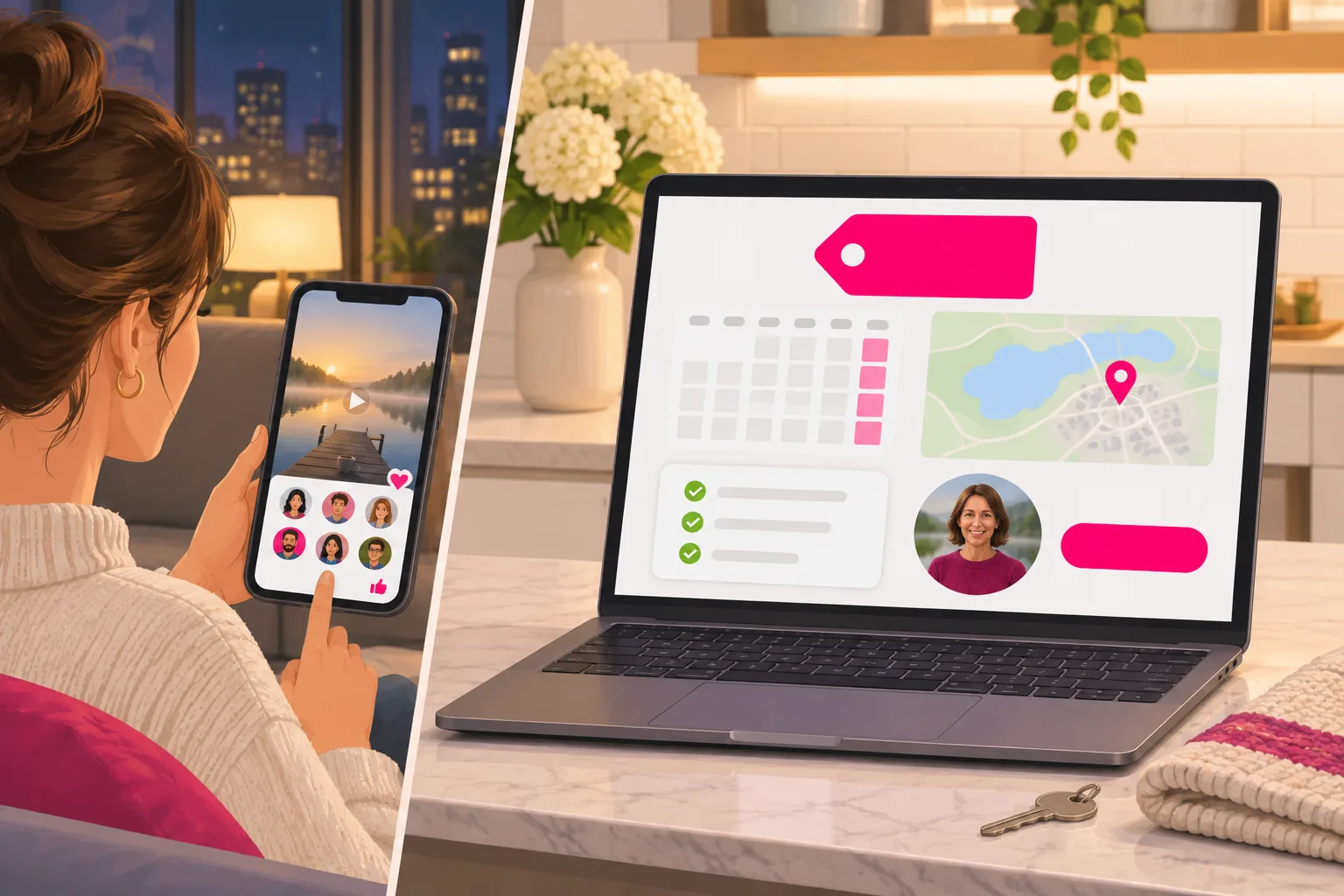
The booking page is the single highest-leverage thing a host can build for the account, and it is the rung that leaks the most, because most hosts do not have one. They have a listing. A listing is written for a search engine and a platform's template; the booking page is written for a nervous stranger whose friend just sent her a video, in the order she needs the information. Whether that page is your own direct-booking site or a simple page that ends in a button to your listing is a money question, and the money guide answers it, with the fee math and the three jobs a direct booking moves onto you. This section is about what is on the page, which is the same either way. Here is the anatomy, in order:
- The total for a sample weekend, first and biggest. "Two nights in October, sleeps six, about seven hundred dollars with the cleaning fee and the county tax on." Not the nightly rate with an asterisk. Under the federal fee rule the total has to be the most prominent number on the page anyway, on your site as on the platforms, so make it the proudest number instead of the one you hoped she would not notice. Then the one thing that moves it: a third night, a holiday weekend, the midweek rate.
- What the number is made of, in one breath. "$240 a night for a house that sleeps six, which is a hundred and twenty a couple. The $140 cleaning fee is four hours of Rosa. The tax is the county's. Two nights minimum, because a one-night stay costs the same four hours to reset." This is the price explainer in text, and it is the paragraph the husband reads.
- The calendar, synced and current. The real one, pulled from wherever the bookings live, so the open weekend on the page is actually open. A page that says a weekend is available and a message that says it is not is the one thing that turns a decided group back into twelve tabs.
- The rules, said like a person. "Quiet after ten, because the lake carries sound. The dock is yours. Dogs are welcome and the yard is fenced; please do not feed the ducks, they remember. The house sleeps six and the insurance is written for six." Not the lease. Not the paragraph in capital letters about fines. The rule belongs on the page; the grievance does not.
- What check-in is like, exactly as the arrival video shows it. "The code comes by text the morning of. The kitchen light is on a timer so the house is lit when you pull in. The welcome book is on the island." She is picturing arriving at eleven at night with tired kids; tell her what that will look like.
- A map to the town, not the house. The town, the lake, the drive time from each city, the last gas station. The pin goes on the town. The house is forty minutes past it, and that is all the page says.
- Your face, and one sentence. "I'm June. I bought this cabin in 2019 and still drive up every other Friday. Rosa has reset it two hundred times." The page converts better with a person on it than with any amenity list, because the group is booking a person, and a person is harder to be a scam.
- The button, and what happens after it. "Book here" to your own calendar or to the listing, and one line about what comes next: "you will hear from me within the hour."
Then the question. On your own site it is a field on the form; on a platform it is a line in the welcome message, which section 7 covers: "how did you find us?" with TikTok as one of the choices. The question is how you count, and every number in section 14 comes from it. But the page has to work for the person who never answers it, because some will just book.
Two things the page must not contain: the essay about your hosting philosophy, and the scolding paragraph ("violations will result in immediate eviction without refund"). Both belong somewhere; neither belongs between a nervous stranger and your door. And one thing it must: the calendar kept honest about the windows. Put "the summer calendar opens Thursday the fifteenth" up in early January, "summer is full - fall color weekends open now" up the day it fills, and the holiday weeks up in September, because the person tapping the link in February is planning for July, not for this weekend.
6. Rung 5, Continued: The Three Saved Replies
No matter how clearly the bio says "the total is on the page," people will message and comment, because asking is how the group tests whether a human is there. For a rental those messages come in three kinds, and you need a saved reply for each before the first one arrives - plus one named person who owns the property phone, including within the hour on a Sunday night in January when the summer calendar has just opened. The filming guide's written property-phone rule names that person (at the cabin it is June) and says what she may answer without asking anyone. One rule governs all three replies, and section 13 explains it: if the question arrived inside a platform's inbox, the answer stays inside it - no site, no code, no "text me."
"How much for a weekend in October?"
The total for a sample two-night weekend with the fees and the tax on, the one thing that moves it, and the link. Word for word: "A two-night weekend in October is about seven hundred dollars all in - that is the two nights, the cleaning fee and the county tax, nothing added at the end. A third night adds $240. The fall color weekends in the middle of the month go first. Here is the page with the calendar and the exact total for your dates." What kills this reply is "check the listing" followed by silence. She did not ask because she could not find the listing. She asked to see whether a person would answer, and the person who answered with a number is the person the group books.
"Is it open the second weekend of June?"
Yes or no, said out loud, the nearest open weekend if it is a no, and the link - within the hour. "The second weekend of June is open as of right now, and on the site I can hold it for a day while the group decides; the page has the total for those dates." Or: "The second weekend is booked, but the first and the fourth are both open, and the fourth is the one with the long light; here is the calendar." A full summer said kindly with the next open window in it - "summer is full, and the fall color weekends open the first week of August; follow the account and I will say the date out loud" - is still a reply that keeps the group. Silence, or "check availability on the listing," loses it to the slower host who answered.
"Can we bring ten people and a boat?"
Kind, specific, and the rule said like a person. "The house sleeps six and the insurance is written for six, so ten is a no, and I would rather say that now than at the door. The dock takes a boat up to about twenty feet; anything bigger, the marina in town has slips by the weekend and I can send you their number. If you are a group of ten, the house next to the marina sleeps twelve and I know the owner." Never a yes you will regret on a Saturday night, never a lecture, and never the sentence about what happened the last time someone brought ten. The pillar's compliance section explains why advertised occupancy and permitted occupancy have to be the same number; this reply is where that rule meets a real person, and it should sound like one.
A fourth message arrives on any rental account that posts turnovers, and it is not from a guest: the other host, two states away, asking which pricing tool you use and whether you have a checklist. That person is the feed path, and the money guide says what to sell her and where. The saved reply on the property's account is one line, warm, pointing at June's own account, once. The house's inbox is for the people who want the house.
7. Rung 6: The Inquiry Within the Hour and the Welcome Message
The hour matters more in this vertical than in any other, because the group is deciding in real time and the house that answers first is the house that gets booked. The woman on the couch has four houses open in four tabs. She sends the same question to two of them. The one that answers in twenty minutes with the total and the nearest open weekend has the booking before the other one has read the message. That is not a platform algorithm, though the platforms reward response time in search too. It is six people on a Tuesday night who want to stop deciding.
So the property phone has an owner, the saved replies are typed before January, and the inquiry gets three things: the answer, the next open weekend said out loud whether or not she asked, and warmth. "Yes, the second weekend of June is open, the total for those dates is on the page, and if the group needs a day I will hold it until tomorrow night." A hold is a sentence you can only say on your own site; on a platform it is "as of right now it is open, and these go quickly in January."
Then she books, and the welcome message goes out the same day, and it is the most under-used message in hosting. Most hosts send the house manual. Send four things instead, in a few lines:
- Thanks by name, with the dates said back. "Thanks, Maria - you have the cabin Friday the twelfth to Sunday the fourteenth." She will screenshot it for the group.
- What check-in is like, exactly as the video showed it. "The code comes by text the morning you arrive. The kitchen light will be on. The welcome book is on the island, and so is the wifi password." The arrival video made a promise; this line repeats it so the family arrives expecting the thing they will get.
- The one or two rules that matter, said like a person. Not the manual. "Quiet after ten because the lake carries sound, and the dock is yours." The rest is in the welcome book, which is where it belongs.
- "How did you find us?" One line, no pressure, no survey link. "Out of curiosity - how did you find the cabin?" Most people answer, and the ones who say "my sister-in-law sent me the sunrise video" or "we watched the drive-in video about six times" have just told you which video to promote in January. Write it down the same day, on the booking, where section 14 can count it.
What the welcome message must not contain, if she booked through a platform: a link to your direct site, a code for next time, or a request for her email or phone number. All three cross the platform's off-platform line, which section 13 covers, and the penalty is the listing. The welcome message is the same warm message on both paths; only the links change.
8. Rung 7: The Stay Has to Match the Video

Here is the rung where rebooks are won and lost, and it has nothing to do with the phone. The family arrives at eleven on a Friday night with tired kids, having watched the arrival video four times. For the next forty-eight hours the house is either the video or it is not, and the rebook message in section 10 only works if it was. Four rules, and the filming guide's guests-are-never-content rule sits underneath all of them.
- The arrival is exactly as filmed. The code came by text that morning. The kitchen light is on. The welcome book is on the island, open to the wifi page. If the video showed the gravel, the green door and the lit kitchen, that is what the headlights find. The first thirty seconds inside the door decide whether the group chat gets "it is exactly like the video" or "well, it's fine."
- No chore list that was not in the video. This is the pillar's permission hook made real: "you do not have to strip the beds - here is what we actually ask, and it fits on an index card." So the index card on the fridge has three lines, the same three the video said, and the lease-length laminated sheet is in a drawer where Rosa can find it and the guest never does. A family that arrives braced for a chore list and finds an index card has just been given the thing they will tell everyone about.
- No surprise rule. Every rule the family meets during the stay was on the booking page and in the welcome message. The hot tub that is closed until April was closed on the page. The dog yard that is fenced on three sides said three sides. A surprise is not the rule itself; it is finding out at the house, and that is what gets written in the review and said in the group chat.
- No camera, and no content. The indoor-camera ban has applied to every platform listing since April 2024, outdoor cameras are disclosed before booking, and the doorbell camera is for the door. Beyond the policy: the house is filmed empty, on turnover day, by June and Rosa, and nothing the family does, leaves or says is a video. The family that rented a private house got one. That is the review that mentions trust, and trust is what rebooks.
Then the first morning, which should look like the first-morning video because the first-morning video was filmed from that deck on a turnover morning at seven. The coffee is where the video showed it. The dock is clear. If the house delivers the fifteen seconds the group chat bought, the family films its own version and the sister-in-law gets it by nine.
And when something breaks - the pipe in January, the storm that closes the road, the hot tub that will not heat - the stay still matches the video if the host does what the honest week says she does. One message, within the hour, with what is happening and what you are doing about it; the plumber on Sunday; the weekend made right without being asked. The families who rebook most reliably are not the ones whose stay was perfect. They are the ones who saw what happened when it was not.
9. Rung 7, Continued: The Useful Follow-Up the Week They Get Home
The family drives home on Sunday. On Monday or Tuesday, one message from June - not a survey, not a review request with a discount in it, not a newsletter signup - with three parts:
- Thanks by name, and the house as they left it. "Thanks for a great weekend, Maria - Rosa said the place was spotless, and the dogs clearly had a better time than anyone." If something was left behind, this is where it is said, kindly and once, with how to get it back.
- The one useful thing. The thing they asked about during the stay, answered: the name of the trail they could not find, the marina's number, the recipe for the thing in the welcome basket. Or, if nothing was asked, the thing you know they wanted: "the first morning from your weekend went up on the account Thursday - it was the mist one - if the group wants it." It is the first-morning video filmed on the turnover morning before they arrived, posted the week they get home, and it is the most shared post the account makes all month.
- Nothing to buy. No rebook yet - that is a separate message, two weeks out, and section 10 explains why the gap matters. No storefront link. No course. The follow-up is useful or it is nothing.
The review deserves one sentence here, because this is when hosts are tempted. The platforms prompt both sides automatically. If you ask at all, ask once, for an honest review, with nothing attached - the federal consumer-review rule in force since October 2024 treats "five stars for a discount on your next stay" as a violation, and it treats quietly steering unhappy guests away from reviewing as one too. A family that had the weekend the video promised writes the review by itself, and it is the only review worth quoting - in her words, on a card at the island, never her name.
10. Rung 8: The Rebook Message Is the Conversion
Everything above exists for this message. Two weeks after checkout - long enough that the laundry is done and the photos have been posted, short enough that the group chat is still talking about it - one message from June:
"The same week next year is open until the fifteenth - want me to hold it?"
That is the whole technique, and almost nobody uses it. The pillar guide puts it plainly: a surprising share of the families who had a good week say yes if anyone asks, and almost nobody asks. The family has already told each other they want to go back. What they have not done is decide when, and "the same week next year" decides it for them while "until the fifteenth" tells them the decision has a date. Both halves matter. "Let us know if you ever want to come back" is not a rebook message; it is a goodbye.
Where the hold lives depends on where they booked, and the difference is the one the money guide is built on. On your own site the hold is yours to give: pencil the week in, send the message, and the rebook costs the house card processing and nothing else. On a platform you cannot hold a date outside the platform's calendar, and the message cannot steer her off it - so the rebook message to a platform family is the date said out loud and the platform's own link: "the second week of July is open as of today, and July goes in January - here is the listing if you want to grab it." No site, no code, no discount. The family that booked on a platform rebooks the way they booked, unless they find the site on their own, in the welcome book on the island where it has always lived.
Then the three answers, and what each one means. "Yes, hold it" is a rebook; pencil it, confirm the date back, and say when the deposit is due. "Let me check with the group" is a maybe with a date in it: pencil it anyway, and text once on the fifteenth - "holding your week until tonight, then it goes on the page." A pencil is a rebook; "we'll see" is not. "We'll see" means never, usually, and that is fine - it is the family you did not lose, because you asked and they told you, and the week goes on the page on the sixteenth where the next family finds it. The host who never asks has a calendar full of "we'll see" and does not know it.
One more thing the rebook message does: it sets the clock for the rest of the account. Every family who stayed in July gets the message in August, every "until the fifteenth" is the same fifteenth, and by the end of August June knows how much of next July is already gone before the summer calendar opens in January. That number - the share of next summer held by families who already came - is the one that tells the owner the account is working, and it is the number section 14 says matters most.
11. Rung 9: The Regular, the Referral, and the Drive-In Sentence
A regular is a family that has stopped deciding. The family that has had the second week of July since 2021 does not open twelve tabs in February; they get the message in August, say yes, and plan the rest of their summer around it. The account did not make them a regular. The rebook message, sent four Augusts in a row, did. They are the most valuable people the house has, and the only video on the account that is for them is the December receipt the money guide describes - the one thing changed this year because a guest asked, said out loud.
The referral is where the ladder pays the account back, and it has a specific shape in this vertical. The regular does not send her sister-in-law a listing. She sends her the account, or the first morning, or just the sentence "watch the drive-in video." The sister-in-law opens the profile, finds the arrival pinned exactly where she was told it would be, watches the gravel and the green door and the total said out loud, and sends it to her own group chat - and when her husband says "for two nights?" she says the sentence that wins the argument in every one of these threads: "We saw the drive-in video. It's exactly like that."
That sentence is the whole reason the arrival is re-filmed every season and pinned, and the whole reason the stay in section 8 has to match it. A referral is a stranger who arrives at rung five already trusting you, because somebody they trust told them the video was true. It is the cheapest booking the house will ever get, and it only happens if the pinned video is still the house - the same door, the same price, the same index card. The regular who says "it's exactly like the video" is doing the account's marketing for free, and the host's only job is to keep that sentence true.
12. High-Intent Content: The Videos That Actually Produce Guests
Most of a rental account is the feed path: the turnovers, Rosa's towel fold, the design reveal, the honest week. Those videos earn the follow and go everywhere, and the ideas vault has dozens of them. But only a handful of videos put a family on the dock, and a host who knows which ones they are can make them on purpose, on the right turnover day, and promote them in the right month. Seven, and the ideas vault's arrivals and questions sections have the filmed versions:
- The arrival, one per property, re-filmed each season and pinned. From the exit to the total said out loud. This is the conversion video of the vertical, the one that gets sent to the member of the group who asked "is it really like the photos?", and the one the referral is told to watch.
- The price explainer, at the island with the welcome book. "Why a two-night weekend here is about seven hundred dollars." Count saves and sends. One a season, because the number and the season change.
- The question answered, filmed where the answer is. "Is it really ten minutes from the lake?" timed on the dash. "Can you work from here?" with the speed test at the desk by the window. "Are there stairs?" - four to the deck, none inside. Every one comes out of the inquiry log, and every one removes a reason the group says no.
- The permission video. "You do not have to strip the beds - here is what we actually ask, and it fits on an index card." The strongest hook the vertical has, because every guest arrives braced for a chore list, and the video that removes it is the one that gets sent with "see, this one's fine."
- The countdown. "The summer calendar opens Thursday." The first snow with the arrival re-filmed in it. The far shore turning in August with the October weekend price. Each one gives the group a date to decide by.
- "Here is what January looks like," posted in early December. Shot last July: the dock in the long light, the kids on it, cut to the same deck in the snow with June and a coffee, and the date the summer calendar opens said out loud. The pillar's calendar is built on this one video.
- The first morning with the rebook line. Fifteen seconds from the deck, posted the week the family gets home, with one line in the caption: "same week next year is open until the fifteenth." It is the send and the rebook in one post, and it is the only video on the account that talks to a family that already came.
What is not on the list: the drone flyover, the amenity-list graphic, the welcome-basket photo, the turnover with the trending sound, and anything that opens on a guest. The turnover is the best video the account makes and it earns the follow; it does not produce a booking, and the growth roadmap's famous-and-empty plateau is what happens to an account that only makes it.
13. The Off-Platform Line, the Guest Who Is Never Content, and the Review
Three rules run under every rung from the saved replies onward, and the first one is the one that costs a listing if it is missed. The money guide explains each in full; here is how they land on the inbox.
- The off-platform line governs every reply to a platform guest. The platforms' off-platform rules - Airbnb's was tightened in May 2025 - bar links, discounts and contact-detail requests that steer a guest off the platform inside a listing or a message thread, bar taking any part of a platform booking's payment outside the platform, and bar marketing to the contact details of guests who booked through it. In practice: a question that arrived in a platform's inbox is answered in it, with the platform's own link; the welcome message to a platform family has no site in it; the rebook message to a platform family is the date and the platform's link; and the platform family is never added to a mailing list she did not join. The direct site lives on TikTok and in the welcome book on the island, where she can find it on her own, and nowhere a platform can read. "How did you find us?" is a question, not a steer, and it is fine. Read the current policy before you type the saved replies, because the wording changes and the penalty is the listing.
- The guest is never content, and the ladder does not change that. Nothing a family does, leaves or says during a stay becomes a video, a caption or a comment reply - not the car in the drive, not the kids on the dock, not the thing they forgot, not the sweet thing they wrote in the welcome book. The two exceptions keep their yes: a guest's own tagged first morning is reposted only after asking, and taken down the day she changes her mind; a review is quoted in her words, never her name, her city or her week. The filming guide's guests section has the four reasons, and only one of them is a policy.
- The review is earned, never bought, never filtered. No discount for stars, no "message me first if anything was wrong" that quietly routes the unhappy family away from the public review, no review request with a code in it. The consumer-review rule has been federal since October 2024 and the platforms enforce their own version. The stay in section 8 is the review strategy; there is not another one.
One more line, because it comes up the first week the account works: the permit. A video under an account that names the lake is a public record that the house operates, and the inquiry that mentions a video is a record that it sells. The pillar's compliance section puts the permit, the lodging tax and the occupancy number first for that reason. Build the ladder on a house that is allowed to be rented, with the number in the bio where the town requires it.
14. Tracking: The Three Numbers and the Sentence That Wins the Owner
The account is not judged on views, and it is not judged on followers either, unless they are in the right cities. It is judged on three numbers, counted by the person who owns the property phone, written on the booking and looked at monthly. The money guide puts the same three next to the fee; here they are as the ladder's scoreboard, one per leak.
- Clicks to the booking page, per week. From the link in the bio - the link tool or the site's own analytics will count it. This is the first leak measured: the share of viewers who did something. It should jump the week after an arrival, a price explainer or a "here is what January looks like," and sit flat after a turnover.
- Inquiries per month that mention a video or answered "how did you find us?" with TikTok. The second leak. Counted from the welcome message and the inbox, not from analytics, and written on the booking the day it comes in. This is the only number the listing site's promoted placement can never produce, because the family that watched the drive in three times in February and booked July was never on the platform's search page.
- Stays that became a rebook when asked. The third leak, and the number that matters most. Not the families who said they would love to come back - the ones who said yes to a date, or whose pencil held on the fifteenth. Count it as a share of the families you asked, and count the asks too, because a rebook rate with no asks under it is a rate of zero that looks like a hundred.
Then the sentence. Every month, from those three numbers, one sentence to the owner - or to the spouse, or to yourself on the drive home: "Five inquiries this month mentioned a video, and two of them are holding July." That sentence wins every argument the account will ever have, because it is made of weekends and not of views. The growth roadmap's cohost section is built on the same three numbers for the person who runs the account for an owner three hours away - they are the only proof that survives a bad month of views.
Honest counting cuts both ways. If a family found the house on a platform and never saw a video, they are not a TikTok booking, even if they followed the account later. If a regular who has come since 2021 rebooks, she is a rebook, not a TikTok booking, even if she now sends the first mornings to her sister-in-law. And if nobody asked "how did you find us?" that month, the second number is a blank, not a zero - write "did not ask" and ask next month. A scoreboard that flatters the account for one month costs the account the owner's trust for a year.
15. Amplify the Arrival That Already Fills the Calendar - in the Quiet Weeks
Once the ladder is built and the three numbers exist, you know something most hosts never learn: which video actually produces inquiries. That is the only video worth a dollar that came out of the same account as the mortgage and the plumber, and there are five rules for spending it - four shared with every business in this series, and one that inverts.
- Promote the proven video, never the new one. The arrival that already produced booking-page clicks and an inquiry that mentioned it is the one that gets budget. A promoted video that has not earned a click organically will not start earning them because strangers in another city saw it.
- Promote for followers, not for a one-time booking. A stranger asked to book a seven-hundred-dollar weekend nine seconds after meeting the house will not. A follower watches the house for six weeks - the countdown, the arrival, the price explainer, the first mornings - knows the day the summer calendar opens, and arrives at rung five already trusting you.
- Draw the map away from home. This is the rule that inverts. Every other local business promotes to a twenty-minute drive; a rental promotes the arrival, the price explainer and the countdown to the two or three cities within a Friday-after-work drive, and never to its own county, because nobody rents a cabin in their own town. The turnover can go wider, home and travel, only if you are selling to hosts.
- Amplify in the quiet weeks before the window, never the week before a holiday. She decides in January for July. Promote "here is what January looks like" and the arrival in the snow in January, when the summer calendar opens; the work-from-the-deck midweek in March; the fall color arrival in August; the "eight people around this table" video in September. The week before a holiday, every hotel and travel site in the country is bidding, the calendar is already full, and the budget buys nothing.
- Pause the day the calendar fills. A promoted arrival still running the week after the summer sold out buys "do you have anything in July?" messages and a first impression that the house is never available. The date the calendar filled is the scoreboard and the off switch at the same time - and it is the day the booking page changes to "summer is full; fall color weekends open the first week of August."
Then report it next to the host fee and the listing site's promoted placement, because that is the comparison the owner is actually making. Each of those has a cost and, if anyone asked in the welcome message, an inquiry count and a rebook share - and the promoted placement's rebook share is the number the platform would rather you never counted. A modest budget on a proven arrival, promoted for followers in the two cities in the quiet weeks, has a cost per follower in the right cities, a cost per booking-page click, a count of inquiries that said TikTok, and a rebook share. In our pillar guide's example, the promoted arrival brought nine weekends in the six weeks after a January push, four of them booked direct with no commission, and two of those families were already asking for the same week next year. Put that next to the fee in February.
This is where a done-for-you TikTok promotion service earns its place in a rental budget. Viryze takes a video that has already proved it brings inquiries, promotes it for followers in the cities you name, in the weeks you choose, and reports the follower cost by segment - so the host with a day job two hours away never has to learn Ads Manager with the mortgage money, and the owner sees the January campaign reported in the same three numbers as the organic work. The Spark Ads guide explains the format, which promotes the house's own post from the house's own account, with the comments and the sends attached. Four cautions the local business guide does not need: any price in a promoted video is an advertised price under the federal fee rule, so the promoted explainer says seven hundred, not two hundred and forty; TikTok treats housing ads as a special category in the US and Canada, so assume the strict reading and write every promoted video about the house and never about who should rent it ("sleeps six, dogs welcome," not "perfect for young couples"); the misleading-content rules apply to the lens, so the promoted arrival is the honest room and the hot tub that is closed until April says so; and consent to appear is not consent to be promoted - a guest's tagged first morning needs a separate yes before budget goes on it, and Rosa's yearly agreement names paid promotion on its own line.
Frequently Asked Questions
How do I get more bookings on Airbnb using TikTok?
By building the nine rungs between a view and a booking instead of the first two. A viewer in one of the two or three cities within a Friday-after-work drive sees the arrival video or the first morning, follows for the series, saves the price explainer and sends the first morning to the group chat; the group taps the profile, which names the lake, the town, the drive time, "sleeps six, dogs yes" and one link; the link opens a page with the total for a sample weekend first and biggest, the rules said like a person, what check-in is like, a map to the town and the host's face; the inquiry is answered within the hour with the next open weekend said out loud; the welcome message asks "how did you find us?"; the stay matches the video; and two weeks after checkout one message offers the same week next year. Most hosts have the videos and a listing and nothing in between, which is why views pile up while weekends stay open. The honest measure is not views but link clicks, inquiries that mention a video, and stays that became a rebook.
How do I get repeat guests at my vacation rental?
Ask, two weeks after checkout, with a date in the message. "The same week next year is open until the fifteenth - want me to hold it?" is the whole technique, and almost nobody uses it. A surprising share of the families who had a good week say yes if anyone asks, because they are already telling the group chat they want to go back and nobody has made it easy. On your own booking site the hold is yours to give, so give it. On a platform you cannot hold a date outside the platform's calendar, so the message is the date said out loud and the platform's own link, and nothing else. The second half of the technique is earning the message during the stay: no chore list that was not in the video, no surprise rule, no camera, and a first morning that looks like the first-morning video. A family that was lectured on checkout does not rebook no matter how good the message is.
What should an Airbnb welcome message say?
Four things, in a few lines, sent the day the booking confirms: thanks by name and the dates said back to her; what check-in is like, exactly as the arrival video showed it (the code arrives by text the morning of, the kitchen light is on a timer, the welcome book is on the island); the one or two rules that matter said like a person ("quiet after ten because the lake carries sound; the dock is yours"); and the question "how did you find us?" with no pressure attached. That last line is not small talk. It is the only way the account ever learns which video produced the booking, and every number in the tracking section of this guide comes from it. What the welcome message must not contain: a link to a direct-booking site, a discount for next time, or a request for her email or phone number when she booked through a platform - all of that crosses the platform's off-platform line and the penalty is the listing. The welcome message is the same warm message whether she booked on your own site or on a platform; only the links change.
Can I ask an Airbnb guest to book direct next time?
Not inside the platform's listing or message thread, and not by marketing to the contact details the platform gave you. Airbnb's Off-Platform and Fee Transparency Policy, tightened in May 2025, bars links, discounts and contact-detail requests that steer a guest off the platform inside a listing or a message, bars taking any part of a platform booking's payment outside the platform, and bars marketing to guest contact data. So the rebook message to a family who booked through a platform is the date said out loud and the platform's own link - "the second week of July is open until the fifteenth; here is the listing" - with no site, no code and no discount. The family that booked on a platform rebooks the way they booked, unless they find the direct site on their own, on TikTok or in the welcome book on the island, where it has always lived. A viewer who found the arrival on TikTok, tapped the one link in the bio and booked on your site was never a platform guest, and that rebook is yours to hold. Read the current policy before you write the saved replies, because the wording changes.
How fast should I reply to a vacation rental inquiry?
Within the hour, and with the answer in it. The person asking "is it open the second weekend of June?" has twelve tabs open and a group chat waiting, and the first house that says yes or no out loud, names the nearest open weekend if it is a no, and sends the link is the house the group decides on. "Check the listing" followed by silence loses to a slower host who answered the question. That is why the three saved replies in this guide exist - the price for a sample weekend with the fees and tax on, the open-or-not answer with the nearest alternative, and the kind specific answer to "can we bring ten people and a boat?" - and why one named person owns the property phone, including on a Sunday night in January when the summer calendar has just opened. Speed is the cheapest conversion lever a rental has, and the platforms reward it in search as well.
Do I need my own booking website to get guests from TikTok?
You need one page the link in the bio opens, and whether that page is a full direct-booking site or a simple page that sends the guest to your listing depends on how full the calendar already is. The ladder in this guide works either way: the total for a sample weekend, the rules said like a person, check-in described, the map to the town and the host's face can all sit on a free landing page that ends in "book here" pointing at the platform. What the direct site changes is the fee and the rebook - the share of each weekend that stays home instead of going to the listing site, and the hold you can give a returning family without a platform in between. Build the account first; add the site the month the arrival video starts producing inquiries that mention it. The money guide covers the site, the fee math and the three jobs a direct booking moves onto the host.
Found the arrival two cities already trust?
The ladder tells you which video actually puts a family on the dock - amplification decides how many future guests see it, where, and when. Viryze promotes the videos that have already proved themselves, putting your best arrival or price explainer in front of thousands more people in the two or three cities within a Friday-after-work drive, in the quiet weeks before the summer calendar opens or fall color sells, and pausing the day the calendar fills - so the money you spend comes back as inquiries that say TikTok in the welcome message, rebooks you can count in August, and a sentence worth saying out loud to the owner.
Related Reading
- TikTok for Airbnb Hosts and Vacation Rentals: The Complete 2026 Guide - the full two-audience strategy, the calendar and the compliance framework this ladder plugs into.
- Growing an Airbnb TikTok: From 0 to 10K Followers in the Right Cities - the followers in the right cities, the two scoreboards, and the cohost who runs the account for an owner three hours away.
- How Airbnb Hosts Make Money on TikTok: Direct Bookings, the Host Course, and the Storefront - the direct-booking site, the fee that stays home, and the off-platform line in full.
- Airbnb TikTok Content Ideas: 50+ Video Concepts That Fill the Calendar - the arrivals, the explainers, the questions and the first mornings that do the converting.
- How to Film Airbnb Videos for TikTok (The Empty House, the Address Rule, the Cohost Agreement & the Property-Phone Rule) - the arrival filmed from the exit, the guest who is never on camera, and the written rule for who answers the phone.
- Getting Clients Into the Chair: Turn TikTok Views Into Rebooks - the sister conversion guide: the same nine rungs for a business whose customer lives twenty minutes away.
- Getting Customers Down the Driveway: Turn TikTok Views Into Second Orders - the other seasonal business that sells the busy season in the quiet one and counts the second order.
- TikTok for Travel Creators: Complete Guide to Growing Your Travel Account - the other side of the weekend: the viewer who decides where to go from a video.