
Vacation Rentals17 min read
How to Film Airbnb Videos for TikTok (The Empty House, the Address Rule, the Cohost Agreement & the Property-Phone Rule)
The complete filming guide for Airbnb hosts and vacation rentals on TikTok in 2026: the turnover kit under $75 with a tabletop tripod, a dash mount, a clip light for the north-facing bedroom and a lav that survives a vacuum, the room with the view as the set and the four angles that work in any rental, the arrival filmed from the highway exit to the total with a hand over the keypad, the once-a-year cleaner and cohost agreement with paid promotion on its own line, why guests are never on camera, the address rule (no street sign, house number, mailbox, keypad or landmark directions), the neighbor rule and the council meeting, the turnover-day capture list, what never appears in a rental video, the wide-angle lens and the honest room, the hot-tub and fire-pit safety frame, the commercial music library and the sound of the lake, the written property-phone rule that says who posts and who owns the handle when the cohost leaves or the house sells, and the frame check that runs before every post.
By Ryan MitchellHead of Creator Success at Viryze
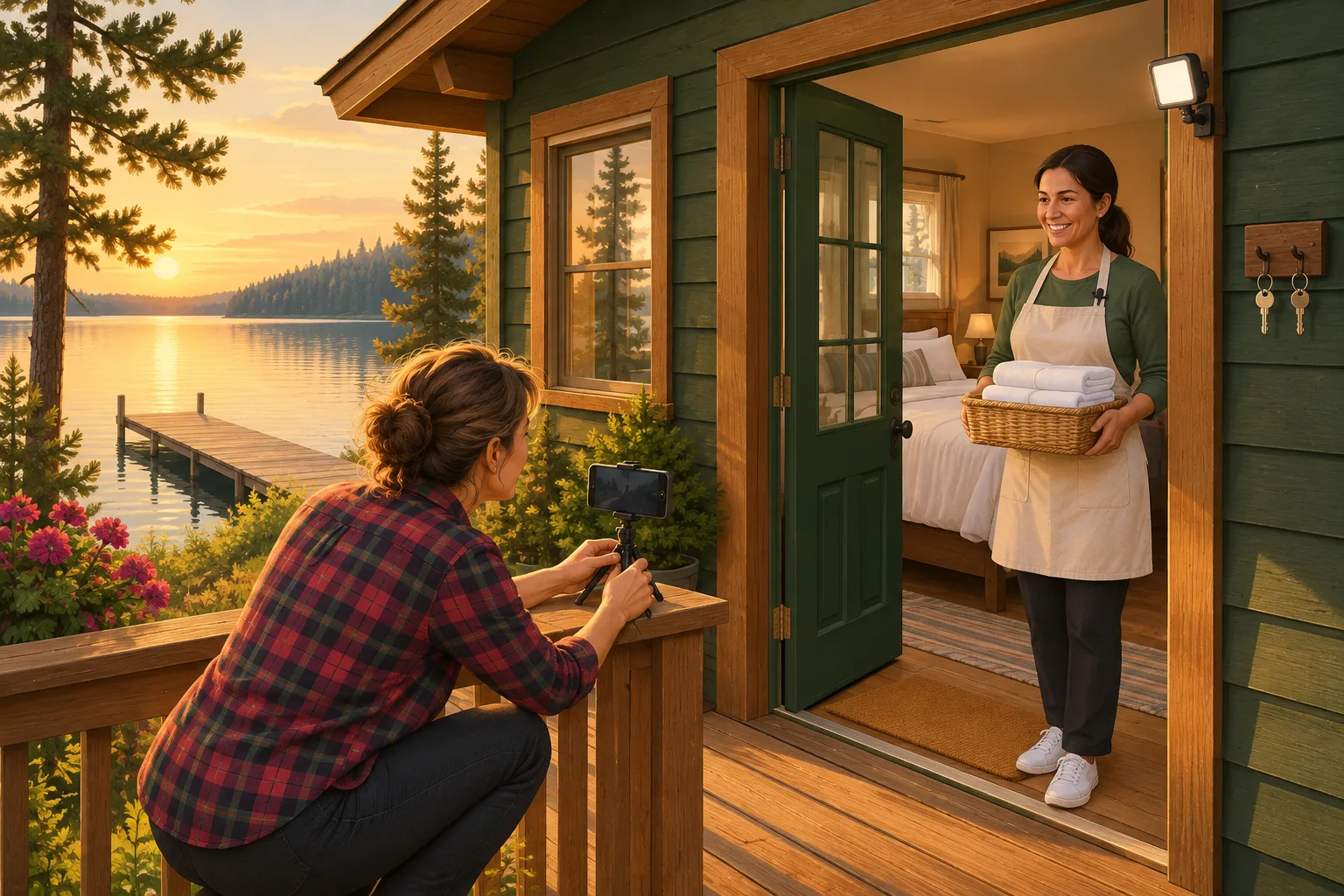
Ask the host who runs the property's phone why the house isn't on TikTok and the answer is rarely "there's nothing to film." A house with a view is nothing but things to film. The answer is the practical wall. Who holds the phone when both hands are stripping a bed? Can we post the family on the dock? The house number is in the drive-in - now what? The neighbor's mower is in every take. And whose account is it, so it isn't a fight the day the cohost moves on or the house goes on the market?
Those are the right questions, and every one of them has a short answer. This guide is the filming manual for a rental account: the kit, the set, the arrival, the two consent rules, the address rule, the neighbor rule, the turnover-day capture list, the never list, the light and sound and lens fixes, the written property-phone rule, and the check you run before anything posts.
One thing makes rental filming different from a salon's or a farm's in this series. Your set is a private house that strangers sleep in, your cast is two people who are rarely there at the same time, and every video is a public record of where an unoccupied building with a hot tub sits on a Tuesday in February. So every choice below runs on the test the pillar gave you: the empty house, the address, and the neighbor.
If you haven't read our complete TikTok guide for Airbnb hosts and vacation rentals yet, start there for the strategy. If you're short on what to film, our 52 Airbnb content ideas supply the list. This article is about getting those ideas onto a phone on one Friday turnover without spending money, posting a guest who did not agree, showing a stranger where the house is, or starting an argument about whose account it is.
The one-sentence version:
Stand the phone on a small tripod in the room with the view before the first bed is stripped, clip a mic on whoever is explaining and pause the vacuum, film the house empty with the two people who signed the one-page agreement in January and never a guest, clip the phone to the dash for the arrival and put a hand over the keypad, keep the street sign and the house number and the mailbox and the house across the road out of every frame, use the normal lens on every room and the music library on every sound, write the one page in the welcome binder that says who posts what and who owns the handle when the cohost leaves or the house sells - then run the two-minute check and post. Everything below is detail on those instructions.
What's Inside
- 1. The Turnover Kit (Under $75)
- 2. The Room With the View Is the Set: Four Angles and the Honest Lens
- 3. Filming the Arrival from the Exit to the Total (With a Hand Over the Keypad)
- 4. Consent, Part One: The Cleaner, the Cohost, and the Once-a-Year Agreement
- 5. Consent, Part Two: Guests Are Never on Camera
- 6. The Address Rule
- 7. The Neighbor Rule (The House Across the Road and the Council Meeting)
- 8. The Turnover-Day Capture List
- 9. What Never to Show
- 10. The North-Facing Bedroom, the Vacuum, the Mower, and the Lake: Light, Sound, and Music
- 11. The Written Property-Phone Rule (A One-Page Template)
- 12. The Pre-Post Frame Check, and What to Do When a Video Works
- Frequently Asked Questions
1. The Turnover Kit (Under $75)
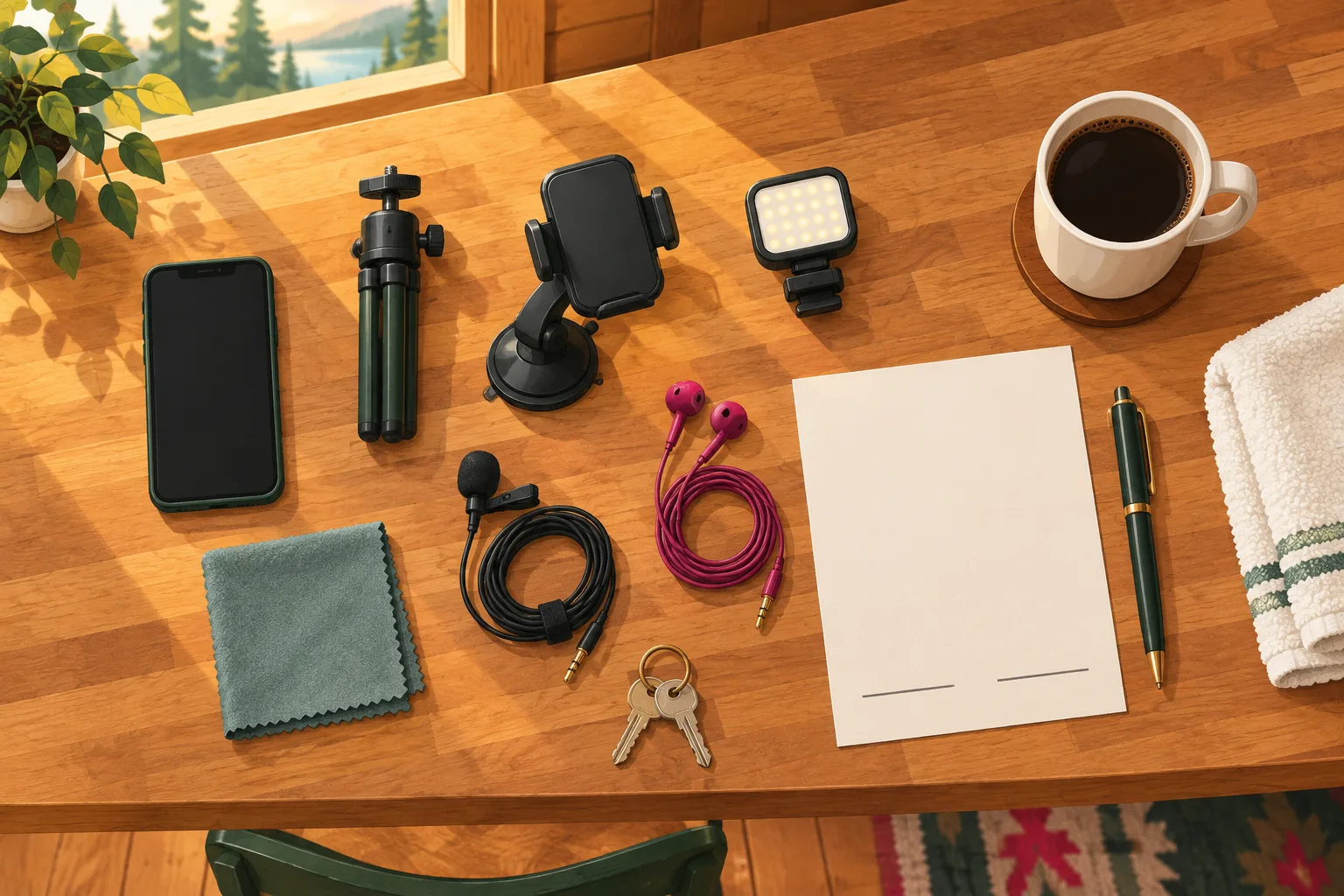
The equipment question has a shorter answer than most hosts expect, and the pillar already gave the first half of it: a phone on a small tripod before the first bed is stripped, and twenty minutes. Here is the rest. Everything the account needs fits in one kitchen drawer at the house, and you already own the expensive part.
- A phone. Any phone from the last four or five years is enough. Use the rear camera, film vertically, and wipe the lens every time it comes out of a pocket - a cabin's lens collects woodsmoke, sunscreen and the dust of a gravel drive the way a salon's collects hairspray, and half the "soft" rental footage online is a thumbprint.
- A small tabletop tripod ($15-20). This is the rental's one essential purchase. A salon clamps to a mirror and a farm hangs the phone on a fence post; a house has flat surfaces everywhere, and a palm-sized tripod with a ball head stands on the deck rail, the end of the kitchen island, the nightstand, the bathroom counter and the dock. Stood in the corner of the bedroom at hip height, it films Rosa resetting the room while both of her hands work, which is the only way a turnover clip ever gets made. Get the kind with bendable legs so it wraps a rail.
- A suction-cup dash mount ($10-15). The one extra a rental needs that no other kind of account carries. The arrival - the exit, the forty minutes, the gravel, the door - is the video that books a weekend, and it has to be filmed from the driver's seat with both hands on the wheel. The mount goes on the windshield low and to the right, the phone records the whole drive, and you cut it in the kitchen.
- A small clip-on LED light ($15-20). Every rental has one room the light never reaches - the north-facing second bedroom, the bathroom with the fan and no window, the basement bunk room - and it is the room the guest will ask about. A palm-sized light clipped to the top of the tripod, bounced off the ceiling rather than pointed at the bed, fixes that room and the grey Tuesday in March.
- A clip-on lavalier microphone with a foam windscreen ($15-25). The one non-negotiable for anything with a voice in it. The wind off the lake is a rental's background noise the way a dryer is a salon's, and a phone's microphone from six feet away on a deck records the wind and nothing else. A $20 lav on the collar with the foam on it makes the host sound like she is sitting across the table from the viewer. Rosa's vacuum is a different matter - see section 10. Nothing survives it; you pause it, say the line, and start it again.
- A microfiber cloth ($3) and the wired earbuds you already own. The cloth for the lens, the earbuds for the one habit that saves more clips than any gear: listen to the first ten seconds before the real take, because the earbuds hear the mower across the road and the phone speaker does not.
Then add two things no camera store sells, and both are paper. The one-page agreement the cleaner and the cohost sign every January, which section 4 is about, and the one page in the welcome binder that says who posts and who owns the handle, which section 11 is about. They cost nothing and they are the two pieces of equipment most rental accounts are missing.
One rule about whose phone it is. The pillar's cadence rule is that one person owns the property phone - in our two bedrooms on the lake, forty minutes past the last gas station, that is June, who has owned the house since 2019, lives two hours away and drives up every other Friday - and the kit lives in the drawer at the house, not in her car. If Rosa catches the first morning on her own phone because June is not up that week, the footage moves to the property phone or the shared folder that evening and comes off the personal phone, including the clips nobody posted. Footage of a house that strangers sleep in should not live in a camera roll that leaves when the cleaner takes a job in town.
2. The Room With the View Is the Set: Four Angles and the Honest Lens
Here is the principle that makes rental filming safe: don't try to spot the problem shot by shot. Choose angles where the things that should not be seen cannot be seen - the road, the house across it, the mailbox, the keypad, the calendar on the tablet - and keep a short list of places the camera never points. When privacy is built into the direction of the lens, you stop worrying about it, and the worrying is what keeps most hosts from ever pressing record.
Start with the good news. The pillar's content engine already picked your set: the room with the view, filmed with the daylight coming from the side. In a lake house that is the deck at seven in the morning and again at golden hour, the end of the kitchen island by the window, and the main bedroom in the afternoon when the light comes across the bed instead of into the lens. Every one of those faces the water, which means every one of them faces away from the road. That is not a coincidence you got lucky with. It is the reason the rule works.
Four angles work in almost every rental:
- The doorway reveal. Tripod on the deck rail or held at chest height, pointed at the closed green door. The door opens and the frame fills with the made bed, the lamp already on, the window beyond it. This is the first ten seconds of the arrival and the last ten seconds of the turnover, and it is the one shot that answers the twelve-tabs minute - "is it really like the photos?" - because the door is the moment the photos stop and the house starts.
- The corner tripod on the reset. Tripod in the corner of the bedroom at hip height, aimed at the bed, while Rosa strips it and makes it. Hands, sheets, the hospital corner, the towels landing on the chair. This is the volume angle, it is the feed-path workhorse the pillar describes, and it needs no face at all - which is why a cleaner who signed "hands and voice, not my face" can be in every one of them.
- The deck to the water. Phone held at chest height, walking from the slider across the deck, down the steps and the eleven steps to the water, one take, no cuts. The question it answers - "how far is the lake, really?" - is the second most asked in the inbox, and a walk answers it in a way a sentence cannot. Walk slowly. The viewer is counting.
- The island with the thing in your hand. The explainers get filmed where the thing happens, with the thing in hand, the way the pillar asks - the cleaning fee with the folded towels and Rosa's invoice on the counter, the lodging tax with the county's form, the two-night minimum with the tablet showing a sample weekend (the calendar, never the guest names). Never in the car with a slide. June at the island with a mug and the folder is the most trusted frame on the account, and it costs nothing.
The wide-angle lens and the honest room
The lens is where rental accounts quietly break the one rule that matters most. The wide-angle setting on a phone doubles a bedroom, turns a galley kitchen into a hall and puts the lake ten feet closer than it is, and the guest who walked through that video arrives to a smaller house than the one she booked. TikTok's misleading-content rules sit under the lens the same way they sit under the listing photos, and so does the review. Film rooms at the normal lens, from the doorway, at standing height. If a room photographs bigger than it is, say so out loud: the pillar's compliance section calls that "say what the house is," and the family who arrives and finds it exactly as filmed is the one who rebooks. The wide lens is for one thing in a rental: the view from the deck, where the only thing it exaggerates is the sky.
A note on height. A phone held at eye level and tilted down makes every room look like a dollhouse; a tripod at hip height, level, makes a room look like a room. The rule of thumb for the inside of a house is the same one a real-estate photographer uses: the lens at the height of the doorknob, level with the floor, and never pointed down at the bed. Our virtual tours guide covers the room-by-room walk-through craft in more detail; a rental needs about a third of it, because the viewer is not buying the house, she is deciding whether to sleep in it for two nights.
3. Filming the Arrival from the Exit to the Total (With a Hand Over the Keypad)
The arrival is the one video a rental cannot skip, and the one most hosts film wrong, because they film the house and forget the drive. The pillar's six formats put it first for a reason: the woman with twelve tabs open is not asking whether the house is nice. She is asking whether it is real, whether she can find it, and what the whole weekend costs. The arrival answers all three in sixty seconds, and it is pinned to the top of the profile until the next season's version replaces it.
Here is how June films it, start to finish:
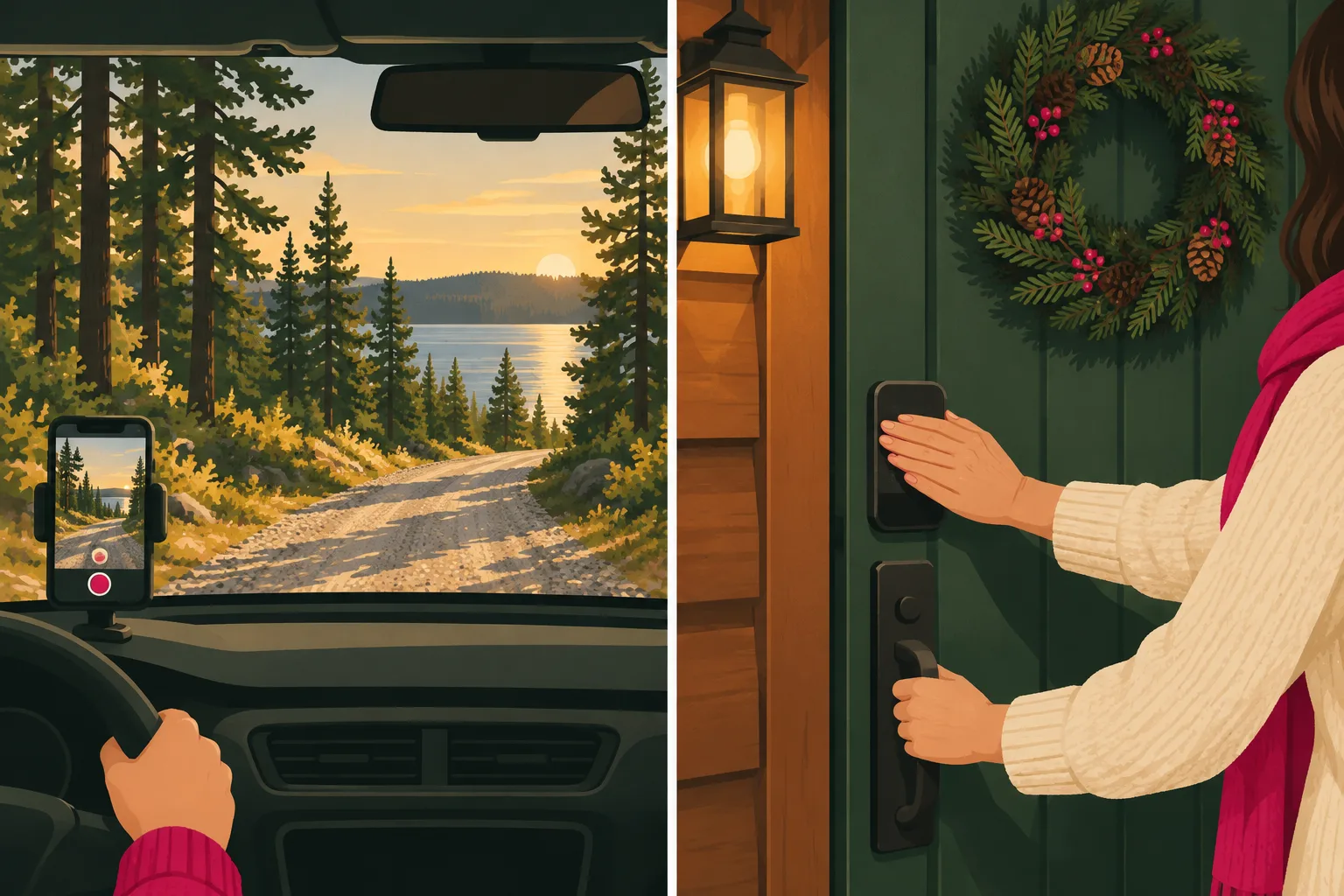
- The dash, before the exit. Phone on the suction mount, low right on the windshield, recording from the mile before the exit. She says the first line into the lav while she drives: "Three hours from the city. Here is the last forty minutes." The exit sign is in the footage. It will not be in the edit.
- The last gas station. The turn past it is the landmark everyone remembers, so it stays - as a gas station, from the back, with the brand cropped and the price sign out of frame. "Fill up here. There is nothing after this."
- The road. The pavement ends, the gravel starts, the lake flashes through the trees. This is the part of the drive people rewatch, and it is also the part with the mailboxes, the neighbors' drives and the road sign at the fork. Film all of it; cut to the trees and the water and let the turns go.
- The door. Out of the car, phone in hand at chest height, up the steps to the green door. The keypad is in frame for one second and June's left hand is flat over it the whole time her right hand enters the code. No numbers, no sound of the beeps, no lockbox. "You will have the code the morning you arrive."
- The kitchen light. The door opens, the hand finds the switch, the island and the window beyond it come up. One step in, pause, let the viewer look.
- The deck. Through the house to the slider, out onto the deck, the lake. The one place the wide lens is allowed. Hold it for five seconds with nothing said.
- The total, out loud. Back at the island, the tablet with a sample weekend showing - a Friday and a Saturday in October, no names - and the number said as a sentence: "Two nights here, this October, is about seven hundred dollars all in. Link in the bio for the one you want." The total first, every time - the FTC's fee rule has made the all-in number the one that has to be most prominent since May 12, 2025, and the host who says it first is the one who gets believed.
Re-film it in each season - the arrival in the snow is a different video from the arrival in July, and the ideas vault's eight arrival ideas include the one after dark, the one to the town instead of the house and the one for the person in the group chat who got outvoted. The dash footage is the part that takes planning: June records the drive every time she comes up, so by the time she needs the snow version she has three to choose from.
The drive is the dangerous part. The inside of the house has nothing in it that tells a stranger where it is. The drive has everything: the exit number, the gas station's brand, the road sign at the fork, the row of mailboxes, the neighbor's name on the gate, the house number on the post at the end of the drive. The edit is where the address rule is enforced, not the shoot. Section 6 has the list, and the last thing June does before the arrival posts is scrub through the road footage one frame at a time with the earbuds in.
4. Consent, Part One: The Cleaner, the Cohost, and the Once-a-Year Agreement
A rental's cast is small and that is its advantage. There is the host, there is the cleaner or the cohost who is in the house more often than the host is, and occasionally there is the handyman who fixed the heat tape in January and agreed to be a recurring character. Nobody else. No guests, no neighbors, no kids on the dock, no family who booked the second week of July. Two or three adults, who chose to be on the account, in an empty house.
The model is the one our salon filming guide uses for the stylists and the farm guide uses for the crew, with one difference a rental cannot skip: the cleaner is the star of the volume format, and she is paid by the hour or by the turnover, so what she is paid for the time on camera has to be its own line. Every adult who appears on purpose signs one plain-language page each January. It says:
- Which platforms the house posts to, that posts are public, and that they may be reshared and stitched by strangers.
- What they appear in. Rosa's line reads: the turnover clips, the first-morning shots, the explainers at the island when she is the one who knows the answer - and never the honest week unless she asks to be. Hands and voice always; her face by her choice, checked once a year, with a box for each.
- What they are paid for it. Rosa is paid four hours per turnover whether the tripod is up or not. The agreement says the filming adds no time to the reset, and that if a video needs a second take of the hospital corner, that is the house's time, paid at her rate. A cleaner who is asked to perform for free will stop being on camera by March, and she will be right to.
- A separate checkbox for paid promotion. Consent to appear in a post is not consent to appear in an ad. The turnover clip that goes out to the two cities three hours away with money behind it has Rosa in it; she gets to decide that separately, and she gets told which videos were promoted.
- It expires in a year, it is reviewed in January when the summer calendar is about to open, and it can be withdrawn with a text, after which the clips come down within the day, no argument.
- Saying no changes nothing about her hours, her rate, her turnovers or whether she is the one June calls. That line is written down because it is the one a cleaner would never ask about.
The cohost's version adds two lines, and both are about the future rather than the camera: which account she posts from (the property's, never her own, for anything about the house), and what happens to the handle when she stops cohosting. Section 11 has that answer. The agreement is where she signs it.
Rosa's baby. One of the ideas in the vault's honest-weeks section is the turnover that got covered when Rosa had her baby, because the account has a cast and a cast has a life. That video exists only because Rosa agreed to be mentioned, in those words, before it was cut - not because she is on the agreement. The yearly page covers the house. A person's life is asked about every time, and the answer is allowed to be no.
5. Consent, Part Two: Guests Are Never on Camera
A salon has a yes card at the desk and a farm has a sign at the gate, because the customer is in the room where the filming happens. A rental has neither, because the guest is never in the room where the filming happens. That is the whole rule, and it is simpler than the other verticals': the house is filmed empty. On turnover day, between the family who left at ten and the one arriving at four, by the people who signed the page.
There are four reasons, and only one of them is a policy.
- The platform's camera rule. Airbnb has banned indoor security cameras in every listing since April 30, 2024, and outdoor cameras and noise sensors have to be disclosed in the listing before a guest books. A doorbell camera is for the door. Footage from it is not a video, and a host who posts "look who checked in at 2 a.m." from the doorbell has posted a guest without asking and told the platform where the camera points.
- The guest did not rent a film set. A family who booked a private house for a weekend has a reasonable expectation that the house is private, and that expectation does not end at the deck. Their car in the drive, their kids on the dock, their towels on the rail, the dog at the slider - none of it is yours to post, and "you can't see their faces" is not the test. The group chat can tell whose car that is.
- What they left behind is never content. The pillar's hooks section calls the "look what they left" reveal the guest-shaming clip, and it is the one video that costs more than it earns. It grows an audience of hosts who will never book, and it tells the woman with twelve tabs open that she will be judged, filmed and posted if she forgets a sock. Rosa films the reset. She does not film the before.
- The house full is a house you cannot sell. The pillar's calendar is built on filming the empty weeks for the full ones: the July footage is shot on a July turnover and posted in January, when the person who sees it can still have the week. A video filmed with guests in it is a video filmed when the house is booked, and that is the wrong week to be filming anyway.
Two exceptions, both with a yes attached. The tagged video. A guest who films her own first morning on the deck and tags the house has made the best video the account will get that month, and it is hers. Ask, in the comments or by message, before reposting it - "may we share this to the house's page?" - and take it down the same day if she changes her mind. The review. A review worth quoting is quoted in her words, on a card at the island or read by June, and never with her name, her city or the week she stayed. "Exactly like the videos" is a review. A surname and the second week of August is a doxxing.
6. The Address Rule
Here is the rule the other filming guides in this series do not have, because a salon wants you to know where it is and a farm stand puts the address on the sign. A rental wants you to know the town, the lake and the drive time, and nothing closer. A video that says "three hours from the city, forty minutes past the last gas station, on the lake" is a video a family can decide on. A video with the house number in it is a public record of where an unoccupied house with a hot tub and a kayak rack sits on a Tuesday in February, posted by the owner, searchable forever.
The address is never on the platform. In practice that means:
- No street sign. The road sign at the fork, the one at the end of the drive, the county road marker. The drive-in is cut to trees and water.
- No house number. On the post, on the door, on the mailbox, on the dock, painted on the rock, carved into the sign your father-in-law made. Walk the property once with the phone and find every place it appears; there are more than you think.
- No mailbox. Yours or the row at the end of the road. A row of mailboxes with names is a directory.
- No keypad. Not the buttons, not the sound of the beeps, not the lockbox or the hook it hangs on. The hand goes over it before the phone comes up.
- No landmark directions. "The second cabin past the bridge," "the green door across from the boat launch," "turn at the church." Directions are an address said slowly.
- No map pin. The location tag on the post is the town, never the lake road, and the profile says "two bedrooms on the lake, three hours from the city" - which is enough for the group chat and not enough for anyone else.
What carries the rest is the part of the ladder that happens after the booking: the booking page with the map to the town, the welcome message with the address and the code the morning of arrival, the binder on the island. The pillar's guest ladder has that sequence. The video's job ends at the decision; the address belongs to the booking.
The permit number is not an address. Some towns and counties require a short-term rental permit or registration number on all advertising, and a TikTok bio is advertising. That number goes in the bio, where the pillar's compliance section puts it. A permit number tells the town you are registered. It does not tell a stranger which drive is yours, and a host who confuses the two and leaves it off has traded a privacy rule she already follows for a fine.
7. The Neighbor Rule (The House Across the Road and the Council Meeting)
The neighbor is to a rental what the client in the next chair is to a salon: the person who is in the background of every careless shot, who did not agree to anything, and who has the most reason to mind. The difference is what minding looks like. A salon client who finds herself in a video asks for it to come down. A neighbor who finds his house in a video about the short-term rental across the road has something to bring to the next council meeting - and in most towns right now there is a next council meeting about exactly this.
So the neighbors are never in frame, ever. Not the house across the road, not the man on the mower, not his truck, his dock, his dog or his flag. Not the shared drive, not the property line, not the fence he put up the year the rental opened. And it is framed for, not spotted:
- Film the lake side. The deck, the slider, the dock, the view - every set in section 2 faces the water and away from the road. The front of the house, the drive and the road side are filmed from the door looking out at the trees, never from the road looking in at the house, because looking in at the house means the house next to it.
- Stand the tripod where the next house cannot be in the background. Walk the deck once and find the two spots where the frame holds only your rail, your trees and the water. Those are the two spots. Tape a small mark on the rail if it helps.
- The arrival from the dash, cut at the turn. The one video that has to show the road shows it as trees and gravel, and the neighbor's drive, gate and mailbox go in the cut with the street sign.
- Sound is a frame too. The lav picks up the mower across the road and the dog two houses down, and a viewer who knows the lake can place a house by its neighbor's dog. The explainer waits until the mowing stops. The earbuds are how you know.
- The town meeting video never quotes the neighbor. The ideas vault's honest-weeks section has the day the town argued about rentals, told in June's words, with nobody else's. The man across the road said what he said at a public meeting; it is still not content.
And if a neighbor asks you to take a video down - because his roofline is in the corner of the deck shot, because his boat was at your dock that day - take it down the same day without an argument. It is cheaper than the meeting, and the account that outlasts the argument about rentals in your town is the one that never gave anyone an exhibit.
8. The Turnover-Day Capture List
The pillar's content engine and the ideas vault's turnover-day system both start from the same fact: the house is empty one day a week, and that day is the content calendar. June drives up every other Friday; Rosa is there every Friday. Between them, with the phone on the tripod before the first bed is stripped, one turnover produces a week of posts. This is the list, in the order the day runs.
One Friday, five posts:
- Before the first bed is stripped: the deck at the hour. Thirty seconds of the lake from the two marked spots on the rail, the mug on the table, nothing said. This is the first-morning shot if it is morning and the golden-hour shot if it is not, and it is the one that gets sent to the group chat. Film it every turnover; most of them will never post, and the one in the first snow will.
- The reset, from the corner. Tripod at hip height in the corner of one bedroom, aimed at the bed, recording the whole strip-and-make. Rosa does what she does. It is cut to forty seconds on Sunday night, with the hospital corner and the towels landing on the chair, and the caption is the line the vault gave it: "one of two bedrooms, four hours of this." One room per week. There are more rooms than weeks.
- The explainer at the island, vacuum off. One question from the log - the cleaning fee, the two-night minimum, the lodging tax, the gift certificate - answered in sixty seconds with the thing in hand and the total said first. Filmed in the window between the vacuum and the mop, with the lav on and the earbuds checked.
- One question in forty seconds. The vault's questions section - how far is it really, can the dog come, how fast is the wifi, what happens if it rains - answered where the answer lives: the walk to the water, the speed test at the island, the shelf of board games. The question log on the property phone is the script.
- Ninety seconds of the house as hands. Sheets, the broom, the fire laid, the lid going back on the hot tub, the key going on the hook. No faces, no voice. This is the footage the honest weeks are cut from later, and it is the only kind of footage you will wish you had more of in December.
Twenty minutes of capture, counting the walk to the dock, on a day the two of you were already there. The pillar's cadence is three posts a week - one guest-path, one feed-path, one first morning or countdown - so a Friday like this one is a week and a half of posts, and the first mornings that did not post are the bank. The question log on the property phone is the part that makes it repeatable: every inquiry, every "quick question" the night before, every "wait, is it actually" in the comments goes in the note, and the Friday explainer comes off the top of it.
Two things the list leaves out on purpose. The arrival is filmed separately, from the car, on the drive up, and re-cut per season - section 3. And the honest week is said, never shown, once, by June, when there is one to tell; it is not on a Friday list because a hard week does not run on a schedule.
9. What Never to Show
Most of this list is the three rules above written as frames. The rest is the handful of things a house has that a stranger can use, and a few that a guest could copy badly.
- A guest, a guest's car, a guest's kid, a guest's name, or anything a guest left behind. Section 5. No exceptions, no "you can't see their face," no doorbell footage.
- The address in any form. Section 6. The sign, the number, the mailbox, the keypad, the lockbox, the landmark directions, the pin on the lake road.
- The neighbor's house, truck, dock, dog, fence or voice. Section 7.
- The wifi card, face up. The vault's turnover ideas include the wifi card going on the nightstand - turned face down, which is the whole joke and the whole rule. The network name and the password are on a card in every rental, and a card in focus on a nightstand is a password posted on the internet.
- The tablet with names on it. The calendar is content when it shows open weekends; it is a guest list when it shows who booked them. Sample weekends, future dates, the inbox closed.
- Where the spare key, the lockbox or the breaker is. The walk-through shows the key going on the hook inside. It does not show the hook outside.
- The thermostat you can see from two hours away, the camera at the door, the noise sensor. The honest week about the frozen pipe mentions the thermostat because it is the point of the story; the video does not show the app, the login or the brand of the camera. A smart home's screens are a map of a smart home.
- The hot tub with the lid off and nobody there, the fire pit without its screen, the ladder in the water with no line about depth. Nothing a guest could copy badly. A video is a public record of how the house is used, and the one the insurer finds first is the one with fourteen people in a hot tub rated for six. Film the lid going on, the screen going over the fire, the life jackets on the hook - the safety frame is the content, and it photographs well.
- More occupancy than the permit allows. The table set for eight in a house that sleeps six is a video the town can read.
- The guest-shaming clip, the early-check-in skit, the two-star dramatic reading, and the grievance post. Section 5 and the pillar's hooks section. They grow the wrong audience and they teach every future guest the wrong thing.
- A review with a name, a city or a date on it. Her words, quoted; her name, never.
- A nightly rate without the total next to it. "$240 a night" in a video and "$700 all in" on the booking page is the hidden fee the FTC's rule is about, and it is also the comment thread that never ends. The total, first, every time.
- A room at the wide-angle setting. Section 2. The lens is for the sky.
- The trending song from a consumer streaming account, or the radio in the kitchen under the explainer. Section 10.
None of this costs you a video. The house empty, from the lake side, at the normal lens, with Rosa's hands and June's voice and the total said first, is the account. The list is just the edge of the frame.
10. The North-Facing Bedroom, the Vacuum, the Mower, and the Lake: Light, Sound, and Music
A rental's light is mostly solved by the set: the water side of the house is the bright side, and the deck at seven and again before sunset is the best studio most hosts will ever have for free. The problems are the rooms that face the other way and the hours in between.
- The north-facing bedroom. Every house has the room the sun never reaches, and it is the room the guest asks about - "is the second bedroom dark?" Film it at the brightest hour it gets, lamps on, blinds fully open, with the clip light on the tripod bounced off the ceiling so it fills the room instead of making a hot spot on the bed. Then say it: "this is the cooler room, it gets the morning and that is it." Honest about the dark room is a video; a dark room lit to look like the bright one is a review.
- The window behind the bed. The main bedroom's best feature is the view, and pointing the phone at it from the door turns the room into a silhouette. Film the room with the window to the side, and film the view from the bed, separately, as the first-morning shot.
- The bathroom with the fan and no window. The clip light, held up and bounced off the white ceiling, for the ten seconds the walk-through needs. Fan off while you film. Nobody needs to hear it.
- Golden hour is on the clock. The deck at the hour before sunset is the most-saved frame on any lake account, and in October it happens at six and in July at half past eight. Turnover day runs ten to four; the golden-hour shot is the one reason June stays late on the Fridays she is up.
Sound is where the rental accounts that look fine still fail:
- The vacuum. Nothing survives it, not the lav, not a $300 shotgun mic. Rosa's reset is cut to music or to the quiet parts; the explainer is filmed in the window between the vacuum and the mop; and the one rule is that nobody talks over it. Pause, say the line, press the pedal again.
- The wind off the lake. The foam windscreen on the lav handles a breeze. A real wind on the deck is a day you film the deck silent and talk at the island.
- The mower, the dog, the boat. The neighbor rule for sound - section 7. Wait. Mowing takes twenty minutes.
- The sound of the lake. Loons at seven, the water on the dock, the fire, the screen door - the sound of the house is the sound most hosts replace with a song, and it is the one the group chat turns up. Record it clean on purpose: a minute of the deck with nothing said, every turnover, and the honest weeks have a bed to sit on.
Music
A rental account should be a business account, and a business account's in-app sound picker is limited to TikTok's commercial music library, so the trending pop song on the turnover clip is the fastest route to a muted or removed video. Use the library, use original sound, or use the lake. The kitchen radio is the other problem: a lav picks it up, and a video that clearly captures a song playing from a consumer streaming account is a video you may lose. Radio off for the explainer, the reset cut to the library or to the vacuum's quiet parts, and the first morning with nothing but the loons.
11. The Written Property-Phone Rule (A One-Page Template)

The pillar's cadence section says one person owns the property phone and that the rule is written down. This is the page. It lives in the welcome binder on the island, behind the house rules, and it is decided once - ideally in January, the week the agreements get signed and before the summer calendar opens - by the owner, with the cohost and the cleaner reading it before they sign their pages. It is the one document in this guide that will matter more in two years than it does today, because the last line is about a day that has not happened yet.
The property-phone rule (fill in the names and put it in the binder):
- Who owns the account. The account is the house's, named for the house, owned by the owner of the house. The handle, the followers, the saved videos and the question log are property of the house, not of whoever posts. The host's own account is separate and posts the business - the pricing tool, the cohosting, the course - and tags the house; the house's account posts the house and tags the host.
- What happens when the cohost or the cleaner leaves. The handle, the followers and every clip filmed in the house stay with the house. Her own account and its followers go with her. Her face comes down from the clips if she asks, the same day; her hands stay unless she asks about those too. The public post is one kind sentence, and nothing about why.
- What happens when the house sells. Decided now, in writing: the account is named for the house, so it is either sold with the house as part of the listing - the handle, the followers and the footage, with the cast agreements disclosed - or it is retired with one last post the week the sale closes and never handed to a stranger with Rosa still in the clips. June's page says sold with it, and that Rosa gets a text first.
- Who posts. One name. Everyone else sends footage to the property phone or the shared folder by Friday night.
- What goes up without asking. The turnover from the corner, the first morning, the deck at the hour, the walk to the water, a question answered from the log.
- What always gets a look from the owner first. Any price or total; any frame with the road in it; any neighbor in any background; anything a guest left; the honest week; anything about a review, a platform or another host; the explainer about where to book; anything that is going to be promoted.
- What never goes up. A guest, a car, a kid, a name, a thing left behind, doorbell footage; the address in any form; the neighbor; the wifi card face up; the tablet with names; the lockbox; the hot tub with the lid off and nobody there; more people than the permit; the guest-shaming clip; the grievance post; the trending song from a consumer account; a room at the wide lens.
- How consent works and where it lives. The yearly page for every adult on purpose, signed in January, in the binder and in the shared folder; a text withdraws it; a tagged guest video is reposted only after asking; a review is quoted in her words and never her name.
- Who answers inquiries, how fast, and the three saved replies. Within the hour, from the property phone, with the pillar's three: the total for the weekend asked about and what moves it, the open-or-not said out loud with the nearest open weekend, and the house sleeps six and the insurance is written for six.
- Holiday mode. On the full holiday weekends - the Fourth, Labor Day, Thanksgiving week - the account posts a first morning, a tagged video with its yes, and the replies within the hour. Nothing else. Silent on the Fourth is fine; silent in January is not.
- The hard-day rule. The frozen pipe, the year the house almost sold, the town meeting: said once, by the owner, in her words, never a guest's story and never an ask. Rosa sees the cut first if she is in it.
Review it each January with the agreements. Most years nothing changes, and that is the point: the one January something does change - a new cohost, a listing agent, a town that just passed a permit rule - is the year the page was worth writing. Our farm filming guide has the same page on a fridge, and the salon guide has it on a break-room wall; the rental's is the only one with a line about the day the building changes hands, because the rental is the only one where the business is the building.
12. The Pre-Post Frame Check, and What to Do When a Video Works
Choosing the right angle prevents almost every problem. The frame check catches the rest - the mailbox at the edge of the drive-in, the neighbor's roofline in the corner of the deck shot, the house number on the dock post you forgot was painted there, the wifi card face up on the nightstand behind the reset, the mower under the explainer.
Run it on every video, before it posts. Two minutes each. This is the job of whoever is posting, and of the owner when the video is on line 6 of the property-phone page.
Before you post:
- Pause on every frame change. If the camera moved or turned, stop and look at what is newly in view - especially anything through a window or past the end of the deck.
- Look for the road. Any frame with the road, the drive, the fork, the gas station's brand or the row of mailboxes in it is a frame that gets cut or cropped. The arrival is checked one frame at a time.
- Look for the house across it. The roofline, the truck, the dock, the dog, the flag. Any yes means the clip does not go up.
- Count the people against the pages. Everyone in it chose to be, has a current page, and is in the kind of video her page allows. A guest, a car, a kid, a thing left behind: cut.
- Zoom on every surface. The post at the end of the drive, the door, the mailbox, the dock, the keypad, the wifi card, the tablet, the binder, the invoice on the island, the county form. If you can read a number or a name at full zoom, so can everyone else.
- Check the lens. Every room at the normal lens, from the doorway, at standing height. The wide lens is on the deck pointed at the sky and nowhere else.
- Listen with the earbuds. The mower, the neighbor's dog, the beeps of the keypad, the radio, a name said at the island, a number read back. Earbuds catch what the phone speaker hides.
- Listen to the speaker. A nightly rate without the total? "Lakefront" for lake-view? A hot tub that is closed from November to April? A line about a guest, a review, the platform or the town? Any yes means re-record.
- Check the safety frame. Lid on, screen on, life jackets on the hook, no more people at the table than the permit. The video is a public record of how the house is used.
- Check the door. Does the caption or the bio tell the family the town, the drive time, what it sleeps, dogs yes or no, and where to book? The arrival without the booking link is a tour of a house nobody can rent.
- Ask the last two questions. Did everyone in this video choose to be in it - and would the house be glad to have it on the internet in five years, with a different owner?
Film this way for a few weeks and something predictable happens. One video - usually the plain arrival from the exit, or the "why a weekend here is about seven hundred dollars" explainer - far outperforms the rest. High completion, saves piling up, profile visits jumping, and a comment section full of "is this the one on the lake?" and new questions for the log.
That video has proved, with real viewers, that it answers the twelve-tabs minute. What you do next depends on which of the pillar's two audiences it speaks to - and here is where a rental is the one kind of local business in this series whose map is inverted. An arrival only helps if it reaches people who can drive three hours on a Friday after work, which means the two or three cities within that drive and never the home county, because nobody rents a cabin in their own town. A turnover clip can travel anywhere, and whether you want it to is a decision about whether you sell a host course or a design guide or a storefront link, not an accident.
That selective approach is what our TikTok promotion service is built for. We amplify videos that have already proven themselves, to the audience that fits the map - the drive cities for the arrival, the price explainer and the "summer calendar opens Thursday" countdown, wider only if the host sells something that fits in a box - and we aim at followers rather than a one-time booking, because a follower watches the deck for a season and knows the week the calendar opens. Timing matters too: build in the empty weeks for the full ones - January for summer, March for the midweek, August for fall color, September for the holidays - never the week before a holiday when every hotel is bidding, and pause the day the calendar fills.
Before anything is promoted, run the frame check once more with four additions. Confirm that everyone in the video checked the promotion box on her page - consent to post is not consent to promote, and Rosa decided that line separately. Confirm the total is the number in the video, because a promoted explainer that says $240 when the weekend is $700 is the one the FTC's fee rule was written about. Confirm it fits TikTok's housing rules, which the pillar's promotion section covers - a rental ad is a special category that loses some targeting and can only be shown to adults, so write the ad about the house, "sleeps six, dogs welcome," never about who should book it. And remember that a promoted video is a public record that you operate a rental there: the permit, the tax and the insurance come first, and the ad money came out of the same account as the mortgage and Rosa's four hours, so decide in advance what result would justify it - a booking-page click, an inquiry that says "TikTok," a weekend on the calendar that was open last week.
Our Spark Ads guide covers the format most hosts should default to, since it promotes your organic post with its comments intact - and the comments on an arrival are the questions. If the guest path is your goal, our local business TikTok guide covers the filming choices that build recognition in a place - read it with the map turned around, pointed at the cities instead of the town.
Frequently Asked Questions
What equipment do I need to film my Airbnb for TikTok?
The phone you already own, a small tabletop tripod that stands on a deck rail, a kitchen island or a nightstand ($15-20), a suction-cup dash mount for the arrival video ($10-15), a small clip-on LED light for the north-facing bedroom and the grey days ($15-20), a clip-on lavalier microphone with a foam windscreen for anything with a voice in it ($15-25), a microfiber cloth and the wired earbuds you check the audio with - under $75 total, and it lives in one kitchen drawer at the house. The tripod matters more than any lens because the two people on the account both have their hands full on turnover day. The dash mount matters because the arrival is the one video that books a weekend. Keep the house's footage on the property phone, not in the cleaner's camera roll or the cohost's, because the cohost's phone leaves when she does.
Can I post videos of guests at my Airbnb?
No. Guests are never content - not their faces, their cars in the drive, their kids on the dock, their names, or what they left behind. A family who rented a private house did not rent a film set, Airbnb has banned indoor security cameras since April 30, 2024, outdoor cameras have to be disclosed before booking, and a doorbell camera is for the door, not for a video. The house is filmed empty, on turnover day, by the two people who chose to be on the account. If a guest tags the house in her own video, ask before you repost it, and take it down the same day if she changes her mind. If a review is worth quoting, quote it in her words and never her name. The "look what they left" clip grows an audience of hosts and tells every future guest she will be filmed and posted; it is the one video that costs more than it earns.
Should I show my Airbnb's address or location on TikTok?
Name the town and the drive time, show the inside and the view, and never the address. No street sign in the drive-in, no house number on the post, no mailbox, no keypad with the buttons visible, no lockbox and where it hangs, no "the second cabin past the bridge." A video that says the lake and "three hours from the city, forty minutes past the last gas station" is enough for the family on the couch to decide; the booking page and the welcome message carry the rest after they book. One frame with the house number in it is a public record of where an unoccupied house with a hot tub is on a Tuesday in February, and it cannot be un-posted. The drive-in is filmed from the dash and cut at the turn; the keypad is filmed with a hand flat over it. Where your town requires a permit number on advertising, that number goes in the bio - a permit number is not an address.
What about the neighbors?
The neighbors are never in frame, ever - not the house across the road, not the man on the mower, not their dock, their dog or their truck - and this is the rule most rental accounts break by accident. A short-term rental is the most argued-about business on most council agendas, and a neighbor who finds his house in your video has something to bring to the next meeting. Frame for it: film the lake side of the house, not the road side; stand the tripod where the next house cannot be in the background; and shoot the arrival from the dash with the turn, the mailboxes and the neighbor's drive cut out. The sound counts too - a lav on the host picks up the mower across the road and the dog, so the explainer waits until the mowing stops. If a neighbor asks you to take a video down, take it down the same day without an argument. It is cheaper than the meeting.
What should an Airbnb social media policy include?
One page in the welcome binder, decided once, covering nine things: who owns the account and what happens to the handle, the followers and the footage when the cohost or the cleaner leaves (they stay with the house; her own account goes with her) and when the house sells (the account is named after the house, so it is sold with it or retired with one last post - decided now, in writing); who posts; what goes up without asking (the turnover, the first morning, the view); what always gets a look from the owner (any price, any neighbor in the background, anything a guest left behind, anything that shows the road, the honest week, anything about a review or another host, anything to be promoted); what never goes up (a guest, a car, a name, the address, the keypad, the wifi card, the lockbox, the calendar screen, the guest-shaming clip, the grievance post, the trending song from a consumer account); how consent works and where the yearly agreement is kept; who answers inquiries within the hour and the three saved replies; what holiday mode means and for which weekends; and the hard-day rule - said once, by one person, never an ask. Review it each January when the agreements get signed again.
Can I use the wide-angle lens and trending songs in my Airbnb TikToks?
Use the normal lens for rooms and the music library for sound. The wide-angle setting on a phone doubles a bedroom and turns a galley kitchen into a hall, and TikTok's own misleading-content rules sit under the lens the same way the listing photos do; the guest who arrives to a smaller room than the one she watched is the review that caps the account, and the one who finds it exactly as filmed is the one who rebooks. Film from the doorway at standing height at the normal lens, and if a room photographs bigger than it is, say so out loud - "the one bedroom that photographs bigger than it is" is a video that earns trust. For sound, a rental account should be a business account, and a business account's in-app sound picker is limited to TikTok's commercial music library, so the trending pop song is the fastest route to a muted or removed video. Use the library, use original sound, or let the video be the lake, the loons, the fire and the vacuum - which performs better than most hosts expect.
Ready to turn your best arrival video into weekends on the calendar?
Film the way this guide describes and one of your clips - probably the arrival from the exit or the "why a weekend here is about seven hundred dollars" explainer - will eventually break out. When it does, Viryze amplifies that proven video to the audience that fits it: the two or three cities within a Friday drive for the house, wider only for the course or the thing that ships. We build followers who watch the deck for a season and know the week the calendar opens, in the empty weeks before the full ones rather than the week before the holiday, and we count the result the way the person who pays the mortgage and Rosa's four hours will - in booking-page clicks, inquiries that say "TikTok," and weekends on the calendar that were open last week, next to the host fee and the listing-site subscription. Your question log supplies the ideas, a phone on a small tripod in an empty house captures them, and selective amplification helps the best of it reach the family on the couch three hours away.
Related Reading
- TikTok for Airbnb Hosts and Vacation Rentals: The Complete 2026 Guide - the full strategy this filming guide plugs into.
- Airbnb TikTok Content Ideas: 50+ Video Concepts That Fill the Calendar - what to film, now that you know how.
- How to Film Salon Videos for TikTok - the once-a-year cast agreement the cleaner's page is built on.
- How to Film Farm Videos for TikTok - the sister guide, with the same one-page rule on a fridge instead of in a binder.
- Virtual Tours on TikTok - the room-by-room walk-through craft a rental borrows a third of.
- Understanding TikTok's Algorithm: What Really Matters - why a forty-second reset gets distributed and a ten-minute house tour does not.
- TikTok Spark Ads Guide - the amplification format for the arrival that takes off.