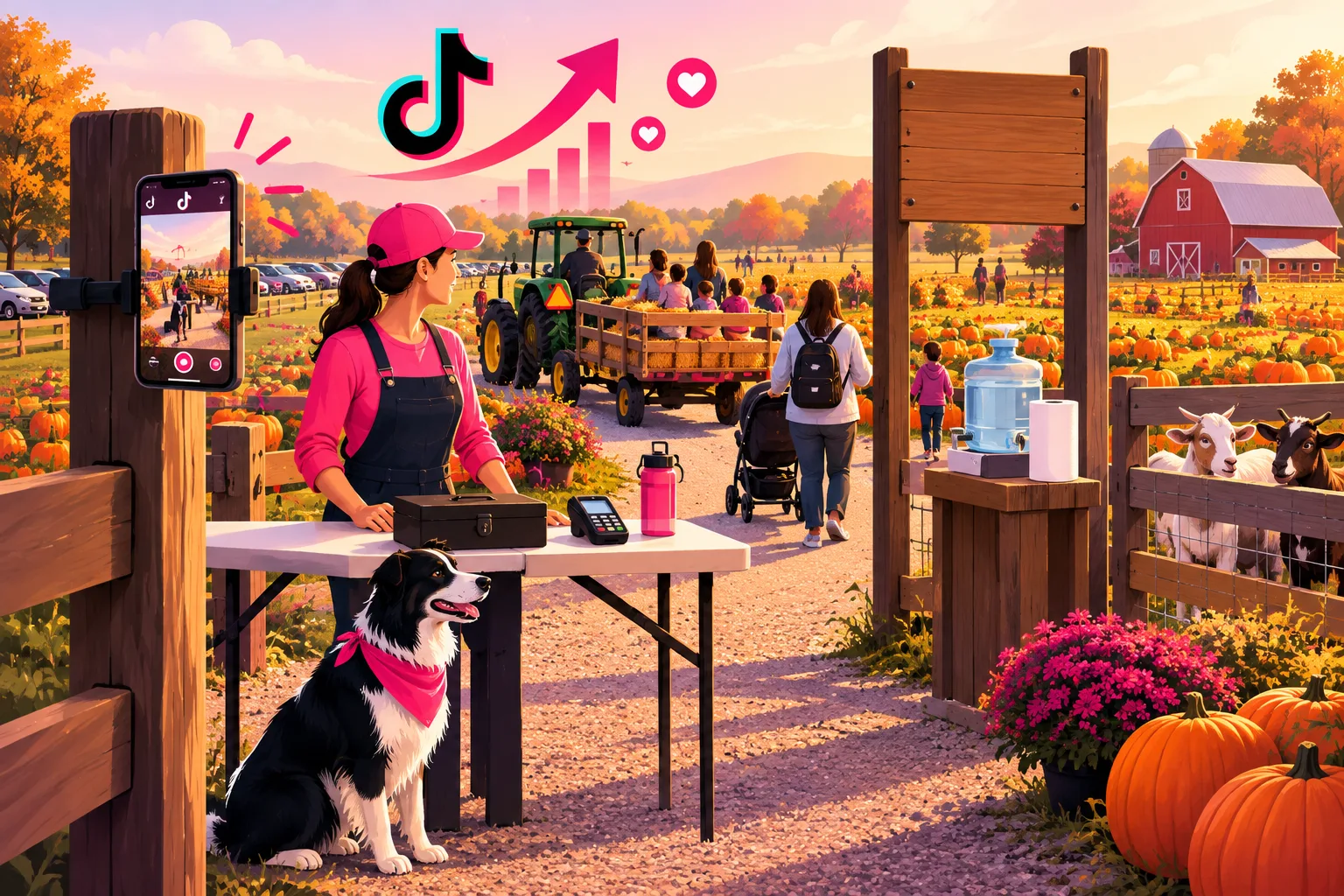
Every other farm in this series sells something a customer carries home. The agritourism farm sells a Saturday. The u-pick field, the pumpkin patch with the hay wagon, the corn maze, the farm stay - none of it fits in a carton, none of it ships, and all of it is bought by the same person, for the same reason, in the same short window: a parent, planning a weekend, deciding whether your driveway is worth the drive.
That changes the math. A dozen eggs is bought fifty times a year. A fall Saturday is bought once, by a family that has never been to your farm, who will decide in about ninety seconds on a phone whether the parking is a field or a ditch, whether a stroller can get to the wagon, whether there is a bathroom, and whether a two-year-old is going to get anything out of it. Those five weekends in October fund the winter. The three weeks of strawberries in June fund the summer. Miss the window and there is no next Tuesday to make it up on.
Which is why the agritourism account is the most parent-shaped account in the farm series, and the one where timing matters more than anywhere else: the patch is sold in August, the u-pick in April, the farm stay whenever the booking calendar has holes, and the video that sells next year is filmed on the busiest weekend of this one.
This guide is the agritourism companion to our complete TikTok guide for farms, which covers the six formats, the two customers, and the farm year every farm account shares. The selling guide gave the ticket its money shape in one section and promised a dedicated guide to the agritourism window. This is it. Here we cover what changes when the customer is a parent with a Saturday to fill, when the window is five weekends long, and when the farm is inviting strangers' children onto the property.
The short version:
- The customer is a parent planning a Saturday. Build every video to answer what she is actually afraid of: parking, strollers, bathrooms, the price, how long it takes, and what the kids can touch.
- Sell the window in the quiet season. The patch in August, the u-pick in April, the farm stay when the calendar has holes - and film next year's sales video on this year's busiest weekend.
- The parents' walk-through is the conversion video, and the countdown earns the follow. One walk-through per door, re-filmed every year, pinned; the countdown ends with the opening date and the hours and nothing else.
- The sign at the gate goes up before the walk-through does, and promotion stops the day you sell out. A video invitation assumes the paperwork is done, and a full parking lot does not need an ad.
What's Inside
- 1. Why the Farm That Sells a Saturday Is Selling to Parents
- 2. Three Windows, Sold in the Quiet Season
- 3. The Parents' Walk-Through: From the Parking Field to the Hay Wagon
- 4. The Countdown: The Season Marker That Earns the Follow
- 5. The Eight Questions Parents Ask, and the Friday Hour
- 6. The Saturday That Has to Match the Video
- 7. The Last Weekend: "See You in June"
- 8. The Sign at the Gate: Liability, the Insurance Rider, and the Hand-Washing Station
- 9. Nine Mistakes That Empty a Patch
- 10. Paid Amplification: The Walk-Through to Parents in August, Off the Day You Sell Out
- Frequently Asked Questions
1. Why the Farm That Sells a Saturday Is Selling to Parents
Start with who makes the decision. A six-year-old does not pick the pumpkin patch. A parent does, usually on a Thursday or Friday night, usually on a phone, usually with three other options open in other tabs - the orchard with the cider donuts, the corn maze with the billboard, the garden center with the pumpkins in a bin by the parking lot. She is not comparing farms. She is comparing Saturdays, and she is asking one question of each: will this go well with my kids?
The pillar guide's central idea is that a farm has two customers, the market path and the feed path. Agritourism is the purest market path there is. Nobody drives two hours for a hay ride, and nobody in another state buys a u-pick morning. The whole country will happily watch your hay wagon come in across the field at golden hour; the only people who will ever sit on it live within a Saturday-morning drive of your gate. Every video on this account is for them, and specifically for the one of them holding the phone.
Three things shape the rest of the design:
- The money is real and it is growing. USDA's Economic Research Service put farm income from agritourism and recreational services at roughly $1.26 billion in the 2022 Census of Agriculture, up about 12 percent from 2017 after inflation, with farms in more than half of U.S. counties reporting some. It is still a small slice of a very large pie, which is the point: in most counties there are a handful of farms doing it, and the first one that shows parents what the Saturday actually looks like answers the question for the whole county, alone.
- The window is short and the stakes are concentrated. A u-pick strawberry field is open about three weeks. A patch sells for about five weekends. A farm stay has maybe thirty summer weekends and a dozen in the fall. A rainy Saturday in October is not a slow day; it is a fifth of the season. Which means the family has to be decided before the weekend arrives, not persuaded on the morning of.
- The fear is a parking-lot fear with a stroller attached. The pillar calls it the gravel-driveway minute: right driveway, where to park, are we bothering someone working. The agritourism version adds a toddler, a diaper bag, a grandparent with a bad knee, and a four-year-old who will need a bathroom in the middle of the field. A parent who cannot picture those four things going well does not book. She does not say why. She just goes to the orchard with the billboard.
Put together: the agritourism account is not a prettier version of the farm account. It is the account that shows a parent, in ninety seconds, that her Saturday is going to go well - and it does that in August, while she is still deciding.
2. Three Windows, Sold in the Quiet Season
The pillar's farm calendar has one rule that matters more for agritourism than for anything else a farm sells: build in the quiet season for the busy one. The video that fills the patch is not posted in October, when every orchard and corn maze in the state is posting at once and every retailer is bidding for the same family. It is posted in August, saved quietly by parents who are deciding, and the opening-day post lands on an audience that already knows where to park. Three windows, three sale dates.
The u-pick: three weeks, sold in April
The strawberry field opens on a Saturday in late May or June and is picked over by the third weekend. The sale happens in April: the walk-through from last June, the honest answer about what a flat costs and how long it takes a family to fill one, and the countdown that starts around the first bloom. By the time the field opens, the parent who saved the walk-through in April has already told the grandparents which Saturday. The growth guide's signals section explains why saves in April predict cars in June better than views ever will.
The patch: five weekends, sold in August
The pumpkin patch is the big one, and the one most farms sell too late. In August the parent is not thinking about pumpkins, which is exactly why she has room to. The walk-through filmed last October, the hay-wagon clip, the "what a fall Saturday actually looks like here" cut, the price explainer, the rain rule - all of it goes out in the second half of August, and the countdown starts four to six weeks before opening day. In October the account posts the season marker, answers the Friday DMs, and films next year. It does not try to sell a patch that is already full or already empty.
The farm stay: sold whenever the calendar has holes
A farm stay is the one agritourism product without a fixed window, so the rule changes shape: look two months ahead at the booking calendar and sell the weekends with holes. The walk-through is the cabin from the car door to the porch, the host at the door, the chores a guest is welcome to join at seven, and the honest answers - the rooster starts at five, the wifi is slow, the dog sleeps on the porch. The farm stay is also the one product where the guest is never content, which section eight covers.
Film on the busy weekend, sell in the quiet one. The hardest footage to get is a full hay wagon, a packed strawberry row, a line at the entrance table that still looks friendly. You have it for five Saturdays a year. Set the phone on the fence post every one of them, with the consent rules the filming guide lays out, and you will have next August's sale cut by November.
3. The Parents' Walk-Through: From the Parking Field to the Hay Wagon
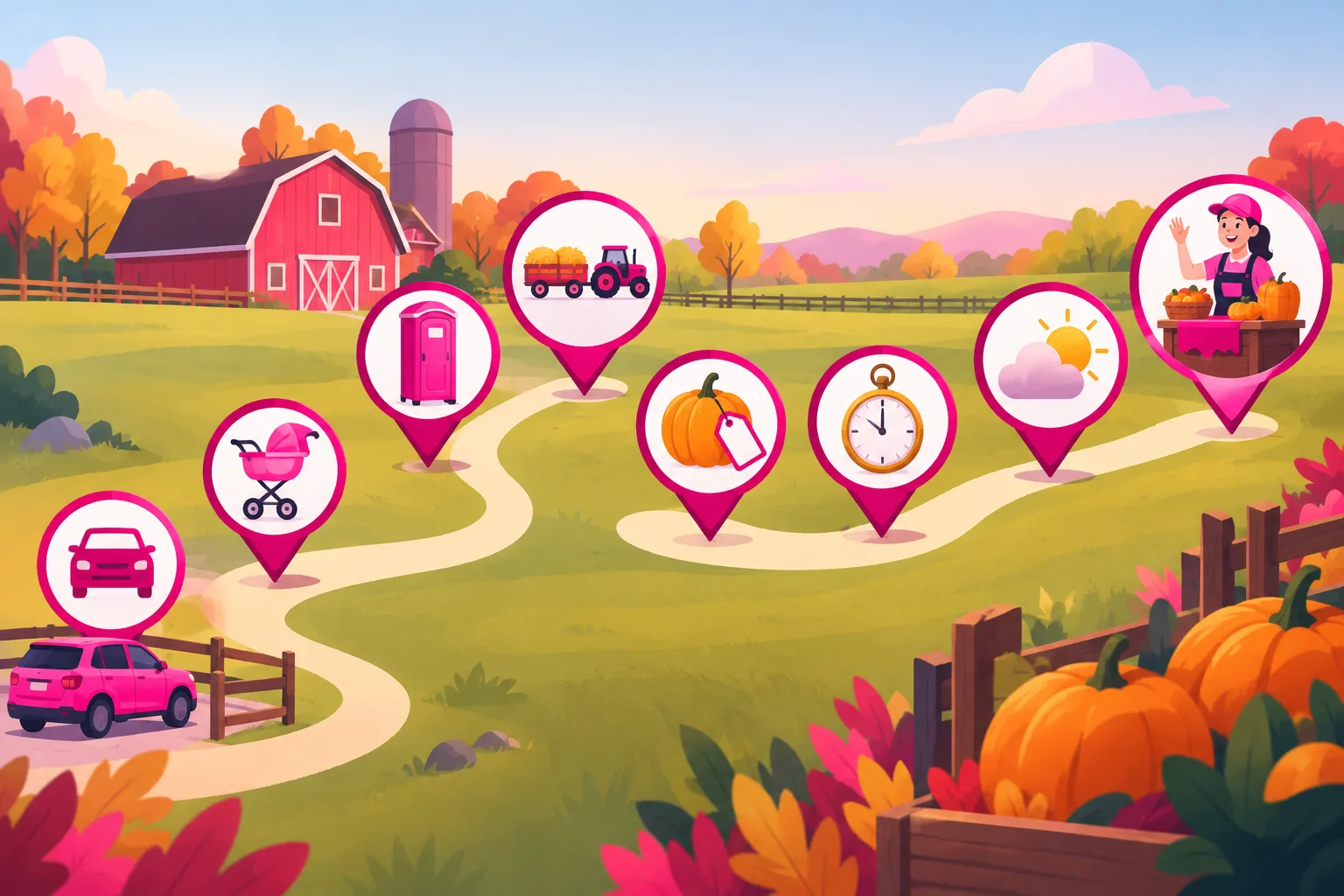
The walk-through is the conversion video of the whole farm series - the pillar's one format per door - and the agritourism version is the one with the most doors and the most nervous viewer. It is filmed from the road to the checkout in one take, by the person who will be at the table, and it answers the parent's questions in the order she will meet them on the day. Here is the order:
- The gate from the road. "Route 9, the red barn past the grain elevator, second driveway, the one with the white gate." Start the video at the same gate the family will see from the car. A rural address does not always land where the map says, and the first fear is the wrong farm.
- Parking, and the ground. Show the mown field, the fence to park along, and someone in a vest pointing. Then say the thing no listing says: "It is a hay field. A stroller with big wheels is fine; the umbrella kind will fight you. We have two wagons at the gate you can borrow for a toddler and a diaper bag."
- The bathrooms. Where, how many, whether there is a changing table, whether there is a hand-washing station next to them. Pan to it. This is the single most searched-for fact on an agritourism page and the one most farms leave out.
- The entrance table and the price. "Admission is free; the wagon ride is five a person, under two free; pumpkins are by the size, the small ones start at three and the big ones top out around fifteen." In June the same line says strawberries are by the pound and a flat usually lands around twenty-five. Cards and cash, and the reader works most Saturdays, so bring a twenty. The selling guide's price section is the reason the number is said first and plainly: a parent who has to ask the price at the table feels ambushed, and a parent who heard it on Tuesday feels invited.
- The hay wagon, and how often it runs. Show it loading. "Every fifteen minutes from the entrance, out to the patch and back. The tractor is slow on purpose. Kids sit on the bales; nobody stands."
- What kids can touch, and what they cannot. The goats at the fence, yes, with the hand-washing station right there. The barn, the equipment, the pasture, the tractor when it is parked - no. Say the no plainly and kindly. A parent trusts the farm that has already decided where her kid is not allowed.
- How long it takes. "Most families are here about two hours. The wagon out and back is twenty minutes, the patch is as long as it takes to argue about a pumpkin, and the goats will take whatever is left." She is planning a nap around this.
- The rain rule. "We are open in a drizzle and closed in lightning, and we post the call by seven on Saturday morning. The field gets muddy; boots, not sandals." A farm with no rain policy loses the Saturday to the indoor option the moment the forecast wavers.
End the walk-through at the table, with the person who runs it, by name. "I'm Maggie, I'll be at the table every Saturday, and I have never once been annoyed by a question." The customers guide's visit page anatomy is the written version of the same information; the walk-through and the page should match line for line, because the parent will watch one and then check the other.
Two production rules. First, re-film it every year, on a busy weekend, with that year's prices, because a two-year-old walk-through with last year's wagon price is a complaint at the table. Second, it is filmed with the filming guide's walk-through method: hands, backs, baskets, the wagon from behind, and nobody's child identifiable who was not asked that day. The ideas guide has eight walk-through concepts if you want the u-pick, the farm stay, and the maze versions spelled out.
4. The Countdown: The Season Marker That Earns the Follow
The pillar lists the season marker among its six formats and calls it the reason to follow. For a stand that sells eggs every week, a follow is nice. For a field that is open three weeks a year, a follow is the whole mechanism: it is how a parent who saw the walk-through in April is still looking at your account on the Thursday in June when she decides. The countdown is the season marker built for that.
It is simpler than it sounds. One clip, every few days, of the thing that is changing: "Nineteen days until the strawberries. First blooms this week." "Twelve days. The field is set and the wagon has new tires." "Five days. We picked the first quart and ate it in the truck." "Tomorrow. Eight to noon, Route 9, the white gate." Each one ends with the opening date and the hours and nothing else - no price list, no hashtag block, no plea. The ideas guide's season-marker concepts cover the first calf and the first frost; the countdown is the same format pointed at a date.
Three rules keep it honest and keep it working:
- Count real things. The bloom, the first ripe berry, the hay delivered, the gourds coming in, the wagon hitched. A countdown that is just a number on a graphic is the price-list feed in a costume.
- Say the hard part before opening day. "The field is usually picked over by noon on a Saturday; come early or come Wednesday." "The last two weekends of October are the busy ones; the first two are the quiet ones." The family that knows the honest sellout time arrives at nine and leaves happy. The one that did not arrives at one and leaves a review.
- The countdown stops when the window closes. The last post is the opening day. After that the account is in harvest mode: the season marker, the Friday answers, and the footage for next year. Nothing is required of a farm in the middle of its five weekends except to run them.
5. The Eight Questions Parents Ask, and the Friday Hour
The customers guide's saved replies handle "can we visit?", "do you ship?", and the price comment for the stand. The agritourism inbox is different in one way that changes how you staff it: the questions come on Friday, from people deciding tomorrow, and a question unanswered until Monday is a family that went to the orchard down the road. During the window, Friday is a workday for the phone. Someone - the one person who owns the phone - checks messages and comments on the hour from noon until bedtime, and the standard is an answer within the hour.
The good news is that the questions are the same eight, nearly every week, so the answers are written once and pasted as a person. Keep them in a note on the phone:
- "Are you open if it rains?" The rain rule, word for word, and where the call gets posted by seven.
- "Is it stroller friendly?" The honest ground report, the big wheels, and the loaner wagons at the gate.
- "Can my toddler pet the goats?" Yes at the fence, the hand-washing station is right there, and the barn is off-limits.
- "How much is it?" The same numbers as the walk-through, in the same order, with the link to the visit page. Never "it depends."
- "Do you take cards?" Yes, the reader works most Saturdays, bring a twenty.
- "How long does it take?" About two hours for most families; the wagon is twenty minutes out and back.
- "Do we need to book?" The real answer. If the patch is walk-up, say so and give the quiet hours. If the farm stay or the u-pick is booked, the link and how far out it fills.
- "Is it worth it for a two-year-old?" The honest answer, which is usually "the wagon and the goats, yes; the maze, no." A parent who gets a straight no about the maze trusts the yes about the wagon.
Two more that are not questions. The "we had a bad time" comment is answered once, as a person, with a real apology and a phone number, and never argued with in public; the family deciding is reading. And the comment that argues about farming - the price, the pesticides, the goats - gets the same line the whole series uses: we don't debate in the comments. The pillar's hook rules explain why the rant grows an audience that never buys a wagon ticket.
6. The Saturday That Has to Match the Video
The customers guide calls it the first Saturday: the visit either confirms the video or breaks the trust the video built. For agritourism, the stakes are higher because the family drove out with children and planned a whole day around it, and because there are only five of these Saturdays before the season is over. Four things have to be true on the day:
- The gate matches. The white gate is open, the sign is up, someone in a vest is in the parking field, and the loaner wagons are where the video said. If Maggie is not at the table, the chalkboard says who is: "Maggie's on the hay wagon today - I'm Dad."
- The question gets asked. "How did you hear about us?" - at the entrance table, as a question in the natural pause, with a tally column on the clipboard marked TikTok. This is the number that decides next year's August budget, and it is the number that wins the argument at supper in November. The customers guide's tracking section has the full scoreboard.
- Nobody films the customers. The phone on the fence post films the wagon from behind, the pumpkins, the goats, the line as backs and baskets. A family on their one Saturday of the fall did not come to be content. A parent is asked, on the spot, with the camera down, for anything with a face in it - and the one who says no is exactly as welcome as the one who says yes.
- The sold-out day is announced, not hidden. If the parking field is full at eleven or the strawberries are picked over by noon, the account says so, at once: "We're full for today. Next Saturday is quieter; Wednesdays are quietest." The chalkboard at the gate says the same. And every promoted video is switched off that morning, which section ten comes back to.
And the thing that does not happen on the Saturday: no one is sold a CSA share at the wagon, nobody is lectured about the grocery store, and the family that got a flat tire in the field is helped with the jack, not filmed. The second visit is earned by the first one going well, and by one thing more, which is the next section.
7. The Last Weekend: "See You in June"
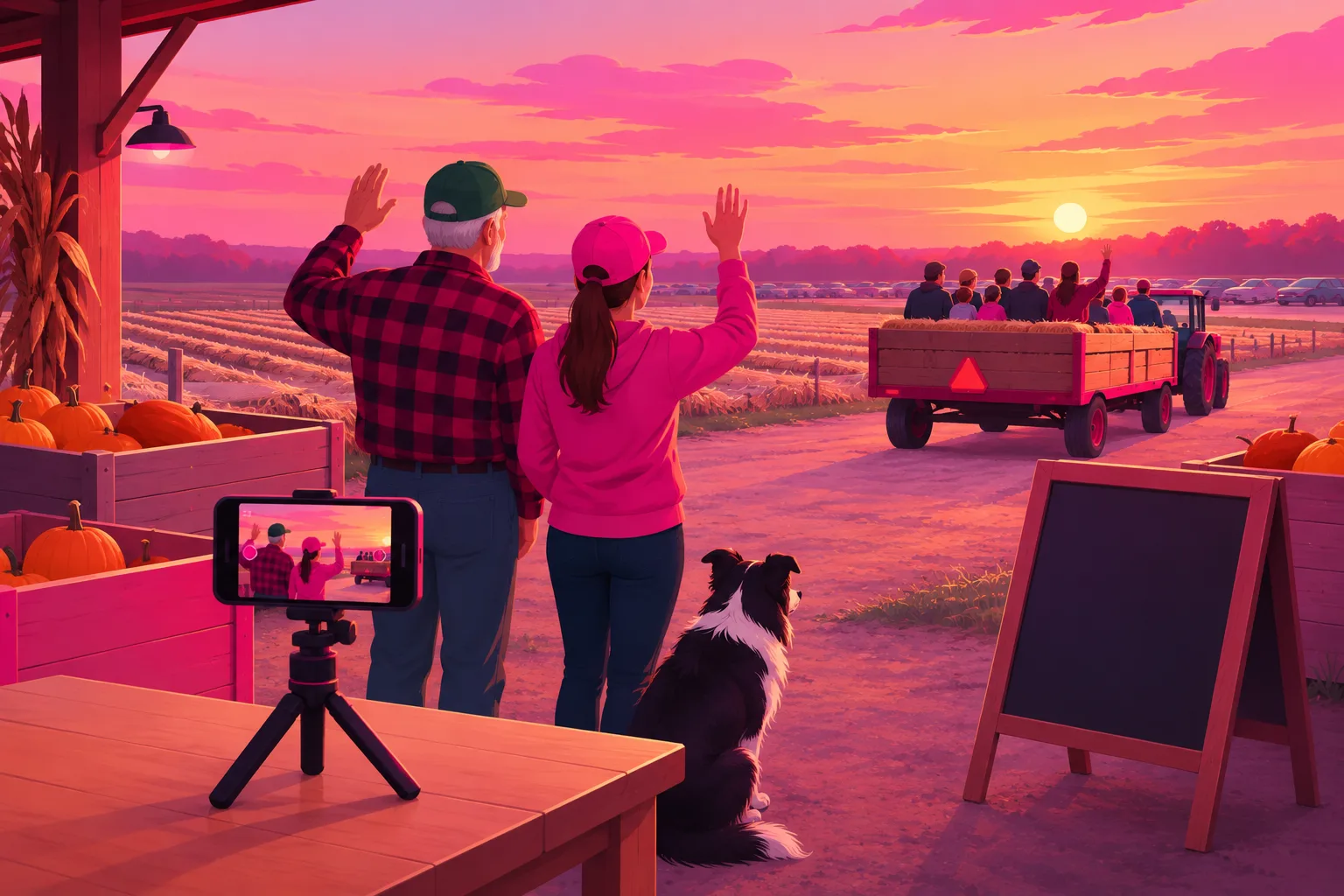
The pillar names the most common failure in farm marketing as the October crowd nobody invited back. It is an agritourism failure more than any other, because the patch family has no weekly reason to return. The eggs bring the stand customer back on their own. The pumpkin does not. If the farm wants that family in the strawberry field in June, it has to ask, and the moment to ask is the last weekend of the patch, while the wagon is still running and the family is still standing there.
So the last weekend has one job besides running the patch: film the thank-you and the "see you in June." Dad and Maggie at the gate at dusk, the last wagon pulling away, the bins nearly empty, and the two of them saying what the season did - how many families, how many wagon rides, the Saturday it rained - and then the sentence: "The strawberries open the first Saturday in June. Same gate, same wagon. Come early; they go by noon." That video is pinned from November to May, and it is the second-visit video the customers guide calls "here is what next time looks like".
Then the follow-up, in late May, to the families who left a number at the entrance table: one text. "Thanks again for coming out in October - the strawberries are about three weeks out, and the field opens Saturday the sixth at eight. Maggie." Not a newsletter, not a code, not a survey. One useful fact and a date. The family that said TikTok at the table in October and gets that text in May is the second visit, and the second visit is the number the whole series is built to count.
The farm stay version is the guest book and the lambs. A guest who leaves on Sunday gets a thank-you at the door and, with their permission, their line in the book appears in a video in February: "The lambs come in March. The cabin is open the second and fourth weekends." The guest is not filmed. Their words, with a yes, can be.
8. The Sign at the Gate: Liability, the Insurance Rider, and the Hand-Washing Station
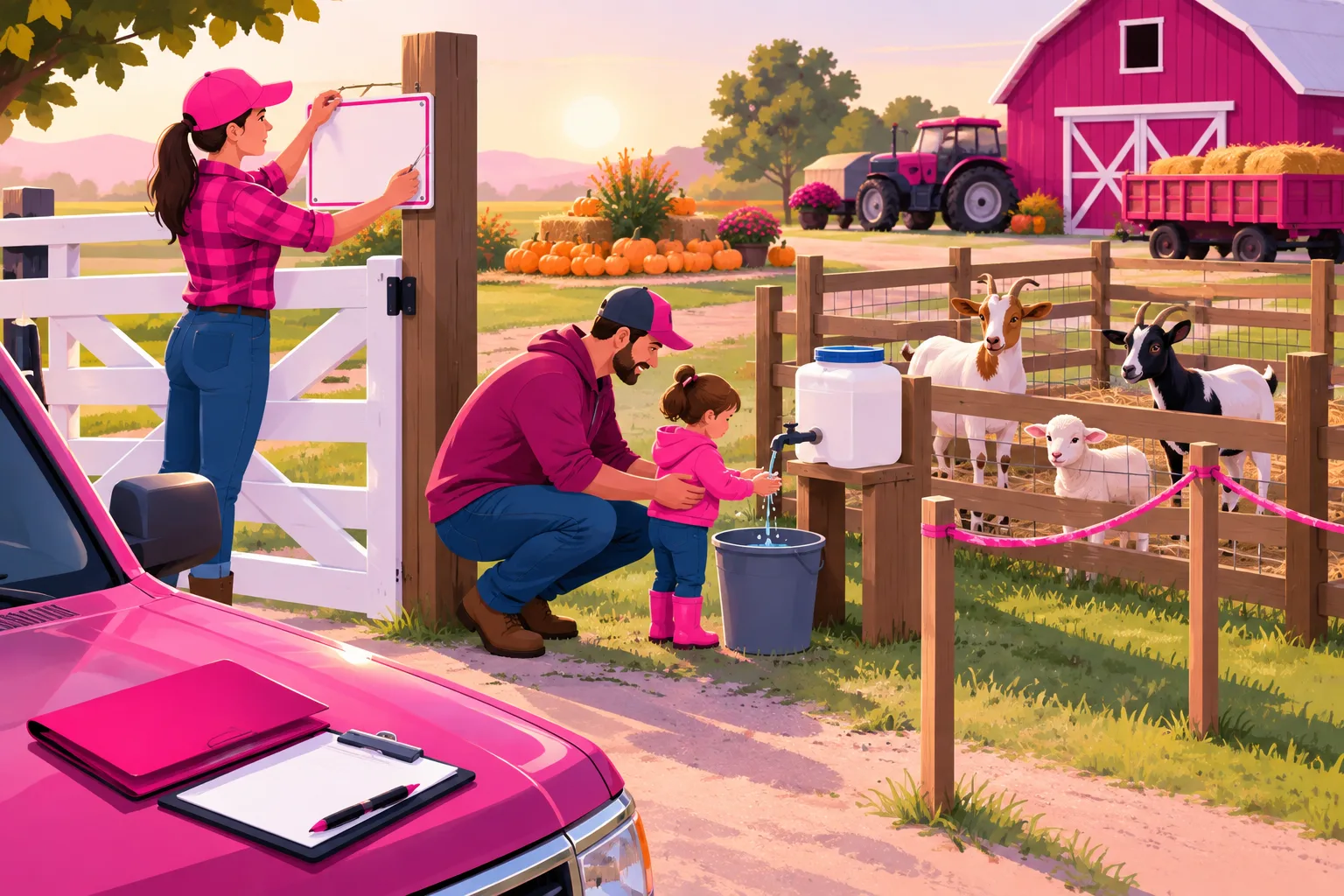
Every other spoke in this series treats visitors as a section. For agritourism, visitors are the product, and the pillar's compliance section has one line that becomes the whole chapter: if the account invites people to drive out, the farm has to be ready for them to arrive. A walk-through that goes up before the paperwork is done is an invitation to a farm that is not yet open. Four pieces, in the order to do them.
The sign with the statute's wording
Most states now have an agritourism liability statute. In general terms, these laws limit a farm's liability for the inherent risks of a farm visit - the uneven ground, the animal that behaves like an animal, the hay wagon - but the protection usually depends on posting a warning sign with the statute's exact wording, sometimes in a required size, at the entrance. Some states add a signed written agreement, with a parent or guardian signing for a minor; Pennsylvania's law, for example, requires both the sign and the agreement, and states such as Florida, Texas, and Washington have their own versions with their own wording. Your state's Department of Agriculture or Extension office usually publishes the required text. Order the sign, post it at the gate the walk-through starts at, and if your state wants a signature, the entrance table has the form and the pen before the first wagon loads.
The insurance rider
A standard farm policy was written for a farm that grows things, not for a farm that hosts four hundred strangers' children on a Saturday. Before the first walk-through goes up, call the agent and say the words "u-pick," "hay ride," "petting area," and, if it applies, "overnight guests," and get the visitor or agritourism rider in writing. The agent will also ask the questions that become your never-go list: where is the equipment parked, is the pond fenced, who drives the tractor, and is there a rope between the goats and the bull.
The hand-washing station and the petting area
If children can touch an animal, there is a hand-washing station at the exit of the petting area, with running water or a jug with a spigot, soap, and paper towels - not just a bottle of sanitizer - and the visit page and the walk-through both say to use it. Public-health guidance for animal exhibits has recommended this for years, along with no food, drink, strollers, or pacifiers inside the animal area, and an adult with every small child at the fence. Visitors' dogs stay in the car; the goats and the hens do not know them. Say each of these once, kindly, on the page and on a small sign at the pen, and never in a video that scolds. The customers guide's consent and safety section has the stand version of the same rules.
Where visitors never go, and who is never filmed
Decide out loud, before opening day, where visitors never go: the barn, the equipment, the pasture, the pond, the neighbor's fence line with the horses. Rope it, sign it, say it in the walk-through, and keep it off camera too - the never-show list still applies on a farm that takes visitors, and a video of a guest's kid on the parked tractor is a comment storm and, in some states, a visit. Your own children are a per-use decision and never on running equipment on camera, with the filming guide's numbers behind the rule. The hired crew who load the wagon all October are never content without informed consent that was never a condition of the job, and the farm-stay guest is never content at all: they paid for the privacy, and their children are somebody else's children. The room before check-in, the host at the door, the view from the porch, the chores - that is the farm stay account. The guest is not in it.
9. Nine Mistakes That Empty a Patch
- Selling the patch in October. Every orchard, corn maze, and big-box store is posting the same week. The parent decided in August; the farm that was quiet in August is the one with the empty parking field.
- The drone flyover with a country song. Beautiful, shared by other farmers, and tells nobody where to park, what it costs, or whether there is a bathroom.
- Burying the price. "DM for pricing" on a family activity is a closed door. The number, said first and plainly, is the invitation.
- No rain rule. The forecast wavers on Thursday and the family books the indoor option, because the farm never said what happens if it rains.
- The kid on the wagon fender. Yours or a visitor's. The clip that gets the comments is the one that costs the season, and in some states a visit.
- The walk-through from two years ago. Old prices, the old wagon, the bathroom that moved. A complaint at the table and a review. Re-film it every busy weekend.
- Filming the customers. A family's one Saturday of the fall, posted without asking. The parent who sees her kid on a stranger's feed does not come back, and tells the other parents.
- The rant about the orchard down the road. Their prices, their donuts, their parking. It grows an audience that never buys a wagon ticket and makes you the farm that complains.
- The promoted video that kept running. The parking field was full at eleven, you turned cars away at noon, and the ad bought three hundred more followers that afternoon who will arrive next Saturday to a sign that says full. The next section.
10. Paid Amplification: The Walk-Through to Parents in August, Off the Day You Sell Out
The pillar's promotion rules apply to every farm: promote the proven video, promote for followers, draw the map to a Saturday-morning drive, amplify in the quiet weeks before the window, and stop the day you sell out. Agritourism is where those five rules are least optional, because the window is the shortest, the audience is the most local, and the sold-out day is the most visible.
- The video is the parents' walk-through - the one that already produced visit-page clicks on its own in August. Not the drone flyover, not the countdown graphic, and never anything with a visitor's child in it, whatever was said at the fence. Consent to post is not consent to promote; the hired hand and the regular who agreed to be in the walk-through are asked again before it becomes an ad.
- The audience is parents within a Saturday-morning drive. The town and the towns around it, drawn as a drive radius, never the state. A follower in another county is a view; a follower twenty minutes away is a wagon ticket in October and a flat of strawberries in June.
- The timing is the quiet weeks. The patch walk-through in the second half of August, the u-pick walk-through in April, the farm stay walk-through when the calendar two months out shows holes. On the peak weekend the family has already decided and the budget buys nothing.
- The off switch is the sold-out day. This is the rule no other business needs. The morning the parking field fills, every promoted video is paused - not at the end of the week, that morning - and it stays paused until there is a Saturday with room. A patch countdown still buying followers the weekend you turned cars away is a refund and an apology.
- Animals are a restricted category in TikTok's ad rules, written for live-animal sales but close enough that a promoted video that reads like a listing for the goats can trip it. Promote the farm, the walk-through, and the follow - never a product listing - and the pillar's compliance section covers the alcohol rules for the orchard that also sells cider.
Then report it the way the whole series reports it: next to the fall newspaper ad, the farm-trail listing, and the highway sign. Each has a cost; the clipboard at the entrance table gives each a customer count. In the pillar's worked example, a modest budget on the proven patch walk-through, promoted for followers to the drive radius in August, brought twelve new families before the patch opened - and five of them were back in strawberry season, which is the number that matters. The ad money came out of the same account as the seed, and it has to answer to the same supper table.
That is exactly what our TikTok promotion service is built for: taking the walk-through that already fills the wagon and putting it in front of thousands more parents inside your drive radius, in the weeks before the window, with budget flowing to the audiences that respond and an off switch for the day you sell out. For the mechanics of promoting an existing organic video, the Spark Ads guide walks through the setup step by step.
Frequently Asked Questions
When should a pumpkin patch start posting on TikTok?
In August. The patch sells for about five weekends, and the family that fills it decides in the quiet weeks before, not on the Saturday morning when every orchard, corn maze, and retailer in the state is posting at once. Post the parents' walk-through, the honest answers, and the "what a fall Saturday actually looks like here" clip from last year's footage in late summer, start the countdown four to six weeks out, and let the opening-day post land on an audience that already knows where to park. The same logic sells the u-pick in April, three or four weeks before the field opens.
What should an agritourism walk-through video show?
Exactly what a parent is worried about, in the order she will meet it: the gate from the road, where to park and whether a stroller can manage the ground, the bathrooms, the entrance table and what it costs, the hay wagon and how often it runs, what children can touch and what they cannot, roughly how long a visit takes, and what happens if it rains. Film it from the road to the checkout in one take, with the person who will be at the table on camera and named, and film next year's version on this year's busiest weekend so the quiet-season sale has real footage behind it.
How do I handle TikTok messages during the fall season?
Treat Friday as the day the weekend is decided and answer within the hour. Most agritourism questions are the same eight - are you open if it rains, is it stroller friendly, can my toddler touch the goats, how much per pumpkin, do you take cards, how long does it take, do we need to book, is it worth it for a two-year-old - so write the answers once, keep them in a saved-replies note, and paste them as a person with the hours and the visit-page link. A question that goes unanswered until Monday is a family that went to the orchard down the road.
Do I need a liability sign before inviting visitors with a TikTok video?
In most states, yes - and the sign should go up before the walk-through does. Most states now have an agritourism liability statute that limits a farm's liability for the inherent risks of a visit, but the protection usually depends on posting a warning sign with the statute's exact wording at the entrance, and in some states on a signed agreement as well, with a parent signing for a minor. Pennsylvania's law, for example, requires both the sign and a written agreement. Check your own state's wording, call your insurance agent about a u-pick or visitor rider, and decide out loud where visitors never go. None of this is legal advice; it is the paperwork a video invitation assumes you have done.
Should a farm stay post its guests on TikTok?
No. A farm stay guest paid for privacy as much as for the view, and a guest's children are somebody else's children. The farm stay account films the room before check-in, the host at the door, the morning chores a guest is welcome to join, the honest answers (the rooster starts at five, the wifi is slow, the dog sleeps on the porch), and the view from the cabin - never a guest who did not ask to be in it. The guest book, with permission, is the one place a guest's own words can appear.
When should a u-pick or pumpkin patch promote a TikTok video with paid budget?
In the quiet weeks before the window: the u-pick walk-through in April, the patch walk-through and countdown in August, the farm stay walk-through whenever the booking calendar shows holes two months out. Promote the video that already produced visit-page clicks on its own, promote it for followers to the towns within a Saturday-morning drive, and stop the day you sell out. A promoted patch video still buying followers the weekend you turned cars away is a refund and an apology, not a sale.
How do I get this year's pumpkin patch families back for strawberries?
Film the thank-you and the "see you in June for strawberries" on the last weekend of the patch, while the hay wagon is still running and the families are still there, and pin it from November to May. The most common failure in agritourism is the October crowd nobody invited back. At the entrance table, ask "how did you hear about us?" and keep the clipboard, so the family that said TikTok in October gets one text in late May that says the strawberries are three weeks out and the field opens on a Saturday at eight.
A necessary caveat: this is a general overview for planning purposes, not legal advice, insurance advice, or a substitute for your state's agritourism statute. Your obligations depend on your state's liability law and its exact sign and agreement requirements, your insurer's conditions for visitors and overnight guests, local zoning and health rules for petting areas, food service, and lodging, and the platform's current rules for advertising. The compliance section of the pillar guide covers the rules every farm account shares - and when a specific question about visitors, a child on camera, or a claim in a video is in doubt, the answer is to ask your Extension office, your agent, and where needed your counsel before the walk-through goes up.
Ready to put the walk-through in front of parents before the patch opens?
You already have the video that works - the walk-through that showed a parent the parking field, the bathrooms, and the hay wagon, and brought a family down the driveway in October. Viryze amplifies that proven content to thousands more parents within a Saturday-morning drive of your gate, timed to the quiet weeks they are deciding, with budget flowing to the audiences that respond and an off switch for the day you sell out. Trust you have already earned, in front of the people who can actually sit on the wagon.
Promote your best videoRelated Reading
- TikTok for Farms: The Complete 2026 Guide - the six formats, the two customers, the farm calendar, and the compliance rules every farm account shares.
- Selling Farm Products on TikTok: CSA Shares, Beef Shares, and What Fits in a Box - the money shape of the ticket, the price explainer, and the December receipt.
- Getting Customers Down the Driveway: Turn TikTok Views Into Second Orders - the visit page, the saved replies, the first Saturday, and the second visit as the real conversion.
- How to Film Farm Videos for TikTok (Kids, Workers, Equipment & the Family Rule) - the walk-through method, the per-use rule for children, and the never-show list.
- Farm TikTok Content Ideas: 50+ Video Concepts That Bring Customers Down the Driveway - the walk-through and season-marker concepts, including the u-pick, the maze, and the farm stay.
- Growing a Farm TikTok: From 0 to 10K Local Followers - the local-follower roadmap, the signals that predict customers, and the one person who owns the phone.
- TikTok for Youth Ministry: Reaching Teens Without Putting Them on Camera - the other account in this series built for a parent deciding a Saturday, and the strictest version of the no-children-on-camera rule.
- Local Business TikTok Marketing: Get Customers in Your Area - the drive-radius mechanics behind every agritourism promotion.

Head of Creator Success at Viryze
TikTok growth strategist helping creators reach their first 100K followers through data-driven promotion strategies.