
Vacation Rentals18 min read
How Airbnb Hosts Make Money on TikTok: Direct Bookings, the Host Course, and the Storefront
The direct booking vacation rental guide to what a rental TikTok account actually earns: why the weekend funds the house and the national audience buys only what fits in a box, the six streams in honest order (the direct-booking site and the rebook that never touches a platform, the host course and design guide for other hosts as the feed path's real money, the storefront link to the sheets and the towel rack with the disclosure line, the cohosting pitch that lets the second house pay for the first, the mattress and coffee brand deal, and the gift certificate sold the week after Thanksgiving), the total-price explainer as the sale, the off-platform line and the rules that only show up once something is for sale, the December receipt, the selling calendar for the rental year, the three numbers that win the owner, the selling mistakes that cost hosts money, and when to put budget behind the video that fills the calendar.
By Ryan MitchellHead of Creator Success at Viryze

Every other vacation-rental marketing article answers "how do I get followers." This one answers the question the host asks on the drive home on Sunday night: what does the phone actually make? The honest answer fits in one sentence, and it is the sentence this whole guide is built on. The weekend funds the house, and the national audience buys only what fits in a box.
Here is what that looks like in money instead of followers. One rental account has four hundred thousand followers from every state, a course for new hosts in the bio, and open weekends in October. The course sells a few seats a month. The other account - June's, the two-bedroom cabin on the lake, forty minutes past the last gas station - has a few hundred followers, most of them in the two cities within a Friday-after-work drive, and a summer that sold out in January. The second account is the one making money, and almost none of it arrives through anything a monetization guide would call monetization. It arrives through the green door, one weekend at a time, and the best of it arrives through a page the listing sites never see.
The reason is the size of the calendar, which the growth roadmap lays out: a house sells about fifty-two weekends a year, and a summer is ten or twelve of them. At around seven hundred dollars all in for a two-night weekend, of which a little over six hundred is the house's before the listing site takes its share, that is on paper something over thirty thousand dollars a year through the door before a single midweek night. No storefront commission, no brand deal, no course available to a one-house host comes within a mile of it. Which is why the first stream in this guide is the direct-booking site and the rebook, the last is the ad budget, and the ones in between - the host course, the storefront link, the cohosting pitch, the brand deal, the gift certificate - are sized honestly, in the order a host should turn them on, with the one real exception named: the host who sells to hosts, for whom the feed path is a second business and not a side income.
So this is the money guide: the six streams in order, the total-price explainer that sells all of them, the off-platform line and the rules that only show up once something is for sale, the December receipt, the selling calendar for the rental year, the three numbers that win the owner, the selling mistakes that cost hosts money, and the point where selective amplification puts budget behind the video that fills the calendar instead of the one that sells a seat. It builds on our complete TikTok guide for Airbnb hosts and vacation rentals - if you haven't read that yet, start there for the two-audience strategy and the compliance framework, then come back here for the money.
The honest summary:
- The weekend funds the house. A family in one of the two cities within a drive who books, comes back the same week next year, and does it on your own page is worth more than every seat, link, and brand deal on this list combined. The national audience is real, and it buys only what fits in a box.
- Nothing is sold by a listing; everything is sold by an explainer. "Why a two-night weekend here is about seven hundred dollars" sells the weekend. "One of two bedrooms, four hours of this" sells the turnover checklist to another host. "These are the sheets, and here is why" sells the sheets. The amenity-list graphic sells nothing.
- The direct site lives on TikTok and in the welcome book. Never in the listing text, never in the inbox. The family that found the arrival on TikTok books on your page with no commission; the family that booked on a platform rebooks the way they booked. The line is the platform's inbox, and crossing it costs the listing.
- The calendar is the sales funnel. Summer sold in January, the midweek in March, fall color in August, the holidays in September, the gift certificate the week after Thanksgiving, the receipt said once in December. Build in the empty weeks for the full ones, and stop the day the calendar fills.
- Organic growth tells you which selling video the two cities already trust - amplify that one, for followers, in the quiet weeks, pointed away from home.
What's Inside
- 1. The Math That Changes Everything (The Weekend Funds the House)
- 2. Stream One: The Direct-Booking Site, the Fee That Stays Home & the Rebook
- 3. Stream Two: The Host Course & the Design Guide (The Feed Path's Real Money)
- 4. Stream Three: The Storefront Link to the Sheets & the Towel Rack
- 5. Stream Four: The Cohosting Pitch (The Second House Pays for the First)
- 6. Stream Five: The Mattress, the Coffee & the Disclosure Line
- 7. Stream Six: The Gift Certificate (The Week After Thanksgiving)
- 8. The Total-Price Explainer Is the Whole Sale
- 9. "Where We Can Sell You a Weekend": The Off-Platform Line, the Fee Rule & the Direct-Booking Jobs
- 10. The December Receipt
- 11. The Sequence: The Selling Calendar for the Rental Year
- 12. Tracking It: The Three Numbers That Win the Owner
- 13. The Selling Mistakes That Cost Hosts Money
- 14. Accelerating: Put Budget Behind the Video That Fills the Calendar
- Frequently Asked Questions
1. The Math That Changes Everything (The Weekend Funds the House)
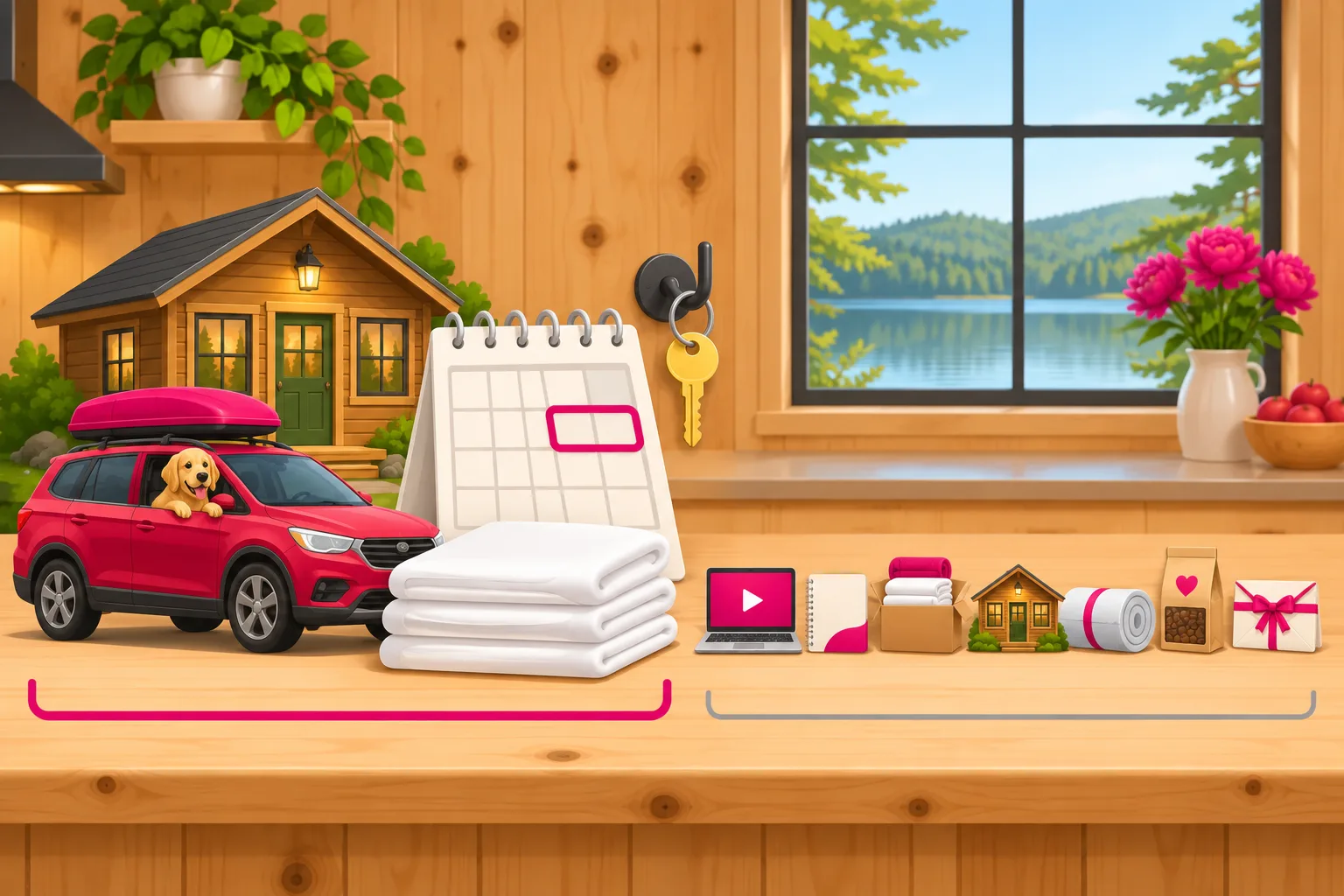
A vacation rental is tied to one piece of ground and watched by the whole country, which is why the pillar guide says every rental account speaks to two audiences, and the local one is inverted. The money version of that sentence is blunter. The guest path - the family three hours away who drives up on a Friday - buys the one thing you cannot ship, at full price, for two nights, and comes back the same week next year. The feed path - the host in another state, the design-obsessed viewer who follows everything - buys only what fits in a box or a download, once, when she feels like it. Here are the six streams a rental account can open, sized honestly:
- The direct-booking site and the rebook. The whole house. Fifty-two weekends at a little over six hundred dollars to the house is, on paper, something over thirty thousand dollars a year before a midweek night, and every video on the guest path is selling this whether it says so or not. The direct site changes one number inside it: the share a listing site keeps - somewhere around twelve to fifteen percent of the booking, depending on the site - stays home, and the rebook never touches a platform at all.
- The host course and the design guide. The only feed-path stream that can rival a weekend, and only for the host whose calendar is already full and who has something to teach. Twenty one-hour calls a month, or a design guide that sells a few copies a day after the turnover video goes wide, is real money sold to the exact audience the turnover clips collect by accident. It is also a second business, with its own hour on the phone, and it lives on the host's own account, not the house's.
- The storefront link. Real, and a slice. "Where did you get the sheets?" is the most-asked question on any rental account, and a storefront link to the sheets, the towels, the coffee maker and the dog bed pays a few percent of each order. On a town-sized audience that is a few dollars a week; on a national one it is real money, which is the audience the guest path should not be chasing.
- The cohosting pitch. The turnover series is a resume. The owner three hours from her own cabin who watches Rosa reset a house two hundred times is the customer for a cohost, and cohosting a second house for a share of its bookings is how the second house pays for the first. It is also a second property phone.
- The brand deal. Rare for a one-house account, and worth having only when disclosed and only for the thing already in the house. The mattress company and the coffee roaster find the account that is honest about its mattress and its coffee; they do not find the one that sells a code for a product it does not own.
- The gift certificate. Sold in one window a year, and really a weekend prepaid: the only "product" on this list that walks a stranger through the green door. It is also cash you owe back as a weekend, which matters in section 7.
Notice the shape. The stream that funds the house sells one weekend at a time inside a three-hour drive, and it is the one nobody writes about because it does not look like TikTok money. The streams that look like TikTok money are sold to the whole country and are small for a one-house host, with one exception that is a different business. Most hosts should turn them on in the order above, and most should stop after the third. The host who already sells to hosts, or already manages for owners, starts in a different place, and the growth roadmap's two scoreboards are how you tell which host you are: if the number you report every month is seats and storefront clicks, you are the exception; if it is weekends and rebooks, you are the house.
2. Stream One: The Direct-Booking Site, the Fee That Stays Home & the Rebook
Everything on the guest path ends at one page, and the pillar's nine-rung ladder describes it: the total for a sample weekend with everything on it, the rules said like a person, what check-in is like, a map to the town and not the house, and June's face. The money guide adds the part the ladder leaves implied. That page can be a landing page that sends the guest to your listing on a platform, or it can be the place she books. The second one is the direct-booking site, and it is the real money in this guide.
What the fee actually costs, in weekends
Here is the arithmetic a host does once and never forgets. A two-night weekend at the cabin is $240 a night and a $140 cleaning fee, which is four hours of Rosa, so the house's part of the weekend is $620 before the county lodging tax and the platform's own guest fee are added on top. A listing site keeps a share of that $620: on the host-only fee most hosts are now on, something around fifteen percent, and on the other big site a flat twelve percent since late October 2026. Call it somewhere between seventy and a hundred dollars a weekend, depending on the site, before the plumber is paid. On the host's own site the same weekend costs card processing of around three percent and the booking software's monthly subscription - roughly twenty dollars on that weekend plus the subscription spread across the year. The difference on one weekend is a plumber's visit. Across the twenty weekends a year that a TikTok account can reasonably send to the site instead of the listing, it is somewhere near the property tax bill. Check the current fee pages, because they change and the exact share differs by market; the shape does not.
That is the whole case for the direct site, and it is also its limit. The site does not bring strangers; it has no search box anyone types into. TikTok brings the stranger, the pinned arrival convinces her, and the site closes her at a lower cost than the listing. A host who builds the site and waits for it to fill the calendar has built a very nice page nobody visits. A host who builds the account first and adds the site the month the arrival starts producing inquiries has moved twenty weekends a year off the fee.
What the page has to have
- The total for a sample weekend, first and biggest. "Two nights in October, sleeps six, about seven hundred dollars with the cleaning fee and the county tax on." Under the federal fee rule the total has to be the most prominent number on your own site exactly as it is on the platforms, so make it the proudest number on the page instead of the one you were hoping she would not notice.
- A calendar that is actually synced. One calendar across the site and every listing, updated the minute a booking lands anywhere, because the direct booking that double-books a platform weekend costs you the platform's cancellation penalty and a review you did not earn. The booking software does this; a spreadsheet does not.
- The rules said like a person, the same way they are said in the videos: "quiet after ten because the lake carries sound; the dock is yours; please do not feed the ducks, they remember." Nothing on the page that was not in the video, and nothing in the house that is not on the page.
- A rental agreement, a deposit or damage waiver, and an ID check. On a platform these came with the booking. On your site they are yours to run, and a direct booking with none of them is a weekend you are hoping goes well. The agreement is one page; the deposit is a hold on the card; the ID is a photo you compare to the name on the booking. All three are said out loud on the page, once, kindly.
- The map to the town, check-in described, and June's face. The address rule applies to the site exactly as it does to the videos: the town, the drive time, the inside and the view, never the road.
- One link from the bio, and no other way in. The viewer who found the arrival on TikTok, tapped the link and booked here was never a platform guest. That sentence is the whole off-platform line, and section 9 says why it matters.
The rebook is the sale
The direct site's best weekend is not the first one. It is the one two weeks after checkout, when the message the pillar calls the real conversion of the vertical goes out: "the same week next year is open until the fifteenth - want me to hold it?" On a platform the hold is a date said out loud and a link, and the fee is paid again next year. On your own site the hold is yours: the week is blocked, the deposit is taken, and the family that has booked the second week of July since 2021 never sees a listing again. A surprising share of happy families say yes if anyone asks, and almost nobody asks. The host who asks, from her own page, has turned one weekend into a line in the calendar that renews itself, with no commission, for as long as the house is the house.
Two things keep the stream honest. Keep the platform listing; the stranger who has never heard of you still goes there for the reviews, and a rental with no listing anywhere is a rental a careful guest will not trust. And do not race to the bottom with a "book direct and save fifteen percent" banner. The guest who found you through the arrival video is not price-shopping between your site and your listing; she is deciding whether the cabin is really like the photos. Give her the same total on both, keep the difference, and spend it on the mattress.
3. Stream Two: The Host Course & the Design Guide (The Feed Path's Real Money)
The host in another state who asked in the comments what pricing tool June uses is not a guest and never will be. She is a customer for something else, and she decided June could teach from watching Rosa strip a bed from the corner tripod. This is the one feed-path stream that can rival a weekend, and the money guide is going to be honest about who it is for, because the vertical is full of hosts selling courses from houses with open weekends in October.
Who it is for
Two things have to be true. Your own calendar is full - sold out in the quiet months, not just July - because the audience of hosts can tell, and because a course sold from an empty house is the famous-and-empty cabin with a storefront. And you have something a new host cannot get from the platform's own help pages: a design guide that comes with the photos to prove it, the welcome-book template guests actually read, the turnover checklist Rosa built over two hundred resets, the exact words of the rebook message, a one-hour call about the first house. If either is false, this section is not for you yet, and the house is better served by section 2.
Three products fit her
- The design guide, as a download. The room-by-room list of what is in the house and why, with the sheets, the blackout curtains, the desk by the window, the rain closet of board games, and the cheap thing that gets mentioned in every review. Priced like a book, sold a few copies a day the week a turnover video goes wide, with no customer service beyond a download link.
- The first-house course or call. The permit, the tax, the insurance policy that says "short-term rental," the cleaner's agreement, the property-phone rule, the first listing, the first winter. Sold as a short course or as a one-hour call, twenty seats a month at most, because every seat costs an hour you would otherwise spend on the house.
- The templates. The welcome book, the one-page cohost agreement, the property-phone page, the rebook message, the saved replies. Cheap, instant, and the one that sells itself in the comments of the property-phone video.
How it is sold, where it lives, and the claim you cannot make
It is sold by the turnover clip that proved the demand, in the caption, with the price said out loud - never by a "link in bio" dropped on a first morning, which is a guest video and should stay one. It sells in January, when a new host has decided over the holidays and has money, and in late summer, when she has watched a full season from the outside. And it lives on June's own account, not the house's, with the property account as the proof and each one tagging the other: the pillar's rule is that the pricing-tool talk, the course and "how I bought the second cabin" are the host's story, and the property account stays a house with a view that families in two cities want to book. Mixing them teaches the algorithm the house is a channel for hosts, and the family deciding in the group chat does not want to be a case study.
The claim rule is the one that ends careers. "Make ten thousand a month from one cabin" is an earnings claim, and earnings claims are the thing a regulator reads first and the thing a refund request quotes. The only number you can honestly sell is your own, with the year it happened, the fact that your lake is not her lake, and the winter the pipe burst said in the same breath. Teach the first house, price it plainly, promise nothing but the hour.
4. Stream Three: The Storefront Link to the Sheets & the Towel Rack
Under every turnover video, in every state, the same comment: where did you get the sheets. Then the towels, the coffee maker, the blackout curtains, the dog bed, the hooks by the door, the board games in the rain closet. A storefront link - the affiliate page that lists the things in the house and pays a few percent of each order - is the honest answer to that comment, and it is the smallest real stream on this list for a one-house account. On a few hundred followers in two cities it pays for a bag of coffee a month. On a turnover video that went to two million views it pays real money for a week, and the host who chased that audience on purpose has the open weekends in October to show for it.
What belongs on it
- What is actually in the house, and what you would buy again with your own money. The sheets in both bedrooms, washed two hundred times. The towels Rosa folds. The coffee maker the guests mention. The desk lamp by the window. Nothing you have not slept on, dried off with, or made coffee in.
- The cheap thing, because it sells best: the door hook, the lid for the hot tub, the drying rack, the clip that keeps the chip bag closed. A guest who buys a twelve-dollar hook because the cabin had one is the whole stream in one order.
- Not the mattress, unless it is the mattress (section 6), and not the thing you were sent for free without the label that says so.
The video that sells it is the "which thing I actually used" clip, filmed at the island with the thing in hand, the way the filming guide films every explainer: the sheets out of the dryer, why that weave, how many washes, the one thing wrong with them, and the disclosure in the first sentence. "I get a small cut if you buy them through this link" said out loud, then the link in the first line of the caption. Section 6 has the whole disclosure rule; the short version is that the audience trusts the host who says what she earns, and screenshots the one who does not.
5. Stream Four: The Cohosting Pitch (The Second House Pays for the First)
There is an owner three hours from her own cabin who has watched Rosa reset the lake house eleven times and has never once seen her own cleaner work. She has a house that is clean on paper and a calendar she cannot explain, and she is the customer for the quietest stream on this list: cohosting her house for a share of its bookings. Cohost pay runs somewhere from a tenth to a third of a house's revenue depending on what you take on, plus whatever the turnover costs, and a second house managed well is how the first house's mortgage stops being the only line that matters. One of the platforms now runs a network that introduces cohosts to owners; the account is what makes her say yes.
The pitch is not a video that says "I cohost." It is the turnover series, "Rosa resets the lake house," watched by an owner who recognizes a system when she sees one - the corner tripod, the hospital corners, the hot tub lid going back on, the key on the hook, the welcome book on the island, the same house reset the same way two hundred times - and the property-phone role the growth roadmap describes, said out loud once: who posts, what gets a look, four hours a week, three numbers a month. An owner who has been improvising for three years will pay for that sentence.
Three honest limits. First, a second house is a second property phone, with its own written rule, its own account or none, its own cast agreement with its own cleaner, and its own line about who owns the handle when the arrangement ends - decided before the first clip, in writing, because the only thing worse than one house sold with Rosa still in the clips is two. Second, the second house's permit, tax and insurance are the owner's and are checked before the pitch, not after; a cohost who posts an arrival for an unpermitted house has put her own name on the exhibit. Third, the pitch lives on June's own account with the house as the proof, for the same reason the course does: a family in the city does not book a cabin from a management company's feed.
6. Stream Five: The Mattress, the Coffee & the Disclosure Line
A one-house account does not get many brand deals, and the ones it gets arrive because the account was honest about the thing first. The mattress company finds the host who filmed "this is the cooler room, and here is the mattress, and here is the one complaint we have had about it in seven years." The coffee roaster two towns over finds the first morning with the mug in it. The deal, when it comes, is small - a replacement mattress and a few hundred dollars, a year of coffee for the welcome basket and a code - and it is worth having only on three conditions.
- It is already in the house, or would be. The guest who arrives and finds the mattress from the video is the point. The code for the air fryer the cabin does not own is the famous-and-empty account's bio, and the two cities can tell.
- It is labeled, every time, in a way a viewer cannot miss. The federal endorsement guides require a clear and conspicuous disclosure whenever you are paid, given the thing free, or earn a commission, and "clear" means said out loud or on screen early and written in the first line of the caption - not a hashtag at the bottom. TikTok adds its own layer: the branded-content setting switched on for any paid partnership, which adds the paid-partnership label and routes the video to the commercial sound library, and the commercial-content disclosure on any storefront or affiliate link.
- It never makes a claim the label does not make. "Organic," "hypoallergenic," "the best sleep of your life" are the brand's sentences to defend, not yours. Say what the thing is, in plain words, and what you have noticed in seven years of guests sleeping on it.
The rental version of the rule is simpler than the law: only take a deal for what you would put in the house with your own money, say what you were given when you were given it, and keep the sponsored video off the guest path. A sponsored mattress video is a feed-path video with a label; a first morning with a coffee code in the caption is a guest video that just taught the group chat you are for sale.
7. Stream Six: The Gift Certificate (The Week After Thanksgiving)
Once a year, with one video, in the week after Thanksgiving - November 26 in 2026 - the account sells the only product on this list that walks a stranger through the green door: a weekend, prepaid, bought by someone who will never sleep in the house. The daughter in another state buying her parents the lake. The six in the group chat splitting a weekend for the one who got outvoted last year. The husband who does not know what a two-night minimum is and does not need to.
The video is June at the island with the amounts said out loud - a midweek night, a two-night weekend in the quiet season, and the full weekend - and one sentence about who each one is for. Then the four things the certificate has to say plainly, in the video and on the certificate: whether it expires, which weeks it cannot be used for, that it books through the site like any other weekend, and that the family who redeems it gets the same arrival as everyone else. Under federal rules a gift certificate cannot expire sooner than five years after it is sold, and several states go further, so "never expires" is only a sentence you say if it is true where you are. "Good for a July weekend" is only a sentence you say if a July weekend is open, and by the time this video goes up it usually is not; say "good for any open weekend, and the summer calendar opens in January" instead.
It sells on the direct site, which is the only place a rental can sell one, and that is a quiet argument for section 2 all by itself. And treat the cash honestly: a certificate sold in December is a weekend you owe in March, not December revenue, which is why the quiet-season calendar the certificates fill is the second half of the sale. The host who spends December's certificates in December has a very quiet March and a plumber she cannot pay.
8. The Total-Price Explainer Is the Whole Sale
Every stream above is sold by the same video shape, and the pillar guide calls it the conversion video of the vertical next to the arrival: the "what it costs and why" explainer, filmed at the island with the thing in hand. For the money guide there are three of them, and a host should have all three easy to find on the profile at some point in the year.
"Why a two-night weekend here is about seven hundred dollars"
June at the island with the tablet showing a sample weekend: $240 a night for a house that sleeps six, which is a hundred and twenty a couple; the $140 cleaning fee, which is four hours of Rosa, and here is what four hours of Rosa looks like; the county lodging tax she did not set and sends on; the platform's own fee if you book there; the two-night minimum because a one-night stay costs the same four hours to reset. Forty seconds, total first, no apology. It is not a defense of the price; it is the price, explained, and it produces the most valuable action a rental audience takes - the save, which means someone is deciding, and the send, which means she decided and is forwarding it to the group chat that said "seven hundred dollars for two nights?"
"Where you can book, and what each one costs you"
The careful one, and the explainer that sells the direct site without ever crossing the line in section 9. June at the island with the laptop: here is the house on the listing sites, with their guest fee on top, and here is the house on our own page, with the same total for the house and no guest fee, and the reasons a careful stranger might still prefer the listing - the reviews are there, the platform's protections are there - said honestly. It is posted on TikTok, it is printed in the welcome book, and it is never sent in a platform message or pasted into a listing. The ideas vault's explainer section has eight more, including the lodging tax, the rebook, and January versus July.
"These are the sheets, and here is why"
The storefront explainer, and the one almost nobody makes well. The sheets out of the dryer, the weave, the number of washes, the one thing wrong with them, the disclosure in the first sentence. This is the video the storefront link hangs on, and it is the one that proves to the feed path that the host says the true thing about the things she sells, which is what makes the design guide sell three months later.
And the price comment rule, because every explainer earns one: "seven hundred dollars for two nights in a cabin is insane" gets one reply, as a person, with the explainer linked, and then nothing. The family deciding in the group chat is reading the thread, and the host who wins the argument loses the weekend.
9. "Where We Can Sell You a Weekend": The Off-Platform Line, the Fee Rule & the Direct-Booking Jobs
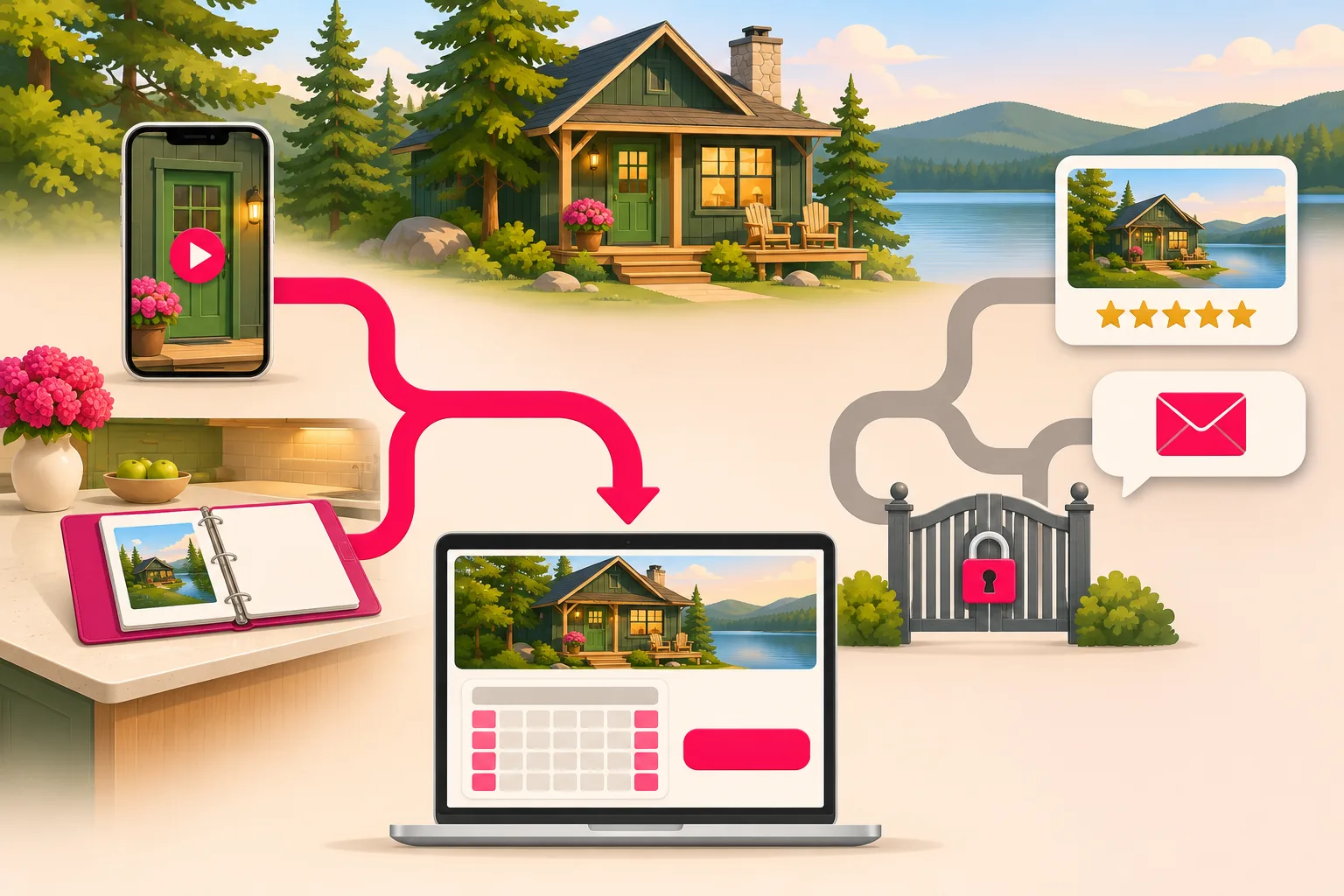
A video is a public record of where you operate, what you charge and what you promised, and the pillar's compliance section covers the permit, the guest, the neighbor, the address and the music. The money guide adds the rules that only show up once something is for sale, and the first one is the rule this whole vertical gets wrong. None of this is legal advice; read the current platform policy, your town's rules and your insurance policy before you build anything.
- The off-platform line. The platforms bar links, discounts, contact-detail requests and anything else that steers a guest off the platform inside a listing or a message thread; bar taking any part of a platform booking's payment outside the platform; and bar marketing to the contact details of guests who booked through them. Airbnb's Off-Platform and Fee Transparency Policy was tightened in May 2025, and the penalty is the listing. So the line is the platform's inbox: the direct site lives on TikTok and in the welcome book, never in the listing text and never in the thread. The family that found the arrival on TikTok and booked on your page was never a platform guest. The family that booked on a platform rebooks the way they booked unless they find the site on their own, and they are not added to a list they did not join. The rebook message to a platform guest is the date said out loud and the platform's own link.
- The fee rule binds your own site. The federal rule on unfair and deceptive fees, in force since May 12, 2025, covers short-term lodging and anyone who advertises it - the platforms, your page and your videos. The total price is the clear, most prominent number; the mandatory fees can be itemized underneath it but never added after. A direct site that shows $240 a night in large type and the cleaning fee at checkout is the violation the rule was written for.
- The three jobs a direct booking moves onto you. The lodging tax: in many places the platform collected and remitted it for you, and on a direct booking you collect it, hold it and send it on to the county yourself, on their schedule, with their form. The insurance: the platform's host protection covers only the platform's bookings, so the house needs a short-term rental policy that says so before the first direct guest, not after the first claim. The screening: the agreement, the deposit and the ID check are yours to run. Ask the bookkeeper and the agent before the first direct weekend, not after the first notice.
- Advertised occupancy is permitted occupancy, on the site as in the videos. A page that says "sleeps six" and a video of a table set for eight is the exhibit the insurer finds first.
- Paid is labeled. The disclosure in the first line, the branded-content setting on for any paid partnership, the commercial-content disclosure on any storefront link, every time. A sponsored video also lives inside the commercial sound library, so the trending song is out before you start.
- No earnings claims on the course. Your own number, your own year, your own lake, and the winter the pipe burst in the same breath. Nothing that promises what another house will make.
- Consent to appear is not consent to sell with. Rosa agreed on a yearly one-page cast agreement to be in the turnover videos, and paid promotion has its own line on it. The towel fold that sells the towels, the reset that sells the checklist and the clip that pitches a cohosting client are wider uses than the feed, and the agreement names them or they do not happen. A guest's tagged video is never used to sell anything without her separate yes, and a review is quoted in her words and never her name.
10. The December Receipt

Every other selling video in this guide sells a thing. The receipt sells the next year, and it is the only video a rental posts about money that is not an offer. It goes up in the last week of December, once, from the island, and it says what this year did.
June, at the island after the last turnover of the year, with the numbers that are true and public: how many weekends the house was booked this year, and how many of those families found it through a video. How many booked on the house's own page. The day the summer sold out - a Thursday in January this year, three weeks earlier than last. The families who came back for the same week, and the one that has come every July since 2021. The one thing in the house that changed because a guest asked. The thing that failed - the pipe in January and the plumber on a Sunday, the weekend the road closed - said once, as the pillar's honest-week rule requires: said, not shown, never a guest's story, never a sad song, never an ask. Then thank you, and the one line that matters for January: "the summer calendar opens on a Thursday in January, I will say the date the first week of the year, and the gift certificates are good for it."
The receipt converts for three reasons. The family deciding whether to hold their July week just heard the year they were part of, totaled. The viewer who followed after the fall-color video and has never booked now knows the house has a January, a direct page, a Rosa, and a date. And the owner who still half-believes the phone is a toy - or the host who is her own skeptic - just heard the year said out loud as a list of weekends, with the account's part in each one implied by the fact that it was the account that said it. Nothing in it is a pitch. Everything in it is a reason to be watching on the Thursday the calendar opens.
Two rules keep the receipt a receipt. It never includes a dollar figure the host would not say to the neighbor across the road - counts, not revenue, and never the fee math. And it is never the guilt post. "It was a hard year and we need bookings" makes a family book once out of pity and never again. "Here is what we did, and here is when the calendar opens" makes them set an alarm for a Thursday.
11. The Sequence: The Selling Calendar for the Rental Year
Turning everything on at once is how a host ends up with a direct site nobody visits, a course page, a storefront, a cohosting pitch, a gift-certificate graphic and the same open weekends in October. Do it in this order instead, and notice that every sale is made in the quiet weeks before the window it fills:
Before you sell: decide the order
Guest or feed, in writing, on the property-phone page. For most hosts: the weekend first, unless you already sell to hosts or already manage for owners. It decides which explainers get filmed first, whether the direct site exists this year, and whose account the course lives on.
November: build the page, re-film the arrival
The direct site goes up with the total for a sample weekend, the synced calendar, the agreement and the deposit, the insurance policy checked and the county's tax form in the binder. The arrival re-filmed in the first snow. The gift-certificate video the week after Thanksgiving, once, with the amounts and whether it expires.
December: "here is what January looks like," then the receipt
The January explainer in the first week. The receipt in the last week, with the date the summer calendar opens promised for the first week of the year. Certificates are sold on the site and nowhere else. Nothing else is for sale in December.
January: the summer sells
The paid month. The calendar opens on a Thursday said out loud, the countdown posts weekly until July is gone, the seven-hundred-dollar explainer is re-pinned, inquiries are answered within the hour, and the arrival is promoted to the two cities. The design guide and the first-house call go live the same month on June's own account, because new hosts decided over the holidays.
February-March: the midweek and the work-from-the-deck explainer
"Can you work from here?" with the speed test, the desk and the midweek number said as a number closer to five hundred than seven. The rebook messages from the January bookings go out two weeks after each checkout, from the site.
April: Memorial Day, and the storefront goes up
The Memorial Day weekend sold with the October explainer re-cut for May. The storefront link added to the bio with the sheets video, disclosed, now that the calendar is full enough that a national order is a bonus and not a distraction.
May-July: the rush - film everything, sell nothing to guests
Turnovers and first mornings carry the account. The rebook message goes out the week each family gets home. "Here is what July looks like" is filmed during July for next January, with nobody in the frame. The turnover series does the cohosting pitch by itself; the owner who messages in June gets a call in September. Holiday mode on the Fourth.
August: fall color, and the October price
The far shore turning, the fire pit, "how much for a weekend in October?" with the total, and the arrival promoted to the two cities a second time. The late-summer course window on June's own account for the host who watched a season from the outside.
September: the holidays, and the storefront refreshed
"Eight people around this table" - filmed at a table set for six, because six is what the house sleeps. The holiday-week explainer. The sheets and towels re-filmed with this year's replacements and the cohosting calls returned. Check the platform's off-platform policy and the fee pages again, because they change.
October: the quiet month builds everything
Re-shoot the three explainers with this year's numbers. Write next year's guide. Read the insurance renewal. Decide whether the direct page earned its subscription, in weekends. Then November, and the page goes up again, better.
The pattern underneath every line is the pillar's build-in-the-empty-weeks rule: the video that sells a window is filmed in the window before and posted in the quiet weeks before the next one. A host who follows it never posts "we have openings this weekend" on a Thursday in July, and never has to.
12. Tracking It: The Three Numbers That Win the Owner
The dashboard shows views, likes and followers, and none of those will convince an owner who has paid the mortgage and the plumber out of the same account for seven years that the phone sells anything. Three numbers will, and all three are written down in the binder, not read off a screen:
- 1. Weekends booked on the house's own page. Counted monthly, with the fee each one did not pay written next to it, and the answer to the welcome message's one question - "how did you find us?" - written beside that, so you know which of them a video sent. Not lectured, not sent a survey. Just counted.
- 2. Inquiries that mentioned a video. Of the inquiries this month, how many said TikTok, named a video, or quoted the arrival back to you. This is the number the pillar's ladder is built on and the one a selling account should be judged by. "Five inquiries this month mentioned a video, and two of them are holding July" is the sentence that wins the owner.
- 3. Stays that became a rebook when asked. Of the families who checked out this month and got the message two weeks later, how many held the same week next year - and how many did it on the site. A selling account moves this number every year, and it is the one that turns a weekend into a line in the calendar that renews itself.
Add one date to the bottom of the page: the day the summer filled this year versus last, because the day a window fills is also the day its promotion stops, so the date is both the scoreboard and the budget. For the host who teaches, ships or cohosts, add the feed path's whole scoreboard in the same breath - seats, guide orders, storefront orders, the cohosting calls - and which video each followed, so nobody mistakes it for the house. The growth roadmap's section on the cohost who does the social media covers the half-hour monthly report these numbers go in, and why paying the Sunday hour like a turnover hour is what keeps the role - and the numbers - alive past week six.
13. The Selling Mistakes That Cost Hosts Money
- The direct link in the listing or the thread. The single most expensive mistake in the vertical, because the price is the listing. The site lives on TikTok and in the welcome book, and a platform guest is never steered, never paid outside the platform, and never added to a list.
- "DM for rates." The most expensive three words on a rental account. The total for a sample weekend, the one thing that moves it, and the link - in the saved reply, within the hour. A price withheld is a weekend lost to the cabin that said the number.
- Delisting the day the site goes live. The stranger who has never heard of you still checks the listing for the reviews. The site is where the family that already trusts you books, not a replacement for the place a careful stranger starts.
- The "book direct and save fifteen percent" banner. It teaches every viewer the listing price was padded, invites the price-shopper, and gives away the exact money the site was built to keep. Same total everywhere; keep the difference.
- A direct booking with no agreement, no deposit and no ID. The platform ran those for you; the site does not. A direct weekend with none of them is a weekend you are hoping goes well, and the house is the thing at risk.
- Forgetting whose job the lodging tax became. In many places the platform collected and sent it on; on your own page you do. The county's notice arrives in the spring, with interest.
- The platform's protection as the insurance. It covers the platform's bookings. The short-term rental policy that names direct guests is bought before the first one, not after the first claim.
- The course from the empty house. The famous-and-empty cabin with a storefront. Fill the calendar first, teach second, and keep the course on your own account, not the house's.
- The earnings claim. "Ten thousand a month from one cabin" is a refund request and a screenshot and a letter you did not need. Your number, your year, your lake, the pipe in the same breath.
- The storefront full of things that are not in the house. The two cities can tell, and so can the comments. Only what you have slept on, dried off with, or made coffee in, disclosed in the first line.
- The unlabeled mattress. Free product and no disclosure is a sentence the trade screenshots and a regulator reads. First line of the caption, toggle on, every time.
- The gift certificate that "never expires" when it does, or is "good for a July weekend" when July is gone. Say the truth about expiry for your state and the truth about which weeks are open, in the video and on the certificate, and never a term shorter than the federal floor of five years.
- Spending December's certificates in December. It is a weekend you owe in March. The host who treats it as revenue has a quiet March and an invoice from the plumber.
- Pitching cohosting on the property's account. The family in the group chat does not book a cabin from a management company's feed. The pitch lives on the host's own account, with the house as proof.
- Using Rosa's reset to sell without the line on the agreement. The towel fold that sells the towels and the clip that pitches a client are wider uses than the feed. The yearly page names them, or they do not happen.
- Letting the calendar empty while the feed buys. The money version of the famous-and-empty cabin: a course that sells, a storefront that ships, and open weekends in October. Legitimate if you chose it and the calendar was full first. A failure if the account drifted there because turnovers go everywhere and the arrival never named the lake.
14. Accelerating: Put Budget Behind the Video That Fills the Calendar
Run the account through a season and something predictable happens: one arrival or one price explainer outruns everything else. Completion high, saves stacking, sends climbing, and the welcome message hearing "we saw the drive-in video." That video has already passed the only test that matters - real strangers in the right cities watched to the end and inquired afterward - and it is the one a host puts budget behind. The money guide adds four rules to the growth roadmap's amplification section, and all four are about what the budget is for.
First, promote for followers, not a booking. A stranger asked to book a seven-hundred-dollar weekend nine seconds after meeting the house will not; a promoted arrival buys a follower who watches the house for six weeks, knows the Thursday the summer calendar opens, and arrives at the direct page already knowing what the weekend costs - and is far more likely to be the family holding July. Cost per follower in the right cities on the way to cost per rebook is the metric; cost per seat or per order is the feed path's, and only for the host who chose it. Second, the map, and this is the one vertical in our series where it is inverted: the arrival, the price explainer and the calendar countdown go to the two or three metros within a Friday-after-work drive, never the host's own county, because nobody rents a cabin in their own town; the turnover with the checklist named goes wider only if you sell the guide or the course - the one place a rental widens on purpose. Third, the timing: January for the summer, August for fall color, September for the holidays, March for the midweek - never the week before a holiday, when every hotel and travel site in the country bids for the same family, which is also why the gift-certificate video earns its reach from the welcome book and the profile rather than from budget. Fourth, and the rule no other business needs so badly: pause the day the calendar fills - and the day the course sells out. A promoted arrival running when July is gone buys nothing but "do you have anything in July?" messages and a first impression that the house is never available.
Then put the number next to the ones the owner already knows: the share the listing site keeps, the promoted placement some listing sites sell, the booking software's subscription, and what each of them produced. The example we use across this series is a promoted arrival that brought nine weekends in the six weeks after a January push, four of them booked on the house's own page with no commission, two already asking for the same week next year. That is a sentence an owner can count, and it is the sentence that decides whether the ad money - which came out of the same account as the mortgage and the plumber - was worth it.
That's exactly the model behind our TikTok promotion service: selective amplification of the videos that already earned it, targeted to the cities you chose, timed to the quiet weeks ahead of your window and paused when the calendar is full. Promoted selling content has a few rules that are stricter in a paid placement than an organic one. Any price in a promoted video is an advertised price under the fee rule, so the promoted explainer says seven hundred, not two hundred forty. TikTok's housing special category in the US and Canada is a self-declared setting that loses gender and ZIP-code targeting and can only be shown to adults, and whether a cabin weekend counts is a checkbox question, so assume the strict reading and write every promoted video about the house, never about who should rent it - "sleeps six, dogs welcome," not "perfect for young couples." The lens is honest: the wide angle is for the sky from the deck, and "lakefront" means the water is at the bottom of the steps. A promoted post that sells a thing carries the same disclosure as the organic one. And a promoted video is a public record that you operate, shown to thousands of people in your own state, so the permit, the tax and the insurance come first, Rosa's agreement names paid promotion on its own line, and a guest's tagged video needs its own yes. For the mechanics of promoting through TikTok's native tools, see the Spark Ads guide; for the local-discovery mechanics behind targeting a city, the local business TikTok marketing guide; and for the full four-rule framework this plugs into, the growth roadmap's amplification section and the pillar's promotion rules.
Frequently Asked Questions
How do Airbnb hosts make money on TikTok?
Mostly through the weekend, and that is the part most "monetization" advice skips. A rental TikTok account earns in six streams, and they are not the same size: the direct-booking site and the rebook (a family in one of the two or three cities within a drive who books, comes back the same week next year, and never touches a listing site again - the stream that funds the house); the host course and the design guide for other hosts (the only feed-path stream that can rival a weekend, and only for the host whose calendar is already full and who has something to teach); the storefront link to the sheets, the towels and the coffee maker (small, disclosed, and only for the things actually in the house); the cohosting pitch (the turnover series as a resume, so the second house pays for the first); the brand deal with the mattress or coffee company (rare for a one-house account, labeled every time); and the gift certificate, sold the week after Thanksgiving, which is really a weekend prepaid. A two-bedroom cabin sells about fifty-two weekends a year at around seven hundred dollars all in, so the honest order for most hosts is the weekend first and everything else second.
Can I put my direct booking website in my Airbnb listing or messages?
No, and the account that tries it is the account that gets its listing suspended. The platforms' off-platform rules - Airbnb's Off-Platform and Fee Transparency Policy was tightened in May 2025 - bar links, discounts, contact-detail requests and anything else that steers a guest off the platform inside a listing or a message thread, bar taking any part of a platform booking's payment outside the platform, and bar marketing to the contact details of guests who booked through the platform. The line that works is simple: the direct site lives on TikTok and in the welcome book, never in the listing text or the inbox. A viewer who found the arrival video on TikTok, tapped the one link in the bio and booked on your site was never a platform guest. A family that booked through a platform rebooks the way they booked, unless they find the site on their own, and they are not added to a mailing list they did not join. Read the current policy before you build the site, because the wording changes and the penalty is the listing.
Do I need a direct booking website to make money from TikTok as a host?
You need one page with the total price for a sample weekend, the rules said like a person, a map to the town and a way to book, and whether that is a full direct-booking site or a simple page that sends the guest to your listing depends on how full the calendar already is. The site is not what brings strangers - TikTok brings them, the pinned arrival convinces them, and the site closes them. What the site changes is the fee: on a listing site the house gives up somewhere around twelve to fifteen percent of every booking, on the host's own site it gives up card processing of around three percent plus the booking software's subscription, and the rebook - the same family asking for the same week next year - happens on the site with no commission at all. A direct booking also moves three jobs onto the host: the rental agreement and the deposit, the short-term rental insurance policy (the platform's host protection covers only the platform's bookings), and the lodging tax, which in many places the platform collected and remitted for you and which you now collect and send on yourself. Keep the platform listing either way; the stranger who has never heard of you still checks it for the reviews.
Should I sell a course for other Airbnb hosts?
Only if two things are true: your own calendar is full, and you have something a new host cannot get from the platform's own help pages - a design guide that comes with the photos to prove it, the welcome-book template the guests actually read, the turnover checklist Rosa built over two hundred resets, a one-hour call about the first house. The host who sells a course from a cabin with open weekends in October is the famous-and-empty cabin with a storefront, and the audience of hosts can tell. If both are true, the course lives on your own account, not the property's, with the property account as the proof and each one tagging the other; it is sold in the caption of the turnover video that proved the demand, with the price said out loud; it sells in January and in late summer, when aspiring hosts have decided and have money; and it never promises income. "Make ten thousand a month from one cabin" is a claim a regulator reads, and the only number you can honestly sell is your own, with the year it happened and the fact that your lake is not their lake.
Do I have to disclose the storefront link to the sheets and towels?
Yes, every time, in a way a viewer cannot miss. The FTC's endorsement guides require a clear and conspicuous disclosure whenever you earn a commission, are paid, or were given the thing for free, and "clear" means said out loud or on screen early in the video and written in the first line of the caption, not buried in a hashtag block. TikTok adds its own layer: a paid partnership has to be posted with the platform's branded-content setting switched on, which adds the paid-partnership label and routes the video to the commercial sound library, and a Shop or affiliate link carries its own commercial-content disclosure. The rental version of the rule is simpler than the law: only link to what is actually in the house and what you would buy again with your own money, say what you earn when you earn it, and never make a claim the label does not make. "These are the sheets in both bedrooms, I get a small cut if you buy them through this link, and we have washed them two hundred times" is a sentence a guest trusts. A storefront full of things that are not in the house is a sentence the comments screenshot.
Should a vacation rental sell gift certificates on TikTok?
Once a year, with one video, the week after Thanksgiving - November 26 in 2026. The gift-certificate video is June at the island with the amounts said out loud - a midweek night, a two-night weekend in the quiet season, and the full weekend - and one sentence about who each one is for: the daughter in another state buying her parents the lake, the group chat splitting a weekend six ways. Say plainly whether it expires and what weeks it cannot be used for; under federal rules a gift certificate cannot expire sooner than five years after it is sold and several states go further, so "never expires" is only a sentence you say if it is true where you are, and "good for a July weekend" is only a sentence you say if a July weekend is actually open. Sell it on the direct site, because a certificate bought at ten at night on December 23 is the only product on this list that walks a stranger through the green door. And treat the cash honestly: a certificate sold in December is a weekend you owe in March, not December revenue, which is why the quiet-season calendar it fills is the second half of the sale.
Found the explainer two cities already trust?
The account finds the video that fills the calendar - amplification decides how many future guests see it, where, and when. Viryze promotes the videos that have already proved themselves, putting your best arrival or price explainer in front of thousands more people in the two or three cities within a Friday-after-work drive, in the quiet weeks before the summer calendar opens or fall color sells, and pausing the day the calendar fills - so the money you spend comes back as inquiries that mention a video, weekends booked on your own page with no commission, rebooks you can count, and a December receipt worth reading out loud.
Related Reading
- TikTok for Airbnb Hosts and Vacation Rentals: The Complete 2026 Guide - the full two-audience strategy and compliance framework this money guide plugs into.
- Growing an Airbnb TikTok: From 0 to 10K Followers in the Right Cities - the size of the calendar, the two scoreboards, and the paid Sunday hour that keeps the account alive.
- Airbnb TikTok Content Ideas: 50+ Video Concepts That Fill the Calendar - the explainers, the arrivals, and the countdowns that do the selling.
- How to Film Airbnb Videos for TikTok (The Empty House, the Address Rule, the Cohost Agreement & the Property-Phone Rule) - the cast agreement's promotion line and the property-phone page the direct site belongs on.
- How Salons Make Money on TikTok: Retail, Education, and the Booking Link - the sister money guide: a local business whose national audience buys only what fits in a box.
- Selling Farm Products on TikTok: CSA Shares, Beef Shares, and What Fits in a Box - the other seasonal business that sells the busy season during the quiet one.
- TikTok Shop for Small Business: Complete Setup Guide - the setup, the fees, and when a storefront link beats the Shop.
- How to Make Money as a Travel Creator on TikTok - the other side of the weekend: the creator whose whole business is the feed.