
Salon18 min read
Getting Clients Into the Chair: Turn TikTok Views Into Rebooks
A practical guide for hair stylists, barbers, nail techs, and salon owners on how to get new clients from TikTok who actually come back: the nine-rung client ladder from first view to regular, the save and the send as the referral engine, the profile that works like the sign on the door, the booking page part by part (price ranges, time, the policy said like a person, the named face, where to park), the three saved replies for "how much is a ___?", "anything this week?" and "can you fix this?", the first appointment that has to match the video (no upsell, no word about the box dye), the useful follow-up with a date in it, the rebook at the desk as the real conversion, the videos that actually produce clients, consent at the desk, and the three numbers and one sentence that win the argument with the owner.
By Ryan MitchellHead of Creator Success at Viryze
There is a woman in a parked car behind the pharmacy right now, engine off, phone in her hand. She has watched your balayage reveal three times since Tuesday. She drove twenty minutes. And she is sitting in a shared parking lot asking herself whether this is the right door, whether she needed an appointment, what she is supposed to say when she sits down, whether anyone will say anything about the box dye, how much this is going to cost, and whether it is weird that she has never been to a real salon before.
The video got her to the parking lot. Everything in this guide is about what happens between the parking lot and the second appointment. Because the question stylists type into a search bar - how to get new clients as a hair stylist - is really three questions stacked up: how to get her to come once, how to make the once go well, and how to turn once into a rebook at the desk and a regular on the book every six weeks. Most salon accounts work hard on the first and never build the other two, and then conclude in January that TikTok brought a holiday crowd that never came back.
Our TikTok for Salons guide splits every salon account into two audiences: the chair path (a person within a twenty-minute drive who buys the appointment) and the feed path (anyone, anywhere, who buys only what fits in a box). This guide is the chair path worked all the way down to the desk. The growth roadmap earns you the local followers and the money guide prices what they buy; this is the ladder in between, rung by rung, with where each one breaks and how to fix it. It is written for the salon next to the pharmacy on Main - Dani, who owns it; Tasha, who rents the second chair and runs the phone; Marcus in the barber chair at the back; and the front-desk kid who hands over the intake form - but the ladder is the same for a nail studio, a suite, or a one-chair shop.
What's Inside
- 1. Why Views Don't Fill a Chair
- 2. The Client Ladder: Nine Rungs From Viewer to Regular
- 3. Rungs 1-3: The Save and the Send Are the Referral
- 4. Rung 4: Your Profile Is the Sign on the Door
- 5. Rung 5: The Booking Page, Part by Part
- 6. Rung 5, Continued: The Three Saved Replies
- 7. Rung 6: The First Appointment Has to Match the Video
- 8. Rung 7: The Useful Follow-Up, With a Date in It
- 9. Rung 8: The Rebook at the Desk Is the Conversion
- 10. Rung 9: The Regular, Six Weeks at a Time
- 11. High-Intent Content: The Videos That Actually Produce Clients
- 12. Consent at the Desk
- 13. Tracking: The Three Numbers and the Sentence That Wins the Break Room
- 14. Amplify the Walk-Through That Already Fills the Chair - in the Quiet Weeks
- Frequently Asked Questions
1. Why Views Don't Fill a Chair
Start with the size of the thing you are trying to do. A stylist on a six-week rebook cycle has room for roughly two hundred regulars. Four chairs and the barber chair in the back is well under a thousand people. You do not need a viral video. You need a few hundred people within a twenty-minute drive to decide, over a few weeks, that your door is one they can walk through. The growth roadmap calls this the size of the book, and it is the reason a salon with fourteen hundred local followers can close its holiday book on November 5 while an account with three hundred thousand has an open Tuesday.
That decision is made in what the pillar guide calls the parking-lot minute. The woman in the car is not asking whether you are passionate about hair or trained in the latest technique. She is asking what will happen to her if she gets out. Is this the right door? Did she need an appointment? What is she supposed to say when she sits down - does she need a photo, a name for the thing, a word for the color? Is someone going to look at the box dye and say something? How much is this going to cost, and when does she find out? How long will she be here? Does she tip, and how?
Every one of those questions can be answered in a sixty-second video, and almost no salon answers them. The transformation reel with the trending sound answers a question she is not asking. The price-list graphic answers nothing she cannot find out at the desk. The twenty-second foil-placement clip from the mirror clamp is beautiful and travels to every state, and it does not tell her where to park. So the views pile up on the feed side of the account while the door stays exactly as intimidating as it was.
The second leak is that salons measure the wrong end of the chain. A view is free and instant; a client is weeks later and arrives in a car. If the only number anyone in the break room looks at is the view count, the account drifts toward the videos that travel - the reveal with the sound, the process clip, and, for the salons that fall for it, the clip that makes fun of a client - and away from the plain local videos that put a person in the chair. The growth roadmap describes the two scoreboards; this guide is the chair-path scoreboard worked down to the intake form at the desk.
The third leak is the one this guide spends the most time on: the salon gets the appointment and loses the client. She came in December, for the party. Nobody asked how she heard about the salon, or someone asked and wrote nothing down, or nobody told her what January looks like, or the desk said "call us when you want to come back" and she never did. By March she has forgotten which door it was, and the salon concludes that the holiday crowd never comes back. It does not come back because nobody built the rung it needed to stand on.
2. The Client Ladder: Nine Rungs From Viewer to Regular
We call the path the Client Ladder. The pillar guide introduces it; this guide is about repairing it. Each rung is a separate decision one person makes, and each has its own way of failing:
- The view - she watched one walk-through or one "why a balayage is $180 and three hours" to the end. She knows nothing about you except that the person behind the chair seemed kind and the door looked like one she could open. The only job is to be worth another sixty seconds, which means opening on the hair and never on the client.
- The follow - she followed because there was a series to follow for: "What it costs and why," "Do you do curly hair?," the fourth-Thursday regular's reveal, and a countdown to something - the holiday book opening October 1, prom in March. A follower watches six weeks of the chair before she sits in it. The failure is an account with no lane: a reveal, then a price list, then a logo.
- The save and the send - a mom saves the kids'-chair walk-through for the first week of August; a client sends the balayage explainer to the friend who asked why hers cost so much; a client sends her own reveal to forty people. This is the invitation, and it is the rung that matters most. The failure is a video too long, too inside, or too mean to forward to someone you like.
- The profile visit - she taps your name. Town, what you do, walk-ins or book, one link. If the bio says "luxury hair experience" and nothing else, the climb ends here.
- The booking page, and the message - ranges, time, the policy said like a person, where to park, a named face. Some people will not tap the link and will message you instead: "how much is a balayage?" This is the first rung you can measure directly, and the most fragile.
- The first appointment - counted on the intake form, greeted by name, the consultation done exactly the way the video promised, with no upsell and no word about the box dye. This rung belongs to whoever is behind the chair and whoever is at the desk, not to your camera.
- The useful follow-up - a text the next day with how to style it at home, which product you actually used, and when to come back, with a date. One sentence of thanks, one useful thing, nothing else. This is the rung where most salons lose most of the clients they worked for, and the cheapest one to fix.
- The rebook - the real conversion. It happens at the desk, before she leaves the chair: "six weeks puts you at the twelfth, same time?" Holiday crowds vanish in January because nobody built this rung. The video that earns it was filmed on the busy Saturday itself: "here is what January looks like."
- The regular - the woman who has come every fourth Thursday since 2009, the man whose two sons now sit in Marcus's chair, the one who brings her sister. Months and years, not weeks. Never asked for on the first rung, and never the subject of a video aimed at first-timers.
Two things follow from this shape. First, you cannot skip rungs. A video that tells first-time viewers to "book now, grab the product, leave a review, bring a friend" is demanding rung-nine behavior from rung-one people, and it trains the audience to hear every video as a sales pitch.
Second, your worst rung caps everything above it. A salon with a beautiful reveal and no booking page converts fewer people than a salon with a shaky phone video and a page that says "park behind the pharmacy, the door with the pink awning, a cut is $65, ask for Tasha." A salon with a perfect first appointment and a desk that says "call us" loses the client it just spent three hours on.
Before you make another video, walk the ladder yourself. Open your account in a private browser window as if you were a woman two towns over who has watched your reveal twice, has a wedding in six weeks, has gone to the same chain for ten years, and has never once known what to ask for. Where exactly does she get stuck?
3. Rungs 1-3: The Save and the Send Are the Referral
Ask the regulars in your chairs how they first came, and most of them will name a person. A coworker's color looked right under office light. A sister-in-law said "go see Tasha." A friend texted a video. The bottleneck in a salon has never been the willingness of people to try a new chair. It is that the people who already love your work do not have an easy way to bring someone else, and "you should go to my stylist" sounds like a pitch and feels like a chore.
TikTok's send button fixes that, and it is the whole reason the first three rungs exist. A client who sends her own reveal to forty people is not sharing a video; she is making a referral forty times in one tap, with her own face as the proof. A client who sends "why a balayage is $180 and three hours" to the friend who asked why hers cost so much is dissolving a price objection in someone else's group chat. Neither of them would have called the friend. Both of them will hit send if the video is short, kind, specific, and has the price range and the day in it.
Which means the first three rungs are built with one rule the pillar guide states and this guide depends on: hook on the hair, never on the client. The box-dye wince, the late-client skit, the Pinterest-photo mockery, and the "nobody respects our time" post each do well with an audience of other stylists, and each is the video nobody forwards to a friend who has been thinking about trying a real salon. She does not know whether the joke is about her. A reveal travels because the client in it is proud; an explainer travels because the sender looks smart for already going to you. The send is the referral, and nobody refers a friend to a place that might make fun of her.
Three kinds of video get saved and sent on a salon account, and the content ideas vault has fifty-two of them sorted by format. The walk-through gets saved by the person planning a first visit. The explainer gets sent by the person defending her own choice. The reveal gets sent by the person in it, to everyone she knows, on the day it goes up - which is why the reveal is filmed from behind the chair into the mirror with her own written yes, and why it never needs a song. Make those three easy to forward and the follow takes care of itself. A follow is just someone deciding there will be another one worth sending.
4. Rung 4: Your Profile Is the Sign on the Door
She tapped your name. She has about four seconds and a thumb. The bio is the sign on the door, and a sign that says "luxury hair experience - DM for prices" is a locked door. Here is what the four lines hold, in order:
- Where, in words a stranger can picture. Not "serving the tri-county area." "The four chairs next to the pharmacy on Main, park behind the pharmacy." The address is the point; privacy on a salon account is about the people in the mirror, never the place.
- What you do, plainly. "Cuts, color, curly hair cut dry, kids, and Marcus in the barber chair." Not "color specialist and dream maker." The woman in the car wants to know whether the thing she needs is a thing you do.
- Walk-ins or book, and the day. "Book online; walk-ins Tuesdays for cuts." Half of the parking-lot minute is the fear of showing up wrong.
- One link, and it opens the booking page. Never the homepage, never a link tree with nine buttons, never a "DM to book." The money guide calls the booking page the shelf, because it is where the chair is sold.
Then pin three videos, and make them the three rungs she is standing on: the walk-through from the parking lot to the desk, the price explainer, and your best question answered at the station. A profile is read top to bottom by someone deciding whether to tap the link, and the pinned trio answers the three questions she has in order - can I find it, can I afford it, are they kind. The profile photo is a face, not a logo and not a pair of scissors. People book people.
If a stylist has her own account as well as the salon's - and in a salon with booth renters she should - each profile points at the other and each says which chair she is in. The break-room rule settles whose handle a reveal lives on; for the ladder, what matters is that whichever profile she lands on, the link opens a page where she can book that specific chair.
5. Rung 5: The Booking Page, Part by Part
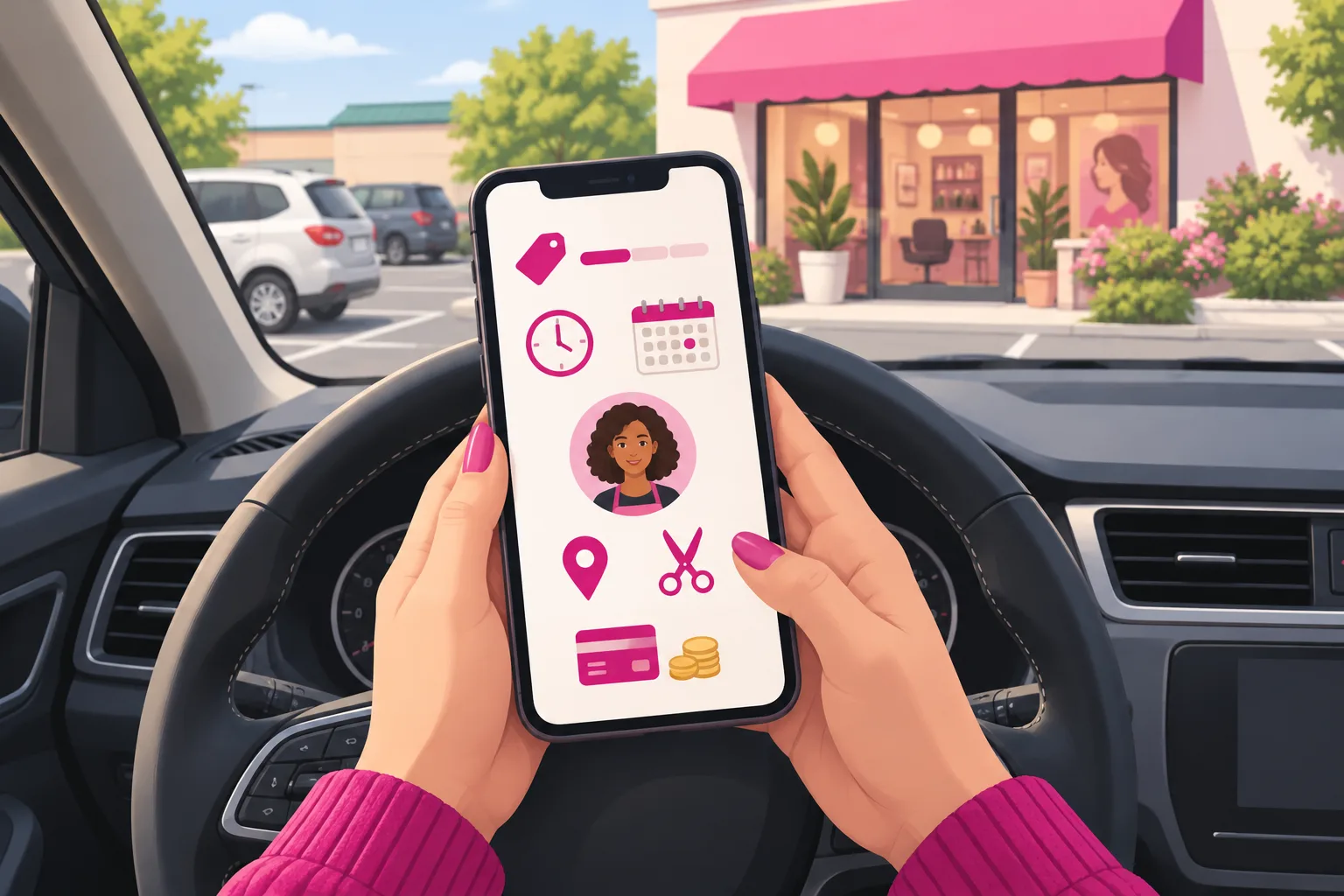
The booking page is the single highest-leverage thing a salon can build for its TikTok account, and most booking software already gives you one; the work is what you write on it. It is written for a nervous stranger, in the order she needs the information, and it is where the parking-lot minute gets answered before she leaves the house. Here is the anatomy, in order:
- The price ranges, and the one thing that moves each one. "Women's cut $65. Balayage from $180, and that includes the toner; longer hair or a first color appointment runs more, and we tell you the number at the consultation before we mix anything. Men's cut $35, beard trim extra. Kids $22. A color correction is priced by the hour at the consultation and never quoted in a message." A range is not a dodge; it is the honest shape of a service whose cost depends on the head in the chair. The money guide explains why the salon that hides its prices is not protecting itself from a cheap client but losing a fair one to the shop that said the number.
- How long each service takes. "A cut is about forty-five minutes. A balayage is three hours; bring a book." She is planning an afternoon and a babysitter, and the salon that tells her it is three hours gets the client who blocked the time instead of the one who left at the toner.
- Walk-ins or book, and which day. "Book online for color. Walk-ins welcome Tuesdays for cuts; Marcus takes walk-ins all week when the chair is empty." Say what happens if she just shows up, because some people will.
- The cancellation policy, said like a person. "If you need to move your appointment, a day's notice is all we ask, because three hours of Dani's day is hard to fill at nine in the morning. Text the salon phone and we will find you a new day." Not the warning paragraph in capital letters, not the word "strictly," not the fee in bold before the hours. The policy belongs on the page; the grievance does not.
- Where to park and which door. "Park behind the pharmacy - it is a shared lot, nobody will mind. Our door is the one with the pink awning." Put a photo of the awning on the page. The walk-through video should begin at the same awning.
- Cash or card, and the tip, said once. "We take cards and cash. Tips are welcome and never expected; the card reader will ask, and no is fine." Said exactly once, as information, never as a lecture, because the tip question is the one she is most embarrassed to ask.
- Each stylist by name and face, with what she is known for. "Ask for Tasha - she does the curly cuts, dry, curl by curl. Dani has cut hair on this street for twenty-two years and does most of the color. Marcus is the barber chair in the back." This converts better than any paragraph about your passion, because it replaces a room full of mirrors with a person, and the viewer books a person. If the chair is rented, the link books the renter's chair, not the salon's desk.
Then the form - the online booking form and the paper intake form at the desk, both - with one question added: "how did you hear about us?" with TikTok as one of the choices, a first name, and a number for the follow-up text with a line that says what it is for: "We send one text the day after your appointment with how to style it at home. That's it." The question is how you count, and every number in section 13 comes from it. But the page has to work for the person who never fills it in, because some will just walk in on Tuesday.
Two things the page must not contain: the essay about your philosophy of hair, and the scolding paragraph ("no-shows will be charged in full, no exceptions, we are a business and our time is valuable"). Both belong somewhere; neither belongs between a nervous stranger and your chair. And one thing it must: the book kept current. Put "holiday book open" up on October 1, "holiday book full - the January book opens the fifteenth" up the day it fills, and the prom window up the first week of March, because the person tapping the link in late November is planning for January, not for the Saturday before Christmas.
6. Rung 5, Continued: The Three Saved Replies
No matter how clearly the bio says "link below," people will message you and comment. For a salon, those messages come in three kinds, and you need a saved reply for each before the first one arrives - plus one named person who owns the inbox, including within the hour in October, when the holiday book is selling. The written break-room rule names that person (at Dani's salon it is Tasha) and says what she may answer without asking.
Message one: "how much is a ___?" It is the most common message a salon account gets, and "DM for prices" followed by silence is the fastest way to send her to the chain. The reply is the range, the one thing that moves it, and the link:
"Balayage here starts at $180 and that includes the toner. It runs higher for longer hair or a first color appointment, and we tell you the exact number at the consultation before we mix anything - no surprises at the desk. It takes about three hours. The booking link has the whole menu and the open days; ask for Tasha if you want curly hair cut dry, and if you're not sure what to ask for, that's completely fine, just book a cut and we'll talk when you sit down."
Then make the question a video. "How much is a balayage?" answered by Dani at the color bar with the bowl in her hand is the question-answered format from the pillar guide, and the ideas vault has ten of them. Never reference the asker; the question is common enough that it belongs to everyone, and the person who asked is standing in for a few hundred who did not.
Message two: "do you have anything this week?" This is a rung-five person asking permission to come to rung six, usually with an event behind the question, and the reply is the next open day said out loud, within the hour if you can:
"Yes - Tasha has Thursday at 2 and Saturday at 10 for a cut, and Dani has Friday morning open for color, which is three hours so plan the afternoon. The link will let you grab either one; if they're gone by the time you look, text the salon phone and we will find you something. Park behind the pharmacy - it's a shared lot - and come in the door with the pink awning."
If there is nothing this week, say so with the next open day, not with silence and not with "we're fully booked" and a period. "Nothing this week - the first open day is Tuesday the ninth, and if you want to be first when a cancellation comes up, say so and Tasha will text you." A full book said kindly is the most persuasive thing a salon can post. A full book said curtly is a door closing.
Message three: "can you fix this?" with a photo of a disaster. It will arrive within the first month of any explainer going anywhere, usually on a Saturday night, and the friend she is going to forward your answer to is reading it. The rule is kind, specific, a consultation, and never a diagnosis or a quote in the message:
"Oh, I'm sorry - that is fixable more often than it looks on a Saturday night. I can't tell you honestly from a photo what it needs or what it will cost, because box color and the water in your house and what was on it before all matter, so the first step is a free fifteen-minute consultation with Dani where she looks at it in the chair. Bring whatever box or receipt you have. Corrections are priced by the hour and she will tell you the number before anything is mixed. The link will book the consultation; come in the door with the pink awning."
No "yikes," no "who did this to you," no number. The person who sent the photo is at the most embarrassed point of her year, and the way you treat her is the clearest answer you will ever give to the friend reading over her shoulder. The pillar guide has the short form of all three replies; what matters for the ladder is that each one ends with the link and a door, and none of them ends with a question back.
A fourth kind of message exists, and the break-room rule handles it in one line: the stylist in another state who wants your formula, your developer, your technique. She is a feed-path person at a chair-path account, and she is the customer for the class and the digital guide the money guide describes - one kind reply with the link to that, and then nothing. She will never sit in the chair, and that is fine; she is not the person this guide is for.
7. Rung 6: The First Appointment Has to Match the Video
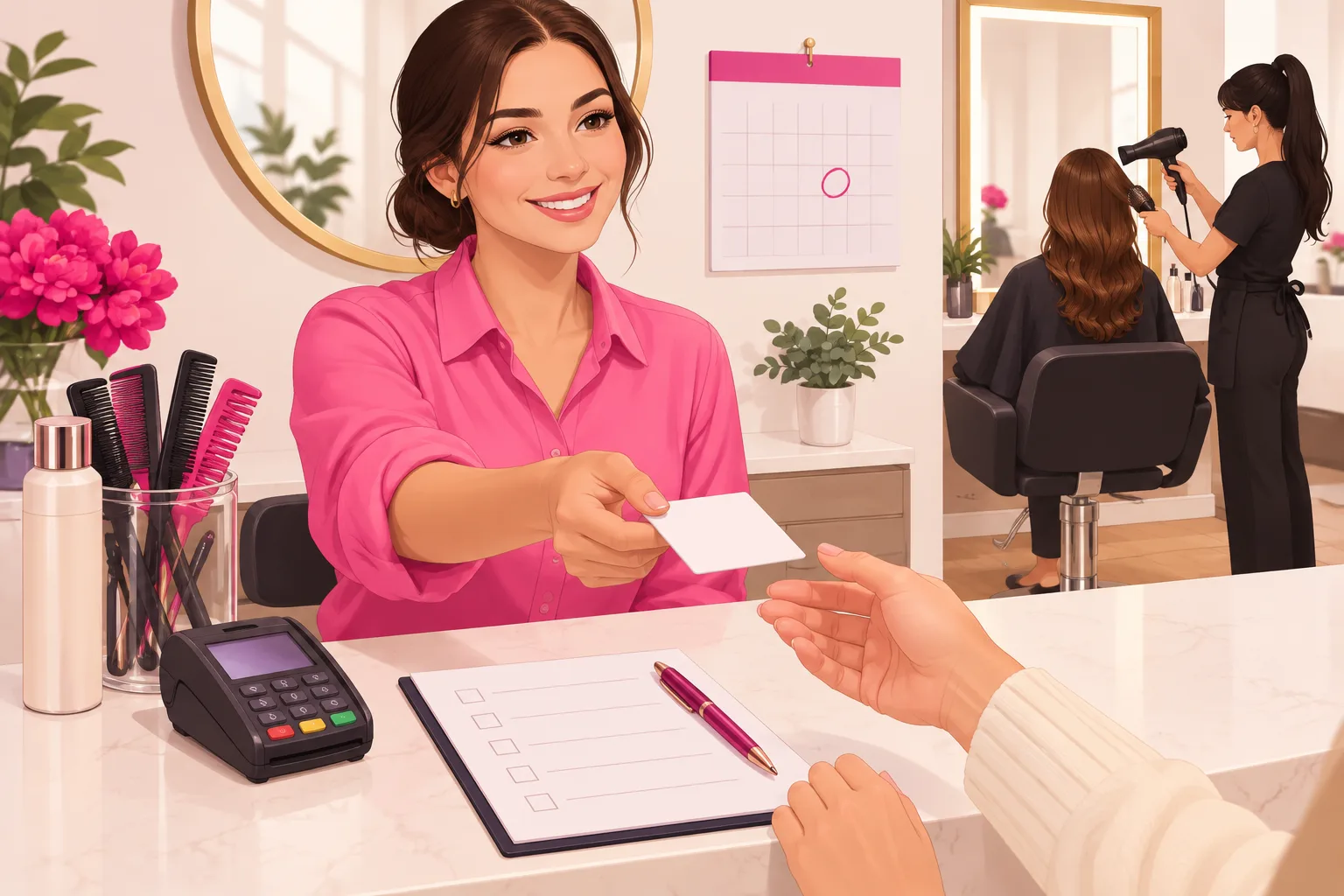
She made it through the door. Everything in the next forty-five minutes - or three hours - decides whether the video told the truth. The walk-through promised a kind person at the desk, a consultation where "I don't know what to ask for" was a fine answer, a number said before anything was mixed, and no word about the box dye. If the first appointment delivers that, the rebook is easy. If it delivers something else, no video will get her back, and she will tell the friend she almost brought.
The first appointment has five parts, and they belong to whoever is at the desk and whoever is behind the chair, not to the phone:
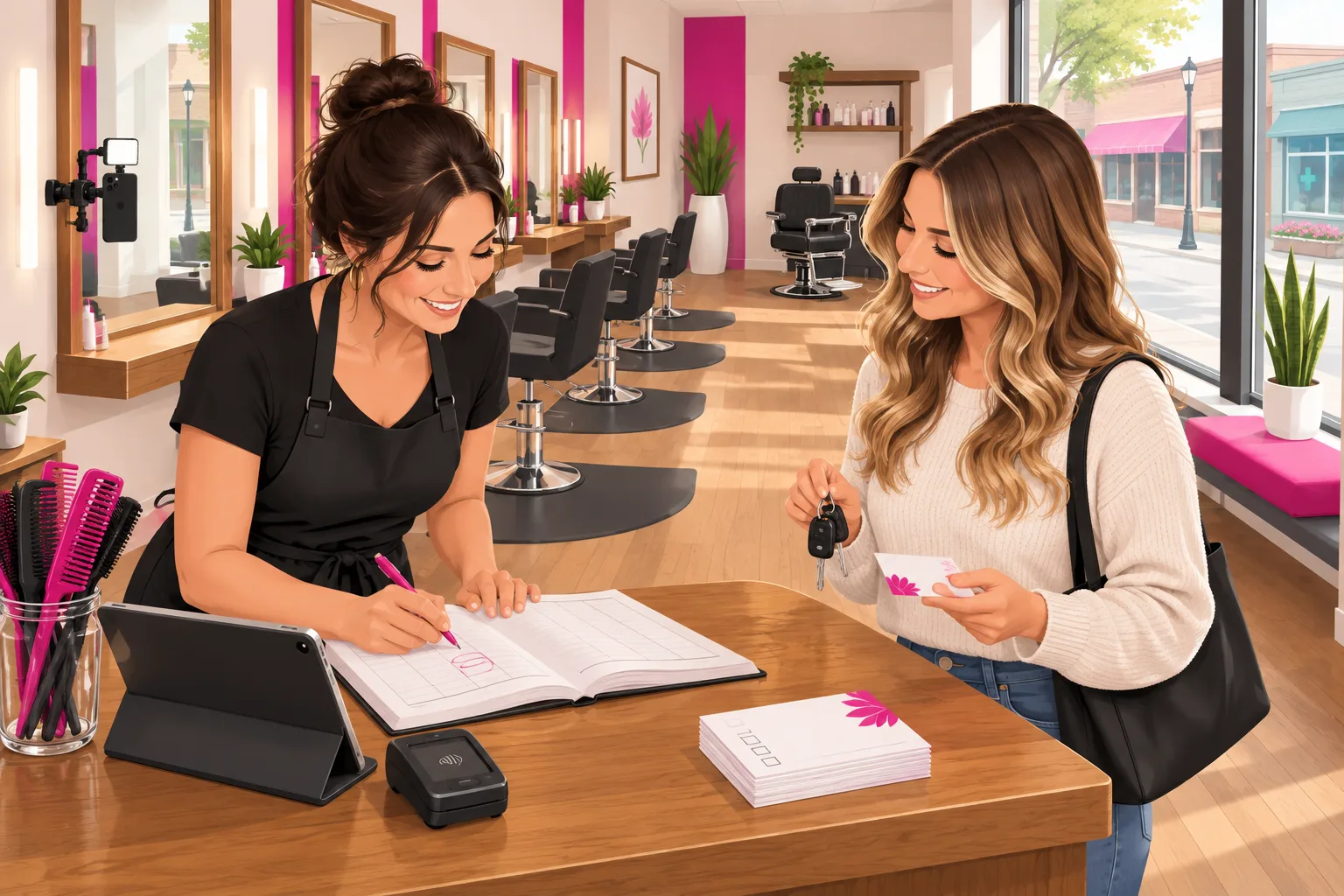
- Greeted by name, by a person who was expecting her. The booking form gave you a first name; the front-desk kid uses it. "You must be Jen - Tasha's chair is the second one, she's just finishing up, can I get you a water?" A first-timer who is expected stops being a stranger before she sits down. The intake form comes with it, with the "how did you hear about us?" question asked out loud as well as printed, and the yes card handed over with the same sentence every time: "We film some of the work for the salon's account - this says what you're okay with, and no is completely fine."
- The consultation done the way the video promised. The photo welcomed ("perfect, that tells me a lot"), the "I don't know" welcomed ("most people don't - tell me what you don't like and we'll work from there"), the honest "that photo is three sessions, and here is what one session gets you." The consultation is the thing the walk-through sold; it has to be the thing she gets. If she watched the permission video - "you do not have to know what to ask for" - she is testing it now.
- The number, before anything is mixed. "So that's a balayage with the toner, and because your hair is past your shoulders it's going to be $210 today - does that work?" Said at the chair, before the bowl, every time. The booking page promised it. A surprise at the desk is the one thing a first-timer never forgives.
- No upsell, and no word about the box dye. The treatment, the gloss, the second product, the membership - none of it on the first visit. She came for the thing in the video, and the salon that tries to sell her three more things has told her what the next visit will be like. And the box dye, the chain cut, the home trim: not a wince, not a joke, not "who did this," not a kind little lecture about why it will take longer. She knows. She drove twenty minutes to a stranger because she knows. The stylist who says nothing about it has just become her stylist.
- The when-to-come-back said during the service, as information. "This will want a trim in about six weeks, and the toner will fade a little by then - that's normal, we'll refresh it." Said mid-service, as a fact about the hair, it makes the rebook at the desk a confirmation instead of a sale. The desk asks a question Tasha has already answered.
One more thing about the first appointment. It is the appointment where the chair is slowest, because the consultation is real and the hair is unknown, and a salon that books first-timers into a slot sized for a regular rushes the one appointment that cannot be rushed. Dani blocks an extra fifteen minutes for every "new client" in the book. Over a year that is a few lost cuts. Against the two hundred regulars a chair can hold, it is the cheapest thing on this list.
8. Rung 7: The Useful Follow-Up, With a Date in It
Here is the rung that costs the least and is missing from almost every salon. She left the chair at four with the best color of her year. By the next morning she has either washed it and wondered why the toner looks duller, or tried to blow it out and gotten the chain-salon shape back, or - if you did one small thing - she has styled it the way Tasha showed her, it looks like the mirror, and she has already texted the reveal to her sister.
The small thing is a text the next day, from the stylist, sent only to the client who left a number on the intake form and was told what it was for. It has three parts and no fourth:
- One sentence of thanks from a person, by name. "Tasha here, from the salon next to the pharmacy - thanks for coming in yesterday."
- One useful thing about the hair she left with. How to style it at home in two steps: "Blow it out from underneath with the round brush, and go easy on the front - it wants to fall forward." Which product you actually used, and why: "The leave-in I put on you was the blue bottle - a pea-sized amount on damp hair is plenty, and it's what keeps the ends from going fuzzy." What not to do: "Skip the wash tomorrow so the toner sets, and use the purple shampoo once a week, not every day." This is the part that turns a nervous first appointment into a confident second one, and the money guide explains why "which product I actually used" is also the only retail engine a salon needs.
- When to come back - with a date. If she rebooked at the desk: "See you the twelfth at ten." If she did not: "Six weeks is right around the twelfth; Thursdays are the easiest to get, and the link is below." A reason to follow the account and a reason to come back, in one line, with a day in it.
What the follow-up is not: a discount blast, a request to leave a review, a survey, a link to the shop, a loyalty-program pitch, or a paragraph about how every client matters to a small salon. Any of those turns a thank-you into a pitch, and she learns that leaving a number means being marketed to. One text, useful, and then quiet until she comes back. The review will come on its own from the client who got the text, and the one who got the discount blast is the one who unsubscribes.
The follow-up is also where the content comes from. Every "how do I style this at home" Tasha has typed into a text is a sixty-second video waiting to be filmed at the station with the dryers off, and the ideas vault's question log treats the day-after text as one of its two sources. The video answers the question for everyone, and the text is where you learned the question existed.
9. Rung 8: The Rebook at the Desk Is the Conversion
Not the first appointment. The first appointment was curiosity, a wedding in six weeks, a video that worked. The rebook is a person who has decided your chair is where she gets her hair done, and it happens in one place and one moment: at the desk, before she leaves, with the book open and a specific day.
"Six weeks puts you right at the twelfth - same time, ten o'clock, with Tasha?"
That sentence, said every time by the person at the desk, is the whole conversion rung. Not "do you want to rebook?" - a yes-or-no question a polite stranger answers with "I'll call." Not "call us when you need us." A date, a time, and a name, so that saying yes takes less effort than saying no. A client who rebooks at the desk comes back. A client who says "I'll call" is, in most salons, a client you see in four months if at all, by which time the toner has long faded and the chain is on her way home from work. If she says "let me check my calendar," the answer is "of course - I'll pencil the twelfth and text you Monday, and if it doesn't work we move it, no charge." Pencil is a rebook. "I'll call" is not.
Three things make the rebook land, and two of them happened before she reached the desk. The first appointment matched the video, so there is nothing to recover from. Tasha said "about six weeks" during the service, so the desk is confirming information rather than opening a negotiation. And the front-desk kid asks the same way for every client, not just the ones who seemed happy, because the person at the desk cannot tell from the chair who is going to say yes. A salon where the rebook depends on the stylist remembering to ask is a salon where the rebook happens on good days.
Then the holiday crowd, which is the rebook problem at scale. Many of December's first-timers came for a party and have no idea what the salon looks like in January. The video that earns their rebook is the one the pillar guide calls "here is what January looks like," and it is filmed on the busiest December Saturday, from the desk looking out at the full room:
"Most of you in here today are here for the first time, and this is the only month you'll see it like this. In January it looks like this" - cut to last January, the same room, two chairs open, Tasha reading at the desk - "same chairs, same prices, and the January book opens the fifteenth. Save this."
Posted mid-December and pinned through January, it is the single highest-return video on a salon account, because it is the only one that speaks to a person who has already climbed six rungs. The ideas vault has two more readings of it - the Saturday after the last prom ("here is what June looks like") and the booked-out week - and the money guide adds the other January rebook: the gift card sold the week after Thanksgiving, which is a service the salon owes in February and a first-timer who already has a reason to come.
One rebook rule for the clients who move their appointment. The booking page said a day's notice is all you ask; the desk has to mean it. A client who texts Tuesday night to move Thursday is a client keeping her word, and the reply is "no problem - the nineteenth at ten is open, want that?" Not a reminder of the policy, not a sigh. The reschedule is a rebook too, and the salon that treats it as one keeps the client the cancellation-fee post would have lost.
10. Rung 9: The Regular, Six Weeks at a Time
The regular is not a client who comes often. She is a client who has stopped deciding. She does not check whether you have anything this week; she rebooked six weeks ago at the desk. She does not watch the price explainer; she knows the number and she tips the same every time. The woman who has sat in Dani's chair every fourth Thursday since 2009 - seventeen years - has not made a decision about her hair in years, and that is the whole point. She brings her sister in June, and the sister is the one who says "I saw you on TikTok" at the desk, because the regular forwarded the video.
Three things about rung nine shape the rest of the account. First, it takes months and years, not weeks. A client becomes a regular after the third rebook, or the second holiday season, and no video speeds that up; only the useful follow-up and a chair that keeps matching the video do. Second, the regular is never asked for on rung one. "Become a regular," "join our salon family," "loyalty members get ten percent" - said to a first-time viewer, each lands as pressure and costs you the view. Third, the regular is where the December receipt comes from. The receipt counts people, not dollars, and the people it counts are the ones who climbed all nine rungs. Said once, with gratitude, it is the only video on the account that is for the regular, and the only one where she is the subject - with her own yes, and her own cast agreement if she is in a series.
One more thing the regular does that no video can: she answers the parking-lot question for the next person, in person, in the waiting chairs. "First time? Park behind the pharmacy next time, nobody minds. Ask for Tasha. Don't worry about the box dye, she won't say a word." Every salon that has built the ladder has a few of these, and they are worth more than any follower count. Do not film them. Thank them, by first name if they wrote it on the card, in December.
11. High-Intent Content: The Videos That Actually Produce Clients
Once the ladder exists, you can sort every video on the account by the rung it serves. The process clip - foils going in from the mirror clamp, the fade line, the curl-by-curl dry cut - serves rungs one and two and the feed path; it earns views and follows from every state and almost never a car in the lot. That is fine, and the pillar guide treats the process clip as the account's volume source. But a chair-path account needs a second category: videos made for the person who is already at rung four or five and deciding whether to drive. There are six, and they produce nearly every first-timer who says TikTok on the intake form.
- The walk-through, one per door. From the parking lot to the price at the desk: the shared lot behind the pharmacy, the pink awning, the desk, the person, the chair, the consultation, the number said out loud, the card reader, back to the car. One for the salon, one for Marcus's barber chair, one for the kids' chair filmed empty, one for a first color appointment, one for the formal booking, one for the suite if a renter has one. Sixty seconds, the phone on the clamp or in a steady hand, no music over the talking. The filming guide has the script and the fears in order. Re-film each one every September, because the awning got replaced and the front-desk kid is a different kid.
- The question answered, where it happens. "Do you do curly hair? Yes, and here is exactly how we cut it - dry, curl by curl," at Tasha's chair. "Do I need an appointment?" at the desk on a Tuesday. "What do I even ask for?" with the front-desk kid in the chair playing the client, never a real one. Each is a rung-five person getting the permission she was about to message for, and each comes straight from the question log.
- The price explainer. "Why a balayage is $180 and three hours," filmed at the color bar with the bowl and the clock. It is the most-sent video on a salon account, because it makes the sender feel smart for already going to you, and a save on it is a person deciding. It belongs to the ideas vault; here it is simply the rung-three video.
- The permission video. "Is it weird that I've never been to a real salon? No. You do not have to know what to ask for." Posted December 26 as the first post of the new year's book, and pinned through January, when the gift-card redeemer and the new-year's-resolution client are both standing in the parking lot for the first time.
- The countdown. "The holiday book opens October 1." "Prom appointments open the first Monday in March." "Back-to-school cuts, first week of August, the kids' chair is $22." A countdown is a reason to follow and a reason to save, and it is the only format that moves a rung-two follower toward a rung-six appointment without asking her to do anything.
- "Here is what January looks like." Filmed on the busiest December Saturday for the first-timer already in the chair. Covered above; listed here because it is the only rung-eight video there is, and most salons have never made one.
Notice what is not on the list. The transformation reel with the trending sound. The price-list graphic. The "meet the team" montage. The empty-chairs post. The client-shaming clip, in any form. Each of those is either for the feed path or for nobody, and none of them answers a single question the woman in the parking lot is asking. The pillar guide's hook rules - the hair, never the client - apply to all six; a walk-through that opens on a joke about box dye is not a walk-through anymore.
12. Consent at the Desk
A salon that works as a TikTok set is a room with strangers' faces in every mirror, and the rules that protect them protect the account. The filming guide covers the full consent model; the ladder adds five rules that apply specifically to the desk, where clients and camera meet.
- The yes card comes with the intake form, from the desk, never from the chair. The front-desk kid hands it over with the same sentence every time, and the stylist never asks with the phone in her hand. Three boxes - no, yes but not my face, yes to everything - plus a separate line for the before, and a take-it-back line that works the same day. The client who checks "no" should feel exactly as welcome as the one who checks everything, which means the clamp comes off her station and nobody mentions it at the chair. A booking is not a yes, and last month's yes is not this month's.
- The first-timer gets the card and nothing else. Not the cast agreement, not "would you be in a series," not "can we film the reveal, it would do so well." She is on rung six and being asked for rung-nine trust. If she checks yes, the reveal is filmed from behind the chair into the mirror with her own yes; if she sends it to forty people, that was her decision, and it is the best referral the salon will get this month.
- The minor is the parent's per-visit decision, with the parent in the room. The filming guide has the full rule; at the desk it means the card goes to the parent, the kid is asked too, and the school logo, the jersey, and the pickup line through the window never appear. The kids'-chair walk-through that brings back-to-school families is filmed empty, and the parent is the viewer.
- The next chair is never background, and the mirror shows the whole room. The client in Dani's chair said yes; the client in the next chair did not say anything, and the mirror behind Dani reflects her. The three-second mirror check exists for this, and so does the rule that a renter not on the salon account is the next chair, every day.
- Consent to post is not consent to promote. The yes card has a separate promotion box, and the client who was fine with her reveal on the salon's account is asked again before it is put in front of strangers with a budget behind it. The pillar guide has the rest of the compliance list - the license, the claims, the music, the exaggerated before-and-after - and none of it is optional on the day a first-timer is in the chair.
And the chair as a confessional. Clients tell stylists things, and the first-timer who tells Tasha about the divorce on the day of the balayage has not consented to being a story. The card covers the hair. It never covers the conversation, and a salon that remembers that keeps the trust the whole ladder is built on.
13. Tracking: The Three Numbers and the Sentence That Wins the Break Room
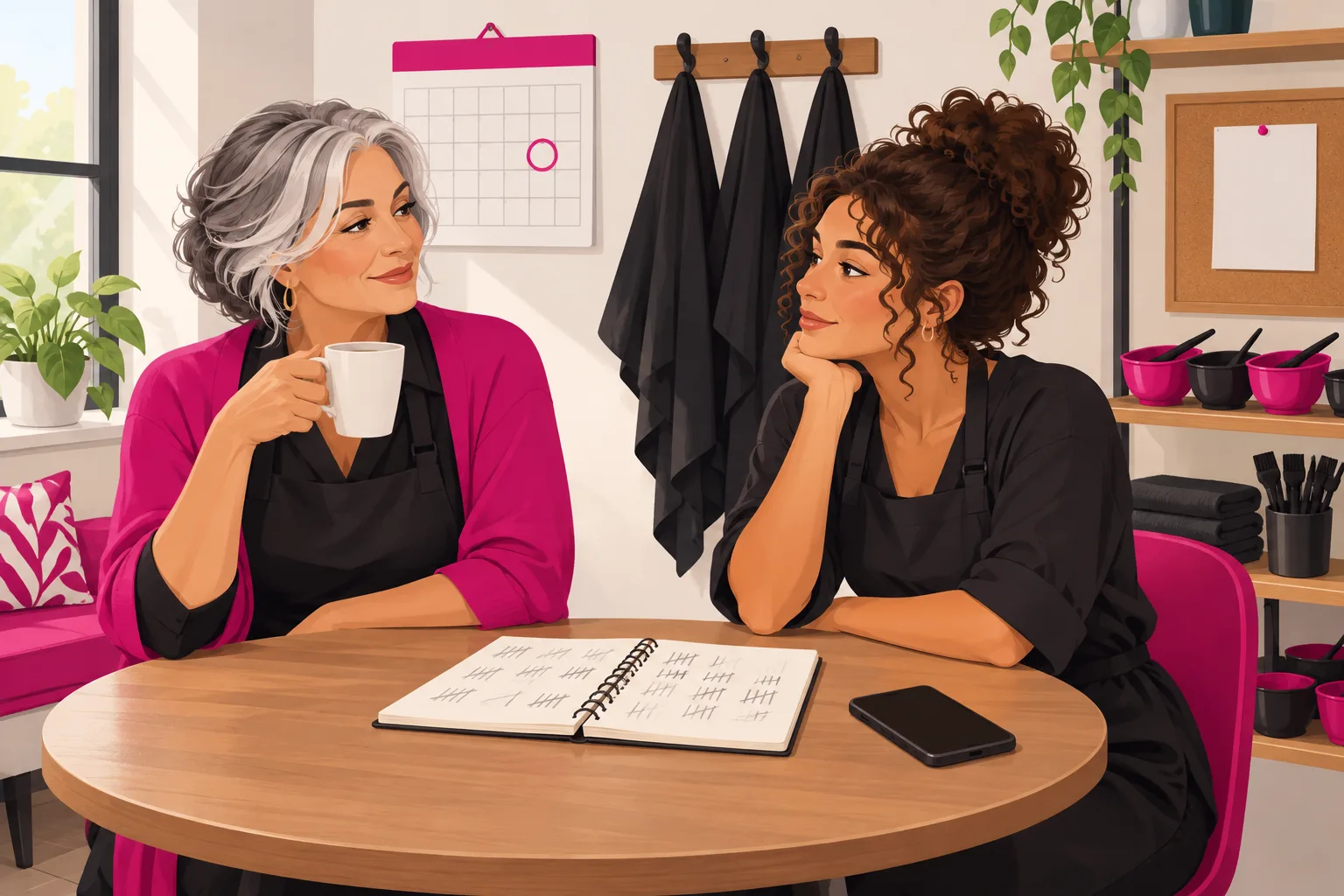
A salon account that cannot say how many clients it produced will be judged on views, and on views it will lose to the mailer and the booking marketplace's new-client fee. Three numbers, kept by the one person who owns the phone and said out loud once a month in the break room, change that conversation:
- Booking-page clicks per week. From the link in the bio, read off the booking software's own numbers. The leading indicator for everything below. A walk-through with ten thousand views and three clicks has a profile problem, not a content problem.
- First-time clients per month who said TikTok - the tally from the intake forms, by chair, plus the checkbox on the online booking form. This is the chair-path number, and it is the one the owner has never seen before.
- The rebook rate of those clients. Of the first-timers who said TikTok, how many booked their next appointment at the desk before they left. Counted by the front-desk kid, because they are the one who asked the question and the one who wrote the date down.
And once a quarter, count backwards:
- Which video was pinned, or most sent, the week each TikTok first-timer booked - so you learn which walk-through actually opens the door, and which countdown actually sold the holiday book.
- How many of last December's TikTok first-timers were still on the book in March, compared with the ones who came from the mailer or the marketplace. This is the number that tells you whether "here is what January looks like" worked.
- How many of this year's regulars - the ones on a standing six-week rebook - first found the salon on the phone, and, as the lagging number, how many of them have brought someone.
Then the sentence. Every salon has one conversation a year where the question is whether the phone is worth Tasha's Monday hour, and it usually happens in the break room in November, and the sentence that wins it is not a view count. It is: "Six new clients this month said TikTok, and four of them are on the book for December." The first time a stranger at the desk says "I saw you on TikTok," write down the date. That sentence, repeated and counted, is the whole case, and it is the one that makes an owner who has cut hair on this street for twenty-two years stop calling it "the phone." The growth roadmap has the same three numbers as the monthly report for whoever "does the social media," and why paying the Monday hour like a client hour is what keeps the numbers alive past week six; the money guide adds the date the book filled, which is the scoreboard for the windows.
Keep the counting honest in two directions. Do not credit TikTok for the client a neighbor sent who also happens to follow the account - the question at the desk asks what brought her, and her answer stands. And do not discount the client who said TikTok because the regular who forwarded the video "really" brought her; that send is the account working exactly as designed, and the regular should hear about it in December.
14. Amplify the Walk-Through That Already Fills the Chair - in the Quiet Weeks
Once the ladder is built and the three numbers exist, you know something most salons never learn: which video actually produces first-time clients. That is the only video worth a dollar that came out of the same account as the rent and the color order, and there are five rules for spending it - four shared with every local business, and one the booking marketplace will never tell you.
- Promote the proven video, never the new one. The walk-through that already produced booking-page clicks on its own is the one that gets budget. A promoted video that has not earned a click organically will not start earning them because strangers saw it.
- Promote for followers, not for a one-time appointment. A follower watches six weeks of the chair - the countdown, the walk-through, the price explainer, the fourth-Thursday reveal - and arrives at rung five already trusting you. A stranger who saw one ad arrives at rung one, books once if at all, says "I'll call" at the desk, and is gone.
- Draw the map to a twenty-minute drive. The chair path is local by definition; nobody drives an hour each way for a trim every six weeks. The process clip and the class video can go wider if the salon teaches or ships, but the walk-through, the permission video, and the holiday countdown are promoted to the town and the towns around it, and nowhere else.
- Amplify in the quiet weeks before the window, never the week before Christmas. She decides in the weeks before the appointment. Promote the holiday walk-through in October, when the book opens; the prom explainer in March; the kids'-chair walk-through the last two weeks of July for the first week of August; the permission video the first week of January. The week before Christmas, every retailer in the country is bidding, the book is already full, and the budget buys nothing.
- Pause the day the book is full. This is the rule the marketplace never mentions, because it is paid per new client whether or not you had a chair for her. A promoted holiday walk-through still buying followers the week after the book closed is an apology at the desk, not a client. The date the book filled is the scoreboard and the off switch at the same time - and it is the day the booking page changes to "the January book opens the fifteenth."
Then report it next to the mailer and the marketplace's new-client fee, because that is the comparison the owner is actually making. Each of those has a cost and, if anyone asked at the desk, a client count and a rebook rate - and the marketplace's rebook rate is the number it would rather you never counted. A modest budget on a proven walk-through, promoted for followers to the drive radius in the quiet weeks, has a cost per local follower, a cost per booking-page click, a count of first-timers who said TikTok, and a rebook share. In our pillar guide's example, the promoted holiday walk-through brought fourteen new clients in six weeks, and nine of them rebooked at the desk. Put that next to the mailer in November.
This is where a done-for-you TikTok promotion service earns its place in a salon budget. Viryze takes a video that has already proved it brings people through the door, promotes it for followers inside the radius you draw, in the weeks you choose, and reports the follower cost by segment - so the stylist who runs the phone never has to learn Ads Manager with the rent money, and the owner sees the October campaign reported in the same three numbers as the organic work. The Spark Ads guide explains the format, which promotes the salon's own post from the salon's own account, with the comments and the sends attached. Three cautions the local business guide does not need: the platform's misleading-content rules mean a promoted before-and-after is the same station, the same light, no filter and no retouch; if the salon offers injectables or permanent makeup, those services stay out of promoted videos entirely under the cosmetic-procedure ad rules; and consent to be in a video is not consent to be in a promoted one. The regular who agreed to the series and the client who checked "yes to everything" are each asked again before the budget goes on.
Frequently Asked Questions
How do I get new clients as a hair stylist using TikTok?
By building the whole path, not just the video. A new client climbs nine rungs between seeing your work and becoming a regular: the view, the follow, the save or the send, the profile visit, the booking page or the message, the first appointment, the useful follow-up, the rebook at the desk, and the regular. Most stylists work hard on rung one and never build the other eight, which is why an account can have thousands of views and an open Tuesday. The videos that produce clients are plain and local: the walk-through from the parking lot to the price at the desk, the question answered where it happens, the price explainer ("why a balayage is $180 and three hours"), and "here is what January looks like" filmed on a busy Saturday. Under them sits a booking page with price ranges, how long each service takes, the cancellation policy written the way you would say it, and a named face ("ask for Tasha, she does the curly cuts"). Then the first appointment has to match the video, the next-day text has to be useful and have a date in it, and the rebook has to happen at the desk before she leaves the chair. Count the first-timers who say TikTok on the intake form and how many of them rebooked; that is the number, not the views.
What should a salon booking page say to convert TikTok viewers?
Everything the woman in the parking lot is afraid to ask, in the order she is afraid of it. Price ranges with the one thing that moves each one ("balayage from $180 plus toner; longer or a first color appointment runs more, and we tell you the number before we mix anything"). How long each service takes, so she can plan the afternoon. Whether you take walk-ins and on which day, or booking only. The cancellation policy written the way you would say it out loud at the desk, never as a warning paragraph. Where to park and which door ("behind the pharmacy, it is a shared lot, the door with the pink awning"). Each stylist by name and face with what she is known for, so the viewer books a person and not a room full of mirrors. And one question on the online form: "how did you hear about us?" with TikTok as an option. Leave off the essay about your passion for hair and the scolding paragraph about no-shows; both have a place, and neither belongs between a nervous stranger and your chair.
How should a stylist reply to "how much is a balayage?" in TikTok DMs?
With the range, the one thing that moves it, and the link, within the hour if you can, and never "DM for prices" followed by silence. Something like: "Balayage here starts at $180 and that includes the toner; it runs higher for longer hair or a first color appointment, and we tell you the exact number at the consultation before we mix anything. Takes about three hours. The booking link has the menu and the open days, and ask for Tasha if you want curly hair cut dry." A price range is not a dodge; it is the honest shape of a service whose cost depends on the head in the chair, and a stylist who hides it is not protecting herself from a cheap client, she is losing a fair one to the shop that said the number. Save the reply so it goes out the same way every time, and make the question a video, because the person who asked is standing in for a few hundred people who did not.
How do salons get TikTok clients to rebook?
At the desk, before she leaves the chair, with a date: "six weeks puts you at the twelfth, same time?" The rebook is the real conversion; the first appointment was curiosity and a video that worked. A client who rebooks at the desk comes back, and a client who says "I'll call" is, in most salons, a client you see in four months if at all. Three things make the rebook land. The first appointment matched the video, so there is nothing to recover from. The stylist said when to come back during the service, as information, not a pitch, so the question at the desk is a confirmation rather than a sale. And the person at the desk asks every client the same way, with the book open and a specific day, not "do you want to rebook?" For the holiday crowd, the video that earns the rebook is filmed on the busiest December Saturday: "here is what January looks like," posted mid-December, so the first-timer who came for the party knows the quiet month exists and that the chair is open in it. Then count it: of the first-timers who said TikTok, how many rebooked before they left. That share is the number a salon account is judged by.
What is the best follow-up after a new client's first salon appointment?
One text the next day, from the stylist, with three parts and no fourth: a sentence of thanks by name, one useful thing about the hair she left with (how to style it at home in two steps, which product you actually used on her and why, how to sleep on the blowout, when to wash the color), and when to come back, with a date already on the book if she rebooked or the next open day if she did not. "Tasha here from the salon next to the pharmacy. Thanks for coming in yesterday. Blow it out with the round brush from underneath and the leave-in I used, about a pea-sized amount on damp hair, and skip the wash tomorrow so the toner sets. See you the twelfth at ten." What it is not: a discount blast, a review request, a survey, a link to the shop, or a paragraph about how much every client matters to a small salon. Any of those turns a thank-you into a pitch and teaches her that giving you her number means being marketed to. Send it only to the client who left a number on the intake form, and then be quiet until she comes back.
How do I know if TikTok is actually bringing clients to my salon?
Three numbers, written down at the desk, not read off a screen. Booking-page clicks per week, from the link in the bio, read off the booking software: the leading indicator, and a walk-through with thousands of views and three clicks has a profile problem, not a content problem. First-time clients per month who said TikTok, from one question asked out loud at the desk and on the online form: "how did you hear about us?" And the rebook rate of those clients: of the first-timers who said TikTok, how many booked their next appointment before they left the chair. Then once a quarter count backwards: which video was pinned or most sent the week each TikTok first-timer booked, how many of last year's holiday-season TikTok first-timers are still on the book, and how many of this year's regulars first found the salon on the phone. Keep it honest in both directions: do not credit TikTok for the client a neighbor sent who also follows the account, and do not discount the one who said TikTok because a regular forwarded her the video, since that send is the account working exactly as designed. The sentence that wins the break room is "six new clients this month said TikTok, and four of them are on the book for December."
Found the walk-through your town already trusts?
The ladder tells you which video actually puts a first-timer in the chair - amplification decides how many future clients see it, where, and when. Viryze promotes the videos that have already proved themselves, putting your best walk-through or price explainer in front of thousands more people within a twenty-minute drive, in the quiet weeks before the holiday book or prom or the January reopening, and pausing the day the book is full - so the money you spend comes back as first-time clients who say TikTok on the intake form, rebooks you can count at the desk, and a sentence worth saying out loud in the break room.
Related Reading
- TikTok for Salons and Barbershops: The Complete 2026 Guide - the full two-audience strategy, the short form of the ladder, and the compliance framework this guide plugs into.
- Growing a Salon TikTok: From 0 to 10K Local Followers - the size of the book, the two scoreboards, and the paid Monday hour that keeps the account alive.
- How Salons Make Money on TikTok: Retail, Education, and the Booking Link - the booking page as the shelf, the "which product" text, and the December receipt.
- Salon TikTok Content Ideas: 50+ Video Concepts That Fill the Chair - the walk-throughs, the question answers, and the explainers that do the converting.
- How to Film Salon Videos for TikTok (The Yes Card, Minors, the Mirror & the Break-Room Rule) - the yes card at the desk, the walk-through script, and who owns the inbox.
- Getting Customers Down the Driveway: Turn TikTok Views Into Second Orders - the same nine-rung ladder worked for a farm stand, where the rebook is a standing egg order.
- Getting Patients from TikTok: Turn Views Into New-Patient Appointments - the ladder for the other business where a photo in the DMs is never answered with a diagnosis.