
Vacation Rentals18 min read
TikTok Advertising for Airbnb Hosts: Fill the Calendar Without Burning the Mortgage Money
The paid-promotion guide for Airbnb hosts, vacation rental owners, and cohosts: what "Airbnb advertising" usually means (the listing sites' own paid placements, compared honestly against the host fee), why a promoted video buys a guest who rebooks the same week next year rather than one weekend, what the Promote button, Spark Ads, and Ads Manager can each target and why a rental ad is declared under TikTok's housing category, the inverted map (promote to the two or three cities within a Friday-after-work drive, never the home county), the four videos worth mortgage money (the arrival, the price explainer, the summer-calendar or holiday countdown, the first morning with the rebook line) and the four that never are, how much to spend against the host-only fee and the rule that promotion pauses the day the calendar fills (per house for a manager), the quiet weeks of January, March, August, and September as the only time to buy, the compliance list that tightens with money behind it (the total price on the promoted number, the permit as the first line item, the cohost's yes, the guest's tagged video, the pixel off the booking page), the numbers to see, and cost per rebook as the only one that matters.
By Ryan MitchellHead of Creator Success at Viryze

Type "airbnb advertising" into a search bar and you get two different conversations. One is about the listing sites themselves: whether you can pay Airbnb to rank your cabin higher, what Vrbo's new sponsored placement costs, whether the extra commission on Booking.com is worth it. The other is about advertising your rental anywhere else. This guide answers both, in that order, because the first conversation explains why the second one matters.
Here is the shape of it. Every paid placement a listing site sells buys you a better position in a grid of competing houses, for one booking, from a guest the platform keeps. The fee on that booking is the same whether she comes back or never thinks of you again, and the platform has no reason to care which. A promoted TikTok video is a different purchase. It buys a follower in one of your cities who watches the house for six weeks, books knowing the total, and answers the rebook message in August. It is spent out of the same account as the mortgage, which changes what an ad is for, who should see it, and how you know whether it worked.
It also puts you under rules a coffee shop never meets. The rental of a home is a special category in TikTok's ad system. The number in your most-watched video is now an advertised price, and the federal rule on fees says which number that has to be. The cleaner in your best turnover agreed to appear on your feed, not in a paid placement shown to her neighbors for six weeks. And a promoted arrival is a public record that you operate a rental at all, which is a sentence that should make every host check a permit before they check a budget.
Here is the good news. Those constraints make rental advertising on TikTok unusually disciplined, and discipline is what makes it work. You already know which video earns trust, because the arrival from the highway exit to the green door has been producing booking-page clicks organically. You know exactly who should see it, because nobody rents a cabin in their own town. And the windows of your year, summer sold in January, the midweek in March, fall in August, the holidays in September, are on the calendar before the ice is off the lake.
This is the paid-promotion companion to our complete TikTok guide for Airbnb hosts and vacation rentals, and the last piece of the series. The pillar covers the rules of promotion in a section. This guide covers the rest: what the listing sites actually sell and what it leaves out, the math of a guest who rebooks, what each TikTok ad tool can target and how the housing category changes it, the inverted map, which videos deserve mortgage money, how much to spend and why promotion pauses the day the calendar fills, the quiet weeks that are the only time to buy, the compliance list that tightens with money behind it, the numbers to watch, and when to hand the work off.
The short version:
- The listing sites sell position. You are buying a rebook. Vrbo's auction, Booking.com's booster, and whatever Airbnb ships next all put your house higher in a grid of other houses for one booking. None of them can produce the family that comes back the second week of July.
- Promote for followers, never for a one-time booking. A follower in your city watches six weeks of the house before the summer calendar fills. A stranger who saw one ad is the weekend that never asks about next year.
- The map is inverted. The arrival, the price explainer, and the countdown go to the two or three cities within a Friday-after-work drive, never the home county. The feed path goes wider, and only if you sell something to other hosts.
- Promote the house, never the guest. The arrival, the price explainer, the countdown, and the first morning get budget. The guest-shaming clip, the grievance post, the amenity graphic, and anything that describes who should rent never do.
- Buy in the empty weeks, stop the day the calendar fills. January, March, August, and September are the ad windows of the rental year. The week before a holiday is never, and a full calendar pauses every campaign before the first check-in. A manager pauses per house.
- Report cost per rebook. Next to the host-only fee and the sponsored-placement bid, in the same notebook, at the kitchen table.
What's Inside
- 1. What "Airbnb Advertising" Usually Means: The Listing Sites' Own Placements, Compared Honestly
- 2. The Math: A Guest Who Rebooks vs. a Weekend Filled Once
- 3. Promote, Spark Ads, and Ads Manager: What Each Can Target, and the Housing Category
- 4. The Inverted Map: Two Audiences, Two Campaigns, and Never the Home County
- 5. The House-Not-Guest Rule: Four Videos Worth Mortgage Money, Four That Never Are
- 6. The Mortgage-Money Budget: How Much to Spend, and the Calendar-Is-Full Rule
- 7. Timing: The Empty Weeks Before Each Window, Never the Week Before a Holiday
- 8. Compliance in Paid Placements: The Total Price, the Permit, Consent, Music, and the Pixel
- 9. The Numbers to See, the Ones to Ignore, and Whether to Run Ads Manager Yourself
- Frequently Asked Questions
1. What "Airbnb Advertising" Usually Means: The Listing Sites' Own Placements, Compared Honestly
Most hosts who go looking for "airbnb advertising" want to know one thing: can I pay to be seen higher in the search results where guests are already looking? The honest answer, as of November 2026, depends on which site you mean, and every version of it has the same limit.
Airbnb: not yet, and soon
Airbnb sells no paid placement a host can buy. What it sells is visibility in exchange for a discount: a custom promotion puts a strikethrough price and a badge on the listing and tends to lift it in search for the dates you discount, and a brand-new listing gets a temporary ranking lift for nothing. That is the whole menu today. It will not stay that way. The company's chief executive has called sponsored listings an obvious product and said in the fall of 2026 that one is being built into Airbnb's coming search tools, so by the time you read this there may be a bid box in the host dashboard. If there is, read the rest of this section with it in mind, because it will work the way the others do.
Vrbo: the auction that launched in September
Vrbo launched Sponsored Listings worldwide on September 1, 2026, after a pilot with a handful of large managers. The mechanics: you set a bid per booked night, five dollars at minimum and no cap, and a higher bid wins a better chance at one of the top two positions in the search results for your area. You pay nothing up front and nothing for the impression; the charge lands only when a booking comes through the ad, on top of the commission the booking already carries. For a two-night weekend at the floor bid, that is ten dollars for a top-of-page position, which is the cheapest first-booking placement in the industry on paper. Two cautions. In a popular lake region in January the floor bid will not hold the top slot for long, because the thirty-door manager down the road bids more. And some of the bookings it is credited with would have happened anyway: the family that searched your house by name and clicked the sponsored card instead of the organic one cost you ten dollars for a weekend you already had. If your house is on Vrbo, test it in a quiet week. It is a reasonable tool. It simply cannot do the thing this guide is about.
Booking.com: pay with commission points
Booking.com sells visibility two ways, both priced in commission rather than cash. The Visibility Booster lets you raise your commission rate on the dates you choose in exchange for a better position on those dates; how many points it takes depends on the destination and the season, and in a hot week it can take a lot. The Preferred Partner program is by invitation, for listings in roughly the top third by performance, and costs a few extra points of commission for a badge and a lift. Both are the same deal in a different currency: you give the platform a larger share of the booking so that it shows your house before the others.
What every one of them has in common
- They sell position inside a grid of your competitors. The guest who clicks your sponsored card sees eleven other houses on the same page, with a total price on each, and the one that wins is the one with the best photos and the lowest number. You are paying to enter a comparison, and the comparison is the platform's product.
- They charge per booking, and a booking is not a guest. The fee is identical whether the family comes back every July or forgets your name by Labor Day, and nothing in the platform's interest depends on which. The guests guide calls that the third leak: you got the weekend and lost the guest.
- The guest stays theirs. Her contact details, her message history, and her next search all live on the platform, under rules that bar you from marketing to her off it. You bought a booking. You did not buy a relationship.
- They cannot show the house before she is comparing. By the time your sponsored card appears, she has already picked dates and a town and is sorting by price. Nothing in the grid shows her the forty minutes past the last gas station, the green door, or the dock at seven in the morning. The only place she can see those before she compares is a video.
That last point is the whole reason the second conversation exists. The pillar's two-audience section explains why a rental has a guest path and a feed path; everything that follows is about putting money behind the guest path, in the cities the guests come from, so the group chat has already chosen your house before anyone opens a search grid.
2. The Math: A Guest Who Rebooks vs. a Weekend Filled Once
Every decision in this guide comes back to two things. What a guest who rebooks is worth to a one-house host, and what a weekend filled once actually cost you.
What a guest who rebooks is worth. Start with the number nobody writes on the calendar. June's cabin rents for $240 a night with a two-night minimum and a $140 cleaning fee, so a weekend is about seven hundred dollars all in once the county lodging tax and the platform fee are on top. The family that has booked the second week of July since 2021 is not a booking. They are six summers of a full week at peak, a sister-in-law who took a September weekend on their say-so, and a review that still brings inquiries. The monetization guide's arithmetic is blunt about it: the house is funded by the weekend, and the weekend is funded by the guest who comes back. That guest is the unit every dollar in this guide is trying to buy.
What a weekend filled once costs. The other side of the ledger is the group that came once because a sponsored card was at the top of the grid, arrived at eleven at night after missing the turn at the last gas station, found the house colder than the photos because nobody told them about the woodstove, left a four-star review that mentioned the stairs, and went back to the search grid next year. The platform kept its fifteen percent either way. If a placement produced that weekend, you paid twice: once for the booking and once for the open second week of July the year they did not come back.
The fee you already pay. The largest platform moved most listings to a host-only fee of about fifteen and a half percent by the end of 2025, replacing the old split in which the host paid around three percent and the guest paid the rest. On June's weekend that is roughly $96 out of the $620 that is hers before tax, on every booking, forever. The money guide calls the version of that fee a direct booking keeps "the fee that stays home," and it is the single most useful number in this guide, because it is what a TikTok campaign is measured against. A promoted arrival that brings four direct weekends has paid for itself in fees before you count anything else.
Why this makes advertising a follower purchase, not a booking purchase. The pillar's promotion section puts it in one line: you are not buying a weekend, you are buying the chance to show someone the house for a season. A stranger asked to book a seven-hundred-dollar weekend nine seconds after meeting the house mostly will not. A stranger in one of your cities who follows the week the summer calendar opens watches the arrival, then June in the kitchen explaining why a weekend costs what it costs, then the honest answer about the four stairs to the deck and the two dogs, then the countdown, and by the time she sends the first morning to the group chat she knows the total, the drive, and the rules. So the objective of every campaign in this guide is followers in the right cities and booking-page clicks. The weekend comes later, and the rebook is the one that counts.
This also changes what a good result looks like. A campaign that fills every open weekend in June with groups who are never heard from again is not better than one that brings nine weekends over six weeks, four of them direct, two of them already asking about the same week next year. The second one is the business. The growth guide's two scoreboards are built so you never confuse the two.
3. Promote, Spark Ads, and Ads Manager: What Each Can Target, and the Housing Category
TikTok gives you three ways to put money behind a video. For a rental the difference between them comes down to two questions: how precisely can each one pick two cities three hours away on a map, and what happens when the ad is about renting a home?
The Promote button (inside the app)
Promote is the button under any of your videos. It is quick, it needs no separate account, and it is fine for a cheap test of whether the arrival holds up in front of strangers. Its weakness is the map. The location controls are coarse, and you cannot reliably keep spend in the two cities your guests drive from while keeping it out of the county the house sits in. The person with the property phone may test with it in a quiet week. Do not run the January campaign on it.
Spark Ads (the format)
A Spark Ad promotes a video that already lives on your account instead of a separate ad creative. It keeps the handle, the comments, the sends, and the follow button, so every bit of engagement lands on the property's real profile, which for a campaign whose whole goal is followers is the point. For a rental it is the only sensible format. The viewer should meet the green door, follow, watch six weeks of the house, and then tap the booking page. A video that looks like a commercial breaks that chain at step one, because the one thing a woman planning a weekend for six people is afraid of is a listing that is not really like the photos, and a commercial is the photos with music. Our Spark Ads guide walks through the authorization code and setup.
Ads Manager (the control panel)
Ads Manager is where Spark Ads get real targeting. In the United States you can pick locations by state, designated market area, county, and city, set an age floor, and run the same video against several audiences to see which one responds, which for a rental means running the arrival against each of your cities as its own ad group and finding out which one actually drives up. It is also where the learning curve lives: objectives, ad groups, bids, daily minimums (around twenty dollars a day per ad group as of this writing, more at the campaign level), and a dashboard designed for media buyers rather than for someone who is at the house one day a week. Section 9 covers the alternative. The practical point for now is that picking cities by name, the feature a rental needs most, lives here.
The housing category: the step a coffee shop skips
This is the part of the setup that is specific to you. TikTok puts ads about housing, employment, and credit in a special category with its own rules, because those are the three areas where discrimination law has the longest reach. The rental of a home is housing. Whether a two-night weekend counts is a judgment the platform's reviewers make, not you, and the safe move for every rental ad is to declare it. Declaring it removes targeting by gender and by ZIP code, limits the audience to adults, and turns off the automatic and hashtag-based targeting that could narrow the audience in ways you cannot see. None of that costs a rental anything it needs. The inverted map in section 4 works at the city and metro level, which the category still allows, and an age floor of eighteen is the age floor you wanted anyway.
The category also changes what you write. An ad about who should rent is the kind of ad the rules exist for: "perfect for young couples," "a family-friendly escape," "ideal for retirees" all describe a person, and fair-housing law has a long memory for advertising that describes a person. Write the ad about the house. "Sleeps six, two dogs welcome, four stairs to the deck and none inside, a desk by the window, three hours from the city" describes the house completely, and anyone reading it can decide for themselves whether it is for them. The pillar's compliance section has the organic version of the same rule; money behind the video only makes it matter more.
Expect the arrival to clear review. Expect the price explainer and the countdown to clear. Expect a video whose caption describes the guest rather than the house to be questioned, and do not appeal it, because it is the wrong video anyway. Review runs per ad and per market, so build the time into the calendar in section 7. A host who discovers the housing toggle on the Thursday the summer calendar opens has spent the January window waiting.
On objectives: the goal is not website conversions, and it is certainly not nights booked the week the ad runs. It is followers in your cities, profile visits, and the booking-page clicks that follow, because the booking comes from the bio link after a viewer has watched a few weeks, and because (as section 8 explains) you do not want conversion tracking anywhere near a booking page that collects a family's names and the dates their house will be empty. Choose an objective built around reach, community interaction, or profile visits, and judge the campaign by who follows and what the welcome-message answers say afterward.
4. The Inverted Map: Two Audiences, Two Campaigns, and Never the Home County
Every other local business in this series draws a circle around its own front door and promotes inside it. A rental is the one business whose customers, by definition, do not live nearby. Nobody books a weekend in their own town. So the map for a promoted arrival is the pillar's map turned inside out: the home county is the one place the ad should never run, and the two or three cities within a Friday-after-work drive are the only places it should. The growth guide explains why that inversion is the whole reason a rental's follower count means something different from a salon's; here it becomes a targeting setting.

The guest campaign: two or three cities, three hours out
June's cabin is three hours from one city and two and a half from the other. Those two metros are the whole guest campaign. In Ads Manager each one is its own ad group running the same arrival, which tells you within two weeks which city actually drives up (it is usually not the one you expected), and the age floor is eighteen because the housing category requires it and because the person who books for six adults is an adult. Pull the cities from the evidence you already have: the "how did you find us?" answers in the welcome message, the inquiry log, the home cities in five years of reviews, counted as tallies and never as names. If a third city shows up in the tallies at a four-hour drive, add it as a third ad group and let the numbers decide. Skip interest targeting entirely; the cities do the narrowing and the video does the sorting, and the housing category has turned most of it off anyway.
The videos that run here are the four in section 5: the arrival, the price explainer, the countdown, and the first morning. The caption carries the drive and the total, the bio carries "two bedrooms on the lake, three hours from the city, sleeps six, dogs yes," and the booking page carries the total for a sample weekend. The guests guide has every line of that page, and an ad pointed at a page without the total on it is money spent to produce the question "how much is it?" in the inbox.
The feed campaign: wider, and only if you sell to hosts
The turnover, Rosa resetting the house in four hours, travels the way the arrival never will: other hosts, design viewers, and people who like watching a bed get made will watch it in any state. That audience buys only what fits in a box, the host course, the design guide, the storefront link, a cohosting pitch, and if you sell none of those, the feed campaign does not exist and the turnover stays organic. If you do, it runs on its own budget, to a national audience, measured against follows and course sales rather than against anyone in the house. The money guide covers what that audience actually pays for. Never blend the two campaigns. An arrival promoted nationally buys "I wish this were closer to me" from a thousand people who will never drive up, and the pillar's famous-and-empty cabin, four hundred thousand followers and open weekends in October, is what blending them looks like at scale.
The manager's map, and the one video that points home
A manager with thirty doors in a resort town draws the same inverted map for the town account, with one ad group per city and the neighborhood arrival or a "which of our houses" explainer as the creative, and pauses per house rather than per account when a house fills (section 6). The exception is the hiring video. "Here is what Saturday looks like" from the crew van is promoted toward the home county two weeks in April, because the cleaners live there and the guests do not, and it is declared as an employment ad under the same special category. The manager guide has the per-house version of the budget and the owner's statement line it lands on.
The neighbor across the road is in neither campaign, and the only thing a promoted video should ever say about the road is nothing. Section 8 explains why the address rule gets stricter with money behind it.
5. The House-Not-Guest Rule: Four Videos Worth Mortgage Money, Four That Never Are
The pillar's hook rule is that you hook on the house and never on the guest. Promotion turns that rule into a budget line, because a video that shames a guest organically grows an audience of other hosts, and the same video with money behind it is you paying to tell a city of potential guests what you think of them. Only promote what has already proven itself: strong completion, saves, sends to the group chat, and booking-page clicks without a dollar behind it. Then promote only from this list.
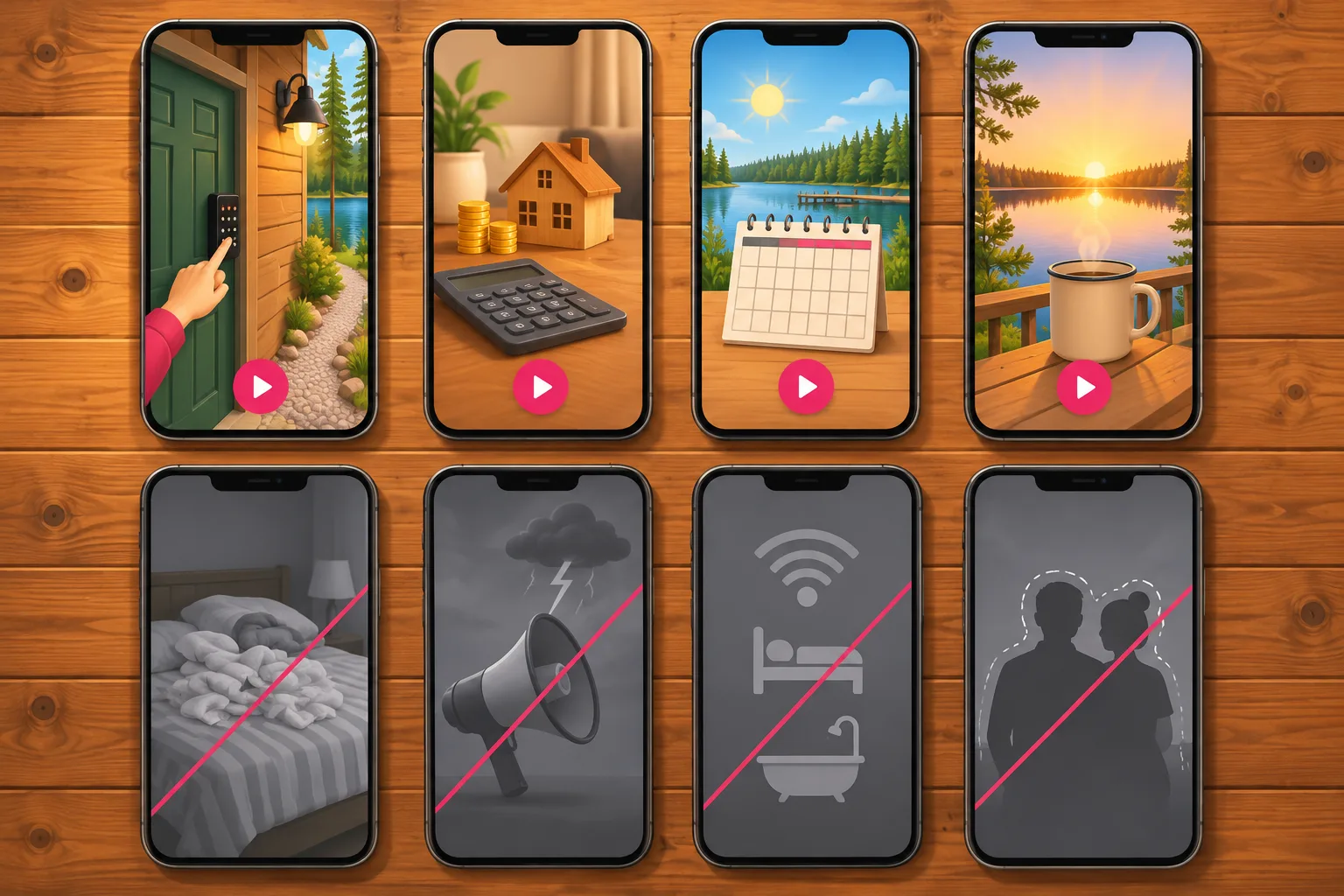
Four videos worth mortgage money
- The arrival. The highway exit, the forty minutes past the last gas station, the gravel, the green door, the code with a hand over the keypad, the kitchen light, the deck, and the total said out loud at the end. It is the conversion video of the whole series because it answers the question every guest is actually asking in the twelve-tabs minute, "is it really like the photos?", by showing her the drive she is about to make. The filming guide has the seven beats. Promoted to two cities in January, it is the single best use of a rental's money.
- The price explainer. June in the kitchen: why a two-night weekend here is about seven hundred dollars. The $240 a night for a house that sleeps six, the $140 cleaning fee that is four hours of Rosa, the county lodging tax, the platform fee, the two-night minimum, said like a person. It is the video that turns "seven hundred dollars for two nights?" in the group chat into "that is a hundred and twenty each." Promoted, the number in it is an advertised price, and section 8 explains why it has to be the total.
- The summer-calendar or holiday countdown. "The summer calendar opens Thursday," "here is what July looks like," filmed during July and posted the following January, or "the holiday weeks open in September." A countdown creates a date to act on, and the first morning cut into it tells her what she is acting for. It runs from the day the calendar opens until the day it fills, and not an hour longer.
- The first morning with the rebook line. The deck at seven, the mug on the rail, the dock, the line "the same week next year is open until the fifteenth." Organically it is the share source, the video one person sends to five. Promoted, it is the one video in the series that sells the rebook to someone who has not stayed yet, by showing her what a rebook is. The ideas guide has eight versions of it.
Four videos that never are
- The guest-shaming clip. "Look what they left." The early-check-in skit, the two-star review read dramatically, the stripped-beds lecture. It performs, because other hosts love it, and it is the single worst thing to put money behind: it makes the woman planning a weekend for six feel judged before she arrives, it trains the algorithm to show your videos to the trade instead of the group chat, and in a paid placement it is your house telling a city of potential guests how it talks about them. The pillar's fifth hook, the permission ("you do not have to strip the beds"), is the version of this video that can be promoted.
- The grievance post. "Nobody reads the house rules." "Here is why we charge a cleaning fee." The organic version grows an audience of other hosts who never book. The promoted version pays to put the lecture in front of the one person who had not heard it yet. The rules are said like a person on the booking page ("quiet after ten because the lake carries sound"), the hard week is said in the honest-week video and never shown, and neither is ever promoted.
- The amenity-list graphic. A slide of icons for wifi, hot tub, king bed, and smart TV on a pretty background is the genre's least-watched format organically, promotion does not change that, and a grid of icons is the frame least likely to make anyone feel the house. If the wifi matters, promote the thirty-second speed test at the desk by the window; if the hot tub matters, it is in the first morning.
- Anything that describes who should rent. "Perfect for couples," "a girls' weekend spot," "great for young families," "an adults-only retreat." Organically it is a weak hook. Promoted, it is a housing ad that describes a person, which is both the kind of ad reviewers decline and the kind of ad fair-housing law was written about. Describe the house. "Sleeps six, two dogs welcome, four stairs to the deck" lets every viewer decide for herself, and it is a better video anyway.
A fifth never, in case it needs saying: no video with a guest in it, promoted or otherwise. The filming guide's rule is that guests are never content, the house is filmed empty by the people who signed, and a guest's own tagged video is reposted only after asking. Section 8 adds the paid corollary.
6. The Mortgage-Money Budget: How Much to Spend, and the Calendar-Is-Full Rule
"How much should we spend?" has a better answer than a flat number. Spend against what the calendar can absorb, start small enough to learn cheaply, and stop when the number you are buying stops moving. And anchor every figure to the ones you already pay without a second thought: the host-only fee, the sponsored-placement bid, and the listing-site subscription.
What the house already spends to be found. The host-only fee runs about fifteen and a half percent of every booking on the largest platform, which on June's weekend is roughly $96, paid whether or not the family ever comes back. A sponsored placement on the site that sells one adds at least five dollars a booked night on top, and more if you want to hold the slot in January. A yearly subscription listing on a smaller site runs several hundred dollars a year and produces a number nobody checks. A host who books thirty weekends a year through the platform is paying it close to three thousand dollars in fees for the privilege of being compared. Those are the budget lines a TikTok campaign is competing with, and together they are a generous one.
The test phase. Roughly $100 to $250 over two or three weeks, behind one proven arrival, shown only to the two cities it was made for, starting the week the summer calendar opens in January. You are not trying to fill July from a test. You are buying an answer to one question: do cold viewers in those cities become followers and booking-page clicks, and within a few weeks, inquiries that answer "how did you find us?" with TikTok? If yes, you have a campaign. If the video earns views and nothing else, the problem is usually the bio without the drive in it, or a booking page without the total for a sample weekend on it. Fix those first; the guests guide covers each one. One mechanical note: Ads Manager has daily minimums (around twenty dollars a day per ad group as of this writing), so a self-run two-week test is a few hundred dollars by construction. A done-for-you service can run smaller.
The working range. Once an arrival proves it converts in its cities, about $300 to $800 across the year's windows (summer in January, the midweek in March, fall in August, the holidays in September) is realistic for a single house, which is to say the fee on four to eight platform weekends. The feed campaign, if it exists, runs on its own budget and is measured against follows and course sales rather than against anyone in the house.
An illustration of the comparison (your numbers will differ)
- •The host fee: about $96 per weekend at fifteen and a half percent, paid whether or not they ever come back, and the family was shown eleven other houses on the way in. Last year it took about thirty weekends through the grid. Nobody knows how many of those families are still thinking about the house.
- •The sponsored placement: at least $10 on top of the fee for each two-night weekend it is credited with, including the weekends that searched for the house by name.
- •The campaign: $300 from the Thursday the summer calendar opened in January to the day it filled in the last week of February, behind the arrival and the calendar countdown, promoted for followers to the two cities. Result: about 340 new followers in those two cities, 70-odd booking-page clicks, and nine weekends in six weeks from people who answered "how did you find us?" with TikTok, four of them direct with no commission.
- •The number that matters: four direct weekends kept about $385 of fees at home, which paid for the campaign before a single platform booking was counted, and two of the nine have already asked about the same week next year. $300 divided by two is $150 per rebook, for a guest worth seven hundred dollars a year for as long as she keeps coming. The platform cannot produce that line, because it never asks whether she came back.
- •The real risk: not overspending. It is spending on an unproven video, on a map that includes the home county, on a caption that describes the guest, or on a campaign that was still running the week the calendar was already full.

The calendar-is-full rule. This is the rental version of a stop rule, and it is the one rule in this guide that sounds strange until you have lived it. A promoted arrival running the week every summer weekend is taken buys you nothing but "sorry, that weekend is booked" replies and a stranger's first impression that your house is the one she cannot have. A promoted countdown running after the calendar filled buys an apology. So the day the calendar fills, before the first check-in, every promoted video is paused. The pillar puts it in the calendar as a date: the summer calendar opens on a Thursday in January and is typically full by late February, and the pause happens the morning it is. The second half of the rule is capacity. Watch one thing every Monday: can the house, the turnover, and the inbox absorb the guests the video is bringing? When Rosa is turning the house twice a week with no gap, when the inquiry that should get an answer within the hour waits a day, when the first stay stops matching the video because the woodstove was not lit and the code was not texted, turn the campaign down. A first-time guest who waited a day for a reply and arrived to a cold house is the guest least likely to rebook, so ads that overfill the calendar are buying the weekend-filled-once at full price.
The manager's version. A manager with thirty doors never pauses the account, because some house is always in a quiet week. The pause happens per house: the ad group for the ridge house stops the day its July fills, the lake-side cabin's midweek campaign keeps running, and the budget is a line on each owner's statement. The manager guide has the wall of house cards that makes the per-house pause possible.
The restart rule. Turn the dial back up before the window, not after the empty weekend. Summer, the midweek, fall color, and the holidays are all visible months ahead. Restart the guest campaign the week each calendar opens, so new followers arrive as the openings do. A cancellation three weeks out is, in advertising terms, the moment to spend a little: the arrival promoted to the nearer city for four days fills a weekend with a family who came for the house rather than for the discount a last-minute listing-site promotion would have needed.
The kitchen-table conversation. Every dollar here came out of the same account as the mortgage, so present it the way the platform statement gets presented: a cost, a result, and a comparison. "We spent $300 in January, gained 340 followers in the two cities, nine weekends came from people who said TikTok, four of them direct, and two have already asked about next year; that is $150 per rebook, against a platform that charges $96 a weekend for a family who may never come back and a sponsored slot that charges on top of it." A spouse or a co-owner who hears that sentence approves August. One who hears "the arrival got 80,000 views" is right to ask what that bought.
7. Timing: The Empty Weeks Before Each Window, Never the Week Before a Holiday
The pillar's rule is that you build in the empty weeks for the full ones, and paid promotion is the sharpest version of it. A guest decides weeks or months before she travels, so the ad runs while she is deciding and stops the day the calendar does. Put the money where the pillar's calendar puts the posting.
- January, for summer. The paid month. The summer calendar opens on a Thursday; the arrival and the calendar countdown start that day in both cities and run until the calendar fills, which for June is usually the last week of February. "Here is what July looks like," filmed the previous July, is the creative. Start the ad review in the first week of January so the housing declaration has cleared before the Thursday.
- March, for the midweek. The work-from-the-deck explainer, the desk by the window, the speed test, the midweek rate, promoted to the nearer city for three weeks. The audience is the person who can work from anywhere and has not thought about where. Smaller budget, longer season, the campaign that fills Tuesdays.
- August, for fall color. The arrival cut with the maple on the road, promoted from the first week of August until the October weekends are gone, which is fast.
- Late April, for Memorial Day. A short run of the arrival to both cities if the holiday weekend is still open, and not a day of it if it is not.
- September, for the holidays. Thanksgiving week, the week between Christmas and New Year's, and the long weekends sell in September, to the family who plans the holidays early. "Here is what January looks like," the quiet-cabin video, runs in early December for the one audience that wants an empty lake.
- The week the guests get home. Not a paid window but a timed one: the first morning posted the week the guests get home with the rebook line, organic, because the audience for that one is the five people in the group chat, and the ad cannot reach them better than a send can.
Never the week before a holiday. The week before Memorial Day, the Fourth, Labor Day, or Christmas is the worst purchase of the year, three times over. Every retailer in the country is bidding for the same family that week and the price of reaching her goes up. The weekend is already booked, by someone who decided in January, so the ad produces "sorry, that one is taken" replies. And the rule in section 6 has already paused everything, because the holiday calendar filled in September. A host who feels the urge to advertise the week before a holiday has a different problem: an open holiday weekend in a year when the holidays were not sold in September, and the answer to that is next September, not this week.
The ideas guide's timing map matches each video to its window, and the growth guide's plateaus include the two that promotion causes: the full-summer plateau, which is a success wearing a flat line, and the July plateau, which is the house being too busy to film what it will need to sell next January.
8. Compliance in Paid Placements: The Total Price, the Permit, Consent, Music, and the Pixel
Everything in the pillar's compliance list still applies. Paid placements add a layer on top, because a promoted video is advertising in the eyes of the platform, an advertised price in the eyes of the agency that wrote the fee rule, a public record in the eyes of the county, a wider disclosure in the eyes of the cleaner in it, and a tracked click in the eyes of whichever page it points at. Take them in the order they can hurt you.
The permit is the first line item
A promoted arrival is a paid announcement, shown on purpose to tens of thousands of adults, that you operate a short-term rental. Before the first dollar, the file has the permit or registration the town requires, the lodging-tax account and who remits it, the short-term rental insurance policy, and the HOA letter if there is one. The pillar tells the story of the city whose registration law took effect in the fall of 2023 and removed the large majority of its listings within weeks; a host who was promoting an arrival in that city the week before had produced the exhibit. Where a registration number is required in listings, it goes in the caption of the promoted video too. And the occupancy in the video is the occupancy on the permit and the insurance: fourteen people in a hot tub rated for six is the promoted clip the insurer finds first. The manager guide keeps the permit roster ahead of the content calendar for exactly this reason.
The promoted number is the total
The federal rule on unfair and deceptive fees took effect on May 12, 2025, and it covers short-term lodging, the platforms, and any advertiser who puts a price in front of a consumer. The number shown most prominently has to be the total, with the mandatory fees in it. So the promoted explainer says "about seven hundred dollars for the weekend," not "$240 a night," and the ridge house in the manager's town is "about fourteen hundred all in for two nights," not "$490." The pillar's what-it-costs-and-why format was built on the idea that the host who explains the total first wins; with money behind it, the total is not just the better video but the lawful one. Two corollaries. The number has to be true on the day the ad runs, so an explainer that ran all of January is true on the last day of February, and a change to the cleaning fee is a new cut, not a caption edit. And the direct booking page the ad points to is bound by the same rule, so the total for a sample weekend sits at the top of it.
TikTok's ad rules
- The housing category. Declared on every rental ad (section 3). No gender targeting, no ZIP-code targeting, adults only, and a caption that describes the house rather than the guest. Treat a reviewer's question about a caption as a note that the caption was about a person.
- Misleading content. The platform bars claims an ad cannot support, and a rental's version is the lens: the arrival shot wide enough that a living room looks twice its size is a promoted claim about the room. Film at eye height with a normal lens, and say the square footage if you say anything. The three-second frame check in the filming guide was written for this.
- Per-ad, per-market approval. Every ad is reviewed individually, and each city is a market. Start the review in the first week of January for the summer window and in the last week of August for the holidays, not the week you want to run.
- Music. A business account uses TikTok's Commercial Music Library, and a promoted video has to be cleared for commercial use. The trending song under the arrival is a rejected ad and a licensing problem at once. The arrival needs no music; the gravel, the door, and the lake are the sound. The filming guide covers the audio.
The address rule gets stricter with money behind it
The filming guide's address rule is that the address never appears on the platform: no street sign, no house number, no mailbox, no keypad digits, no "second cabin past the bridge." A promoted arrival is that rule shown to a hundred times the audience, on purpose, in a city where nobody has a reason to protect you. Re-watch the promoted cut for the road sign reflected in the windshield and the neighbor's mailbox in the turn. The neighbor across the road is never in frame, promoted or not, and the town-meeting test applies with extra weight: a promoted video is the exhibit that says you paid to bring more cars down this road.
Consent to post is not consent to promote
Everyone who appears identifiably in a rental video said yes first: Rosa on the yearly one-page agreement the filming guide describes, the cohost on the same page, the crew lead in the manager's van. Paid promotion adds one step most hosts miss. A yes that covers posting on the property's feed does not automatically cover a paid campaign that puts the same face in front of her neighbors, her other clients, and a hundred thousand strangers for six weeks. So the yearly agreement names paid promotion on its own line, Rosa signs it in January knowing what it means, and she can take that line back by text with the campaign paused the same day. Promotion also goes on the invoice: a turnover that is promoted is a turnover that was filmed for more than the feed, and the money guide's rule that the cohost's Sunday hour is paid applies twice over.
The manager's version runs through the owner. The owner page for each house carries promotion as its own line, the owner signs it separately, she is told which video ran and when, and she can revoke it with a text. Her house is never named with her in the promoted caption either, for the same safety reason as the organic one.
Guests are the case that cannot be fixed with paper. A guest is never content: the house is filmed empty, by the cast, and the indoor-camera ban that took effect in April 2024 is the least of the reasons. A guest's own tagged video, the one she posted of the first morning from the dock, is reposted only after asking, and promoted only after asking a second time in plain words, "may we put money behind this so people in your city see it?", because a yes to a repost is not a yes to a paid placement, and most guests who think about it for a moment will say no, which is the right answer. The simpler path is the one this whole guide points toward: the videos most worth promoting have nobody in them who did not sign in January.
The off-platform line
A promoted TikTok can point to your own booking site, because TikTok is your channel and so is the welcome book in the kitchen drawer. The platform's off-platform rules, which tightened in 2025, govern what you say inside its listing and its inbox and what you do with the guest data it gave you: no link to the direct site in the listing, no steering in the message thread, no marketing to a platform guest's email because the platform gave it to you for the stay. The money guide draws the line in detail. Promotion does not move it; it only makes the direct site busier, which is the point.
The pixel line: measurement without tracking the family
Every ad platform will encourage you to install its tracking pixel so it can count conversions. For a rental, the booking page is the one place it must never go. That page collects the names of everyone in the party, including the children, a phone number and a card, and the two most sensitive facts a family has: where they will be, and the dates their own house will be empty. A woman who typed her kids' names into your booking form at ten at night after watching the first morning should never become a data point in an ad platform's profile of her, or the seed of an audience that follows her around the internet with your cabin's name on it. It is not a risk worth taking to count conversions you can count by asking.
The safe pattern:
- Measure inside TikTok. Followers by city, profile visits, completion rate, saves, sends, and comments are all in the ad dashboard with no pixel at all.
- Keep the booking page clean. No third-party tracking of any kind on the page that collects names, dates, or payment. Check it yourself, because booking software adds trackers quietly, and check again after every update.
- The house page is different. If the direct site has a plain page with the total for a sample weekend, the drive, the rules said like a person, and the map to the town rather than the house, and nothing about the visitor, a pixel can live there and nowhere else.
- The welcome message is the real measurement. "How did you find us?" as the last line of the message that goes out within the hour, tallied by city in the notebook, and the rebook recorded when the August message is answered, beat every pixel for a rental, because they count the only thing that matters: a family at the green door, twice.
None of this is a reason not to advertise. It is the reason to advertise the way this guide describes: measure in the platform, and let the welcome message tell you the rest.
9. The Numbers to See, the Ones to Ignore, and Whether to Run Ads Manager Yourself
Ads Manager will show you dozens of metrics. For a rental, five matter, in this order. The first two are visible inside TikTok while the campaign runs; the last three come from the booking page, the welcome message, and the calendar, and they lag the spend by weeks or, for the one that matters most, by a year.
- Followers gained in the two or three cities, and what each one cost. The leading indicator, and the number that proves the map is right. Followers in the home county are the campaign leaking; followers in a city you did not target are a third ad group waiting to be made.
- Completion rate, saves, and sends on the promoted video. If cold viewers finish the arrival, save the price explainer, and send the countdown, the video is doing its job. The pillar's rule applies to ads too: a save is a woman deciding and a send is a woman who has decided, usually to the friend who said "seven hundred dollars for two nights?" If completion drops sharply from the organic run, the audience is wrong, not the video.
- Booking-page clicks per week during the window. The first number that links spend to the calendar, tallied from the bio link. The guests guide's tracking section builds the notebook around it, and the money guide adds the direct-versus-platform column.
- Inquiries and bookings per month that said TikTok. The number that tells you the bio, the booking page, and the reply within the hour are working, not just the ad. Counted by city, and split direct versus platform, because the direct ones are the fee that stayed home.
- Cost per rebook. The number that matters most: ad spend divided by the guests from TikTok who booked the same week next year or answered the August message with a yes. That is the guest you were paying for. Compare it, in the same notebook, with the cost per rebook from the host fee and the sponsored placement, which for every listing site is a blank line, because nobody there counts whether she came back.
The numbers to ignore are the ones that look best. Total views, total reach, comment volume, and nights booked the week the ad ran are vanity metrics for this work. A flood of "I wish this were near me" on an arrival means the map drifted out of the cities. A campaign that earns 300,000 views and a calendar full of groups who are never heard from again has produced thirty weekends-filled-once with an invoice attached. One that earns 15,000 views, 340 followers in two cities, and nine weekends, four direct and two already asking about next July, has succeeded, even though the first one looks better on the phone on Sunday night. The high-intent signals in the guests guide are the ones to watch while the campaign runs; the rebook is the one to count when it is over.
Ads Manager yourself vs. a done-for-you promotion service
There are two honest ways to run what this guide describes. The right one depends on how much of the Sunday hour the person with the property phone has you want spent inside a media-buying dashboard in the third week of January, with the mortgage money on the line, from a kitchen two hours from the house.
Running Ads Manager yourself makes sense if someone in the family does this for a living, or if you manage several doors and want to watch each house's city ad groups yourself. The cost is time and a learning curve: the housing declaration, objectives, ad group structure per city, bids, daily minimums, per-ad review, and the discipline to move budget away from a city that is not responding while you are also answering inquiries within the hour. Most hosts who try it run one campaign the week before a holiday, get an unclear result, and conclude that TikTok does not book anybody. The job box in the growth guide defines the phone owner's hours down to the Sunday cut, and Ads Manager is not in them, for this reason.
A done-for-you promotion service makes sense if you would rather those hours go to the question log and the turnover-day tripod, or if you are the host with a day job in another city who drives up every other Friday. That is what Viryze is built for. You choose the arrival that has already proven itself. Viryze promotes it as a Spark Ad, so the engagement lands on the property's real account, tests it across several audience combinations inside the cities you named, and moves budget toward the viewers who follow and keep watching, not the ones who just scroll. It is built around follower growth, not raw views, which for a rental whose entire economics is the rebook is the right thing to optimize. Pause it the day the calendar fills, and because measurement happens inside TikTok, nothing about the family who booked the second week of July ever leaves your booking system.
Whichever path you take, the rules stay the same. Promote proof, and only the arrival, the price explainer, the countdown, and the first morning. Run the guest and the feed as two campaigns on two maps, and point the guest one away from home. Spend mortgage money in the empty weeks of January, March, August, and September, pause everything the day the calendar fills, and never put budget behind a stripped bed or a lecture. Say the total. Keep the pixel off the booking page. And check every campaign against TikTok's current ad policies, your permit, your insurance, and the consent of every adult in it before it goes live. If you want the closest parallels from other sectors, our salon advertising guide makes the same case for a business that lives on the rebook and pauses when the book is full, the farm advertising guide is where the sold-out rule comes from and the other place a family drives from a city for a date, and the local business guide covers the drive-radius targeting that a rental turns inside out.
Frequently Asked Questions
Does Airbnb sell advertising to hosts?
Not as of November 2026. Airbnb has no paid placement a host can buy; its chief executive has called sponsored listings an obvious product and said the company is building one, so check the host help center before you rely on this paragraph. What Airbnb sells today is visibility in exchange for a discount: a custom promotion puts a strikethrough price and a badge on the listing, and a new listing gets a temporary ranking lift at no charge. Vrbo is different: in September 2026 it launched Sponsored Listings, an auction where a host bids at least five dollars per booked night for one of the top two search positions and pays only when a booking comes through the ad. Booking.com sells the Visibility Booster, which raises your commission on the dates you choose, and invites top listings into a Preferred Partner tier for a few extra commission points. All of them sell one thing: a better position in a grid of competing houses for a guest the platform keeps. None of them can produce the guest who comes back next July, which is what the rest of this guide is about.
Can you advertise an Airbnb or vacation rental on TikTok?
Yes, and a rental clears ad review more easily than most local businesses, with three things to know first. The rental of a home falls under TikTok's housing, employment, and credit category, so a promoted arrival is declared as a housing ad, which removes gender and ZIP-code targeting and limits the audience to adults; city and metro targeting, which is all a rental needs, still works. The promoted number has to be the total a guest will actually pay, because the federal rule on unfair and deceptive fees covers short-term lodging and any advertiser, so the explainer says about seven hundred dollars for the weekend, not two hundred and forty a night. And a promoted video is a public record that you operate, so the permit, the lodging tax, and the insurance come before the first dollar. Inside those lines the strongest format is a Spark Ad that promotes the arrival already on the property's account, shown to adults in the two or three cities within a Friday-after-work drive, promoted for followers rather than for a booking.
How much should a vacation rental host spend on TikTok ads?
Anchor it to what you already pay to be found, because that is the comparison you are making. The host-only fee on the biggest platform is about fifteen and a half percent of a booking, so a seven-hundred-dollar weekend hands the platform roughly ninety-six dollars of the host's six hundred and twenty, whether or not the guest ever returns. A listing-site auction placement adds at least five dollars a booked night on top of that commission. A TikTok test is smaller: roughly $100 to $250 over two or three weeks in the second half of January behind one arrival that already produces booking-page clicks, shown only to the two or three cities your guests drive from. If it produces followers in those cities, booking-page clicks, and inquiries that answer "how did you find us?" with TikTok, $300 to $800 across the year's windows (summer in January, the midweek in March, fall in August, the holidays in September) is realistic for a single house, with the campaign paused the day the calendar fills. Self-run campaigns in Ads Manager carry a daily minimum of about twenty dollars per ad group, so a two-week test is a few hundred dollars by construction; a done-for-you service can run smaller. Report cost per rebook next to the host fee.
Should I promote a vacation rental TikTok for followers or for bookings?
Followers, every time. A stranger asked to book a seven-hundred-dollar weekend nine seconds after meeting the house will not, and the few who do are the ones who book once and never think of you again. A follower in one of your cities gained in January watches the arrival, then the price explainer, then the honest answer about the stairs and the dog, then the summer-calendar countdown, and by the time she sends the first morning to the group chat she already knows the total, the drive, and the rules. She is the guest who answers the rebook message in August. So choose an objective built around community interaction or profile visits, point the ad at a booking page with the total for a sample weekend on it, and measure the campaign in rebooks rather than in nights booked the week it ran.
Where should TikTok ads for an Airbnb be targeted?
Away from home. A rental is the one local business whose customers never live nearby: nobody books a weekend in their own town, so the audience for the arrival is the two or three cities within a Friday-after-work drive, roughly three hours, and never the home county. Use TikTok Ads Manager rather than the Promote button and pick those cities or metro areas by name, with the age floor at eighteen (a housing ad cannot target by ZIP code, which is fine, because a metro is the right size anyway). Pull the cities from the inquiries and the welcome-message answers as counts, never names, and draw the rings where the guests already come from. The one promoted video that points at the home county is a manager's hiring video for cleaners, because the crew lives there and the guests do not. A feed-path video about hosting goes wider, and only if you sell a course or a cohosting service.
What kind of Airbnb TikTok video should be promoted?
A video that has already earned strong completion, saves, sends, and booking-page clicks on its own, and that hooks on the house rather than the guest. The four that convert most reliably are the arrival from the highway exit to the green door with the total said out loud, the price explainer (why a two-night weekend here is about seven hundred dollars, told in the kitchen), the countdown to the summer calendar opening or the holiday weeks, and the first morning on the deck with the line "the same week next year is open until the fifteenth." Never put budget behind the guest-shaming clip ("look what they left"), the grievance post about early check-in requests, the amenity-list graphic, or anything that describes who should rent instead of describing the house, however well it performs organically. And never a video with a guest in it, whatever they said at checkout.
When is the best time of year to run TikTok ads for a vacation rental?
In the empty weeks, for the full ones. Guests decide weeks or months before they travel, so the summer calendar is sold in January (the campaign starts the week the calendar opens and ends the day it fills), the work-from-the-deck midweek is sold in March, fall color is sold in August, and the holiday weeks are sold in September. The week before a holiday is the worst purchase of the year: every retailer in the country is bidding for the same family, the weekend is already booked, and the one rule that matters has already paused everything, because a host pauses every promoted video the day the calendar fills. A manager with thirty doors pauses per house, not per account, because some house is always in a quiet week.
Can I promote a TikTok video with a guest, the cleaner, or a cohost in it?
A guest, never: guests are not content, promoted or otherwise, and a guest's own tagged video is reposted only after asking and promoted only after asking a second time, because a yes to a repost is not a yes to a paid placement shown to a hundred thousand strangers for six weeks. The cleaner or cohost who appears on purpose signed the yearly one-page agreement that names paid promotion on its own line, so her turnover can be promoted, and she can take that line back by text with the campaign paused the same day. A manager promoting a video of an owner's house needs the promotion line on that owner's page signed and tells the owner which video ran. The simplest path is the one this guide points toward: the videos most worth promoting (the arrival, the price explainer, the countdown, the first morning) are filmed in an empty house by people who signed in January.
An arrival that already fills weekends, and the summer calendar opening in a few weeks?
Viryze takes the video that has already proven itself, promotes it as a Spark Ad to the two or three cities you named, tests audiences, and moves budget toward the viewers who follow and keep watching. Time it for the Thursday the summer calendar opens behind the arrival and the countdown and you reach families while they are still deciding where July goes. Measurement stays inside TikTok, the campaign pauses the day the calendar fills, and you see cost per rebook next to the host fee.
Promote your arrival before the calendar opensRelated Reading
- TikTok for Airbnb Hosts and Vacation Rentals: The Complete 2026 Guide - the two audiences, the rental calendar, and the full compliance list.
- Getting Guests to Book: Turn TikTok Views Into Airbnb Bookings and Rebooks - the booking page, the welcome message, and the tracking habits ads depend on.
- How Airbnb Hosts Make Money on TikTok: Direct Bookings, the Host Course, and the Storefront - the fee that stays home, the price explainer, and the off-platform line.
- TikTok for Vacation Rental Managers and Cohosts: Thirty Doors, One Phone - the per-house pause, the owner's promotion line, and the one video that points home.
- Growing an Airbnb TikTok: From 0 to 10K Followers in the Right Cities - the inverted map and the two scoreboards, before any money is spent.
- Airbnb TikTok Content Ideas: 50+ Video Concepts That Fill the Calendar - where the arrivals, explainers, and countdowns worth promoting come from.
- How to Film Airbnb Videos for TikTok (The Empty House, the Address Rule, the Cohost Agreement & the Property-Phone Rule) - the cast agreement the promotion line is added to, and the address rule.
- Spark Ads on TikTok: Creator's Complete Guide - the mechanics of promoting a video that already lives on your account.