
Most advice about TikTok ads is written for a business spending its own money on a sale. A farm is spending money that came out of the same account as the seed and the feed, on a customer who will not show up in a dashboard until a Saturday in October. That changes what an ad is for, who it should reach, and how you know whether it worked.
It also puts you under rules a hardware store never meets. TikTok lists animals and animal products among the industries it does not advertise, which is awkward when your product stands in a pasture. Wineries and cideries carry alcohol rules on top. The hired hand in your most-watched chore video agreed to appear on your feed, not in a paid placement shown to their cousins. And the parent at supper will, correctly, ask why a hundred dollars went to a social media company when the quarter page in the October paper has already been booked.
Here is the good news. Those constraints make farm advertising on TikTok unusually disciplined, and discipline is what makes it work. You already know which video earns trust, because the stand walk-through has been producing visit-page clicks organically. You know exactly who should see it, because nobody drives more than about forty minutes for a dozen eggs. And the three windows of your year, the patch sold in August, the CSA sold in February, the u-pick sold in April, are on the calendar before the seed catalog arrives.
This is the paid-promotion companion to our complete TikTok guide for farms, and the last piece of the series. The pillar covers the rules of promotion in a section. This guide covers the rest: what each TikTok ad tool can target and how approval works when your product is an animal, how to run the market path and the feed path as two campaigns, which videos deserve seed money, how much to spend and why promotion stops the morning you sell out, why the quiet weeks before each window are the only time to buy, the compliance list that tightens the moment money is involved, the numbers the parent should see, and when to hand the work off.
The short version:
- Promote for followers, never for a one-time visit. A follower watches six weeks of the farm before the patch opens. A stranger who saw one ad is the October crowd that never comes back for strawberries, with an invoice attached.
- Two customers, two campaigns. The Saturday-morning drive radius gets the walk-through and the countdown. The wider ring gets the chore and the explainer, and only if the farm ships. Never blend them.
- Promote the harvest, never the rant. The stand walk-through, the price explainer, the countdown, and the December receipt get budget. The rant, the guilt post, the price-list graphic, and anything that reads as an animal or alcohol listing never do.
- Buy in the quiet weeks, stop the day you sell out. The second half of August, the first weeks of February, and the second half of April are the ad windows of the farm year. The peak weekend is organic only, and a sold-out morning pauses every campaign before breakfast.
- Report cost per second order. Next to the fall newspaper ad, in the same notebook, at supper in November.
What's Inside
- 1. The Math: A Family Back in June vs. a Car in the Driveway in October
- 2. Promote, Spark Ads, and Ads Manager: What Each Can Target, and How Approval Works When Your Product Is an Animal
- 3. Two Customers, Two Campaigns: The Saturday-Morning Drive for the Stand, Wider for the Box
- 4. The Harvest-Not-Rant Rule: Four Videos Worth Seed Money, Four That Never Are
- 5. The Seed-Money Budget: How Much to Spend, and the Sold-Out Rule
- 6. Timing: The Quiet Weeks Before Each Window, Never the Peak Weekend
- 7. Compliance in Paid Placements: TikTok's Industry Rules, Labels, Consent, and the Pixel
- 8. The Numbers the Parent Should See, and the Ones to Ignore
- 9. Ads Manager Yourself vs. a Done-For-You Promotion Service
- Frequently Asked Questions
1. The Math: A Family Back in June vs. a Car in the Driveway in October
Every decision in this guide comes back to two things. What a family who comes back is worth to a farm, and what an October visitor who never returns actually cost you.
What a family who comes back is worth. Start with the number nobody puts in the notebook. A farm with two hundred hens lays somewhere around eighty dozen a week, a forty-share CSA is forty families, and the patch is five weekends. The customer this guide is trying to buy is not a car in the driveway. It is the family that bought a dozen eggs in August, told Maggie at the table to write them down for a standing order, brought the sister-in-law to the patch in October, and renewed the CSA in February. The selling guide's arithmetic is blunt about it: the market path funds the farm, and it funds it through the second order, the standing order, and the renewal. That family is the unit every dollar in this guide is trying to buy.
What an October visit costs. The other side of the ledger is the family that came once because an ad told them to, waited forty minutes for the hay wagon on the busiest Saturday of the year, never heard from the farm again, and bought their strawberries at the grocery store in June. The customers guide calls that the third leak: you got the visit and lost the customer. If an ad produced it, you paid twice: once for the impression and once for the empty row of strawberries in June.
Why this makes advertising a follower purchase, not a visit purchase. The pillar guide's promotion section puts it in one line: you are not buying a visit, you are buying the chance to show someone your farm for a season. A stranger asked to drive out Saturday nine seconds after meeting you mostly will not. A stranger who follows in August watches the walk-through, then the hay wagon being greased, then Dad explaining why the pumpkins are priced by size, then the countdown, and by the last week of September she knows the driveway, the rain rule, and that Maggie is the one at the table. So the objective of every campaign in this guide is local followers and visit-page clicks. The visit comes later, and the second order is the one that counts.
This also changes what a good result looks like. A campaign that puts ninety extra cars in the hay field on the second Saturday of October and six families back in June is not better than one that produces three hundred local followers, twelve first-time families spread across the patch who said TikTok at the table, and five who were back for strawberries. The scoreboard for ads is the same one the customers guide uses: visit-page clicks, first-time customers who said TikTok on the clipboard, and the share who ordered twice. Never cars on opening day.
2. Promote, Spark Ads, and Ads Manager: What Each Can Target, and How Approval Works When Your Product Is an Animal
TikTok gives you three ways to put money behind a video. For a farm the difference between them comes down to two questions: how precisely can each one draw a Saturday-morning drive on a map, and will the ad clear review when there is a heifer in the frame?
The Promote button (inside the app)
Promote is the button under any of your videos. It is quick, it needs no separate account, and it is fine for a cheap test of whether a walk-through holds up in front of strangers. Its weakness is the map. The controls are coarse, and you cannot reliably keep spend inside the forty minutes your customers drive on a Saturday morning. The person with the phone may test with it in a quiet week. Do not run the farm's August campaign on it.
Spark Ads (the format)
A Spark Ad promotes a video that already lives on your account instead of a separate ad creative. It keeps your handle, its comments, its sends, and the follow button, so every bit of engagement lands on the farm's real profile, which for a campaign whose whole goal is followers is the point. For a farm it is the only sensible format. The viewer should meet Maggie at the table, follow, watch six weeks of the farm, and then tap the visit page. A video that looks like a commercial breaks that chain at step one, because the one thing the parent planning a Saturday is afraid of is a tourist trap with a tractor out front. Our Spark Ads guide walks through the authorization code and setup.
Ads Manager (the control panel)
Ads Manager is where Spark Ads get real targeting. In the United States you can pick locations by state, designated market area, county, city, and zip code, set an age floor, and run the same video against several audiences to see which one responds. It is also where the learning curve lives: objectives, ad groups, bids, and a dashboard designed for media buyers rather than for someone who was in the parlor at five. Section 9 covers the alternative. The practical point for now is that map targeting, the feature a farm needs most, lives here.
Approval: the step a hardware store skips
This is the part of the setup that is specific to you. TikTok's advertising handbook for North America sorts industries into prohibited, restricted, and allowed, and lists animals, animal parts, and animal products among the prohibited ones. The rule was written for live-animal sales, fur, and the like, not for a dairy, but the reviewer looking at your ad has thirty seconds and a checklist. A video that reads as a listing ("quarters available, message to reserve," a litter of piglets with a price, a cooler of eggs with a dollar figure on screen) can be rejected, and approval runs per ad and per market, so a video that cleared in one state may not clear in the next. Expect the walk-through to clear. Expect the countdown to clear. Expect the beef-share listing to be rejected, and do not appeal it, because it is the wrong video anyway. Build the review time into the calendar in section 6. A farm that discovers the approval step on September 20 has missed the patch window.
On objectives: the goal is not website conversions, and it is certainly not cars on the day. It is followers, profile visits, and the visit-page clicks that follow, because the visit comes from the bio link after a viewer has watched a few weeks, and because (as section 7 explains) you do not want conversion tracking anywhere near a booking page that asks for a child's name. Choose an objective built around reach, community interaction, or profile visits, and judge the campaign by who follows and what the clipboard says afterward.
3. Two Customers, Two Campaigns: The Saturday-Morning Drive for the Stand, Wider for the Box
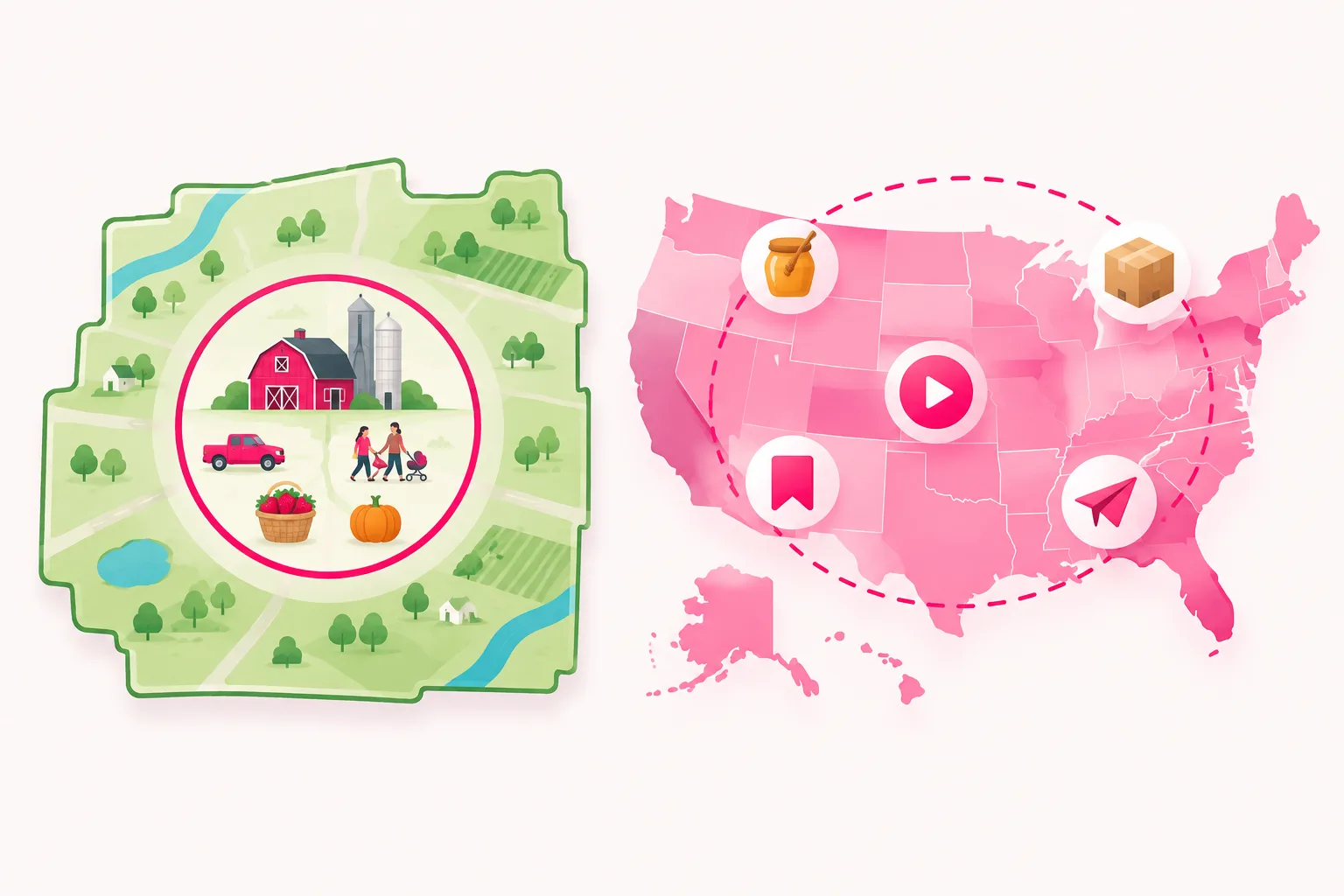
The pillar guide's central idea is that a farm account speaks to two customers. The market customer is local: nobody drives more than about forty minutes for a dozen eggs, a flat of strawberries, or a pumpkin with children in the back. The feed customer is borderless: the woman in Arizona who watches the morning chores with her coffee, the homesteader three states away saving the fencing video, the person who will never pull into the driveway and will happily buy a jar of honey. Organic reach blurs those two customers together. Paid reach is where you finally get to separate them.
The market campaign: the Saturday-morning drive. Target the county, the nearest town, and the metro that your customers actually drive from. Pull the list from the order forms and the clipboard at the stand (counts by zip code, never names) and draw the circle around where the Saturday cars already come from. A viewer ninety minutes away who loves the walk-through is a fan, not a first-time customer. Every dollar that reaches her with "ask for Maggie at the table" is a dollar that did not reach the family twenty minutes away who could be in the driveway this Saturday. This campaign promotes the stand walk-through, the price explainer, the countdown, and the receipt, and it is judged by followers inside the circle, visit-page clicks, and first-time customers who said TikTok at the table.
The feed campaign: the wider ring. If the farm ships, and the feed path is a goal on purpose this year, run it as its own campaign with its own budget and a deliberately wider map: the state, the region, or the country. This campaign promotes the chore and the explainer, which travel anywhere, sends viewers to the profile rather than to a visit page they cannot use, and is judged by follows, saves, sends, and orders on the shipping page, never by anyone in the driveway. Most farms with a Saturday stand should not run this campaign at all, and the growth guide says why: the famous-and-broke plateau is six hundred thousand followers from every state and forty CSA shares unsold in March. Paid reach pointed at the whole country buys that plateau faster.
Why never blend them. Put one budget behind one wide audience and TikTok will spend it wherever views are cheapest, which is almost never your county. You end up with the famous-and-broke farm in paid form: a real bill, a pile of "I wish I lived near you" comments on a video about where to park, and a clipboard count that looks the same as last October. Two campaigns keep two scoreboards honest. And if you are still deciding which customer comes first, the answer the pillar gives holds for ads too: market first unless you ship, say the county in the bio, and let each video make one ask.
The twist your sector gets. For a dentist, a follower four states away is waste. For a farm that ships honey, maple, wool, or seeds, that follower is a customer who buys what fits in a box, counted on the shipping page and never confused with the stand. Just make sure the promoted chore never ends with "come see us Saturday." It ends with the chore. And the feed campaign never promotes anything that could be read as an animal-product listing, which rules out the egg cooler, the freezer, and the lambs, however well they perform at home.
More than one door. A farm with a Saturday stand on Route 9 and a Wednesday booth downtown runs one ad group per door, not one campaign for the farm, because the stand that sells out of eggs by ten and the booth that goes home with half a cooler need opposite things from the same August. The customers guide has one walk-through per door for exactly this reason, and the one you promote for each ad group is the one for that door. The agritourism farm draws the circle around the hay field, not around the farmhouse, and promotes the parents' walk-through with the bathrooms in it.
Age, and the third audience. Set the age floor at eighteen. A video about the goats at the fence still targets adults, because the person who decides where a four-year-old spends Saturday is a parent, and the agritourism guide adds one line: never a video with a visitor's child in it. And remember who else lives inside your circle: the other farms. A promoted price explainer will reach the dairy two roads over and the orchard down the highway, and the only thing it should ever say about them is nothing. Section 4 explains why the rant is never promoted, and section 7 explains why a promoted claim about your beef is now an advertising claim.
Interests, and when they help. On the market campaign, skip interest targeting. It shrinks an already county-sized audience to a sliver, and the walk-through finds the family that was already thinking about a Saturday drive inside any zip code without your help. On the feed campaign, a broad food, gardening, or homesteading interest can reasonably narrow a national audience, but let it stay broad. Let geography do the narrowing and let the video do the sorting.
4. The Harvest-Not-Rant Rule: Four Videos Worth Seed Money, Four That Never Are
Promotion multiplies what already exists. A video people scroll past organically will be scrolled past by a bigger, more expensive audience. So the first filter is proof: the video has already earned strong completion, saves, sends, and real questions in the comments, and ideally you can trace at least one visit-page click or one "I saw you on TikTok" at the table back to it. The second filter is specific to your sector: it has to hook on the harvest, never the rant, because ad review and the parent planning a Saturday both punish the scold. Four kinds pass both filters reliably.
- The stand walk-through. From the turn on Route 9 (say the landmark, never show the mailbox) to the white gate, the fence to park along, Bess, the table, cash or card, and Maggie by name. This is the video that answers the question under every visit not made (is it weird to just show up?), and it is the single best use of a farm promotion budget. It converts cold viewers because it proves the welcome before anyone has asked them for anything. The content ideas guide has a version for every door, and the one you promote is the one for the door you most want to fill: the patch in August, the stand in May, the CSA pickup in February.
- The price explainer. Dad in the henhouse, the seven-dollar dozen named in the first sentence, and then what it costs to have eggs here next year too. It is your expertise in action, it travels to the feed customer without losing the market customer, and it is the video most likely to be sent to the exact spouse who said "seven dollars for eggs?" The selling guide calls the price explanation the whole sale, and a promoted one has one extra rule: the number has to still be true in week six. Keep it kind: explain your price, never the grocery store's.
- The countdown. "Nineteen days until the strawberries." The season marker that counts real things, says the hard part before opening day, ends with the date and the hours and nothing else, and stops on opening day. It is the one series nobody else in your county can run, and it is the reason to follow that a promoted video needs: the viewer who follows at day nineteen is reminded eighteen more times without you paying for any of them. Promoted to the drive radius four to six weeks out, it is the video that fills the first Saturday with people who already know the rain rule.
- The December receipt. What this year's customers made possible: the new fence line, the second hoop house, the hired hand kept on through the winter, told in counts and never in revenue, with no ask attached. The selling guide ends it with "shares go on sale for members on the twenty-sixth," which is why it is the only money video that ever gets budget: promoted to the drive radius in the middle two weeks of December, it tells the county this farm is busy and honest a week or two before the CSA opens.
Four kinds of video should never get budget, however well they seem to perform.
- The rant. The grocery-store takedown, the orchard down the road that buys its apples wholesale, the people who think food comes from a truck. It is the strongest hook in the genre and the worst ad. It travels, fills the comments with people who came to argue, makes the parent feel lectured before she arrives, trains the algorithm to show your kind videos to the fight crowd, and the moment it names the other farm it is a comparative claim in a paid placement, which section 7 explains is a different legal animal. Conviction can be the fourth sentence of a promoted video. It can never be the hook.
- The guilt post. "Farms are dying, buy local or else." A guilt customer buys once, and a promoted guilt post buys a crowd of once-customers at full price. The pillar's rule stands: the hard day is said, not shown, never a sad song, never an ask, and never promoted.
- The price-list graphic. A list of prices on a pretty background is the genre's least-watched format organically, promotion does not change that, and a dollar figure over a cooler of eggs is the exact frame most likely to read as a listing to a reviewer. If the price matters, promote the sixty-second explainer of why the eggs cost that, and let the prices live on the visit page.
- Anything that reads as an animal, animal-product, or alcohol listing. The piglets with a price, "two quarters left in the freezer," the turkey reservation form held up to the camera, the cider with a bottle shot and a tasting-room time. Each one is an organic video the selling guide already tells you to replace with an explainer, and each one is a paid placement that runs into TikTok's industry rules the moment money is attached. Promote the explainer behind the product. Never the product.
And one video that is never promoted whatever the organic numbers say: anything with a child in it, yours or a visitor's. The filming guide allows some of those organically with a per-use yes from a parent. None of them is ever promoted, because a paid placement puts a named child from a named farm on a named road in front of every adult in the county, and no release makes that wise.
If you do not yet have a proven walk-through, you do not yet have anything to promote. A season of posting from the ideas guide and the filming guide comes before the first dollar, and the growth guide's seven signals tell you when a video has earned it. Saves and sends above everything.
5. The Seed-Money Budget: How Much to Spend, and the Sold-Out Rule
"How much should we spend?" has a better answer than a flat number. Spend against what the stand and the field can absorb, start small enough to learn cheaply, and stop when the number you are buying stops moving. And anchor every figure to the ones the parent already approves without a second thought: the fall newspaper ad, the farm-trail listing, and the sign on the highway.
What the farm already spends. Published rate cards for small weekly papers put a quarter page somewhere around $140 to $250 an insertion, so the three October weeks most patches book is roughly $450 to $750, and it produces a number nobody can check: however many families, if any, mentioned the paper at the gate. A listing on the county farm trail or the state agritourism map runs about $45 to $300 a year depending on the association. A state tourist-oriented directional sign on the highway runs roughly $50 to $400 a year per sign plus a few hundred dollars to fabricate it, and in some states it is only available to farms open five days a week. Those are the budget lines a TikTok campaign is competing with, and together they are a generous one.
The test phase. Roughly $100 to $250 over two or three weeks, behind one proven stand walk-through, shown only to the drive radius it was made for, in the second half of August. You are not trying to fill the patch from a test. You are buying an answer to one question: do cold viewers inside the circle become followers and visit-page clicks, and within a few weeks, first-time families who say TikTok at the table? If yes, you have a campaign. If the video earns views and nothing else, the problem is usually the bio without the county in it, or a visit page without the sellout time and a named person on it. Fix those first; the customers guide covers each one.
The working range. Once a walk-through proves it converts on its map, about $300 to $800 across the year's three windows (the patch in August, the CSA in February, the u-pick in April) is realistic for a farm with a Saturday stand, which is to say about what the newspaper costs for one October. The receipt gets its own small run in mid-December. The feed campaign, if it exists, runs on its own budget and is measured against follows and shipping orders rather than against anyone in the driveway.
An illustration of the comparison (your numbers will differ)
- •The newspaper: about $600 for a quarter page in three October issues of the county weekly. Result: unknown, because nobody asked at the gate.
- •The campaign: $400 from mid-August to the first week of September behind the patch walk-through and the countdown, promoted for followers to the Saturday-morning drive. Result: 310 new local followers, 52 visit-page clicks, twelve first-time families across the five patch weekends who said TikTok at the table.
- •The number that matters: five of those twelve families were back for strawberries in June, and two of them are on the egg list. $400 divided by five is $80 per second order. The newspaper cannot produce the same line.
- •The real risk: not overspending. It is spending on an unproven video, on a map that reaches the next county, on a listing that gets rejected, or on a campaign that was still running the Saturday the field was picked clean.
The sold-out rule. This is the farm version of a stop rule, and it is the one rule in this guide no other business needs. A promoted u-pick video running the week the field is picked over buys you nothing but apologies in the DMs. A promoted CSA explainer running after the fortieth share sold buys a refund and an apology. So the morning you sell out, before the chalkboard goes up, every promoted video is paused. The agritourism guide puts it in the Saturday routine: the sold-out announcement and the pause happen in the same five minutes. The second half of the rule is capacity. Watch one thing every Monday: can the stand, the hay wagon, and the people at the table absorb the families the video is bringing? When the eggs are gone by nine instead of ten, when cars are parking on the road instead of along the fence, when Maggie cannot get to the clipboard, turn the campaign off. A first-time family that drove forty minutes to an empty cooler is the family most likely never to come back, so ads that overfill the driveway are buying the October crowd at full price.
The restart rule. Turn the dial back up before the window, not after the empty Saturday. The CSA opening on December 26, the u-pick in June, the first stand Saturday in May, the turkey form by October 1, and the patch at the end of September are all visible months ahead. Restart the market campaign three to six weeks before each, so new families arrive as the strawberries do. Adding a second door, the Wednesday booth or a farm stay, is, in advertising terms, the moment to spend more.
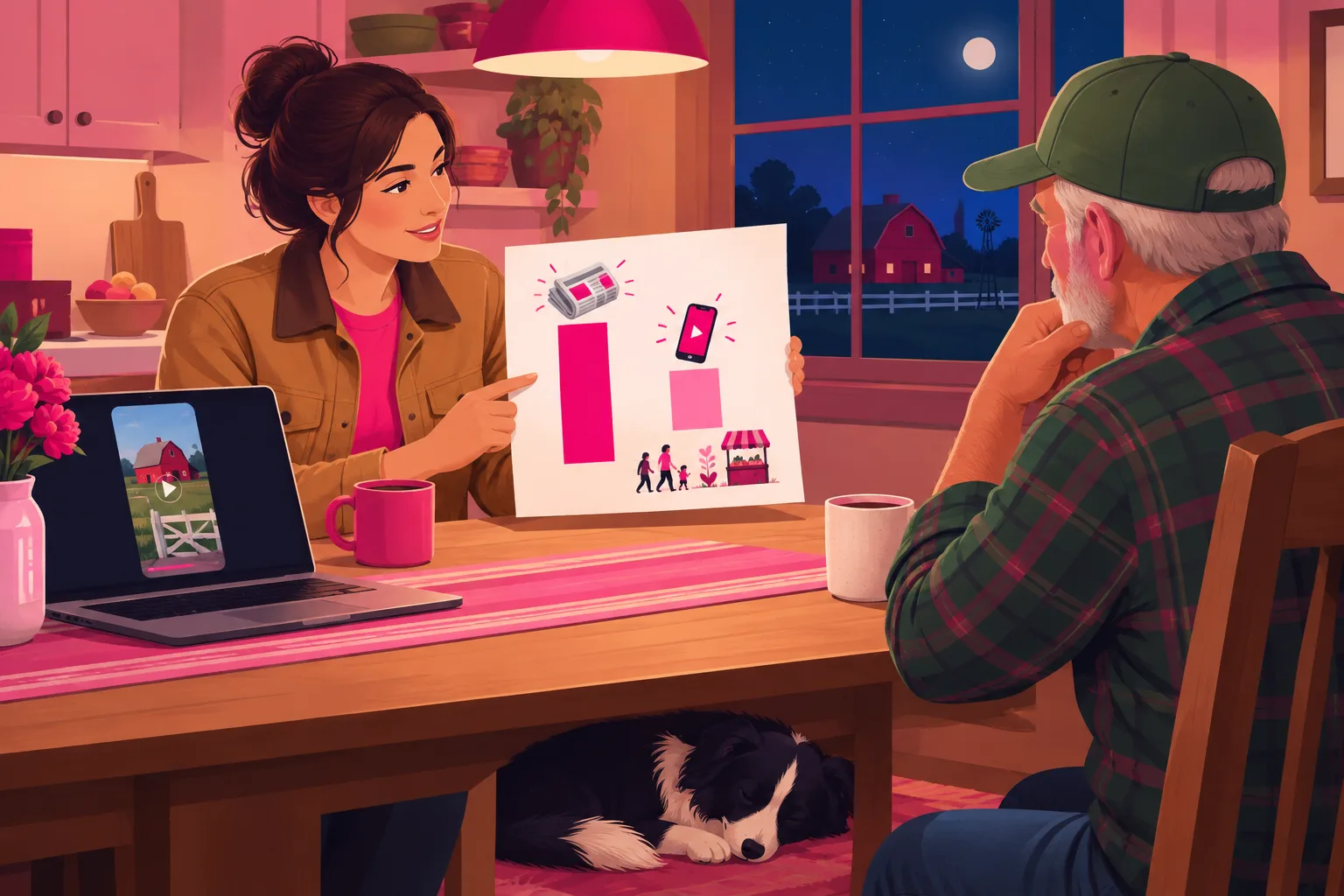
The supper conversation. Every dollar here came out of the same account as the seed, so present it the way the newspaper ad gets presented: a cost, a result, and a comparison. "We spent $400 in August, gained 310 local followers, twelve first-time families told us TikTok at the table, and five of them have been back; that is $80 per second order, against a newspaper ad we cannot measure at all." A parent who hears that sentence approves February. A parent who hears "the video got 80,000 views" is right to ask what that bought.
6. Timing: The Quiet Weeks Before Each Window, Never the Peak Weekend
Your sector has something almost no other has: the customer decides weeks before the Saturday, and the Saturdays are printed on the calendar a year in advance. The patch is five weekends, the u-pick is three, the CSA sells in one month, and the parent planning each one is quietly deciding in the weeks before. That makes the farm year the most predictable set of waves in any vertical, and it makes timing the most powerful lever in this guide.
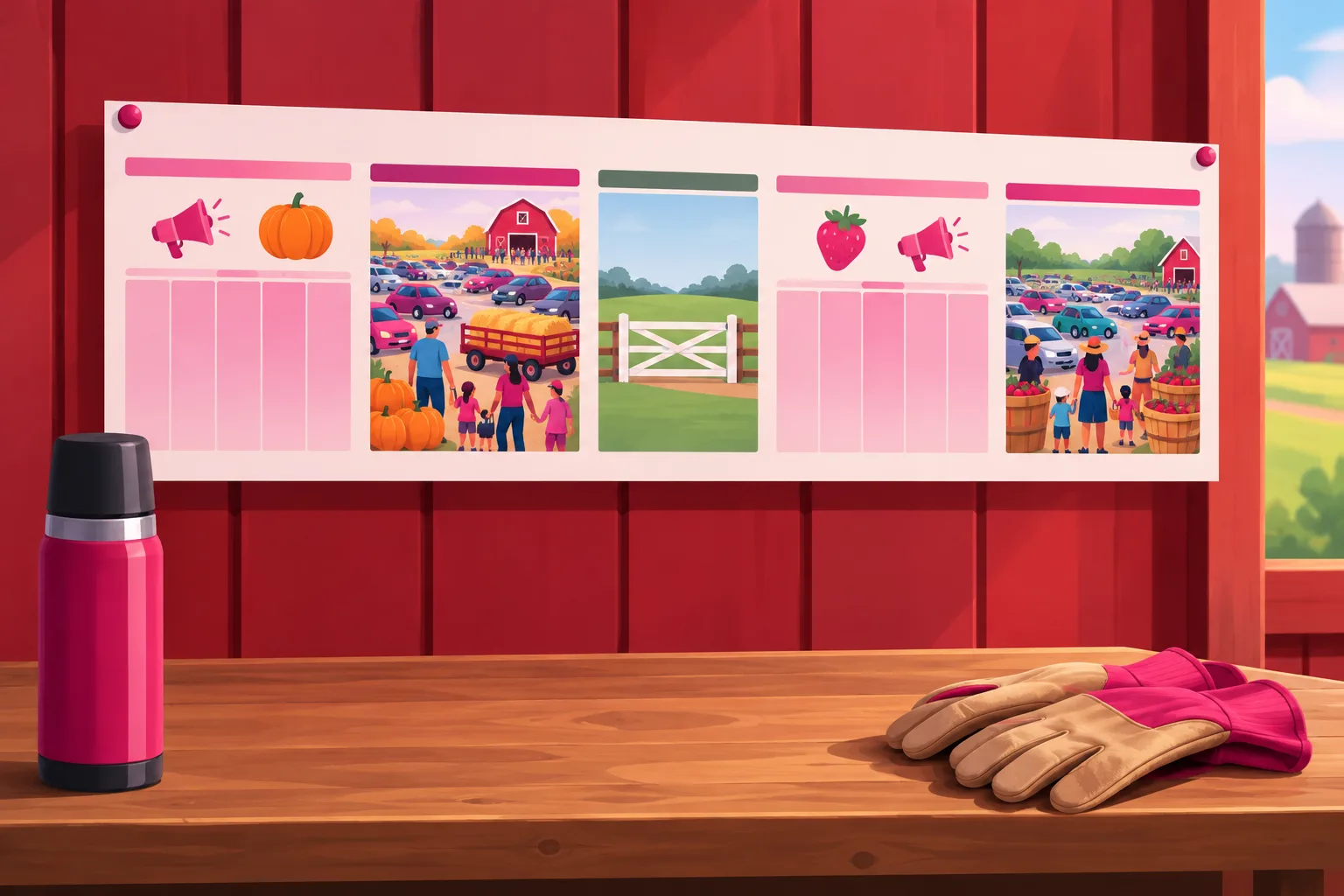
Build in August, run from mid-August to the first week of September. The patch opens at the end of September, and the parent decides in the weeks before, not on the day. So the campaign runs from about August 15 to September 7 behind the proven patch walk-through, with the countdown taking over the budget for the final two weeks of the run, four to six weeks out from opening day. A family that follows in late August sees the hay wagon greased, the goats moved to the fence, the rain rule said out loud, and the countdown eighteen times before they decide where to go on the first Saturday, and arrives already knowing the bathrooms exist. There is a second reason to go early. From the last week of September on, every orchard, corn maze, and retailer with a fall sale is bidding for the same family, the auction gets crowded and expensive, and the same budget buys a fraction of the reach it bought in August. Amplify before the wave, not during it. The pillar's calendar and the three windows in the agritourism guide map the organic side of the same weeks.
The patch weekends themselves, organic only. Those are the days to run the hay wagon, not to buy. Your followers, the regulars who sent the walk-through to a sister-in-law, and the county that saw it in August are the audience, and they are free. Spending on the second Saturday of October is paying the most expensive rate of the year to reach people at the moment they have already decided, and if the morning sells out, the sold-out rule has already paused everything anyway.
The week after the last weekend, for the second order. The one exception inside the quiet period is the "see you in June" filmed by Dad and Maggie at the gate at dusk on the last patch Saturday, promoted to the drive radius only, for the single week after the patch closes. It reaches the families who were in the hay field with proof that the farm exists in a quieter month, it is pinned from November to May, and it is the cheapest week of the fall to buy attention, because every orchard has stopped. Pair it with the one text in late May to everyone who left a number, and the two together are how the October crowd stops vanishing.
February, the same shape in winter. The receipt goes up in the second or third week of December, the first CSA post on December 26 for members, and the February window runs members first, then the waitlist, then the public in the third week. The campaign runs from the first day of February through the public week behind the pickup walk-through and the week-by-week box video, never behind the share listing itself. It is paused the morning the fortieth share sells, and in the illustration the selling guide uses, that is February 20 with eight shares left and ten days to go. The CSA campaign reaches the family that bought eggs in August, which is the whole point of having bought that family in August.
April, for the strawberries. The u-pick walk-through, re-filmed the week before each window so the gate and the rows match, runs from about April 20 to mid-May, with the countdown taking over inside the six-week mark and stopping on opening day, which is the first Saturday in June. A family that follows in late April watches the blossoms, the first green berry, the day count, and the "picked over by noon, come early or come Wednesday" line enough times to arrive at eight.
Mid-December, for the receipt. The third and smallest window is the second and third weeks of December, once the receipt is up. The receipt video, promoted to the drive radius, tells the county this farm is busy and transparent before anyone has thought about a CSA, and a local follower gained in December sees the December 26 post and the February explainer after that. The selling sequence keeps the ask on the form; the ad only ever carries the receipt.
Harvest mode is real for ads too. The fridge page says the farm posts less in harvest mode, and the ad account follows it. No campaign is launched, adjusted, or appealed between the last week of September and the end of the patch, or in the first two weeks of the u-pick, because nobody has the hour, and because the only decision that needs making in those weeks is the sold-out pause, which takes five minutes. Build the review time in before harvest mode, not during it.
The unplannable week, never promoted. When the barn burns down the road, when the storm takes the hoop house, when the county needs a straight answer about the recall or the outbreak in the news, the organic same-day plan does the work: one person at the gate, said once, no music. Do not put budget behind it. It fails the harvest rule, the auction is flooded with every organization in the category that week, and the attention it buys is the attention least likely to be in the driveway. Promote the walk-through a month later instead, when the county is ready to come out.
7. Compliance in Paid Placements: TikTok's Industry Rules, Labels, Consent, and the Pixel
Everything in the pillar's compliance list still applies. Paid placements add a layer on top, because a promoted video is advertising in the eyes of the platform, an advertising claim in the eyes of the agencies that police the words on your label, a wider disclosure in the eyes of the hired hand in it, and a tracked click in the eyes of whichever form it points at. Then there is a fifth issue most farms have never thought about, and it involves the booking page that asks how old the kids are.
TikTok's ad rules
- Animals, animal parts, and animal products. TikTok's North America ad handbook lists the category among its prohibited industries, written for live-animal and fur sales, and pet-care products are treated differently from the animals themselves. For a farm the working rule is the one the pillar gives: promote the farm and the follow, never the listing. The heifer on day 41 in a countdown clears. The heifer with a price does not. If a reviewer rejects a walk-through because the cooler is in frame, re-cut the walk-through rather than argue; the table with Maggie behind it is the video anyway.
- Alcohol, for the orchard with a cidery and the farm with a tasting room. Alcohol is a restricted industry. In the United States trade coverage of TikTok's 2024 policy change puts the targeting floor at 25 and over for any ad that features or promotes alcohol, ads carry a responsible-drinking standard, and in some markets documentation is part of review. The hard cider gets its own campaign with its own age floor, or it stays organic. The patch walk-through that pans past the tasting-room sign is a judgment call a reviewer may make against you, so film the patch version without it.
- Hemp and CBD. Ingestible hemp products are not allowed in ads, and the non-ingestible ones that may be allowed in some markets go through a sales representative rather than self-serve. The hemp field is a chore video, never a promoted one.
- Per-ad, per-market approval. Every ad is reviewed individually, and a video that clears in one market may not in another. Start the first review in early August for the patch and in early January for the CSA, not the week you want to run.
- Music. A business account uses TikTok's Commercial Music Library, and a promoted video has to be cleared for commercial use. The country song under the drone flyover is a rejected ad and a licensing problem at once. The walk-through needs no music. The countdown needs the rooster.
The words on the label are now the words in an ad
- Label claims. The pillar's rule that the words on the label are the words in the video gets stricter with money behind it, because a promoted claim is advertising. "Organic" has rules behind it (above a small sales threshold it needs certification, and an exempt farm cannot use the seal), and "grass-fed," "pasture-raised," and "raised without antibiotics" are documented label claims. Say what you actually do in plain words, in the promoted explainer as in the organic one, and the review is the easy part.
- The comparative claim. "Fresher than the grocery store" in a promoted video is a claim about someone else's product, and "unlike the orchard down the road" names them. Comparative advertising has its own body of rules and its own kind of letter from a lawyer, and nothing about your eggs needs either. Explain your price. Never theirs.
- Live-animal shares. The selling guide explains why the farm sells the live animal by the share, and that some states and Extension offices are specific about how a share may be advertised (a price per pound of live or hanging weight, not a price per pound of meat). A promoted video is advertising by any reading, so the beef explainer that gets budget says the three numbers the selling guide lists and never a price per pound of beef.
- True on the day it runs. If the promoted walk-through says Maggie is at the table and the eggs are usually gone by ten, that is true in week six. If the countdown says the first Saturday in June, the field opens the first Saturday in June. A video that ran for a whole August has to be true on opening day.
- Keep a copy. Save the video, the caption, the targeting, the dates, and the spend for every campaign. The parent, the accountant at tax time, and the market manager who asks what you are telling people may each want it, and the supper report in section 8 is built from the same file.
Consent to post is not consent to promote
Every adult who appears identifiably in a farm video has signed the once-a-year family and cast agreement the filming guide describes, and the hired hand and any seasonal crew were asked in their own language, away from the crew, by someone other than the supervisor, with a yes that was never a condition of the job, the housing, or next season. Paid promotion adds one step most farms miss. A yes that covers posting on the farm's feed does not automatically cover a paid campaign that puts the same face in front of their cousins, their last employer, and a hundred thousand strangers for six weeks. If you ever want to promote a video with the hired hand in it, the agreement has to name paid promotion in its own checkbox, they have to understand that is what they are signing, and they have to be able to withdraw it with the campaign stopped the same day. Dad and Maggie, who appear in the walk-through and the price explainer as the people at the table, sign that line each winter with the cast agreement. Everyone else is asked again.
Some people should never be in an ad regardless of what they or anyone else signs: children, yours or a visitor's; a customer who said yes at the table, because yes at the table is yes to the feed; the regular who answered the driveway question in the parking row; and anyone whose immigration, housing, or health circumstances the video would reveal. The simpler path is the one this whole guide points toward. The videos most worth promoting (the walk-through, the price explainer, the countdown, the receipt) have nobody in them who did not sign in January, which is why the high-intent list in the customers guide is built that way.
The pixel line: measurement without tracking the family that booked the farm stay
Every ad platform will encourage you to install its tracking pixel so it can count conversions. For a farm, the farm-stay booking page that asks for the names and ages of the children, the CSA sign-up with a home address on it, and the order form with a phone number are the places it must never go.
The reason is partly the law and mostly the person. A booking form that collects a child's name and age is exactly the kind of page where children's privacy rules and a third-party tracker should never meet, and the family that typed it in at ten at night after watching your lambing video should never become a data point in an ad platform's profile of them, or the seed of a retargeting audience that follows them around the internet with your farm's name on it. The pillar's rule that visitors are never content has a paid-placement corollary: they are never data either. It is not a risk worth taking to count conversions you can count with a clipboard.
The safe pattern:
- Measure inside TikTok. Followers, profile visits, completion rate, saves, sends, and comments are all in the ad dashboard with no pixel at all.
- Keep the booking and order pages clean. The farm-stay booking page, the CSA sign-up, and the turkey reservation form carry no third-party tracking of any kind and no source line. Check them yourself, because booking plugins and form builders add trackers quietly, and check again after every website update.
- The visit page is different. It has hours, the driveway, and the dog on it, and nothing about the visitor. If you do use a pixel anywhere, keep it there and nowhere else, and keep it off the shipping page too, because a jar of honey is not a conversion you are buying with the stand campaign.
- The clipboard is the real measurement. "How did you hear about us?" asked as a question in the natural pause, a TikTok tally column on the clipboard, counted by Maggie on Saturday afternoon, beats every pixel for a farm, because it counts the only thing that matters: a family at the table.
None of this is a reason not to advertise. It is the reason to advertise the way this guide describes: measure in the platform, and let the clipboard tell you the rest.
8. The Numbers the Parent Should See, and the Ones to Ignore
Ads Manager will show you dozens of metrics. For a farm, five matter, in this order. The first two are visible inside TikTok while the campaign runs; the last three come from the visit page, the clipboard, and the order book, and they lag the spend by weeks or, for the one that matters most, by a season.
- Followers gained inside the drive radius, and what each one cost. The leading indicator. For the market campaign, that means followers in your county and the ones next to it. For the feed campaign, any follower counts, because the chore travels.
- Completion rate, saves, and sends on the promoted video. If cold viewers finish the walk-through, save the price explainer, and send the countdown, the video is doing its job. The selling guide's rule applies to ads too: a save is a family deciding and a send is a family that has decided. If completion drops sharply from the organic run, the audience is wrong, not the video.
- Visit-page clicks per week during the window. The first number that links spend to the driveway, tallied from the bio link. The customers guide's tracking section builds the notebook around it.
- First-time customers per month who said TikTok at the table. The number that tells you the bio, the visit page, and the person at the table are working, not just the ad. Counted by product, so the patch, the stand, and the CSA each get their own line.
- Cost per second order. The number that matters most: ad spend divided by the families from TikTok who ordered twice, whether that is a standing egg order, a second visit through a different door, or a renewal. That is the family you were paying for. Compare it, in the same notebook, with the cost per second order from the newspaper ad, the farm-trail listing, and the highway sign, which for most farms is a blank line, because nobody counted.
The numbers to ignore are the ones that look best. Total views, total reach, comment volume, and cars in the hay field on the second Saturday of October are vanity metrics for this work. A flood of "I wish there were a farm like this near me" on a walk-through usually means the market campaign drifted out of the county. A campaign that earns 300,000 views and ninety extra cars on one October Saturday that were never seen again has produced the October crowd with an invoice attached. One that earns 15,000 views, 310 local followers, and twelve first-time families, five of whom came back for strawberries, has succeeded, even though the first one looks better at supper.
Keep the tally the way the customers guide describes it: a TikTok column on the clipboard, a quarterly count backwards from second orders, and the one sentence that wins supper ("Twelve first-time families this fall said TikTok at the table, and five of them have been back"). The monthly report the person with the phone already gives carries those three numbers; an August campaign simply adds a spend line and the newspaper beside it. That comparison is the whole case for or against the channel, and it is the only version of the supper conversation you should ever have.
9. Ads Manager Yourself vs. a Done-For-You Promotion Service
There are two honest ways to run what this guide describes. The right one depends on how much of the four hours a week the person with the phone has you want spent inside a media-buying dashboard in the middle of August, with the seed money on the line.
Running Ads Manager yourself makes sense if someone in the family does this for a living, or if you run several doors and want to watch each radius as its own ad group. The cost is time and a learning curve: industry review, objectives, ad group structure, bids, per-ad approval, and the discipline to move budget away from an audience that is not responding while the hay is down. Most farms that try it run one campaign the week before the patch opens, get an unclear result, and conclude that TikTok does not sell anything. The job box in the growth guide deliberately leaves Ads Manager out of the phone owner's four hours for this reason.
A done-for-you promotion service makes sense if you would rather those hours go to the five o'clock capture and the question log. That is what Viryze is built for. You choose the walk-through that has already proven itself. Viryze promotes it as a Spark Ad, so the engagement lands on the farm's real account, tests it across several audience combinations inside the radius you drew, and moves budget toward the viewers who follow and keep watching, not the ones who just scroll. It is built around follower growth, not raw views, which for a farm whose entire economics is the second order is the right thing to optimize. Pause it the morning you sell out, and because measurement happens inside TikTok, nothing about the family that booked the farm stay ever leaves your website.
Whichever path you take, the rules stay the same. Promote proof, and only the walk-through, the price explainer, the countdown, and the receipt. Run the market and the feed as two campaigns on two maps. Spend seed money in the quiet weeks of August, February, and April, pause everything the morning you sell out, and never put budget behind a rant or a listing. Keep the pixel off the booking page. And check every campaign against TikTok's current ad policies and industry rules, your label claims, and the consent of every adult in it before it goes live. If you want the closest parallel from another sector, our church advertising guide makes the same two-campaign argument with a connect card instead of a clipboard, the nonprofit advertising guide does it with a donor file, and the local business guide covers the drive-radius targeting side of the market path.
Frequently Asked Questions
Can a farm advertise on TikTok?
Yes, with one rule most businesses never meet. TikTok's advertising handbook for North America lists animals, animal parts, and animal products among its prohibited industries, rules written for live-animal and fur sales, and ads are reviewed one at a time and market by market. So a farm promotes the farm and the follow, never a listing: the stand walk-through, the price explainer, the countdown to the patch, and the December receipt all clear, while a video that reads as an offer for a litter of piglets, a beef quarter, or a dozen eggs may not. Wineries and cideries carry alcohol rules on top (25+ targeting and review), and hemp is restricted outright. Inside those lines the strongest format is a Spark Ad that promotes a video already on the farm account, shown to people within a Saturday-morning drive of the gate and promoted for followers rather than for a one-time visit.
How much should a farm spend on TikTok ads?
Anchor it to what the farm already spends on the fall newspaper ad, the farm-trail listing, and the highway sign, because that is the comparison the parent at supper is already making. Published rate cards put a quarter page in a small weekly at roughly $140 to $250 an insertion, so three October weeks is somewhere around $450 to $750; a farm-trail or agritourism-map listing runs about $45 to $300 a year; a state highway sign is roughly $50 to $400 a year per sign plus fabrication. A TikTok test is smaller: about $100 to $250 over two or three weeks in the second half of August behind one stand walk-through that already produced visit-page clicks, shown only to the drive radius. If the test produces local followers, visit-page clicks, and first-time families who say TikTok at the table, $300 to $800 across the year's three windows (August for the patch, February for the CSA, April for u-pick) is realistic for a farm with a Saturday stand, with every promoted video paused the morning you sell out. Report cost per second order next to the newspaper ad in November.
Should a farm promote a TikTok video for followers or for a visit?
Followers, every time. A stranger asked to drive out Saturday nine seconds after meeting the farm mostly will not, and the few who do are the October crowd that never comes back for strawberries. A local follower gained in August watches six weeks of the farm before the patch opens: the walk-through, the hay wagon, the honest answer about the price, the countdown. By the time the gate opens she already knows the driveway, the rain rule, and who is at the table, and she is the family most likely to be back in June. So choose an objective built around community interaction or profile visits, point the ad at a visit page with a named person on it, and measure the campaign in second orders rather than in cars on opening day.
How do I target TikTok ads to people near my farm?
Use TikTok Ads Manager rather than the Promote button and draw the audience to a Saturday-morning drive. In the United States Ads Manager can target by state, designated market area, county, city, and zip code, so a farm can show its walk-through only to the county, the nearest town, and the metro forty minutes away, with the age floor at eighteen. Pull the zip codes from the order forms and the clipboard at the stand (counts, never names) and draw the circle where the customers already come from, because nobody drives more than about forty minutes for a dozen eggs with children in the back. Skip interest targeting on the market campaign; geography does the narrowing and the video does the sorting. A very small set of zip codes raises the cost per result, so start with the whole metro and tighten only if the clipboard says to.
What kind of farm TikTok video should be promoted?
A video that has already earned strong completion, saves, sends, and visit-page clicks on its own, and that hooks on the harvest rather than the rant. The four that convert most reliably are the stand walk-through (from the turn on Route 9 to the table, with the named person), the price explainer (why the eggs are seven dollars, told in the henhouse), the countdown to the patch or the u-pick field, and the December receipt that shows what the year's customers made possible. Never put budget behind the rant about the grocery store or the farm down the road, the guilt post, the price-list graphic, or anything that reads as a listing for an animal, an animal product, or alcohol, however well it seems to perform.
When is the best time of year for a farm to run TikTok ads?
The quiet weeks before each window, never the peak weekend. The parent decides in the weeks before the Saturday, so the patch walk-through and countdown are promoted in the second half of August and the first days of September, the CSA explainer in the first three weeks of February after the December 26 opening post, and the u-pick walk-through in the second half of April, six weeks before the field opens. On an October Saturday every orchard, corn maze, and retailer in the state is bidding for the same family, the parent has already decided, and the same budget buys a fraction of the reach. The smallest window is the middle of December for the receipt. And the rule no other business needs: every promoted video is paused the morning you sell out.
Can we promote a video with the hired hand or a customer in it?
Only if that person's written consent names paid promotion in its own checkbox, and even then it is rarely the best choice. Consent to post is not consent to promote: the hired hand who agreed to the chore video did not agree to a paid placement shown to their cousins, their last employer, and a hundred thousand strangers for six weeks, their yes can never be a condition of the job or next season, and they must be able to withdraw it with the campaign stopped the same day. A customer who said yes at the table said yes to the feed, not to an ad. A video starring a child is never promoted, whatever a parent signs. The videos most worth promoting have nobody in them who did not sign in January: the walk-through with Maggie, the price explainer with Dad, the countdown with the field.
Can I promote my beef shares or my CSA on TikTok?
You can promote the explainer, not the listing. A video that reads as an offer for a beef quarter runs into TikTok's animal-products industry rule and, in several states, the rules on how a live-animal share may be advertised at all. A video that reads as an offer for forty CSA shares at $600 is an ad for a product nobody buys from a stranger. What clears review and actually sells is the video behind each one: Dad in the henhouse explaining the three numbers of a beef share, Maggie walking the CSA pickup from the white gate to the cooler, the week-eleven box, the February price explainer. Promote those for followers to the drive radius in the quiet weeks, send viewers to the profile and the visit page, let the sign-up happen on your own form, and pause the campaign the day the fortieth share sells.
A walk-through that already fills the driveway, and the CSA window ten weeks out?
Viryze takes the video that has already proven itself, promotes it as a Spark Ad to the Saturday-morning drive you drew, tests audiences, and moves budget toward the viewers who follow and keep watching. Time it for the middle of December behind the receipt and you reach families while they are still deciding where next year's vegetables come from. Measurement stays inside TikTok, the campaign pauses the morning you sell out, and the parent sees cost per second order next to the newspaper ad.
Promote your walk-through before the window opensRelated Reading
- TikTok for Farms: The Complete 2026 Guide - the two customers, the farm-year calendar, and the full compliance list.
- Getting Customers Down the Driveway: Turn TikTok Views Into Second Orders - the visit page, the clipboard, and the tracking habits ads depend on.
- Selling Farm Products on TikTok: CSA Shares, Beef Shares, and What Fits in a Box - the price explainer and the December receipt, the only money video that ever gets budget.
- TikTok for Agritourism: Filling the U-Pick, the Pumpkin Patch, and the Farm Stay - the three windows, the countdown, and the Saturday that pauses the campaign.
- Farm TikTok Content Ideas: 50+ Video Concepts That Bring Customers Down the Driveway - where the walk-throughs and explainers worth promoting come from.
- Spark Ads on TikTok: Creator's Complete Guide - the mechanics of promoting a video that already lives on your account.

Head of Creator Success at Viryze
TikTok growth strategist helping creators reach their first 100K followers through data-driven promotion strategies.