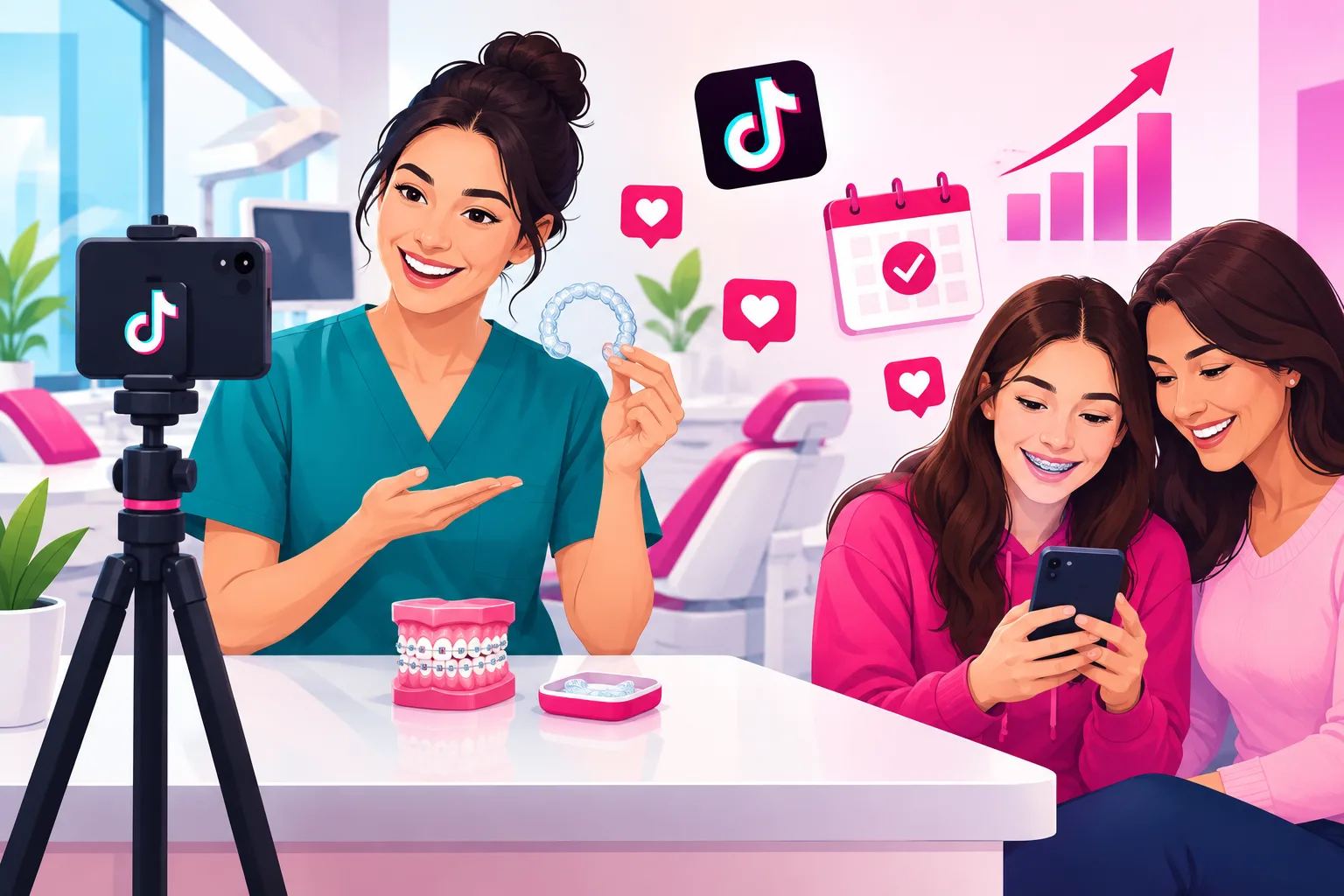
Somewhere in your city tonight, a fourteen-year-old is watching her sixth braces-off reveal in a row. She has already decided she wants aligners instead of brackets, she has a strong opinion about which color of elastics is embarrassing, and she knows exactly what a power-chain is. The only thing she cannot do is book a consult - because the person who books it is in the next room, wondering what this is going to cost.
That gap is the whole story of orthodontics on TikTok. No other corner of dentistry has an audience this eager, this young, and this far from the decision. The braces-off reveal is one of the platform's most-watched genres, orthodontic patients are the platform's heaviest users, and almost none of them hold the credit card. The orthodontist who understands that - who makes content for the teen who wants treatment and the parent who books it, and names the city so the views land inside a drive radius - fills a consult calendar for years. The one who only collects reveal views builds a national fan club and an unchanged schedule.
This guide is the orthodontics-specific companion to our complete TikTok guide for dentists, which covers the foundations every dental account shares. Here we cover what changes when the patient is a teenager, the treatment lasts two years, the reveal is a regulated before-and-after, and the specialty title on the door is both your best differentiator and a claim your state board polices.
The short version:
- You have two audiences and one consult. The teen wants it; the parent books it. Every week needs content for both, and the parent's video is the one that fills the calendar.
- The reveal is a before-and-after. It is your most powerful format and your most regulated one: a specific written authorization, a parent's signature for a minor, honest framing, and organic only.
- Your title is real. Use it kindly. Orthodontics is a recognized specialty, which makes "orthodontist" a clean claim - and the general dentists you might be tempted to contrast yourself with are the people who refer to you.
- Demand peaks in summer. Build in spring. The consult calendar fills in June and again in August. The videos that fill it are posted and promoted four to six weeks earlier.
What's Inside
- 1. Why Orthodontics Is the Most Native Genre in Dental TikTok
- 2. The Teen Who Wants It and the Parent Who Books It
- 3. The Six Formats That Book Orthodontic Consults
- 4. The Braces-Off Reveal Without Crossing the Line
- 5. Minors on Camera: Two Signatures, Not One
- 6. "Orthodontist" Is a Real Title: Use It Without Punching Down
- 7. The Consult Ladder: From a Teen's Feed to a Two-Year Relationship
- 8. The Orthodontic Demand Calendar
- 9. The Mistakes That Keep Orthodontic Accounts Small
- 10. Paid Amplification: Fill the Summer Consult Calendar on Purpose
- Frequently Asked Questions
1. Why Orthodontics Is the Most Native Genre in Dental TikTok
Every dental practice benefits from TikTok. Orthodontists start with three advantages the rest of the profession has to manufacture.
- The genre already exists, and it is enormous. The braces-off reveal, the aligner tray check-in, the "month six update," the elastics color choice, the bracket-glue satisfying clip: these are not formats you have to invent. Teenagers have been documenting their own treatment on the platform for years, and the audience for it is one of the largest in all of health content. A licensed orthodontist walking into that genre is not starting a conversation. You are joining one that has been waiting for an adult in the room.
- Your patients are the platform's heaviest users. Most comprehensive orthodontic cases start between roughly eleven and fifteen. That is the platform's core demographic, and they are the ones who will bring your name home. No general dentist gets that: the person who watches their content and the person who books are usually the same forty-year-old, and that forty-year-old is on the platform less.
- One case is worth several thousand dollars, and it brings a sibling. A comprehensive case runs twelve to twenty-four months of monthly visits, ends in a retainer relationship that lasts for life, and is followed - often within two years - by the younger brother, because the family already trusts you. Add the large and growing share of adult patients starting aligners for a wedding, a promotion, or a photo they finally disliked enough, and the math on a single consult that converts is better than almost anything else in dentistry short of an implant case.
Put those together and orthodontics looks like the easiest lane in the vertical. It is also the one with the most specific trap, because the audience that makes it easy is the one that cannot book. The rest of this guide is about closing that gap.
2. The Teen Who Wants It and the Parent Who Books It

In our dentist guide we describe the two radii - the drive-radius audience that fills the hygiene column and the regional audience that travels for a case. Orthodontics has its own version of a split audience, and it is not geographic. It is generational. The same consult has two buyers, they watch different videos, and they need different things from you.
The teen needs to want it and to not be scared of it. Her questions are about experience: does it hurt, can I still play the trumpet, what can I eat, will people notice the aligners, how long until the reveal, which colors look good, is it true you cannot have popcorn for two years. She also carries the profession's specific fear - not the dental fear of pain, but the social fear of looking different for eighteen months at exactly the age when looking different is the worst thing that can happen. Content that answers those questions kindly makes her the advocate at the dinner table. That is the job of the teen video: turn a viewer into the person who asks.
The parent needs to trust you and to understand the money. His questions are about the decision: does my kid actually need this or is it cosmetic, what age should the first visit be, what is the difference between you and our regular dentist who offers aligners, what does it cost, what does insurance actually cover, is there a monthly plan, what happens if she does not wear the elastics, will the results last. He is on the platform less, he watches longer when he is there, and he saves. The parent video is the one that turns the dinner-table request into a consult request, and it is the video most orthodontic accounts never make - because the teen video gets ten times the views and the account chases the views.
The practical rule is a two-lane posting week. For every reveal or teen-experience video, publish one parent video: a consult walk-through, a cost explainer, a "when should my child first see an orthodontist" answer, a what-insurance-covers explainer. The parent video will get a fraction of the views and produce most of the consults. Do not let the analytics talk you out of it.
And say the city in both lanes. The teen who tags her mother in your video is doing your marketing for free - but only if the mother can tell, in the first five seconds of your profile, that you are twelve minutes from her house. The local-signal mechanics in our patient-acquisition guide apply exactly here.
3. The Six Formats That Book Orthodontic Consults
You could post a hundred different things. These six do the booking, and the first is the only one most orthodontic accounts ever make.
- 1. The reveal, with the form signed. Braces off, the first look in the mirror, the aligner before-and-first-tray. It is the genre's signature and the fastest-growing thing you can post - and it is a regulated before-and-after starring a minor, so it lives inside the rules in sections 4 and 5. Post it for reach and for the teen lane. Do not expect it to book on its own.
- 2. The what-happens-at-the-consult walk-through. The parking lot, the front desk, the scan or the photos, the panoramic x-ray, the treatment-plan conversation, the financing sit-down, the fact that nobody is committing to anything today. This is the single highest-intent parent video you can make, because the consult is what you are actually selling on the platform. Pin it to your profile.
- 3. The honest braces-versus-aligners comparison. Which cases each handles well, which ones need brackets whether the teen likes it or not, what compliance means when the appliance comes out of the mouth twenty times a day, and what changes the price. The teen wants aligners; the parent wants the truth. A video that gives both to both is saved by families for weeks while they decide.
- 4. The cost, insurance, and monthly-payment explainer. Orthodontics has a money conversation general dentistry does not: a fee in the thousands, an insurance benefit that is usually a lifetime maximum rather than an annual one, often limited to children and often less than half the fee, a flexible spending account that can pay part of it, and a monthly plan that turns the number into something a household can say yes to. The practice that explains this plainly on camera wins the parent who was too embarrassed to call four offices and ask. Ranges, not promises, and the terms of any special disclosed the way your board requires.
- 5. The correction: mail-order aligners and rubber-band braces. Your version of the DIY-dentistry correction that anchors the whole dental vertical, and orthodontics has the two most urgent examples on the platform. A mailed impression cannot see roots or bone, which is why the largest company selling aligners without an exam shut down; and elastic bands wrapped around teeth move them into the bone and eventually out of the mouth. Say it kindly, say it every few months, and the teen who was about to try it becomes a consult instead.
- 6. The fear-removal Q&A from the front desk. Reply to real questions on camera, in the words they were asked: "Will it hurt when they tighten them?" "Can I get my braces off before prom?" "What happens if I lose an aligner?" "Do I really have to wear the retainer forever?" Every question your front desk logs is a pre-validated video, and the person who asked comes back to see the answer as a warmer lead.
Notice what is not on the list: the team doing the trend of the week in matching scrubs. It can season the account if the team loves it. It books nobody. For a deeper bench that adapts cleanly to orthodontics - the model-mouth demonstrations, the seasonal moments, the team formats - the dentist content ideas vault has fifty more, and the inner-sentence hook rule applies to every one of them: open on the sentence the teen or the parent already says in their own head, never on a stranger's crooked teeth.
4. The Braces-Off Reveal Without Crossing the Line
The reveal is the most persuasive thing an orthodontist can post and the most regulated, and both are true at once. It is a treatment endpoint shown on an identifiable face, which makes it a before-and-after in your state dental board's eyes and protected health information in HIPAA's. Handle it with a checklist, not enthusiasm.
- A specific written authorization that names social media. Not the general consent to treatment, not the photo release buried in the intake stack, not the teen saying "yes, post it!" in the chair with the brackets in her hand. A form that says what will be posted, where, for how long, that it can be revoked, and that saying no changes nothing about her care - signed before the camera comes out. The full consent framework, including how to ask so a no is easy, is in our dental filming guide.
- Your own patient, unaltered, honest. Many state boards require that before-and-after images be of your own patients, unretouched, and accompanied by a statement that results vary. Same lighting, same angle, no filter that whitens or straightens. Your future patient will compare her own mirror to your feed eighteen months from now; an over-edited reveal creates an unhappy family in real life.
- One person's result, never a promise. "Eight months, done" on a reveal caption is a treatment-time claim you cannot make for the viewer, and boards cite "fast," "painless," "guaranteed," and "best" more than any other words. Show the outcome; let the consult set the expectation.
- The reveal stays organic. Ad platforms apply stricter rules to before-and-after imagery and personal-appearance claims in promoted content, and stricter rules again to content involving minors. The reveal is the video you post; the consult walk-through is the video you promote. Section 10 comes back to this.
- The patient-free reveal exists, and it is most of your volume. The assistant's own aligner check-in, the hygienist's own retainer, the typodont with brackets bonded and removed on camera, the wire bent on a model, the elastics demonstration on a set of plastic teeth: these need no one's signature and they are the satisfying clip without the risk. The never-show list in the filming guide is the other half of this rule.
None of this is a reason to avoid reveals. It is a reason to build the consent habit on the first day, so that two years from now you have a library of compliant transformations that no competitor in your metro can match - and a stack of signed forms behind every one of them.
5. Minors on Camera: Two Signatures, Not One
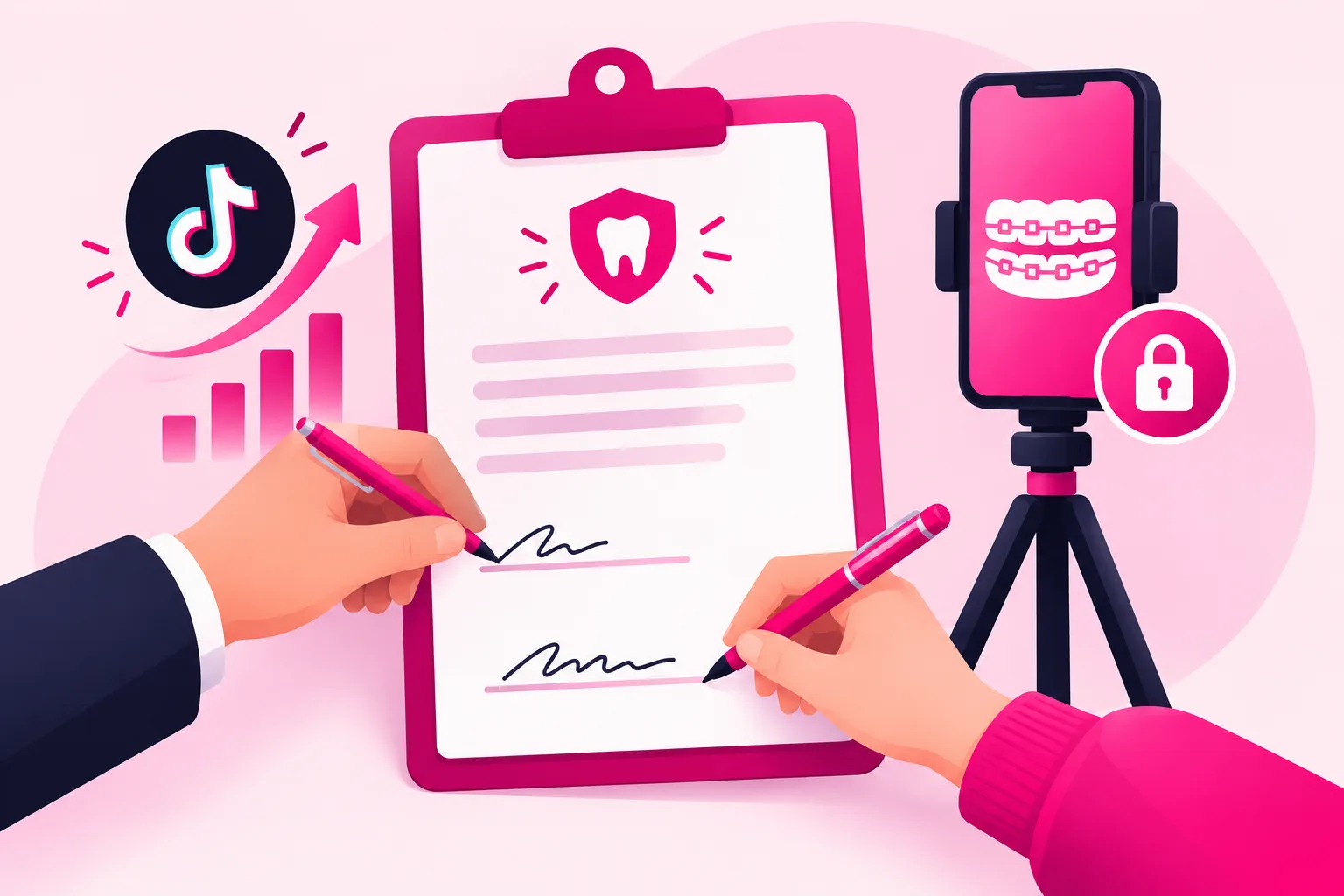
Every dental account has to think about consent. Orthodontic accounts have to think about it for people who cannot legally give it, and that changes the habit in four specific ways.
- The parent or guardian signs. The teen is asked. Under HIPAA the parent signs the authorization as the minor's personal representative, so legally one signature is the requirement. Ethically and practically, get two. A fourteen-year-old who did not want to be on your account will find the video, and so will everyone at her school. Ask her directly, in the chair, with the parent present, for this specific video - and if the answer is a shrug, that is a no.
- Strip the identifiers a teen carries. The school hoodie, the jersey with a number, the name on the backpack, the friend in the background, the location tag on a post filmed at three-fifteen on a Tuesday. A face is already an identifier; a face plus a school is a map. Frame tight, and never name a school, a team, or a grade.
- Never post a minor whose parent is not in the room. The seventeen-year-old who drove herself and says her mom "won't care" is not a signature. Film the patient-free version that day and shoot the reveal at the next visit with the form in hand.
- Revocation is real and it can come from either of them. The teen who moves schools, the parent who changes his mind, the family that splits - any of them can ask you to take the video down, and you do, the same day, without argument. Keep a simple log of which video maps to which form so that is a five-minute job.
One more that lives in the inbox rather than the operatory. Teenagers will send you photos of their own teeth and ask whether they need braces, and parents will send photos of their children. That is a stranger's minor, a diagnosis you have not done, and health information on a platform that cannot protect it. The prepared reply is the same one our patient-acquisition guide gives for the photo in the DMs: warm, no verdict, a pointer to the consult request form, and then delete the photo from the thread.
6. "Orthodontist" Is a Real Title: Use It Without Punching Down
Our dentist guide spends a paragraph warning general dentists off "cosmetic dentist" and "specialist," because cosmetic dentistry is not a recognized specialty and most state boards police the word. You are on the other side of that rule. Orthodontics is a recognized dental specialty. An orthodontist finished dental school and then an accredited residency of two to three years, and the title is restricted to dentists who did. That makes "orthodontist" one of the cleanest claims in all of dental advertising, and you should say it in the bio, in the first sentence of the consult video, and every time someone in the comments asks what the difference is.
The difference is also your best parent-lane content, because parents genuinely do not know it. A large share of clear-aligner cases are now started by general dentists, and the honest question in the comments - "our regular dentist offers aligners, why would we see you?" - deserves an honest answer: what the residency covers, what a specialist consult includes that a general exam may not, which cases benefit most from a specialist, and which simple cases genuinely do not need one. That last part is what makes the video credible rather than a sales pitch.
Which leads to the rule that governs the whole subject: never punch down at the general dentists. They are your referral base. The pediatric dentist who sends you the age-seven screening, the family practice that sends you the crowding case, the hygienist who tells a mother "you should really have an orthodontist look at that" - those relationships are worth more than any video, and a video that mocks general dentists doing aligners will be watched by every one of them. Educate about the specialty; never disparage the profession. The general dentists in your metro who see you explaining, kindly, what a specialist consult adds will send you more cases, not fewer.
The mirror-image rule applies to the general dentists reading this guide: if you offer aligners, say "a general dentist who provides clear aligners," never "orthodontist" and never "orthodontic specialist." It is the same title rule the compliance section of the dentist guide covers, and boards enforce it.
7. The Consult Ladder: From a Teen's Feed to a Two-Year Relationship
Views become patients through the same patient ladder every dental practice climbs - viewer, follower, trigger, request, first visit, and the relationship after it - and the mechanics are covered rung by rung in our patient-acquisition guide. Rather than repeat them, here is what changes when the patient is a teenager and the treatment lasts two years.
- The follower and the booker are different rungs. The teen follows. Then, somewhere between your feed and the dinner table, the parent has to become a believer too. Your profile is the handoff: the parent lands on it once, from a tagged video, and decides in ten seconds whether you are real, local, and worth a call. City in the bio, "orthodontist" in the bio, the consult walk-through pinned, one link that goes to a consult request - not a homepage, not a link tree.
- The trigger is usually on someone else's calendar. The school photo, the general dentist's "you should have that looked at," the age-seven screening the pediatric dentist recommended, the tryout that needs a mouthguard, the older sister's reveal, the adult's engagement. Your content cannot create these moments. It can make sure that when one arrives, yours is the name already in the house.
- The request form asks for the patient's age and the city. Two fields, and they sort your inbox for you. A request for a nine-year-old is an early screening; a request for a fifteen-year-old is a comprehensive case; a request for a thirty-four-year-old is an aligner consult with a wedding date attached. A request from four states away is a polite reply and a referral to the specialty association's find-an-orthodontist tool, not an hour of your treatment coordinator's afternoon.
- The consult is the product you sell on TikTok. Nobody books a several-thousand-dollar case from a video, and you should never ask them to. The ask is always the small, safe step: "A consult is just a look and a conversation, nobody is committing to anything, the link has our times." Sell the conversation. Let the treatment coordinator sell the treatment.
- The relationship is the recall, monthly, for two years. A general dentist sees a patient every six months. You see yours every four to eight weeks, and each visit is a consented content opportunity if the family wants it: the month-six update, the wire change, the elastics reminder that the teen's own feed will not deliver. It is also where compliance lives - the patient who wears the elastics finishes on time and becomes the reveal; the one who does not becomes the awkward extension conversation. Content that makes wearing the elastics feel normal is patient care and marketing in the same thirty seconds.
- The reveal is a rung, not the top. After it comes the retainer for life, the retainer-check visit that most practices treat as an afterthought and that keeps the family in your orbit, and then the rung that pays for everything: the sibling. Families with one orthodontic patient usually have another coming, and the second consult is booked without a single video being watched, because the trust is already in the house. Track it. The sibling rate is the truest measure of whether the first case went well.
Two orthodontic-specific inbox messages deserve a prepared reply alongside the four in the patient-acquisition guide. The poking wire or broken bracket at nine on a Saturday night gets a warm, fast, non-clinical reply - orthodontic wax, a pencil-eraser tip for the wire, the emergency line - and never a "that looks fine" about a photo. And the out-of-radius "how much would aligners be, I could drive down" gets no number, ever, and a pointer to the cost explainer and the consult form - because the fee depends on the case and the case depends on the exam.
8. The Orthodontic Demand Calendar
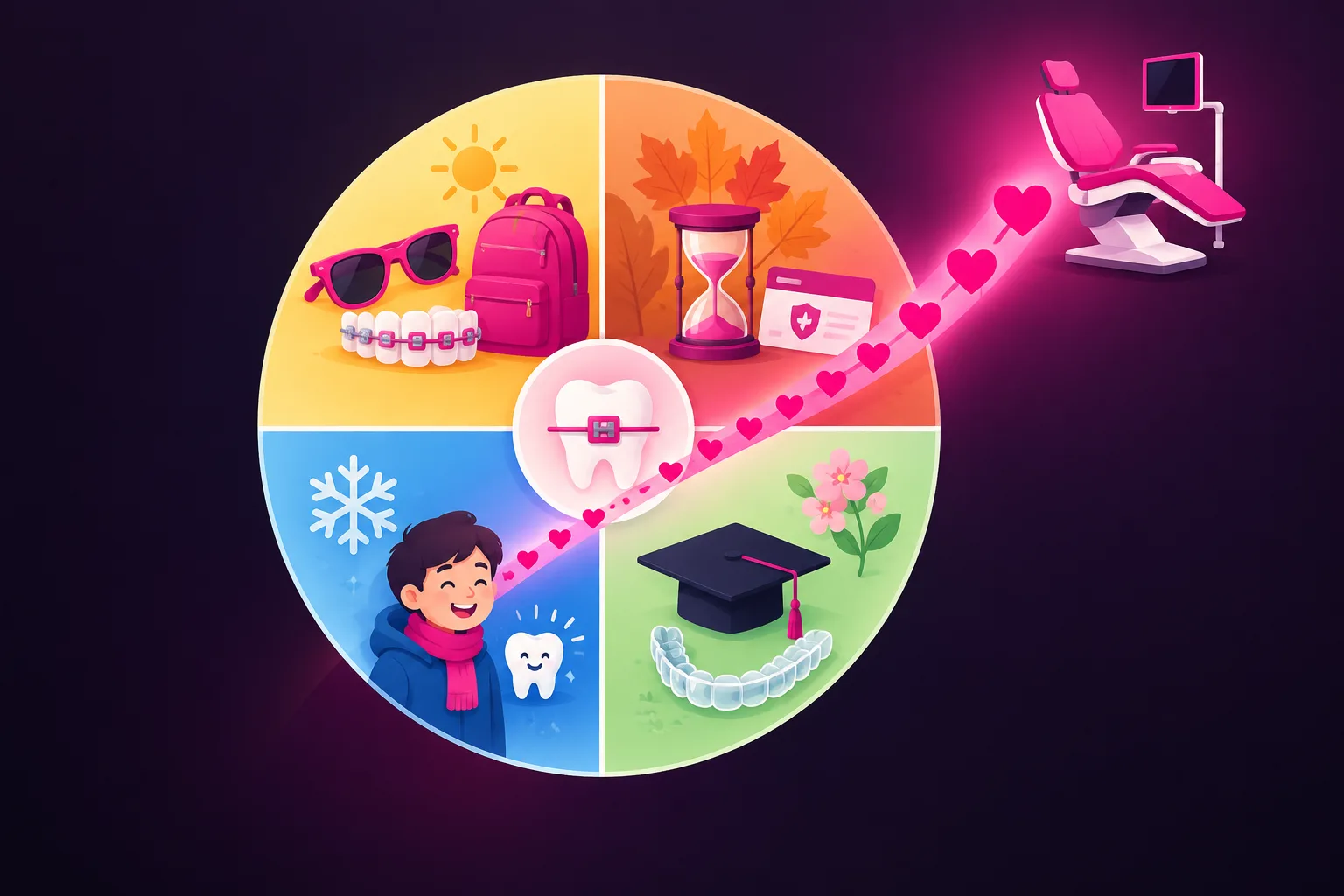
The benefits calendar that runs the general-dentistry year still applies to you, but your peaks are in different places, and they are sharper. Orthodontic demand follows the school year, because the patient is in school and the parent is planning around it. Post and promote four to six weeks ahead of each moment:
- Late spring into summer (May-July): the start-before-school peak. The biggest consult rush of the year. Families want treatment started, and the first few sore weeks over with, before school begins. The consult walk-through, the braces-versus-aligners comparison, and the cost explainer are posted in April and May and promoted in May and June. Graduation, prom, and senior-photo season also brings the adult and older-teen aligner inquiry, often with a date attached.
- Late summer (August): back-to-school and the mouthguard moment. The second peak. The school-form checkup sends families to the general dentist, who sends the crowding case to you; fall tryouts make the "can my kid play football with braces?" video the most saved thing you post all year; and the reveal season begins for the cases started the previous summer.
- Fall (October-December): the benefits deadline, orthodontic edition. Dental insurance orthodontic benefits are usually a lifetime maximum rather than an annual one, so the year-end rush is quieter for you than for a general dentist. But a flexible spending account still empties on December 31, and a family that starts treatment in December can put this year's balance toward the down payment and next year's toward the monthly plan. That is a genuinely useful explainer almost no orthodontic account makes, and it belongs in October.
- Winter (January-February): new plans and the age-seven screening. New insurance plans bring the "what does my new plan cover for orthodontics" question back to the top. February is Children's Dental Health Month, and the specialty's own recommendation - a first orthodontic check by around age seven - is the video parents save for their pediatric dentist to confirm. This is the early-screening pipeline, and it is the rung of the ladder with the longest payoff.
Map your own version of this - a practice near a university, a military base, or a retirement community peaks differently - and write it down. Every decision in the next two sections is easier once you know which weeks you are aiming at, and the seasonal ideas in the dental vault fill the months between.
9. The Mistakes That Keep Orthodontic Accounts Small
Most stalled orthodontic accounts are making one of these six errors, usually with great consistency:
- Building a national reveal account. Two hundred thousand followers, reveal after reveal, no city anywhere, and a consult calendar that never changed. It is the orthodontic version of the national-dental-account trap, and it is the most common way an orthodontist concludes the platform does not work.
- Only ever talking to the teen. The views are intoxicating and the parent video gets a tenth of them. The parent video books the consult. Two lanes, every week.
- Promising treatment time. "Straight teeth in six months" is a claim you cannot make for a viewer you have not examined, boards cite it, and it produces the family that is furious at month fourteen. Show outcomes; let the consult set the timeline.
- Punching down at general dentists. Covered in section 6. They are your referral base, they will see the video, and the case count will show it.
- Filming the teen without the form. The reveal is the fastest way to grow and, without the parent's signature and the teen's yes, the fastest way to a complaint - and in a small town, to a story that follows the practice for years.
- Letting the reveal carry the whole account. Six formats book consults. One of them is the reveal. An account that is only reveals has no cost explainer for the parent to save, no consult walk-through to pin, and nothing to promote when summer arrives. The signals that matter in our dental growth roadmap - saves, profile visits, local comments - are the ones to watch instead of the view count.
10. Paid Amplification: Fill the Summer Consult Calendar on Purpose
Organic content builds the asset. Paid amplification is how you point that asset at the weeks that matter - and orthodontics is unusually well-suited to doing it profitably, because the demand has a calendar, the patient has a value, and the buyer has an age.
The logic is simple. By the time you consider spending money, you already know which videos work: the consult walk-through that produced request-form submissions, the cost explainer parents keep saving, the braces-versus-aligners video that locals commented on. Promotion is not a gamble on new creative. It is buying more of your metro's attention for a video that has already proven it books.
Three orthodontic-specific rules shape the campaign. Target the parents, not the teens. The parent books, and ad platforms restrict both what can be shown to minors and how they can be targeted, so the paid audience is adults in your drive radius - which, conveniently, is exactly who was missing from your organic reach. Promote the explainer, not the reveal. Before-and-after imagery and personal-appearance claims face stricter policy in promoted content than on your feed, and the consult walk-through converts colder audiences better anyway. Time it to the calendar. Four to six weeks before the summer start and again before back-to-school, with a smaller push in January for the new-plan and age-seven screening content.
The economics do the rest. When one comprehensive case is worth several thousand dollars, lasts two years, and brings a sibling, the budget required to put a proven consult explainer in front of thousands of nearby parents is routinely covered by a single consult that converts. Compare that with search ads, where orthodontic keywords are among the most expensive clicks in local marketing and the click buys no trust at all. Timed to the calendar in section 8, paid reach stops being a cost and becomes scheduling.
That is exactly what our TikTok promotion service is built for: taking the educational video that already books consults and putting it in front of thousands more parents in your area, with budget flowing to the audiences that respond. For the mechanics of promoting an existing organic video, the Spark Ads guide walks through the setup step by step, and the case-path economics in our dental monetization guide show the break-even math in full.
Frequently Asked Questions
Does TikTok actually work for orthodontists?
Yes, and more naturally than for almost any other kind of dental practice. Braces-off reveals, aligner check-ins, and elastics reminders are already among the largest genres on the platform, and the teenagers who make up most of an orthodontist's patients are its heaviest users. The catch is that the teen who watches is rarely the person who books. An orthodontic account works when it also reaches the parent - with consult walk-throughs, honest cost and insurance explainers, and the age-seven screening video - and names its city out loud so the views land inside a drive radius.
What should an orthodontist post on TikTok?
Six formats do most of the work: the consented braces-off or aligner reveal, the what-happens-at-the-consult walk-through, the honest braces-versus-aligners comparison, the cost, insurance, and monthly-payment explainer, the mail-order-aligner and rubber-band-braces correction, and the fear-removal Q&A built from the questions teens and parents ask at the front desk. Trends and team dances can season the account but they book nobody.
Can an orthodontist post a patient's braces-off reveal on TikTok?
Usually yes, under real conditions. The reveal shows an identifiable face, so it needs a specific written HIPAA authorization for social media - signed by a parent or guardian when the patient is a minor, with the teen asked as well - and it is a before-and-after in your state dental board's eyes, so it has to be your own patient, unaltered, and framed as one person's result rather than a promise. Paid placements are stricter still, which is why reveals stay organic and explainers get the ad budget.
Can a general dentist who offers clear aligners call themselves an orthodontist on TikTok?
No. Orthodontics is a recognized dental specialty that requires an accredited residency after dental school, and state boards restrict the title to dentists who have completed one. A general dentist who provides aligners should say exactly that. For actual orthodontists, the title is a clean, legitimate differentiator - explain what the residency is and what a specialist consult includes, without disparaging the general dentists who refer to you.
When should an orthodontist promote a TikTok video with paid budget?
Four to six weeks before the consult peak, which for most practices is late spring ahead of the summer start and again in late summer ahead of back-to-school. Promote the video that has already produced consult requests organically - almost always a consult walk-through or a cost explainer, not a reveal - to adults in your metro, since the parent books and ad policies restrict both before-and-after imagery and advertising to minors. One comprehensive case is worth several thousand dollars, so a modest, well-timed budget pays for itself on the first consult that converts.
How many followers does an orthodontist need before TikTok fills the consult calendar?
Fewer than you would think, provided they are the right ones. A few thousand followers inside a drive radius - a meaningful share of them parents - can keep a consult calendar full, because one case is worth what most creators earn from a million views. A hundred thousand followers spread across four time zones fills nothing. Measure the account by consult requests with a local address and a patient age on them, not by the follower count.
A necessary caveat: this is a general overview for planning purposes, not legal or regulatory advice. Your obligations depend on your state dental board, your license, HIPAA, your employer, and the platform's current policies. Confirm the details against your own board's rules - and when a specific video is in doubt, a five-minute question to your state association or your liability carrier before you post is cheaper than any answer after.
Ready to fill the summer consult calendar?
You already have the video that books consults - the walk-through parents save, the cost explainer that started the request forms. Viryze amplifies that proven content to thousands more parents in your metro, timed to the weeks when families are deciding. Trust you have already earned, in front of the people who can actually book.
Promote your best videoRelated Reading
- TikTok for Dentists: The Complete 2026 Guide - the foundations every dental account shares, from hooks to compliance.
- Getting Patients from TikTok: Turn Views Into New-Patient Appointments - the full patient ladder and the prepared inbox replies your consult funnel runs on.
- How to Film Dental Content for TikTok - the consent form, the model-mouth setup, and the never-show list.
- Dentist TikTok Content Ideas: 50+ Video Concepts - the corrections, walk-throughs, and seasonal moments that adapt cleanly to orthodontics.
- How Dentists Make Money on TikTok in 2026 - the case-path economics behind a single consult that converts.
- TikTok for Med Spas & Aesthetic Practices - the sister sub-vertical guide to before-and-after content inside the rules.

Head of Creator Success at Viryze
TikTok growth strategist helping creators reach their first 100K followers through data-driven promotion strategies.