Every dentist knows the new-patient call that starts with an apology. "It's been a while. Like, a long while." Then the real questions, in a smaller voice: whether it will hurt, whether you will be able to tell how long it has been, whether you are going to say something about it, and what it is going to cost. Your front desk answers the third one in thirty seconds - that nobody in the building is going to lecture anyone, that the first visit is mostly looking and talking, that people come back after ten years all the time. There is a pause. Then they book.
Those thirty seconds are the most persuasive thing your practice says all week, and it says them to an audience of one. Somewhere in your city, a dentist with the same degree films that identical answer on her phone between patients, in the chair, holding a model mouth. Four hundred thousand people watch it. A few thousand of them live within twenty minutes of your office, have been "meaning to find a dentist" for three years, and just realized nobody is going to be mad at them.
This guide is the complete 2026 playbook for dental professionals - general and family dentists, cosmetic and implant dentists, orthodontists, pediatric dentists, hygienists, and the practice owners who need every column of the schedule full: the six video formats that grow dental accounts fastest, the inner-sentence hook that opens on the fear instead of the shame, the consent-first content engine, the schedule-or-case choice and the two radii that divide them, the benefits calendar built around the year-end insurance reset, the 90-day plan from an empty account to the dentist people in your city think of, the patient ladder with a safe reply for the photo-in-the-DMs diagnosis request, the HIPAA and state board rules that protect your license, and when paid promotion fills the schedule versus burns budget. Pair it with our TikTok algorithm guide for the ranking-signal frame and the TikTok growth strategy guide for the cross-niche fundamentals.
The honest summary:
- Teeth are already one of the platform's biggest genres - and a daily stream of it is do-it-yourself dentistry. A licensed dentist kindly correcting the record is one of the most trusted voices on TikTok, and you never have to make anyone care about the subject.
- A patient is a lifetime of recall plus the big case, not a visit. Two cleanings a year for years, the family that follows, and the occasional crown, implant, or aligner case - so a small audience within a twenty-minute drive is worth more than a large audience anywhere.
- Decide: schedule path or case path - and respect the two radii. A veneer reveal travels nationally; a hygiene column fills from the drive radius. Anchor to your city on purpose, or build a case brand on purpose - never drift.
- Use paid promotion as selective amplification on proven explainers, targeted to the radius you can actually serve and timed ahead of the year-end benefits reset - never to rescue a weak clip, and always within HIPAA, your state board's advertising rules, and TikTok's ad policies.
What's Inside
- 1. Why TikTok Works So Well for Dentists in 2026
- 2. The Six Video Formats That Grow Dental Accounts Fastest
- 3. The Inner-Sentence Hook: Open on the Fear, Never the Shame
- 4. The Consent-First Content Engine
- 5. Schedule Path or Case Path: The Choice and the Two Radii
- 6. The Benefits Calendar: Why You Build in September for December
- 7. A Posting Cadence That Survives a Full Schedule
- 8. The 90-Day Plan to Becoming the Dentist Your City Thinks Of
- 9. The Patient Ladder: Turning Viewers Into a Lifetime of Recall
- 10. When Paid Promotion Fills the Schedule vs. Burns Budget
- 11. HIPAA, Your State Board, and the Mistakes That Cap Dental Accounts
- Frequently Asked Questions
1. Why TikTok Works So Well for Dentists in 2026
Dental practices have filled the same way for decades: the insurance directory, the postcard mailer to every household within five miles, the review site, and the neighbor who said "my dentist is great, but they're booked out three months." That model works right up until it does not - you open a second operatory and the hygiene column has holes in it, you invest in an implant system and need cases to justify it, a big employer moves out of town, or you realize your schedule is full of one-visit emergencies who never come back for the cleaning. TikTok is the most efficient answer available right now, for five specific reasons.
The first is one very few professions get: teeth are already one of the platform's biggest genres. Satisfying scaling clips, tartar removal, braces-off reveals, and veneer transformations pull enormous watch time on their own. Running alongside them is a constant stream of do-it-yourself dentistry: baking soda and lemon juice for whitening, charcoal toothpaste, teeth filed with a nail file, mail-order aligners, and the unlicensed "veneer tech" doing composite veneers in a rented room. You do not have to make anyone care about teeth. The platform did that already. What it did not do is get any of it right, and the licensed dentist who calmly corrects the record - without mocking anyone - is one of the most trusted voices on the entire platform. The accountant and the contractor have to manufacture interest in their subject. Yours arrives pre-installed and doing itself real damage.
The second is the economics of a new patient. A converted viewer is not an appointment. It is a hygiene visit every six months for as long as they live in town, the spouse and kids who follow because someone finally found "a dentist who doesn't make you feel bad," and - this is the part most guides miss - the periodic big case. A crown, an implant, a set of clear aligners, a veneer case: any one of them is worth more than most professions' entire client relationship. So the question is not "how do I get a million views." It is "how do I get a few hundred people within twenty minutes of my office to decide that coming back will not be a lecture." That is a dramatically easier problem, and it is a better schedule at the end of it.
The third is dental fear, dental shame, and the fact that content is the direct repair. Your profession's central barrier is not skepticism about whether dentistry works. It is fear - of pain, of the drill, of the bill - and underneath it a thing no other vertical has to deal with: embarrassment. Surveys of adults consistently find dental fear in a large minority and severe fear in more than one in ten, and the people who have stayed away longest are the ones most convinced that the first thing you will do is judge them for it. Sixty seconds of a real dentist saying "here is exactly what happens when you come back after eight years, and here is what nobody is going to say to you" dissolves more of that than any postcard ever printed. Your biggest marketing problem is solved by the exact thing your best front-desk person already does for a living: explaining, kindly, that it is fine.
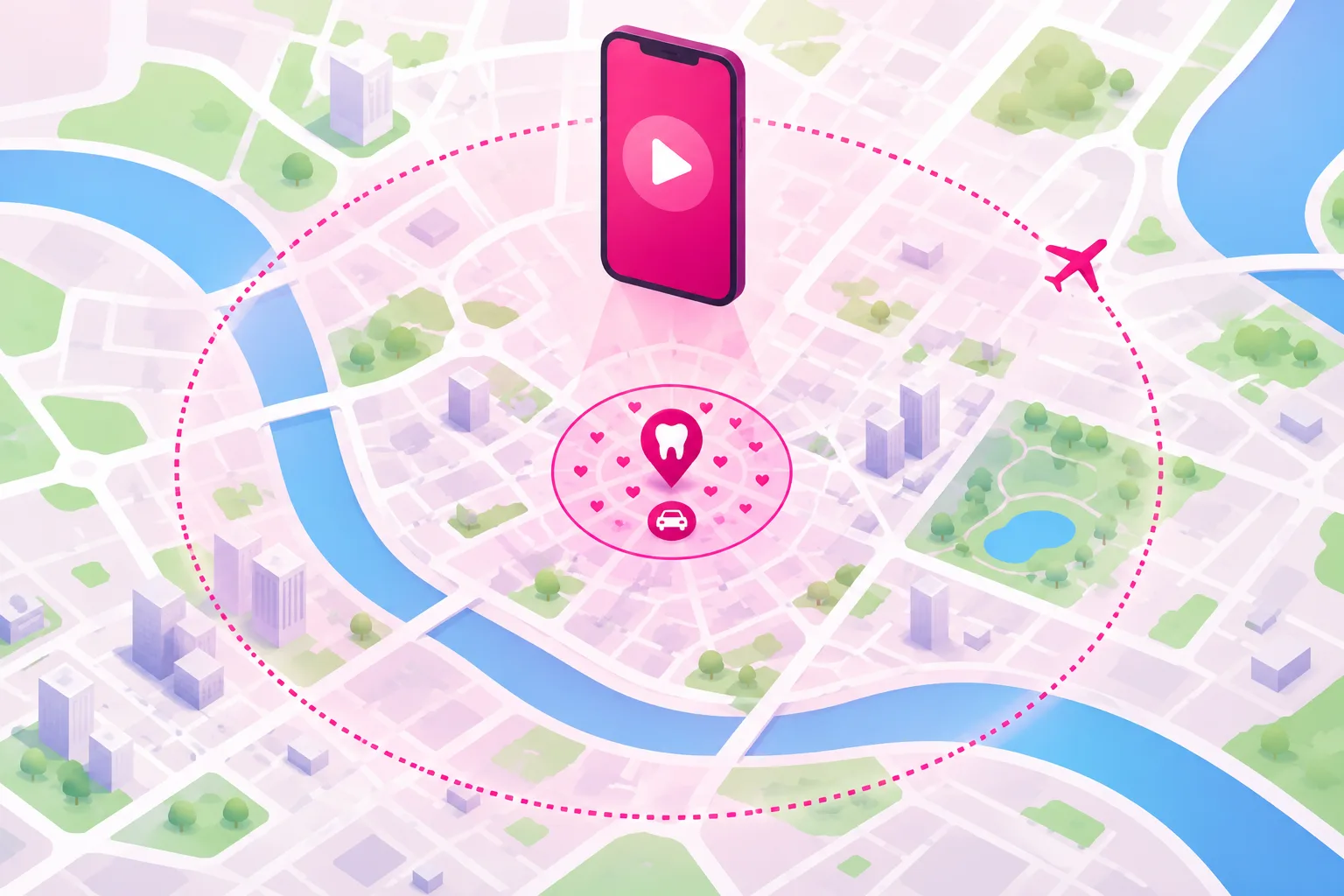
The fourth is the two radii. A general practice fills its schedule from a fifteen-to-twenty-minute drive. A cosmetic case, an implant case, or a full-arch case will drive three hours, or fly in. That makes a dental account unlike any other profession on this platform: it can be two businesses with two audience shapes at once, and the video that travels furthest is not the video that fills Tuesday's hygiene column. Section 5 is about what that means, because it is the thing dental accounts get wrong most.
The fifth reason is a second payoff: the content recruits, because the team is the cast. Hygienists are the natural stars of the satisfying-clip genre, the front desk owns the questions, the assistant runs the camera, and the dentist explains the case. In a documented hygienist shortage, the account that shows a team that likes each other, reasonable schedules, and a dentist who lets people be on camera reaches the next hire from the same footage that reaches the next patient. Dental accounts that grow are team accounts, and the team notices.
For context on how the algorithm treats watch-time, saves, and other ranking signals across niches, see our algorithm ranking factors breakdown.
2. The Six Video Formats That Grow Dental Accounts Fastest
Random posting is the slowest path on TikTok. The algorithm is trying to work out who your videos should be shown to, and an account that posts the team doing a dance trend, then a stock photo of a smile, then a "we're accepting new patients" graphic gives it nothing to work with. These six formats give it a clear signal - and between them they cover essentially everything a dental practice needs to say.
Format 1: The DIY-Dentistry Correction
The highest-leverage format in the niche, because the raw material is everywhere and the stakes are real. Take one thing the platform is confidently doing to itself and say what it actually does. "Lemon juice does not whiten your teeth - it dissolves the surface, which looks brighter for a week and then never stops looking yellow." "A mail-order aligner cannot see your roots or your bone, and that is why the largest company selling them shut down." "A veneer tech is not a dentist, and composite bonded over unprepared enamel by someone without a license is a permanent problem, not a cheap alternative." Correct gently - half your audience tried the baking soda trick last month, and you need them to stay. Every one of these is a complete video, and the platform hands you a new one daily.
Format 2: The No-Judgment Walk-Through
"Here is exactly what happens when you come back after eight years." The forms, the x-rays, the fact that the first visit is mostly looking and talking, that you will explain what you see before anyone touches anything, that they can raise a hand and everything stops, that nobody in the building is going to say a word about how long it has been. This format converts better than anything else you will post, because it resolves the exact fear that keeps people from booking. Film variations: the first visit for someone with a bad childhood-dentist memory, for the person who is sure they need "everything pulled," for the parent bringing a three-year-old, for the person whose partner made the appointment for them.
Format 3: The Satisfying Clinical Clip
The format the genre was built on, and the one with the most rules attached. A scaling sequence, a crown seated, a set of braces coming off, the before-and-after of a cleaning. The watch time is extraordinary, and it works for one reason: it shows the thing people are afraid of, and it is not scary. The rules are that any patient in the clip has signed a specific written authorization for social media - a smile is identifiable, and section 11 covers exactly what the form has to say - and that before-and-after imagery follows your state board's rules. The workaround most practices underuse: the model mouth. A typodont, a demonstration of a filling on a plastic tooth, a scaling on a training model - the same satisfying mechanics, no patient at all.
Format 4: The What-It-Costs-and-Why Explainer
The most under-used format in the vertical and one of the most important, because it addresses the second thing that keeps people away: the bill they are imagining. Why a crown costs what it costs - the lab, the materials, the two visits. What an annual maximum is and why yours probably resets on December 31. What a membership plan is for the third of your patients with no insurance at all. Why the "free whitening with every cleaning" offer down the street is not free. Why an implant is a three-part price. You are resolving a real anxiety rather than pitching a service, and nothing about these videos requires a patient. They describe how care works and what it costs - and the person who has been avoiding the call because they assume the number is unbearable finally hears the number.
Format 5: The Comment-Reply Q&A
Once you are posting consistently, your comments become the best content calendar you will ever have. Reply to a real question on camera. It is the least-effort, highest-trust video format that exists: the question is pre-validated, the format is native to the platform, and it visibly demonstrates that you answer people. Keep answers general - you are explaining how something works, not diagnosing a stranger - and say so out loud, because that sentence is both good practice and the line covered in section 11. The photo-in-the-DMs question ("is this a cavity?") gets its own prepared reply in section 9.
Format 6: The Team-as-Humans Clip
Education earns the reach. The humans in the building earn the appointment. The hygienist who has been there eleven years and what she actually thinks about flossing, the front-desk person who answers the phone with the voice that makes people book, the dentist's own dental-fear story from childhood, the office dog, the modality you chose and why, the Tuesday morning huddle. People do not hand their mouths to a credentialed stranger - they hand them to a credentialed person they feel they already know, in a building that seems kind. Roughly one in five posts should be this. Everyone on camera has consented in writing, and that is covered in section 11 too.
The two formats most dental accounts lead with - and shouldn't: the dance trend, which is not content but a calendar entry - no saves, no reason to follow, and it teaches the algorithm nothing about who to show you to - and its more damaging cousin, the shaming close-up. A tight shot of someone else's neglected teeth with "this is what happens when you skip the dentist" gets views, and it drives the person you most want to reach further away, because it confirms the exact fear that kept them out of the chair. The practices that grow durable accounts show what happens in the room, not what happens to people who avoid it.
3. The Inner-Sentence Hook: Open on the Fear, Never the Shame
You get about one and a half seconds. In that time a viewer decides whether this is about them. The single highest-leverage change most dental accounts can make is to stop opening with themselves and start opening with the sentence the viewer already says inside their own head.
Weak openers introduce the speaker: "Hi, I'm Dr. Patel, I'm a general dentist in Tampa, and today I want to talk about gum disease." By the time that sentence lands, the viewer is gone. Strong openers state the viewer's own experience in the viewer's own words: "If your heart starts racing in the parking lot of the dentist's office - here is what we can actually do about that." The credentials still matter enormously; they just belong at second twelve, once someone has a reason to care who is talking.
The trap unique to your profession is that the strongest hook in the genre is also the most harmful one. "If your gums look like this, you already have gum disease" stops the scroll better than almost anything on the platform - and it is exactly the video that makes the anxious viewer close the app and put off the call for another year. The discipline that keeps your hooks both effective and kind is simple: hook on the fear or the sensation, never on the shame. The fear is universal and the viewer will admit to it. The shame is the thing they are hiding from you.
Four hook patterns that consistently work in this niche:
- The inner sentence. "If you've been putting off the call because you're embarrassed about how long it's been, this is for you." Real, specific, and the viewer feels seen before they know who you are.
- The correction. "Everyone on this app is whitening with baking soda. Please stop - and here is what it's actually doing." Contradiction earns attention; the follow-through earns the follow.
- The permission. "You are allowed to come back after ten years. Nobody is going to say anything." This one converts, because the person who needed permission has been waiting a decade for someone to give it.
- The insider observation. "I've been a dentist for fourteen years, and here is what I can tell in the first thirty seconds of an exam - and what I genuinely cannot." It promises something the viewer cannot get anywhere else, from someone positioned to know, and it demystifies the chair at the same time.
One discipline holds all four together: answer the question in the video. The most common self-inflicted wound in professional content is the tease - "book a consult to find out." It reads as a sales pitch, kills completion, and completion is what decides whether the video travels. Give the explanation away. The people who need someone to actually do the work will still come, and now they will come already trusting you.
4. The Consent-First Content Engine
Here is where your profession differs from the therapist and the lawyer in this series. You can film the work. The operatory is one of the most watchable rooms on the platform, and unlike a counseling session, a cleaning can be shown - as long as the person in the chair has signed for it. The practices that quit posting usually quit for one of two reasons: they believed every video needed a patient, or they filmed patients without the right form and got a letter. Both are avoidable, and the fix is the same: build the engine so most of it never needs a patient at all, and the part that does runs on a form.
Keep one running note on the front-desk computer. Six capture points fill it, and only the last one requires a patient:
- The front-desk question log. Everything people ask before they are your patient - "do you take my insurance," "will it hurt," "how long has it been too long," "do I have to get x-rays," "can I be sedated for a cleaning." These are administrative, not clinical, and they are the purest content ideas you will ever get, because someone cared enough to call.
- The model mouth. The typodont on the counter is the most under-used prop in dentistry. A filling on a plastic tooth, a crown prep on a model, a scaling on a training jaw, what a night guard actually does, how an implant sits in bone - every satisfying mechanic of the genre with no patient, no form, and no risk. Buy two, because one will end up in the video every day.
- The team's own teeth. The hygienist demonstrating flossing on herself. The assistant's clear-aligner journey filmed on her own smile. The dentist showing the difference between an old filling and a new one on his own molar. Consenting adults who work for you and have signed the staff form, and the content is warmer for it.
- The myth on your own feed. Whatever confidently wrong thing the algorithm showed you this week. Screenshot the idea, not the creator - do not stitch someone to humiliate them - and correct it kindly. Free, pre-validated, and the platform delivers a fresh one daily.
- The seasonal moment. Whatever is about to land on your schedule because of the calendar - the benefits deadline in December, the new plans in January, the wedding in June, the Halloween candy. Covered in full in section 6.
- The consented patient. The satisfying clip, the reveal, the walk-through with a real person in the chair. Only with the specific social-media authorization signed before the camera comes out, only inside your state board's before-and-after rules, and never as a condition of care. Our HIPAA-safe filming guide for healthcare covers the in-clinic setup, and section 11 covers what the form must say.
Then batch. Pick one ninety-minute block - the admin morning, the last hour of the Friday half-day - set up the phone once in the operatory you always use, put the model mouth on the tray, and film ten to fifteen answers back to back in the same scrubs. Do not change rooms or outfits; nobody notices, and the whole point is to remove every decision that could stop you. Fifteen videos is five weeks of posting from one morning.
The rule that keeps this safe: is the person in this video a patient, and if so, did they sign for this use? A face is identifiable. So is a smile, a distinctive tooth, a voice, a tattooed hand on the armrest, and the schedule on the monitor behind the chair. If no patient appears and nothing on screen belongs to one, it is education and it is yours to post. If a patient appears, the specific written authorization for social media - not the general consent to treatment, not a verbal "sure" - exists before the camera comes out. See section 11 before you film anyone in the chair.
5. Schedule Path or Case Path: The Choice and the Two Radii
This is the section that matters most, and it is the one dental accounts get wrong almost universally - not by doing something badly, but by never deciding what they are doing at all.
Here is the trap. The quality that makes teeth one of the platform's biggest genres also makes the content borderless. A veneer reveal lands in Phoenix and Philadelphia and Perth with equal force, and the algorithm - which does not know or care that your operatories are in one building - will happily find you two million viewers who will never sit in your chair. Call it the national-dental-account trap: a huge following, a flood of "how much for a full set" DMs from four time zones away, and a hygiene schedule that looks exactly like it did before. It is extremely common, and it usually ends in one of two conclusions - that TikTok "doesn't work for dentists," or that the only way to serve all these people is to sell them a whitening kit.
The reason it happens is that a dental practice has two radii, and most accounts never notice which one a given video is for. The fix is to choose, on purpose, between two legitimate paths.
The schedule path: build a drive-radius audience that books
The account exists to fill the hygiene schedule - yours or the practice's - with patients who come back every six months and bring their families, and everything is anchored to the twenty-minute drive: the city and neighborhood in the bio, "we're the office by the high school on Route 9" said out loud in videos, references only someone local would catch, replies to local commenters, a new-patient request one tap away that asks for the city before anything else. The numbers are smaller - thousands of followers, not millions - but a meaningful share of them can actually become patients. Success is measured in new-patient requests from people who can reach the office and how many of them keep the second appointment, never in views. This is the same shape as a veterinary practice, and our TikTok for Veterinarians guide is the closest parallel for the local mechanics.
The case path: build a regional brand around the signature procedure
The account exists to reach the person who will drive three hours or fly in for one thing you do exceptionally well - full-arch implants, veneers, complex aligner cases, sedation dentistry for the severely phobic - and the revenue comes from those cases, not the hygiene column. This is a real business with its own logic: the consult-with-photos intake, travel and lodging explained, financing explained, the case timeline explained, and a before-and-after library that lives entirely inside your state board's rules. The radius is a region, sometimes the country, and the bio says so. It is also the path with the tightest compliance, because specialty claims, before-and-after imagery, and "cosmetic dentist" language are exactly what state boards watch most closely - section 11 has the detail.
Here is the twist that makes your profession different: the hybrid is more legitimate for you than for almost anyone else, because one office can genuinely do both. "Fill the hygiene schedule first, then build the case brand once the columns are full" is a sequence, not a conflict - and many of the best dental accounts on the platform run exactly that way. What still has to be decided is the order, and which metric wins when the two collide. The veneer reveal that goes national is wonderful; the follow-up should still say your city out loud, and the pinned video should still be the no-judgment walk-through. Decide in week one, write it at the top of your running note, and let it settle every argument about what to post next.
6. The Benefits Calendar: Why You Build in September for December
Nobody books a dentist on a random Tuesday. They book at a trigger moment: a tooth that started hurting on a Sunday, a chipped incisor two weeks before a wedding, a kid's school form, a spouse's ultimatum, a new job with new insurance, or a letter saying their benefits expire in six weeks. Your content cannot create those moments. It can make sure that when one arrives, yours is the name already in their head - and that they already believe coming back will not be a lecture.
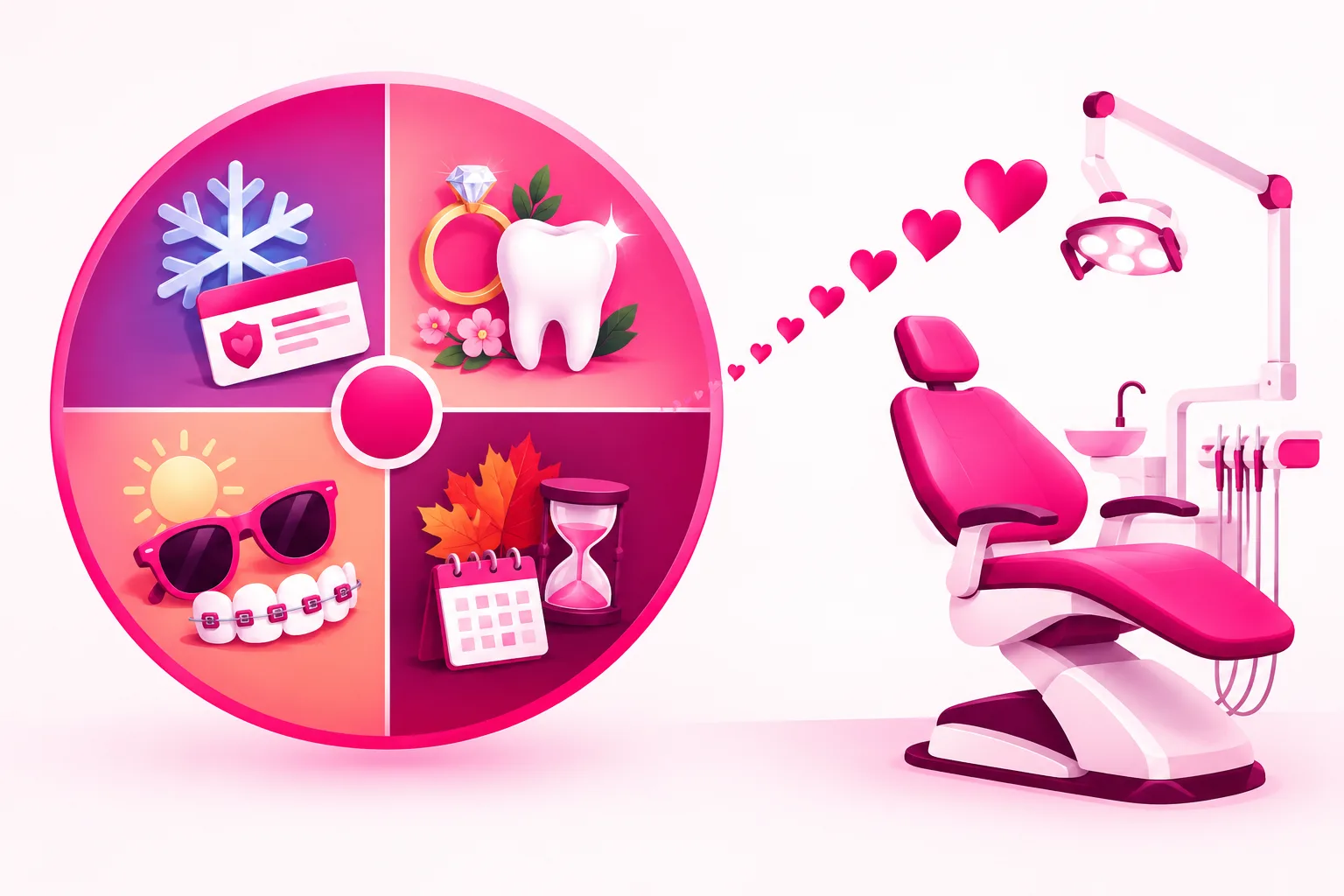
The single largest predictable trigger in your profession is on the calendar and nobody else in this series has it: the benefits deadline. Most dental insurance plans carry an annual maximum that resets on December 31, and most flexible spending accounts empty on the same day, which makes October through December the year's biggest rush for crowns, fillings, and the cleaning someone skipped in April. Which means the video that wins December is not posted in December. It is a "here is what an annual maximum is, here is why yours is about to disappear, and here is what to use it on" explainer published in September, saved by people quietly doing the math, and paying off in appointment requests through the fall. The dentist who owns that explainer in a given city owns the rush.
Layered over that is a dental year that gives you a reason to post every month, with an audience already primed by the date:
The dental content year
- January - February: new plans and the kids. New insurance plans and resolutions bring the "how to find a dentist who takes your plan" and the no-judgment walk-through back to the top. February is Children's Dental Health Month - the first-visit-for-a-toddler video and the "when does my kid need to see an orthodontist" explainer belong here.
- March - June: the smile season. Weddings, proms, graduations, and the senior-photo season drive whitening and bonding, and the what-it-costs explainer for whitening - and the correction of every DIY whitening trick - earns its keep. June is when teens are out of school and aligner and braces consults spike.
- July - August: back to school and the build. Sports mouthguards, the school-form checkup, the orthodontic consult before the year starts, and - underneath it - the most important job of late summer: publishing the benefits-deadline explainer that wins the fall.
- September - October: the rush begins. The benefits content built in late summer pays off now, and Halloween is the easiest seasonal content in the entire vertical - the honest ranking of candy by how much your dentist minds it is a video that gets saved by parents every single year.
- November - December: the deadline. The "you have six weeks to use your benefits" reminder, the crown that has been waiting since spring, and the holiday-photo whitening request. And beneath it all, the year's second most important job: publishing the new-plan and no-judgment content that wins January.
The practical rule: publish thirty to sixty days ahead of the moment. A video needs runway - it gets surfaced, saved, and re-surfaced for weeks - and the person who books in the first week of November started paying attention in September. If you are reading this in late summer, you are holding the best possible timing. If it is already December, post the benefits video today, reply to every comment, and put a recurring block on your calendar for August.
7. A Posting Cadence That Survives a Full Schedule
Consistency beats volume, and a cadence you abandon the first week you see thirty patients is worse than a smaller one you keep. Design for your worst week, not your best one.
Three posts a week, from one batching block a month. Three is enough for the algorithm to build a clear picture of your account and enough for you to learn what your audience responds to, without becoming a second job on top of one that already runs on a ten-minute schedule. In a crushed week - a hygienist out, a run of emergencies - drop to two from the bank and do not apologize for it.
Two additions that cost almost nothing, and one that is unique to your profession. First, reply to comments daily, even in a bad week; five minutes at the front desk between patients, and it is the highest-return activity available because it both feeds the algorithm and feeds your content queue. Second, when something happens - a DIY trend goes viral, a mail-order company collapses, a celebrity's new teeth are all over the feed - break the schedule and post the same day. Timeliness is worth more than polish in that window, and being the dentist who showed up first is remembered.
The third addition is the cast rotation. Dental accounts that grow are team accounts, and the cadence should reflect that: the hygienist owns the satisfying clip and the flossing demonstration, the front desk owns the question-log reply, the assistant owns the camera and the model-mouth demonstration, and the dentist owns the correction, the walk-through, and the case explainer. One person on camera every time burns out in six weeks. Four people sharing three posts a week is a habit the practice keeps for years - and it is the recruiting content from section 1, made for free.
For the underlying mechanics of consistency, watch-time, and how posting rhythm affects distribution, see the complete growth strategy guide.
8. The 90-Day Plan to Becoming the Dentist Your City Thinks Of
Ninety days is enough to go from an empty account to a small, genuinely valuable audience - as long as you resist the urge to talk to everyone.
Days 1-30: Pick the path and the lane
First the path, from section 5. Then the lane. "Dentist" is not a lane. "The dentist for people who haven't been in ten years," "the sedation dentist for the truly phobic," "the office that explains the bill before it happens," "the pediatric practice where the first visit is a tour and nothing else," "aligners for adults who never got braces" - those are lanes. Narrowing feels like giving up audience, and in your profession it is the opposite twice over: it tells the algorithm precisely who to show you to, and it tells a viewer "this office already understands my problem" before you say a word - which is the match that predicts whether they keep the second appointment. It is also how a two-operatory practice competes with a corporate chain that has a marketing department.
Then mine forty questions from the front-desk log and your running note, film in two batches with the model mouth on the tray, and post three times a week. Judge nothing yet. The first month is for building the habit and finding your camera voice, which is simply the voice you already use with someone in the chair who is gripping the armrests.
Days 31-60: Find the series
By now one or two videos will have clearly outperformed. Do not treat that as luck - treat it as instruction. Turn the winner into a series: "things this app is doing to its teeth, part 9" or "what actually happens in the chair, part 4" compounds in a way that nine unrelated videos never will. Viewers follow series, not accounts, and each installment pulls people back to the earlier ones.
This is also when the comment-reply habit starts in earnest, when the "this is education, not an exam" line goes on every post, when the staff and patient authorization forms are printed and in the drawer, and when the new-patient request form gets the city question at the top. By day sixty most accounts that post consistently have their content problem permanently solved, because the audience is now generating the queue.
Days 61-90: Make it easy to reach you
Only now is it worth optimizing conversion, because only now do you have people to convert. Three things: a bio that names the lane, the credential, and the city ("General dentist - the office for people who haven't been in years - Westside, Tampa - new patients welcome"), a pinned trio at the top of your profile, and a new-patient path exactly one tap away - online booking if you have it, a short form if you do not, and never "DM us."
The pinned trio that works best for dental practices:
- Your best-performing correction - proof that you are worth listening to.
- Your "what actually happens when you come back after years" walk-through - the room, the steps, the hand-raise rule, the promise that nobody lectures. This one reduces the fear that keeps people from booking, and it visibly cuts first-visit no-shows.
- Your most reassuring money video - the one that says, to the person who has been avoiding this for years because they assume the number is unbearable, "here is what a first visit actually costs, here is what a membership plan is if you have no insurance, and here is how we phase treatment so nobody gets a bill they didn't expect." This one quietly does more converting than the other two combined.
Day ninety is also the earliest point at which paid amplification makes sense, because you now have organic performance data telling you which video deserves it. More on that in section 10.
9. The Patient Ladder: Turning Viewers Into a Lifetime of Recall
Views are not the product. A patient who comes back every six months for a decade, brings their family, says yes to the crown when it is time, and tells two coworkers how they found you, is the product. Here is the path between them, one rung at a time - and where each rung usually breaks.
- Viewer. Someone watches one correction or one walk-through. Breaks when the video opens with your credentials instead of their inner sentence.
- Follower. They follow because you made something embarrassing feel ordinary. Breaks when your account has no discernible lane, so there is nothing to follow for.
- Someone who now believes coming back will not be a lecture. Weeks of content later, the shame has quietly dissolved and you are the office they picture when they imagine finally going. This rung is unique to your profession, and it is where most of the real work happens. Breaks when you post three times and stop.
- Trigger moment. The Sunday toothache, the chipped tooth before the wedding, the school form, the benefits letter. You do not cause this rung; you are simply present for it. Breaks when your bio gives them nowhere to go.
- New-patient request - and the photo in the DMs. Most messages say "are you taking new patients?" Some say "is this a cavity?" with a photo attached. You cannot diagnose from a photo, and no dentist can - and the DM is not a place to discuss anyone's care. The rung breaks when you go silent because you are unsure what you are allowed to say. What works is a warm, prepared response you keep saved: "Thanks for trusting me with this. I genuinely can't tell from a photo - nobody can, and I wouldn't want to guess about your mouth. If it's hurting or you're worried, that's reason enough to get it looked at. If you're near Tampa, here's our new-patient link and we'll get you in this week; if you're not, any general dentist can check this at a regular exam." Say the first half publicly once as a video and it becomes one of your most-saved posts.
- First visit. Breaks on response time and on friction - a request answered the same day is a different practice than one answered in a week - and on one thing unique to you: the patient arrives having watched the walk-through, so the visit has to match it. If the video promised that nobody lectures, nobody lectures. The patients who found you this way tend to stay, because they chose you for how you explained things, and that never stops being true.
- The recall relationship. The rung that makes your profession different from most of this series. The therapist's success is a client who no longer needs her; yours is a patient who comes back twice a year for as long as they live in town. Breaks when the hygiene visit does not feel like the videos did - so the team on camera should be the team in the room.
- The big case, and the family. The crown when it is time, the aligners the patient has been thinking about since they saw the explainer, the spouse who books because someone at home finally likes their dentist. This is where the economics from section 1 actually land - and it only happens on a foundation of recall visits that felt like the account promised.
- Referral. The patient who came back after ten years tells the coworker who has been "meaning to." And - specific to you - the local physician, the pediatrician, the orthodontist two towns over who watched your videos and now has a name to write down. A person who found you by watching you explain something describes you exactly that way.
Two practical notes. First, expect inquiries to be lumpy and event-driven rather than evenly distributed - the person who followed you in August books the week after the benefits letter arrives, and that lag is normal, not failure. Second, be honest about capacity. If hygiene is booked out three months, say so and open a waitlist, because an account that promises "this week" and delivers "March" converts the no-judgment promise into a broken one.
For the closest parallel to this ladder across licensed, patient-facing professions, see our guide to getting patients from TikTok.
10. When Paid Promotion Fills the Schedule vs. Burns Budget
Paid promotion on TikTok is not advertising in the way practices usually think about it. It is not a postcard to every mailbox in a zip code - it is taking a video that has already earned attention and showing it to more of the right people, in the right place. That distinction decides whether the money works.
The proven-video rule: only promote videos that have already performed organically. Strong completion rate, real saves and shares, and a visible bump in profile visits and new-patient requests. Promotion amplifies signals the algorithm is already reading. It cannot manufacture interest in a video people scroll past - it just buys you a larger audience of people scrolling past.
The radius rule, which is specific to your profession: target the radius the video is for. Organic reach goes wherever the algorithm sends it; promoted reach goes exactly where you point it. For the schedule path that is the metro, drawn tightly - a viewer forty minutes away who loves your videos is a fan, not a patient, and every dollar that reaches them is a dollar that did not reach the person ten minutes away who could book on Monday. For the case path it is the region the signature procedure actually draws from. This is also the cleanest escape from the national-dental-account trap: the veneer reveal can go wherever it goes organically, and the promoted walk-through goes only to the people who can sit in your chair.
The timing rule: amplify ahead of the trigger, not during the scramble. Promoting the benefits-deadline explainer in October, or the new-plan walk-through in late December, reaches people while they are deciding. Promoting the same video in mid-December reaches people who have already booked somewhere - or given up on using the benefit at all.
The math is unusually forgiving here, and it is worth doing explicitly. Take the patient from section 1 - two hygiene visits a year for years, the family that follows, and the occasional case worth thousands on its own. Against a number like that, a modest promotion budget on a proven explainer, pointed at your own metro, does not need a remarkable conversion rate to pay for itself several times over. That is the practical consequence of a new patient being worth a lifetime of recall rather than a visit: your break-even is a fraction of one patient. And for the implant or aligner practice on the case path, the same math runs on a single case.
Three cautions that are stricter for you than for most professions. Promoted content is advertising, so your state dental board's advertising rules follow you into paid placements exactly as they follow you onto a billboard - before-and-after imagery, specialty claims, discount disclosures, and testimonial rules all apply, and they are covered in section 11. HIPAA follows every patient in the clip, and a promoted video is a wider disclosure than an organic one, so the authorization should say so. And TikTok's own ad policies treat cosmetic procedures as a restricted category in many markets - expect rules on before-and-after imagery and on age targeting for anything cosmetic - while its personal attributes rule means the promoted video and its caption cannot assert or imply that the viewer has a condition. "Struggling with gum disease?" is a policy problem; "what a first visit after ten years actually looks like" is not. Confirm compliance with TikTok's ad policies and your own governing rules before you spend anything, and fix the bio, the city screen, and the booking path first - promotion multiplies what already exists.
The format worth defaulting to is Spark Ads, which promotes your existing organic post rather than a separate ad creative - so the engagement accrues to your real account and the video keeps looking like content instead of a commercial. Our Spark Ads guide walks through the setup. If you would rather not run Ads Manager yourself, a TikTok promotion service built around selective amplification handles the radius targeting and the timing for you.
11. HIPAA, Your State Board, and the Mistakes That Cap Dental Accounts
The reason most dentists never start is a specific and reasonable fear: that a public account is a HIPAA complaint or a board letter waiting to happen. That fear is worth replacing with a short, concrete list - because once you know the actual lines, the space inside them is enormous, and it is where the best accounts in your profession already live.
HIPAA, and the fact that a smile is identifiable. Full-face images are on the list of identifiers, and so are "comparable images" - which a close-up of a distinctive smile, a voice, or a tattooed hand on the armrest can be. Any patient in any clip needs a specific, written authorization for social-media use: what will be posted, where, and for how long, signed before the camera comes out, revocable, and never a condition of treatment. The general consent to treatment does not cover it, and neither does a verbal "sure." Minors need a parent or guardian to sign. Keep the schedule off the monitor behind the chair, keep charts and x-rays with names out of frame, and never discuss anyone's care in a DM, because the platform is not a place where health information can be protected. Your healthcare TikTok playbook covers the broader privacy frame that applies to every clinical account.
Your state dental board's advertising rules, which are stricter than the platform's. Every post is an advertisement in the board's eyes, and the rules vary by state on exactly the things dental content is made of. Before-and-after photos: many states require that they be your own patients, unaltered, with consent, and with a statement that results vary. Titles: cosmetic dentistry is not a specialty recognized by the American Dental Association, and many states restrict "specialist" and "cosmetic dentist" language to recognized specialties or require a disclaimer, so "a general dentist who focuses on cosmetic care" is the safe phrasing. Claims: "painless," "guaranteed," and "best" are the words boards cite most. Discounts and new-patient specials often require the full terms and an expiration to be disclosed. And testimonials, unlike in mental health, are usually permitted - but with conditions, and never in a form that is misleading. The ADA's Principles of Ethics say it in one line: nothing false or misleading in any material respect.
Never diagnose a stranger, and say what your videos are. A short, plain statement that your content is education and not an exam, that watching does not make someone your patient, and that a video cannot diagnose anyone costs you nothing and prevents the most likely misunderstanding. Say it out loud occasionally rather than burying it in a caption nobody reads. And the photo in the DMs gets the prepared reply from section 9, every time, because "that looks fine" to a stranger's photo is a diagnosis you have not done, delivered to a person you have not examined.
Staff on camera. The hygienist who is the star of your account is also an employee, and the consent has to be written, voluntary, and paired with a social-media policy that says who owns the account, who approves posts, what happens to the videos if she leaves, and that being on camera is optional. Have an employment attorney read it once. The team account is the best thing about dental TikTok, and one bad departure without a policy is how it ends.
Product deals, sponsorships, and the DIY warning. The dental product-affiliate economy is enormous - whitening kits, electric toothbrushes, water flossers - and if a brand pays you or sends you product, that is an ad and it needs to be labeled clearly every time. Your audience is unusually sensitive to this, because trust in your judgment is the entire product. Vet what you endorse against what you would recommend in the chair. And treat the DIY-dentistry correction as a duty, not just a format: the lemon-juice whitening, the nail-file reshaping, the mail-order aligner with no exam, and the unlicensed veneer tech are causing permanent harm to people who will watch your video, and several state boards have issued public warnings and pursued cases against unlicensed practice for exactly that reason.
A necessary caveat: this is a general overview for planning purposes, not legal or regulatory advice. Your specific obligations depend on your state board, your license, your employer, your insurance contracts, and what you actually do for patients. Confirm the details against your own board's rules and the current HIPAA guidance - and if you are unsure about a particular video, the fastest resolution is usually a five-minute question to your state dental association or your liability carrier before you post, not after.
The four mistakes that cap dental accounts
- The shaming close-up. "This is what happens when you skip the dentist" gets views, confirms the fear that kept the viewer away, and fills your comments with people defending themselves instead of booking. Show what happens in the room, not what happens to people who avoid it.
- The dance trend as the whole strategy. An account that is only the team in matching scrubs doing the trend of the week has no lane, no saves, and nothing for the algorithm to learn. One in ten posts, if the team loves it. Never the other nine.
- Filming the chair without the form. The satisfying clip is the fastest way to grow and, without the specific written authorization, the fastest way to a complaint. Everything you need is in section 4, and most of it is a model mouth.
- Never naming the city. Covered at length in section 5, and it is the most expensive mistake on this list, because it produces an account with a huge following, a flood of people who will never sit in your chair, and a schedule that never changes - and ends in concluding that the platform does not work for dentists.
Frequently Asked Questions
Is TikTok worth it for dentists in 2026?
For most practices that want a fuller schedule or better cases, yes - and for a reason few professions share. Teeth are already one of the platform's biggest genres: satisfying cleanings, braces-off reveals, and a daily stream of do-it-yourself dentistry that a licensed dentist never has to compete with, only correct. The economics are strong too: a new patient is not one appointment but a hygiene visit every six months for years, the family that follows, and the occasional crown, implant, or aligner case worth thousands. And the biggest barrier to booking - the fear of pain, the fear of the bill, and the embarrassment of how long it has been - is exactly the thing a calm sixty-second video dissolves. You do not need a large audience. You need a few hundred people within a twenty-minute drive to decide that coming back will not be a lecture, and that you are the office they would call.
What should dentists post on TikTok?
Six formats grow dental accounts fastest in 2026: the DIY-dentistry correction (why lemon juice and baking soda strip enamel, what a mail-order aligner cannot check, why an unlicensed "veneer tech" is a permanent mistake), the no-judgment walk-through (what actually happens when you come back after eight years, step by step, with nobody lecturing), the satisfying clinical clip filmed with the patient's written social-media authorization or on a model mouth, the what-it-costs-and-why explainer (why a crown costs what it costs, how annual maximums work, what a membership plan is), the comment-reply Q&A answered in general terms, and the team-as-humans clip - the hygienist, the front desk, the dentist explaining a case. The formats to avoid are the dance trend, which teaches the algorithm nothing about who to show you to, and the shaming close-up of neglected teeth, which drives away the exact person you want to reach.
Can dentists post patient videos on TikTok without violating HIPAA?
Only with a signed, specific HIPAA authorization for social-media use - and a smile is identifiable, so that applies to a close-up of teeth as much as to a face. The authorization must be written, must say where the content will be posted, must be revocable, and treatment can never be conditioned on signing it. Minors need a parent or guardian to sign, and staff on camera need their own written consent and a social-media policy. The good news is that the highest-volume content needs no patient at all: the model mouth, the team's own teeth, the front-desk question log, and the myth on your own feed. The safe test for every clip is one question - is the person in this video a patient, and if so, did they sign for this exact use? Beyond HIPAA, your state dental board's advertising rules govern before-and-after photos, specialty and "cosmetic dentist" claims, "painless" and "guaranteed" language, discounts, and testimonials, and they follow you into every post.
How does a dentist get patients from TikTok instead of just views?
By deciding on purpose which of two paths the account is on, because a dental practice has two radii. A general practice fills its hygiene schedule from a fifteen-to-twenty-minute drive; a cosmetic, implant, or full-arch case will drive three hours or fly in. The schedule path anchors the account to the drive radius: the city in the bio and said out loud, hygiene and family content, a new-patient request one tap away with the city on the form, and success measured in new-patient requests from people who can actually reach the office. The case path builds a regional or national brand around a signature procedure, with a consult-with-photos intake and travel and financing explained. The national-dental-account trap is a veneer reveal that goes viral, a flood of "how much" DMs from four time zones away, and a schedule that never changes. Because one office can do both, the honest sequence is usually fill the schedule first, then build the case brand - but decide the order, and when you amplify, target the radius you can actually serve.
Should dentists pay to promote their TikTok videos?
Only videos that have already proven themselves organically - strong completion, real saves and shares, and a visible bump in profile visits and new-patient requests. Paid promotion amplifies signals the algorithm is already reading; it cannot rescue a video nobody finishes. For dentists the case is unusually strong: a patient is a lifetime of recall or a case worth thousands, so one new patient repays a modest budget many times over; the service area is a metro, so targeting is clean; and demand has a calendar - amplifying a "your benefits reset on December 31" explainer in October reaches people while they are deciding. Three rules follow you into paid placements: your state board's advertising rules apply to promoted content exactly as they do to a billboard, HIPAA applies to every patient in the clip, and TikTok treats cosmetic procedures as a restricted ad category in many markets, so confirm its rules on before-and-after imagery and age targeting before you spend. Services like Viryze are built around this kind of selective amplification, promoting a proven video to the right audience instead of boosting every upload.
Ready to turn your best walk-through into a full schedule?
The dental practices growing fastest in 2026 pair a simple consent-first content system with selective paid amplification on their best videos - pointed at the radius they can actually serve and timed ahead of the benefits deadline rather than during the scramble. Viryze is built for exactly that: we only promote videos that have already cleared the organic signal threshold, so your budget compounds your best work instead of rescuing your weakest. And because a new patient is a lifetime of recall rather than a single visit, every person you reach within twenty minutes of the office is a relationship that can pay back for years, not once.
See how selective amplification worksRelated Reading
- The Complete TikTok Algorithm Guide - the ranking signals that decide which explainers travel.
- The Complete TikTok Growth Strategy Guide - cross-niche fundamentals that apply to any professional account.
- TikTok for Healthcare Professionals - the broader playbook for licensed, patient-facing, privacy-bound practices.
- Getting Patients from TikTok - the appointment-conversion mechanics for any clinical practice.
- TikTok for Veterinarians - the closest drive-radius parallel: a local practice, a lifetime client, and a team on camera.
- TikTok Spark Ads Guide - the format worth defaulting to for amplifying a proven post.
- Local Business TikTok Marketing - the local-discovery mechanics for any practice where the drive radius decides who books.

Head of Creator Success at Viryze
TikTok growth strategist helping creators reach their first 100K followers through data-driven promotion strategies.