Most dental accounts die the same way. The team films a dance trend in matching scrubs, posts a "we're accepting new patients" graphic, and gets eleven views from the hygienist's cousins. Meanwhile, that same afternoon, someone called the front desk and asked - half apologizing - whether eight years was too long to come back. The forty-second answer to that question would have stopped a hundred thousand scrolls.
You don't have a content problem. You have a capture problem - and a fear problem, because you have been told, correctly, that a patient's smile is protected health information. It is. But the questions people ask you before they are patients, the confidently wrong dentistry the platform shows you every day, and the model mouth sitting on your counter are an endless, pre-validated video supply, and not one of them requires a patient in the chair.
This guide is the vault: 54 dentist TikTok content ideas organized into the formats that actually fill a schedule - DIY-dentistry corrections, no-judgment walk-throughs, satisfying clips on the model mouth, what-it-costs-and-why explainers, comment-reply Q&A, team-as-humans clips, and the seasonal videos built around the benefits deadline - plus the hooks that make dental videos stop the scroll without shaming anyone, the consent-first capture system that keeps the well full, the month-by-month timing, and the question unique to your profession: which of these ideas travel across the country, and which ones fill Tuesday's hygiene column. New here? Start with our complete TikTok guide for dentists for the full strategy, then come back for the ideas.
Three rules before you film any of these
- One idea, one video. "Things people get wrong about their teeth" is a poster nobody watches. "Does lemon juice whiten your teeth?" is a video. Narrow always wins, and it means one topic becomes thirty videos instead of one.
- Is the person in this video a patient - and did they sign for this use? That is the whole HIPAA test. A face is identifiable, and so is a smile, a voice, a distinctive tooth, and the schedule on the monitor behind the chair. If no patient appears and nothing on screen belongs to one, it is education and it is yours. If a patient appears, the specific written social-media authorization exists before the camera comes out. Every idea below can be filmed without a patient in the chair.
- Hook on the sensation, never the shame. "If your heart races in the dentist's parking lot" is universal and true. "This is what happens when you skip the dentist" is the sentence the viewer has been hiding from you. Show what happens in the room; never show what happens to people who avoid it.
What's Inside
- 1. The Front-Desk Question Log (Why You Never Run Out)
- 2. Hooks First: The Inner Sentence, Never the Shame
- 3. DIY-Dentistry Corrections: The Platform's Native Genre (12 Ideas)
- 4. No-Judgment Walk-Throughs: The Highest-Converting Format (8 Ideas)
- 5. Satisfying Clips Without a Patient: The Model Mouth (8 Ideas)
- 6. What-It-Costs-and-Why Explainers: The Most Under-Used Format (8 Ideas)
- 7. Comment-Reply Q&A: The Highest-Trust Format (6 Ideas)
- 8. Team-as-Humans: The People in the Building (6 Ideas)
- 9. Seasonal Ideas: The Benefits Calendar (6 Ideas)
- 10. The Consent-First Capture System: A Month of Posts From One Admin Morning
- 11. Which Ideas Travel, Which Ideas Fill the Schedule, and What to Do When One Takes Off
- Frequently Asked Questions
1. The Front-Desk Question Log (Why You Never Run Out)
Every idea in this guide comes from one source, and you already own it: the questions people ask you before they are your patient. On the phone with the front desk. In the online form that starts "I know this is embarrassing, but." In the DM at eleven p.m. with a photo attached. At every barbecue where someone finds out what you do and immediately asks, half joking, whether it is too late for their teeth.
Each of those questions has already passed the only test that matters: a real person cared enough to ask it out loud, usually slightly embarrassed that they didn't already know. That embarrassment is the signal. Nobody calls a dental office to ask "does the numbing shot hurt?" - but hundreds of thousands of people type some version of it into a search bar every year, and the dentist who answers it plainly and kindly becomes the office they picture when they finally decide to go.
And here is the part that solves your profession's specific fear: these questions are administrative, not clinical. "Do you take my insurance," "how long has it been too long," "do I have to get x-rays," "can I be sedated for a cleaning" - none of it comes from an exam, none of it belongs to a patient, and every bit of it passes the test in the box above. So before the lists below, build the habit that makes them infinite: the front-desk question log. A running note on the front-desk computer. Every time someone asks something before they are a patient, write it down verbatim, in their words - "is it too late for my teeth" - not your framing - "generalized periodontal concern, deferred care." Their phrasing is your hook; your framing is the answer.
Thirty logged questions is roughly a quarter of content. And the log refills faster than you can empty it, because answering questions on camera generates comment sections full of new ones. That loop - answer, harvest, answer - is the entire reason some dental accounts post effortlessly for years while the practice down the street runs dry by week six.
Use the 54 ideas below as your starter log: concepts that reliably work across general and family practices, cosmetic and implant offices, pediatric practices, and hygienist-led accounts. Adapt each to your lane, your state board's advertising rules, and what you actually do for patients, then let your real question log take over.
2. Hooks First: The Inner Sentence, Never the Shame
A great idea with a weak first two seconds is a video nobody sees. Dental content lives or dies on the inner-sentence hook: open with the sentence the viewer already says inside their own head, in their words. Never open with your name, your degree, or "today I want to talk about gum disease" - those belong in your bio and at second twelve, once someone has a reason to care who is talking. Leading with them is the single most common reason dental accounts flatline.
Hook patterns that work for every idea below
- The inner sentence: "If you've been putting off the call because you're embarrassed about how long it's been, this one is for you."
- The correction: "Everyone on this app is whitening with baking soda. Please stop - and here is what it's actually doing."
- The permission: "You are allowed to come back after ten years. Nobody is going to say a word."
- The demystifier: "Here is exactly what happens in the first ten minutes when you come back after a long time."
- The bill hook: "Here's why a crown costs what it costs - and the part your insurance is about to stop paying for."
- The insider observation: "I've been a dentist for fourteen years, and here's what I can tell in the first thirty seconds of an exam - and what I genuinely can't."
And the one hook your profession must retire, no matter how well it performs: the tight shot of someone else's neglected teeth with "this is what happens when you skip the dentist." It stops the scroll better than anything in the genre, and it drives the person you most want to reach further away - while usually putting an unconsented patient image on a public feed. Hook on the fear. The shame is the thing they are hiding from you.
Then answer fast. Give the explanation in the first eight seconds and spend the rest of the video on the why, the exception, and the mistake people make - completion rate is the signal that decides whether the algorithm carries your video past your existing followers. Never tease: "book a consult to find out" reads as a sales pitch and kills the video. Give the answer away. The people who need someone to actually do the work will still come, and now they will come already trusting you. For the full mechanics, see our TikTok algorithm guide.
3. DIY-Dentistry Corrections: The Platform's Native Genre (12 Ideas)
The highest-leverage format in the niche, because the raw material is everywhere and the stakes are real. Take one thing the platform is confidently doing to itself and say what it actually does. The power is that the viewer has seen the trick a hundred times this week and never once from someone who could explain the enamel. One rule: correct gently. Half your audience tried the baking-soda trick last month, and you need them to stay long enough to hear why - and to still feel welcome on your new-patient form. Screenshot the idea, never the creator; you are correcting a trend, not humiliating a person.
- 1. Lemon juice does not whiten your teeth. It dissolves the surface, which looks brighter for a week and then never stops looking yellow, because the layer underneath is darker and it does not grow back. The foundational correction, and the most-saved one in the niche.
- 2. Baking soda, and why "natural" is not the same as gentle. What abrasivity actually means, why enamel is the one thing in your body that cannot heal, and what to use instead if you want the same brightness without the trade.
- 3. Charcoal toothpaste. Why the black paste feels like it is working, why it usually contains no fluoride, and what it is doing to the gumline over a year.
- 4. Filing your teeth with a nail file. The "even them out" trend, what a millimeter of enamel actually is, and the sensitivity that arrives a month later and stays. Handle with warmth; the comment section will be full of people who already did it.
- 5. Mail-order aligners without an exam. An aligner company that never looked at your x-rays cannot see your roots or your bone - and that is why the largest company selling them shut down. Say what an in-person consult catches that a mailed impression cannot.
- 6. The "veneer tech" in a rented room. A veneer tech is not a dentist, and composite bonded over unprepared enamel by someone without a license is a permanent problem, not a cheap alternative. Several state boards have issued public warnings for exactly this; say so, kindly.
- 7. Rubber-band and DIY braces. Elastic bands do move teeth - into the bone, past the root, and eventually out of the mouth. The most urgent correction in the vault, and the one most worth publishing every six months.
- 8. Undiluted peroxide and the strip that never comes off. Why whitening products have a concentration and a clock, what a chemical burn on the gum looks like, and why "more" produces sensitivity rather than brightness.
- 9. Oil pulling is not brushing. Fine as an addition, useless as a replacement - it does not whiten, it does not reverse decay, and the twenty minutes would do more with floss in them. A gentle one; a lot of your followers do it.
- 10. "Cavities can heal themselves." The most interesting correction in the genre, because it is half true: very early enamel demineralization can remineralize with fluoride and better habits; a cavity that has reached the layer underneath cannot. Explain the line, and you have taught people to think like a dentist.
- 11. Bleeding gums do not mean "floss less." The most common wrong conclusion in dentistry, reversed: bleeding is inflammation, flossing is the fix, and it usually stops within two weeks of doing it daily. The video people send to their partner.
- 12. Brushing harder is not brushing better. What a scrubbed-away gumline looks like, why a soft brush and two minutes beat a hard brush and force, and the electric-toothbrush pressure sensor explained. Demonstrate on the model mouth.
4. No-Judgment Walk-Throughs: The Highest-Converting Format (8 Ideas)
The corrections get you found. These get you booked. A large share of adults avoid the dentist out of fear of pain, fear of the bill, and - the part unique to your profession - embarrassment about how long it has been and what you will think. The walk-through resolves exactly that, by showing the whole visit in advance so there is nothing left to imagine. Film every one in the operatory you actually use, with no patient in the chair - the empty chair, the tray, and your voice are the entire set.
- 13. Exactly what happens when you come back after eight years. The forms, the x-rays, the fact that the first visit is mostly looking and talking, that you explain what you see before anyone touches anything, and that nobody in the building is going to say a word about how long it has been. The single highest-converting video a general practice can post.
- 14. The first visit for someone with a bad childhood dentist. What you do differently, the hand-up signal that stops everything, and permission to say "I need a minute" as many times as they want. The people who need this one have been waiting twenty years for it.
- 15. "I think I need everything pulled." Why almost nobody who says this actually does, what the exam looks at first, and what the realistic plan usually is. This video gives a whole category of avoiders a reason to make the call.
- 16. A cleaning, minute by minute. The sound the scaler makes and why, what the polishing paste is, why the hygienist calls out numbers, and what "you're all done" actually took. Demystify the thing they are picturing.
- 17. The numbing shot, honestly. The gel first, what the pinch is and how long it lasts, why your lip feels enormous, and when it wears off. Fear of the needle is one of the three biggest reasons people stay away; a plain answer removes most of it.
- 18. What happens if you panic in the chair. It happens, it is not embarrassing, here is what the team does, and here are the sedation options in plain language - who they are for and what they cost. The permission hook at its most direct.
- 19. The toddler's first visit. A ride in the chair, a count of the teeth, a sticker - and when it should happen (the first tooth or the first birthday, whichever comes first). Parents save this one, and it is the front door of a family practice.
- 20. "What if I can't afford what you find?" The plan you actually make: what hurts first, what can wait, what can be phased, and the sentence "nobody makes you do everything today." Answers the second-biggest fear in the same breath as the first.
5. Satisfying Clips Without a Patient: The Model Mouth (8 Ideas)
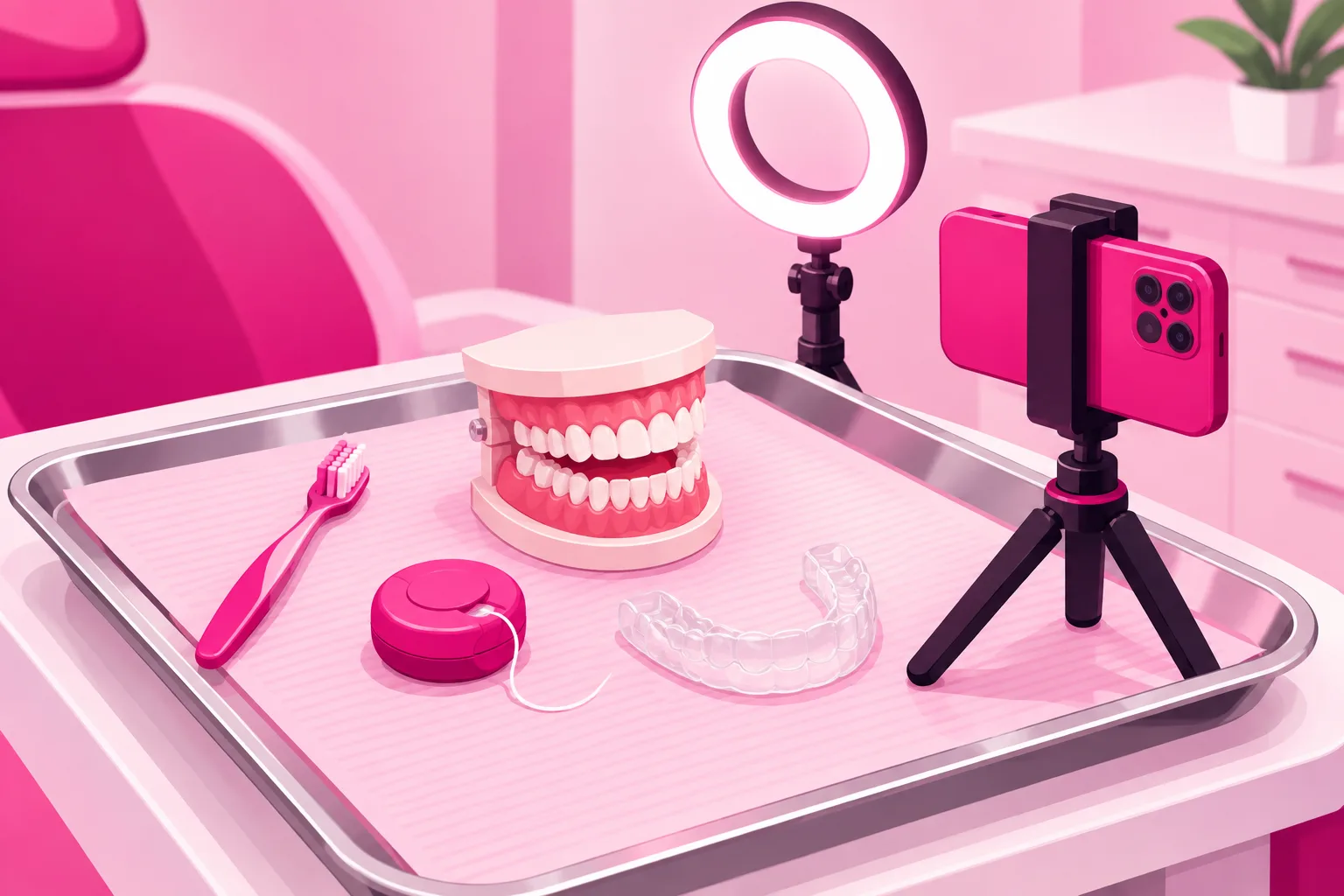
The format the genre was built on - the scaling sequence, the crown seated, the braces coming off - is also the one with the most rules attached, because any patient in the clip needs a specific written authorization and any before-and-after has to clear your state board. Here is the workaround most practices underuse: the typodont. The model mouth on your counter delivers every satisfying mechanic of the genre with no patient, no form, and no risk. Buy two, because one will end up in a video every day. Pair it with the team's own teeth - consenting adults who work for you and have signed the staff form - and you have the entire clinical genre without a single patient.
- 21. A filling on a plastic tooth. Where the decay is, why you remove more than the hole you can see, what the material is, and why it hardens under a blue light. Two minutes, no patient, enormous watch time.
- 22. A crown prep on the model. Why the tooth gets shaped down, what the lab does with the scan, and why it takes two visits (or one, if you mill in-house). The video that makes the crown estimate make sense.
- 23. Scaling on a training jaw. Training models with simulated calculus exist for exactly this; the flakes coming off are the most-watched sight in the niche, and on a model nobody has to sign anything.
- 24. How an implant actually sits in bone. The post, the abutment, the crown - the three parts, on a cross-section model, in the order they go in. Also the video that explains the three-part price in section 6.
- 25. What a night guard does. Model teeth grinding against each other, the wear facets that result, and where the guard goes. The most-shared video for the partner who hears it at night.
- 26. A root canal on a cross-section. "It is the treatment that stops the pain, not the thing that causes it" - shown on a sectioned model, step by step. The reputation repair the entire profession needs.
- 27. Flossing done right, then done wrong. The C-shape on the model, then the snap-and-saw everyone actually does, then the hygienist doing it properly on her own teeth. Same ten seconds people have been getting wrong for thirty years.
- 28. The team's own smiles. The assistant's clear-aligner journey filmed monthly on her own teeth, the dentist showing an old filling next to a new one on his own molar, the hygienist's retainer she still wears at forty. Warmer than any patient clip, and fully consented.
6. What-It-Costs-and-Why Explainers: The Most Under-Used Format (8 Ideas)
The second thing that keeps people away is the bill they are imagining, and almost no practice talks about it on camera. These videos resolve a real anxiety rather than pitching a service, and nothing about them requires a patient - they describe how care works and what it costs. Use ranges rather than promises, disclose the terms of any offer you mention the way your state board requires, and the person who has been avoiding the call because they assume the number is unbearable finally hears the number.
- 29. Why a crown costs what it costs. The lab, the materials, the two visits, the dentist's hour - and what happens to the price of the same tooth if you wait a year. Show the parts; the number stops being arbitrary.
- 30. What an annual maximum is, and why yours is about to disappear. The most important video in this guide. Most plans cap what they pay each year and reset on December 31, most FSA balances empty the same day, and the person doing the math in September becomes the crown in November. Section 9 covers the timing.
- 31. What a membership plan is. For the third of your patients with no insurance at all: what it includes, what it costs, and how it compares to paying per visit. A video that fills the schedule with people who thought they couldn't afford to come.
- 32. Why "free whitening with every cleaning" is not free. The educational version, not the competitive one: what the offer usually costs elsewhere in the visit, and what to ask before you take any dental deal. Keep it kind and general.
- 33. An implant is a three-part price. The post, the abutment, the crown - and sometimes the graft - quoted as one number that scares people and three numbers that make sense. Pairs with idea 24.
- 34. Why your new dentist found cavities your old one didn't. New x-rays, different thresholds for watching versus treating, and how to ask for the images and the reasoning. The most-argued-about video you will post; handle it with generosity toward every dentist involved.
- 35. What "in-network" actually changes about your bill. The contracted fee, the write-off, and the out-of-network reimbursement math, in one example. Bring the question log; this is the front desk's most-asked question.
- 36. Why a "deep cleaning" is a different thing - and a different bill. What scaling and root planing is, why insurance treats it differently from a regular cleaning, and why it is sometimes the visit that saves the teeth. The estimate that confuses more patients than any other, explained.
7. Comment-Reply Q&A: The Highest-Trust Format (6 Ideas)
Once you are posting consistently, your comments become the best content calendar you will ever have. Reply to a real question on camera. It is the least-effort, highest-trust format that exists: the question is pre-validated, the format is native to the platform, and it visibly demonstrates that you answer people. Keep answers general - you are explaining how something works, not diagnosing a stranger - and say so out loud, because that sentence is both good practice and your protection. Until the comments arrive, these six come from every front-desk log in the country.
- 37. "Is this a cavity?" - the photo in the DMs. You cannot tell from a photo, nobody can, and the DM is not a place to discuss anyone's care. Say the first half of your prepared reply on camera once - "if it hurts or you are worried, that is reason enough to get it looked at" - and it becomes one of your most-saved posts. Our dentist guide has the full script.
- 38. "Does it hurt?" Honestly, procedure by procedure - the cleaning, the filling, the extraction, the root canal - including which part is the uncomfortable part and how long it lasts. The honesty is the hook.
- 39. "How long is too long?" Never. The answer is a phone call, and the visit looks like idea 13. The shortest video in the vault and one of the most effective.
- 40. "Do I have to get x-rays?" What they find that an exam cannot, how often you actually take them, and what the radiation compares to in days of ordinary life. Resolves a real objection without arguing.
- 41. "Why does the hygienist call out numbers?" Perio charting explained: what a three means, what a five means, and why hearing the numbers is a good sign, not a bad one. People realize they have been afraid of a measurement.
- 42. "Can I be sedated for a cleaning?" The options, plainly, from a blanket and headphones to nitrous to oral sedation - who each is for, what it costs, and that asking is normal. Converts the most anxious viewer in your audience.
8. Team-as-Humans: The People in the Building (6 Ideas)
Education earns the reach. The humans in the building earn the appointment. People do not hand their mouths to a credentialed stranger - they hand them to a credentialed person they feel they already know, in a building that seems kind. Roughly one in five posts should be this, and everyone on camera has signed the staff form and read the social-media policy. Dental accounts that grow are team accounts - and in a documented hygienist shortage, this format recruits as well as it books.
- 43. The hygienist on what she actually thinks about flossing. Eleven years in the chair, the honest opinion, the thing she wishes people knew. The natural star of the account, and the person the viewer will actually spend forty minutes with.
- 44. The voice that answers the phone. The front-desk person, on camera, answering "are you taking new patients?" the way she actually does. The viewer now knows exactly who picks up, and that the call will not be scary.
- 45. The dentist's own childhood dental fear. Everyone has the story; yours is the reason you practice the way you do. The video that makes the anxious viewer believe the no-judgment promise.
- 46. The comfort menu. The blanket, the headphones, the ceiling screen, the hand-up signal, the numbing gel - a walk through the room with everything you have for the nervous patient, named out loud.
- 47. Why we bought the scanner. The modality you chose and why - the digital scanner instead of the goopy impression tray, the same-day crown mill, the laser - explained as a decision made for patients, not a feature list.
- 48. The assistant's day, from the other side of the camera. Room turnover, the instrument tray, the seven-thirty huddle, the office dog if there is one - the honest, non-clinical rhythm of a place that seems like it would be fine to walk into.
9. Seasonal Ideas: The Benefits Calendar (6 Ideas)
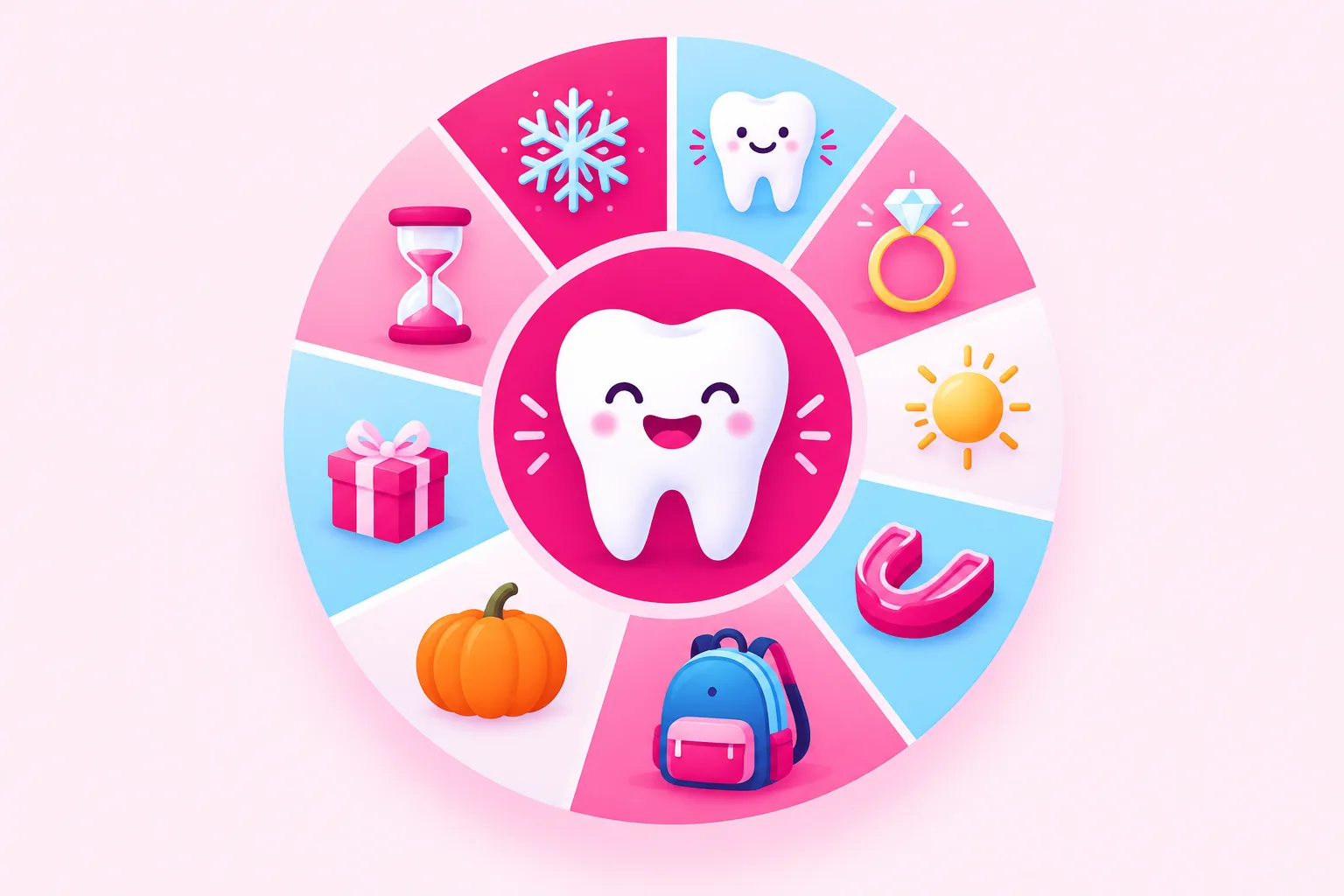
Nobody books a dentist on a random Tuesday. They book at a trigger moment, and the biggest one in your profession is on the calendar: most dental insurance annual maximums and FSA balances reset on December 31, which makes October through December the year's biggest rush. The video that wins December is not posted in December. Publish each of these thirty to sixty days ahead of the moment - a video needs runway to be surfaced, saved, and re-surfaced - and the audience arrives already primed by the date.
- 49. September: the use-it-or-lose-it explainer. Idea 30, timed. What an annual maximum is, why it disappears on December 31, what an FSA balance is, and what to use them on - the crown that has been waiting since spring, the cleaning skipped in April. The dentist who owns this explainer in a given city owns the rush.
- 50. December: the new-plan video that wins January. New insurance, new year, new resolutions: how to find a dentist who takes your plan, what the first visit costs, and what happens if you have not been in a while (idea 13, again). Publish it before the holidays.
- 51. January: Children's Dental Health Month is coming. February is the month; January is when you post the toddler's first visit (idea 19) and the "when does my kid need to see an orthodontist" explainer that parents save for years.
- 52. March: the wedding-and-prom whitening explainer. What professional whitening does, how long before the date to start, what to skip (every trick in section 3), and what it costs. The spring smile season, built in advance.
- 53. July: back-to-school, mouthguards, and the ortho consult. The school-form checkup, a custom sports mouthguard fitted on camera on the model, and why the orthodontic consult happens before the year starts. And underneath it, the most important job of late summer: filming idea 49.
- 54. October: the honest Halloween candy ranking. Which candy your dentist minds most and least, and why the sticky one is worse than the chocolate one. The easiest seasonal video in the entire vertical, saved by parents every single year.
10. The Consent-First Capture System: A Month of Posts From One Admin Morning
Fifty-four ideas are worthless if filming them requires a decision every day. The practices that post for years run a capture system: log all week, film once, post for a month. Keep one running note on the front-desk computer, and six capture points fill it - only the last one requires a patient.
- The front-desk question log. Everything asked before someone is a patient, verbatim. Sections 4, 6, and 7 come from here.
- The model mouth. The typodont on the tray, and the entire clinical genre without a form. Section 5 lives here.
- The team's own teeth. Consenting adults who work for you and signed the staff form. Warmer than any patient clip.
- The myth on your own feed. Whatever confidently wrong thing the algorithm showed you this week. Screenshot the idea, not the creator. Section 3 refills itself from here daily.
- The seasonal moment. Whatever is about to land on your schedule because of the calendar. Section 9, thirty to sixty days early.
- The consented patient. The reveal, the satisfying clip with a real person in the chair - only with the specific social-media authorization signed before the camera comes out, only inside your state board's before-and-after rules, and never as a condition of care. Our HIPAA-safe filming guide covers the in-clinic setup.
Then batch. Pick one ninety-minute block - the admin morning, the last hour of the Friday half-day - set the phone up once in the operatory you always use, put the model mouth on the tray, and film ten to fifteen answers back to back in the same scrubs. Do not change rooms or outfits; nobody notices, and the whole point is to remove every decision that could stop you. Fifteen videos is five weeks of posting from one morning. Assign roles: the assistant runs the camera, the front desk owns the log, the hygienist is the star, and the dentist explains the case.
The rule that keeps all of this safe: is the person in this video a patient, and if so, did they sign for this use? A face is identifiable. So is a smile, a distinctive tooth, a voice, a tattooed hand on the armrest, and the schedule on the monitor behind the chair. If no patient appears and nothing on screen belongs to one, it is education and it is yours to post. If a patient appears, the specific written authorization for social media - not the general consent to treatment, not a verbal "sure" - exists before the camera comes out, and a minor's parent signs it. This is a general overview, not legal advice; confirm the details against your own state board's rules and current HIPAA guidance, and when in doubt, ask your liability carrier before you post, not after.
11. Which Ideas Travel, Which Ideas Fill the Schedule, and What to Do When One Takes Off
Here is the question no other profession in this series has to ask about its content ideas. A general practice fills its hygiene column from a drive radius of fifteen to twenty minutes; a veneer or implant case will drive three hours. So the ideas above sort into two piles, and the video that travels is not the video that fills Tuesday.
The ideas that travel
The DIY corrections, the model-mouth clips, the root canal on a cross-section, the Halloween ranking. They earn reach from four time zones, teach the algorithm what your account is about, and build the trust that everything else spends. They also fill your DMs with "how much for veneers" from people who will never sit in your chair.
Post them for the reach. Do not measure the schedule by them.
The ideas that fill the schedule
The eight-years walk-through with your city named out loud, the membership plan, the benefits-deadline explainer, the front-desk voice, the comfort menu, the toddler's first visit. They get fewer views and more appointment requests, because the person watching lives twelve minutes away and has been meaning to call.
Say the city. Put the new-patient link one tap away. Ask for the zip code on the form.
And when one takes off - because one will, usually a correction or the eight-years walk-through - resist the instinct to boost every upload afterward. The move is selective amplification: take the one video that has already proven itself organically and pay to put it in front of the people who can actually book, inside the radius you serve, timed ahead of the moment they are deciding. The benefits explainer amplified across your metro in October reaches people while they are quietly doing the math. The walk-through amplified in December reaches the new-plan crowd. That is exactly what Viryze is built for: it only promotes videos that have already cleared the organic threshold, so your budget compounds your best explainer instead of rescuing a weak one - and because a new patient is a lifetime of recall rather than a single visit, one person reached within twenty minutes of the office can repay a modest budget for years.
Our Spark Ads guide covers the format practices should default to, since it amplifies your organic post with its comments and credibility intact. Just confirm anything promoted clears TikTok's ad policies, HIPAA, and your state board's advertising rules - the ad is an explainer, never a "painless" or "guaranteed" claim, and any before-and-after stays inside the board's rules.
Frequently Asked Questions
What should dentists post on TikTok?
Six formats cover nearly everything that grows a dental account: DIY-dentistry corrections that kindly explain what the lemon-juice whitening trick or the mail-order aligner actually does, no-judgment walk-throughs that show exactly what happens when someone comes back after eight years, satisfying clinical clips filmed on a model mouth so no patient is needed, what-it-costs-and-why explainers that resolve the bill people are imagining, comment-reply Q&A built from real viewer questions answered in general terms, and team-as-humans clips that show the hygienist, the front desk, and the dentist as people. Layer the seasonal videos on top - above all the annual-maximum explainer published in September ahead of the year-end benefits rush. Most of it requires no patient at all.
How do dentists come up with TikTok content ideas without filming patients?
By keeping a front-desk question log. Everything people ask before they are your patient - "do you take my insurance," "will it hurt," "how long has it been too long," "do I have to get x-rays," "can I be sedated for a cleaning" - is administrative rather than clinical, and every one is a pre-validated video because a real person cared enough to call and ask. Write each down verbatim, in their words. Add the model mouth on the counter, the team's own teeth, the myth the algorithm showed you this week, and the seasonal moment, and the log refills faster than you can film it. The test for every entry: is the person in this video a patient, and if so, did they sign for this specific use? If no patient appears and nothing on screen belongs to one, it is education and it is yours to post.
Can dentists show patients in TikTok videos?
Yes, but only with a specific written HIPAA authorization for social-media use, signed before the camera comes out. A smile is identifiable, and so are a voice, a distinctive tooth, and a tattooed hand on the armrest, so the general consent to treatment and a verbal "sure" do not cover it. The form has to say what will be posted, where, and for how long; it has to be revocable; it can never be a condition of care; and a minor needs a parent or guardian to sign. Before-and-after images additionally follow your state dental board's advertising rules, which in many states require your own patients, unaltered images, consent, and a results-vary statement. The practical shortcut most practices underuse: film the satisfying mechanics on a typodont and the team's own teeth, and save the consented patient for the clip that genuinely needs one.
Should dentists post "if your teeth look like this" videos on TikTok?
No - and it is the single most important idea to leave out of the vault. The shaming close-up of someone else's neglected teeth is the strongest hook in the genre and the most damaging: it confirms the exact fear that keeps the anxious viewer out of the chair, fills your comments with people defending themselves instead of booking, and often puts an unconsented patient image on a public feed. The discipline is to hook on the sensation or the fear, never the shame. "If your heart races in the dentist's parking lot" is universal and the viewer will admit to it. "This is what happens when you skip the dentist" is the sentence they have been hiding from you. Show what happens in the room, not what happens to people who avoid it.
When is the best time of year for a dentist to post on TikTok?
Thirty to sixty days ahead of the trigger moment, and the biggest one in dentistry is on the calendar: most insurance annual maximums and FSA balances reset on December 31, so the "here is what an annual maximum is and why yours is about to disappear" explainer belongs in September, not December. The same rule puts the new-plan and no-judgment walk-through content in December to win January. Underneath that, the dental year gives you a reason to post every month: Children's Dental Health Month in February, wedding and prom whitening in spring, aligner and braces consults in June, sports mouthguards and the school-form checkup in August, the benefits rush in October, Halloween candy - the easiest seasonal video in the vertical - and the six-weeks-left reminder in November.
How often should a dentist post on TikTok?
Three posts a week, sustained for a year, beats any burst of daily posting that dies the first week you see thirty patients - and dental accounts win on trust per video, not volume. The capture system makes the cadence cheap: log questions all week, then batch-film ten to fifteen answers in one ninety-minute block on the admin morning, phone on a tripod in the operatory you always use, model mouth on the tray, same scrubs, one take each. Fifteen videos is five weeks of posting from a single morning, and in a crushed week you drop to two from the bank without apologizing.
Ready to turn your best explainer into a full schedule?
Somewhere in these 54 ideas is the video that becomes your practice's breakout - the lemon-juice correction or the "here is what happens when you come back after eight years" walk-through that half your city ends up watching. When it happens, Viryze amplifies it to the people within the radius you actually serve, timed ahead of the benefits deadline, instead of boosting every upload and hoping. Your front desk supplies the content; selective amplification turns the best of it into a hygiene column full of patients who stay.
See how selective amplification worksRelated Reading
- TikTok for Dentists: The Complete 2026 Guide - the full strategy these ideas plug into.
- The Complete TikTok Algorithm Guide - the ranking signals that decide which of these ideas travels.
- TikTok for Healthcare Professionals - the broader playbook for licensed, patient-facing, privacy-bound practices.
- Healthcare TikTok Content Ideas: 50+ Video Concepts That Build Patient Trust - the idea vault for every other clinic with a waiting room.
- Veterinarian TikTok Content Ideas - the closest drive-radius parallel: a local practice, a lifetime client, and a team on camera.
- TikTok Spark Ads Guide - the amplification format for the ideas that take off.

Head of Creator Success at Viryze
TikTok growth strategist helping creators reach their first 100K followers through data-driven promotion strategies.