
Salon16 min read
Salon TikTok Content Ideas: 50+ Video Concepts That Fill the Chair
A vault of 52 salon TikTok content ideas for hair salons, barbershops, nail studios and suite stylists, sorted into the six formats that fill the chair and keep a national audience watching: the process clips that are the volume source, the walk-throughs that answer the parking-lot minute ("do I need an appointment? what do I even ask for?"), the "what it costs and why" explainers that are the whole booking, questions answered word for word from the desk and the DMs, the reveals with dignity and the countdowns that make the holiday book a reason to follow, and the honest days told once - every one checked against the yes card, the minor rule and the mirror - plus the book-first capture system that means you never run dry, the month-by-month timing laid over the salon year (prom in March, back-to-school the first week of August, the holiday book on October 1, the January book in mid-December), and which ideas travel to anyone anywhere versus book the chair twenty minutes away.
By Ryan MitchellHead of Creator Success at Viryze
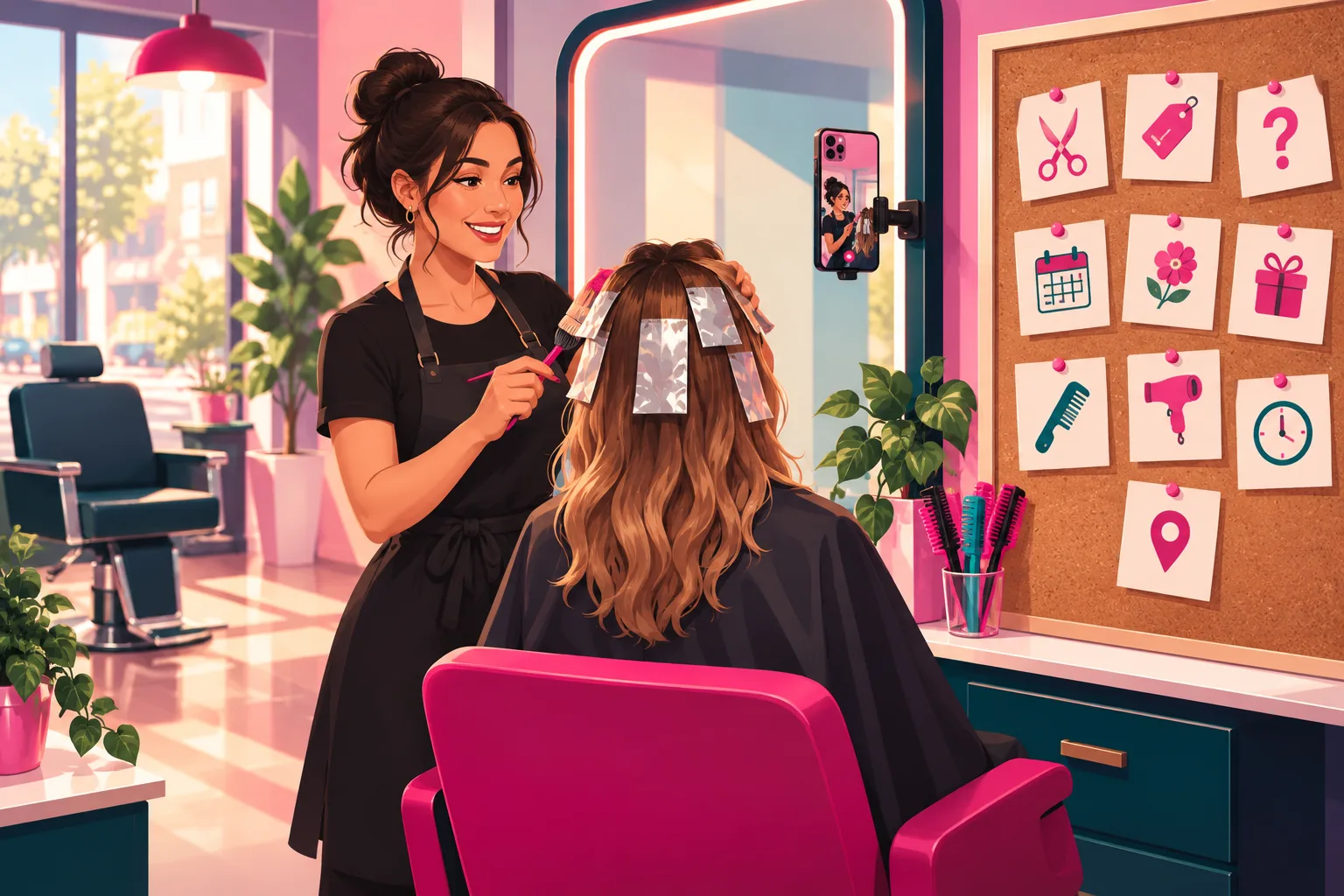
Most salon accounts die the same way. Someone posts the price-list graphic, a montage of the empty chairs set to a trending song, and the "we're hiring" flyer. It gets eleven views, six of them from other stylists. Meanwhile, that same afternoon, a woman sat in her car in the lot behind the pharmacy on Main, looked at your door, and drove to the chain instead - because she did not know whether she needed an appointment, what to ask for, how much it actually was, or whether anyone would wince at the box dye. The forty-second video that answers her would have stopped a hundred thousand scrolls, and filled a Tuesday.
You don't have a content problem. You have a capture problem - and a worry, which is a correct one, that the woman in the chair did not sit down to be filmed and that the mirror behind you shows the whole room. Both are true. But the work already in the book, the questions people ask at the desk, the year that turns on a handful of short windows, and the price nobody has ever explained are an endless video supply. Every idea below can be filmed with a written yes from anyone in the frame, and most of them with nobody in it but your own hands.
This guide is the vault: 52 salon TikTok content ideas, sorted into the six formats that actually fill the chair - the process clip, the walk-through, the "what it costs and why" explainer, the question answered, the reveal with dignity, and the honest day. It also covers the hooks that open on the hair instead of the client, the book-first capture system that keeps the well full, the timing laid over the salon year, and the question most local businesses never have to ask: which ideas travel to anyone anywhere and sell what fits in a box, and which ones book the chair twenty minutes away. New here? Start with our complete TikTok guide for salons and barbershops for the full strategy, then come back for the ideas.
Three rules before you film any of these
- One service, one video. "A day in our salon" is a montage nobody finishes. "Why a balayage is $180 and three hours" is a video. Narrow always wins, and it means one Tuesday in the book becomes a week of posts instead of one.
- The yes card, the minor, and the mirror. That is the whole consent test. The stylists and the front-desk kid who chose to be on the account agree once a year. Booth renters own their chairs and their own accounts, and appear here only by choice. Every client gets a written yes card at check-in with three boxes - no, yes but not my face, yes to everything - and a separate line for the before, revocable the same day without an argument. Minors are a per-visit yes from a parent, never with the school logo on the uniform or the pickup line in the window. The client in the next chair is never background, the mirror shows the whole room so you frame for it, and the chair is a confessional: nothing a client said is ever content. Every one of the 52 ideas below passes that test.
- Hook on the hair, never the client. "A balayage here is $180. Here is every minute of the three hours" brings the woman in the parking lot through the door. The box-dye wince, the "she said just a trim and then showed me this" skit, and the late-client reenactment fill your comments with stylists who will never book a chair, and teach the woman two miles away that she would rather not be judged. Conviction can be the fourth sentence. The first one is the hair.
What's Inside
- 1. The Book and the Question Log (Why You Never Run Out)
- 2. Hooks First: The Hair, Never the Client
- 3. Process Clips: The Volume Source (10 Ideas)
- 4. Walk-Throughs: The Format That Answers the Parking-Lot Minute (8 Ideas)
- 5. "What It Costs and Why": The Format That Is the Whole Booking (10 Ideas)
- 6. Questions Answered: The Format That Proves the Welcome (10 Ideas)
- 7. Reveals With Dignity and Countdowns: The Share Source (8 Ideas)
- 8. Honest Days: Last on Purpose (6 Ideas)
- 9. The Capture System: A Week of Posts From the Book You Already Have
- 10. Timing: Which Ideas to Post in Which Month
- 11. Which Ideas Travel, Which Ideas Fill the Chair, and What to Do When One Takes Off
- Frequently Asked Questions
1. The Book and the Question Log (Why You Never Run Out)

Nearly every idea in this guide comes from two sources, and you already own both. The first is the appointment book. The balayage on Tuesday at ten, the fade at four, the first color appointment on Thursday, the eleven Saturday cuts - it happens this week whether or not a phone is running, on a schedule, in a room you control, with the one person in the frame who has already decided to be there. You do not make videos. You film the work you were going to do anyway, and cut it on Monday.
The second is the questions people ask you. At the desk, in the half-second before they decide whether $180 is too much. In the DM that starts "this is probably a dumb question." On the booking form, in the box marked "anything we should know?" In the comment that starts "wait, do you actually." And in Dani's own head, where there is a list called "people always ask me" that has never been written down in twenty-two years on this street.
Each of those questions has already passed the only test that matters. A real person cared enough to ask it out loud. For every one who asked, hundreds sat in the parking lot, wondered the same thing, and drove to the chain. The salon that answers plainly and kindly becomes the one they picture when they finally decide to do something about their hair - and in most towns, no salon answers at all.
So before the lists below, build the habit that makes them infinite: the question log. One running note on the salon phone, that the front-desk kid and whoever runs the account can both add to. Every time a client, a commenter, or a caller asks something, write it down word for word - "can I just get a trim?" - not in your framing - "service expectations." Their phrasing is your hook. Your framing is the answer. One line on the wall next to it: the question is content, and what she told you after it never is. The chair is a confessional.
Thirty logged questions is roughly a quarter of content. And the log refills faster than you can empty it, because answering questions on camera fills your comments with new ones. That loop - answer, harvest, answer - is why some salons post easily for years while the one across the street runs dry by the third week of January.
Use the 52 ideas below as your starter log. The examples lean on one shop - four chairs next to the pharmacy on Main, two booth renters, a barber chair in the back, walk-ins on Tuesdays and a booking link the rest of the week - because it is easy to picture. Dani owns it and has cut hair on this street for twenty-two years. Tasha rents the second chair, does the curly cuts, and runs the phone. Marcus has the barber chair in the back. The front-desk kid agreed to be on camera and is good at it. But every idea adapts to a solo colorist in a suite, a nail studio, a six-chair barbershop with a line out the door, a kids' cuts place, or a bridal specialist who works out of a trailer in May. Swap in your own book, then let your real question log take over.
2. Hooks First: The Hair, Never the Client
A great idea with a weak first two seconds is a video nobody sees, and for a salon the first two seconds carry a weight most businesses do not have to think about. The person you most want to reach is nervous - about the price, about not knowing the words, about being judged for the box dye or the ten years at the chain or the Pinterest photo she is embarrassed to show - and the hook either disarms that or confirms it. Never open with your salon's name, your years in business, or your hours. Those belong in your bio and at second twelve, once someone has a reason to care who is talking.
Hook patterns that work for every idea below
- The price, named first: "A balayage here is $180 and takes three hours. Here is every minute." You said the thing they were going to say in the comments. They exhale, and they watch.
- The count: "Hour six of this color correction." "Eleven days until the holiday book opens." A number in progress is a reason to come back tomorrow, and tomorrow is a follow.
- The honest answer: "Can we fix box dye? Yes. Here is what it takes, and why it is not one appointment." The woman who has never set foot in a salon and the one who has three stylists both keep watching.
- The person: "Dani has cut hair on this street for twenty-two years. Here is what she will tell you about that." One stylist, one question, one station. Never a montage.
- The permission: "You do not have to know what to ask for. Here is what to say when you sit down." The most powerful opening in the vertical, because it is the exact sentence the woman in the parking lot needs to hear.
And the hook your account must retire, no matter how well it performs: the clip that is really about the client. The box-dye wince. The "she said just a trim and then showed me this" skit. The late-client reenactment, the Pinterest photo held up next to a wig, the tipping lecture. It travels. It gets numbers. It also fills your comments with other stylists who came to commiserate and will never book your chair, makes the woman two miles away decide she would rather not be judged, and trains the algorithm to show your next video, the kind one, to the trade instead of to her. Its quieter cousin, the grievance post - "nobody respects our time," "here is why we charge a cancellation fee" - is worse, because it reads as a warning on the door. Our pillar guide covers why the hair beats the client in full.
Then answer fast. Give the point in the first eight seconds and spend the rest on the why, the exception, and the part people get wrong. Completion rate is the signal that decides whether the algorithm carries your video past your existing followers. And never tease: "DM for prices" reads as a pitch and kills the video. Give the range away. The woman who wants to book will still find the link, and she will arrive already trusting you. For the full mechanics, see our TikTok algorithm guide.
3. Process Clips: The Volume Source (10 Ideas)
The format every salon already has the raw material for, and the one most salons ruin by turning it into a montage with a song or a commentary about the client. A process clip is sixty seconds of real work, filmed as it happens from a clamp on the station mirror, framed vertical, with the next chair out of the shot. One sentence to the camera when you start, one when you finish. The middle can be silent, or it can be the sound of the shears.
This is the feed-path workhorse: it travels anywhere, it is what strangers and other stylists follow, and it is cheap, because the footage exists every working day. Two rules travel with every clip. The client's yes card decides the framing - the back of the head and the hands if she ticked the middle box, her face only if she ticked the third. And the clip never turns into the take about what she walked in with; when you feel it coming, stop the phone.
- 1. Foils going in, start to finish. The clamp on the mirror, the sectioning, the paper, the brush, the light moving across the station while you work. "This is a full balayage. Hour one of three." The foundational clip, and the one that teaches you the format: clamp it, run it, cut it on Monday. Check the mirror before you press record - it shows the whole room.
- 2. The fade line coming up. Marcus, the guards changing, the line appearing out of nothing on the side of a head seen from behind. Fifteen seconds of silence, then one sentence: "this is the part people pay for." The barber chair's workhorse, and the clip that teaches a man who has gone to the same chain for ten years what he has been missing.
- 3. The shampoo bowl. The ten minutes nobody films. Why the shampoo is where the toner sets, why the water is the temperature it is, the scalp massage that is the reason half your regulars say they come. Hands and water and a cape. A surprising number of strangers follow a salon for this clip alone.
- 4. The round-brush blowout, section by section. Hands, brush, the section lifting, the shine arriving. "This is what you are paying for when you say you can't make it look like this at home." The clip that quietly sells the blow-dry lesson in idea 25 and the product in idea 26 without asking for either.
- 5. Mixing the color. The bowl, the scale, the two tubes, the stir. "The formula is hers. The method is everyone's." Forty seconds of why a color is weighed and not guessed, said while you do it. The clip that sets up the price explainer in idea 19 and makes the $180 feel like craft instead of a number.
- 6. The gel set under the lamp. For the nail studio: the cuticle work, the base, the cure, the color, the cure again. Say "forty-five minutes" out loud, and let the sanitizer jar sit in the frame on purpose. Hands only, so the yes card is the easiest one in the shop.
- 7. Dry-cutting curls, one curl at a time. Tasha's clip. "We cut curly hair dry, curl by curl, and here is why." It travels to the curly crowd in every state who follow anyone doing it right - and it books the woman twenty minutes away who has had her hair straightened before every cut of her life because nobody ever told her there was another way.
- 8. The toner going on, and the color changing. The brassy to the soft, in real time, in the same light, with no filter. "This is the twenty minutes that makes it look expensive." The clip that makes the toner explainer in idea 20 land - and, because it is filmed honestly, the one you can put money behind later without tripping the rule about exaggerated before-and-afters.
- 9. Between clients: the sweep, the comb into the jar, the cape changed. The boring sixty seconds. "This is most of the job." It is also your proof: the comb goes in the jar, the cape is fresh, the station is wiped, every time, on camera. Inspectors have phones, and so does the client deciding between you and the chain. One of the most-followed formats on the platform is work nobody else shows.
- 10. The updo, pin by pin. The prom trial or the bridal run-through, filmed from behind - a head of hair, two hands, forty pins and a can of spray. Mostly silent. One sentence at the end: "this is what three weeks out looks like." A process clip that doubles as a countdown, and the first reason for a parent to follow in March.
4. Walk-Throughs: The Format That Answers the Parking-Lot Minute (8 Ideas)
The conversion video of the vertical, and the one almost no salon has ever filmed. A woman sits in her car in the lot and runs the list: appointment or walk-in? will they judge the box dye? how much is it actually? what if I hate it? is it weird that I have never been here? She has no idea what to ask for, and she is a little ashamed of that. The walk-through, a phone in one hand from the parking lot to the price at the desk, answers all of it before she turns the key - the same video dental practices use to dissolve the fear of walking in.
Make one per door, over time, and film each one on a Tuesday morning before the first client so there is nobody in the frame who did not agree to be. Pin the main one. These are the videos you re-post before every window and the ones worth money in October, because they only make sense to someone who could drive here - which is exactly who fills the chair.
- 11. The salon, from the parking lot to the price at the desk. Where to park (behind the pharmacy, the lot is shared). Which door. Who says hello and what they say. Where you wait and for how long. What the consultation actually sounds like - "you can bring a photo, you can say 'I don't know, just not this,' and nobody will sigh." The shampoo bowl. How long a cut takes. The price at the desk and whether the blow-dry is included. Cards, cash, tips, whether you can bring a kid. Walk-ins on Tuesdays, the link the rest of the week. Pin it. Everything else in this section is a variation.
- 12. The barber chair in the back. Marcus's door. Walk in or the app, and what the wait actually is on a Saturday. Where you sit. How to ask for it - the numbers, the taper, "bring the photo, I will tell you if your hair will do it." Thirty minutes. $35, and yes the beard trim is extra, and here is what it costs. The video for the man who has gone to the chain for ten years and never knew there was a chair in the back of the salon his wife goes to.
- 13. The first color appointment. Why it is longer than the ones after: the consultation, the strand test, the three hours, the toner at the end. "Bring a photo. You will not leave with a surprise." What it costs, said out loud, and what changes the number. The walk-through for the woman who has done her own color for eight years and is finally ready to hand it over.
- 14. The kids' chair. Filmed with nobody in it. The booster seat, the tablet, the clipper guards, the sticker drawer. How long it takes, that the parent stays, that a crying three-year-old is not an emergency here. $22. "We have done a thousand first haircuts and we are not in a hurry." This goes up the first week of August and fills the two weeks before school starts.
- 15. The formal booking. For the nervous seventeen-year-old and the parent who is paying. Trial or no trial. How long it takes on the day. What it costs and what the trial adds. "Bring the dress photo and the earrings." When to book so the slot exists. The parent is the viewer and the parent's yes is the one that matters later, so say the price plainly.
- 16. Booking the renter's chair. Tasha's door, on the salon account by her choice. How booking her works - her link, not the salon's; who to text; why her prices are hers; what happens if you call the desk and ask for her. The video that stops a dozen confused DMs a month and shows the suite stylist down the street exactly how to film her own.
- 17. The consultation, word for word. You never film a real one, because the chair is a confessional. So on a Tuesday morning the front-desk kid sits in the chair and Dani walks through exactly what the first five minutes sound like: "what do you like about it right now? what do you want to stop doing every morning? how much time do you actually have?" The permission hook in its purest form - here is what to say when you sit down.
- 18. The busy-Saturday edition. Two versions, one idea. On the busiest Saturday of a window, a phone in one hand through the full room: in December, "here is what January looks like - same chairs, half the wait, and the gift card you got works for all of it," and the Saturday after the last dance, "here is what June looks like." And in the week the holiday book fills, the honest version: "we are booked through the twentieth. Here is the next open day, and here is how to be first in January." The crowd nobody invited back is the most common failure in this business. This is the invitation.
5. "What It Costs and Why": The Format That Is the Whole Booking (10 Ideas)
Nobody has ever explained a salon price to her. She has paid it, resented it, Googled it, and asked a friend, but no one has stood at a station with a bowl in hand and said why. Forty seconds, one thing, explained with the plainness of someone who remembers not knowing it. Curiosity is the cheapest attention on the platform, and every one of these dissolves a price objection before she reaches the desk.
Film every explainer where the thing happens - the balayage explainer at the station, the men's-cut explainer at the barber chair, the price explainer at the desk with the card reader in frame - never in the break room with a slide. And count the right thing: a save means she is deciding, a send means she decided and is forwarding it to the friend who said "a hundred and eighty dollars for hair?" Views are the metric that matters least here.
- 19. Why a balayage is $180 and takes three hours. The consultation, the sectioning, the hand-painting that cannot be rushed, the processing, the toner, the blow-dry, the color that is weighed and not guessed from idea 5. The single most important video in this vault: it is the whole booking, and it is the one she sends to the friend.
- 20. Why the toner is extra, and what happens without it. Use the footage from idea 8. The brass, the twenty minutes, the difference between "blonde" and "expensive blonde." The explainer that turns the line item people argue about at the desk into the part they ask for by name.
- 21. Why the first color appointment is longer than the rest. The strand test, the history you have to ask about, the box dye that changes the plan. "After the first one, we know your hair. The first one is where we learn it." Pairs with idea 13 and takes the fear out of the longer slot.
- 22. Why a men's cut is $35 here when the chain charges $19. Said at the barber chair, by Marcus, without a word against the chain. The consultation, the years behind the chair, the hot towel, the neck shave, the same person every time, the chair that remembers how you like it. "Sixteen dollars buys you not having to explain it twice." The men's version of idea 19.
- 23. Why a color correction is priced by the hour, and why we will never quote it in a DM. Because nobody can see what is under the box dye from a photo. What a consultation is, what it costs (usually nothing), and why "bring the box or the receipt" is the kindest sentence in the trade. The explainer that answers the hardest DM you get, in a way the friend she forwards it to can also understand.
- 24. What a "trim" actually is here, and why it costs what a cut costs. The consultation, the shampoo, the shape, the blow-dry, the same forty-five minutes. Said kindly, never as a complaint about people who ask. The explainer that retires the most common misunderstanding at the desk without making anyone feel foolish for having it.
- 25. What is in a $65 cut. The consultation, the shampoo and the scalp massage, the cut, the blow-dry, and the two minutes at the end where Dani shows you how to do it at home with the brush you own. "You are paying for the two minutes as much as the forty-five." The explainer that makes a cut feel like a lesson, which is what it is.
- 26. What the product on the shelf actually is - and what it is not. "Here is the one I used on you today, here is what it does, here is who it is not for." Say what the product is. Words like "medical-grade," "non-toxic," "organic" and "formaldehyde-free" are claims with rules behind them, and the honest sentence sells more anyway. The retail engine for the national audience that buys what fits in a box, and the pillar guide's compliance section has the rest.
- 27. Why your stylist asks you to rebook before you leave. Six weeks for the cut, eight for the root, twelve for the balayage, and what actually happens to the color in week fourteen. "Six weeks puts you at the twelfth. Same time?" is not an upsell, it is the plan. The explainer that makes the most important sentence at the desk feel like care, because it is.
- 28. The gift card, in plain numbers. "A $65 card is a cut. A $100 card is a cut and a blow-dry lesson. A $200 card is a balayage and the toner." How it works, whether it expires, who to ask for. The week after Thanksgiving and the two weeks before Mother's Day, and nowhere else.
6. Questions Answered: The Format That Proves the Welcome (10 Ideas)
Real questions from the desk, the DMs and the comments, answered honestly in your shop's own voice by the person who actually answers them. This is the format that proves the welcome instead of asserting it. "We are a judgment-free salon" is a sign. "Can we fix box dye? Yes, here is what it takes" is a welcome. Film them where the answer lives - the walk-in question at the door, the curly question at Tasha's station, the kids question at the booster seat - and take one question per video, never a list.
The first ten are below. Your real log will overtake them by Thanksgiving. Three of them are also your saved DM replies, which the pillar guide's client ladder covers - once the video exists, the reply is a link and a sentence, inside the hour.
- 29. "Can I just get a trim?" Yes. Here is what a trim is here and what it is not - the shape, the ends, the blow-dry, the forty-five minutes. Answered warmly, with the price, and with none of the eye-roll the question gets in the stylist group chats. The most-asked question at the desk deserves the kindest video on the account.
- 30. "Do you do curly hair?" Yes, and here is exactly how we cut it - dry, curl by curl, and here is why we never straighten it first. Tasha, at her station, with a mannequin head or a client who ticked the third box. The single most trust-building forty seconds a salon can post, for a woman who has been told "we'll just blow it out" her whole life.
- 31. "Do you take walk-ins?" Tuesdays, yes, and here is what that looks like. The rest of the week, the link, and here is honestly what happens if you walk in on a Saturday - we will try, and we may say three o'clock. The answer that saves the front-desk kid eleven DMs a week and never makes anyone feel unwelcome for asking.
- 32. "What if I hate it?" The honest answer: come back within the week, we fix it, and here is exactly how that conversation goes - no charge, no defensiveness, no "well, you said." The question nobody asks out loud and everybody is thinking, answered before the first appointment so the first appointment happens.
- 33. "Can I bring a picture?" Please do, and here is what we do with it. The honest version: "sometimes the answer is 'your hair will not do that, and here is what it will do that is close.'" The video that retires the Pinterest-photo joke forever by being kind about the Pinterest photo.
- 34. "Can you fix box dye?" Yes. Here is what it takes, why it is sometimes two appointments, why we need to see it in person, and what to bring. Never a diagnosis and never a quote, because you cannot see what is under it from a DM. Say the word "consultation" and the word "free." The friend she forwards it to is reading too.
- 35. "How often should I come back?" Six weeks for the cut, eight for the root touch-up, twelve for the balayage, every two for the nails - with a reason for each number and a date, not a vibe. The question whose answer is the rebook, and the video to send with the follow-up text the day after her first visit.
- 36. "Do you cut kids? How old do they have to be?" Yes. Any age. $22. A parent stays in the room, here is the booster seat, here is the tablet, here is how long. Filmed at the empty kids' chair with nobody in it, and paired with idea 14 the first week of August.
- 37. "How much is a ___?" The range, the one thing that moves it inside the range, and the link. "A women's cut is $65. Length and thickness move it, and the blow-dry is included." Make one per service and you have a saved reply for every price DM you will ever get. Never "DM for prices" followed by silence - that is a door with no handle.
- 38. "Is it weird that I've never been to a real salon?" No. Said by Dani, at the desk, to the camera: "half of the people in this chair came from the chain, and the only thing you need to know how to say is 'I don't know what I want, I just know what I don't.'" The permission hook as a whole video, and the one to post on December 26.
7. Reveals With Dignity and Countdowns: The Share Source (8 Ideas)
The reveal is the moment she sees it, and it is the share source of the whole vertical: she sends her own reveal to forty people, and that is a referral engine no mailer can touch. It works on two conditions. The yes card decides the framing, and the before is its own line on the card, never assumed from the yes to the after. And there is never a word about what she walked in with - a reveal filmed with contempt for the before is a different video, and it belongs in section 2 with the things you never post.
The countdown lives here too, because a reveal with a date attached is a reason to follow: "prom hair, three weeks out," "the holiday book opens Thursday." One rule for both: same light, no filter, no retouch. TikTok's misleading-content rules bar before-and-afters that exaggerate the result, and the honest version is the only one you can ever put money behind.
- 39. The reveal, the moment she sees it. The cape comes off, the chair turns, and the phone on the clamp catches whichever version she ticked - the back of her head and her hands going up, or her face. No voiceover, no "from this to this." Her reaction is the whole video. She shares it before she reaches the car.
- 40. The before and after, with its own yes. Only when the before line on the card is ticked, and only in a way she would be glad to see again - the same chair, the same light, the hair, not the slump. "Three hours, $180 plus the toner, and here is every step" in the caption, promising nothing the chair cannot repeat. The reveal that is also idea 19.
- 41. The regular, every fourth Thursday since 2009. She has come to Dani for seventeen years, she loves being on camera, and she has agreed for the year. Her reveal is a series - the same chair, the same two people, the small changes - and it is the most honest ad for "the same person every time" you could ever make.
- 42. Prom hair, three weeks out. The countdown in March: the trial (idea 10), the dress photo, the date circled. Then the reveal on the day, with the parent's yes, because she is seventeen. "Three Saturdays left before the dance. The book is here." The video the parent sends to the other parents.
- 43. Back to school, two weeks out. The kids'-chair countdown the first week of August, and the first-haircut reveal when it happens - the back of a small head, the parent's hand on the armrest, the certificate, with the parent's yes and never the school logo or the pickup line. "We have done a thousand of these. Two weeks until the bell."
- 44. "The holiday book opens Thursday." October 1. The chair, the calendar at the desk, Dani: "the holiday book opens Thursday. We book out by mid-November, every year. Here is how to be in it." Said plainly, with the link, and re-posted once a week until it fills. The most important countdown of the year, and the one worth money.
- 45. "Here is what January looks like." Posted in mid-December, while the room is full. The open book for the second week of January, the gift card that works for it, the new-year consultation. "Same chair, half the wait." The countdown to the calm, and the video that keeps the holiday crowd.
- 46. The December receipt. What this year actually looked like in the chair, said once, with the faces who agreed: the first-time clients who said TikTok at the desk, the proms, the first haircuts, the color corrections nobody got to see, the Tuesday that filled. Not a hard day - the year's marker. Ask for nothing on camera that the receipt has not already earned.
8. Honest Days: Last on Purpose (6 Ideas)
The most powerful format on the platform for a salon, because it is the one thing the chain can never say. It goes last on purpose: the walk-throughs and the explainers earn the trust that makes an honest day land, and the rules have to be in place before the first one. It is said, not shown. It is never a client's story - the chair is a confessional and nothing she told you is yours. There is never a sad song under it, and it never turns into an ask or a grievance. A hard day is part of the work and your clients can handle it. What they cannot handle is being the punchline.
A few of these a year, not a series. One person at the desk or the station, in their own words, once. Whoever owns the phone gets a look before any of them go up - that is written on the break-room wall.
- 47. The eight-hour color correction. Told with the client's permission and without her name, at the station after she has gone, with nothing of her hair in the frame unless she ticked the box. What it took, what it cost her, what you learned, and the one sentence for anyone with a box in the bathroom cabinet: "come in before, not after." No wince anywhere in it.
- 48. The Tuesday nobody came. One person at the desk, the walk-in sign, the empty book. What you did with the day - the question log, the explainers, the deep clean - and what Tuesdays are for. No sad song, no sale, no "we have openings!" The video that makes the next Tuesday feel like a place a person could just walk into.
- 49. The cut Dani would do differently now. Twenty-two years on the street, and the one she still thinks about - what she would tell herself at year one, what she tells the new stylist now. Said at her station, once. The video that makes a stranger trust the consultation before she has had it.
- 50. The stylist who left, and the chair that is open. One kind sentence about the open chair and what you are looking for. Never a word about her, where she went, or whose clients went with her - who owns the handle and the followers was written on the wall before it mattered, which is why this video is possible at all. The town is already talking. Say it once and kindly.
- 51. The year Dani almost closed. Her own story, told by her, and she sees the cut before it posts. The lease, the spring nobody came, what kept the lights on, and the regulars by name only if they agreed. The most-saved video an owner will ever make, and the reason a town decides a salon is theirs.
- 52. The day the town needs a straight answer. A storm closes Main Street for a week, a bad review goes around the town group, a client is hurt by a service somewhere and everyone is talking about hair. One person at the desk, no process clip underneath, no sale attached, saying what the salon is doing and whether you are open. Decide now who posts it.
9. The Capture System: A Week of Posts From the Book You Already Have
Fifty-two ideas are useless if filming them means a third person, a tripod, and a Tuesday you do not have. So the system is built around what is already true: the book is full of work, the work happens at the station, and the phone fits on a clamp. On Sunday night, look at the week. A balayage on Tuesday at ten is ideas 1, 8, 19 and 20 before anyone has had to invent anything. A first haircut on Thursday is 36 and, if the parent ticks the box, 43. A full Saturday is the ninety seconds of the room. The book is the content calendar.
Then the working-day capture list, which takes about twenty minutes spread across a day you were already working. The phone goes on the station clamp before the first client. One process clip, start to finish, from the chair whose client ticked a box. One reveal with its own yes. One explainer, filmed at the station with the bowl in hand, where the thing happens. One question from the log, one answer, at the desk. And on Saturday, ninety seconds of the room - hands, capes, the broom, the jar of combs - and never a face in the next chair without asking. Monday, one hour before the first client, is when it all gets cut. The pillar guide has the full book-first capture list.
Once a month, on a slow Tuesday, stand Dani at the desk with the card reader in frame and film ten answers from the question log back to back. Same spot, same apron, one take each. Together that is roughly five weeks of posting from one month of workdays and one hour.
Last, one person owns the salon phone, and the rule is written on the break-room wall: who posts, what goes up without asking (the six formats inside the rules), what gets a look first (any before, any minor, any price, any other stylist's client, any honest day), what never goes up, and - the line that matters most on the day it matters - who owns the handle, the followers and the reveals when a stylist leaves. The stylist's own account is not the salon's: the salon posts the salon and tags the chairs, the stylist posts her chair and tags the salon. And Saturday mode is a real setting on that wall: for the six weeks of the holiday rush, the account runs on reveals with their yeses, the pre-filmed walk-through and DMs answered the same day, and nothing else is required. Silent in the second week of December is fine. Silent in September is not.
The rule that keeps all of this safe: the yes card, the minor, and the mirror. The cast who chose the account agree once a year. Booth renters own their chairs and their own accounts, and the salon never posts a renter's client without both yeses. Every client gets a written yes card at check-in - no, yes but not my face, yes to everything - with a separate line for the before, revocable the same day without an argument. Minors, your own included, are a per-visit yes from a parent, never with a school logo or the pickup line in the window. The client in the next chair is never background, and the mirror shows the whole room, so check it before you press record. The chair is a confessional. The comb goes in the jar on camera, the chemical service never happens on a fourteen-year-old against your own policy, the lash or permanent-makeup work outside your license is never content, and a product is called what it is. A business account's in-app sound picker only offers the Commercial Music Library, so use it, or the shears, and remember the clamp hears the salon radio too. This is a general overview, not legal advice - the pillar guide's compliance section has the details, our dental filming guide has the closest per-visit consent model, and when in doubt, leave the person out. Every one of the 52 ideas can be filmed with a written yes from anyone in the frame.
10. Timing: Which Ideas to Post in Which Month
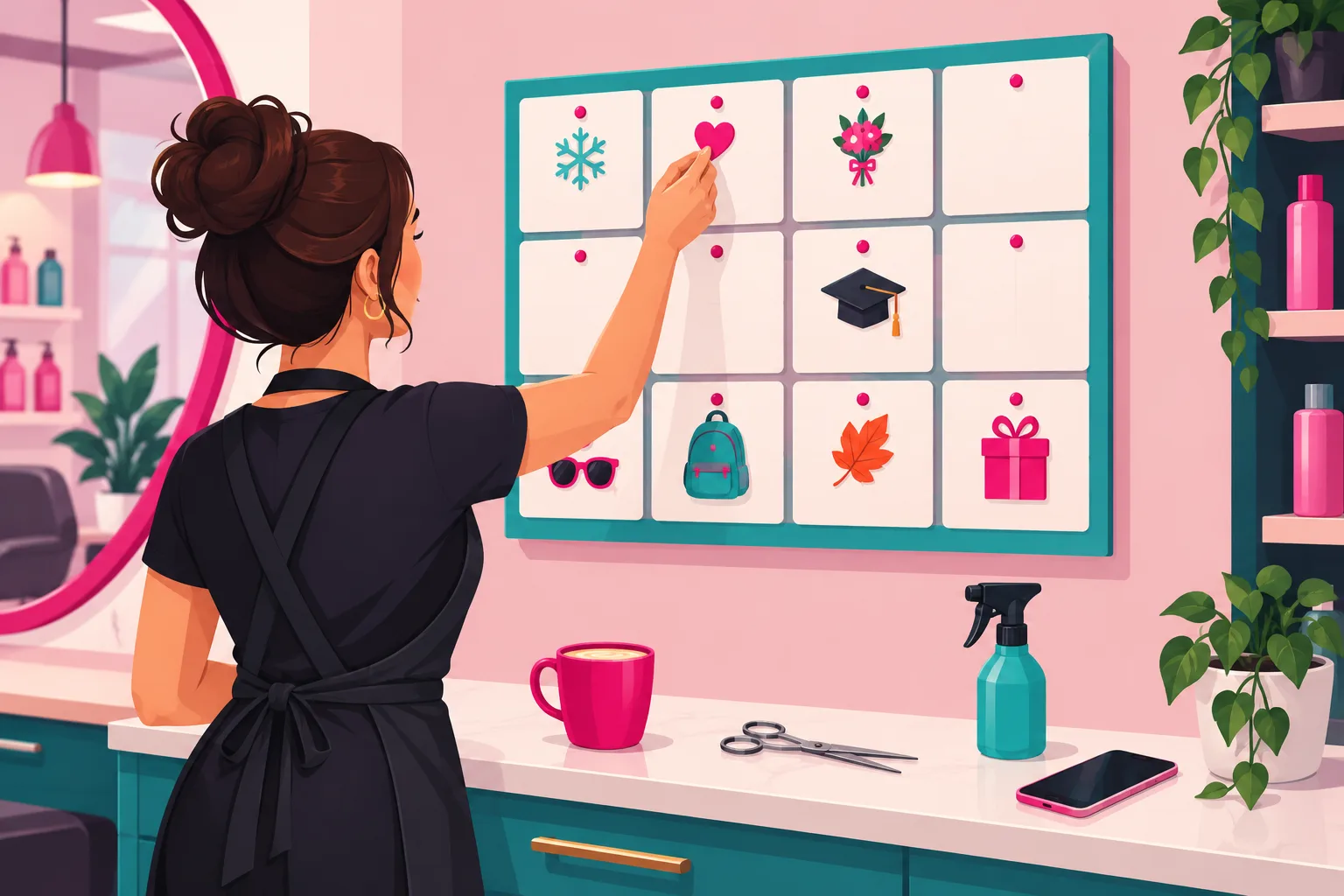
Almost nobody books a salon on a random Tuesday. They come at a moment - a dance, a wedding, a new job, the first week of school, the photo for the holiday card, the resolution - and the difference between a salon and nearly every other business is that your moments are on the calendar a year out, and they are short. The holiday book opens October 1 and is full by mid-November. Prom is three Saturdays. Back-to-school is two weeks. January is empty for exactly as long as you let it be.
So the video that fills the holiday book is not posted on December 20, when every salon in town is posting "we have openings!" at once. It is posted in October. Build in the quiet weeks for the busy ones. Here is the vault laid over the salon year, by idea number.
The vault, month by month
- January to February: the quiet, and correction season. Ideas 38, 17, 34, 23, 19 and 21. The permission video first, the consultation walk-through second, then the box-dye answer and the correction explainer, because January is when the cabinet box gets opened and regretted. The gift cards from December are being redeemed in your calmest weeks; idea 27 makes sure those clients leave with a date. If you are reading this in January, film idea 38 this week.
- March: prom sells now. Ideas 15, 42, 10 and 33, in that order, three to four weeks before the first dance. The formal walk-through for the parent who is paying, the countdown, the trial filmed pin by pin, and "yes, bring the picture." The parent is the viewer, and the parent's yes is the one you will need in April.
- April to May: the proms, the trials, and Mother's Day. Idea 42 as reveals, with their yeses, as the dances happen. Idea 10 for the bridal trials. Idea 28 two weeks before Mother's Day, and nowhere near it otherwise. The Saturday after the last dance, the summer half of idea 18: "here is what June looks like."
- June to August: blonding, curls, and back-to-school. Ideas 1, 8, 20 and 19 while the foils are the content, and 7 and 30 for the curly crowd who finally take the humidity personally. Then the first week of August, exactly: 14, 36 and 43 - the kids'-chair walk-through, the kids question and the countdown - posted while parents are quietly deciding and before the chain starts its back-to-school ads.
- September: the quiet month is the build month. Film 11 fresh, 12, 13, 25 and 22, and batch the questions - 29 through 37 on one slow Tuesday. Shoot the holiday-book walk-through now so it is ready to post on October 1. Nothing goes up in September that was filmed in September except the question answers; everything else is for October.
- October: sell the holiday book. Idea 44 on October 1 and once a week after until the book fills. Idea 11 pinned. Ideas 31, 35 and 37 re-posted so every DM on a Friday can be answered with a link within the hour. Idea 13 for the client who has never had a holiday color appointment, and idea 27 so the November clients leave with a January date. This is the month paid promotion earns its keep - section 11.
- November to December: Saturday mode, the gift card, and the receipt. Thanksgiving is November 26 in 2026; idea 28 goes up the week after. Idea 39 with its yeses as the reveals happen, and nothing else is required. On the busiest Saturday in December, the January half of idea 18, filmed while the room is full. Idea 45 in mid-December. The last week of the year, idea 46 - what this year actually did, said once - and then idea 38 on December 26, which is the first post of the new year's book.
- The day the town needs you. Idea 52, and no other. One person at the desk, saying what the salon is doing and whether you are open. Decide now who posts it.
The pillar guide's salon calendar explains the reasoning behind each stretch. The short version: fix the box dye in January, sell prom in March, sell the kids' chair in the first week of August, build in September, sell the holiday book in October, run Saturday mode through December, and film January on the busiest day of the year.
11. Which Ideas Travel, Which Ideas Fill the Chair, and What to Do When One Takes Off
Here is the question a plumber or a dentist never has to ask about their content ideas. A salon has two audiences. The chair is local. The feed is not. Nobody gets a balayage at a salon they cannot drive to in twenty minutes, and the foils going in can reach a stylist in Phoenix, a retired teacher in Maine, and a nineteen-year-old in a city apartment who has never seen a color weighed on a scale - none of whom will ever sit in your chair, and any of whom might buy the product from idea 26 or a seat in a class.
So the ideas above sort into two piles. Your far-away viewers are not wasted - they just buy a different thing, and they need a different scoreboard. What has to be decided is the order.
The anchors: the chair path
The walk-throughs (11-18), the questions about showing up (31, 36, 37, 38), the countdowns that name a date (42, 43, 44, 45), the reveals with a local face (39, 41), the price explainers when they are sent to a friend (19, 22, 25), the gift card (28), and the receipt (46). They only make sense to someone who could be in the chair on Thursday, and that person is the one who fills the book.
Say the town and the street out loud. Point them at the booking page with the price ranges, how long each service takes, the cancellation policy said like a person, and a named face - "ask for Tasha, she does the curly cuts." Measure them in booking-page clicks, new clients who say "TikTok" on the intake form, and the rebook before she leaves the chair - never views. Our local business guide covers the mechanics of being found by the twenty-minute drive.
The travelers: the feed path
The process clips (1-10), most of the explainers (20, 21, 23, 24, 26, 27), the questions anyone anywhere wants answered (29, 30, 32, 33, 34, 35), the honest before-and-after (40), and the honest days (47-52). They make sense to a viewer in another state, and that viewer buys only what fits in a box: the product you actually used, the class, the digital guide, the education day.
Point them at the shop page and the class page, and put on them only what can ship or be taught. Measure them in follows, saves, shares, and orders - and answer every DM as a person, never as content. Our TikTok Shop guide covers the shipping side.
Three habits keep the two piles from blurring. Give each video one ask, or none - most should have none. Count saves and sends, not views, because the woman who saved the walk-through is deciding and the one who sent the balayage explainer to her friend already did. And decide which pile leads this year by answering one question: does this salon need the chair full or boxes out the door more? The pillar guide walks through how to choose, and for most salons the honest answer is chair first, unless you already sell education or product. The famous-and-empty chair - 300,000 followers from every state, comments full of stylists in Phoenix and Tampa, and an open Tuesday - made every video for the feed. A chair-first account still posts the foils. It just posts the walk-through more.
And when one takes off - because one will, usually a walk-through or a price explainer - resist the urge to boost every upload afterward. The move is selective amplification: take the one video that already proved itself and pay to show it to more of the right people.
For a salon that means five things. Promote for followers, not a one-time booking, because a follower watches the chair for six weeks and knows the day the book opens, and a one-time viewer sees one ad. Match the map: a walk-through, a price explainer or a book countdown goes to your own twenty-minute drive, and a process clip goes wider only if you sell a class or a product. Do it in the quiet weeks before the window - October for the holiday book, March for prom, the first week of August, the first week of January - and never the week before Christmas, when every retailer in the country is bidding. Pause the day the book is full, because a promoted walk-through running the week you are booked out buys "no availability" DMs and a first impression that you are too busy for her. And measure it against the mailer and the booking marketplace's new-client fee, because the ad money came out of the same account as the rent and the color order. That is exactly what Viryze is built for: it focuses on follower growth, and you pick the videos that have already cleared the organic threshold, so the money compounds your best video instead of rescuing a weak one.
Our Spark Ads guide covers the format to default to, since it promotes your real post with its comments intact. Three limits come with you. TikTok's misleading-content rules bar before-and-afters that exaggerate the result, so the promoted reveal is the honest one - same light, no filter, no retouch, a caption that promises nothing the chair cannot repeat. If the salon also offers injectables or permanent makeup, keep that work out of promoted videos entirely; cosmetic-procedure ads in the US and Canada carry their own approval, age-targeting and disclosure rules, and no video in this vault needs them. And consent to post is not consent to promote - the client who ticked "yes to everything" did not tick "and put money behind it," so the yes card and the renter's yes should each say which, and the safest videos to amplify are the walk-throughs and the explainers with nobody in them who did not sign up to be the cast, which is most of this vault.
Frequently Asked Questions
What should a salon post on TikTok?
Six formats cover nearly everything that grows a salon account and fills a chair: the process clip filmed from a clamp on the station mirror (foils going in, the fade line coming up, the shampoo - the volume source), the walk-through from the parking lot to the price at the desk that answers "do I need an appointment and what do I even ask for?", the "what it costs and why" explainer (why a balayage is $180 and three hours, why a men's cut is $35 when the chain charges $19), the question answered word for word from the desk and the DMs ("do you do curly hair? Yes, and here is exactly how we cut it - dry, curl by curl"), the reveal with dignity and the countdown that turns the holiday book or prom into a reason to follow, and, last and least often, the honest day told once - said, not shown, never a client's story, never an ask. Retire the price-list graphic, the empty-chairs montage with a trending song, the "we're hiring" flyer, and every clip that is really about the client in the chair.
How does a salon come up with TikTok content ideas without filming clients who did not agree?
By treating the appointment book as the content calendar and keeping a question log. The book is full of work that happens this week whether or not a phone is running - a balayage on Tuesday is a process clip, a toner explainer and a price explainer before anyone has to invent anything. And every question asked at the desk, in the DMs, on the booking form and in the comments that start "wait, do you actually" is a pre-validated video, because a real person cared enough to ask it. Write each one down word for word. Faces follow one rule: the stylists and the front-desk kid who chose to be on the account agree once a year; booth renters own their chairs and appear only by choice; every client gets a written yes card at check-in with three boxes (no / yes but not my face / yes to everything) and a separate line for the before, revocable the same day; minors are a per-visit yes from a parent, never with a school logo or the pickup line in the window; the client in the next chair is never background; the mirror shows the whole room, so frame for it; and the chair is a confessional - nothing a client said is ever content. Every one of the 52 ideas here can be filmed with a written yes from anyone in the frame, and most of them with nobody in it but your own hands.
Should a salon post before-and-after videos on TikTok?
Yes, with dignity and with two yeses. The reveal - the moment she sees it - is the share source of the whole vertical, because the client sends her own reveal to forty people, and that is a referral engine no mailer can touch. But the before is its own decision on the yes card, never assumed from the yes to the after, and it is filmed only in a way she would be glad to see again. Two things never happen: there is no commentary about what she walked in with (the box-dye wince and the "she said just a trim" skit grow an audience of stylists who never book and make the woman two miles away decide she would rather not be judged), and the comparison is never exaggerated - same light, no filter, no retouch, a caption that promises nothing the chair cannot repeat. TikTok's misleading-content rules bar before-and-afters that overstate results, and if you ever put money behind a reveal that is the version that gets approved. Consent to post is also not consent to promote - the yes card should say which.
Can a salon post kids' haircuts on TikTok?
With a parent's yes, per visit, and carefully. A first haircut is one of the most-shared videos a salon or barbershop can post, but a minor is never on the account on a standing permission - the parent decides each time, at check-in, and can change their mind the same day without an argument. Never film the school logo on the uniform or the pickup line out the window, because together they tell a stranger where a child is every weekday at three. The back of the head, the booster seat, the tablet, the clipper guard and the parent's hand on the armrest are all the video needs, and the kids'-chair walk-through - "we have done a thousand first haircuts and we are not in a hurry" - is filmed with nobody in the chair at all. That is the video that fills the first week of August.
When is the best time of year for a salon to post on TikTok?
In the quiet weeks before each window, not during it. A salon's year is a handful of short windows known a year out - prom in the spring, back-to-school in August, the holiday rush in November and December - and the clients decide before them. So the holiday book is sold in October: it opens October 1, "we book out by mid-November" is said plainly, and the walk-through for the client who has never had a holiday appointment goes up the first week. Prom is sold in March, to the parent. The kids'-chair walk-through goes up the first week of August. The one video you film on the busy December Saturday is "here is what January looks like," because the holiday crowd nobody invited back is the most common failure in this business. The gift-card video goes up the week after Thanksgiving (November 26 in 2026), the January book is posted in mid-December, and the last week of the year is for the receipt - what this year looked like in the chair, said once.
How often should a salon post on TikTok?
Three posts a week from the book you already have - Tuesday, Thursday, Saturday: one for the chair, one for the feed, one reveal or countdown - sustained through the year, beats a burst of daily posting that dies the first Saturday in December. The phone goes on the station clamp before the first client: one process start to finish, one reveal with its own yes, one explainer filmed at the station with the bowl in hand, one question with one answer, and ninety seconds of the room on Saturday. Twenty minutes of capture across a working day and one hour on Monday before the first client is a week of posts. One person owns the salon phone and the rule is written on the break-room wall. Saturday mode is a real setting: for the six weeks of the holiday rush the account runs on reveals with their yeses, a pre-filmed walk-through and DMs answered the same day, and nothing else is required. Silent in the second week of December is fine. Silent in September is not.
Ready to turn your best walk-through into clients who rebook?
Somewhere in these 52 ideas is the video that becomes your salon's breakout - the parking-lot-to-the-desk walk-through, or the "why a balayage is $180" explainer that half your town ends up watching. When it happens, Viryze helps you put that one proven video in front of more of the right people, aimed at followers rather than a one-time booking, drawn to your own twenty-minute drive, and timed for October and March instead of the week before Christmas. Your book supplies the content. Selective amplification helps the best of it reach the woman in the parking lot who will walk in on Thursday, and rebook before she leaves the chair.
Related Reading
- TikTok for Salons and Barbershops: The Complete 2026 Guide - the full strategy these ideas plug into.
- Understanding TikTok's Algorithm: What Really Matters - the ranking signals that decide which of these ideas travels.
- Farm TikTok Content Ideas: 50+ Video Concepts That Bring Customers Down the Driveway - the sister vault built around the same walk-through-as-conversion idea and the same two audiences.
- TikTok for Beauty Creators - the other side of the chair: the creator path, the product reviews, the brand deals.
- Local Business TikTok Marketing: Get Customers in Your Area - the local-discovery mechanics behind the chair-path ideas.
- TikTok for Small Business - the closest parallel for a one-phone team with no marketing department.
- TikTok Spark Ads Guide - the amplification format for the ideas that take off.