
Salon17 min read
TikTok for Salons and Barbershops: The Complete 2026 Guide
The 2026 TikTok playbook for hair salons, barbershops, nail studios, and the stylist who got handed the salon phone - turning videos of the chair, the consultation, and the reveal into new clients who book, come back, and rebook before they leave. Covers the six video formats that grow salon accounts, the hook that opens on the hair instead of the client, the book-first content engine, the chair-path vs.
By Ryan MitchellHead of Creator Success at Viryze
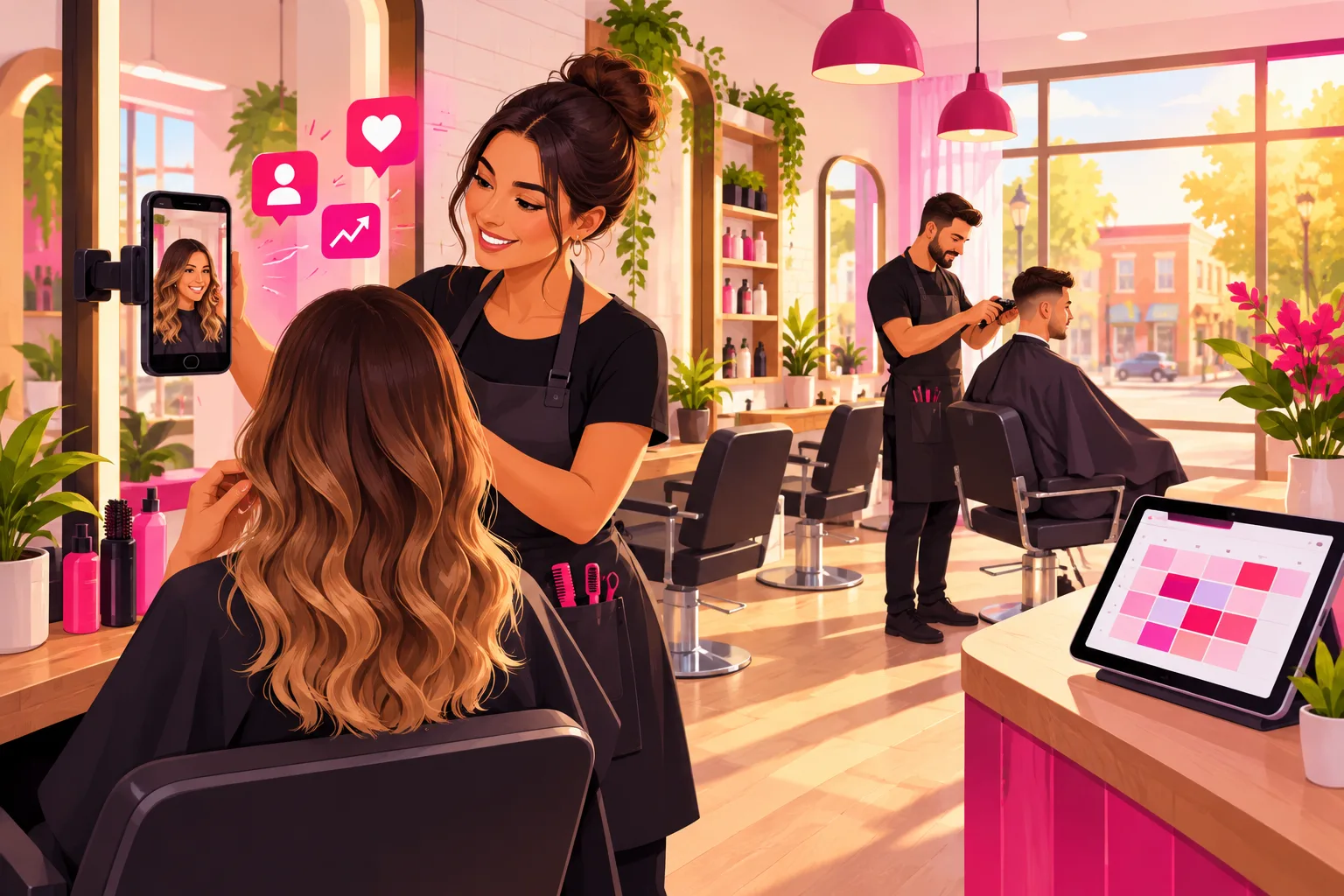
Every salon has a version of the parking-lot minute. A woman sits in her car outside a shop she has "been meaning to try" since she moved to town, and does not get out. Inside the car she is running the list: Do I need an appointment? Will they judge the box dye? What do I even ask for? How much is this actually going to cost? What if I hate it? Will they try to sell me a hundred dollars of product? Is it weird that I have never been here before? The car idles. Then it goes to the chain in the strip mall, where nobody has to wonder anything and nobody will remember her name.
Every question on that list can be answered in sixty seconds of video. Almost no salon answers them. Somewhere in your town, a four-chair salon next to the pharmacy films the walk from the parking lot to the chair - the door, who says hello, where you wait, what the consultation sounds like, the shampoo bowl, the price at the desk, the card reader. Forty thousand people watch it. A few hundred of them live within a twenty-minute drive and have not loved a haircut in three years. Some of them get out of the car.
This guide is the complete 2026 playbook for salons and barbershops - the owner with four chairs and two booth renters, the barber with a chair in the back, the solo stylist in a suite, the nail studio, the curly-hair specialist, and the youngest person in the building who got handed the salon phone because they are the one who "does TikTok": the six video formats that grow salon accounts fastest, the hook that opens on the hair instead of the client, the book-first content engine, the chair-path-or-feed-path choice and the two audiences behind it, the calendar that sells the holiday book in October and prom in March, the 90-day plan from an empty account to the salon your town thinks of, the client ladder from first view to rebook, the license, consent, music, and mirror rules that protect your shop, and when paid promotion fills the book versus burns the rent money. Pair it with our TikTok algorithm guide for the ranking-signal frame and the TikTok growth strategy guide for the cross-niche fundamentals.
The honest summary:
- A salon has two audiences on TikTok. The chair audience lives within a twenty-minute drive and buys the one thing that cannot ship - the appointment. The feed audience lives anywhere, follows everything, and buys only what fits in a box. Decide which one each video is for, or you will build a famous salon with an open Tuesday.
- The fear under every empty chair is "what do I even ask for?" The walk-through from the parking lot to the price at the desk answers it - and it is the single video most salons never make.
- The book is the content. You do not need to make videos. You need a clamp on the station, a yes card at check-in, and twenty minutes a day of filming the work you were already going to do.
- Use paid promotion as selective amplification on proven videos, aimed at followers rather than a one-time booking, pointed at the drive radius, timed in the quiet weeks before a window and paused the day the book is full - inside TikTok's rules on before-and-after claims, cosmetic procedures, and body image, because the ad money came out of the same account as the rent.
What's Inside
- 1. Why TikTok Works So Well for Salons and Barbershops in 2026
- 2. The Six Video Formats That Grow Salon Accounts Fastest
- 3. The Reveal Hook: Open on the Hair, Never the Client
- 4. The Book-First Content Engine
- 5. Chair Path or Feed Path: The Two Audiences
- 6. The Salon Calendar: Why You Sell the Holiday Book in October
- 7. A Posting Cadence That Survives a Saturday
- 8. The 90-Day Plan to Becoming the Salon Your Town Thinks Of
- 9. The Client Ladder: Turning Viewers Into Rebooks
- 10. When Paid Promotion Fills the Book vs. Burns the Rent Money
- 11. Licenses, Consent, Music, Mirrors, and the Mistakes That Cap Salon Accounts
- Frequently Asked Questions
1. Why TikTok Works So Well for Salons and Barbershops in 2026
Salons have found clients the same way for a generation: the sign on Main Street, the referral from a sister-in-law, the listing on a booking marketplace that takes a cut of every new head it sends, the coupon in the mailer, and the slow accumulation of regulars who have sat in the same chair every fourth Thursday since 2009. That model works right up until it does not - the regulars age out or move, the referral chain thins, the marketplace fee climbs, the mailer goes in the recycling, and the new family that moved into the subdivision last spring books the chain because it was the only name they knew. TikTok is the most efficient answer available right now, for five specific reasons.
The first is that the chairs are multiplying and the clients are on their phones. Industry researchers count roughly a million salon businesses in the United States, most of them a single person renting a chair or a suite, and the Bureau of Labor Statistics projects employment of barbers, hairstylists, and cosmetologists to grow about five percent from 2024 to 2034 - faster than the average occupation. More chairs, the same number of heads. The person deciding which chair to sit in is a thirty-year-old watching three short videos at ten at night, and surveys keep finding that something like four in ten younger adults start that kind of search on TikTok rather than on a search engine. She is going to pick a salon she has already seen inside.
Second, the business is repeat business, and the first visit is the whole fight. Every salon owner knows that most of the revenue comes from clients who come back, and that a new client who does not rebook was never really a client at all. Booking-software companies like to say that one in five appointments ends in a no-show without reminders, and whether the number is exactly that in your shop, you have felt the hole in a Tuesday. The entire economics of a chair come down to getting the right stranger to sit in it once and treating her so well she books the next one before she leaves. TikTok is the only channel that can show her the first visit before she has it.
Third, and this is the one no other local business gets: you already own what the platform rewards. Transformation. Hands doing skilled work. A result you can see in forty seconds. A company selling insurance has to invent a reason for anyone to watch and pays an agency to do it. You have one of the most-watched genres on the platform happening in your window all day - hair videos draw views in the billions, single salons in small towns have built six-figure followings from wash-and-curl clips, and the reveal is the most shared format in local business. And yet the typical salon feed is a price-list graphic, a montage of empty chairs set to a trending song, and a "we're hiring" flyer - three things that tell the algorithm nothing and tell the woman idling in the parking lot even less.
Fourth, the lane is empty where you are. The famous hair accounts are famous nationally - the colorist with two million followers, the barber whose fades get watched in Manila - and nearly none of them are in your town. The handful of salons that post consistently are scattered across the map, which means the first salon in a given town to show what its chair, its consultation, and its desk actually look like does not compete with anyone for the "who should I go to?" question. It answers it, for that town, alone. The ranking signals reward exactly what a working salon produces every hour: a real face, real hands, a complete watch.
Fifth, the price explanation is the whole booking, and nobody makes it. The woman who balks at a $180 balayage has never seen that it is three hours, two bowls of color, a toner, and a stylist who trained for a year to do it. The man who thinks $35 for a cut is steep when the chain charges $19 has never seen the difference in the line at the back of his neck. Salons lose the booking at the price, every day, to a client who would gladly have paid it if anyone had shown her where the money goes. A sixty-second video is the explanation, and it is the easiest piece of marketing a salon has ever been able to make. We will count saves and sends, not views, for the rest of this guide - because the woman who saves "why a balayage is $180" is deciding, and the one who sends it to her friend has decided.
And one thing to say plainly about size. A one-chair suite cannot out-schedule a twelve-chair salon. It does not need to. It can show the one thing the big shop cannot: the same person, every time, by name, who remembers how you like the back. That is a video. It is, in fact, the best video.
2. The Six Video Formats That Grow Salon Accounts Fastest
Across the salon accounts that grow in 2026 - the four-chair shop on Main Street, the barber in the back, the solo colorist in a suite, the curly specialist, the nail studio - the same six formats keep working. Every video you make should be one of them, and the order is deliberate.
Format 1: The Process Clip
Foils going in. The fade line coming up the side. The shampoo. The round brush. The gel polish under the lamp. Filmed as it happens, from a clamp on the station mirror, with a sentence or two of what you are doing and why. This is the volume source and the feed-path workhorse: it travels anywhere, it is what strangers and other stylists follow, and it is the format every salon already tries. It fails when it is the only format, and it fails worst when the clip turns into commentary about the client in the chair. Section 3 has the rule.
Format 2: The Walk-Through
A phone in one hand, from the parking lot to the desk. Where to park. Which door. Who says hello and what they say. Where you wait and for how long. What the consultation actually sounds like - "you can bring a photo, you can say 'I don't know, just not this,' and nobody will sigh." The shampoo bowl. How long the service takes. The price at the desk and whether the toner is included. Cards, cash, tips, whether you can bring a kid. Whether you take walk-ins or want a booking. This is the conversion video of the vertical - the no-judgment answer to every question in the parking-lot minute, the same video that dental practices use to dissolve the fear of walking in - and the one almost no salon has ever filmed. Make one per door over time: the salon, the barber chair, the kids' chair, the first color appointment, the formal-event booking, the suite.
Format 3: The "What It Costs and Why" Explainer
Why a balayage is $180 and takes three hours. Why the toner is extra and what happens without it. Why the first color appointment is longer than the ones after. Why a men's cut is $35 here when the chain charges $19. Why a color correction is priced by the hour and why you will not quote it in a DM. Forty seconds, one thing, explained with the plainness of someone who remembers not knowing it. Curiosity is the cheapest attention on the platform, and every one of these dissolves a price objection before the client gets to the desk. They travel anywhere - and they are the videos a client sends to the friend who said "a hundred and eighty dollars for hair?"
Format 4: The Question Answered
"Can I just get a trim?" "Do you do curly hair?" "What if I hate it?" "Do you take walk-ins?" "How often should I come back?" "Can I bring a picture?" "Do you cut kids?" "Can you fix box dye?" Real questions from the desk, the DMs, and the consultation, answered honestly in your shop's own voice by the person who actually answers them. "Do we do curly hair? Yes, and here is exactly how we cut it - dry, curl by curl" is the single most trust-building forty seconds a salon can post. This is the format that proves the welcome instead of asserting it. Keep a running list; it never runs dry, because every Saturday adds three.
Format 5: The Reveal With Dignity
The transformation the client is proud of, shown the moment she sees it - with her written yes, her before filmed only with its own yes and only in a way she would be glad to see again, and never a word of commentary about what she walked in with. This is the share source of the vertical: the client sends her own reveal to forty people, and that is a referral engine no mailer can touch. It is also your countdown format - "prom hair, three weeks out," "the holiday book opens Thursday" - and a countdown is a reason to follow. The reveal filmed with contempt for the before is a different video entirely, and it goes in the next section with the things you never post.
Format 6: The Honest Day
The eight-hour color correction, told with the client's permission and without her name. The Tuesday nobody came. The cut you would do differently now. The stylist who left and the chair that is open. Told by the person, in their words, once, without a sad song under it and without asking anyone for anything. This is the most powerful format on the platform for a salon, because it is the one thing the chain can never say, and it goes last on purpose: the walk-through and the explainers earn the trust that makes an honest day land, and the rules in section 11 - what you never show, whose story is never yours to tell, when you do not post at all - have to be in place before the first one. A hard day is part of the work and your clients can handle it. What they cannot handle is being the punchline.
What to retire: the price-list graphic ("Cut $65, Color $120, Balayage $180" as an image - the algorithm has nothing to learn from it and no stranger shares it), the montage of empty chairs set to a trending song, the "we're hiring" flyer, and the account where every post is a logo.
What to never post: the client-shaming clip - the box-dye disaster filmed with a wince, the "clients who show up fifteen minutes late" skit, the Pinterest photo mocked as a wig, the bait that gets views from other stylists and comments that make the woman who was going to book decide she would rather not be judged. More on this in the next section, because it is the single most common way a salon account grows an audience that never books anything.
3. The Reveal Hook: Open on the Hair, Never the Client
The first three seconds decide whether anyone sees the rest, and for a salon the first three seconds carry a weight most businesses do not have to think about. The person you most want to reach is nervous - about the price, about not knowing the words, about the box dye, about being judged for the three years she went to the chain - and the hook either disarms that or confirms it. Here is the rule: hook on the hair, never the client.
Five hook shapes carry nearly every salon video that works:
- The price, named first. "A balayage here is $180 and takes three hours. Here is every minute." You said the thing they were going to say in the comments. They exhale, and they watch.
- The count. "Hour six of this color correction." "Nine days until the holiday book opens." A number in progress is a reason to come back tomorrow, and tomorrow is a follow.
- The honest answer. "Can we fix box dye? Yes. Here is what it actually takes, and what it costs." The viewer who has never sat in a real salon and the one who goes every six weeks both keep watching.
- The person. "Dani has cut hair on this street for twenty-two years. Here is what she will tell you about that." One stylist, one question, one morning. Never a montage.
- The permission. "You do not have to know what to ask for. Here is what to say when you sit down." The hook that opens the car door. Nobody else in your town is saying it.
Now the client-shaming clip, because it is the salon version of the mistake every vertical in this series has. For nonprofits it is the pity close-up. For farms it is the rant about city people. For salons it is the twenty-second take about the client - the box dye revealed with a wince, the "she said just a trim and then showed me this" skit, the reenactment of the late client, the lecture about tipping. It travels. It gets numbers. And it does three things at once: it makes the woman in the parking lot feel judged before she opens the door, it fills your comments with other stylists who came to commiserate and will never book, and it trains the algorithm that your account is a place for the trade - so it shows your next video, the kind one, to stylists in other states instead of to the mom two miles away. You will grow. You will grow an audience that never sits down, and that audience will chase away the one that would have.
The shaming clip has a quieter cousin that salons fall for even more often: the grievance post. "Nobody respects our time." "Here is why we charge a cancellation fee." "Stylists are exhausted and clients do not care." Much of it is true, and it is the worst hook on the platform, because nobody books an appointment to be scolded, and a client who shows up out of guilt does not rebook. The woman who comes every six weeks for a decade comes because the chair was kind and the hair was right - not because she was afraid of your policy.
The fix is not to stop having standards about your time and your craft. It is to lead with the hair. The policy can be the fourth sentence on the booking page. The first one is the reveal.
4. The Book-First Content Engine
The reason salon accounts go quiet is not that there is nothing to film. It is that the person with the phone thinks of each post as a project, and projects lose to a double-booked Saturday. The system is simple: the book is the content calendar. The footage exists every hour, on a schedule, in a room you control, with a client who has already agreed to sit there. You do not make videos. You film the work you were going to do anyway, and you cut it on Monday.
The working-day capture list
- The phone goes on the station clamp before the first client: not in the drawer, not in the back. Twenty minutes of capture, spread across the day, is enough for a week.
- One process, start to finish: the clamp running the whole service, framed vertical, with the client's yes on the card. You will cut sixty seconds from it on Monday. Say one sentence to the camera when you start and one when you finish; the middle can be the sound of the shears.
- One reveal with its own yes: the moment she sees it, filmed from behind the chair, fifteen seconds. This is the share source, and it is the reason to ask every client instead of once a week.
- One "what it costs and why" in forty seconds: at the station, with the bowl in your hand, between clients, once a week.
- One question, one answer: "Somebody at the desk asked if we take walk-ins. Here is the answer." Thirty seconds, done.
- Saturday, ninety seconds of the room: the door opening, the chairs filling, hands and capes and the broom, never a face in the next chair without asking. The walk-through is built from this over several weeks.
That is a week of posts from one working day, and the honest day fills in when it comes. Behind it sits the question log: a note on the phone where every question a client asks in the consultation, every DM, every comment that starts with "wait, do you actually," and your own "people always ask me" list goes. Each entry is a Format 4 video waiting. A salon that keeps the log through one holiday season never again wonders what to post.
The engine runs on a faces rule, decided once. The stylists who chose to be on the account - the owner, the barber in the back, the renter who runs the phone, the front-desk kid who said yes - are the cast and agree once a year. Booth renters own their chairs and their own accounts; a renter appears on the salon account only by choice, and the salon never posts a renter's client without both yeses. Clients are a per-visit written yes at check-in - a card with three boxes: no; yes, but not my face; yes, everything - with a separate line for the before, and a standing rule that a yes is revocable the same day, without argument. Minors, including your own kids in the chair, are a parent's per-visit decision and never appear with a school logo on the uniform. The client in the next chair is never background without being asked - and the mirror is the trap, because it shows the whole room. Nothing a client told you in the chair is ever content. Our dental filming guide covers the consent model - specific, written, revocable, never a condition of being served - that a salon should adopt wholesale, minus the federal paperwork.
One practical note on the set: the station nearest the window is the best studio on the platform, and you own it six days a week. The explainers get filmed where the thing happens - the balayage explainer at the station with the bowl, the men's-cut explainer at the barber chair, the price explainer at the desk with the card reader in frame. Never in the break room with a slide.
5. Chair Path or Feed Path: The Two Audiences
This is the section that matters most, and it is the one salon accounts get wrong almost universally - not by doing something badly, but by never deciding what the account is for.
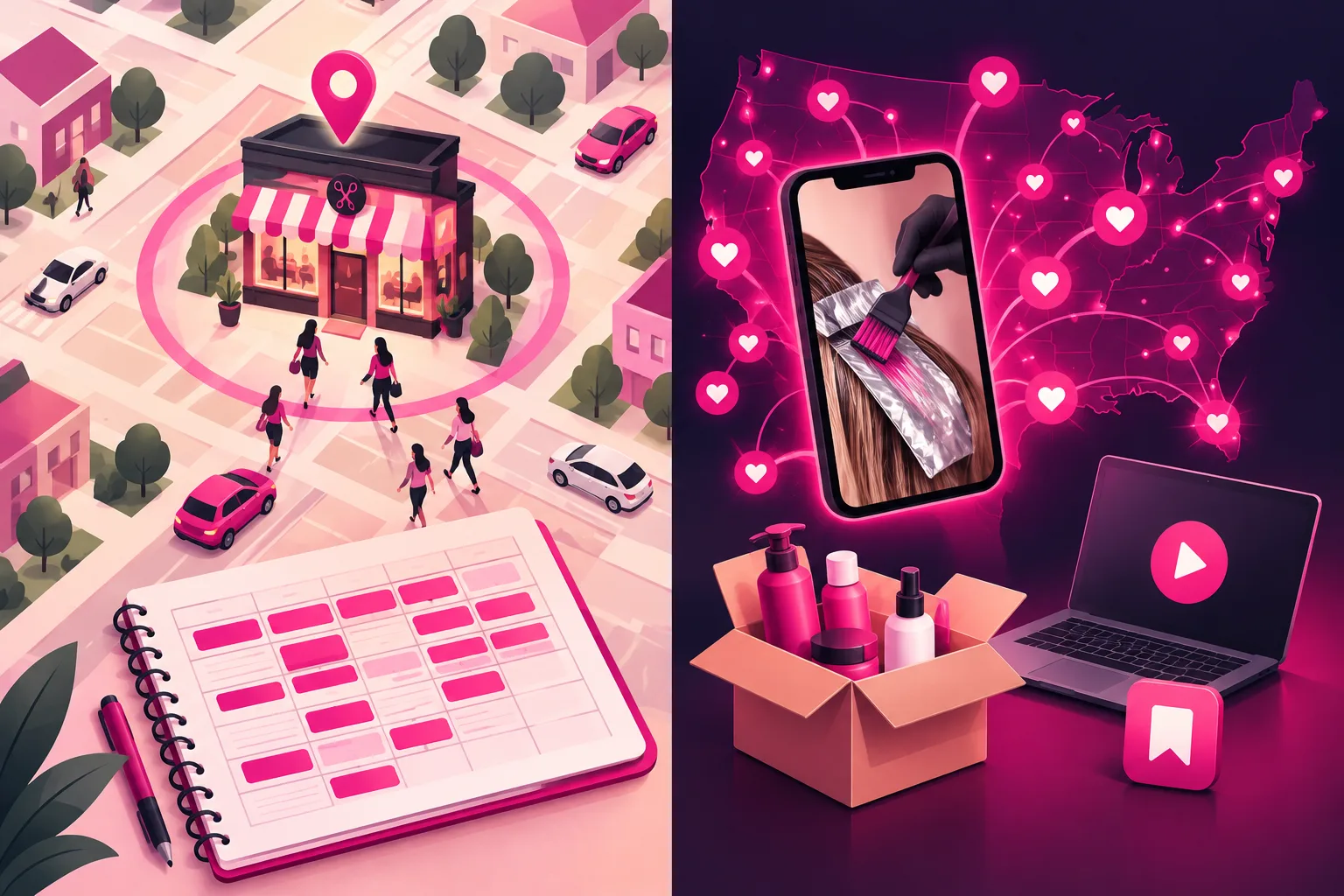
A salon is one of the most local businesses there is. A haircut, a color, a fade, a set of nails - none of it ships, and the client has to drive to you and sit in the chair, which means fifteen to twenty-five minutes, not an hour. And a salon is also a business whose daily work strangers across the country genuinely want to watch. So every salon account is speaking to two audiences at once: the chair audience, who is local and can only come from the drive radius, and the feed audience, who is anywhere, follows everything, and buys only what fits in a box. Our farm guide calls the same split the market path and the feed path, and the trap is identical.
Here is the trap. Call it the famous-and-empty chair: an account with three hundred thousand followers from every state, comments full of stylists in Phoenix and Tampa who say the foiling videos are the best part of their day - and an open Tuesday, a holiday book that did not fill until the second week of December, and an owner who has decided that "TikTok doesn't book anybody." That reach is real, and nothing in this guide tells you to give it up. But it fills no chair, it funds very little - a national audience buys, but in small amounts of whatever ships, from people who can never pull into the lot - and the verdict that the account does not book is true only because every video was for the feed and none was for the chair.
The chair path: build a local audience that books
The account exists to put first-time clients in the chair and to get them to rebook. Everything is anchored to the drive radius: the town and the street in the bio with the hours, "we're the four chairs next to the pharmacy on Main," the walk-through pinned to the top of the profile, the price explainers for your actual menu, the question videos answering what your town actually asks, and one link to a booking page - not the homepage - with the price ranges, how long each service takes, the cancellation policy said like a person, and the name and face of the stylist they will be sitting with. Success is counted in booking-page clicks, new clients per month who say TikTok on the intake form, and the share of them who rebook before they leave. The local business playbook has the geography; this guide has the chair.
The feed path: build a national audience that buys what fits in a box
The account exists to be watched by people who will never visit: other stylists, hair obsessives, the woman in Maine who wants to understand her own curls. They buy the product you retail and ship, the class you teach, the digital guide, the affiliate link, the brand deal, the education day you host for other professionals - the salon equivalent of what fits in a box, and TikTok Shop is built for exactly that. Success is counted in follows, saves, shares, and orders on the shipping page or seats in the class. It is a real business. It is not the chair.
Decide the order. Most salons: chair first, unless you already sell education or product. The process clip and the explainer will travel to the feed anyway - let them - but the walk-through, the countdown, and the booking link are built for the fifteen-minute drive, and the scoreboard the owner sees every month is the chair's.
The sorting test is one question per video: who is this for, and what do I want them to do? "Here is how I foil a full head in forty minutes" is for the feed, and the ask is a follow. "Here is what your first color appointment with us looks like, from the lot to the desk" is for the chair, and the ask is the link. Both are good videos. Only one fills Tuesday.
6. The Salon Calendar: Why You Sell the Holiday Book in October
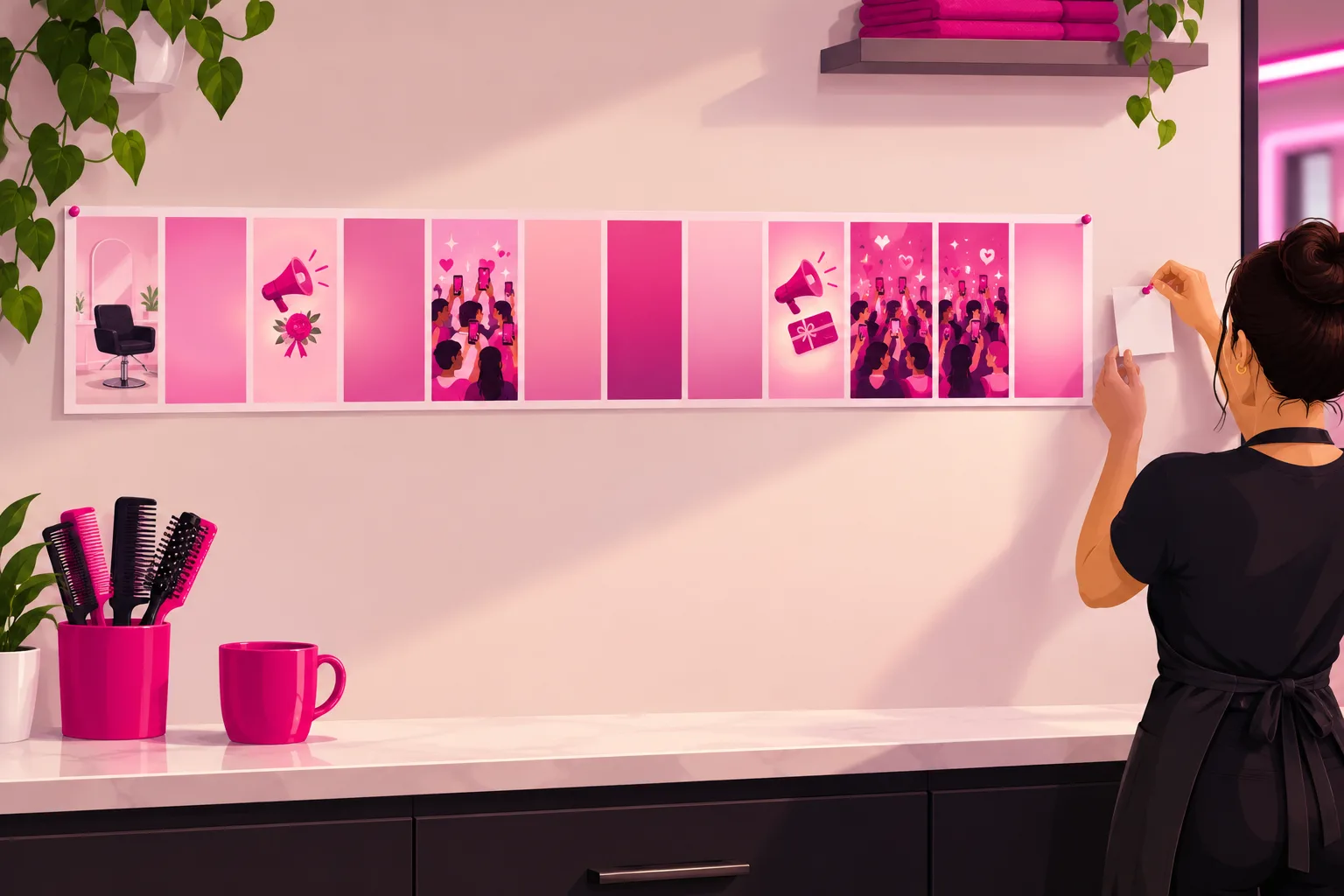
A salon's year is not twelve equal months. It is a handful of windows that fill the book, separated by stretches where the book is the reason you lie awake. The windows are known a year out, they are short, and the clients decide before them - which means the account that posts "we have openings!" on December 20th is already late, and the one that filmed the holiday-book walk-through in October was on time.
The rule is build in the quiet weeks for the busy ones. Sell the holiday book in October, not December. Sell prom in March, not the week of the dance. Sell back-to-school the first week of August. And - the part almost every salon forgets - film "here is what January looks like" on the busy Saturday in December, because the most common failure in this business is the holiday crowd nobody invited back.
The salon content year
- January: the quiet month and the correction season. The "new year, new hair" consultation video; the honest "here is what a box-dye correction actually involves" explainer; the gift cards sold in December being redeemed in your calmest weeks. Post the January book in mid-December.
- February-March: prom and formal season books now. The formal-hair walk-through for a nervous seventeen-year-old and her parent - trial or no trial, how long, what it costs, bring the dress photo. The parent is the viewer; the parent's yes is required for the reveal.
- April-May: prom weekends, bridal trials, Mother's Day gift cards. Film the proms as reveals with per-visit yeses; post "here is what summer looks like" the Saturday after the last dance.
- June-August: blonding season, kids' cuts, and back-to-school. The kids'-chair walk-through goes up the first week of August - the booster seat, the tablet, how long, what it costs, "we have done a thousand first haircuts and we are not in a hurry."
- September: the quiet month. Build the series, film the explainers, fill the question log, shoot the holiday-book walk-through now so it is ready to post on October 1.
- October: SELL THE HOLIDAY BOOK. The countdown to the book opening, the "we book out by mid-November" season marker said plainly, the walk-through for the client who has never had a holiday appointment. This is the month paid promotion earns its keep - section 10.
- November-December: the rush. Nothing is required but reveals with their yeses and DMs answered the same day. The week after Thanksgiving (November 26 this year), the gift-card video. On the busiest Saturday, film "here is what January looks like," because that is the video that fills it.
- Late December: the receipt - what this year looked like in the chair, said once, with the faces who agreed - and the January book.
Then there is the moment you cannot plan: a stylist leaves and takes her Thursdays, a bad review goes around the town group, a storm closes Main Street for a week, a client is hurt by a service somewhere and the whole town is talking about hair. The rule is the same as for the honest day: one person at the desk, no process clip underneath it, no sale attached, say it once and kindly. The account that handles the hard week with grace earns more trust than any reveal.
7. A Posting Cadence That Survives a Saturday
The cadence that works for salons is the one that is still running on the Saturday before Christmas with three stylists out and a walk-in at the door. Three posts a week, from one working day of capture, with one hour of cutting on Monday morning before the first client. The general growth playbook would tell you to post daily; a salon that tries that quits by Valentine's Day. Three that keep going beat seven that stop.
- Tuesday, Thursday, Saturday. One chair-path video (the walk-through, the explainer, the question), one feed-path video (the process clip), one reveal or countdown. Twenty minutes of capture on the working day, one hour Monday to cut and caption.
- One person owns the salon phone. Written on the break-room wall, not understood: who posts, what goes up without asking (the process clip with a yes on the card), what gets a look first (any before, any minor, any price, any other stylist's client, the honest day), and what never goes up. And one line nobody wants to write until the day it matters: who owns the followers and the handle when a stylist leaves.
- The stylist's own account is not the salon's. Booth renters and commission stylists alike will have their own, and should. The salon posts the salon - the door, the desk, the walk-through, the team - and tags the chairs. The stylist posts her chair and tags the salon. Both link each other. Nobody fights about a reveal.
- Saturday mode is a real setting. In the weeks when the book is full, the account is allowed to run on reveals with yeses, reposts, and DMs answered the same day, and nothing else. Silent in the second week of December is fine. Silent in September is not.
- The cast is the salon, not the phone. The owner who has been on the street for twenty-two years, the barber whose line has a following, the renter who runs the phone, the front-desk kid who agreed, the regular who has come every fourth Thursday since 2009 and loves being on camera. Rotate the faces that chose to be there.
- Series beat singles. "What to say when you sit down." "Why it costs that." "Walk in with me." "Fix-it Friday." "Ask the barber." A recurring title is a reason to follow, and it means Monday's cutting hour starts with a decision already made.
Our small business guide covers the one-phone, no-marketing-department version of all of this, and a salon is the purest case of it: the content is already happening in the chair, the only question is whether the clamp was on.
8. The 90-Day Plan to Becoming the Salon Your Town Thinks Of
Ninety days is long enough to go from an empty account to the salon a town names when someone in the group chat asks "who do you go to?" It is not long enough to go viral, and that is the point. The milestones below are counted in new names on the intake form, not followers.
Days 1-30: Fix the desk before you film it
The bio says the town, the street, what you do in plain words, and whether you take walk-ins - "cuts, color, fades, and kids, next to the pharmacy on Main, book online or walk in Tuesdays." The link goes to a booking page - not the homepage - with the price ranges and what moves them, how long each service takes, the cancellation policy written the way you would say it out loud, and the name and face of each stylist with what they are known for. A line on the intake form asks "how did you hear about us?" with TikTok as an option, because without it you will never be able to prove any of this worked. The yes card is printed and at the desk. Then twelve posts: the walk-through first, three explainers, three questions answered, three process clips, two reveals with their yeses. Nothing is promoted. Everything is measured by one number - clicks to the booking page - and one line on the form.
Days 31-60: Find the series
By now a few videos have outperformed. Sort them by audience: which traveled (feed) and which brought a click to the booking page or a new name to the desk (chair). Build a weekly series from the best of each. Count the first client who says "I saw you on TikTok" and write down the date; it is the sentence that wins the argument with the owner who thinks the phone is a toy. Watch the saves and the sends above everything - a mom saving the kids'-chair walk-through in July is a booster seat in August - and make the shareable explainer a weekly habit. Answer every DM within the day with a warm saved reply, and keep the "how much is" reply separate from the "anything this week?" reply.
Days 61-90: Compound toward the next window
Lay the calendar from section 6 over the next ninety days and work backward from the nearest window. The walk-through for that window is filmed now and posted three to four weeks before the book opens. The "here is what next month looks like" is filmed on the busy Saturday itself. If one walk-through has already proven itself organically and the window is inside six weeks, this is the first moment paid promotion makes sense, and section 10 says how. By day 90 a healthy account has a few hundred to a couple thousand local followers, a booking page that gets clicked every week, a desk that hears "TikTok" a few times a month, and - the real milestone - a rebook rate you can state.
9. The Client Ladder: Turning Viewers Into Rebooks
A viewer does not become a regular in one step, and a salon that asks for the whole climb in a single video - "book now, buy the product, leave a review, bring a friend" - gets none of it. Here are the rungs in order, with what moves someone up each one.
- The view. Earned by the hook. The hair, never the client.
- The follow. Earned by the series and the countdown - a reason to come back to the account before coming to the chair.
- The save and the send. A woman saves the walk-through as "my next appointment"; a client sends "why a balayage is $180" to the friend who asked; a client sends her own reveal to forty people. This is the rung that matters most. Make videos that are easy to send: short, kind, specific, with the price range and the day in them.
- The profile visit. Town, street, what you do in plain words, walk-ins or book, one link. If the bio says "luxury hair experience" and nothing else, the climb ends here.
- The booking page. Ranges, time, the policy said like a person, and a named face. "Ask for Tasha - she does the curly cuts" converts better than any sentence about your passion for hair.
- The first appointment. Counted on the intake form. Greeted by name. The consultation done exactly the way the video promised - the photo welcomed, the "I don't know" welcomed - with no upsell and no word about the box dye.
- The follow-up that is actually useful. A text the next day with how to style it at home, which product you actually used, and when to come back - with a date. One sentence of thanks, one useful thing, nothing else - never a discount blast she did not ask for.
- The rebook. The real conversion, and it happens at the desk before she leaves the chair: "six weeks puts you at the twelfth - same time?" Holiday crowds vanish in January because nobody built this rung. The video that earns it was filmed on the busy Saturday: "here is what next month looks like."
- The regular and the referral. The woman who has come every six weeks for three years, the man whose two sons now sit in the barber chair, the one who brings her sister. Months, not weeks. Never asked for on the first rung.
Three messages deserve a prepared reply before the first video is posted. The first is "how much is a ___?" - answered with the range, the one thing that moves it, and the link, never "DM for prices" followed by silence, which is the fastest way to send her to the chain. The second is "do you have anything this week?" - answered with the next open day said out loud and the link, within the hour if you can. The third is "can you fix this?" with a photo of a disaster, which will arrive within the first month. Reply kindly and specifically: yes or honestly maybe, a consultation first, bring whatever box or receipt you have - and never a diagnosis or a quote in the DM, because the friend she forwards it to is reading.
Measure the ladder, not the views: booking-page clicks per week, new clients per month who say TikTok, and the share of them who rebook before they leave. A salon that can state those three numbers has an owner who stops calling it "the phone." Our second-order conversion guide works the same ladder for farms, including the saved replies and the useful follow-up.
10. When Paid Promotion Fills the Book vs. Burns the Rent Money
Paid promotion on TikTok is not advertising in the way salons usually think about it. It is not the coupon in the mailer, the search ad that costs more every quarter, or the booking marketplace that takes a fee for every new client it sends and then shows her three other salons. It is taking a video that has already earned attention and showing it to more of the right people. And for you there is one extra sentence: the money came out of the same account as the rent and the color order, so the standard for spending it is higher.
The proven-video rule: only promote videos that have already performed organically. Strong completion, real saves and shares, a visible bump in profile visits and clicks to the booking page. Promotion amplifies signals the algorithm is already reading. It cannot manufacture interest in a video people scroll past, and it will not make a price list into content.
The follower rule, which is specific to your business: promote for followers, not for a one-time booking. A stranger asked to book nine seconds after meeting you mostly will not. A follower watches your chair for six weeks - the walk-through, the honest answer, the reveal, the countdown - and by the time the holiday book opens she already knows the day and the stylist. You are not buying an appointment. You are buying the chance to show someone your chair for a season.
The map rule: target the audience the video is for. Organic reach goes wherever the algorithm sends it; promoted reach goes exactly where you point it. The walk-through, the price explainer, and the book-opening countdown go to your own town, drawn to a twenty-minute drive - a viewer two hours away will never sit down. The process clip can go wider, to people who already engage with hair content, if you sell a class or a product and the feed path is a goal this year.
The timing rule: amplify in the quiet weeks before the window, not during it. October for the holiday book, March for prom, the first week of August for back-to-school, the first week of January for the correction season - the weeks when clients are quietly deciding. The week before Christmas is when every retailer in the country is bidding for the same woman, the cost of reaching anyone climbs, and you pay more to be one of fifty invitations. And the rule that sounds strange until you have lived it: pause the day the book is full. A promoted walk-through running the week you are booked out buys you nothing but "sorry, no availability" DMs and a stranger's first impression that you are too busy for her.
The math deserves honesty, because the owner will ask. Compare it to what you already spend: the marketplace's new-client fee, the mailer, the search ad, the sponsorship of the school program. Then track the promoted walk-through like any other outreach cost - cost per new local follower, per booking-page click, per new client who says TikTok, per rebook - and report it next to the mailer. If a modest budget on a proven walk-through brings fourteen new clients in the six weeks before the holiday book and nine of them rebook before they leave the chair, the owner can do the arithmetic without your help.
Three cautions that are stricter for you than for most. First, your best ad is a before-and-after, and TikTok's misleading-content policy bars before-and-after comparisons that exaggerate a result - written for creams and procedures, but a promoted reveal lives under it, so the before and the after are shot in the same light, with no filter and no retouch, and the caption promises nothing the chair cannot repeat. Second, if the salon also offers injectables, permanent makeup, or anything that reads as a cosmetic procedure, those ads fall under TikTok's cosmetic-procedure rules - which in the United States and Canada now mean eligibility approval through a sales representative, age targeting, licensed providers, and risk disclosures - and a cut-and-color salon should keep that work out of its promoted videos entirely. Third, an ad built on shame - "tired of your grey? embarrassed by your split ends?" - is both bad for business and the kind of body-image framing TikTok's ad policies push back on; promote the reveal and the welcome, never the flaw. And one more: consent to post is not consent to promote. The client whose yes card said "everything" did not say yes to a paid placement shown to her coworkers, and the renter whose reveal you want to boost needs her own yes, so the card and the break-room rule should say which. Fix the bio, the booking page, and the saved replies first - promotion multiplies what already exists.
The format worth defaulting to is Spark Ads, which promotes your existing organic post rather than a separate ad creative - so the engagement accrues to your real account and the video keeps looking like your salon instead of a commercial. Our Spark Ads guide walks through the setup. If you would rather not run Ads Manager yourself in the middle of the holiday rush, a TikTok promotion service built around follower growth and selective amplification handles the targeting and the timing for you.
11. Licenses, Consent, Music, Mirrors, and the Mistakes That Cap Salon Accounts
Everything above is about growth. This section is about the four things that can undo it, in a trade where every video is a public record of what you did, to whom, with what, and whose face was in the mirror. None of it is complicated. All of it has to be decided before the first post.
The license and the claim
Every state licenses barbers, stylists, and cosmetologists, and the people who enforce those licenses have phones too. A video is a record of the service - the chemical service on a fourteen-year-old against your own policy, the lash or permanent-makeup work done by someone whose license does not cover it in your state, the comb that did not go back in the jar, the cape that was not changed. Film the shop you would be glad to have inspected. The same goes for words: "medical-grade," "non-toxic," "organic," "formaldehyde-free" are claims, and a straightening treatment described as formaldehyde-free when the safety sheet says otherwise is a problem in a video that lasts forever - especially while federal regulators have been promising a ban on formaldehyde in hair-straightening products since 2023 and keep missing their own deadlines. Say what the product is, in plain words, and what you actually do.
The client's face, the before, and the mirror
A client's face is hers. A verbal yes at the shampoo bowl cannot be proven in six months, and the woman who agreed to a photo on your portfolio wall did not agree to a video with a pink heart on it shown to strangers. The yes is written, per visit, on a card with three boxes - no; yes, but not my face; yes, everything - with a separate line for the before, because the before is the part she may be glad to have never seen again. A yes is revocable: when she asks you to take it down, it comes down the same day, without argument and without a conversation about how well it was doing. Minors need a parent's yes for each visit, never appear with a school logo on the uniform, and never appear in a video that shows the school pickup line out the window. And the mirror is the trap in this trade: it shows the whole room, which means the client in the next chair who said no, the renter who is not on the salon account, and the kid at the desk are all in your reveal unless you frame for it. The chair is also a confessional. Nothing a client told you while you foiled her - the divorce, the diagnosis, the daughter - is ever content, with or without her name.
The music
A salon account should be a business account, and a business account's in-app sound picker is limited to TikTok's commercial music library - the trending pop song is the fastest route to a muted video or a removed one. Use the commercial library, use original sound, or let the video be the sound of the shears, which performs better than most owners expect. The radio playing in the salon itself is a separate licensing question that the clamp on the station will pick up; if the shop plays music from a consumer streaming account, a video that captures it clearly is a video you may lose.
The stylist who leaves
It will happen, and the account will be part of it. Who owns the salon handle, the followers, and the reveals filmed in the salon's chairs is written on the break-room wall before the day it matters, along with the plain rule that booth renters post their own chairs and the salon never posts a renter's client without both yeses. When a stylist goes, the public post about it is one sentence, kind, and about the chair that is open - never about her. Her regulars are watching, and so is the next stylist you want to hire.
The mistakes that cap salon accounts:
- The price-list feed - prices as graphics, nothing a stranger would send.
- The montage of empty chairs with a trending song, which tells nobody where to park.
- The client-shaming clip - growing an audience of stylists who never book.
- The grievance post - a client who shows up out of guilt does not rebook.
- "DM for prices" with no range and no reply for two days.
- No town, no street, no "walk-ins or book" in the bio.
- The holiday crowd nobody invited back for January.
- The verbal yes, the before without its own yes, the kid with the school logo.
- The client in the next chair, visible in the mirror.
Frequently Asked Questions
Is TikTok worth it for a small salon or barbershop in 2026?
For a salon, barbershop, or nail studio that has an open chair on a Tuesday - and almost all of them do - yes, and the smaller and more local the shop, the better the odds. Hair is one of the most-watched genres on the platform, the person you most want in the chair decides where to book from her phone, and the Bureau of Labor Statistics projects employment of barbers, hairstylists, and cosmetologists to keep growing faster than the average occupation through 2034, which means more chairs competing for the same heads. Almost none of the roughly one million salon businesses in the country show a nervous first-time client what the parking lot, the consultation, and the price at the desk actually look like. You do not need a viral account. You need a few hundred people within a twenty-minute drive to watch your chair for a season, long enough to trust it, and a booking link that tells them what it costs, how long it takes, and who they will be sitting with.
What should a salon post on TikTok?
Six formats grow salon accounts fastest in 2026: the process clip (foils going in, the fade line, the shampoo, filmed as it happens from a clamp on the station - the volume source and the format strangers follow), the walk-through (from the parking lot to the chair to the price at the desk, answering every question a first-time client is afraid to ask), the "what it costs and why" explainer (why a balayage is $180 and three hours, why the toner is extra, why the first appointment is longer), the question answered (can I just get a trim, do you do curly hair, what if I hate it, do you take walk-ins), the reveal with dignity (the transformation the client is proud of, filmed with a written yes and sent by the client to forty people), and the honest day (the eight-hour correction, the Tuesday nobody came - last on purpose, with rules). Retire the price-list graphic, the montage of empty chairs set to a trending song, and the logo-only account. Never post the client-shaming clip - the box-dye disaster filmed with contempt, the "clients who show up late" rant - because it grows an audience of other stylists and makes the person who was going to book feel judged before she sits down.
Can a salon actually fill its book from TikTok?
Yes, but mostly not the way the famous hair accounts do. A salon has two audiences on TikTok. The chair audience lives within a twenty-minute drive and buys the one thing that cannot ship - the appointment. The feed audience lives anywhere, follows everything, and buys only what fits in a box or a download - the product, the class, the brand deal. The trap is the famous-and-empty chair: three hundred thousand followers from every state, comments full of other stylists, and an open Tuesday, because every video was for the feed and none was for the chair. Decide which audience each video is for, build the chair path first unless you already sell education or product, count new clients on the intake form with a "how did you hear about us?" line, and treat the rebook - booked before they leave the chair - as the real conversion.
Do I need my client's permission to post their hair on TikTok?
Yes - every time, in writing, and separately for the before. A client's face is theirs, a verbal yes in the shampoo chair is not something you can prove later, and the client who agreed to a photo on your portfolio wall did not agree to a video shown to strangers with a pink heart on it. The simplest system is a card at check-in with three boxes - no; yes, but not my face; yes, everything - plus a separate line for the before, and a standing rule that a yes is revocable: when a client asks you to take it down, it comes down the same day, no argument. Minors need a parent's yes for each visit and never appear with a school logo on the uniform. The client in the next chair is never background without being asked, and the mirror is the trap - it shows the whole room. Nothing a client told you in the chair is ever content, with or without their name.
Should a salon pay to promote its TikTok videos?
Only videos that have already proven themselves organically - strong completion, real saves and shares, and a visible bump in profile visits and clicks to your booking page - and only with a few salon-specific rules. Promote for followers rather than for a one-time booking: a stranger asked to book nine seconds after meeting you mostly will not, while a follower watches your chair for six weeks and knows the day the holiday book opens. Point the walk-through, the price explainer, and the book-opening countdown at your own twenty-minute drive radius, and the process clip wider only if you sell a class or a product. Amplify in the quiet weeks before a window - October for the holiday book, March for prom, the first week of August for back-to-school - never the week before Christmas when every retailer is bidding, and pause the day the book is full. Keep TikTok's ad rules in mind: its misleading-content policy bars before-and-after comparisons that exaggerate results, so a promoted reveal has to be the real one with no filter and the same light, and if the salon also offers injectables or permanent makeup, those ads fall under the cosmetic-procedure rules with their own approval and age-targeting requirements. Services like Viryze are built around this kind of selective amplification, promoting a proven video to the right audience instead of boosting every upload.
Ready to turn your best walk-through into clients who rebook?
The salons growing fastest in 2026 pair a simple book-first content system with selective paid amplification on their best videos - aimed at followers rather than a one-time booking, pointed at the twenty-minute drive radius, and timed in the quiet weeks before a window rather than during the noise of the holiday rush. Viryze is built for exactly that: we focus on follower growth, and you pick the videos that have already cleared the organic signal threshold for us to promote, so your budget compounds your best work instead of rescuing your weakest. And because a follower watches your chair for a season before the book opens, every person you reach is someone who already knows which door.
Related Reading
- Understanding TikTok's Algorithm: What Really Matters - the ranking signals that decide which videos travel.
- The Ultimate Guide to TikTok Growth - cross-niche fundamentals that apply to any account.
- TikTok for Dentists - the closest parallel in this series: a chair, a nervous first-timer, and a walk-through that dissolves the fear of walking in.
- TikTok for Farms - two audiences, one phone, and the trap of a famous account with an empty stand.
- Local Business TikTok Marketing - the local-discovery mechanics behind the chair path.
- TikTok for Small Business - the one-phone, no-marketing-department playbook a four-chair salon can run.
- TikTok for Beauty Creators - the other side of the chair: the creators your clients watch between appointments.
- TikTok Spark Ads Guide - the format worth defaulting to for amplifying a proven post.