
Salon18 min read
How Salons Make Money on TikTok: Retail, Education, and the Booking Link
The hair stylist marketing guide to what a salon TikTok account actually earns: why the chair funds the salon and the national audience buys small, the five streams in honest order (the booking link and the rebook, retail that ships and the "which product I actually used" follow-up, education for other stylists as the feed path's real money, affiliate links and brand deals with the disclosure line, and the gift card sold the week after Thanksgiving and before Mother's Day), the price explainer as the sale, the rules on claims, professional product, TikTok Shop and the renter's shelf, the December receipt, the selling calendar for the salon year, the three numbers that win the break room, the selling mistakes that cost salons money, and when to put budget behind the video that fills the book.
By Ryan MitchellHead of Creator Success at Viryze
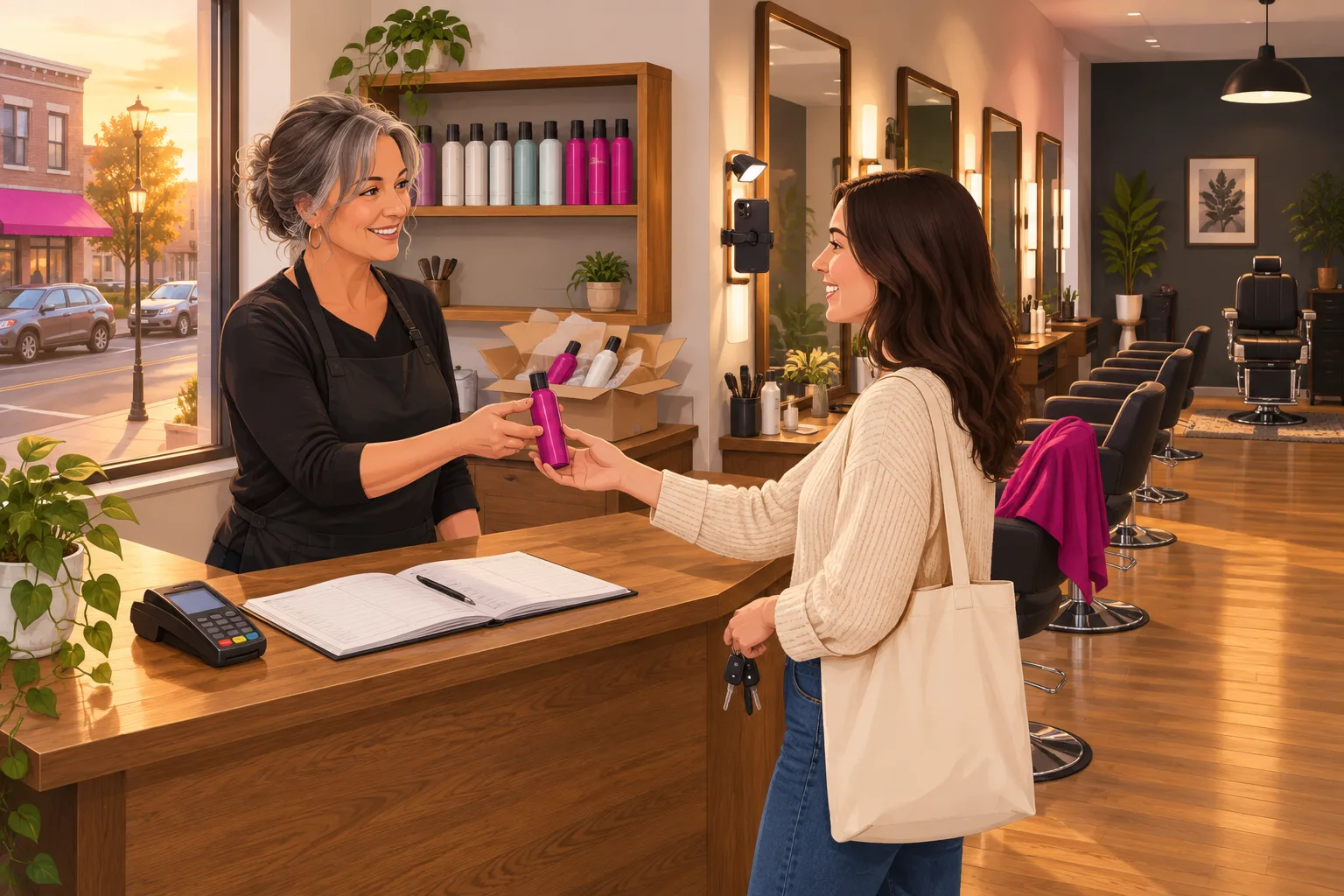
Every other salon-marketing article answers "how do I get followers." This one answers the question the owner asks on the drive to the bank: what does the phone actually make? The honest answer fits in one sentence, and it is the sentence this whole guide is built on. The chair funds the salon, and the national audience buys small.
Here is what that looks like in money instead of followers. One salon account has three hundred thousand followers from every state, a discount code for a flat iron in the bio, and an open Tuesday. The code pays out a few dollars a week. The other account - Dani's, the four chairs next to the pharmacy on Main - has fourteen hundred followers, most of them within a twenty-minute drive, and a holiday book that closed on November 5. The second account is the one making money, and almost none of it arrives through anything a monetization guide would call monetization. It arrives through the desk, six weeks at a time.
The reason is the size of the book, which the growth roadmap lays out: a stylist on a six-week rebook cycle has room for roughly two hundred regulars. At a $65 cut, every six weeks, that is on paper well over a hundred thousand dollars a year through one chair before a single bottle leaves the shelf. No affiliate commission, no Shop, no brand deal available to a four-chair salon comes within a mile of it. Which is why the first stream in this guide is the booking link, the last is the ad budget, and the ones in between - retail that ships, education for other stylists, the affiliate link, the gift card - are sized honestly, in the order a salon should turn them on, with the one real exception named: the salon that teaches, for whom the feed path is a second business and not a side income.
So this is the money guide: the five streams in order, the price explainer that sells all of them, the rules on claims and professional product and the renter's shelf, the December receipt, the selling calendar for the salon year, the three numbers that win the break room, the selling mistakes that cost salons money, and the point where selective amplification puts budget behind the video that fills the book instead of the one that sells a bottle. It builds on our complete TikTok guide for salons and barbershops - if you haven't read that yet, start there for the two-audience strategy and the compliance framework, then come back here for the money.
The honest summary:
- The chair funds the salon. A client within a twenty-minute drive who books, rebooks at the desk, and comes back every six weeks is worth more than every bottle, code, and brand deal on this list combined. The national audience is real, and it buys only what fits in a box.
- Nothing is sold by a listing; everything is sold by an explainer. "Why a balayage is $180 and three hours" sells the appointment. "This is the leave-in I used on you and why" sells the bottle. "Here is exactly how I place these foils" sells the class. The price-list graphic sells nothing.
- The calendar is the sales funnel. The holiday book in October, the class in January, prom in March, the gift card the week after Thanksgiving and before Mother's Day, the receipt said once in December. Build in the quiet weeks for the busy ones, and stop the day the book is full.
- Organic growth tells you which selling video your town already trusts - amplify that one, for followers, in the quiet weeks, inside a twenty-minute drive.
What's Inside
- 1. The Math That Changes Everything (The Chair Funds the Salon)
- 2. Stream One: The Booking Link, the Menu With Ranges & the Rebook
- 3. Stream Two: Retail That Ships (What Fits in a Box & the "Which Product" Text)
- 4. Stream Three: Education for Other Stylists (The Feed Path's Real Money)
- 5. Stream Four: Affiliate Links, Brand Deals & the Disclosure Line
- 6. Stream Five: The Gift Card (The Week After Thanksgiving & Before Mother's Day)
- 7. The Price Explanation Is the Whole Sale
- 8. "What We Can Sell You and How": Claims, Professional Product, the Shop & the Renter's Shelf
- 9. The December Receipt
- 10. The Sequence: The Selling Calendar for the Salon Year
- 11. Tracking It: The Three Numbers That Win the Break Room
- 12. The Selling Mistakes That Cost Salons Money
- 13. Accelerating: Put Budget Behind the Video That Fills the Book
- Frequently Asked Questions
1. The Math That Changes Everything (The Chair Funds the Salon)
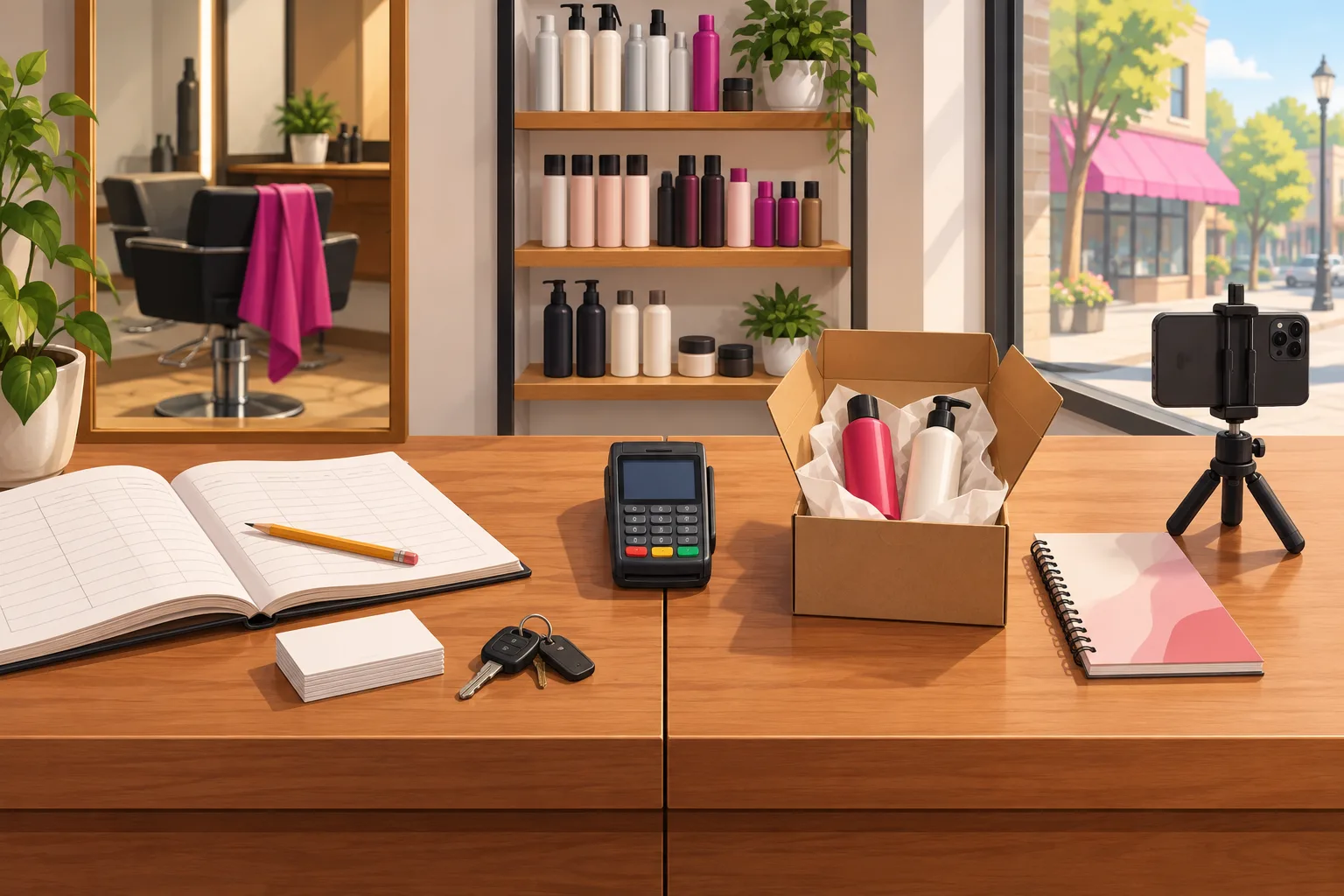
A salon is one of the most local businesses there is and one whose daily work the whole country wants to watch, which is why the pillar guide says every salon account speaks to two audiences. The money version of that sentence is blunter. The chair path - the client who drives twenty minutes and sits down - buys the one thing you cannot ship, at full price, every six weeks, for years. The feed path - the stylist in Phoenix, the hair obsessive in Tampa - buys only what fits in a box, once, when she feels like it. Here are the five streams a salon account can open, sized honestly:
- The booking link and the rebook. The whole salon. Two hundred regulars at $65 every six weeks is, on paper, more than a hundred thousand dollars a year through one chair, and a four-chair salon with a barber chair in the back is several of those. Every video on the chair path is selling this, whether it says so or not.
- Retail that ships. Real, and a slice. Industry benchmarks like to say a well-run salon sells retail worth somewhere around a tenth of its service revenue, and most salons sell far less than that because nobody has time at the bowl to explain the bottle. The video has time. Most of the retail an account sells goes across your own desk; the shipped version is a handful of orders a week, in January and after the rush.
- Education for other stylists. The only feed-path stream that can rival a chair, and only for the salon that teaches. Eight seats at an education day after hours is more than a Saturday of cuts, and it is sold to the exact audience the process clips collect by accident. It is also a second business, with its own hour on the phone.
- Affiliate links and brand deals. Small, for a local salon, and worth having only when disclosed and only for the product you would hand across the desk. A code in the bio pays a few dollars a week on a town-sized audience; it pays real money on a national one, which is the audience the chair path should not be chasing.
- The gift card. Sold in two windows a year, and really the chair prepaid: the only "product" on this list that walks a stranger into the salon. It is also cash you owe back as a service, which matters in section 6.
Two rules fall out of the list. First, the order: for most salons the chair comes first, and the other four get turned on only once the book is full enough that a national audience is a bonus and not a distraction - because an account that opens the shipping page in month two grows toward the feed by default, and the feed does not rebook. The exception is the salon that already teaches or already ships, for whom education is the plan and the chair is the proof. Decide which you are, in writing, before the first "link in bio."
Second, and this is the sentence the rest of the guide keeps returning to: nothing is sold by a listing; everything is sold by an explainer. The menu with prices sells nothing. "Why a balayage is $180 and three hours" sells the appointment. The shelf by the window sells nothing. "This is the leave-in I used on you and here is why" sells the bottle. The flyer for the class sells nothing. "Here is exactly how I place these foils, and I am teaching it on the twenty-sixth" sells the seat. Every stream below is a different explainer pointed at a different buyer, and the account that understands that never has to post a sale.
2. Stream One: The Booking Link, the Menu With Ranges & the Rebook
The chair is sold at three places, and a salon account that gets all three right has done most of its monetizing before anyone mentions a product.
The booking page is the shelf
One link, and it opens a booking page - never the homepage, never a link tree with nine buttons, never "DM for prices." On it: the price ranges and the one thing that moves each of them, how long each service takes, the cancellation policy written the way you would say it out loud, whether you take walk-ins and which day, and the name and face of each stylist with what she is known for. "Ask for Tasha - she does the curly cuts" is a sentence that converts a room full of mirrors into a person. A viewer who watched the walk-through twice taps the profile, taps the link, and books in under a minute, and the whole sale happened inside the video. Add a "how did you hear about us?" question to the online form with TikTok as one of the options, because this is where every number in section 11 comes from.
The menu with ranges, and the one thing that moves it
A price range is not a dodge; it is the honest shape of a service whose cost depends on the head in the chair. "Balayage from $180, plus toner; a first appointment runs longer; a correction is priced by the hour at the consultation and never quoted in a message" tells a stranger what to budget and why, and it tells her you will not spring anything on her at the desk. The menu on the booking page and the explainer on the account should say the same numbers in the same words, because the woman in the parking lot has read both. The men's cut is $35 and the chain charges $19; the kids' cut is $22; say them. A salon that hides its prices is not protecting itself from a cheap client. It is losing a fair one to the shop that said the number.
The rebook is the sale
The first appointment is not the conversion. The rebook is - at the desk, before she leaves the chair, with a date: "six weeks puts you at the twelfth, same time?" A client who rebooks at the desk comes back; a client who says "I'll call" is, in most salons, a client you will see in four months if at all. The pillar's client ladder has every rung, and the growth roadmap's section on the signals that matter explains why the rebook is the number an account is judged by. For the money guide, one more thing belongs here: the rebook is also where retail starts. The useful follow-up text the next day - how to style it at home, which product you actually used, when to come back with the date already on the book - is the most reliable retail engine a salon has, and it is the subject of the next section.
3. Stream Two: Retail That Ships (What Fits in a Box & the "Which Product" Text)
Retail fails in salons for one reason: the stylist has thirty seconds at the bowl to explain a $34 bottle to a woman who has a $9 one at home, and she is tired, and it feels like selling. The video removes the thirty seconds, the tiredness, and the feeling.
The "which product I actually used" follow-up
The retail engine is a thirty-second clip, filmed at the station with the bottle in hand after the service: "this is the leave-in I used on you today, this is why - your hair is fine and it tangles - and this is how much, a pea, on damp hair." Film it once per product, not once per client. Then the follow-up text the day after a first appointment includes the link to that clip, the product named, and the price, from Tasha, as a person. The client who watched it buys it at the next visit across the desk - or, if you ship, that night from her couch. Nobody was sold to. She was told what was on her hair and why, after the fact, by the person who did it. In most salons this single habit moves retail-per-ticket from almost nothing toward the benchmark, at full margin, with no box. Keep the two clips for the products you sell most easy to find on the profile, and put the price in the caption.
What fits in a box, and what does not
For the stylist in Phoenix and the hair obsessive in Tampa, retail is the only thing they can buy from you, so the shipping page carries exactly what ships well and nothing that implies a service. What fits: the shampoo and conditioner you actually use, the leave-in, the styling cream, the bond builder, the purple shampoo in blonding season, the beard oil from Marcus's chair, the travel kit, the brush. What does not: the color, the developer, the toner, and any "kit" that quietly promises a chemical service at home. A salon that sells a box-dye alternative kit has told the whole country it is fine to do this in a bathroom, and then has to fix it in the chair at the hourly rate. Keep the shelf to the things that make a cut last and a color hold, and keep the chemistry in the salon, where your license is.
When TikTok Shop is worth it
TikTok Shop puts the checkout inside the video, which is the most efficient place a "which product" clip can sell. It is worth opening when three things are true: the chair is full enough that national orders are a bonus; the professional brand you carry allows online sale of its product, because most professional lines have an authorized-retailer agreement that says where their bottles may be sold and some bar marketplaces outright - read yours before you list a single one; and someone in the salon has an hour a week to pack boxes and answer "where is my order." In exchange you pay a commission on each order and take on the platform's seller rules and the shipping obligation. If any of the three fails, sell across the desk and through the shop page your booking software already provides, which reaches the same stylist in Phoenix with a link and none of the overhead. Our TikTok Shop guide for small businesses covers the setup, the fees, and the cases where a shipping page beats the Shop. Check TikTok's current seller and affiliate requirements for your region, because the follower and age minimums change.
Who gets the retail at a renter's chair
In a salon with booth renters, the bottle sold after Tasha's cut is either the salon's retail, Tasha's retail, or a fight in the break room, and the video makes the question louder because the clip that sold it has the salon's handle on it. Write it down before the first clip: who orders the product, who rings it, who keeps the margin, and whether a renter's own shelf may appear on the salon account. The filming guide's section on booth renters has the two-yeses rule for the renter and her client; the retail line belongs on the same break-room page.
4. Stream Three: Education for Other Stylists (The Feed Path's Real Money)
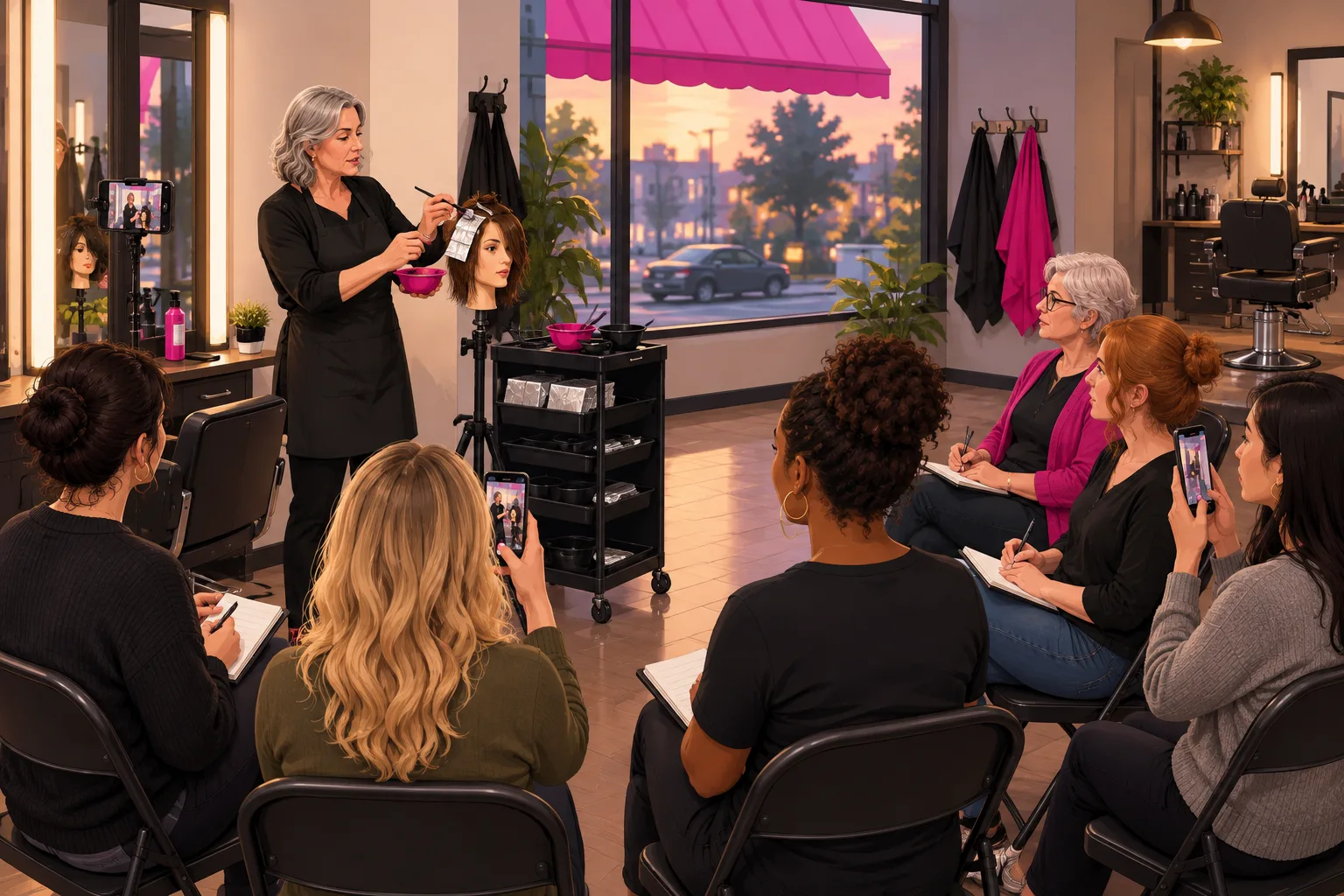
The comment under the foil clip - "what developer did you use?" from a stylist in Phoenix - is not noise on the chair path. It is a customer on the feed path, and she has already decided you can teach from watching foils go in from the mirror clamp. For the salon that wants it, education is the one feed-path stream that can rival a chair, and it is sold to the exact audience the process clips collect by accident.
Three products fit her
- The education day. The salon after hours on a Monday, six to eight seats, the technique on a mannequin head and then on a model with her own written yes. Dani teaches; the renters assist and are paid for the evening. Eight seats at a serious price is more than a Saturday of cuts, and the attendees post the day from their own accounts, which is the one time another stylist's camera in your salon is a gift.
- The digital guide. The consultation scripts, the formula notes, the "what to say when she sits down" document, the pricing worksheet - sold as a download. It ships for free, it sells in January at two in the morning, and it is the product the stylist who cannot fly to your town can buy. Price it like a class, not like an app.
- The shadow day. One stylist, one working day beside Dani's chair, with every client that day having said yes to a second person in the mirror. Rare, priced accordingly, and the thing a serious stylist DMs about after the guide.
How it is sold, and when
The process clip sells it. Name the technique precisely, name the product, show the placement at the speed you actually work, and put one line in the caption: "teaching this on the twenty-sixth, six seats, link below." No flyer, no slide, no trending song. Stylists buy education in January, after the rush, when they have money and an open Monday, and in the summer lull; the guide sells year-round and spikes in the same two windows. Never promise what a class cannot deliver - no "double your prices," no results guarantee, no "become a six-figure stylist" - because the trade screenshots, and because it is not true. If you promise continuing-education credit, your state board has to approve you as a provider first; most salon classes do not promise credit, and say so in the listing.
Two honest rules for the salon that teaches. Education is a second business with its own hour on the phone, so decide early whether it lives on the salon's handle or on Dani's own account - the break-room rule has a line for it, and the renter who teaches needs the same line. And the chair does not get to empty while the class sells out: the account that goes feed-first because the education day is thrilling is the famous-and-empty chair with a better excuse. The beauty creator guide is the other side of this chair - the educator whose whole business is the feed - and it is the right read for the stylist who decides that is who she is.
5. Stream Four: Affiliate Links, Brand Deals & the Disclosure Line
A salon account with a few thousand followers in one town will be offered a code before it is offered anything else - the flat iron, the bond builder, the color line's new gloss. Here is the honest size of it: on a town-sized audience, a code pays a few dollars a week; on a national one it can pay real money, and the national one is the audience the chair path is not chasing. So the salon's rule is simpler than the law. Only link to what you would hand across the desk. Say what you earn when you earn it. Never make a claim the label does not make.
The law, briefly, because a video is a public record: the FTC's endorsement guides require a clear and conspicuous disclosure whenever you are paid, given free product, or earn a commission on what you recommend - said out loud or on screen early in the video and written in the first line of the caption, not buried in a hashtag block. TikTok adds its own layer: a paid partnership is posted with the platform's branded-content setting switched on, which adds the paid-partnership label and limits the video to the commercial sound library, and a Shop or affiliate link carries its own commercial-content disclosure. "I get a small cut if you buy it through this link, and I have used it on every blonde in this chair for four years" is a sentence a town trusts. A code with no disclosure is a sentence the trade screenshots.
The brand deal worth taking is the one that pays you to say what you already say. The color line Dani has mixed for eleven years, the clipper brand Marcus will not switch from, the leave-in Tasha texts every curly client about - those are deals where the toggle goes on, the disclosure goes in the first line, and the video is the same honest explainer it would have been for free. The brand deal to decline is the one that wants the before-and-after with the filter, the "medical-grade" word, or the product you have never put on a head. Marcus's beard-oil clip is the model: he names the oil, says the shop earns a little on the link, shows the two drops, and the sale is a shop that is still trusted on Tuesday.
6. Stream Five: The Gift Card (The Week After Thanksgiving & Before Mother's Day)
The gift card is the only product on this list that walks a stranger into the chair, and it is sold twice a year with one video each time: the week after Thanksgiving - November 26 this year - and the two weeks before Mother's Day. Outside those windows the gift card lives quietly on the booking page and is never mentioned.
The video is Dani at the desk with the card reader, three amounts, and one sentence each about who they are for. $65 is a cut. $100 is a cut and the product she keeps asking about. $200 is a balayage with the toner. The viewer is the husband who does not know what a balayage is and the daughter in another state who does, and the sentence that sells it is "you do not have to know what to ask for - that is our job, and this is what she gets for it." Sell it at the desk and on the booking page, because a gift card bought online at ten at night on December 23 is a sale the account made without anyone being awake.
Three rules keep it clean. Say whether it expires, plainly: under federal rules a gift card cannot expire sooner than five years after it is sold, and several states go further, so "never expires" is a sentence you say only if it is true where you are, and "expires in ninety days" is a sentence you cannot say at all. Say what it buys in a service, not in a dollar figure alone, because "a balayage with the toner" is a gift and "$200" is an errand. And treat the cash honestly: a gift card sold in December is a service you owe in February, not December revenue - the owner who spends December's gift-card money on December's color order has a very quiet February. Which is why the January book is the second half of the gift-card sale, and why "here is what January looks like," filmed on the busiest Saturday in December, is the gift-card video's sequel.
7. The Price Explanation Is the Whole Sale
Every stream above is sold by the same video shape, and the pillar guide calls it the conversion video of the vertical: the "what it costs and why" explainer, filmed where the thing happens, with the thing in hand. For the money guide there are three of them, and a salon should have all three pinned at some point in the year.
"Why a balayage is $180 and three hours"
Dani at the station with the bowl: the sectioning, the hand-painting, the processing time she is not allowed to rush, the toner that is a second service, the first appointment that runs longer because she is learning your hair. Forty seconds, no apology. It is not a defense of the price; it is the price, explained, and it produces the most valuable action a salon audience takes - the save, which means someone is deciding, and the send, which means she decided and is forwarding it to the friend who said "a hundred and eighty dollars for hair?"
"Why the men's cut is $35 when the chain charges $19"
Marcus at the chair in the back: the consultation, the hot towel, the line-up with the straight razor, the same barber every time who remembers how you like the neckline, the chair that is yours for thirty minutes instead of eleven. The viewer is a man who has gone to the same chain for ten years and never once thought about it, and the video's job is to make him think about it once.
"Why the bottle on the shelf costs more than the one at the drugstore"
The retail explainer, and the one almost no salon makes. Tasha at the shelf with both bottles: what is actually in the professional one, why the concentration means it lasts twice as long, what the drugstore one does to color after six washes - said plainly, with the words on the label and nothing the label does not say. This is the video that moves retail-per-ticket, and it is the one the next-day text links to. The ideas vault's explainer section has ten more, including the correction priced by the hour and why the first appointment is longer.
And the price comment rule, because every explainer earns one: "a hundred and eighty dollars for hair is insane" gets one reply, as a person, with the explainer linked, and then nothing. The friend deciding in the group chat is reading the thread, and the salon that wins the argument loses her.
8. "What We Can Sell You and How": Claims, Professional Product, the Shop & the Renter's Shelf
A video is a public record of the service, the product, and the claim, and the pillar's compliance section covers the license, the face, the music, and the stylist who leaves. The money guide adds the rules that only show up once something is for sale. None of this is legal advice; check your state board and your brand agreement before you list anything.
- The service stays inside the license. You sell the services your license covers, in the salon, and nothing on the shipping page implies a chemical service at home. The lash or permanent-makeup work that is outside the license in your state does not become legal because it has a price in the bio.
- The claim is the label's, not yours. "Medical-grade," "non-toxic," "organic," and "formaldehyde-free" are claims with rules behind them - the FDA has promised a formaldehyde hair-straightener rule since 2023 and had still not published it as of January 2026 - and a video makes a claim permanent. Say what the product is, in plain words, with the words on its label.
- The brand decides where its product may be sold. Most professional lines have an authorized-retailer agreement that names the channels you may sell through, and some bar marketplaces or online sale entirely; selling around it is how a salon loses the color line it has mixed for eleven years. Read the agreement before the Shop, and if it says no, the "which product" clip still sells the bottle across the desk.
- The bottle is taxed; the cut often is not. Most states tax retail product and many do not tax the service, so a salon that starts selling bottles online - especially across state lines - has a sales-tax question it did not have before. Ask the bookkeeper before the first shipped order, not after the first notice.
- Paid is labeled. The FTC disclosure in the first line, TikTok's branded-content setting on for any paid partnership, and the commercial-content disclosure on any Shop or affiliate link, every time. A sponsored video also lives inside the commercial sound library, so the trending song is out before you start.
- The renter's shelf is written down. Who orders, who rings it, who keeps the margin, and whether a renter's product appears on the salon's account - on the break-room page, before the first clip. Both yeses for a renter's client still apply when the reveal is selling something.
- Consent to post is not consent to sell with. The client who checked "yes, everything" on the per-visit card agreed to be on the account. Using her reveal in a gift-card video, a class listing, or a promoted post is a wider use, and the yes card has a separate box for it. Ask, every time, and accept the no without argument.
9. The December Receipt

Every other selling video in this guide sells a thing. The receipt sells the next year, and it is the only video a salon posts about money that is not an offer. It goes up in the second or third week of December, once, from the desk, and it says what this year did.
Dani, at the desk after close, with the numbers that are true and public: how many first-time clients walked in this year and said TikTok at the desk, and how many of them are still on the book. The day the holiday book closed - November 5 this year, two weeks earlier than last. The number of kids who had their first haircut in the booster seat in August. The class she taught in February and the stylists who drove in for it. Roughly how many bottles went home. The thing that failed - the stylist who left in June, the Tuesday in September nobody came - said once, as the pillar's honest-day rule requires: said, not shown, never a client's story, never a sad song, never an ask. Then thank you, and the one line that matters for January: "the January book opens on the fifteenth, and the gift cards are good for it."
The receipt converts for three reasons. The regular who is deciding whether to rebook in a slow January just heard the year she was part of, totaled. The holiday client who followed in November and has never been back now knows the salon has a January, a class, a shelf, and a Tasha, and that the book opens on the fifteenth. And the owner who still half-believes the phone is a toy just heard the year said out loud as a list of clients, with the account's part in each one implied by the fact that it was the account that said it. Nothing in it is a pitch. Everything in it is a reason to be on the book in January.
Two rules keep the receipt a receipt. It never includes a dollar figure the owner would not say to a neighbor - counts, not revenue. And it is never the guilt post. "It was a hard year and we need you" makes a client book once out of pity and never again. "Here is what we did, and here is when the book opens" makes her book on the fifteenth.
10. The Sequence: The Selling Calendar for the Salon Year
Turning everything on at once is how a salon ends up with a Shop, a class page, a code in the bio, a gift-card graphic, and the same open Tuesday. Do it in this order instead, and notice that every sale is made in the quiet weeks before the window it fills:
Before you sell: decide the order
Chair or feed, in writing, with the salon. For most salons: chair first, unless you already teach or already ship. It decides which explainers get filmed first, whether the shipping page exists this year, and whose handle the class lives on.
December: the receipt, then the January book
"Here is what January looks like" filmed on the busiest Saturday. The receipt in the second or third week. The January book opens with the gift cards named as good for it. The permission video - "can we fix box dye? yes" - up on December 26 for correction season.
January: correction season and the class sells
The correction explainer, priced by the hour, pinned. The education day announced in the caption of the process clip that proved the demand, because stylists buy in January. The digital guide goes live the same week. Gift cards are redeemed; the rebook at the desk turns them into regulars.
February-March: prom and the formal book
The parent is the viewer and the parent's yes is required. The trial explainer, the "how to make it last the night" retail clip, the countdown from three weeks out. The education day happens in late February, and the attendees post it.
April-May: bridal trials and the Mother's Day card
The gift-card video two weeks before Mother's Day, once. Bridal trials with their own yeses. "Here is what summer looks like" the Saturday after the last dance, so the prom crowd has a June.
June-August: blonding season, then the kids' chair
The purple-shampoo explainer is the retail video of the summer. The toner-at-home question answered honestly: no. The kids'-chair walk-through the first week of August - booster seat, tablet, $22, "a thousand first haircuts and we are not in a hurry."
September: the quiet month builds everything
Film the holiday walk-through for October 1. Re-shoot the three retail clips with this season's products. Write next year's guide. Check the brand agreement and the Shop requirements if the shipping page is on next year's list.
October: sell the holiday book
The paid month. The book opens October 1 and is sold until it is full - mid-November for most salons - with the countdown weekly, messages answered within the hour, and the walk-through promoted to a twenty-minute drive. Nothing else is for sale in October.
November: Saturday mode and the gift-card video
The rush. Reveals with yeses, reposts, messages the same day, and nothing else required. Thanksgiving is November 26 this year; the gift-card video goes up the week after, once, with the three amounts and whether it expires. Then the quiet the receipt is written in.
The pattern underneath every line is the pillar's build-in-the-quiet-weeks rule: the video that sells a window is filmed in the window before and posted in the quiet weeks before the next one. A salon that follows it never posts "we have openings this week" in the second week of December, and never has to.
11. Tracking It: The Three Numbers That Win the Break Room
The dashboard shows views, likes, and followers, and none of those will convince an owner who has cut hair on this street for twenty-two years that the phone sells anything. Three numbers will, and all three are written down at the desk, not read off a screen:
- 1. First-time clients who said TikTok. One question on the intake form and the online booking form, asked out loud by the front-desk kid when a new name walks in: "how did you hear about us?" Counted monthly, by chair. Not lectured, not handed a brochure. Just counted.
- 2. The rebook rate of those clients. Of the first-timers who said TikTok, how many rebooked at the desk before they left the chair. This is the conversion the pillar's ladder is built on and the number a selling account should be judged by. "Six new clients this month said TikTok, and four of them are on the book for December" is the sentence that wins the break room.
- 3. The date the book filled. When the holiday book closed this year versus last. When prom was spoken for. When the education day sold out. A selling account moves these dates earlier every year, and the day a window fills is also the day its promotion stops, so the date is both the scoreboard and the budget.
For retail, add one line to the monthly report: retail per ticket, before and after the "which product" texts started. For the salon that teaches or ships, add the feed path's whole scoreboard in the same breath - seats sold, guide orders, shipped orders per week, and which video each followed - so nobody in the break room mistakes it for the salon. The growth roadmap's section on the stylist who does the social media covers the half-hour monthly report these numbers go in, and why paying the Monday hour like a client hour is what keeps the role - and the numbers - alive past week six.
12. The Selling Mistakes That Cost Salons Money
- The price-list graphic as a "sale." A menu with numbers and a trending song is a listing, and listings sell nothing. The same prices, said by Dani at the station with the bowl in hand, are an explainer, and explainers sell everything.
- "DM for prices." The most expensive three words on a salon account. The range, the one thing that moves it, and the link - in the saved reply, within the hour. A price withheld is a booking lost to the shop that said the number.
- Turning on the Shop before the book is full. The shipping page in month two teaches the algorithm you are a store, grows the account toward the feed, and leaves the chair where it was. Chair first; the box is a bonus.
- The code-first account. When every video ends in a discount code, the audience learns you are a store and the town learns you are not for them. A code is a footnote on an explainer, disclosed, for a product you would hand across the desk - never the point of the video.
- Selling the box-dye alternative. The "at-home kit" that implies a chemical service in a bathroom is a liability with your name on it, and the correction comes back to your chair at the hourly rate. Keep the chemistry in the salon.
- The unlabeled brand deal. Free product and no disclosure is a sentence the trade screenshots and a letter from a regulator you did not need. First line of the caption, toggle on, every time.
- The gift card that "never expires" when it does - or expires in ninety days. Say the truth about expiry for your state, in the video and on the card, and never a term shorter than the federal floor of five years.
- Spending December's gift-card cash in December. It is a service you owe in February. The owner who treats it as revenue has a very quiet February and a color order she cannot pay for.
- The class that promises results. "Double your prices," "six-figure stylist," a continuing-education credit your state board never approved - each one is a refund request and a screenshot. Teach the technique, price it plainly, promise nothing but the day.
- The renter's retail argument. The bottle sold after Tasha's cut, with the salon's clip having sold it, is a fight unless it was written down first. Who orders, who rings it, who keeps the margin - on the break-room page, before the clip.
- Using a client's reveal to sell without her second yes. The gift-card video, the class listing, and the promoted post are a wider use than the feed. The yes card has a box for it; the no is accepted without argument.
- Letting the chair empty while the feed buys. The money version of the famous-and-empty chair: eight seats sold in January, a Shop order a day, and an open Tuesday. Legitimate if you chose it and the book was full first. A failure if the account drifted there because foils travel and parking lots don't.
13. Accelerating: Put Budget Behind the Video That Fills the Book
Run the account through a season and something predictable happens: one explainer or one walk-through outruns everything else. Completion high, saves stacking, sends climbing, and the desk hearing "I saw you on TikTok." That video has already passed the only test that matters - real strangers watched to the end and booked afterward - and it is the one a salon puts budget behind. The money guide adds four rules to the growth roadmap's amplification section, and all four are about what the budget is for.
First, promote for followers, not a bottle. A promoted "shop my favorites" buys a few orders and a thinner audience; a promoted walk-through buys a stranger who follows in September, watches the chair for six weeks, knows the day the book opens, and walks in already knowing to ask for Tasha - and is far more likely to be on the book for January. Cost per local follower on the way to cost per rebook is the metric; cost per order is the feed path's, and only for the salon that chose it. Second, the map: the walk-through, the price explainer, and the book countdown go to a twenty-minute drive, drawn tightly; the process clip with the technique named goes wider only if you sell the class or the guide - the one place a salon widens on purpose. Third, the timing: October for the holiday book, March for prom, the first week of August, the first week of January for the class - never the week before Christmas, when every retailer in the state bids for the same woman, which is also why the gift-card video earns its reach organically and from the desk rather than from budget. Fourth, and the rule no other business needs so badly: pause the day the book is full - and the day the class sells out. A promoted walk-through running the week you are booked out buys nothing but "no availability" messages and a first impression that you are too busy for her.
Then put the number next to the ones the owner already knows: the booking marketplace's new-client fee, the mailer, the search ad, the school-program sponsorship, and what each of them produced. The example we use across this series is a promoted walk-through that brought fourteen new clients through the door in the six weeks before the holiday book, nine of whom rebooked before they left the chair. That is a sentence an owner can count, and it is the sentence that decides whether the ad money - which came out of the same account as the rent and the color order - was worth it.
That's exactly the model behind our TikTok promotion service: selective amplification of the videos that already earned it, targeted to the audience you chose, timed to the quiet weeks ahead of your window and paused when the book is full. Promoted selling content has a few rules that are stricter in a paid placement than an organic one: TikTok's misleading-content policy bars before-and-after comparisons that exaggerate results, so the promoted reveal is the same light, no filter, no retouch, and a caption that promises nothing the chair cannot repeat; if the salon offers injectables or permanent makeup, that work stays out of promoted videos, because the cosmetic-procedure ad rules in North America add approval, age targeting, and disclosure requirements of their own; no shame-based body-image framing, ever; a promoted post that sells a product carries the same disclosure as the organic one; and the client in the reveal and the renter in the next chair need their own yes for paid use, because consent to post is not consent to promote. For the mechanics of promoting through TikTok's native tools, see the Spark Ads guide; for the local-discovery mechanics behind the twenty-minute drive, the local business TikTok marketing guide; and for the full four-rule framework this plugs into, the growth roadmap's amplification section.
Frequently Asked Questions
How do hair stylists and salons make money on TikTok?
Mostly through the chair, and that is the part most "monetization" advice skips. A salon TikTok account earns in five streams, and they are not the same size: the booking link and the rebook (first-time clients within a twenty-minute drive who book, come back in six weeks, and bring a sister - the stream that funds the salon); retail that ships (the bottle you actually used, handed across the desk or shipped in a box, sold by the next-day "which product" text rather than a listing); education for other stylists (the class, the education day after hours, the digital guide - the only feed-path stream that can rival a chair, and only for the salon that teaches); affiliate links and brand deals (small, disclosed, and only for products you would hand across the desk); and the gift card, sold the week after Thanksgiving and in the two weeks before Mother's Day, which is really the chair prepaid. A stylist on a six-week rebook cycle has room for roughly two hundred regulars, which on paper is well over a hundred thousand dollars a year through one chair before a single bottle leaves the shelf, so the honest order for most salons is chair first and everything else second.
Should a salon sell products on TikTok Shop?
Only after three things are true: the chair is full enough that a national audience is not a distraction, the professional brand you carry allows you to sell its product online (most professional lines have authorized-retailer agreements that say where their product may be sold, and some bar marketplaces outright - read yours before you list a single bottle), and someone in the salon has an hour a week to pack boxes and answer "where is my order." If all three hold, TikTok Shop puts the checkout inside the video, which is the most efficient place a "which product I actually used" clip can sell, in exchange for a commission on each order, the platform's seller rules, and the shipping obligation. If any of the three fails, sell retail the way most salons should anyway: across the desk after the service, by a text the next day with the product named, and through the shop page your booking software already provides. A simple shipping page sells the same bottle to the stylist in Phoenix without the Shop's overhead. Check TikTok's current seller and affiliate requirements for your region, because the follower and age minimums change.
How much can a salon realistically make from retail on TikTok?
Less than the chair and more than nothing, and the useful way to size it is per ticket, not per follower. Industry benchmarks like to say a well-run salon sells retail worth somewhere around a tenth of its service revenue, so the realistic goal of a salon account is not a shipping business - it is moving your own retail-per-ticket number from almost nothing toward that benchmark, because the video did the explaining the stylist never has time to do at the bowl. A thirty-second "this is the leave-in I used on you and here is why" clip, sent as a text the next day with a link, sells more bottles across your own desk than a month of national reach, at full margin, with no box. The shipped version is real but small for a four-chair salon: a handful of orders a week from the stylist and the hair obsessive who follow the process clips, usually in January and after the holiday rush. If the shipped orders start to rival the desk, you are an education-and-retail business with a salon attached, which is a legitimate thing to be - as long as you chose it, and the book was already full.
How do stylists sell classes and education on TikTok?
By letting the process clip sell it. The stylist in Phoenix who asked what developer you used in the comments is the customer, and she already decided you can teach from watching foils go in from the mirror clamp. Three products fit her: the education day (the salon after hours on a Monday, six to eight seats, the technique on a mannequin and then on a model with her own yes), the digital guide (the consultation scripts, the formula notes, the "what to say when she sits down" document, sold as a download), and the shadow day for one stylist. Sell the day in January and in the summer lull, when stylists have money and an open Monday; announce it in the caption of the process clip that proved the demand, with the technique named precisely and the price said out loud; and never promise what a class cannot deliver - no "double your prices," no results guarantees. If you promise continuing-education credit, your state board has to approve you as a provider first; most salon classes do not promise credit, and say so. Education is a second business with its own hour on the phone, so decide early whether it lives on the salon's handle or the educator's own, and write that on the break-room wall.
Do salons have to disclose affiliate links and brand deals on TikTok?
Yes, every time, in a way a viewer cannot miss. The FTC's endorsement guides require a clear and conspicuous disclosure whenever you are paid, given free product, or earn a commission on what you recommend, and "clear" means said out loud or on screen early in the video and written in the first line of the caption - not buried in a hashtag block. TikTok adds its own layer: a paid partnership has to be posted with the platform's branded-content setting switched on, which adds the paid-partnership label and routes the video to the commercial sound library, and a Shop or affiliate link carries its own commercial-content disclosure. The salon version of the rule is simpler than the law: only link to what you would hand across the desk, say what you earn when you earn it, and never make a claim the label does not make. "I get a small cut if you buy it through this link, and I have used it on every blonde in this chair for four years" is a sentence a town trusts. A code with no disclosure is a sentence the trade screenshots.
When should a salon sell gift cards on TikTok?
Twice a year, each time with one video: the week after Thanksgiving, which is November 26 in 2026, and the two weeks before Mother's Day. The gift-card video is Dani at the desk with three amounts - $65, which is a cut; $100; and $200, which is a balayage with the toner - and one sentence about who each one is for, aimed at the husband who does not know what a balayage is and the daughter in another state. Say whether it expires, plainly; under federal rules a gift card cannot expire sooner than five years after it is sold, and several states go further, so "never expires" is only a sentence you say if it is true where you are, and "expires in ninety days" is a sentence you cannot say at all. Sell it at the desk and on the booking page, because a gift card bought online at ten at night on December 23 is the only product on this list that walks a stranger into the chair. And treat the cash honestly: a gift card sold in December is a service you owe in February, not December revenue, which is why the January book that the gift cards fill is the second half of the sale.
Found the explainer your town already trusts?
The account finds the video that fills the chair - amplification decides how many future clients see it, where, and when. Viryze promotes the videos that have already proved themselves, putting your best walk-through or price explainer in front of thousands more people within a twenty-minute drive, in the quiet weeks before the holiday book or prom or the January class, and pausing the day the book is full - so the money you spend comes back as first-time clients who say TikTok on the intake form, rebooks you can count, and a December receipt worth reading out loud.
Related Reading
- TikTok for Salons and Barbershops: The Complete 2026 Guide - the full two-audience strategy and compliance framework this money guide plugs into.
- Growing a Salon TikTok: From 0 to 10K Local Followers - the size of the book, the two scoreboards, and the paid Monday hour that keeps the account alive.
- Salon TikTok Content Ideas: 50+ Video Concepts That Fill the Chair - the explainers, the reveals, and the countdowns that do the selling.
- How to Film Salon Videos for TikTok (The Yes Card, Minors, the Mirror & the Break-Room Rule) - the yes card's promotion box and the break-room page the renter's shelf belongs on.
- Selling Farm Products on TikTok: CSA Shares, Beef Shares, and What Fits in a Box - the closest parallel: a local business whose national audience buys only what ships.
- TikTok Shop for Small Business: Complete Setup Guide - the setup, the fees, and when a shipping page beats the Shop.
- TikTok for Beauty Creators: Complete 2025 Guide - the other side of the chair: the educator whose whole business is the feed.