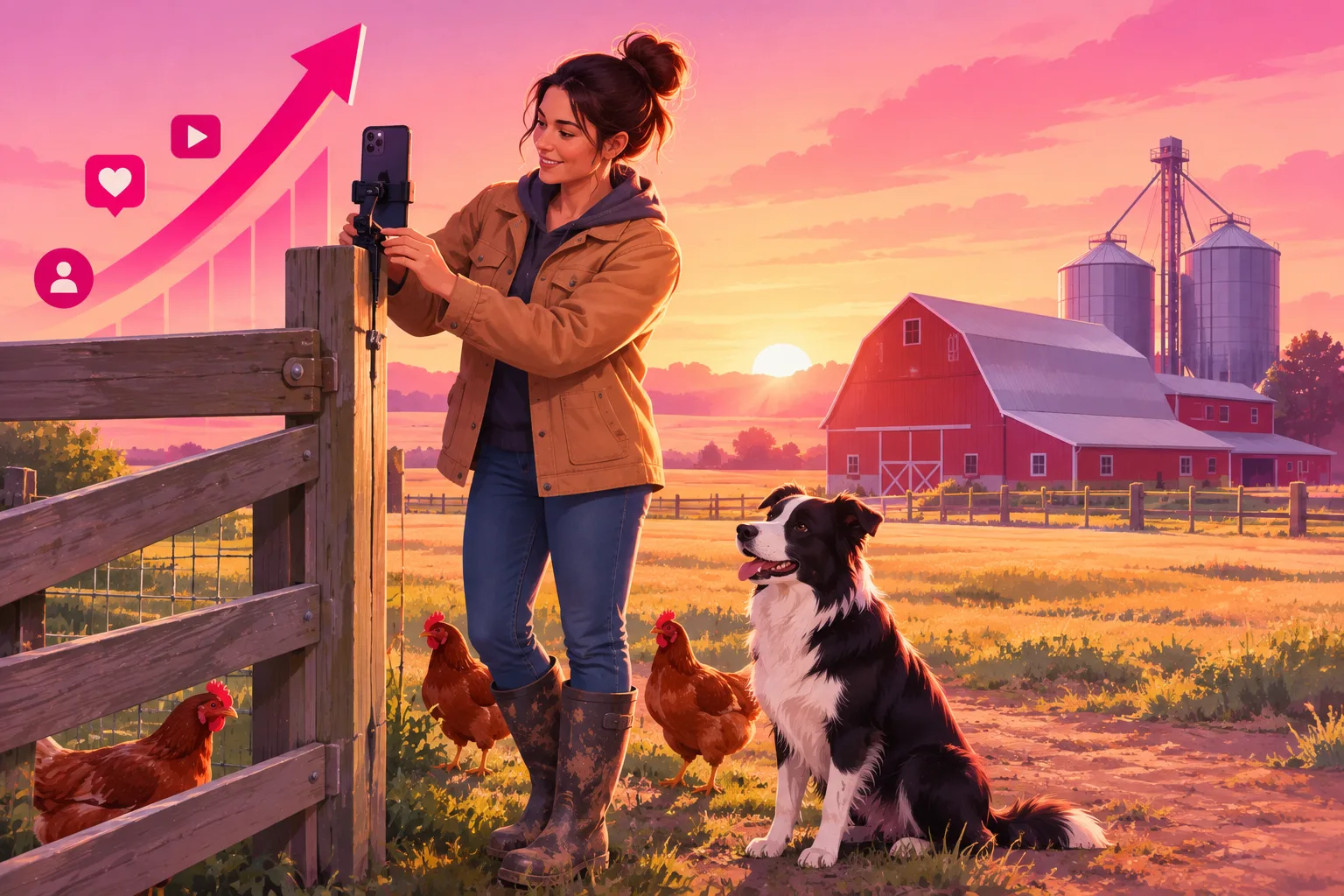
Ask the person who got handed the farm's phone why it isn't on TikTok and the answer is rarely "there's nothing to film." A farm is nothing but things to film. The answer is the practical wall. Who holds the phone when both hands are on the work? Can the kids be in it? What about the crew? Does the whole county get to see the mailbox? And who decides what goes up, so it isn't a fight at supper?
Those are the right questions, and every one of them has a short answer. This guide is the filming manual for a farm account: the kit, the angles, the three consent rules, the morning capture plan, the walk-through, the never list, the outdoor light and sound fixes, the written family rule, and the check you run before anything posts.
One thing makes farm filming different from a dentist's or a church's in this series. Your set has running machinery in it, your cast includes your own children and people you employ, and your address is the product. So every choice below runs on two tests: did this person choose to be on camera, with a real option to say no - and is anyone near running equipment?
If you haven't read our complete TikTok guide for farms yet, start there for the strategy. If you're short on what to film, our 52 farm content ideas supply the list. This article is about getting those ideas onto a phone at five in the morning without spending money, putting a child near a machine, or starting an argument about whose farm it is.
The one-sentence version:
Clamp the phone to a post at first light, clip a windscreened microphone on whoever is explaining, film the family who agreed once a year and your kids only per use and never on anything running, ask the crew in their own language with nothing riding on the answer, keep the road and the mailbox and the neighbor's land out of every frame, write the one page on the fridge that says who posts what - then run the two-minute check and post. Everything below is detail on those instructions.
What's Inside
- 1. The Chest-Pocket Kit (Under $75)
- 2. The Field Is the Set: The Gate, the Post, the Morning Light, and the Frame Sweep
- 3. Consent, Part One: The Family and the Once-a-Year Cast Agreement
- 4. Consent, Part Two: Children, the Per-Use Decision, and Never on Running Equipment
- 5. Consent, Part Three: Employees, Seasonal Crews, and H-2A Workers
- 6. Customers at the Stand, Visitors in the Field, and the Neighbor's Land
- 7. The Twenty-Minute Morning Capture Plan
- 8. Filming the Walk-Through from the Road to the Checkout
- 9. What Never to Show
- 10. Wind, Dust, Dawn, and Diesel: Light and Sound Outdoors
- 11. The Written Family Rule on the Fridge (A One-Page Template)
- 12. The Pre-Post Frame Check, and What to Do When a Video Works
- Frequently Asked Questions
1. The Chest-Pocket Kit (Under $75)
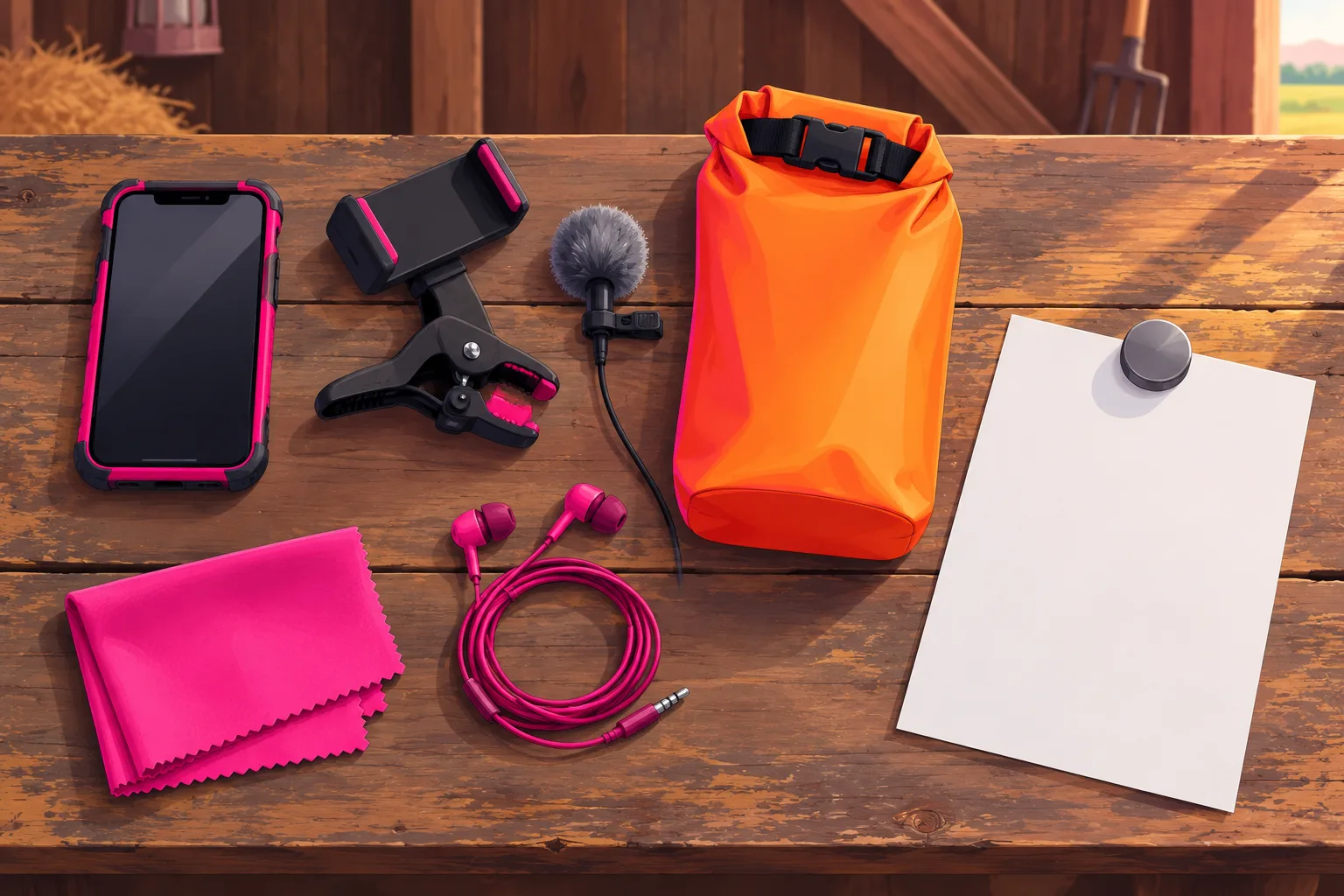
The equipment question has a shorter answer than most farm families expect, and the pillar already gave the first half of it: the phone goes in the chest pocket at five. Here is the rest. Everything the account needs fits in that pocket and one zip pouch on the dash, and you already own the expensive part.
- A phone. Any phone from the last four or five years is enough. Use the rear camera, wipe the lens every time it comes out of the pocket - dust, chaff, and a wet nose are the three things always on it - and film vertically.
- A spring-clamp phone mount ($10-15). This is the farm's tripod. A tripod needs level ground and a farm has none; a clamp grips a fence post, a gate rail, a stall board, the bed of the parked truck, a hay bale string, the handle of a wheelbarrow. The cheap plastic kind with a ball joint and a phone holder on top is all you need. It lives in the pouch, so the one time you leave it on a post you notice by the next chore.
- A clip-on lavalier microphone with a furry windscreen ($15-25). The one non-negotiable. Wind is a farm's background noise the way the HVAC hum is a church's, and a phone's microphone from six feet away in a ten-mile-an-hour breeze records nothing but the breeze. A $20 lav on the collar of whoever is explaining, with the little gray fur over it, makes them sound like they are standing next to the viewer. Buy the windscreen the same day as the mic.
- A small dry bag or a zip pouch ($8-12). The phone lives in weather. The pouch holds the clamp, the mic, and the cloth, and keeps the phone itself dry on the morning you forgot it was in the pocket when you hosed the parlor.
- A microfiber cloth ($3) and the wired earbuds you already own. The cloth for the lens, the earbuds for the one habit that saves more clips than any gear: listen to the first ten seconds before the real take.
Then add one thing no other kind of account carries: a single sheet of paper and a magnet. It goes on the fridge, not in the kit, and section 11 is about what gets written on it. The point of listing it here is that it costs nothing and it is the piece of equipment most farm accounts are missing.
One rule about whose phone it is. The pillar's cadence rule is that one person owns the phone - on our farm that is Maggie - and the kit lives with that person. If a sibling home for harvest or a worker who agreed films a clip on their own phone, the footage moves to the farm's phone or shared drive that evening and comes off the personal phone, including the clips you decided not to post. Video of your kids at the egg box and your crew at the packing table should not live in a camera roll that goes home to another state in November.
2. The Field Is the Set: The Gate, the Post, the Morning Light, and the Frame Sweep
Here is the principle that makes farm filming safe: don't try to spot the problem shot by shot. Choose angles where the things that should not be seen cannot be seen - the road, the mailbox, the house number, the gate code, the neighbor's land, the crew that has not agreed - and keep a short list of places the camera never points. When privacy is built into the direction of the lens, you stop worrying about it, and the worrying is what keeps most farms from ever pressing record.
Start with the good news. You own the best-lit set on the platform seven days a week, and the pillar's content engine says it plainly: morning light in a field is the best studio there is. The first hour after sunrise is low, warm, and comes from one direction, which is the whole trick of professional lighting for free. The chores happen in it anyway.
Four angles work on almost every farm:
- The post, chest height, pointed at the work. Clamp the phone to a fence post or a stall board at about the height of your sternum, aimed at where the chore happens, and walk into the frame. This is the volume angle: the feed cart, the egg collection, the gate swinging, the dog working. The sun is behind the phone or to one side of it, never behind the person in the frame.
- The gate, looking in. Stand at the gate to the lane or the field and film inward, toward the barn and the work, with your back to the road. Everything you own is in the frame and nothing a stranger could navigate by. This is the walk-through's opening angle and the season marker's home - the first calf is filmed from the gate, not from the house.
- Where the thing happens, with the thing in your hand. The explainers get filmed in the coop with the egg, at the freezer with the cut, at the stand with the carton, the way the pillar asks - never at the kitchen table with a slide. The lav is on, the phone is clamped a step away, and you talk to it like it is the customer who asked.
- The stand, from behind the table. On Saturday the phone clamps to the table leg or the canopy pole, aimed at the produce and the hands reaching for it. Customers appear from the back and the side, as a line that is moving. More on that angle in section 6.
And the places the camera never points, no matter who is filming or why. The road and the mailbox, which together are your address. The house number, the road sign, and the gate keypad. The neighbor's land, cattle, equipment, and crew, which are not yours to film from your side of the fence any more than from theirs. The sick pen and the processor, for reasons section 9 covers. The cab of anything moving, because the person filming is never the person operating. The pillar's compliance section puts the rest of it plainly: a video is a public record of how your food was grown and who stood near the machinery.
Whatever angle you choose, do a one-time sweep of everything the lens can see and everything the microphone can hear:
The frame sweep - in view:
- The mailbox, the house number, the road sign, and the gate keypad
- License plates on the truck, the trailer, and any car that turned in
- The order board or the CSA list with customers' names, the clipboard at the stand, the egg-money box with the cash visible
- The processor's paperwork, the vet's invoice, the feed bill, the tags and ear-tag numbers that tie an animal to a sale
- The chemical shed, the labels on anything in it, and the sprayer rig in the yard
- The neighbor's fence line, barn, or crew in the background of a wide shot - and their drive, if your lane shares it
- A child anywhere near anything running, and the fender, the running board, and the side-by-side seat in any frame with a child in it
- The house - windows, the back door, the kids' bikes by it, the dog's name tag
- Reflections - the truck window, the milk tank, the stand's glass case - which show whatever is behind the camera
The audio sweep - in earshot:
- A customer's name or phone number read off an order at the stand
- The crew talking in the next row, in any language, about anything
- A price being argued, a neighbor being discussed, a vet's diagnosis
- The radio in the shop - a recorded song is music you have no license to post
- Wind, the generator, the fan in the barn, the compressor - the farm's constant hum
One setting on the phone completes the sweep: turn off location tagging in the camera app. Your farm's location belongs in the bio and on the visit page, where you put it on purpose and in the words you chose - "the red barn past the grain elevator on Route 9" - not stamped into the metadata of the clip from the calving pen.
3. Consent, Part One: The Family and the Once-a-Year Cast Agreement
A farm account has a cast, and the pillar is specific about who it is: not the person with the phone alone but the parent who has milked at five for fifty-one years, the spouse, the sibling who comes home for harvest, the market manager who waves from the next booth, the hired hand who agreed, the dog, the heifer that was day 41. The people on that list are the adults who appear on purpose, and they are the easy case.
Each of them signs one plain-language agreement a year, in the winter when the CSA posts go up and the fridge page gets reviewed, and the signed pages live in the farm office folder, not in a text thread. "Signs" sounds formal for your own father. It is not. It is the five-minute conversation that means he never finds out from a cousin that he is in a video with two hundred thousand views, and it is the one that stops the argument before it starts. Our nonprofit filming guide lays out the consent model in detail, and the farm version keeps the same bones:
What the annual cast agreement should say:
- What kinds of videos it covers. Chores, walk-throughs, explainers, questions answered, season markers, hard days - the six formats, named in plain words.
- Where they will go. Name the platforms, including the farm's website and the market's page. Say plainly that posts are public, can be reshared by strangers, and cannot be fully recalled.
- Whether a video may be promoted with money. A yes to a chore clip is not a yes to an ad. A separate checkbox, now, so the August patch promotion does not stall on a conversation at supper.
- That it expires in a year, and gets signed again when the fridge page is reviewed.
- That it can be withdrawn with a text to the person with the phone, and that the video comes down the same day with no questions asked.
- That nothing about their place on the farm depends on it. This line matters most for the hired hand and the in-law, and it is true for everyone.
- What the account will never include about them. Last name unless they want it, health, money, the thing they said at the table they would not say on camera.
Then the stories. "The year Dad almost sold" is the best video this farm will ever post, and it needs consent that is informed, specific, revocable, and offered without pressure. Ask weeks ahead, not with the phone already out. Offer levels - face and first name, voice over footage of the barn, a written line with no name. Show him the finished video before it posts; the ideas vault's rule is that he sees it first, and it is the right rule. And if he changes his mind in a year, the video comes down the same day and he is thanked for saying so.
Done this way, consent stops being a source of hesitation. The father who said yes after a real chance to say no is usually the one who sends the video to his brother. That is the pillar's whole feed-path thesis in one gesture: the send is the sale.
4. Consent, Part Two: Children, the Per-Use Decision, and Never on Running Equipment
Kids are the hardest line in farm filming, because they are your own, because they are genuinely part of the work, and because the internet loves them. The rule is short enough to memorize: a child appears only by a parent's decision for this video and this use, never on or near running equipment on camera, and never in a video that shows the road, the mailbox, or the bus stop.
The first half is about consent. Your child cannot give it, and "they love being in the videos" is not the same as a parent deciding, per video, that this clip of this child doing this thing may be public forever. Make the decision each time. The kid at the egg box with the per-use yes is a recurring character in the pillar for a reason: it is a decision that was made, not a default.
The second half is about the machinery, and it is the rule this guide exists to put in writing. Federal labor law lets a child of any age work for a parent on a farm the parent owns or operates, so the seven-year-old on the side-by-side is usually legal, and this guide is not about the law. It is about the camera. The National Children's Center for Rural and Agricultural Health and Safety reports that a child dies in an agricultural incident roughly every three days in the United States and at least 33 are seriously injured every day. A clip of a kid riding the fender, standing on the running board, or sitting in the cab while the PTO turns is three things at once: a screenshot that follows the farm around, the single most reliable way to fill your comments with strangers who will never buy from you, and - this is the part the comment storm is not wrong about - a record of the one habit those numbers are about.
What the per-use decision should cover:
- Which video, which day. "Gathering eggs, the Saturday before the patch opens," not "the kids in the farm videos."
- Whether the child's first name is said. Default is no. A child is never named on camera or in a caption unless both parents want it.
- Whether it may ever be promoted with money. A separate line, and the account should rarely ask - the pillar's rule is that a video with a child is never the promoted one.
- Both parents where there are two, and where there is any question of custody, the answer is no.
- That the child was asked too, in words they understand, and that a child who says no is not on camera and is not talked into it.
- That the frame was checked for the road, the mailbox, the bus stop, the school logo on the shirt, and anything that places a child at an address on a schedule.
Three rules stand even when the decision is yes. No child on or near anything running, on camera, ever - the tractor, the skid steer, the auger, the baler, the side-by-side, the chainsaw, the mower. If the chore involves a machine, film the chore without the child or the child without the machine. The person filming is never the person operating: if a machine is running near you, the phone is in the pocket, and the chore clip of the machine is filmed from a post, with the operator in plain view and nobody else near it. And a child who ran into the shot comes out of the shot, in the edit, without a conversation about it.
Here is the part that frees most farm families: the content that works does not need the child on the equipment. The egg basket, the planting tray, the strawberry row, the kid-sized basket at the stand, the small hand on the calf's halter while an adult holds the lead - filmed from behind or at the side, from the post, with the per-use yes - is the footage that makes a parent in town think "we could take ours there." Our family content filming guide covers the wider question of children on camera; the farm version adds the machinery line and keeps everything else.
5. Consent, Part Three: Employees, Seasonal Crews, and H-2A Workers
The pillar's line is that employees and seasonal crews are not content, and it is worth saying why in a filming guide, because the packing line on a July morning is the most tempting shot on the farm. A worker appears only with informed consent that was never a condition of the job - and on a farm that sentence needs two more items after it: the housing, and next season.
A seasonal worker, and especially a worker here on an H-2A contract, depends on you for the job, often for the roof, and for whether they are asked back. A yes under those conditions is not a yes unless you have built it to be one. Federal H-2A rules have long barred employers from retaliating against workers who speak up, and the precise scope of those protections has been in flux since 2024, so treat the ethical rule as the floor rather than the law as the ceiling: nothing about the job depends on the answer, and the worker knows it.
How to ask a worker:
- In their own language, with a written version they can keep, not a thumbs-up across the field.
- By someone other than their direct supervisor if the farm has one - and if it does not, with the supervisor saying out loud that no is fine.
- Away from the crew, so nobody says yes because the person next to them did.
- With the honest explanation: where it goes, that it is public and can be reshared anywhere, including at home; a separate line for paid promotion; that they can withdraw it any time with no consequence.
- With the farm's promise written down: this is not a condition of the job, the housing, the hours, or next season's contract.
- Never as the punchline. The worker who agreed is a colleague on camera, named if they want to be, credited for the work, and never the joke.
A crew that has not agreed appears the way the congregation does in our church filming guide: as backs and hands at a distance, in a wide shot where nobody is identifiable, or not at all. Never zoom in. Never film the housing. Never film a worker's face in a comment reply about labor, immigration, or wages - that video is about your farm's politics and it puts a person who did not sign up for it in the middle of it.
And when the hired hand agrees and turns out to be good on camera - the pillar's "hired hand who agreed" is a recurring character because that happens - treat it as the gift it is. Ask again each season. Share the credit, not just the tag. The farm with a worker who chose to be on the account and is glad they did has something no national farm account can fake.
6. Customers at the Stand, Visitors in the Field, and the Neighbor's Land
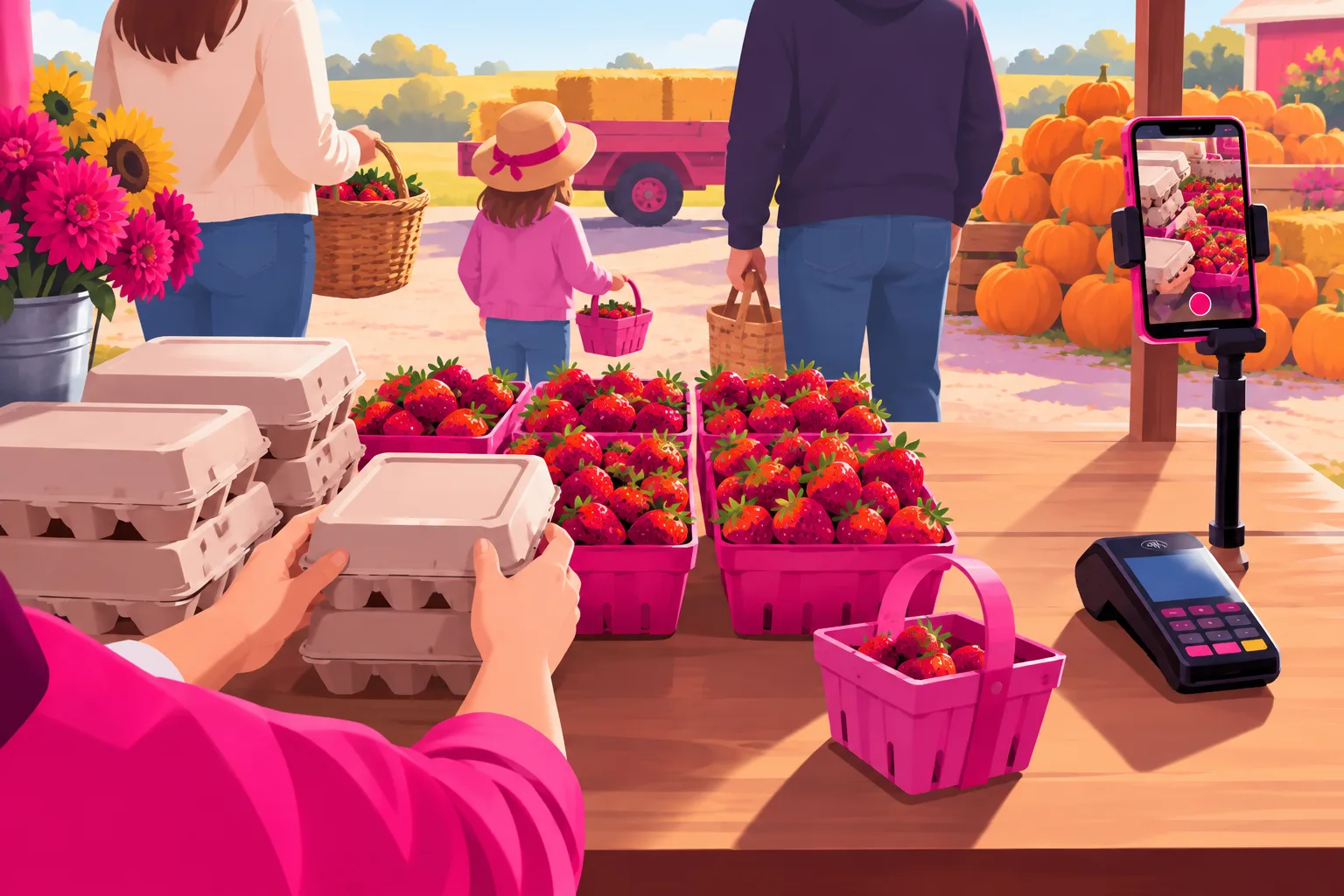
Three more things end up in front of the lens that nobody signed an agreement for - customers, visitors, and the neighbor's land - and each has a simple rule.
Customers appear as customers. On Saturday the phone clamps to the table leg or the canopy pole, aimed at the produce, and the ninety seconds of the stand the pillar asks for is hands reaching for a carton, backs at the table, baskets on arms, a car turning in, the line moving. Nobody is singled out, nobody is close, and the energy of a stand that is selling comes through. The moment you want a face, a name, or someone's kid at the kid-sized basket, you ask at the table, out loud, before the shot, and a no is a no with no awkwardness. A small card on the table - "we film the stand on Saturdays; tell Maggie if you'd rather not be in it" - makes the ask routine. Keep the lens off license plates and the card reader screen, never read an order aloud with a name in it, and never, ever post a customer's reaction to a price. The pillar's price explainer is the answer to the price objection; a stranger wincing at seven-dollar eggs is a video about the stranger.
Visitors in the field get the walk-through before they get the invitation. If the account invites people to drive out for u-pick, the patch, or a farm stay, the farm has to be ready on camera for the day they arrive. The pillar's compliance section covers the agritourism liability statute most states have, whose protection usually depends on a posted sign with the statute's wording at the entrance; the filming rule is that the sign is posted before the walk-through goes up, and the walk-through shows it. Show the handwashing station at the petting area and the "no food past this gate" sign too - the national animal-contact guidance that state fairs and petting farms follow treats handwashing as the single most effective step, and a parent watching the walk-through is looking for it. Decide out loud which parts of the farm visitors never enter, and keep those parts out of the visitor videos entirely, so nobody arrives expecting the calving barn. If yours is a working farm that does not take visitors, say so in the bio and in the saved reply, and never show the mailbox, the road sign, or the gate code.
The neighbor's land is not yours to film. Not the fence line, not their cattle, not their crew, not their barn in the background of your wide shot, not their drive if your lane shares it, and not from above. If you fly a drone for the account at all - and the pillar retires the flyover with the country song for good reason - footage for the farm's account is generally business use under FAA rules, which means a Part 107 remote pilot certificate and a list of operating limits - altitude, airspace, and flying over people - that change over time. Check the FAA's current rules before you fly. Then the farm's own rules, which are stricter: never over the neighbor's land, never over a crew that has not agreed, never low over livestock, and never as the opening of the walk-through, which is filmed from the road at the height of a stranger's eyes.
One more line that belongs here because it is about people who did not choose the account: the neighbor's loss. A barn fire two farms over, the disease order that closes the county, the family that sold. The pillar's unplannable-moment rule is one person at the gate, said once, no chore clip, no sale - and never a frame of the neighbor's place.
7. The Twenty-Minute Morning Capture Plan
The pillar's content engine is chore-first: you don't make videos, you film the work you were going to do and cut it on Tuesday. Here is what the twenty minutes of capture look like on the clock, with the filming rules above already built in.
- 5:00 - The phone goes in the chest pocket. Lens wiped, clamp in the pouch, lav in the pouch, location tagging off. That is the whole setup, and it happens before coffee is finished.
- 5:20 - One chore, start to finish, propped on a post (five minutes of attention). Clamp the phone to the post at chest height, aimed at where the chore happens, press record, do the chore. Feeding, the gate, the egg collection, the dog moving the heifers. You do not perform it; you do it. No child in the frame unless the per-use decision was made last night. No machine running in the frame with anyone near it. The post does the filming while both your hands do the work, which is the only way a chore clip ever gets made on a farm.
- 5:45 - One thing that changed (one minute). The first strawberry with color on it, the calf that stood, the frost on the cover crop. Filmed from the gate or the post, with the thing close and the farm behind it. This is the season marker, and a countdown is a reason to follow.
- 6:10 - One explainer where it happens (three minutes). Lav on, phone clamped a step away, the thing in your hand. "Why the eggs are seven dollars," in the coop, with the carton. One take, no script, stop when the answer ends. The price explanation is the whole sale, and it is filmed where the price comes from.
- 6:15 - One question, one answer (two minutes). Pull one line from the question log - the market table, the DMs, the "wait, do you actually" comments - and answer it in forty seconds to the clamped phone. "Is it organic? No. Here is what we do instead."
- Saturday, 8:00 - Ninety seconds of the stand. Phone clamped to the table leg, aimed at the produce. Hands, backs, baskets, the line moving, Maggie at the table. The only capture point on the list with people who are not the cast in it, filmed the way section 6 says.
That is five pieces of raw material from one morning and one Saturday, posted three times across the week - one market-path video, one feed-path video, one season marker - Tuesday, Thursday, Saturday, cut in an hour on Tuesday night. Keep the question log on the phone: every question at the table, in the DMs, in the comments, and the ones you say "people always ask me." It feeds the explainer and the question slot forever, and the ideas vault covers you on the morning the log runs dry. In the six weeks of harvest mode, the plan shrinks to the season marker and the pre-filmed walk-through, and that is fine - the pillar's cadence section says silent in July is fine and silent in February is not.
8. Filming the Walk-Through from the Road to the Checkout
The pillar calls the walk-through the conversion video of this vertical, and it is the one video in this guide worth filming badly rather than not at all. It answers the gravel-driveway minute - "is it weird to just show up?" - by showing up. Which driveway, where to park, is the dog friendly, do you take cards, can the kids go near the animals, are we bothering someone who is working. Ninety seconds, from the road to the checkout.
The filming is simple and has four rules:
- Film it from the stranger's eyes, starting at the turn. Phone at chest height, walking or riding slowly in the passenger seat, steady, with the lav on the person narrating. Start where the stranger starts - "you'll see the red barn past the grain elevator, turn at the second drive" - and say the landmark instead of showing the mailbox or the road sign. The viewer sees what a first-timer would see, in the order they would see it.
- Shoot it on a quiet morning, then once on a busy one. The empty pass on a weekday at eight - the lane, the parking, the stand with the cartons out, the egg fridge, the card reader, the kid-sized baskets, where the dog sleeps - and a second pass from behind the table on a Saturday so you can cut between "here is the stand" and "here is what it feels like when it's busy." Both passes keep every customer as a back or a basket.
- Show the kids' parts from the parent's side. Where kids can go, where they cannot, the handwashing station, the fence they stay on this side of. Say it out loud rather than filming a child demonstrating it. No child of yours is in the walk-through unless the per-use decision was made and the frame was checked for the road.
- Say the fears in the order they occur. The turn, the parking, the dog, "you're not bothering anyone - Saturday is the day we're here for you," cash or card, what's in stock this week, where the kids can stand, how long it takes, what to do if nobody is at the table. The sentence "just pull in, the dog will meet you" has sold more eggs than any drone shot. End on the named person: "Ask for Maggie at the table."
Film one walk-through per door - the stand, the u-pick field, the market booth, the CSA pickup, the fall patch, the farm stay - and re-film each one the week before its window opens, because the parking changed and the dog got old. The pillar's calendar section says when each window is sold, which is when its walk-through needs to exist. Our dental filming guide covers the same video for a different fear; the structure is identical because the fear is.
9. What Never to Show
Most of this list is already implied above. It is collected here because the person posting on a Tuesday night needs one place to look, and because the fridge page in section 11 will point at it.
Never in a farm video:
- A child on or near running equipment - and never a child near the road, the mailbox, or the bus stop, with a per-use yes or without.
- A hand near the PTO shaft, a chainsaw without hearing and eye protection, a guard off anything, a rider on the fender. The pillar's line: evidence first, content second. The clip that shows how the work is really done on a bad day is the clip an insurer, an inspector, or a lawyer watches with the sound off.
- The mailbox, the road sign, the house number, the gate code. Your address goes in the bio in the words you chose, once.
- The processor - the load-out, the trailer at the plant, anything from inside. Turkeys going to the processor is said plainly, as the pillar's season marker does, and not shown.
- The sick pen, a lame animal, a down cow, a calf that is not going to make it. The hard day is said, not shown, and it is never a sad song and never an ask. A lame cow on camera is a video about why she has not been seen to.
- A worker who did not agree, and never the crew housing, and never a worker's face in a reply about labor, wages, or immigration.
- A customer's face, plate, name, or reaction to a price without being asked at the table.
- The neighbor's land, cattle, crew, barn, or loss - from your side of the fence, from the lane, or from above.
- The rant and the guilt post. City people, the grocery chain, the regulation, the vegans, the organic or conventional crowd, "farms are dying, buy local or we're gone." The pillar covers why: the rant travels to people who came to argue, and a guilt customer buys once.
- A label claim you cannot back. "Organic" without the certification above the small-farm threshold, "grass-fed" on an animal that was finished on grain, "raised without antibiotics" when one was treated. Say what you actually do, in plain words.
- Anything from inside the chemical shed, and the labels on it.
- A recorded song from the shop radio under any clip.
Show instead:
- The lane, the stand, and the named person standing at it
- Customers as a line that is moving, from behind the table
- Hands gathering eggs, planting trays, loading the market truck
- The adults who agreed, answering the questions people actually ask
- The calf that stood, from the gate, with the whole farm behind it
- The price, named first, with the carton in your hand and the reason behind it
If a video needs something on the first list to work, it is the wrong video. Our pillar's hook section has five ways to open on the harvest that do not need any of it.
10. Wind, Dust, Dawn, and Diesel: Light and Sound Outdoors
A farm is the best-lit and worst-sounding set in this series, and the problems show up in predictable ways. Each has a free fix.
Lighting:
- The sunrise silhouette. A person in front of the rising sun is a dark shape with a glowing edge. Clamp the phone so the sun is behind it or to one side, and put your back to the barn, not the sky. The first hour is the best light you will ever get, as long as it is on your face and not behind your head.
- Noon. Overhead sun puts shadows in eye sockets and burns out the white of an egg carton. The explainers are morning videos. If a question has to be answered at noon, step into the open barn door with the light coming in behind the camera, or under the stand's canopy with the phone looking in.
- The dark barn with the bright door. The phone exposes for the doorway and everything inside goes black. Tap on the face or the work, not the door - the phone will let the door blow out, which is fine. Or turn around and use the door as the light.
- The parlor and the coop. Fluorescent tubes make skin green and the phone's own flicker filter does not always catch them. Open the door, kill the tubes if you can for three minutes, or clip a $15 LED light - the one optional extra worth adding to the pouch - at face height, slightly above the lens.
- Dust and bugs on the lens. The cloth, every time the phone comes out of the pocket. Half the "soft" farm footage online is a smudge.
Audio:
- Wind. The number one problem, and the windscreen on the lav solves ninety percent of it. For the rest: put the post or the truck between the wind and the speaker, turn so the wind hits the back of your head, and talk a little closer to the mic than feels natural.
- The tractor, the generator, the fan, the compressor. Diesel under a voice is mud. Film the explainer before the tractor starts or after it stops, and never try to talk over it. The chore clip of the machine itself gets the real sound, which is good footage with no voice at all.
- The lav through a canvas jacket. Fabric rub sounds like static. Clip it on the collar or the chest pocket flap, outside the layer, and listen to the first ten seconds with the earbuds before the real take.
- The hens, the dog, the calf. You want them under everything; they are the sound of the place. You do not want the rooster on top of the one sentence that matters. Wait him out and say it again.
- The stand. Under the Saturday footage, the sound of a line is the point. Under Maggie's answer to a question, it is noise - pull her three steps behind the truck with the lav on and the stand becomes background.
None of this needs a budget line. Every farm in the country has a post, a barn door, and an hour after sunrise. That is a studio.
11. The Written Family Rule on the Fridge (A One-Page Template)

Everything above becomes sustainable through one page. The pillar's cadence rule is that one person owns the phone, decided once, in writing on the fridge if you have to. We are saying: you have to. Without the page, every clip waits for supper, the morning footage is stale by the time it is seen, and the account quits by the second month - usually after an argument that was never about the video. With it, the account runs on a Tuesday night without anyone being asked, and it survives the sibling going back to the city and the parent who was skeptical in March.
It is also the document the skeptical parent will accept, because it says what they were afraid nobody had decided. Keep it to one page. Here is the shape, with a sample sentence for each part so you can adapt rather than draft.
[Farm name] - The Phone Rule - agreed at the kitchen table [date], reviewed each winter
- Ownership. "The account belongs to the farm, not to the person running it. It is registered to [farm email], two of us hold the login, and the recovery codes are in the office folder. If the person with the phone moves away, gets married, or quits, the account, the followers, and the footage stay with the farm, and whoever takes over gets this page."
- Who posts. "[Maggie] owns the phone and posts. She does not ask permission for anything in line 3. [Dad / spouse] is the one person who gets a look at anything in line 4, and answers within a day. Nobody else approves posts."
- What goes up without asking. "The six formats - chores, walk-throughs, explainers, questions answered, season markers, and the hard day told the way line 9 says - when everyone in them has a current agreement on file, no child is in them, nobody is near anything running, and nothing on the never list is present."
- What always gets a look. "Any video with a child. Any video that shows a price or a label claim. The hard day. Anything that mentions a neighbor, another farm, a regulation, or the news. Anything with a worker in it. Anything we plan to promote with money."
- What never goes up. "Anyone on or near running equipment; a child near the road, the mailbox, or the bus stop; the mailbox, the road sign, the house number, or the gate code; the processor, the sick pen, a lame or down animal; a worker who did not agree, or the crew housing; a customer's face, plate, or reaction to a price; the neighbor's land or loss; the rant; the guilt post; a label claim we cannot back; a song from the radio."
- Consent. "Family and cast sign the one-year agreement each winter. Children are a per-use decision by a parent, every time. Workers are asked in their own language, by someone other than their supervisor, with nothing about the job depending on it. Customers are asked at the table. Signed pages live in [the office folder]. A withdrawal by text to [Maggie] takes the video down the same day."
- Messages and comments. "[Maggie] answers DMs within a day, and within the hour on Fridays in patch season. 'Can we visit?' gets the kind specific answer and the stand hours. 'Do you ship?' gets the box list and the honest line about what cannot travel. A comment about the price gets one reply, as a person, with the explainer - we never argue, because the family deciding is reading."
- Harvest mode. "For [the six weeks of u-pick / the patch / the big harvest], the account posts the season marker and the pre-filmed walk-through and answers DMs, and nothing else is required of anyone. Silent in July is fine. Silent in February is not, and the first CSA post goes up December 26."
- The hard day. "The calf that did not make it, the hail, the drought, the neighbor's fire - one person says it once, at the gate, with no chore clip, no sad song, and no ask. Nothing is shown. Then we go quiet until [Dad] says otherwise."
Nine lines, one page, a magnet. Read it aloud at the kitchen table the winter the agreements get signed, and hand a copy to whoever takes the phone during the week Maggie is at the wedding. The whole apparatus - the kit, the angles, the three consent rules, the never list - fits on that page, which is the point. A rule nobody can find is a rule nobody follows, and a rule on the fridge is one the whole family agreed to while looking at it.
This guide is general information for planning purposes, not legal advice. Your obligations depend on your state, your labor arrangements, your insurer's requirements, and the rules that apply to what you sell. Confirm the agreement wording with your attorney and your insurer, the worker-consent approach with whoever handles your H-2A or seasonal contracts, the agritourism sign with your state's statute, drone use with the FAA's current rules, and anything about TikTok's rules against the platform's current policies - and if you are unsure about a particular video, a five-minute question before you post is faster than anything that happens after.
12. The Pre-Post Frame Check, and What to Do When a Video Works
Choosing the right angle prevents almost every problem. The frame check catches the rest - the plate on the trailer at the edge of the chore clip, the kid who ran into the shot, the order list on the stand table, the radio under the shop footage, the neighbor's barn in the wide shot you forgot was theirs.
Run it on every video, before it posts. Two minutes each. This is the job of whoever is posting, and of the one person who gets a look when the video is on line 4 of the fridge page.
Before you post:
- Pause on every frame change. If the camera moved or a person or an animal moved, stop and look at what is newly in view.
- Count the faces. Every adult who is identifiable has a current agreement. Every child is accounted for by a per-use decision for this video. Every worker in frame agreed. If the answer is "I think so," cut the shot.
- Look for the machine. Is anything running in the frame? Is anyone near it? Is a child anywhere in a frame with it? Is a guard off, a hand near the PTO, a rider where there is no seat? Any yes means the clip does not go up, and the morning is worth a conversation.
- Zoom on every surface. The mailbox, the plate, the order list, the vet's invoice on the dash, the ear tag, the chemical label, the house number. If you can read it at full zoom, so can everyone else.
- Listen with the earbuds. A customer's name, the crew in the next row, a price being argued, the radio in the shop. Earbuds catch what the phone speaker hides.
- Listen to the speaker. A label claim you cannot back? A line about the neighbors, the grocery chain, the regulation, the vegans? A guilt close? A sad song over the hard day? Any yes means re-record.
- Check the door. Does the caption or the bio tell a stranger the county, the days, the hours, and the person to ask for? The walk-through without the visit page is a tour of a farm nobody can find.
- Ask the last two questions. Did everyone in this video choose to be in it - and would they be glad to see it in five years?
Film this way for a few weeks and something predictable happens. One video - usually the plain stand walk-through or the egg price explainer - far outperforms the rest. High completion, saves piling up, profile visits jumping, and a comment section full of "is this the one on Route 9?" and new questions for the log.
That video has proved, with real viewers, that it answers the gravel-driveway minute. What you do next depends on which of the pillar's two customers it speaks to. A walk-through only helps if it reaches people who can drive to the stand on a Saturday morning. A chore clip can travel anywhere, and whether you want it to is a decision about what you ship, not an accident.
That selective approach is what our TikTok promotion service is built for. We amplify videos that have already proven themselves, to the audience that fits the map - the Saturday-morning drive radius for the walk-through and the u-pick countdown, wider only if the farm ships what fits in a box - and we aim at followers rather than a one-time visit, because a follower watches the strawberries ripen for six weeks. Timing matters too: build in the quiet weeks before the window - August for the patch, February for the CSA, April for u-pick - never on the peak weekend, and stop the day you sell out.
Before anything is promoted, run the frame check once more with three additions. Confirm the agreement for every person in the video checked the paid-promotion box - consent to post is not consent to promote, and a video with a child is never promoted at all. Confirm it fits TikTok's ad policies, which the pillar's compliance section covers - promote the farm and the follow, never anything that reads as an animal or alcohol product listing, with approval per ad and per market. And remember whose money it is: the ad money came out of the same account as the seed, so decide in advance what result would justify it - a visit-page click, a first-time customer who says "TikTok," a second order.
Our Spark Ads guide covers the format most farms should default to, since it promotes your organic post with its comments intact. If the market path is your goal, our local business TikTok guide covers the filming choices that build recognition in one county.
Frequently Asked Questions
What equipment do I need to film farm videos for TikTok?
The phone you already own, a spring-clamp phone mount that grips a fence post, a gate rail, or a stall board ($10-15), a clip-on lavalier microphone with a furry windscreen ($15-25), a small dry bag or zip pouch ($8-12), a microfiber cloth, and the wired earbuds you use to check the audio - under $75 total, and most farms spend under $50. The clamp matters more than a tripod on a farm, because the ground is never level and a post is always there. The windscreen matters more than the microphone, because wind is the farm's background noise the way the HVAC hum is a church's. Keep the kit in one zip pouch on the dash or in the chest pocket, and keep the farm's footage on the farm's phone, not in a seasonal worker's camera roll.
Can my kids be in our farm TikToks?
Yes, by a parent's decision made per video, for this use, and inside three rules that never bend. A child is never on or near running equipment on camera - not the fender, not the running board, not the side-by-side, not next to the PTO - even where the work itself is legal under the federal parental exemption for a family farm. A child is never in a video that shows the road, the mailbox, the house number, or the bus stop. And the child is asked too, in words they understand, and a child who says no is not on camera. Film the egg basket, the planting, the strawberry row, and the kid-sized basket at the stand, from behind or at the side when you can. The National Children's Center for Rural and Agricultural Health and Safety reports that a child dies in an agricultural incident roughly every three days in the United States and at least 33 are seriously injured every day; the clip of a seven-year-old on the auger is both a safety-optics problem and the single most reliable way to fill your comments with strangers who will never buy from you.
Do I need my farm employees' permission to film them?
Yes, and it has to be the kind of permission a person can actually refuse. Employees and seasonal crews, including H-2A workers, appear only with informed consent that was never a condition of the job, the housing, or next season's contract - asked in the worker's own language, by someone other than their direct supervisor if you can manage it, with a plain explanation of where the video goes and that it is public, a separate line for paid promotion, and the right to withdraw it any time with no consequence. Federal H-2A rules have long barred employers from retaliating against workers who speak up, and the exact scope of those protections has been in flux since 2024, so treat the ethical rule as the floor: nothing about the job depends on the answer. A crew that has not agreed appears as backs and hands at a distance, or not at all, and a worker is never the punchline of a video. If the hired hand agreed and is a recurring character, that is a gift; thank them with a share of the credit, not just a tag.
Do I need permission to film customers at my farm stand?
Not if customers appear as customers - hands reaching for a carton, backs at the table, baskets on arms, a car turning in - filmed from behind the table with the phone aimed at the produce. Nobody is singled out and nobody is identifiable. The moment you want a face, a name, or a child, you ask at the table, out loud, before the shot, and a no is a no with no awkwardness. Put a small notice at the stand that the account films the stand on Saturdays, keep the lens off license plates and the card reader screen, and never post a customer's reaction to a price. The reassuring stand video is the one that shows the line moving, the kid-sized baskets, and Maggie at the table, not a stranger's face.
What should a farm social media policy include?
One page on the fridge, decided once at the kitchen table, covering nine things: who owns the account (the farm, with two people holding the login and a line about what happens if the person with the phone moves away); who posts; what goes up without asking; what always gets a look from a parent or a spouse (any child, any price, the hard day, anything about the neighbors, anything to be promoted); what never goes up (anyone on running equipment, a child near the road, the mailbox or the gate code, the processor, the sick pen, a lame animal, a worker who did not agree, the rant, the guilt post); how consent works and where the signed agreements live; who answers DMs and the three saved replies; what harvest mode means and for which six weeks; and the hard-day rule - said once, by one person, at the gate, never an ask. Review it each winter when the agreements get signed again.
Can I use drone footage in my farm TikToks?
Sparingly, and legally. The flyover with a country song is the format the pillar guide retires, because it shows an audience a map and not a farm; thirty seconds of the dog working the heifers at ground level will outperform it every time. If you do fly, footage for the farm's account is generally business use under FAA rules, which means a Part 107 remote pilot certificate and a list of operating limits - altitude, airspace, and flying over people - that change over time - and that is before the farm's own rules: never over the neighbor's land, never over a crew that has not agreed, never low over livestock, and never as the opening of the walk-through, which is filmed from the road at the height of a stranger's eyes. Check the FAA's current requirements before you fly for the account.
Ready to turn your best morning video into customers who come back?
Film the way this guide describes and one of your clips - probably the stand walk-through or the egg price explainer - will eventually break out. When it does, Viryze amplifies that proven video to the audience that fits it: the Saturday-morning drive radius for the stand, wider only for what fits in a box. We build followers who watch your season come in for six weeks, in the quiet weeks before the window rather than on the peak weekend, and we count the result the way the person who signed the seed invoice will - in visit-page clicks, first-time customers who say "TikTok," and second orders, next to the cost of the fall newspaper ad. Your question log supplies the ideas, a phone clamped to a post captures them, and selective amplification helps the best of it reach the people who will turn down the driveway.
See how selective amplification worksRelated Reading
- TikTok for Farms: The Complete 2026 Guide - the full strategy this filming guide plugs into.
- Farm TikTok Content Ideas: 50+ Video Concepts That Bring Customers Down the Driveway - what to film, now that you know how.
- How to Film Nonprofit Content for TikTok - the consent model this guide borrows for hired help.
- How to Film Family Content for TikTok - the wider question of children on camera.
- How to Film Pet Videos for TikTok - getting an animal to cooperate with a lens, which the heifer will not.
- Understanding TikTok's Algorithm: What Really Matters - why a tight chore clip gets distributed and a ten-minute barn tour does not.
- TikTok Spark Ads Guide - the amplification format for the walk-through that takes off.

Head of Creator Success at Viryze
TikTok growth strategist helping creators reach their first 100K followers through data-driven promotion strategies.