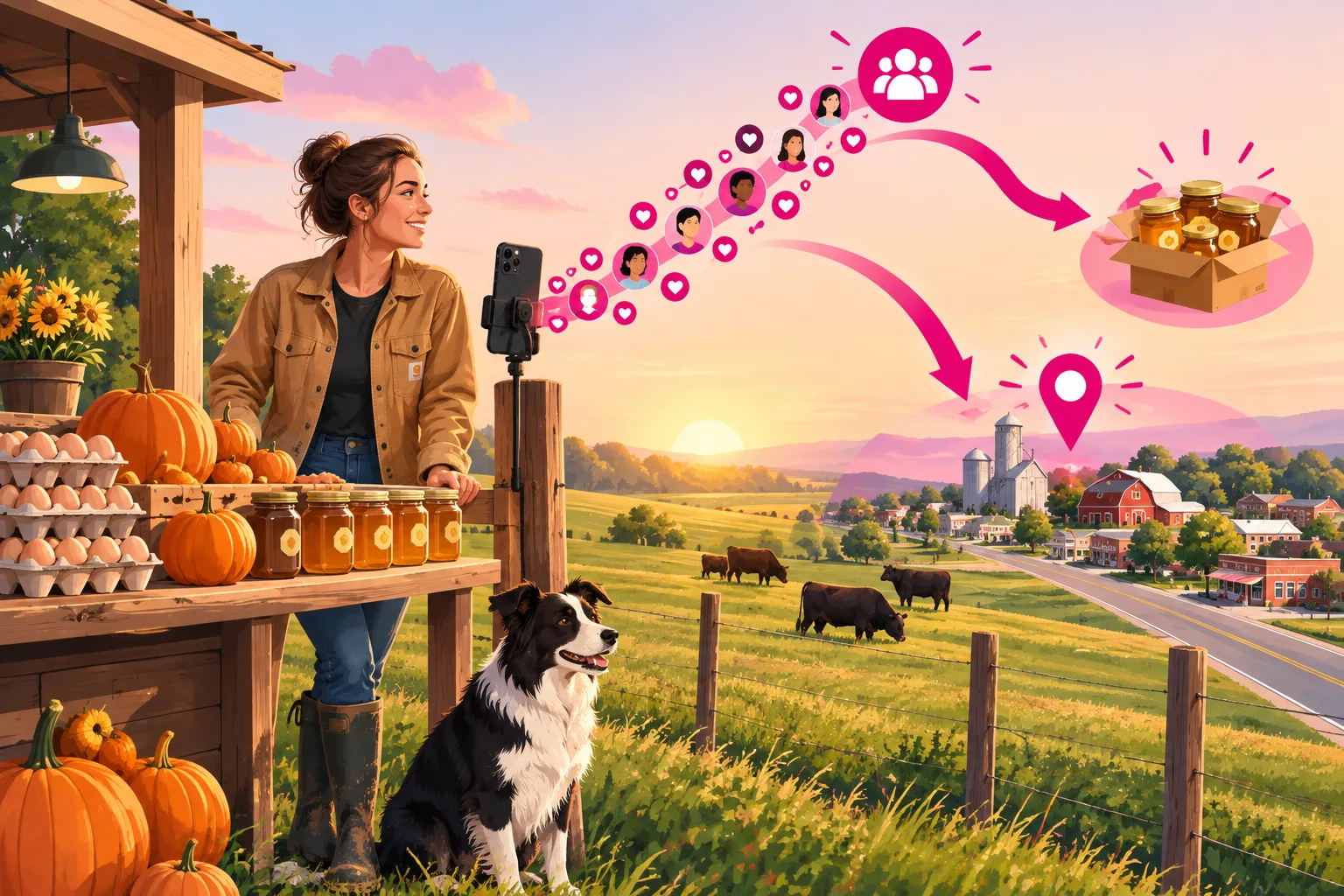
Most growth guides on this site open with a warning that growth will be slow, because nobody wakes up wanting to watch a dentist. Yours opens with a stranger one. A farm account can grow fast, because the whole country wants to watch your morning - and the most common way a farm account fails is not failing to grow. It is growing to six hundred thousand people and having forty CSA shares unsold in March.
Call it the famous-and-broke farm. The calf standing up for the first time travels, the comments fill with people in Arizona and Maine who say the morning chores are the only calm thing in their feed, and the stand on Saturday has the same eleven cars it had last year. That is a real audience, and nothing in this guide tells you to stop serving it. But it quietly convinces a parent that "TikTok doesn't sell anything," which is true only because every video was for the feed and none was for the driveway.
Because that is the thing about a farm that no other account on this platform shares: you are one of the most local businesses there is, and the one whose daily work was built to go everywhere. A beef share, a gallon of milk, a flat of strawberries, a pumpkin, a u-pick morning - none of it ships, and the customer drives out on a Saturday. The chores, the births, the hail, the sunrise - all of it ships, to anyone, for free. So a farm account speaks to two customers - the market and the feed - and unlike the dentist or the vet in our other guides, a national audience is not automatically waste for you. It is waste only if the stand was never full first, and only if nobody decided which customer this year was for. Every growth decision in this guide is downstream of that fact.
Meanwhile the economics on the other side of the trap are better than most farmers believe, for a reason that is usually described as the farm's biggest problem. The person standing at your price tag is not deciding whether farming is noble. They are deciding whether seven dollars for a dozen eggs is a ripoff, whether it is weird to just show up, whether the dog is friendly, and whether they are bothering someone who is working. The 2022 Census of Agriculture counted more than 116,000 farms selling directly to consumers, about $3.3 billion worth and up roughly 16 percent in five years, so the demand is there; what is missing is the minute at the end of the gravel driveway where a stranger decides whether to turn in. A 60-second video that shows exactly what happens from the turn off the road to the card reader answers that question before they arrive, and a follower who has watched it twice pulls in already knowing to ask for Maggie at the table. This guide is the roadmap to that audience: the two scoreboards, the 90-day plan that finds your content engine, the series compounding that accelerates it, the family role that keeps it alive through harvest, the growth signals that actually predict a fuller stand, and the point where selective amplification takes a proven walk-through and points it at a Saturday-morning drive in the quiet weeks before the patch opens. It builds on our complete TikTok guide for farms - if you haven't read that yet, start there for the strategy and compliance framework, then come back here for the growth mechanics.
The honest summary:
- Pick your scoreboard before you post. A market-path account is measured in first-time customers who say TikTok at the table and in second orders from a Saturday-morning drive. A feed-path account is measured in follows, saves, sends, and shipping-page orders for what fits in a box. Neither is measured in views. One farm can run both, but only in a decided order - and for most farms selling direct, the market comes first unless you already ship.
- The 90-day plan has three phases: market or feed, lane lock, and the question log (days 1-30), series compounding with a cast and one phone (days 31-60), and making it easy to show up while building toward the next season window (days 61-90) - ideally timed so the engine is warm when the CSA goes on sale or the patch is sold in August.
- Sends, saves on the walk-through, visit-page clicks, and the second order predict a fuller stand. Views entertain; the customer who sends the egg explainer to a spouse, the parent who saves the u-pick walk-through in April, the profile tap that becomes a visit-page click, and the family that comes back in June are what turn into customers you can count.
- Growth you earn organically tells you which videos deserve promotion - amplify proof, not hope, promote for followers, not a one-time visit, and stop the day you sell out.
What's Inside
- 1. Why Farm Growth Is Different (Two Customers, Two Scoreboards)
- 2. The Foundation: Profile, Bio, the Pinned Trio & the Visit Page
- 3. Days 1-30: Market or Feed, Lane Lock & the Question Log
- 4. Days 31-60: Series Compounding, the Cast & the One Phone
- 5. Days 61-90: Make It Easy to Show Up & Build Toward the Window
- 6. The Growth Signals That Actually Matter
- 7. Milestones: What Changes at 500, 2K, 10K & the 600K With an Empty Stand
- 8. The Family Member Who "Does the Social Media": A Role That Survives
- 9. Breaking the Plateaus Every Farm Account Hits
- 10. The Growth Mistakes That Stall Farm Accounts
- 11. Accelerating Growth: Amplify Proof, Not Hope
- Frequently Asked Questions
1. Why Farm Growth Is Different (Two Customers, Two Scoreboards)
Most growth advice on TikTok is written for entertainers who need scale, because their revenue is a thin slice of a huge audience. Most professional growth advice is written for people whose subject is boring, because their first job is making anyone care. You are in neither group, and that changes five things about how you grow:
- Your problem is the driveway, not the attention. The accountant has to earn a view. You have to point one somewhere. A calf finding its feet, a hand lifting the first strawberry of June, a parent who has milked at five in the morning for fifty-one years - these are close to native currency on this platform, so the risk is never that nobody watches. It's that six hundred thousand people watch, none of them live within a Saturday-morning drive, and nobody ever told the one who does where to park.
- You have two customers, and you must pick the order. The vet and the dentist have radii. You have a market path (local: first-time customers at the stand, the field, the booth, and the CSA list; second orders; the family that drives 35 minutes on a Saturday) and a feed path (borderless: follows everything, buys only what fits in a box - honey, jam, maple, wool, seeds, dried flowers, the cookbook), and they grow on different videos, different hooks, and different scoreboards. The pillar guide's section on the two customers lays them out. For growth purposes the rule is simple: the hybrid is nearly mandatory for a farm, but it is a sequence - most farms selling direct fill the stand first and carry the feed second, unless they already ship - and an account that never decides grows toward the feed by default, because calves travel and driveways don't.
- Your conversion is a drive to a business that is also somebody's home, which is the most awkward conversion on the platform. A viewer can book a dentist from the couch. Yours has to turn down a gravel driveway with no sign that says "open," park somewhere that might be wrong, and walk up to a stranger who is clearly in the middle of work, with their kids and a dog they are not sure about. The question under every visit that never happens is "is it weird to just show up?" - and that belief is dissolved by repeated exposure to the walk-through from the road to the checkout, not by one viral calf. So growth in this vertical is measured less in how many people saw you once and more in how many people saw the turn, the parking, and the table three times before a Saturday. The walk-through that gets saved and rewatched is doing more for the patch than the clip that got a million views.
- The price explanation is the whole sale. Direct-market farms lose the sale at the price tag to a customer who would have paid it if anyone had shown where the money goes. "Why our eggs are seven dollars" - the feed bill, the hens that stopped laying in December, the forty minutes a day - is not a defense, it is the conversion video for everything you sell. And it produces the most valuable action any audience on the platform can take: the save means someone is deciding, and the send means they decided and are forwarding it to the spouse who asked why the eggs cost that. No other account has an audience whose best move is sending a video about egg prices to one specific person at home.
- Your third audience is the county. The market manager who decides who gets the corner booth, the restaurant that wants the beef, the school that books the field trip, the feed store, the other farms - they watch the account too, and it tells them something a brochure never does. And a fourth audience watches the same feed from the other side of the kitchen table: the parent who was skeptical in March, who sees the account the way a customer does for the first time, and who will accept three numbers a month if someone is counting them. The first farm in a county to consistently show what its stand looks like on a Saturday answers "where do you get your eggs?" for that county, alone.
So while "0 to 10K" is the headline, hold the real scoreboard in mind, and hold it against the size of the stand. Two hundred hens lay somewhere around eighty dozen eggs a week in a good month. A forty-share CSA is forty families. A pumpkin patch is five weekends. A few hundred followers who could drive to you on a Saturday morning is every dozen you will lay this year, spoken for. Ten thousand local followers is the market-path ceiling for all but the largest agritourism farms, and we'll cover what each tier unlocks honestly - including the version of six figures that is a warning sign rather than a trophy: a famous farm with an empty stand. Nobody should wait for a big number to consider this working.
2. The Foundation: Profile, Bio, the Pinned Trio & the Visit Page
Growth turns viewers into followers at exactly one place: your profile. A viewer finishes a video, taps your name, and decides in about three seconds whether to follow. Before posting anything, make those three seconds count - and make them point at the driveway:
- The county-plus-hours-plus-sentence bio. "Sixty acres in [your county], on Route 9 past the grain elevator - Saturdays 8 to noon at the stand, Wednesdays at the downtown market - eggs, beef by the share, u-pick strawberries in June - visit page below." The county and the landmark tell the algorithm and the viewer you are reachable; the hours tell them when; the list tells them what; the last line is the step that a sunrise over the pasture never includes. "Stewarding the land for four generations" is not a sentence a stranger can use. "The red barn past the grain elevator, turn in at the hay wagon" is. If you've chosen the feed path this year, the county stays and the sentence becomes what the account is for - "morning chores, every Tuesday, honey and wool shipped anywhere."
- A face, not a barn - and in your sector, the face at the table. People follow a specific kind human. They scroll past a logo, a drone shot, and a stock photo of a tractor. Your profile photo is a person who appears in the videos - Maggie, who runs the phone and the table, or Dad at the gate - and the farm's name lives in the bio. Farm accounts that grow are cast accounts, so decide early who the recurring faces are - more on the cast in section 4.
- The pinned trio. Pin your stand walk-through (the fear-remover, the turn off the road to the card reader, the single video that converts a viewer into a car in the driveway), your best-performing "where it comes from" explainer (proof the price explains itself instead of apologizing - "why our eggs are seven dollars"), and your best question answered from the market table (proof the honesty is real: "is it organic? no - here's what we do instead," in forty seconds). The first quietly converts more than the other two combined.
- The visit page, one tap away, with a named person on it. A link-in-bio that opens a visit page - never the homepage, never "DM us" - with the hours, the driveway described in words a stranger can follow, cash or card, whether the dog is friendly, where kids can go and where they cannot, what is in stock this week, and the name and face of the person who will be at the table. "Ask for Maggie - she'll be at the table in the green apron" converts better than any sentence about your soil ever will, because it turns a driveway into a person. The pillar's customer ladder walks every rung from the first view to the second order. Set the account up as a business account: in most regions that adds the website link without waiting for 1,000 followers and gives you TikTok's Commercial Music Library for business use, which matters more than it sounds when the alternative is a country song from the radio.
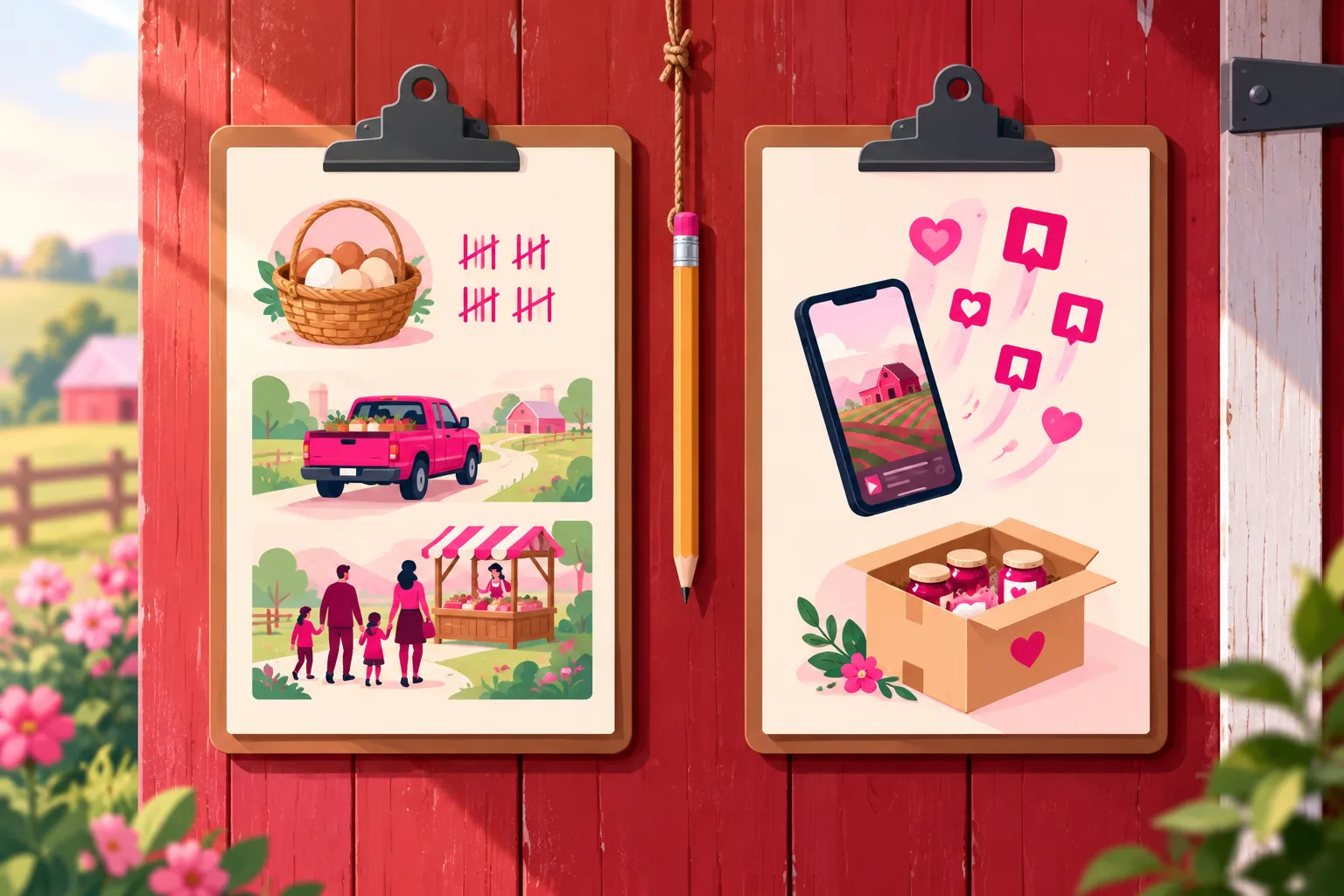
- The "how did you hear about us?" line. At the market table, out loud, and on the CSA and share order forms, with TikTok as one of the options. This is the growth infrastructure most farms never build, and without it you will never be able to prove any of this worked - a parent will hear "we have 3,000 followers" and ask, reasonably, how many of them have bought an egg. The line is how you answer. It is also the thing the useful follow-up runs on, because it is where a first-time customer leaves a number.
- The agreements, in the folder before you need them. The once-a-year family and cast agreement that everyone who appears on purpose signs each winter, the per-use decision a parent makes for any child in any video, and the worker consent that was never a condition of the job. The stand appears as hands, backs, and baskets; the children appear at the egg box with a per-use yes and never near anything running; the hired hand appears because they chose to. Print the pages now, so that by month two the person with the phone is never choosing between a good video and the rule. The farm filming guide's consent sections have the agreement, the levels, and the edge cases.
- Three saved replies, written on day one. The "can we visit?" reply - warm, specific, a kind no if you are a working farm without visitors, and the booth and the hours either way, never silence and never a biosecurity lecture. The "do you ship?" reply - the box list and the honest line about what cannot legally travel. And the price comment - answered once, as a person, with the explainer linked, never argued, because the family deciding is reading. The first two are growth tools. The third is the whole sale, and the account will receive more of them than you expect from the first month on.
3. Days 1-30: Market or Feed, Lane Lock & the Question Log
One scheduling note before the plan: if you can choose when to start your 90 days, start in the first week of December. Month one then runs through the December receipt and the first CSA post on December 26, month two is February, when the CSA and the spring beef shares are actually sold, and month three ends in early March as calving begins with the April u-pick walk-through already on the calendar. The other strong start is the first week of June, which opens with u-pick, runs through the July glut, and lands the engine in late August, when the pumpkin patch is sold. The engine works in any season - more on the timing lever in section 5, and on what to do if it is already October in the FAQ.
The first month has three jobs, and none of them is going viral: decide which customer this year is for, lock your lane, and build your question log.
Decide market or feed first, in writing, at the top of the running note on the phone. Market path: a drive-radius audience that visits, comes back, and brings a sister. Feed path: a borderless audience that watches, saves, sends, and orders honey in November. If the honest answer is "both," write the order too - for most farms selling direct, market first, feed second, unless the shipping page already pays a bill - and which number wins when the two collide. The algorithm is about to decide for you if you don't, and it will decide feed, because calves travel.
Lane lock means every video teaches the algorithm the same thing about who you are - and in month one, it's deciding exactly that from your first fifteen or twenty videos. This is the growth detail farm accounts miss most, and it is where the famous-and-broke farm is actually built: if those first twenty are newborn animals and sunrise shots with no place in them, the algorithm files you as a farm-aesthetic account and serves you to people who like farm aesthetics everywhere - fine for the feed path, fatal for the market path, and almost impossible to undo once the account is large. For a market-first farm the opening month is deliberately anchor-heavy: the stand walk-through, explainers filmed where the thing happens, the season marker tied to a date at the stand, the county said out loud, the grain elevator in the background. For a feed-first farm it is chores start to finish and explainers with the thing named precisely. The travelers that reach nationally - the birth, the hail, the honest hard day - come in month two, once your identity is set and they can lift an already-anchored account instead of defining an unanchored one.
The question log is the habit that powers everything after, and yours has two sources, which is one more than anyone else gets. The first is the chore list: you do not make videos, you film the work you were going to do anyway. The second is the questions: the market table ("do you wash the eggs," "is it grass-fed," "what do I do with a kohlrabi"), the DMs, the "wait, do you actually" comments, the parent's "people always ask me" list. Everything that is a question about the farm goes into a running note, verbatim. Each one is a video with proven demand. In a normal week you'll bank 10-15. The asker's exact wording is your hook: open with their question, in their words, then answer it the way you would across the table. No introduction, no founding year, no mission statement - the question stops the scroll. The ideas vault's idea engine shows both sources running at once.
The month-one cadence:
- Post three a week, 30-60 seconds each, captured in twenty minutes spread across one morning's chores with the phone in the chest pocket at five - because that is when the farm exists on camera - and designed for your worst week, not your best. Tuesday, Thursday, Saturday: one for the market, one for the feed, one season marker. The farm filming guide covers the kit under $75, the clamp that turns a fence post into a tripod, and the angles where nobody but the cast is identifiable, so most of your library needs no one's permission but your own.
- Hook on the harvest, never the rant. "Here's why a dozen of these costs seven dollars" grows an account. The rant about city people, the grocery chain, the regulation, or the neighbors travels, fills the comments with people who came to argue, makes the family at the price tag feel judged before they arrive, and trains the algorithm to show your kind videos to the fight crowd. Its quieter cousin, the guilt post - "farms are dying, buy local or we're gone" - brings a customer who buys once out of guilt and never comes back. Pride can be the fourth sentence; the first is the harvest. This is the growth-correct move as well as the kind one, and it is the hook a promoted video can use later. The pillar's hook section has the five shapes.
- One chore per clip, cut at the moment. The chore video that works is 30 seconds, start to finish, the phone propped on a post - not four minutes of walking between buildings. A ten-minute tour of the whole operation is a farm documentary, and nobody follows a documentary. The filming guide's morning capture plan shows the five stops.
- Say the county out loud. "If you've driven past the grain elevator on Route 9, we're the red barn right after it" - one spoken local reference per market video, not just a hashtag, because local viewers stay longer on something that is visibly about their county, and the algorithm notices who stays. Feed videos name the thing precisely instead - the breed, the cut, the variety - so the algorithm learns which hearts to find.
- Tag county and lane every time. The county, the nearest town, and the lane - local viewers search, and the algorithm serves local content to local viewers.
- Reply to every comment, daily - five minutes between chores. Each one is tomorrow's video and a signal that your account generates conversation. The "is it okay if we just stop by Saturday" comment gets the visit reply and a name. The price comment gets one reply as a person with the explainer, and then it gets left alone - we do not argue about eggs in the comments, because the family deciding is reading. The comment that attacks a person gets hidden.
- Judge nothing before day 30. Early videos fluctuate wildly while the algorithm tests audiences. The data you need - which topics outperform, and where your followers actually live - only becomes readable with 12-20 videos posted.
4. Days 31-60: Series Compounding, the Cast & the One Phone
By day 30 you have data: a few videos clearly outran the rest. Month two is about turning those outliers into series - the single most underused growth lever in farm content, and the one your sector is unusually well built for, because your best series already comes with a calendar. Every farm has a season.
Here's why they compound. A one-off video earns a view. A series - "Chore with me, day 12," "Why it costs that, part 6," "What's in the box, week 9," "Ask the farmer, part 14" - earns a reason to follow. The viewer who watched part 4 follows so they don't miss part 5. Follows-per-view, the number that actually grows an account, jumps measurably the moment a numbered series appears. And your sector has a series nobody else can run: the countdown. "Day 41 of waiting on this heifer" is followed by people who need to know about day 42. "Nineteen days until the strawberries" is a reason to follow that a dentist would pay for. Series also feed binge-watching: a viewer who finds week 8 scrolls your profile to watch weeks 1 through 7, and that session of deep engagement tells the algorithm to show your account to more people like them. "Why it costs that" is the most reliable series starter in farm content: every price on your table that a stranger would not understand - the eggs, the beef share, the deposit, the processor's cut, why the tomatoes all arrive in August - is one episode, the episodes never run out, and every installment is also the answer to a question the family at the price tag was embarrassed to ask.
The month-two playbook:
- Promote your two best-performing topics into named series with a consistent on-screen title and numbering. Pair one traveler series (the chore, the explainer - these reach nationally and serve the feed) with one anchor series (the walk-through, the season marker tied to a date at the stand - these fill the driveway). The ideas vault sorts every format into travelers and anchors; the growth rule is that the anchor series never gets dropped when the traveler series takes off, because that is precisely how a famous-and-broke farm gets built by accident.
- Give each series a host - this is the cast, and it is the farm, not the phone. The lever unique to your sector: your cast is already in the barn at five, and they are the reason a stranger believes the driveway has a place for them. Dad hosts "Why it costs that," because fifty-one years of five a.m. milkings is the most credible voice on egg prices in the county. Maggie hosts the walk-through and the market booth. The hired hand who agreed hosts "Chore with me" the weeks they want to. The market manager hosts "what's at the market this Wednesday." The heifer hosts her own countdown. The dog hosts nothing and appears in everything. Five voices means five hook styles being tested at once, so you find out faster which the algorithm and your county respond to, nobody burns out in week six, and the account visibly stops being one person talking at a phone. Everyone on camera signed the winter agreement; the hired hand's job never depended on it.
- One person owns the phone. The supper-table plateau is the farm-specific killer, and month two is when it strikes: a clip that waits until everyone is in from the field is a clip from a morning that is already stale, and a walk-through that goes through three rounds of family edits loses the plainness that made it work. The family agrees the rule - what goes up without asking, what always gets a look, what never goes up - once, in writing, on the fridge, and the person with the phone posts inside it. One person posts, one other person gets a look at a child, a price, a worker, or the hard day and answers within a day, and nobody else approves anything. The filming guide's one-page phone rule is the document; section 8 below is the role it protects.
- Turn your comment section into episodes. Use TikTok's video-reply feature to answer real comments on camera - the questioner shares it, the algorithm boosts the conversation loop, and you never run out. "Is it organic?" answered in the field with the honest "no - here's what we do instead" becomes one of your most-saved posts. "Do you wash the eggs?" answered at the sink in thirty seconds becomes another.
- Switch on the hard day told honestly. Last on purpose, and only now, once the account has shown enough good mornings to earn it. The calf that didn't make it, the hail, the dry July - one person, at the gate, saying it once. Said, not shown: nothing from the sick pen, no sad song, no ask at the end. Keep it to about one video in ten; the chores, the walk-through, the explainers, and the season markers carry the rest. The ideas vault's hard-day section has the shape, including the one about the year Dad almost sold - which he sees first.
- Watch completion rate above all. It's the dominant ranking signal. If a series' completion sags, the episodes are running long - farmers love context, and the walk between the barn and the field kills completion. Tighten to 30-45 seconds, cut at the moment, put the backstory in the caption, and completion and reach recover. The TikTok algorithm guide breaks down the full signal hierarchy.
5. Days 61-90: Make It Easy to Show Up & Build Toward the Window
Month three is deliberately boring: more of what the data says, less of everything else. This is where most farm accounts fail - not from lack of ideas, but from novelty-chasing. Someone gets restless, abandons the series that was working for the trend of the week or a drone flyover with a country song, and resets the momentum. The accounts that reach the low thousands of local followers are the ones that kept shipping week 9 of "Why it costs that" when week 8 felt repetitive to them - because it never feels repetitive to the audience, most of whom just arrived.
- Scale the winners. If the explainers outperform, plan a "why it costs that" week. If the countdown drives most of your follows, post it daily for the last ten days before the field opens.
- Refresh your pinned trio with the best performers from the last 60 days - your profile should always lead with the walk-through for the window that is coming, not the one for the window that closed.
- Check the map - and read it by path. Open your analytics and look at follower territories. For a market-first farm this is the month it learns whether it is actually one: if the share of followers within a Saturday-morning drive has fallen as reach rose, the calf videos are winning too hard - add the county to them and give the anchor series a second episode that week. For a feed-first farm the map is almost irrelevant; check instead that saves and sends grew with the follower count, that the shipping page gets an order a week, and that every DM got a person within a day. Twenty thousand followers and a "do you ship?" inbox nobody opens is an account that is failing at the one thing it chose.
- Switch on the invitation - only now. Only now is it worth optimizing conversion, because only now do you have people to convert. The bio names the county and the hours, the visit page is live with Maggie on it, the table asks how you heard, and Dad says one sentence at the stand, once, on camera: "if your sister asked you why our eggs cost that, send her Tuesday's video." Decide who sends the useful follow-up to a first-time customer - how to cook the cut, how long the eggs keep, when the next thing comes, from a real person, never an unasked newsletter - and give that person the order forms every Saturday afternoon. The pillar's customer ladder shows where each rung breaks.
- Mine your analytics for the hero video. By day 90, one or two videos will have dramatically outrun everything: highest completion, most saves, most profile visits - and for a farm, most sends. Those are your amplification candidates - more on that in section 11.
- Work backward from the window - it's your biggest lever. Demand in your sector is the most calendar-driven of any we cover, and the windows are short and known a year out: u-pick is three weeks, the patch is five weekends, the CSA is bought in the dead of winter, a turkey is ordered by October 1. The customer decides in the weeks before, so you build in the quiet season for the busy one: sell the patch in August, not October when every orchard and corn maze and retailer bids for the same family; the CSA in February; u-pick in April, three to four weeks before the field opens. Publish each walk-through ahead of its window so your library is already surfaced and saved when a parent suddenly decides this is the Saturday. And the most important piece of all is filmed on the busy weekend: what next time looks like. The October crowd nobody invited back is the number-one failure in farm growth, and it vanishes because nobody showed those families that June has strawberries, the same dog, and the same Maggie. The pillar's calendar section has the full farm year, including the unplannable day you decide before you need it.
6. The Growth Signals That Actually Matter
Views are the vanity metric of farm TikTok - more so than in most niches, because a million views that put nobody in the driveway is just the famous-and-broke farm with a number on it. Seven signals actually predict whether an account is growing toward a fuller stand, and the seventh is one only a farm can measure:
- Completion rate - the algorithm's favorite signal. Above 50% on a 40-second video means your hooks and pacing work; reach follows.
- Shares - counted as sends, and watched above everything. In every other vertical shares are valuable but erratic. In yours they are the sale: a customer sending "why our eggs are seven dollars" to the spouse who asked is a price objection dissolving in someone else's kitchen, and TikTok counts it. Track shares per video by format. When the explainers and the walk-through get sent at twice the rate of everything else, your customers have started making your argument for you, and the table will show it within a month.
- Saves - especially on the walk-through. A save on a chore clip means "I want to watch that again." A save on the u-pick walk-through in April means something rarer: "I'm going to watch this again before Saturday." It is a parent planning a morning. Treat saves on the walk-through in the quiet weeks as the leading indicator of the window.
- Profile visits per video - the top of your customer ladder. A video can get modest views but drive heavy profile traffic; that's a winner in disguise, because profile visits are one tap from the visit page.
- Follows per view - your conversion rate from stranger to audience. When a specific topic or series doubles it, you've found your growth engine; feed it.
- Follower territory - read by path. TikTok's analytics show where your followers are. For a market-first farm this single number is the difference between a customer pipeline and a nature channel: a small account with most of its followers within a Saturday-morning drive fills a stand; a huge account with a sliver in-county does not. For a feed-first farm, ignore the geography and watch the saves, the sends, and the shipping-page orders instead. A national audience is not the trap in your sector - a national audience that was never a decision is.
- The table and the second order. Open the order forms and the tally at the stand, not your analytics, and count two things by month: the first-time customers who said TikTok when asked how they heard, and how many of them ordered again - the CSA renewal, the second fall visit, the standing egg order. The highway sign and the farm-trail listing never reach the family that watched the walk-through three times and then came back - only the account that showed them the driveway does. When those counts rise, and when they cluster in the weeks after you post a walk-through or a "see you in June," your content is doing the one thing in this sector that nothing else can. It is the most honest growth metric a farm has, and the sentence that wins the argument at supper is "four new egg customers this month said TikTok, and three of them are standing orders now."
Notice what's not on the list: likes (cheap), DM volume ("do you ship?" is a question to answer, not a metric, and the number that rises fastest on a feed account is the one to serve rather than count), raw follower count (the output, not the input), and the viral calf's view total (which is real reach and a false signal if nobody within forty minutes saw it). Check these seven weekly, in TikTok's built-in analytics and the tally at the table, and let them - not your feelings about a video, and not the relative who wants another drone flyover - decide what you make next.
7. Milestones: What Changes at 500, 2K, 10K & the 600K With an Empty Stand
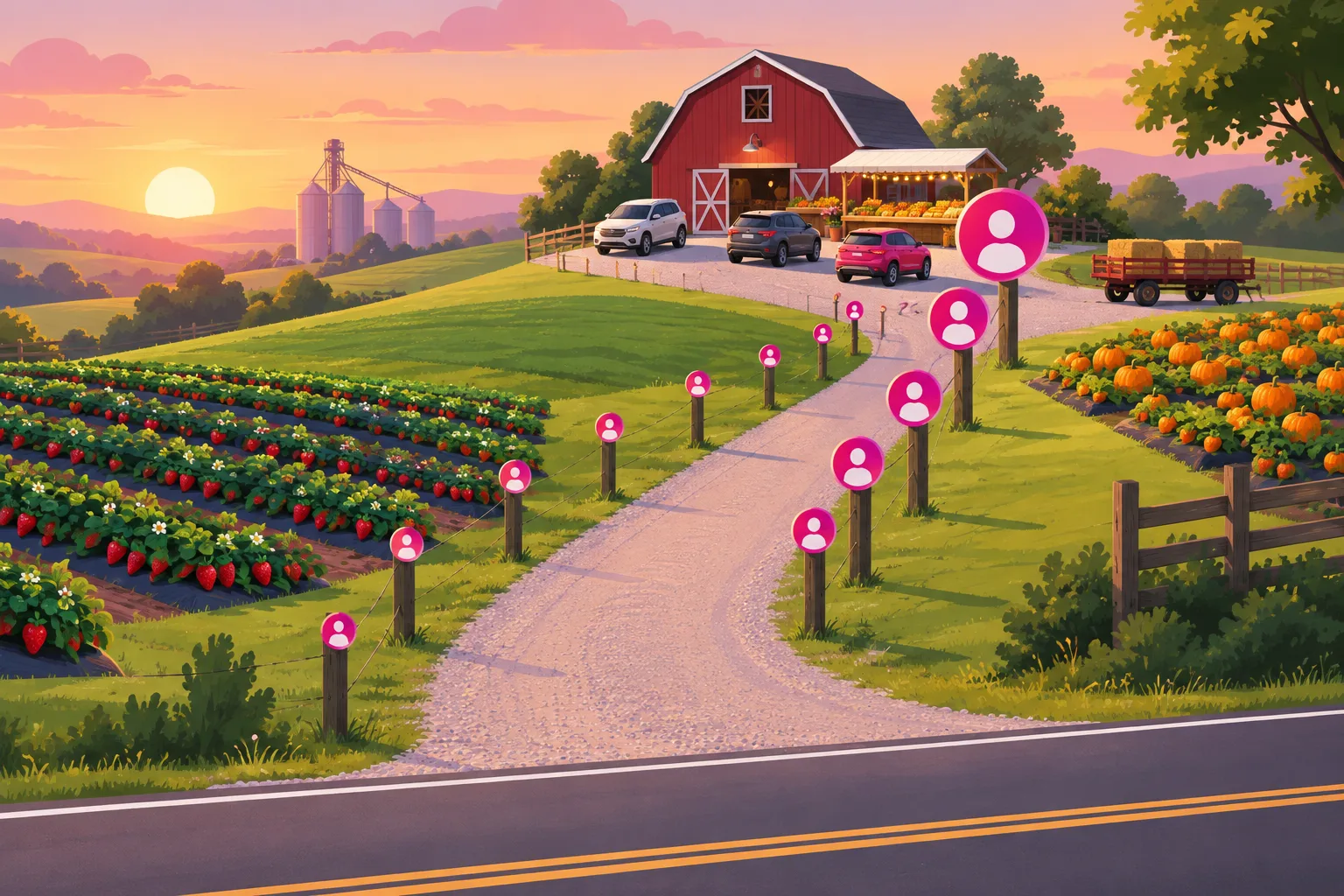
Growth isn't linear, and each tier unlocks something different. Here's the honest map, written for the market path and sized to a real stand, with the feed path noted where it diverges:
- 0-500: the proving ground. The slowest stretch for most professions, and a mixed one for you - a newborn animal gets tested on a willing audience immediately, and walk-throughs grow at the pace of Saturdays. Typical timeline with three posts a week: 60-90 days to 500. Remember the size of the stand: two hundred hens lay somewhere around eighty dozen a week, so 500 followers within a Saturday-morning drive is every dozen you lay, spoken for several times over. The unlock at 500 is enough data to read your map. The warning at 500 comes in two versions: a market-first farm whose five hundred are already spread across the country, which needs its anchors fixed now while it is small enough to steer, and a feed-first farm with five hundred followers and no shipping page, which needs its box list and its cottage-food rules sorted before anything else.
- 500-2,000: the first "I saw you on TikTok." If your content is lane-focused and place-anchored, this is where the table starts hearing it. The family that drove 35 minutes because the walk-through told them where to park. The parent who walked up and asked for Maggie by name. The couple who split a beef share after watching Dad explain what the processor charges. Here the retention math takes over: a second-order rate you can state out loud - "three of the four came back" - is worth more to a skeptical parent than any follower count, and it is the number that changes what gets said about the account at supper.
- 2,000-10,000: the farm your county thinks of. First-time customers arrive pre-sold - they know where to park, they know the dog's name, they have already decided seven dollars is fair, which changes the tone of the first visit, visibly lowers the gravel-driveway anxiety, and, anyone who has worked a stand will tell you, makes the second visit far more likely. The CSA sells out in February. The patch is spoken for by Labor Day. The restaurant calls about the beef. The market manager offers the corner booth. The school books the field trip. Dad stops asking why you are on TikTok and starts asking what to post. For a market-first farm, this tier is the entire game won: a reliable, essentially free stream of first-time customers that the highway sign, the farm-trail listing, and the fall newspaper ad never produced - and the only ceiling left is the size of the Saturday-morning drive.
- 10,000-100,000 and beyond: the feed tier - and the famous farm that looks like it. Growth past 10K increasingly comes from viewers outside your radius, which stops adding cars but starts adding a different customer, and this is where your sector diverges from every practice in this series: for you, that customer is legitimate, if small. They buy what fits in a box - the honey, the maple, the wool, the seeds, the cookbook - and they buy it in November. Push toward it if that is what this year is for, and build the shipping page, the box list, the honest "what we cannot ship" line, and the cottage-food and label-claim homework before you arrive, because every rule gets stricter the farther a product travels. But treat six hundred thousand followers and forty unsold CSA shares as a trap you fell into, not a milestone you reached - unless you chose the feed path on day one and the stand was already selling out without it.
The strategic takeaway: optimize for the 500-10K local tiers first. That's where the second orders live - and where a family that comes back in June, renews the share in February, brings the grandparents to the patch, and is still buying eggs in five years makes every milestone worth more than it would be in most niches. 100K is a legitimate goal for the farm that ships - and the playbook is the same engine, run longer, with amplification widening the audience beyond your radius on purpose and a shipping page that actually works underneath it.
8. The Family Member Who "Does the Social Media": A Role That Survives

On most farms the account belongs to whichever family member "does the social media," which usually means the daughter who came home, the son-in-law who is good with the phone, or the spouse who already runs the market table. Nearly all of those accounts die the same way: the person doing it was doing it on top of everything else, nobody agreed what it was for, every clip waited for supper, and the first busy season ended it. The fix is not a hero. It is a defined role - with hours, a list of what it is and is not responsible for, and a page on the fridge that lets the person in it make decisions without asking anyone. Here is the role as it actually works on a direct-market farm, and what changes when it becomes a hire.
The person with the phone (family) - about four hours a week
- Reports to: the one person named on the fridge page who gets a look at a child, a price, a worker, or the hard day. Not the whole family, not the supper table, not the sibling in the city with opinions.
- The week: twenty minutes of capture spread across one morning's chores with the phone in the chest pocket at five (one chore start to finish propped on a post, one thing that changed, one explainer where it happens, one question one answer, and ninety seconds of the stand on Saturday); about an hour on Tuesday night to cut and schedule three posts for Tuesday, Thursday, and Saturday; ten minutes a day on comments and messages, within the hour on Fridays when a window is open; thirty minutes a month to write the report.
- Responsible for: the three posts a week inside the fridge rule; the question log; the agreement folder (the winter family and cast agreements, the per-use decisions for children, the worker consents); the three saved replies, sent within a day; the pinned trio and the visit page staying current, including this week's stock; the monthly report.
- Not responsible for: the full cadence during harvest mode (six weeks of season marker, pre-filmed walk-through, and DMs, and nothing else is required of anyone); arguing the price in the comments (one reply, then left alone); being the only face (the cast is the farm); any label claim (anything with "organic," "grass-fed," or "pasture-raised" in it always gets a look); the books; the drone.
- Needs, before the first post: the one-page phone rule agreed at the kitchen table; the account registered to a farm email with two people holding the login and the recovery codes in the office folder; the kit under $75; the visit page with a named person on it; the agreement folder; a backup who can post from the bank during the week of the wedding or the hospital; and one week off a quarter, with the posts for it already banked.
- The monthly report, one paragraph: three numbers and one sentence. Visit-page clicks this month; first-time customers who said TikTok at the table or on the form; how many of them ordered again. Then the sentence: the one video that got sent the most, and why. That is the whole report. The parent does not need the view count, and giving it to them teaches them to ask for it.
How to prove it to a parent. Not with followers. A parent who has farmed for fifty-one years has watched a dozen things that were going to save the farm, and a number from an app is not evidence to them - a car in the driveway is. So the report is three numbers the parent already understands: how many people clicked to find out when the stand is open, how many new faces at the table said TikTok when asked, and how many of those came back. "Four new egg customers this month said TikTok, and three of them are standing orders now" is a sentence that ends the argument at supper, because it is counted in eggs. Keep the tally at the stand for ninety days before you show anyone anything, and then show them every month without being asked. The parent who was skeptical in March will be the one asking in July whether the patch walk-through is filmed yet.
Family member or hire? Most direct-market farms run this on a family member, and it works at four hours a week because the fridge rule, the three saved replies, and the visit page have already made most of the decisions - and because harvest mode means the busy season is a plan rather than a failure. Some larger farms and agritourism operations do pay for a few hours a week, sometimes folded into the market or farm-store role. The right moment to create that is when the family version can state a second-order rate and the bottleneck is Tuesday editing rather than strategy - and the first paid hour should be editing on Tuesday night, not a logo. A farm that hires someone before it has a scoreboard hires someone to make price-list graphics faster.
Who to pick. Not the youngest person at the table - the one who is staying. The sibling home for the summer can capture beautifully and should be on the team; the account is owned by someone who will still be on the farm in February, because the CSA is sold then and the phone cannot be in a dorm room. And the account survives the person with the phone leaving only if it was never theirs to begin with: the farm email, the two logins, the recovery codes in the office folder, and the line that says the account, the followers, and the footage stay with the farm if that person moves away, gets married, or quits. All of that is written down once, in the one-page phone rule in the filming guide, which is the document that makes this role survivable. Nothing in this section works without it, and nothing in it needs restating here - print it, read it aloud at the kitchen table the winter the agreements get signed, and put the magnet on it.
9. Breaking the Plateaus Every Farm Account Hits
Every growing account stalls somewhere. Farm accounts stall in predictable places, with predictable fixes:
- The famous-and-broke plateau. Reach is up, followers are up, the comments are full of people in other time zones, and the stand has the same eleven cars it had in January. This is the farm plateau - it looks like success, which is why it lasts so long. Every video was for the feed. Fix: the county said out loud in the next six videos, the walk-through re-pinned, the anchor series given two episodes a week for a month, and the follower-territory map checked every Saturday until the in-county share turns. The national audience will not leave; the local one will finally be told where the driveway is.
- The rant plateau. A rant about the grocery chain or the regulation or the people who think milk comes from a store went big, and then the comments turned into a fight, follows flattened, and - the part nobody connects - visit-page clicks fell, because the family at the price tag saw how you talk about people who aren't customers yet. Fix: rebuild the hooks on the harvest, re-pin the walk-through, leave the arguments alone, and let the fight crowd drift. It takes about a month for the algorithm to stop serving your kind videos to the people who came to argue.
- The guilt plateau. "Farms are dying, buy local or we're gone" produced the best week of sales the stand has ever had, and then nobody from that week came back. A customer who buys out of guilt buys once. Fix: the December receipt - what this year did, said once, with pride and no ask - and six months of showing the harvest instead of the wound. The second order comes from wanting the eggs, not from feeling bad about the farm.
- The supper-table plateau. Posting slowed to nothing because every clip needed sign-off from both parents, the spouse, and the sibling in the city, and Tuesday's chore footage was still in the group text on Friday. Fix: one person owns the phone, the one-page rule agreed once, one other person who gets a look within a day, and the family seeing the three numbers monthly instead of the clips nightly. The post that waits for supper never happens.
- The October-crowd plateau. The patch walk-through worked, the five weekends were the fullest the farm has ever seen, and in June not one of those families came for strawberries. Fix - and have it ready before the window: the "see you in June" filmed on the last patch weekend itself and posted that night ("here's what next time looks like - quieter, same dog, same Maggie"), the useful follow-up to every order form that said TikTok, and nothing asked of anyone on their first visit. A busy weekend with a next-time plan is a customer list. A busy weekend without one is a photo for the barn wall.
- The price-list plateau. The feed became price-list graphics, drone flyovers with a country song, and the logo over a sunset, and follows stopped because there was nothing to follow for. Fix: show the morning. The new price list becomes Dad explaining the one line that went up and why; the flyover becomes thirty seconds of the chore the flyover was flying over.
- The harvest plateau. The account grew beautifully through the spring, then u-pick opened, then the patch, and posting stopped for ten weeks - and the family concluded the account could not survive a real farm. Fix: harvest mode, written down before the season. Six weeks of season marker, the pre-filmed walk-through, the DMs answered within the hour on Fridays, and nothing else required of anyone. The chores and the explainers were banked in the quiet weeks for exactly this. Silent in July is fine. Silent in February is not, and the pillar's cadence section says which is which.
- The consent plateau. Posting slowed because every idea seemed to need a kid on the tractor and the per-use decision felt like a hurdle. Fix: the engine was never supposed to run on children, and it was never supposed to run near equipment. The chore start to finish, the stand from behind the table, the explainer where it happens, the question log, and the countdown carry every video on the calendar; the kid at the egg box with a per-use yes is a bonus, never a requirement, and nobody is ever on anything running. The filming guide's children section has the rule and the numbers behind it, and every one of the 52 ideas in the vault can be filmed by the person who owns the phone with nobody else in the frame.
- The same-audience plateau. Reach flatlines because the algorithm has shown you to everyone in your immediate interest pocket. Fix: adjacent-topic expansion that stays credibly in your lane. "How long do farm eggs actually keep," "what to do with a kohlrabi," "how to cook a chuck roast so it isn't shoe leather," "when do strawberries actually come in around here" - questions people type into a search bar at night, answered by the same kind voice that hosts "Ask the farmer." Adjacent lanes reach new pockets while deepening the trust the walk-through built.
- The fear plateau. Someone said "organic," "the labor department," and "the kids" in the same supper, and you stopped posting anything with a person or a label in it. Fix: the rules are narrower than the fear. A walk-through, a chore, or a price explainer makes no label claim, puts no child near a machine, and films no worker who did not agree - which is exactly what makes it the safest lane in this sector. Say what you actually do in plain words instead of a protected term, keep the agreements in the folder, and keep the phone in the pocket when anything is running; the pillar guide's compliance section walks through exactly where the lines are. Substance grows the account; vagueness is what the regulator and the algorithm both ignore.
10. The Growth Mistakes That Stall Farm Accounts
- Opening with the farm's name and founding year. "Hi, we're a fourth-generation family farm on Route 9, farming since 1911, and today..." is an exit ramp. The question from the price tag is the hook; your name belongs in your bio and your history in the "why Dad stayed" story.
- Posting price lists instead of answers. The price-list graphic, the "we're open Saturday" flyer, the logo over a sunset - your existing customers mildly care; the algorithm's audience doesn't. Every video should answer something a stranger has actually wondered about your farm, your county, or what happens when they turn in.
- The drone-only account. An account where every video is a flyover with a country song is a screensaver, and a stranger cannot picture themselves in a screensaver. Dad at the gate, Maggie at the table, the hired hand who agreed, and the heifer on day 41 are the reasons they believe there is a place for them in the driveway. The drone appears once a season and is never the only angle.
- Never saying the county. The single most expensive omission for a market-first farm, because your content travels so well by default. A perfect walk-through with no county in it fills nobody's stand. One spoken local reference per market video is the cheapest targeting that exists.
- Deleting slow videos. Farm videos surge on the season's schedule, not the posting date - the u-pick walk-through posted in a quiet April wakes up every April for years, and the "why our eggs are seven dollars" explainer wakes up every time a grocery price makes the news. Old videos become binge material when a new viewer discovers your profile. Deletions erase the algorithm's learning. Leave the catalog alone.
- Chasing trends outside your lane - especially the ones with a kid on a machine. The dance in the milking parlor isn't a strategy; it's lane noise. The trend that puts a child on the tractor fender or the auger for a laugh is not lane noise, it is the video that gets a comment storm, a visit from someone official in some states, and a county that remembers. Use a trend only when your lane genuinely fits it - a sound that works for "Chore with me" is in-lane; a child near anything running never is.
- Arguing the price in the comments. "Seven dollars for eggs is insane" deserves one reply, as a person, with the explainer linked, and then nothing. The reply thread where the farm wins the argument is the thread where the family deciding at the kitchen table decides to keep buying at the store. The explainer does the arguing; the account stays kind.
- Filming the kids without the per-use yes - or anywhere near the PTO. A co-parent who sees their child on the farm's feed without having said yes to that video is a family argument, and a child on running equipment on camera is a reputational hit in exactly the county you serve plus a reason for the next family not to turn in. The per-use decision costs nothing, and the egg box needs no machine. The filming guide's never list has the full rule, including the road, the mailbox, and the bus stop.
- The label claim you cannot back. "Organic" is a word with rules behind it - above a small sales threshold it needs certification - and "grass-fed" on beef that was finished in a lot is a claim a video makes permanent. Say what you actually do, in plain words, on camera: "we don't spray, we're not certified, here's why." It is more trusted than the term, and it is true.
- Running the account from the sibling's personal phone. The login leaves when they go back to the city in August, and so does every video and every follower. The account is registered to a farm email with two people holding the login, the footage is backed up off one device, and what happens to the account when anyone leaves is written on the fridge before anyone is on camera.
- Buying followers. Bots never turn into the driveway, never send the egg explainer to anyone, and their dead engagement teaches the algorithm to bury you with real neighbors. A padded count is also the kind of thing a county finds out about, and a farm caught inflating its numbers has lost the one thing it was on the platform to build. There is no shortcut here that works - only the amplification of real, proven content.
11. Accelerating Growth: Amplify Proof, Not Hope
Run the 90-day engine and something predictable happens: one or two videos dramatically outperform everything else. Completion high, saves stacking, profile visits spiking, and - the farm signal - sends climbing. Those videos have already passed the only test that matters: real strangers watched to the end and felt less weird about turning in afterward.
That's the moment paid promotion stops being a gamble. Amplifying an unproven video is hope; amplifying your hero video is arithmetic - and farm arithmetic is unusual in four ways. First, the payback is measured in second orders, not a sale, which changes what you promote for: promote for followers, not a one-time visit. A stranger who sees one promoted "patch opens Saturday" ad and comes once is the October crowd with an invoice attached; a stranger who follows in August watches the pumpkins size up for six weeks, arrives already knowing where to park, and is far more likely to be back for strawberries. The right metric is cost per local follower on the way to cost per second order.
Second, the targeting solves the two-customers problem: promoted reach goes exactly where you point it, which is the one thing the organic algorithm will never do for you. Point the stand walk-through, the u-pick walk-through, and the patch countdown at a Saturday-morning drive, drawn tightly, and point the chore and the explainer wider only if you ship - never the other way around. Third, the timing lever is real: promoting the proven walk-through in the quiet weeks before the window - August for the patch, February for the CSA, April for u-pick, early fall for turkeys - while families are quietly deciding what this season looks like, costs a fraction of competing on the peak weekend when every orchard, corn maze, and retailer in the state bids for the same parent. Fourth, and this is the rule no other business needs: stop the day you sell out. A promoted countdown for a u-pick field that is already booked solid buys nothing but disappointed families in the comments. Then put the number next to the one the family already knows: the fall newspaper ad, the farm-trail listing, the highway sign, the fair booth - and what each of them produced. The example we use across this series is a promoted stand walk-through that brought twelve new families down the driveway before the patch opened, five of whom were back in strawberry season. That is a sentence a parent can count.
That's exactly the model behind our TikTok promotion service: selective amplification of the videos that already earned it, targeted to the customer you chose, timed to run in the quiet weeks ahead of your window and stopped when the field is full. Promoted farm content still has to follow your rules, and a few are stricter in a paid placement than in an organic one: TikTok's advertising policies for North America list animals, animal parts, and animal products among restricted or prohibited industries - written for live-animal and fur sales, but a beef-share or piglet "listing" can trip it, so promote the farm and the follow, never the product listing, and expect approval per ad and per market; wine, cider, and spirits carry age-gated targeting, prior approval, and license documentation in the U.S., and hemp and CBD are restricted outright; a promoted video is a wider disclosure than an organic post, so the hired hand in the chore clip and the customer at the table need their own yes for paid use - consent to post is not consent to promote; and the ad money came out of the same account as the seed, so measure it, report it next to the newspaper ad like any other expense, and stop when the cost per second order says to.
Which is one more reason the harvest hook wins: it is the hook a promoted video can use. Amplify the walk-through, not the rant. For growth toward the feed tier, the same approach deliberately widens the targeting beyond your radius - for the farm that ships. For the mechanics of promoting through TikTok's native tools, see the Spark Ads guide; for the local-discovery mechanics that help any business serving a drive radius, the local business TikTok marketing guide; and for the broader organic playbook this plugs into, the ultimate TikTok growth guide covers the cross-niche fundamentals.
Frequently Asked Questions
How long does it take a farm TikTok account to grow?
Faster than almost any local business and slower than most families expect, because the two customers grow at different speeds. The feed grows quickly: a calf standing up for the first time or an honest "why our eggs are seven dollars" gets tested on a willing audience immediately, and most farms posting three times a week see their first outlier inside 30 days. The market grows at the pace of Saturdays. With the stand walk-through pinned, the county said out loud, and a visit page one tap away, most direct-market farms cross 500 local followers in 60-90 days, reach the low thousands inside a year, and hear the first "I saw you on TikTok" at the table somewhere between 500 and 2,000 local followers. Measure it against the stand, not the follower count: two hundred hens lay somewhere around eighty dozen eggs a week, so a few hundred followers who could drive to you on a Saturday morning is every dozen you will lay this year, spoken for.
How many TikTok followers does a farm need to sell out the stand or the CSA?
Far fewer than the count suggests, as long as they are the right followers for the path you chose. On the market path, a few hundred people inside a Saturday-morning drive who have watched the walk-through twice and know to ask for Maggie at the table will sell out a forty-share CSA in February and a five-weekend pumpkin patch sold in August; the numbers that matter are the share of your followers who could physically reach you, which TikTok shows in the follower-territory breakdown, the visit-page clicks each week, and the people at the table who say TikTok. On the feed path, geography barely matters and the numbers that matter are saves, sends, and shipping-page orders for what fits in a box. The warning sign is the account that is large on the wrong scoreboard: six hundred thousand followers from every state and forty CSA shares unsold in March is a real audience that will convince a parent TikTok does not sell anything, because every video was for the feed and none was for the driveway.
Why is my farm TikTok getting views but no customers?
You are in the famous-and-broke trap: the content is working and none of it is pointed at the driveway. Check four things in order. First, the place: say the county and the nearest town out loud in the video, not just in a hashtag, and put them and the stand hours in the bio. Second, the fear: pin the stand walk-through, the video that answers "is it weird to just show up?" from the turn off the road to the card reader, because the question under every visit that never happens is that one. Third, the path: the link should open a visit page with the hours, the driveway in words, cash or card, the dog, where kids can go, this week's stock, and the name of the person at the table, never the homepage. Fourth, the map: open TikTok's follower territories and see what share of your followers live within a Saturday-morning drive. If it is a sliver, the calf videos have been teaching the algorithm you are a farm-aesthetic account; add the county to them and give the walk-through and the season marker the next six slots.
Should a farm hire a social media manager or have a family member do it?
Start with a defined family role and hire only after it has produced a number. Most direct-market farms run the account on one family member at about four hours a week: twenty minutes of capture spread across the morning chores with the phone in the chest pocket, about an hour on Tuesday night to cut and schedule three posts, ten minutes a day on comments and messages, and half an hour a month to report three numbers. The thing that makes that survivable is not the person; it is the one-page phone rule on the fridge that the family agreed to once, the farm email and two logins that own the account, a backup who can post during the week the regular person is at a wedding, harvest mode written down so silence in the patch season is a plan and not a failure, and a visit page so nobody is ever improvising the invitation. The right moment to pay someone is when the family version can state a second-order rate and the bottleneck is Tuesday editing rather than strategy. The first paid hour should be editing, not a logo.
When is the best time of year to start a farm TikTok?
Start your 90 days in the first week of December, so month one runs through the December receipt and the first CSA post on December 26, month two is February when the CSA and the spring beef shares are actually sold, and month three ends in early March as calving begins and the April u-pick walk-through is due. The other strong start is the first week of June, which opens with u-pick, runs through the July glut, and ends in late August as the pumpkin patch is sold to the families who will fill the five weekends of October. The account works in any season because the farm year gives you a reason to post every month, so if it is spring, start now with the newborns and the market opening walk-through. If it is already October, the patch is open and you are in harvest mode: post the season marker and the pre-filmed walk-through, answer the DMs within the hour on Fridays, film "see you in June for strawberries" on the last patch weekend, make sure the turkey form is up, and plan the December receipt. Your 90 days starts December 26.
Who should run and own the farm TikTok account?
The farm owns it and the farm is the cast. Register the account to a farm email with two people holding the login, keep the recovery codes in the office folder, and write down that the account, its followers, and its footage stay with the farm if the person with the phone moves away, gets married, or quits. Viewers follow a specific, kind human and scroll past a logo and a drone shot, and the person they most want to see is often not the one holding the phone: it is the parent who has milked at five in the morning for fifty-one years explaining why the eggs cost that, the hired hand who agreed to be on camera, the heifer on day 41. One person owns the phone and posts without asking for the six formats; one other person gets a look at any child, any price, any worker, the hard day, and anything you plan to promote, and answers within a day. Nobody else approves posts, and nothing waits for supper.
Found the walk-through your county already trusts?
The 90-day engine finds your winners - amplification decides how many future customers see them, where, and when. Viryze promotes the videos that have already proved themselves, putting your best walk-through or price explainer in front of thousands more people within a Saturday-morning drive, in the quiet weeks before the patch or the CSA or the field opens, and stopping the day you sell out - so the honesty you've built converts into followers who already know where to park, first-time customers who say TikTok at the table, and second orders you can count.
Grow your farm's account fasterRelated Reading
- TikTok for Farms: The Complete 2026 Guide - the full strategy and compliance framework this growth roadmap plugs into.
- Farm TikTok Content Ideas: 50+ Video Concepts That Bring Customers Down the Driveway - the vault, sorted into travelers and anchors, that keeps the 90-day engine fed.
- How to Film Farm Videos for TikTok (Kids, Workers, Equipment & the Family Rule) - the kit, the agreements, and the one-page phone rule that make the family role survivable.
- Growing a Church TikTok: From 0 to 10K Local Followers - the closest parallel: another account with two legitimate audiences and two scoreboards.
- Local Business TikTok Marketing: Get Customers in Your Area - the local-discovery mechanics behind the market path.
- Understanding TikTok's Algorithm: What Really Matters - the signal hierarchy behind every recommendation in this roadmap.

Head of Creator Success at Viryze
TikTok growth strategist helping creators reach their first 100K followers through data-driven promotion strategies.