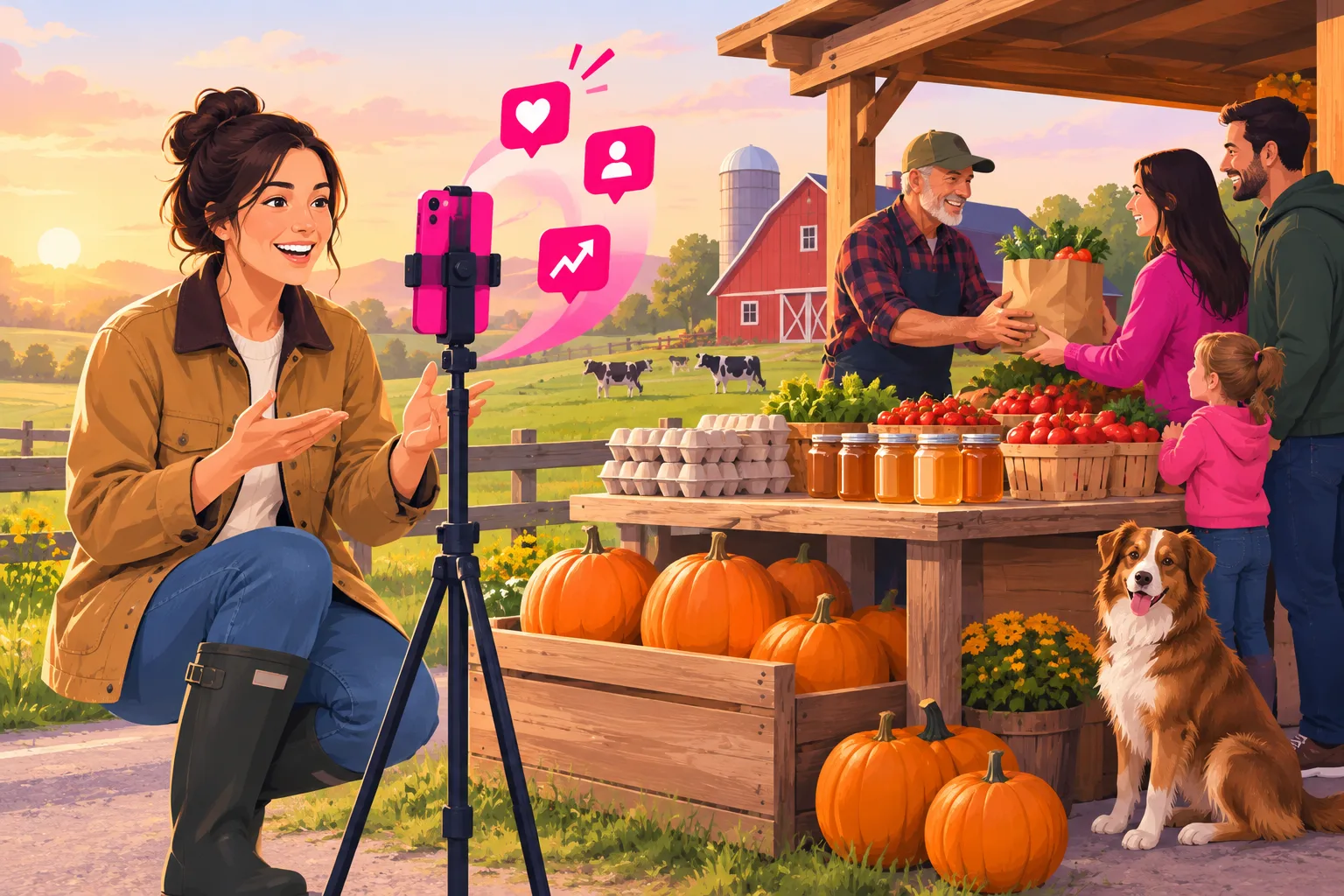
Every farm that sells to the public has a version of the gravel-driveway minute. A car slows at the mailbox on a Saturday morning and does not turn in. Inside it, a family that has "been meaning to try that farm" since they moved out here is running the list: Is this the right driveway? Where do we park? Is the dog friendly? Do they take cards? Is it weird to just show up? Are the kids allowed near the animals? Will we be bothering someone who is working? The car idles. Then it goes on to the grocery store, where nobody has to wonder anything.
Every question on that list can be answered in sixty seconds of video. Almost no farm answers them. Somewhere in your county, a sixty-acre operation with two hundred laying hens and a two-acre strawberry patch films the walk from the road to the checkout table - the turn, the parking, the dog, the egg fridge, the card reader, the kid-sized baskets. Fifty thousand people watch it. A few hundred of them live within a Saturday-morning drive and have never bought a single thing from a farm. Some of them turn in.
This guide is the complete 2026 playbook for farms - the diversified family farm, the ranch selling beef by the share, the homestead with a cottage-food license, the u-pick orchard, the fall pumpkin patch, the dairy, the flower farm, and the son or daughter who got handed the phone because they are the one under forty: the six video formats that grow farm accounts fastest, the hook that opens on the harvest instead of the rant, the chore-first content engine, the market-path-or-feed-path choice and the two customers behind it, the calendar that sells the pumpkin patch in August and the CSA in February, the 90-day plan from an empty account to the farm your county thinks of, the customer ladder from first view to second order, the label, food-safety, kids-and-equipment, and visitor rules that protect your farm, and when paid promotion fills the stand versus burns the seed money. Pair it with our TikTok algorithm guide for the ranking-signal frame and the TikTok growth strategy guide for the cross-niche fundamentals.
The honest summary:
- A farm has two customers on TikTok. The market customer lives within a Saturday-morning drive and buys what does not ship. The feed customer lives anywhere, follows everything, and buys only what fits in a box. Decide which one each video is for, or you will build a famous farm that is broke.
- The fear under every empty stand is "is it weird to just show up?" The walk-through from the road to the checkout answers it - and it is the single video most farms never make.
- The chore is the content. You do not need to make videos. You need to film the work you were already going to do, twenty minutes a day, and let the season be the calendar.
- Use paid promotion as selective amplification on proven videos, aimed at followers rather than a one-time visit, pointed at the drive radius for the stand and the patch, timed in the quiet weeks before a season window and stopped the day you sell out - inside TikTok's rules on animal, alcohol, and hemp advertising, because the ad money came out of the same account as the seed.
What's Inside
- 1. Why TikTok Works So Well for Farms in 2026
- 2. The Six Video Formats That Grow Farm Accounts Fastest
- 3. The Harvest Hook: Open on the Harvest, Never the Rant
- 4. The Chore-First Content Engine
- 5. Market Path or Feed Path: The Two Customers
- 6. The Farm Calendar: Why You Sell the Pumpkin Patch in August
- 7. A Posting Cadence That Survives Harvest
- 8. The 90-Day Plan to Becoming the Farm Your County Thinks Of
- 9. The Customer Ladder: Turning Viewers Into Second Orders
- 10. When Paid Promotion Fills the Stand vs. Burns the Seed Money
- 11. Labels, Food Safety, Kids, Visitors, and the Mistakes That Cap Farm Accounts
- Frequently Asked Questions
1. Why TikTok Works So Well for Farms in 2026
Farms that sell direct have found customers the same way for a generation: a hand-painted sign at the end of the road, a booth at the Saturday market, a listing on the county's farm-trail brochure, a classified ad in October, and word of mouth from the families who already come. That model works right up until it does not - the sign is read by nobody who moved here in the last five years, the market crowd ages with the vendors, the brochure goes in the recycling, and the newspaper ad costs more every fall than the two families it brings. TikTok is the most efficient answer available right now, for five specific reasons.
The first is that direct sales are growing, and the buyers are on their phones. The 2022 Census of Agriculture counted roughly 116,600 farms selling directly to consumers - $3.3 billion in sales, up 16 percent from 2017 - while USDA's economists put agritourism income at $1.26 billion in 2022, growing even after inflation, with more than half of all U.S. counties reporting some. That is the part of agriculture that is getting bigger, and every dollar of it is spent by someone who decided where to drive and what to order by looking at a screen. In 2026, "looking" means a thirty-two-year-old watching three short videos of your farm at ten at night and deciding, before anyone at your place knows she exists, whether it would be weird to just show up.
Second, the commodity side is getting harder, and direct is the hedge. USDA's 2026 forecast has net farm income slipping for the sector as a whole, commodity receipts falling, farm debt rising, and a record-sized share of farm earnings coming from government payments rather than sales. A farm that sells a beef share to a family forty minutes away sets its own price and gets paid before the animal goes to the processor. The same census found the average producer is now 58 years old and under-35 producers are about nine percent of the total - which means that when the person under forty on your farm picks up the phone, it is not a hobby on the side. On a lot of farms, the direct-sales account is the succession plan.
Third, and this is the one no business gets: you already own what the platform rewards. Real work, outdoors, every single day, with animals and weather and a result you can hold. A calf is born. The first strawberry turns. The hail comes. A company selling water bottles has to invent a reason for anyone to care and pays an agency to do it. You have one of the most-watched genres on the platform happening in your yard at five in the morning - the #farmtok tag has drawn views in the billions, individual farm creators have gone from nothing to hundreds of thousands of followers within months, and reporters covered what the 2025 ban scare would have meant for farm creators specifically. And yet the typical farm feed is a price-list graphic, a drone flyover with a country song, and a stock photo of a barn - three things that tell the algorithm nothing and tell the family idling at the mailbox even less.
Fourth, the lane is empty where you are. The famous farm accounts are famous nationally - a camel dairy, a grain farmer explaining prices, a vet with a quarter million followers - and nearly none of them are in your county. Of the roughly 1.9 million farms in the country, the handful that post consistently are scattered across the map, which means the first farm in a given county to show what its stand looks like on a Saturday does not compete with anyone for the "where should we get eggs?" question. It answers it, for that county, alone. The ranking signals reward exactly what a small farm can produce every day: a real face, real work, a complete watch.
Fifth, the price explanation is the whole sale, and nobody makes it. The family that balks at seven-dollar eggs has never seen what it costs to keep a hen alive in January. The one that thinks a beef share is expensive has never seen the processor's invoice. Direct-market farms lose the sale at the price tag, every day, to a customer who would gladly have paid it if anyone had shown them where the money goes. A sixty-second video is the explanation, and it is the easiest piece of marketing a farm has ever been able to make. We will count saves and sends, not views, for the rest of this guide - because the family that saves "why our eggs cost seven dollars" is deciding, and the one that sends it to a spouse has decided.
And one thing to say plainly about size. A twelve-acre farm cannot out-produce a twelve-hundred-acre one. It does not need to. It can show the one thing the big operation cannot: the person who grew it, handing it to you, by name. That is a video. It is, in fact, the best video.
2. The Six Video Formats That Grow Farm Accounts Fastest
Across the farm accounts that grow in 2026 - the forty-cow dairy, the quarter-acre market garden, the ranch that sells by the quarter, the orchard with the corn maze - the same six formats keep working. Every video you make should be one of them, and the order is deliberate.
Format 1: The Chore
The morning feeding. Collecting eggs. Moving the cattle to the next paddock. Thinning carrots. Fixing the fence the deer took down. Filmed as it happens, by the person doing it, with the phone propped on a post - sixty seconds of real work with a sentence or two of what you are doing and why. This is the volume source and the feed-path workhorse: it travels anywhere, it is what the national audience follows, and it is the format most farms already try. It fails when it is the only format, and it fails worst when the chore turns into a rant. Section 3 has the rule.
Format 2: The Walk-Through
A phone in one hand, from the road to the checkout. Which driveway. Where to park. Whether the dog is friendly. Where the eggs are, where the beef freezer is, how the honor box works or who takes the card. Whether kids can see the animals and where they absolutely cannot go. Where the bathroom is, if there is one. How long a u-pick morning takes and what to wear. Where your booth is at the Saturday market and what time you sell out. This is the conversion video of the vertical - the no-judgment answer to every question in the gravel-driveway minute - and the one almost no farm has ever filmed. Make one per door over time: the stand, the u-pick field, the market booth, the CSA pickup, the fall patch, the farm stay.
Format 3: The "Where It Comes From" Explainer
The egg, from the nest box to the carton in the fridge. Why the eggs are seven dollars - feed, the winter, the hawk, the cartons. Why tomatoes arrive in August and not May. What a beef share actually is, what the processor charges, and why the price per pound is what it is. Why the milk is not pasteurized here, or why it is. Forty seconds, one thing, explained with the plainness of someone who remembers not knowing it. Curiosity is the cheapest attention on the platform, and every one of these dissolves a price objection before the customer gets to the table. They travel anywhere - and they are the videos a customer sends to the spouse who said "seven dollars for eggs?"
Format 4: The Question Answered
"Do you wash your eggs?" "Is it organic?" "Can we visit?" "Do you ship?" "Is the beef grass-fed?" "Can I bring my dog?" "What do I do with a kohlrabi?" Real questions from the market table, the DMs, and the order form, answered honestly in your farm's own voice by the person who actually answers them. "Is it organic? No. Here is exactly what we do instead" is the single most trust-building forty seconds a small farm can post. This is the format that proves the welcome instead of asserting it. Keep a running list; it never runs dry, because every Saturday adds three.
Format 5: The Season Marker
The first calf. The first strawberry. Planting day. First frost. The patch opening. The last market of the year. Turkeys going to the processor, said plainly. This format is a countdown, and a countdown is a reason to follow: the viewer who sees "strawberries in about three weeks" comes back for the date. It is the market-path anchor - it tells your county what is coming and when - and it is also where most of the shares live, because "the patch opens Saturday" is the video a parent sends to the group chat.
Format 6: The Hard Day Told Honestly
The calf that did not make it. The hail on the week before u-pick. The drought summer. The hen the fox got. Told by the person, in their words, once, without a sad song under it and without asking anyone for anything. This is the most powerful format on the platform for a farm, because it is the one thing the grocery store can never say, and it goes last on purpose: the walk-through and the explainers earn the trust that makes a hard day land, and the rules in section 11 - what you never show, what you never say in the comments, when you do not post at all - have to be in place before the first one. Death is part of farming and your customers can handle it. What they cannot handle is being guilted with it. More on that in the next section.
What to retire: the price-list graphic ("Eggs $7, Honey $12, Beef shares available" as an image - the algorithm has nothing to learn from it and no stranger shares it), the drone flyover with a country song, the stock photo of somebody else's barn, and the account where every post is a logo.
What to never post: the rant - the clip about city people, the grocery store, the government, the vegans, the other kind of farmer, the bait that gets views from people who want a fight and comments that make the family that was going to drive out decide not to. More on this in the next section, because it is the single most common way a farm account grows an audience that never buys anything.
3. The Harvest Hook: Open on the Harvest, Never the Rant
The first three seconds decide whether anyone sees the rest, and for a farm the first three seconds carry a weight most businesses do not have to think about. The person you most want to reach is nervous - about the price, about not knowing how farms work, about showing up and being in the way, about being judged for buying eggs at the grocery store for thirty years - and the hook either disarms that or confirms it. Here is the rule: hook on the harvest, never the rant.
Five hook shapes carry nearly every farm video that works:
- The price, named first. "Our eggs are seven dollars a dozen. Here is every penny." You said the thing they were going to say in the comments. They exhale, and they watch.
- The count. "Day 41 of waiting on this heifer." "Eleven days until the patch opens." A number in progress is a reason to come back tomorrow, and tomorrow is a follow.
- The honest answer. "Is our beef grass-finished? No. Here is what it is, and why." The viewer who has never bought from a farm and the one who buys from three both keep watching.
- The person. "Dad has milked at five in the morning for fifty-one years. Here is what he will tell you about that." One farmer, one question, one morning. Never a montage.
- The surprise. "We farm twelve acres. Here is how many families that feeds." Smallness, told with pride, is a hook - not a weakness to hide.
Now the rant, because it is the farm version of the mistake every vertical in this series has. For nonprofits it is the pity close-up. For churches it is the warning clip. For farms it is the twenty-second take about what is wrong with everyone else - the people in the city, the grocery chain, the regulation, the vegans, the organic crowd or the conventional crowd, the neighbors. It travels. It gets numbers. And it does three things at once: it makes the family at the mailbox feel judged before they turn in, it fills your comments with people who came to argue and will never buy an egg, and it trains the algorithm that your account is a place for a fight - so it shows your next video, the kind one, to the same crowd. You will grow. You will grow an audience that never comes, and that audience will chase away the one that would have.
The rant has a quieter cousin that farms fall for even more often: the guilt post. "Farms are dying. Buy local or we are gone." It is true, and it is the worst hook on the platform, because nobody drives forty minutes to be scolded, and a customer who buys out of guilt buys once. The family that comes back every fall comes back because the patch was wonderful and the people were kind - not because they were afraid of what would happen if they did not.
The fix is not to stop having opinions about how food should be grown. It is to lead with what you grow. Conviction can be the fourth sentence. The first one is the harvest.
4. The Chore-First Content Engine
The reason farm accounts go quiet is not that there is nothing to film. It is that the person with the phone thinks of each post as a project, and projects lose to the fence that is down. The system is simple: the chore list is the content calendar. The footage exists every day, on a schedule, on land you own, with people and animals who are already there. You do not make videos. You film the work you were going to do anyway, and you cut it on Tuesday.
The morning capture list
- The phone goes in the chest pocket at five: not in the house, not in the truck. Twenty minutes of capture, spread across the morning, is enough for a week.
- One chore, start to finish: the phone propped on a post or a gate, running the whole time, framed vertical. You will cut sixty seconds from it on Tuesday. Say one sentence to the camera when you start and one when you finish; the middle can be silent.
- One thing that changed: the first bloom, the calf standing, the frost on the hoophouse, the trailer backing in. Fifteen seconds. This is the season marker, and it is the reason to film every day instead of once a week.
- One "where it comes from" in forty seconds: the egg from the nest box to the carton, standing where it happens, once a week.
- One question, one answer: "Somebody at the market asked if we wash the eggs. Here is the answer." Thirty seconds, done.
- Saturday, ninety seconds of the stand: the cars turning in, the table filling, hands and backs and baskets, never a customer's face without asking. The walk-through is built from this over several weeks.
That is a week of posts from one morning routine, and the hard day fills in when it comes. Behind it sits the question log: a note on the phone where every question a customer asks at the table, every DM, every comment that starts with "wait, do you actually," and your own "people always ask me" list goes. Each entry is a Format 4 video waiting. A farm that keeps the log through one market season never again wonders what to post.
The engine runs on a faces rule, decided once. The family and anyone who chose to be on the account - the person who runs it, the parent who milks, the market manager who waves from the next booth - are the cast and agree once a year. Employees and seasonal crews are not content; a worker appears only with informed consent that was never a condition of the job, and never as the punchline. Customers appear as customers - hands, backs, baskets, a car turning in - and never identifiably without being asked at the table. Children, including your own, are a per-use decision by a parent, never on the running equipment on camera, and never in a video that shows the road, the mailbox, or the school bus stop. The neighbor's land, the neighbor's cattle, and the neighbor's hired crew are not yours to film. Our nonprofit filming guide covers the consent model - informed, specific, revocable, never a condition of being served or employed - that a farm with hired help should adopt wholesale.
One practical note on the set: morning light in a field is the best studio on the platform, and you own it seven days a week. The explainers get filmed where the thing happens - the egg explainer in the coop, the beef explainer at the freezer, the price explainer at the stand with the carton in your hand. Never in the kitchen with a slide.
5. Market Path or Feed Path: The Two Customers
This is the section that matters most, and it is the one farm accounts get wrong almost universally - not by doing something badly, but by never deciding what the account is for.
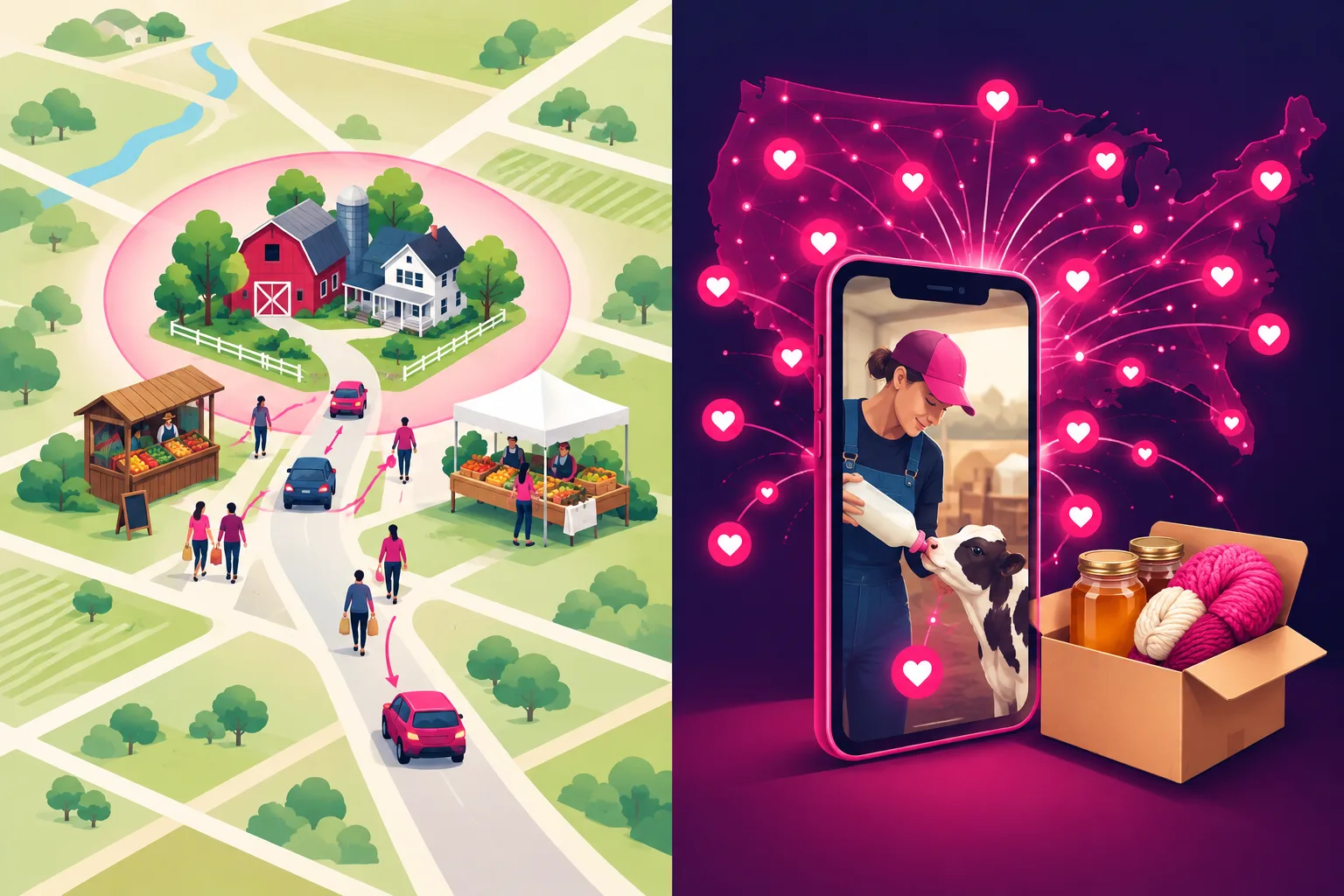
A farm that sells direct is one of the most local businesses there is. A beef share, a gallon of milk, a flat of strawberries, a pumpkin, a u-pick morning, a night in the farm stay - none of it ships, and the customer has to drive to you on a Saturday morning, which means twenty to forty minutes with kids in the back, not two hours. And a farm is also the one business whose daily work the entire country wants to watch. So every farm account is speaking to two customers at once: the market customer, who is local and can only come from the drive radius, and the feed customer, who is anywhere, follows everything, and buys only what fits in a box.
Here is the trap. Call it the famous-and-broke farm: an account with six hundred thousand followers from every state, comments full of people in Arizona and Maine who say the morning chores are the best part of their day - and forty CSA shares unsold in March, a pumpkin patch that was half empty in October, and a parent who has decided that "TikTok doesn't sell anything." That reach is real, and nothing in this guide tells you to give it up. But it fills no stand, it funds very little - a national audience buys, but in small amounts of whatever ships, from people who can never pull into the driveway - and the verdict that the account does not sell is true only because every video was for the feed and none was for the market.
The market path: build a local audience that drives out
The account exists to put first-time customers at the stand, in the field, at the booth, or on the CSA list, and to get them to order again. Everything is anchored to the drive radius: the county and the nearest town in the bio with the hours, "we're the red barn past the grain elevator on Route 9" said out loud, the actual gate and the actual people, references only a local would catch, and a link one tap away that gives the hours, the driveway, whether to bring cash, where the kids can go, and what is in stock this week. The numbers are small - a few thousand followers, not a million - but a meaningful share of them can actually turn in. Success is measured in first-time customers and second orders, never in views. This is the same shape as any neighborhood business, and our local business TikTok marketing guide covers the local-discovery mechanics.
The feed path: build a borderless audience that buys what ships
The account exists to carry the farm to people who will never pull in - and to sell them the things that fit in a box: honey, jam, maple syrup, wool and yarn, seeds and transplants in spring, dried flowers, a cookbook, a calendar, a hat. The content leans on the chore, the explainer, and the hard day, which travel anywhere. Success is measured in follows, saves, shares, and orders on the shipping page - and in the discipline of answering the DM. This path carries its own rules: what you ship has to be legal to ship (cottage foods and raw dairy mostly are not, across state lines), and anything you say about how it was raised is read by people who have never met you and will screenshot it. Our TikTok Shop guide for small business covers the shipping-page side.
Here is the twist that makes your situation different from a dentist or a plumber: the national audience is not waste, because some of what you grow fits in a box. So the hybrid is legitimate for most farms. What still has to be decided is the order, and which customer each video is for. "Come pick strawberries Saturday" shown to the whole country is a wasted ask. The honey listing shown only to your zip code leaves the jars on the shelf. For most farms selling direct, the honest answer is market first: the stand has to be full enough to pay for the shipping boxes. Ask one question in week one - does this farm need cars in the driveway or boxes out the door more this year? - write the answer at the top of the running note, and let it settle every argument about what to post next. Our nonprofit TikTok guide works the same two-map problem for organizations whose "hands" are local and whose "dollars" are not - the closest parallel to a farm in this series.
6. The Farm Calendar: Why You Sell the Pumpkin Patch in August
Almost nobody buys from a farm on a random Tuesday. They come at a moment: the first warm Saturday, a kid who asked where eggs come from, a new baby and a sudden interest in what is in the food, a diagnosis, a move to the country, a fall weekend with grandparents in town, a freezer that finally arrived. Your content cannot create those moments. It can make sure that when one arrives, yours is the farm already in their head - and that they already know which driveway.
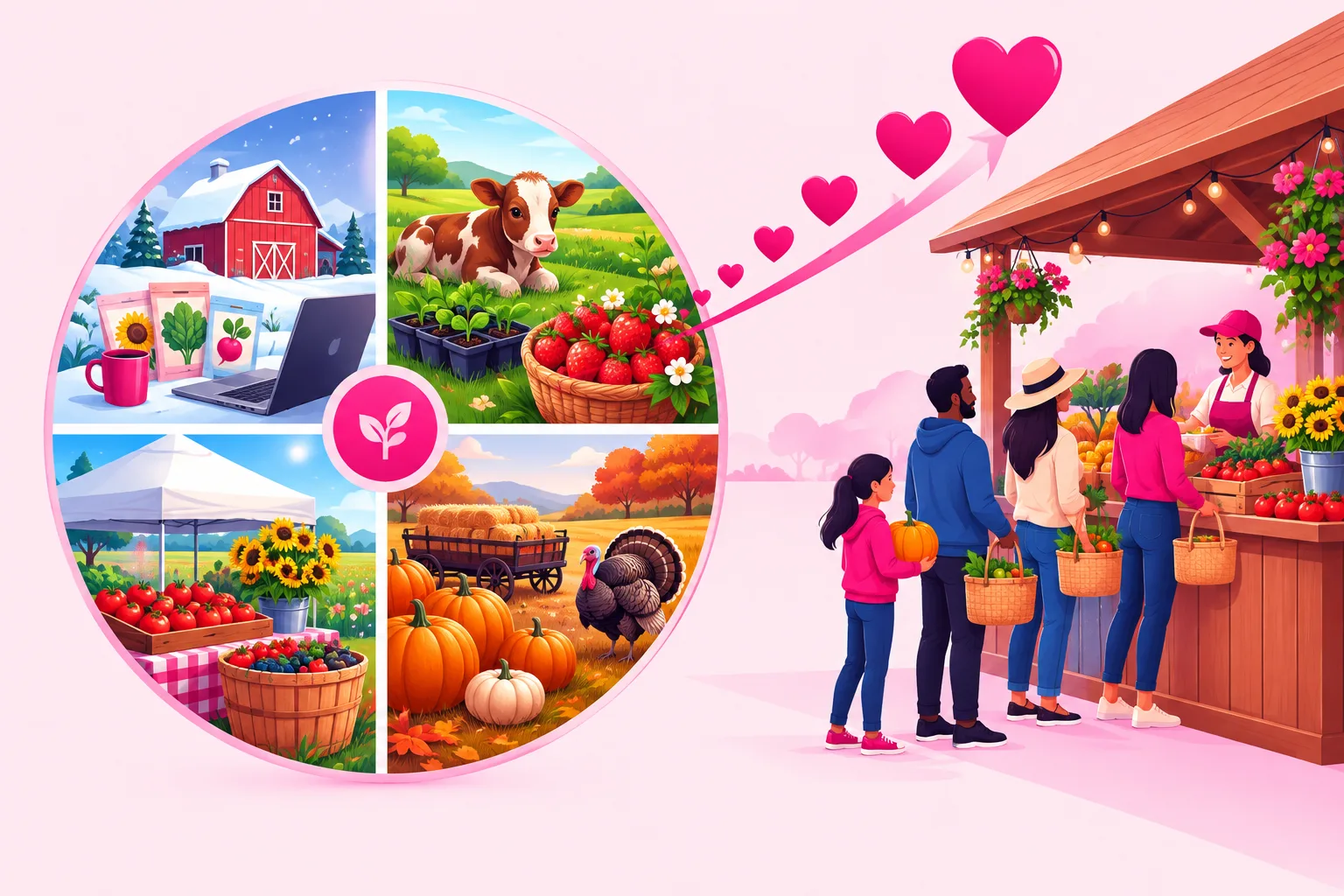
The difference between a farm and almost every other business in this series is that your season windows are known a year out and they are short. A u-pick strawberry field is open for three weeks. A pumpkin patch sells for five weekends. CSA shares are bought in the dead of winter. A turkey is ordered by the first of October or it is not ordered. Which means the video that fills the patch is not posted in October, when every orchard and corn maze in the state is posting at once and every retailer is bidding for the same family. It is posted in August. The walk-through, the honest answers, and the "what a fall Saturday actually looks like here" clip go out in late summer, get saved by parents quietly deciding, and the opening-day post lands on an audience that already knows where to park. Build in the quiet season for the busy one - and film the "here is what next year looks like" video on the busy weekend itself, because the most common failure in farm marketing is the October crowd that nobody invited back.
Layered over that is a farm year that gives you a reason to post every month:
The farm content year
- January - February: the CSA is sold now. Seed orders, the planning spreadsheet, the hoophouse in snow - and the "what is actually in the box, week by week" explainer from last season's footage. The share sells in February or it does not sell. Beef and pork shares for spring processing are reserved here too.
- March - April: calving, kidding, seedlings. The highest-watched footage of the year is a newborn animal standing up. Film it with the honesty rule in mind. The u-pick strawberry walk-through goes out in April, three to four weeks before the field opens; the season marker counts the days.
- May - June: first harvest and the market opening. The market-booth walk-through the week the market opens - where the booth is, what time you sell out, cash or card. U-pick opens; film the "here is what next week looks like" on opening Saturday.
- July - August: the glut and the fall build. Tomatoes, sweet corn, cut flowers - the volume is the content. And this is when the fall patch is sold: the hay wagon walk-through, the honest answers for parents, the hours, the price, filmed from last year and posted in August.
- September - October: the agritourism window. The five weekends that fund the winter. The season marker counts down to opening day, the walk-through is pinned, the DMs get answered within the hour on Fridays, and the turkey order form goes up by the first of October. Film the thank-you and the "see you in June for strawberries" on the last weekend.
- November: the freezer and the table. Thanksgiving is November 26 in 2026; turkeys and the last beef shares of the year are the between-markets content, along with the "how to cook it" replies. Wreaths, trees, and the winter box go up the week before.
- December: the receipt and the rest. One video that says what this year actually did - how many families, how many dozen, what the new fence cost, what the hail took - said plainly and once. Then the year-end shipping push for what fits in a box, and the first CSA sign-up post on the twenty-sixth.
And then the unplannable moment: the barn fire two farms over, the flood, the disease order that closes a county to visitors, the neighbor's loss that the whole community feels. Decide the same-day plan now. No chore clip, no sale. One person, at the gate, saying what the farm is doing today and whether you are open. Say it plainly and say it once.
7. A Posting Cadence That Survives Harvest
The honest constraint on a farm is not interest. It is that the account is run by the one person under forty, who is also the one driving the baler in July; a parent who thinks the phone is the reason the fence is still down; and a season where nobody sleeps for six weeks. The cadence has to survive all three.
Three posts a week from one morning routine is the floor, and it is enough. Tuesday, Thursday, Saturday - one market-path video, one feed-path video, one season marker. That rhythm takes twenty minutes of capture in the chest pocket each morning and about an hour of editing on Tuesday night. Daily posting is a goal for the farm that has a family member whose actual job this is; for everyone else it is the fastest route to a dead account by the second cutting.
One person owns the phone. This is the rule that saves more farm accounts than any other, because the alternative is the family argument. Decide once, in writing on the fridge if you have to: who posts, what gets posted without asking, what always gets a look from a parent or a spouse, and what never goes up. The person who runs the account does not have to ask permission for the chore clip. They do have to ask before the hard day, before any video with a child, and before anything that shows a price. If every clip waits for supper, the morning footage is stale by the time it is seen, and the account quits by the second month.
Harvest mode is a real setting. For the six weeks of your busiest window - u-pick, the fall patch, the big harvest - the cadence drops to the season marker and the walk-through, both filmed in advance, and the rule is that the DMs get answered and nothing else is required. An account that goes silent in July because July is the whole point is fine. An account that goes silent in February because nobody decided who posts is not.
The cast is the farm, not the phone. An account where every video is one person talking at a fence is a vlog, not a farm. The parent who has milked for fifty-one years, the dog, the market manager, the heifer that was day 41, the kid who runs the egg money box (with the per-use yes from a parent), the hired hand who agreed - each is a recurring character, and each is a reason for a stranger to believe the stand has a place for them. The person with the phone appears once or twice a week and is never the only face.
Series beat singles. "Chore with me" (one chore per week), "Why it costs that" (one price per week), "What's in the box" (one CSA week per week in season), "Ask the farmer" (one question from the log per week). A series tells the algorithm what the account is about, and tells the viewer there is a reason to follow rather than just watch. The cross-niche cadence and consistency mechanics are in our complete growth guide, and the one-phone, no-marketing-department version of the problem is worked through in our small business guide.
8. The 90-Day Plan to Becoming the Farm Your County Thinks Of
Ninety days is long enough to go from an empty account to the farm a county names when someone asks "where do you get your eggs?" It is not long enough to go viral, and that is the point. The milestones below are counted in cars in the driveway, not followers.
Days 1-30: Fix the gate before you film it
The bio says the county, the nearest town, what you sell, and when - "Saturdays 8 to noon at the stand, Wednesdays at the downtown market." The link goes to a visit page - not the homepage - with the hours, the driveway described in words a stranger can follow, cash or card, whether the dog is friendly, where kids can go, what is in stock this week, and the name and face of the person who will be at the table. A line at the market table and on the order form asks "how did you hear about us?" with TikTok as an option, because without it you will never be able to prove any of this worked. Then twelve posts: the walk-through first, three explainers, three questions answered, three chores, the season marker twice. Nothing is promoted. Everything is measured by one number - clicks to the visit page - and one question at the table.
Days 31-60: Find the series
By now a few videos have outperformed. Sort them by customer: which traveled (feed) and which brought a click to the hours page or a car to the stand (market). Build a weekly series from the best of each. Count the first customer who says "I saw you on TikTok" and write down the date; it is the sentence that wins the argument at supper. Watch the saves and the sends above everything - a parent saving the u-pick walk-through in April is a family in the field in May - and make the shareable explainer a weekly habit. Answer every DM within a day with a warm saved reply, and keep the "can we visit?" reply separate from the "do you ship?" reply.
Days 61-90: Compound toward the next season window
Lay the calendar from section 6 over the next ninety days and work backward from the nearest window. The walk-through for that window is filmed now and posted three to four weeks before it opens. The "here is what next time looks like" is filmed on the busy weekend itself. If one walk-through has already proven itself organically and the window is inside six weeks, this is the first moment paid promotion makes sense, and section 10 says how. By day 90 a healthy account has a few hundred to a couple thousand local followers, a visit page that gets clicked every week, a table that hears "TikTok" a few times a month, and - the real milestone - a second-order rate you can state.
9. The Customer Ladder: Turning Viewers Into Second Orders
A viewer does not become a regular in one step, and a farm that asks for the whole climb in a single video - "come Saturday, buy a beef share, join the CSA, book the farm stay" - gets none of it. Here are the rungs in order, with what moves someone up each one.
- The view. Earned by the hook. The harvest, never the rant.
- The follow. Earned by the series and the season marker - a reason to come back to the account before coming back to the farm.
- The save and the send. A parent saves the u-pick walk-through; a customer sends "why our eggs are seven dollars" to the spouse who asked. This is the rung that matters most. Make videos that are easy to send: short, kind, specific, with the date and the price in them.
- The profile visit. County, town, what you sell, when, one link. If the bio says "regenerative family farm" and nothing else, the climb ends here.
- The visit page. Hours, the driveway, cash or card, the dog, the kids, this week's stock, and a named person. "Ask for Maggie at the table" converts better than any sentence about your soil.
- The first purchase. Counted at the table or on the order form. Greeted by the named person. Not lectured about the grocery store, not handed a CSA brochure, not asked why they have never been before.
- The follow-up that is actually useful. A text or a reply with how to cook the cut they bought, how long the eggs keep, when the next thing comes in. One sentence of thanks, one useful thing, nothing else - never a newsletter they did not ask for.
- The second order. The real conversion. The CSA renewal, the second fall visit, the standing egg order. October crowds vanish because nobody built this rung. The video that earns it was filmed on the busy weekend: "here is what next time looks like."
- The regular. The family that comes every fall, the name on the beef list every spring, the one who brings a friend. Months, not weeks. Never asked for on the first rung.
Three messages deserve a prepared reply before the first video is posted. The first is "can we come visit?" - and if yours is a working farm that does not take visitors, the reply is a kind, specific no with the market booth and the hours, never silence and never a lecture about biosecurity. The second is "do you ship?" - answered with the list of what fits in a box and the honest line about what cannot legally travel. The third is the price comment, which will arrive within the first week from a stranger who thinks seven dollars is a joke. Reply once, as a person, with the explainer link, and never argue in the thread; the family that was deciding is reading it.
Measure the ladder, not the views: visit-page clicks per week, first-time customers per month who say TikTok, and the share of them who order again. A farm that can state those three numbers has a parent who stops calling it "the phone." Our donor and volunteer conversion guide works the same ladder for nonprofits, including the saved replies and the 48-hour rule.
10. When Paid Promotion Fills the Stand vs. Burns the Seed Money
Paid promotion on TikTok is not advertising in the way farms usually think about it. It is not the quarter-page ad in the October paper or the sign on the highway. It is taking a video that has already earned attention and showing it to more of the right people. And for you there is one extra sentence: the money came out of the same account as the seed and the feed, so the standard for spending it is higher.
The proven-video rule: only promote videos that have already performed organically. Strong completion, real saves and shares, a visible bump in profile visits and clicks to the visit page. Promotion amplifies signals the algorithm is already reading. It cannot manufacture interest in a video people scroll past, and it will not make a price list into content.
The follower rule, which is specific to your business: promote for followers, not for a one-time visit. A stranger asked to drive out Saturday nine seconds after meeting you mostly will not. A follower watches your strawberries ripen for six weeks - the walk-through, the honest answer, the day count, the first ripe one - and by the time the field opens she already knows the date and the driveway. You are not buying a visit. You are buying the chance to show someone your farm for a season.
The map rule: target the customer the video is for. Organic reach goes wherever the algorithm sends it; promoted reach goes exactly where you point it. The stand walk-through, the u-pick video, and the patch countdown go to your own metro, drawn to a Saturday-morning drive - a viewer two hours away will never turn in. The chore and the explainer can go wider, to people who already engage with farm and food content, if you ship and the feed path is a goal this year.
The timing rule: amplify in the quiet weeks before the window, not during it. August for the fall patch, February for the CSA, April for u-pick, early fall for turkeys - the weeks when parents are quietly deciding. The peak weekend is when every orchard, corn maze, and retailer in the state is bidding for the same family, the cost of reaching anyone climbs, and you pay more to be one of fifty invitations. And the rule no other business needs: stop the day you sell out. A promoted u-pick video running the week the field is picked clean buys you nothing but apologies in the DMs.
The math deserves honesty, because the parent will ask. Compare it to what you already spend: the fall newspaper ad, the farm-trail listing, the highway sign, the county fair booth. Then track the promoted walk-through like any other outreach cost - cost per new local follower, per visit-page click, per first-time customer who says TikTok, per second order - and report it next to the ad. If a modest budget on a proven stand walk-through brings twelve new families before the patch opens and five come back in strawberry season, the parent can do the arithmetic without your help.
Three cautions that are stricter for you than for most. First, TikTok's advertising handbook for North America lists animals, animal parts, and animal products among its restricted and prohibited industries - rules written for live-animal and fur sales, but a promoted video that reads as a listing for a beef share or a litter of piglets can trip them, and approval is per ad and per market. Promote the farm and the follow, not the product listing. Second, if you sell wine, cider, or spirits, alcohol ads in the United States carry age-targeting requirements, prior approval, and in some cases license documentation, and hemp and CBD products are restricted outright - so the orchard's hard cider gets its own rules, and the hemp field does not get promoted at all. Third, consent to post is not consent to promote. The hired hand who agreed to be in the chore video did not agree to a paid placement shown to his cousins, and the customer who said yes at the table did not say yes to an ad, so the release should say which. And fix the bio, the visit page, and the saved replies first - promotion multiplies what already exists.
The format worth defaulting to is Spark Ads, which promotes your existing organic post rather than a separate ad creative - so the engagement accrues to your real account and the video keeps looking like your farm instead of a commercial. Our Spark Ads guide walks through the setup. If you would rather not run Ads Manager yourself in the middle of harvest, a TikTok promotion service built around follower growth and selective amplification handles the targeting and the timing for you.
11. Labels, Food Safety, Kids, Visitors, and the Mistakes That Cap Farm Accounts
The rules in your sector are stricter than for almost any business in this series, because a video is a public record of how food was grown and who was standing near the machinery. Handled well they are a moat: the farm that says exactly what its beef is and is not, that keeps the kids off the auger on camera, and that posts the sign at the gate is the one families trust with their dinner and their Saturday. Four areas, in order of how often they go wrong.
The words on the label are the words in the video
"Organic" is a regulated term. Under USDA's organic rules a farm may describe its products as organic without certification only if its gross organic sales are under $5,000 a year, and even then it has to follow the standards and cannot use the USDA seal; above that, the word requires a certifier. A chore video that says "our organic tomatoes" on a farm that is not certified is a label claim with a timestamp. The same goes for meat and poultry: "grass-fed," "pasture-raised," and "raised without antibiotics" are claims USDA's inspection service expects to be documented and approved on the label, and feedlot-finished beef cannot be called grass-fed. Say what you actually do, in plain words - "we don't spray, we aren't certified, here is why" - and you will sell more than the farm that reached for the word.
Food safety and what can be sold
What you can legally sell, and where, decides what you can promise in a video. Under the federal produce safety rule, very small produce farms - roughly $25,000 a year in produce sales, adjusted for inflation - are not covered, and farms under about $500,000 in total food sales that sell mostly direct to consumers or nearby can qualify for a lighter exemption, but even then the farm's name and address go on the label or at the point of sale, and a market manager can still require a food-safety plan to let you in. Cottage foods - the jam, the baked goods, the pickles - are governed state by state, with lists of allowed foods, sales caps, labeling rules, and usually a ban on shipping across state lines. Raw milk is legal to sell at retail in some states, at the farm only in others, and not at all in the rest. Meat sold by the cut generally has to come through an inspected processor, which is why so many farms sell the live animal by the share instead. None of this is a reason not to post. It is a reason to make the "what we can sell you and how" explainer early, so the DM that asks for a gallon of raw milk shipped to another state gets a kind, correct no.
Kids, workers, and the equipment
Federal labor law lets a child of any age work for a parent on a farm the parent owns or operates, so the seven-year-old driving the side-by-side is usually legal. Filming it is a different decision. The National Children's Center for Rural and Agricultural Health and Safety reports that a child dies in an agriculture-related incident roughly every three days in this country and at least 33 are seriously injured every day, and the clip of a kid riding the fender or standing on the running board is the single most reliable way to fill your comments with strangers who will never buy from you, and the kind of screenshot that follows a farm around. Film the kids gathering eggs, planting, and running the stand - per use, with a parent's yes - and keep them off the running equipment on camera. Adults have a version of the same rule: a clip of a worker without hearing protection on the chainsaw, a lame cow that should have been seen to, or a hand near the PTO shaft is evidence first and content second. Employees and seasonal crews are never content without informed consent that was never a condition of the job, and a customer at the stand is never identifiable without being asked. The test, every time: did this person say yes to this use, with a real option to say no - and would they be glad to see it in five years?
Visitors, biosecurity, and the sign at the gate
If the account invites people to drive out, the farm has to be ready for them to arrive. Most states now have an agritourism liability statute that limits a farm's liability for the inherent risks of a visit - but the protection usually depends on posting a warning sign with the statute's exact wording at the entrance, and in some states on a signed agreement, with a parent signing for a minor. Post the sign before the walk-through goes up, call the insurance agent about a u-pick or visitor rider, and decide out loud which parts of the farm visitors never enter. If yours is a working farm that does not take visitors, say so in the bio and in the saved reply, and never show the mailbox, the road sign, or the gate code in a video. The hard-day videos follow their own line: the animal that died is said, not shown; nothing from the processor; nothing from the sick pen; never a video of a neighbor's loss, and never a hard day turned into an ask.
The mistakes that cap farm accounts:
- The price-list feed - prices as graphics, nothing a stranger would share.
- The drone flyover with a country song, which tells nobody where to park.
- The rant - growing an audience that never buys an egg.
- The guilt post - a customer who buys out of guilt buys once.
- No county, no hours, and no "what we sell" in the bio.
- The DM that was never answered on a Friday in October.
- The October crowd nobody invited back for strawberries.
- The word "organic" on a farm that is not certified.
- The kid on the auger, and the comments that follow.
Frequently Asked Questions
Is TikTok worth it for a small farm in 2026?
For a farm that sells anything directly - eggs, a beef share, a CSA box, u-pick berries, a fall pumpkin patch, a Saturday market booth, honey that ships - yes, and the smaller and more local the farm, the better the odds. The 2022 Census of Agriculture counted about 116,600 farms selling directly to consumers, $3.3 billion in sales and a 16 percent rise in five years, and USDA puts agritourism income at $1.26 billion and growing. The people who buy that way already decide where to drive and what to order from their phones, and almost no farm in any given county shows them what its stand, its field, or its box actually looks like. You do not need a viral account. You need a few hundred households within a Saturday-morning drive to watch your farm for a season, long enough to trust it, and a link that tells them when you are open, where to park, and whether to bring cash.
What should a farm post on TikTok?
Six formats grow farm accounts fastest in 2026: the chore (the daily work, filmed as it happens, the volume source and the format the national audience follows), the walk-through (gate to checkout at the stand, the u-pick field, or the market booth, answering every question a first-time customer is afraid to ask), the "where it comes from" explainer (the egg to the carton, why your eggs cost what they cost, why tomatoes arrive in August), the question answered (do you wash the eggs, is it organic, can I visit, do you ship), the season marker (first frost, first calf, first strawberries, the patch opening), and the hard day told honestly (the calf that did not make it, the hail, the drought - last on purpose, with rules). Retire the price-list graphic, the drone flyover with a country song, and the stock photo of a barn. Never post the rant - the clip about city people, the grocery store, the government, or the other kind of farmer - because it grows an audience that wants a fight, not one that buys eggs.
Can a farm actually make money from TikTok?
Yes, but mostly not the way the famous farm accounts do. A farm has two customers on TikTok. The market customer lives within a Saturday-morning drive and buys the things that do not ship - the beef share, the milk, the produce, the pumpkins, the u-pick morning, the farm stay. The feed customer lives anywhere, follows everything, and buys only what fits in a box - honey, jam, wool, seeds, dried flowers, a cookbook, merch. The trap is the famous-and-broke farm: six hundred thousand followers from every state and forty CSA shares unsold, because every video was for the feed and none was for the market. Decide which customer each video is for, build the market path first unless you already ship, count first-time customers at the table with a "how did you hear about us?" question, and treat the second order - the CSA renewal, the second fall visit, the standing egg order - as the real conversion.
Can I show my kids on the tractor in farm TikToks?
Legally, on a family farm, the work itself is usually allowed - federal labor law lets a child of any age work for a parent on a farm the parent owns or operates. Whether to film it is a different question. The National Children's Center for Rural and Agricultural Health and Safety reports that a child dies in an agriculture-related incident roughly every three days in the United States and at least 33 are seriously injured every day, so a clip of a seven-year-old on the auger or riding the fender is both a safety optics problem and the single most reliable way to fill your comments with strangers who will never buy from you. Film the kids feeding the chickens, washing eggs, and selling at the stand, with consent and a parent's per-use decision, and keep them off the running equipment on camera. The same rule applies to every face: employees and seasonal workers are never content without informed consent, and a customer at the stand is never identifiable without being asked.
Should a farm pay to promote its TikTok videos?
Only videos that have already proven themselves organically - strong completion, real saves and shares, and a visible bump in profile visits and clicks to your hours or order page - and only with a few farm-specific rules. Promote for followers rather than for a one-time visit: a stranger asked to drive out Saturday nine seconds after meeting you mostly will not, while a follower watches your strawberries ripen for six weeks and knows the date. Point the stand walk-through and the u-pick video at your own Saturday-morning drive radius, and the chore or the explainer wider only if you ship. Amplify in the quiet build weeks before a season window - August for the fall patch, February for the CSA, April for u-pick - never on the peak weekend when every farm and every retailer is bidding, and stop the moment you sell out. Keep TikTok's ad rules in mind: its advertising handbook lists animals and animal products among restricted industries, alcohol ads carry age-targeting and approval requirements, and hemp and CBD are restricted, so promote the farm and the follow rather than a product listing. Services like Viryze are built around this kind of selective amplification, promoting a proven video to the right audience instead of boosting every upload.
Ready to turn your best stand walk-through into customers who come back?
The farms growing fastest in 2026 pair a simple chore-first content system with selective paid amplification on their best videos - aimed at followers rather than a one-time visit, pointed at the Saturday-morning drive radius, and timed in the quiet weeks before a season window rather than during the noise of the peak weekend. Viryze is built for exactly that: we focus on follower growth and only promote videos that have already cleared the organic signal threshold, so your budget compounds your best work instead of rescuing your weakest. And because a follower watches your farm for a season before the field opens, every person you reach is someone who already knows which driveway.
See how selective amplification worksRelated Reading
- Understanding TikTok's Algorithm: What Really Matters - the ranking signals that decide which videos travel.
- The Ultimate Guide to TikTok Growth - cross-niche fundamentals that apply to any account.
- TikTok for Nonprofits - the closest parallel in this series: two maps, one phone, and an audience that is local for some things and borderless for others.
- Local Business TikTok Marketing - the local-discovery mechanics behind the market path.
- TikTok for Small Business - the one-phone, no-marketing-department playbook a farm family can run.
- TikTok for Food Creators - where your customers' "what do I do with a kohlrabi?" question gets answered on the other side of the table.
- TikTok Spark Ads Guide - the format worth defaulting to for amplifying a proven post.

Head of Creator Success at Viryze
TikTok growth strategist helping creators reach their first 100K followers through data-driven promotion strategies.