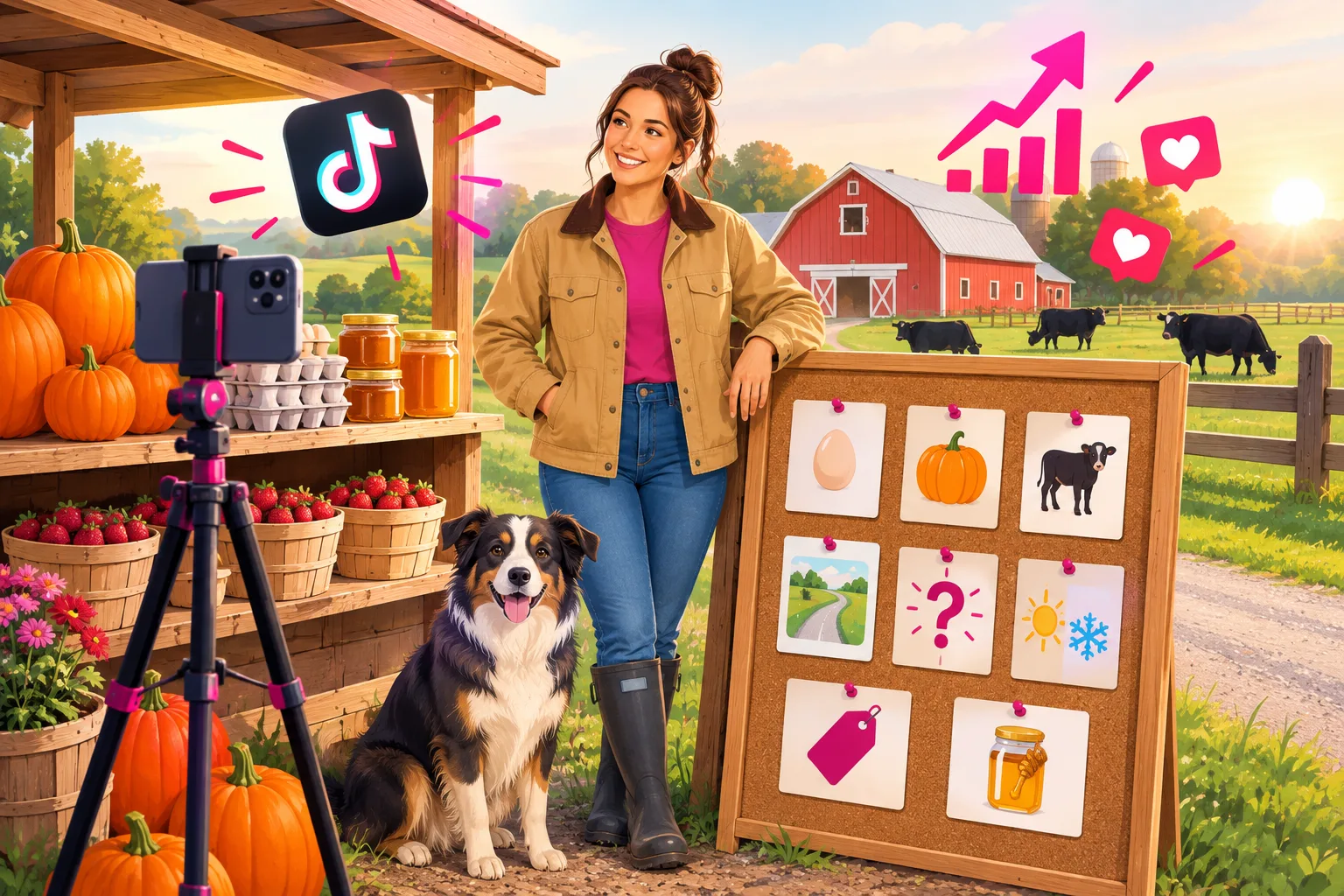
Most farm accounts die the same way. Someone posts the price-list graphic, a drone flyover with a country song under it, and a photo of the barn at sunset. It gets nine views, seven of them from cousins. Meanwhile, that same Saturday, a family slowed down at the end of your driveway, saw the red barn and a man working by the gate, and kept driving - because they did not know if it was weird to just show up, where to park, or whether the dog bites. The forty-second video that answers them would have stopped a hundred thousand scrolls, and brought them in.
You don't have a content problem. You have a capture problem - and a worry, which is a correct one, that the hired hand did not sign up to be filmed and that your kids must never be on camera near a running tractor. Both are true. But the chores you were going to do anyway, the questions people ask at the market table, the season that changes every single week, and the price nobody has ever explained are an endless video supply. Almost none of it needs anyone in the frame but the person holding the phone.
This guide is the vault: 52 farm TikTok content ideas, sorted into the six formats that actually bring customers down the driveway - the chore, the walk-through, the "where it comes from" explainer, the question answered, the season marker, and the hard day told honestly. It also covers the hooks that open on the harvest instead of the rant, the chore-first capture system that keeps the well full, the timing laid over the farm year, and the question no dentist or plumber has to ask: which ideas travel to anyone anywhere and sell what fits in a box, and which ones fill the stand on Saturday. New here? Start with our complete TikTok guide for farms for the full strategy, then come back for the ideas.
Three rules before you film any of these
- One chore, one video. "A day on our farm" is a montage nobody finishes. "Why the eggs are seven dollars" is a video. Narrow always wins, and it means one morning becomes a week of posts instead of one.
- Did this person choose to be on camera - and is anyone near running equipment? That is the whole consent test. The family and anyone who chose to be on the account agree once a year. Employees and seasonal crews are never content without informed consent that was never a condition of the job, and never the punchline. Customers appear as customers: hands, backs, baskets, a car turning in. Children, including your own, are a per-use decision by a parent, never on running equipment on camera, and never in a video that shows the road, the mailbox, or the bus stop. Every one of the 52 ideas below can be filmed by the person who owns the phone with nobody else in the frame, and not one of them needs a child.
- Hook on the harvest, never the rant. "Our eggs are seven dollars a dozen. Here is every penny" brings the family at the mailbox down the driveway. A twenty-second take about city people, the grocery chain, or the vegans keeps them on the road and fills your comments with people who will never buy an egg. Conviction can be the fourth sentence. The first one is the harvest.
What's Inside
- 1. The Question Log (Why You Never Run Out)
- 2. Hooks First: The Harvest, Never the Rant
- 3. Chores: The Volume Source (10 Ideas)
- 4. Walk-Throughs: The Format That Answers the Gravel-Driveway Minute (8 Ideas)
- 5. "Where It Comes From": The Format That Dissolves the Price (10 Ideas)
- 6. Questions Answered: The Format That Proves the Welcome (10 Ideas)
- 7. Season Markers: The Countdown That Earns the Follow (8 Ideas)
- 8. Hard Days Told Honestly: Last on Purpose (6 Ideas)
- 9. The Capture System: A Week of Posts From One Morning Routine
- 10. Timing: Which Ideas to Post in Which Month
- 11. Which Ideas Travel, Which Ideas Fill the Stand, and What to Do When One Takes Off
- Frequently Asked Questions
1. The Question Log (Why You Never Run Out)
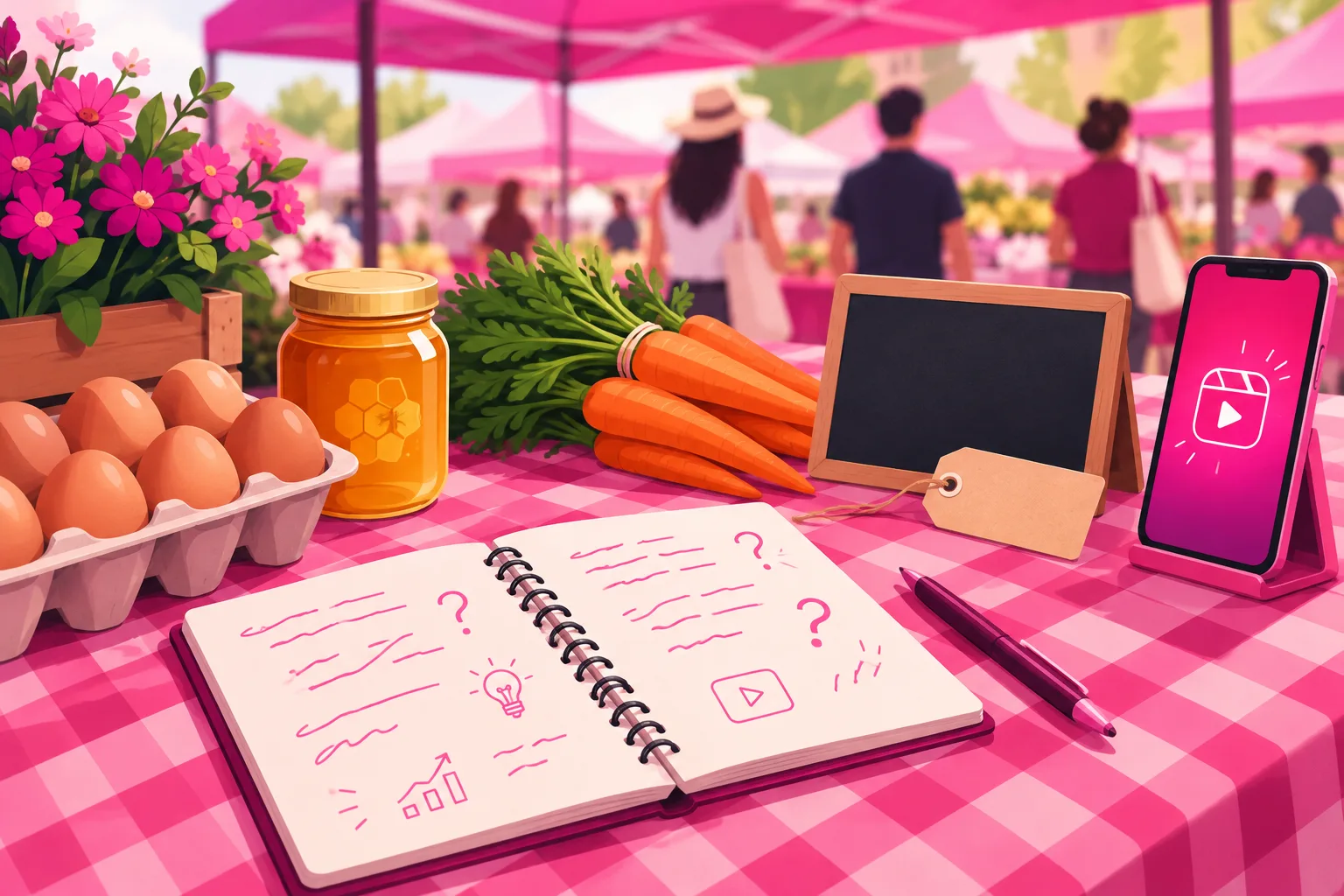
Nearly every idea in this guide comes from two sources, and you already own both. The first is the chore list. The feeding, the egg run, the fence, the move to the next paddock - it happens every morning whether or not a phone is running, on a schedule, on land you own, with animals who never object to being filmed. You do not make videos. You film the work you were going to do anyway.
The second is the questions people ask you. At the market table, in the half-second before they decide whether seven dollars is too much. In the DM that starts "this is probably a dumb question." On the order form, in the box marked "anything else?" In the comment that starts "wait, do you actually." And in Dad's own head, where there is a list called "people always ask me" that has never been written down in fifty-one years.
Each of those questions has already passed the only test that matters. A real person cared enough to ask it out loud. For every one who asked, hundreds slowed down at the end of the driveway, wondered the same thing, and kept going. The farm that answers plainly and kindly becomes the one they picture when the freezer finally arrives - and in most counties, no farm answers at all.
So before the lists below, build the habit that makes them infinite: the question log. One running note on the phone of whoever runs the account, that the person at the market table and the parent who milks can both add to. Every time a customer, a commenter, or a caller asks something, write it down word for word - "do you wash your eggs?" - not in your framing - "egg handling practices." Their phrasing is your hook. Your framing is the answer.
Thirty logged questions is roughly a quarter of content. And the log refills faster than you can empty it, because answering questions on camera fills your comments with new ones. That loop - answer, harvest, answer - is why some farms post easily for years while the one down the road runs dry by the third week of June.
Use the 52 ideas below as your starter log. The examples lean on a diversified family farm - sixty acres, thirty beef cows, two hundred laying hens, a two-acre u-pick strawberry field, a fall pumpkin patch with a hay wagon, a Saturday roadside stand and a Wednesday market booth - because it is easy to picture. But every idea adapts to a quarter-acre market garden, a ranch that sells by the quarter, a dairy, a flower farm, an orchard with a corn maze, or a homestead with a cottage-food license. Swap in your own morning, then let your real question log take over.
2. Hooks First: The Harvest, Never the Rant
A great idea with a weak first two seconds is a video nobody sees, and for a farm the first two seconds carry a weight most businesses do not have to think about. The person you most want to reach is nervous - about the price, about not knowing how farms work, about showing up and being in the way, about being judged for buying grocery-store eggs for thirty years - and the hook either disarms that or confirms it. Never open with your farm's name, your acreage, or your hours. Those belong in your bio and at second twelve, once someone has a reason to care who is talking.
Hook patterns that work for every idea below
- The price, named first: "Our eggs are seven dollars a dozen. Here is every penny." You said the thing they were going to say in the comments. They exhale, and they watch.
- The count: "Day 41 of waiting on this heifer." "Eleven days until the patch opens." A number in progress is a reason to come back tomorrow, and tomorrow is a follow.
- The honest answer: "Is our beef grass-finished? No. Here is what it is, and why." The viewer who has never bought from a farm and the one who buys from three both keep watching.
- The person: "Dad has milked at five in the morning for fifty-one years. Here is what he will tell you about that." One farmer, one question, one morning. Never a montage.
- The surprise: "This is sixty acres. Here is how many families it feeds." Smallness, told with pride, is a hook - not a weakness to hide.
- The permission: "Yes, you can just show up. Saturday, eight to noon. The dog is friendly. Ask for Maggie."
And the hook your account must retire, no matter how well it performs: the twenty-second take about what is wrong with everyone else - the people in the city, the grocery chain, the regulation, the vegans, the organic crowd or the conventional crowd, the neighbors. It travels. It gets numbers. It also fills your comments with people who came to argue and will never buy an egg, makes the family at the mailbox feel judged before they turn in, and trains the algorithm to show your next video, the kind one, to the fight crowd. Its quieter cousin, the guilt post - "farms are dying, buy local or we are gone" - is worse, because a customer who buys out of guilt buys once. Our pillar guide covers why the harvest beats the rant in full.
Then answer fast. Give the point in the first eight seconds and spend the rest on the why, the exception, and the part people get wrong. Completion rate is the signal that decides whether the algorithm carries your video past your existing followers. And never tease: "link in bio for prices" reads as a pitch and kills the video. Give the answer away. The family that wants to come will still find the visit page, and they will arrive already trusting you. For the full mechanics, see our TikTok algorithm guide.
3. Chores: The Volume Source (10 Ideas)
The format every farm already has the raw material for, and the one most farms ruin by turning it into a montage with a song. A chore is sixty seconds of real work, filmed as it happens by the person doing it, with the phone propped on a post or a gate and framed vertical. One sentence to the camera when you start, one when you finish. The middle can be silent.
This is the feed-path workhorse: it travels anywhere, it is what the national audience follows, and it is cheap, because the footage exists every morning. Two rules travel with every chore. The person doing it is the cast - you, the parent, the hired hand only if he agreed and it was never a condition of the job. And the chore never turns into the rant; when you feel the take about the grocery chain coming, stop the phone.
- 1. The morning feeding at five, start to finish. The phone on the fence post, the buckets, the cattle coming up, the light arriving while you work. "This is what five in the morning looks like here. Every day." The foundational chore, and the one that teaches you the format: prop it, run it, cut it on Tuesday.
- 2. The egg run, and the count. Two hundred hens, the nest boxes, the basket filling. Then the number: "163 today, not 200. Here is why." The molt, the winter light, the hawk that has been circling since Tuesday. The count is a hook on its own, and it sets up the price explainer in idea 19.
- 3. Moving the cattle to the next paddock. The gate opens, the herd walks, the dog does the one job she was born for. Thirty seconds of why you move them - the grass, the rest, the manure where you want it - said once in plain words. The video that explains what "pasture-raised" means on your farm without ever using the word.
- 4. Fixing the fence the deer took down. The posts, the wire, the gloves, the forty minutes nobody sees. "This is most of farming." The boring chore told honestly is one of the most-followed formats on the platform, because nobody else is showing it.
- 5. Planting day. The flats of seedlings going into the ground, hands and dirt, the rows stretching out. Mostly silent. The one sentence at the end: "these are your August tomatoes." A chore that doubles as a season marker and the first reason to follow for the whole summer.
- 6. Thinning, weeding, the chore that never ends. The carrots, the hoe, the row that took two hours. Why you thin, what happens if you do not, and what it does to the price of the bunch. The video a CSA member sends to the friend who asked why the box costs what it costs.
- 7. Packing the CSA box on Tuesday. The table, the crates, the twelve things going into the box this week, hands only. "Here is what you are getting on Thursday." Members watch it to plan dinner. Everyone else watches it to see what a share actually is - which is why it is also the February video, in idea 23.
- 8. Loading for the Wednesday market at five. The coolers, the folding tables, the truck bed filling, the drive downtown as the sun comes up, the booth from behind as it is set up. Stop the phone before the first customer. The farm the town only sees at the table, shown getting there.
- 9. One chore with Dad. One morning, one task, one question: "you have done this for fifty-one years. What is different?" Let him answer while he works. Never a montage, never a tribute song - one farmer, one question, one morning. The person hook from section 2, delivered by the one person who signed up for this.
- 10. The dog's job. The herd dog at the gate, the barn cat at the grain bin, the goose that guards the stand. The chores from the point of view of the animal who does them, with the person narrating. The cast member who never objects, and the most-shared video most farms will ever post.
4. Walk-Throughs: The Format That Answers the Gravel-Driveway Minute (8 Ideas)
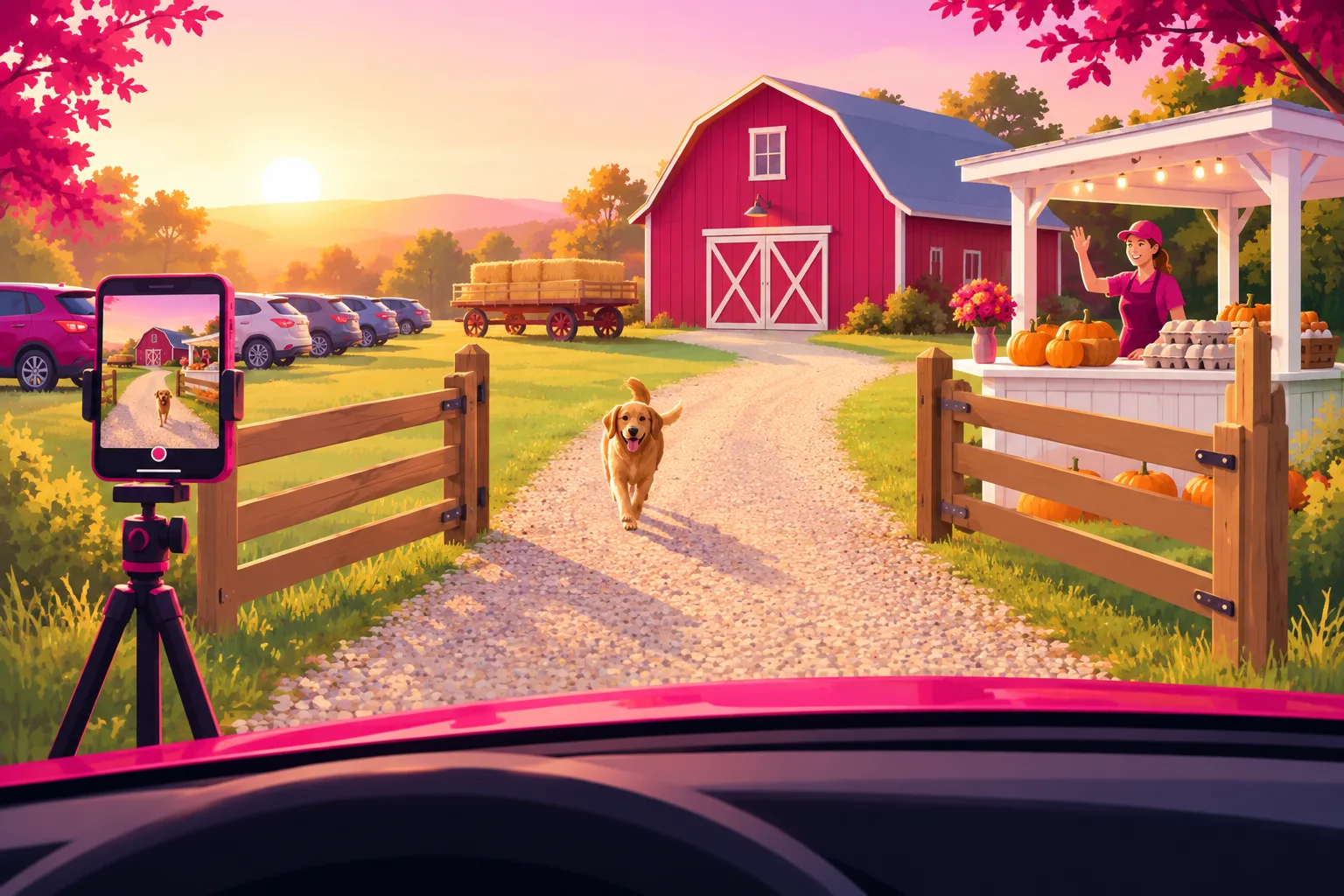
The conversion video of the whole vertical, and the one almost no farm has ever made. Every first-time customer has the same minute at the end of your driveway: is this the right one, where do I park, is the dog friendly, is it cash or card, can the kids see the animals, are we bothering someone who is working. The walk-through answers every one of those from the road to the checkout, so the family has already visited before they visit.
Two rules. Film it from the customer's point of view - the phone is their eyes, turning in. And make one per door, because the stand, the u-pick field, the market booth, the CSA pickup, the fall patch, and the farm stay are different visits with different fears. The set is your gate, your stand, and the people who chose to be on camera. Customers are hands, backs, and baskets, filmed over several Saturdays and stitched.
- 11. The full stand walk-through, from the road to the checkout. "We are the red barn past the grain elevator on Route 9." Which driveway. Where to park. That the dog is friendly. Where the eggs are, where the beef freezer is, how the honor box works or who takes the card. Where kids can go and where they absolutely cannot. Whether there is a bathroom. The foundational video of the whole vault. Pin it, and re-post it every season.
- 12. The u-pick walk-through for parents. What to wear (boots - the field is wet at eight), how long a morning takes, whether you bring your own flats, how you pay, where the stroller can go, where the hand-wash station is, and what happens if it rains. Film it this year and post it in April, three to four weeks before the field opens, when parents are quietly deciding.
- 13. The market-booth walk-through. Which corner of the Wednesday market, what the tent looks like, what time you sell out of eggs, cash or card, and the sentence that does more than any paragraph about your soil: "ask for Maggie at the table." The market manager waves from the next booth, because she agreed to.
- 14. The CSA pickup walk-through. Where the shares are, how the checklist works, what the swap box is for, what to do if you miss a week, and whether you can send a friend. The video that turns a February sign-up into a June member who is not nervous on the first Thursday.
- 15. The fall patch walk-through, for the family in the back seat. Parking, the hay wagon, the bathrooms, the prices by size, what kids can touch and what they cannot, how long it takes, the rain policy. Filmed from last October, posted in August - before every orchard and corn maze in the state is posting at once.
- 16. The "we don't take visitors" walk-through. For the working farm that cannot have cars in the driveway: a kind, specific no, then the walk-through to where you can be found - the booth, the pickup spot, the hours. Never silence, never a biosecurity lecture. The no-visitor farm also never shows the mailbox, the road sign, or the gate code.
- 17. What to bring, and what people actually wore. A cooler, cash, boots. A wide shot of the edge of the strawberry field at nine on opening Saturday - muck boots, sneakers, one pair of sandals someone regrets. No faces, just feet. The honest answer to "what do I wear," in fifteen seconds, and one of the most-saved videos a farm can post.
- 18. The busy-weekend edition: "here is what next time looks like." Film it on the busiest Saturday of the year - u-pick opening in June, the patch in October: the full lot, the line at the wagon, and then the sentence - "next week is calmer, and here is what it looks like." Then, on the last patch weekend, the thank-you and the "see you in June for strawberries." The October crowd nobody invited back is the most common failure in the vertical, and this one video is the fix.
5. "Where It Comes From": The Format That Dissolves the Price (10 Ideas)
A direct-market farm loses most of its sales at the price tag, to a customer who would have paid it if anyone had shown where the money goes. This is the format that does that. Take one thing, say what it is, why it costs what it costs, and what happens between your field and their fridge. Forty seconds, filmed where the thing happens - the egg explainer in the coop, the beef explainer at the freezer, the price explainer at the stand with the carton in your hand. Never in the kitchen with a slide.
One rule: explain, never defend. Half your audience has bought grocery-store eggs their whole life and is not sorry, and some of them are the people who will drive out because you explained yours kindly. Measure these in saves and sends, not views: a save is a customer deciding, and a send is a customer who already decided and is forwarding it to the spouse who said "seven dollars for eggs?"
- 19. Why our eggs are seven dollars. The feed bill, the winter when they lay half as many, the hawk, the cartons, the hour at the stand. Every penny, with the carton in your hand. The whole sale, in forty seconds, and the single most-sent video in the vault.
- 20. The egg, from the nest box to the carton. Collected, candled or not, washed or not and why - the bloom, the fridge, the thirty days. The curiosity hook of the vertical, and the video that answers idea 30 before anyone asks it.
- 21. What a beef share actually is. A quarter, a half, the hanging weight, what the processor charges, why the price per pound is what it is, the deposit, the freezer space you will need, and why it is sold as a share of a live animal and not by the steak. The video that turns "we should get a cow" into a February deposit.
- 22. Why tomatoes come in August and not May. What is actually in season when, here, and why the hoophouse only buys you three weeks. Said by someone who remembers not knowing it. The explainer that quietly makes your CSA box make sense.
- 23. What is actually in the box, week by week. Last season's footage from idea 7, cut into one video: June's greens, July's glut, September's squash, the week it was mostly kohlrabi. Posted in February, because the share sells in February or it does not sell. The most honest CSA ad ever made, and it is not an ad.
- 24. What we can sell you, and how. Why the milk is pasteurized here, or why it is only sold at the gate, or why you cannot buy it at all in this state. Why the beef comes as a share and not a steak. What the cottage-food label on the jam means. The rules differ by state, so say yours plainly - the farm that explains the rules is the farm people trust about everything else.
- 25. What "pasture-raised" means on this farm. Not the label - the paddock, the move every three days, the hay in January. Say what you actually do, in plain words, and nothing you cannot document: "grass-fed," "raised without antibiotics," and "organic" are claims with rules behind them, and feedlot beef cannot be grass-fed. Honesty here is the whole brand.
- 26. What the hens eat in January. The winter explainer: the light, the feed, why there are half as many eggs and why there is a waiting list, and why the price does not drop in May when there are too many. The video that keeps a customer through the months you have nothing to sell them.
- 27. What a pumpkin costs to grow. The seed in June, the irrigation in a dry July, the hay wagon, the port-a-john rental, the insurance rider. Why the patch price is what it is, said in August when the parent is quietly comparing. The fall version of idea 19.
- 28. Sixty acres, and how many families it feeds. The surprise hook from section 2 as a full explainer: the dozens per week, the shares, the flats of strawberries, the Saturday morning count. Smallness told with pride, and the video that makes a county feel it already knows the farm past the grain elevator.
6. Questions Answered: The Format That Proves the Welcome (10 Ideas)
A walk-through says you are welcome. A question answered proves it, because the viewer watches you take a nervous, specific, slightly embarrassing question seriously and answer it without flinching. This is the format that comes straight from the question log, and the reason the log exists.
Read the question exactly as it was asked, in their words. Answer in the first eight seconds. Then the why, and the exception. Whoever actually answers it at the table answers it on camera - Maggie answers most, Dad answers the beef ones, and the account is better for the mix.
- 29. "Is it organic?" "No. Here is exactly what we do instead." The single most trust-building forty seconds a small farm can post, and the one that proves honesty is the brand. The word "organic" has rules behind it - above a small sales threshold it needs certification, most small farms are not certified, and the honest answer sells better than the vague one.
- 30. "Do you wash your eggs?" The most-asked question at every egg table in America, answered in the coop, with your honest practice and the reason. The customer who asked will watch it twice before Saturday.
- 31. "Is it weird to just show up?" No. Saturday, eight to noon, the red barn past the grain elevator, park on the grass, the dog is friendly, ask for Maggie. The gravel-driveway minute answered in one sentence, by the person who will be at the table. For a working farm with no visitors, the answer is idea 16.
- 32. "Do you ship?" The box list - honey, jam, maple, wool, seeds in spring, the dried flowers - and the honest line about what cannot legally travel: the eggs, the milk, the meat, the cottage-food jam across a state line. The video that sells to the person in Maine who will never pull in.
- 33. "Is the beef grass-fed?" Your honest answer, whatever it is: grass-fed and grain-finished, grass-finished, or "here is what we do and why." The viewer who buys from three farms respects the plain answer more than the right one.
- 34. "What do I do with a kohlrabi?" The CSA question of the year, answered at the packing table with a knife and thirty seconds. The useful follow-up as a format: how to cook the cut, how long the eggs keep, what to do with twelve zucchini. The video members save and send, and the reason they renew.
- 35. "Can I bring my kids? Can I bring my dog?" Where kids can go, what they can touch, where the hand-wash station is, where they absolutely cannot go and why. The dog rule, whatever yours is, said kindly. Every parent watching is reassured, and no child appears in the frame.
- 36. "Why is it cheaper at the store?" The price comment, answered once, as a person, with the explainer from idea 19 and no argument. "It is. Here is what is different, and it is fine if that is not for you." The family deciding is reading the reply, not the commenter.
- 37. "Do you take cards? Is there a bathroom? Can I use the honor box after dark?" The small questions people are embarrassed to ask, answered in one video without flinching. Honesty about the port-a-john is worth more than a vague "everyone is welcome."
- 38. The DM, answered. A question that came through the DMs or the order form, read without the sender's name or any detail that could identify them, answered on camera for everyone who wondered the same thing. The format that proves the account is run by a person, and the one that refills the log fastest.
7. Season Markers: The Countdown That Earns the Follow (8 Ideas)
The format that no restaurant, dentist, or church can copy, because their building looks the same in March as in October. Yours does not. The first calf, the first strawberry, planting day, first frost, the patch opening - each one is a fifteen-second video, and together they are a countdown. A countdown is a reason to follow: the viewer who sees "strawberries in about three weeks" comes back for the date.
This is the market-path anchor. It tells your county what is coming and when, and it is where most of your shares live, because "the patch opens Saturday" is the video a parent sends to the group chat. Film one thing that changed since yesterday, every morning, and this format fills itself.
- 39. Day 41, and then the calf standing. The count while you wait on the heifer, one post a day, and then the morning she calves: the calf on its feet, filmed with the honesty rule in mind. A newborn animal standing is the highest-watched footage of the farm year. The count before it is what turns viewers into followers.
- 40. "Strawberries in about three weeks." The first blossom, the first green berry, the first red one, the honest date. The u-pick countdown runs alongside the walk-through from idea 12 and turns April viewers into June cars.
- 41. The seedlings go out. The hoophouse emptying, the flats on the wagon, the first rows in the ground. The spring marker that says the season has started and the CSA was a good idea.
- 42. The market opens. The first Wednesday: the empty square at six, the tent going up, the first dozen sold. "We are back downtown every Wednesday until the end of October." Pair it with the booth walk-through from idea 13.
- 43. First frost, last tomatoes. The white on the field at dawn, the vines blackened, the last basket. The turn of the year, said plainly, and the honest sentence: "this is why they come in August and not May."
- 44. "Eleven days until the patch opens." The countdown series: the pumpkins turning, the wagon out of the shed, the signs painted, one fifteen-second post a day with the walk-through from idea 15 pinned above it. The video that opens the five weekends that fund the winter.
- 45. The turkey form is up, and the last market of the year. The order form goes up by the first of October or the turkeys do not sell. Thanksgiving is November 26 in 2026. Then the last Wednesday downtown: the tent coming down, the thank-you, and "see you in May." Turkeys going to the processor are said plainly, not shown.
- 46. The December receipt. What this year actually did: how many families, how many dozen, what the new fence cost, what the hail took. Said once, plainly, by the person at the gate. The backbone of the whole year, and the video that makes the first CSA post on the twenty-sixth land.
8. Hard Days Told Honestly: Last on Purpose (6 Ideas)
The most powerful format in the vault, and the one that goes last on purpose. The calf that did not make it, the hail on the week before u-pick, the drought summer - told by the person, in their words - moves people the way nothing else here does, because it is the one thing the grocery store can never say. It is also the only format where a mistake costs you the trust the other five earned, which is why these are a few videos a year, not a weekly series.
Three rules, and they do not bend. Said, not shown: the person at the gate, nothing from the processor, the sick pen, or a lame animal. Never a sad song under it. And never an ask - the hard day that ends with "so buy a share" is the guilt post from section 2 wearing a different hat. Death is part of farming and your customers can handle it. What they cannot handle is being guilted with it.
- 47. The calf that didn't make it. The morning after, at the gate, in your words: what happened, what you did, what you will do differently. Sixty seconds, one take. No footage of the calf. The video that proves the account is run by a person who would rather tell the truth than be liked.
- 48. The hail, the week before u-pick. What it took, said plainly, and then the honest part people do not expect: what is left, and that the field opens anyway. The hard day that is also a season marker, and the one that fills the field with people who came because you told them.
- 49. The drought summer. The count: the inches that did not fall, the hay you had to buy, the paddocks that went brown. No rant about the weather, the government, or the neighbors. The video a customer watches and understands, for the first time, why a beef share costs what it costs.
- 50. The hen the fox got. The small hard day: the gap in the fence, the count that was eleven short, what you changed by Tuesday. Said with the plainness of someone who has lost hens before and will again. The format at its lightest, and the one to start with.
- 51. The year Dad almost sold. A consented story: the person who chose the account, telling his own hardest year in his own words, weeks after the fact, filmed where it happened. He sees the finished video before it posts, and he can say no. The person hook from section 2 at its most honest, and the video that makes a town feel it knows the man past the grain elevator.
- 52. The day the county needs a straight answer. The barn fire two farms over, the flood, the disease order that closes the county to visitors. One person at the gate, no chore clip, no sale, saying what the farm is doing today and whether you are open. Said once. Never the neighbor's loss as content, never a plea. Decide now who is allowed to post it without a family meeting.
9. The Capture System: A Week of Posts From One Morning Routine
Fifty-two ideas are worthless if filming them takes a decision every day, because the decision loses to the fence that is down. The farms that post for years run a capture system: log all week, film every morning, cut on Tuesday night. Six capture points feed the running note, and only one of them - the stand on Saturday - puts anyone in the frame who did not sign up to be the cast, and they appear as hands, backs, and baskets.
- The question log. Everything customers, commenters, and the order form ask, word for word, plus Dad's "people always ask me" list. Section 6 comes from here.
- The chore list. Whatever you were going to do this morning anyway, with the phone propped on a post. Section 3 lives here, and so does most of the feed path.
- The cast. The family, the parent who milks, the market manager who waves from the next booth, the hired hand who agreed - people who are on the account on purpose and agree once a year. Sections 5, 6, and 8 live here.
- The thing that changed. The calf standing, the frost on the hoophouse, the first red strawberry, the wagon out of the shed. Fifteen seconds, every morning. Section 7 fills itself from this.
- The stand on Saturday. Ninety seconds of cars turning in, the table filling, hands and backs and baskets, never a customer's face without asking at the table. Section 4 is built from this over several weeks.
- The hard day. Section 8, a few times a year, when it comes, by the person at the gate, with the consented story approved by the person in it before it posts.
Then batch - every morning, because your footage exists every day, on a schedule, on land you own. The phone goes in the chest pocket at five, not in the house, not in the truck. One chore propped on a post, start to finish. One thing that changed. One "where it comes from" standing where it happens, once a week. One question, one answer. And ninety seconds of the stand on Saturday. Twenty minutes of capture across the morning and one hour on Tuesday night is a week of posts. The pillar guide has the full morning capture list.
Once a month, on a slow Tuesday, stand Maggie or Dad at the stand with the carton in hand and film ten answers from the question log back to back. Same spot, same jacket, one take each. Together that is roughly five weeks of posting from one month of mornings and one hour.
Last, one person owns the phone, and the rule is written on the fridge: who posts, what goes up without asking (the six formats inside the rules), what gets a look first (the hard day, any child, any price), and what never goes up. A video that needs Dad, Mom, and the brother-in-law to agree posts eleven days after the calf stood up. And harvest mode is a real setting on that fridge: for the six weeks of strawberries or the five weekends of the patch, the account runs on a season marker, the pre-filmed walk-through, and answered DMs, and nothing else is required. Silent in July is fine. Silent in February is not.
The rule that keeps all of this safe: did this person choose to be on camera, and is anyone near running equipment? The family and the cast agree once a year. Employees and seasonal crews are never content without informed consent that was never a condition of the job, and never the punchline. Customers appear as customers - hands, backs, baskets. Children, including your own, are a per-use decision by a parent, never on or near running equipment on camera, and never in a video that shows the road, the mailbox, or the bus stop - a child dies in a farm incident roughly every three days in this country, and the clip of a kid on the fender of a moving tractor is a comment storm at best. The neighbor's land, cattle, and crew are not yours to film. Nothing from the processor, the sick pen, or a lame animal is content. Say only what you can document about how the food was raised - "organic," "grass-fed," and "pasture-raised" are claims with rules behind them. This is a general overview, not legal advice - the pillar guide's compliance section has the details, our nonprofit filming guide has the consent model for hired help, and when in doubt, leave the person out. Every one of the 52 ideas can be filmed with nobody in the frame but you.
10. Timing: Which Ideas to Post in Which Month
Almost nobody buys from a farm on a random Tuesday. They come at a moment - the first warm Saturday, a kid who asked where eggs come from, a freezer that finally arrived - and the difference between a farm and nearly every other business is that your moments are on the calendar a year out, and they are short. U-pick is three weeks. The patch is five weekends. A turkey is ordered by the first of October or it is not ordered. CSA shares are bought in the dead of winter.
So the video that fills the patch is not posted in October, when every orchard and corn maze in the state is posting at once. It is posted in August. Build in the quiet season for the busy one. Here is the vault laid over the farm year, by idea number.
The vault, month by month
- January to February: the share sells now. Ideas 23, 21, 26, 14, 19, and 32. The "what is actually in the box" video first, the beef-share explainer second, the CSA pickup walk-through third, so the feed is a complete answer to "what am I actually buying" by the middle of February. The shipping push for what fits in a box runs alongside. If you are reading this in January, cut idea 23 from last summer's footage this week.
- March to April: calving, seedlings, and the u-pick build. Ideas 39, 41, 5, and 3 as they happen, then 12, 17, and 40 in April, three to four weeks before the field opens - the walk-through for parents, what to wear, and the countdown. The calf standing is the highest-watched footage of the year; film it with the honesty rule in mind.
- May to June: the market opens and the field opens. Ideas 42, 13, 11, and 8 the week the market opens. On opening Saturday of u-pick, the busy-weekend half of idea 18: "here is what next week looks like." Then 34 and 7 for the first CSA boxes, so nobody is afraid of the kohlrabi.
- July to August: the glut, and the patch is sold now. Ideas 6, 22, 4, and 28 while the volume is the content. And the fall patch sells in August: 15 from last October's footage, 27, and 35, posted while parents are quietly comparing and nobody else is bidding for them yet.
- September to October: the five weekends. Idea 44 counting down, 15 pinned, 31, 35, and 37 re-posted so every DM on a Friday can be answered with a link within the hour, and 45 - the turkey form - by the first of October. On the last weekend, the thank-you half of idea 18: "see you in June." Harvest mode is on; nothing else is required.
- November: the freezer and the table. Thanksgiving is November 26 in 2026. Ideas 21 and 24 for the last beef shares of the year, 34 for "how do I cook it," and the turkey half of idea 45. Wreaths, trees, and the winter box go up the week before.
- December: the receipt, then the first CSA post. Idea 46 first - what this year actually did, said once - then 32 for the year-end shipping push, and idea 23 again on December 26, which is the first CSA sign-up post of the new year. Ask for nothing on camera that the receipt has not already earned.
- The day the county needs you. Idea 52, and no other. One person at the gate, saying what the farm is doing and whether you are open. Decide now who posts it.
The pillar guide's farm calendar explains the reasoning behind each stretch. The short version: sell the share in winter, build the u-pick in April, open in June, film the glut and sell the patch in August, run harvest mode in October, fill the freezer in November, and report in December.
11. Which Ideas Travel, Which Ideas Fill the Stand, and What to Do When One Takes Off

Here is the question no dentist or plumber has to ask about their content ideas. A farm has two customers. The stand is local. The feed is not. Nobody can pick strawberries at a farm they cannot drive to on a Saturday morning, and the morning chore can reach a nurse in Arizona, a retired couple in Maine, and a kid in a city apartment who has never seen a calf stand up - none of whom will ever pull into the driveway, and any of whom might buy a jar of honey.
So the ideas above sort into two piles. Your far-away viewers are not wasted - they just buy a different thing, and they need a different scoreboard. What has to be decided is the order.
The anchors: the market path
The walk-throughs (11-18), the questions about showing up (31, 35, 37), the season markers that name a date (40, 42, 44, 45), and the price explainers when they are sent to a spouse (19, 27). They only make sense to someone who could drive here on Saturday, and that person is the one who fills the stand.
Say the county and the town out loud. Point them at the visit page with the hours, the driveway in words, cash or card, the dog, where the kids can go, this week's stock, and a named person at the table. Measure them in visit-page clicks, first-time customers who say "TikTok" when you ask how they heard, and second orders - never views.
The travelers: the feed path
The chores (1-10), most of the explainers (20-26, 28), the questions anyone anywhere wants answered (29, 30, 32, 33, 34, 36, 38), and the hard days (47-52). They make sense to a viewer in another state, and that viewer buys only what fits in a box: honey, jam, maple, wool, seeds, dried flowers, the cookbook.
Point them at the shipping page, and only put on it what can legally travel. Measure them in follows, saves, shares, and shipping-page orders - and answer every DM as a person, never as content. Our TikTok Shop guide covers the shipping-page side.
Three habits keep the two piles from blurring. Give each video one ask, or none - most should have none. Count saves and sends, not views, because the parent who saved the u-pick walk-through is deciding and the customer who sent the egg explainer to a spouse already did. And decide which pile leads this year by answering one question: does this farm need cars in the driveway or boxes out the door more? The pillar guide walks through how to choose, and for most farms selling direct the honest answer is market first, unless you already ship. The famous-and-broke farm - six hundred thousand followers from every state and forty CSA shares unsold in March - made every video for the feed. A market-first account still posts the chores. It just posts the walk-through more.
And when one takes off - because one will, usually a walk-through or a price explainer - resist the urge to boost every upload afterward. The move is selective amplification: take the one video that already proved itself and pay to show it to more of the right people.
For a farm that means four things. Promote for followers, not a one-time visit, because a follower watches the strawberries ripen for six weeks and a one-time viewer sees one ad. Match the map: a stand walk-through or a patch countdown goes to your own Saturday-morning drive radius, and a chore or an explainer goes wider only if you ship. Do it in the quiet weeks before the window - August for the patch, February for the CSA, April for u-pick - never on the peak weekend when every orchard and every retailer is bidding at once. And the rule no other business needs: stop the day you sell out. That is exactly what Viryze is built for: it focuses on follower growth and only promotes videos that have already cleared the organic threshold, so the money that came out of the same account as the seed compounds your best video instead of rescuing a weak one.
Our Spark Ads guide covers the format to default to, since it promotes your real post with its comments intact. Three limits come with you. TikTok's advertising policies for North America list animals and animal products among the industries that are restricted or prohibited - written for live-animal and fur sales, but a beef-share or piglet "listing" can trip it - so promote the farm and the follow, never the product listing, and expect approval per ad and per market. Anything that reads as an alcohol ad (the cidery, the farm winery) carries its own age-targeting and approval rules. And consent to post is not consent to promote - the hired hand who agreed to the chore clip did not agree to an ad, so the safest videos to put money behind are the ones with nobody in them who did not sign up to be the cast, which is most of this vault.
Frequently Asked Questions
What should a farm post on TikTok?
Six formats cover nearly everything that grows a farm account and fills a stand: the chore filmed as it happens (the morning feeding, the egg run, moving the cattle - the volume source), the walk-through from the road to the checkout that answers "is it weird to just show up?", the "where it comes from" explainer (why the eggs are seven dollars, what a beef share actually is), the question answered word for word from the market table and the DMs ("is it organic? No, here is exactly what we do instead"), the season marker that turns the first calf or the patch opening into a countdown people follow, and, last and least often, the hard day told honestly - said, not shown, never with a sad song, never with an ask. Retire the price-list graphic, the drone flyover with a country song, the stock photo of someone else's barn, and the rant about everyone who is not a farmer.
How does a farm come up with TikTok content ideas without putting kids or hired workers on camera?
By filming the chore list and keeping a question log. The chores happen every day whether or not a phone is running, so the footage exists on a schedule, on land you own, with animals who never object. And every question asked at the market table, in the DMs, on the order form, and in the comments that start "wait, do you actually" is a pre-validated video, because a real person cared enough to ask it. Write each one down word for word. The cast is the family and anyone who chose to be on the account and agrees once a year. Employees and seasonal crews are never content without informed consent that was never a condition of the job. Customers appear as customers - hands, backs, baskets. Children, including your own, are a per-use decision by a parent, never on running equipment on camera, and never in a video that shows the road, the mailbox, or the bus stop. Every one of the 52 ideas here can be filmed by the person who owns the phone with nobody else in the frame, and not one of them needs a child.
Should a farm post about an animal dying on TikTok?
Yes, carefully, and not first. The hard day told honestly is the most powerful format on the platform for a farm, because it is the one thing the grocery store can never say - but it only lands after the walk-throughs and the explainers have earned the trust that makes it land, which is why it is the last format in the vault and a few videos a year, not a series. Three rules: it is said, not shown (the person at the gate in their own words, nothing from the processor, the sick pen, or a lame animal); there is never a sad song under it; and it never turns into an ask or a rant. "We lost the calf this morning. Here is what we did and what we will do differently" keeps your customers. "Farms are dying, buy local or we are gone" keeps a guilt customer for exactly one purchase.
Can a farm show its own kids working on TikTok?
The work is usually legal - the Fair Labor Standards Act lets a child of any age work on a farm their parent owns or operates - but filming it is a separate decision, made per video by a parent, and the rule that never bends is that a child is never on or near running equipment on camera. The National Children's Center for Rural and Agricultural Health and Safety reports that a child dies in an agricultural incident roughly every three days and dozens are seriously injured every day, and the clip of a kid on the fender of a moving tractor is a comment storm at best and a visit from someone official at worst. Film the egg box, the seedlings, the stand - per use, with a parent's yes - and never a video that shows the road, the mailbox, or the school bus stop. None of the 52 ideas here needs a child in the frame.
When is the best time of year for a farm to post on TikTok?
In the quiet weeks before each season window, not during it. A farm's windows are short and known a year out - u-pick is three weeks, the pumpkin patch is five weekends, a turkey is ordered by October 1 or not at all, and CSA shares are bought in the dead of winter - so the video that fills the patch is posted in August, when parents are quietly deciding, not in October when every orchard and corn maze in the state is posting at once. The CSA walk-through and the "what is actually in the box" explainer go out in February. The u-pick walk-through goes out in April, three to four weeks before the field opens. The one video you film during the busy weekend is "here is what next time looks like," because the October crowd nobody invited back is the most common failure in farm marketing. December is for the receipt - what this year actually did, said once - and the first CSA post goes up on the 26th.
How often should a farm post on TikTok?
Three posts a week from one morning routine, sustained through the year, beats a burst of daily posting that dies the first week of strawberry season. The phone goes in the chest pocket at five: one chore propped on a post start to finish, one thing that changed since yesterday, one explainer filmed where the thing happens, one question with one answer, and ninety seconds of the stand on Saturday. Twenty minutes of capture across a morning and one hour on Tuesday night is a week of posts. One person owns the phone and the rule is written on the fridge. Harvest mode is a real setting: for six weeks the account can run on a season marker, a pre-filmed walk-through, and answered DMs and nothing else - silent in July is fine, silent in February is not.
Ready to turn your best walk-through into customers who come back?
Somewhere in these 52 ideas is the video that becomes your farm's breakout - the road-to-checkout walk-through, or the "why our eggs are seven dollars" explainer that half your county ends up watching. When it happens, Viryze helps you put that one proven video in front of more of the right people, aimed at followers rather than a one-time visit, drawn to your own Saturday-morning drive radius, and timed for August and February instead of the peak weekend. Your chore list supplies the content. Selective amplification helps the best of it reach the families who will turn in on Saturday, and come back in June.
See how selective amplification worksRelated Reading
- TikTok for Farms: The Complete 2026 Guide - the full strategy these ideas plug into.
- Understanding TikTok's Algorithm: What Really Matters - the ranking signals that decide which of these ideas travels.
- Church TikTok Content Ideas: 50+ Video Concepts That Bring First-Time Guests - the sister vault built around the same walk-through-as-conversion idea.
- TikTok for Food Creators - the other side of the table: what happens to the box after it leaves the stand.
- Local Business TikTok Marketing: Get Customers in Your Area - the local-discovery mechanics behind the market-path ideas.
- TikTok for Small Business - the closest parallel for a one-phone team with no marketing department.
- TikTok Spark Ads Guide - the amplification format for the ideas that take off.

Head of Creator Success at Viryze
TikTok growth strategist helping creators reach their first 100K followers through data-driven promotion strategies.