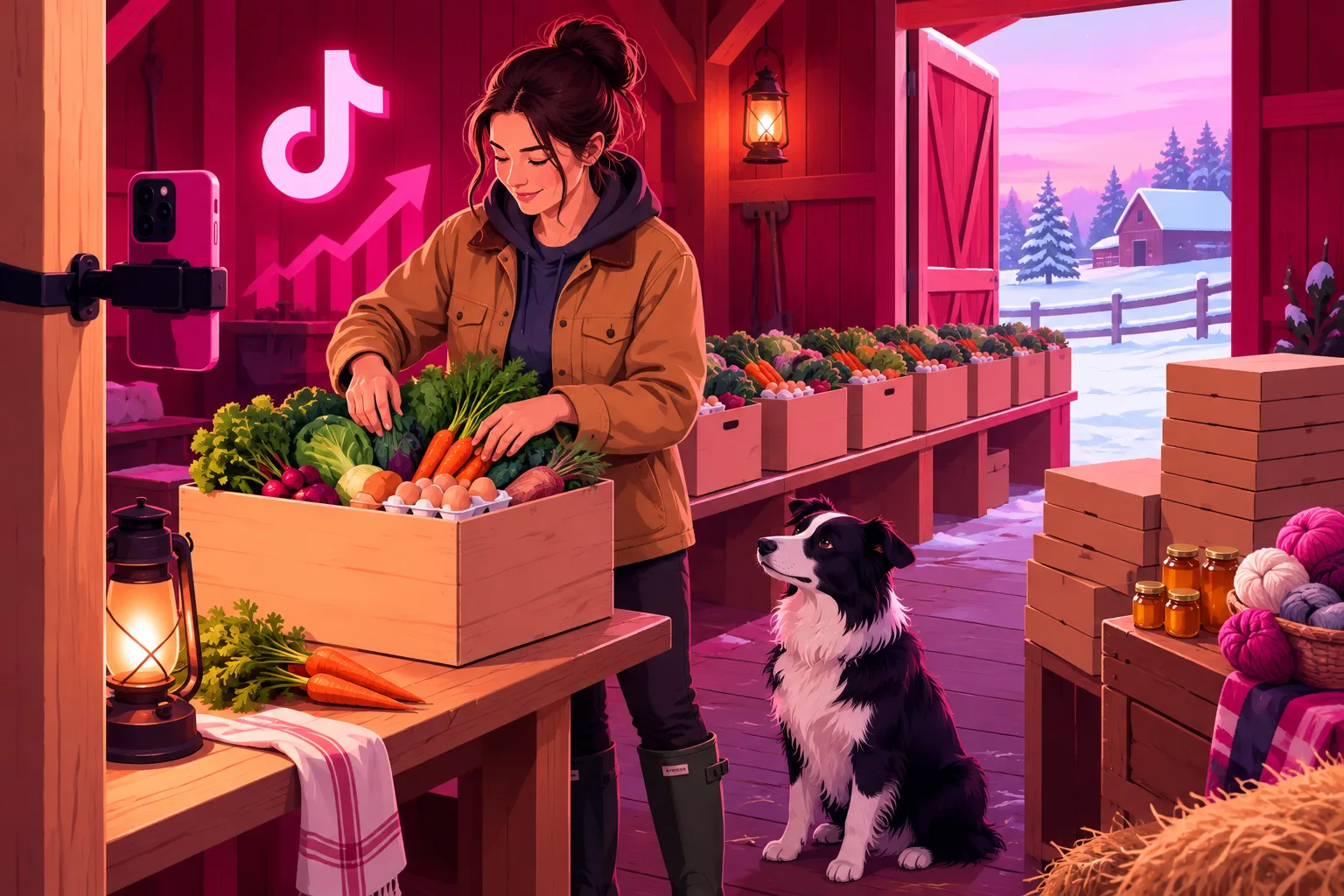
Every monetization guide on this site opens with a comparison: the creator who needs a million followers to see a five-figure year, versus the professional who needs three thousand of the right ones. Yours is the only one where that comparison can be true in both directions at once - because a farm sells two kinds of things, and TikTok sells each of them to a completely different person.
The first kind does not ship. A CSA share, a quarter of a steer, a dozen eggs, a flat of strawberries, a pumpkin on a hay wagon, a gallon of milk where that is legal - every one of them is bought by a family inside a Saturday-morning drive who has decided it is not weird to just show up. That list is the farm. It is what the 2022 Census of Agriculture was counting when it found more than 116,000 farms selling about $3.3 billion directly to consumers, and it is what keeps the lights on in the barn in February.
The second kind fits in a box. Honey, jam, maple, wool and yarn, seed packets, dried flowers, a cookbook, a hat with the farm's name on it. That list is the only thing a viewer in Arizona can buy from you, and it is the list every farm reaches for first, because the calf standing up for the first time just got four hundred thousand views and surely some of those people want something. Some do. A small jar's worth. The farm that builds its selling around the second list before the first one is full is the famous-and-broke farm from our growth guide: six hundred thousand followers, a shipping page that moves nine jars a week, and forty CSA shares unsold in March.
This guide is about selling in the right order. It covers the CSA sold in February from last season's footage, beef and pork by the share without tripping the rule that makes the meat unsellable, the stand and the market booth as a channel with a sellout time, what fits in a box and when TikTok Shop is worth the paperwork, the "what we can sell you and how" explainer for cottage foods and raw milk, the price explanation that is the whole sale, the December receipt, a selling calendar for the farm year, the three numbers that prove the account paid for itself at the supper table, and the point where selective amplification sells the last eight shares in the quiet weeks before the window instead of the peak weekend. It builds on our complete TikTok guide for farms - if you haven't read that yet, start there for the two-customer strategy and the compliance framework, then come back here for the money.
The honest summary:
- The market path funds the farm. Locals buy what does not ship - the share, the quarter, the dozen, the flat, the pumpkin - and they buy it because a video showed them the price, the pickup, and the person at the table. The national audience buys small, and only what fits in a box.
- Nothing is sold by a listing; everything is sold by an explainer. "What was actually in the box, week by week" sells the CSA. "What a quarter of a steer really costs and what fits in the freezer" sells the share. "Why our eggs are seven dollars" sells the eggs, and the standing order after them.
- The calendar is the sales funnel. CSA in February from a December 26 start, u-pick in April, the patch in August, turkeys by October 1, the box push in early December, the receipt said once. Build in the quiet season for the busy one, and stop the day you sell out.
- Organic growth tells you which selling video the county already trusts - amplify that one, for followers, in the quiet weeks, inside a Saturday-morning drive.
What's Inside
- 1. The Math That Changes Everything (The Market Path Funds the Farm)
- 2. Stream One: The CSA, Sold in February From Last Season's Footage
- 3. Stream Two: Beef & Pork by the Share (The Live-Animal Rule)
- 4. Stream Three: The Stand, the Market Booth & the Standing Order
- 5. Stream Four: What Fits in a Box (And When TikTok Shop Is Worth It)
- 6. Stream Five: The Ticket - U-Pick, the Patch & the Farm Stay
- 7. The Price Explanation Is the Whole Sale
- 8. "What We Can Sell You and How": Cottage Foods, Raw Milk, Meat & the Organic Word
- 9. The December Receipt
- 10. The Sequence: The Selling Calendar for the Farm Year
- 11. Tracking It: The Three Numbers That Win Supper
- 12. The Selling Mistakes That Cost Farms Money
- 13. Accelerating: Put Budget Behind the Video That Sells the Last Shares
- Frequently Asked Questions
1. The Math That Changes Everything (The Market Path Funds the Farm)
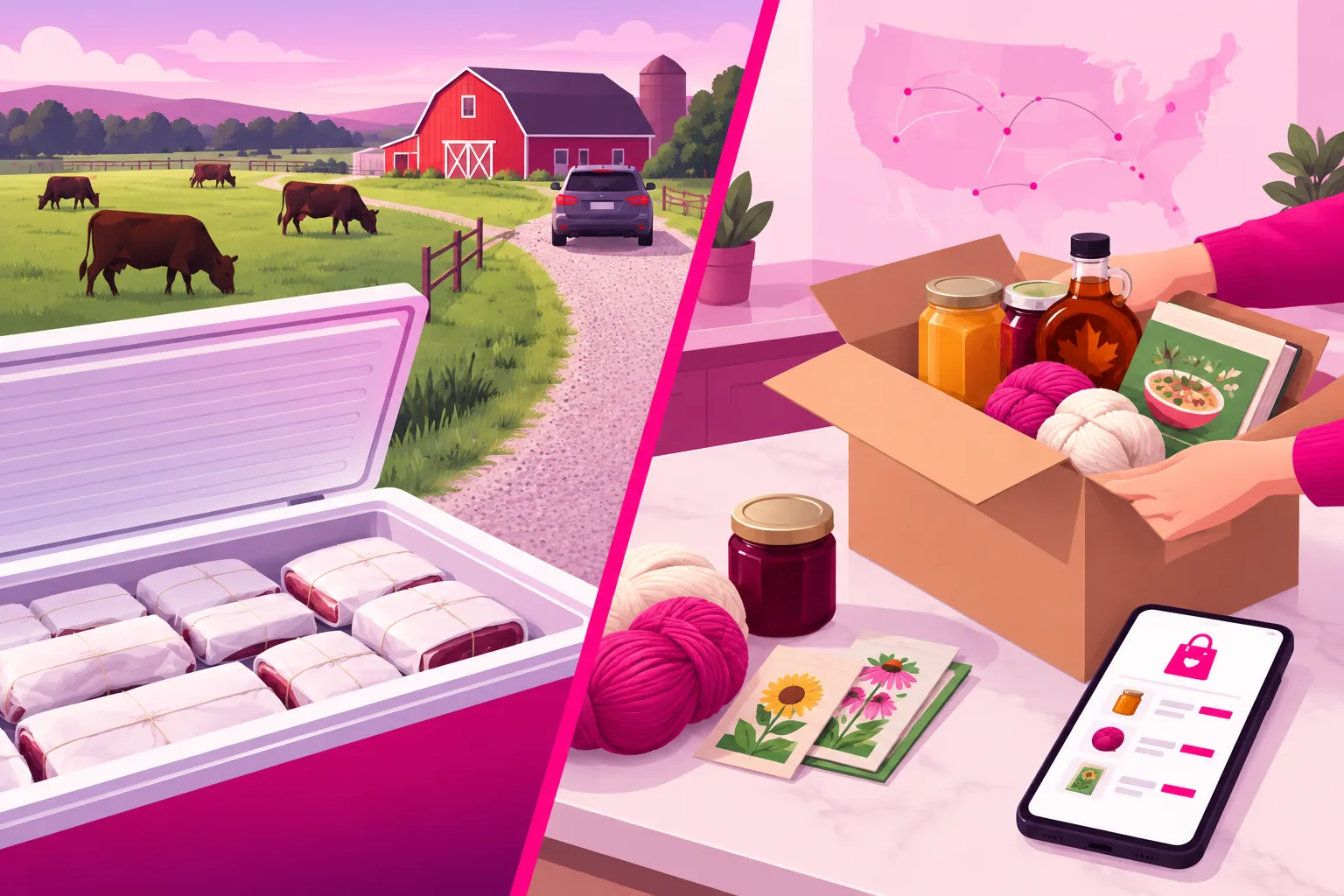
Run the comparison honestly and the order writes itself.
Take the farm from the rest of this series: sixty acres, thirty beef cows, two hundred laying hens, a two-acre u-pick strawberry field, a fall pumpkin patch with a hay wagon, a Saturday stand from eight to noon, and a Wednesday booth at the downtown market. Now take its two possible audiences.
The feed audience is six hundred thousand people in every state who love the morning chores. What can they buy? Honey at twelve dollars a jar, jam, maple, a skein of wool, a seed packet, a cookbook. Suppose a generous one in a thousand of them orders once a year, and the average order is thirty dollars after shipping eats what it eats. That is roughly $18,000 a year gross, before jars, labels, postage, and the Tuesday nights spent packing. It is real money. It is not a farm.
The market audience is a few hundred families inside a Saturday-morning drive. Forty of them buy a CSA share in February - call it $600 for twenty weeks, so $24,000 in the bank before anything is planted. Fifteen of them take a quarter of a steer in the spring and the fall, at a few hundred dollars a quarter plus what the processor charges them directly. Eighty dozen eggs a week leave the stand at seven dollars, which is close to $29,000 a year from two hundred hens. The patch's five weekends fund the winter. The u-pick field's three weeks fund June. None of that required a single viewer outside the county, and most of it was bought by someone who watched a sixty-second video that answered "is it weird to just show up?"
This is the inversion at the heart of farm monetization: the audience that is hardest to reach is worth the most per person, and the audience that arrives for free buys the least. It is the opposite of the creator economy, where scale is everything, and it is why the market-or-feed decision in the pillar guide comes before any selling decision in this one. The feed is not waste. Honey ships, the cookbook ships, and a farm that already packs orders should run that lane with pride. But the stand comes first unless you already ship, because the first list is what the farm is for, and because a family that drove out once and came back is worth more over five years than any number of strangers who bought a jar.
Three things follow from the math, and the rest of this guide is built on them:
- Nothing on the first list is sold by a listing. A share is bought after a family understands what is in it, what it costs per week, and where they pick it up. A quarter of a steer is bought after someone has seen what fits in a freezer. A dozen eggs is bought at seven dollars after someone has heard why. Every stream below is an explainer before it is an offer.
- The second sale is the real one. The pillar guide's nine-rung ladder puts the conversion at the second order for a reason: a CSA renewal, a standing egg order, a family back for a second fall. A first purchase that never repeats is a one-time visitor who cost you a video. Selling on TikTok is mostly the work of making the second order easy.
- The calendar is the funnel. You do not sell all year. You sell the CSA in February, the u-pick in April, the patch in August, the turkey in early fall, the box in early December, and the explainers that make each of those sales fast are filmed in the season before. A farm that posts a sign-up link in March has missed the window; a farm that filmed the pack table every Tuesday from June to October has February already in the can.
2. Stream One: The CSA, Sold in February From Last Season's Footage
Most CSA marketing fails on timing and on fear. The timing failure is a sign-up post in late March when the family deciding has already spent its grocery budget on a different plan. The fear failure is the one nobody says out loud: the family has heard that a CSA is twenty weeks of kohlrabi, that you cannot skip a week, and that it costs six hundred dollars up front for vegetables they might not know how to cook. A graphic with a price and a link answers none of that. Last season's footage answers all of it.
The video that sells the share: "What was actually in the box, week by week"
Every Tuesday of the season, Maggie filmed ninety seconds at the pack table: the box, the contents named out loud, the thing people would not recognize named twice. By October there are twenty clips. In the last week of December she cuts them into one video - week one, greens and radishes; week six, the first tomatoes; week eleven, the August glut where the box would not close; week fourteen, the kohlrabi, said with a grin and the recipe she sent; week twenty, squash and the last of the peppers. No music under it. Her voice, the farm's county and the pickup town said in the first ten seconds, the price per week said once, and the date the shares go on sale at the end.
That one video does the work of a whole brochure, because it is proof instead of a promise. A family can see that the box is generous in August and modest in June, that there is one strange vegetable a month and not one a week, and that the person packing it is someone they could ask a question. It goes up on December 26, the first day the farm year turns, and it gets pinned until the shares are gone.
The February set
Four more videos carry the sale through the window, and all four are filmed before the window opens:
- The pickup walk-through. From the turn off the road to the cooler: where to park, which door, the sheet on the table with the names, what to do if you miss a week (swap with a neighbor, donate it, pick it up Sunday from the fridge on the porch - whatever your rule is, say it). Filmed in the fall when the pickup actually ran, re-cut in January. This is the share version of the stand walk-through, and it answers the fear nobody admits: "will I be standing in someone's driveway not knowing what to do?"
- The price explainer. Six hundred dollars divided by twenty weeks is thirty a week, said out loud, next to what that week's box looked like in July. Then where the thirty goes - seed, soil, the two hired hours on Tuesday, the boxes themselves, the fuel to the pickup town. Not defensive. A person explaining a number to a neighbor. Section 7 is about why this video matters more than any other, so for now: film it in the field, not the kitchen.
- The half-share and the every-other-week option. If you offer one, say so in its own thirty-second video, because the family that was scared off by twenty weeks is the one that will take ten. If you do not, say that too, and say why.
- The member answer. One of last year's families, on camera because they asked to be, saying the one thing they wish they had known in week one. Consent in writing, their choice of first name only, and never a child without the per-use decision from the filming guide.
Renewal is the conversion, not the sign-up
The order the shares sell in tells you whether the account is working. Last year's members get the first week of the window, by message, before the public post; a renewal rate is the number a CSA lives or dies on, and a farm that renews thirty of forty has to find ten families, not forty. The waitlist gets the second week. The public gets the third. The payment question is answered in the pickup walk-through, not left to the form: full payment in February if you can, a deposit and two installments if you cannot, and the honest line that the February money is what buys the seed.
Then the thing that keeps a member: the useful follow-up during the season. The Tuesday pack clip, posted the same day, telling members what is in this week's box and what to do with the strange one. That is the video the ideas guide files under explainers, and it is also next year's sales video being filmed one week at a time. A member who knew what to do with the kohlrabi renews. A member who threw it away does not, and does not say why.
The day the last share goes, say so, on the account and on the pinned video's caption, and stop. The family who missed it goes on next year's waitlist, which is the only marketing list a CSA needs, and the account goes back to chores.
3. Stream Two: Beef & Pork by the Share (The Live-Animal Rule)
A beef share is the highest-ticket thing most direct-market farms sell and the one the fewest customers understand, which makes it the best explainer on the account and the easiest place to break a rule on camera without meaning to. Start with the rule, because the video has to be built around it.
What you are actually selling
Meat sold by the cut - a package of ground beef, a pork chop, a steak with your label on it - generally has to come from a plant under federal or equivalent state inspection. Most small farms do not use one. They use a custom-exempt processor, and meat that comes back from a custom-exempt plant is stamped "not for sale": it cannot be sold, bartered, or donated by anybody. So the farm does not sell the meat. It sells the animal, or a share of the animal, while the animal is alive, and the customer - who now owns a quarter of a steer - has it processed and pays the processor for the kill fee and the cutting, usually by the pound of hanging weight. The farm charges for the live animal, typically quoted per pound of hanging weight or live weight, and takes a deposit when the share is reserved.
Two cautions that belong in the planning, not the caption. Federal rules do not set a number of shares per animal, but some states cap it (four or eight are common figures), and selling eighths or smaller in a state that does not allow it reads to a regulator as an attempt to route around inspection. And shares cannot be sold after the animal is processed, which means the "we have a few quarters left in the freezer" video is the one that gets a letter. Check your state's department of agriculture before you film the offer, and if you want to sell by the cut at the stand or online, that is a different business with an inspected plant, a label, and in most places a license.
The video that sells the share: "What a quarter really costs and what fits in the freezer"
Dad, at the gate, with the steers behind him. The three numbers a family needs, in order: what the farm charges per pound of hanging weight and roughly what a quarter hangs at, what the processor will charge them on top and that it goes to the processor, not the farm, and roughly how many pounds come home - because hanging weight is not take-home weight, and the family that expected two hundred pounds and got a hundred and thirty is a one-time customer. Then the freezer: a chest freezer with a quarter in it, lid open, so they can see what "a quarter" means in their garage. Then the dates - when the next animals go, when the deposit is due, when pickup at the processor happens - and the honest line that the cuts are the processor's cutting sheet, which the family fills out, and that Maggie will walk them through it on the phone.
Three details change how this converts:
- Say "a share of a live animal," not "beef for sale." It is the true sentence, it is the lawful one, and it is more persuasive than the shorter one, because it tells the family they are buying an animal that is standing in a field they can see. Extension guidance on share advertising (Oregon's is explicit) says that "shares available at a price per pound of live weight" is the acceptable form and a price per pound of meat is not.
- Never film the processor, and never film the day. The pillar guide's compliance section and the filming guide's never-show list both say so. The share video is the animal in the field and the freezer in the garage. The middle is not content.
- The split-a-quarter answer is a saved reply. "Can two families share a quarter?" is the most common question and the easiest sale: the answer is whatever your state allows and your processor will do, said once, kindly, with a link to the explainer. Write it down and reuse it.
Pork follows the same shape with smaller numbers and a faster calendar, and lamb the same again. For all three, the second order is the fall animal after the spring one, and the follow-up that earns it is a thirty-second "how to cook the cut you did not recognize" posted in the weeks after pickup. A family that cooked the chuck roast well orders again. A family that stared at a package labeled "flank" for six months does not.
4. Stream Three: The Stand, the Market Booth & the Standing Order
The stand is the channel that most farms already have and almost none of them treat as one. Farmers market marketing, as it is usually practiced, is a chalkboard and a hope. On TikTok it is four facts, repeated until the county knows them without looking: where, when, what time you sell out, and whether you take cards.
The two walk-throughs
The stand walk-through is the pillar guide's conversion video, and it has been covered in every farm guide in this series: the turn past the grain elevator, the gravel, where to park, the dog, the cash box and the card reader, the person at the table. Film one for the stand and a separate one for the market booth, because the booth has its own fears: which end of the street, what the booth looks like so they can find it among thirty, whether you are there every Wednesday or only in season, and what is usually gone by ten.
That last line is the sales lever most farms never pull. Say what time you sell out, and say it honestly. "The eggs are gone by nine most Saturdays, the strawberries by ten in June, and the sweet corn does not last past the first hour in August." Scarcity you can see in a video is the only scarcity a customer believes, and the family that shows up at 8:15 because they watched the video is exactly the family you want - they came on purpose, they were not disappointed, and they ask about the standing order.
The standing order is the stand's CSA
A standing egg order - two dozen held under a name every Saturday, paid monthly - is the single most valuable thing the stand sells, because it turns a maybe into a certainty for both sides. Offer it in the walk-through as a sentence, not a form: "If you want eggs held every week, tell Maggie at the table and she will write you down." The farm with forty standing orders has sold most of its eggs before it opens, and the account's job on the egg side is finished for the year the day the list is full. The same works for a weekly flower bunch, a Thanksgiving turkey ordered by October 1, and a Christmas wreath the week before.
This week's stock
The Friday post is forty-five seconds of what will be on the table tomorrow, filmed Friday afternoon in the cooler. It is the most reliable sales video a stand has, because it is a reason to drive out this week specifically, and it needs no editing. Pair it with a visit page the bio links to - hours, the driveway in words, cash or card, the dog, where kids can go, this week's stock, and the name at the table - and the stand has a storefront without a website.
One rule the filming guide owns and this section repeats: customers at the stand appear as hands, backs, and baskets. A card on the table says the stand is sometimes filmed. Anyone who is identifiable asked to be, and the customers section of that guide has the exact wording. A customer who finds themselves in a selling video they did not agree to is a lost customer and a story the county tells.
5. Stream Four: What Fits in a Box (And When TikTok Shop Is Worth It)
Now the feed path, in its place. A farm that makes honey, jam, maple syrup, wool or yarn, seed packets, dried flowers, a cookbook, or a hat has something the Arizona viewer can actually buy, and the question is not whether to sell it but how much apparatus it deserves.
The box list, and the rule
Write the list down and read it against one test: can it sit in a cardboard box for five days at room temperature and arrive legal? Honey, jam, maple, wool, seeds, dried flowers, a book, merch pass. Eggs, milk, meat, fresh produce, anything frozen, and most cottage foods do not - the first group for the cold chain and the second for the law, which section 8 covers. The box list is the whole feed-path catalog. If it is empty, the feed path is an audience you serve for its own sake and for the people in it who will one day drive out, and you can skip the rest of this section with a clear conscience.
The video that sells the box: where it comes from
The box is sold by the same format that sells everything else here - the explainer, filmed where the thing happens. The honey extraction. The wool coming off the sheep in April and the skein it became. The maple run, sap to syrup, with the number of gallons it takes said out loud. The flowers hanging in the barn to dry. None of these end with a pitch. They end with one sentence: "the jar is on the shipping page in the bio," and then the caption says the same. The viewer who wants it finds it; the viewer who does not keeps watching the farm, which is the point.
The shipping page first, TikTok Shop second
A farm that ships a few orders a week needs a plain page: the six things, the prices, the shipping rule, the honest line about what cannot legally travel. That is enough for the first year of the feed path, and it keeps the orders on a site you own.
TikTok Shop becomes worth the paperwork when two things are true: the orders are steady enough that losing the viewer between the video and the website is costing you sales, and the products are the shelf-stable, labeled kind the platform allows in its food and household categories. Registration is a government ID, a bank account, and the business registration for a company account, and the most common rejection is paperwork - the name on the ID, the bank, and the business filing have to match exactly. Once a listing is live, the honey extraction video can carry the jar as a tagged product, and the viewer buys without leaving the app. Our TikTok Shop setup guide walks through the registration and the listing step by step, and the products section covers what a listing needs. Fees and approval times change and are published in the Seller Center, so read the current page rather than a blog post, including this one.
What never goes in the Shop, from a farm: eggs, milk, meat, produce, live plants in most cases, anything that needs a cottage license to sell at all, and the CSA. The share is sold at the pickup, by the walk-through, to the county. A Shop listing for it would be selling the one thing the feed audience cannot use to the one audience that cannot use it.
6. Stream Five: The Ticket - U-Pick, the Patch & the Farm Stay
The farm that sells a morning instead of a product sells it the same way the CSA is sold: early, with footage from last time, to parents. The u-pick field is three weeks and is sold in April; the patch is five weekends and is sold in August; the farm stay is sold whenever the calendar has holes. This series has a dedicated guide to the agritourism window coming, so this section is the money shape only.
- The parents' walk-through is the sales video. Parking, strollers, bathrooms, the hay wagon, what kids can and cannot touch, the price per pound or per pumpkin, how long it takes, the rain rule. A parent who has seen it books the Saturday. Film it on the busy weekend this year for next year's quiet-season sale, exactly as the pillar's calendar section says.
- The countdown is the reason to follow. "Nineteen days until the strawberries" is a season marker, and the growth guide calls it the series nobody else can run. Every countdown post ends with the date the field opens and the hours, and nothing else.
- The sold-out weekend is when selling stops. A patch with a full parking lot does not need a video telling more people to come, and the thing it does need - the thank-you and the "see you in June for strawberries" filmed on the last weekend - is next year's sale, not this year's.
- The sign at the gate goes up before the walk-through does. Most states have an agritourism liability statute whose protection depends on posted wording, and the pillar's compliance section covers it. A ticket sold by a video is a visitor you invited, and the invitation should be to a farm that has done the paperwork.
7. The Price Explanation Is the Whole Sale
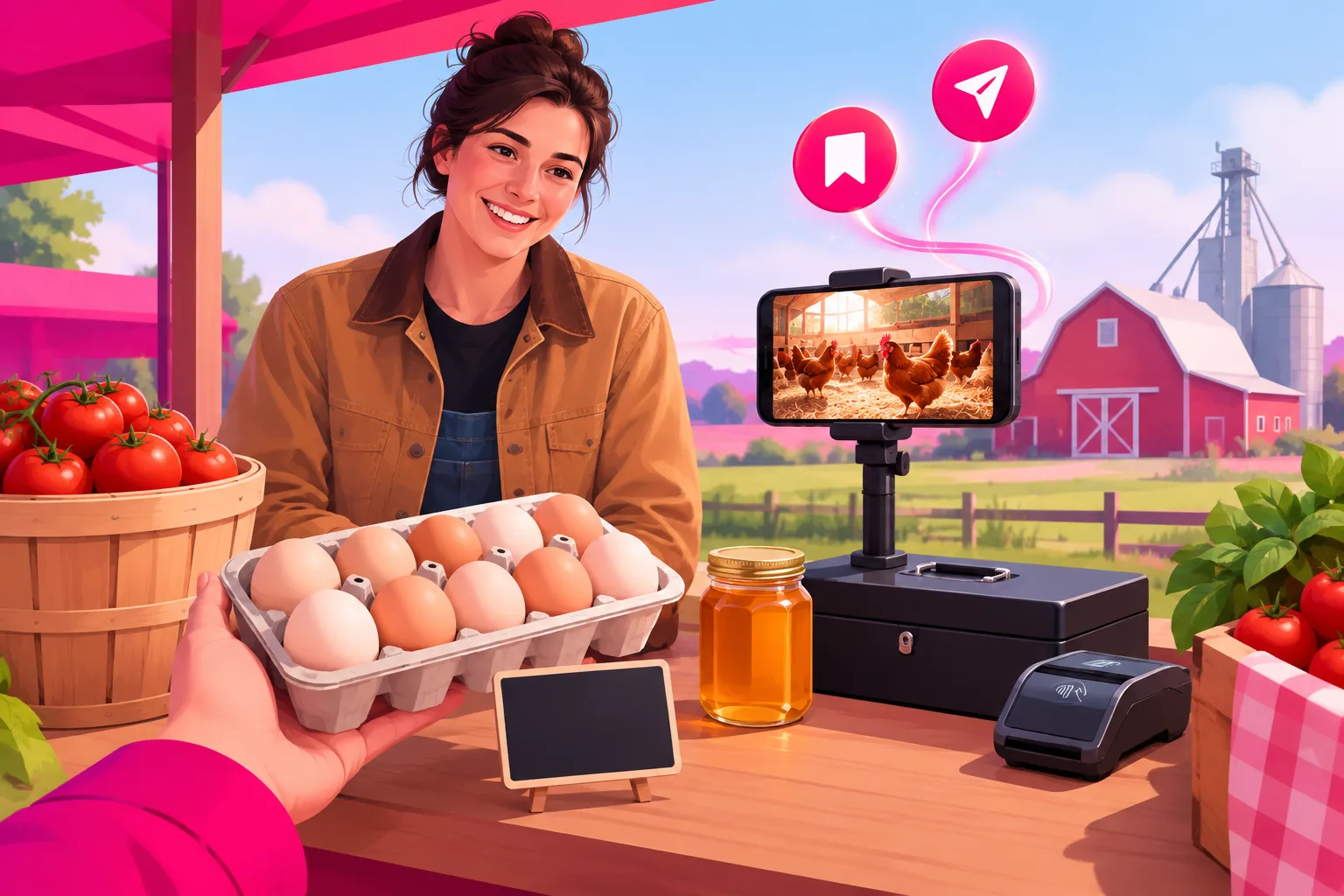
Direct-market farms do not lose the sale at the driveway. They lose it at the price tag, to a customer who would have paid it if anyone had shown where the money goes. Seven dollars for a dozen eggs next to a grocery price under three is not a hard sell; it is an unexplained one, and an unexplained number reads as a ripoff to a family that has no way to know better. The single most valuable selling video on a farm account is therefore not a product video at all. It is a person, in the place where the thing happens, explaining a number.
"Why our eggs are seven dollars"
Dad, in the henhouse, with the hens. Feed for two hundred birds through a winter, said as a monthly number. What the pullets cost and how long until they lay. The cartons. The fact that the hens go outside and what that does to the count in January. The four hours on Saturday someone stands at the table. Then the number, divided out, and the line that ends it: "that is what it costs to have eggs here next year too." Ninety seconds. No music. Filmed where the eggs come from, never at a kitchen table with a slide, and never as a comparison that sneers at the grocery store, because the family watching shops there on Tuesday.
The pillar guide's hook rule applies with the volume up: the price named first, never the rant. "Why our eggs are seven dollars" opens with the number. The version that opens with "people don't understand what food costs" is the same information delivered as an accusation, and the family deciding closes it in two seconds.
Count the saves and the sends
The price explainer is the one video on the account where views are a vanity number and two other numbers are the sale. A save is a person deciding - they will watch it again, or show it to someone, before they drive out. A send is a person who has decided and is forwarding it to the spouse who asked why eggs would ever cost that. The growth guide's growth signals put the send at the top for this reason. An explainer with a modest view count and a high save-and-send share is doing exactly its job; one with a huge view count and nothing else was entertainment for the feed.
The price comment
Every price explainer gets the comment. "Seven dollars for eggs is insane." The reply is written once, saved, and used the same way every time: as a person, with the number and the link, and with no second reply. "It is what it costs us to feed two hundred hens through a winter and still have a farm next year - the full breakdown is in this video," and the link. Then nothing. The reply is not for the commenter, who was never going to drive out; it is for the family reading the thread, and a calm answer with a real number is the most persuasive thing they will see all week. The argument, the sarcasm, the rant about what groceries really cost, and the price-list graphic posted in frustration each lose that family in a different way. Never argue. The family deciding is reading.
One explainer per product that has a number to explain: the eggs, the share price, the beef per pound, the u-pick per pound, the honey. Each gets filmed once, pinned during its window, and linked from its saved reply. That is the entire price strategy, and it is more than almost any farm in your county has.
8. "What We Can Sell You and How": Cottage Foods, Raw Milk, Meat & the Organic Word
A video is a public record of what you sold and how, which cuts both ways. The rules that decide what a small farm can sell are state by state, change every session, and are misunderstood by nearly every customer - which makes the honest explainer about them one of the most trusted videos a farm can post, and the careless one a letter from the state. The answer to both is the same video: "here is what we can sell you, and here is how."
Cottage foods
Jam, baked goods, pickles in some states, dried herbs, granola - the things made in a home kitchen fall under a cottage food law that varies by state: an allowed list, a label rule, where you may sell (the stand and the market almost always, online sometimes, by mail rarely), and in some states an annual sales cap. The rule that matters most for a TikTok audience is the shipping one: most states do not allow cottage foods to ship across state lines, and only a small number have recently opened that door. So the honest line in the "do you ship?" saved reply is the box list minus the cottage items, with "the jam is at the stand and the market, and we cannot mail it" said plainly. A viewer who hears a farm explain its own limits believes everything else it says.
Raw milk
Raw milk is the clearest case of "how" mattering more than "what." Some states allow it in stores, some only at the farm, some only through a herd-share arrangement where the customer owns part of the animal and pays for boarding, and a few ban it entirely - and it may never be sold across state lines for human consumption. The state-by-state chart shifts every year, so a dairy's selling video says exactly what its state allows, in the words the state uses, and says nothing that a viewer in a different state could mistake for an offer. "We can sell milk here at the farm, on Saturdays, and that is the only place" is both the law and a reason to drive out.
Meat, by the cut and by the share
Section 3 covered the share. The video version of the rule is a sentence Dad can say at the gate: "we sell the animal, you pay the butcher, and if you want a single steak, that comes from somebody with an inspected plant, which is not us." Poultry has its own small-producer exemptions in many states that let a farm sell a limited number of birds it raised and processed on-farm, within the state, with labels - the Thanksgiving turkey ordered by October 1 usually lives there. Say what your exemption is, in its own words, and say the number of birds if there is a cap.
The organic word, and the others
"Organic" has rules behind it: above a small annual sales threshold it needs certification, and even the smallest exempt farm, which must still follow the organic standards, cannot use the USDA seal. "Grass-fed," "pasture-raised," and "raised without antibiotics" are documented label claims on meat and poultry, and an animal finished in a feedlot cannot be called grass-fed. None of that is a reason to be vague. It is a reason to use the format the pillar recommends in its compliance section: "is it organic? No. Here is what we do instead," filmed in the field. A customer who has heard exactly what you spray and do not spray, and why, buys from you for years. A customer who catches a word that does not hold, even an innocent one, tells the county, and a video is the easiest thing in the world to screenshot.
The "what we can sell you and how" explainer is filmed once a year, in January, after the farm has checked its state's current pages, and re-filmed when the law moves. It is pinned beside the walk-through during every selling window, and it is the video the saved replies point to when the question is "can I buy a steak" or "do you ship milk."
9. The December Receipt
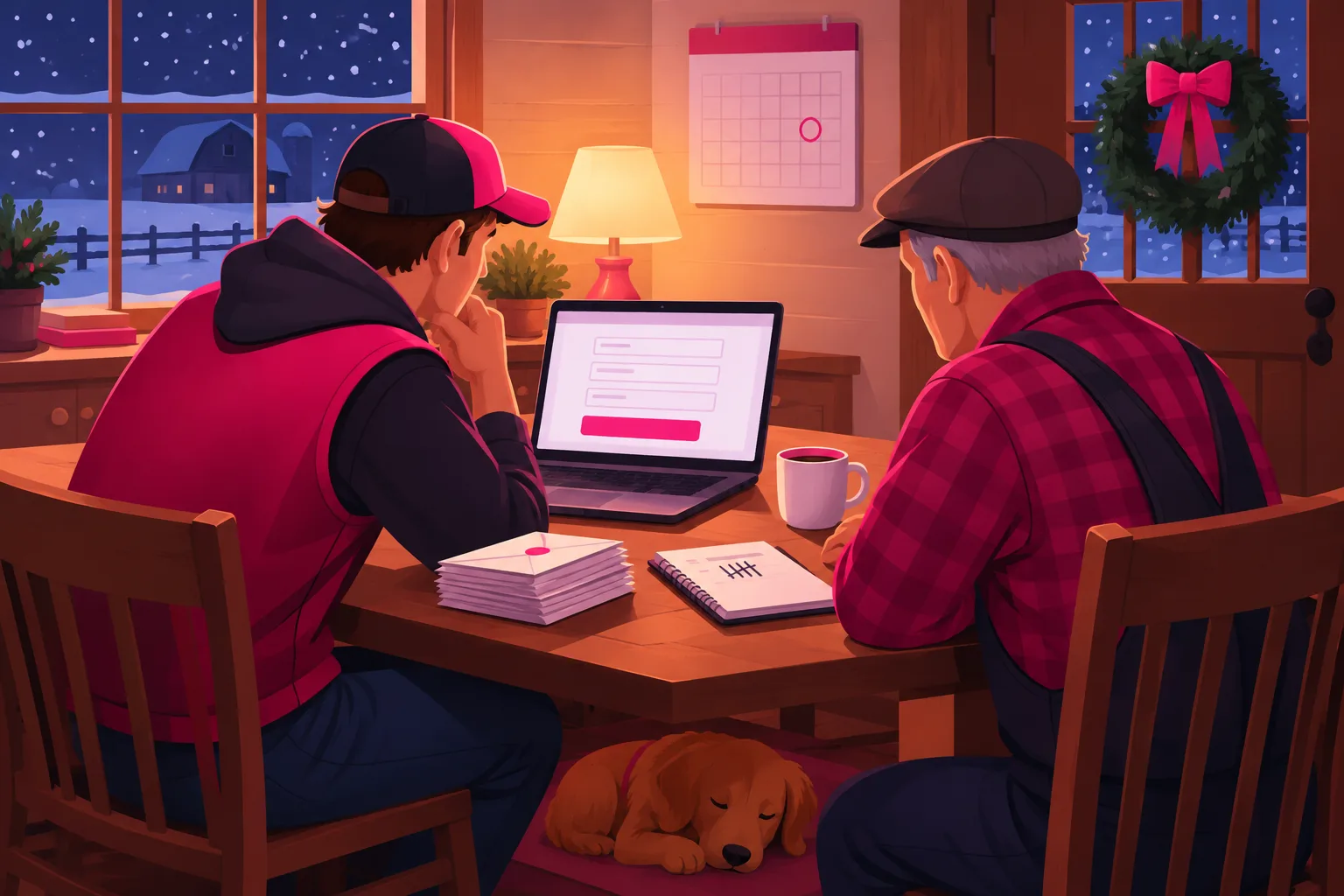
Every other selling video on this list sells a thing. The receipt sells the next year, and it is the only video a farm posts about money that is not an offer. It goes up in the second or third week of December, once, and it says what this year did.
Maggie, at the kitchen table or at the gate, with the numbers that are true and public: forty shares, twenty weeks, the number of boxes packed. The animals that went and the families they fed. How many dozen the hens laid. The five weekends, and roughly how many families came down the driveway. The thing that failed - the hail in June, the week the strawberries were done early - said once, as the pillar guide's hard-day rule requires: said, not shown, never a sad song, never an ask. Then thank you, and the one line that matters for February: "shares go on sale for members on the twenty-sixth."
The receipt converts for three reasons. The member who is deciding whether to renew just saw the year they paid for, totaled. The family who followed in October after the patch and has never bought anything now knows what the farm sells all year, and that the share exists. And the parent at the supper table, who still half-believes the phone is a hobby, just heard the year said out loud as a list of sales, with the account's part in each one implied by the fact that it was the account that said it. Nothing in it is a pitch. Everything in it is a reason to be on the list on December 26.
Two rules keep the receipt a receipt. It never includes a dollar figure the family would not say to a neighbor; counts, not revenue. And it is never the guilt post. "It was a hard year and we need you" is the sentence that makes a customer buy once out of pity and never again. "Here is what we did, and here is when the next one starts" is the sentence that makes them buy in February.
10. The Sequence: The Selling Calendar for the Farm Year
Turning everything on at once is how a farm ends up with a shipping page, a Shop, a CSA form, a beef waitlist, and a stand that still has the same eleven cars. Do it in this order instead, and notice that every sale is made in the season before it happens:
Before you sell: decide the order
Market or feed, in writing, with the family. For most farms selling direct: market first, unless you already ship. It decides which explainers get filmed first, where the county is said, and whether the shipping page exists this year at all.
December: the receipt, then the first CSA post on the 26th
The receipt in the second or third week. The year-end box push the week before that for farms that ship. The "what was in the box, week by week" video on December 26, pinned, with members messaged first.
January: the rules explainer and the beef video
"What we can sell you and how," filmed after checking the state's current pages. The spring beef and pork share explainer at the gate, with deposits open. Renewal messages to last year's members. The pickup walk-through re-cut.
February: the CSA window
Members, then the waitlist, then the public. The price explainer and the half-share video in rotation. The saved price reply ready. The day the last share goes, say so and stop. Spring shares reserved the same month.
March-April: the newborns and the u-pick sale
Calving and kidding are the most-watched footage of the year and the quiet season for selling; let them carry the feed path. Three to four weeks before the field opens, the u-pick walk-through for parents and the countdown begins.
May-June: the stand opens, the standing orders fill
The stand and booth walk-throughs. The egg explainer, pinned. The standing-order sentence at the table. The Friday "this week's stock" begins and runs to November. First Tuesday pack clip - next year's CSA video starts here.
July-August: the glut is the content, the patch is sold now
The August box that will not close is February's best clip. The patch walk-through and the five-weekend calendar go up in August, never October. The fall beef shares open with the same explainer re-posted.
September-October: harvest mode, the turkey form by October 1
Countdown, pre-filmed walk-through, DMs within the hour on Fridays, and nothing else required. The turkey order form is up by October 1 with the poultry exemption said in its own words. The thank-you and "see you in June" filmed on the last patch weekend. Selling stops the day the weekend sells out.
November: the freezer and the table
Fall share pickups and the "how to cook the cut" follow-ups. Thanksgiving is November 26 this year; wreaths, trees, and the winter box go up the week before. The last market. Then the quiet that the December receipt is written in.
The pattern underneath every line is the pillar's build-in-the-quiet-season rule: the video that sells a window is filmed in the window before and posted in the quiet weeks before the next one. A farm that follows it never posts a sign-up link in March, and never has to.
11. Tracking It: The Three Numbers That Win Supper
The account's dashboard shows views, likes, and followers, and none of those will convince a parent who has milked at five in the morning for fifty-one years that the phone sells anything. Three numbers will, and all three are written down at the table, not read off a screen:
- 1. First-time customers who said TikTok. One question at the table and on every order form: "how did you hear about us?" Counted monthly, by product - four new egg customers, three new CSA families, two beef quarters. Not lectured, not handed a brochure. Just counted.
- 2. The second-order share. Of those, how many came back: the standing order, the renewal, the fall quarter after the spring one, the second Saturday. This is the conversion the pillar's ladder is built on, and the number a selling account should be judged by. "Four new egg customers this month said TikTok, and three of them are standing orders now" is the sentence that wins supper.
- 3. The sold-out date. When the CSA sold out this year versus last. When the fall shares were spoken for. When the patch weekends filled. A selling account moves these dates earlier every year, and the day a window sells out is also the day its promotion stops, so the date is both the scoreboard and the budget.
For the farm that ships, add one: shipping-page or Shop orders per week, and which video they followed. That is the feed path's entire scoreboard, and it should be reported in the same breath as the other three so nobody at the table mistakes it for the farm. The growth guide's section on the family member who does the social media covers the half-hour monthly report these numbers go in, and why it is the thing that keeps the role alive.
12. The Selling Mistakes That Cost Farms Money
Selling the box before the stand is full
The famous-and-broke farm, in its selling form: a Shop with nine listings, a honey video with half a million views, and forty shares unsold. The feed buys small. Fill the stand, then ship.
The sign-up post in March
A CSA sold in the season it is eaten is a CSA that does not sell. February, from a December 26 start, with members messaged first. The same mistake in October form is the patch sold on the first weekend instead of in August.
The listing instead of the explainer
A price-list graphic, a "shares available" caption, a product photo. Nothing on the first list is bought from a listing. What is in the box, what a quarter really costs, why the eggs are seven dollars - the explainer is the sale.
"Beef for sale" from a custom-exempt freezer
The video that gets a letter. Shares of a live animal, sold before processing, with the processor paid by the customer. Never the freezer-full-of-quarters post, never the processor on camera, and never eighths in a state that caps at four.
Arguing in the price comment
One reply, as a person, with the number and the link. The second reply, the sarcasm, and the rant each cost you the family reading the thread, who was the only person in it who might have driven out.
A label word the farm cannot back up
"Organic" without the certification, "grass-fed" on an animal finished on grain, "raw milk, we ship" in a state where neither is allowed. Say what you do, in plain words, in the field. The honest answer builds the trust the word was trying to borrow.
No second-order plan
The sale that never repeats. The "how to cook the cut" follow-up, the Tuesday pack clip for members, the standing-order sentence at the table, and the renewal message in January are where the farm's money actually is.
Selling past the sellout, and the guilt post
A video inviting more families to a patch with a full lot, or an ad still running for a CSA with no shares, buys disappointment. And "farms are dying, buy local or we are gone" buys one pity order and no second. Stop the day you sell out. Say the hard year once, in the receipt, and ask for nothing.
13. Accelerating: Put Budget Behind the Video That Sells the Last Shares
Everything above is organic, and for most farms the organic version fills the stand. The reason to spend money is specific: the CSA is at thirty-two of forty shares on February 20, the u-pick opens in three weeks and the parents in the next town over have never seen the walk-through, or the fall quarters are half spoken for and the next animals go in a month. In each case the video that would close the gap already exists and has already proved itself, and the only question is how many of the right families see it in the next ten days.
That is the job Viryze's TikTok promotion service was built for, and the farm version has rules no other business needs:
- Promote the explainer, not the offer. The box-by-week video, the pickup walk-through, the price explainer, the parents' walk-through, the December receipt. Never the price-list graphic, never the rant, never the guilt post, and never anything that reads as a listing for an animal or an animal product - the platform's ad rules treat animals and animal products as a restricted category, written for live-animal and fur sales but easy to trip with a "quarters available" caption. Promote the farm and the follow. Alcohol, for the cidery or the farm winery, is age-gated and needs prior approval; hemp and CBD products are restricted outright.
- Promote for followers, not a one-time order. A follower watches the strawberries ripen for six weeks, sees the Friday stock post, and is on the list on December 26. A one-time order from a promoted post is a customer with no second order planned.
- The map rule. The CSA, the share, the stand, the u-pick, and the patch are promoted to a Saturday-morning drive radius, which for most farms is the metro their pickup town sits in. The honey extraction goes wider only if the shipping page exists. Our local business guide covers the radius mechanics.
- The timing rule, and the rule after it. The quiet weeks before the window - February for the CSA, April for the u-pick, August for the patch, early fall for turkeys, early December for the box - and never the peak weekend, when every orchard and retailer is bidding. Then the rule no other business needs: stop the day you sell out. The forty-first share sold by an ad that kept running is a refund and an apology.
- Consent to post is not consent to promote. The member who agreed to be in the CSA video, the hired hand in the chore clip, the family at the table - each gets asked again before their video is put in front of strangers with money behind it. Spark Ads keep the video on your account with its comments and saves intact; the Spark Ads guide covers the format.
Measure it the way the parent will: against the fall newspaper ad, the farm-trail listing, and the highway sign. Cost per first-time customer who said TikTok, and cost per second order. The promoted stand walk-through from the pillar guide brought twelve new families down the driveway before the patch opened, and five of them came back in strawberry season; those two numbers, divided into what it cost, are the only ad report a farm needs. The promotion section of the pillar has the full math, and the advertising guide in this series will take it further. The ad money came out of the same account as the seed. Spend it like seed: on proven ground, in the right week, and not one row more than the field can hold.
Frequently Asked Questions
Can you actually sell farm products on TikTok?
Yes, but almost never by listing them. A direct-market farm sells two kinds of things and TikTok sells each of them differently. What does not ship (a CSA share, a beef or pork share, a dozen eggs, a flat of strawberries, a pumpkin, a gallon of milk where that is legal) is sold to people inside a Saturday-morning drive by the walk-through, the price explainer, and the season marker, and it is bought at the stand, the booth, or an order form that your bio links to. What fits in a box (honey, jam, maple, wool and yarn, seeds, dried flowers, a cookbook, merch) can be sold to anyone, through a shipping page or TikTok Shop, and it is the only thing a national audience will buy. The money that keeps a farm open comes from the first list. Farms that try to sell the second list before the stand is full end up famous and broke.
How do you market a CSA on TikTok?
Sell it in the dead of winter with footage from last season. The CSA is bought in February, so the first post goes up on December 26, and the video that sells it is not a sign-up graphic; it is "what was actually in the box, week by week," cut from the Tuesday clips you filmed at the pack table from June to October, with the kohlrabi week and the August tomato glut both shown honestly. Follow it with the pickup walk-through (where to park, which cooler, what the sheet on the table says, what happens if you miss a week) and the price explainer that divides the share by twenty weeks and names the number out loud. Say the county and the pickup town in every one of them. Count renewals from last year's members first, then the waitlist, then new families, and stop posting about it the day the shares are gone.
How do you sell beef or pork by the share without breaking the law?
You sell the live animal, or a share of it, before it is processed, and the customer pays the processor for the cutting. Meat that comes back from a custom-exempt processor is stamped not for sale and cannot be sold by the pound, so a farm without an inspected plant sells the animal in halves or quarters while it is standing in the field, takes a deposit, delivers the animal, and the customer picks up their share at the butcher and pays the kill and processing fees. Some states cap how many shares one animal can be split into, so check your state before you advertise eighths. In the video, say what you are actually selling: a quarter of a steer at a price per pound of hanging weight, what the processor charges on top, roughly what fits in the freezer, and when the next animals go. "Beef for sale, ten dollars a pound" is the sentence to avoid unless your cuts came from an inspected plant with its own label.
Should a farm open a TikTok Shop?
Only for the things that fit in a box, and only after the stand is full. TikTok Shop is a storefront for shelf-stable, shippable products with a label: honey, jam, maple syrup, wool, seed packets, dried flowers, a cookbook, a hat. It is not for eggs, milk, meat, produce, or anything that needs a cold chain or a state license to leave the farm, and it is not where the CSA is sold. Registration takes a government ID, a bank account, and for a business the registration paperwork, and names on all of them need to match exactly. If you already ship a few orders a week from a website, a Shop lets the viewer who just watched the honey extraction buy the jar without leaving the app; if you do not, start with a plain shipping page linked from the bio and open a Shop when the orders justify the listings.
What do you say when someone comments that your prices are too high?
Reply once, as a person, with the number and the explainer, and never argue. "Seven dollars is what it costs us to feed two hundred hens through a winter and still have a farm next year; here is the full breakdown" with the link to the "why our eggs are seven dollars" video. The reply is not for the commenter. It is for the family reading the thread who is deciding whether to drive out on Saturday, and a calm answer with a real number is the most persuasive thing they will see. Count the saves and the sends on that explainer, because a save is a person deciding and a send is a person who decided and is showing a spouse. Then move on. The price-list graphic, the sarcastic reply, and the rant about what groceries really cost each lose that family in a different way.
Can a farm say organic or grass-fed in a TikTok video?
Only if the claim is true in the regulatory sense, because a video is a public record of how your food was grown. "Organic" has rules behind it: above a small annual sales threshold it needs certification, and even the smallest exempt farm cannot use the USDA seal. "Grass-fed," "pasture-raised," and "raised without antibiotics" are documented label claims for meat and poultry, and finishing an animal in a feedlot makes grass-fed untrue. The move that builds more trust than any label is the honest answer the pillar guide recommends: "is it organic? No. Here is what we do instead," filmed in the field where the thing happens. Customers who hear exactly what you do buy from you for years. Customers who catch a claim that does not hold, even an innocent one, tell the county.
When should a farm promote a selling video on TikTok?
In the quiet weeks before the window, never on the peak weekend, and stop the day you sell out. The CSA is promoted in February, the u-pick in April, the pumpkin patch in August, the turkeys in early fall, and the year-end shipping push for what fits in a box in early December. Promote the video that already proved itself organically (the box-by-week explainer, the pickup walk-through, the price explainer, the December receipt), promote it for followers rather than a one-time order, and point the market-path videos at a Saturday-morning drive radius and the box videos wider only if you ship. Two cautions specific to farms: the ad platform treats animals and animal products as a restricted category, so promote the farm and the follow rather than a beef-share listing, and anything with alcohol is age-gated and needs approval. Measure the spend against the fall newspaper ad: cost per first-time customer who said TikTok, and cost per second order.
Eight shares left and the window closes in ten days?
The explainer that sells them already exists on your account - amplification decides how many of the right families see it, where, and when. Viryze promotes the videos that have already proved themselves, putting your box-by-week video, your pickup walk-through, or your price explainer in front of thousands more people within a Saturday-morning drive, in the quiet weeks before the CSA or the field or the patch opens, and stopping the day you sell out - so the honesty you've built converts into followers who already know the price, first-time customers who say TikTok at the table, and second orders you can count.
Sell out the window fasterRelated Reading
- TikTok for Farms: The Complete 2026 Guide - the two-customer strategy, the calendar, and the compliance framework every stream here depends on.
- Growing a Farm TikTok: From 0 to 10K Local Followers - the two scoreboards, the famous-and-broke plateau, and the family role that keeps the selling account alive.
- Farm TikTok Content Ideas: 50+ Video Concepts That Bring Customers Down the Driveway - the explainers, walk-throughs, and season markers that every selling window draws from.
- How to Film Farm Videos for TikTok (Kids, Workers, Equipment & the Family Rule) - the consent rules for members, customers, and crew that a selling video has to pass.
- TikTok Shop for Small Business: Complete Setup Guide - the registration and listing walkthrough for what fits in a box.
- TikTok for Food Creators: Complete 2025 Guide - the other side of the table, and where the cookbook and the recipe follow-up come from.
- Getting Donors and Volunteers from TikTok: Turn Views Into Monthly Supporters - the closest parallel to the renewal: a second gift as the real conversion, and the useful follow-up that earns it.

Head of Creator Success at Viryze
TikTok growth strategist helping creators reach their first 100K followers through data-driven promotion strategies.