
Coffee Shops13 min read
Coffee Shop Advertising on TikTok: How to Pay for Regulars, Not a One-Day Line
A plain guide to coffee shop advertising and cafe advertising for an independent shop: an honest comparison of the map listing, search ads, delivery apps, mailers, local sponsorships, a sidewalk sign and a promoted TikTok video, what one regular is worth, why a promoted video should aim for nearby followers and not a rush, the three ways to pay for one, how small to draw the map, the four videos worth paying for and the four that are not, a worked $280 example, the two times of year to spend, why you should never advertise a line you cannot serve, the rules a paid video has to follow, and the numbers to check.
By Ryan MitchellHead of Creator Success at Viryze
Most coffee shop advertising is sold as a way to get more people through the door. That is the wrong goal for a coffee shop. A hundred people who come once are worth less than one person who comes back three times a week.
This guide covers one option in detail: paying to show a TikTok video to people near your shop. It starts with an honest look at what you may already be paying for, because a promoted video is not better than those tools at everything.
The short version: the map listing and the sidewalk sign reach the person who wants a coffee right now. A promoted video introduces your shop to the person who will need a new morning stop next month. Use it when routines change, keep the area small, and never pay to make your busiest hour busier.
It is the last part of our complete TikTok guide for coffee shops and cafes. You do not need to have read the rest. The last section explains where a TikTok promotion service fits and where it does not.
The honest summary:
- Fix the free things first. A current map listing and a clear sign reach more nearby people than any ad.
- Pay for regulars, not for a rush. The first visit barely covers the cost. The visits after it are the point.
- A promoted video is slow and local. It works over weeks, and only on people who live, work or pass close to your door.
- Only promote a video that already works. Money makes a good video reach further. It does not fix a weak one.
- Do not advertise a line you cannot serve. If the morning is full, promote the quiet afternoon.
What's Inside
- 1. What Coffee Shops Already Pay For
- 2. What One Regular Is Worth
- 3. What a Promoted Video Actually Buys
- 4. Three Ways to Pay for It
- 5. The Map: A Few Minutes From the Door
- 6. Four Videos Worth Paying For, and Four That Are Not
- 7. How Much to Spend: A $280 Example
- 8. When to Spend and When to Pause
- 9. The Rules a Paid Video Has to Follow
- 10. The Numbers to Check, and Who Should Run It
- Frequently Asked Questions
1. What Coffee Shops Already Pay For
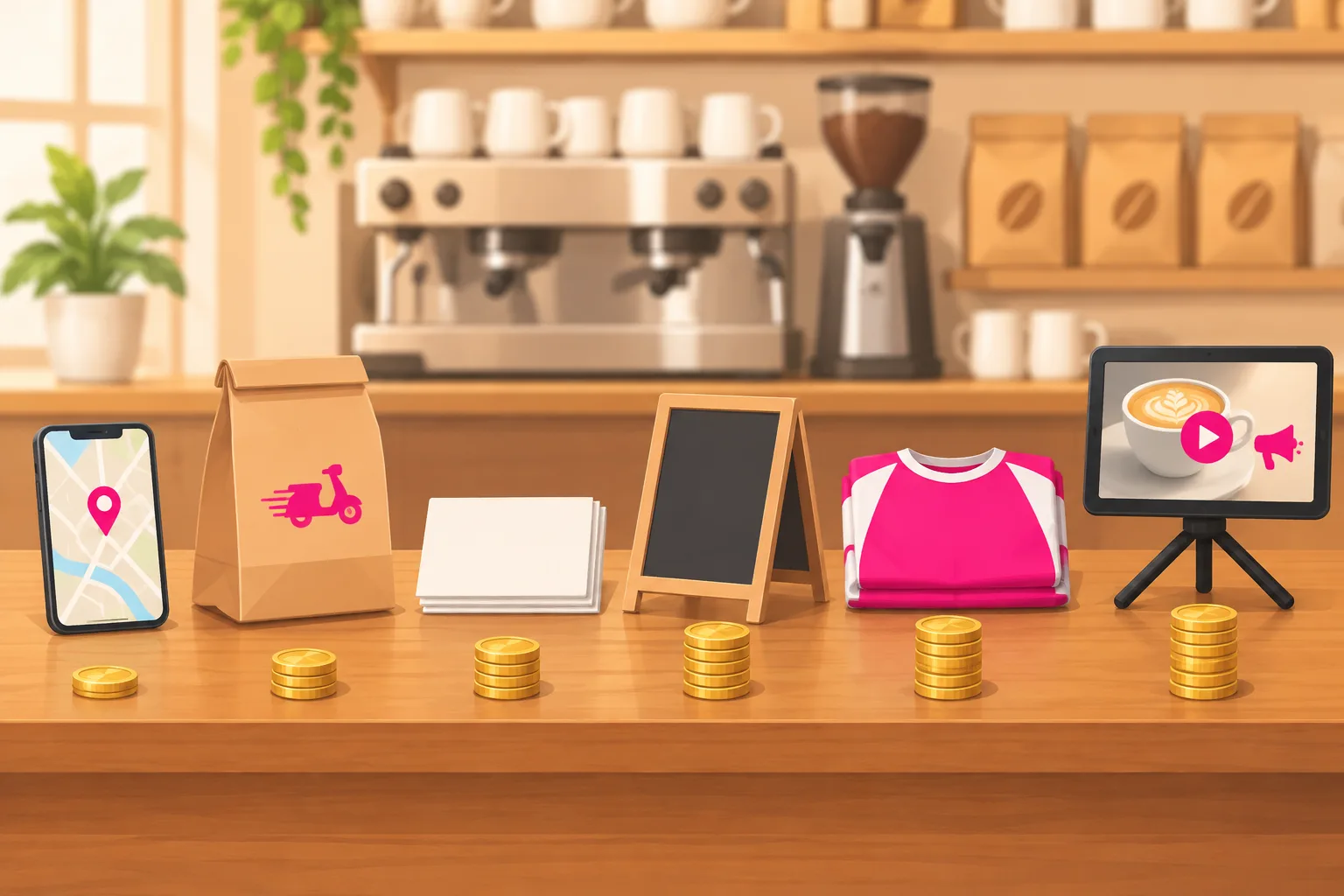
Before adding anything new, look at what the usual options are good at. Each one below is a reasonable tool. The prices are rough figures for the United States at the time of writing. They change, and they vary by area, so check your own.
The map listing
This is the most important one, and it is free. In Google's own figures, people in the United States search for "coffee near me" more than sixteen million times a month. Most of them pick from the map.
A listing with the right hours, a typed menu with prices and a few honest photos does more than any ad on this page. Its weakness is that it only reaches a person who is already looking for coffee. It also cannot show what your shop is like inside.
Search ads
A search ad puts your shop at the top when someone types something like "coffee shop near me." You pay for each click. In Google's figures for November 2026, a click on that phrase averaged about 44 cents across the United States.
That is cheap, but do the next step of the math. Not every click becomes a visit. If one click in five does, a first visit costs a little over two dollars, and that visitor spends about six. Search ads make the most sense for a new shop that does not yet show up on the map by itself.
Delivery apps
A delivery app lists your shop and takes a share of each order. One large app's published plans take 15, 25 or 30 percent of a delivered order, and 6 percent of an order the customer picks up. A promoted spot in the app costs extra, and is usually charged for each order it brings.
On a $5.50 latte, 30 percent is $1.65. Delivery reaches someone at a desk or at home who would not have walked over, and that is real extra business. Its weakness is that the customer belongs to the app. She never sees your shop, and you never learn her name.
Mailers, sponsorships and the sidewalk sign
These are the oldest tools, and for a neighborhood shop they are still some of the best. They reach the people who live and walk nearby, and nobody else.
- Mailers. The post office will deliver a postcard to every door on a mail route for about 26 cents each in postage. Two thousand doors is about $520, plus printing. You choose the exact streets, which makes a mailer a good fit for an opening.
- Local sponsorships. A youth team, a school fundraiser, a neighborhood run. The cost is often a few hundred dollars. It builds goodwill with families nearby. It is very hard to count what it brought in.
- The sidewalk sign. A one-time cost, and it is seen only by people who pass your door. Those are the people most likely to become regulars. Check your town's rules on signs first.
Their weakness is that paper and chalk cannot show the inside of the shop. A postcard says you exist. It does not show where to order, whether there is a seat, or how long the wait is.
A promoted video
Paying to promote a TikTok video means paying to show a video you already posted to more people in an area you choose. You pay for views, not for visits. Nobody is looking for coffee at the moment they see it.
That makes it the slowest option on this list. It is also the only one where a stranger can walk through your door on a screen, hear two prices, see the seats, and keep seeing your shop for weeks without you paying again.
| Option | Best at | Weak at |
|---|---|---|
| The map listing | People looking for coffee right now | Showing what the shop is like |
| Search ads | A new shop that is not on the map yet | Many clicks never become a visit |
| Delivery apps | Orders from people who would not walk over | A share of every order; the customer stays with the app |
| Mailers | Choosing exact streets | Cannot show the shop |
| The sidewalk sign | People who already pass by | Nobody one street over sees it |
| A promoted video | Showing the inside, for weeks | Slow; reaches people too far away as well |
These are not rivals. Someone who has watched your videos for a month is more likely to notice your sign, and more likely to pick your name on the map. If your map listing is out of date, fix that before you spend a dollar anywhere. The menu page checklist covers the listing and the page your profile links to.
2. What One Regular Is Worth
You cannot judge any advertising without knowing what a customer is worth. This series uses one made-up shop to keep the numbers concrete. Swap in your own as you read.
The shop is on a corner, across from a bus stop. It opens at 6:30 and closes at 4. It has twelve seats. A 12-ounce latte is $5.50 and a drip coffee is $3.25. On an ordinary weekday morning it sells about 190 drinks.
- One visit. About $6.
- One regular. Three visits a week at about $6 is $18 a week. Over a year that is about $900.
- The comparison. It takes about 150 people who come once to equal one regular.
Those figures are sales, not profit. Coffee, milk, cups, wages and rent all come out of them.
But they give you a ceiling, and they change which question you ask. If an ad brings one visit for $20, it lost money on that visit. If the same person becomes a regular, $20 bought about $900 of sales in the first year. So the question for any ad is not "how many people came in?" It is "how many came back?"
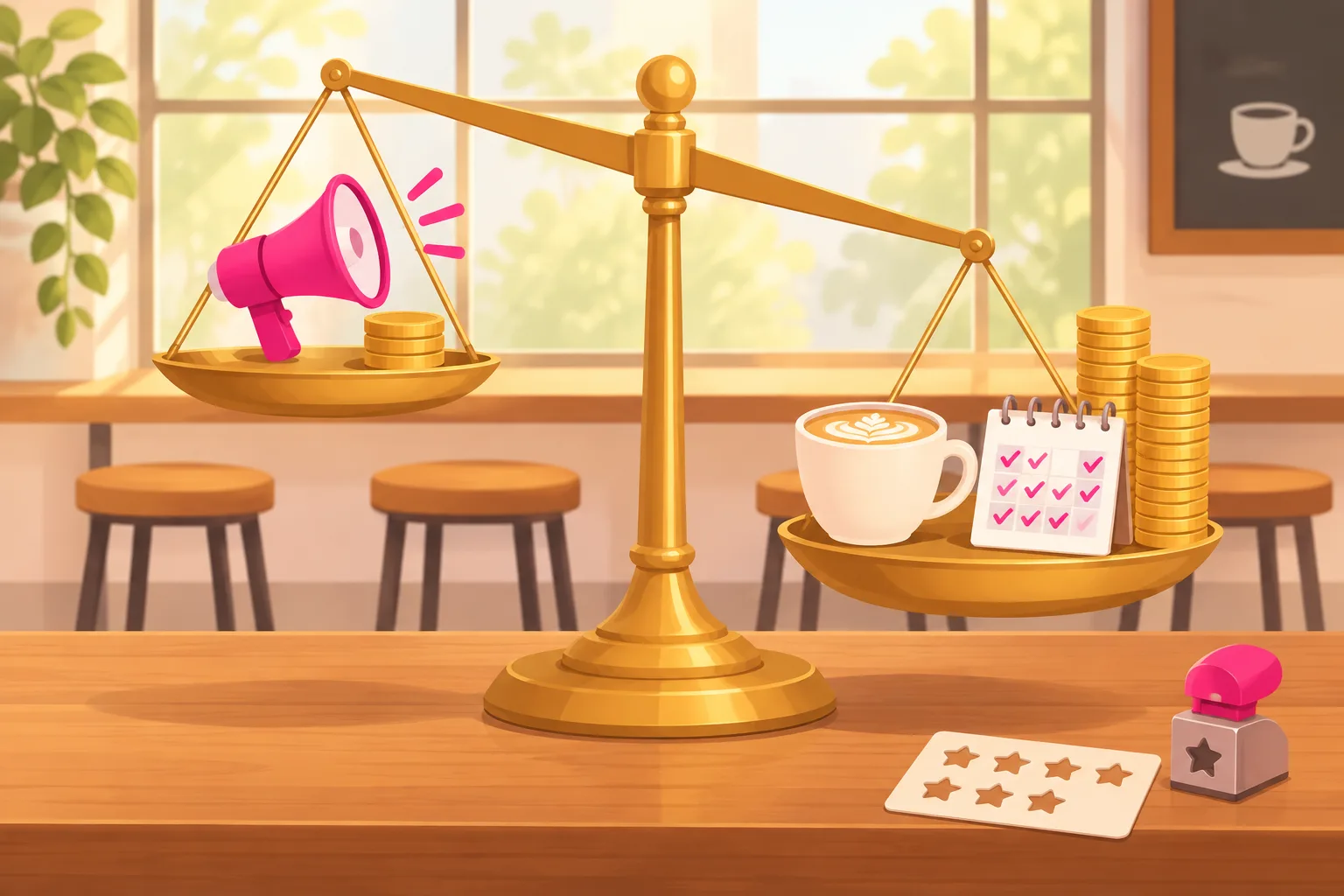
One more thing shapes the math. Regulars come from nearby. As a rule of thumb, a regular lives, works or passes within a few minutes of the door. Someone who loves your videos from forty minutes away may visit once on a Saturday. She will not stop in on a Tuesday before work.
So every ad has a second question: "how close is she?" The guide to how coffee shops make money from TikTok works through the regular math in full.
3. What a Promoted Video Actually Buys
A search ad sells you a click from someone who wants coffee now. A promoted video sells you attention from someone who was not thinking about coffee at all. If you expect one to behave like the other, you will be disappointed.
Think about what you are asking for. A morning coffee is a habit. The person you want already has a stop, or makes coffee at home. Changing that is a small decision, but people do not make it nine seconds after seeing a shop for the first time.
So do not aim a promoted video at a rush of visits. Aim it at followers who are nearby. A follower costs you once. After that she sees your next video, and the one after that, for free.
Here is how it usually goes:
- In the first week of January she sees your promoted first visit video. She recognizes the bus stop. She follows.
- Over the next two weeks she sees a drink being made, what oat milk costs, and a clip of the window seats at two in the afternoon.
- One morning her train is late. She already knows where to order and what a latte costs. She walks in.
- She gets a loyalty card with the first punch already made. That card is the reason for the second visit.
The ad paid for step one. Your regular videos, your menu page and the person at the register did the rest. That is why promotion only works when the rest is in place.
Before you spend anything, check three things:
- A video has already worked without money. People watched it to the end, saved it or sent it, and at least one first-timer mentioned it at the register.
- Your profile answers the next question. Where you are, your hours, and a menu with prices. If the link hides the prices, you are paying to send people to a dead end.
- The second visit is set up. A first-timer leaves with a reason to return. In our example shop that is the paper loyalty card with one punch already made.
If any of the three is missing, fix it first. It costs nothing, and it will help every other kind of advertising you buy.
4. Three Ways to Pay for It
There are three ways to put money behind a TikTok video. They differ in how much control you get and how much time they take.
The Promote button in the app
Promote is a button on your own videos. You pick a goal, an audience and a budget, and it runs. It takes a few minutes and needs no extra account.
It is fine for a small first test. Its limit is control. You get fewer choices about where the video is shown, and for a coffee shop the "where" is most of what matters.
TikTok Ads Manager
Ads Manager is TikTok's full advertising tool. It lets you choose locations more exactly, show the same video to two different groups, and see which group responds.
It also takes time to learn. There are goals, ad groups, bids and daily minimums to set. At the time of writing, TikTok's help pages give a minimum of about twenty dollars a day for each ad group, and fifty if you set a daily budget for the whole campaign. That is why a self-run test usually costs a few hundred dollars.
Inside Ads Manager, the format to use is called a Spark Ad. A Spark Ad promotes a video that is already on your account. The video keeps your shop's name, its comments and its follow button. When someone follows, they follow your real account.
Our Spark Ads guide explains the setup, and this comparison of Promote and Ads Manager covers the differences in more detail.
A promotion service
The third way is to pay a service to run the promotion. You choose the video and the budget. The service sets it up, tests audiences, and moves the money toward what is working. Section 10 covers when that makes sense, and what to ask before you sign up.
Whichever way you pick, choose a goal built around followers or profile visits. Do not choose a goal built around website sales, unless you are selling beans by mail. Your sale happens days later, at the register.
5. The Map: A Few Minutes From the Door
This is the hardest part of paid video for a coffee shop, so it is worth being plain about it. A regular post goes wherever TikTok sends it. A paid video goes where you point it. But no ad tool lets you point at four blocks.
In the United States, Ads Manager lets you choose locations in many cases down to the city. A city is far bigger than the area a coffee shop draws from. That means a share of the people you pay to reach will live too far away to ever become regulars.
You cannot remove that waste. You can shrink it. Three things help:
- Pick the smallest area the tool offers. Your city, not the metro area. Never the whole state or the whole country.
- Let the video sort people. Say the cross streets and the neighborhood in the first few seconds, and put them on screen as text. "We are on the corner across from the bus stop." People who do not know that corner will scroll past, which is what you want.
- Keep the budget small enough to forgive the waste. A two-week test can still pay for itself if it brings a handful of regulars. Section 7 shows the arithmetic.
Be honest with yourself about what this means. If you need exact streets, a mailer or a sign does that better than any video ad. A promoted video earns its place by showing the shop, not by precision.
There is one exception. If you sell bags of coffee by mail, that audience is national. A wide map is correct for a video about beans, a subscription or a mug.
Run that as a second, separate campaign and never mix the two. A neighborhood video shown to the whole country buys followers who cannot visit. A beans video shown only to your city misses most of the people who could order. The main guide's section on the two audiences explains the difference.
For more on how location works for any neighborhood business, see the local business TikTok marketing guide.
6. Four Videos Worth Paying For, and Four That Are Not
Most of your videos should never have money behind them. A few should. The ones worth paying for all answer the questions a stranger has before she walks in: where is it, what does it cost, and will there be room for me?
Four worth paying for
- The first visit. About forty seconds. The door from the street, where to order, the menu with two or three prices said out loud, where drinks come out, the seats and outlets, the wait at the busiest time, the hours. This is the first video to promote. The filming guide has the shot list.
- The quiet afternoon. "It is two in the afternoon and every window seat is open. There are outlets along the window. We close at four." This video sends people to the hours when you have room.
- The price video. You, at the bar, saying what a latte costs and what the money pays for. People save this one. A shop that says its prices out loud looks like a shop with nothing to hide.
- The loyalty card. Fifteen seconds. "Your first card comes with one punch already on it. Nine more drinks and the tenth is free. It never expires." It gives a new follower a reason to make the first visit.
The list of 55 content ideas has several versions of each. Whichever you pick, promote it only after it has done well with no money behind it.
Four not worth paying for
- The drink video with no location. A slow pour of milk into espresso is the most-watched kind of coffee video. It travels far, mostly to people who will never be near your door. Post it. Do not pay for it unless the name, the price and the cross streets are on screen.
- The logo and the address. A still picture with your name on it is a postcard that costs more. On paper it works. In a video feed people scroll past it.
- The discount. "Half off this week" brings people who came for half off. Section 2 explains why a crowd of one-time visitors is worth very little.
- Anything about a customer or another shop. A funny order, a complaint, a comparison with the place down the street. It tells everyone watching that they could be your next video.
One more that needs care: the limited drink. A new seasonal drink is a good reason to visit, and it is fine to promote if you can make as many as people ask for. If it runs out by nine, paying for more viewers buys more people you have to disappoint. The guide for bakeries covers what to promote when the product sells out.
7. How Much to Spend: A $280 Example
Start with a test, not a year's budget. A test should be small enough that losing all of it would be annoying and nothing worse.
Here is an example for the corner shop. These numbers are an illustration of how to do the arithmetic. They are not a promise, and your results will differ.
The example
- The video: the first visit video, which first-timers had already mentioned at the register.
- The budget: $20 a day for two weeks, starting the first Monday of January. $280 in total.
- The area: the city, which was the smallest choice the tool offered.
- The goal: followers.
The shop keeps a tally sheet by the register. Every first-timer is asked how they found the shop. Anyone who mentions a video gets a loyalty card with a small dot in the corner. Before the ad, about nine first-timers a month mentioned a video.
On the last Friday of February, the owner counts what happened in January and February:
- About 210 new followers during the two weeks of the ad.
- 31 first-timers who mentioned a video.
- 15 of those dotted cards came back for a second punch.
By the end of March, eight of those people are in most weeks. Now the arithmetic, done honestly:
- What would have happened anyway: nine a month for two months is 18 first-timers. The ad gets credit for the other 13.
- Cost per extra first visit: $280 divided by 13 is about $22. A first visit is worth about $6. On first visits alone, the ad lost money.
- Extra regulars: 13 of the 31 first-timers came from the ad, so give it the same share of the eight regulars. That is about three.
- Cost per extra regular: $280 divided by three is about $93.
- First-year sales from those three: three times $900 is $2,700.
Three honest notes about this example. First, look at how the result depends on the second visit. The ad brought people in at a loss. The loyalty card, the name remembered at the register and the coffee turned three of them into regulars. Without those, $280 would have bought 13 lattes.
Second, a weaker result is still worth knowing. If the same $280 had brought one extra regular, that is about $900 of sales in a year. After coffee, milk and wages, it is close to breaking even. That is a reason to try a different video before spending more.
Third, if it had brought followers and no new faces, the test did its job. It told the owner that the video does not say clearly enough where the shop is, or that the promotion ran too far away.
For scale, the same $280 is about a thousand postcards in postage, before printing. Neither is the right answer for every shop. Run each one once, count the dotted cards and the postcards people bring in, and keep the one that brings regulars for less.
Three budget rules
- Set the total before you start. Write it down. Do not add to it because the first few days look good or bad.
- One video, one area, one goal. If you change three things at once, you will not know which one mattered.
- Judge it in regulars, about two months later. Followers and views arrive in days. Second visits take weeks. Wait for the number that pays the rent.
8. When to Spend and When to Pause
A coffee habit is hard to change in an ordinary week. It changes easily when a person's days change. That makes timing worth more than budget.
- Late August into September. School starts, people return to offices, and new neighbors have just moved in. Many people are choosing a morning stop for the year.
- The first weeks of January. New jobs, new schedules and new resolutions. The example in section 7 used this window.
- The two weeks around an opening. A new shop is news on its street once. The five grand opening videos are the ones to choose from.
- The rest of the year: usually nothing. Keep posting. Spend little or nothing. A settled month is an expensive time to ask people to change a habit.
A promoted video works best when a new follower finds a full profile. Start posting about six weeks before the window: mid-July for September, mid-November for January. The 90-day plan is built around those dates.
Ads are reviewed before they run, and review can take a day or more. Set the campaign up a few days before you want it to start.
Do not advertise a line you cannot serve
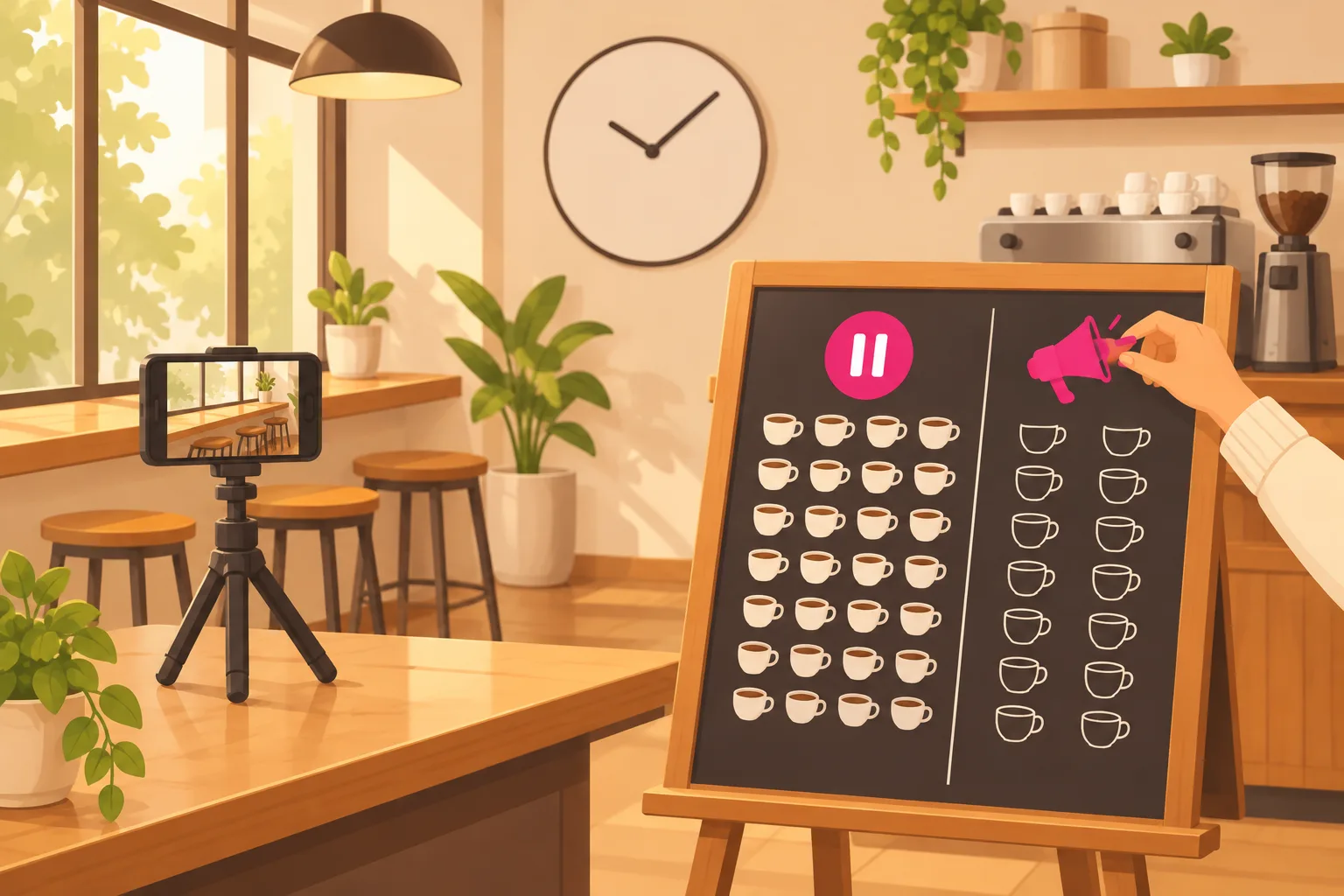
This rule matters more for a coffee shop than for almost any other business. In our example shop, the 7:40 line already takes about six minutes. If an ad adds ten people to it, the wait gets longer for the regulars who pay the rent, and the new people meet the shop at its worst.
So look at your day before you choose a video. A shop is rarely full all day. It is full at certain hours.
- If the morning line reaches the door, promote the quiet hours. In the example shop the rush ends around 9:30, and the afternoon has open seats until closing.
- If the seats are full at lunch, promote takeaway, or the early morning.
- If one item sells out, do not put it in a paid video. Promote something you can make all day.
- If every hour has room, promote the first visit video and say the wait honestly.
A quiet-hours video has a second benefit. The people it brings are the ones with time to sit down, look around and talk to whoever is behind the bar. That is how a first visit turns into a second one.
And if the whole shop is as busy as you want it to be, pause. Save the money for the next window. An ad you do not need is the easiest saving there is.
9. The Rules a Paid Video Has to Follow
A paid video is an advertisement. It is held to a higher standard than a regular post, by TikTok and by the law. None of these rules is hard to follow, but each one is easier to handle before the ad runs than after. This is general information, not legal advice, and rules differ from place to place.
Permission
- Customers. The simplest rule is that no customer appears in a paid video at all. If a customer wants to be in one, saying yes to a regular post is not saying yes to an ad. Ask again, in writing, for the one video you want to promote. The filming guide covers how to keep people, laptop screens and names on cups out of the shot.
- Staff. Anyone who works for you and appears in the video should be asked each time a video is going to be promoted. Being in a post and being in an ad are different things. The six-line staff page has a line for it.
- Children. Never in a paid video, even with a parent's yes.
Honest claims
- The price. The price in the ad is the price people pay at the register. If oat milk is 75 cents more, do not film the oat milk latte and say the plain latte price.
- The offer. If you advertise a free drink or a special price, say the dates and the limits in the video. If it is a giveaway with a prize, rules on those differ by state, so check yours first.
- Health. Do not say coffee, or anything you add to it, treats or prevents anything. Be careful with words like "gluten-free" and "allergen-free." Say what is in the drink and let people decide.
- Reviews. In the United States, federal rules do not allow paying for reviews or offering rewards for positive ones. If you quote a customer's review in an ad, use her words, ask first, and leave out her full name.
Three TikTok rules
- A hiring video is a job ad. If you pay to promote "we are hiring a barista," TikTok treats it as an employment ad in the United States and Canada. You have to declare it when you set it up, and some targeting choices, such as age, gender and ZIP code, are switched off. Write it about the job, the pay and the hours. Do not write it about what kind of person should apply.
- Music. A song that is fine in a regular post may not be allowed in an ad. Use TikTok's library of music cleared for business use, or use the sound of the shop. The music section of the filming guide explains why the grinder and the steam are often enough.
- Alcohol. If your cafe serves beer, wine or coffee cocktails in the evening, keep them out of a paid video until you have read TikTok's current rules. Alcohol advertising is tightly limited, and the limits differ by country.
Platform rules change. Check TikTok's current advertising policies before each campaign. The main guide's rules section covers the same ground for regular posts.
10. The Numbers to Check, and Who Should Run It
An ad dashboard shows dozens of numbers. You need five. Two come from the dashboard and three come from your own counter.
- Cost per follower. From the dashboard. It tells you whether the video is working as an ad. Compare it week to week, not against anyone else's number.
- Profile visits. From the dashboard. People who tapped through to see who you are.
- Taps on the menu link. From your link tool or website. If followers rise and menu taps do not, the video is not telling people what to do next.
- First-timers who mention a video. From the tally sheet. Ask every time: "Is this your first time in? How did you find us?" Never during the rush, and never in a way that suggests the answer.
- Dotted cards that reach a second punch. This is the number that matters at the end. Divide what you spent by the new regulars to get the cost of each one.
Check the first two once a week while the ad runs. It takes five minutes. Check the last three at the end of the month, and again a month later. Then put the cost of a regular next to what you paid for mailers, search ads or a sponsorship in the same year.
That comparison is the whole point. It turns "I think the videos are working" into a number you can show a partner or a bookkeeper. The four monthly numbers in the customers guide use the same records.
Run it yourself, or use a service?
Both are reasonable. The choice is about time.
Running it yourself makes sense if you like this kind of work, or someone on the team does. You get the most control over the map. The cost is the learning curve, on top of running the shop.
Using a service makes sense if you would rather spend those hours behind the bar. That is what Viryze is built for. You choose a video that has already worked. Viryze shows it to several different audiences, sees which one follows for the least money, and moves the budget there. The promotion runs on your real post, so the followers land on your real account.
Be clear about what a service can do for a neighborhood shop. Before you pay for any promotion service, ours included, look at the location choices it offers and ask how closely they match the area your regulars come from. If a service cannot keep a campaign close to your shop, use it for videos meant for a wider audience, such as coffee by mail, and promote the neighborhood videos another way.
Whichever you choose, the rules in this guide stay the same. Fix the free things first. Promote a video that has already worked. Keep the map small. Spend when routines change. Send people to the hours when you have room. Count the second visits.
For how other local businesses handle the same decision, see the TikTok advertising guide for salons, which pauses when the appointment book is full, and the advertising guide for landscapers, which pauses one route day at a time.
Frequently Asked Questions
What is the best advertising for a coffee shop?
Start with the things that cost little and reach people who are already close: a complete, current map listing and a sidewalk sign. Most people choose a coffee shop because it is on their way, so being easy to find nearby matters more than being seen widely. After that, mailers let you choose exact streets, which is useful for an opening. A promoted TikTok video is slower. It lets people nearby watch the shop for a few weeks before they come in. Whatever you use, ask every first-timer how they found you and compare the cost of each new regular.
Do TikTok ads work for coffee shops?
They can, if you use them for the right job. A promoted video is good at showing people what the shop is like inside, what a drink costs and when there is a seat, before they have ever walked in. It is not good at filling the shop tomorrow morning. It works best when the video has already done well without money, the menu page shows your prices, and the video says where you are in the first few seconds. Judge it by first-timers at the register, not by views.
How much should a coffee shop spend on TikTok advertising?
Start with a small test. If you run TikTok Ads Manager yourself, the minimum is about twenty dollars a day for each ad group at the time of writing, so two weeks is about $280. That is enough to learn whether a video brings new faces. Before you decide whether it paid off, compare it with what a regular is worth to you. In our example, a regular who comes three times a week spends about $900 a year.
When should a coffee shop advertise?
When routines change. People pick a new morning stop when their days change: late August and September, when school and work schedules restart, and the first weeks of January. A small budget in those weeks does more than a large one in a settled month. A new shop has a third window, which is the two weeks around its opening. In every case, start posting regular videos about six weeks earlier, so there is something for a new follower to watch.
Should I promote a video for followers or for visits?
Followers, in most cases. Nobody changes their morning routine a few seconds after seeing a shop for the first time. A follower nearby sees your next several videos for free, and she can come in when it suits her. A goal built around instant visits or website sales does not match how people choose a coffee shop. The exception is a shop that sells beans by mail, where a sale can happen online the same day.
Can I show a TikTok ad only to people in my neighborhood?
Not exactly. TikTok Ads Manager lets you choose locations in the United States, in many cases down to the city. A city is still much larger than the few blocks most regulars come from, so expect many viewers who live too far away to become regulars. Choose the smallest area the tool offers, say your cross streets in the first seconds of the video, and judge the result by how many first-timers mention a video at the register.
Which video should a coffee shop promote first?
The first visit video: the door from the street, where to order, the menu with two or three prices said out loud, where drinks come out, the seats and the wait. It answers the questions that stop a stranger from walking in. Promote it only after it has done well with no money behind it. The second choice is a video of the quiet afternoon, with the open seats and the hours.
Should a cafe advertise a discount or a free drink?
Usually not. A discount brings people who came for the discount, and many of them do not return at full price. A coffee shop earns its money on the second, tenth and hundredth visit. A loyalty card with the first punch already made does the same job at the register, costs one drink in ten, and only rewards people who come back. If you do advertise an offer, say the price, the dates and the limits plainly in the video.
A video that works and an hour with room?
If one of your videos has already brought a first-timer to the register, your menu page shows your prices, and you know which hours have open seats, the next step is more of the right viewers before routines change. Viryze can put that video in front of more people, test which audience responds, and shift the budget to what is working - so more viewers become followers and, in time, some of them become regulars.
Related Reading
- TikTok for Coffee Shops and Cafes: The Complete 2026 Guide - the full strategy this guide is part of.
- How to Get Coffee Shop Customers From TikTok: The First Visit, the Second Visit and a Simple Loyalty Program - the menu page and the loyalty card to set up before you spend.
- How Coffee Shops Make Money From TikTok: Regulars, Gift Cards, Beans by Mail and Office Orders - what a regular is worth, and the one audience that is national.
- Coffee Shop Marketing on TikTok: A 90-Day Plan for Growing Regulars - the plan that produces a video worth promoting, and the tally sheet.
- How to Film Coffee Shop Videos for TikTok (Quiet Hours, the Pour Shot and Customers Out of Frame) - the first visit shot list, permission and music.
- Coffee Shop TikTok Content Ideas: 55 Videos That Bring In Regulars - 55 ideas, including the first visit and the quiet afternoon.
- TikTok for Bakeries and Bakery Cafes: Sell-Outs, Pre-Orders, Holiday Deadlines and Custom Cakes - the same questions when the case empties by ten.
- Spark Ads on TikTok: Creator's Complete Guide - how to promote a post that is already on your account.