
Coffee Shops12 min read
How to Get Coffee Shop Customers From TikTok: The First Visit, the Second Visit and a Simple Loyalty Program
A plain guide for independent coffee shops and cafes on turning TikTok viewers into regulars: the eight steps from a view to a habit and the three places people drop off, what to put in the profile and on the menu page, three saved replies written out in full, how to make the first visit match the video, how to win the second visit, how to set up a simple coffee shop loyalty program (paper punch card or app), learning names, and the four numbers that show which step needs work.
By Ryan MitchellHead of Creator Success at Viryze
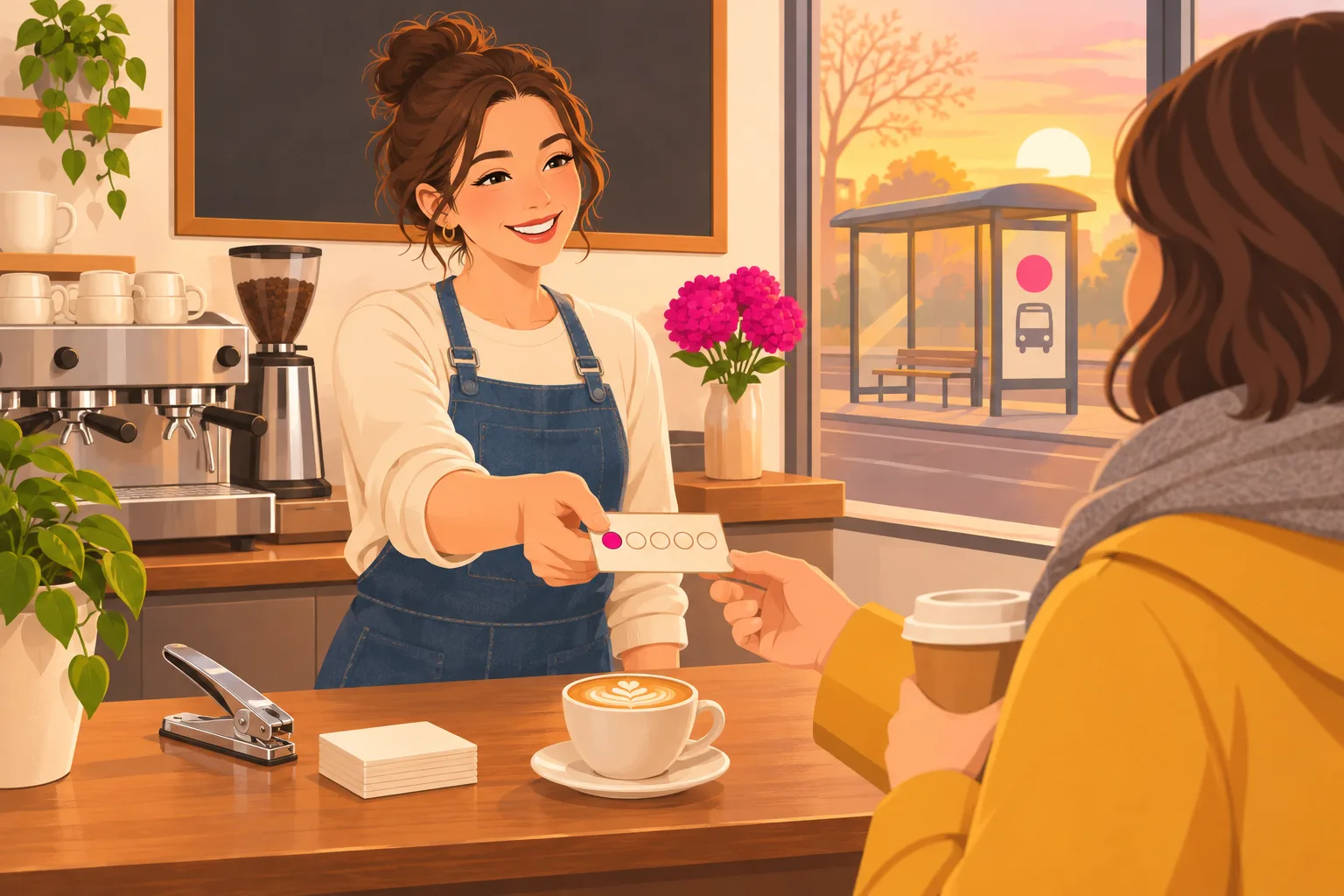
A video can get a thousand views and your morning can look exactly the same. That is common, and it does not mean TikTok is not working. It usually means something small is in the way between the video and your door.
This guide walks through every step from a view to a regular. It shows where people drop off, and what to fix at each place. It spends the most time on the step that matters most: the second visit, and the simple loyalty program that helps it happen.
It is one part of our complete TikTok guide for coffee shops and cafes. You do not need any marketing background to follow it.
The short version:
- Say where you are and what one drink costs in every video.
- Link to a menu page with typed prices, hours and cross streets.
- Make the first visit match the video.
- Hand every first-timer a loyalty card with the first punch already made, and learn her name.
- Count second punches, not followers.
What This Guide Covers
- 1. The Eight Steps From a View to a Regular
- 2. The Three Places People Drop Off
- 3. The Profile: Four Lines and Three Pinned Videos
- 4. The Menu Page
- 5. Three Saved Replies
- 6. The First Visit Has to Match the Video
- 7. The Second Visit
- 8. A Coffee Shop Loyalty Program That Fits on a Card
- 9. Paper Card or App?
- 10. Learning Names
- 11. When a Regular Brings Someone
- 12. Four Numbers That Show Which Step Needs Work
- 13. Six Mistakes to Avoid
- 14. When to Put Money Behind a Video
- Frequently Asked Questions
1. The Eight Steps From a View to a Regular
A stranger does not become a regular in one step. Our main guide lists eight:
- She sees a video.
- She follows, or sends it to a friend.
- She looks at your profile.
- She opens your menu page.
- She comes in once.
- She comes back within a week or two.
- It becomes a habit.
- She brings someone.
Videos do the first two steps. The profile and the menu page do the next two. Everything after that happens inside your shop, and no video can do it for you.
Why the last steps matter
A coffee shop sells a habit. A regular who comes in three times a week and spends about $6 each time is worth about $900 a year. A person who visits once is worth $6.
So one regular is worth the same as 150 people who come once. That is why this guide cares more about step six than about step one.
The example shop in this guide
This guide uses the same made-up shop as the rest of the series. It sits on a corner across from a bus stop. It opens at 6:30 and closes at 4, and it has twelve seats. A latte costs $5.50 and drip coffee costs $3.25. A barista named Sam works the morning bar.
Every number about that shop is an example. Yours will be different, but the steps are the same.
2. The Three Places People Drop Off
People can stop at any step. In practice, most of them stop at one of three places.
After the video: "Where is this?"
She liked the drink, but she has no idea if your shop is ten minutes away or ten hours away. So she scrolls on.
The fix is to put your location in every video. Say the cross streets and the neighborhood out loud. Write them in the caption. Add them as text on the screen.
On the profile and the menu page: "I cannot find the price."
She tapped through to learn three things: what it costs, when you are open and how to get there. If she cannot find them in a few seconds, she leaves. Sections 3 and 4 fix this.
After the first visit: nothing brings her back
This is the biggest drop of the three. She came in and the coffee was good. But her old routine is still there, and nothing reminds her of you on Tuesday morning. Sections 6 to 10 are about this one.
3. The Profile: Four Lines and Three Pinned Videos
Your profile is the first place she looks after a video. She will give it a few seconds, so it has to answer her questions fast.
The four lines
- What and where. "Coffee and pastries on the corner of [your two streets]."
- When. "Open 6:30 to 4."
- One true thing about sitting there. "Twelve seats. Laptops welcome."
- The link. "Menu and prices below."
Put the neighborhood in the profile name too, after the shop name. People search for coffee by place.
The three pinned videos
- The first visit video. The door from the street, where to order, three prices, the seats and the wait. This is idea 1 in our list of 55 coffee shop content ideas.
- The loyalty card video. Show the card and the punch, and say what it is worth. This is idea 20 in the same list.
- The new thing this week. Change this one whenever there is a newer one.
Together, these three tell a stranger what a visit is like, why to come twice and why to come this week.
4. The Menu Page
The link in your profile should go to one page. It can be a page on your website or a simple link page. What matters is what she sees first.
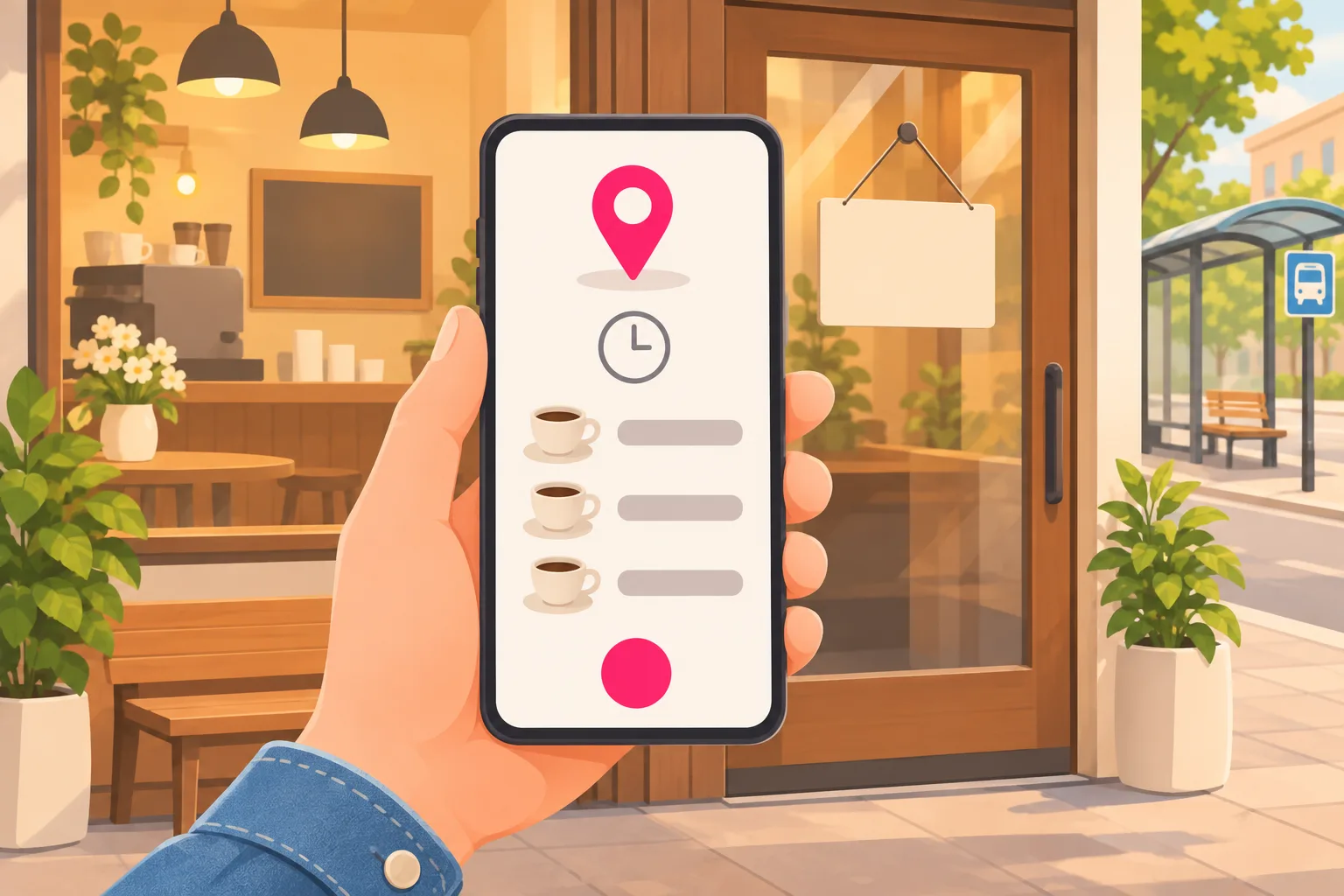
Put these on the page, in this order:
- Where you are. The shop name, the two cross streets and the neighborhood, in words. Add one landmark, such as "across from the bus stop". Put a map button under it.
- When you are open. The hours for every day of the week. If a holiday changes them, put that at the top of the page the week before.
- The menu with prices, typed out. Type it as text. Do not post a photo of the menu board, because nobody can read it on a phone. In the example shop the page starts with a 12-ounce latte at $5.50 and drip coffee at $3.25.
- The small extras people ask about. Oat milk is 75 cents more. Any drink can be made decaf for the same price. Say what you have for someone who avoids dairy or gluten, and be honest about what you do not have.
- What it is like inside. Twelve seats. Outlets along the window. Laptops are welcome. There is no parking, but the street behind usually has room before nine.
- The wait. Say the truth. "At 7:40 the line takes about six minutes. After 9:30 there is usually no line."
- The loyalty card. One line is enough. "Your tenth drink is free, and your first card comes with a punch already on it."
The first three should show without scrolling. A person standing at a bus stop will decide from those alone.
Keep it true
Check the page on the first of each month. Are the prices right? Are the hours right? A wrong price on your own page does more harm than no price at all.
Also check your listing on map apps the same day. Many people will see a video on TikTok and then look you up on a map. The hours should match everywhere.
5. Three Saved Replies
A comment with a question is a person deciding whether to come in. Three questions come up again and again. Write the answers once and keep them in the notes on the shop phone.
"How much is it?"
"A 12-ounce latte is $5.50 and drip coffee is $3.25. Oat milk is 75 cents more. The full menu is at the link in our profile."
"Where is this?"
"We are on the corner of [your two streets] in [your neighborhood], across from the bus stop. Open 6:30 to 4 today."
"Do you have oat milk, decaf, or anything without gluten?"
"Yes to oat milk, for 75 cents more. Any drink can be made decaf for the same price. Nothing in our pastry case is made without gluten, so we would rather be honest about that."
Change the last one to fit your shop. Give a clear yes or no. Never promise that something is safe for an allergy unless you are certain.
How to use them
- Answer on the same day. Ten minutes a day is enough for most shops.
- Answer in the comments, where the next person with the same question can see it.
- Change a few words each time so it does not read like a machine.
- If one question keeps coming, make a video that answers it.
6. The First Visit Has to Match the Video
Walking into a new coffee shop is a little awkward. Where do I order? Do I wait here or over there? Your first visit video took that worry away. Now the shop has to keep the promise.
Check four things
- The door. Does it look the way it does in the video?
- The register. Is it where the video said to order?
- The prices. Are they the ones you said out loud?
- The wait. Is it about what you said?
When one of these changes, film that clip again. Our filming guide builds the first visit video from eight short clips for this reason. A new price means one new clip, not a whole new video.
What the person at the register does
A first-timer should get three small things:
- One question. "Is this your first time in? How did you find us?" Put a mark on the tally sheet. Skip the question during the rush.
- The card. "Your tenth drink is free, and the first punch is already on it." This takes five seconds, so it happens even at 7:40.
- Her name. Ask for it for the cup, and say it when you hand over the drink.
The tally sheet is explained in our 90-day growth plan. Ask "How did you find us?" and not "Did you see us on TikTok?" People like to say yes to a friendly barista.
Everyone on the bar knows
This only works if every person who takes orders does it. Tape the three steps next to the register. Go over them once with each new hire.
A person who comes in with a gift card for the first time counts as a first-timer too. She gets the same three things.
7. The Second Visit
One visit is a try. Two visits close together are the start of a routine. If the second visit does not happen within a week or two, it often does not happen at all.
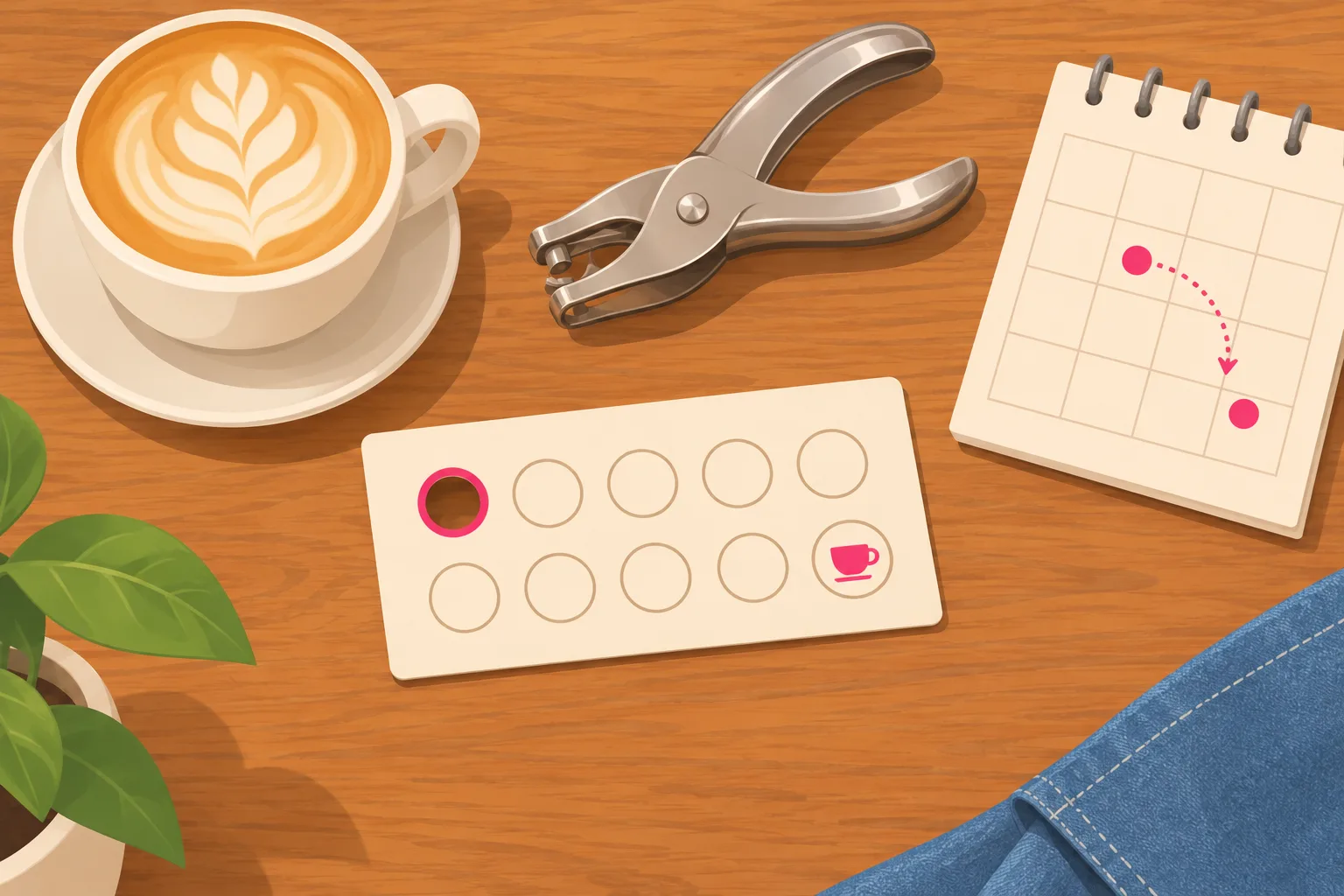
Four small things bring her back:
- A card in her wallet with one hole in it. She sees it every time she pays for something.
- A day, said out loud. "See you Thursday" is friendlier than "come again", and it plants a day in her head.
- A reason tied to a day. "We only bake that one on Saturday, and it is usually gone by nine."
- Your next video. If she follows you, Friday's video about the new thing reaches her before the weekend.
What not to do
Do not hand her a coupon for money off her next drink. It works once, and it tells her your prices are not the real prices. The card does the same job without that message.
Do not ask for her email or phone number either. She came in for a coffee, not to sign up for something.
Count it
When you punch a card that has only its starting punch, add a mark to the "second punch" row of the tally sheet. That mark is the most useful number in this whole guide. It counts people who chose you twice.
8. A Coffee Shop Loyalty Program That Fits on a Card
A coffee shop loyalty program does not need software. It needs one clear promise that your staff can say in five seconds and your customers can remember.
In the example shop the promise is this: buy nine drinks and the tenth is free. The card has ten circles. A first-timer's card is handed over with the first circle already punched.
Six choices to make
- The reward. Make it any drink on the menu. A reward with small print ("drip coffee only, small size") feels like a trick at the moment it should feel like a thank-you.
- The number. Ten is the usual choice for coffee. A person who comes three mornings a week gets a free drink about every three weeks, which is soon enough to care about. A card that needs twenty feels too far away.
- What earns a punch. One punch for each drink. Two drinks earn two punches. Keep it that simple, so nobody at the register has to do arithmetic at 7:40.
- The head start. Hand a first-timer a card that already has its first punch. A card that has been started feels worth keeping. A blank one often goes in the bin.
- The words on the card. Print one sentence: "Buy nine drinks and the tenth is free." Add your cross streets and your hours on the back. Do not print an expiry date.
- The punch. Use a hole punch with an unusual shape, such as a small star, and keep it at the register. A round hole is easy for anyone to copy at home.
Why the head start works
People are more likely to finish something they have already started. A well-known study of car wash loyalty cards, published in 2006 by Joseph Nunes and Xavier Drèze, tested this. Customers who got a card with the first stamps already filled in came back sooner than customers who got a blank card, even though both groups needed the same number of washes.
Some shops go further and give a first-timer two punches. The example shop gives one, so that a second punch always means a second visit. That keeps the count simple.
What it costs you
One free drink in ten is, at most, ten percent off for your most loyal customers. A regular who visits about 150 times a year earns about fifteen free drinks.
Each free drink costs you the coffee, the milk and the cup. That is much less than the menu price. In return, that regular spends about $900 a year with you. It is one of the cheapest things you will ever pay for.
Small rules that save trouble
- Lost card. Start a new one with a smile. Do not argue about how many punches the old one had.
- Two half-full cards. Add them together. She earned them.
- The free drink. Keep the finished card and hand her a new one with its first punch made.
- Never for reviews. Do not give a punch or a free drink in exchange for a good review. Ask for honest reviews and reward nobody for them.
Tell people about it
A loyalty program only works on people who know about it. Pin the card video. Put the one line on your menu page. Say it at the register to every new face.
Here is a script for the video:
"Your tenth drink is free. If you come three mornings a week, that is a free drink about every three weeks. And your first card comes with one punch already on it."
9. Paper Card or App?
Sooner or later someone will offer you a loyalty app, or you will notice that your register system has a loyalty feature. Both paper and software can work. They are good at different things.
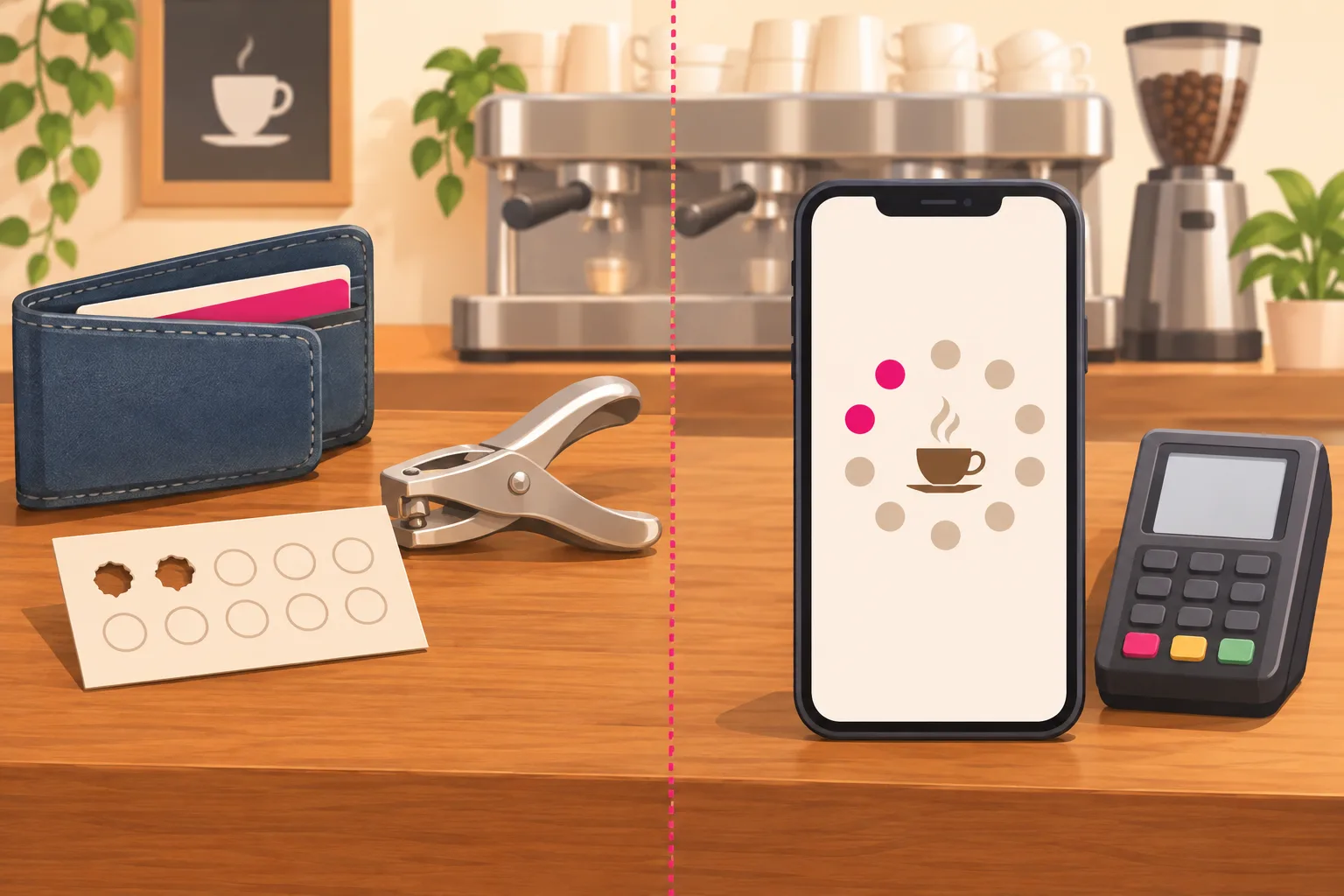
| What matters | Paper card | App or register program |
|---|---|---|
| Cost | A box of printed cards and a hole punch | Often a monthly fee. Check what your register already includes |
| At the rush | One punch, about a second | Typing a phone number can slow the line |
| What the customer gives you | Nothing | Usually a phone number or an email |
| If it is lost | The punches are gone | Nothing is lost |
| Counting | You count by hand on the tally sheet | It counts for you, including who came back |
| As a reminder | She sees it in her wallet every day | Out of sight, unless you send messages |
Our suggestion
Start with paper. It is cheap and fast, and it asks nothing from a person who has only just met you. You can begin tomorrow.
Think about software when one of these is true:
- Your register already includes a loyalty feature at no extra cost.
- You have a second location and want one program for both.
- Many of your orders are placed ahead on a phone, where a paper card cannot go.
- Regulars keep telling you they have lost their cards.
If you do switch, keep the same promise. The tenth drink is still free, and a new person still starts with one already counted. Honor the paper cards that are still out there.
A caution about messages
Some programs can send texts or emails to your customers. In the United States, marketing texts need the person's clear permission first, and other countries have their own rules. Ask the company that provides the program how it handles this. And send very little. A regular does not need a text to remember where she gets her coffee.
10. Learning Names
A card gives a person a reason to return. A name gives her a place where she is known. The second one is stronger, and it costs nothing.
Three moments
- The order. You already ask for a name for the cup. Listen to it.
- The drink. Say the name when you hand the drink over. "Latte for Dana."
- The goodbye. Say it once more, with a day. "See you Thursday, Dana."
The usual
On the third visit, try this: "Same as last time?" A person who has a usual order at your shop is a regular, whether or not she has thought of it that way.
If remembering is hard, keep a small notebook behind the bar. Write a first name and a usual drink, and nothing else. New staff can read it on their first week and greet people the way Sam does.
Keep names off the phone
What you know about a customer stays in the shop. Do not put a customer's name, her order or the name on her cup in a video. If a regular wants to be in a video, ask first and get her yes in writing, as the filming guide explains.
11. When a Regular Brings Someone
The last step is the one that grows a shop without any more videos. A regular brings a coworker, a friend or a study group.
The spare card
When a card reaches its fifth punch, hand over a second card with its first punch made. Say: "This one is for whoever you bring next time."
It is not a discount, and it costs you one punch. But it gives your regular something to hand to a coworker, and it gives the coworker a head start.
The video that gets sent
People send coffee shop videos as invitations. "Saturday?" with a link is a plan to meet. The video that gets sent most is the new thing this week, so say three things in it: what it is, what it costs and how long you will have it.
The office
A regular who carries four cups back to work every morning is already bringing people. Our guide to how coffee shops make money from TikTok shows how to turn that into a standing order for the whole office.
12. Four Numbers That Show Which Step Needs Work
Once a month, write down the same four numbers the rest of this series uses:
- Taps on the link to your menu page.
- First-time customers who said they saw a video.
- Loyalty cards that reached a second punch.
- Drinks sold on an ordinary weekday morning.
Each number sits at a different step. Read them in order, and they show you where people stop.
| What you see | Where people stop | What to work on |
|---|---|---|
| Views, but few taps on the link | After the video | Say the cross streets and a price in every video. Fix the four lines and the pinned videos |
| Taps, but few first-timers who mention a video | On the menu page | Put the address, hours and prices at the top. Also check that the viewers are nearby |
| First-timers, but few second punches | After the first visit | Is every first-timer getting the card and hearing her name? Does the visit match the video? |
| Second punches, but the weekday morning is flat | Nowhere yet | Be patient. Habits take a few months to show up in the morning count |
Reading the example shop
In the third month of our growth plan, the example shop counted 80 taps on the menu link and nine first-timers who mentioned a video. Nineteen cards reached a second punch that month, counting every new customer and not only the ones who saw a video.
Eighty taps and nine visits is not a worrying gap. Many of the people who tapped live too far away to come. So the owner looks at the last step instead. Of the cards handed to new people, how many came back?
If that share is low, the fix is not another video. It is the five seconds at the register.
A note on viewers far away
Some of your views will always come from people who can never visit. That is normal. Do not count them as a leak. Judge your videos by what happens near your door.
13. Six Mistakes to Avoid
- A discount for followers. "Show this video for a dollar off" brings in people who came for the dollar. It also teaches your regulars to wait for the next offer. The loyalty card rewards the thing you want, which is coming back.
- A link that goes to a photo of the menu board. People pinch and zoom, give up and close the page. Type the menu out.
- A visit that does not match the video. If the price went up or the register moved, film that one clip again. A first-timer who pays more than the video said will not trust the next video.
- Asking for a phone number on the first visit. A stranger buying one coffee does not want to join anything. Give her a paper card and ask nothing in return.
- Answering comments three days late. Someone who asks "where is this?" is deciding about this week. Answer within the day, with the saved reply.
- Counting followers. Followers can live anywhere. The number that shows whether the plan works is how many cards come back for a second punch.
14. When to Put Money Behind a Video
Paying to show a video to more people only helps when the later steps work. If first-timers are not coming back, more first-timers will not fix it. Get the card, the names and the menu page right first.
A video has earned a small budget when:
- First-timers have mentioned it at the counter.
- Cards from those first-timers are coming back for a second punch.
- You can serve more people at the time the video invites them.
The last point matters. If your 7:40 line already reaches the door, promote a video about the quiet hours after 9:30 instead.
Which video
The first visit video is usually the right one. It answers every question a new person has. The two best times of year are early September and early January, when people change their routines and a new morning stop can stick.
Our guide to local business TikTok marketing has more ways to reach people close to your door.
If you do spend
Keep the budget small and aim for followers, not a one-day rush. A follower sees your next videos for free and can come in when she is ready.
You can do this yourself in the TikTok app. If you would rather spend the time behind the bar, Viryze can run it for you. You pick the video. Viryze shows it to several different audiences, sees which one follows for the least money, and moves the budget there. The promotion runs on your real post, as our Spark Ads guide explains.
One caution applies to every tool and service, ours included. Check the location choices before you pay. A coffee shop needs viewers who can walk in. If a service cannot keep a campaign close to your shop, know that before you start, and judge it by the tally sheet and not by the follower count.
Frequently Asked Questions
How do I get customers into my coffee shop from TikTok?
Make every step after the video easy. Say your cross streets and one price in each video. Pin a first visit video that shows the door, where to order, three prices, the seats and the wait. Link to a menu page with typed prices and hours. Answer "how much" and "where is this" on the same day. Then make sure the visit matches the video, and hand every first-timer a loyalty card that already has its first punch.
What is the best loyalty program for a small coffee shop?
For most independent shops, the best coffee shop loyalty program is the simplest one: a paper card, one punch for each drink, and the tenth drink free. Give first-time customers a card with the first punch already made. It costs very little, needs no phone or sign-up, and is fast during the morning rush. Move to an app or a register-based program later if you need it to keep count for you.
Is a paper punch card or a loyalty app better for a coffee shop?
A paper card is cheaper, faster at the register and asks nothing of the customer. An app or a program built into your register cannot be lost, counts visits for you and can show how many new customers came back. It usually costs a monthly fee and often asks for a phone number, which slows the line and puts some people off. Many shops start with paper and switch only when they have a clear reason.
How do I get first-time coffee shop customers to come back?
Aim for a second visit within a week or two, because that is when a new stop can turn into a habit. Three things help. Give her a loyalty card with the first punch already made. Learn her name and say a day, as in "see you Thursday". And give her a reason tied to a day, such as the pastry you only bake on Saturday. None of these cost more than a few cents.
Should a coffee shop offer TikTok followers a discount?
Usually not. A discount brings people who came for the price, and many of them live too far away to become regulars. A loyalty card is a better offer, because it only rewards people who come back. If you want something special for new people, the head start on the card already does that job.
How do I know where my coffee shop is losing people between a video and a visit?
Keep four numbers once a month: taps on the link to your menu page, first-time customers who said they saw a video, loyalty cards that reached a second punch, and drinks sold on an ordinary weekday morning. Few taps means the videos or the profile need work. Plenty of taps but few first-timers points to the menu page or the address. First-timers who do not return points to the visit itself.
Start with the card and the menu page
A box of loyalty cards, a typed menu page and three saved replies cost almost nothing, and you can have all three ready this week. Later, when cards from video first-timers are coming back and you want more people to see the video that brought them, Viryze can put it in front of several audiences, find the one that follows for the least money, and shift the budget there. You stay behind the bar.
Related Reading
- TikTok for Coffee Shops and Cafes: The Complete 2026 Guide - the full plan this guide belongs to.
- Coffee Shop Marketing on TikTok: A 90-Day Plan for Growing Regulars - the tally sheet and the monthly numbers in detail.
- Coffee Shop TikTok Content Ideas: 55 Videos That Bring In Regulars - including the first visit video and the loyalty card video.
- How to Film Coffee Shop Videos for TikTok (Quiet Hours, the Pour Shot and Customers Out of Frame) - how to film the first visit video in eight short clips.
- How Coffee Shops Make Money From TikTok: Regulars, Gift Cards, Beans by Mail and Office Orders - what regulars buy besides coffee.
- Getting Clients Into the Chair: Turn TikTok Views Into Rebooks - how another neighborhood business wins the second visit.
- Local Business TikTok Marketing: Get Customers in Your Area - how to reach people close to your door.
- Spark Ads on TikTok: Creator's Complete Guide - how to promote a post that is already on your account.