There is a very particular kind of frustration that hits therapists about four months into posting. The videos are landing. One of them - the one about why you apologize when someone else bumps into you - did 1.2 million views. The comments are full of "I have never felt so understood" and "I wish you were my therapist."
And you still have the same six open slots you had in May.
That gap is almost never a content problem. It is a handoff problem - and in this profession it has a twist no other one has. Mental health content travels nationally by default, and your license stops at a state line.
So you can earn the trust of a million people and be legally able to treat almost none of them. Meanwhile the ones you could treat are making a series of small, separate decisions between "this person gets it" and "my first session is Thursday at 4." Most practices have quietly built four or five of the eight.
This guide is about sealing those leaks. It picks up where the 90-day growth roadmap leaves off and plugs into the broader strategy in our complete TikTok guide for therapists. If people are already watching you, everything below is about making sure the ones you can actually help find their way to your consult form - safely, and at the pace they are ready for.
The short version:
- Views are not the product - a well-matched client in your state is. A few hundred people inside your license beat a million scattered viewers, because only one group can legally sit across from you.
- Your profile is the waiting room. License and state in the bio, openings said out loud, a pinned trio that dissolves first-session fear, and a consult form one tap away.
- The door is a form, never "DM me." An inbox is not a secure channel, and it cannot ask the one question that matters first: what state are you in?
- Your inbox will receive three messages - the crisis message, the in-state consult request, and the out-of-state request. Each needs a prepared reply before the first one arrives.
- The ladder ends differently here. Every other profession wants the client forever. Your seventh rung is a client who no longer needs you, and that is what powers the eighth.
- Track counts, never names. You will undercount this channel unless you measure it, and you can measure it without a single client ever appearing in a spreadsheet.
What's Inside
- 1. Why Views Don't Fill a Caseload
- 2. The Caseload Ladder: Eight Rungs From Viewer to Referral
- 3. Rungs 1-3: Turning Nationwide Views Into People in Your State
- 4. Rung 4: The Trigger Moment - Your Profile Is the Waiting Room
- 5. Rung 5: Earning the Consult Request (CTAs That Work Under Your Ethics Code)
- 6. Rung 5, Continued: The Three Messages and the Reply for Each
- 7. Rung 6: The Consult Call and the First Session
- 8. Rungs 7-8: The Treatment That Ends Well and the Referral You Never Ask For
- 9. High-Intent Content: The Videos That Actually Produce Consult Requests
- 10. Ethics at the Inquiry Stage (The Part Nobody Warns You About)
- 11. Tracking Which Videos Are Actually Filling the Caseload
- 12. Amplify the Video That Already Fills Slots - Before the Wave
- Frequently Asked Questions
1. Why Views Don't Fill a Caseload
A view is a stranger watching you for fourteen seconds. A new client is a person deciding to tell you the thing they have never told anyone, every week, for months. Nothing about the first automatically produces the second.
In practice, therapist accounts leak clients in five predictable places. See how many of these describe your account right now:
- The audience is the whole country and your license is one state. A video about people-pleasing reaches viewers from Maine to San Diego, which feels incredible and fills nothing. This is the national-therapist-account trap the pillar guide warns about. Your view count is measuring how many people feel understood, not how many you could legally see.
- The next step is invisible. The video ends, the viewer thinks "maybe I should finally talk to someone," and nothing on screen tells them how. Four seconds later they are watching someone restore a cast-iron pan, and the thought is gone until the next bad night.
- The profile makes them work. They tap your name, and the bio says "Healing humans | Tea enthusiast | She/her" with no license, no state, and no hint of whether you have openings. The link goes to a page with eleven buttons. Every extra tap costs you a slice of the people who were finally ready.
- The request goes cold - and it took them three years to send it. Reaching out to a therapist is one of the hardest messages a person ever writes. When it sits for a week, they do not follow up. They conclude that this, too, was a bad idea, and it may be another year before they try anyone.
- Nobody knows what it costs, or whether they are "bad enough." A huge share of people who would love a therapist like you never reach out. They assume they cannot afford it, that you must be full, or that their problem is too small to deserve an hour. If your videos never address those three, your audience quietly self-disqualifies.
Here is the encouraging part: every one of those is fixable in an afternoon, and none of them require you to make better videos. You need the path between the video and the first session to be short, obvious, state-anchored, and safe.
2. The Caseload Ladder: Eight Rungs From Viewer to Referral
We call the path the Caseload Ladder. The pillar guide introduces it; this guide is about repairing it. Each rung is a separate decision the person makes, and each one has its own failure mode:
- Viewer - they watched one explainer to the end. They know nothing about you. The only job here is to be worth another fourteen seconds, which mostly means opening with the sentence already in their head instead of your credentials.
- Follower - they followed because you made something shameful feel ordinary. The job is to make it obvious there is a lane to follow for, rather than a correction one day, a quote graphic the next, and then nothing.
- Someone who now believes therapy is for people like them - the rung only your profession has. Weeks of content later, the stigma has quietly dissolved, and you are the person they picture when they imagine finally going.
- Trigger moment - the breakup, the panic attack in the parking lot, the ultimatum, the new insurance plan. You do not cause this rung; you are simply present for it. It is why requests arrive in lumps rather than a steady drip.
- Consult request - and the crisis moment - they raised their hand. Most hands say "do you have openings?" A few say something much heavier. This is the fragile rung, and the first one you can directly measure.
- First session - the consult call happened, the fit was real, and the intake is on the calendar. This rung belongs to your response time and your paperwork, not your camera.
- The treatment relationship that ends well - the rung that makes you different from every other profession in this series. Your client's success is that they no longer need you.
- Referral - the client who finished tells the friend who has been "meaning to." And colleagues refer: the full therapist two counties over, the school counselor, the primary-care doctor who now has a name to write down.
Two things follow from this shape. First, you cannot skip rungs. Videos that ask first-time viewers to book a consult convert badly, because you are demanding rung five behavior from rung one people.
Second, your worst rung caps everything above it. A practice with brilliant content and a consult form nobody checks fills fewer slots than a practice with average content and a reply that arrives the same afternoon.
Before you make another video, walk the ladder yourself. Open your account in a private browser window as if you were a 34-year-old in your state who has been "meaning to find someone" for two years and had a very bad Sunday night. Where exactly do you get stuck?
3. Rungs 1-3: Turning Nationwide Views Into People in Your State
Reach is not the goal. Reach among people you are licensed to treat is the goal. Three thousand followers inside your state is a waitlist for years. Three hundred thousand spread across the country is a lovely thing to have and a full inbox of people you have to turn away.
Your audience shape is unlike any other profession's. A vet needs a drive radius. A creator wants the whole country. Telehealth made your service area exactly the size of your license: an entire state, and not one mile past it. If you hold more than one license or a compact privilege, "your state" may be several - but it is still a list, not a nation.
Everything about rungs one through three is about making that fit unmistakable, to the algorithm and to the humans watching:
- Say your state out loud, in the video. Not as a pitch - as context. "I'm a licensed counselor in Colorado, and this is the question I get on almost every intake call." One sentence tells the viewer and the platform where you are, and it quietly tells everyone else that the consult link is not for them.
- Balance travelers with anchors. Therapy-speak corrections and name-the-pattern videos travel nationally and build the audience. Insurance explainers, "how to find a therapist in this state" videos, and replies to local commenters anchor you to a place. The content ideas library sorts fifty-plus ideas into those two piles; a roughly four-to-one mix keeps the account growing without letting it drift national by accident.
- Hook on the experience, never the label. "If you rehearse phone calls before you make them" brings you someone who recognizes their own life. "Five signs you have this disorder" brings you an inbox of strangers seeking a diagnosis. The first builds rung three. The second builds a moderation problem.
- Show the chair. Filming in your real office or telehealth corner, with the frame rules from the filming guide, turns you from a voice on a screen into a room someone can picture sitting in. For a person whose biggest fear is the unknown, that glimpse does more than any credential.
- Be there every week. Rung three is built by repetition, not reach. The person who finally believes therapy is for them has usually seen you a dozen times over two months. The account that posts three times and stops never gets there.
- End with a reason to follow, not a reason to book. "I answer one intake-call question every Tuesday" moves rung one to rung two. "Book a consult today" does not, because they do not know you yet.
Then check the map. TikTok's follower analytics show where your audience lives, but your most honest indicator sits one rung higher: the share of consult requests that pass your state screen. If that share is climbing, rungs one through three are working. The growth roadmap builds that check into the 90-day plan.
This is also the one place paid amplification changes the math outright. Promotion lets you choose the state directly instead of hoping the algorithm finds it - more on that in section 12.
4. Rung 4: The Trigger Moment - Your Profile Is the Waiting Room
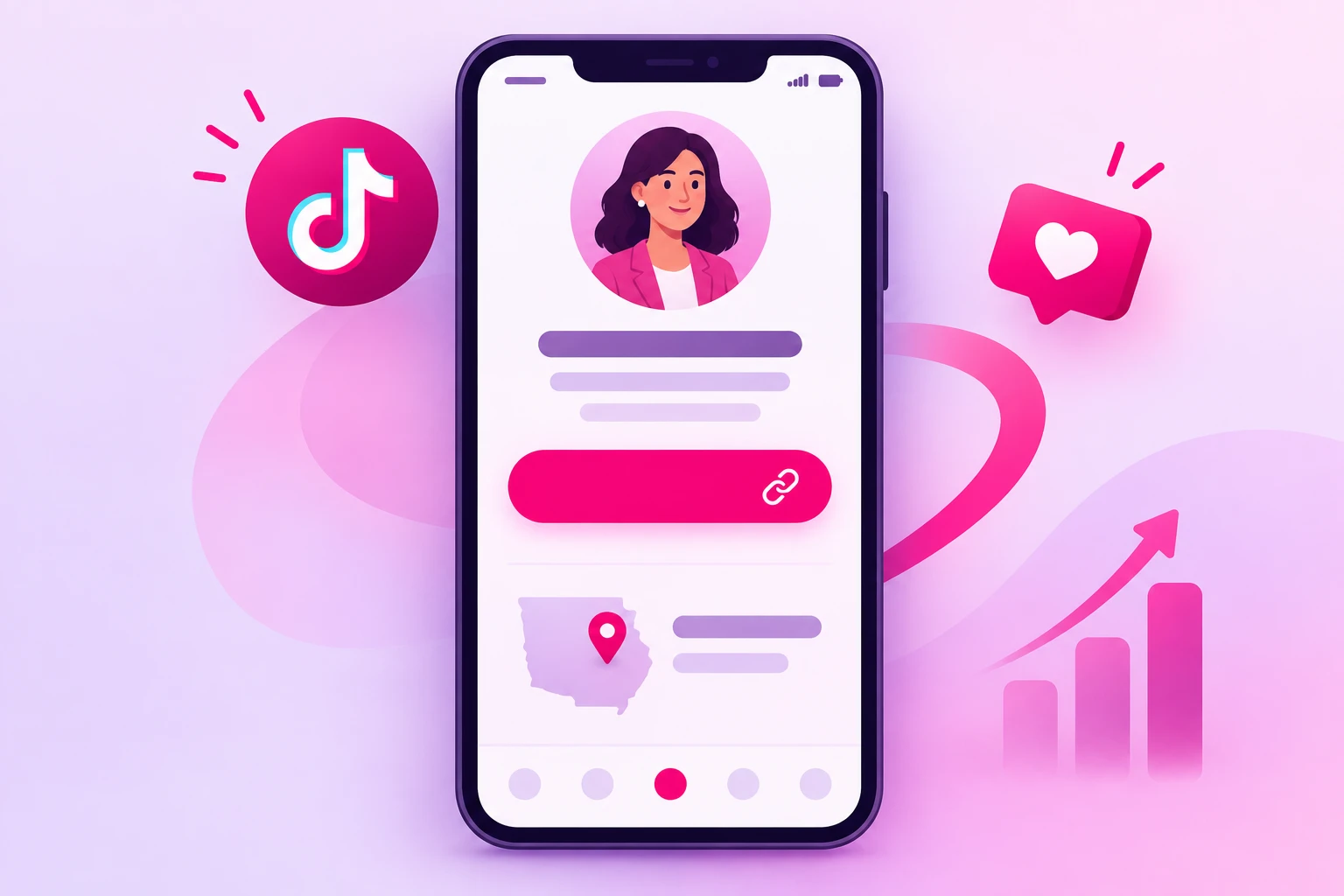
Rung four is the one you do not control. A relationship ends. A panic attack happens at work. A partner says "I can't keep doing this." A new insurance card arrives in January.
In that moment, a person who has been quietly watching you for months finally taps your name. What happens in the next six seconds decides whether they become a client or go back to coping alone. Treat that screen the way you treat your actual waiting room: calm, clear, and obvious about where to go next.
The bio: your lane, your license, your state, and whether you have room. Not "holding space for your healing journey." Something a nervous person can act on:
"Anxiety + people-pleasing. Licensed Professional Counselor, Colorado. Seeing clients statewide by telehealth - openings now. Education, not therapy. Not monitored for emergencies: call or text 988."
Use your title exactly as your state grants it. And if you genuinely are full, say "waitlist" rather than absorbing requests you cannot serve. An honest bio still books the people who will wait for you, and it sends the rest toward someone who can see them this month.
The pinned trio. You get three pinned slots, and they are the only part of your feed whose order you control. Use them for the three fears that stop people from reaching out:
- The first-session walk-through - what actually happens in the first fifty minutes, what you will ask, and what you will not make anyone talk about. This is the video that dissolves the fear of the unknown, and it is the one a person in January most needs to find.
- A short who-I-see video - your name, your license, your state, who you work with, and who you do not. It turns an account into a person with a practice, and it gently filters the wrong-fit and wrong-state requests before anyone has to be turned away.
- The what-it-costs video - your fee or fee range, whether you take insurance, what a superbill is, and whether you keep sliding-scale slots. Almost nobody in the profession makes this video, and it removes the barrier that silently disqualifies the largest share of your audience.
The link, and what sits behind it. One tap, landing on something that takes a minute to complete. Not a page of eleven buttons, and not your course. For the caseload path, the destination is a consult request form, and it should be built on a secure, healthcare-grade tool - the form builder inside your practice-management system is usually the simplest answer.
- Ask the state first. "Are you located in Colorado?" is the first question, not the last. A "no" should land on a kind page that explains why and shows them how to find someone licensed where they live.
- Keep it tiny. Name, email or phone, state, and a best time to talk. One optional line: "Anything you would like me to know?" The full intake comes later, once there is a consult on the calendar.
- Put the crisis line on the form. A sentence at the top - "This form is not monitored around the clock. If you are in crisis, call or text 988" - costs you nothing and matters enormously to the one person who needs it.
- Offer a time, not a wait. If your system allows it, let people book the free 15-minute consult directly after the state screen. Picking a slot themselves converts far better than "I will be in touch."
One seasonal note. The pinned trio and the link can follow the trigger calendar. In December and August, the first-session video goes in the first pinned slot, because that is what the January and September waves arrive looking for. In November, the holiday-dinner video can take a slot. A profile that anticipates the moment books the moment.
5. Rung 5: Earning the Consult Request (CTAs That Work Under Your Ethics Code)
This is the rung where most therapist accounts either get shy or get pushy, and both cost clients. The shy version never mentions that you see clients at all - a real problem in a profession where people assume the good therapists are full.
The pushy version sounds like a wellness brand - "Ready to transform your life? Spots are filling fast!" - and gets ignored by exactly the careful, ambivalent people who make the best-matched clients.
What works is a call to action that names the moment the viewer is in, lowers the stakes, and points at the form:
- The long delay: "If you have been meaning to start for a year and the first session is the part you dread, I made a video about exactly what happens in it. It is pinned. I see clients anywhere in Colorado, and the consult link is in my bio."
- Not "bad enough": "You do not need a crisis to deserve an hour. 'I am tired of feeling like this' is a complete reason."
- The cost fear: "If money is the thing stopping you, watch my video on superbills and sliding scales before you decide you cannot afford it."
- New insurance: "If your plan changed in January, here is how to check your out-of-network mental health benefits in one ten-minute phone call."
- The free consult: "The 15-minute consult is free and it is not a commitment. You can ask me anything, and if I am not the right fit I will give you three names who might be."
- The universal one: "Ask the general version of your question in the comments and I will answer it in a video." It costs the viewer nothing, gives you your next video, and keeps the specifics of anyone's life out of a public thread.
Four things to keep off your videos, whatever your license. First, anything that sounds like a promise. "Six sessions and you will feel like yourself again" is a claim no clinician can make and no board will forgive.
Second, anything that tells the viewer they have a condition. "If this is you, you have anxiety - book now" is an assessment of a stranger, and it also makes the video ineligible for promotion later under TikTok's personal-attributes rule.
Third, testimonials. The APA, ACA, and NASW codes all prohibit soliciting them from current clients, and the ACA extends that to former clients. Your account grows on explanation, never on "my client said."
Fourth, the phrase "DM me." It feels warm and it is the most expensive two words in the vertical. It invites people to type their history into a channel that is not secure, it cannot screen for state, and it turns your evenings into an unmonitored crisis line. The consult form is the door. Say so, kindly, every time.
6. Rung 5, Continued: The Three Messages and the Reply for Each

If you fix exactly one thing from this article, fix this one. No matter how clearly your bio says "use the form," people will message you. Those messages come in three kinds, and you need a saved reply for each before the first one arrives.
Message one: the crisis message. "I don't want to be here anymore." You cannot provide care over DM, and no clinician can. The rung breaks when you go silent because you are unsure what you are allowed to say. What works is warm, prepared, and short:
"I'm really glad you reached out. I can't provide care over messages, and I don't check this inbox often - but you don't have to be alone with this tonight. Call or text 988 right now, or go to the nearest emergency room. They are there for exactly this."
Be honest with yourself about what this reply is. It is a kindness, not a safety net. You are not a crisis service, you will not see every message in time, and you should never imply that you will.
That is why the real protection is built before the message: 988 in the bio, in a pinned comment on every video, and in the inbox auto-reply if your account type offers one.
Say the response once, publicly, as a video. It will become one of your most-saved posts. And ask your liability carrier now - not at 11 p.m. - what they expect you to do and document when a stranger sends a message like this.
Message two: the in-state consult request. "Hi, I'm in Denver - do you have openings?" The reply does one thing: it moves them to the form, without engaging with anything clinical.
"Thank you for reaching out - that is not a small thing to do. I do have openings. I keep anything personal out of this inbox because it isn't private enough, so the next step is the short form at the link in my bio. I reply to every request within one business day."
Then keep the promise. The rule for consult requests is one business day, every time. This person may have taken years to write to you, and silence confirms every fear they had about asking. Block fifteen minutes at the same time each working day for the form. If you have an administrator, they can own it - with one firm boundary: they schedule, they never assess.
Message three: the out-of-state request. This will be most of them, and it is the one therapists handle worst - usually by not answering. The person on the other end just got up the nerve to ask for help. A "no" that leaves them with a next step is still help:
"Thank you for asking - I wish I could. I'm only licensed to see clients located in Colorado, and that rule exists to protect you. I made a video on how to find a therapist licensed in your state and what to ask on the first call. It is pinned on my profile. Please don't let this 'no' be the end of looking."
That reply is the honest escape from the national-account trap. You cannot treat them, but you can make sure the trust you built gets spent on finding someone. It is also, not incidentally, the behavior that makes colleagues in other states think of you when they have a client moving to yours.
Then measure it. Pick a week, log the time of every consult request and every first reply, and look at the median gap. Most clinicians who do this for the first time find a number that surprises them - and fixing it is free.
7. Rung 6: The Consult Call and the First Session
Here is the quiet advantage of clients who come from content: they arrive different. A person who found you in a directory is comparing forty headshots and has no idea who any of you are. A person who has watched twenty of your videos already knows how you talk, what you believe about change, and whether they like you.
Clinicians who build a real in-state audience report the same three things about these consults:
- The fit question is mostly answered. They chose you for how you explain their exact problem, which makes them far more likely to be a specialty match - and match is what predicts whether someone stays past session three.
- The fee conversation is easier. Your what-it-costs video had that conversation weeks ago. They arrive knowing your rate, knowing what a superbill is, and having already decided it is worth it.
- They show up. People who have watched you for months keep their appointments. Show rate is the least glamorous number in a practice and one of the most valuable.
Which means the job on the consult call is not to persuade. It is to confirm fit - honestly, in both directions. Confirm the state again, out loud. Ask what made them reach out now. Tell them plainly whether this is work you do well.
And when it is not - the wrong specialty, a level of care you do not provide, a schedule that will never line up - say so kindly and give them names. Keep a short list of trusted colleagues in your state for exactly this. Those referrals come back around, and the who-I-see video in your pinned trio will slowly reduce how often you need them.
Between the consult and the first session, remove friction. Send the intake paperwork through your secure portal the same day. Offer a first session within a week or two if you possibly can. And link the first-session walk-through in your confirmation email - it is already public, it is already made, and it is the best no-show prevention you own.
The parasocial head start. One thing is unique to you. This client has known you for months; you met them on Tuesday. They may feel closer to you than the relationship has earned, or expect the person from the videos rather than the person in the room.
Name it in the first session, gently, as part of the frame: "You have seen a lot of me and I am just getting to know you, so let's go at your pace." Walk through the social media clause in your informed consent - you do not follow clients, you do not reply to their comments as their therapist, and nothing clinical happens in a DM. Said warmly in week one, it reads as care. Discovered in month four, it reads as rejection.
8. Rungs 7-8: The Treatment That Ends Well and the Referral You Never Ask For
The seventh rung. Every other profession in this series wants the client forever. A veterinary client stays for the life of the pet; an accounting client renews every spring. Your measure of success is a client who no longer needs you.
So retention here has a precise definition, the one the monetization guide uses: long enough for the work to work, and not a session longer. The account helps with the first half of that sentence. A client who chose you on purpose is less likely to drop out at session three, which is where most of the lost value in a caseload actually goes.
Three habits protect this rung:
- Post as if Thursday's client is watching - because they are. A client who found you on TikTok keeps following you. That is why self-disclosure on camera is a clinical decision, not a content decision. Before you post the personal story, ask what it will mean to the person who hears it and then sits across from you.
- Treat a mentioned video as clinical material. "I saw your video about avoidant partners and I think you were talking about me." You were not, because your content engine never touches a client - and the fact that you can say that with complete honesty is why the "could this exist if I had never met a client?" test matters.
- Never recruit clients into the account. Do not ask them to follow, share, comment, or duet. The account is for the public. The room is for them.
The eighth rung. Here is the rule that separates you from every other vertical: you never ask a client for a referral, a review, or a testimonial. Asking puts pressure on a person in a relationship with a power imbalance, which is exactly what the ethics codes are guarding against.
You also do not need to. A client who finished well tells the friend who has been "meaning to," and the thing they send is a public video - no disclosure required on their part, no involvement on yours. Your content is the referral mechanism. Your only job is to keep it findable.
The referrals you can build on purpose come from colleagues:
- Full therapists in your state. Every clinician with a waitlist needs names to give. A short, clear who-I-see video is the easiest thing in the world to forward.
- Prescribers and primary-care doctors. They are asked "do you know a good therapist?" daily, and most have no answer. One who has watched you explain panic attacks now has a name to write down.
- School counselors, clergy, and HR leads. The people others confide in first. They refer to whoever they have seen be kind and clear.
- Out-of-state colleagues. The therapist in Ohio whose client is moving to Colorado remembers who answered out-of-state requests gracefully.
One boundary on all of it: no money changes hands for a referral. The ACA and NASW codes restrict paying or receiving fees for referring someone to professional services, and the APA code ties payment to services actually provided. Refer because it is right for the person, and the network takes care of itself.
9. High-Intent Content: The Videos That Actually Produce Consult Requests
Not all therapist content converts equally. The videos that go furthest are usually the travelers - the therapy-speak correction, the pattern everyone recognizes, the thing your own therapist said that changed how you work. Those build the audience, and you should keep making them.
But the videos that produce consult requests are a different, quieter category. They are watched by far fewer people, most of whom are close to a decision:
- The first-session walk-through. What happens, minute by minute, and what does not. The single most valuable video a caseload-path therapist can own, because the people searching for it are, by definition, about to choose a therapist.
- The cost video. Your fee, in-network versus out-of-network, superbills, sliding scale, and what to ask your insurance company. Keep plan specifics general so the video stays accurate. Almost nobody makes it, and it converts.
- "I have openings in [state]." Said plainly, on camera, with your license, by you. It sounds too simple to matter and it is routinely the video that produces the most requests, because it answers the question stopping people from asking.
- "Am I bad enough for therapy?" The most common unspoken objection in the profession. Answer it without a symptom list: you do not need a diagnosis to deserve support.
- What the free consult actually is. Fifteen minutes, no commitment, here are three good questions to ask me. People avoid what they cannot picture.
- "Therapy didn't work for me last time." Explain fit, modality, and timing - without disparaging a colleague. The person with one bad experience is often the most ready to try again with someone they have already vetted.
- How to find a therapist licensed in your state. It serves the in-state viewer and the out-of-state one equally, it is the link you will paste into a hundred replies, and it is generous in a way people remember.
Notice what every item on that list has in common: none of them needs a client to exist, and none of them tells the viewer they have a condition. That second point matters later, because it is what makes them eligible for promotion.
A useful ratio is roughly four audience-building videos to one high-intent video. And because demand arrives in waves, high-intent videos work best published 30 to 60 days ahead. Build the first-session, cost, and openings videos in December for January, and again in August for September. The seasonal timing section of the ideas library maps the rest of the year.
10. Ethics at the Inquiry Stage (The Part Nobody Warns You About)
Most advice about therapists on social media covers ethics at the content stage - no client stories, no diagnosing strangers. That is the easy half. The harder half happens after someone reaches out, and it is where otherwise careful clinicians get into trouble.
The inbox is not a clinical channel. A social media inbox was not built for health information, and the platform is not going to sign the kind of agreement your practice-management vendor did. Keep the clinical conversation out of it entirely. Redirect the moment someone starts describing their situation, and move every real inquiry to your secure form.
The therapy-by-comment problem. "My mom does this exact thing - is that trauma?" Answering for that person is an assessment you have not done. It also starts to look like a professional relationship you never agreed to, possibly in a state where you hold no license. Answer the general version in a video - "here is what that word actually means, and how a therapist would go about figuring it out" - where it helps everyone.
The "you're my therapist!" problem. Sooner or later a current client will comment publicly. You cannot confirm that anyone is or is not your client - not with a reply, and arguably not with a heart. The safest public response is none. The right response is a warm conversation in the next session, which your informed consent already set up.
Praise is not a testimonial - until you use it as one. A stranger commenting "this video changed how I see my marriage" is simply a comment. Screenshotting it into your next post, or pinning "you saved my life" to the top of the thread, moves it toward marketing, and you often cannot know whether the author is a client. Leave praise where it lands. And never ask clients for online reviews.
The impersonation problem. As your account grows, scammers clone it and message your followers offering "sessions" or asking for payment to hold a spot. Your followers are, by definition, people in a vulnerable moment. Tell them - on camera and in your bio - that you never message first, never offer therapy by DM, and never take payment through the app. Report clones the day you find them.
The rest of the checklist:
- Disclaim clearly and consistently. "Education, not therapy. Watching my videos does not make you my client." In the bio, and out loud now and then, which is how the APA code's media-presentations rule is best honored.
- Screen for state before anything else. On the form, on the consult call, and again at intake. Where the client is physically located during the session is what counts, and it is worth asking about travel and college addresses.
- Know what you will do with a worrying message from a stranger. Your obligations to someone who is not your client vary by state and by license. One call to your liability carrier or your association's ethics line, made before you need it, replaces a great deal of late-night guessing.
- Train and bind anyone who touches the inbox or the form. An assistant who sees consult requests is seeing sensitive information and needs to be covered by your confidentiality practices. Their script is scheduling and the three saved replies. Nothing else.
- Associates: get sign-off on the whole path. If you are pre-licensed, your supervisor should approve not just your videos but your bio, your saved replies, and where your consult link goes. Use your exact provisional title everywhere.
- Know your employer's policy. If you work for a group practice or an agency, intake may have to run through their system rather than your personal link. Get it in writing before the first request arrives.
- Protect yourself. You will read heavy messages from people you cannot help. Set hours for the inbox, keep it off your phone's home screen, and bring what it stirs up to your consultation group. The clinician's own steadiness is part of the infrastructure.
A necessary caveat: this is a general overview for planning purposes, not legal, ethical, or clinical advice. Your obligations depend on your license, your state, your ethics code, and your employer. The pillar guide's compliance section covers the content-stage rules; for anything specific, your board, your association's ethics line, and your liability carrier are the right call.
None of this is a reason to stay off the platform. It is a reason to spend one hour writing three replies and one form, and then let everything after that be just posting. The same discipline runs through the patient-acquisition playbook for healthcare professionals, where the inbox is a privacy surface for medical practices.
11. Tracking Which Videos Are Actually Filling the Caseload
Therapists consistently underestimate what social is producing, for two reasons. First, a person who watched forty of your videos over three months does not describe themselves as a "TikTok lead." They say they found you online, or they say nothing.
Second, the lag. The person who followed you in October books the week after the holidays. Meanwhile the source that gets the credit is whatever they typed into a search bar the day they finally reached out.
You do not need attribution software. You need four habits - and one rule that sits above them: counts, never names. A marketing spreadsheet is not part of the clinical record, and nothing that identifies a client belongs in it.
- Ask on the consult form. "How did you find me?" with social media as a named option, not a text box people leave blank.
- Give your TikTok profile its own consult link. A dedicated form or landing page separates those requests from your directory and website traffic, and lets you watch volume move after a particular video.
- Track the state-screen pass rate. Every month: how many requests came in, and what share were in-state? This is your version of a local-audience check. A rising pass rate means the ladder is filling from the top. A fast-growing account with a falling pass rate is drifting national.
- Count backwards from new clients, not forwards from views. Once a quarter, tally how many new clients started from each source, and how many of those stayed past session three. Tallies only. That short table tells you what to make more of and what to amplify.
One number to ignore: DM volume. A flood of messages feels like demand, and it is usually a symptom of the national-account trap - people you cannot treat, in a channel you should not be using.
Then look at the number that actually matters: cost per well-matched client, valued at a course of treatment. Not one session - the whole arc. As an illustration only: a private-pay client at $160 a session who stays for twenty sessions is about $3,200, and the slot they fill was going to be filled by someone.
Compare that against what you pay each month for directory listings, or what a lead-gen vendor charges per inquiry, and how many of those inquiries pass session three. Most clinicians who run this honestly find the content channel is not close. The monetization guide works through those economics in detail.
12. Amplify the Video That Already Fills Slots - Before the Wave
Once the ladder is intact, you have something most practices never build: a video you can prove converts. Not a video that got views - a video that produced in-state consult requests, and requests that became clients who stayed.
That changes what paid promotion is for. You are no longer gambling on whether the content works; you already know it does.
You are buying more of the right people seeing it - and for a therapist, "the right people" is unusually precise. It is your state, drawn exactly, which promotion can target by location in a way the organic algorithm never will. Office-only practices can narrow further to the metro.
Then there is timing. Promoting your proven first-session walk-through to your own state in December reaches people while they are deciding, weeks before the January rush. The same video in August reaches the September wave. Amplify before the wave, not during it.
Two rules are stricter for you than for anyone else. The ad is always an explainer, never a testimonial. And under TikTok's personal-attributes rule, a promoted video and its caption cannot assert or imply that the viewer has a condition - which is why the high-intent list in section 9 is built the way it is. "What a first session actually looks like" is promotable. "Struggling with depression?" is not.
That is what our TikTok promotion service is built to do: take the educational video that has already proven it produces consult requests and put it in front of more people in the state where you are licensed, ahead of the wave. The rule is the same one that governs the whole growth roadmap: amplify proof, not hope. For the mechanics of promoting an existing organic video, the Spark Ads guide walks through the setup step by step. Whatever you promote still has to satisfy TikTok's ad policies, your state board's advertising rules, and your ethics code.
Frequently Asked Questions
How do therapists actually get clients from TikTok?
Through an eight-step path, not a single viral video. Someone watches one explainer, follows because you made something shameful feel ordinary, slowly comes to believe therapy is for people like them, hits a trigger moment - a breakup, a panic attack, an ultimatum, a new insurance plan - requests a consult, shows up to a first session, does the work until they no longer need you, and then tells the friend who has been meaning to go. Most practices build four or five of those rungs. They earn real trust from a nationwide audience and then lose it in the handoff: the bio never names the state, the only door is "DM me," or a consult request from someone who took three years to send it sits unanswered for a week. Fixing the handoffs usually fills more of the caseload than posting more videos.
How many followers does a therapist need before TikTok brings in clients?
Far fewer than most clinicians expect, because the number that matters is followers inside the state where you are licensed, not total followers. Mental health content travels nationally by default, so a therapist can reach a million people and be legally able to treat almost none of them. Practices that convert usually see their first "I found you on TikTok" consult request somewhere between 1,000 and 5,000 followers, once the account has anchored itself to a state. And a caseload is small: a solo clinician with 20 to 25 weekly slots may only need one or two well-matched new clients a month to stay full. A few hundred people in your state who trust you is a waitlist.
What call to action works best for therapist TikTok videos?
Soft, specific, and tied to the moment the viewer is in - and always pointing at a consult form, never at your DMs. "If you have been meaning to start for a year and the first session is the part you dread, I made a video about exactly what happens in it. I see clients anywhere in Colorado by telehealth, and the consult link is in my bio" works because it names the fear and the state. Avoid anything that promises an outcome, anything that tells the viewer they have a condition, the phrase "DM me," and client testimonials - the APA, ACA, and NASW codes all prohibit soliciting them from current clients. The highest-converting therapist CTA is often simply "ask the general version of your question in the comments and I will answer it in a video."
Should therapists answer DMs from people asking for help?
Answer them, but never clinically. A social media inbox is not a secure channel for health information, and a reply that engages with the details of a personal situation starts to look like a professional relationship you have not agreed to and may not be licensed to hold. Prepare three saved replies before you need them: a crisis response that points to 988 and emergency services and says plainly that you cannot provide care over messages, a consult reply that sends in-state requests to your secure form, and a warm out-of-state reply that explains the licensing limit and shows the person how to find someone licensed where they live. Say in your bio that the account is not monitored for emergencies. Answer the general version of any question publicly, in a video, where it helps everyone.
How do I know whether TikTok is actually bringing in clients for my practice?
Put "How did you find me?" on your consult form with social media as a named option, give your TikTok profile its own consult link so those requests are separated from directory and website traffic, and track two numbers every month: how many consult requests came from that link, and what share of them passed the state screen. Then, once a quarter, count how many new clients started from each source and how many of them stayed past the third session. Keep counts, never names - a marketing spreadsheet is not part of the clinical record and should not contain anything that identifies a client. Most clinicians find the channel produces more than they thought, because of the lag: the person who books in January often followed in October.
When is the best time of year for a therapist to start getting clients from TikTok?
Now, whenever you are reading this - but aim the effort at the calendar. Demand for therapy arrives in two predictable waves: January, when resolutions, the aftermath of the holidays, and new insurance plans all land at once, and September, when routines restart after the summer slump. That means the first-session walk-through, the fee explainer, and the "I have openings in [state]" video should be filmed and pinned in December and in August, 30 to 60 days ahead of the people they are for. If you are starting in the quiet stretch of early summer, you are not late. You are in batching season, with time to build the whole library before the September wave.
Know which video brings in the consult requests?
Then you already know where the budget belongs - and when. Viryze amplifies the educational video that has already proven it produces in-state consult requests, putting it in front of more people in the state where you are licensed before the January and September waves arrive, so the trust you built turns into first sessions with people you are actually the right therapist for.
Promote the video that fills your caseloadRelated Reading
- TikTok for Therapists: The Complete 2026 Guide - the full strategy this client-acquisition path plugs into.
- Growing a Therapist TikTok: From 0 to 100K Followers - the 90-day roadmap that builds the in-state audience you convert here.
- How Therapists Make Money on TikTok in 2026 - why caseload quality is the first income stream, and what comes after it.
- Therapist TikTok Content Ideas: 50+ Video Concepts That Fill a Caseload - the travelers and anchors that fill the top of this ladder.
- How to Film Therapy Content for TikTok (Confidentiality, Office Setup & What Never to Say) - the frame and clock rules that make the high-intent videos safe to make.
- Getting Patients from TikTok: Turn Views Into Booked Appointments - the parallel conversion playbook for medical practices.

Head of Creator Success at Viryze
TikTok growth strategist helping creators reach their first 100K followers through data-driven promotion strategies.