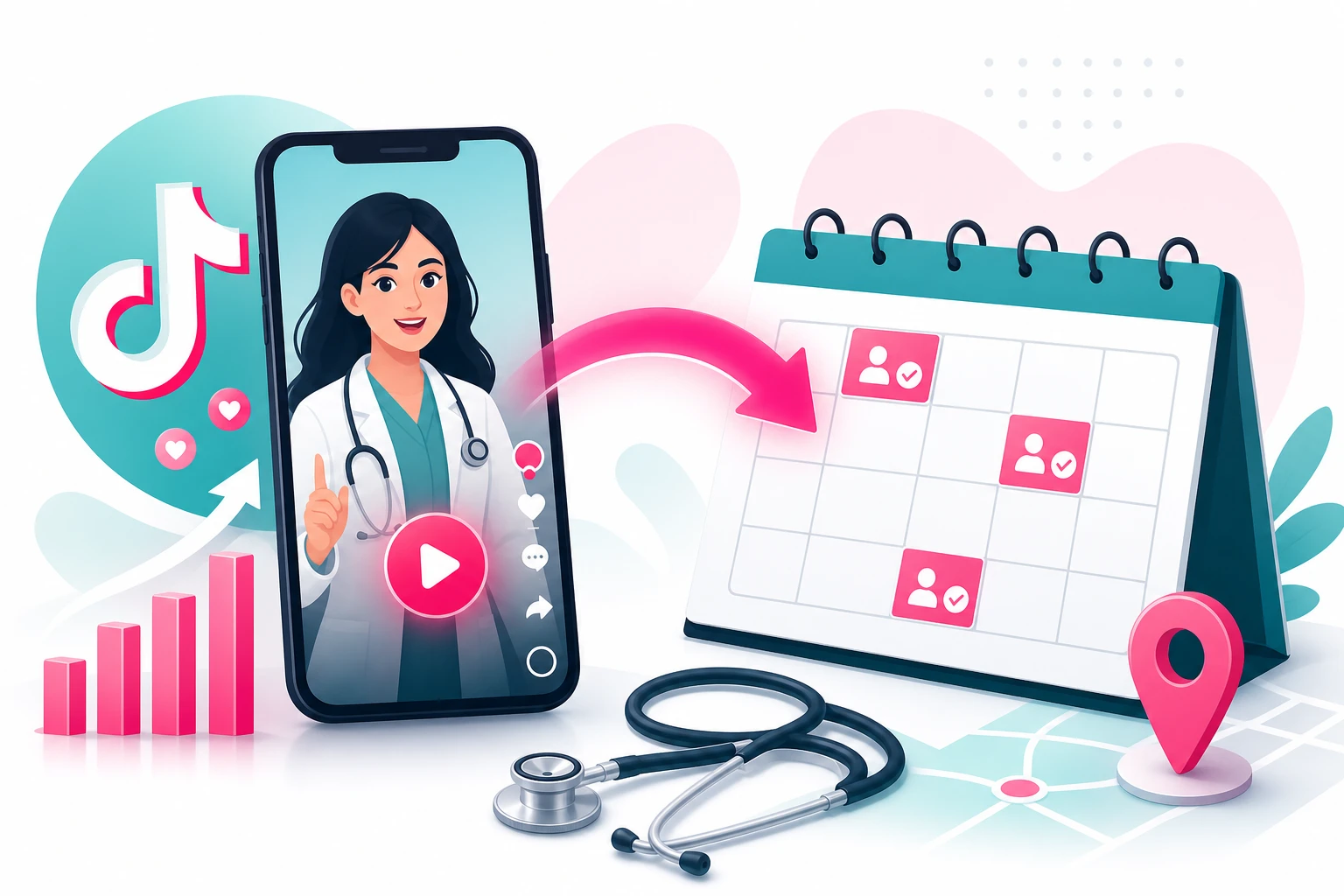
There is a specific kind of frustration that hits providers about three months into posting on TikTok. The videos are working. The views are climbing. People are commenting "finally someone explained this properly." And the schedule looks exactly the same as it did before you started.
That gap is almost never a content problem. It is a handoff problem. Views become patients through a series of small steps, and most practices have built four of the five - so the trust they earn quietly leaks out somewhere between "I really like this dentist" and "I have an appointment on Tuesday."
This guide is about closing those gaps. It builds on the audience you create with the 90-day growth roadmap and the strategy in our complete TikTok guide for healthcare professionals. If you already have people watching, everything below is about making sure the ones who need care can actually find their way to your calendar.
The short version:
- Views are not the product - proximity is. One thousand local viewers beat a million scattered ones, because only one group can sit in your chair.
- Your profile is the front desk. Specialty plus city in the bio, a pinned trio of your best videos, and a booking link one tap away.
- The response window decides everything. An inquiry answered in an hour books at a dramatically higher rate than the same inquiry answered in two days.
- Track it or you will underestimate it. Patients from social rarely mention it unprompted - they just arrive already trusting you.
What's Inside
- 1. Why Views Don't Book Appointments
- 2. The Booking Ladder: Five Rungs From Viewer to Patient
- 3. Rungs 1-2: Turning Scattered Views Into Local Followers
- 4. Rung 3: Your Profile Is the Front Desk
- 5. Rung 4: Earning the Inquiry (CTAs That Work in Healthcare)
- 6. Rung 5: The Response Window That Books the Appointment
- 7. High-Intent Content: The Videos That Actually Book
- 8. Tracking Attribution Without Breaking Privacy Rules
- 9. Compliance at the Booking Stage
- 10. Amplify the Videos That Already Book
- Frequently Asked Questions
1. Why Views Don't Book Appointments
A view is a stranger watching you for eleven seconds. A booked patient is a person who trusts you enough to hand over their health, their time, and often a meaningful amount of money. Nothing about the first automatically produces the second.
In practice, healthcare accounts leak patients in four predictable places. See if any of these sound familiar:
- The audience is national when the practice is local. A myth-bust about root canals travels everywhere, which feels wonderful and books nobody. If 95% of your viewers live more than an hour away, your view count is measuring something other than patient demand.
- The next step is invisible. The video ends, the viewer thinks "I should really get that looked at," and there is nothing telling them what to do about it. They scroll. The thought is gone in four seconds.
- The profile makes them work. They tap your name, and the bio does not say what city you are in or what you actually treat, and the link goes to a homepage where booking is three clicks deep. Every extra step costs you a percentage of the people who were ready.
- The inquiry goes cold. Somebody DMs a question on Friday evening. Nobody checks the account until Monday. By then they have found another provider - or gone back to putting it off.
Here is the encouraging part: every one of those is a fixable, one-afternoon problem. You do not need better videos. You need the path between the video and the calendar to be short, obvious, and staffed.
2. The Booking Ladder: Five Rungs From Viewer to Patient
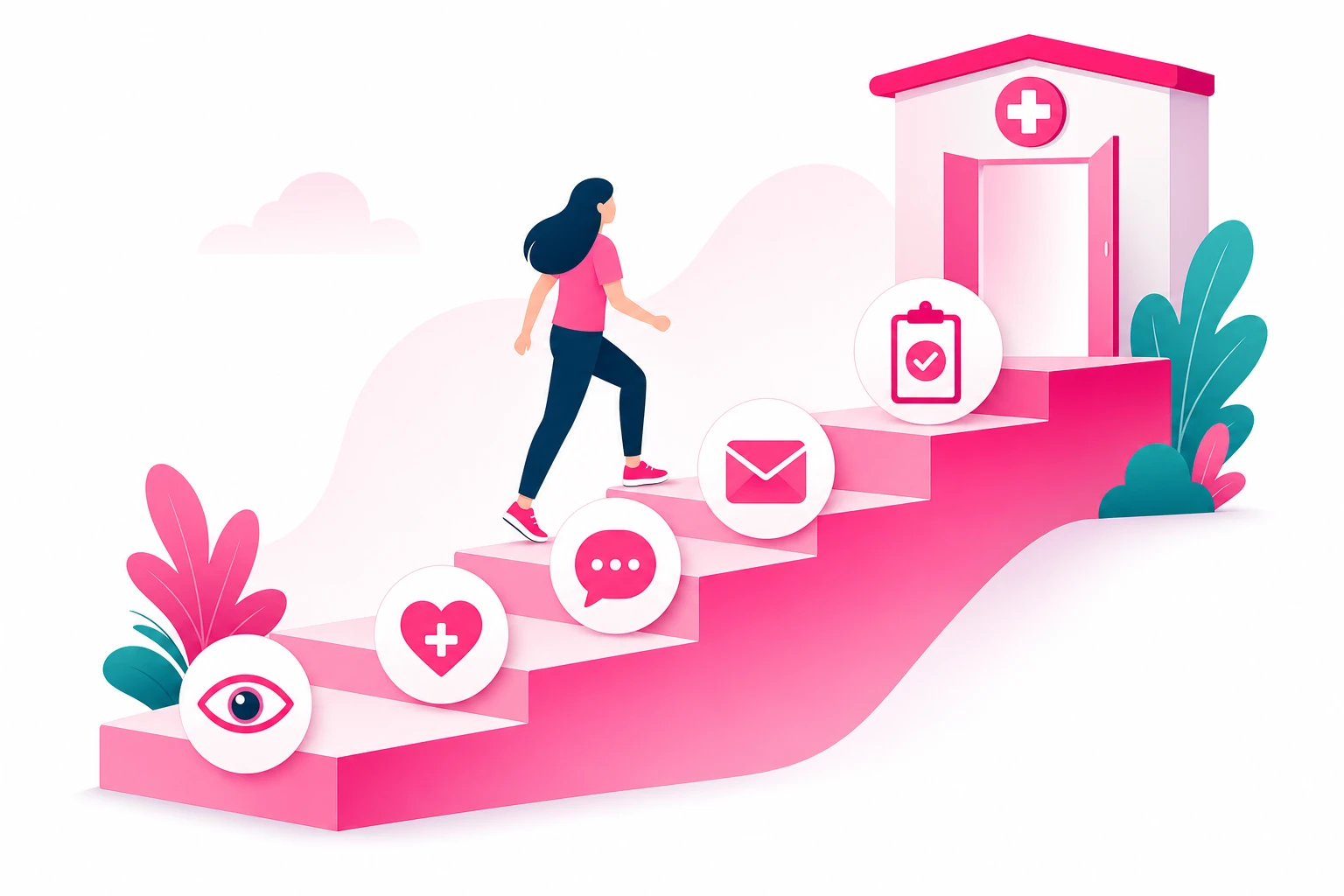
We call the path the Booking Ladder. Each rung is a separate decision the person makes, and each one has its own failure mode:
- Viewer - they watched one video to the end. They know nothing about you yet. The job here is simply to be worth eleven more seconds.
- Follower - they decided they want more of this. The job is to make it obvious that there is more, and that it is consistently useful.
- Trusting local - they have watched you several times and know you are nearby. This is where most of the compounding happens, and it takes weeks, not days.
- Inquiry - they raised their hand: a DM, a comment, a link tap, a phone call. This is the fragile rung. It is also the only one you can directly measure.
- Booked patient - they are on the schedule. This rung belongs to your front desk, not your camera.
Two things follow from this shape. First, you cannot skip rungs - the videos that beg for bookings from first-time viewers convert badly, because you are asking rung five behavior from rung one people. Second, your worst rung caps everything above it. A practice with brilliant content and an unanswered inbox books fewer patients than a practice with mediocre content and a receptionist who replies in ten minutes.
So before you make another video, walk the ladder yourself. Open your account in a private browser as if you were a nervous 34-year-old who has been avoiding a dentist for six years. Where do you get stuck?
3. Rungs 1-2: Turning Scattered Views Into Local Followers
Reach is not the goal; reach near you is the goal. A few thousand followers in your metro area is a genuinely valuable asset. A few hundred thousand spread across the country is a hobby.
You cannot force TikTok to show your videos only to locals, but you can make local relevance unmistakable - to the algorithm and to the humans watching:
- Say your city out loud, in the video. Not as a sales pitch - as context. "We see this constantly in our Phoenix office, especially in summer." Spoken location cues do more work than a hashtag, because they land with the viewer rather than just the index.
- Make some content that only makes sense locally. Seasonal allergies in your region, the local water, the sports league that sends you the same injury every spring, what your area's insurance landscape actually covers. National accounts cannot make these videos, and the people who need them are all nearby.
- Show the room. Filming in your actual clinic - the waiting area, the front door, the neighborhood outside the window - does something a talking-head-in-a-void video cannot: it makes you a real place a person can drive to.
- Give a reason to follow at the end of a video, not a reason to buy. "I answer one of these every week" converts rung one to rung two. "Book today" does not, because they do not know you yet.
This is also the point where paid amplification earns its keep, because it is the one lever that lets you choose geography directly - more on that in section 10. The local business TikTok playbook covers the broader geography tactics that apply to any practice with a physical address.
4. Rung 3: Your Profile Is the Front Desk
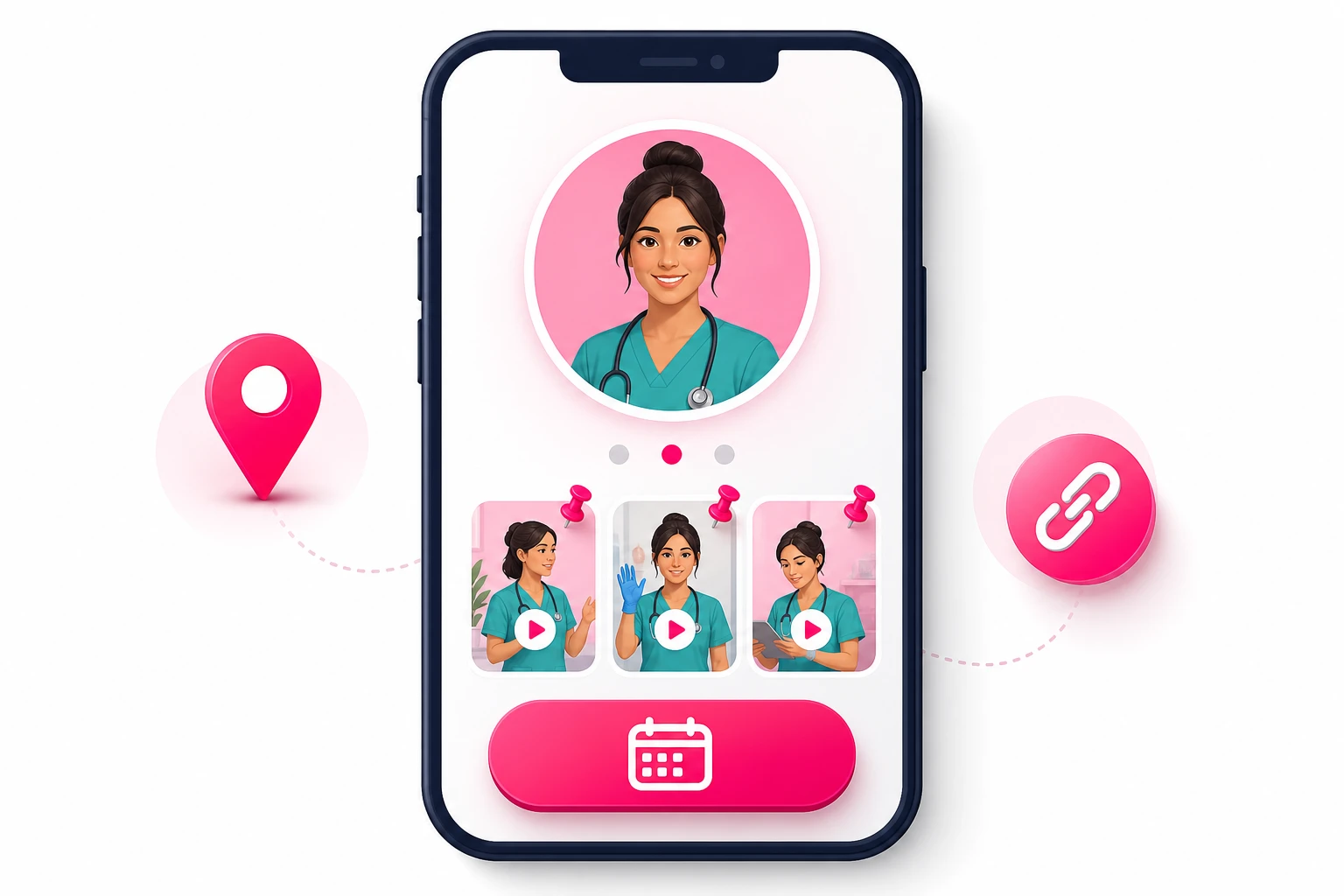
When someone finishes a video that resonates, they tap your name. What happens in the next six seconds decides whether they become a patient or a scroll. Treat that screen the way you treat your actual reception area.
The bio: specialty plus city, in plain words. Not "passionate about smiles." Something a person can act on: "Family dentist in Tucson. Answering the questions patients are too embarrassed to ask." If someone cannot tell what you do and where you are within one line, the bio is not working.
The pinned trio. You get three pinned slots. Use them deliberately, because they are the only part of your feed you control the order of:
- Your best explainer - the video that most clearly demonstrates you are good at your job and easy to understand.
- A short who-I-am video - your name, your practice, your approach, thirty seconds. This is the video that turns an account into a person.
- Your most reassuring video - whatever addresses the fear that keeps people out of your chair. What the appointment actually feels like. What it costs. Why it will not hurt the way they are imagining.
The link: one tap to a booking page. Not your homepage. Not a link-in-bio page with fourteen buttons. The fewer decisions between the tap and the calendar, the more patients arrive. If your practice management system has a public scheduling page, that is your link. If it does not, a simple contact form with your phone number visible works fine - many patients will call instead, and that is a good outcome.
One thing worth checking that almost nobody does: open your booking link on a phone, on cellular data, and try to book yourself an appointment. If it takes more than about ninety seconds or asks for an insurance ID before it will show you a time, you have found your biggest leak - and it is not on TikTok at all.
5. Rung 4: Earning the Inquiry (CTAs That Work in Healthcare)
Healthcare calls to action have to do something unusual: invite action without applying pressure. Urgency tactics that work for a flash sale read as predatory when the product is someone's body, and depending on your state board's advertising rules, some of them are not allowed at all.
What works instead is naming the hesitation and offering a small next step:
- The permission CTA: "If you have been putting this off for years, that is genuinely common - and it is not too late. Our next consultation times are in the link." This works because the thing standing between them and booking is usually shame, not information.
- The question CTA: "What else do you want to know about this? I will answer the top comment next week." The best healthcare CTA often is not a booking request at all - it generates the comments that become your next videos, and commenters convert later at high rates.
- The specific-service CTA: Attach the invitation to the exact thing the video was about. "If this sounds like what you have got going on, that is what a consult is for." Generic "book an appointment" converts worse than an invitation tied to the problem they just watched you explain.
- The quiet CTA: On some videos, say nothing at all. If every video ends with an ask, the account starts to feel like an advertisement and trust erodes. A rough ratio of one invitation for every three or four purely educational videos keeps the account feeling like a person.
Also: answer your comments in public, at length, and generously. Comment sections are where undecided people go to decide. Someone reading twenty thoughtful replies you wrote to strangers learns more about what it is like to be your patient than any promotional video could tell them. The content ideas vault has the comment-reply formats that do double duty as both an answer and a video.
6. Rung 5: The Response Window That Books the Appointment
This is the rung that costs practices the most patients, and it has nothing to do with content. Somebody works up the nerve to send a message about a thing they have been anxious about for months. What happens next is entirely down to your operations.
Three things make the difference:
- Somebody owns the inbox. Not "the practice." A named person, with a defined window - twice a day, every weekday, is enough for most practices. An unowned inbox is an inbox that gets checked when someone remembers, which is to say rarely.
- Speed beats polish. A short reply in an hour outperforms a perfect reply in two days, every time. The person who messaged you is in a brief window of resolve; your job is to catch them while it lasts.
- Move them off the platform quickly and warmly. DMs are not a clinical channel and were never meant to be. Get them to a phone call, a booking link, or an intake form within a message or two.
Give your front desk an actual script so nobody has to improvise. Something like: "Thanks so much for reaching out - and good on you for asking. I cannot give personal medical advice over messages, but this is exactly what a consultation is for, and [Dr. Name] sees this all the time. Here is our scheduling link, or call us at [your number] and we will find a time that works." It acknowledges them, sets the boundary, removes the shame, and gives two ways to act - swap in your own names and links and hand it to whoever owns the inbox.
One more operational note that pays for itself: tell whoever answers your phone that TikTok patients exist. A caller who says "I saw your video about jaw pain" is not a cold lead - they are pre-sold, and they should be treated with the warmth you would give a referral from an existing patient. Because that is essentially what they are.
7. High-Intent Content: The Videos That Actually Book
Not all educational content converts equally. Some videos build a general reputation; others reach people who are actively considering care right now. You want both, but if your schedule needs filling, weight the mix toward the second kind.
The highest-intent formats in healthcare tend to be:
- "What actually happens during ___" - a plain walkthrough of a specific procedure. Anyone watching a root canal explainer to the end is thinking about a root canal.
- Cost and coverage explainers - the question everyone has and nobody asks. Talking honestly about what things cost and how insurance tends to handle them removes the single most common reason people delay care.
- "Is it time to come in?" symptom guidance - general, careful education about when a symptom is worth a professional look. This is the format that converts fastest, and the one that most needs a disclaimer.
- The fear-removal video - what the room looks like, what you will feel, what happens if it hurts, what your options are if you are anxious. For a large share of patients, fear is the only thing between them and your calendar.
- The first-visit walkthrough - literally what happens from the parking lot to the front desk to the chair. Uncertainty is friction; a video that removes it books people who were 90% of the way there.
Weight these toward the services you most want to grow, and film them in the same batch as everything else - the HIPAA-safe filming system turns roughly an hour a week into a full slate of them.
8. Tracking Attribution Without Breaking Privacy Rules
Practices routinely under-count TikTok patients, because those patients rarely announce themselves. They just walk in already knowing who you are. Three lightweight habits fix that:
- Put the question on the intake form. "How did you hear about us?" with social media as an explicit checkbox option, not a blank line. Blank lines get skipped.
- Train the front desk to ask and log it. One sentence on the phone - "Do you mind if I ask how you found us?" - captures the callers who never touch a form.
- Use a dedicated booking link for your profile. A separate URL or a tracked link keeps TikTok traffic distinguishable from every other source, so you are measuring rather than guessing.
Two cautions on the privacy side. First, be careful about advertising pixels and conversion tracking on pages that could reveal health information about a specific person - patient status is itself sensitive, and tracking tools on scheduling or condition-specific pages deserve a conversation with whoever handles your compliance. Second, never connect a specific commenter or DM to a specific patient in anything you post. Aggregate counts are fine; individuals are not.
And watch the right number. Views are a vanity metric here. The number that tells you the channel is working is new patients per month who mention social, and after that, the follow-on referrals those patients send - which are invisible in any dashboard and often larger than the original effect.
9. Compliance at the Booking Stage
Everything about privacy that applies to filming applies double at the booking stage, because this is where actual patients start interacting with you in public. The rules are not complicated, but they are absolute:
- Never confirm that someone is your patient. Not in a comment, not in a reply, not by implication. If a commenter says "you did my crown last year!" you can thank them warmly without confirming anything clinical. Their disclosure is not your permission.
- Never diagnose in a comment or DM. Answer the general version of the question, add a plain disclaimer that it is education rather than individual medical advice, and route anything specific to a proper channel.
- Do not repeat identifiable details. If someone shares symptoms, ages, photos, or their own name in a comment you plan to answer on camera, strip it. Their oversharing does not transfer risk to them.
- Know your board's advertising rules. Testimonials, before-and-after imagery, and superlative claims like "the best" or "painless" are restricted for many professions in many states. This matters most in exactly the videos designed to convert.
- Written consent, every time, for anything patient-facing. If a patient appears in a video in any recognizable way - face, voice, tattoo, a distinctive case - you need documented consent that specifically covers social media.
The full compliance framework lives in the pillar guide, and none of this is legal advice - your board and your compliance officer are the authority on your specific situation. The reassuring reality is that education-first content built entirely from your own commentary needs no patient information at all, which is why this whole approach stays comfortably inside the lines.
10. Amplify the Videos That Already Book
Once the ladder is intact, you have something most practices never build: a video you can prove converts. Not a video that got views - a video that produced inquiries, and inquiries that became appointments.
That changes what paid promotion is for. You are no longer gambling on whether content works; you already know it does. You are buying more of the right people seeing the thing that already works - and in healthcare, "the right people" means one very specific thing: adults who live close enough to actually become patients.
The economics are unusually kind here. When one booked patient is worth hundreds or thousands of dollars, the budget that makes sense for reaching your metro area is far larger than most practices assume - a single conversion can cover a month of promotion. And the cost of putting a trust-building video in front of a thousand local people compares very favorably to search ads, where practices routinely pay double-digit sums for one anonymous click that builds no trust at all.
That is what our TikTok promotion service is built to do: take the educational video that has already proven it books patients and put it in front of thousands more people in your area. The rule is the same one that governs the whole healthcare income ladder: amplify proof, not hope. For the mechanics of promoting an existing organic video, the Spark Ads guide walks through the setup step by step.
Frequently Asked Questions
How do healthcare providers actually get patients from TikTok?
Through a five-step path, not a single video. A prospective patient watches an educational video, follows because they want more, watches enough over time to trust you, sends an inquiry or taps your booking link, and then becomes a booked appointment. Most practices lose people between steps three and four - they build genuine trust but never make the next step obvious, or the booking link is buried, or nobody answers the inquiry for two days. Fixing those handoffs usually produces more patients than posting more videos.
How many followers does a practice need before TikTok books patients?
Far fewer than most providers expect, because what matters is engaged local followers rather than total followers. Practices commonly report their first TikTok-attributed patients somewhere between 2,000 and 5,000 followers, and some see inquiries much earlier when their content is specific to one procedure and one city. A few hundred people in your metro who trust you is worth more than a hundred thousand scattered viewers who cannot physically visit you.
What call to action works best for healthcare TikTok videos?
Soft, specific, and low-commitment. "If you have been putting this off, the link in our bio has our next available consultation times" outperforms "book now" because it names the hesitation and offers a small next step. Avoid urgency tactics and pressure language - they read as untrustworthy in a medical context and can conflict with state board advertising rules. The strongest healthcare CTA is often just an invitation to ask a question in the comments, because answering it publicly becomes your next video and your next follower.
Can I answer patient questions in TikTok comments or DMs?
You can answer general educational questions, but you cannot give individual medical advice or diagnose anyone in a comment or DM - and you should never repeat identifiable details a commenter shares about their own health. The safe pattern is to answer the general version of the question publicly, add a short disclaimer that it is education rather than personal medical advice, and move anything individual to a proper intake channel: "That is a great question and it depends on your specific situation - our team can look at it properly, here is how to reach us."
How do I know whether TikTok is actually bringing in patients?
Add "How did you hear about us?" to your intake form with social media as an explicit option, and train the front desk to ask and log the answer when someone calls. Use a dedicated booking link for your TikTok profile so link taps are separated from the rest of your web traffic. Most practices discover the channel is producing more than they thought, because patients arriving from social rarely volunteer it unprompted - they simply show up already knowing who you are.
Ready to put your best video in front of your whole metro?
Once you know which video books patients, the only thing standing between you and a fuller schedule is how many local people see it. Viryze amplifies your proven educational content to thousands more prospective patients in your area - so the trust you have already built turns into consultations.
Start filling your calendarRelated Reading
- TikTok for Healthcare Professionals: The Complete 2026 Guide - the full strategy this booking path plugs into.
- Healthcare Provider Growth on TikTok: From 0 to 100K Followers - the 90-day roadmap that builds the local audience you convert here.
- How Healthcare Professionals Make Money on TikTok - every income stream a booked patient unlocks, ranked.
- Healthcare TikTok Content Ideas: 50+ Video Concepts - the high-intent video formats that fill the top of this ladder.
- Getting Coaching Clients from TikTok - the parallel conversion playbook for another trust-driven service.

Head of Creator Success at Viryze
TikTok growth strategist helping creators reach their first 100K followers through data-driven promotion strategies.