
Most professional growth guides on this site open with the same warning: growth will be slow, because nobody wakes up wanting to watch an accountant. Yours opens with a stranger one. A therapist account can grow fast - sometimes frighteningly fast - and still fail, because it grew an audience that cannot legally be your client.
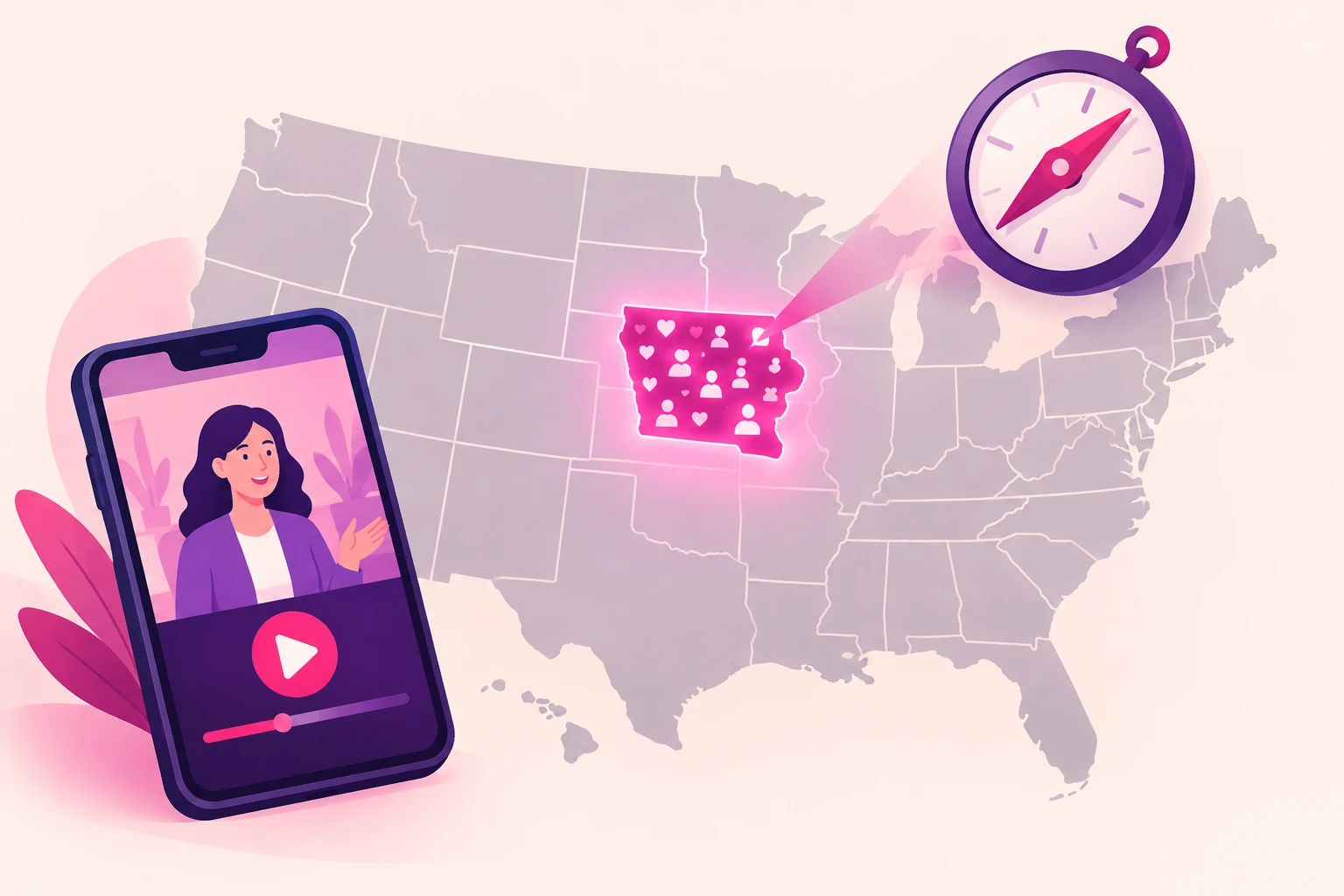
Mental health is already one of the platform's biggest conversations, and most of it is wrong. Attachment styles, boundaries, gaslighting, trauma responses - millions of videos a day, overwhelmingly from people with no clinical training. You never have to make anyone care about your subject. The algorithm will happily hand a counselor licensed in one particular state two million viewers in forty-nine others, plus a few countries, and the counselor will conclude that "TikTok doesn't work for therapists." It worked perfectly. It just wasn't pointed at anything.
Meanwhile the economics on the other side of that trap are unusual in the best way. A client is a course of treatment, not a visit - months of sessions, often at private-pay rates that are a multiple of panel reimbursement - and a client who chose you for how you explain things is far more likely to be a specialty match who stays past session three. A few thousand people inside your state who trust you out-earn a million scattered viewers. And because a caseload is capped at what one human can see in a week, this is the only growth guide in this series where "full" is a milestone rather than a fantasy.
This guide is the roadmap to that audience, and beyond it to 100K for the clinicians who want the educator lane: the two scoreboards, the 90-day plan that finds your content engine without ever touching a client, the series compounding that accelerates it, the growth signals that actually predict a booked first session, and the point where selective amplification takes a proven account and points it at the state line. It builds on our complete TikTok guide for therapists - if you haven't read that yet, start there for the strategy and ethics framework, then come back here for the growth mechanics.
The honest summary:
- Pick your scoreboard before you post. A caseload account is measured in consult requests from inside your state and how many of them match your specialty. A platform account is measured in reach. They conflict, and you decide which wins - and in which order.
- The 90-day plan has three phases: path, lane lock, and intake-log question mining (days 1-30), series compounding (days 31-60), and doubling down on proven winners (days 61-90) - ideally timed so the engine is warm by August or December.
- Saves and follower geography predict clients. Views entertain; saves, profile taps, and the share of followers who live in your state are what turn into first sessions.
- Growth you earn organically tells you which videos deserve promotion - amplify proof, not hope.
What's Inside
- 1. Why Therapist Growth Is Different (Fast, and Exactly the Size of a License)
- 2. The Foundation: Profile, Bio & the Pinned Trio
- 3. Days 1-30: Path, Lane Lock & Intake-Log Mining
- 4. Days 31-60: Series Compounding
- 5. Days 61-90: Double Down on What Works
- 6. The Growth Signals That Actually Matter
- 7. Milestones: What Changes at 1K, 5K, 10K, Full & 100K
- 8. Breaking the Plateaus Every Therapist Account Hits
- 9. The Growth Mistakes That Stall Therapist Accounts
- 10. Accelerating Growth: Amplify Proof, Not Hope
- Frequently Asked Questions
1. Why Therapist Growth Is Different (Fast, and Exactly the Size of a License)
Most growth advice on TikTok is written for entertainers who need scale, because their revenue is a thin slice of a huge audience. Most professional growth advice is written for people whose subject is boring, because their first job is making anyone care. You are in neither group, and that changes five things about how you grow:
- Your problem is aim, not interest. The lawyer and the accountant have to earn attention. You have to direct it - and your target is a shape no other profession has. A vet aims at a drive radius. A creator aims at everyone. You aim at a state: telehealth turned your service area into the entire state where you are licensed, and not one mile past it. Every decision in this guide is downstream of that one fact.
- You win on trust density inside a license. The goal isn't everyone who has ever felt anxious. It's the people in your state, in your lane, repeatedly seeing you explain their own inner sentence clearly and kindly. Twenty videos watched by the same high-achiever in your state who has been "meaning to" for three years does more for your caseload than one video watched by twenty thousand strangers who can't book you.
- Your content supply is pre-validated, and it never touches a client. "Do I have to talk about my childhood?" "Am I bad enough for therapy?" "What is a superbill?" "Will I have to cry?" These are asked on your intake calls and in your comments all day, by people who are not yet clients, in words you can quote without going near a session. Our 52 therapist content ideas vault is built entirely on that engine.
- A follower is worth more to you than to almost anyone on the platform. Not a transaction - a course of treatment. And the quality payoff is bigger than the volume payoff: a client who found you by watching you explain something chose you for the specialty match, which is what predicts whether they stay past session three, show up on time, and finish well. Growth here is about a better caseload as much as a fuller one.
- Your growth has a ceiling, and you get to choose it. A caseload is capped at what one human can see in a week. Every other guide in this series treats growth as endless; yours has a real moment called "full" - and what you do at that moment is one of the most important decisions in this article.
So while "0 to 100K" is the headline, hold the real scoreboard in mind. For a practice, consult requests start arriving in the low thousands of in-state followers. 100K is the educator and creator tier - courses, workbooks, books, group programs, speaking - and we'll cover it honestly, including the case where 100K is a warning sign rather than a trophy. Nobody should wait for it to consider this working.
2. The Foundation: Profile, Bio & the Pinned Trio
Growth turns viewers into followers at exactly one place: your profile. A viewer finishes a video, taps your name, and decides in about three seconds whether to follow. Before posting anything, make those three seconds count - and make them point somewhere:
- The lane-plus-license-plus-state bio. "LPC - anxiety & burnout in high-achievers - Colorado, telehealth statewide - accepting new clients. Videos are education, not therapy." The lane tells the algorithm and the viewer what you are; the license tells them you are the real thing in a genre full of people who are not; the state tells someone in Colorado you're reachable and someone in Ohio to look for their own; the last line does ethics-code work in five words. "Therapist" alone is not a lane - and in most states it isn't even a protected title, which is exactly why the license goes in the bio. If you've chosen the platform path, swap the state for the niche and read the program-and-course version of this foundation in our guide for coaches and consultants.
- A face, not a quote graphic. People follow a specific calm human who made something shameful feel ordinary. They scroll past a practice logo, and they scroll past inspirational text over a sunset even faster. Your profile photo is you, recognizable as the same person in the videos and in the chair a future client will sit across from; the practice name lives in the bio. Associates and pre-licensed clinicians should build this on a personal account - it travels with you when the placement ends - with the provisional title stated honestly and the supervisor's sign-off in writing.
- The pinned trio. Pin your best-performing explainer (proof you're worth following), your "what a first session with me actually looks like" video (the room, the questions, the awkward part - the fear-remover that visibly cuts consult no-shows), and your most reassuring video - the one that tells the person who has been avoiding this for years because of the cost or the shame, "you're allowed to come before it's a crisis, and here's how we handle the money." The third quietly converts more than the other two combined.
- The consult path, one tap away - with the state screen on it. A link-in-bio to a consult request form whose first question is "are you located in Colorado?" It matters little at 500 followers and enormously at 5,000 - and in this vertical the request arrives at eleven p.m. after the argument, so the path has to work when nobody is answering the phone. The state question does two jobs: it routes the out-of-state person to a directory with kindness instead of silence, and it keeps your inbox from filling with people you cannot treat. Set it up now.
- The safety layer, before you need it. A pinned comment on every video with the 988 Suicide & Crisis Lifeline and a one-line "education, not therapy" statement, keyword filters on, and a saved crisis response ready. Not because month one will need it - because the video that finally takes off will, and you will not have time to write it that day. Add the social-media clause to your informed consent now too: clients will find the account, and the pillar guide's compliance section covers what the clause should say.
3. Days 1-30: Path, Lane Lock & Intake-Log Mining
One scheduling note before the plan: if you can choose when to start your 90 days, start in late spring so the engine is warm when you publish the first-session explainer in August for the September wave, or in late summer so it is warm for the December build that wins January. The engine works in any season - more on the timing lever in section 5.
The first month has three jobs, and none of them is going viral: choose your path, lock your lane, and build your question engine.
Choose the path first, in writing, at the top of your running note. Caseload path: a state-sized audience that books. Platform path: a national audience that buys courses, workbooks, and programs. The pillar guide's section on this choice lays out both, including the hybrid sequence your capped caseload makes legitimate. For growth purposes the only rule is that you decide now, because the algorithm is about to decide for you if you don't.
Lane lock means every video teaches the algorithm the same thing about who you are - and in month one, it's deciding exactly that from your first fifteen or twenty videos. This is the growth detail most therapist accounts miss: if those first twenty are all borderless corrections and name-the-pattern explainers with no state in them, the algorithm files you as a mental-health account and serves you to anxious people everywhere. If they are explainers with the state said out loud, a lane in the bio, and a weekly video on how therapy works, it files you as a licensed clinician somewhere and serves you closer to home. Your opening month is deliberately anchor-heavy. The national-reach travelers come in month two, once your identity is set and they can lift an already-anchored account.
Intake-log mining is the habit that powers everything after, and it is the therapist version of a rule every other profession gets to skip: your sessions are never the content source. The questions you mine are the ones people ask before they are clients - on the intake call, in the consult that said no, in your comments. "Do you take my insurance?" "What if I don't know what to talk about?" "What's the difference between you and a psychiatrist?" Every one goes into a running phone note, verbatim, administrative and general. In a normal week you'll bank 15-20. Each one is a video with proven demand, and the asker's exact wording is your hook. Before any of them gets filmed, run the one test that governs this vertical: could this video exist if I had never met a single client? If the answer is no, it does not get made - not de-identified, not as a composite, not as "someone I work with."
The month-one cadence:
- Post three educational answers a week, 30-60 seconds each, filmed in one monthly batching block on a day with no sessions, and designed for your worst week, not your best. The filming guide covers the office-chair studio under $75, the frame rule that keeps everything that belongs to a client out of the shot, and the clock rule that keeps filming and sessions from ever sharing an hour.
- Hook on the experience, never the label. "If you apologize when someone else bumps into you" stops the scroll and is true for a stranger. "Five signs you have this disorder" stops the scroll too - and it is also the growth-wrong move, not just the ethics-wrong one. The label hook fills your inbox with people seeking a diagnosis rather than treatment, it trains the algorithm to find you label-shoppers instead of people ready to book, and it is the one kind of video you will never be allowed to promote later under TikTok's rule against ads that imply a viewer has a condition. Name the pattern; the assessment happens in the room.
- Frame every answer as education. "This is education, not therapy - if any of this lands hard, a licensed clinician in your state can help you look at it," said or captioned. It protects you under the ethics codes, and it's the growth-correct move: general psychoeducation travels, advice for one commenter can't.
- Say the state out loud. "If you're in Colorado and you've been meaning to find someone, this is how." One spoken reference per video, not just a hashtag - because the algorithm learns from what viewers do, and in-state viewers stay longer on something that is visibly for them. Office-only practice? Say the city instead.
- Tag lane and state every time. "#ColoradoTherapist #AnxietyTherapy" - in-state viewers search, and the algorithm serves local-tagged content to local viewers.
- Reply to every comment, daily, and moderate while you do it - five minutes between sessions. Each reply is tomorrow's video and a signal that your account generates conversation; each scan is the crisis check. Keep replies general; "I can't tell you what's going on for your mom without being her therapist, but here's what that pattern often means" is complete, compliant, and surprisingly well-liked. Anything that reads as a crisis gets the saved response, never silence.
- Judge nothing before day 30. Early videos fluctuate wildly while the algorithm tests audiences. The data you need - which topics outperform, and where your followers actually live - only becomes readable with 12-20 videos posted.
4. Days 31-60: Series Compounding
By day 30 you have data: a few videos clearly outran the rest. Month two is about turning those outliers into series - the single most underused growth lever in therapist content, and the one your subject is unusually well built for, because the platform hands you a fresh piece of wrong therapy-speak every single day.
Here's why they compound. A one-off video earns a view. A series - "Therapy-speak, corrected: part 12", "Why your brain does that, part 7", "What actually happens in a first session, part 4" - earns a reason to follow. The viewer who felt seen by episode 12 follows so they don't miss episode 13. Follows-per-view, the number that actually grows an account, jumps measurably the moment a numbered series appears. Series also feed binge-watching: a viewer who finds episode 14 scrolls your profile to watch episodes 1 through 13, and that session of deep engagement tells the algorithm to show your account to more people like them - which, for a caseload account, is exactly when the state anchor in each episode matters most.
The month-two playbook:
- Promote your two best-performing topics into named series with a consistent on-screen title and numbering. Pair one traveler series (corrections, name-the-pattern explainers - these reach nationally) with one anchor series (how-therapy-works, what-a-first-session-is-like, the money conversation - these book in your state). The ideas vault sorts every format this way; the growth rule is that the anchor series never gets dropped when the traveler series takes off - and that the traveler still says the state out loud at the end.
- Turn your comment section into episodes. Use TikTok's video-reply feature to answer real comments on camera - the questioner shares it, the algorithm boosts the conversation loop, and you never run out. Answer the general version of the question, never the person: "is my husband a narcissist?" becomes an episode about what that word has come to mean online versus what it means clinically. Say the crisis response on camera once, publicly - "I can't provide care over messages, but you don't have to be alone with this tonight; call or text 988" - and it becomes one of your most-saved posts.
- Switch on the therapist-as-human clips. Why you chose your modality, what your own therapist taught you, the consultation group that keeps you honest, the tea you make between sessions. This is the format that earns the affection that makes someone book you rather than the platform with the marketing department - and for a group practice, it's the same footage that makes an associate want to work for you. Keep it to about one video in five, and keep self-disclosure a clinical decision, not a content strategy.
- Watch completion rate above all. It's the dominant ranking signal. If a series' completion sags, the episodes are running long - clinicians love caveats, and caveats kill completion. Tighten to 30-45 seconds, put the one essential caveat ("this is general education - a clinician who knows you decides what fits you") in the caption, and completion and reach recover. The TikTok algorithm guide breaks down the full signal hierarchy.
5. Days 61-90: Double Down on What Works

Month three is deliberately boring: more of what the data says, less of everything else. This is where most therapist accounts fail - not from lack of ideas, but from novelty-chasing. Someone gets restless, abandons the series that was working for a trend, and resets the momentum. The accounts that reach five figures are the ones that kept shipping episode 15 when episode 14 felt repetitive to them - because it never feels repetitive to the audience, most of whom just arrived.
- Scale the winners. If the first-session demystifiers outperform, plan a demystifier week. If one series drives most of your follows, take it to two episodes a week.
- Refresh your pinned trio with the best performers from the last 60 days - your profile should always lead with current proof.
- Check the map. Open your analytics and look at follower territories. This is the month the caseload-path account learns whether it is actually one. If the share of followers in your state has fallen as reach rose, the traveler series is winning too hard - put the state in the first three seconds of the next ten videos and give the anchor series a second episode that week. If the in-state share held or grew, you've built the rarest thing in this vertical: a therapy account the algorithm knows is somewhere.
- Mine your analytics for the hero video. By day 90, one or two videos will have dramatically outrun everything: highest completion, most saves, most profile visits, a consult request or two that mention it by name. Those are your amplification candidates - more on that in section 10.
- Ride the wave calendar - it's your biggest lever. Nobody starts therapy on a random Tuesday, and the two largest predictable trigger moments are scheduled: the January wave (resolutions, the aftermath of the holidays, new insurance plans) and the September wave (back to routine). Publish each topic 30-60 days before its moment - the "what a first session looks like and how to find someone licensed in your state" explainer in December and again in August, the couples demystifier in late January, the back-to-school anxiety video in July, the holiday-dinner-with-your-family genre in early November - so your library is already surfaced and saved when someone suddenly needs it. A video posted in December gets found in January; a video posted in January competes with every practice and directory in the country.
6. The Growth Signals That Actually Matter
Views are the vanity metric of therapy TikTok - more so than in most niches, because they are so easy to get. Six signals actually predict whether an account is growing toward booked first sessions:
- Completion rate - the algorithm's favorite signal. Above 50% on a 40-second video means your hooks and pacing work; reach follows.
- Saves - the therapist superpower. A save on a first-session explainer or a "how to find someone licensed in your state" video means "I am not ready yet, but I will be" - and when the trigger moment comes, that person opens your video at the exact moment they are choosing a clinician. The person who saved it quietly in December books the week after the holidays. Demystifiers, the money conversation, and the "you're allowed to come before it's a crisis" video are save-magnets. One caution unique to you: saves also come from people outside your state, so read this signal next to the map, never alone.
- Profile visits per video - the top of your caseload ladder. A video can get modest views but drive heavy profile traffic; that's a winner in disguise, because profile visits are one tap from your consult link.
- Follows per view - your conversion rate from stranger to audience. When a specific topic or series doubles it, you've found your growth engine; feed it.
- Follower territory - the signal that makes your vertical different. TikTok's analytics show where your followers are. For a caseload account this single number is the difference between a marketing channel and a hobby: a small account with most of its followers in-state is a pipeline; a huge account with a sliver in-state is the trap. Check it monthly and let it veto content decisions.
- Consult requests that pass the screen - the only signal that lives outside TikTok, and the one that matters most. Not DMs; a flood of DMs from people you cannot treat is a symptom of the trap, not a sign of growth. Count the requests that answered "yes" to the state question and described a problem inside your lane. When that number moves, the account is working, whatever the follower count says.
Notice what's not on the list: likes (cheap), shares (genuinely valuable here - "send this to your sister" is how therapy content spreads - but erratic), raw follower count (the output, not the input), and DM volume. Check these six weekly, and let them - not your feelings about a video, and not the practice manager who wants another "now accepting new clients" graphic - decide what you make next.
7. Milestones: What Changes at 1K, 5K, 10K, Full & 100K
Growth isn't linear, and each tier unlocks something different. Here's the honest map, written for the caseload path with the platform path noted where it diverges - and with the one milestone no other profession's roadmap contains:
- 0-1,000: the proving ground. The slowest stretch for most professions, and often a quick one for you - mental-health content gets tested on a willing audience immediately. Typical timeline with three posts a week: 45-90 days. The unlock at 1K is the link-in-bio, which completes your caseload ladder. The warning at 1K is the map: if those thousand are spread across the country already, fix the anchors now while the account is small enough to steer.
- 1,000-5,000: the first consult requests. If your content is lane-focused and state-anchored, this is where "I found you on TikTok" starts appearing in your consult form - lumpy and event-driven, clustered around the January and September waves, rather than evenly spread. Here the course-of-treatment math takes over: two or three well-matched clients from this tier, each a stretch of months at private-pay rates, don't just cover the effort of posting - they typically fund years of it. And they arrive already sure you're the right kind of therapist, which is why they stay.
- 5,000-10,000: the state's therapist. Clients arrive pre-sold - they've watched twenty of your videos and trust you before the first session, which changes the tone of the intake, cuts no-shows, and gives the first session a parasocial head start you should name out loud. Referrals compound as viewers send your videos to the friend who has been "meaning to." Colleagues start referring the in-state clients they can't fit, and associates start applying because they watched your team. For a solo practice, this tier is the entire game won: a reliable, essentially free pipeline that a directory listing can't touch.
- Full: the milestone only you get. Somewhere in the previous tier the caseload fills, and most accounts respond by stopping. Don't. Say "waitlist" in the bio, keep a short list of in-state colleagues to refer to, and keep the account running at two posts a week from the bank - because caseloads turn over, an account that helps people find someone still pays in referrals and retention, and a group practice can point the same audience at every associate's empty Tuesdays. Then make the decision on purpose: this is the one moment where "fill first, then go national" stops being a conflict and becomes a sequence. If you choose the platform path now, the travelers in your vault build that second audience. If you don't, keep saying the state. Either is right; drifting is the only wrong answer.
- 10,000-100,000: the educator and creator lane. Growth past 10K increasingly comes from viewers outside your state - which stops adding clients but starts adding different assets: reach, recruiting, and the platform-path revenue of courses, workbooks, books, group programs, speaking, and disclosed partnerships. Push toward 100K if you want those, or if you are an associate building a career that travels with you. Skip it guilt-free if you just wanted a full, well-matched caseload - and treat 100K with a two-percent in-state share as a trap you fell into, not a milestone you reached, unless you chose the platform path on purpose. One footnote that can move the line: PSYPACT for psychologists and the counseling and social work compacts being enacted state by state can make "my state" more than one state, so check your board before you decide the travelers are wasted.
The strategic takeaway: optimize for the 1K-10K in-state tiers first. That's where the practice economics live - and where a months-long, well-matched client makes every milestone worth more than it would be in almost any other niche. 100K is a legitimate goal for therapist-educators - and the playbook is the same engine, run longer, with amplification widening the audience beyond the state line on purpose, and the ethics code's line between education and treatment following you the whole way.
8. Breaking the Plateaus Every Therapist Account Hits
Every growing account stalls somewhere. Therapist accounts stall in predictable places, with predictable fixes:
- The national-drift plateau. Reach is up, followers are up, the inbox is full, and the consult form is flat - because everyone writing to you is somewhere else. This is the therapist plateau; it looks like success, which is why it lasts so long. Fix: re-anchor. The state in the first three seconds of the next ten videos, the "how to become a client and what it costs" explainer re-pinned, in-state commenters answered first, and the state question checked on the consult form from a phone. The national audience will not leave; the in-state one will finally be able to find you.
- The label plateau. The symptom-checklist video got huge views, then follows stopped climbing and the inbox filled with people asking whether they have it. Labels are a commodity - there are ten million checklist videos on the platform - so they earn a view and a request for a diagnosis, not a follow and a consult. Fix: hook on the experience. "If Sunday night feels like dread" is the hook; "here's what that pattern is often about, and what a first conversation with someone looks like" is the reason to follow.
- The full-caseload plateau. The account worked, the caseload filled, and posting stopped because there was nowhere to put anyone. Then the caseload turned over in June and the pipeline was cold. Fix: the waitlist bio, the referral list, and two posts a week from the bank - see the "full" milestone above. A cold account takes three months to rewarm; a warm one refills a slot in a week.
- The parasocial plateau. The account grew, and with it came the weight no other profession's comment section carries: disclosures from strangers at their worst, hostile comments about whether you should be allowed to practice, being recognized in the grocery store, and the fifty DMs you cannot answer. Posting slowed to nothing, and not because you ran out of ideas. Fix: build the infrastructure before the growth, not after it. Keyword filters on, the saved crisis response in place, your consultation group told what you are doing, your own therapist told too, and permission - written on the same note as the path decision - to drop to two a week without apologizing. Three sustained beats seven in a good month and zero in a bad one, every time. This is the account's mental health, and it is yours.
- The safe-messaging plateau. Reach fell off a cliff after a video on suicide, self-harm, or eating disorders, or a video was removed. TikTok's community guidelines are strict on those topics, and the algorithm quietly throttles borderline videos. Fix: the pattern-and-path approach - what the experience is like and what help looks like, never method, means, or numbers - with 988 in the caption, pinned, and spoken, and no trending audio. The filming guide's hard-topics section has the full safe-messaging checklist.
- The same-audience plateau. Reach flatlines because the algorithm has shown you to everyone in your immediate interest pocket. Fix: adjacent-topic expansion. An anxiety account adds a series on the adults who just found out they have ADHD; a couples therapist adds the holiday-dinner-with-your-family genre; a perinatal therapist adds the partner's side. Adjacent lanes reach new pockets while staying credibly inside your license.
- The fear plateau. Someone mentioned the board, or HIPAA, or a client found the account, and you stopped posting anything with substance. Fix: the rules are narrower than the fear. Psychoeducation that could exist if you had never met a client uses no confidential information and diagnoses no one - which is exactly what makes it the safest lane in professional content. The education-not-therapy line, no client stories in any disguise, no diagnosing a stranger, honest titles, and the crisis protocol keep you compliant; the pillar guide's compliance section walks through exactly where the lines are. Substance grows the account; vagueness is what the board and the algorithm both ignore.
9. The Growth Mistakes That Stall Therapist Accounts
- Opening with credentials or a quote graphic. "Hi, I'm a licensed clinical social worker and today we're talking about..." is an exit ramp, and a serif quote over a sunset is a faster one. The viewer's inner sentence is the hook; your credentials belong in your bio and your competence in the answer.
- Posting announcements instead of answers. "Now accepting new clients" graphics, awareness-month slogans, holiday-hours posts - your existing clients mildly care; the algorithm's audience doesn't. Every video should answer something a stranger has actually wondered about their own mind.
- Never saying where you're licensed. The single most expensive omission in this vertical. A perfect explainer with no state in it grows a national audience by default. One spoken reference per video is the cheapest targeting that exists.
- Telling a client story in any disguise. De-identified, composite, "someone I work with" - it is a confidentiality problem first, and a growth problem second, because the clients who would have chosen you for your discretion just watched you demonstrate the opposite. The concept is the content; the person never appears.
- Deleting slow videos. Therapy videos surge on the calendar's schedule, not the posting date - the holiday-dinner video posted in a quiet March wakes up every November, and the first-session explainer wakes up every January and September for years. Old videos become binge material when a new viewer discovers your profile. Deletions erase the algorithm's learning. Leave the catalog alone.
- Chasing trends outside your lane. A trending sound over a coffee mug isn't a strategy; it's lane noise. Use a trend only when your expertise genuinely fits it - a kind correction of a viral piece of therapy-speak is in-lane; stitching the creator to humiliate them is not, and it reads as cruelty to exactly the people you want to book.
- Answering the clinical DM. Beyond the ethics risk, "I can't tell you that without being your therapist - here's 988 if tonight is hard, and here's my consult link if you're in Colorado" is also the growth-correct move. General education travels across the platform; an answer for one commenter's mother helps one person, risks a license, and trains the algorithm on nothing.
- Following clients back or engaging their comments. An ethics problem, and a growth one: it collapses the frame that makes the account trustworthy to everyone watching, and it turns your comment section into a place current clients cannot safely be. The social-media clause in your informed consent, and a consistent no, protect both.
- Buying followers. Bots never book a consult, their dead engagement teaches the algorithm to bury you in-state, and a padded count is exactly the kind of misleading representation licensing-board advertising rules and the ethics codes exist to police. There is no shortcut here that works - only the amplification of real, proven content.
10. Accelerating Growth: Amplify Proof, Not Hope
Run the 90-day engine and something predictable happens: one or two videos dramatically outperform everything else. Completion high, saves stacking, profile visits spiking, a consult request that mentions it by name. Those videos have already passed the only test that matters - real strangers watched to the end and trusted you more afterward.
That's the moment paid promotion stops being a gamble. Amplifying an unproven video is hope; amplifying your hero video is arithmetic - and therapy arithmetic is unique in three ways. First, the payback is measured in courses of treatment, not sessions: a promoted first-session explainer that converts one well-matched client didn't buy one appointment, it bought months of them, so break-even is a fraction of a single relationship, and a group practice runs the same math once per empty caseload. Second, the targeting fixes the trap: paid reach can be pointed at exactly the state where you are licensed - or the metro, for an office-only practice - which is the one thing the organic algorithm will never do for you on its own. Third, the timing lever is real: promoting a proven explainer across your state in December, while people are quietly deciding over the holidays, or in August ahead of the September wave, costs a fraction of competing in January when every practice, platform, and directory in the country bids for the same person. Amplify before the wave, not during it, and January's new clients arrive already trusting you.
That's exactly the model behind our TikTok promotion service: selective amplification of the videos that already earned it, targeted to the people inside the state where you can actually practice, timed to run ahead of the wave. Promoted therapy content still has to follow your professional rules, and here they bite harder than in any other vertical: the ad is always an explainer and never a testimonial, because the APA, ACA, and NASW codes prohibit soliciting them from clients; the promoted video and its caption cannot assert or imply that the viewer has a condition, under TikTok's rule on personal attributes, which is why the demystifiers and how-it-works explainers are the ad-safe candidates and the symptom checklist never is; your state board's advertising rules apply to a promoted video exactly as they do to your website; and nothing promoted promises an outcome. Amplify the education, not the pitch. For growth toward the 100K educator tier, the same approach deliberately widens the targeting beyond the state line. For the mechanics of promoting through TikTok's native tools, see the Spark Ads guide; for the closest parallel in another licensed, patient-facing profession, the healthcare provider growth guide; and for the broader organic playbook this plugs into, the ultimate TikTok growth guide covers the cross-niche fundamentals.
Frequently Asked Questions
How long does it take a therapist TikTok account to grow?
Faster than most professional accounts, because mental health content is already one of the platform's biggest conversations and the audience is waiting for a licensed voice. With three educational videos a week, most therapist accounts see their first outlier video inside 30 days, cross 1,000 followers in 45-90 days, and reach five figures within a year. The more useful timeline is the caseload one: clinicians who anchor to their state typically report their first "I found you on TikTok" consult request between 1,000 and 5,000 followers, clustered around the January and September waves rather than spread evenly across the year.
How many TikTok followers does a therapist need to fill a caseload?
Far fewer than the follower count suggests, as long as they are the right followers. A clinical caseload is capped at what one person can see in a week, and a single client is months of sessions, so a few thousand people inside the state where you are licensed who trust the way you explain things can fill a private practice. What matters is the share of your followers who live in your state, which TikTok shows in the follower-territory breakdown in your analytics, and the share of consult requests that match your specialty. A lane-plus-license-plus-state bio, the state said out loud in videos, and amplification targeted to your state all push both numbers up.
Why is my therapist TikTok getting views but no consult requests?
Usually one of two things. The first is the national-therapist-account trap: therapy content is borderless, so the algorithm has found you an audience that cannot legally be your client. Check your follower territories in analytics; if only a sliver is in your state, re-anchor by saying the state in the first three seconds, pinning the "how to become a client and what it costs" explainer, replying to in-state commenters first, and putting a consult link with an "are you located in this state?" question one tap away. The second is the label hook: symptom-checklist videos earn views and fill the inbox with people who want a diagnosis, not treatment. Hook on the experience instead of the label and the consult requests change character.
Should a therapist buy TikTok followers?
No. Purchased followers are bots and dead accounts that will never book a consult, and they actively hurt you: they crater your engagement rate, which tells the algorithm your content is weak, so real in-state reach drops. A padded count is also the kind of misleading representation that state licensing board advertising rules and the APA, ACA, and NASW ethics codes address under false or deceptive statements about your practice. The legitimate way to accelerate is the opposite: promote a video that has already proven itself with real viewers, targeted to the state where you are licensed, so the followers you gain are people who could actually become clients.
When is the best time of year to grow a therapist TikTok?
Start your 90 days in late spring or early summer so the engine is running and the account has a warm audience when you publish the first-session explainer in August, ahead of the September wave - or start in late summer so it is running when you publish in December for January, the biggest predictable acquisition moment of the therapy year. The account works any time of year because the emotional-season calendar gives you a reason to post every month, so if it is February, start now with relationship-season content and plan the August shoot. If it is January, post the first-session video today, reply to every comment, and block August on your calendar.
What should I do with my TikTok account once my caseload is full?
Do not stop posting. Say "waitlist" in the bio, keep a short list of in-state colleagues to refer to, and keep the account running at two posts a week from the bank - because a full caseload turns over, the account keeps referrals and colleague referrals flowing, and a group practice can point the same audience at every associate's empty slots. Then decide, on purpose, whether this is the moment to switch scoreboards: a capped caseload is the one situation where "fill first, then go national" is a legitimate sequence, and the travelers in your vault are the videos that build that second audience. Just write the decision down, because drifting into it is how the national-therapist trap happens.
Found the explainer your future clients already trust?
The 90-day engine finds your winners - amplification decides how many future clients see them, where, and when. Viryze promotes the educational videos that have already proved themselves, putting your best explainer in front of thousands more people inside the state where you are licensed before the January or September wave lands - so the trust you've built converts into in-state followers, consult requests, and a caseload that is full of the clients you do your best work with.
Grow your practice's account fasterRelated Reading
- TikTok for Therapists: The Complete 2026 Guide - the full strategy and ethics framework this growth roadmap plugs into.
- Therapist TikTok Content Ideas: 50+ Video Concepts That Fill a Caseload - the vault, sorted into travelers and anchors on the state line, that keeps the 90-day engine fed.
- How to Film Therapy Content for TikTok (Confidentiality, Office Setup & What Never to Say) - the client-free production system behind the monthly batch block.
- Healthcare Provider Growth on TikTok: From 0 to 100K Followers - the closest parallel roadmap in another licensed, patient-facing profession.
- TikTok for Coaches & Consultants: The Complete 2026 Guide - the program-and-course mechanics for clinicians who choose the platform path.
- Understanding TikTok's Algorithm: What Really Matters - the signal hierarchy behind every recommendation in this roadmap.

Head of Creator Success at Viryze
TikTok growth strategist helping creators reach their first 100K followers through data-driven promotion strategies.