Your program already produces more raw entertainment in one game week than most brands manufacture in a quarter - rivalries, comebacks, locker-room chaos, a mascot, seniors playing their last home game. And yet most team accounts post a schedule graphic, a final score, and wonder why nobody follows.
Here's the shift that changes everything: fans don't follow results - they follow characters and storylines. The team accounts blowing up on TikTok aren't the ones with the best records. They're the ones that turned the program into a show fans feel part of.
This guide is the complete TikTok playbook for sports teams and programs - high school and college teams, club and academy programs, and local leagues. You'll get the five content lanes that keep every kind of fan watching, the Game-Week Content Engine that turns one week into ten posts, the player-feature rules that keep compliance happy, and the funnel that converts followers into tickets, sign-ups, and sponsor value. It's the team chapter of our complete TikTok guide for athletes.
The short version:
- Run the account like a character - one consistent personality fans recognize, not a bulletin board of scores.
- Rotate five content lanes so students, parents, alumni, and casual scrollers all have a reason to follow.
- Systematize capture. One game week filmed with a plan produces 10+ posts without adding work to anyone's job.
- A fan base is an asset - it fills stands, sells merch, strengthens recruiting, and raises what sponsors pay the program.
What's Inside
- 1. Why Sports Teams Have an Unfair Advantage on TikTok
- 2. Setting Up the Team Account (and Who Should Run It)
- 3. The Program Content Wheel: Five Lanes That Keep Every Fan Watching
- 4. The Game-Week Content Engine: One Week, Ten Posts
- 5. Making Players the Faces (Without a Compliance Headache)
- 6. Growing the Fan Base: Local First, Then Everywhere
- 7. The Stands-and-Sponsors Funnel: Turning Followers Into Real Value
- 8. Paid Amplification: Packing the Stands on Purpose
- Frequently Asked Questions
1. Why Sports Teams Have an Unfair Advantage on TikTok
#SportsTok has accumulated hundreds of billions of views for a simple reason: sport is the rare content category with built-in stakes. Every game has a winner, every season has an arc, every roster has personalities - the narrative ingredients other creators have to invent, a team gets for free every single week.
Teams also hold an advantage individual creators would pay for: a cast. One athlete can burn out carrying an account alone; a program has fifteen to fifty characters, a coach with quotable moments, a mascot, and a student section. When one player has a quiet week, another has the moment that carries the feed.
And the payoff is bigger than vanity metrics. A team's TikTok following compounds into things programs actually need: bodies in the stands, club sign-ups, recruiting reach, booster energy, and a sponsorship story local businesses will pay for. From our experience helping creators grow, the accounts that win treat the fan base as program infrastructure - as real as the weight room - not as a side project for whoever has free time.
One distinction before the tactics: the team account and the athlete account do different jobs. The team account builds the program's brand and fan community; an individual athlete's account builds their following and NIL value - and the two feed each other, as we'll cover in section 5. If you're an athlete deciding where to invest first, start with our athlete growth roadmap - your personal account is the one that travels with you.
2. Setting Up the Team Account (and Who Should Run It)
Most team accounts die of governance, not content. Ten programs start a TikTok in September; by November, seven have gone quiet because nobody owned it. Solve the ownership question before the content question:
- One owner, deputized capture. One person - a coach, team manager, sports information staffer, or a trusted senior - holds the login and approves every post. Two or three players plus a parent or student assistant film into a shared album. The owner curates; the deputies capture. This survives busy weeks; committees and single-person-does-everything models don't.
- A recognizable handle and bio. Team name + school/town + sport, in that order (@lincolnvolleyball beats @lvhs_vb_official). The bio states who you are, where you play, and the season's storyline in one line - "Lincoln HS Volleyball • Defending district champs • Road to State".
- Two pinned videos: your best-performing hype or highlight video, and a 30-second "meet the team" intro. New visitors decide in seconds whether this account is a character worth following - pins make the case instantly.
- Ground rules in writing. Before the first post: who approves content, what never gets posted (injuries, opponents mocked, anything a player hasn't okayed), and what happens to the login when the current owner graduates or moves on. Ten minutes of writing prevents the mid-season account death spiral.
Set the tone deliberately. The best team accounts pick a personality - deadpan, chaotic, wholesome, cocky-but-lovable - and hold it so consistently that fans could identify the account from the caption alone. Tone is a decision, not an accident; make it once and write it into the ground rules.
3. The Program Content Wheel: Five Lanes That Keep Every Fan Watching
A team account serves four audiences at once - students, parents, alumni, and casual scrollers who've never heard of your program. No single content type feeds all four, which is why score-graphics accounts stall. We call the fix the Program Content Wheel: five lanes, rotated so every audience gets a reason to follow within any given week:
Lane 1: Game-day content
Arrivals and fit checks, warmup rituals, crowd and student-section reactions, the celebration after the winning point. Game-day content carries the emotion casual scrollers stop for - lead with the loudest moment, not the opening whistle.
Lane 2: Behind the scenes
Practice drills, conditioning suffering (respectfully), bus trips, pre-game meals, coach's whiteboard moments. BTS is the follow-maker: it gives fans the access feeling that broadcasts never provide, and it's filmable at every practice.
Lane 3: Player personality
Spotlights, teammates answering one question, trends done as a team, mic'd-up moments. Personality content turns roster names into characters - and characters are what fans return for between games.
Lane 4: Community & tradition
The mascot, rivalry week, senior night, throwback footage, the town showing up. This lane belongs to parents and alumni - the audiences that buy tickets, fund boosters, and share your videos into every local Facebook group.
Lane 5: Results storytelling
Not bare scores - narratives. The comeback recap cut to the momentum swing, the five-game win streak montage, the "nobody picked us" season arc. Results gain reach only when they're framed as story beats.
A workable in-season rhythm: two game-day posts, two BTS, one personality, one community or results post per week - then double down on whichever lane your analytics show converting viewers into followers. For a deeper vault of concepts that adapt directly to team accounts, raid our athlete content ideas library - most of its 50+ formats work at program scale.
4. The Game-Week Content Engine: One Week, Ten Posts
The number-one objection from coaches and team managers is time - and it's legitimate if content is treated as extra work. The fix is the Game-Week Content Engine: a capture schedule mapped onto the week the program already lives, so filming adds minutes, not hours.
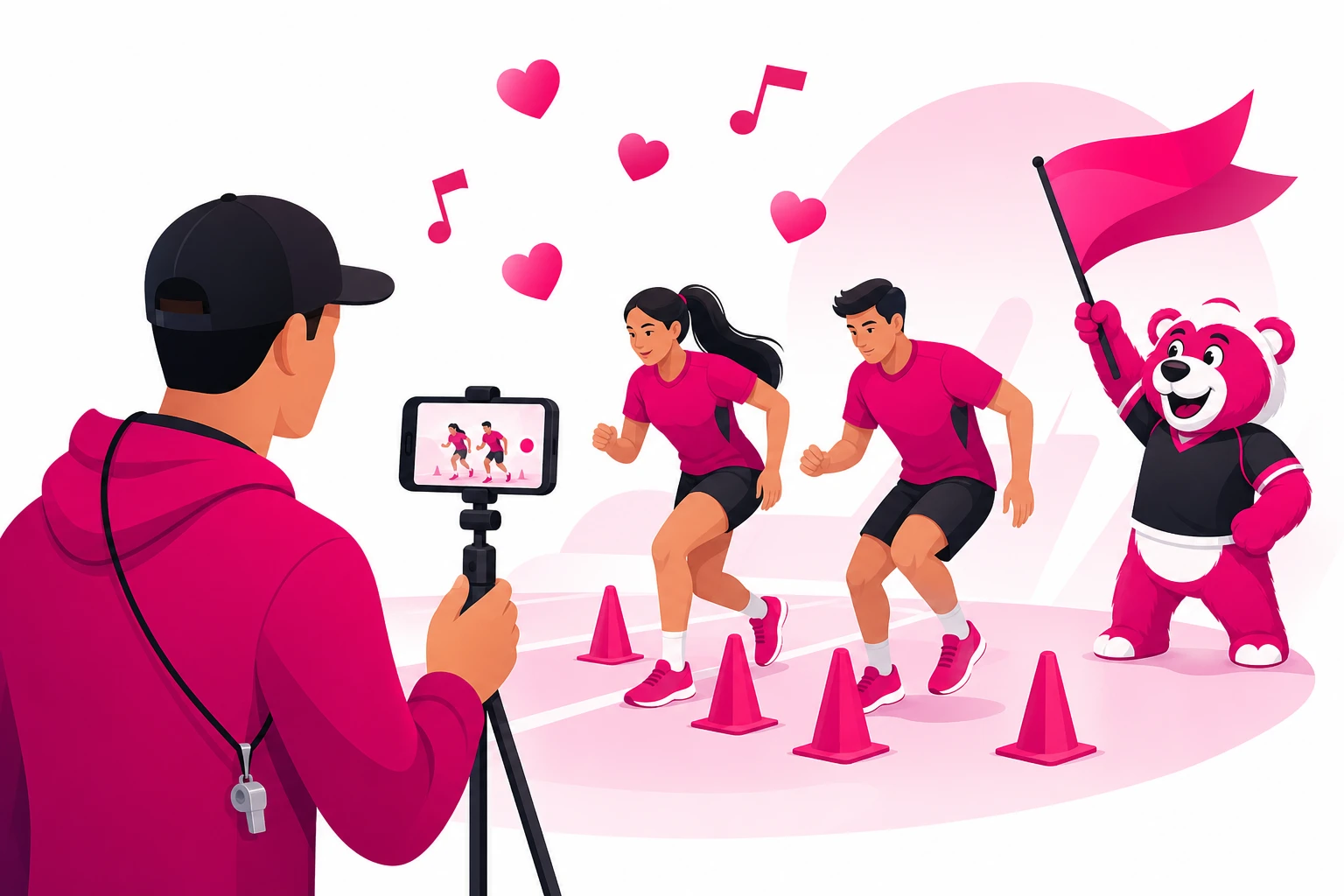
- Monday - the setup post. Film 60 seconds at practice: the week's stakes, the rivalry, the standings math. One clip of a drill, one line of on-screen text framing the week's story.
- Midweek - two BTS clips. A phone on a small tripod at practice captures drills, coach soundbites, and unscripted moments while everyone works. Ten minutes of footage cuts into two posts. The angles and settings that make practice footage look good are covered in our athlete filming guide - everything in it scales from one athlete to a full roster.
- Game-day morning - the hype post. Arrival fits, the locker room, the pump-up ritual. Post it 3-6 hours before start so local fans see it in time to show up.
- During the game - capture, don't post. A designated deputy (not the coach) films the crowd, the bench reactions, and the big moments. Trying to post live means missing the best clips.
- Post-game to next morning - the payoff posts. The celebration clip goes up within two hours while local emotion is peaking; the crafted recap - momentum swing, hero moment, final score reveal - lands the next morning as the week's anchor post.
That's eight to ten posts from one ordinary week, none of which required a practice to run differently. The only new habit is the tripod going up when the whistle blows - and after two weeks, players start pointing your deputies toward moments worth filming.
5. Making Players the Faces (Without a Compliance Headache)
Fans follow faces. The programs with the strongest accounts consistently feature players as recurring characters - the freshman phenom, the comedian, the captain on a redemption arc. But featuring athletes, many of them minors, comes with rules. Handle them once, properly, and the lane is wide open:
- Get consent in writing. For minors, that means a parent or guardian media release - most schools have one; confirm every roster member is covered and honor opt-outs without drama. For college programs, follow the athletic department's social policy before anything else.
- Two editorial rules that prevent 95% of problems: never post a player looking bad (missed plays, emotional lows, injuries), and give any featured player veto power over their clip before it posts. Players who trust the account start feeding it their best moments.
- Mind the NIL line. A hype video is fine; sponsored content built around a specific college athlete crosses into name, image, and likeness territory - route it through compliance first. The full rulebook is in our NIL deals guide.
- Tag and cross-post with athlete accounts. When the team features a player, tag their account; when a player posts, they tag the program. Each account converts the other's viewers - the team gains reach from every athlete's audience, and athletes gain the discoverability that raises their own NIL value.
That last point deserves emphasis, because it turns the team account into a recruiting pitch: a program that grows its players' visibility is offering something money can't buy. A club or school known for making its athletes discoverable - the machinery described in our TikTok guide for athletes - has an edge with every recruit who walks in the door.
6. Growing the Fan Base: Local First, Then Everywhere
Here's the strategic clarity most team accounts never reach: your first thousand followers should mostly live within driving distance of your venue. A local follower buys a ticket; a random viral viewer doesn't. Build local density first, and let the algorithm find the wider sport audience second:
- Name your place relentlessly. School, town, league, and rivalry names in captions and on-screen text give TikTok the geographic signals it uses to route videos to nearby feeds - the same local-discovery mechanics that power TikTok for small businesses.
- Recruit the student section. Announce a hashtag at games, duet and stitch the best fan clips, and let students see themselves on the team account. Every reposted fan video deputizes another camera - and student shares are how a team video floods a school overnight.
- Reply to every comment in hour one. Early engagement tells the algorithm the video deserves reach, and in-character replies are themselves content fans screenshot and share.
- Ride the season's calendar. Season openers, rivalry weeks, playoffs, and signing days bring predictable attention spikes - plan your strongest content into those windows instead of spending it on quiet weeks. The mechanics of completion rate, shares, and the interest graph that decide who sees it all are in our TikTok algorithm guide.
Benchmarks from programs that run this playbook: a consistent high school or club account typically reaches 1,000-5,000 local followers in its first season, and accounts that add a breakout series - a mic'd-up coach, a weekly player spotlight, a season-long "road to state" arc - are the ones that clear 10,000 and start showing up in opposing student sections' feeds.
7. The Stands-and-Sponsors Funnel: Turning Followers Into Real Value
A fan base only matters if it converts into things the program needs. We call the conversion path the Stands-and-Sponsors Funnel: viewer → follower → fan → attendee → revenue - and each stage has one job:

- Followers → attendees. Post the game-day hype early enough to act on, put the schedule link in the bio, and make attendance content a lane of its own - when the student section sees itself going viral, showing up becomes part of the show. Programs consistently report their loudest home crowds in the weeks after a video travels locally.
- Followers → sign-ups. For clubs and academies, the account is a recruiting engine: tryout announcements, "day in the program" videos, and player-development arcs sell the program to the next class of parents better than any flyer.
- Followers → merch and fundraising. Drop merch content in the emotional windows - after the rivalry win, during senior week - and give boosters a number to point at. "12,000 local followers" moves a fundraising conversation in a way "we need support" never has.
- Followers → sponsor value. An engaged local audience is exactly what the businesses on your banner boards are buying. A program with real TikTok reach can put sponsors in content - not just on a fence - and charge accordingly. The same five numbers sponsors check before funding an athlete apply to programs, and they're broken down in our NIL deals guide.
Audit the funnel monthly from a stranger's seat: watch your latest video, tap the profile, and count the taps to a schedule, a tryout form, or a sponsor contact. Every extra tap is a fan - or a check - leaking out of the funnel.
8. Paid Amplification: Packing the Stands on Purpose
Organic reach decides which of your videos deserve investment; paid amplification decides how far the winners travel. For a team, the play is selective amplification: take the video your analytics already prove out - best completion rate, most profile visits, most new followers - and put budget behind showing it to thousands more people in your town, your league's footprint, and your sport's audience.
This is exactly what a TikTok promotion service built for follower growth does well. Viryze tests multiple audience combinations against your proven video - by location, age, and interest - and automatically shifts budget toward the segments that actually follow, so a program's spend concentrates on the local fans, students, and parents who show up rather than vanishing into random global views.
Time it to the calendar: amplify the hype series the two weeks before the season opener, push the rivalry-week video while the town is already talking, and boost the tryout announcement when registration opens. Because the promoted video is your own proven post running through TikTok's official ads platform, it keeps its organic look - our Spark Ads guide explains the format.
Pro Tip
Amplify the follow-maker, not the score. The best video to promote is rarely the final-point clip - it's the one that makes a stranger care about your program: the mic'd-up coach, the senior-night story, the comeback recap. Run selective amplification on the video that converts viewers into followers, and the game-day content inherits the bigger audience for free.
The math a program should run: if a few hundred dollars of amplification adds 3,000 local followers, and that audience lifts gate revenue, fills a tryout class, or justifies a higher sponsor package, the account has crossed from social media hobby to revenue infrastructure - which is precisely how the best-run programs now treat it.
Ready to Build a Fan Base That Shows Up?
Viryze grows team accounts with real local fans - AI-powered audience testing, automatic budget optimization, and follower growth through TikTok's official ads platform. Amplify your proven videos into season openers, rivalry weeks, and tryout windows, and watch the stands fill.
Grow Your Team's Fan Base with ViryzeFrequently Asked Questions
How do sports teams grow on TikTok?
The teams that grow treat the account like a character, not a bulletin board. They pick a consistent personality, post 4-7 times a week from footage the program already produces (practice, game day, travel, locker room), lead every video with the payoff in the first two seconds, and make players the recurring faces fans attach to. Local discoverability compounds it: school, town, and league names in captions, local sounds, and replies to every comment in the first hour. Score updates alone don't grow accounts - stories and personalities do.
What should a sports team post on TikTok?
Rotate five lanes: game-day content (arrivals, warmups, crowd reactions, celebrations), behind-the-scenes (practice, drills, travel, pre-game rituals), player personality (spotlights, mic moments, trends done by the team), community and tradition (mascot, rivalries, seniors, throwbacks), and results storytelling (comeback recaps, season narratives - not bare scores). Programs that rotate all five lanes keep casual scrollers, students, parents, and alumni all watching; accounts that post only highlights plateau fastest.
Who should run a sports team TikTok account?
One owner with final say, plus deputized capture help. The owner - a coach, team manager, sports information staffer, or a trusted senior player - approves what posts and holds the password. Capture is distributed: two or three players and a parent or student assistant film clips into a shared album, because the best moments happen where the owner isn't standing. What fails is the committee model with no owner (the account goes quiet by mid-season) and the locked-down model where one busy coach must film everything.
Do teams need player permission to post athletes on TikTok?
Yes - treat consent as non-negotiable. For minors, get written parent or guardian permission (most schools fall under an existing media release; confirm every roster member is covered and honor opt-outs). For college programs, follow the athletic department social media policy and check name, image, and likeness implications before any sponsored content features a specific athlete. Two working rules keep it clean: never post a player looking bad (missed plays, emotional moments, injuries) and give any featured player veto power over their clip before it goes up.
How often should a sports team post on TikTok?
In season: 4-7 posts a week, which one game and two practices can supply if capture is systematic. Game weeks support daily posting - hype Monday, drills midweek, game-day morning, live-window clips, and a next-morning recap. Off-season: 2-3 posts a week to keep the account warm (training arcs, throwbacks, recruiting news, personality content). The pattern to avoid is the burst-and-vanish cycle - ten posts in September, silence by November - because the algorithm and the fan base both reward consistency over volume.
Continue Reading
TikTok for Athletes: The Complete 2026 Guide
The full playbook: the six video formats that grow athlete accounts, the highlight-first hook, and the deal ladder that turns followers into NIL income.
Read More →How to Film Athlete Content for TikTok
The under-$50 pocket studio, the five-capture training-day system, and the angles that make sports footage hit - all of it scales to team accounts.
Read More →NIL Deals from TikTok: Followers Into Brand Deals
The three deal sources, the five numbers sponsors scout, and the compliance steps that protect eligibility - for athletes and the programs behind them.
Read More →
Head of Creator Success at Viryze
TikTok growth strategist helping creators reach their first 100K followers through data-driven promotion strategies.