Most athletes post the same video over and over: a highlight, a song, a logo in the corner. It gets a few hundred views from people who already know them, and nothing changes. Meanwhile the athlete two towns over filmed the exact same practice you did this morning - and turned it into four posts, 40,000 views, and a DM from a local brand.
The difference isn't talent, a better season, or a nicer camera. It's having a vault of proven idea patterns to pull from, so filming becomes assembly instead of invention. You already do the hard part every single day. The content is sitting inside the work.
This guide is that vault: 50+ athlete TikTok content ideas organized into the six categories that actually build a following - training and workout clips, highlights and game-day POV, skill breakdowns, journey storytimes, personality and team content, and the NIL and brand videos that turn an audience into income - plus the hooks that make sports videos stop the scroll and the capture system that means you never run dry. New here? Start with our complete TikTok guide for athletes for the full strategy, then come back for the ideas.
The honest summary:
- One training day is a week of content. Five quick captures per session feed the whole vault - no separate "content days."
- Highlights get views. Journey gets followers. A great play is forgettable; a story people are invested in is not.
- Teach something and they save it. Skill breakdowns are the most-saved athlete content, and saves travel.
- When one idea takes off, use selective amplification to push that proven video to more fans in your sport and your market.
What's Inside
- 1. The Training-Day Idea Engine: Never Run Out Again
- 2. Hooks That Make Athlete Videos Stop the Scroll
- 3. Training & Workout Videos (Ideas 1-12)
- 4. Highlights & Game-Day Content (Ideas 13-22)
- 5. Skill Breakdowns & Teaching Clips (Ideas 23-32)
- 6. Journey & Storytime Videos (Ideas 33-42)
- 7. Personality, Team & Fan Content (Ideas 43-50)
- 8. NIL, Brand & Business Content (Ideas 51-56)
- 9. Turning the Vault Into a Weekly System
- 10. When One Idea Takes Off: Amplifying Your Winners
- Frequently Asked Questions
1. The Training-Day Idea Engine: Never Run Out Again
Before the list, the system - because a list of 56 ideas eventually runs out, and a machine that generates them doesn't. Athletes who post for years aren't more creative than you. They stopped inventing content and started capturing it from training they were already doing.
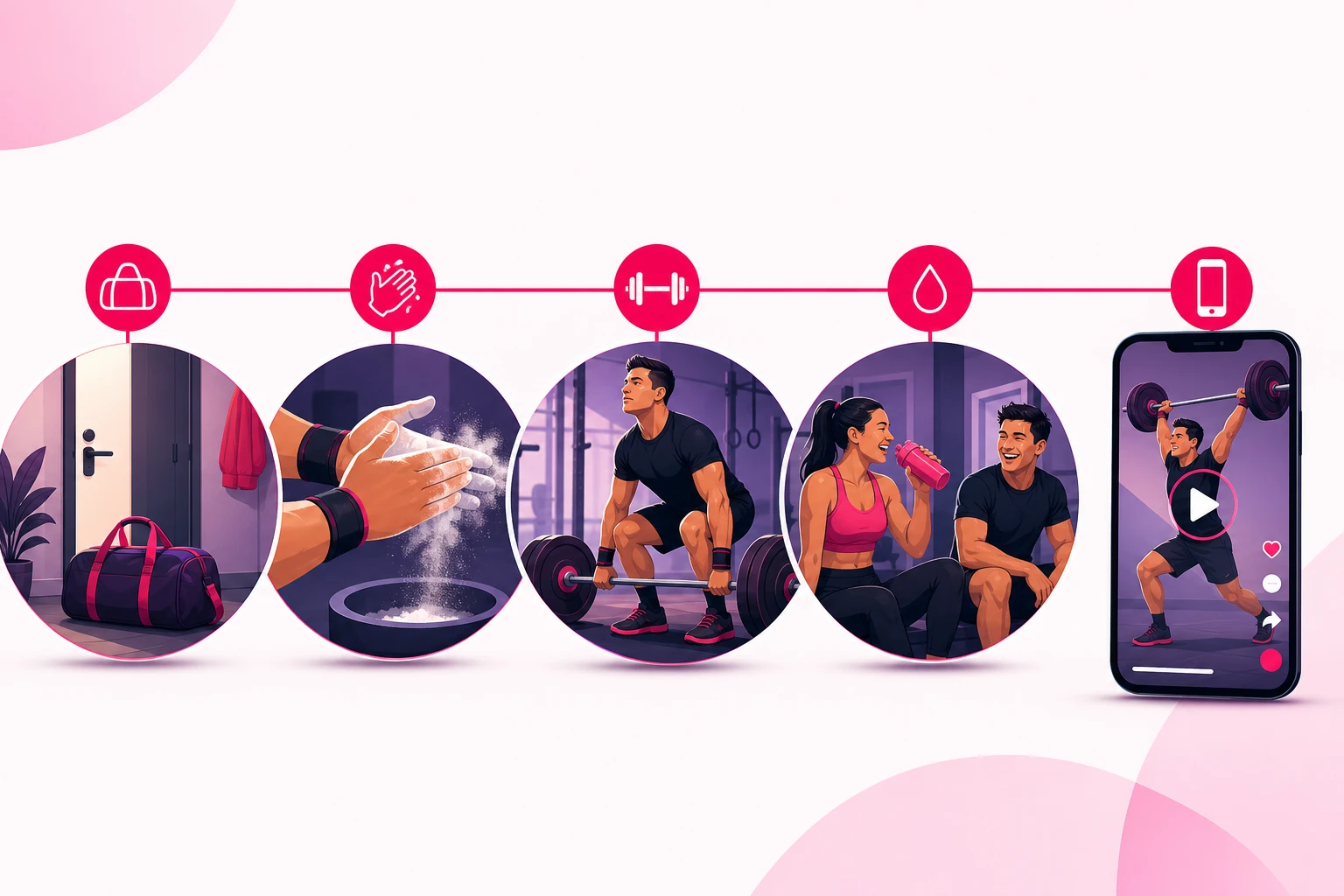
Five capture points feed the machine, and together they cost about ninety seconds across an entire training day:
- The before shot. Ten seconds at the start: walking into an empty gym, the bar loaded, the field before anyone else arrives, the clock on your phone. Without a before there is no transformation, and transformation is what holds attention.
- The work clips. Two or three ten-second clips mid-session - the drill, the set, the sprint, the rep you keep failing. Prop the phone against a water bottle and let it run. These become training posts and the middle of every edit.
- The result clip. The made shot, the PR, the clean rep, the time on the watch. This is your hook material - the two seconds you'll open a video with.
- The human moment. The reaction, the frustration, the laugh with a teammate, the collapse on the mat. One genuine moment turns a training clip into something people actually feel.
- The story note. Before you leave, voice-memo one thing: what you were working on, what went wrong, what a coach said. That note is next week's storytime or skill breakdown, in your own words while it's fresh.
Your second source is the audience itself. Every question in your comments and DMs is a video the platform has already proven demand for - someone cared enough to ask. From our experience helping creators grow, comment-sourced videos average roughly 40% higher engagement than invented topics, because the algorithm routes them back to the exact conversation that spawned them. For an athlete, every "how do you jump that high?" and "what does your week look like?" is a script handed to you for free.
The 56 ideas below are the patterns that this capture system feeds. Treat each one as a template: plug in today's session, today's result, or today's frustration, and the video writes itself.
2. Hooks That Make Athlete Videos Stop the Scroll
An idea only works if people stop for it, and on TikTok the stop happens - or doesn't - in the first second. Watch-through rate is the dominant ranking signal, so before you film anything in this vault, decide its hook. The rule from our athlete pillar guide applies to every idea below: lead with the moment, not the buildup.
- The result-first open. Two seconds of the made shot, the finish, the bar locked out - then cut back to how you got there. The payoff earns the attention; the story holds it.
- The reaction open. Start on your face, a teammate losing it, or the bench erupting. Emotion out-performs action, because emotion tells the viewer the moment mattered before they know what happened.
- The number hook. "14 months to add four inches to my vertical." Specific numbers signal a real process; vague claims signal filler.
- The stakes open. "Last practice before cuts." Stakes make a routine clip feel like a story with an outcome worth waiting for.
- The storytime cold open. "A coach told me I was too small to play." No intro, no greeting - drop the viewer into the middle of something.
- The caption hook. A bold on-screen line before you say a word. Most people watch on mute, so the caption often does more work than your audio does.
For the mechanics behind why these openings out-rank slow intros, our TikTok algorithm guide breaks the ranking signals down frame by frame.
3. Training & Workout Videos (Ideas 1-12)
The backbone of an athlete account. Training content is endlessly available, costs you nothing extra to film, and answers the question every viewer is quietly asking: what does it actually take? It also builds the credibility that makes your highlights land.
- Idea 1 - The 5 AM reality. Alarm, dark parking lot, empty gym, first rep. Honesty about the grind reads as commitment, and it's the most relatable athlete video there is.
- Idea 2 - The session timelapse. Two hours compressed into twenty seconds. Set the phone down once and it films itself - the easiest post in this entire list.
- Idea 3 - The one-drill deep dive. A single drill, ten reps, and what you're actually trying to fix. Specific beats broad every time.
- Idea 4 - The PR attempt. The miss, the reset, the make. Failure before success is the most-watched structure in sports content because the outcome is genuinely in doubt.
- Idea 5 - The finisher nobody films. The conditioning at the end, the part where you're done and there's still work left. Nobody posts this, which is exactly why it stands out.
- Idea 6 - The rehab session. Band work, ice, the slow road back. Unglamorous and deeply human - and it reaches every athlete currently sitting out.
- Idea 7 - The lift-day POV. Your program for the day, filmed from your perspective. Strength content overlaps directly with the fitness creator audience, which is one of the biggest on the platform.
- Idea 8 - The warm-up routine. Exactly what you do before you compete, in order. Useful, repeatable, and easy for younger athletes to copy - which means saves.
- Idea 9 - The bag tour. Everything you carry and why. Doubles as brand content the day a gear company notices you.
- Idea 10 - Training on the road. The hotel gym, the empty field, the workout you improvised at 11 PM. Travel adds visual variety without any extra effort.
- Idea 11 - The off-season week. What you do when nobody's watching - the volume, the boredom, the reps that pay off in six months.
- Idea 12 - The training series. Number it: "day 34 of the off-season." Series are how most athlete accounts break out, because each entry compounds the audience of the one before it.
4. Highlights & Game-Day Content (Ideas 13-22)
Highlights get you discovered - but only when they're framed as a moment instead of dumped as a montage. The fix is context: give the viewer stakes, a reaction, or a number, and a ten-second clip becomes a story. Game-day content does the rest of the work by showing the parts fans never get to see.
- Idea 13 - The hooked highlight. Open on the result, then rewind: "this was the last play of the game." Same clip, completely different retention.
- Idea 14 - The full sequence. Not just the finish - the three plays that set it up, narrated. Shows sports IQ, which is what recruiters and serious fans actually watch for.
- Idea 15 - Game-day POV. Bus ride, headphones, taping up, tunnel, first whistle. The most repeatable format in the entire category - you get one every game.
- Idea 16 - The walk-out. The tunnel, the mat, the blocks, the ring. Ten seconds of pure anticipation that works in every sport.
- Idea 17 - The crowd shot. Turn the camera around. The reaction to what you did is often better content than what you did.
- Idea 18 - Sideline energy. The bench, the huddle, the celebration nobody broadcasts. Personality lives here, and personality is what earns the follow.
- Idea 19 - The postgame raw take. Filmed in the parking lot, still in uniform, unedited. Immediacy beats polish - this is the closest thing to being there.
- Idea 20 - The stat-line video. "What a 24-point night actually looks like" - every touch, cut together. Numbers give the montage a reason to exist.
- Idea 21 - The loss. How you handle the bad night. Posting after a loss builds more trust than ten wins, because everyone posts the wins.
- Idea 22 - The season recap. A full year in forty seconds, ending on what comes next. Perfect for the week your season ends - and it doubles as a recruiting reel.
5. Skill Breakdowns & Teaching Clips (Ideas 23-32)
This is the most under-used category in the sports niche, and the highest-value one. Teaching clips get saved and rewatched, and saves are a strong quality signal - they also position you as someone worth learning from, which is the first step toward camps, lessons, and coaching income later on.
- Idea 23 - How I actually do it. Your signature move, broken into three steps. Whatever you're known for, someone is searching for how to learn it.
- Idea 24 - The mistake everyone makes. The single most common error you see in your sport, plus the correction. Mistake-format videos out-perform tip-format videos because people watch to check themselves.
- Idea 25 - The drill that fixed my weakness. Name the weakness, show the drill, show the before and after. Vulnerability plus a solution is a powerful combination.
- Idea 26 - Slow-motion mechanics. Your form at quarter speed with arrows or text pointing out what matters. Cheap to make, extremely saveable.
- Idea 27 - The comment answer. Screenshot a real question and demo the answer on the field. The single easiest video in this guide, and pre-validated demand.
- Idea 28 - Beginner vs. advanced. The same skill at two levels, side by side. Gives every viewer an entry point and a goal in one video.
- Idea 29 - What coaches actually look for. The unglamorous things that get you playing time. Enormously valuable to younger athletes and their parents.
- Idea 30 - Gear that's worth it. Honest opinions on what you use and what you wasted money on. Trust-building, and the natural bridge to affiliate income.
- Idea 31 - Recovery and fuel, specifically. Your actual sleep, meals, and recovery routine with real numbers. Skip the generic advice - specificity is the whole value.
- Idea 32 - The teaching series. One skill per week, numbered. This is the format that turns a following into a coaching and lessons business when you're ready for it.
6. Journey & Storytime Videos (Ideas 33-42)
Highlights get views; journey gets followers. Nobody follows an account because one play was good - they follow because they want to know what happens next. This is the category that converts a viewer into a fan, and fans are what brands are actually paying for.
- Idea 33 - The origin story. How you started, at what age, and why you stuck with it. Pin it - it's the video new followers watch second.
- Idea 34 - The cut. The team you didn't make, the bench you sat on, what you did about it. The most-shared storytime in youth and college sports.
- Idea 35 - The injury timeline. Diagnosis to first day back, told in thirty seconds. Comeback arcs are the strongest narrative in all of sports content.
- Idea 36 - The transfer or move. New school, new team, new city - what changed and what you learned. Timely and highly searched during transfer windows.
- Idea 37 - The recruiting process, honestly. What the emails, camps, and calls were really like. Extremely valuable to the athletes two years behind you.
- Idea 38 - The balancing act. Classes, a job, practice, and sleep - what your actual week looks like. Every athlete watching recognizes their own schedule.
- Idea 39 - What I got wrong. The training mistake, the year you wasted, the advice you should have ignored. Admitting an error out-performs claiming expertise.
- Idea 40 - The goal declaration. Say publicly what you're chasing this season. It creates a story people follow all year - and it holds you to it.
- Idea 41 - Then versus now. Old footage next to current footage. Visual proof of work is one of the most-shared formats on the platform.
- Idea 42 - The journey series. "The road to state, part 9." A numbered arc with a clear finish line is the single most reliable way for an athlete account to break out.
7. Personality, Team & Fan Content (Ideas 43-50)
Every sport has a hundred accounts posting the same clips. What it doesn't have is a hundred accounts with your sense of humor, your teammates, and your voice. Personality is the least competitive lane in the whole niche - and it's the reason people remember which athlete they follow.
- Idea 43 - The locker-room bit. The running joke, the nickname, the teammate who never shuts up. Film it with permission and keep it good-natured.
- Idea 44 - Rating things. Pre-game meals, road trip hotels, warm-up playlists, your teammates' cleats. Low-effort, high-comment, endlessly repeatable.
- Idea 45 - The stitch or duet. React to another athlete's clip or a take you disagree with. The fastest way to reach an audience that isn't yours yet.
- Idea 46 - Answering the critic. Read a doubting comment, then respond on the field. Handle it with humor, not heat - the composure is the content.
- Idea 47 - Teammate Q&A. Interview each other with fan-submitted questions. Two athletes, two audiences, one video.
- Idea 48 - The day off. Who you are when you're not competing - the cooking, the hobby, the dog, the little sibling. Dimension is what makes people stay.
- Idea 49 - The young fan moment. Signing something, running a clinic, showing up at a youth practice. Community content is the most-shared thing an athlete posts, and brands notice it.
- Idea 50 - The coach cameo. Their honest scouting report on you, or one piece of advice that changed things. Borrowed credibility, and usually very funny.
If performance and movement content is your lane, the TikTok guide for dancers covers a closely related playbook for filming the body in motion - much of it transfers directly to gymnastics, combat sports, and track.
8. NIL, Brand & Business Content (Ideas 51-56)
In the NIL era your following isn't a vanity metric - it's the number deals get priced against. These six make the business side visible so brands and collectives can find you, understand you, and reach you without digging.
- Idea 51 - The pinned intro. Fifteen seconds: name, sport, position, school or club, market, and what you're chasing. The video every new visitor and every brand watches first.
- Idea 52 - The partnership done right. A brand you genuinely use, worked into a real training clip - clearly disclosed with #ad. Sponsored content that looks like your normal content is the kind that gets renewed.
- Idea 53 - Behind a deal. How a partnership actually came together, minus the confidential numbers. Wildly useful to other athletes, and it signals to brands that you're easy to work with.
- Idea 54 - The merch or product story. Why you made it, not just that it exists. Story-first product videos out-sell announcement posts by a wide margin.
- Idea 55 - The camp or lesson promo. Show a real session, then say how to book. Running your account like a small business is a skill in itself - our small business TikTok guide covers the fundamentals.
- Idea 56 - The thank-you. To a coach, a parent, a trainer, or the people who've watched from the start. Gratitude content travels further than anyone expects.
One compliance note worth ten minutes:
Your own training, story, personality, and teaching content is almost never a problem - none of it involves a deal. The care is needed around paid posts and other people: clear sponsorships with your school or conference compliance office before you post, disclose paid partnerships with #ad, check the rules on showing facilities, uniforms, logos, and branded gear, and ask teammates before you post footage of them. Asking first is always cheaper than fixing it after.
9. Turning the Vault Into a Weekly System
Ideas don't grow accounts; a repeatable week does. Aim for four to six posts a week while you're building, drawn from the categories above in roughly this mix:
| Category | Posts per Week | What It's For |
|---|---|---|
| Training or highlight | 2 | Earn reach and get discovered by fans of your sport |
| Skill breakdown | 1 | Earn saves and build authority in your position or event |
| Journey or storytime | 1 | Convert viewers into followers who come back |
| Personality or team | 1 | Make you memorable and worth rooting for |
Batch it. Pull your capture clips into one editing block early in the week, cut a training or highlight video (result first, then the work), one skill breakdown, and one journey or personality clip filmed straight to camera, then schedule them out. One take each - the slightly rough version reads as more real than the polished one. Keep videos to 20-40 seconds with the payoff up front, caption everything for mute viewers, and put your sport, position, and city in captions so local fans and brands can find you.
Then hold the cadence through the off-season, which is where most athlete accounts quietly die. Games stop, but training, skill, and journey content don't - and that's the stretch where you have the most time to build. For how this rhythm fits the bigger curve, the complete TikTok growth strategy guide maps zero to 100K, and our follower acquisition framework shows how saves and shares become followers.
10. When One Idea Takes Off: Amplifying Your Winners
Post consistently from this vault and a pattern shows up: most videos do fine, and a few dramatically out-perform - higher completion, more saves, a spike in profile visits and follows. Those are your hero videos, and they deserve different treatment than the rest.
For athletes, the math on amplifying a hero video is unusually favorable, because your following is priced. Deals routinely start in the 5,000-25,000 follower range when the audience is engaged, on-niche, and local, so every additional real follower moves the number a brand or collective quotes you. Timing multiplies it: interest in your sport and your name peaks during your season, around recruiting windows, and in the days right after a video pops. Amplifying into those windows reaches the warmest audience your account will ever have.
The discipline is selectivity. Only amplify videos that already cleared the organic bar - completion above 50%, save and share rates above your account average, and a clear follow spike. Paid traffic can't rescue a video nobody finishes; it can only pour fuel on one that's already burning.
That's exactly the model our TikTok promotion service is built on - selective amplification of your proven best videos toward fans of your sport in your market, instead of boosting every upload and hoping. For the mechanics of running promotion through TikTok's native format, see the Spark Ads guide and the complete TikTok advertising guide.
Frequently Asked Questions
What should an athlete post on TikTok?
Six categories cover almost everything that works: training and workout clips (what your 5 AM actually looks like), highlights and game-day POV framed with a hook instead of dumped as a montage, skill breakdowns that teach one specific thing you do well, journey storytimes about the cut, the injury, or the comeback, personality and team content that shows who you are off the field, and NIL and brand content that makes the business side visible. Pick two or three that fit your sport and repeat them until the algorithm can categorize your account - a pure highlight feed is the most oversupplied content in the entire sports niche.
How do athletes never run out of TikTok content ideas?
By capturing content from training they were already doing instead of inventing it. Five capture points per training day - the before shot, two or three work clips, the result clip, one human moment, and a 30-second voice note before you leave - turn a single practice into a week of posts. Add a second source: every question in your comments and DMs is a video the platform has already proven demand for. One training day plus your inbox is weeks of pre-validated ideas, filmed from work you were doing anyway.
Do athletes need to post highlights to grow on TikTok?
Highlights help you get discovered, but they rarely earn the follow on their own. Highlight-only accounts are interchangeable, so viewers watch the clip and scroll on. Followers come from journey, skill, and personality content, because those give people a reason to care about you specifically rather than about a nice play. The mix that works is highlights and training to earn reach, skill breakdowns to earn saves, and journey and personality content to convert viewers into fans who show up for the next post.
What can college athletes post without breaking NIL rules?
Your own training, your own story, your own personality, and skill teaching are almost always safe - none of it involves a deal. The care is needed around paid content and other people: run sponsorships through your school or conference compliance process before you post, disclose paid partnerships clearly with #ad, check the rules on showing team facilities, uniforms, logos, and branded gear, and ask teammates before posting footage of them. When in doubt, ask compliance first - a 10-minute question is cheaper than an eligibility problem.
How often should an athlete post on TikTok?
Five to seven times per week while you're under 5,000 followers, then four to six as the account gains traction, and three to five once you're established. That's sustainable because the training-day capture system produces clips faster than you can post them - one practice yields a training clip, a result clip, a skill breakdown, and a story note for later. Keep posting in the off-season too: training, skill, and journey content is at its best when the games stop, and that's exactly when most athlete accounts go quiet.
Got a video that's already outperforming the rest?
Don't let your best clip stall at whatever reach the algorithm handed it. Viryze amplifies videos that have already proved themselves - putting your winner in front of thousands more fans of your sport, so every new follower adds to the number brands and collectives price your next deal against.
Amplify your best athlete videoRelated Reading
- TikTok for Athletes: The Complete 2026 Guide - the full strategy this idea vault plugs into.
- The Complete TikTok Algorithm Guide - the ranking signals that decide which of these ideas travel.
- TikTok for Fitness Creators - the training-content playbook that overlaps most with athlete accounts.
- TikTok for Coaches & Consultants - for when your teaching clips turn into camps, clinics, and lessons.
- TikTok Spark Ads Guide - the format to use when one of these ideas earns amplification.

Head of Creator Success at Viryze
TikTok growth strategist helping creators reach their first 100K followers through data-driven promotion strategies.