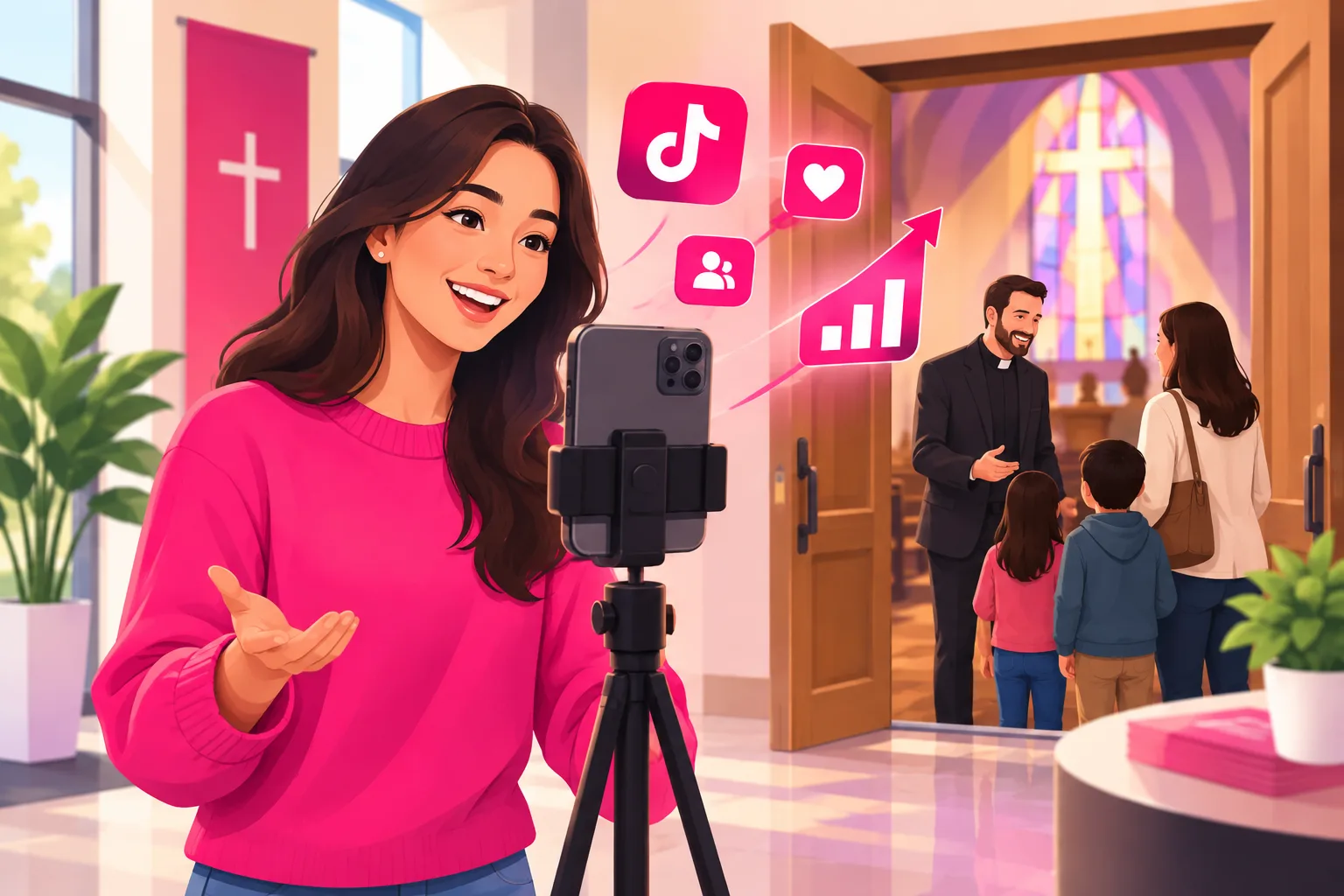
Every church has a version of the parking-lot minute. A car pulls in at 10:52 for the 11:00 service and nobody gets out. Inside it, someone who has not been in a church in nine years is running the list: Where do I even go in? Will someone make me stand up? Are my jeans okay? What happens to my kids? Will they ask me for money? Will anyone notice if I just leave? At 10:57 the car either empties or backs out. Your greeters never know which cars backed out.
Every question on that list can be answered in sixty seconds of video. Almost no church answers them. Somewhere in your county, a congregation of seventy with a volunteer and a phone films the walk from the parking lot to the coffee - the door, the greeter, the nursery, the row where a first-timer can sit near the back. Forty thousand people watch it. A few hundred of them live within a Sunday-morning drive and have been "meaning to find a church" since they moved. Some of them get out of the car.
This guide is the complete 2026 playbook for churches - pastors, communications staff where there is any, the volunteer who got handed the account, youth and worship leaders, church planters, and the elders who have to be convinced: the six video formats that grow church accounts fastest, the hook that opens on the welcome instead of the warning, the Sunday-first content engine, the door-path-or-feed-path choice and the two congregations behind it, the church calendar built around Easter and Christmas, the 90-day plan from an empty account to the church your town thinks of, the guest ladder from first view to second visit, the consent, music, and tax rules that protect your church, and when paid promotion fills seats versus burns tithe dollars. Pair it with our TikTok algorithm guide for the ranking-signal frame and the TikTok growth strategy guide for the cross-niche fundamentals.
The honest summary:
- The room and the feed are two congregations. A first-time guest can only come from a Sunday-morning drive; a sermon clip can reach anyone on earth. Decide which one each video is for, or you will build a national pulpit over an empty room.
- The fear under every empty pew is "what will happen to me if I walk in?" The Sunday walk-through answers it - and it is the single video most churches never make.
- The share is the invitation. Your members do not invite friends because they do not have the words. A sixty-second video is the words. Count sends, not views.
- Use paid promotion as selective amplification on proven videos, aimed at followers rather than a one-time visit, pointed at the drive radius for door videos, timed in Lent and Advent rather than Holy Week - and always inside TikTok's rules on political content, because every ad dollar is a tithe dollar.
What's Inside
- 1. Why TikTok Works So Well for Churches in 2026
- 2. The Six Video Formats That Grow Church Accounts Fastest
- 3. The Welcome Hook: Open on the Welcome, Never the Warning
- 4. The Sunday-First Content Engine
- 5. Door Path or Feed Path: The Two Congregations
- 6. The Church Calendar: Why You Build in Lent for Easter
- 7. A Posting Cadence That Survives a Volunteer Team
- 8. The 90-Day Plan to Becoming the Church Your Town Thinks Of
- 9. The Guest Ladder: Turning Viewers Into Second Visits
- 10. When Paid Promotion Fills Seats vs. Burns Tithe Dollars
- 11. Consent, Music, Politics, and the Mistakes That Cap Church Accounts
- Frequently Asked Questions
1. Why TikTok Works So Well for Churches in 2026
Churches have found new people the same way for a century: a member brings a friend, a family moves to town and tries the one nearest the house, a sign goes up on the lawn, and a postcard lands in the mailbox the week before Easter. That model works right up until it does not - the members stop inviting, the neighborhood stops moving in, the lawn sign is read by nobody under fifty, and the postcard costs more every year than the one family it brings. TikTok is the most efficient answer available right now, for five specific reasons.
The first is that the church hunt moved online, and it moved there fastest with the young. Pew's research on how Americans choose a congregation found that 85 percent of people who searched attended a service before deciding - the visit still decides it - but only 37 percent looked online, and among adults 18 to 30 that figure was 59 percent. That data is a decade old, and "looking online" then meant a website with service times. In 2026 it means a twenty-five-year-old watching three short videos of your Sunday at eleven at night and deciding, before anyone at your church knows she exists, whether she would be welcome. Your account is not a billboard for the visit. For most people under thirty-five, it is the first visit.
Second, the audience is more open than the headlines say. Gallup's 2025 numbers are sobering: about 31 percent of American adults attend weekly or nearly weekly, 57 percent seldom or never, and among adults under 30 only about a quarter attend weekly. Read one way, that is decline. Read the other way, it is the largest pool of people who are not in a church that has ever existed - and Barna's 2025 research found that Gen Z and millennial churchgoers now attend nearly twice as often as they did five years ago, with a measurable rise in commitment to Jesus among Gen Z men in particular. The people most likely to walk into a church for the first time this year are the same people who are on TikTok every day. You do not have to convince the platform's audience to care about faith. A meaningful share already does, quietly, and has nowhere local to put it.
Third, and this is the one no business gets: you already own what the platform rewards. Real people in a real room, every single week. Music performed live. A story told out loud by someone who means it. Something happening Tuesday and Thursday and Saturday - the pantry, the funeral meal, the youth group, the hospital visit. A company selling water bottles has to invent a reason for anyone to care and pays an agency to do it. You have a building where something that matters happens on a schedule. And yet the typical church feed is a sermon-title graphic, an event flyer, and a Bible verse over a sunset - three things that tell the algorithm nothing and tell the nervous person in the parking lot even less.
Fourth, the lane is empty where you are. The 2020 U.S. Religion Census counted roughly 356,700 congregations, and the Faith Communities Today study put the median congregation at about 65 people in worship, with roughly seven in ten gathering 100 or fewer. Most of those churches have nobody posting video at all. Which means the first church in a town to consistently show what its Sunday looks like does not compete with the megachurch two counties over for the "which church should I try" question - it simply answers it, for that town, alone. The ranking signals reward exactly what a small church can produce every week: a real face, a real question, a complete watch.
Fifth, the invitation is the whole engine, and it is broken. Lifeway Research has found that roughly a third of unchurched Americans say they would attend a service if a friend invited them, and more than half say an invitation from a family member would be effective. The bottleneck has never been openness. It is that your members do not invite anyone, because they do not know what to say and are afraid of being the weird one. A sixty-second video of your church gives them the words. "This is my church, this is what it's actually like, come sit with me" is a text message with a link, and it is the easiest invitation a Christian has ever been able to make. The share button is the invitation. We will count sends, not views, for the rest of this guide.
And one thing to say plainly about size. A church of 65 cannot out-produce a church of 6,500. It does not need to. It can show the one thing the big church cannot: that you will be known by name by your third Sunday. That is a video. It is, in fact, the best video.
2. The Six Video Formats That Grow Church Accounts Fastest
Across the church accounts that grow in 2026 - the twelve-person rural congregation, the urban plant meeting in a school gym, the two-hundred-year-old parish with the stone steps - the same six formats keep working. Every video you make should be one of them, and the order is deliberate.
Format 1: The Sunday Walk-Through
A phone in one hand, from the parking lot to the coffee after. Where to park. Which door. Who is standing at it. Where the bathrooms are. Where the kids go, who is in that room, and how check-in works. Where a first-timer can sit if they want to be near the back. What happens when everyone stands up. What the offering is and that nobody is watching whether you give. How long it runs. What happens after. This is the conversion video of the vertical - the no-judgment answer to every question in the parking-lot minute - and the one almost no church has ever filmed. Make one per entry point over time: the single adult, the family with small kids, the teenager coming alone, the person who has not been inside a church in twenty years.
Format 2: The One-Idea Sermon Clip
Thirty seconds. One thought that stands on its own without the twenty minutes around it. Cut at the sentence, not at the paragraph. The pastor looks at the camera, not the stage, for at least the first line - which means filming the sermon from a tripod at the front, not the stream camera at the back. This is the feed-path workhorse: it travels anywhere, it is what the homebound member and the stranger in another state both want, and it is the format most churches already try. It fails when it is the only format, and it fails worst when the one idea is a warning. Section 3 has the rule.
Format 3: The "Why We Do That" Explainer
Why everyone stands at the same moment. What communion is and whether a visitor takes it. What the water in the font is for. Why the pastor wears that. Why the candles. Why there is a moment of silence, or a moment where everyone shakes hands. Forty seconds, one practice, explained with the warmth of someone who loves it and the plainness of someone who remembers not understanding it. Curiosity is the cheapest attention on the platform, and every one of these makes the unfamiliar safe. They travel anywhere - and they are the videos a member sends to the friend who said "I wouldn't know what to do."
Format 4: The Question Answered
"Do I have to be a member to take communion?" "Can I come if I'm divorced?" "What if I don't believe any of this yet?" "Do you take attendance?" "What do I do with my kids?" "Will someone follow up with me and how much?" Real questions from the door, the DMs, and the plan-a-visit form, answered honestly in your church's own voice by the person who actually answers them - the pastor, the greeter, the kids' director. This is the format that proves the welcome instead of asserting it. Keep a running list; it never runs dry, because every Sunday adds two.
Format 5: The Church Between Sundays
The Tuesday food pantry. The funeral meal team setting out casseroles. The nursery volunteer folding blankets. Choir rehearsal on Thursday. The youth group's terrible, wonderful game night. The hospital visit, filmed in the parking lot afterward, not the room. This format says the church is a people and not a building, and it is the door-path anchor - it shows your town what it would be joining. It is also where most of your filming volume lives, because it needs no sermon, no stage, and usually no one who did not already sign the volunteer release.
Format 6: The Story Told With Consent
A baptism. A testimony. "Why I stayed" from the member who almost left. "Why I came back after fourteen years." Told by the person, in their words, with informed, specific, written consent that was never a condition of baptism or membership and can be withdrawn. This is the most powerful format and it goes last on purpose: the walk-through and the explainers earn the trust that makes a story land, and the consent discipline in section 11 has to be in place before the first one is posted. One person, one story. Never a montage of faces set to a song.
What to retire: the event flyer ("Trunk or Treat, Oct 31, 5-7pm" as a graphic - the algorithm has nothing to learn from it and no stranger shares it), the verse-on-a-sunset, the full service uploaded and chopped into ten-minute blocks, and the pastor-only account where every post is one person at a podium.
What to never post: the warning clip - the excerpt about what is wrong with the culture, the hot take, the bait that gets views from people who want a fight and comments that make the person who was going to visit decide not to. More on this in the next section, because it is the single most common way a church account grows an audience that never comes.
3. The Welcome Hook: Open on the Welcome, Never the Warning
The first three seconds decide whether anyone sees the rest, and for a church the first three seconds carry a weight no business has to think about. The person you most want to reach is afraid - of being judged, singled out, sold to, or found out - and the hook either disarms that fear or confirms it. Here is the rule: hook on the welcome, never the warning.
Five hook shapes carry nearly every church video that works:
- The fear, named first. "If you've never been inside a church - or not in a long time - here's exactly what happens when you walk through our door." You said the quiet thing. They exhale.
- The honest answer. "Do you have to dress up for church? No. Here's what people actually wore last Sunday." Then the jeans, the work boots, the one suit.
- The curiosity. "Why does everyone stand up at the exact same moment?" The viewer who has never been in a church and the member who has been in one for forty years both keep watching.
- The person. "Dolores has greeted at this door since 1987. Here's what she'll say to you." One greeter, one question, one Sunday. Never a crowd.
- The surprise. "Our pastor's first sermon here was to eleven people. This is what he'd tell you about that." Smallness, told with affection, is a hook - not a weakness to hide.
Now the warning clip, because it is the church version of the mistake every vertical in this series has. For nonprofits it is the pity close-up. For churches it is the twenty-second excerpt about what is wrong with everyone else - the culture, the other denomination, the people who do not come. It travels. It gets numbers. And it does three things at once: it makes the person in the parking lot feel judged before she arrives, it fills your comments with people who came to argue and will never set foot in your building, and it trains the algorithm that your account is a place for a fight - so it shows your next video, the kind one, to the same crowd. You will grow. You will grow an audience that never comes, and that audience will chase away the one that would have.
The fix is not to soften what your church believes. It is to lead with what it welcomes. Conviction can be the fourth sentence. The first one is the door.
4. The Sunday-First Content Engine
The reason church accounts go quiet is not that there is nothing to film. It is that nobody has a system, so every post is a project. The system is simple: Sunday is the program day. The footage exists once a week, on a schedule, in a building you own, with people who are already there. One volunteer with a phone and twenty minutes captures enough for the week.
The Sunday capture list
- Ninety seconds before the service: the lobby filling, the greeter at the door, the coffee, the sign-in table, the kids' hallway - wide shots, backs of heads, hands. The walk-through is built from this over several weeks.
- The sermon from the front: a tripod at the foot of the stage, framed vertical, running the whole time. You will cut one idea from it on Tuesday. The pastor marks the one-idea moment in their own notes before preaching it.
- One worship moment: live, your own team, your own room - the only music you can post with a clear conscience, and even then with the licensing check in section 11.
- One "why we do that" in forty seconds: the pastor or a deacon, right after the service, standing where it happens.
- One volunteer, one question: "What do you say to someone who looks nervous at the door?" Dolores, thirty seconds, done.
That is a week of posts from one Sunday, and the between-Sundays format fills the rest from whatever happens on Tuesday. Behind it sits the question log: a note on the volunteer's phone where every question a visitor asks at the door, every DM, every plan-a-visit form, and the pastor's own "people always ask me" list goes. Each entry is a Format 4 video waiting. A church that keeps the log for a month never again wonders what to post.
The engine runs on a faces rule, decided once. Adults who are on the platform or at the door on purpose - the pastor, the worship team, the greeters, the kids' director - are the cast and sign a release once a year. The congregation appears as a congregation: wide, from behind, from the side, nobody identifiable who did not choose to be. Children never appear without a specific written release from a parent for that specific use, and the nursery and the check-in desk are not filmed at all. Anything that happens in a pastor's office, a prayer room, or a hospital hallway is not content and never was. Our nonprofit filming guide covers the consent model - informed, specific, revocable, never a condition of being served - that a church should adopt wholesale, because the people who walk in on their worst week deserve exactly that protection.
One practical note on the set: the sanctuary is the best-lit, best-sounding, most recognizable room you have, and you own it seven days a week. Film the explainers there on a Tuesday afternoon with the lights up. The stained glass does half the work.
5. Door Path or Feed Path: The Two Congregations
This is the section that matters most, and it is the one church accounts get wrong almost universally - not by doing something badly, but by never deciding what the account is for.
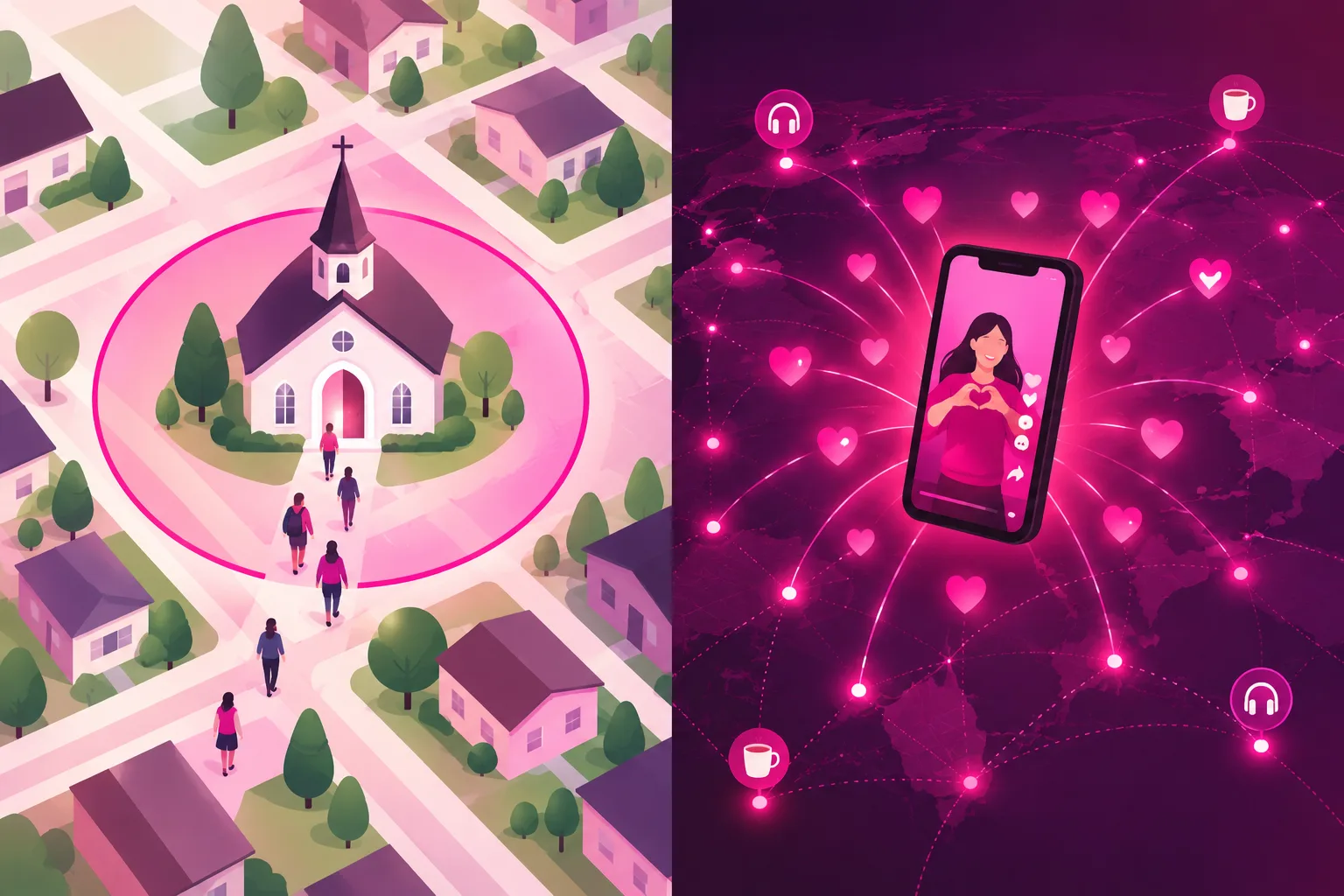
A church is the most local institution there is. You cannot attend a church you cannot drive to, and the drive is a Sunday-morning drive - twenty minutes with kids in the back, not forty-five. And a church is also the one institution whose message was explicitly built to travel to the ends of the earth. So every church account is speaking to two congregations at once: the room, which is local and small and can only grow from the drive radius, and the feed, which is borderless and can grow forever and will never fill a pew.
Here is the trap. Call it the national pulpit: a pastor with four hundred thousand followers from every state and a sanctuary with sixty people in it. The sermon clips traveled. The comments are full of people in Oregon and Florida who say the clips got them through a hard year. That is real ministry, and nothing in this guide tells you to stop it. But it fills no seats, it funds very little - a national audience gives, but in small fragile amounts from people who can never be known by name - and it quietly convinces the elders that "TikTok doesn't bring anyone to church," which is true only because every video was for the feed and none was for the door.
The door path: build a local audience that shows up Sunday
The account exists to put first-time guests in the room and get them to come back. Everything is anchored to the drive radius: the town in the bio with the service times, "we're the brick church across from the high school" said out loud, the actual building and the actual people, references only a local would catch, and a plan-a-visit link one tap away that gives a service time, parking, where the kids go, and the name of a person who will meet you at the door. The numbers are small - a few thousand followers, not a million - but a meaningful share of them can actually walk in. Success is measured in first-time guests and second visits, never in views. This is the same shape as any neighborhood business, and our local business TikTok marketing guide covers the local-discovery mechanics.
The feed path: build a borderless congregation that stays
The account exists to carry the message to people who will never walk in - the homebound member, the person deconstructing at one in the morning, the family in a town with no church like yours, the college student three states away who grew up in your pews. The content leans on the sermon clip, the explainer, and the story, which travel anywhere. Success is measured in follows, saves, shares, prayer requests answered, podcast listens, and online gifts - and in the discipline of answering the DM. This path carries the tighter rules: music licensing matters more because the clips travel farther, and anything that touches politics is scrutinized harder because it reaches people who have never met you. Section 11 has both.
Here is the twist that makes your situation different from a dentist or a plumber: a national audience is not waste. A viewer in Oregon cannot sit in your room, but she can be changed by what was said in it, and that is the point of a church. So the hybrid is not just legitimate for you - it is nearly mandatory. What still has to be decided is the order, and which congregation each video is for. "Come Sunday" shown to the whole country is a wasted ask. The sermon clip shown only to your zip code leaves the message in the building. For most churches under a few hundred, the honest answer is door first: the room has to be full enough to carry the feed. Ask one question in week one - does this church need people in the room or the message in the world more this year? - write the answer at the top of the volunteer's running note, and let it settle every argument about what to post next. Our nonprofit TikTok guide works the same two-map problem for organizations whose "hands" are local and whose "dollars" are not - the closest parallel to a church in this series.

6. The Church Calendar: Why You Build in Lent for Easter
Almost nobody tries a church on a random Sunday. They come at a moment: a move, a baby, a diagnosis, a funeral, a divorce, a new year, a daughter who asked to go, or a holiday when going feels allowed. Your content cannot create those moments. It can make sure that when one arrives, yours is the church already in their head - and that they already know what your door looks like.
The two largest predictable moments in your year are the two everyone knows. In Lifeway Research's survey of Protestant pastors, 90 percent named Easter as one of their three highest-attendance Sundays, and 28 percent said Christmas is their single highest. Those are the visitor days - the two Sundays a year when a person who has not been in years can walk in without feeling conspicuous. But the visitor decides in the weeks before, not that morning. Which means the video that wins Easter is not posted in Holy Week, when every church in the county is posting at once. It is posted in Lent. The walk-through, the honest answers, and the "what Easter actually looks like here" clip go out in late February and March, get saved by people quietly deciding, and the invitation lands on an audience that already knows where to park. Easter falls on March 28 in 2027, with Ash Wednesday on February 10, so the Lent build starts the second week of February. And the follow-up matters more than the day: the single most common failure in church growth is the Easter crowd that vanishes, because nobody showed them what the second Sunday looks like.
Layered over that is a church year that gives you a reason to post every month:
The church content year
- January: new year, new church. One of the predictable return seasons. Re-post the walk-through, run a "what to expect" week, answer the January questions - "is it weird to show up alone?" and "what if I haven't been in years?"
- February - March: the Lent build. The why-we-do-that series on Lent, Ash Wednesday, and Holy Week - the practices that most confuse a first-timer. The Easter walk-through goes out two to three weeks before. Holy Week services as a video, never a flyer.
- Easter and the Sunday after. Film the follow-up on Easter itself: "next Sunday looks like this, and here is who will be at the door." The second-visit push is the whole game.
- April - May: Mother's Day and milestones. Historically one of the higher-attendance Sundays. Baptisms, confirmations, graduations - the consented-story season, with the releases already signed.
- June - August: the slump is batching season. VBS, camp, the mission trip, the garden - the church-between-Sundays footage that will carry the fall. Film in bulk, post slowly.
- August - September: the fall return. The other predictable return season: back to school, small groups launching, youth group kicking off, Back to Church Sunday in September. The walk-through for families goes out the week school starts.
- October - November: stewardship and thanks. Many churches run giving season here. The video is the receipt: what this year's giving actually did, line by line, including the boiler. Thanksgiving is a between-Sundays week - the meal, the baskets, the people who have nowhere to go.
- Advent: the Christmas build. Advent begins November 29 in 2026. The Christmas Eve walk-through - candlelight, how long it runs, whether kids are fine - is posted the first week of December, and the service time is in the bio by Thanksgiving. Christmas Eve is the other visitor night, and it is the one an unchurched family will try with grandparents in town.
And then the unplannable moment: the funeral the whole town attends, the local tragedy, the storm, the news event that sends people looking for a building with its lights on. Decide the same-day plan now. No sermon clip, no schedule graphic. One person, standing at the open door, saying what the church is doing today and that anyone can come in. Say it plainly and say it once.
7. A Posting Cadence That Survives a Volunteer Team
The honest constraint in your sector is not interest. It is that the account is run by a twenty-four-year-old volunteer with a phone, a pastor who is already doing four jobs, and a board that thinks TikTok is for teenagers. The cadence has to survive all three.
Three posts a week from one Sunday is the floor, and it is enough. Tuesday, Thursday, Saturday - one door-path video, one feed-path video, one from between Sundays. That rhythm takes twenty minutes of capture on Sunday and about an hour of editing on Tuesday. Daily posting is a goal for the church that has a staff member for it; for everyone else it is the fastest route to a dead account by March.
One approver, not a committee. This is the rule that saves more church accounts than any other. The pastor approves the policy - what can be posted without asking, what always needs a look, what never goes up - once, in writing. The volunteer posts inside it without asking. If every clip waits for a Tuesday staff meeting, the Sunday footage is stale by the time it is seen, and the volunteer quits by the second month. The written policy also answers the question the elders will ask - "who is speaking for the church?" - and protects everyone when a clip lands wrong.
The cast is the congregation, not the pastor. An account where every video is one person at a podium is a sermon archive, not a church. The greeter, the kids' director, the worship leader, the eighty-year-old who has sat in the same pew since 1961, the youth pastor, the man who runs the pantry - each is a recurring character, and each is a reason for a stranger to believe the room has a place for them. The pastor appears once or twice a week and is never the only face.
Series beat singles. "What to expect" (one entry point per week), "Why we do that" (one practice per week), "Ask the pastor" (one question from the log per week). A series tells the algorithm what the account is about, and tells the viewer there is a reason to follow rather than just watch. The cross-niche cadence and consistency mechanics are in our complete growth guide, and the volunteer-team version of the problem - no marketing department, one phone - is worked through in our small business guide.
8. The 90-Day Plan to Becoming the Church Your Town Thinks Of
Ninety days is long enough to go from an empty account to the church a town names when someone asks "where should I try?" It is not long enough to go viral, and that is the point. The milestones below are counted in people in the room, not followers.
Days 1-30: Fix the door before you film it
The bio says the town, the service times, and one sentence about who you are. The link goes to a plan-a-visit page - not the homepage - with the address, parking, the kids' plan, what to wear, how long it runs, and the name and face of the person who will meet a first-timer at the door. The connect card, paper or digital, gets a "how did you hear about us?" line with TikTok as an option, because without it you will never be able to prove any of this worked. Then twelve posts: the walk-through first, three explainers, three questions answered, three between-Sundays, the pastor twice. Nothing is promoted. Everything is measured by one number - plan-a-visit clicks - and one question at the door.
Days 31-60: Find the series
By now a few videos have outperformed. Sort them by congregation: which traveled (feed) and which brought a plan-a-visit click (door). Build a weekly series from the best of each. Count the first guest who says "I saw you on TikTok" and write down the date; it is the sentence that wins the board. Watch the shares above everything - a member sending a video to a friend is the invitation this whole guide is about - and make the shareable explainer a weekly habit. Answer every DM within a day with a warm saved reply, and keep the prayer-request reply separate from the plan-a-visit reply.
Days 61-90: Compound toward the next visitor day
Lay the calendar from section 6 over the next ninety days and work backward from the nearest visitor day. The walk-through for that day is filmed now and posted two to three weeks before. The follow-up - what the Sunday after looks like - is filmed on the visitor day itself. If one walk-through has already proven itself organically and the visitor day is inside six weeks, this is the first moment paid promotion makes sense, and section 10 says how. By day 90 a healthy account has a few hundred to a couple thousand local followers, a plan-a-visit page that gets clicked every week, a connect card that says TikTok a few times a month, and - the real milestone - a second-visit rate you can state.
9. The Guest Ladder: Turning Viewers Into Second Visits
A viewer does not become a member in one step, and a church that asks for the whole climb in a single video - "come Sunday, join a group, get baptized, serve" - gets none of it. Here are the rungs in order, with what moves someone up each one.
- The view. Earned by the hook. The welcome, never the warning.
- The follow. Earned by the series - a reason to come back to the account before coming back to the building.
- The send. A member shares the video with the friend who said "I wouldn't know what to do." This is the invitation, and it is the rung that matters most. Make videos that are easy to send: short, kind, specific, no inside jokes.
- The profile visit. Town, service times, one sentence, one link. If the bio says "a community of believers" and nothing else, the climb ends here.
- The plan-a-visit page. Time, address, parking, kids, dress, length, and a named person. "Ask for Dolores at the door" converts better than any sentence about your mission.
- The first visit. Counted on the connect card. Greeted by the named person. Not singled out from the front, not handed a pledge card, not followed to the parking lot.
- The 48-hour follow-up. A text or a short handwritten note from a real person, not a form letter and not a home visit unless they asked. One sentence of thanks, one invitation to next Sunday, nothing else.
- The second visit. The real conversion. Easter crowds vanish because nobody built this rung. The video that earns it was filmed on the first visit's Sunday: "here is what next week looks like."
- Belonging. A small group, a serving team, a membership class, a first gift. Months, not weeks. Never asked for on the first rung.
Two DMs deserve a prepared reply before the first video is posted. The first is the plan-a-visit message - "is it okay if I come alone / with my kids / if I'm not sure I believe?" - answered warmly, specifically, and with the named person's name. The second is the prayer request, which will arrive within the first month from a stranger in a hard week. Reply as a person, pray if you say you will, and never turn it into content. If the message describes a crisis, the reply ends with a way to get help right now, including the 988 Suicide and Crisis Lifeline, and a human who follows up.
Measure the ladder, not the views: plan-a-visit clicks per week, first-time guests per month who say TikTok, and the share of them who come back. A church that can state those three numbers has a board that funds the next step. Our donor and volunteer conversion guide works the same ladder for nonprofits, including the saved replies and the 48-hour rule.
10. When Paid Promotion Fills Seats vs. Burns Tithe Dollars
Paid promotion on TikTok is not advertising in the way churches usually think about it. It is not the Easter postcard to every address within three miles. It is taking a video that has already earned attention and showing it to more of the right people. And for you there is one extra sentence: every dollar you spend was put in a plate by someone who trusted you with it, so the standard for spending it is higher.
The proven-video rule: only promote videos that have already performed organically. Strong completion, real saves and shares, a visible bump in profile visits and plan-a-visit clicks. Promotion amplifies signals the algorithm is already reading. It cannot manufacture interest in a video people scroll past, and it will not make a flyer into content.
The follower rule, which is specific to your sector: promote for followers, not for a one-time visit. A stranger asked to show up Sunday nine seconds after meeting you mostly will not. A follower sees four Sundays before Easter - the walk-through, the honest answer, the greeter, the explainer - and by the time the invitation arrives she already knows where to park. You are not buying a visit. You are buying the chance to show someone your church for a season.
The map rule: target the congregation the video is for. Organic reach goes wherever the algorithm sends it; promoted reach goes exactly where you point it. The walk-through and the between-Sundays video go to your own metro, drawn to a Sunday-morning drive - a viewer ninety minutes away will never be a first-time guest. The sermon clip and the explainer can go wider, to people who already engage with faith content, if the feed path is a goal this year.
The timing rule: amplify ahead of the visitor day, not during it. Lent - late February through mid-March in 2027 - and Advent reach people while they are quietly deciding. Holy Week and Christmas week are when every church and every retailer is bidding for the same attention, the cost of reaching anyone climbs, and you pay more to be one of fifty invitations.
The math deserves honesty, because the finance committee will ask. A new family that stays is worth more to a church than any number can hold, but the committee compares dollars, so compare them: the Easter mailer to three thousand homes against a modest budget on a walk-through that has already proven it brings plan-a-visit clicks. Track it like any other outreach cost - cost per new local follower, per plan-a-visit click, per first-time guest who says TikTok, per second visit - and report it next to the mailer. If the promoted walk-through brings three first-time families before Easter and one stays, the committee can do the arithmetic without your help.
Three cautions that are stricter for you than for most. First, TikTok prohibits political content in advertising, full stop. A sermon clip that mentions a candidate, a party, or a ballot measure cannot be promoted, whatever your tax status allows you to say from the pulpit - and section 11 explains why that line is narrower than many pastors assume this year. Promote the walk-through and the explainer, not the sermon that touched the news. Second, religious content is permitted under TikTok's advertising policies, but anything that disrespects another faith, its figures, or its symbols is not, approval is per ad and varies by market, and TikTok's rules on nonprofit and faith advertisers are worth confirming before the first campaign. Third, consent to post is not consent to promote. The member who agreed to have her baptism on your feed did not agree to a paid placement shown to her coworkers, so the release should say which. And fix the bio, the plan-a-visit page, and the 48-hour follow-up first - promotion multiplies what already exists.
The format worth defaulting to is Spark Ads, which promotes your existing organic post rather than a separate ad creative - so the engagement accrues to your real account and the video keeps looking like your church instead of a commercial. Our Spark Ads guide walks through the setup. If you would rather not run Ads Manager yourself, a TikTok promotion service built around follower growth and selective amplification handles the targeting and the timing for you.
11. Consent, Music, Politics, and the Mistakes That Cap Church Accounts
The rules in your sector are stricter than for almost any business in this series, and they are a moat, not a blocker. The church that handles them well is the one families trust with their kids, their worst week, and their money. Four areas, in order of how often they go wrong.
Children and consent
Kids are the hardest line. No child appears in a video without a specific written release from a parent for that specific use, and a signed form from last year's VBS is not consent for this year's TikTok. The nursery, the check-in desk, the classroom numbers, and the pickup tags are never filmed - they are a map to your children for anyone who wants one. Youth group appears only with per-use releases, and the teenager who did not want to be on camera is simply not on camera, without a conversation about it. For adults, the baptism, the testimony, and the "why I stayed" need consent that is informed, specific, revocable, and never a condition of baptism or membership. And some things are never content: anything said in a pastor's office, a prayer request, a benevolence request, the person crying in the lobby, the hospital room. The test, every time: did this person say yes to this use, with a real option to say no - and would they be glad to see it in five years?
Music
Worship music is copyrighted, and the license on your wall was written for the sanctuary. A CCLI streaming license generally covers streaming your own service and its replay, but it does not cover recorded commercial tracks, and whether a separately posted thirty-second clip of your worship team is covered is a question to ask CCLI directly rather than assume. A church account registered as a business or organization account is limited to TikTok's Commercial Music Library, which excludes most popular music, and the audio a personal account sees is licensed for personal use, not for an organization. The clean paths: live worship your own team plays during your own service (confirm coverage), public-domain hymns, songs your church wrote, or the Commercial Music Library. Never lay a recorded worship track from a streaming service under a clip. A muted video is embarrassing; a takedown on the Easter walk-through is worse.
Politics and the tax line
As of 2026 the Johnson Amendment still bars a 501(c)(3) church from endorsing or opposing candidates for office. A July 2025 settlement in which the IRS proposed not to treat a church's good-faith speech to its own congregation during services as campaign intervention was rejected by a federal judge on March 31, 2026, and is under appeal, so the rule stands - and a clip on a public feed is, in any case, not speech to your congregation during a service. Lobbying on issues has its own limits. TikTok's own line is stricter still: political content cannot be advertised at all. The practical rule for the account is simple. The sermon can say what the church believes. The account does not name candidates, parties, or ballot measures, and nothing that touches them is ever promoted.
Ownership, giving, and the written policy
The church owns the account, not the pastor. Two admins, a shared email on the login, and a line in the written social media policy about what happens when the pastor leaves - because pastors leave, and the account with four years of your church's face on it should not go with them. That policy also says who answers DMs, what the volunteer can post without asking, what always gets a look, and what is never posted; it is the document the elders will ask for, so write it in month one. On giving: the link in the bio goes to your own online giving page with a plain sentence about what gifts do, a gift gets a receipt, and gifts sent during a TikTok LIVE are not charitable donations - the platform keeps a large share and the giver gets no tax receipt - so say so if anyone asks.
The mistakes that cap church accounts:
- The flyer feed - dates and times as graphics, nothing a stranger would share.
- The full service uploaded in chunks, which nobody watches on a phone.
- The warning clip - growing an audience that never comes.
- The pastor-only account - a sermon archive, not a church.
- No town and no service time in the bio.
- The DM that was never answered.
- The Easter crowd nobody showed the second Sunday to.
- A recorded worship track under a clip, and the takedown that follows.
Frequently Asked Questions
Is TikTok worth it for a small church in 2026?
For most churches that want first-time guests who come back, yes - and the smaller the church, the better the odds, because the lane is usually empty. Roughly half of American congregations gather 65 or fewer people on a Sunday, and in most towns none of them post video. The people most likely to try a church for the first time are the ones who look online first: in Pew research on how Americans choose a congregation, 85 percent attended a service before deciding, but among adults under 30 nearly six in ten looked online first, and in 2026 "online" means short video. You do not need a viral account. You need a few hundred people within a Sunday-morning drive to watch what your Sunday actually looks like, long enough to believe they would be welcome, and a link that tells them when to come and who will meet them at the door.
What should churches post on TikTok?
Six formats grow church accounts fastest in 2026: the Sunday walk-through (parking lot to coffee, answering every question a nervous first-timer is afraid to ask), the one-idea sermon clip (thirty seconds, one thought, the pastor looking at the camera), the "why we do that" explainer (why everyone stands, what communion is, what the water is for), the question answered (honest answers to "do I have to be a member?" and "can I come if I'm not sure I believe?"), the church between Sundays (the Tuesday pantry, the funeral meal team, the youth group), and the story told with consent (a baptism, a "why I stayed"). The formats to avoid are the event flyer and the verse-on-a-sunset graphic, which give the algorithm nothing to learn from, and the warning clip - the scolding excerpt that travels far, gets comments from people who will never come, and makes the person who was going to visit feel judged before they arrive.
Can churches post worship music on TikTok?
Carefully. Worship songs are copyrighted, and the licenses most churches hold were written for the sanctuary and the live stream, not for short clips. A CCLI streaming license generally covers streaming your own service and its replay, but it does not cover recorded commercial tracks, and whether a separately posted thirty-second clip is covered is a question to put to CCLI directly rather than assume. Church accounts registered as business or organization accounts on TikTok are also limited to its Commercial Music Library, which excludes most popular songs. The safest path is live worship your own team plays during your own service, public-domain hymns, songs your church wrote, or music from the Commercial Music Library. Never add a recorded worship track from a streaming service to a clip, and do not count on the audio library a personal account sees - it is licensed for personal use, not for an organization.
How does a church get first-time visitors from TikTok instead of just views?
By deciding on purpose which congregation each video is for, because a church has two. The room is local: a first-time guest can only come from a Sunday-morning drive, so door-path videos say the town out loud, show the actual building and the actual people, and point to a plan-a-visit page with a service time, parking, where the kids go, and the name of a person who will meet them. The feed is borderless: the sermon clip and the explainer travel to people who will never walk in, and that reach is real ministry - but it fills no pews. The trap is the national pulpit: a pastor with a huge following from everywhere and sixty people in the room. Most small churches should build the door path first, count first-time guests with a "how did you hear about us?" line on the connect card, follow up within 48 hours with a text rather than a form letter, and treat the second visit - not the first - as the conversion.
Should churches pay to promote their TikTok videos?
Only videos that have already proven themselves organically - strong completion, real saves and shares, and a visible bump in profile visits and plan-a-visit clicks - and only with a few church-specific rules. Promote for followers rather than for a one-time visit: a stranger asked to show up Sunday nine seconds after meeting you mostly will not, while a follower sees four Sundays before Easter. Point the walk-through at your own Sunday-morning drive radius and the sermon clip wider. Amplify in Lent and Advent, ahead of the two visitor days, rather than during Holy Week when every church is shouting. And three cautions: TikTok prohibits political content in ads, so a clip that touches a candidate or a ballot measure cannot be promoted whatever your tax status allows organically; religious content is permitted under its policies but anything disrespectful toward another faith is not, and approval is per ad and per market; and consent to post is not consent to promote. Every ad dollar is a tithe dollar, so track cost per follower, per plan-a-visit click, and per second visit. Services like Viryze are built around this kind of selective amplification, promoting a proven video to the right audience instead of boosting every upload.
Ready to turn your best Sunday walk-through into guests who come back?
The churches growing fastest in 2026 pair a simple Sunday-first content system with selective paid amplification on their best videos - aimed at followers rather than a one-time visit, pointed at the Sunday-morning drive radius, and timed in Lent and Advent rather than during the noise of the holiday itself. Viryze is built for exactly that: we focus on follower growth and only promote videos that have already cleared the organic signal threshold, so your budget compounds your best work instead of rescuing your weakest. And because a follower sees your church for a season before the invitation arrives, every person you reach is someone who already knows where to park.
See how selective amplification worksRelated Reading
- Understanding TikTok's Algorithm: What Really Matters - the ranking signals that decide which videos travel.
- The Ultimate Guide to TikTok Growth - cross-niche fundamentals that apply to any organization's account.
- TikTok for Nonprofits - the closest parallel in this series: a volunteer team, two maps, and giving that has to be earned twice.
- Local Business TikTok Marketing - the local-discovery mechanics behind the door path.
- TikTok for Small Business - the one-phone, no-marketing-department playbook a volunteer team can run.
- TikTok for Dentists - another account where the whole job is dissolving the fear of walking in.
- TikTok Spark Ads Guide - the format worth defaulting to for amplifying a proven post.

Head of Creator Success at Viryze
TikTok growth strategist helping creators reach their first 100K followers through data-driven promotion strategies.