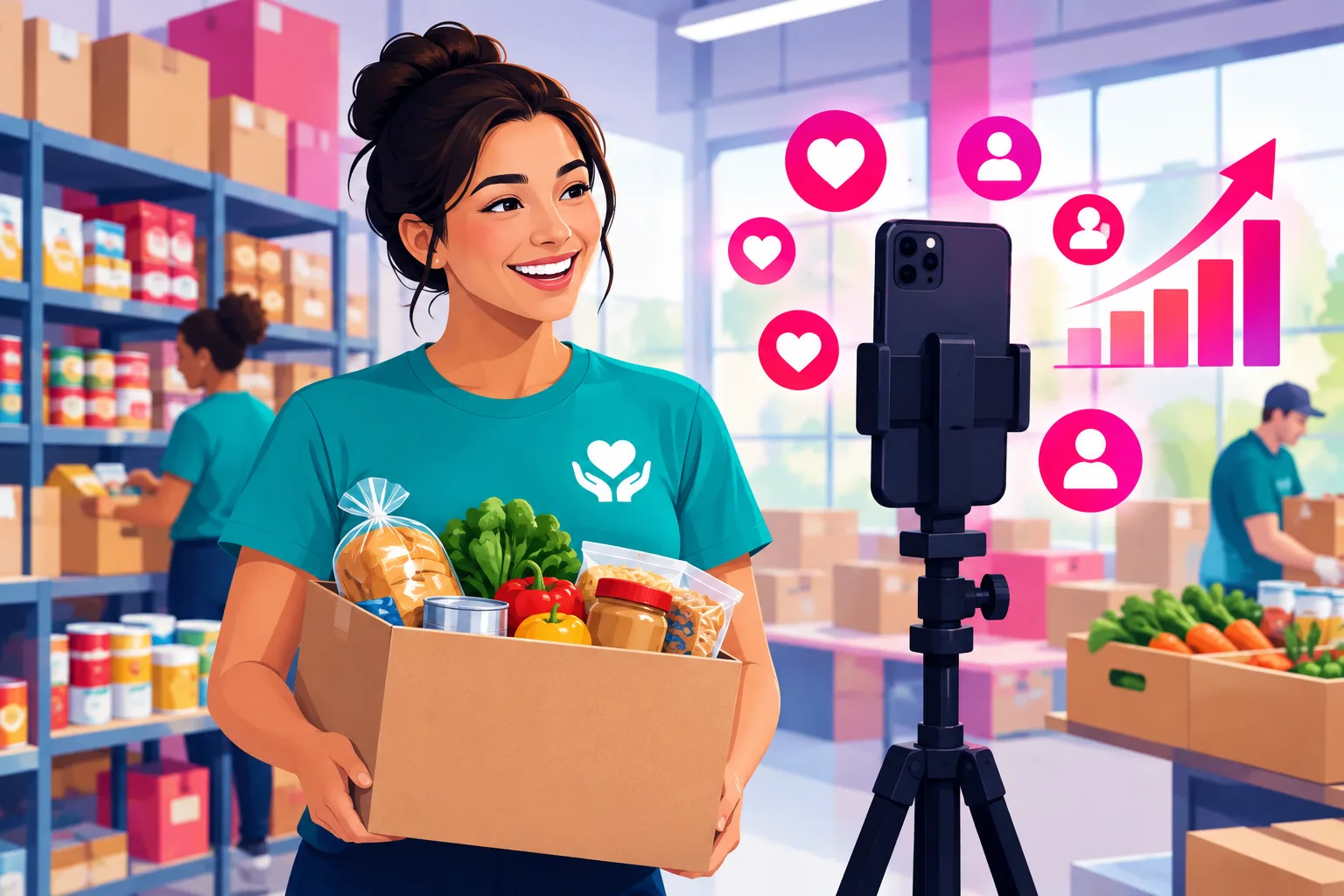
Every nonprofit has a version of the Saturday tour. A first-time volunteer shows up a little nervous, gets walked through the warehouse, sees the pallets, and hears what one box means to the family that picks it up on Tuesday. They pack for two hours. On the way out they say the sentence your development director would frame if she could: "I had no idea this is what you do." Then they sign up for next month. A week later, a monthly gift appears.
That tour is the most persuasive thing your organization does, and it does it for six people a month. Somewhere in your city, an organization with half your budget films the same tour on a phone - the pallets, the box, the honest answer to where the money goes. Three hundred thousand people watch it. A few thousand of them live within a twenty-minute drive and have been "meaning to volunteer somewhere" for two years. A few hundred more live nowhere near you, and give anyway.
This guide is the complete 2026 playbook for nonprofits and charities - executive directors, communications and development staff, volunteer coordinators, founders of brand-new organizations, and the board members who have to be convinced: the six video formats that grow nonprofit accounts fastest, the one-person hook that opens on the fix instead of the pity, the dignity-first content engine, the hands-or-dollars choice and the two maps that divide them, the giving calendar built around GivingTuesday and December 31, the 90-day plan from an empty account to the cause your city thinks of, the supporter ladder from first view to monthly donor, the consent and charity rules that protect your mission, and when paid promotion builds support versus burns donor dollars. Pair it with our TikTok algorithm guide for the ranking-signal frame and the TikTok growth strategy guide for the cross-niche fundamentals.
The honest summary:
- You already own what the platform rewards: real stakes and visible results. Brands pay agencies to invent a story. You walk past six before lunch - and most nonprofit feeds hide them behind event flyers.
- A supporter is a relationship, not a gift. Roughly four in five first-time donors never give again, mostly because nobody showed them what happened. A follower sees it every week - so the second gift, not the first, is the number to chase.
- Decide: hands path or dollars path - and respect the two maps. Money travels; hands don't. A gift can come from anywhere, a volunteer only from the drive radius. Give every video one ask that matches its map - never just "awareness."
- Use paid promotion as selective amplification on proven videos, aimed at followers rather than one-time gifts and timed ahead of GivingTuesday - never to rescue a weak clip, and always within TikTok's rules for nonprofit advertisers, because every ad dollar is a donor's dollar.
What's Inside
- 1. Why TikTok Works So Well for Nonprofits in 2026
- 2. The Six Video Formats That Grow Nonprofit Accounts Fastest
- 3. The One-Person Hook: Open on the Fix, Never the Pity
- 4. The Dignity-First Content Engine
- 5. Hands Path or Dollars Path: The Choice and the Two Maps
- 6. The Giving Calendar: Why You Build in October for December
- 7. A Posting Cadence That Survives a Two-Person Team
- 8. The 90-Day Plan to Becoming the Cause Your City Thinks Of
- 9. The Supporter Ladder: Turning Viewers Into Monthly Donors
- 10. When Paid Promotion Builds Support vs. Burns Donor Dollars
- 11. Consent, Charity Law, and the Mistakes That Cap Nonprofit Accounts
- Frequently Asked Questions
1. Why TikTok Works So Well for Nonprofits in 2026
Nonprofits have found supporters the same way for decades: the year-end letter, the spring gala, the board member's address book, and the grant application. That model works right up until it does not - a major funder changes priorities, the mailing list ages, the gala costs more than it raises, or the volunteer roster that ran on twelve retirees is down to seven. TikTok is the most efficient answer available right now, for five specific reasons.
The first is one no business gets: you already own what the platform rewards. Real stakes. Real people. Work with a visible before and after. A company selling water bottles has to invent a reason for anyone to care, and pays an agency to do it. You have a warehouse, a kennel, a classroom, a creek, or a front desk where something that matters happens every day. And yet the typical nonprofit feed is an event flyer, a gala photo, and a statistic on a logo-colored square. The organizations that grow are the ones that point the phone at the work itself.
The second is the economics of a supporter. Sector benchmarks have put first-time donor retention at roughly one in five for years. Four of every five people who give once never give again - and the reason is rarely the cause. It is silence. They gave, got a tax receipt, and never saw what happened. A follower sees what happened every week, for free. So the question is not "how do we get a million views." It is "how do we get a few hundred people to watch the work long enough to give a second time." That is a far easier problem, and a twenty-dollar monthly donor who stays for years is worth more than a viral week.
The third is the trust question, and the fact that content is the direct repair. Under every gift not given is the same doubt: where does the money actually go? Your sector's central barrier is not indifference to the cause. It is suspicion about overhead, salaries, and whether a small gift does anything at all. Sixty seconds of a real person saying "here is exactly what last month's donations did, line by line, including the boring parts" dissolves more of that than any annual report ever printed. Your biggest fundraising problem is solved by the exact thing your best board treasurer already does at every meeting: showing the numbers, plainly.
The fourth is the two maps. A gift can come from anywhere in the country. A volunteer, a donated couch, an adoptive family, and a person who needs your services can only come from the drive radius. That makes a nonprofit account unlike any practice or shop on this platform: a viewer four states away is not automatically wasted reach. Section 5 is about what that means, because it is the thing nonprofit accounts get wrong most.
The fifth reason is a second payoff: one video reaches three audiences at once. The donor sees where the money goes. The would-be volunteer sees what a shift is like. And the person who needs you - the parent who has been too embarrassed to walk into a food pantry - sees that nobody at the door is going to make it hard. No mailer has ever done all three. The same forty seconds of footage does.
For context on how the algorithm treats watch-time, saves, and other ranking signals across niches, see our algorithm ranking factors breakdown.
2. The Six Video Formats That Grow Nonprofit Accounts Fastest
Random posting is the slowest path on TikTok. The algorithm is trying to work out who your videos should be shown to, and an account that posts a gala flyer, then a staff birthday, then a "donate today" graphic gives it nothing to work with. These six formats give it a clear signal - and between them they cover essentially everything an organization needs to say.
Format 1: The Receipt
The highest-leverage format in the niche, because it answers the question nobody asks out loud. "Here is what came in last month, and here is where every dollar went." The produce. The fuel for the truck. The part of one salary that makes the other two programs possible - and why that line is not waste. Hold the actual invoice up to the camera if you can. Every number has to be true and has to come from the person who keeps the books. Do this monthly and it becomes a series people wait for.
Format 2: The One Story
One person. One animal. One house. One classroom. Not "we served 4,000 families" - the single family, told with their consent and in their own words, where they are the capable person in the story and you are the help that showed up. The rules for that consent are in section 4. The variation most organizations underuse needs no person at all: follow one box from the pallet to the porch, one dog from intake to the adoption photo, one donated laptop from the drop-off bin to the desk it ends up on.
Format 3: The Cause Correction
Every cause has things the public confidently gets wrong, and you know all of them. "Everyone thinks a food pantry is for people without jobs - here is who actually came through our door on Tuesday." "A shelter dog is not there because something is wrong with it." "Here is what that donated bag of clothes really costs us to sort." Correct gently - half your audience believed the myth last month, and you need them to stay. This is the format that travels furthest, and it positions you as the organization that actually understands the problem.
Format 4: The Come-With-Me Shift
"Here is exactly what your first volunteer shift looks like." Where you park. What you wear. Who meets you at the door. What you actually do for two hours. That nobody quizzes you, and that you can come alone. People do not skip volunteering because they do not care. They skip it because they picture showing up and not knowing what to do. Film variations: the shift for a family with kids, for a teenager who needs service hours, for a company team, and for the introvert who would like to sort cans in the back and talk to no one.
Format 5: The How-to-Get-Help Walk-Through
If you serve people directly, some of them are watching. "Here is what happens the first time you come in." What to bring. What nobody is going to ask you. How long it takes. What you leave with. This video does two jobs at once. It reaches the person who has been putting off the visit out of embarrassment, and it shows donors, better than any mission statement, how you treat people. If your organization does not serve individuals - an arts group, a land trust, an advocacy organization - swap this for the day-in-the-work clip that shows how the thing actually gets done.
Format 6: The Thank-You and the Comment Reply
The least-effort, highest-trust format you have. Thank the people who gave this week, on camera, and say what their gifts are doing right now. Then reply to real comments on video - including the hard ones. "How much does your director make?" answered calmly, with the number and the reason, is worth more than a month of polished posts. Roughly one in five videos should be this. It is also the format that produces the second gift, which section 9 explains is the one that matters.
The two formats most nonprofit accounts lead with - and shouldn't: the flyer, which is not content but a calendar entry - no saves, no reason to follow, and it teaches the algorithm nothing about who to show you to - and its more damaging cousin, the pity close-up. A suffering face over sad piano music gets views. It also takes something from the person in the frame, and it trains your audience to look away from your cause instead of toward it. The organizations that build durable accounts show what the help looks like, not what the need looks like at its worst.
3. The One-Person Hook: Open on the Fix, Never the Pity
You get about one and a half seconds. In that time a viewer decides whether this is worth their attention. The single highest-leverage change most nonprofit accounts can make is to stop opening with the organization and start opening with one specific thing a viewer could actually change.
Weak openers introduce the speaker: "Hi, we're the Eastside Community Pantry, and since 1994 we have been serving families across the region." By the time that sentence lands, the viewer is gone. Strong openers put one concrete, solvable thing on screen: "This box costs us eleven dollars, and it is dinner for a family of four until Friday." The mission statement still matters. It just belongs at second twelve, once someone has a reason to care who is talking.
Two things make that opener work. The first is one, not many. People respond to a single named situation far more readily than to a statistic - it is one of the better-documented findings in research on giving, and it is why "4,000 families served" moves nobody and "this one box" does. The second is the trap unique to your sector: the strongest hook available is also the most harmful one. A child's tearful face stops the scroll better than almost anything on the platform - and it costs that child their dignity, it works exactly once, and it leaves the viewer feeling guilty rather than useful. Guilt gets a single gift. Feeling useful gets a second one. The discipline is simple: hook on the fix, never on the pity.
Four hook patterns that consistently work in this niche:
- The small number. "Eleven dollars. That is this whole box." A price makes a problem feel solvable, and a solvable problem is one a viewer can picture themselves solving.
- The correction. "Everyone thinks a food pantry is for people without jobs. Here is who actually came in on Tuesday." Contradiction earns attention; the follow-through earns the follow.
- The invitation. "If you have two hours on a Saturday and you have been meaning to do something useful with them - this is what it looks like here." This one fills shifts, because the person who needed to picture it has now pictured it.
- The insider observation. "I have run an animal shelter for nine years, and here is the one thing that gets a dog adopted faster than anything else." It promises something the viewer cannot get anywhere else, from someone positioned to know.
One discipline holds all four together: one ask per video, at the end - and most videos have no ask at all. An account where every post ends in "donate now" reads as a collection plate, and viewers scroll past collection plates. Show the work four times. Ask once. The people who are ready to help will find the link, and they will arrive already trusting you.
4. The Dignity-First Content Engine
Here is where your organization differs from the clinic and the law office in this series. Nobody doubts you have stories. The risk runs the other way: the stories belong to people who have less power than the organization telling them. Nonprofits that quit posting usually quit for one of two reasons. They believed every video needed a client's face and ran out of people willing, or they posted one and got a phone call from a family member. Both are avoidable, and the fix is the same: build the engine so most of it never needs a person you serve at all.
Keep one running note that everyone on staff can add to. Six capture points fill it, and only the last one involves a person you serve:
- The question log. Everything people ask at the front desk, on the phone, and at volunteer orientation - "do you take expired cans," "how old do you have to be to volunteer," "can I drop off a couch," "do I need ID to get food," "where does the money go." These are the purest content ideas you will ever get, because someone cared enough to ask.
- The work without faces. Hands packing a box. Pallets coming off the truck. The kennels being cleaned at seven in the morning. A wall going up. The whiteboard with this week's numbers on it. This is the most watchable footage you have, and it needs nobody's story and nobody's form.
- Staff and volunteers. The volunteer who has come every Thursday for nine years. The warehouse manager who can stack a pallet in four minutes. Consenting adults who chose to be there, with a photo release at sign-in and a real option to stay off camera.
- The myth on your own feed. Whatever confidently wrong thing the algorithm showed you about your cause this week. Respond to the idea, not the creator, and correct it kindly. Free, pre-validated, and the platform delivers a fresh one regularly.
- The calendar moment. Whatever is about to happen because of the date - the back-to-school drive, the first cold night, GivingTuesday, the last three days of December. Covered in full in section 6.
- The consented story. A person you serve, in their own words. Only with consent that is informed, written, specific to this video and this platform, and revocable - and never asked for on the day they came to you in a crisis. Show them the finished video before it posts. If they hesitate, the answer is no, and you thank them and move on.
Then batch - but batch on program days, because that is the one way you differ from an office that can film any morning. Your footage only exists when the work is happening. On distribution day, build day, or clinic day, give one person a phone and forty-five minutes, and collect ten short clips of the work without faces. Once a month, sit one staff member down for an hour and film ten answers from the question log back to back. That is five weeks of posting from one Tuesday and one hour.
The rule that keeps this safe: did this person say yes to this use, with a real option to say no - and would they be proud to show this video to their own family in five years? Someone who depends on you for food or housing cannot easily refuse you, so the asking has to make refusing easy. A face is identifiable. So is a voice, a tattoo, a car in the parking lot, a name on a sign-in sheet, and the front of a building whose address is supposed to be confidential. If nobody you serve appears and nothing on screen belongs to one of them, it is yours to post. See section 11 before you film anyone who came to you for help.
5. Hands Path or Dollars Path: The Choice and the Two Maps
This is the section that matters most, and it is the one nonprofit accounts get wrong almost universally - not by doing something badly, but by never deciding what they are asking for at all.
Here is the trap. The word that ends more nonprofit accounts than any other is "awareness." A video gets eight hundred thousand views. The board is thrilled. And nothing in the building changes - no new gifts, no filled shifts - because the video had no ask, the bio had no link, and nobody who watched was ever given a next step. Call it the awareness trap: an account that is famous and broke. Its cousin is the viral spike - one video brings three thousand five-dollar gifts, nobody is thanked, nobody is asked again, and by February they are gone. Both usually end in the same conclusion: that TikTok "doesn't work for nonprofits."
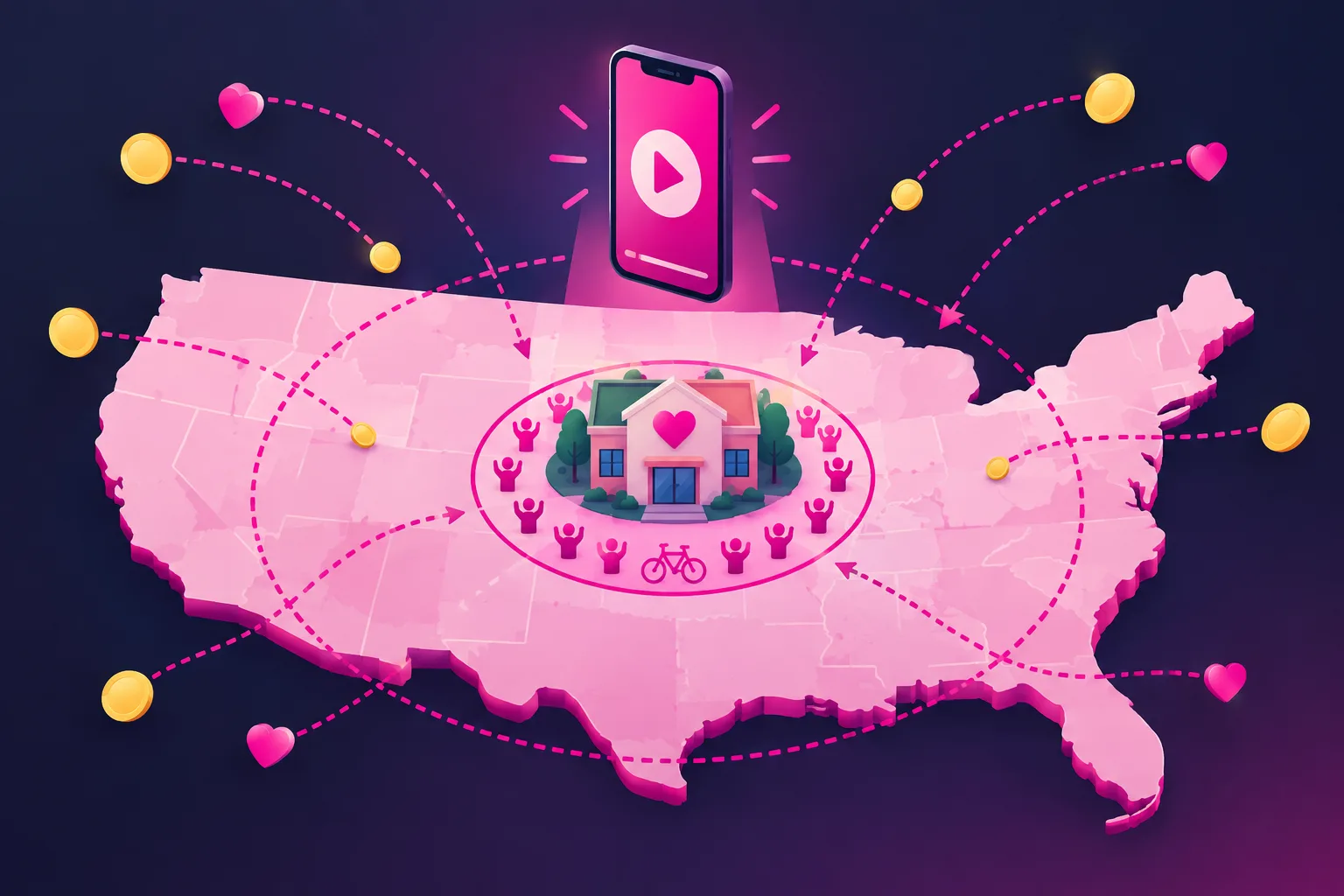
The reason it happens is that a nonprofit has two maps, and most accounts never notice which one a given video is for. Money travels. Hands don't. The fix is to choose, on purpose, between two legitimate paths.
The hands path: build a local audience that shows up
The account exists to fill shifts, stock shelves, find adopters and foster homes, fill seats at the event, and reach the neighbors who need what you offer. Everything is anchored to the drive radius: the city and neighborhood in the bio, "we're the blue warehouse behind the bus depot on Fourth" said out loud, references only a local would catch, and a volunteer sign-up one tap away that asks for a zip code first. The numbers are smaller - thousands of followers, not millions - but a meaningful share of them can actually walk through the door. Success is measured in completed sign-ups and filled shifts, never in views. This is the same shape as any neighborhood business, and our local business TikTok marketing guide covers the local-discovery mechanics.
The dollars path: build a borderless audience that gives again
The account exists to find people anywhere who care about the cause and will fund it - and then fund it a second time. The bio says what a gift does. The link goes to a donation page with the monthly option visible and an email sign-up beside it. The content leans on the receipt, the one story, and the cause correction, which travel anywhere. Success is measured in first gifts, second gifts, and monthly donors. This path carries the tighter discipline: every number in an ask has to be true, money raised for a specific thing has to go to that thing, and asking residents of other states for money can carry registration requirements - section 11 has the detail.
Here is the twist that makes your sector different from every practice in this series: a national audience is not automatically waste. A viewer four states away cannot pack a box, but she can pay for forty of them. So the hybrid is not just legitimate for you - it is the norm. What still has to be decided is the order, and the ask each video makes. "Come volunteer" shown to the whole country is a wasted ask. "Give" shown only to your neighborhood leaves most of the map untouched. Ask one question in week one - does this organization need hands or dollars more this year? - write the answer at the top of your running note, and let it settle every argument about what to post next.

6. The Giving Calendar: Why You Build in October for December
Almost nobody gives on a random Tuesday. They give at a moment: a friend's birthday fundraiser, a news story, a match that doubles the gift, a first cold night, or a December evening with the year nearly over. Your content cannot create those moments. It can make sure that when one arrives, yours is the name already in their head - and that they already believe the money does what you say.
The single largest predictable moment in your sector is year-end. Depending on whose data you read, somewhere between a fifth and a third of all annual giving arrives in December, with a real spike in the final three days. GivingTuesday, the Tuesday after Thanksgiving, opens the season - in 2026 it falls on December 1. Which means the video that wins December is not posted in December. In December you are one of two hundred asks in every feed. In October you are the only organization showing the work. The receipt and the one story are published in October and early November, saved by people who are quietly deciding where their year-end gift will go, and the ask arrives to an audience that already trusts you.
Layered over that is a nonprofit year that gives you a reason to post every month:
The nonprofit content year
- January - February: thank and report. The quietest months for giving and the most important for keeping donors. "Here is what your December gift is doing right now" is the video that earns next December. The January day of service and new-year resolutions also bring first-time volunteers, so the come-with-me shift belongs here.
- March - May: events and volunteers. Galas, walks, regional giving days, and National Volunteer Week in April. Film the event as a story about one person in the room, never as a flyer before it and a photo dump after.
- June - August: the slump and the build. Giving dips and staff take vacation - while need often rises. Children lose school meals, shelters fill with kittens, heat arrives. Say so on camera. Summer is also your batching season, and August brings the back-to-school drive.
- September - October: build the audience before the ask. Publish the receipt, the one story, and the walk-through. Line up the matching gift. This is the most important stretch of the year, and it contains almost no asking.
- November - December: the ask. GivingTuesday through December 31. Post daily in the final week, thank donors on camera the same day they give, and draft the January report before the holiday break.
One more moment cannot be scheduled: the day your cause is in the news. A storm, a fire, a local crisis, a story that suddenly has everyone talking about the problem you work on. Decide now who is allowed to post without a meeting and which link the video points to. Being the organization that calmly explained what was happening, and what would actually help, is remembered for years.
The practical rule: publish thirty to sixty days ahead of the moment. A video needs runway - it gets surfaced, saved, and re-surfaced for weeks - and the person who gives on December 30 started paying attention in October. If you are reading this in early fall, you are holding the best possible timing. If it is already December, post the receipt today, thank every donor on camera, and put a recurring block on your calendar for next September.
7. A Posting Cadence That Survives a Two-Person Team
Consistency beats volume, and a cadence you abandon the week of the gala is worse than a smaller one you keep. Design for your worst week, not your best one - and be honest that in most organizations "the social media team" is half of one person's job.
Three posts a week, from program-day clips and one monthly sit-down. Three is enough for the algorithm to build a clear picture of your account and enough for you to learn what your audience responds to, without becoming a second job. In a crushed week - a grant deadline, an event, a staff member out - drop to two from the bank and do not apologize for it.
Two additions cost almost nothing. First, reply to comments daily, even in a bad week. Five minutes, and it is the highest-return activity available because it both feeds the algorithm and fills your question log. Second, when your cause is suddenly in the news, break the schedule and post the same day. Timeliness is worth more than polish in that window.
The third addition is unique to your sector: one approver, not a committee. What kills nonprofit accounts is rarely the algorithm. It is the approval chain - a video that needs the director, the development chair, and a board member to sign off, and posts eleven days after the moment passed. Name one person who can approve a video the same day. Give them a one-page list of what never goes out, taken from section 11. Keep the board informed, not consulted. Then rotate the cast: the long-time volunteer owns the come-with-me shift, program staff own the question log, and the director owns the receipt. One person on camera every time burns out in six weeks.
One practical note on sound: accounts registered as organizations are generally limited to TikTok's Commercial Music Library, so the trending song everyone else is using may not be licensed for you. It rarely matters. A real voice explaining real work outperforms borrowed audio in this niche anyway. For the small-team mechanics, our TikTok for small business guide is the closest parallel, and the complete growth strategy guide covers how posting rhythm affects distribution.
8. The 90-Day Plan to Becoming the Cause Your City Thinks Of
Ninety days is enough to go from an empty account to a small, genuinely valuable audience - as long as you resist the urge to talk to everyone.
Days 1-30: Pick the path and the lane
First the path, from section 5. Then the lane. "We strengthen the community" is not a lane. "The pantry where nobody asks for ID," "the rescue that takes the senior dogs nobody else will," "the tutoring program that gets third-graders reading by June," "the land trust saving the creek behind the mall" - those are lanes. One problem, one place, one promise. Narrowing feels like giving up audience, and it is the opposite twice over. It tells the algorithm precisely who to show you to, and it tells a viewer exactly what their gift or their Saturday will do. It is also how a three-person organization stands out next to a national charity with an agency.
Then pull forty questions from the log, film on two program days, and post three times a week. Judge nothing yet. The first month is for building the habit and finding your camera voice, which is simply the voice your best volunteer already uses on the Saturday tour.
Days 31-60: Find the series
By now one or two videos will have clearly outperformed. Do not treat that as luck - treat it as instruction. Turn the winner into a series: "where your money went, month four" or "one box, start to finish, part six" compounds in a way that nine unrelated videos never will. Viewers follow series, not accounts, and each installment pulls people back to the earlier ones.
This is also when the comment-reply habit starts in earnest, when the photo release goes on the volunteer sign-in sheet, when the story consent form is printed and in the drawer, and when you decide who thanks a new donor within 48 hours. By day sixty most accounts that post consistently have their content problem permanently solved, because the audience is now generating the queue.
Days 61-90: Make it easy to act
Only now is it worth optimizing conversion, because only now do you have people to convert. Three things: a bio that names what you do, where, and the ask ("Free groceries, no ID needed - East Tulsa - volunteer or give below"), a pinned trio at the top of your profile, and a link that opens a page with three plain buttons - give, volunteer, get help. Put the monthly option where people can see it, ask for the zip code on the volunteer form, and add an email sign-up. A follower is rented. A list is yours.
The pinned trio that works best for nonprofits:
- Your best-performing cause correction - proof that you understand the problem.
- Your come-with-me shift, or your how-to-get-help walk-through - the door, the steps, the promise that nobody makes it awkward. This one removes the fear of the first visit, and it tends to cut volunteer no-shows.
- Your receipt - the video that says, to the person who has been wondering whether a small gift does anything, "here is exactly what twenty dollars did last month." This one quietly does more converting than the other two combined.
Day ninety is also the earliest point at which paid amplification makes sense, because you now have organic performance data telling you which video deserves it. More on that in section 10.
9. The Supporter Ladder: Turning Viewers Into Monthly Donors
Views are not the product. A person who gives every month for six years, shows up twice a year with their kids, and runs a birthday fundraiser that brings in eleven new donors is the product. Here is the path between them, one rung at a time - and where each rung usually breaks.
- Viewer. Someone watches one receipt or one correction. Breaks when the video opens with your name and founding year instead of one solvable thing.
- Follower. They follow because you showed them something they did not know about their own city. Breaks when the feed is flyers, so there is nothing to follow for.
- Someone who now believes the money does what you say. Weeks of receipts later, the doubt has quietly dissolved. This rung is unique to your sector, and it is where most of the real work happens. Breaks when you post three times and stop - or when every post is an ask.
- The moment. GivingTuesday, a match, a news story, a birthday, December 30. You do not cause this rung; you are simply present for it. Breaks when your bio gives them nowhere to go.
- First gift or first shift - and the message asking for help. Most messages say "how do I sign up?" Some say "I need food and I don't know what to do." A DM is not the place for casework, and that person deserves an answer in minutes, not days. What works is a warm reply you keep saved: "Thank you for reaching out - I'm glad you did. You don't need an appointment or ID. We're open Tuesday and Thursday from four to seven, and you'll leave with about a week of groceries. If you need something tonight, call 211 and they can tell you what is open near you." Say the first half publicly once as a video and it becomes one of your most-saved posts.
- The thank-you. The rung where the sector loses four donors in five. Within 48 hours, specific, and from a human: a fifteen-second video or a personal note saying what the gift will do this week. Breaks when the only things a donor ever receives are a tax receipt and, three months later, another ask.
- The second gift. The real conversion. A donor who gives twice is roughly three times as likely to keep giving as one who gave once, and a volunteer who comes back for a second shift is far more likely to become a regular. Count second gifts and second shifts. They are the honest measure of whether any of this is working.
- Monthly donor. The rung that changes your budget. Fifteen or twenty dollars a month, for years, is income you can plan a program around. The invitation belongs here, after the second gift, not at the first moment. Breaks when the donation page hides the monthly option behind a checkbox nobody sees.
- Fundraiser and advocate. The birthday fundraiser, the coworkers brought to a shift, the stitched video that says "this is the place I told you about." A supporter who found you by watching you show the work describes you exactly that way.
Two practical notes. First, expect giving to be lumpy and calendar-driven rather than evenly distributed - the person who followed you in August gives on December 30, and that lag is normal, not failure. Second, be honest about capacity. If Saturday shifts are full through November, say so and open a waitlist, and do not ask for donated furniture you have nowhere to store. An eager volunteer who hears nothing for two weeks is a supporter you will not get back.
10. When Paid Promotion Builds Support vs. Burns Donor Dollars
Paid promotion on TikTok is not advertising in the way organizations usually think about it. It is not a letter to every address on a rented list - it is taking a video that has already earned attention and showing it to more of the right people. And for you there is one extra sentence: every dollar you spend was given by someone, so the standard for spending it is higher.
The proven-video rule: only promote videos that have already performed organically. Strong completion rate, real saves and shares, and a visible bump in profile visits and sign-ups. Promotion amplifies signals the algorithm is already reading. It cannot manufacture interest in a video people scroll past.
The follower rule, which is specific to your sector: promote for followers, not for one-time gifts. A stranger asked to give nine seconds after meeting you mostly will not - and the few who do are exactly the one-and-done donors from section 1. A follower sees the receipt in October, the story in November, and the ask on GivingTuesday. You are not buying a gift. You are buying the chance to show someone the work for a year.
The map rule: target the map the video is for. Organic reach goes wherever the algorithm sends it; promoted reach goes exactly where you point it. The come-with-me shift goes to your own metro, drawn tightly - a viewer ninety minutes away is never going to pack a box. The receipt and the cause correction can go wider, to people who already engage with your kind of cause.
The timing rule: amplify ahead of the ask, not during it. Late October through mid-November reaches people while they are deciding. From late November on, every retailer in the country is bidding for the same attention, the cost of reaching anyone climbs, and you are paying more to be one of two hundred asks.
The math deserves honesty, because your board will ask. A twenty-dollar monthly donor is $240 a year, and one who stays three years is $720. A volunteer hour is commonly valued at more than thirty dollars, so someone who takes one shift a month contributes several hundred dollars of work a year. Against numbers like those, a modest budget on a proven video does not need a remarkable conversion rate to pay for itself. But track it like any other fundraising cost - cost per new follower, per email sign-up, per first gift, per second gift - and report it the same way you report the gala.
Three cautions that are stricter for you than for most. First, TikTok prohibits political and issue-based advertising. A video urging viewers to support a bill, a ballot measure, or a candidate cannot be promoted, whatever your tax status allows you to say organically - so promote the receipt and the walk-through, not the advocacy. Second, TikTok handles nonprofit advertisers through its own eligibility and approval rules, which vary by country, and its limits on shocking or distressing imagery apply to every ad - one more reason to hook on the fix. Confirm what applies to your organization before you plan a campaign. Third, consent to post is not consent to promote. Someone you serve who agreed to appear on your feed did not agree to a paid placement shown to their neighbors, so the form should say which. And fix the bio, the link, and the thank-you process first - promotion multiplies what already exists.
The format worth defaulting to is Spark Ads, which promotes your existing organic post rather than a separate ad creative - so the engagement accrues to your real account and the video keeps looking like content instead of a commercial. Our Spark Ads guide walks through the setup. If you would rather not run Ads Manager yourself, a TikTok promotion service built around follower growth and selective amplification handles the targeting and the timing for you.
11. Consent, Charity Law, and the Mistakes That Cap Nonprofit Accounts
The reason most organizations never start is a specific and reasonable fear: that one wrong post embarrasses someone you serve, angers a funder, or puts your tax status at risk. That fear is worth replacing with a short, concrete list - because once you know the actual lines, the space inside them is enormous.
Consent and dignity for the people you serve. Someone who depends on you cannot easily say no to you, so the way you ask has to make no easy. Ask separately from the service, ideally through someone who does not decide what help they receive. Put it in writing, make it specific to the video and the platform, and take the video down the same day if they change their mind. Minors need a parent or guardian, and children in foster care usually cannot be shown identifiably at all. Programs for survivors of violence often have confidentiality written into law and into their funding, including the location of the building. Immigration status, health information, school records, and recovery programs each carry their own rules. If you run a clinic, our healthcare TikTok playbook covers the health-privacy frame.
The political line. If you are a 501(c)(3), the organization cannot support or oppose candidates for public office - and on TikTok that includes things that do not feel like endorsements. A duet with a candidate's video, a like from the organization's account, a "you know who to vote for" in a caption. Speaking about issues and a limited amount of lobbying are generally allowed, but keep it plainly about the issue. Staff are free to have opinions on their personal accounts, which should look nothing like the organization's. With an election weeks away as this is published, write the one-page rule now.
Fundraising law follows the ask. Roughly forty states require charities to register before asking their residents for money, and how that applies to an online ask depends on the state and on how deliberately you are reaching people there - ask your accountant or attorney before the dollars path goes national. If the video says the money is for the new van, the money is for the new van. Every figure on screen has to be true. Raffles, giveaways, and "donate to enter" are regulated in most states and restricted by the platform. Gifts of $250 or more need a written acknowledgment for the donor's tax records.
TikTok's own donation tools, stated honestly. TikTok has offered in-app giving features - donation stickers and profile fundraisers, run through a fundraising partner - but they are open only to approved organizations, and many small nonprofits will not qualify. Apply if you are eligible, and do not wait on it. The link in your bio to your own donation page works for everyone, and it tells you who gave so you can thank them. Be careful with LIVE: gifts sent during a livestream are not charitable donations. The platform keeps a large share and the viewer gets no tax receipt, so say that out loud rather than letting anyone assume.
Staff, volunteers, and who owns the account. Put a photo release on the volunteer sign-in sheet, offer a "no photos" sticker, and make being on camera optional for staff. Then register the account to an organizational email and phone number with two administrators. The most common way a nonprofit loses its account is not a violation. It is an intern graduating with the only login.
A necessary caveat: this is a general overview for planning purposes, not legal or tax advice. Your specific obligations depend on your tax status, your state, your funders' terms, and the people you serve. Confirm the details with your attorney or accountant and against TikTok's current policies - and if you are unsure about a particular video, the fastest resolution is usually a five-minute question to your state nonprofit association before you post, not after.
The four mistakes that cap nonprofit accounts
- The pity close-up. It gets views, takes something from the person in the frame, and teaches your audience to look away. Show what the help looks like, not what the need looks like at its worst.
- The flyer feed. An account that is only event graphics and gala photos has no lane, no saves, and nothing for the algorithm to learn. One in ten posts, if the event matters. Never the other nine.
- The ask without the thank-you. Asking in every post and reporting back in none is how an account becomes a collection plate. Four videos of the work for every ask, and a thank-you within 48 hours of every gift.
- Never choosing hands or dollars. Covered at length in section 5, and it is the most expensive mistake on this list, because it produces an account with a huge following, no ask, no link, and no list - and ends in concluding that the platform does not work for nonprofits.
Frequently Asked Questions
Is TikTok worth it for nonprofits in 2026?
For most organizations that need donors who give again or volunteers who show up, yes - and for a reason no business shares. A nonprofit already owns the thing the platform rewards: real stakes, real people, and work with a visible result. The economics favor it too. Sector benchmarks have long put first-time donor retention at roughly one in five, mostly because people give once and never see what happened; a follower sees it every week, for free, and can be thanked and asked again. And the question under every gift not given - where does the money actually go - is exactly what a sixty-second receipt video answers. You do not need a viral account. You need a few hundred people to watch the work long enough to believe in it, and a link that gives them one clear thing to do.
What should nonprofits post on TikTok?
Six formats grow nonprofit accounts fastest in 2026: the receipt (exactly what last month's donations did, line by line), the one story (one person, one animal, or one project, told with consent and with dignity), the cause correction (what people get wrong about the problem you work on), the come-with-me shift (a first volunteer shift from the parking lot to the last box), the how-to-get-help walk-through for the people you serve, and the thank-you and comment reply. The formats to avoid are the event flyer and logo graphic, which give the algorithm nothing to learn from, and the pity close-up - a suffering face over sad music - which costs the person in it their dignity and teaches your audience to scroll past the cause.
Can nonprofits raise money directly on TikTok?
Sometimes, but do not build the plan on it. TikTok has offered in-app donation tools such as donation stickers and profile fundraisers, processed through a fundraising partner, but they are limited to approved organizations and many small nonprofits do not qualify. The path every organization can use is a link in the bio to its own donation page, with the monthly option visible and an email sign-up beside it, so you know who gave and can thank them. Two cautions: gifts sent during a LIVE are not charitable donations - the platform keeps a large share and the viewer gets no tax receipt - and an online ask can trigger charitable-solicitation registration in the states where your donors live, so check before the asks go national.
How does a nonprofit get donors and volunteers from TikTok instead of just views?
By deciding on purpose which ask each video makes, because a nonprofit has two maps. Money travels: a gift can come from anywhere. Hands do not: a volunteer shift, a donated couch, an adoption, and a person who needs your services can only come from the drive radius. The hands path anchors the account to your city - the neighborhood said out loud, a sign-up that asks for a zip code first, success measured in filled shifts. The dollars path speaks to anyone who cares about the cause, with a donation page one tap away and success measured in second gifts and monthly donors rather than views. The awareness trap is a video with a million views and no ask, no link, and no list. Most organizations need both paths, so decide the order, give each video one ask or none, thank every new donor within 48 hours, and treat the second gift as the real conversion.
Should nonprofits pay to promote their TikTok videos?
Only videos that have already proven themselves organically - strong completion, real saves and shares, and a visible bump in profile visits and sign-ups. For nonprofits the rule that matters most is to promote for followers rather than for one-time gifts: a stranger asked to give nine seconds after meeting you mostly will not, while a follower sees the receipt in October, the story in November, and the ask on GivingTuesday. Point volunteer videos at your own metro and cause videos wider, and amplify in late October and early November before retail advertisers crowd the auction. Three rules come with you: TikTok prohibits political and issue-based ads, its eligibility rules for nonprofit advertisers vary by market, and consent to post is not consent to promote for anyone you serve. Every ad dollar is a donor's dollar, so track cost per follower, per sign-up, and per second gift. Services like Viryze are built around this kind of selective amplification, promoting a proven video to the right audience instead of boosting every upload.
Ready to turn your best receipt video into supporters who stay?
The nonprofits growing fastest in 2026 pair a simple dignity-first content system with selective paid amplification on their best videos - aimed at followers rather than one-time gifts, pointed at the right map, and timed ahead of GivingTuesday rather than during the noise. Viryze is built for exactly that: we focus on follower growth and only promote videos that have already cleared the organic signal threshold, so your budget compounds your best work instead of rescuing your weakest. And because a follower can be thanked, shown the result, and asked again, every person you reach is a relationship that can give back for years, not once.
See how selective amplification worksRelated Reading
- Understanding TikTok's Algorithm: What Really Matters - the ranking signals that decide which videos travel.
- The Ultimate Guide to TikTok Growth - cross-niche fundamentals that apply to any organization's account.
- TikTok for Small Business - the closest parallel for a small team with no marketing department.
- Local Business TikTok Marketing - the local-discovery mechanics behind the hands path.
- TikTok for Pet Creators - the animal-content playbook that shelters and rescues can borrow from.
- TikTok for Dentists - another account with two audience shapes, and a year-end deadline to build toward.
- TikTok Spark Ads Guide - the format worth defaulting to for amplifying a proven post.

Head of Creator Success at Viryze
TikTok growth strategist helping creators reach their first 100K followers through data-driven promotion strategies.