Most veterinary accounts die the same way. The vet sits down to film after a sixty-hour week, can't think of anything that feels both safe and interesting, and posts a "We're closed Monday for the holiday!" graphic that nine people see. Meanwhile, that same afternoon, an owner asked them whether grapes were really that bad - for free, hand on the exam-room door - and the answer would have stopped a hundred thousand scrolls.
You don't have a content problem. You have a capture problem. The questions pet owners ask you every single day are an endless, pre-validated video supply, and not one of them requires a patient record, a specific animal, or anything that puts your license near a line.
This guide is the vault: 52 veterinarian TikTok content ideas organized into the six formats that actually win clients - "can my dog eat this?" verdicts, myth-busts, why-the-bill explainers, comment-reply Q&A, behavior decoders, and the clinic-life videos that make someone choose you - plus the hooks that make pet videos stop the scroll, the capture system that keeps the well full, the month-by-month calendar that decides which idea to post when, and the one question no other profession has to ask: which of these ideas travel and which ones book. New here? Start with our complete TikTok guide for veterinarians for the full strategy, then come back for the ideas.
Three rules before you film any of these
- One idea, one video. "Foods that are toxic to dogs" is a poster nobody watches. "Can my dog have grapes?" is a video. Narrow always wins, and it means one topic becomes thirty videos instead of one.
- Educate, never treat. The VCPR - the veterinarian-client-patient relationship - is the bright line. You can explain how something works for every dog; you cannot diagnose, prescribe, or dose for a stranger's dog. Every idea below is built to live on the right side of that line.
- Every clip needs the animal and the expertise. Cute animal with no explanation is a pet account, and the algorithm will send it pet lovers everywhere and clients nowhere. The animal earns the attention; the explanation earns the appointment.
What's Inside
- 1. The Exam-Room Question Log (Why You Never Run Out)
- 2. Hooks First: How to Open Every Pet Video
- 3. "Can My Dog Eat This?" Verdicts (12 Ideas)
- 4. Pet Myth-Busts: The Farthest-Traveling Format (10 Ideas)
- 5. Why-the-Bill-Is-What-It-Is Explainers (8 Ideas)
- 6. Comment-Reply Q&A: The Highest-Trust Format (6 Ideas)
- 7. Behavior Decoders: The Videos Everyone Sends to Someone (8 Ideas)
- 8. Clinic Life: The Humans Behind the Exam Room (8 Ideas)
- 9. The Capture System: A Week of Posts From the Week You Already Worked
- 10. Timing: Which Ideas to Post in Which Month
- 11. Which Ideas Travel, Which Ideas Book, and What to Do When One Takes Off
- Frequently Asked Questions
1. The Exam-Room Question Log (Why You Never Run Out)
Every idea in this guide comes from one source, and you already own it: the questions pet owners ask you. In the exam room. At the front desk while paying. In the DMs that arrive at nine p.m. At every barbecue and school pickup where someone finds out what you do and immediately describes their cat's vomiting schedule.
Each of those questions has already passed the only test that matters: a real person cared enough to ask it out loud, often slightly embarrassed that they didn't already know. That embarrassment is the signal. Nobody books an appointment to ask "does a dry nose mean my dog is sick?" - but hundreds of thousands of people type it into a search bar every year, and the person who answers it plainly and kindly becomes the vet they think of when the stakes get real.
So before the lists below, build the habit that makes them infinite: the exam-room question log. A running note on your phone. Every time an owner asks you something, write it down verbatim, in their words - "why does my dog eat grass" - not the clinical framing - "pica versus self-induced emesis." Their phrasing is your hook; your framing is the answer. And the hand-on-the-door questions, the ones asked as they're leaving, are the purest of all, because those are the ones people were too shy to lead with.
Thirty logged questions is roughly a quarter of content. And the log refills faster than you can empty it, because answering questions on camera generates comment sections full of new ones. That loop - answer, harvest, answer - is the entire reason some veterinary accounts post effortlessly for years while their competitors run dry by week six.
Use the 52 ideas below as your starter log: concepts that reliably work across small-animal general practice, emergency, mobile, and specialty settings. Adapt each to your patients, your region, and your state's rules, then let your real question log take over.
2. Hooks First: How to Open Every Pet Video
A great idea with a weak first two seconds is a video nobody sees. Veterinary content lives or dies on the pet-owner question hook: open with the exact question a real owner would ask, in their words, ideally with the animal in frame. Never open with your name, your clinic, or your credentials - those belong in your bio and at second twelve, once someone has a reason to care who is talking. Leading with them is the single most common reason clinic accounts flatline.
Hook patterns that work for every idea below
- The verdict hook: "Can your dog have grapes? No - and it has nothing to do with how many."
- The myth hook: "A dry nose does not mean your dog is sick. Here's what actually does."
- The dangerous-assumption hook: "If you're about to give your limping dog something from your own medicine cabinet, stop."
- The cost hook: "Here's why the bloodwork on your perfectly healthy cat is the cheapest thing you will ever buy her."
- The decoder hook: "That's not a guilty face. Your dog is telling you something completely different."
- The insider hook: "I've been a vet for twelve years, and there's one thing I notice the second you walk into the room."
And one cheat code no other profession has: an animal's face in the first frame buys you a beat of attention that no professional headshot ever will.
Then answer fast. Give the verdict in the first eight seconds and spend the rest of the video on the why, the exception, and the mistake people make - completion rate is the signal that decides whether the algorithm carries your video past your existing followers. Never tease: "book an appointment to find out" reads as a sales pitch and kills the video. Give the answer away. The owners who need someone to actually examine the animal will still come, and now they will come already trusting you. For the full mechanics, see our TikTok algorithm guide.
3. "Can My Dog Eat This?" Verdicts (12 Ideas)
The highest-volume format in the niche, and the one people save. Take one specific food or household item, deliver the verdict immediately, then explain the actual reason - the mechanism is what makes it memorable. The power is in the narrowness: not "toxic foods," but the single thing sitting on your viewer's counter right now.
- 1. Grapes and raisins. The verdict everyone has heard and nobody understands. Explain that it isn't about quantity, that the sensitivity varies by dog, and why "he's had them before and was fine" is exactly the wrong reassurance. The single most-saved verdict in the niche.
- 2. Chocolate - but which chocolate, and how much. Baking chocolate versus milk chocolate versus white, why size of dog matters, and why the answer is a phone call to poison control or the ER rather than waiting to see.
- 3. Xylitol: the sugar-free ingredient in your gum, peanut butter, and toothpaste. The most dangerous thing most owners have never heard of. Teach them to read a peanut butter label. This one gets sent to every dog owner the viewer knows.
- 4. Lilies and cats. Every part of the plant, including the water in the vase, and why a cat that merely brushed the pollen needs to be seen. The Easter and Mother's Day post, published a week before each.
- 5. Onions, garlic, and the leftovers problem. Why the risk is cumulative, why cats are more sensitive, and the sneaky places it hides - broth, baby food, seasoning blends.
- 6. Cooked bones versus raw bones. Splintering, obstruction, and the barbecue that becomes a surgery. A perfect summer verdict.
- 7. The Thanksgiving plate. Fat trimmings, turkey skin, and pancreatitis - the most predictable holiday emergency in the profession, explained the week before it happens.
- 8. Human pain relievers. Why the things in your medicine cabinet are poison to dogs and worse for cats, and why the well-meaning owner is the most common route in. Explain the mechanism in general; never give a dose. This is a VCPR line and the video is more powerful for saying so.
- 9. Can dogs have peanut butter, cheese, and the other "yes, but" foods? The permission verdict: which common treats are actually fine, in what amounts, and the one ingredient to check for. People love being told yes, and it earns credibility for the no's.
- 10. Is milk actually good for cats? The cartoon myth versus lactose intolerance. Small, funny, endlessly shareable, and a clean way to teach that folklore is not nutrition.
- 11. Avocado, macadamia nuts, and the surprising list. The ones nobody expects. Each is its own video; a "three foods you didn't know" version is a strong follow-up.
- 12. The household-item round: antifreeze, rodent bait, essential oils, and the spring-cleaning cabinet. Not food, but the same format and often higher stakes. Antifreeze tastes sweet; diffusers and cats do not mix; and secondary poisoning from a bait-eating mouse is real. Publish the cleaning-chemical version in March.
4. Pet Myth-Busts: The Farthest-Traveling Format (10 Ideas)
There is more confident misinformation about pets than almost any other subject, and correcting it travels farther than anything else you will post, because it carries built-in tension: the viewer either discovers they were wrong or gets ammunition for an argument they've been having with a family member for years. Either way they comment, and the comments carry the video to people who have never heard of you.
One rule: never mock the person who believed it. Half your audience believed it too, and you need them to stay long enough to hear the correction - and to still feel welcome in your lobby.
- 13. A dry, warm nose does not mean your dog is sick. The foundational myth. Then say what the actual early signs of illness are - appetite, water intake, energy, bathroom habits - and you've turned a myth-bust into a monitoring lesson.
- 14. A dog's mouth is not cleaner than yours. Where it came from, what's actually in there, and the dental-disease point it sets up perfectly for February.
- 15. Indoor cats still need parasite prevention. Mosquitoes come inside, fleas ride in on you, and heartworm has no cure in cats. The most useful thirty seconds of cat care on the platform.
- 16. "He's not just getting old - he's in pain." Slowing down, hesitating on stairs, and sleeping more are not personality changes. The most important myth-bust in this section, because it changes what an owner does next week.
- 17. One human year is not seven dog years. Size and breed change the math, and the point is that "senior" arrives earlier than most owners think - which is why senior bloodwork starts when it does.
- 18. Purring does not always mean a happy cat. Cats also purr when they are stressed or in pain. Small revelation, enormous shares.
- 19. Cats do not always land on their feet. High-rise syndrome, the window-screen conversation, and why the most dangerous height is not the one people expect.
- 20. A wagging tail is not a friendly dog. Height, speed, and stiffness tell a different story. This one is also a child-safety video, and parents share it.
- 21. "Grain-free is healthier." What the label actually means, what the research has and hasn't shown, and why "ask your vet" is not a dodge. Handle it calmly; this comment section will be lively.
- 22. "Vets are only in it for the money." The myth about you, addressed directly and without defensiveness: what a clinic's costs actually look like, what a new graduate earns against their debt, and why the profession has the mental-health statistics it has. Filmed once, honestly, this is the video that repairs more trust than any other you will make.
5. Why-the-Bill-Is-What-It-Is Explainers (8 Ideas)
The most emotionally charged moment in your client's year is the estimate. These videos resolve a live anxiety instead of pitching a service, which is why they convert unusually well - and they address the exact sentiment that costs clinics clients. None of them require a real patient. They describe how care works and what it costs to deliver. It is the most under-used format in the vertical and the most important one.
- 23. What an exam actually includes. Walk through what you are checking in those fifteen minutes - eyes, ears, teeth, heart, lymph nodes, abdomen, skin, gait - and why the "she just looked at him" visit found the murmur.
- 24. Why bloodwork on a healthy senior pet is the cheapest thing you'll buy. Kidneys, thyroid, liver, and the fact that animals hide illness until it is advanced. The baseline-versus-crisis math sells itself once someone hears it.
- 25. Why a dental cleaning needs anesthesia. Below the gumline is where the disease is, an awake animal cannot hold still for probing and X-rays, and "anesthesia-free" cleanings are cosmetic. The February post.
- 26. Why the emergency hospital costs more at two in the morning. Staffing a surgeon, a technician team, and imaging around the clock is the product. This video reduces the trauma of the first ER visit for every viewer who ever needs one.
- 27. How pet insurance actually works. Reimbursement versus network, pre-existing conditions, why you enroll a healthy puppy and not a sick senior. General education, no product endorsement, and the most-saved video in this section.
- 28. Wellness plans versus insurance. One spreads predictable costs; the other covers unpredictable ones. Most owners have no idea these are different things.
- 29. What a spay or neuter actually involves. It is abdominal surgery, not a haircut. Explaining the anesthesia, monitoring, and pain control behind the number does more for price acceptance than any discount ever will.
- 30. What to do when you can't afford the treatment. Payment options, charitable funds, the honest conversation about tiers of care, and the fact that you would always rather hear it than have someone disappear. This one gets saved and privately shared more than anything else you'll post - and it is the opposite of the shaming that drives owners away.
6. Comment-Reply Q&A: The Highest-Trust Format (6 Ideas)
Once you're posting consistently, your comment section becomes the best content calendar you will ever have. The question is pre-validated, the format is native to the platform, and it visibly proves you answer people - which is the entire thing a prospective client is trying to find out about you.
Keep every answer general. You are explaining how something works, not diagnosing a stranger's animal, and saying that out loud is both good practice and the compliance line that protects your license.
- 31. The straight reply. One good comment, one clean answer, on camera. If you only ever make this format, the account still works.
- 32. The "I get this every week" compilation. Three related questions answered in one video - why does my dog eat grass, why does he scoot, why does he lick his paws - efficient for you, and it signals to viewers that they are not the only one wondering.
- 33. The correction video. A guideline changed, or you got something slightly wrong. Publicly fixing it builds more trust than being right did.
- 34. "It depends - and here's exactly what it depends on." Turn the answer everyone hates into a useful decision tree: how long has it been going on, is the animal eating, is there blood. This is what clinical judgment looks like from the outside.
- 35. The stitch of bad advice. Respond to confidently wrong pet content - the home remedy, the raw-diet claim, the "just give him a baby aspirin" - with what is actually true. Enormous reach, and it positions you as the calm one. Correct the claim, not the person.
- 36. "I can't answer that one here, and here's why." The dosing question, the "what's this lump" photo, the "is this an emergency" DM. Modeling the VCPR boundary on camera - and giving the triage redirect, "if he's doing X, that's an ER visit tonight; if not, call your vet in the morning" - is itself a trust video, and it quietly explains why some questions require an exam.
7. Behavior Decoders: The Videos Everyone Sends to Someone (8 Ideas)
This is the format no other professional vertical gets, and it is the highest-share one in yours. Explain what an animal is actually communicating, and every viewer knows exactly which person to send it to. It also positions you as someone who understands the animal, not just the chart - which is precisely the quality people are choosing a vet for.
- 37. The "guilty" face. It is appeasement, not remorse, and your dog is responding to your tone rather than the chewed shoe. The most-shared decoder on the platform, and it gently changes how people discipline.
- 38. The slow blink. What it means when a cat does it, and how to do it back. People film themselves trying it and tag you.
- 39. Why cats knead - and why some drool while they do it. Kittenhood, comfort, and the reason your cat does it on the softest thing you own.
- 40. The exam-room yawn. It isn't boredom; it's stress. Which leads naturally into what you do in the room to make a nervous dog feel safer - a video that sells your clinic without mentioning it.
- 41. Play or fear? Reading a dog park in ten seconds. Loose bodies versus stiff ones, the play bow, and the moment to step in. A safety video that owners share with other owners.
- 42. Why your dog eats grass, and when it's a problem. The universally-asked question, answered with the boring truth: usually nothing, occasionally something, and here is the line between them.
- 43. Why your cat pees outside the box. Medical first, always - and then the litter, the location, and the stress. This is the video that gets a cat to the clinic before a blockage becomes an emergency.
- 44. Zoomies, head-tilts, and the other things that look funny but mean something. A lighter recurring series: one behavior per video, what it means, and the rare version that's worth a visit. Your comments will supply the next fifty.
8. Clinic Life: The Humans Behind the Exam Room (8 Ideas)
Education earns the reach. The human behind the exam room earns the appointment. People do not hand over the animal they love to a competent stranger - they hand it to a competent person they feel they already know. Roughly one in five posts should be this, and you have something no other vertical gets: the most beloved subject matter on the platform walking through your door every fifteen minutes.
These videos also do the second job this profession badly needs: recruiting. A clinic that laughs on camera and shows the good days pulls in technicians and associates from the same content that brings in clients. Two rules: any patient on camera has an owner who consented - a single checkbox on your intake form makes that a system - and technicians can be the stars of these clips without ever giving medical advice on camera.
- 45. The consented patient of the day. Thirty seconds of the morning's most photogenic visitor, with one educational line attached - what she was in for and why it matters. Owners who checked the box are usually thrilled to be tagged, and they share it.
- 46. The recovery walk-out. The dog going home after surgery, the cat leaving in the carrier after a scare. The single most emotionally satisfying genre in the vertical, and it requires no footage of anything graphic.
- 47. What actually happens "in the back." The mystery room that owners fear. Show the technician handling, the gentle restraint, the treats. Removing that fear is the highest-converting video in this section.
- 48. A technician's morning. The person who does the most hands-on care, shown doing it well. This is your recruiting video and your trust video at the same time.
- 49. What a first visit looks like. Filmed once for new owners, pinned forever, linked in every welcome email. The new-pet wave lands in January; this is the video it lands on.
- 50. Why you became a vet - the real version. Not the application essay. The animal, the moment, the thing that still gets you through the hard weeks. Sixty seconds, no script.
- 51. The hardest part of this job, said honestly. Compassion fatigue, the conversations nobody sees, the day that follows a euthanasia. Handle it with care and without a patient attached - and watch it repair the "only in it for the money" sentiment faster than any explainer.
- 52. How to actually become a client. Where you are, who you see, what a new-patient visit involves, and what to bring. Pin it, put the neighborhood in it, and update it when your capacity changes. The most boring video in the vault and the one that books the most appointments.
9. The Capture System: A Week of Posts From the Week You Already Worked
Fifty-two ideas are worthless if filming them feels like a second job stacked on a full appointment book. The veterinarians who sustain this for years don't "make content" - they capture what already happens, at six points in an ordinary clinic week. The first five need no patient information at all:
- The exam-room question log - fills itself all week, with hooks already written in real owners' words.
- The preventable-emergency note - the cooked bone, the flea infestation that became anemia, the dental that waited two years and became six extractions. If you treat it constantly, thousands of owners are heading toward it right now and none of them know.
- The "I had to explain this again" moment - any explanation you have given a hundred times. The fact that it bores you is the signal: it means the explanation is polished.
- The seasonal-danger reminder - whatever the calendar is about to send through your door. Ticks in April, heat stroke in July, chocolate in October. The next section maps the whole year.
- The overheard myth - whatever confidently wrong thing you heard this week at the dog park, in a breed group, or in your own comments. Free, pre-validated, and shareable.
- The consented patient moment - the one capture point unique to your profession. The day's most photogenic patient becomes a clinic-life clip with the owner's blessing, thanks to that checkbox on the intake form.
Then batch it all at once: one ninety-minute block - a slow Wednesday afternoon, or the hour after the last surgery - phone on a tripod, same scrubs, ten to fifteen answers back to back, one take each. Fifteen videos is five weeks of posting from a single afternoon. The full weekly system, cadence ladder, and 90-day plan live in the pillar guide.
If this engine sounds familiar, it should - it's the same education-first playbook that works for every licensed, high-trust profession. Our guide for healthcare professionals runs the human-medicine version, where the question log is a patient-question log and the privacy rulebook is HIPAA. You have two advantages over them, though: your patients can be on camera with a checkbox rather than a legal review, and your calendar tells you exactly what to post next - which is the subject of the next section.
10. Timing: Which Ideas to Post in Which Month
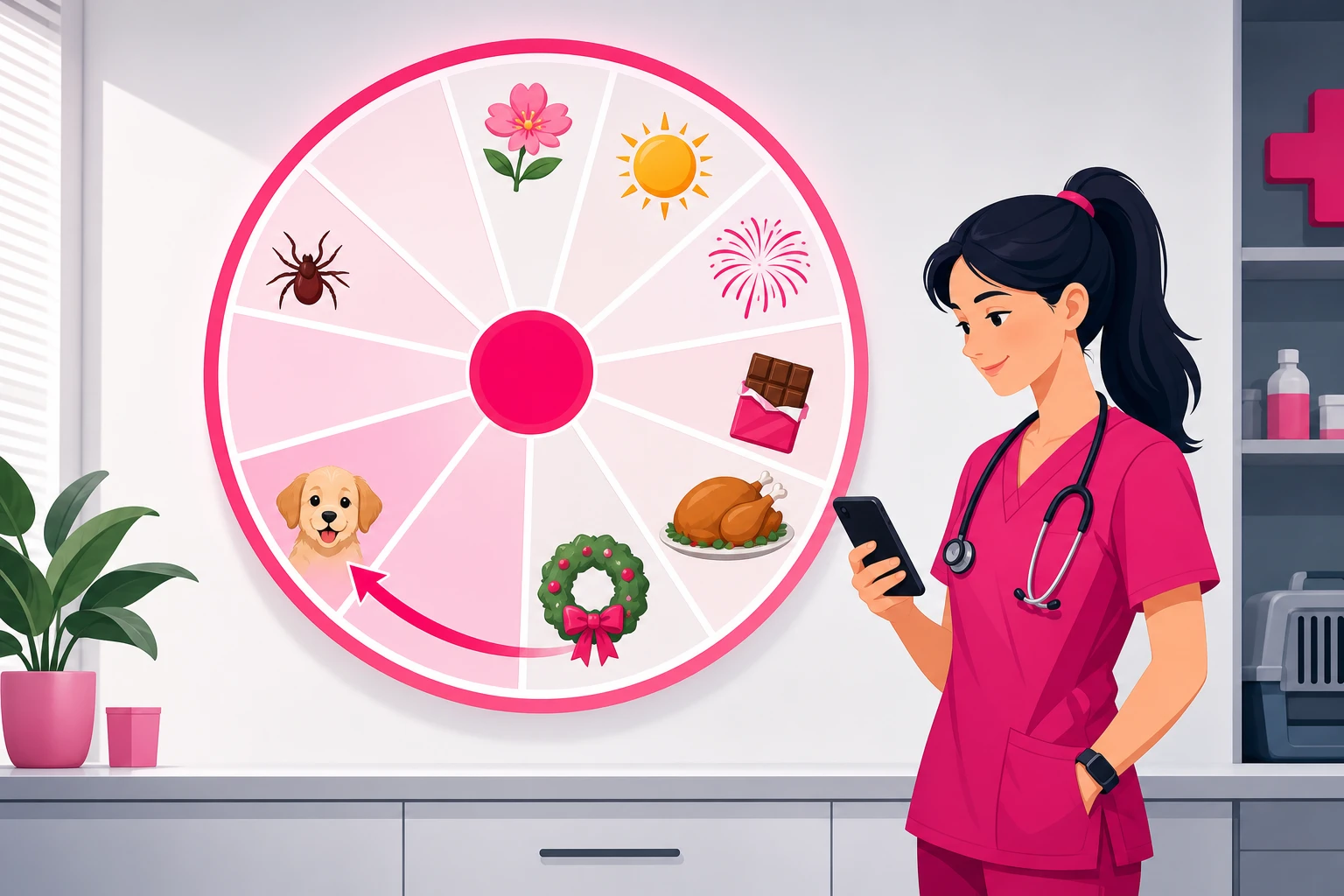
Nobody chooses a vet on a random Tuesday. They choose one at a trigger moment - a new pet, a move, a bad bill somewhere else, a nine p.m. scare - and the biggest of those moments is on the calendar. Puppies and kittens adopted or gifted over the holidays become new-client exams in January and February, the single largest acquisition wave of the veterinary year. The video that wins it is not posted in January. It is posted in November.
The rule that governs the whole vault: film each idea thirty to sixty days before its moment. A video needs runway to get surfaced, saved, and re-surfaced, and the owner deciding on a vet in January started paying attention in December. Here is the rotation, idea numbers included:
- January - February (the wave lands): Post the first-visit video (#49) and how-to-become-a-client (#52) you filmed in the fall, then lean on the dental explainer (#25) and the dog's-mouth myth (#14) for February's dental-health month. Reply to every comment; your job this quarter is to answer inquiries, not to produce.
- March - May (parasites and pollen): Indoor-cats-need-prevention (#15), the lily warning (#4) a week before Easter and again before Mother's Day, the spring-cleaning cabinet (#12), and the dog-park decoder (#41) as the weather turns.
- June - August (heat and noise): Cooked bones (#6) before the first barbecue, the fireworks-anxiety and hot-pavement explainers from your question log in the last week of June, and the ER-cost explainer (#26) because summer is when first-time ER visits spike. Kitten season is also when the recovery walk-outs (#46) write themselves.
- September - October (back to school and Halloween): Separation anxiety from the log, the "he's in pain, not old" myth-bust (#16) alongside the senior-bloodwork explainer (#24) for fall check-ups, and the chocolate verdict (#2) the week before Halloween - everyone has the dangerous thing in the house on the same night.
- November - December (table scraps, toxins, and the build): The Thanksgiving plate (#7), xylitol in the holiday baking (#3), the poinsettia-versus-lily correction, and tinsel for cat owners. And underneath all of it, the most important job of the year: film the new-puppy first-year explainer, the insurance explainer (#27), and the first-visit video (#49) now, so they are already saved by anxious new owners when January arrives.
The evergreen ideas - the behavior decoders, most of the myth-busts, the clinic-life clips - fill the gaps between the seasonal ones and never expire. Bank eight to ten of them so a fourteen-hour surgery day never takes the account dark. If you are reading this in the autumn, you are holding the best possible timing. If it is January, post the dental explainer, reply to everything, and put a recurring block on your calendar for October.
11. Which Ideas Travel, Which Ideas Book, and What to Do When One Takes Off
Here is the question no accountant or lawyer has to ask about their content vault, and the one that decides whether yours produces clients. Pet content is borderless. A grapes verdict or a slow-blink decoder travels to Ohio and Osaka with equal enthusiasm, and the algorithm - which does not know or care that you are a clinic on the east side of one particular city - will happily find you two million viewers who will never be within a thousand miles of your parking lot.
So sort the vault. The travelers are the verdicts, the myth-busts, and the behavior decoders: they build reach, followers, and authority, and if you are on the platform path they are your whole career. The anchors are the bill explainers, the comment replies, and the clinic-life clips - especially the first-visit video, the "in the back" tour, and how-to-become-a-client. They travel less and book more, because they are about your clinic and the people in it. A practice-path account needs both, in roughly a four-to-one ratio, and it needs the travelers to say the city out loud: "if you walk your dog on the riverfront trail, this is tick season." That one spoken sentence is the difference between a national pet account and a local vet account. Our local business TikTok guide covers the rest of the local-discovery mechanics.
Post from this vault consistently and something predictable happens: one or two videos dramatically outperform everything else. High completion, saves stacking up, profile visits jumping. That video just passed the audition - and a proven video is the only kind worth putting money behind.
For a veterinary practice, the math on amplifying it is better than for almost any other local business, for one reason: your client is a decade long. A wedding photographer books one wedding; a contractor finishes one roof. A new puppy is ten to fifteen years of exams, preventives, dentals, and senior care, and multi-pet households multiply it. Reaching a few thousand of the right households within a fifteen-minute drive costs a rounding error against a single lifetime client - and timed to the calendar, the same dollars go further: the new-puppy explainer pushed toward your radius in December reaches the owner exactly while they are choosing.
This selective approach is exactly what Viryze is built for: we amplify the videos that have already proven themselves organically, to the drive-radius audience that could actually book with you, instead of boosting every upload and hoping. Our Spark Ads guide covers the format clinics should default to, since it amplifies your organic post with its comments and credibility intact. Just confirm anything promoted clears TikTok ad policies, your state board's advertising rules, and your employer's social policy if you have one - and never let a promoted video imply a guaranteed outcome or promote a prescription product as if anyone can have it without an exam.
Frequently Asked Questions
What should veterinarians post on TikTok?
Six formats cover nearly everything that grows a veterinary account: "can my dog eat this?" verdicts that settle one specific food or household item, myth-busts that correct the confident pet misinformation people repeat, why-the-bill-is-what-it-is explainers that resolve the anxiety around an estimate, comment-reply Q&A built from real viewer questions, behavior decoders that explain what an animal is actually communicating, and clinic-life videos that show the humans behind the exam room. None of it requires a patient record or a specific animal - general education, your own commentary, and consented patients carry every format.
How do veterinarians come up with TikTok content ideas?
By keeping an exam-room question log. Veterinarians are asked pet questions constantly - in the room, at the front desk, in DMs, and at every gathering the moment someone learns what you do. Write each one down verbatim, in the owner's words rather than the clinical term: "why does my cat throw up right after eating" not "post-prandial regurgitation." Every entry is a pre-validated video, because a real person already cared enough to ask, and thousands more are typing those exact words into a search bar tonight. Thirty logged questions is roughly a quarter of content, and the log refills faster than you can film it.
Can a vet give medical advice on TikTok?
You can educate; you cannot treat. A veterinarian-client-patient relationship (VCPR) is required before you diagnose, prescribe, or give dosing for a specific animal, and it generally requires that you have examined that animal - so "how much of this can I give my dog?" is the one question you cannot answer for that dog. The safe pattern behind every idea in this guide is to explain how something works in general, say out loud that it is education and not advice for anyone's specific pet, and close with "when in doubt, call your vet or the ER." Telehealth rules vary by state, so check your practice act, not a comment thread.
Can I show patients on TikTok?
Only with the owner's consent - and the simplest way to make that a system instead of a daily judgment call is a single checkbox on your intake form asking whether the clinic may photograph or film the pet for social media. Never identify an owner, never turn a real case into advice for a stranger's animal, and think hard before featuring cases that ended badly. Also respect TikTok's community guidelines on graphic content and animals in distress: show the before and the after, the recovery walk-out, and the educational framing, and skip surgical footage and the gross-out genre entirely.
When is the best time of year for a vet clinic to post on TikTok?
Thirty to sixty days ahead of whatever is about to walk through your door. The biggest acquisition moment of the veterinary year is the holiday-to-January new-pet wave, so the "first year with a new puppy" explainer belongs in November, not January. Underneath that, the toxin-and-danger calendar gives you a reason to post every month: dental explainers in February, parasite prevention and lily warnings in March, heat and fireworks anxiety in June, chocolate before Halloween, and table-scrap pancreatitis before Thanksgiving. Each of those videos is filmed the month before its moment.
How often should a veterinarian post on TikTok?
Three to five posts a week, sustained for a year, beats any burst of daily posting that dies in week six - and veterinary accounts win on trust per video, not raw volume. The capture system makes that cadence cheap: log questions all week, then batch-film ten to fifteen answers back to back in one ninety-minute block, phone on a tripod, same scrubs, one take each. Fifteen videos is five weeks of posting from a single slow Wednesday afternoon.
Ready to turn your best idea into new-client forms?
Somewhere in these 52 ideas is the video that becomes your clinic's breakout - the grapes verdict or the "why the bloodwork" explainer that half your city ends up watching. When it happens, Viryze amplifies it to the drive-radius audience that could actually book with you, instead of boosting every upload and hoping. Your exam-room questions supply the content; selective amplification, timed to the new-pet wave and the seasonal calendar, turns the best of it into a lifetime client roster.
See how selective amplification worksRelated Reading
- TikTok for Veterinarians: The Complete 2026 Guide - the full strategy these ideas plug into.
- The Complete TikTok Algorithm Guide - the ranking signals that decide which of these ideas travels.
- Local Business TikTok Marketing - the local-discovery mechanics behind reaching households in your drive radius.
- TikTok for Pet Creators - the creator-side playbook if the platform path is the one you choose.
- TikTok for Healthcare Professionals - the human-medicine version of the same education-first playbook.
- TikTok Spark Ads Guide - the amplification format for the ideas that take off.

Head of Creator Success at Viryze
TikTok growth strategist helping creators reach their first 100K followers through data-driven promotion strategies.