
Cleaning Businesses13 min read
Cleaning Business Marketing on TikTok: A 90-Day Plan for Filling the Schedule
A plain 90-day marketing plan for house cleaning businesses and maid services on TikTok: what to set up before the first video, what to post in each of the three months, a weekly rhythm that takes just under three hours, who should run the company phone and why it is paid time, what to expect month by month, the tally sheet that shows whether videos are filling regular spots, seven common plateaus and how to get past each one, how the plan changes when you work alone or add a second team, and when a video has earned a small promotion budget.
By Ryan MitchellHead of Creator Success at Viryze

Most advice about marketing on TikTok is about followers. For a cleaning business, that is the wrong thing to count. A cleaning business grows when a new customer takes a regular spot on the schedule and keeps it.
This guide is a 90-day plan built around that idea. It tells you what to set up, what to post each month, how much time it takes, and who should do it. It also shows you how to tell, with a pencil and a sheet of paper, whether any of it is working.
It is one part of our complete TikTok guide for cleaning businesses. That guide has a short version of this plan. Here we go through it step by step. You do not need any marketing background to follow it.
The short version:
- Count regular spots filled, not followers.
- Month one is for setting up. Month two is for rhythm. Month three is for results.
- The whole plan takes just under three hours a week, and none of it happens on a customer's time.
- A tally sheet on a clipboard in the car is your real scoreboard.
What This Guide Covers
- 1. What Growth Means for a Cleaning Business
- 2. Before Day One: The Setup
- 3. Days 1 to 30: One of Each
- 4. Days 31 to 60: The Weekly Rhythm
- 5. Days 61 to 90: Read the Results
- 6. The Tally Sheet: Your Real Scoreboard
- 7. What to Expect, Month by Month
- 8. Who Runs the Phone
- 9. Seven Plateaus and How to Get Past Them
- 10. From Working Alone to a Second Team
- 11. Six Mistakes to Avoid
- 12. After Day 90: When a Video Has Earned a Budget
- Frequently Asked Questions
1. What Growth Means for a Cleaning Business
A cleaning business sells a spot on the schedule. The customer who matters most is not the one who books a single clean. It is the one who has you back every two weeks.
Here is the math from our main guide. Say a customer has a three-bedroom house cleaned every two weeks at $160 a visit. That is 26 visits, or $4,160 a year. A one-time first clean at $320 is worth one thirteenth of that.
So the goal of this plan is simple. Find people in your service area who could become regular customers, earn one first clean, and make the second clean easy.
A full schedule is a small number
A cleaning business also differs from most businesses in one more way. It can be full. A team of two that cleans three houses a day, five days a week, makes fifteen visits a week. If every customer is on an every-two-weeks schedule, that is about thirty regular customers.
Thirty is the whole target for one team. You do not need thousands of people. You need the right thirty, and you probably have some of them already.
Why followers mislead you
Regular customers come from the towns you already drive to. Time between houses is unpaid, so the best new customer lives two streets from one you already have. A follower three states away may love your videos, and she will still never be on your schedule.
That is why 300 followers in your service area can be worth more than 30,000 spread across the country. The follower count cannot show you the difference. Your schedule can.
The example company in this guide
To keep the numbers concrete, this guide uses the same made-up company as the rest of the series. It is an owner and a teammate named Ana. They clean houses together, arrive in one car in matching shirts, and bring everything, including the vacuum.
Every number about that company is an example. Your prices, your towns and your results will be different. The steps are the same.
2. Before Day One: The Setup
A viewer who likes a video will tap through to your profile. If the profile does not say which towns you serve or what a clean costs, that is where you lose her. So set up seven things before you post anything. It takes one quiet evening.
- Switch to a business account. It is a free setting in the app. It gives you the business tools, including music that is cleared for business use.
- Use a company email address. The account belongs to the company, so it should not sit under a personal email. Keep the password where the owner can find it.
- Write the profile in one breath. Say what you do, where you work and how it works. For example: "House cleaning in [your towns]. Weekly, every two weeks, or move-out. We bring everything. You do not have to be home."
- Link to one page. The page needs prices for two or three common home sizes, what is included, the towns you serve and a photo of who comes. Add a short form that asks for bedrooms, bathrooms, pets and how often, plus one more question: "How did you find us?"
- Put two sheets of paper on the clipboard in the car. One is the question log, for questions customers ask again and again. The other is the tally sheet, which section 6 explains.
- Give the kit a home. A small tripod, a dry lens cloth and a roll of painter tape, in a zip bag in the car next to the clipboard. It usually costs under $50.
- Agree the team page. Anyone who might appear in a video reads and signs a short agreement first. Being in a video is always a choice. If you work alone, skip this step for now.
The filming details are in our guide on how to film cleaning videos, including the kit, the light in a small bathroom and the six-line page for your team.
When to start
People look for a cleaner when their routine changes. For most households that happens about three times a year: in early January, in early March when spring cleaning starts, and in late August when school starts again.
If you can, start about six weeks before one of those dates. That means late November, late January or mid-July. Your first clean video will then be pinned and tested by the time people are looking.
If today is nowhere near any of those dates, start anyway. A plan that begins in May is still three months ahead of a plan that never begins.
3. Days 1 to 30: One of Each
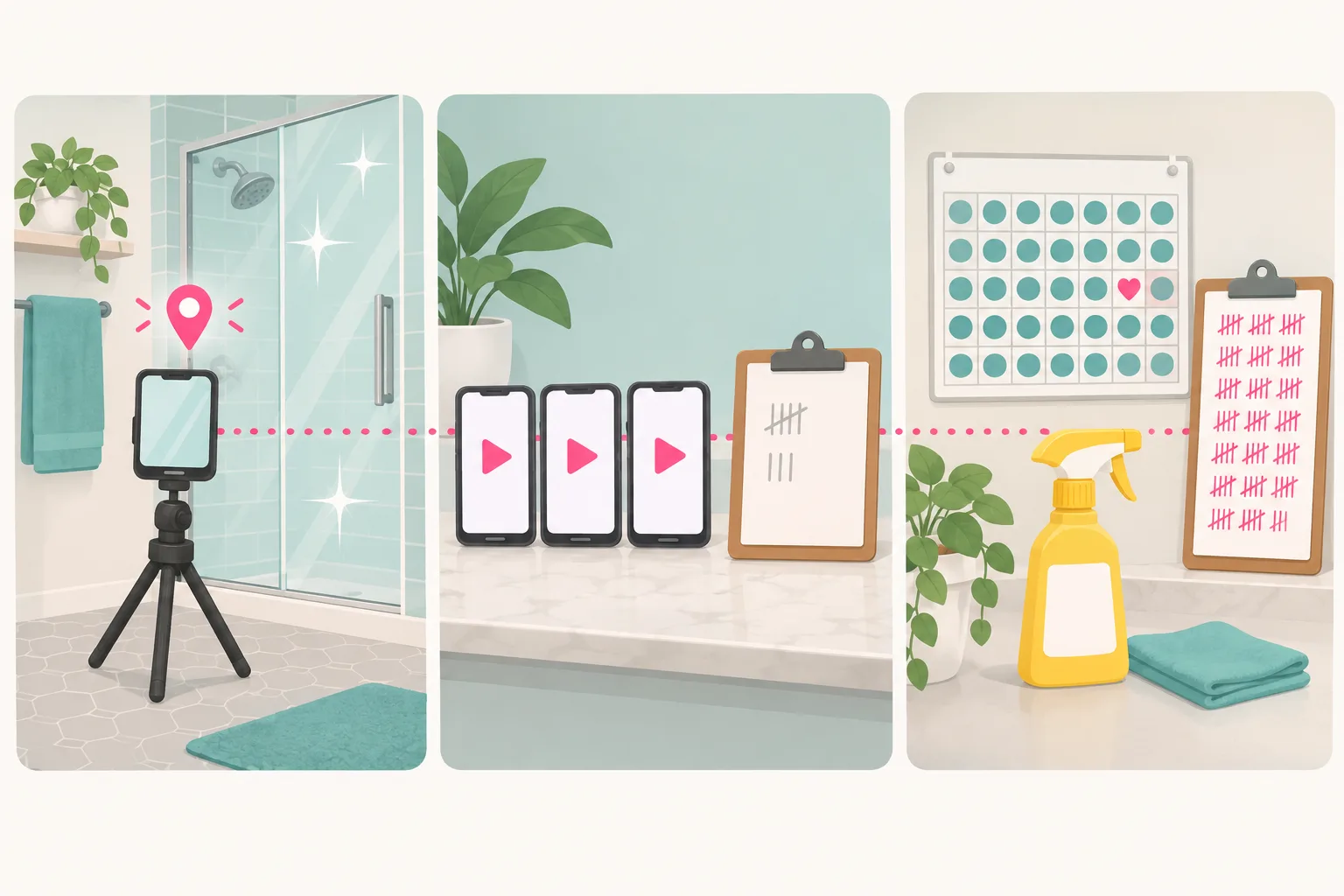
The first month has one job. By day 30, your profile should hold one good example of each kind of video a cleaning business needs. There are six kinds, and the main guide explains each one in the section on the six kinds of video.
Two videos a week is enough this month. You are learning the filming routine, and that takes longer at the start.
| Week | What to post | Why |
|---|---|---|
| 1 | The first clean video. Pin it to the top of your profile. | It shows a new customer what will happen, from the text the day before to the message when you are done. |
| 2 | A before and after, and a video about what a clean costs and why. | The before and after earns views. The price video earns trust. |
| 3 | A question answered, and a useful tip. | Questions bring comments. Tips get sent to friends. |
| 4 | An honest week, and a second before and after. | The honest week shows how you handle a problem. The second before and after tests a different opening. |
Start with the first clean video
Hiring a cleaner is a trust decision. A stranger comes into the home, often when nobody is there. The first clean video answers the questions nobody asks out loud. Who comes? What do they bring? What is not included? How do they lock up?
It is eight short clips, about fifty seconds in total, with the price on screen in the last one. Film it in your own home. Then pin it. Everything else you post this quarter sends people to your profile, and this is what they should find there.
Tell your customers
Your first followers should be the people whose homes you already clean. Add one line to your next "all done" message: "We have started posting short videos about how we work. The account is [name], if you ever want to send it to a neighbor."
This is not about the number. Your customers live in the towns you serve, and they send videos to people who live there too. A neighbor two doors down is the best customer you can get.
What not to worry about yet
Do not check the view counts every hour. Do not pay to promote anything. Do not copy a trend that has nothing to do with cleaning. This month you are building a shelf of useful videos and a habit of filming.
If you need more to choose from, our list of 50 cleaning business content ideas is sorted by the same six kinds.
4. Days 31 to 60: The Weekly Rhythm
In the second month you move to three videos a week, on the same three days. A steady three is better than seven one week and none the next. The example company posts on Sunday, Tuesday and Thursday, in the evening.
A simple mix works well. Each week, post one before and after, one answered question and one tip. Once a month, swap one of them for a price video. Use the honest week only when something real has happened.
A week in the example company
| Day | What happens | Time |
|---|---|---|
| Saturday | Film at home in daylight: one before and after, one question, one tip. | 30 minutes |
| Sunday | Post the before and after. | 15 minutes |
| Tuesday | Post the answered question. | 15 minutes |
| Thursday | Post the tip. | 15 minutes |
| Friday | Count the week's tally marks, read the question log and pick next week's videos. | 20 minutes |
| Every day | Answer the comments and the messages. | 10 minutes |
Why the evening? That is when many people are at home, looking at the house and thinking about the week ahead. Your own numbers will tell you whether another time works better.
Let the question log choose the videos
By now the question log has a month of marks on it. Look at which questions have the most. Do I have to be home? Do I need to tidy first? What about the dog? Each one is a video that customers have already asked for.
Answer them plainly. The one that travels furthest is often the permission: "No, you do not have to clean before the cleaners come." A lot of people put off calling a cleaner because they are embarrassed by the house. That one sentence removes the reason.
Ten minutes a day on comments and messages
When someone asks "how much?" or "do you come to my area?", give the real answer. Keep three replies saved so this takes seconds:
- The price reply. It asks for the four things you need to give a number: bedrooms, bathrooms, pets and how often.
- The towns and open days reply. It lists where you work and which days have room.
- The "how it works" reply. You do not have to be home, you do not have to tidy first, and we bring everything.
A message asking for a price is a customer at your door. Try to answer it the same day.
Two more jobs for this month
First, add the yes list line to your service agreement. It is one sentence with a box, and it lets a customer say in writing that one surface in her home may be filmed. Our filming guide has the wording for the yes list. Never offer a discount for a yes.
Second, start the tally sheet. From now on, everyone who asks for a price also gets asked one short question: "How did you find us?" Section 6 explains how to keep the count.
5. Days 61 to 90: Read the Results
Keep the same weekly rhythm in the third month. The new work is looking back. You now have about twenty videos and a few weeks of tally marks, which is enough to learn from.
Three things to look at
- Which videos sent people to your profile. The analytics in the TikTok app show how many people looked at your profile each day. Compare the days after each post. A video with modest views that sends many people to your profile is doing more for the company than a popular one that sends none.
- Which videos customers mention. When someone says "I saw your video", ask which one. Write it next to the tally mark.
- Which videos get sent. A send is often one partner asking the other, "Can we do this?" The first clean video and the price videos usually lead here.
Then make three decisions
- Make more of the two kinds that did best. If questions and price videos lead, post two of those each week and one of anything else.
- Update the first clean video. Has a price, a town or an open day changed since day one? Film that one clip again and swap it in.
- Decide whether one video has earned a budget. Section 12 explains how to tell. For many companies the honest answer at day 90 is "not yet", and that is fine.
Last, look at the calendar. If January, March or late August is less than two months away, plan your best videos for the weeks just before it. The main guide has a month-by-month cleaning calendar to plan from.
6. The Tally Sheet: Your Real Scoreboard
TikTok can tell you how many people watched a video. It cannot tell you who asked for a price or who took a spot. Its numbers on where followers live are also too broad to show a town.
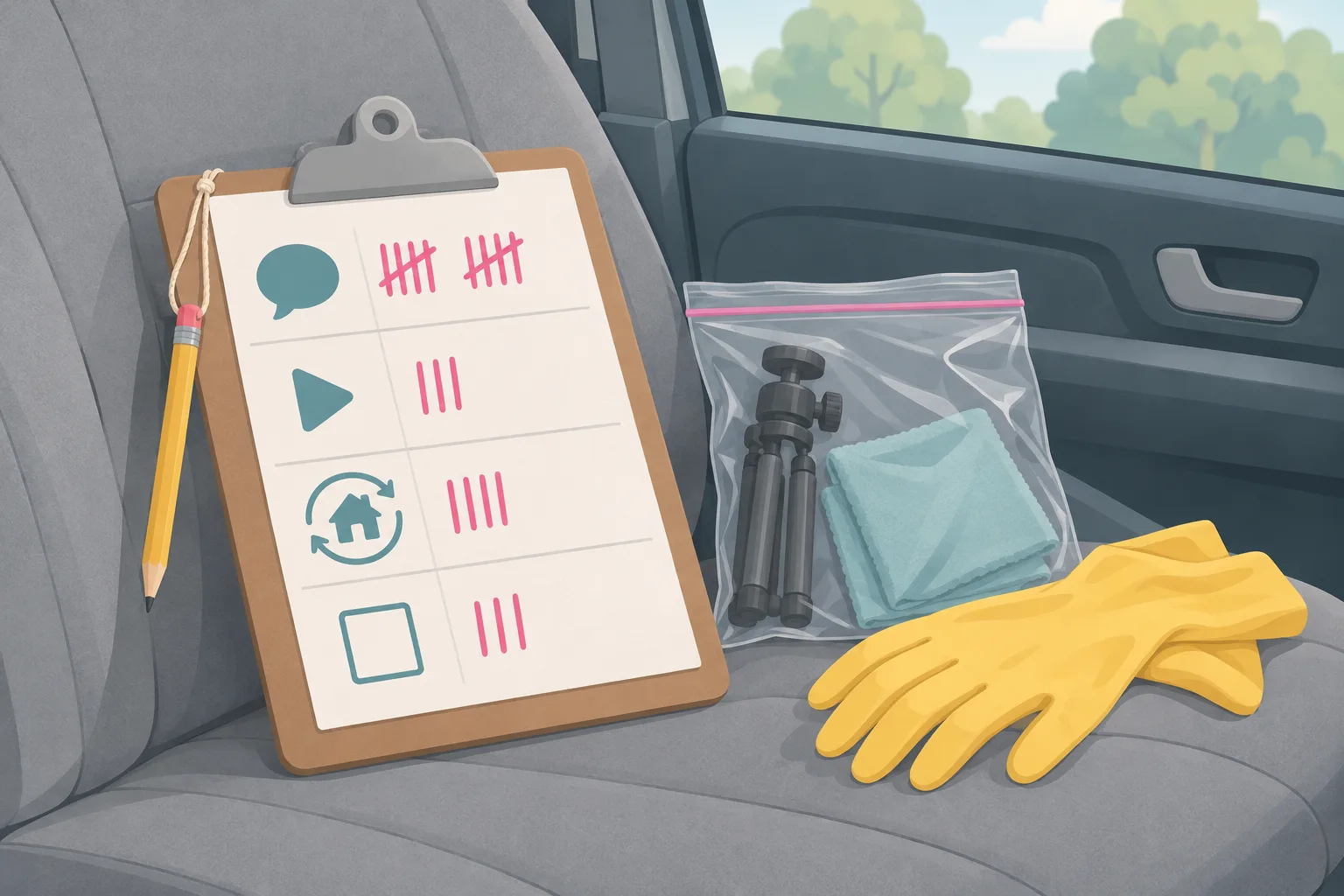
So the scoreboard for this plan is a sheet of paper on the clipboard in the car, with a pencil on a string. It is the most useful tool in this guide, and it costs nothing.
How to keep it
Ask at the moment someone requests a price. The form on your price page already asks. When a request comes by message or by phone, ask it yourself: "How did you find us?"
Then make one mark on the sheet, in one of five columns:
- A neighbor or a friend
- A video
- A map or a search
- The car, a sign or a flyer
- Something else
Keep all five columns, not only the one for videos. If "a neighbor" grows in the same months as your videos, some of those neighbors were sent a video. You will only see that if you count everything.
Two rules that keep it fair
Ask everyone. Ask the person who books and the person who does not. If you only ask the ones you like, the count will flatter you.
Do not lead the answer. Ask "How did you find us?" and not "Did you see us on TikTok?" People like to say yes to a friendly question.
Count the regular spot
A first clean is a good sign. A regular spot is the result you are working for. So when a first clean turns into a regular booking, circle that customer's tally mark.
A circled mark in the video column means a video brought you a regular customer. In the example company, each of those circles is worth about $4,160 a year.
Four numbers, once a month
On the last Friday of each month, write down:
- Requests for a price. Every request, from every source.
- New customers who said they saw a video. From the video column.
- First cleans that turned into a regular spot. The circled marks.
- Regular spots still open. Count them on your schedule, and write down which days they are.
The first two numbers tell you whether the videos work. The third tells you whether the first clean and the offer after it work. If the first two rise and the third stays flat, the videos are fine and the visit needs attention.
The fourth number tells you what to say next. If the only open spots are every other Wednesday, that is the day your next video should name.
7. What to Expect, Month by Month
Results differ a lot between companies. A company in a large suburb will see more than one in a small town. Treat what follows as a rough picture and not as a promise.
Month one: quiet
Most of your first followers will be customers, family and their friends. Views will be small. The tally sheet may show no mention of a video at all. This is normal, and it is the month when most owners give up.
Month two: the first signs
Question videos start to collect comments. One before and after may travel further than the rest. One or two people who ask for a price say they saw a video, and you start to hear which one.
Month three: a pattern
The mentions become regular, even if they are few. As our main guide says, three or four "I saw your video" is a real start. Some of those first cleans turn into regular spots.
The example company after 90 days
| Number | Month 1 | Month 2 | Month 3 |
|---|---|---|---|
| Requests for a price | 4 | 7 | 11 |
| New customers who said they saw a video | 0 | 2 | 3 |
| Of those, first cleans that turned into a regular spot | 0 | 1 | 2 |
| Regular spots still open | 5 | 4 | 2 |
These are made-up numbers for a made-up company, and they are small on purpose. Now put them next to the math from section 1. Five new customers mentioned a video over the three months. Three of them took a regular spot. That is about $12,480 a year in sales.
Notice what is not in the table. There is no follower count. The example company might have 200 followers or 2,000 at this point, and the table would read the same.
Notice the last row too. Two spots are left, and both are every other Wednesday. The company's next video says exactly that.
8. Who Runs the Phone
Plans like this one rarely fail because of bad videos. They fail because nobody was in charge. So give the job to one named person.
It can be the owner. It can be a team member who enjoys it. In the example company, the owner films at home on Saturday and answers the messages, and Ana appears in the videos when she is happy to. One person still has to own the week, and in that company it is the owner.
Just under three hours a week
- Filming: one session of thirty minutes, at home.
- Finishing and posting: about fifteen minutes for each of three videos, to trim the clip, add the text and write the caption. That is 45 minutes.
- Comments and messages: ten minutes a day. That is about 70 minutes.
- The Friday count: twenty minutes to add up the tally sheet, read the question log and choose next week's three videos.
That adds up to two hours and forty-five minutes. The first month takes a little more, because of the setup and the first clean video.
It is paid time
If a team member does this work, it is work. Put the filming session and the Friday count on the schedule, and pay for them like any other job.
There is a practical reason as well as a fair one. Work that is on the schedule gets done. Work that depends on someone's free time stops the first week the houses run long.
Being on camera is a separate question from doing the filming, and it is always a choice. The six-line team page in our filming guide covers it.
The account stays the company's
Team members move on, and that is normal. The account should not leave with them. Keep one page of notes so anyone can take over:
- The company email the account uses, and where the password is kept.
- The three posting days and the filming time.
- Where the kit bag and the clipboard live.
- The three saved replies.
- Where the tally sheets and the monthly numbers are filed.
The owner's five minutes
If the owner does not run the phone, the owner still has one job. Every Friday, look at the tally sheet and ask one question: "Which video did people mention this week?"
That question keeps everyone looking at the right number. It also tells the person doing the work that somebody notices.
9. Seven Plateaus and How to Get Past Them
Almost every company gets stuck at some point. Here are the seven most common places, and what to do at each one.
- The views are fine, but nobody asks for a price. Watch your last five videos as a stranger would. Can you tell which towns you serve? Say them out loud and put them in the caption. Then check that the first clean video is still pinned, and that the link on your profile opens a page with real prices on it.
- One video brought a thousand followers from far away. Enjoy it, and change nothing. Those followers cannot take a spot on your schedule. Go back to the service area videos the next day. Do not start making videos for the new crowd unless you have something to sell them online.
- The requests come from towns you do not serve. Answer kindly and say where you do work. Then name your towns in the first line of the next three videos. "We are in the north end on Tuesdays" tells a viewer in two seconds whether to keep watching.
- People book a first clean and do not take a regular spot. This is not a video problem. Look at the visit. Did it match the first clean video? Did the "all done" message offer a real day, the same faces and a clear price? If it only said "thank you", you left the second clean to chance.
- You have run out of things to film. Read the question log. Every tally mark is a video somebody already asked for. After that, film one more surface in your own home. There is always another shower door.
- The person who films has stopped. It usually means the weekly session fell off the schedule. Put it back on, as paid time, and cut the plan to two videos a week for a month.
- The schedule is full. This is the plateau you wanted. Stop asking for new requests, start a waiting list, and read section 10 before you post anything that promises a day you cannot staff.
One more thing is worth knowing. After a strong video, the next few usually get fewer views. That is how TikTok works for everyone, and it does not mean you did something wrong. Our guide to the TikTok algorithm explains why each video is judged on its own.
10. From Working Alone to a Second Team
The plan above fits a company of any size. Two moments change it a little: when you work alone, and when the schedule is full.
If you work alone
A solo cleaner has an advantage on camera. The answer to "who comes?" is always the same person, and she is the one in the videos. Say so in the first clean video: "It is me, every visit."
You also have fewer spots to fill, so two videos a week is enough. Keep the tally sheet all the same. With a small schedule, two or three new regular customers can be the difference between a thin month and a full one.
When the schedule is full
A full schedule is good news, and it changes what you post. Do not keep asking for requests you cannot serve. Post an honest "we are full" video and keep a waiting list in the order people asked.
Keep posting while you are full. The questions, the tips and the before and afters hold your place in people's minds. Customers move away, and a spot will open again.
Your videos also help you hire. A person who has watched how you work for three months knows what the job is before she applies. A short video about what a day looks like, what you pay for and how the team treats each other is worth posting before you need someone. If you ever pay to promote a hiring video, read TikTok's rules for job ads first. They are not the same as the rules for ordinary ads.

When the second team starts
A second team roughly doubles the spots you can sell. It also brings back the oldest question in the business: "Is it the same people every time?" Answer it before anyone has to ask.
- Introduce the new team on video first. If they agree to be on camera, post a short video by the car before they arrive at anyone's door. Names, faces, the shirts and the car.
- Update the first clean video. If it says "Ana and me, every visit", that is no longer true for every customer. Film the clip again and say what is true: each home has its own team, and it is the same team each time.
- Start the new route next to the old one. Fill the second team's days in towns you already serve before you add a new town. Two cars ten minutes apart can cover for each other on a sick day.
- Say which days are open. A new team starts with an empty week. "Mondays and Fridays just opened in [your towns]" is the most useful video you can post that month.
- Keep a tally sheet in each car. Add them up on Friday. The four monthly numbers stay the same.
Do not move an existing customer to the new team without asking her. She agreed to let two particular people into her home. Tell her first, and let her choose.
11. Six Mistakes to Avoid
- Posting every day for two weeks, then stopping. Three a week for three months does far more. Pick the days and keep them.
- Counting followers. A follower count cannot tell you whether anyone took a spot on your schedule. The tally sheet can.
- Filming in a customer home because it looks more real. A private home is never content without a written yes. Your own shower door gets just as dirty, and nobody has to be asked.
- Answering a price request the next week. A person who asks for a price is deciding now, and she has probably asked someone else too. Answer the same day, with a number.
- Paying to promote in the first month. You do not yet know which video works. Wait until one has earned its marks on the tally sheet.
- Making fun of a messy home. Every viewer wonders whether you would say the same about hers. The video that works is the opposite one: "No, you do not have to clean before the cleaners come."
12. After Day 90: When a Video Has Earned a Budget
Paying to promote a video means paying to show it to more people. It helps a good video travel further. It does not fix a weak one. So the question at day 90 is whether you have a video that has proved itself.
Three signs it is ready
- People watch it to the end.
- It sends people to your profile and your price page.
- People who asked for a price have mentioned it, and it is on the tally sheet.
The first clean video often passes all three. So does a clear video about your towns and open days. Check the fourth monthly number before you spend anything. Do not advertise a day you cannot staff.
Start with the free steps
Pin the video. Film a second one in the same style. Post it again in the weeks when routines change. Our guide to local business TikTok marketing has more ways to reach people in your area without spending anything.
If you do spend
Keep the budget small and aim for followers, not a burst of one-time jobs. A follower sees your next videos for free. She can watch you work for a few weeks and ask for a price when she is ready. The main guide lists four rules for paid promotion.
You can do this yourself in the TikTok app. If you would rather spend the time on your houses, Viryze can run it for you. You pick the video. Viryze shows it to several different audiences, sees which one follows for the least money, and moves the budget there. The promotion runs on your real post, as our Spark Ads guide explains.
One caution applies to every tool and service, ours included. Check the location choices before you pay. If a service cannot keep a campaign inside the towns you serve, use it for videos meant for a wider audience, such as a tip or a before and after from a company that sells a checklist online. Promote the service area videos another way.
Then judge the spending the same way you judge everything else in this plan. Did the tally sheet change? If the followers went up and the marks did not, stop and check where the promotion ran.
Frequently Asked Questions
How long does TikTok marketing take to work for a cleaning business?
Plan on about three months before you judge it. The first month is mostly setting up and being found by people who already know you. In the second month, one or two people who ask for a price usually say they saw a video. By the end of the third month you should have enough marks on a tally sheet to see which kinds of video bring requests from the towns you serve. Follower numbers differ a lot from one business to the next, so judge the plan by regular spots filled, not by a follower target.
How many TikTok followers does a cleaning business need?
Fewer than most owners think. A cleaning business needs followers who live in the towns it already drives to, because only they can become regular customers. A few hundred followers in your service area can be worth more than tens of thousands spread across the country. In our example, one customer every two weeks is worth about $4,160 a year, and a two-person team has room for about thirty of them. Three new regular customers in three months is a real result.
How much time does TikTok marketing take for a cleaning company?
Just under three hours a week once the account is set up. That covers one thirty-minute filming session at home, about fifteen minutes to finish and post each of three videos, ten minutes a day answering comments and messages, and twenty minutes on Friday to count the tally sheet and plan the next week. None of it happens on a customer clock.
Who should run a cleaning business TikTok account?
One named person, so it does not depend on whoever remembers. It can be the owner or a team member who enjoys it. If it is a team member, the hours are work and should be on the schedule as paid time. Whoever runs it, the account should belong to the company: a company email address, a password the owner holds, and one page of notes so someone else can take over.
How do I know if TikTok is bringing in cleaning customers?
Ask and count. Ask every person who requests a price how she found you, and put a mark on a tally sheet. Once a month, write down four numbers: requests for a price, new customers who said they saw a video, first cleans that turned into a regular spot, and regular spots still open. If the first two rise and the third does not, the videos are working and the first clean or the offer after it needs attention.
Can a solo house cleaner use this plan?
Yes, with two changes. A solo cleaner has fewer spots to fill, so two videos a week is enough, and the schedule can fill within a few months. The other change is what happens when it is full. Post an honest "we are full" video, keep a waiting list in order, and do not promote open days until you have hired. When a second team starts, introduce the new people on video before they arrive at anyone's door.
Ninety days in, with a video customers keep mentioning?
Start with the profile, the first clean video and the sheet of paper on the clipboard. They cost almost nothing. Later, when one video has earned its marks on the tally sheet and you want more people to see it, Viryze can put it in front of several audiences, find the one that follows for the least money, and shift the budget there. You stay with your houses.
Related Reading
- TikTok for Cleaning Businesses: The Complete 2026 Guide - the full plan this growth guide belongs to.
- Cleaning Business TikTok Content Ideas: 50 Videos That Fill the Schedule - what to post in each of the three months.
- How to Film Cleaning Videos for TikTok (Your Own Home as the Set, the Before and After, and the Yes List) - how to film all of it in one short session a week.
- Local Business TikTok Marketing: Get Customers in Your Area - how to reach people in the towns you serve.
- Growing a Landscaping TikTok: From 0 to 10K Followers in the Right Two Towns - how another business that works on a route grows a nearby following.
- Understanding TikTok's Algorithm: What Really Matters - why each video is judged on its own.
- Spark Ads on TikTok: Creator's Complete Guide - how to promote a post that is already on your account.