
Cleaning Businesses15 min read
TikTok for Cleaning Businesses: The Complete 2026 Guide
A plain 2026 TikTok guide for house cleaning businesses and maid services: why a cleaning business sells a spot on the schedule and not a single clean, the six kinds of video that work, how to open a video, how to film without putting a private home online, the choice between your service area and a national audience, the cleaning calendar, a 90-day plan, the steps from a first view to a regular customer, when paid promotion is worth it, and the rules on homes, claims, safety and reviews.
By Ryan MitchellHead of Creator Success at Viryze
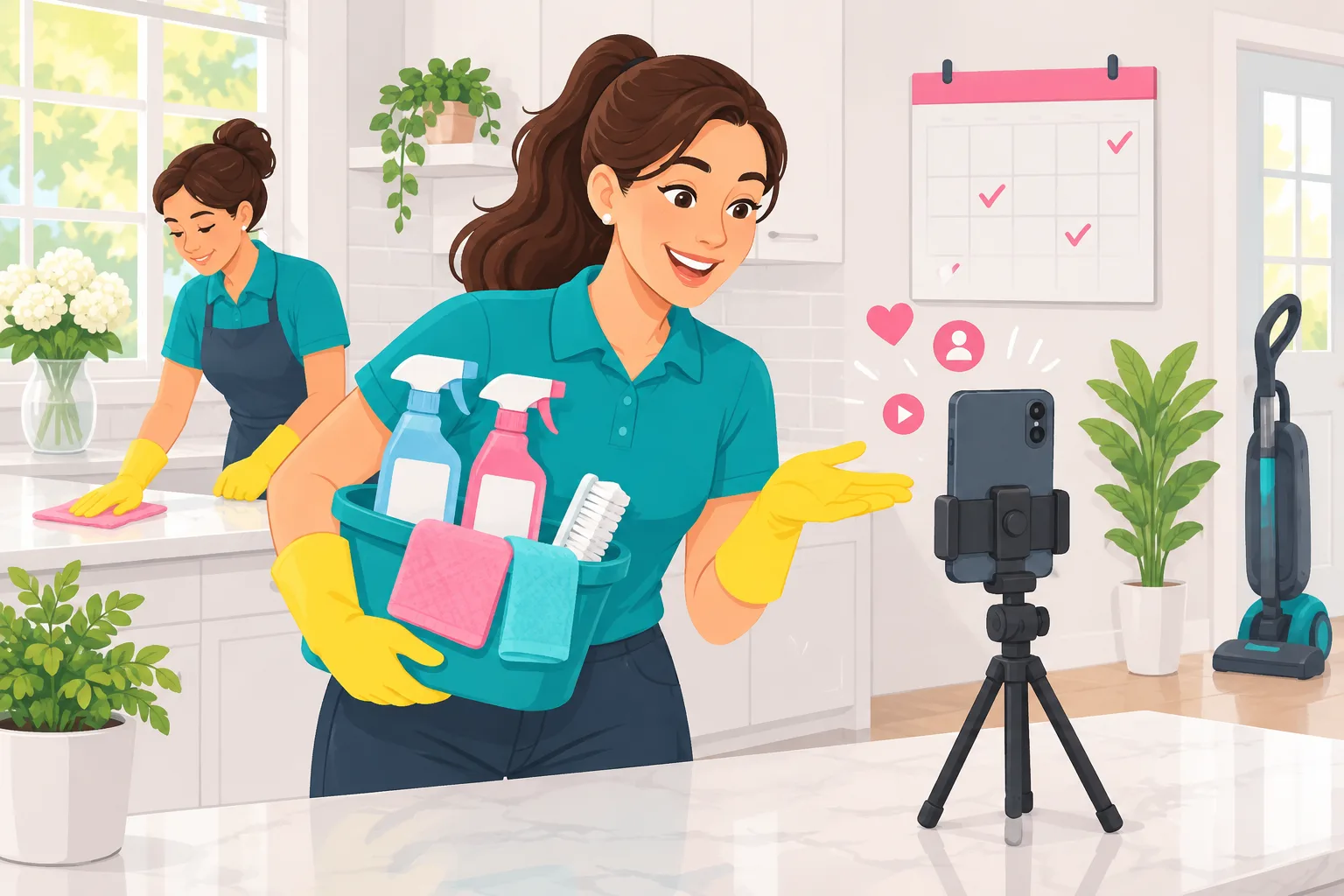
Think about someone who lives two streets from a house you clean every other Tuesday. She has wanted to hire a cleaner for a year. The money is not what stops her. A few small questions do, and she has nobody to ask.
Who exactly comes into my house? Is it the same person each time? Do I have to be home? What do I do about the key? Do I have to tidy up first? What does it cost for a house like mine? And will they judge me for how it looks right now?
A one-minute video can answer every one of those questions. This guide shows how a house cleaning business or maid service can use TikTok to turn people in its service area into regular customers. It is written for the solo cleaner, the owner of a small team, and whoever was handed the company phone.
You do not need to know anything about marketing to follow it. If you want the background on how TikTok decides who sees a video, our TikTok algorithm guide explains it, and the TikTok growth guide covers the basics that apply to every kind of account.
The honest summary:
- You sell a spot on the schedule, not one clean. One customer who books every two weeks is worth more than a dozen one-time jobs.
- Customers come from where you already drive. A video only fills your schedule if people in your service area see it.
- Make the first clean video first. Show who arrives, what gets cleaned, how you lock up and what it costs.
- A customer's home is never content without a written yes. Film most videos in your own home.
- Pay only to push a video that already works. The best weeks are early January, early March and late August.
What's Inside
- 1. Why TikTok Fits a Cleaning Business
- 2. The Six Kinds of Video That Work
- 3. How to Open a Video
- 4. Filming Without Putting a Customer's Home Online
- 5. Your Service Area or the Whole Country
- 6. The Cleaning Calendar
- 7. How Often to Post, and Who Does It
- 8. A 90-Day Plan
- 9. From a View to a Regular Customer
- 10. When Paid Promotion Is Worth It
- 11. The Rules: Homes, Claims, Safety and Reviews
- Frequently Asked Questions
1. Why TikTok Fits a Cleaning Business
People love watching things get clean. TikTok said in 2023 that videos tagged #CleanTok had been viewed more than 78 billion times. A dirty shower door turning clear is one of the most watched things on the app.
That is nice to know, but it is not the real reason TikTok fits your business. The real reason is trust. Hiring a cleaner means letting someone into your home, often when you are not there. That is a bigger decision than choosing a restaurant or a barber.
Most people make that decision with very little to go on: a name, a star rating and a price. Video gives them much more. They can see your face, hear how you talk, and watch how you work, all before they send a message. By the time they ask for a price, you are no longer a stranger.
The math of one regular customer
Here is a simple example. Say a customer with a three-bedroom house books a clean every two weeks at $160. That is 26 visits a year, or $4,160. Many regular customers stay for several years.
Now compare that with a customer who books one big clean for $320 and never calls again. You would need thirteen customers like her to equal one regular's first year.
These prices are only an example. Price guides for 2026 put a typical every-two-weeks visit somewhere between $100 and $250, and yours depend on your area and the size of the home. The point holds at any price. The number that matters is not views, and it is not even first cleans. It is how many new customers take a regular spot on your schedule.
Customers come from where you already drive
Nobody pays you for the time between houses. A new customer two streets from one you already have costs you five minutes of driving. A new customer on the far side of the county can cost you an hour of every working day she is on the schedule.
This changes how you should judge a video. A video seen by 2,000 people in the towns you serve can do more for the business than one seen by 2 million people spread across the country. Section 5 comes back to this, because it is the choice most cleaning accounts get wrong.
2. The Six Kinds of Video That Work
You do not need new ideas every day. Six kinds of video cover almost everything a cleaning business needs to say. The examples use one made-up company: an owner and a teammate named Ana, who clean houses together and arrive in one car.
1. The first clean
This is the most important video you will make. It walks a new customer through a visit in the order it happens. Film it once in your own home, pin it to the top of your profile, and film it again when something changes.
A good first clean video shows, in order:
- The text the customer gets the day before.
- Who arrives, what they wear and what they drive.
- What you bring in with you, such as supplies and the vacuum.
- The order of the work, room by room.
- What is not included.
- How you leave: lights off, door locked, key back where it belongs.
- The message the customer gets when you are done.
A script can be this short: "The day before, you get a text with our arrival time. Ana and I come in one car, in these shirts. We bring everything, including the vacuum. We start in the kitchen, then the bathrooms, then dusting, and floors last. A three-bedroom house takes the two of us about two hours. We lock up, put the key back where you told us, and text you when we leave. You do not have to be home. It is $160 every two weeks."
2. The before and after
This is the easiest video to film and the one strangers enjoy most. Pick one surface, such as a shower door, a stovetop or a sink. Show it before, show the work, and show it after, in 15 to 25 seconds. The sound of the scrubbing is enough. You do not have to talk.
Keep it honest. Film the before and the after from the same spot, in the same light, on the same day, and only show your own work. Then add one line of text with what it is, how long it took and the area you serve. That turns a satisfying video into something useful for a person nearby. Film it in your own home, or in a customer's home only if she has agreed in writing. Section 4 covers how to ask.
3. What it costs and why
People wonder what a cleaner costs, and many are too shy to ask. Answer before they do. Stand by the car with your supplies and explain it simply: two people for two hours, the products, the insurance, the drive and the taxes.
Two questions come up again and again, and each one deserves its own short video. Why does the first clean cost more? Because it takes about twice as long to catch a house up. Why is every two weeks cheaper per visit than once a month? Because a house that is cleaned often takes less time each visit.
4. The question answered
Every cleaning business hears the same questions each week. Do I have to be home? Do I need to tidy up first? Do you bring your own supplies? What about my dog? Is it the same people every time? What do you not clean? What happens if something breaks?
Each question is one short video. Say the question, then answer it honestly in two or three sentences. If the answer is no, say so kindly. "We do not do laundry or dishes, so we can spend the whole visit on the kitchen, the bathrooms and the floors" is a helpful answer.
5. The useful tip
Show one small thing a viewer can do at home. How to keep a glass shower door clear between cleans. The order to clean a bathroom so you never redo a surface. This is the video people send to a partner with one line: "We should do this."
It can feel strange to teach people to clean when you sell cleaning. It is not a problem. The people who hire a cleaner are not short of knowledge. They are short of time. A good tip shows that you know your work, and that is who they call when the time runs out. Keep every tip safe to copy. Section 11 explains how.
6. The honest week
Sometimes a lamp gets knocked over. Sometimes one of you is sick and three houses have to move to Friday. A short, calm video about it makes the company feel like it is run by real people.
Use this one sparingly, and follow two rules. Talk about what happened and what you did about it, such as "we told her the same day and paid for the lamp." Never describe a customer or her home in a way she could recognize.
| Kind of video | What it is for | How often |
|---|---|---|
| The first clean | Turns a viewer into a customer | Once, then pinned |
| The before and after | Brings views and new followers | Weekly |
| What it costs and why | Builds trust in the price | Once a month |
| The question answered | Removes a reason not to call | Weekly |
| The useful tip | Gets sent to other people | Weekly |
| The honest week | Shows real people run the company | Now and then |
If you also offer work such as carpet, window or pressure cleaning, the TikTok guide for contractors and home service pros has more ideas for filming a job from start to finish.
3. How to Open a Video
People decide in the first two seconds whether to keep watching. So the opening line and the opening picture matter more than anything that follows. Here are five openings that suit a cleaning business.
- The price first. "A three-bedroom house, every two weeks, is $160. Here is what gets done."
- The clock. "Two people, two hours. Watch the kitchen."
- The honest answer. "No, we do not do laundry. Here is what we do with that time."
- The person. "This is Ana. If you book a Tuesday, Ana is who comes to your door."
- The permission. "No, you do not have to clean before the cleaners come."
The last one works especially well. Many people put off hiring a cleaner because they are embarrassed by the state of the house. Telling them it is fine, and that you have seen it all before, is a kind of welcome.
Three openings to avoid
Making fun of a messy home. "You will not believe how this client lives" gets views from strangers. But the person who was about to call you sees it and learns that her kitchen could be the next video. It is the fastest way to lose the exact customer you want.
Putting down other cleaners. Solo cleaners, franchises and big companies all have happy customers. You gain nothing by criticizing them, and it makes your own business look unsure of itself. Show what you do well and leave it there.
Complaints. Last-minute cancellations, customers who haggle, the price of supplies. These may all be fair points. They still give a stranger no reason to book.
4. Filming Without Putting a Customer's Home Online
A shop can film its own counter. You work in other people's homes, and a home is the most private place a person has. So the first rule is simple: a customer's home is never in a video unless she has said yes in writing.
Where to film
- Your own home. The first clean video, the tips and most question videos can all be filmed in your own kitchen and bathroom. Nobody needs to give permission.
- The car and the supplies. The price video and many question videos work well standing by the car with your caddy.
- An empty home. A move-out clean has no furniture, no photos and no family. Ask whoever is in charge of the property for a written yes first.
- Homes on your yes list. These are the customers who have agreed in writing. Two or three are enough.
The yes list
Add one line with a box to your service agreement. It can say: "You may film the surfaces you clean in my home for your videos. No people, no family photos, no mail and nothing that shows where I live." A customer who ticks the box is on the yes list.
Tell her she can change her mind at any time with a text, and that the videos will come down. Never offer a discount for saying yes. A customer who feels she had to agree is not really agreeing.
What stays out of the frame
Even in a home on the yes list, never show:
- People, and above all children.
- Family photos, mail, calendars, school papers and anything with a name on it.
- Medicine, and the inside of cupboards and drawers.
- The view from a window, the front of the house and the house number.
- Keys, lockboxes, door codes and alarm panels.
The easy way to follow all of this is to film close. Point the phone at one surface and your gloved hands. A sink looks like a sink in any house.
Do not film on the customer's time
The customer is paying for cleaning. If setting up a shot takes ten minutes, add ten minutes to the visit at your own cost. Better still, do most of your filming at home, and film only one before and after a week in a customer's house.
Two small habits
Keep a question log. Open a note on the company phone. Every time someone asks a question you have heard before, in a text, a call or a comment, add it to the note. The questions that come up most are your next videos.
Keep a short capture list. Write down five things to film each week, such as one before and after, one question, one tip, the car being packed and anything new. A list saves you from standing in a bathroom wondering what to film.
5. Your Service Area or the Whole Country
A cleaning business has two possible audiences on TikTok. They want different things, and they are worth very different amounts to you.
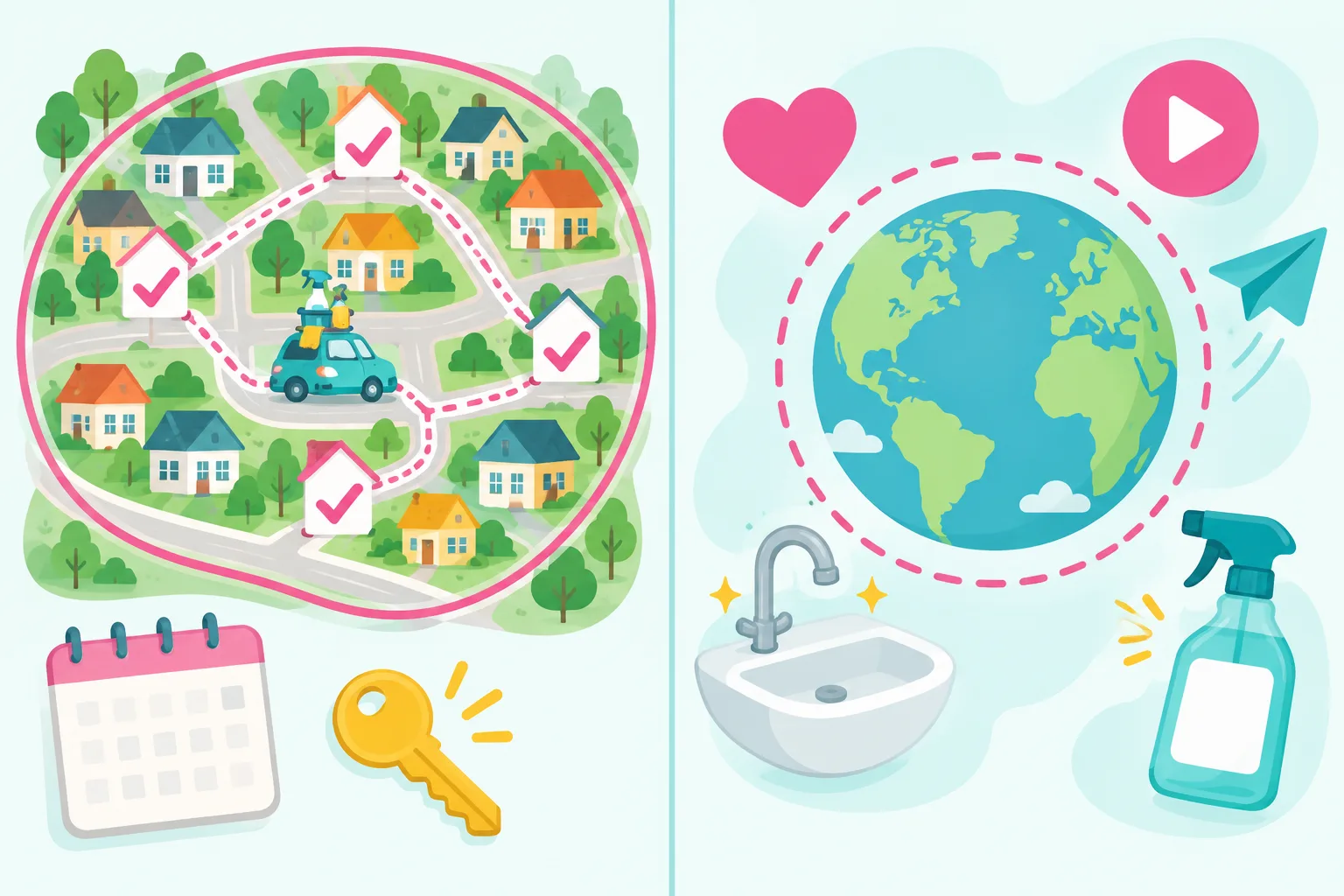
The service area audience
These are the people who live in the towns and neighborhoods you already drive to. They can become regular customers. They care about practical things: what it costs, who comes, which days you have open and whether you come to their street.
To reach them, be specific about where you work. Say the names of the towns you serve out loud, and put them in the caption and in your profile. Name the area and never a customer's street. "We are in the north end on Tuesdays" tells a neighbor everything she needs.
The national audience
These are people anywhere who simply enjoy cleaning videos. They love a before and after. They will follow, like and comment, and almost none of them will ever be on your schedule.
They can only buy what you sell online. If you have a printable checklist, a course for new cleaners, or products you recommend, this audience has real value. If you do not, it is mostly applause.
The trap: famous online, same empty Wednesday
It is easy to chase the bigger number. An oven video reaches a million people, the follower count jumps, and it feels like success. Then the week starts and Wednesday afternoon is still open.
A big audience far away can even cost you time. Messages arrive from people three states away asking if you can come to them, and each one takes a minute to answer kindly.
For most cleaning businesses the right order is the service area first. Build the national audience second and only if you have something to sell online. For a wider look at reaching people close to you, see the local business TikTok marketing guide.
6. The Cleaning Calendar
People do not decide to hire a cleaner evenly through the year. They decide when routines change. In the search data we checked, interest in cleaning services was highest in January and in March. Many families also set new routines when school starts.
Those are the weeks when someone is most likely to try a cleaner and keep one. Plan your best videos for the weeks just before them.
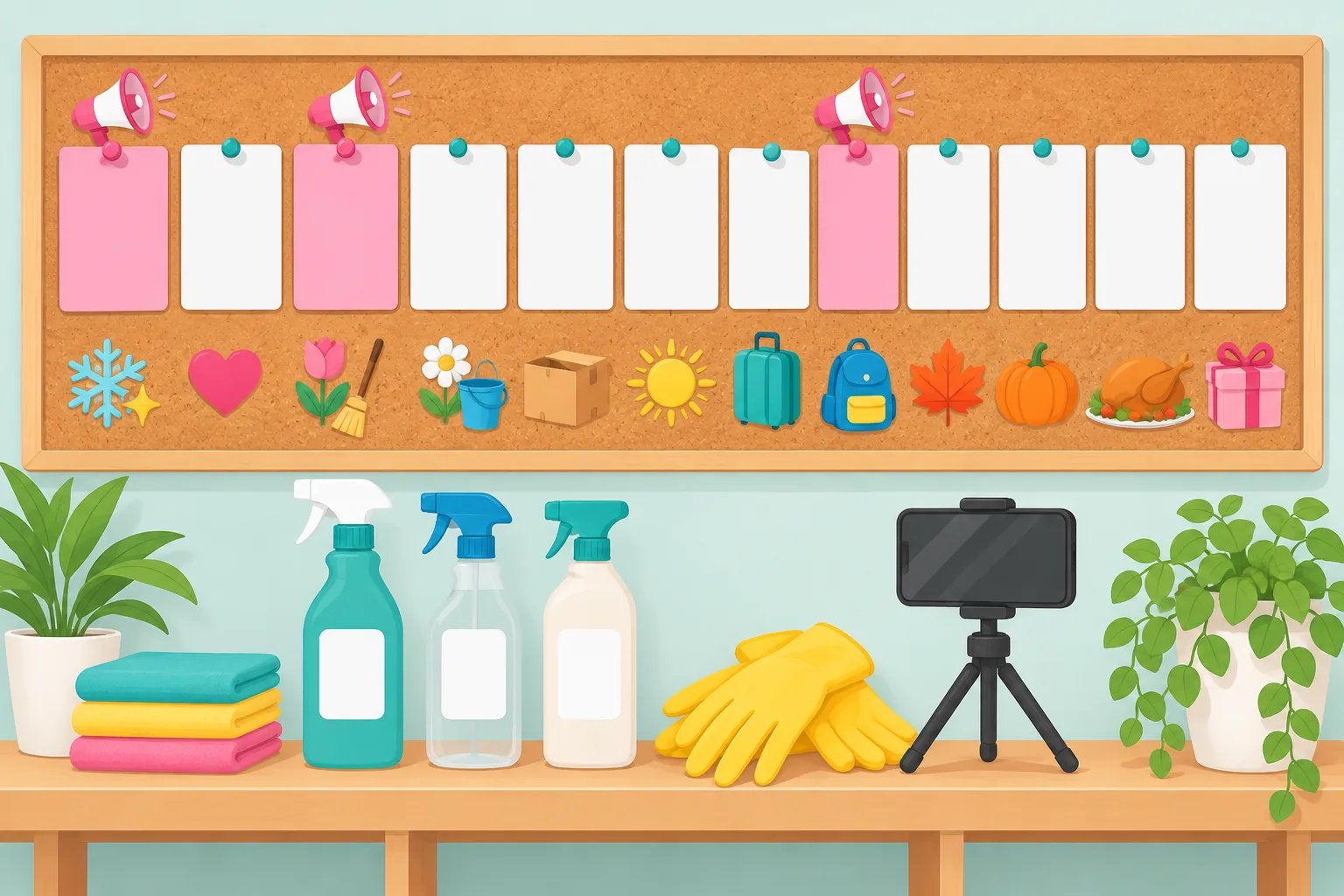
- January. New year, new routines. Re-post the first clean video and say which days you have open. This is a good month to promote.
- February. A quieter month. Answer questions and introduce the people who come to the door.
- March and April. Spring cleaning. Many people book one big clean. Offer each of them a regular spot before you leave. Early March is a good time to promote.
- May to August. Moving season. Move-out and move-in cleans are common, and an empty home is the easiest place to film a before and after.
- Late August and September. School starts and families set new routines. This is the third good time to promote.
- October and November. The weeks before the holidays fill up fast. Say out loud which days are left, and say so when you are full.
- December. Gift certificates and cleans before guests arrive. A short video on "a gift for someone who never has a free weekend" does well early in the month.
Your area may have its own dates that matter more, such as a college move-out week or the start of a tourist season. Put those on the calendar too.
7. How Often to Post, and Who Does It
Three videos a week is plenty for a cleaning business. A steady three is better than seven one week and none the next. Pick the days and keep them, such as Sunday, Tuesday and Thursday.
Try posting in the evening. That is when many people are at home, looking at the house and thinking about the week ahead. Your own numbers will tell you whether another time works better.
One person owns the phone
Decide who is responsible. It can be the owner or a team member who enjoys it. If it is a team member, it is work, so it should happen on paid time.
The account itself should belong to the company. Use a company email address and keep the password where the owner can find it. Team members move on, and the account should not leave with them.
Answer the comments and the messages
Set aside ten minutes a day to reply. When someone asks "how much?" or "do you come to my area?", give the actual answer. A message asking for a price is a customer at your door. Try to answer it the same day.
8. A 90-Day Plan
Here is a plan for the first three months. It assumes you are starting from an empty account. The follower numbers will vary a lot from one business to the next, so the plan focuses on what you do, not on a target.
Days 1 to 30: set up
- Write a profile that says what you do, where you work and how it works. For example: "House cleaning in [your towns]. Weekly, every two weeks, or move-out. We bring everything. You do not have to be home."
- Link to one page with prices for two or three common home sizes, what is included, the towns you serve, a photo of who comes, and a short form that asks "how did you find us?"
- Film the first clean video in your own home and pin it.
- Post one video of each of the other five kinds.
- Start the question log on the company phone.
Days 31 to 60: find a rhythm
- Post three times a week on the same days.
- Turn the top questions from the log into videos.
- Reply to every comment and message that asks a question.
- Add the yes list line to your service agreement.
- Ask every new customer how she found you, and keep a tally of the ones who mention a video.
Days 61 to 90: look at results
- Look at which videos led people to your profile and your price page.
- Make more of the two kinds that did best.
- Count the tally. Even three or four "I saw your video" is a real start.
- Decide whether one video has earned a small promotion budget (see section 10).
The real sign of progress is not a follower count. It is a new every-two-weeks customer on a street you already drive down.
9. From a View to a Regular Customer
A stranger does not become a regular customer in one step. It helps to see the steps in order, so you can tell where people drop off.
- She sees a video. Usually a before and after or a tip.
- She follows, or sends it to her partner. A send often means "can we do this?"
- She looks at your profile. The pinned first clean video and the list of towns do the work here.
- She opens your price page. She checks the cost and whether you come to her area.
- She asks for a price. You answer the same day, with a number.
- She books a first clean. The visit should match the video.
- She takes a regular spot. This is the step that matters most.
- She tells a neighbor. That neighbor is the best customer you can get, because you are already on the street.
Make the second clean easy
The gap between the first clean and the second is where most new customers are lost. They mean to call again, and then a month goes by. So do not wait for the call. Offer the spot yourself, in the message you send when the first clean is done.
It can be one line: "All done, and the key is back in the lockbox. We have every other Wednesday morning open. It would be Ana and me each time, at $160 a visit. Would you like it?" A real day, the same faces and a clear price make it easy to say yes.
Three replies to keep ready
- "How much is it?" Give a real number. "For a three-bedroom house, a clean every two weeks is $160. The first visit is $320 because it takes about twice as long. Tell me your bedrooms, bathrooms and town and I will send your price today."
- "Do you come to my area?" Name the towns you serve and the days you are in each one. If the answer is no, say so kindly.
- "Do I have to be home? Are you insured?" Give an honest answer to each, and explain how the key works.
Four numbers to keep
Once a month, write down:
- Requests for a price.
- New customers who said they saw a video.
- First cleans that turned into a regular spot.
- Regular spots still open on your schedule.
These four tell you more than views do. If the first two rise and the third does not, your videos are working and the first clean, or the offer after it, needs attention.
10. When Paid Promotion Is Worth It
Paying to promote a video means paying TikTok to show it to more people. It can help. It can also waste money, so a few rules are worth following.
Rule 1: Promote a video that already works
Money makes a good video travel further. It does not fix a weak one. Choose a video that people already watched to the end, shared, and followed you from. The first clean video is often the best choice.
Rule 2: Aim for followers in your service area
A person who follows you sees your next videos for free. She can watch you work for a few weeks and send a message when she is ready. For a decision as personal as this one, that time matters.
Where the promotion runs matters a great deal. Before you pay for any tool or service, ours included, look at the location choices it offers and ask how closely they match the towns you serve. A follower three states away will never be on your schedule.
Rule 3: Spend when routines change
The best weeks are early January, early March, and late August into September. A small budget in those weeks does more than a large one in a month when everyone's habits are settled.
Rule 4: Do not advertise days you cannot staff
If your schedule is full, more requests only mean more people you have to turn away. Promote the day that is open. "Tuesdays and Thursdays are full. We have two spots every other Wednesday" is a good video to put money behind. If every day is full, wait until you have hired.
A simple way to judge it
Go back to the math from section 1. In our example, one regular customer is worth about $4,160 a year. If a small promotion brings even one or two new regulars, it has paid for itself many times over.
If it brings followers from far away and no new requests, stop and check where the promotion ran. Your tally of "I saw your video" is the honest test.
Doing it yourself, or using a service
You can promote a video from inside the TikTok app, or set up a campaign in TikTok Ads Manager, which gives more control and takes more time to learn. Our comparison of TikTok Ads and Promote explains the difference, and the Spark Ads guide shows how to promote a post that is already on your account.
If you would rather spend that time on the schedule, a service can run it for you. That is what Viryze does. You pick a video that has already worked. Viryze shows it to several different audiences, sees which one follows for the least money, and moves the budget there. The promotion runs on your real post, so the followers land on your real account.
The same caution applies to us as to anyone. Check the location choices before you start. If a service cannot keep a campaign close to the towns you serve, use it for videos meant for a wider audience, such as tips and anything you sell online, and promote the service area videos another way.
11. The Rules: Homes, Claims, Safety and Reviews
A few rules protect your customers, your team and your business. This section is general guidance and not legal advice. Laws differ from place to place, so check the ones that apply to you.
Homes, customers and team
- Film in a customer's home only with a written yes, and only the surfaces you clean.
- Never show people, children, family photos, mail, medicine, keys, door codes or anything that shows where the home is.
- Never post about what you saw in a home, even without a picture. What you see at work stays at work.
- Ask team members to agree in writing before they appear, and let them say no without any consequence.
- If you want to pay to promote a video filmed in a customer's home, or one with a team member in it, ask again. Being in a post and being in an ad are different things.
What you say about a clean
- Germs. Be careful with words like "disinfect", "sanitize" and "germ-free." In the United States, products that claim to kill germs are regulated by the Environmental Protection Agency, and they only work as claimed when used the way the label says. "We use a disinfectant on kitchen and bathroom surfaces" is accurate. "Your home will be germ-free" is not.
- Health. Do not say a clean prevents illness or treats allergies or asthma. Describe what you do and what you use.
- Green words. "Non-toxic", "eco-friendly" and "chemical-free" are broad claims that are hard to back up. It is safer to name what you actually use, or to say "we can use your own products if you prefer."
- Insured, bonded, background-checked. Say these only if they are true today, and be ready to show proof when a customer asks.
- Prices. If you say a price in a pinned video, update the video when the price changes.
Safety in your tips
People copy what they see. A tip video is advice to thousands of strangers, so every tip should be safe to repeat in a small bathroom with the door closed.
- Never show cleaning products being mixed. Bleach mixed with ammonia, vinegar or other cleaners can release dangerous gas.
- Use products the way the label says, and show yourself doing it.
- Wear your gloves on camera, and open a window when the product calls for it.
- Skip the "hack" you have not tried yourself. If it damages a viewer's counter, your name is on the video.
Before and afters, reviews and free products
Before and afters. Show your own work, on the same day, without filters or edits that change how the surface looks. If a result took a special deep clean, say so.
Reviews. Do not offer a discount in exchange for a five-star review. In the United States, a Federal Trade Commission rule that took effect in October 2024 prohibits paying for reviews that must be positive. You can ask happy customers for an honest review. You cannot buy a good one.
Free products. If a brand sends you a free vacuum, mop or cleaner and you feature it in a video, say so in the video.
Music
A popular song in a business video can get the video muted or removed. Business accounts on TikTok have a Commercial Music Library of tracks cleared for business use. The sounds of the work itself are often better anyway.
A note on paid videos
Ads have stricter rules than ordinary posts. A promoted video about a job opening is treated as an employment ad, and TikTok limits how those can be aimed at people. Read TikTok's current ad policies before you promote a hiring video.
Seven common mistakes
- Never making the first clean video.
- Leaving out the price and the towns you serve.
- Judging success by views and not by new regular customers.
- Filming in a customer's home without a written yes.
- Making jokes about a messy home or about other cleaners.
- Leaving messages that ask for a price unanswered.
- Paying to promote a video that reaches people who live far away.
Other local businesses face the same choices in different forms. The TikTok guide for landscapers and lawn care companies covers another business built on a regular route. If you clean short-term rentals, the TikTok guide for Airbnb hosts shows how your customers think about their own videos. And the TikTok guide for small business covers the basics for any owner.
Frequently Asked Questions
Is TikTok worth it for a small cleaning business in 2026?
For most house cleaning businesses, yes, as long as you measure the right thing. You do not need a viral video. You need people in the towns you already drive to to know who comes to the door, what gets cleaned, and what it costs. A short video can show all of that before anyone hands you a key. The goal is more regular customers, and a few hundred followers in your service area can be enough to fill the open days on your schedule.
What should a cleaning business post on TikTok?
Six kinds of video cover almost everything: the first clean (what happens from the text the day before to the locked door), the before and after, what a clean costs and why, a customer question answered, one useful cleaning tip, and the honest week when something went wrong. Start with the first clean video and pin it. Skip videos that make fun of a messy home or of other cleaners. They entertain strangers and make a nervous customer less likely to call.
Can I film inside a customer's home for TikTok?
Only with clear written permission, and even then only the surfaces you clean. Never show faces, children, family photos, mail, medicine, the view from a window or the outside of the house. The simplest plan is to film most videos in your own home, and to keep a short list of customers who have agreed in writing and can change their mind with a text. This is general guidance and not legal advice, so check the rules where you work.
Can a cleaning business really get customers from TikTok?
Yes, but mostly from viewers who live where you already work. A cleaning business has two audiences on TikTok. People in your service area can become regular customers. People far away can only watch, unless you sell something online. A before-and-after video with a million views across the country can leave your Wednesdays just as empty. Ask every new customer how they found you, and count the ones who mention a video.
Should a cleaning business pay to promote TikTok videos?
Sometimes. Promote only a video that has already done well on its own, and aim for followers in your service area and not a burst of one-time jobs. The best times are early January, early March and late August, when people change their routines. Before you pay for any tool or service, check how closely it can keep the promotion to your area. If your schedule is already full, promote your open day or wait until you have hired.
Have a video that is already bringing in requests?
Start with the first clean video and the question log. They cost nothing. Later, if one of your videos has brought new customers and you want more people to see it, Viryze can put it in front of several audiences, find the one that follows for the least money, and shift the budget there. You stay on the schedule.
Related Reading
- TikTok for Contractors & Home Service Pros: The Complete 2026 Guide - for other work done inside a customer's home.
- Local Business TikTok Marketing: Get Customers in Your Area - how to reach people close to where you work.
- TikTok for Landscapers and Lawn Care Companies: The Complete 2026 Guide - another business that lives on a regular route.
- TikTok for Airbnb Hosts and Vacation Rentals: The Complete 2026 Guide - useful if you clean short-term rentals.
- TikTok for Small Business: Complete 2025 Guide - the basics for any owner starting an account.
- Spark Ads on TikTok: Creator's Complete Guide - how to promote a post that is already on your account.
- Understanding TikTok's Algorithm: What Really Matters - how TikTok decides who sees a video.