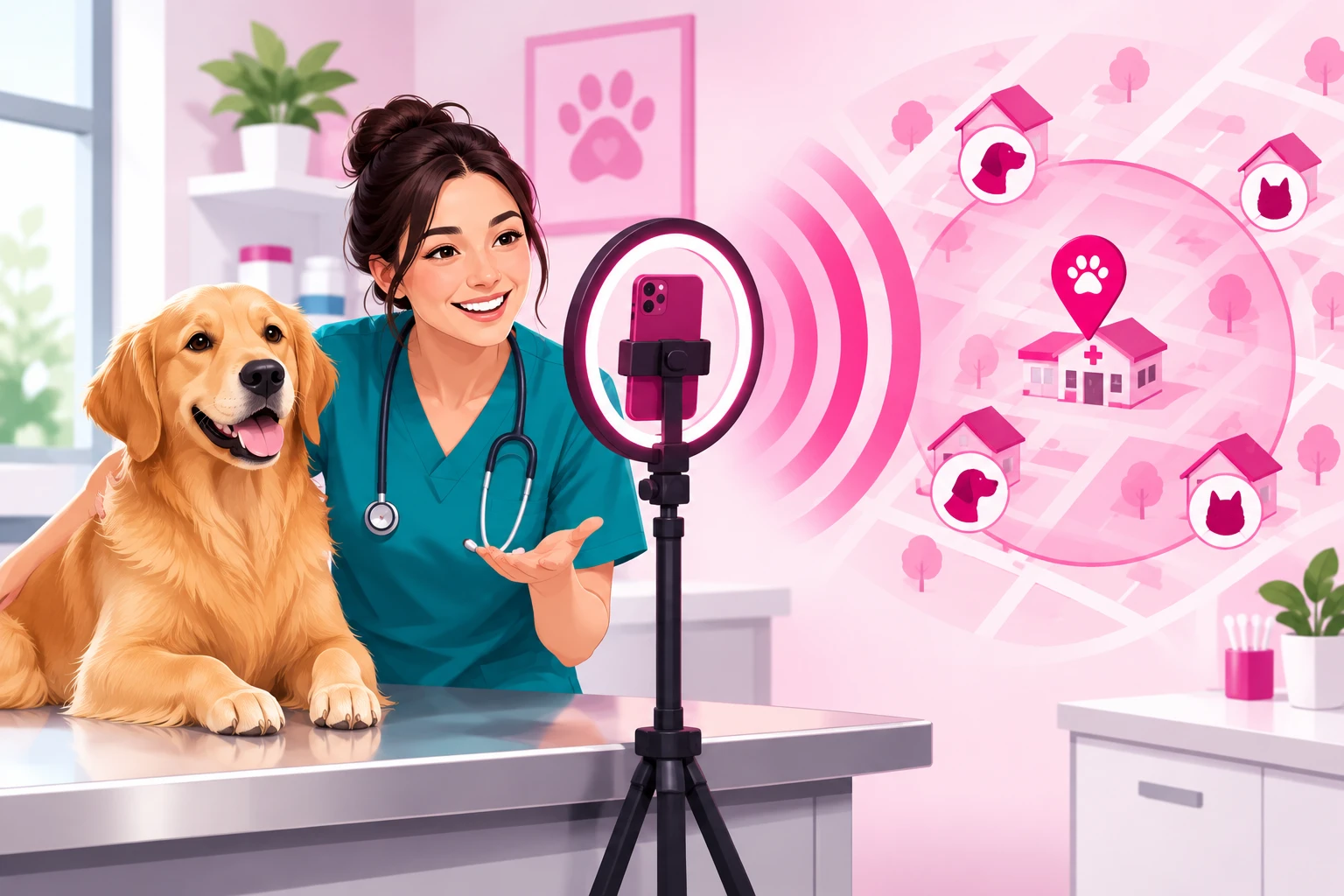
Somewhere in your account there is a video that outperformed everything else you have posted. Probably a "can my dog eat this" verdict or a "why the exam fee is what it is" explainer. It earned a pile of saves, a comment section full of owners describing their pets in loving detail - and then the algorithm moved on, and the video stopped being seen.
Here is the part that stings. Look at where those views came from. If your account is like most vet accounts, the great majority were two states away: people who adored the video and will never, ever bring an animal through your door. Pet content travels. That is its gift and its trap, and it is the reason a veterinary clinic's paid strategy has to be built differently from every other local business - because paid reach is the one lever that goes exactly where you point it.
This is the advertising finale of our veterinary series. It covers when TikTok ads for veterinarians actually make sense, how to choose what to promote, why the targeting rule is a drive radius and not a metro, what to spend and when the calendar says to spend it, the practice-act and consent rules that follow money into paid placements, the only numbers worth judging a campaign by, and when a done-for-you service beats running Ads Manager yourself. It builds on the foundations in our complete TikTok guide for veterinarians, so if you have not started posting yet, begin there.
The short version:
- A converted household is a decade, not a visit. Payback math runs against lifetime household value, so a season of promotion is justified by one or two new-client forms.
- Amplify proven videos, never guess. Only put budget behind a video your own analytics already show works. Paid reach multiplies what a video does; it cannot rescue a weak one.
- Target the drive radius, not the metro. A vet is one of the most tightly local businesses that exists. Every dollar that reaches a fan forty minutes away is a dollar that did not reach the household ten minutes from your door.
- Spend ahead of the trigger, not during it. The biggest one is the holiday-to-January new-pet wave. Amplify the new-puppy explainer in December, not in February.
- Your professional rules follow the money. State practice acts, the AVMA Principles, the VCPR, and the media release all apply to a promoted video - and consent to post is not consent to promote.
What's Inside
- 1. Why Veterinary Medicine Has Unusually Forgiving Ad Math
- 2. Boosting Is Not Advertising: The National-Pet-Account Trap, Paid Edition
- 3. The Proven-Video Rule (and What a Clinic Must Never Promote)
- 4. The Drive-Radius Rule: Zip Codes, Not Metros
- 5. Budgets and Payback Math by Practice Type
- 6. The Trigger-Calendar Spend Plan: When to Actually Run Ads
- 7. Practice Acts, the VCPR, and Consent in Paid Placements
- 8. Cost Per New Household: Judge Against a Decade of Care
- 9. Ads Manager vs. a Done-For-You Promotion Service
- Frequently Asked Questions
1. Why Veterinary Medicine Has Unusually Forgiving Ad Math
Most local businesses justify ad spend against one transaction: a booked job, a signed contract, a sold car. Our accounting guide moved the goalposts to an annual renewal. Veterinary medicine moves them again, because a new-client household is a decade of care, multiplied by every animal in the house - and bonded by something people almost never price-shop.
Do the arithmetic the way this whole series has done it. A family spending around $700 a year on routine care for one dog, for twelve years, is roughly $8,400 from a single new-client form. That is before the dental, before the second pet, before the senior bloodwork, and before the Saturday-night emergency they bring to you instead of the hospital across town because they already trust the person on the screen. An accountant's client renews out of obligation; a pet owner stays out of attachment. Once a household believes you are kind and honest with their animal, they do not open four tabs to compare exam fees.
Then there is the advantage no other professional vertical gets, and it is worth saying plainly: your subject is the platform's native currency. A promoted accounting video has to make a cold viewer care about depreciation. A promoted vet video shows a stranger a dog, and the stranger was already there for the dog. Pet content is one of the largest categories on TikTok, which means a clinic's promoted explainer is not an interruption - it is exactly what the viewer opened the app for. In practical terms, that makes it the cheapest cold attention a licensed profession can buy. The only question is whether that attention is anywhere near your clinic. Sections 2 and 4 are about making sure it is.
Hold that against how clinics usually buy new clients: a local search click on "vet near me," bought at auction against every hospital in the metro, from a person comparing exam fees in four tabs after a bad experience somewhere else. The same person could have watched you explain, months earlier and in your own voice, exactly what an exam fee covers - and why the bloodwork on a healthy cat is not a shakedown. One channel sells a commodity at peak prices. The other repairs, one viewer at a time, the profession's sorest wound: the belief that vets are only in it for the money. That repair is the whole reason a promoted bill explainer converts, and it is a payoff no other vertical's ad budget can buy.
2. Boosting Is Not Advertising: The National-Pet-Account Trap, Paid Edition
Here is the trap nearly every clinic falls into on day one: someone taps the "Promote" button on the newest video, spends $50, watches the view counter climb, gets nothing, and concludes TikTok ads do not work for vets. They are half right. That kind of boosting rarely works - and for a vet account it fails in a specific, predictable way.
The pillar guide named the national-pet-account trap: pet content travels so well that a clinic can reach millions of people and gain zero local clients. A careless boost is that trap with money on it. Point a pet video at a broad audience and TikTok will happily find you the cheapest pet lovers in the country - a wonderful result for a creator, a total loss for a clinic. You will have paid to grow a national fan base that can never book an exam.
Real amplification is a system with three moving parts, not a button. First, you pick a video that has already proven it earns trust. Second, you point it at a precisely drawn audience - the households within a short drive of your clinic. Third, you let budget flow toward whichever slices of that audience respond and away from the ones that do not. Skip any of the three and you are paying TikTok to show a random video to random people, most of them far away.
And the goal is almost never raw views. It is one specific chain that ends in a new-client form:
- The right person watches the whole video - a pet owner ten minutes from your door - and comes away thinking you explained their animal's question more clearly and more kindly than anyone had before.
- They tap your profile and find a bio that names your city and your lane, says whether you are accepting new clients, a pinned trio that proves the kindness was not a fluke, and a booking link one tap away.
- They follow, save, or reach out. Even a follow is a win, because vet decisions are triggered - the local owner who follows you in October is the one who books the new-puppy exam in January, already trusting you.
That chain is the whole game, and the machinery of it - the profile as a front desk, the calls to action that work under your practice act, the two-lane response window built around the "is this an emergency?" DM - is covered rung by rung in our guide to getting clients from TikTok. Advertising only accelerates a funnel that already works. If tapping your profile does not tell a stranger where you are and how to book, fix that before you spend a dollar.
3. The Proven-Video Rule (and What a Clinic Must Never Promote)
This is the single most important rule in the guide, and the one clinics break most often: only ever amplify a video your own analytics have already validated. Paid reach multiplies whatever a video already does organically. Promote a weak video and you are paying to spread a weak result faster.
So what counts as proven? Open your analytics and look for a video that beats your own account averages on the signals that actually predict new-client forms:
- A high save rate for your account. Saves are the strongest signal in veterinary content, because owners save the answer before they need it. The chocolate video gets saved in October and opened on Halloween night; the new-puppy timeline gets saved in November and opened in January. A save is a future trigger moment with your name already attached.
- Shares, not just likes. Pet explainers get sent to the friend who just adopted, the group chat of the dog park, the breed rescue's volunteer thread. A share is a referral happening without you.
- Strong completion and rewatches. A video people finish is one that holds a cold stranger's attention - precisely the job a promoted view has to do.
- Above-average profile visits. If a video already pushes an unusual share of viewers to your profile, amplification is just scaling something that works.
In practice the videos that clear this bar are almost always the plain educational ones: the can-my-dog-eat-this verdict, the what-the-exam-fee-covers bill explainer, the when-to-go-to-the-ER decision guide, the first-year-with-a-new-puppy timeline - the free questions you answer in the exam room all day, answered clearly with a calm animal in frame. If you are not sure which formats earn saves in the first place, the veterinarian content ideas vault is a full library of them, already sorted into the ones that travel nationally and the ones that anchor locally - build a few, see which perform, then promote the winners.
The two-week rule, plus a local check
Give a video at least two weeks organically before deciding it is proven - pet explainers get saved and resurface at the trigger moment, so the video that looks average at forty-eight hours is often the one still booking exams in month three. Then add the check no other vertical needs: open the video's viewer breakdown and see what share came from your own area. A video that earned its saves from local owners is proven for a clinic. A video that went viral in another time zone is proven for a creator - which is a different business.
What a clinic must never promote
Most industries can promote anything that performs. Veterinary clinics cannot, because the videos most tempting to put money behind are the exact ones that create professional risk, get rejected by TikTok's ad review, or both:
- Graphic or distressing footage. The abscess drain, the surgery close-up, the animal in obvious distress. TikTok's community guidelines already limit this organically; its advertising policies are stricter still, and a paid placement puts the footage in front of people who did not choose to follow a vet. If a video only performed because it was shocking, it is not a video to buy reach for. The filming guide's what-not-to-show list applies twice as hard once money is involved.
- Dosing, human-medication answers, and anything individualized. A promoted video reaches thousands of animals you have never examined. "How much Benadryl for a 40-pound dog" is a VCPR problem on an organic post; under paid reach it is a VCPR problem at scale. Promote the framework - "call your vet before giving any human medication" - never the number.
- A patient whose owner consented to a post, not to an ad. This is the trap unique to your profession. The check-in media release that covers a clinic post usually does not cover paid promotion of that footage to strangers, and an owner who was delighted to see Biscuit on your feed may feel very differently about Biscuit in a commercial. Before an identifiable animal appears in a promoted video, get a release that says so - or promote the videos that use a prop, a staff pet, or the clinic cat instead.
- Outcome promises and anything that reads like one. "We saved him" is a story; "we'll save yours" is a guarantee, and your state board's advertising rules and the AVMA Principles both reach it. Promote the explanation, never the promise.
- Discount-led offers, at least without checking. Some states restrict how veterinary discounts and free-exam offers may be advertised. A "$29 first exam" video that performs is not automatically a video you can promote - and it also attracts the price-shopper you spent section 1 explaining you do not need.
- Title and comparison claims you cannot back. "Specialist" is reserved for board-certified diplomates in most states. "The most affordable clinic in town" is a comparison you cannot substantiate. And the bill-you-did-not-understand video must never name or disparage the clinic that produced it.
The happy accident, same as everywhere else in this series: the safest content and the highest-converting content are the same content. A clear, kind explanation of what an exam fee covers builds more trust with a cold local viewer than any surgical close-up or coupon ever will.
4. The Drive-Radius Rule: Zip Codes, Not Metros
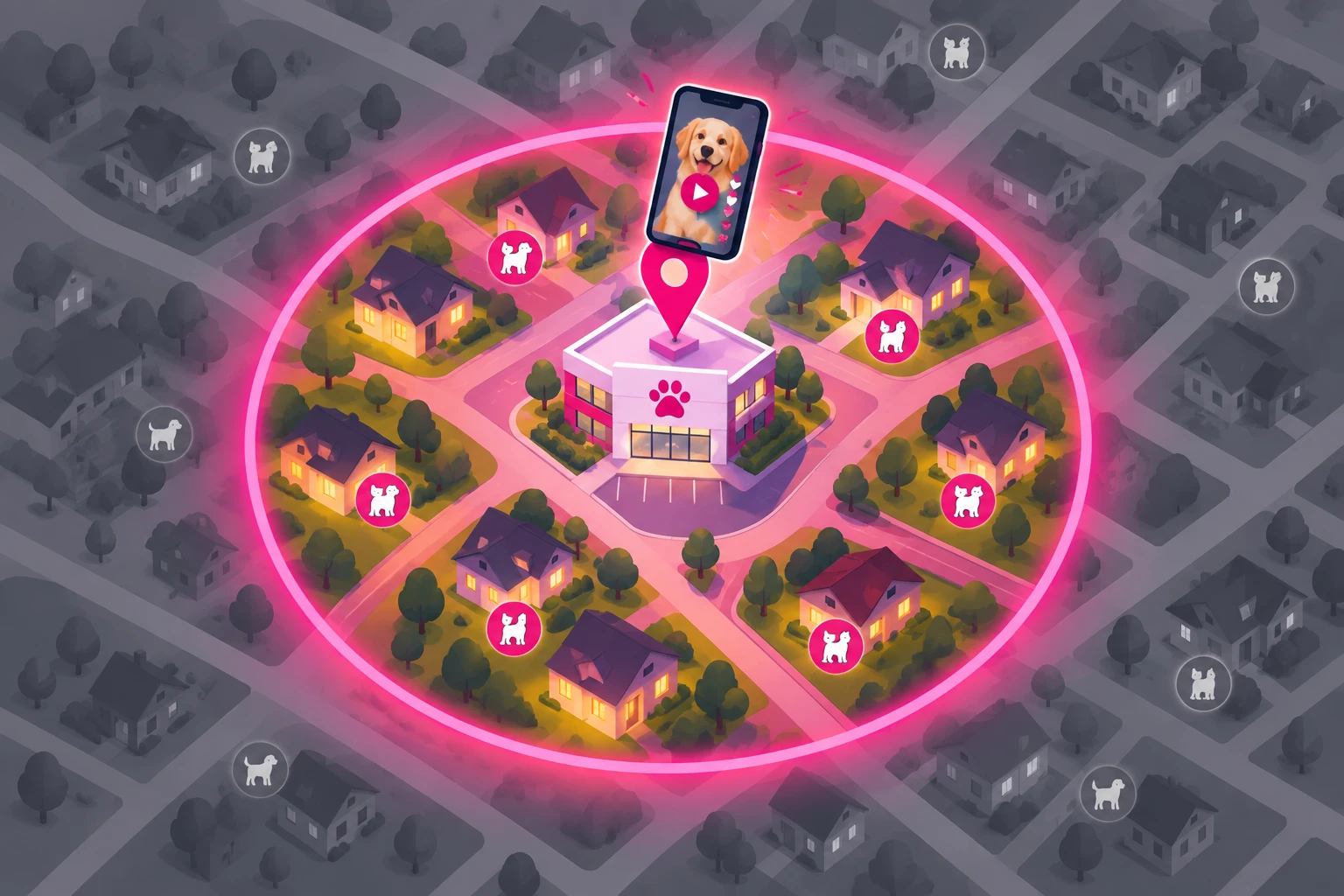
Our legal advertising guide has one targeting rule: jurisdiction. Our accounting guide has two shapes: metro or niche. Veterinary medicine is simpler and stricter than either, because a clinic is one of the most tightly local businesses that exists. Target the drive radius - a handful of zip codes - and resist everything wider.
Think about how far a person will actually drive with a carsick dog or a yowling cat in a carrier: not far. Most of a clinic's households live within a short drive, and paid targeting lets you draw that circle precisely, which the organic algorithm never will. A viewer forty minutes away who adores your videos is a fan, not a client. Every dollar that reaches them is a dollar that did not reach the household ten minutes from your door. Set the radius to the distance your existing clients actually travel - your practice software can tell you - and do not widen it because a bigger audience "feels" better. A smaller circle with a proven video out-books a metro with a mediocre one every time.
Inside the circle, keep it broad. Adults, skewed toward the ages that own homes and pets; pet-owner interest signals if you want them, but do not stack a dozen. TikTok's delivery works best when you give it room inside a tight geography and let a genuinely good video do the selecting. The one refinement worth making is by trigger, not by demographic: the new-puppy explainer wants the youngest households in your radius, the senior-dog arthritis explainer wants the oldest, and the parasite video wants everyone.
The exceptions, by practice type
- Mobile and house-call vets: your radius is your service area, which is usually larger than a fixed clinic's and shaped by roads, not by a circle. Target the zip codes you actually drive to.
- Emergency and specialty hospitals: people drive much farther for an ER or a referral, so the radius is a region, and the video that works is the when-to-go-to-the-ER decision guide - which is also the one that reduces the terror of the first visit.
- Equine and large-animal vets: counties, not zip codes, and a fiercely loyal audience where the practice path and the platform path overlap more than anywhere else in the profession.
- The platform path: if the account is a national creator business rather than a clinic funnel, geography is the wrong knob entirely and the targeting looks like any other pet creator's. That is a different playbook - our pet content advertising guide covers it. Just decide which business you are running before you spend, because a clinic budget pointed nationally is the trap from section 2 with a receipt.
Whichever shape applies, run the same proven video against three or four audience slices and let results decide - age bands within the radius, or the near ring against the far ring. You do not know in advance whether your bill explainer lands with 25-34 first-time owners or 45-54 senior-pet households. Nobody does. Testing is where the waste gets found, and it is the part clinics skip.
5. Budgets and Payback Math by Practice Type
The right budget is not a number someone else picks for you. It falls out of one question: what is one new household worth to this practice over the life of the pet? Work backward from that and the decision makes itself.
Here is how the payback math tends to look across practice types. Fees vary enormously by market, so treat these as illustrative shapes rather than quotes - and notice the last column is denominated in households, not visits:
| Practice Type | Typical Lifetime Value | Households Needed to Justify $1,000/mo |
|---|---|---|
| Small-animal general practice | Mid four figures per pet over a decade, multiplied per household | One or two a year |
| Wellness-plan-heavy practice | Four figures a year per pet, billed monthly and renewing | One or two a year |
| Mobile / house-call | Mid four figures, with the highest retention in the profession | One or two a year |
| Emergency / specialty hospital | High three to four figures per visit, low repeat, referral-driven | A few visits a month |
| Equine / large-animal | Four to five figures per barn or herd client | One a year covers everything |
Look at that last column again. For most practice types the entire annual promotion budget is justified by one or two households - and remember those households bring the second pet, the dental, and the emergency along with them. The ER row is the honest outlier: an emergency hospital's math is closer to a normal local business, one visit at a time, which is why its promoted video should be the decision guide that earns the referral, not a brand spot. The full economics of each stream - including preventive-care acceptance, the wellness-plan bridge, and the platform-path income a clinic account should not chase - are in the veterinarian monetization guide.
A practical ramp for a single-location clinic:
- Weeks 1-4: a $200-$400 test. One proven video, your own zip codes, three or four slices. You are not buying households yet - you are learning whether cold local viewers respond to your best explainer the way your followers did.
- Months 2-3: $300-$800 a month. Keep the winning slice, add your next proven video. Now you are building a local audience that compounds between campaigns - and in this vertical, the household you reach in October books in January.
- Ongoing: $300-$1,000 a month, weighted to the calendar. Heavier in the windows the next section maps, lighter outside them, always behind videos that have earned it.
Geography sets the ceiling
Here is the budget rule no other vertical has to think about: a drive radius contains a finite number of pet-owning households, and past a certain spend you are simply showing the same people the same video again. When the frequency number in your reporting starts climbing while new followers flatten, the answer is not more money - it is the next proven video, or waiting for the next trigger window. A clinic's useful budget is capped by its map, which is one more reason the math is forgiving: you cannot overspend your way into trouble the way a national brand can.
6. The Trigger-Calendar Spend Plan: When to Actually Run Ads

People do not choose a vet on a schedule. They choose one at a trigger moment: a new animal, a move to a new town, a bad bill or a bad experience somewhere else, or an "is this an emergency?" scare at eleven at night. Most of those are unpredictable. One of them is on the calendar, and it is the biggest. The holiday-to-January new-pet wave is the most concentrated new-client moment in the profession, and the household that just brought home a puppy has never chosen a vet. The whole discipline of clinic advertising compresses into one rule: amplify thirty to sixty days ahead of the trigger, never during the scramble.
- Late November-December: the new-pet window. This is the window most worth funding aggressively. Your proven first-year-with-a-new-puppy or new-kitten timeline, amplified to your own zip codes now, is the reason a family walks in for the first exam in January already knowing your name - weeks before they would have searched for anyone. The video must already exist and already be proven by early November, which is why the filming guide schedules its big shoot for October.
- Late January-February: the dental window. February is the profession's dental-health month, and a "why does my dog need a dental, and what does the fee cover" explainer promoted in late January reaches owners while the question is already in the air - and repairs the bill-shock reputation at the same time.
- March-April: the parasite and spring window. Flea, tick, and heartworm prevention, spring allergies, and the Easter-lily warning for cat households. Owners are making a prevention decision they will repeat every year; the clinic that explains it becomes the clinic that fills it.
- Late June: the fireworks window. The noise-anxiety video, promoted the last two weeks of June, reaches every dog household in your radius in the exact days they are dreading the Fourth. It is also one of the most shared videos a clinic can make.
- October-November: the toxin windows. Chocolate and Halloween in October; table scraps, pancreatitis, and holiday plants in November. Small, cheap, well-timed pushes that keep the account present in local feeds right as the big December window opens.
- Always-on, lightly: the moving trigger. Households move all year, with a summer peak, and every one of them needs a vet within a month of arriving. A modest always-on budget behind your best bill explainer catches the trigger no calendar can predict.
The tactic that makes all of this work is having the video ready in advance. You cannot film, publish, wait two weeks for organic proof, and then promote - all inside a trigger window. Build the seasonal explainers a month early so they are proven and waiting when their window opens, the same rhythm the vet clinic growth roadmap uses for the organic side: publish thirty to sixty days ahead, then amplify the one that proved itself.
The recruiting overlay
One more window nobody outside the profession has: clinics short a technician can amplify a real day-in-the-back video toward their own radius and the zip codes around nearby technician programs, timed to the May-June graduation hiring season and the fall application cycle. The same content engine that fills the exam schedule fills the hiring pipeline - during a shortage in which most clinics have nothing to show a candidate but a job board listing. The vet tech guide covers what that footage should look like from the technician's side.
7. Practice Acts, the VCPR, and Consent in Paid Placements
The moment you put money behind a video, it stops being a post and becomes professional advertising - and the rules that govern your website and your sign out front govern it too. The good news: the profession's rules are navigable, and the compliant path and the effective path point the same direction. Here is the checklist:
- Your state veterinary practice act and board rules. Every state prohibits false or misleading veterinary advertising; beyond that, the details vary. Some states restrict how discounts and free-service offers may be advertised, some require that a licensed veterinarian be identifiable in practice advertising, and most reserve "specialist" for board-certified diplomates. Read your own board's advertising section before the first campaign - it is usually short.
- The AVMA Principles of Veterinary Medical Ethics. Advertising must not be false, deceptive, or misleading - which reaches overstated results, unjustified comparisons with other clinics, and any claim you cannot substantiate. Plain education passes cleanly.
- The VCPR, at scale. A promoted video reaches thousands of animals you have never examined. Nothing individualized, no dosing, no "your dog probably has," and a canned redirect ready for the emergency DMs a promoted video will generate: "I can't assess an animal I haven't examined - if you are worried right now, call your vet or the nearest emergency hospital." The pillar's compliance section has the full wording and the telehealth-VCPR caveat, which is state-specific.
- Consent to post is not consent to promote. The check-in media release that lets you show a patient on your feed may not cover paying to show that patient to strangers. Before an identifiable animal appears in a promoted video, confirm the release covers advertising use - and if the case ended badly, ask again, specifically. Client records and client identities are confidential under most practice acts; the safest promoted videos use a prop, a consented staff pet, or the clinic cat.
- The custom-audience trap. Ad platforms let you upload a customer list to build a lookalike audience. For a clinic, that list is client records - confidential under your practice act and often under your own privacy policy. Do not upload your practice-software export to an ad platform without checking your state's rules and obtaining consent. Geography-based targeting needs none of it, which is why this whole series keeps steering you there.
- Product relationships and FTC disclosure. If a pet food, supplement, insurance, or pharmacy company pays you or gives you product, the promoted video must disclose it. "Vet recommended" is a regulated claim on a pet food label, and prescription products are a restricted category in TikTok's advertising policies - keep them out of promoted content entirely.
- TikTok's own ad policies. Animal-related and health-adjacent ads get a closer review than most categories, and anything the reviewer reads as animal distress will be rejected. Keep the footage calm, keep claims plain, and expect the occasional rejection that a resubmission with a gentler clip clears.
- Your employer, if you are an associate. A corporate-owned clinic almost certainly has a marketing department and a social policy, and running ads in the clinic's name without them is a fast way to a difficult meeting. Get it in writing - or, if the answer is no, take the platform path on a personal account instead.
None of this is legal advice - it is a map of what to go read. The practical takeaway is the same one that keeps recurring: promote plain educational content, in your own voice, with a calm animal or a prop in frame, to households you can actually serve. The rules are a moat, not a blocker. The clinics frozen by them are the reason the lane in your radius is still open.
8. Cost Per New Household: Judge Against a Decade of Care
Clinics judge TikTok campaigns by view counts and then wonder why the numbers feel meaningless. Here is what to actually watch, roughly in the order you will see it move:
- Cost per follower inside your radius. Your leading indicator, visible within days - and the one number that separates a clinic campaign from a creator campaign. Check the follower-territory breakdown in your analytics after every push: if the local share is rising, the campaign is working even before a single form arrives. A follower who can never drive to you is decoration, however much they love your videos.
- Frequency, once the radius is small. The vet-specific warning light. When the same households are seeing the promoted video for the fourth time and new followers have flattened, the audience is saturated - rotate to the next proven video rather than adding budget.
- Saves and shares on the promoted video. If a video that looked proven organically holds its save rate under cold paid reach, scale it. If saves collapse when strangers see it, pull budget and pick another video.
- New-client forms you can trace back. Add a "how did you hear about us" field to your new-client form with a social option, and train the front desk to ask - because TikTok-sourced households rarely announce themselves. They arrive already knowing why you want bloodwork on their healthy cat.
- Cost per new household - valued at a decade of care. The number that ends every internal debate. Total promotion spend divided by households that trace to social, compared against lifetime value, not the first exam fee. Then compare that honestly with what a "vet near me" search click costs per new client - remembering the search client was comparing exam fees in four tabs and the TikTok client chose you.
A note on lag, because it is shorter here than in most professions but not zero: a household that watches your amplified new-puppy explainer in early December books in January, and a household that saves the chocolate video in October may not need you until the following year. That is not the campaign failing - it is the campaign buying a place in someone's memory ahead of the moment. Measure leading indicators weekly and household attribution by trigger window, not by week. The organic-side signals that predict the same outcome, including the follower-territory check, are broken down in the vet clinic growth roadmap.
9. Ads Manager vs. a Done-For-You Promotion Service
There are two ways to actually run this. Both use TikTok's official advertising infrastructure; they differ entirely in who does the work.
TikTok Ads Manager gives you full control. It was also built for professional media buyers - campaign objectives, pixel setup, placement options, and the slice testing from section 4 that takes real hours every single week to run properly. The mechanics of promoting an existing organic video are walked through step by step in the Spark Ads guide, the platform more broadly in our TikTok advertising guide, and the local-discovery tactics that help any business with an address in the local business TikTok playbook. If you have the appetite to learn it, it genuinely works.
But be honest about your clinic. You are short a technician, the practice manager already wears six hats, and the ad account is the first thing neglected in a week with two emergencies and a euthanasia - and a neglected campaign does not pause itself. It quietly keeps spending on the audience slices that were never going to respond, or drifts wider than the radius that made the math work, through exactly the weeks nobody has time to notice. The staffing problem that shapes your whole practice shapes this too.
That is exactly the gap a professional TikTok promotion service fills. Viryze runs the same official TikTok ads infrastructure, but takes the video you have already proven books households, tests it against multiple audience slices inside your radius, and automatically shifts budget toward whichever ones respond. You keep control of what gets promoted and when, which keeps the consent and practice-act calls from section 7 and the trigger timing from section 6 firmly in your hands; the tedious optimization happens in the background, including through the December rush. For a working clinic, that is usually the right trade: the same amplification math, without a second job in the busiest weeks of your year.
Frequently Asked Questions
Do TikTok ads work for veterinary clinics?
They work with some of the most forgiving math in local advertising, for two reasons. First, a converted household is not a transaction: a family spending around $700 a year on routine care for one dog, for twelve years, is roughly $8,400 from a single new-client form, before the dental, the second pet, or the emergency they bring to you instead of the hospital across town. Second, pet content is one of the largest categories on the platform, so a promoted vet video is not interrupting anyone - cold viewers already want to watch it, which makes it the cheapest cold attention any professional service can buy. The catch is geography: pet videos travel nationally by default, so paid reach only pays when it is pointed at the drive radius around your clinic, behind a video that has already proven itself organically, timed ahead of a trigger moment like the January new-pet wave.
How much should a vet clinic spend on TikTok ads?
Start with a $200-$400 test over two to four weeks on one proven educational video, aimed only at the zip codes around your clinic. From there, $300-$1,000 a month is a realistic working range for a single-location practice - and the ceiling is set by geography, not ambition. A drive radius contains a finite number of pet-owning households, so past a certain point extra budget just shows the same people the same video more often; watch frequency and rotate videos instead of raising spend. Anchor the number to lifetime household value: if one household is worth several thousand dollars over a decade, a season of promotion is justified by one or two new-client forms. The common mistake is not overspending - it is promoting an untested video, or letting it run nationally where it earns fans who can never book.
What videos should a vet clinic promote on TikTok?
Follow the Proven-Video Rule: only put budget behind a video your own analytics have already validated - a top-of-your-account save rate, strong completion, shares, and a bump in profile visits. For a clinic that is almost always a plain educational answer to a question owners ask for free: a can-my-dog-eat-this verdict, a what-the-exam-fee-covers bill explainer, a when-to-go-to-the-ER decision guide, or the first-year-with-a-new-puppy timeline. Never promote graphic or distressing footage, dosing or human-medication answers, anything that looks like a promise about an outcome, a patient whose owner consented to a post but not to paid use, or a specialist claim you cannot back with board certification. The safest content and the highest-converting content are the same content.
When should a vet clinic run TikTok ads?
Thirty to sixty days ahead of a trigger moment, with the biggest one on the calendar: the holiday-to-January new-pet wave. Amplify your proven new-puppy or new-kitten first-year explainer to your own zip codes from late November through December, so the families about to bring an animal home already know your name when they search for a vet. Layer smaller pushes over the danger calendar - a dental explainer in late January, parasite and lily warnings in March, the fireworks-anxiety video in late June, chocolate in October, holiday toxins in November - and keep a light always-on budget for the trigger no calendar predicts: the household that just moved to town. Promoting the same video after the moment has passed reaches people who have already chosen someone.
What rules apply to veterinary TikTok ads?
A promoted video is professional advertising, so everything that governs your website governs it. State veterinary practice acts and board rules prohibit false or misleading advertising and, in some states, restrict how discounts are advertised, require the licensed veterinarian to be identifiable, or reserve the word specialist for board-certified diplomates. The AVMA Principles of Veterinary Medical Ethics reach the same claims. The VCPR still applies: a promoted video reaches people whose animals you have never examined, so nothing individualized and no dosing. Consent to post a patient is not consent to promote one - get a media release that covers paid use before an animal appears in an ad. Client records are confidential, so do not upload a client list from your practice software to build a custom audience without checking your state rules and obtaining consent. Add FTC disclosure for any pet-food, supplement, or insurance relationship, expect TikTok to review animal-related and health-adjacent ads carefully, and if you are an associate at a corporate-owned clinic, get the group in writing before you spend a dollar in the clinic name.
Should a vet clinic use TikTok Ads Manager or a promotion service?
Ads Manager offers full control but was built for media buyers: campaign objectives, pixel events, placements, and the audience testing that takes real hours every week to run well. Most clinics have a staffing problem, not a control problem - the practice manager already wears six hats, and a neglected campaign does not pause itself; it quietly keeps spending on the audience slices that never respond, or drifts wider than the drive radius that made the math work. A follower-growth promotion service like Viryze runs the same official TikTok ads infrastructure but handles the slice testing and budget shifting automatically, which is usually the right trade when the alternative in a short-staffed clinic is not doing it at all.
Ready to turn your best explainer into new-client households?
You already have the video that earned the saves and filled your comments with owners describing their pets. Viryze takes that proven video and puts it in front of thousands more pet owners within driving distance of your clinic - shifting budget toward the audiences that respond, timed ahead of the new-pet wave instead of inside it. One household pays it back, and then stays for the life of the pet.
Promote your best videoRelated Reading
- TikTok for Veterinarians: The Complete 2026 Guide - the foundations every practitioner shares, from formats to compliance.
- Getting Clients from TikTok: Turn Views Into New Patients for Your Clinic - the lifetime-client ladder your paid funnel accelerates.
- Growing a Vet Clinic TikTok: From 0 to 100K Followers - the organic growth that produces videos worth promoting.
- How to Film Veterinary Content for TikTok (Consent, Clinic Setup & What Not to Show) - the consent and what-not-to-show rules that matter twice as much in a paid placement.
- TikTok Pet Advertising: Promote Your Pet Content to Millions - the platform-path playbook, for accounts that are creator businesses rather than clinic funnels.
- TikTok Spark Ads Guide - the step-by-step mechanics of promoting an existing organic video.

Head of Creator Success at Viryze
TikTok growth strategist helping creators reach their first 100K followers through data-driven promotion strategies.