There is a very particular kind of frustration that hits accountants about four months into posting. The videos are landing. One of them - the one about why people who got a raise suddenly owe money - did 600,000 views. The comments are full of "why did nobody ever explain this to me" and "I need you to be my accountant."
And the new-client list looks exactly the same as it did in May.
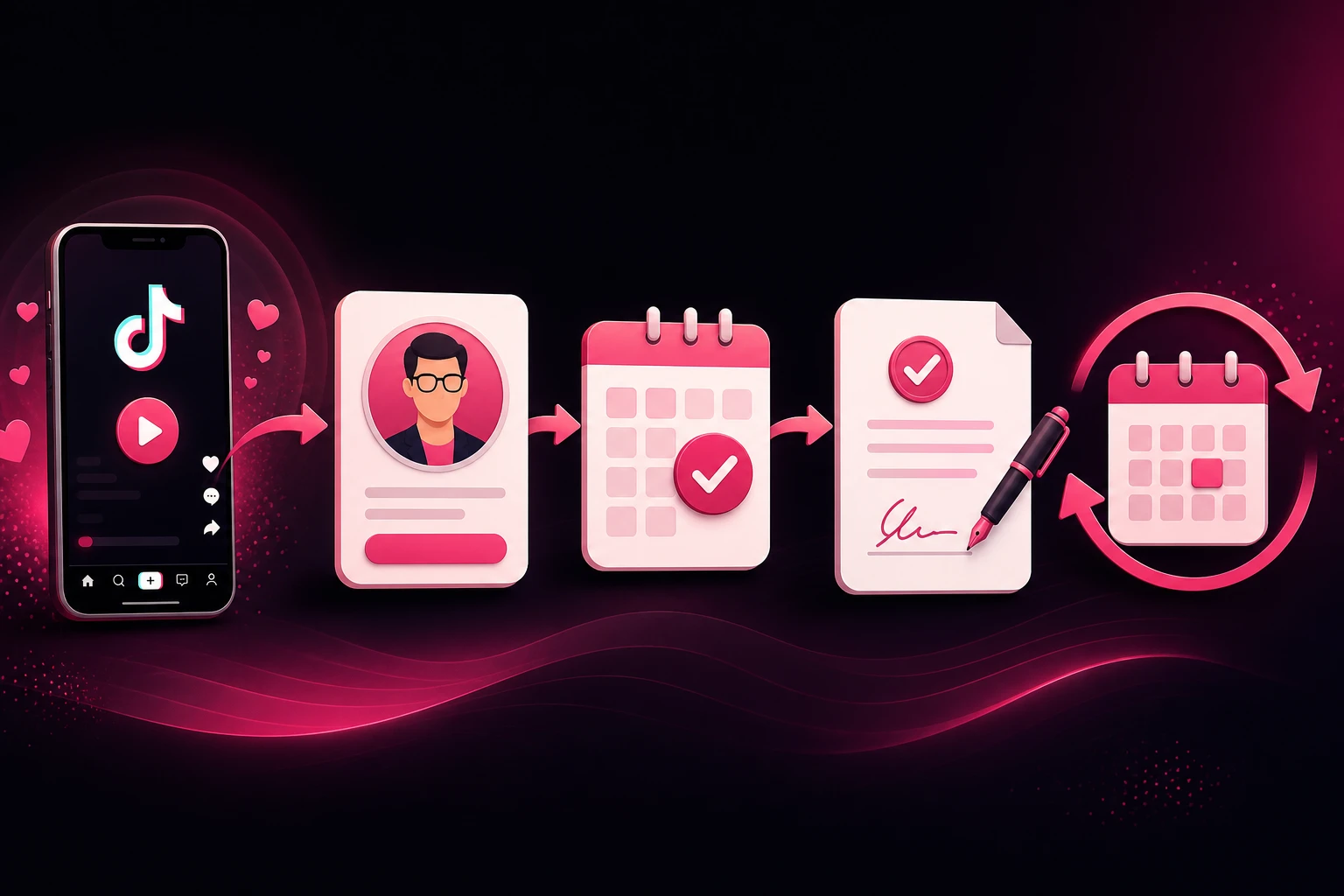
That gap is almost never a content problem. It is a handoff problem. Views become clients through a series of small, separate decisions, and most firms have quietly built four or five of the seven - so the trust they earned leaks out somewhere between "this person actually understands how money works" and "I have a discovery call Thursday at 2."
This guide is about sealing those leaks. It picks up where the 90-day growth roadmap leaves off and plugs into the broader strategy in our complete TikTok guide for accountants. If people are already watching you, everything below is about making sure the ones who need an accountant can find their way to your calendar - and then back to it next year.
The short version:
- Views are not the product - a client who renews is. A few hundred business owners in your niche or metro beat a million scattered viewers, because only one group can hire you, and they hire you every year.
- Your profile is the intake desk. Niche plus city (or niche plus "remote") in the bio, a pinned trio of your best videos, and a booking link one tap away.
- Speed decides more than eloquence - and in this profession the response window has two settings, one for the quiet months and one for the deadline crush.
- Your DMs are a compliance surface. One photo of a W-2 in your inbox is tax return information under Section 7216, sitting in a consumer app instead of your secure portal.
- The ladder has a seventh rung. Every other profession's path ends at the sale. Yours ends at renewal, which is where content actually pays.
- Track it or you will undercount it. Clients from social rarely mention it, and the lag between follow and signature can be months.
What's Inside
- 1. Why Views Don't Sign Engagements
- 2. The Retainer Ladder: Seven Rungs From Viewer to Renewal
- 3. Rungs 1-2: Turning National Views Into Followers Who Can Hire You
- 4. Rung 3: Your Profile Is the Intake Desk
- 5. Rung 4: Earning the Inquiry (CTAs That Work Under Circular 230)
- 6. Rung 5: The Two-Speed Response Window That Books the Discovery Call
- 7. Rungs 6-7: The Call That Signs Itself and the Renewal That Pays for Everything
- 8. High-Intent Content: The Videos That Actually Produce Inquiries
- 9. Compliance at the Inquiry Stage (The Part Nobody Warns You About)
- 10. Tracking Which Videos Are Actually Signing Clients
- 11. Amplify the Videos That Already Sign Clients - Before the Season
- Frequently Asked Questions
1. Why Views Don't Sign Engagements
A view is a stranger watching you for fourteen seconds. A signed client is a business owner handing you their bank feeds, their payroll, and the return that decides whether they sleep in April. Nothing about the first automatically produces the second.
In practice, accounting accounts leak clients in five predictable places. See how many of these describe your account right now:
- The audience is everyone and your practice is not. A video about whether you can write off your car travels to every W-2 employee in the country, which feels incredible and signs nobody. If most of your viewers have no business, no side income, and no reason to ever hire an accountant, your view count is measuring curiosity, not demand.
- The next step is invisible. The video ends, the viewer thinks "I should probably talk to someone about this before year-end," and nothing on screen tells them what that would even look like. Four seconds later they are watching a dog video and the thought is gone until next April.
- The profile makes them work. They tap your name, and the bio says "CPA | Numbers nerd | Coffee" without naming who you serve or where, and the link goes to a firm homepage with a stock photo of a handshake and a contact form below the fold. Every extra tap costs you a slice of the people who were ready.
- The inquiry goes cold - fastest exactly when you are busiest. Someone DMs on a Tuesday in February. Nobody opens the account until the weekend. By then they have walked into the storefront chain on the corner, because a deadline was coming and the chain answered the phone.
- Nobody knows whether they are "big enough" or what it costs. An enormous share of people who would benefit from an accountant never contact one because they assume they are too small to bother you, or that a return costs thousands. If your videos never address that, your audience quietly self-disqualifies.
Here is the encouraging part: every one of those is fixable in an afternoon, and none of them require you to make better videos. You need the path between the video and the engagement letter to be short, obvious, and staffed - in every season.
2. The Retainer Ladder: Seven Rungs From Viewer to Renewal
We call the path the Retainer Ladder. Each rung is a separate decision the person makes, and each one has its own failure mode:
- Viewer - they watched one video to the end. They know nothing about you. The only job here is to be worth another fourteen seconds.
- Follower - they decided they want more of this. The job is to make it obvious that there is more, and that it is reliably useful rather than a deadline-reminder graphic.
- Trusting business owner - they have seen you several times and they know you serve people like them, where they are. This is where the compounding happens, and it takes weeks.
- Inquiry - they raised their hand: a DM, a comment, a link tap, a call. In this profession it is usually triggered by an event - a first 1099, a new LLC, a letter from the IRS - not by the video itself. This is the fragile rung, and the first one you can directly measure.
- Discovery call - they are on your calendar. This rung belongs to your intake process, not your camera.
- Signed engagement - the engagement letter is executed and the portal invite is sent. If the first five rungs were built properly, this one is mostly confirmation.
- Renewal - the rung no other profession has. A law firm signs one case; a photographer books one wedding. Your client files again next year, and the year after, and a client who found you by watching you explain something refers you the same way.
Two things follow from this shape. First, you cannot skip rungs. Videos that ask first-time viewers to book a call convert badly, because you are demanding rung five behavior from rung one people. Second, your worst rung caps everything above it. A firm with brilliant content and an unanswered inbox signs fewer clients than a firm with average content and an admin who replies in ten minutes.
Before you make another video, walk the ladder yourself. Open your account in a private browser window as if you were a 31-year-old who just got their first 1099, a letter from the IRS, and no idea what either one means. Where exactly do you get stuck?
3. Rungs 1-2: Turning National Views Into Followers Who Can Hire You
Reach is not the goal. Reach among people who can hire you is the goal. Three thousand followers who own small businesses in your metro is a genuine book of future renewals. Three hundred thousand W-2 employees spread across the country is a hobby with a good ego return.
Accounting is unusual here, and it helps you. A lawyer's audience has to live inside one jurisdiction. Yours has two valid shapes: local - the business owners in your metro who want someone they could drive to - or niche - the e-commerce sellers, the contractors, the creators, the restaurant owners anywhere in the country, served remotely. Both work. What does not work is being neither: a general accountant for everyone, everywhere, which is a description that fits every firm and attracts no one.
You cannot force TikTok to show your videos only to the right people, but you can make the fit unmistakable - to the algorithm and to the humans watching:
- Say your lane out loud, in the video. Not as a pitch - as necessary context, which for an accountant it genuinely is. "For Texas business owners there's no state income tax, but there is a franchise tax, and other states are completely different." Or: "If you sell on marketplaces, here's the part of sales tax the platform handles and the part it doesn't." One sentence does three jobs: it is accurate, it signals who you serve, and it keeps you from implying a general answer applies to someone whose state or situation is different.
- Make content only your people need. What your county's business personal property filing actually is. What the first year of a food truck looks like on a return. The bookkeeping mess that is specific to one software your niche all uses. General accounts cannot make these videos, and everyone who needs one is a potential client.
- Show the room, and the route. Filming at your real desk, in your real office, with the client-data-safe setup from the filming guide, turns you from a person on a screen into a practice someone can picture working with - or drive to.
- End with a reason to follow, not a reason to hire. "I answer one of these every Tuesday" moves rung one to rung two. "Book a free consultation" does not, because they do not know you yet.
This is also the one place paid amplification changes the math outright, because promotion lets you choose geography or interests directly instead of hoping for them - more on that in section 11. The local business TikTok playbook covers the wider geography tactics that apply to any practice with an address.
4. Rung 3: Your Profile Is the Intake Desk

When someone finishes a video that hits close to home, they tap your name. What happens in the next six seconds decides whether they become a client or a scroll. Treat that screen the way you treat your actual reception area.
The bio: who you serve and where, in plain English. Not "trusted advisor to growing businesses." Something a stressed business owner can act on: "CPA for restaurant owners in Denver. Explaining what your P&L is trying to tell you." Or: "Enrolled agent, remote, all 50 states. Back taxes and IRS letters, no judgment." If a stranger cannot tell what you handle and whether you can take them in one line, the bio is not doing its job.
The pinned trio. You get three pinned slots, and they are the only part of your feed whose order you control. Use them deliberately:
- Your best write-off verdict or why-you-owe explainer - the video that most clearly proves you know this cold and can explain it to a normal human being.
- A short who-I-help video - your name, your firm, who you take on and who you do not, in thirty seconds. This is the video that turns an account into a person, and it filters the wrong-fit inquiries gently before they cost you a call.
- Your what-it-costs-and-what-happens-next video - what working with you actually looks like, roughly what it costs, and what you will need from them. This is the one that removes the fear keeping people from contacting anybody at all.
The link, and what sits behind it. One tap, and it should land on something that takes thirty seconds to complete - not your firm homepage. Match the destination to the kind of inquiry your content produces:
- Urgent inquiries (an IRS notice, a missed deadline, a payroll problem, years of unfiled returns): a phone or text number a human answers, plus a tiny form as backup. Somebody who just opened a certified letter at dinner is not filling out a fourteen-field questionnaire.
- Deliberate inquiries (switching accountants, starting a business, year-end planning, moving to monthly bookkeeping): a scheduler showing real available discovery-call times. Letting someone pick a slot themselves converts far better than "we will be in touch."
- Either way, keep the first form tiny - name, what kind of business, one sentence about the situation, and a way to reach them. Nothing else, and never a document upload. Records change hands after the engagement letter, through your secure portal, and nowhere else.
One seasonal note that no other profession needs: the link can change with the calendar. In the quiet months it goes to the scheduler. During the filing crush, if you genuinely cannot take new work before the deadline, it can go to an honest page that says so and offers the real alternative - "we can file an extension for you now and onboard you properly in May." An inquiry that gets a clear plan waits. An inquiry that gets silence goes to the chain on the corner.
5. Rung 4: Earning the Inquiry (CTAs That Work Under Circular 230)
This is the rung where most accounting accounts either get shy or get pushy, and both cost clients. The shy version never mentions that hiring an accountant is an option. The pushy version sounds like a tax-season billboard - "Maximum refund guaranteed!" - and gets ignored by the exact business owners who are most careful about who touches their books.
What works is a call to action that names the moment the viewer is in and offers a small next step:
- IRS letters: "If a letter from the IRS showed up this week, open it, don't panic, and don't call a number from a voicemail. My booking link is in the bio and the first conversation is about what the letter actually says."
- New business owners: "If you formed an LLC this year and nobody has talked to you about quarterly estimates, that conversation needs to happen before the next due date, not after."
- Bookkeeping: "If you are reconciling in a spreadsheet at midnight, that is the exact moment most people hire this out. The link is in the bio."
- Year-end planning: "The moves that lower this year's bill have to happen before December 31. If you are waiting for March, you are waiting to hear a number you can no longer change."
- Switching: "If your accountant talks to you once a year and it is to send an invoice, the week after the deadline is a fine time to see what a different relationship looks like."
- The universal one: "Ask the general version of your question in the comments and I will answer it in a video." This is the highest-converting accounting CTA there is, because it costs the viewer nothing, gives you your next video, and produces a public answer that earns saves.
Three things to keep off your videos, regardless of what you practice. First, anything that sounds like a promise - "biggest refund," "we save clients an average of," "IRS-approved," specific dollar figures presented as what a viewer can expect. Circular 230 prohibits false, fraudulent, misleading, or deceptive claims in practitioner advertising, the AICPA Code says the same for CPAs, and several states specifically police refund-guarantee language for preparers. Viewers discount it anyway. Second, manufactured urgency. Real deadlines are fine to name - they exist and people need to know them. "Only three client spots left!" is not, and reads as predatory in a field people already approach warily. Third, comparative superlatives like "the best CPA in Phoenix," which is unverifiable and is exactly the kind of claim a state board reads as misleading.
Your state board's rules govern alongside Circular 230, and they vary more than practitioners expect - who may use the CPA title and how, whether your firm must be registered where you advertise, what a disclaimer has to say. Read your own rules once, write yourself a one-page checklist, and then stop worrying about it. The accountants who lose here are not the ones who got the rules wrong; they are the ones who stayed silent for two years because they never looked them up.
6. Rung 5: The Two-Speed Response Window That Books the Discovery Call

If you fix exactly one thing from this article, fix this one. Someone who found you through a search engine is deliberately shopping for an accountant. Someone who found you through TikTok was watching videos on their couch and had a sudden, uncomfortable realization about their own books, or their own unopened mail. That feeling has a short half-life, and in this profession it has a seasonal half-life too.
That is why the accounting response window has two settings. In the quiet months, the rule is simple: hours, not days. In the deadline crush, when you physically cannot onboard anyone before the due date, the rule changes to honesty beats speed. An inquiry that gets "we are at capacity through the deadline - here is how an extension works, and here is the onboarding slot in May" very often waits for you. An inquiry that gets nothing goes to whoever answers first. The silence is what loses the client, not the wait.
Three practical rules make the difference in both seasons:
- Somebody owns the inbox. Not "the firm." A named person who checks DMs and social-sourced form submissions at least twice a day, and who knows what to do with them. If you are a solo practitioner, that person is you, and it is a fifteen minute calendar block - one that survives busy season because it is on the calendar, not in your head.
- Cover the evenings you are actually generating inquiries. TikTok inquiries skew heavily toward evenings, and IRS letters get opened at dinner. Even an honest auto-reply - "Got it. Someone from our office will reach out before noon tomorrow. Please don't send any documents here." - holds the relationship overnight.
- Move to a call fast, and keep records out of the DM. Long message threads are bad for conversion and bad for compliance (see section 9). The reply that works is short and redirects: "Thanks for reaching out - please don't put any numbers or documents in here. What is the best number to reach you, and when are you free this week?"
Then measure it. Pick a week, log the timestamp of every social inquiry and every first response, and look at the median gap. Most firms who do this for the first time discover a number that embarrasses them - and fixing it is free.
7. Rungs 6-7: The Call That Signs Itself and the Renewal That Pays for Everything
Here is the quiet advantage of clients who come from content: they arrive different. A person who found you through a paid search ad is comparing three firms and has no idea who any of you are. A person who has watched twenty of your videos already knows how you think, how you explain things, and whether they like you.
Accountants who build a real audience report the same three things about these discovery calls:
- They are shorter. Half a discovery call is normally spent establishing that you are competent and explaining how the process works. Your videos did that weeks ago.
- They are less price-sensitive. Not because content lets you charge more, but because the person is not choosing between interchangeable strangers. They came for you specifically - which matters most for advisory work, where nobody shops on price.
- They show up better prepared. People who have absorbed your explainers arrive knowing what an S-corp election is, why you will ask about their entity, and which records you will want, because you already told them what would matter.
Which means the job in the call is not to persuade. It is to confirm fit - and to make the mechanics of hiring you as frictionless as everything before it. Send the engagement letter the same day while the conversation is fresh, use e-signature, be explicit about scope (what is included, what is not, what advisory costs extra), and send the secure portal invite the moment the letter is signed. The single most common reason a warm call never converts is not doubt about the accountant; it is an engagement letter that took eleven days and a portal invite that never arrived.
And when the caller is outside your lane - a niche you do not serve, a state return you do not prepare, a business far smaller or larger than your practice is built for - say so kindly and refer them well. Those referrals build a reputation that comes back around, and the who-I-help video in your pinned trio will slowly reduce how often it happens.
Then the seventh rung. This is the part of the ladder no other profession gets, and it is why the payback math in this vertical is so forgiving. A client's first year with you decides the next five, and three habits protect it:
- A 90-day check-in that is not an invoice. One short call or message after onboarding: what surprised them, what is still confusing, what they wish they had known. Clients who feel seen in month three renew in month twelve.
- The year-end planning touchpoint. The November conversation about moves that still change this year's number is the most valuable hour in the relationship, and it is the natural on-ramp from compliance work to a planning package or advisory retainer - the bridge the monetization guide walks through in detail.
- Keep posting, because your clients are still watching. This is the under-appreciated one. A client who found you on TikTok usually keeps following you, and every video they see for the next year is a reminder of why they chose you and a thing they can forward to a friend who owns a business. Your content is your retention program and your referral program, running on the same footage.
8. High-Intent Content: The Videos That Actually Produce Inquiries
Not all accounting content converts equally. The videos that go furthest are usually the entertaining ones - the wildest write-off someone tried to claim, the confident myth everyone repeats about cash, the reaction to a headline about tax changes. Those build the audience, and you should keep making them.
But the videos that produce inquiries are a different, quieter category. They tend to be watched by far fewer people, most of whom are currently in the exact situation you are describing:
- "What happens next" timelines. What actually happens after an IRS notice arrives. What the first ninety days with an accountant look like. What an extension really does and does not do. People in the middle of a money problem are starved for this and cannot find it anywhere.
- The cost video. What a business return costs, what monthly bookkeeping costs, why the range is so wide, and what changes the number. This is the single most underused video in accounting content, and it removes the barrier that silently disqualifies the largest share of your audience.
- "Do I even need an accountant?" Answer it honestly, including the cases where the answer is no. Telling the W-2-only viewer that free filing is fine for them buys more credibility than any testimonial, and the people you send away come back the year they start a business.
- The mistake video. The three things people do in their first year of business that make their return worse: mixing personal and business accounts, ignoring estimates, paying themselves wrong. High save rate, high share rate, and everyone currently making those mistakes recognizes themselves.
- The deadline video. Quarterly estimate dates, the extension window, entity election windows, information-return deadlines - explained as what happens if you miss them. Nothing produces same-day inquiries like a viewer realizing a clock is running. Keep specific thresholds and dollar amounts out of it so it stays accurate next year.
- The reassurance video. What to do if you have not filed in three years. What the first meeting is like. Why you will not judge them. Aimed squarely at the person who has been putting off contacting anyone, and one of the highest-converting videos a tax practice can make.
- The switching video. What moving from your current accountant actually involves, why it is easier than people fear, and when in the year it makes sense. Publish it for the weeks right after the filing deadline, when more business owners decide to switch than at any other time.
A useful ratio is roughly four audience-building videos to one high-intent video. The reach content keeps the account healthy; the high-intent content converts the trust it built. And because inquiries in this profession are event-driven, high-intent videos work best when they are published 60-90 days ahead of the moment they are for - the switching video in late April, the year-end planning video in September, the IRS-letter video in early summer when notice season starts. For fifty more formats to pull from, the accountant content ideas library breaks them down by format and season.
9. Compliance at the Inquiry Stage (The Part Nobody Warns You About)
Most advice about accountants on social media covers compliance at the content stage - do not show client data, do not give individual tax advice. That is the easy half. The harder half happens after someone reaches out, and it is where practitioners who are otherwise careful get into trouble.
The document problem. The moment a viewer sends you a photo of their W-2, a screenshot of an IRS notice, or their business bank balance, you are holding tax return information - and IRC Section 7216 governs its use and disclosure with criminal exposure, not just civil, for knowing or reckless violations. That information is now sitting in a consumer messaging app, outside the safeguards your written information security plan promised under the FTC Safeguards Rule. You did not ask for it. It does not matter.
The protection is process, not luck: say in your bio and in your auto-reply that you never accept documents or numbers by DM, redirect the moment someone starts typing them, and let nothing change hands until there is an engagement letter and a secure portal. This is both the compliant path and, conveniently, the better conversion path - a person who has been told "we will do this properly, through a secure system, after we talk" hears a professional.
The impersonation problem. As your account grows, scammers clone it and DM your followers asking for exactly the documents you refuse to accept. Tell your audience, on camera and in your bio, that you will never message them first asking for information, and keep your firm's verified contact details somewhere they can check. The practices that warn people early are the ones that do not spend a February explaining a data breach that was not theirs.
The informal-advice problem. Accounting has no formal prospective-client rule the way law does, but answering a specific person's specific facts in a DM means giving advice with no engagement letter defining what you were asked, what you knew, and what you were responsible for. Professional liability insurers warn about precisely this. Answer the general version publicly; move the specific one to a call.
The rest of the checklist:
- Disclaim clearly and consistently. "General information, not tax advice. Your situation depends on facts I don't have." In your bio, in your video descriptions, and verbally in videos that get close to specific advice.
- Never answer a specific person's specific facts. Answer the general version publicly, and move the specific one to intake.
- Watch the state line. State tax rules differ enormously, and some states require firm registration or notice before you advertise or practice there. "This is how it works federally; your state may treat it completely differently" belongs in your vocabulary.
- Do not repeat a commenter's details back to them publicly. If someone posts their income, their entity, or their notice number in your comments, answer the general principle and do not quote their situation.
- Know your advertising rules before you write CTAs. Circular 230 on misleading claims, the AICPA Code on advertising and confidentiality, your state board's rules on the CPA title and firm names, and any state-specific preparer rules on refund language.
- Supervise anyone posting for you. If a marketing agency or a junior staff member runs your account, the professional responsibility for what they post - and what they accept in the inbox - is still yours.
None of this is a reason to stay off the platform. It is a reason to spend one hour with the rules, build the guardrails once, and then let everything after that be just posting. The same discipline runs through the client-acquisition playbook for lawyers, where the inbox is an ethics surface for different reasons.
10. Tracking Which Videos Are Actually Signing Clients
Firms consistently underestimate what social is producing, for two reasons. First, a client who watched forty of your videos over three months does not describe themselves as a "TikTok lead." They say a friend recommended you, or that they found you online, or nothing at all. Second, the lag: the person who followed you in November signs in May, the week after they fire the accountant who never called them back. Meanwhile the source that gets credit is whatever they typed into a search bar the day they finally reached out.
You do not need attribution software. You need four habits:
- Ask on the intake form. "How did you hear about us?" with social media as an explicit named option, not a text box people leave blank.
- Train whoever answers the phone to ask and log it. One question, every call, written down in the same field every time. This is where most of your real data comes from.
- Give your TikTok profile its own booking link. A dedicated URL or landing page means link taps are separated from the rest of your web traffic and you can see volume without guessing - and you can watch it spike after a particular video.
- Track backwards from signed engagements, not forwards from views. Once a quarter, take every client you signed and ask which video started it. That list - usually short, usually surprising - tells you what to make more of and what to amplify.
Then look at the number that actually matters in an accounting practice: cost per retained client, valued at lifetime revenue. Not first-year fees - the whole relationship. A $1,200-a-year client who stays six years is a $7,200 outcome, and an advisory client is multiples of that. Compare that against what your firm pays for search ads in the first quarter, when every practice in the country is bidding for the same "accountant near me" click, or against what a lead vendor charges per name. Most practitioners who run this comparison honestly find the content channel is not close. The monetization guide works through those economics in detail.
11. Amplify the Videos That Already Sign Clients - Before the Season
Once the ladder is intact, you have something most firms never build: a video you can prove converts. Not a video that got views - a video that produced inquiries, and inquiries that became signed engagements, and engagements that renewed.
That changes what paid promotion is for. You are no longer gambling on whether the content works; you already know it does. You are buying more of the right people seeing the thing that already works - and in an accounting practice, "the right people" means something specific: business owners in your metro, or people whose interests match your niche, either of which promotion can target directly.
And then there is the lever no other profession has: timing. Paid search for accounting terms is at its most expensive in the first quarter, because that is when every firm wants the same clicks. Promoting a proven explainer in September or October reaches the same business owner for a fraction of the cost, months before anyone is bidding for their attention - so that by the time they need someone, they already follow someone. Amplify before the season, not during it. The economics are forgiving: one retained client who renews covers the entire run many times over.
That is what our TikTok promotion service is built to do: take the educational video that has already proven it brings in clients and put it in front of thousands more of the right people, before they start looking. The rule is the same one that governs the whole growth roadmap: amplify proof, not hope. For the mechanics of promoting an existing organic video, the Spark Ads guide walks through the setup step by step - and whatever you promote still has to satisfy TikTok's ad policies, Circular 230, and your state board's advertising rules.
Frequently Asked Questions
How do accountants actually get clients from TikTok?
Through a seven-step path, not a single viral video. Someone watches a money explainer, follows because they want more, watches you enough times to trust you, sends an inquiry or taps your booking link, has a discovery call, signs an engagement letter, and then renews the following year. Most firms build four or five of those rungs. They earn real trust and then lose it in the handoff - the bio does not say what kind of business they serve or where, the booking link is three clicks deep, or a February DM sits unanswered until the weekend. Fixing the handoffs usually signs more clients than posting more videos, and because an accounting client renews annually, every handoff you fix keeps paying for years.
How many followers does an accountant need before TikTok brings in clients?
Far fewer than most practitioners expect, because the number that matters is engaged followers who can actually hire you - business owners in your metro or in your niche - not total followers. Practices commonly report their first "I found you on TikTok" inquiry somewhere between 1,000 and 5,000 followers, and some see it earlier when the content is specific to one kind of client. Accounting has the friendliest payback math of any profession here: a client is recurring revenue, so a $1,200-a-year relationship that lasts six years is $7,200 from one follow, and a few hundred local business owners who trust you is a serious book of future business.
What call to action works best for accounting TikTok videos?
Soft, specific, and tied to a real moment in the viewer's year. "If a letter from the IRS showed up this week, open it, don't panic, and don't call a number from a voicemail - my booking link is in the bio" works because it names the situation. "The moves that lower this year's bill have to happen before December 31, not in March" works for year-end planning because the deadline is real. Avoid refund guarantees, "biggest refund" language, average-savings claims, and superlatives - Circular 230, the AICPA Code, and state board rules all prohibit false, misleading, or deceptive advertising, and viewers distrust it anyway. The highest-converting accounting CTA is often just an invitation to ask the general version of your question in the comments.
Can accountants answer tax questions in TikTok comments or DMs?
You can answer general educational questions publicly, but you should not give individualized advice to a specific person in a comment or DM, and you should never let documents or identifying details into your inbox at all. Once someone sends you tax return information - even a photo of a W-2 in a DM - it is covered by IRC Section 7216, which carries criminal exposure for unauthorized use or disclosure, and it is now sitting in a consumer messaging app instead of the secure portal your written information security plan requires. Answer the general version publicly with a plain "general information, not tax advice," and route anything specific into a call and a proper engagement letter before any records change hands.
How do I know whether TikTok is actually bringing in clients for my firm?
Put "How did you hear about us?" on your intake form with social media as an explicit option, train whoever answers the phone to ask and log it, and give your TikTok profile its own booking link so taps are separated from the rest of your web traffic. Then, once a quarter, work backwards from every signed engagement to the video that started it, and value each one at lifetime revenue rather than first-year fees. Most firms find the channel is producing more than they thought, partly because clients who arrive from social rarely volunteer it and partly because of the lag - the person who signs in May often followed you in November.
When is the best time of year for an accountant to start getting clients from TikTok?
Now, if you are reading this between May and October, and still now if you are not - but adjust your expectations. The instinct to start in January is backwards on three counts: you have the least capacity to film, every firm in the country is competing for the same attention, and paid search costs peak. The build window is May through August, when you have time to post, the audience is not saturated, and the videos you publish will already be ranking and the followers already warm when the January-April crush, the fall extension deadline, and the year-end planning season arrive. If you are starting in busy season, post lightly, keep the intake path open with an honest extension-and-onboard-later message, and plan the real push for the quiet months.
Know which video books the discovery calls?
Then you already know where the budget belongs - and when. Viryze amplifies the educational video that has already proven it signs clients, putting it in front of thousands more business owners in your market or your niche before the season starts, so the trust you built turns into inquiries, signed engagements, and clients who renew every year.
Promote the video that signs clientsRelated Reading
- TikTok for Accountants: The Complete 2026 Guide - the full strategy this client-acquisition path plugs into.
- Growing an Accounting Firm TikTok: From 0 to 100K Followers - the 90-day roadmap that builds the audience you convert here.
- How Accountants Make Money on TikTok in 2026 - every income stream a signed engagement sits on top of, in the order they turn on.
- Accountant TikTok Content Ideas: 50+ Video Concepts That Win Clients - the high-intent formats that fill the top of this ladder.
- Getting Clients from TikTok: Turn Views Into Signed Cases - the parallel conversion playbook for the other licensed profession.

Head of Creator Success at Viryze
TikTok growth strategist helping creators reach their first 100K followers through data-driven promotion strategies.