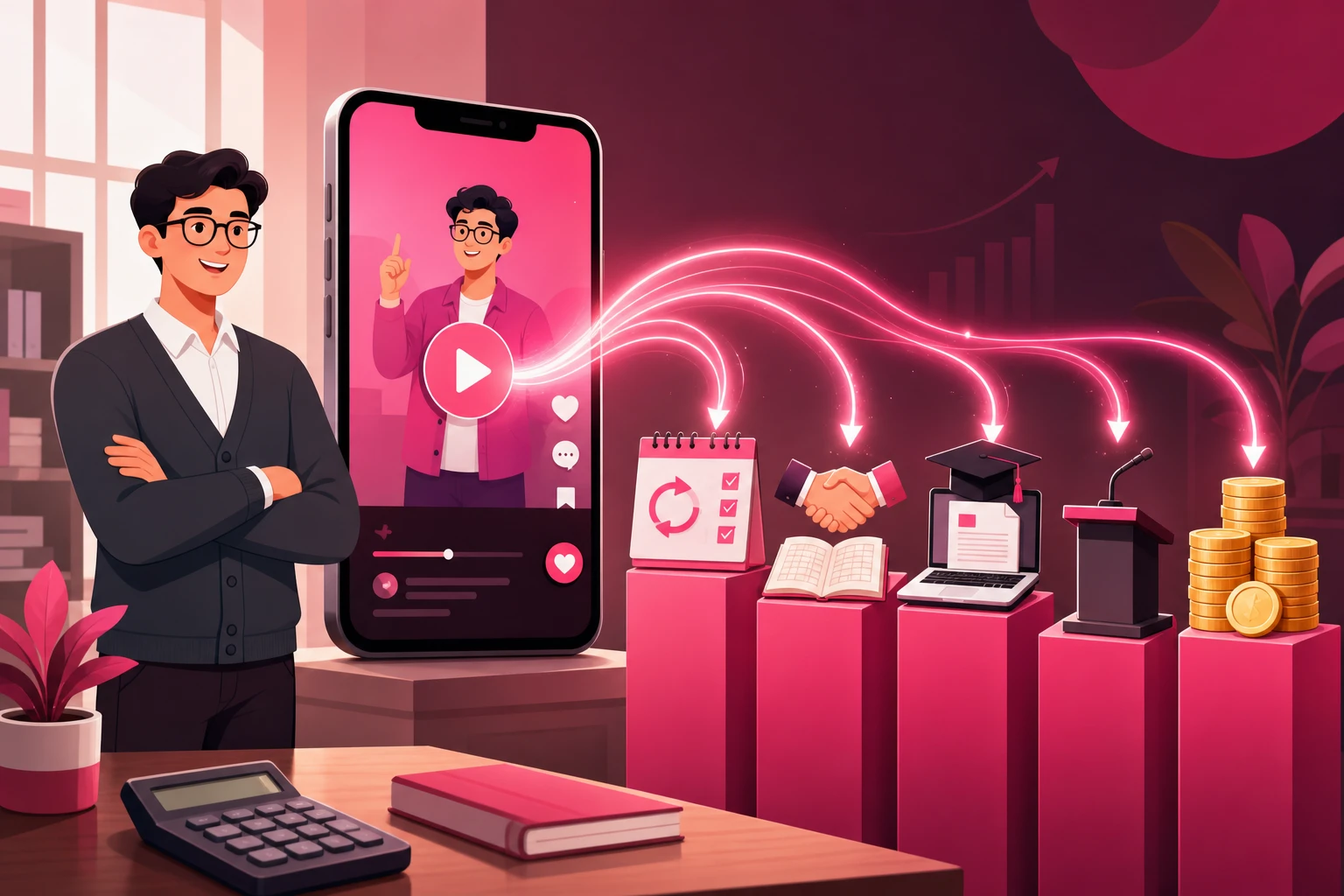
Most guides to making money on TikTok start with the Creator Rewards Program. This one starts with an engagement letter that renews every January.
The Creator Rewards Program pays roughly $0.40 to $1.00 per 1,000 qualified views, so a video seen a million times earns a few hundred dollars. A $1,200-a-year tax-and-bookkeeping client who stays six years is $7,200 - from one follow, earned once - and an advisory or fractional-CFO retainer is multiples of that. For an accountant, TikTok is not a place that pays you. It is a place where the people who will pay you every year decide whether they trust you.
That said, "just get clients" is incomplete advice. Accountants with real audiences earn from six distinct streams, each with its own threshold, its own effort cost, its own season, and its own rulebook. This guide covers all six in the order they actually turn on - what each is worth, when it becomes available, what Circular 230, the AICPA Code, and your state board have to say about it, and where the wasted effort is. It builds on our complete TikTok guide for accountants and the 0 to 100K growth roadmap. If you haven't built the account yet, start there - this is what the account is for.
The honest summary:
- Recurring engagements are the business. One converted follower renews every year. Every other stream on this page combined is usually a rounding error next to that.
- The advisory bridge is where content earns most. Nobody shops for an advisor on price, and short video is the cheapest proof of judgment you can produce.
- Products monetize the people you'll never sign. Tens of millions of people do their own taxes and books; a small slice will pay you to do it better.
- Platform payouts come last, if ever. Chasing Rewards pulls you toward viral money content and away from the calm local explainers that sign clients.
- Every stream here is governed by Circular 230, the AICPA Code, your state board's rules, and Section 7216. Read them before you turn anything on.
What's Inside
- 1. The Math That Changes Everything
- 2. Stream One: Recurring Client Engagements (The Annuity)
- 3. Stream Two: The Advisory Bridge (Planning Packages & Retainers)
- 4. Stream Three: Digital Products for the Clients You'll Never Sign
- 5. Stream Four: CPE, Speaking & Media Commentary
- 6. Stream Five: Software Partnerships, Affiliates & Creator Payouts
- 7. The Hidden Stream: Recruiting
- 8. The Compliance Layer: Getting Paid Without a Board Complaint
- 9. The Sequence: What to Turn On, When, and in Which Season
- 10. Tracking It: The Only Three Numbers That Matter
- 11. The Monetization Mistakes That Cost Accountants Money
- 12. Accelerating: Put Budget Behind the Videos That Produce Inquiries
- Frequently Asked Questions
1. The Math That Changes Everything

Run the comparison honestly and the strategy writes itself.
A comedy creator with a million followers might see a five-figure year from platform payouts, plus brand deals if they hustle. To get there they need enormous, constant, nationwide reach - and the money stops the moment the posting stops.
A small-business CPA with 3,000 followers in her metro books two discovery calls a month from the account. Say one in three signs, at $1,200 a year. That is eight new clients and about $9,600 in year one - unimpressive on any creator dashboard. But in year two those eight renew while eight more arrive, and the account is producing roughly $19,000. By year three it is nearing $29,000 a year, from clients who never had to be re-won. Add one advisory retainer and the number jumps again.
This is the inversion at the heart of accounting monetization: you are not selling attention to advertisers, you are converting a very small number of the right people into relationships that renew. Which means every monetization decision gets tested against one question: does this bring me closer to people who can hire me and keep hiring me, or does it trade them for strangers?
Almost every bad monetization decision an accountant makes on TikTok fails that test. Chasing a viral reaction to the latest "write off your luxury SUV" video gets views from people in 49 states who will never hire a CPA in yours. Optimizing for watch-time payouts pushes you toward long, broad, outrage-shaped money content. Selling a $29 template distracts from an engagement worth forty times that, every year. None of those are crimes - they're just poor trades for someone whose product is bought entirely on trust and paid for annually.
There is a second inversion, and it is unique to this profession: every stream on this page has a season. Advisory conversations happen in November, products sell in the filing-season panic, speaking gets booked in spring, and vendors spend in the fourth quarter. Section 9 lays the calendar over the sequence - because in accounting, turning a stream on in the wrong month is nearly the same as not turning it on at all.
2. Stream One: Recurring Client Engagements (The Annuity)
Everything else on this page is a supplement. This is the business.
The mechanism is simple and slow: a freelancer watches you explain why people owe when they expected a refund, feels calmer, follows you, watches eight more videos over three months - and when the 1099s land in January, books you instead of typing "CPA near me" into a search box alongside everyone else. You were not competing on price or ad spend in that moment. You had already won.
What makes this stream work is the path from video to engagement being short and obvious:
- Your bio names the niche and the city. "CPA for restaurants in Austin" converts strangers into local prospects. "Numbers are my passion" converts nobody. If your practice is niche-defined rather than local - creators, e-commerce, contractors - lead with the niche and drop the city.
- The intake link is one tap from any video. A discovery-call booking page, not a homepage with a phone number buried in the footer. The person who found you on their phone at 11pm the night after opening a scary IRS letter will not navigate a desktop site.
- The response window respects the season. Hours, not days, in the quiet months. During the January-April crush, a fast "we're booked through April - here's how to reserve a May start" keeps a prospect that silence loses. The firm that answers first usually signs the engagement, and this leak has nothing to do with content.
- The pinned trio does the closing. Your best money explainer, a who-I-help intro, and a reassuring what-happens-next walkthrough - "here's what actually happens if you can't pay your tax bill." Someone deciding whether to book you watches those three.
- Every video keeps the frame. "General information, not tax advice - your situation may differ" protects you and, counterintuitively, makes you look more credible, not less.
The content that produces clients is not the content that produces views. Your most-watched video will often be a fun myth-bust with national appeal. Your most valuable video will be a calm, unglamorous walkthrough of what to bring your accountant the first year you have self-employment income - 15,000 views, and four of those viewers are freelancers in your city who now know exactly who to call. The accountant content ideas vault is organized around exactly this kind of high-intent explainer.
And here is what no other profession gets: the client you sign from that video is not one engagement. They are next year's engagement too, and the year after, unless you give them a reason to leave. Retention is a monetization stream in its own right - the cheapest one you will ever run. A client who keeps seeing you in their feed all year, explaining things clearly and calmly, treats renewal as a formality. The one who hears from you once a year, by invoice, shops around.
3. Stream Two: The Advisory Bridge (Planning Packages & Retainers)
Compliance work - returns, data entry, reconciliations - is commoditizing. Software does more of it every year and the price pressure is real. The margin in this profession has moved to advisory: tax planning, client advisory services, fractional CFO work. The problem is that advisory is hard to sell, because most business owners don't know they need it until they see what it looks like.
Short video is the best demonstration of advisory judgment ever invented. Here is how the bridge works in practice:
- The planning package is the first rung. A one-time tax-planning engagement - entity choice, retirement plan selection, timing of income and purchases - commonly priced in the low thousands. It sells itself to a viewer who has just watched you explain, calmly and in general terms, how an entity election changes what an owner pays and why the answer depends on their numbers. They don't want the video. They want you to look at their situation.
- The monthly retainer is the second. Bookkeeping plus cash-flow visibility plus quarterly planning, at a monthly rate that dwarfs an annual return. The video that sells it is the "here's what I look at every month for my restaurant clients" walkthrough, on a demo file, showing the three numbers an owner should know and rarely does.
- Your existing clients upgrade too. They are watching. The most common upgrade path practitioners describe: a long-time individual-return client sees a year-end planning video in November and asks, "why haven't we been doing this?" That is the highest-margin conversion in the profession, and the marketing cost was zero.
- Nobody price-shops the advisor they already trust. The discovery call changes tone completely when the prospect has watched twenty of your videos. They arrive asking "how do we start," not "how much do you charge" - and practitioners consistently report that what those prospects are willing to pay is higher.
The timing here is the whole game. November and December are when advisory conversations actually happen, because it is the last moment anything can be done about the current year. Publish your planning explainers in October so they are ranking, saved, and shared by the time the conversations start - a video posted in December competes with every year-end listicle on the internet.
4. Stream Three: Digital Products for the Clients You'll Never Sign
This is where accounting diverges from the other licensed professions. Tens of millions of people prepare their own returns and keep their own books every year, and most of them will never hire you - not because they don't trust you, but because a professional engagement doesn't fit their budget yet. A slice of them will happily pay to do it better. The do-it-yourself audience is not a lost lead. It's a different product.
What sells, when it sells:
- Niche guides. "The freelancer's quarterly-tax system," "bookkeeping setup for a first-year online shop," "what to track when you start renting out a property." Priced modestly, bought on the strength of the videos, and evergreen if you keep this year's numbers out of them.
- Templates and trackers. A mileage log, an expense-category spreadsheet built for one niche, a what-to-gather-before-filing checklist. Cheap to make, and the kind of thing a viewer buys the same night they watch the video.
- Courses for a defined audience. "Doing your own books as a solo creator" is the real product for the educator tier. It takes forty-plus hours to build, and it is only worth building once the audience exists and has told you - in comments and DMs, repeatedly - what it wants.
- Products for other accountants. Often the better market. Firm workflow templates, busy-season scheduling systems, pricing frameworks, "how I built my firm's TikTok." Your peers can buy from you with no advice-reliance concern at all, and they pay professional prices.
The guardrails, which matter more here than anywhere:
- Sell education, not advice. "How quarterly estimates work" is information. "How much you should pay" is advice you cannot give a stranger who bought a PDF. Practitioners are held to written-advice standards under Circular 230; keep every product general and say so on the cover.
- Keep the numbers out. Thresholds, limits, and rates change every year. A product that quotes them expires in April and generates refund requests in May. Say "there's a per-recipient cap" and link to where the current figure lives.
- State scope plainly. Federal only or not, which entity types, and the line every product needs: "not a substitute for a professional who can see your records."
The most reliable use of a digital product is still as a free lead magnet rather than a revenue line. A free "what to bring your accountant the first year you're self-employed" checklist that collects an email address is worth more to a firm than the same document sold thirty times at $19 - because it feeds Stream One with people who are about to need you, and it tells you when.
5. Stream Four: CPE, Speaking & Media Commentary
This stream is unusual because you don't build it - it finds you. Once you are visibly the person who explains money most clearly for a particular audience, the requests start arriving on their own:
- CPE and state society presentations. Usually the first request, and the most ironic: other accountants want to know how you did it. "Social media for firms, ethically" is a continuing-education topic in demand at state CPA society chapters, CPE providers, and firm-association conferences - and you now have a case study nobody else in the room has.
- Industry association speaking for the niche you serve. The restaurant association, the contractor trade group, the real-estate investor meetup, the creator-economy conference. These rooms are full of prospective clients, which makes this the highest-yield version of the stream even when the honorarium is small.
- Software vendor webinars and partner events. Vendors need practitioners who can explain their category to business owners without jargon. Paid or not, it is authority plus a borrowed audience, and it often leads directly to Stream Five.
- Media commentary. Every filing season, reporters and producers need someone who can explain a tax change in twenty seconds. They search for the people already doing it on camera, because that is the hard part to source on deadline. A local news segment isn't paid directly, but it flows back into every other stream.
- Corporate training and workshops. The highest-paying version: a "finance for founders" session at an accelerator, a bookkeeping bootcamp for a franchise's owners, a manager workshop on reading a P&L. A single engagement can be worth more than a month of content work.
The realistic threshold is around 10,000 to 25,000 followers, though a single clear video in the middle of a tax-law news cycle can trigger it far earlier. Make it easy: a professional email address in your bio, a speaking page on the firm site with a one-paragraph bio and a headshot, and a reply within a day. Then mind the calendar - conference programs are set four to eight months out, the fall CPE season is booked in spring, and the media calls cluster in February through April.
6. Stream Five: Software Partnerships, Affiliates & Creator Payouts
Accounting is unusual here too. The companies selling bookkeeping, payroll, expense, invoicing, and business-banking software run some of the most established partner and affiliate programs in any industry - and they specifically want practitioners with a business-owner audience. A vendor cares more about who watches you than how many do, which is why this stream can arrive earlier for accountants than brand deals do in other niches.
It shows up in three forms:
- Partner and advisor programs. Certifications, referral commissions on subscriptions, and a listing in the vendor's practitioner directory - which is itself a client source.
- Affiliate links. A per-signup fee or revenue share on an app you already recommend across the desk.
- Sponsored content. A paid video, typically once you're in the tens-of-thousands range with a clearly defined audience. Vendor budgets peak in the fourth quarter and early in the year, ahead of filing season.
Four rules make all three safe:
- Disclose properly. #ad, #sponsored, or "affiliate link," clearly and up front. That is the FTC's requirement, and the AICPA Code and your state board expect at least that standard.
- Know the commissions rule before you accept anything. Under the AICPA Code's commissions and referral fees rule, a CPA in public practice may not take a commission for recommending a product or service to a client for whom the firm also performs audits, reviews, or certain other attest engagements - and any permitted commission must be disclosed to the client being recommended the product. Many state boards have their own versions, and some are stricter. If your firm does attest work, this stream needs a conversation with your board's rules before it needs a link.
- Recommend only what you'd recommend anyway. Your credibility is the asset generating every other stream. One partnership with software your clients end up hating spends it.
- Avoid outcome implications. A sponsored video suggesting an app will "lower your tax bill" runs straight into the no-misleading-claims rules that govern every professional communication you make.
The Creator Rewards Program belongs at the very end of this section. It pays on qualified views of longer videos, with rates that reward broad watch time. Enable it - it costs nothing. Just refuse to let it steer. The content that maximizes Rewards is long, broad, and nationally provocative: celebrity tax scandals, "the rich pay nothing" rage-bait, reaction after reaction. The content that maximizes client revenue is short, specific, local, and calm. When those conflict, the payout loses every time. If a video you were going to make anyway runs long and earns, that's a bonus, not a strategy.
Accountant-educators who genuinely want the creator path - building toward 100K and a media presence rather than a fuller roster - can build a real second income here, and the finance creator monetization guide covers that lane. For everyone else, treat it as found money and keep your attention on the intake link. The same practice-first ordering shows up in how lawyers monetize - in licensed professions, the practice almost always out-earns the platform.
7. The Hidden Stream: Recruiting
This one never appears as revenue. It appears as a cost you stop paying - and for a firm, it can be the largest number on this page after Stream One.
The profession has a well-documented pipeline problem: fewer graduates entering, a large share of licensed CPAs at or near retirement age, and firms competing for the same shrinking pool. Recruiter fees commonly run a substantial share of first-year salary per hire, and an open seat costs billable capacity through an entire busy season. Meanwhile, a "we're hiring" graphic on the firm page persuades no one.
A firm with a real personality on camera gets something different: applications from accounting students and career changers who have watched the firm enjoy the work. The 11pm busy-season desk video, the why-I-left-a-big-firm story, the office dog, the partner who explains an entity election like a human being - that is the content that makes a student want to work for you, and it is the same content that makes a business owner want to hire you. Practitioners routinely describe recruiting as the payoff that surprised them most.
Make it deliberate: a pinned "what it's actually like to work here" video during the fall campus-recruiting window and again in May when burned-out staff at other firms are quietly looking, a careers link in the bio during those windows, and the four-to-one education-to-personality ratio the growth roadmap recommends the rest of the year. Healthcare practices see the same effect - our healthcare monetization guide treats recruiting and retention savings as a stream for exactly this reason.
8. The Compliance Layer: Getting Paid Without a Board Complaint
Every stream above intersects with rules that vary by credential and by state. This is a map of where to look, not professional advice - your own state board's rules control, and the AICPA ethics hotline and your state society exist for precisely these questions.
- Content that generates clients is advertising. If you practice before the IRS, Circular 230 prohibits false, fraudulent, misleading, or deceptive public communications. The AICPA Code's advertising rule says the same, and state boards enforce their own versions on anyone using the CPA title. No refund guarantees, no "biggest refund in town," no outcome promises.
- Disclaimers do real work. "General information, not tax advice - your situation may differ." Say it in the video or the caption, consistently. It prevents the reliance problem that makes money content risky in the first place, and it is doubly important on anything you sell.
- Never use client information - including in your marketing. Section 7216 makes unauthorized use or disclosure of tax return information a federal crime, and "I anonymized it" is not a defense. The less-known half: using tax return information to market anything other than tax-return services to your own clients generally requires their written consent under the regulations. "I'll email my client list about my course" is a question for the regs, not an assumption.
- Commissions and referral fees have their own rulebook. The AICPA rule plus your state board's: prohibited where attest services are involved, disclosure required everywhere else. This is the stream most likely to go wrong quietly.
- Fee claims must be honest and stable. Circular 230 lets you publish fee information but expects you to honor published fees for a period afterward. Keep fee language either exact or general - never "starting at" bait that no one actually pays.
- Credentials must be accurate. "CPA" is a licensed title. Enrolled agents, unlicensed preparers, and bookkeepers should describe exactly what they are - some states restrict who may use "accountant" at all - and nobody should call themselves a "tax expert" in a way their board would read as misleading.
- Paid promotion is advertising too. Putting budget behind a video does not change what it is. If the organic video complies, the promoted version generally does - keep copies of anything you promote, since Circular 230 carries record-retention requirements for some forms of advertising, and confirm your state board doesn't add labeling rules for paid placements.
None of this is a reason to stay off the platform. It is the reason your competitors are still frozen - and the practitioners who spend one afternoon reading their board's advertising rules get to build confidently for years while everyone else waits for permission. Our client-data-safe filming guide covers the production side of the same discipline.
9. The Sequence: What to Turn On, When, and in Which Season

Turning everything on at once is how accountants end up with a content habit that feels like a second job and pays like a hobby. Do it in this order instead:
0 - 1,000 followers: intake only
One job: make it trivially easy for a local viewer to book you. Bio, link, pinned trio, response window. Ignore every other stream completely. The first client can and often does arrive here.
1,000 - 5,000: intake + the advisory bridge
Inquiries are steady enough to shape. Add one planning-package explainer a month and a "what I look at monthly" walkthrough, and tell your existing clients where to find you - the upgrades start there.
5,000 - 10,000: the lead magnet and the first product
A free checklist that collects emails, then one modest niche guide built from the question your comments keep asking. Both feed Stream One as much as they earn.
10,000 - 50,000: CPE, speaking, media & partner programs
Requests start arriving unprompted. Add the speaking page and professional email, apply to the partner programs for software you already recommend, and pitch your state society one session.
50,000+: courses and sponsorships
Only now is the audience large and defined enough that a course or a sponsored video generates real money - and only if it doesn't cost you the local trust density that pays the bills.
Now lay the calendar over it, because in this profession the month matters as much as the milestone:
- May - August: build. The quiet months. Film the library, write the products, set up the intake path, and start (or restart) the 90-day engine. Everything below harvests what you plant here.
- September - October: position. Extension-deadline explainers now, year-end planning content published so it's ranking by November, fall speaking pitched, partner-program applications in before vendor budgets lock.
- November - December: the advisory bridge. Planning conversations happen now and only now. Every pinned video should be a planning video; every existing client should see one.
- January - April: harvest. Inquiries peak, products sell to the do-it-yourself panic, media calls arrive. Post from the bank at a reduced cadence, answer fast, and protect capacity with a clear "here's when we can start."
Notice what stays constant across every tier and every month: the intake path. Firms lose more money to a slow reply in the second week of January than to any strategic choice on this page.
10. Tracking It: The Only Three Numbers That Matter
Views, followers, and likes tell you almost nothing about whether this is working. Track these instead:
- Engagements attributed to TikTok. Add one question to your intake form - "how did you hear about us?" - and count. This is the number that turns "the social media thing" into a line item your partners can't argue with.
- Renewal rate of TikTok-sourced clients versus everyone else. The number nobody else tracks, and the one that proves the annuity. Practitioners report these clients renew at least as well as referrals, because they chose you on trust rather than price. If yours churn faster, the content is promising something the engagement doesn't deliver - fix the promise or the delivery.
- Revenue per hour of content work, at lifetime value. New clients times annual fee times expected years, plus advisory upgrades, products, speaking, and partnership income, divided by the hours you and your team put in. Accountants who do this calculation honestly at the twelve-month mark are usually startled by how it compares to their first-quarter search spend - and it is the number that justifies scaling up.
Give it one full turn of the calendar before judging. Trust-based revenue lags content by months by definition: the person who watched you in July hires you in February, and the client you signed in February proves the model when they renew the following January.
11. The Monetization Mistakes That Cost Accountants Money
- Starting in January. The least capacity to film, the most competition for attention, and the highest ad costs of the year, all at once. The account that pays in February was built in July.
- Chasing views instead of neighbors. A national audience feels like success and pays like a hobby. Three thousand followers in your metro or your niche beat a million spread across the country.
- Treating the account as a billboard. Deadline graphics, "Happy Tax Season!" posts, and firm announcements get no reach and build no trust. The questions your clients actually ask are the entire content strategy.
- A slow intake path in season. The most expensive mistake on this list. "We're full until May" said within the hour keeps a prospect; silence hands them to the firm that answered.
- Building a course before an audience. Forty hours on a course for 900 followers. Those forty hours spent on videos would have produced discovery calls.
- Quoting this year's numbers in anything you sell. It expires in April, and the refund requests arrive in May.
- Taking a commission without checking the attest rule. The stream most likely to produce a board complaint from a practitioner who thought they were just sharing a link.
- Letting the payout program pick your topics. The clearest sign this has happened: you're posting about a celebrity's tax bill instead of the question three business owners in your city asked you this week.
- Giving up after one busy season. Accounting content compounds slowly and then all at once, because the buying decision is triggered by a calendar you don't control. The 90-day growth roadmap exists precisely because most firms quit right before the curve turns.
12. Accelerating: Put Budget Behind the Videos That Produce Inquiries
After a few months you'll be able to point at two or three videos and say: these are the ones people mention when they book. That is not a guess - that is a proven asset, and it's the only kind of video worth putting money behind.
The arithmetic in this profession is lopsided twice over. First, the timing: firms bid for "CPA near me" and "tax preparer" in the first quarter, when every firm in the country is competing for the same searches at the highest prices of the year. Amplifying an explainer that has already earned trust, targeted to your metro or your niche in October or November - before anyone is bidding - buys minutes of a prospective client actually watching you, for a fraction of what one January click costs. Second, the payback: a promoted video that converts one $1,200 client didn't buy one sale. It bought an annuity, so break-even is a fraction of a single relationship.
That's the model behind our TikTok promotion service: take the educational videos that already proved themselves with real viewers and put them in front of thousands more people who can actually hire you, ahead of your demand spike, so the trust converts into followers, discovery calls, and clients who renew. Promoted accounting content still has to follow your professional advertising rules - no refund or outcome guarantees, honest credentials, the same disclaimers as any ad - so amplify the education, never the pitch. For the mechanics of promoting through TikTok's own tools, see the Spark Ads guide, and for reaching business owners in a specific metro, the local business TikTok marketing guide covers the targeting fundamentals.
Frequently Asked Questions
How much money do accountants make on TikTok?
Almost none of it comes from TikTok itself. The Creator Rewards Program pays roughly $0.40 to $1.00 per 1,000 qualified views on longer videos, so a million views is a few hundred dollars. A single retained client is worth far more, and unlike any other niche the client renews: a $1,200-a-year tax-and-bookkeeping relationship that lasts six years is $7,200 from one follow, and an advisory retainer is multiples of that. That is why a CPA with 3,000 local followers who signs a handful of clients a year out-earns a 300,000-follower creator living on platform payouts, and the gap widens every year the clients renew. Track TikTok income the way you track any referral source: engagements attributed to the account, valued at lifetime revenue, plus advisory upgrades, products, speaking, and partnership income on top.
Can CPAs get paid for TikTok content under professional rules?
Yes, with conditions. Educational content that produces client inquiries is advertising, which Circular 230, the AICPA Code of Professional Conduct, and state boards all permit as long as it is not false, misleading, or deceptive, makes no refund or outcome guarantees, and uses credentials accurately. Products and courses must stay general education rather than individual advice. Software affiliate commissions and referral fees are governed by the AICPA commissions and referral fees rule and by state board rules: commissions are prohibited for clients who also receive attest services from your firm and must be disclosed to any client you recommend a product to. Sponsored content needs FTC disclosure. Never use client information in any of it, because Section 7216 carries criminal exposure. Read your state board rules before turning any stream on.
Should accountants sell a tax course on TikTok?
Eventually, and only for a defined audience that has told you what it wants. Courses are the right product for the educator tier - typically 10,000+ followers with a clear niche such as freelancers, e-commerce sellers, or creators - because they monetize the large do-it-yourself audience that will never hire a firm. Building one earlier is the most common wasted effort in the niche: forty hours on a course for 900 followers would have produced discovery calls if spent on videos. Start with a free checklist as a lead magnet, then a modest niche guide, and build the course once comments and DMs are asking for it. Keep every product general, keep this year's thresholds out of it so it stays evergreen, and state plainly that it is not a substitute for a professional who can see your records.
Can accountants take affiliate commissions from software companies?
Often, but check two rulebooks first. Under the AICPA Code's commissions and referral fees rule, a CPA in public practice may not accept a commission for recommending a product or service to a client for whom the firm also performs audits, reviews, or certain other attest engagements, and any permitted commission must be disclosed to the client being recommended the product. State boards have their own versions and some are stricter. Partner and affiliate programs from bookkeeping, payroll, and expense software vendors are a natural fit for practitioners with a business-owner audience and can arrive earlier than brand deals do in other niches - just disclose every link and sponsorship, recommend only what you would recommend across the desk, and never imply a product will lower someone's tax bill.
How many followers does an accountant need to make money on TikTok?
Fewer than almost any niche, because a client is recurring revenue. Practices commonly report their first "I found you on TikTok" inquiry between 1,000 and 5,000 followers when the content is niche-focused and city-tagged, and there is no follower threshold to clear before one signed engagement pays for the effort - especially when that engagement renews next year. The thresholds that matter are for the secondary streams: the advisory bridge works from the first client onward, lead magnets and small products earn their keep around 5,000, speaking and CPE requests and vendor partner programs tend to start in the tens of thousands, and courses and sponsorships want a larger, clearly defined audience.
Know which video brings in the discovery calls?
Then you already know where the budget belongs. Viryze amplifies the educational videos that have proven themselves, putting your best money explainer in front of thousands more business owners in your market before the season starts - so the trust you built converts into inquiries, signed engagements, and clients who renew every year, instead of views from people who will never hire you.
Promote your best money explainerRelated Reading
- TikTok for Accountants: The Complete 2026 Guide - the full strategy and compliance framework behind every stream on this page.
- Growing an Accounting Firm TikTok: From 0 to 100K Followers - the 90-day roadmap that builds the audience this monetization depends on.
- Accountant TikTok Content Ideas: 50+ Video Concepts That Win Clients - the explainers that turn viewers into discovery calls.
- How to Film Accounting Content for TikTok - the client-data-safe production system, with no client information required.
- How Lawyers Make Money on TikTok in 2026 - the same practice-first revenue logic in the other licensed profession.

Head of Creator Success at Viryze
TikTok growth strategist helping creators reach their first 100K followers through data-driven promotion strategies.