
Every accountant has had this conversation at a barbecue. Someone finds out what you do, leans in, and says some version of: "Quick question - can I write off my car?" You answer. They light up. They tell you nobody has ever explained it that clearly. Then they go home and keep using the same person who has been doing their taxes wrong for nine years.
That exchange happens to you dozens of times a year, and every single time it is a piece of content you gave away to an audience of one. Somewhere across town, an accountant with the same license and worse handwriting films that identical answer on her phone in ninety seconds. Forty thousand people watch it. Eleven of them are business owners who have been quietly unhappy with their accountant since 2023.
This guide is the complete 2026 playbook for accounting professionals - CPAs, tax preparers, bookkeepers, enrolled agents, and fractional CFOs: the six video formats that grow accounting accounts fastest, the money-question hook that stops the scroll, the question-log content engine that turns the week you already worked into a month of posts, the demand calendar that explains why you build in July for February, the 90-day plan from an empty account to your niche's go-to accountant, the engagement ladder that converts viewers into recurring clients, the confidentiality rules that protect your license, and when paid promotion books clients versus burns budget. Pair it with our TikTok algorithm guide for the ranking-signal frame and the TikTok growth strategy guide for the cross-niche fundamentals.
The honest summary:
- A client is an annuity, not a sale. Most verticals convert a follower once. Yours renews every year - so a small audience of the right people is worth more than a large audience of anyone.
- The free questions are the content. The things people ask you at parties and in DMs are an endless supply of videos requiring zero client information.
- Build in the off-season. Accounting has the sharpest demand curve in professional services, and the instinct to start in January is backwards on every count - capacity, competition, and cost.
- Use paid promotion as selective amplification on proven explainers, timed ahead of the season - never to rescue a weak clip, and always within TikTok ad policies and your professional advertising rules.
What's Inside
- 1. Why TikTok Works So Well for Accountants in 2026
- 2. The Six Video Formats That Grow Accounting Accounts Fastest
- 3. The Money-Question Hook That Stops the Scroll
- 4. The Question-Log Content Engine
- 5. The Demand Calendar: Why You Build in July for February
- 6. A Posting Cadence That Survives Busy Season
- 7. The 90-Day Plan to Becoming Your Niche's Accountant
- 8. The Engagement Ladder: Turning Viewers Into Recurring Clients
- 9. When Paid Promotion Books Clients vs. Burns Budget
- 10. Confidentiality, Compliance, and the Mistakes That Cap Accounting Accounts
- Frequently Asked Questions
1. Why TikTok Works So Well for Accountants in 2026
Accounting practices have grown the same way for a century: referrals, the local network, and whoever inherited the client list. That model works right up until it does not - the referring attorney retires, the biggest client sells, and suddenly a practice that never needed marketing needs it urgently and has no idea how to start. TikTok is the most efficient answer available right now, for five specific reasons.
The first is the economics of recurring revenue. This is the thing that makes accounting different from every other profession we cover. A law firm signs a case. A photographer books a wedding. You sign someone who files every year, and the average tax or bookkeeping relationship runs many years before it ends. A modest $1,200-a-year client who stays six years is $7,200 of revenue from one person who saw one video. An advisory or fractional CFO retainer is several multiples of that. So the question is not "how do I get a million views." It is "how do I get four hundred of the right business owners to trust me," which is a dramatically easier problem.
The second is the timing arbitrage. Paid search for accounting terms is at its most brutal in the first quarter, because every firm in the country decides to advertise in the same twelve weeks. You are bidding against all of them for a stranger who has no preference between you. Content inverts that: a video published in July costs nothing to distribute, keeps being surfaced for months, and reaches that same person in February - after they have already watched you explain things clearly six times. By the time they are ready to hire, the comparison is over.
The third is the advisory pivot. Compliance work is under real price pressure - returns and data entry are increasingly automated and increasingly shopped on price. The margin has moved toward advisory services, tax planning, and fractional CFO work. Nobody chooses an advisor on price; they choose the person they believe understands their situation. Short-form video is the cheapest way ever invented to demonstrate that thinking to a thousand business owners at once. It is not a marketing channel so much as a proof-of- judgment channel, which is exactly what advisory sells.
The fourth is the infinite, pre-validated content supply. "Can I write this off?" "Why do I owe money this year when nothing changed?" "Should I be an S-corp?" "Do I need to file if I only made $4,000?" People have urgent, slightly embarrassing money questions constantly, and they will not pay a consult fee to ask them. Every question in your first-call log is being typed into a search bar by thousands of people this week, and clear answers earn exactly the saves and shares the algorithm rewards most.
The fifth reason is one no other profession gets: the content recruits, too. The accounting profession has a well-documented pipeline problem - fewer graduates coming in, a large retirement wave going out, and firms competing hard for staff. An account that shows a real human being who enjoys the work is a recruiting asset as much as a client-acquisition asset. Every other vertical's content pays off once. Yours pays off twice, from the same ninety seconds of filming.
For context on how the algorithm treats watch-time, saves, and other ranking signals across niches, see our algorithm ranking factors breakdown.
2. The Six Video Formats That Grow Accounting Accounts Fastest
Random posting is the slowest path on TikTok. The algorithm is trying to work out who your videos should be shown to, and an account that posts a deadline reminder, then a team photo, then an office-move announcement gives it nothing to work with. These six formats give it a clear signal - and between them they cover essentially everything an accounting practice needs to say.
Format 1: The Write-Off Verdict
The highest-volume format in the entire niche. Take one specific expense, give the verdict fast, then explain the actual rule behind it. "Can you write off your home office? Probably - but not the way TikTok told you." The power here is specificity: not "business deductions explained," but the single expense your audience keeps arguing about. Every one of these is a complete video, and you have hundreds of them.
Format 2: The Myth-Bust
There is more confident misinformation about taxes than almost any other subject, and correcting it is enormously shareable, because someone always wants to send it to a specific person in their life. "Writing it off doesn't mean it's free" and "an LLC by itself doesn't lower your taxes" are perennial. Bust the myth, then say what is actually true - never mock the person who believed it, because half your audience believed it too and you need them to stay.
Format 3: The Why-You-Owe Explainer
The most emotionally charged moment in your client's year is opening a return and seeing a number they did not expect. Explaining the mechanics behind that feeling - withholding, 1099 income with nothing withheld, a bonus taxed at a different rate than people assume, two jobs each withholding as if it were the only one - converts unusually well, because you are resolving a real anxiety rather than pitching a service. Nothing about these videos requires a real client. They describe how the system works.
Format 4: The Comment-Reply Q&A
Once you are posting consistently, your comments become the best content calendar you will ever have. Reply to a real question on camera. It is the least-effort, highest-trust video format that exists: the question is pre-validated (someone actually asked it), the format is native to the platform, and it visibly demonstrates that you answer people. Keep answers general - you are explaining a rule, not advising a stranger on their specific facts, and saying so out loud is both good practice and good compliance.
Format 5: The Rule-Change Reaction
When a tax rule changes, a threshold moves, or a headline about the IRS makes the rounds, there is a window of a few days where enormous numbers of people want it explained by someone calm and credible. Being the person who reliably shows up in that window is one of the fastest ways to grow an accounting account, because the demand already exists and the supply is mostly panic. Keep it factual, note what is still uncertain, and update when it settles.
Format 6: The Personality Clip
Education earns the reach. Personality earns the inquiry. Busy-season reality, the thing you wish clients did in September instead of March, why you actually like this work, the running joke in your office. People do not hand over their financial life to a competent stranger - they hand it to a competent person they feel they know. Roughly one in five posts should be this, and it is the format most firms skip entirely.
The format most firms lead with - and shouldn't: the deadline-reminder graphic. "March 15 is coming!" on a stock photo is not content; it is a calendar entry. It gets no watch time, no saves, and no shares, and it teaches the algorithm nothing about who to show you to. If you want to cover a deadline, make it a Format 3 explainer about what actually happens if you miss it.
3. The Money-Question Hook That Stops the Scroll
You get about one and a half seconds. In that time a viewer decides whether this is about them. The single highest-leverage change most accounting accounts can make is to stop opening with themselves and start opening with the viewer's question, in the viewer's words.
Weak openers introduce the speaker: "Hi, I'm a CPA with fifteen years of experience and today I want to talk about vehicle deductions." By the time that sentence lands, the viewer is gone. Strong openers state the question the viewer already has: "No, you can't write off a G-Wagon just because someone on this app told you to." The credentials still matter enormously - they just belong at second twelve, once someone has a reason to care who is talking.
Four hook patterns that consistently work in this niche:
- The verbatim question. "A client asked me this week: do I have to pay taxes on money my parents gave me?" Real phrasing beats professional phrasing every time, because it matches how the question is actually searched and thought.
- The costly assumption. "If you're putting your side-hustle income in the same account as everything else, this is going to cost you in April." Specific consequence, specific audience, immediate stakes.
- The correction. "Everyone keeps saying you should form an LLC to save on taxes. That's not how that works, and here's what's actually true." Contradiction earns attention; the follow-through earns the follow.
- The insider observation. "I do this for a living, and there's one mistake I fix on almost every new client's return." It promises something the viewer cannot get anywhere else, from someone positioned to know.
One discipline holds all four together: answer the question in the video. The most common self-inflicted wound in professional content is the tease - "book a call to find out." It reads as a sales pitch, kills completion, and completion is what decides whether the video travels. Give the answer away. The people who need someone to do it will still come, and now they will come already trusting you.
4. The Question-Log Content Engine
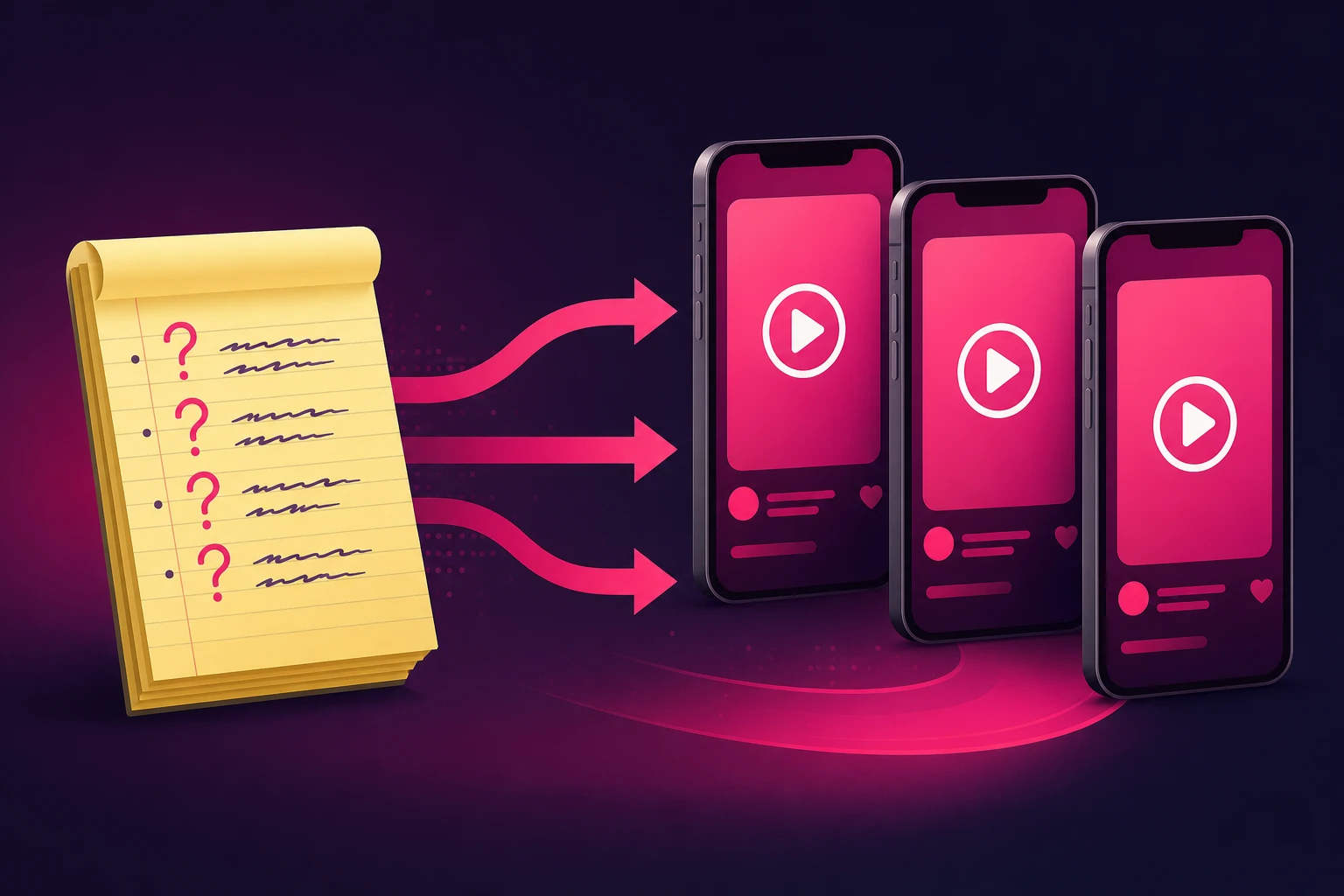
The reason most accountants quit posting is not the filming. It is sitting down on Sunday night with no idea what to say. The fix is to stop generating ideas and start capturing them. Your work week already produces more content than you can post - it just evaporates unless you write it down.
Keep one running note on your phone. Five capture points fill it, none of which require a single piece of client information:
- The first-call question log. Every question someone asks before they become a client, written down verbatim. These are the purest content ideas you will ever get, because someone cared enough to ask before paying anything.
- The recurring-mistake note. The same error you fix on the fortieth return in a row. If you correct it constantly, thousands of people are making it right now and none of them know.
- The "I had to explain this again" moment. Any time you catch yourself giving an explanation you have given a hundred times, that is a video. The fact that it is boring to you is exactly the signal - it means you have the explanation polished.
- The rule-change reaction. Anything that lands in your professional inbox that a normal person would find alarming or confusing. Your newsletter is a content queue.
- The overheard myth. Whatever confidently wrong thing you heard someone say this week - at a party, in a group chat, in your own comments. Free, pre-validated, and shareable.
Then batch. Pick one ninety-minute block - a Friday afternoon in the off-season is ideal - set up the phone once, and film ten to fifteen answers back to back in the same shirt. Do not change outfits or locations; nobody notices, and the whole point is to remove every decision that could stop you. Fifteen videos is five weeks of posting from one afternoon.
The rule that keeps this safe: a video should never be traceable to a person. "A client asked me" is fine when the question is generic and could have come from a thousand people. "A client came in last week with a restaurant on Fifth Street and a big problem" is not - and the exposure there is far more serious than embarrassment. See section 10 before you film anything drawn from real work.

5. The Demand Calendar: Why You Build in July for February
This is the section that matters most, and it is the one accountants get wrong almost universally. No other profession we cover has a demand curve this sharp - and the natural instinct, to start marketing when you feel the pressure, is backwards on every single count.
Consider what starting in January actually means. It is the period when you have the least time to film, the most competition for attention, and the highest advertising costs of the year. You would be launching a new skill during your busiest twelve weeks, against every other firm in the country, at peak prices. Meanwhile May through August is the exact inverse: you have capacity, almost nobody in your profession is posting, and attention is cheap.
There is a second, subtler reason. Content has a lag. A video does not deliver its audience the day you post it - it gets surfaced, saved, and re-surfaced for weeks or months, and the follower it earns in August is a person who watches you eleven more times before February. The decision to hire an accountant is also made before the deadline, not on it. Someone who realizes in November that this year got complicated starts looking then. If your library does not exist until January, you missed them.
The practical rule: publish sixty to ninety days ahead of the moment you want to be hired for. Here is what that looks like across the year.
The accounting content year
- May - August: the build window. The most valuable months of your content year, and the ones everyone wastes. Batch aggressively, experiment with formats, find your lane, and bank a library. Nothing you do here is urgent, which is exactly why it works.
- June and September: quarterly estimates. Estimated payments come due four times a year, and two of those deadlines land squarely inside the build window - which makes them a content lane of their own aimed at the self-employed: who they actually apply to, what happens if you skip one, why the number feels arbitrary. This audience is small, highly commercial, and badly underserved.
- September - October: the extension deadline. An audience that is already anxious and already knows they need help. Explainers here convert unusually well because the intent is immediate.
- November - December: year-end planning, the highest-value window of the year. This is when advisory conversations actually happen, because it is the last moment anything can still be changed. Content published in October reaches people in exactly this window - and these are the clients worth the most to you.
- January - April: harvest, don't plant. Post from the library you banked. Keep the account alive with low-effort comment replies and busy-season personality clips, which perform beautifully precisely because everyone relates to being slammed. Do not try to learn a new skill now.
If you are reading this in the back half of the year, you are holding the best possible timing. If you are reading it in March, the honest advice is: post two comment replies a week to stay warm, and put a recurring block on your calendar for the first week of May. Starting then will outperform forcing it now.
6. A Posting Cadence That Survives Busy Season
Consistency beats volume, and a cadence you abandon in February is worse than a smaller one you keep. Design for your worst week, not your best one.
Off-season (May through December): three posts a week. That is one batching block a month. Three is enough for the algorithm to build a clear picture of your account and enough for you to learn what your audience responds to, without becoming a second job.
Busy season (January through April): one to two posts a week, entirely from the bank. If you filmed fifteen videos in each of your autumn batching blocks, you enter January with a library and you never have to think about it again until May. This single habit - banking before the crush - is what separates the accounts that survive their first busy season from the many that quietly stop in February and never restart.
Two additions that cost almost nothing. First, reply to comments daily, even during the crush; five minutes between calls, and it is the highest-return activity available because it both feeds the algorithm and feeds your content queue. Second, when something in your profession suddenly becomes news, break the schedule and post the same day. Timeliness is worth more than polish in that window.
For the underlying mechanics of consistency, watch-time, and how posting rhythm affects distribution, see the complete growth strategy guide.
7. The 90-Day Plan to Becoming Your Niche's Accountant
Ninety days is enough to go from an empty account to a small, genuinely valuable audience - as long as you resist the urge to talk to everyone.
Days 1-30: Pick the lane
The most important decision you will make is who you are for. "Accountant" is not a lane. "The accountant for freelancers and creators," "taxes for restaurant owners," "bookkeeping for trades and contractors," "the CPA for real-estate investors" - those are lanes. Narrowing feels like giving up audience, and it is the opposite: it tells the algorithm precisely who to show you to, and it tells a business owner "this person already understands my situation" before you say a word. It is also how you compete with a national firm from a spare bedroom.
Then mine forty questions from your log, film in two batches, and post three times a week. Judge nothing yet. The first month is for building the habit and finding your camera voice, which is simply the voice you already use with a client who is embarrassed to ask.
Days 31-60: Find the series
By now one or two videos will have clearly outperformed. Do not treat that as luck - treat it as instruction. Turn the winner into a series: "things you think are deductible but aren't, part 7" compounds in a way that seven unrelated videos never will. Viewers follow series, not accounts, and each installment pulls people back to the earlier ones.
This is also when you start the comment-reply habit in earnest. By day sixty most accounts that post consistently have their content problem permanently solved, because the audience is now generating the queue.
Days 61-90: Make it easy to hire you
Only now is it worth optimizing conversion, because only now do you have people to convert. Three things: a bio that names the niche and the location ("CPA for creators & freelancers - Austin, TX"), a pinned trio at the top of your profile, and an inquiry path exactly one tap away.
The pinned trio that works best for accounting practices:
- Your best-performing explainer - proof that you are worth listening to.
- A short "who I help" video - the niche, what you do, and what working with you actually looks like.
- Your most reassuring video - the one that makes someone who is behind, scared, or embarrassed feel like they can call you anyway. This one quietly does more converting than the other two combined.
Day ninety is also the earliest point at which paid amplification makes sense, because you now have organic performance data telling you which video deserves it. More on that in section 9.
8. The Engagement Ladder: Turning Viewers Into Recurring Clients
Views are not the product. A signed engagement that renews for six years is the product. Here is the path between them, one rung at a time - and where each rung usually breaks.
- Viewer. Someone watches one explainer. Breaks when the video opens with your credentials instead of their question.
- Follower. They follow because you made something confusing feel manageable. Breaks when your account has no discernible lane, so there is nothing to follow for.
- Trusting business owner. Weeks of content later, you are the person they think of when money gets complicated. Breaks when you post three times and stop.
- Inquiry. A DM, a comment, or a link tap - usually triggered by an event, not by a video: a first 1099, an LLC formed, a letter from the IRS, a business that suddenly got real. Breaks when there is no obvious next step in your bio.
- Discovery call. The conversation where fit gets established. Breaks on response time - an inquiry answered in two days is a different business than one answered in two weeks, especially near a deadline.
- Signed engagement. They become a client. Notice how much less selling this took than a cold lead: they have already watched you think for two months.
- Renewal and referral. The rung that makes this profession different. Every other vertical's ladder ends at the sale. Yours restarts annually - and a client acquired through content tends to refer well, because they found you by watching you explain something and that is exactly how they will describe you.
Two practical notes. First, expect inquiries to be lumpy and event-driven rather than evenly distributed - the person who followed you in September contacts you the week they get a notice, and that lag is normal, not failure. Second, be explicit in your bio about what you take on and where, because a stream of inquiries you cannot serve is exhausting; naming your niche and whether you work locally or remotely filters gently and early.
For the underlying local-discovery mechanics that help any practice serving a specific metro, see our local business TikTok marketing guide.
9. When Paid Promotion Books Clients vs. Burns Budget
Paid promotion on TikTok is not advertising in the way accountants usually think about it. It is not buying attention for a message nobody asked for - it is taking a video that has already earned attention and showing it to more of the right people. That distinction decides whether the money works.
The proven-video rule: only promote videos that have already performed organically. Strong completion rate, real saves and shares, and a visible bump in profile visits. Promotion amplifies signals the algorithm is already reading. It cannot manufacture interest in a video people scroll past - it just buys you a larger audience of people scrolling past.
The timing rule, which is specific to your profession: amplify ahead of the season, not during it. Promoting a year-end planning explainer in October, or a self-employment explainer in the weeks before an estimate is due, reaches people while they are deciding and while competition for that attention is low. Promoting the same video in March means paying peak prices to reach people who have already chosen someone.
The math is unusually forgiving here, and it is worth doing explicitly. Take the same client from section 1 - $1,200 a year, six years, $7,200 in lifetime revenue. Against a number like that, a modest promotion budget on a proven explainer does not need a remarkable conversion rate to pay for itself many times over. That is the practical consequence of recurring revenue: your break-even is not one transaction, it is a fraction of one relationship. Very few businesses get to run that math.
Two honest cautions. Promotion multiplies what already exists, so if the video converts poorly, more views produce more of nothing - fix conversion before you spend. And your professional advertising obligations follow you into paid placements: promoted content is advertising, so the same rules on false or misleading claims, guarantees, and required disclosures apply. Confirm compliance with TikTok's ad policies and your own governing rules before you spend anything.
The format worth defaulting to is Spark Ads, which promotes your existing organic post rather than a separate ad creative - so the engagement accrues to your real account and the video keeps looking like content instead of a commercial. Our Spark Ads guide walks through the setup.
10. Confidentiality, Compliance, and the Mistakes That Cap Accounting Accounts
The reason most accountants never start is a vague fear of doing something they are not allowed to do. That fear is worth replacing with a short, concrete list - because once you know the actual lines, the space inside them is enormous.
Client information is the bright line, and it is brighter than most people realize. If you prepare tax returns, the use and disclosure of taxpayer information is governed by Internal Revenue Code Section 7216 and its regulations, which require specific written consent and carry criminal as well as civil exposure. This is meaningfully stricter than the general professional-confidentiality intuition most people operate on, and "I changed the details" is not a safe harbor. The practical rule for content: build videos from general rules and your own commentary, never from a client's facts.
Know which rulebooks apply to you. Practitioners who represent clients before the IRS are subject to Circular 230, which includes restrictions on advertising and solicitation. CPAs are additionally bound by the AICPA Code of Professional Conduct - including its confidentiality provisions and its prohibition on false, misleading, or deceptive promotional activity - and by their state board's rules, which also govern who may use the CPA title and in which states. Bookkeepers and unenrolled preparers have a different set of obligations, but the advertising-honesty principle is universal.
Never guarantee an outcome. "We'll get you the biggest refund" and "I can get your tax bill to zero" are the two claims most likely to cause you a problem, and they attract precisely the clients you least want. Describe what you do, not what you promise the result will be.
Redact ruthlessly, and treat your screen as public. The single most common real-world slip in this niche is not a spoken disclosure - it is a screen share where a client name, an EIN, or a document sits visible in a sidebar for two frames. Use a demo file with invented data. Close the other tabs. Watch the footage back before it goes up.
Say what your videos are. A short, plain statement that your content is general information and not tax advice for anyone's specific situation, and that watching does not make someone a client, costs you nothing and prevents the most likely misunderstanding. Say it out loud occasionally rather than burying it in a caption nobody reads.
Disclose partnerships. If a software company pays you to mention their product, that is an ad and it needs to be labeled clearly. Your audience is unusually sensitive to this, because trust in your judgment is the entire product.
A necessary caveat: this is a general overview for planning purposes, not professional or legal advice. Your specific obligations depend on your credential, your state board, whether you practice before the IRS, and what you actually do for clients. Confirm the details against your own governing rules - and if you are unsure about a particular video, the fastest resolution is usually a five-minute question to your professional liability carrier or state society before you post, not after.
The four mistakes that cap accounting accounts
- Posting the firm instead of the person. Logos do not build trust; faces do. The account should look like a human being who happens to run a practice, not a practice that occasionally posts.
- Speaking in professional register. If a sentence contains "pursuant to" or a code section number, rewrite it the way you would say it to a client who is nervous. Precision matters; jargon is not precision.
- Teasing instead of answering. Withholding the answer to force a call destroys completion, which destroys reach. Give it away.
- Starting in January. Covered at length in section 5, and it is the most expensive mistake on this list, because it usually ends in quitting by March and concluding that the platform does not work for accountants.
Frequently Asked Questions
Is TikTok worth it for accountants in 2026?
For most client-facing practices, yes - and the reason is the math nobody talks about. An accounting client is not a sale, it is an annuity. A tax-and-bookkeeping relationship worth $1,200 a year that lasts six years is $7,200 of revenue from one person, and advisory retainers are multiples of that. Because of this, you do not need a large audience. You need a few hundred of the right business owners to trust you. Meanwhile the questions that would grow that audience - can I write this off, why do I owe this year, should I be an S-corp - are ones people ask you for free constantly. The supply of content is already sitting in your inbox.
What should accountants post on TikTok?
Six formats grow accounting accounts fastest in 2026: the write-off verdict (can you actually deduct this, and the real rule behind the answer), the myth-bust (correcting confident tax misinformation people repeat), the why-you-owe explainer (what actually happened on a return, in plain language), the comment-reply Q&A (answering real money questions on camera), the rule-change reaction (explaining something everyone is already arguing about), and the personality clip (the human behind the spreadsheet). The mistake most firms make is posting deadline-reminder graphics and stock-photo announcements, which nobody watches and nobody saves. Education earns the reach; personality earns the inquiry.
Can accountants post on TikTok without breaking confidentiality rules?
Yes, and the safest content engine requires no client information at all. The hard rules: never use or disclose taxpayer information without the written consent the regulations require - for tax return preparers this is governed by Internal Revenue Code Section 7216, which carries criminal as well as civil exposure, so "I anonymized it" is not a defense. Beyond that, follow Circular 230 if you practice before the IRS, the AICPA Code of Professional Conduct on confidentiality and on false or misleading advertising, and your state board rules, including who may use the CPA title. Never guarantee a refund amount or an outcome, state that videos are general information rather than tax advice for a specific situation, redact ruthlessly before any screen share, and disclose paid partnerships. General tax education needs none of a real client's facts, which is exactly why it is the safest lane to build in.
When should an accountant start posting - before or during tax season?
Before, and it is not close. Accounting has the sharpest demand curve of any professional service, and the instinct to start in January is exactly backwards. In January through April you have the least capacity to film, the most competition for attention, and the highest advertising costs of the year, because every firm in the country is bidding at once. May through August is the opposite on all three counts. Content also needs runway - videos get discovered, saved, and re-surfaced for months, and the decision to hire an accountant usually happens weeks before a deadline, not on it. The practical rule: publish sixty to ninety days ahead of the moment you want to be hired for.
Should accounting firms pay to promote their TikTok videos?
Only videos that have already proven themselves organically - strong completion, real saves and shares, and a visible bump in profile visits. Paid promotion amplifies signals the algorithm is already reading; it cannot rescue a video nobody finishes. For accounting the case is unusually strong for two reasons: client value is recurring, so one converted viewer pays back over years rather than once, and the timing lever is real - amplifying a proven explainer in October or November costs far less than competing in the Q1 bidding war for the same person. Services like Viryze are built around this kind of selective amplification, promoting a proven video to the right audience instead of boosting every upload. Confirm promoted content complies with TikTok ad policies and your professional advertising rules first.
Ready to turn your best explainer into signed clients?
The accounting practices growing fastest in 2026 pair a simple question-log content system with selective paid amplification on their best videos - timed ahead of the season rather than during the scramble. Viryze is built for exactly that: we only promote videos that have already cleared the organic signal threshold, so your budget compounds your best work instead of rescuing your weakest. And because your clients renew, every engaged follower you gain is a relationship that can pay back for years, not once.
See how selective amplification worksRelated Reading
- The Complete TikTok Algorithm Guide - the ranking signals that decide which explainers travel.
- The Complete TikTok Growth Strategy Guide - cross-niche fundamentals that apply to any professional account.
- Local Business TikTok Marketing - the local-discovery mechanics that help any practice serving a specific metro.
- TikTok Spark Ads Guide - the format worth defaulting to for amplifying a proven post.
- TikTok for Lawyers & Legal Professionals - the closest parallel playbook: regulated, trust-driven, and education-first.
- TikTok for Small Business - useful context on the audience most accounting practices are trying to reach.
- TikTok for Finance Creators - the adjacent creator-side playbook if you want to build an audience beyond your client roster.

Head of Creator Success at Viryze
TikTok growth strategist helping creators reach their first 100K followers through data-driven promotion strategies.