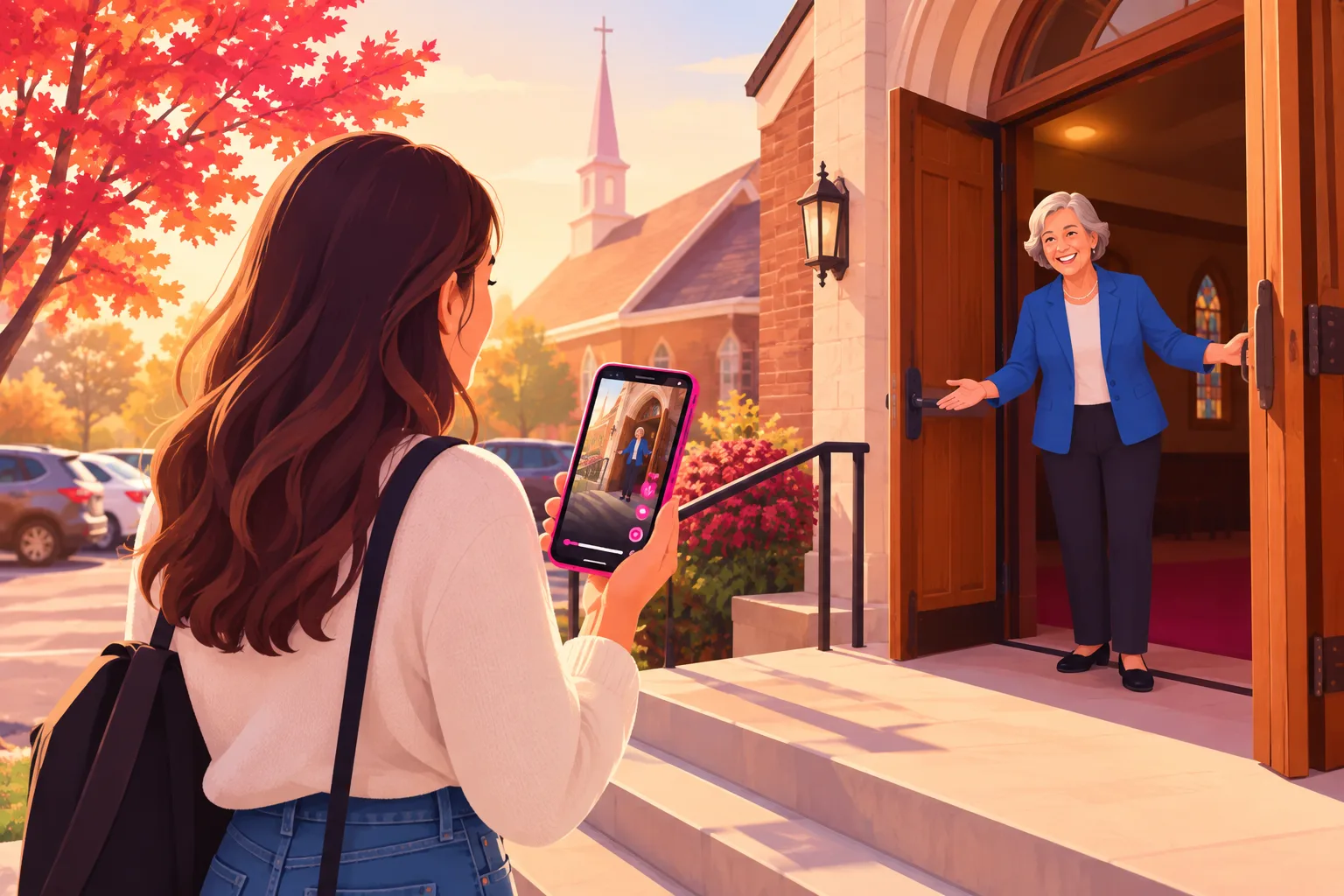
A view is a stranger watching your greeter hold a door open for eleven seconds. A visitor is a person who got out of her car on a Sunday morning, in a parking lot she has never seen, and walked toward a building full of people who already know each other. Nothing about the first automatically produces the second.
The gap between them is not a content problem. It is a chain of small decisions made by one nervous person over several weeks - to follow, to tap the profile, to open the plan-a-visit page, to come, to come back - and a church can build every link of that chain before it posts another video. Most never do. They post a sermon clip, get four thousand views, see nobody new on Sunday, and tell the elders that TikTok does not work for churches.
It does, but only when you build the ladder. Pew Research found that 85 percent of Americans who have looked for a new congregation attended a service in person before deciding, and that feeling welcomed by clergy and lay leaders mattered to 79 percent of them - nearly as many as cared about the sermons. The video does not replace the visit. It decides whether the visit happens, and whether the welcome it promised is the one she gets.
This is spoke six of the church series. It assumes the pillar guide's two congregations - the room and the feed - and it is entirely about the room: the door path, measured in first-time guests and second Sundays. The growth roadmap tells you how to earn the local followers; this guide is about what happens to them next.
What's Inside
- 1. Why Views Don't Fill a Pew
- 2. The Guest Ladder: Nine Rungs From Viewer to Belonging
- 3. Rungs 1-3: The Share Is the Invitation
- 4. Rung 4: Your Profile Is the Front Door
- 5. Rung 5: The Plan-a-Visit Page, Part by Part
- 6. Rung 5, Continued: The Three Messages and the Reply for Each
- 7. Rung 6: The First Sunday Has to Match the Video
- 8. Rungs 7-8: The 48-Hour Note and the Second Visit
- 9. Rung 9: Belonging, Months Later
- 10. High-Intent Content: The Videos That Actually Produce Guests
- 11. Dignity, Privacy, and Consent at the Door
- 12. Tracking: The Three Numbers and the Sentence That Wins the Board
- 13. Amplify the Walk-Through That Already Brings Guests - in Lent and Advent
- Frequently Asked Questions
1. Why Views Don't Fill a Pew
Start with the size of the thing you are trying to do. The Faith Communities Today study put the median U.S. congregation at about 65 people in worship, with roughly seven in ten churches at 100 or fewer. At that size, one new family who stays is a visible change to the room. You do not need a viral video. You need a handful of households within a Sunday-morning drive to decide, over a few weeks, that your door is the one they can walk through.
That decision is made in what the pillar guide calls the parking-lot minute. The person sitting in her car is not asking whether your theology is sound or your worship is good. She is asking what will happen to her if she walks in. Where is the door? Will someone make her stand up? Are jeans okay? Where do the kids go, and who are the adults in that room? Will anyone ask her for money? Will she have to explain where she has been for twenty years?
Every one of those questions can be answered in a sixty-second video, and almost no church answers them. The sermon clip answers a question she is not yet asking. The event flyer answers nothing. The verse over a sunset is for people who already belong. So the views pile up on the feed side of the account while the door stays exactly as frightening as it was.
The second leak is that churches measure the wrong end of the chain. A view is free and instant; a visit is weeks later and arrives on foot. If the only number anyone looks at is the view count, the account drifts toward the videos that travel - which, for churches, means the warning clip and the national pulpit - and away from the plain local videos that put people in the room. The growth roadmap covers the two scoreboards; this guide is the door-side scoreboard worked all the way down to the connect card.
The third leak is the one this guide spends the most time on: the church gets the visit and loses the visitor. She came on Easter. Nobody got her name, or someone got it and sent a form letter, or nobody showed her what an ordinary Sunday looks like. By the second week of April she is gone, and the church concludes the Easter crowd never sticks. It does not stick because nobody built the rung it needed to stand on.
2. The Guest Ladder: Nine Rungs From Viewer to Belonging
We call the path the Guest Ladder. The pillar guide introduces it; this guide is about repairing it. Each rung is a separate decision one person makes, and each has its own way of failing:
- The view - she watched one walk-through or one "why we do that" to the end. She knows nothing about you except that the greeter seemed kind. The only job is to be worth another sixty seconds, which means opening on the welcome and never on the warning.
- The follow - she followed because there was a series to follow for: "What to expect," "Why we do that," "Ask the pastor." A follower sees four Sundays before she comes to one. The failure is an account with no lane - a sermon clip, then a flyer, then a graphic with a logo.
- The send - a member shares the video with the friend who said "I wouldn't know what to do." This is the invitation, and it is the rung that matters most. The failure is a video that is too long, too inside, or too preachy to forward to someone you love.
- The profile visit - she taps your name. Town, service times, one sentence, one link. If the bio says "a community of believers" and nothing else, the climb ends here.
- The plan-a-visit page, and the message - time, address, parking, kids, dress, length, and a named person. Some people will not tap the link and will message you instead: "is it okay if I come alone?" This is the first rung you can measure directly, and the most fragile.
- The first visit - counted on the connect card, greeted by the named person, not singled out from the front, not handed a pledge card, not followed to the parking lot. This rung belongs to your greeters and your kids' check-in, not to your camera.
- The 48-hour follow-up - a text or a short handwritten note from a real person. One sentence of thanks, one invitation to next Sunday. This is the rung where most churches lose most of the guests they worked for, and the cheapest one to fix.
- The second visit - the real conversion. Easter crowds vanish because nobody built this rung. The video that earns it was filmed on the visitor day itself: "here is what next Sunday looks like."
- Belonging - a small group, a serving team, a membership class, and months later a first gift. Never asked for on the first rung, and never the subject of a video aimed at guests.
Two things follow from this shape. First, you cannot skip rungs. A video that tells first-time viewers to "come Sunday, join a group, get baptized, serve" is demanding rung-nine behavior from rung-one people, and it trains the audience to hear every video as a recruitment pitch.
Second, your worst rung caps everything above it. A church with a beautiful walk-through and no plan-a-visit page converts fewer guests than a church with a shaky phone video and a page that says "ask for Dolores at the main doors, blue jacket." A church with great greeters and no 48-hour note loses the family it just welcomed.
Before you make another video, walk the ladder yourself. Open your account in a private browser window as if you were a 31-year-old in your town who has not been inside a church since her grandmother's funeral, has watched your walk-through twice, and is thinking about this Sunday. Where exactly does she get stuck?
3. Rungs 1-3: The Share Is the Invitation
Lifeway Research has found that roughly a third of unchurched Americans say they would attend a church if a friend invited them, and more than half say an invitation from a family member would be effective. The bottleneck in church growth has never been the willingness of the unchurched to come. It is that members do not invite, and they do not invite because they do not have the words. "You should come to my church" sounds like a pitch and feels like a risk to a friendship.
A sixty-second walk-through is the words. The member does not have to explain anything. She forwards a video and types "this is the one I go to - this is what it's like." The friend watches it alone, at her own pace, with no one looking at her face for a reaction. That is why the pillar guide insists that you count sends, not views: a video with 900 views and 40 sends did more for your room than one with 40,000 views and 12.
So the first three rungs - the view, the follow, the send - are earned by making videos a member would be comfortable forwarding to someone she loves. That rules out more than you might expect:
- The warning clip. The scolding excerpt about the culture, the other denomination, the people who do not come. It travels, and it fills the comments with people who came to argue, but nobody forwards it to a friend who is scared of being judged. It also trains the algorithm to show your kind videos to the fight crowd. Conviction can be the fourth sentence of a video; the first sentence is the door.
- The full service in chunks. Nobody sends a friend a nine-minute clip. Thirty seconds, one idea, the pastor looking at the camera from a tripod at the front.
- The inside joke. The potluck reference, the nickname for the fellowship hall, the running bit with the worship leader. It makes members feel at home and makes the outsider feel like one.
- The video that asks. Anything that ends with "join us," "give," or "sign up." The member forwarding it would be making the ask on your behalf, and she will not.
What members do send: the walk-through from parking lot to coffee, the greeter who has been at the door since 1987 explaining what she does when someone looks lost, the "why we do that" about communion or the water in the font, the question answered from the DMs - "can I come if I'm not sure what I believe?" - and the church between Sundays: the pantry on Tuesday, the funeral meal team, the youth game night. Kind, short, specific, and about what it is like to be there.
Make sending easy on purpose. End the walk-through with a line a member can borrow - "if you know someone who has been meaning to come back, this is the one to send them" - and say the town out loud in the first five seconds, because the member in Harlan is forwarding it to a friend in Harlan, and the friend needs to know in one breath that this is a church she could actually drive to. The content ideas guide sorts fifty concepts into door-path anchors and feed-path travelers; the anchors are the sendable ones.
4. Rung 4: Your Profile Is the Front Door
When the friend finishes the video, she taps your name. Your profile has about four seconds to answer three questions: where is this, when is it, and what do I do next. Most church profiles answer none of them, because they were written for people who already belong.
The display name is the church's name and the town: "Grace Church, Harlan." Not the pastor's name, not a slogan. The town is the single most important word on the profile, because it tells a local she can come and tells someone three states away that this is a church to follow, not to attend.
The bio is one plain sentence about what Sunday is like, then the service time, then the next step. "A small church where nobody will make you stand up. Sundays at 10. Planning a visit? Link below - ask for Dolores at the door." Every word was written for the person in the parking lot.
The link goes to the plan-a-visit page, not the homepage, not the sermon archive, and - outside stewardship season - not the giving page. The person tapping it is a would-be guest. Asking her for money before she has parked is the fastest way to confirm the thing she was afraid of. The giving guide explains when the link swaps and how giving sits one tap inside the visit page the rest of the year.
The pinned videos are the walk-through, the "what will not happen to you" explainer, and whichever seasonal video is live - the Christmas Eve walk-through from the first week of December, the Easter one from the middle of Lent. The pins are the front hall; they should look like the room she is about to enter.
Three mistakes end the climb at this rung. The pastor-only account, where the profile is the pastor's name and the bio is a list of credentials, so a visitor cannot tell what church this is or whether she can attend it. The mission-statement bio, which tells her what you believe about yourselves and nothing about what Sunday morning is like. And the dead link - a homepage with a carousel, a sermon podcast, or a page that has not been updated since the service time changed. Check the link from a phone, as a stranger, once a month.
5. Rung 5: The Plan-a-Visit Page, Part by Part
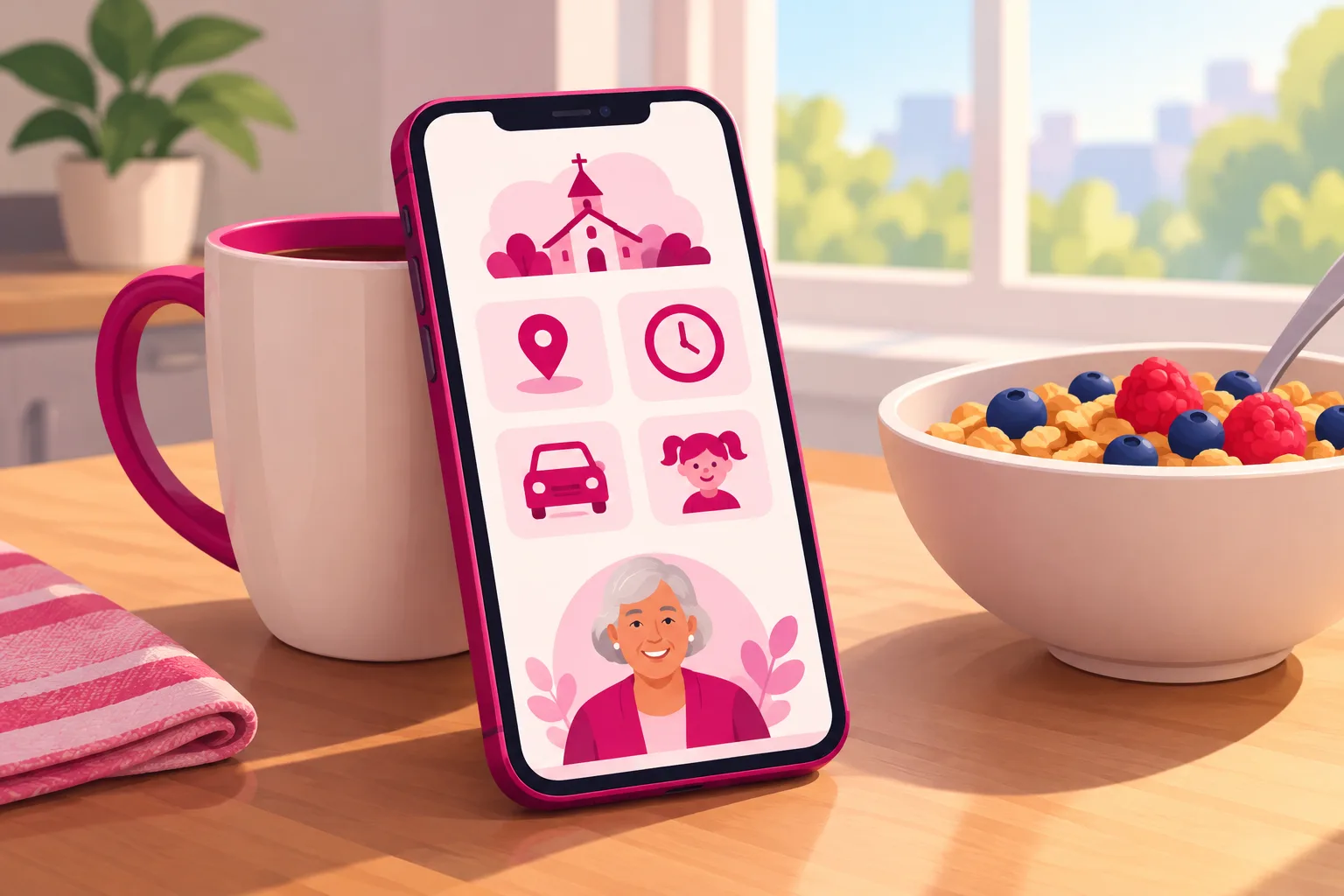
The plan-a-visit page is the single highest-leverage thing a church can build for its TikTok account, and it costs nothing but an afternoon. It is one page on the church's own website, written for a nervous stranger, in the order she needs the information. Pew found that location mattered to 70 percent of people choosing a congregation and the children's programs to about two-thirds of parents; this page is where those questions get answered before Sunday. Here is the anatomy, in order:
- The time, and the length. "Sundays at 10. The service runs about 70 minutes; most people are out by 11:20 and a lot of them stay for coffee." She is planning her morning, and she wants to know when she can leave without it being noticed.
- The address, the map, and the door. Which door. If your building has three, say "the red doors facing Main Street," and put a photo of them on the page. The walk-through video should begin at the same doors.
- Parking. Where, whether it fills up, whether someone will be outside waving people in. "The lot behind the building; Earl is out there in an orange vest and he will point you to a spot." This is also where the walk-through's first shot is taken.
- Kids. The question under every parent's hesitation. Where the nursery is, which ages, who the adults are and that they are screened, how check-in works, and - most important - that children are welcome to stay with their parents in the service. Say it plainly: "if your kids make noise, you are in good company."
- Dress. Answered honestly. If most people wear jeans, say jeans. If some people wear suits and some wear jeans, say that. The wrong answer is "come as you are," which tells her nothing and makes her guess.
- What will not happen to you. This is the paragraph most churches leave out, and it is the one she is looking for. "You will not be asked to stand up or introduce yourself. You will not be asked to give - if it is your first Sunday, you are our guest. Nobody will follow up unless you leave a number and ask us to."
- The named person. A real name, a real face, and where to find her. "Ask for Dolores at the main doors - blue jacket. She has been greeting people here since 1987 and she has never once made anyone feel like they were late." This one line converts better than any sentence about your mission, because it replaces an institution with a person.
Below all of that, an optional form with two fields: a first name and a phone number or email, plus one question - "how did you hear about us?" - with TikTok as a checkbox. Make clear what filling it in does: "Dolores will know to look for you, and we will send one text the week after to say thanks. That's it." The form is how you count, but the page has to work for the person who never fills it in, because most will not.
Two things the page must not contain: a giving button above the fold, and a doctrinal statement. Both belong on the website; neither belongs between a frightened person and the door. And one thing it must: the service times kept current. Put the Christmas Eve times up by Thanksgiving and the Easter schedule up by the middle of Lent, because the person tapping the link in Advent is planning for December 24, not for an ordinary Sunday.
6. Rung 5, Continued: The Three Messages and the Reply for Each
No matter how clearly the bio says "link below," people will message you. For a church, those messages come in three kinds, and you need a saved reply for each before the first one arrives - plus one named person who owns the inbox, including on Friday night. The written social media policy names that person and says what she may answer without asking.
Message one: the plan-a-visit DM. "Is it okay if I come by myself?" "I have a four-year-old who does not sit still." "I'm not sure I believe any of it anymore - is that a problem?" This is a person at rung five asking for permission to come to rung six. The reply is warm, specific, and gives her the named person:
"I'm really glad you asked - yes, and you would not be the only one. Plenty of people come alone, and plenty of people come who are not sure what they believe; nobody is going to quiz you. Sundays at 10, the red doors on Main Street, and the lot behind the building. Ask for Dolores at the door - blue jacket - and tell her you messaged; she will show you where the coffee is and where to sit if you would rather be near the back. You will not be asked to stand up or to give. If you want to, you can plan it at the link in our bio, but you don't have to - just come."
Then make the question a video. "Can I come alone?" answered by Dolores at the door is the question-answered format from the pillar guide, and it is the one that proves the welcome - the viewer sees that a real person asked and a real person answered kindly. Never reference the asker; the question is common enough that it belongs to everyone.
Message two: the prayer request. It will arrive within the first month, from a stranger in a hard week, often late at night. This is the message a church inbox exists to receive, and it is also the one a social inbox was never built for. Reply as a person, not as an account:
"Thank you for trusting us with this - a real person has read it, and I am going to pray for you tonight and again on Sunday. If you would like Pastor Ann to call you tomorrow, reply with a number and she will. If you are nearby and would ever want to just sit in the back on a Sunday, you are welcome, no questions. And if things feel unsafe right now, please call or text 988, the Suicide and Crisis Lifeline - they are there all night, and we will still be here tomorrow."
Three rules, none negotiable. The request is never content - not reposted, not referenced in a video, not anonymized into an illustration. The inbox does not hold a pastoral conversation; the reply moves it to a phone call the same day with a human. And if the message describes a crisis, the reply always ends with a way to get help right now and a person who follows up. Write this reply once, with your pastor, before the first video goes up, and put a copy in the policy.
Message three: the out-of-area follower. "I love your videos - I wish I could come but I'm in Oregon." This is a feed-path person at a door-path account, and the reply does two things: it thanks her honestly, and it helps her find a door she can actually walk through.
"That means a lot - thank you for being part of this from Oregon. You are welcome to keep watching Sundays with us online, and the 'what to expect' videos work for any church, not just ours. If you ever want to find one near you, look for the church in your town that will tell you where to park and who will be at the door - and if you want, tell me the town and I will see if we know anyone."
A fourth kind of message exists, and the policy handles it in one line: the person who came to argue. "We do not debate in the comments" - a kind, single reply offering a real conversation by phone, and then nothing more. The parking-lot person is reading your replies to see whether you are safe to disagree with, and the way you treat your critic is the clearest answer you will ever give her.
7. Rung 6: The First Sunday Has to Match the Video
The walk-through is a promise. Rung six is where you keep it, and the camera is nowhere in the room. If the video showed Earl in the orange vest, Earl needs to be in the lot. If it showed Dolores at the red doors, she needs to be at the red doors, and she needs to know that someone might say "I messaged on TikTok" and what to do when they do - which is to say "oh, I'm so glad," walk them to the coffee, point out where the kids' check-in is, and offer to walk them there.
Four things must not happen to a first-time guest, and the plan-a-visit page already promised they would not:
- Being singled out from the front. No "if you are visiting today, please stand so we can welcome you." No "we saw you on TikTok!" from the pulpit, however warmly meant. The welcome is personal and quiet, or it is a spotlight.
- Being asked for money. The offering explainer from the giving guide exists for this moment: "if it's your first Sunday, you are our guest and we don't expect you to give." Said once, from the front, every week.
- Being followed to the parking lot. One warm goodbye at the door. Nobody walks her to the car, nobody asks whether she will be back, nobody hands her a packet.
- Being surprised by the kids' room. The check-in has to work the way the page described it - the same ages, the same adults, the same option to keep the children with you. A parent who was promised one thing and found another does not come back, and does not say why.
The one thing that must happen is the connect card, because it is how the church counts and how it follows up. Keep it to a card in the pew or a short form on the kids' check-in tablet: first name, how to reach you if you want us to, and "how did you hear about us?" with a TikTok box among the options - a friend, drove past, online search, TikTok, Facebook, other. The greeter mentions it once, lightly: "if you want us to know you were here, there's a card in the pew - no pressure either way."
That TikTok checkbox is the most important data field in this whole guide. Without it, you will never be able to say how many guests the account produced, and the board will go on believing the Easter mailer did it. With it, the volunteer who runs the account can write the monthly report the growth roadmap describes: plan-a-visit clicks, first-time guests who checked TikTok, and how many came back.
On the visitor days - Easter, Christmas Eve, the Sunday after a funeral the whole town attended - the connect card matters most and gets filled in least, because the room is full and the greeters are overwhelmed. Plan for it: two extra greeters at the doors, the card mentioned from the front in the same breath as the guest sentence, and a QR code on the screen that opens the same form. Then film the follow-up video that afternoon, which is the next section.
8. Rungs 7-8: The 48-Hour Note and the Second Visit

If you fix exactly one thing from this guide, fix this one. Church-growth consultants have repeated for years that the odds of a return visit fall sharply with every day that passes before a personal contact. The specific percentages that circulate come from consulting experience rather than controlled research, so we will not quote them - but every church that tracks its own guests finds the same shape, and so will you.
The follow-up that works is small, fast, and from the person who met them. Within 48 hours - Monday evening is the natural slot - the guest gets one of two things:
- A text, from the greeter's or the kids' director's own phone, not from a church number. "Hi Megan, it's Dolores from Grace - it was so good to meet you and the kids yesterday. No reply needed. Same time next Sunday if you feel like it." Two sentences and a door left open.
- A handwritten note, if they left an address, in a plain card, from the same person. The giving guide describes the handwritten thank-you for a first gift; this is the same card, months earlier, for a first visit. One sentence of thanks, one invitation, a signature.
What the follow-up is not: a form letter with the pastor's printed signature; a welcome packet with a giving envelope in it; a phone call from a committee member who was not there; an email sequence; or a home visit, which should happen only when a guest has asked for one. Every one of those turns a kindness into a process, and the guest can tell.
Then the second visit, which is the real conversion. A guest who comes twice has decided your door is one she can walk through; a guest who comes once has decided nothing yet. Three things earn it:
- The first Sunday matched the video - the previous section.
- The 48-hour note - above.
- The "here is what next Sunday looks like" video, filmed on the visitor day itself. On Easter afternoon, while the lilies are still out, one volunteer films 45 seconds: "If today was your first time with us - thank you. Next Sunday is a regular Sunday. Same time, same doors, Dolores will be there, about a third as many people, and the small group for people who are new starts the Sunday after. Here is what it looks like." Post it Tuesday. Send it to every guest who left a number.
The Easter crowd vanishes because the church shows them the best day of the year and then nothing. The second-Sunday video closes that gap: it tells the guest that the ordinary Sunday is also for her, and it tells her exactly what to expect, which is the only thing she ever wanted to know. Film it on Christmas Eve too, and on any Sunday when the room is unusually full of strangers.
9. Rung 9: Belonging, Months Later

After the second visit, the account's job is mostly done, and the congregation's begins. Belonging is a small group, a serving team, a membership class, a child in the Christmas pageant, a name on the funeral meal roster. It takes months, it is built by people rather than videos, and the only thing the account can do to help is to keep showing the church between Sundays, so that the guest who is now a regular can see the places she might fit.
Giving sits on this rung and nowhere earlier. The giving guide's honest rule is that members give and followers mostly do not, which means the first gift arrives months after the first visit, from someone who already belongs, and is never asked for on rung one. A church that puts a giving ask in front of guests is spending its second-visit rate to collect a few dollars it would have received anyway, later, from the same people.
Two things the account can do at this rung. First, the "why I stayed" story, told with consent by someone who came as a guest a year or two ago - the story form from the pillar guide, last on purpose, filmed only when the person wants to tell it and would be glad to see it in five years. Second, the new-group announcement done as a walk-through rather than a flyer: "the group for people who are new meets Tuesday at 7 in this room, these are the two people who lead it, here is what the first night is like." Every step toward belonging has its own parking-lot minute, and the same video solves it.
And the rung produces the next rung-three person. The family that came from a sent video at Easter, came back in April, joined a group in September, and now forwards your Christmas Eve walk-through to their neighbors is the ladder working as designed - the invitation, passed along by someone who remembers what it was like to need one.
10. High-Intent Content: The Videos That Actually Produce Guests
Not every video is meant to produce a visit, and the account needs plenty that are not - the sermon clip, the explainer, the between-Sundays footage that keeps followers following. But a handful of videos are made specifically for the person at rung four or five who is deciding about this Sunday, and they deserve to be made carefully and pinned.
- The walk-through, one per entry point. Parking lot to coffee, sixty seconds, no music, the town said in the first line. Then the same route filmed for the family with young kids (ending at the check-in desk, from the parent's side of it), for the teenager coming alone (where the youth sit, who the adults are), and for the person who has not been in twenty years ("here is what has changed and what hasn't"). Four videos, four fears, one route.
- "What will not happen to you." The plan-a-visit paragraph spoken by the greeter at the door: no standing up, no being asked to give, no one following you to the car. This is the most-saved video a church account can post, and the one most often forwarded with "see?"
- The question answered. One real question from the DMs or the door, answered in forty seconds by the person who would actually handle it. "Can I come alone?" by Dolores. "What if my toddler screams?" by the kids' director. "What if I cry?" by the pastor. Each one proves the welcome in a way no promise can.
- The "why we do that" for the moment that worries newcomers most. Why everyone stands at a certain point, what communion is and whether a guest takes it, what the water in the font is for, what happens when the offering plate comes by. The liturgy is a wall until someone explains it; then it is one of the reasons people stay.
- The seasonal walk-through. The Christmas Eve service from the first week of December - candles, length, when it ends, whether kids are welcome at the late service, the parking plan - and the Easter one posted two to three weeks before, in the middle of Lent. Easter is March 28, 2027, so the Easter walk-through goes up around March 7. Advent begins November 29, 2026, and the Christmas Eve times belong in the bio by Thanksgiving.
- The second-Sunday video. Filmed on the visitor day, posted the Tuesday after, sent to every guest who left a number. The single most under-made video in church social media.
What these videos share: they answer a question the viewer is already asking, they are spoken by the person who will be in the room, and they are about what it is like to be there rather than what the church believes. Nothing in them says "come." They show the door open and let the viewer decide, which is the only invitation that has ever worked.
11. Dignity, Privacy, and Consent at the Door
The guest stage has its own rules, and most of them are about what the camera does not do. The filming guide covers consent in full; these are the parts that bite specifically when a stranger walks in.
- The guest is never filmed. Not at the door, not in the pew, not at coffee, not in a wide shot that happens to catch her face. The lobby footage for the walk-through is filmed before the service, with volunteers who have signed the annual cast release, or from behind. A guest who sees herself on the church's account the week after her first visit does not come back, and she is right not to.
- The connect card is not content and not a mailing list. The name and number go to the one person who sends the 48-hour note and to the pastor, and nowhere else. No newsletter sign-up by default, no giving appeal, no sharing with a denominational office. The page promised one text; send one text.
- Her children are never filmed, ever, and not with a release either on a first visit - a parent who signed a form at check-in while juggling a diaper bag did not give informed consent to anything. The per-use parental release is for members, weeks ahead, for a specific video. The nursery, the check-in desk, and the classroom numbers are never on camera regardless.
- The prayer request is never content, and neither is anything a guest tells the pastor at the door. The "question answered" video uses questions common enough to belong to everyone, never a question that could identify the person who asked it.
- "We saw you on TikTok" is never said from the front. The guest's choice to come after watching is hers; naming it publicly makes her the subject of a story she did not agree to be in. The greeter may say it quietly, once, and only if the guest brought it up first.
- The person who said no. A guest - or a member - who asks not to appear is simply not on camera, without explanation or persuasion. A marked no-camera section in the sanctuary, mentioned on the plan-a-visit page, tells the nervous visitor she can sit there.
A necessary caveat: this is a general overview for planning purposes, not legal advice. Your obligations depend on your state's recording and privacy laws, your denomination's safeguarding policies, your insurer's requirements for anything involving children, and TikTok's current policies. The pillar guide's compliance section covers the content-stage rules; for anything specific, your attorney and your denominational office are the right call.
None of this is a reason to stay off the platform. It is a reason to spend one afternoon writing three replies, one plan-a-visit page, and one connect card, and then let everything after that be just posting. The same discipline runs through the nonprofit version of this guide, where the inbox receives people who need help, and the therapist one, where a DM is a privacy surface - the difference is that yours also receives prayer requests at midnight, and that deserves the warmest reply of all.
12. Tracking: The Three Numbers and the Sentence That Wins the Board
A church account that cannot say how many guests it produced will be judged on views, and on views it will lose to the mailer. Three numbers, tracked by the volunteer who runs the account and reported monthly, change that conversation:
- Plan-a-visit clicks per week. From the link in the bio, read off the page's own analytics. The leading indicator for everything below. A walk-through with ten thousand views and three clicks has a profile problem, not a content problem.
- First-time guests per month who checked TikTok on the connect card or the plan-a-visit form. This is the door-path number, and it is the one the board has never seen before.
- The second-visit share. Of the guests who checked TikTok, how many came back within a month. Counted by the greeter who sent the note, because she is the one who recognizes them.
And once a quarter, count backwards:
- Which video was pinned or sent the week each TikTok guest first came - so you learn which walk-through actually opens the door.
- How many TikTok guests from the visitor days (Easter, Christmas Eve) were still coming six weeks later, compared with guests who came through the mailer or drove past.
- How many of last year's TikTok guests are now in a group, on a serving team, or in the membership class - and, as the lagging number, how many households that first came from TikTok have made a first gift.
Then the sentence. Every church board has one meeting a year where the question is whether the account is worth the volunteer's hours, and the sentence that wins it is not a view count. It is: "Eleven first-time guests this quarter checked TikTok on the connect card, and seven of them have come back at least twice." The first time a greeter hears a stranger at the door say "I saw you on TikTok," write down the date. That sentence, repeated and counted, is the whole case.
Keep the counting honest in two directions. Do not credit TikTok for the guest who was invited by her sister and also happens to follow the account - the connect card asks what brought her, and her answer stands. And do not discount the guest who checked TikTok because the member who sent her the video "really" invited her; that send is the account working exactly as designed. The volunteer manager's monthly report is these three numbers and one sentence about the most-sent video, and nothing else.
13. Amplify the Walk-Through That Already Brings Guests - in Lent and Advent
Once the ladder is built and the three numbers exist, you know something most churches never learn: which video actually produces first-time guests. That is the only video worth a tithe dollar, and there are four rules for spending it.
- Promote the proven video, never the new one. The walk-through that already produced plan-a-visit clicks organically is the one that gets budget. A promoted video that has not earned a click on its own will not start earning them because strangers saw it.
- Promote for followers, not for a one-time visit. A follower sees four Sundays before Easter - the walk-through, the "what will not happen," the question answered, the explainer - and arrives at rung five already trusting you. A stranger who saw one ad arrives at rung one and leaves.
- Draw the map to a Sunday-morning drive. The door path is local by definition; nobody attends a church they cannot drive to in about twenty minutes before 10 a.m. with children in the car. The sermon clip can go wider if the feed path is a goal this year, but the walk-through and the between-Sundays video are promoted to the town and the towns around it, and nowhere else.
- Amplify in Lent and Advent, never in Holy Week or Christmas week. The visitor decides in the weeks before the visitor day. Promote the Easter walk-through from Ash Wednesday (February 10, 2027) through the middle of March, and the Christmas Eve walk-through from the first week of Advent through mid-December. In Holy Week and the week of Christmas, every church and every retailer is bidding, the person has already decided, and the budget buys nothing.
Then report it next to the mailer, because that is the comparison the finance committee is actually making. The Easter postcard to 3,000 homes has a cost and, if anyone asked at the door, a guest count. A modest budget on a proven walk-through, promoted for followers to the drive radius during Lent, has a cost per local follower, a cost per plan-a-visit click, a count of first-time guests who checked TikTok, and a second-visit share. Put the two side by side in April. Every ad dollar is a tithe dollar, and that is the standard it should meet.
This is where a done-for-you TikTok promotion service earns its place in a church budget. Viryze takes a video that has already proved it brings guests, promotes it for followers inside the radius you draw, and reports the follower cost by segment - so the volunteer who runs the account never has to learn Ads Manager with tithe money, and the board sees the Lent campaign reported in the same three numbers as the organic work. The Spark Ads guide explains the format, which promotes the church's own post from the church's own account, with the comments and the sends attached. Consent to post is not consent to promote; the release says which.
Frequently Asked Questions
How do churches actually get first-time visitors from TikTok?
Not from views, and not from a video that says "join us Sunday." A first-time visitor is produced by a chain of small steps: a local person watches a walk-through that answers the question she is actually asking ("what will happen to me if I walk in?"), a member sends it to the friend who said "I wouldn't know what to do," the profile gives the town and the service time, the plan-a-visit page gives parking, kids, dress, length, and a named person at the door, and the first Sunday matches what the video promised. The churches that get guests from TikTok are the ones that built every link in that chain before they worried about the algorithm. Then they count: plan-a-visit clicks per week, first-time guests per month who checked TikTok on the connect card, and how many of those came back a second Sunday.
What should a church plan-a-visit page include?
Seven things, in the order a nervous person needs them: the service time and how long the service runs; the address with a map and which door to use; where to park and whether anyone will wave you in; what happens with kids, including where the nursery is, who the adults are, and that you can keep your children with you; what people wear, answered honestly (if it is jeans, say jeans); what will and will not happen to a first-time guest, which means you will not be asked to stand, introduce yourself, or give; and the name and face of one real person who will be at the door. "Ask for Dolores at the main doors, blue jacket" converts better than any sentence about your mission. An optional form with one question, "how did you hear about us?", lets the church count TikTok guests, but the page must work for the person who never fills it in.
How should a church follow up with first-time visitors?
Within 48 hours, from a real person, and small. The best follow-up is a text or a short handwritten note from the person who actually met them, the greeter or the kids' director, with one sentence of thanks and one invitation to next Sunday, and nothing else. No form letter with the pastor's signature printed on it, no welcome packet in the mail, no phone call from a committee, and never a home visit unless they asked for one. Church-growth consultants have repeated for years that the odds of a return visit fall sharply with every day that passes before a personal contact; the exact percentages that circulate come from consulting experience rather than controlled research, but every church that tracks its own numbers finds the same shape. The follow-up is the rung where most churches lose the Easter crowd, and the fix costs a stack of note cards and one volunteer's Monday evening.
How do you get first-time church visitors to come back a second time?
Treat the second visit as the conversion and build for it on purpose. Three things earn it. First, the first Sunday has to match the video: the named person is at the door, the guest is not singled out from the front, nobody hands her a pledge card, and the kids' check-in works the way the walk-through said. Second, the 48-hour follow-up, a text or handwritten note from the person who met them. Third, a video filmed on the visitor day itself that shows what next Sunday looks like: an ordinary service, the same greeter, the same coffee, the small group that starts the following week. Post it the Tuesday after Easter or Christmas Eve and send it to every guest who left a number. Easter crowds vanish because nobody showed them the second Sunday, and the churches that film the follow-up on the big day are the ones that keep a share of the crowd.
How should a church reply to a prayer request in TikTok DMs?
As a person, never as content. Write one saved reply before the first video goes up, because the request will arrive within the first month from a stranger in a hard week. Thank them for trusting you, say that a real person has read it, say you will pray and then actually do it, and offer one concrete next step: a call from the pastor the same day if they want it, or the plan-a-visit page if they are local. Never repost the request, never reference it in a video even anonymized, and never ask follow-up questions a social inbox has no business holding. If the message describes a crisis, the reply ends with a way to get help right now, including the 988 Suicide and Crisis Lifeline in the United States, and a human who follows up that day. The written social media policy should name who owns the inbox, including on Friday night.
Should a church promote its walk-through video on TikTok?
Yes, and it is one of only a handful of church videos worth a tithe dollar. Promote the walk-through that has already produced plan-a-visit clicks organically, promote it for followers rather than a one-time visit (a follower sees four Sundays before Easter and is far more likely to come than a stranger who saw one ad), and draw the audience to a Sunday-morning drive radius, because nobody attends a church they cannot drive to. Time it for Lent and Advent, two to three weeks before the visitor day, and never in Holy Week or Christmas week when every church and retailer is bidding. Then report it next to the Easter mailer: cost per local follower, cost per plan-a-visit click, first-time guests who checked TikTok, and second visits. A done-for-you promotion service makes sense when nobody on the volunteer team should be learning Ads Manager with tithe money.
Built the ladder? Now put the walk-through in front of your town.
Once the plan-a-visit page, the connect card, and the 48-hour note are in place, the only question left is how many of your neighbors see the video that opens the door - and when. Viryze promotes the walk-through that has already proved itself, for followers, inside a Sunday-morning drive of your building, in Lent and Advent before the visitor day lands - so the welcome you built converts into local followers who have already seen four Sundays, first-time guests who check TikTok on the card, and second visits the board can count against the mailer.
Put your walk-through in front of your townRelated Reading
- TikTok for Churches: The Complete 2026 Guide - the two congregations, the parking-lot minute, and the guest ladder this guide repairs rung by rung.
- Growing a Church TikTok: From 0 to 10K Local Followers - how to earn the local followers in the first place, and the volunteer manager whose monthly report is the three numbers.
- Online Giving and TikTok: How Churches Fund Ministry Without Begging - the honest rule that members give and followers mostly don't, and the offering explainer that tells a guest she is not expected to give.
- How to Film Church Videos for TikTok (Consent, Kids, Music & the Written Policy) - the walk-through filmed without a guest in it, and the policy that names who answers the midnight prayer request.
- Church TikTok Content Ideas: 50+ Video Concepts That Bring First-Time Guests - the door-path anchors a member can forward to a friend.
- Getting Donors and Volunteers from TikTok: Turn Views Into Monthly Supporters - the nonprofit ladder, the saved replies, and the 48-hour rule this guide borrows.

Head of Creator Success at Viryze
TikTok growth strategist helping creators reach their first 100K followers through data-driven promotion strategies.