Most church accounts die the same way. Someone posts the sermon-title graphic, the fall kickoff flyer, and a verse over a sunset. It gets nine views, seven of them from the worship team. Meanwhile, that same Sunday, a woman sat in her car in your parking lot until 10:58, watched two families walk in, and drove away - because she did not know which door to use and was afraid someone would make her stand up. The forty-second video that answers her would have stopped a hundred thousand scrolls, and brought her in.
You don't have a content problem. You have a capture problem - and a worry, which is a correct one, that the people in your building did not come to be filmed, and that the children in the hallway must never be. Both are true. But the questions people ask before they walk in, the things a visitor sees and does not understand, the week your church lives between Sundays, and the adults who chose to be on camera are an endless video supply. Almost none of it needs a child or an identifiable member of the congregation in the frame.
This guide is the vault: 52 church TikTok content ideas, sorted into the six formats that actually bring first-time guests - the Sunday walk-through, the one-idea sermon clip, the "why we do that" explainer, the question answered, the church between Sundays, and the story told with consent. It also covers the hooks that open on the welcome instead of the warning, the Sunday-first capture system that keeps the well full, the timing laid over the church year, and the question no business has to ask: which ideas travel to anyone anywhere, and which ones fill the room on Sunday. New here? Start with our complete TikTok guide for churches for the full strategy, then come back for the ideas.
Three rules before you film any of these
- One idea, one video. "Everything about our church" is a website nobody reads. "Where do I park and which door do I use" is a video. Narrow always wins, and it means one Sunday becomes thirty videos instead of one.
- Did this person choose to be on camera - and would they be glad to see it in five years? That is the whole consent test. Adults who are at the door on purpose sign a release once a year. The congregation appears as a congregation: wide, from behind, from the side. Children never appear without a specific written release from a parent for that specific use, and the nursery, the check-in desk, and anything with a child's name or pickup tag on it are never filmed. Forty-six of the 52 ideas below need nobody on camera but the adults who signed up to be the cast, and not one of them needs a child.
- Hook on the welcome, never the warning. "Here is exactly what happens when you walk through our door" brings the woman in the parking lot inside. A twenty-second clip about what is wrong with everyone who is not in the room keeps her in the car. Conviction can be the fourth sentence. The first one is the door.
What's Inside
- 1. The Question Log (Why You Never Run Out)
- 2. Hooks First: The Welcome, Never the Warning
- 3. Sunday Walk-Throughs: The Format That Answers the Parking-Lot Minute (8 Ideas)
- 4. One-Idea Sermon Clips: Thirty Seconds, One Sentence (8 Ideas)
- 5. "Why We Do That": The Format That Travels (10 Ideas)
- 6. Questions Answered: The Format That Proves the Welcome (10 Ideas)
- 7. The Church Between Sundays: The Volume Source (10 Ideas)
- 8. Stories Told With Consent: Last on Purpose (6 Ideas)
- 9. The Capture System: A Month of Posts From Four Sundays
- 10. Timing: Which Ideas to Post in Which Season
- 11. Which Ideas Travel, Which Ideas Fill the Room, and What to Do When One Takes Off
- Frequently Asked Questions
1. The Question Log (Why You Never Run Out)

Nearly every idea in this guide comes from one source, and you already own it: the questions people ask you. At the door, in the half-second before they decide whether to come in. In the DM that starts "this is probably a dumb question." On the plan-a-visit form, in the box marked "anything we should know?" And in the pastor's own head, where there is a list called "people always ask me" that has never been written down.
Each of those questions has already passed the only test that matters. A real person cared enough to ask it out loud. For every one who asked, hundreds sat in the parking lot and wondered the same thing and never came in. The church that answers plainly and kindly becomes the one they picture when they are finally ready - and in most towns, no church answers at all.
So before the lists below, build the habit that makes them infinite: the question log. One running note on the volunteer's phone that the greeters, the kids' director, and the pastor can all add to. Every time a visitor, a commenter, or a caller asks something, write it down word for word - "do I have to stand up and say my name" - not in your framing - "guest integration process." Their phrasing is your hook. Your framing is the answer.
Thirty logged questions is roughly a quarter of content. And the log refills faster than you can empty it, because answering questions on camera fills your comments with new ones. That loop - answer, harvest, answer - is why some churches post easily for years while the one across town runs dry by the third week of Lent.
Use the 52 ideas below as your starter log. The examples lean on a mid-sized Protestant congregation because it is easy to picture, but every idea adapts to a liturgical parish with a lot to explain, a church plant meeting in a school gym, a rural congregation of forty, or a multi-site church with three lobbies. Swap in your own Sunday, then let your real question log take over.
2. Hooks First: The Welcome, Never the Warning
A great idea with a weak first two seconds is a video nobody sees, and for a church the first two seconds carry a weight no business has to think about. The person you most want to reach is afraid - of being judged, singled out, asked for money, or found out - and the hook either disarms that fear or confirms it. Never open with your church's name, your denomination, or your service times. Those belong in your bio and at second twelve, once someone has a reason to care who is talking.
Hook patterns that work for every idea below
- The fear, named first: "If you've never been inside a church - or not in a long time - here's exactly what happens when you walk through our door."
- The honest answer: "Do you have to dress up for church? No. Here's what people actually wore last Sunday."
- The curiosity: "Why does everyone stand up at the exact same moment?"
- The person: "Dolores has greeted at this door since 1987. Here's what she'll say to you."
- The surprise: "Our pastor's first sermon here was to eleven people. This is what he'd tell you about that."
- The permission: "You can sit in the back. You can leave early. Nobody is going to ask you to stand up."
And the one hook your account must retire, no matter how well it performs: the twenty-second excerpt about what is wrong with everyone else - the culture, the other church, the people who do not come. It travels. It gets numbers. It also fills your comments with people who came to argue, makes the woman in the parking lot feel judged before she arrives, and trains the algorithm to show your next video, the kind one, to the fight crowd. Our pillar guide covers why the welcome beats the warning in full.
Then answer fast. Give the point in the first eight seconds and spend the rest on the why, the exception, and the part people get wrong. Completion rate is the signal that decides whether the algorithm carries your video past your existing followers. And never tease: "link in bio to find out" reads as a pitch and kills the video. Give the answer away. The person who wants to visit will still find the plan-a-visit link, and she will arrive already trusting you. For the full mechanics, see our TikTok algorithm guide.
3. Sunday Walk-Throughs: The Format That Answers the Parking-Lot Minute (8 Ideas)
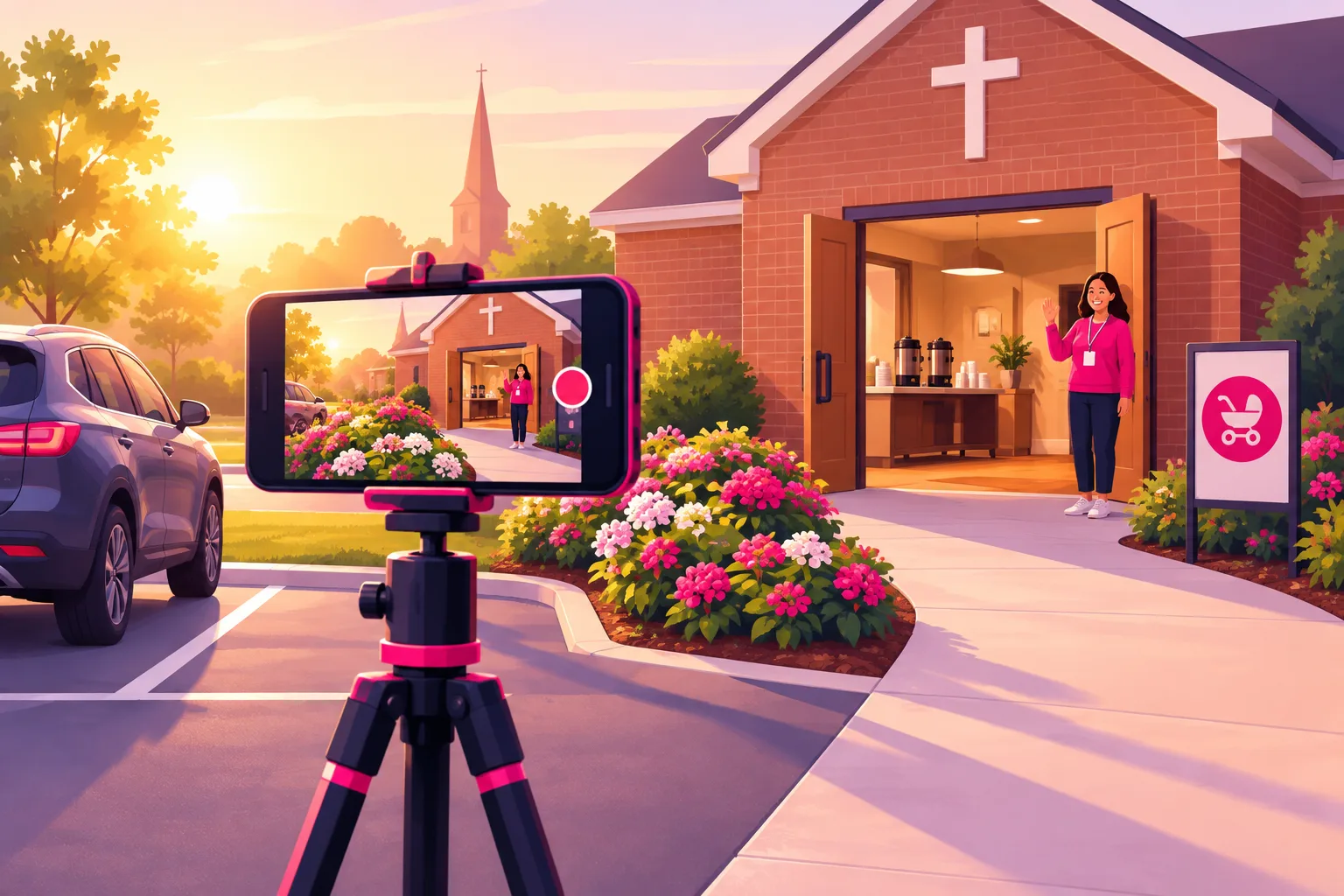
The conversion video of the whole vertical, and the one almost no church has made. Every first-timer has the same minute in the car: where do I go in, will I be singled out, are jeans okay, where do my kids go, will they ask me for money, can I leave if it is awful. The walk-through answers every one of those from the parking lot to the coffee table, so the viewer has already visited before she visits.
Two rules. Film it from the guest's point of view - the camera is her eyes, walking in. And make one per entry point, because the single adult, the family with a stroller, and the man who has not been inside in twenty years are afraid of different things. The set is your building and the adults who chose to be on camera. The congregation is wide shots and backs of heads, filmed over several Sundays and stitched.
- 1. The full Sunday walk-through, parking lot to coffee. Where to park, which door, who is standing at it and what she will say, where the bathrooms are, where to sit if you want to be left alone, how long it runs, and the moment you can leave without anyone noticing. The foundational video of the whole vault. Re-post it every season.
- 2. The walk-through for a family with kids. Where the stroller goes, what check-in looks like from the parent's side, whether kids stay in the service, and what happens when the baby cries. Film the kids' hallway empty before the service, and let the kids' director explain the rest. No child, no check-in desk, no name tag ever appears - and the video answers every parent's question anyway.
- 3. The walk-through for someone coming alone. The specific fear is being the only one. Show the back row, the aisle seat, the coffee table where it is fine to stand by yourself, and say out loud that nobody will ask you to stand up or introduce yourself. If your church does ask guests to stand, say that too, so she can decide.
- 4. The walk-through for the person who hasn't been in twenty years. What has changed (the screens, the coffee, the clothes), what has not (the hymn they will recognize, the prayer they still know), and the sentence they need most: nobody at the door is going to ask where you have been.
- 5. The walk-through for a teenager coming without parents. Where the youth sit, who to ask for, whether there is a separate youth service, and what to do if a friend brought you and then disappeared. The youth leader speaks; no teenager appears on camera unless a parent signed for that specific video.
- 6. What people actually wore last Sunday. A wide shot of the lobby floor at 10:55 - sneakers, work boots, sandals, one pair of dress shoes. No faces, no names, just feet. The honest answer to "do I have to dress up," in fifteen seconds, and one of the most-saved videos a church can post.
- 7. The money minute. What the offering actually looks like, that it passes you and nobody watches what you do, where the box at the back is, and the sentence every guest needs: "if you are visiting, please let it go by." The fear of being asked for money keeps more people in the parking lot than any doctrine.
- 8. The visitor-day edition, and the Sunday after. The Christmas Eve or Easter walk-through - candlelight, how long it runs, where to park when the lot is full, the overflow room, the kids' plan - posted two to three weeks before. Then, on the visitor day itself, film the follow-up: "here is what next Sunday looks like, and it is calmer." The Easter crowd that vanishes is the most common failure in the vertical, and this one video is the fix.
4. One-Idea Sermon Clips: Thirty Seconds, One Sentence (8 Ideas)
The format every church already has the raw material for, and the one most churches ruin by posting the whole thing. A sermon is thirty-five minutes. A sermon clip is thirty seconds and one idea, cut at the sentence, with the pastor looking at the viewer - which means a tripod at the front of the room, not the stream camera at the back of a dark sanctuary.
Three rules travel with every clip. The pastor marks the one-idea moment in their own notes before preaching it, so Tuesday's edit takes four minutes. Nothing in the clip names a candidate, a party, or a ballot measure - the pillar's section on the political line explains why that clip can never be promoted and should never be posted. And if worship music is playing under the clip, the licensing question in the same section applies.
- 9. The one sentence. The line the pastor marked before preaching. Thirty seconds of runway into it, cut the instant it lands. No intro, no outro, no logo. The foundational clip, and the one that teaches the pastor to preach one sentence for the phone every week.
- 10. The sentence for the person who hasn't been in a church. Choose the clip for the guest, not the member: the part about doubt, about grief, about coming back. The members already heard it. The person who needs it is three streets away and has never met you.
- 11. The twenty-second re-say. Right after the service, the pastor stands where it happened and re-delivers the one idea to the camera in plain words, no microphone, no notes. Often outperforms the real clip, because it sounds like a person talking to you.
- 12. The story, not the point. The sermon illustration - the flat tire, the hospital hallway, the kid who asked the question - clipped on its own. Stories travel; exposition does not.
- 13. The question the sermon answered. Open the clip with the question on screen and in the pastor's mouth - "what do you do when you prayed and nothing happened?" - then thirty seconds of the answer. A sermon series is a question log in disguise.
- 14. "I used to think." The clip where the pastor admits something they changed their mind on, got wrong, or still find hard. Honesty from the pulpit is rare enough on the platform to travel on its own.
- 15. One passage, read in your room. The pastor or a lector reads a single passage from the front, lights up, stained glass doing the work, no commentary. This is not the verse-over-a-sunset graphic - it is a person, in your building, reading it out loud. The difference is the whole point.
- 16. The series trailer in twenty seconds. The question each of the next five Sundays will answer, said once each, in order. Post it the week before the series starts and again the day the fall return begins.
5. "Why We Do That": The Format That Travels (10 Ideas)
Every service is full of things a visitor sees and does not understand, and nobody has ever explained them without making her feel foolish for not knowing. Take one and say what it is, why your church does it, and what she is supposed to do during it. The viewer who has never been in a church and the member who has been in one for forty years both keep watching.
One rule: explain, never defend. Half your audience grew up in a church that did it differently, and some of them are the people who will drive across town because you explained yours kindly. Film these in the sanctuary on a Tuesday afternoon with the lights up, standing where it happens.
- 17. Why everyone stands at that exact moment. The reading, the hymn, the prayer - whatever it is in your tradition. Then the sentence that matters: "and if you don't know when, just do what the person next to you does. That is what everyone else is doing too."
- 18. What communion is, and whether a visitor can take it. Your honest answer, whatever your tradition's answer is, said without apology. Then the part nobody tells guests: what to do with your hands, and that it is completely fine to stay seated.
- 19. The water in the font. What baptism means here, who does it, whether it is babies or adults or both, and what happens on a Sunday when one is scheduled. The curiosity hook of the vertical, and the setup for the consented story in idea 47.
- 20. Why there is a plate, a box, or a QR code. What the money does, in plain words, including the boring parts - the boiler, the insurance, the pantry - and the sentence from idea 7: guests are asked to let it pass. The stewardship-season video in disguise.
- 21. Why we say that together. The prayer, the creed, the response the whole room knows by heart. Where it comes from, what it means, and that you can just listen the first ten times.
- 22. Why the room looks like this. The robe or the no-robe, the candles or the screens, the cross on the wall, the empty space where the pulpit used to be. Every choice has a reason, and the reason is a video.
- 23. Why it is this long, and why it starts with music. The honest answer to how long a service runs, what the order is, and why the singing comes first. Then the permission: you do not have to sing. Nobody is listening to you.
- 24. One word, one video. Advent. Lent. Pentecost. Liturgy. Elder. Deacon. Tithe. The vocabulary that sounds like a password to anyone who did not grow up with it, one word per thirty seconds. A series that runs all year and is saved for years.
- 25. What "member" means here, and what you have to do to visit. Nothing. The fear that church is a club with a joining process is real, so say what membership is, that it takes months and is never asked for on a first visit, and that you can come for a year without it ever coming up.
- 26. Why there is a pantry, a preschool, or a Tuesday night meeting in this building. The reason your church runs the thing it runs between Sundays, said by the person who runs it. The bridge between this format and section 7.
6. Questions Answered: The Format That Proves the Welcome (10 Ideas)
A walk-through says you are welcome. A question answered proves it, because the viewer watches you take a nervous, specific, slightly embarrassing question seriously and answer it without flinching. This is the format that comes straight from the question log, and the reason the log exists.
Read the question exactly as it was asked, in their words. Answer in the first eight seconds. Then the why, and the exception. The pastor answers some; the greeter, the kids' director, and the youth leader answer the rest, and the account is better for the mix of faces.
- 27. "Do I have to be a Christian to come?" No. Say it first, then say what the morning will be like for someone who is not sure what they believe, and that nobody will ask. The single most-asked question in the DMs of every church account.
- 28. "Will someone make me stand up or say my name?" Your honest answer, whatever it is. If the answer is yes, say exactly when and what you will be asked, so the viewer can decide. Being surprised is the fear, not the standing.
- 29. "Can I bring my kids, and will they be okay?" The kids' director, in the empty classroom, on who is in the room with them, how check-in and pickup work, what happens if a child cries, and how to find out what they did. No child appears. Every parent watching is reassured anyway.
- 30. "What if I cry?" People do. Say that people do, that nobody will stare, where the tissues are, and that the person at the end of the row is not going to make a thing of it. This question is asked quietly, and the answer gets sent to friends.
- 31. The question you are nervous to answer. "I'm divorced," "I have tattoos," "I haven't been since my dad's funeral," "I'm not sure I'm welcome." Answer honestly in one sentence, welcome first, and film it in a single take. The person who asked will watch it eleven times before she decides.
- 32. "Is there a ramp, a hearing loop, a large-print bulletin?" Film the accessible entrance from the parking lot, the seating that fits a wheelchair, the restroom, and say out loud what you have and what you do not have yet. Honesty about the step at the side door is worth more than a vague "all are welcome."
- 33. "Can I just watch online first?" Yes. Here is where. Then, kindly, what the stream cannot show - the coffee, the person who will remember your name - so the stream becomes the first rung instead of the last.
- 34. "Do you do weddings and funerals for people who aren't members?" The honest answer for your church, who to call, and what it costs if anything. One of the few videos that is searched for at two in the morning by someone who needs it that week.
- 35. "What happens if I fill out the connect card?" Exactly what follows: a text from Pam on Tuesday, not a visit to your house, not a mailing list, not a pledge card. Show the card. Name the person. The fear of what happens after is why most cards go in the trash.
- 36. The DM, answered. A question that came through the DMs or the plan-a-visit form, read without the sender's name or any detail that could identify them, answered on camera for everyone who wondered the same thing. The format that proves the account is run by a person, and the one that refills the log fastest.
7. The Church Between Sundays: The Volume Source (10 Ideas)
Sunday is ninety minutes. The church is the other six and a half days, and almost nobody outside the building knows what happens in them. This is the format that fills the week, anchors you to your town, and answers the question under every skeptic's objection: what does a church actually do?
The set is the work, not the people being served. Hands, boxes, the kitchen, the van, the gym being set up. The pantry guest, the grieving family, the person in the Tuesday night meeting never appear - and nothing from a pastor's office, a prayer room, or a hospital hallway is content. The volunteers who chose to be there are the cast.
- 37. The pantry on Tuesday. The boxes being packed, the shelves, the van, the man who has run it for nine years saying why. Stop the camera before the doors open. Our nonprofit content ideas vault has thirty more videos for the pantry alone, and every one of them keeps the guest off camera.
- 38. The funeral meal team. Eleven casseroles, the kitchen on Thursday morning, the woman who has organized it since 2004. What the team does, why, and the sentence that stops the scroll: "you do not have to be a member. You do not have to be anything." The family is never named and never shown.
- 39. Choir rehearsal on Thursday night. Your own team, your own room, live - twenty seconds of a song coming together, with the licensing check from the pillar done first. The one worship video you can post with a clear conscience, and the one that shows the room is full of ordinary people who were nervous the first night too.
- 40. Saturday setup for the kids' rooms. The craft supplies, the snack bins, the volunteer who prepped it, the empty room with the lights on. Every parent wants to see this. No child, no roster, no name on a cubby, no pickup tag.
- 41. Youth night, before anyone arrives. The gym being set up, the pizza boxes, the youth leader on what happens and who is in the room with the teenagers. The teenagers themselves are not on camera unless a parent signed for that specific video, and the video does not need them.
- 42. The building, and what giving fixed. The boiler that was replaced in January, the roof, the 1961 pew that was re-glued, the ramp that got built. "Here is what this year's giving did, including the boring parts." The receipt video of the vertical and the backbone of stewardship season.
- 43. The pastor's Tuesday. The sermon prep desk, the drive to the hospital (film the drive, never the visit), the Wednesday study being set up, the phone call that is not shown. The answer to "what does a pastor do all week," which half your town has wondered.
- 44. What actually happens at a small group. The living room, the host putting out coffee, the eight chairs, and the host explaining what a first night is like - whether you have to talk, whether you have to pray out loud, what time it ends. The members of the group appear only if they chose to.
- 45. The mission team packing, or the service day. Duffel bags on the fellowship hall floor, the supply list, the hands sorting it. The local service day - the widow's gutters, the school supply drive - filmed as the work, with the address and the homeowner off camera.
- 46. Six in the morning on Sunday. The setup crew, the coffee being made, the sound check, the greeter putting on her name tag, the sanctuary with nobody in it yet. The people nobody sees, shown once. One of the most-shared videos a church posts, because every member knows one of them.
8. Stories Told With Consent: Last on Purpose (6 Ideas)
The most powerful format in the vault, and the one that goes last on purpose. A baptism story, a "why I stayed," a first-timer who became a member - told in the person's own words - moves people the way nothing else here does. It is also the only format where a mistake costs a real person something, which is why these are a few videos a year, not a weekly series.
The consent is informed, written, specific to this video and this platform, and revocable - and never a condition of baptism, membership, or anything else. Ask on a different day than the event. Show the person the finished video before it posts. If they hesitate, the answer is no. Our nonprofit filming guide has the consent model in full, and a church should adopt it wholesale.
- 47. The baptism story, in their words. Not the baptism itself - the person, a few weeks later, on why. Sixty seconds, one take, filmed where it happened. The release says exactly where this can be posted and whether it can ever be promoted.
- 48. "Why I stayed." A longtime member - the woman in the 1961 pew, the man who came back after his divorce - on the thing that kept them. A consenting adult who chose to be there, telling their own story. Post it in January, when people are deciding whether to try a church again.
- 49. "I came in March. Here's why I came back." A first-timer, months later, on the second visit - what they were afraid of, what actually happened, and the person who remembered their name. The most persuasive video a church can post, and the one the guest ladder is built around.
- 50. Fifty years in this room. The couple married here in 1976, the greeter since 1987, the organist who played the first service in the new building. History told by the people who lived it, with affection for how small it all started.
- 51. The volunteer's story. Why the pantry man does Tuesday. Why the funeral meal coordinator started in 2004. Why the nursery volunteer is a nursery volunteer, filmed anywhere but the nursery. A member choosing to be on camera, explaining a choice.
- 52. The pastor's own story. The first sermon to eleven people. The year they almost quit. Why they are here. The surprise hook from section 2, delivered by the one person who signed up for this, and the video that makes a town feel it already knows the person at the front.
9. The Capture System: A Month of Posts From Four Sundays
Fifty-two ideas are worthless if filming them takes a decision every day. The churches that post for years run a capture system: log all week, film on Sunday, post for the week. Six capture points feed the running note, and only the last one involves anyone who did not sign up to be the cast.
- The question log. Everything visitors, commenters, and the plan-a-visit form ask, word for word, plus the pastor's "people always ask me" list. Section 6 comes from here.
- The building and the work. The empty sanctuary with the lights up, the lobby at 10:55, the pantry boxes, the kitchen on funeral-meal day. Most of sections 3 and 7 live here.
- The cast. The pastor, the greeters, the worship team, the kids' director, the youth leader - adults who are on the platform on purpose, with a release signed once a year. Sections 4, 5, and 6 live here.
- The sermon from the front. A tripod at the foot of the stage, framed vertical, running the whole service, with the one-idea moment marked in the pastor's notes beforehand. Section 4 is cut from this on Tuesday.
- The calendar moment. Whatever is about to happen because of the church year. Section 10 has the season-by-season list.
- The consented story. Section 8, a few times a year, with the release signed on a different day and the finished video approved by the person in it.
Then batch - on Sunday, because your footage exists once a week, on a schedule, in a building you own, with people who are already there. One volunteer with a phone and twenty minutes: ninety seconds of the lobby before the service, the sermon from the tripod, one live worship moment, one forty-second explainer right after the service, standing where it happens, and one volunteer answering one question. That is a week of posts. The pillar guide has the full Sunday capture list.
Once a month, on a Tuesday afternoon, sit the pastor or a deacon in the sanctuary with the lights up and film ten answers from the question log back to back. Same spot, same shirt, one take each. Together that is roughly five weeks of posting from four Sundays and one hour.
Last, name one approver. A video that needs the pastor, the elder board, and the communications committee to sign off posts eleven days after the moment has passed. The pastor approves the policy once, in writing - what the volunteer may post without asking, what never goes out, who answers the DMs - and the volunteer posts inside it, same day.
The rule that keeps all of this safe: did this person choose to be on camera, and would they be glad to see this video in five years? The cast signs once a year. The congregation appears as a congregation - wide, from behind, from the side. Children never appear without a specific written release from a parent for that specific use, and the nursery, the check-in desk, classroom numbers, and pickup tags are never filmed at all. Nothing from a pastor's office, a prayer request, a benevolence request, or a hospital room is content. Worship music is copyrighted, so post live music your own team played in your own service and confirm what your streaming license covers for a separately posted clip. And the account never names a candidate, a party, or a ballot measure. This is a general overview, not legal advice - confirm the details with your denomination and your licensing provider, and when in doubt, leave the person out. Forty-six of the 52 ideas need nobody but the cast.
10. Timing: Which Ideas to Post in Which Season
Almost nobody tries a church on a random Sunday. They try one at a moment, and the two biggest moments in your year are on the calendar. In Lifeway Research's survey of Protestant pastors, 90 percent named Easter among their three highest-attendance Sundays, and 28 percent said Christmas is the single highest. The visitor who shows up decided in the weeks before.
So the video that wins Easter is not posted in Holy Week, when every church in the county is posting at once. It is posted in Lent. The same rule puts the Christmas Eve walk-through in the first week of Advent, and the family walk-through in August, before the school-year routine sets. Here is the vault laid over the church year, by idea number.
The vault, season by season
- January: "new year, new church." Ideas 1, 4, 25, 33, 42, and 48. The return season for people who drifted away, and the month for the receipt of what last year's giving did. Post the walk-through for the person who has not been in twenty years the first week.
- Lent (Ash Wednesday, February 10, 2027): build for Easter. Ideas 17 through 24 and 27 through 31, one or two a week, so the feed is a complete answer to "what will happen to me if I walk in" by the middle of March. The Easter edition of idea 8 goes out two to three weeks before Easter Sunday, March 28, 2027. If you are reading this in Lent, film the walk-through this week.
- Easter and the Sunday after. Holy Week is for the service, not the feed - post lightly. On Easter itself, film the second half of idea 8: "here is what next Sunday looks like." Post it Tuesday. Then 35, so the people who filled out a card know what happens next.
- April to May: the consented-story season. Baptisms, confirmations, and graduations make this the window for 19, 47, 49, and 50 - with the release signed weeks before. Mother's Day is historically a high Sunday, so idea 2 goes out the week before it.
- June to August: the slump and the build. Attendance dips, so this is batching season: 37 through 46 are mostly filmed now, and 45 and 41 cover camp, the mission trip, and vacation Bible school. Film the fall walk-throughs in July while the building is quiet.
- August to September: the fall return. Ideas 2, 29, 40, 41, 44, 16, and 26. Back to school, the small-group launch, youth kickoff, and Back to Church Sunday in September. The family walk-through goes out in mid-August, before the routine sets.
- October to November: stewardship season. Ideas 42, 20, 7, and 46 - the receipt first, the explanation second, the money minute third - and 38 as the Thanksgiving-week between-Sundays video. Ask for nothing on camera that the receipt has not already earned.
- Advent (begins November 29, 2026): build for Christmas. The Christmas Eve edition of idea 8 goes out the first week of December, with the service time in the bio by Thanksgiving. Then 24 (one word: Advent), 23, 33, and 1. Christmas week itself is for the candles, not the feed.
- The day the town needs you. The funeral the whole town attends, the storm, the news. No sermon clip, no numbered idea: one person at the open door, saying what the church is doing and when it is open, said once. Decide now who is allowed to post it without a meeting.
The pillar guide's church-year calendar explains the reasoning behind each stretch. The short version: welcome in January, build in Lent, follow up on Easter, film in summer, return in September, report in the fall, and build again in Advent.
11. Which Ideas Travel, Which Ideas Fill the Room, and What to Do When One Takes Off
Here is the question no business has to ask about its content ideas. A church has two congregations. The room is local. The feed is not. Nobody can attend a church they cannot drive to on a Sunday morning, and a sermon clip can reach a college student three states away, the homebound widow across town, and the person who left the church ten years ago and still listens - none of whom will ever sit in your room, and all of whom are real ministry.
So the ideas above sort into two piles. Unlike a dentist or a plumber, your far-away viewers are not wasted - they just need a different ask, and a different scoreboard.
The anchors: the door path
The walk-throughs (1-8), the questions about your building and your people (29 and 32 through 36), the church between Sundays (37-46), and the second-visit story (49). They only make sense to someone who could drive here, and that person is the one who fills the room.
Say the town out loud. Point them at the plan-a-visit page with a service time, the parking, the kids' plan, and a named person at the door. Measure them in plan-a-visit clicks, first-time guests who say "TikTok" on the connect card, and second visits - never views.
The travelers: the feed path
The sermon clips (9-16), the explainers (17-26), the questions anyone anywhere is afraid to ask (27, 28, 30, 31), and most of the stories (47, 48, 50-52). They make sense to a viewer in another state, and that viewer can be fed by you for years without ever walking in.
Point them at the online service, the podcast, and the prayer-request DM. Measure them in follows, saves, shares, and prayer requests answered - and reply to every prayer request as a person, never as content.
Three habits keep the two piles from blurring. Give each video one ask, or none - most should have none. Count sends, not views, because the member who shares the walk-through with the friend who said "I wouldn't know what to do" just did the inviting she never had the words for. And decide which pile leads this year by answering one question: is this church trying to fill the room or feed the world? The pillar guide walks through how to choose, and for most churches under a few hundred the answer is the door first. A door-first account still posts sermon clips. It just posts the walk-through more.
And when one takes off - because one will, usually a walk-through or an explainer - resist the urge to boost every upload afterward. The move is selective amplification: take the one video that already proved itself and pay to show it to more of the right people.
For a church that means three things. Promote for followers, not a one-time visit, because a follower sees four Sundays before Easter and a one-time viewer sees one ad. Match the map: a walk-through goes to your own Sunday-morning drive radius, a sermon clip can go wider only if the feed path is a goal this year. And do it in Lent and Advent, before the visitor days, never in Holy Week or Christmas week when every church and every retailer is bidding at once. That is exactly what Viryze is built for: it focuses on follower growth and only promotes videos that have already cleared the organic threshold, so a tithe dollar compounds your best video instead of rescuing a weak one.
Our Spark Ads guide covers the format to default to, since it promotes your real post with its comments intact. Three limits come with you. TikTok does not allow political content in ads, so a clip that touched the news can never be promoted - promote the walk-through and the explainer. Religious content is permitted, but anything that disrespects another faith is not, and approval is per ad and per market, so check what applies to you first. And consent to post is not consent to promote - the baptism release says which, and the safest videos to put money behind are the ones with nobody in them who did not sign up to be the cast, which is most of this vault.
Frequently Asked Questions
What should churches post on TikTok?
Six formats cover nearly everything that grows a church account: the Sunday walk-through that shows a nervous first-timer exactly what happens from the parking lot to the coffee table, the one-idea sermon clip cut to thirty seconds with the pastor looking at the camera, "why we do that" explainers for the things a visitor sees and does not understand, questions answered word for word from the door and the DMs, the church between Sundays (the pantry, the funeral meal team, the choir rehearsal, the setup crew), and, last and least often, a baptism or "why I stayed" story told with written consent. Retire the event flyer, the verse over a sunset, the full service posted in chunks, and the clip that scolds everyone who is not in the room.
How do churches come up with TikTok content ideas without putting the congregation or children on camera?
By keeping a question log. Every question a visitor asks at the door, every DM, every plan-a-visit form, and the pastor's own "people always ask me" list is a pre-validated video, because a real person cared enough to ask it. Write each one down word for word. Then add the building and the work (the empty sanctuary with the lights up, the pantry boxes, the kitchen on funeral-meal day), the adults who chose to be on camera and signed a release once a year (the pastor, the greeters, the worship team, the kids' director), and the calendar moment, and the log refills faster than you can film it. The congregation appears as a congregation - wide, from behind, from the side - and children never appear without a specific written release from a parent for that specific use. Forty-six of the 52 ideas here need nobody on camera but the adults who signed up to be the cast, and not one of them needs a child.
Can churches post sermon clips on TikTok?
Yes, and they are one of the formats that travels furthest - with four rules. Cut one idea, not a summary, and end on the sentence. Keep it near thirty seconds. Film from a tripod at the front of the room, not the stream camera at the back, so the pastor is looking at the viewer. And leave out anything that names a candidate, a party, or a ballot measure: a 501(c)(3) church cannot endorse or oppose candidates, and TikTok does not allow political content in promoted posts, so that clip can never be amplified anyway. If worship music is playing under the clip, the licensing question in the pillar guide applies - a streaming license covers your service stream, and whether it covers a separately posted thirty-second clip is a question for your licensing provider.
Can churches show children in TikTok videos?
Only with a specific written release from a parent or guardian for that specific video on that specific platform - a general photo line on a registration form is not enough. The nursery, the check-in desk, classroom numbers, and pickup tags are never filmed at all, and a teenager who says no is simply not on camera. The practical answer is that you almost never need to: the walk-through for families shows the kids' hallway empty before the service and lets the kids' director explain what happens, which answers every parent's question without a single child in the frame. The test for every video is whether the person in it would be glad to see it in five years, and for a child that question belongs to the parent.
When is the best time of year for a church to post on TikTok?
In the weeks before the two visitor days, not on them. In Lifeway Research's survey of Protestant pastors, 90 percent named Easter among their three highest-attendance Sundays and 28 percent said Christmas is the single highest, and the visitor who shows up decided in the weeks before. So the Easter walk-through goes out two to three weeks ahead, during Lent (Ash Wednesday is February 10, 2027, and Easter is March 28), and the Christmas Eve walk-through goes out the first week of December, in Advent (which begins November 29, 2026). The other two stretches that matter are the January "new year, new church" return and the August-September fall return, when families settle into a school-year routine. The most common failure is the Easter crowd that never comes back because nobody showed them the second Sunday - so the follow-up video is filmed on the visitor day itself.
How often should a church post on TikTok?
Three posts a week, sustained through the whole church year, beats a burst of daily posting that dies the week after Easter. The capture system makes it cheap. Sunday is the program day: one volunteer with a phone collects ninety seconds of lobby, the sermon from a tripod at the front, one live worship moment, one forty-second explainer, and one volunteer answering one question - a week of posts in twenty minutes. Between Sundays, whatever happens on Tuesday fills the rest. One approver, not a committee: the pastor approves the policy once, in writing, and the volunteer posts inside it. In a crushed week you drop to two from the bank without apologizing.
Ready to turn your best walk-through into guests who come back?
Somewhere in these 52 ideas is the video that becomes your church's breakout - the parking-lot-to-coffee walk-through, or the "will someone make me stand up" answer that half your town ends up watching. When it happens, Viryze helps you put that one proven video in front of more of the right people, aimed at followers rather than a one-time visit, drawn to your own Sunday-morning drive radius, and timed for Lent and Advent instead of Holy Week. Your question log supplies the content. Selective amplification helps the best of it reach the people who will sit in your room on the second Sunday.
See how selective amplification worksRelated Reading
- TikTok for Churches: The Complete 2026 Guide - the full strategy these ideas plug into.
- Understanding TikTok's Algorithm: What Really Matters - the ranking signals that decide which of these ideas travels.
- Nonprofit TikTok Content Ideas: 50+ Video Concepts That Win Donors and Volunteers - the sister vault for the pantry, the meal team, and every other ministry that serves people who did not come to be filmed.
- Local Business TikTok Marketing: Get Customers in Your Area - the local-discovery mechanics behind the door-path ideas.
- TikTok for Small Business - the closest parallel for a volunteer team with no communications department.
- Dentist TikTok Content Ideas: 50+ Video Concepts That Fill the Schedule - another idea vault built around the fear of walking in.
- TikTok Spark Ads Guide - the amplification format for the ideas that take off.

Head of Creator Success at Viryze
TikTok growth strategist helping creators reach their first 100K followers through data-driven promotion strategies.