
Art Creators13 min read
Selling Art on TikTok: How to Turn Followers Into Buyers
The complete playbook for selling art on TikTok in 2026. The four-stage path that turns a scroll into a sale, how to set up a storefront buyers can actually reach, the caption and CTA formula that sells without feeling salesy, how to price your work, the drop strategy that creates demand, and how to amplify the videos that already convert.
By Ryan MitchellHead of Creator Success at Viryze

Your time-lapse just hit 200,000 views. The comments are full of fire emojis and three people asking "is this for sale?" A week later, you've made exactly zero dollars. Sound familiar?
Here's the frustrating truth: views are not sales. Plenty of artists rack up millions of views and never sell a single print, while others with a fraction of the reach quietly sell out drops every week. The difference almost never comes down to talent. It comes down to whether you've built a clear, frictionless path from "I love this" to "I bought it."
This is the complete playbook for selling art on TikTok in 2026. We'll break down the exact path a viewer takes from scroll to purchase, how to set up a storefront buyers can actually reach, the caption and CTA formula that sells without feeling pushy, how to price so people say yes, and how to amplify the videos that are already converting. If you want the broader picture of every way artists earn, pair this with our guide on how artists make money on TikTok.
Three reasons artists with views still don't sell:
- No clear place to buy. The art is wanted, but viewers can't find a link, so the desire fades before they act.
- They never made the ask. Showing the piece isn't the same as telling people it's for sale and how to get it.
- Too much friction. A buried bio, a slow shop, or a confusing checkout loses buyers who were ready to pay.
What's Inside
- 1. Why Views Don't Equal Sales
- 2. The View-to-Sale Path: How a Scroll Becomes a Sale
- 3. Set Up a Storefront Buyers Can Actually Reach
- 4. Remove Every Ounce of Friction
- 5. The Caption & CTA Formula That Sells
- 6. Price So People Actually Buy
- 7. The Drop Strategy: Selling With Launches & Scarcity
- 8. Treat Your Comments & DMs Like a Storefront
- 9. Amplify the Videos That Already Sell
- Frequently Asked Questions
1. Why Views Don't Equal Sales
Let's name the problem precisely. There's a gap between the moment someone falls in love with your work and the moment money changes hands. We call it the Attention-to-Sale Gap - and it's where the vast majority of art income is lost.
A viewer watches your reveal, feels a genuine spark of "I want that," and then... life happens. They keep scrolling. The feeling fades. Unless you give them a fast, obvious way to act on that desire in the few seconds it's at its peak, it disappears - and so does the sale. Desire on TikTok has a short shelf life.
This is the single most important reframe in this entire guide: selling art on TikTok isn't about convincing people to want your work. The work already does that. It's about removing everything that stands between wanting and buying. Once you see it that way, "how do I sell?" stops being a marketing puzzle and becomes a simple engineering problem: shorten the path.
2. The View-to-Sale Path: How a Scroll Becomes a Sale
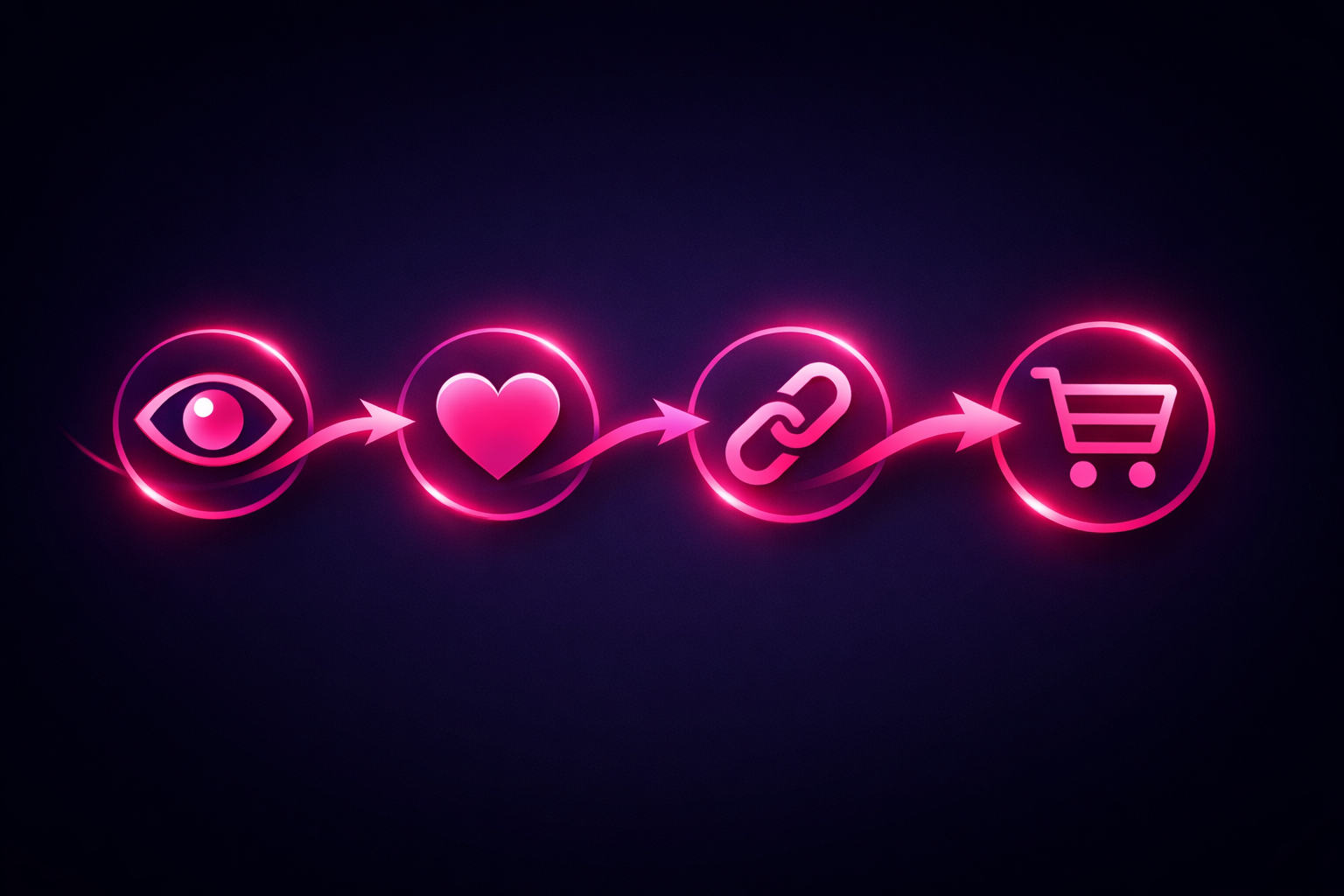
Every art sale on TikTok travels the same four-stage route. We call it the View-to-Sale Path. Understand each stage and you'll know exactly where your sales are leaking - and how to plug the leak.
Stage 1: Stop
A scrolling viewer stops on your video. For artists, the most reliable way to earn the stop is the reveal-first hook - show the stunning finished piece in the opening second, then rewind to the blank surface. They have to watch to see how it happened. No stop, no anything else, so this stage decides whether the rest of the path even begins.
Stage 2: Want
As they watch the piece come together, admiration turns into desire. This is where art has a massive advantage over almost every other niche: people don't just enjoy the content, they want the actual object. The better the finished piece looks on screen - good lighting, accurate color, a satisfying final reveal - the stronger the want.
Stage 3: Find
Now the wanting viewer goes looking for a way to buy. This is the stage where most artists lose the sale. If there's no link, no mention of where to buy, or the path is a maze, the trail goes cold. Your entire job here is to make the answer to "where do I get this?" instant and obvious - in the bio, the caption, and a pinned comment.
Stage 4: Buy
Finally, they check out. A fast, clean, trustworthy purchase experience seals the deal; a slow or confusing one breaks it at the finish line. Sales are won and lost on the details here - how many taps it takes, whether the page loads quickly, and whether the buyer feels confident their money and order are safe.
Find your leak
If you get views but no sales, your leak is almost always Stage 3 (Find) or Stage 4 (Buy). If you get neither views nor sales, the leak is Stage 1 (Stop). Diagnosing which stage is failing tells you exactly what to fix next - instead of guessing.
3. Set Up a Storefront Buyers Can Actually Reach
Before you can sell anything, you need somewhere to send buyers. The good news: you have options at every level of effort and budget, and you can start with the simplest one today.
Print-on-demand (the no-risk starting point)
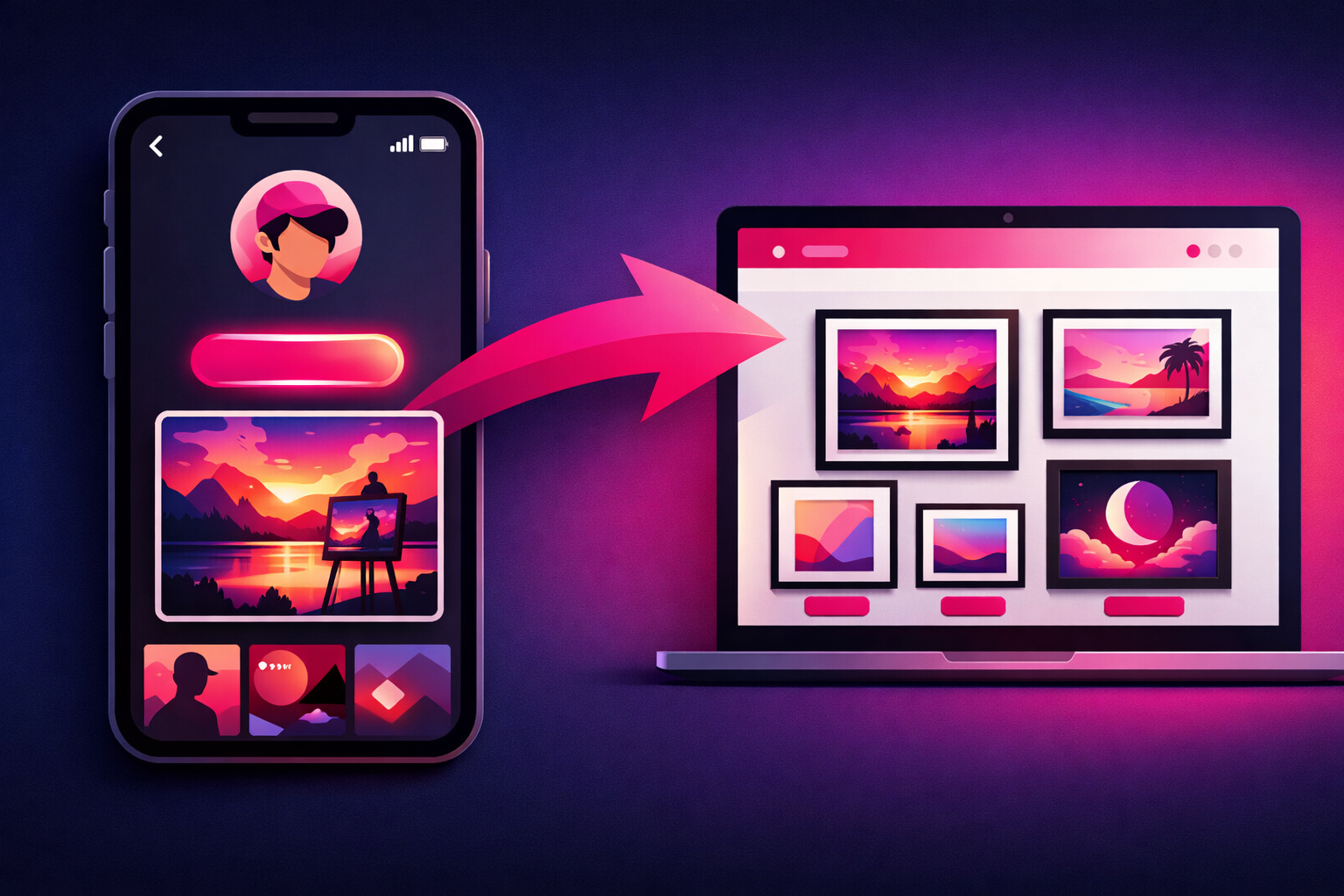
Print-on-demand services print and ship prints, framed art, and products on your behalf - no upfront cost, no inventory, no packing. You upload your art, set your margin, and earn the difference on every sale. It's the fastest way to have a working store live before your next video, and it scales infinitely: one popular piece can sell hundreds of prints without you touching a box.
Your own store (more control, more margin)
A dedicated shop on your own site gives you higher margins, full control over branding, and a customer list you own. It's the right move once you're selling consistently and want to build a real business rather than just take orders. If you're selling physical products at any scale, our TikTok e-commerce guide walks through the storefront mechanics in depth.
TikTok Shop (buying without leaving the app)
TikTok Shop lets viewers buy directly in-app, which removes a whole step from the path and works especially well for affordable prints and products bought on impulse. It's not required - plenty of artists sell beautifully with just a bio link - but it can meaningfully lift conversions for lower-priced items because there's no jump to an external site.
Match the channel to the product
- •Affordable prints & products - TikTok Shop or print-on-demand, where impulse buying thrives.
- •Originals - your own store or a direct link, where you can present the piece as one-of-a-kind.
- •Commissions - a simple form or DM, where you can talk through the custom details.
4. Remove Every Ounce of Friction
This is the highest-leverage section in the guide. Removing friction at the Find and Buy stages converts views you're already getting into sales - no extra reach required. Here's the checklist.
Make your bio link obvious
Your bio link is the front door to your shop. Use a clean link tool or a single direct link, keep the destinations few and clearly labeled, and make sure "Shop" or "Prints" is the first thing a tapping visitor sees. A bio cluttered with ten links is almost as bad as having none - confusion kills conversions just like absence does.
Pin the piece, and pin a comment
When a video sells a specific piece, pin a comment that says where to buy it and pin the video to the top of your profile. New viewers landing on your profile from a viral clip should see the for-sale work immediately. The pinned comment also gives you a place to answer the inevitable "where can I buy this?" once, publicly, for everyone.
Name the piece everywhere
If your bio link goes to a store with 40 products, a buyer who wanted this painting has to hunt for it - and many won't. Name the specific piece in your caption, pinned comment, and ideally link straight to its listing. The fewer decisions between desire and checkout, the more sales you keep.
Pro Tip
Run the "cold buyer" test. Open your own profile in a private window as if you just discovered your work, and time how long it takes to actually buy the piece in your latest video. If it takes more than about ten seconds or requires any guessing, you've found exactly where your sales are leaking - fix that before you post again.
5. The Caption & CTA Formula That Sells
Most artists are scared of looking "salesy," so they never actually tell people the work is for sale. That's a costly mistake - viewers genuinely don't know they can buy unless you say so. The fix is a soft, confident approach we call the Show-Then-Offer Method: let the art earn the desire, then make a simple, no-pressure offer.
The structure is easy to repeat on every selling video:
The Show-Then-Offer caption formula
- Lead with the art or story. Open with something about the piece itself - the inspiration, the medium, a detail viewers loved - so the caption feels like a creator sharing, not a billboard.
- Name the piece and the offer. State plainly that it's available: "Prints of this one are live" or "Original is for sale - link in bio."
- Give one clear instruction. Tell them exactly what to do next, once: "Tap the link in my bio to grab it." One CTA, not five.
Notice what this isn't: it's not begging, discounting, or hard-selling. You're simply making it clear that the thing they already want is available and easy to get. Confidence sells far better than pressure. The art does the persuading; your caption just opens the door.
Want a deeper library of formats that naturally lead to a sale - reveals, "available now" drops, restocks, and behind-the-scenes? Our art TikTok content ideas vault has dozens, and our guide to filming art process videos covers making the finished piece look irresistible on screen.
6. Price So People Actually Buy
Pricing trips up more artists than any other part of selling. Price too high with no context and impulse buyers hesitate; price too low and you both shrink your income and signal that the work isn't valuable. The goal is a structure that gives every viewer a comfortable way to say yes.
Offer tiers, not one price
The most effective approach is a simple ladder: an affordable print for impulse buyers, a mid-range product (a larger or framed print, a set) for fans who want more, and a premium original or commission for the person who has to own the real thing. Different viewers have different budgets and different levels of desire - tiers let all of them buy something instead of forcing a single yes-or-no.
Let demand set your prices
Your sales data is the most honest pricing advice you'll ever get. If prints sell out in minutes or your commission slots vanish the second you open them, that's the signal to raise prices, not to work harder at the current rate. A fuller queue means you can charge more. Treat scarcity and speed of sell-out as your cue to climb the ladder.
7. The Drop Strategy: Selling With Launches & Scarcity
Selling everything all the time, with no urgency, trains your audience to think "I'll buy later" - and later rarely comes. The fix is to sell in drops: limited releases that concentrate demand into a moment and give people a real reason to act now.
A drop works because it stacks three things in your favor: a clear deadline, genuine scarcity, and built-in content. You can build a whole arc of videos around a single release - the teaser, the process, the "dropping Friday" reminder, the launch, and the "almost sold out" nudge - so the drop markets itself across a week of posts.
A simple drop arc
- Tease. Show a glimpse of the piece or collection coming, with a date. Build anticipation before anything is for sale.
- Process. Post the reveal and time-lapse so people fall in love with the work itself in the days before launch.
- Launch. Open the drop, make the offer clearly, and point everyone to the link while desire is peaking.
- Scarcity nudge. "Only a few left" or "closing tonight" converts the fence-sitters who needed a reason to stop waiting.
Keep scarcity honest. Limited really should mean limited - a genuine print run, a real deadline, a true number of commission slots. Art audiences are perceptive, and fake urgency erodes the trust that every future drop depends on. Honest scarcity is one of the most powerful, sustainable selling tools you have.
8. Treat Your Comments & DMs Like a Storefront
Your comment section isn't just engagement - it's a live sales floor. When someone publicly asks "is this for sale?", your reply is seen by everyone who reads the comments. A quick, friendly "Yes! Prints are in my bio link 💕" can convert a dozen silent lurkers who were wondering the same thing.
Reply fast while the video is hot, pin the most useful buying comment to the top, and treat every "how much?" as a warm lead rather than an interruption. The people commenting are the closest to buying you'll ever get - they've already reached the Want stage and are standing at Find, asking you to point the way.
DMs matter even more for higher-value sales. Commission inquiries, original purchases, and custom requests often start with a message, so respond promptly and professionally. A simple saved reply with your process, pricing tiers, and a link turns a casual "do you do commissions?" into a booked job without you retyping the same thing fifty times.
9. Amplify the Videos That Already Sell
Once your View-to-Sale Path is tight - clear storefront, zero friction, confident offer - every additional relevant view becomes a real shot at a sale. And this is exactly where most artists leave money on the table: they have a video that demonstrably converts, and they just... let it fade.
Think about it. When a process clip clearly outperforms your average - higher completion, a flood of saves, a wave of "where do I buy this?" comments and actual orders - that's not luck. That's a proven seller. Putting paid budget behind that winner with a TikTok promotion service extends its reach to far more of the right people, which means more orders from a video you already know converts.
This is the whole idea behind Viryze. Instead of spending on unproven posts, our selective amplification approach promotes the art videos you pick, ideally ones that have already earned their reach organically, then tests audience combinations to find the cheapest path to your ideal buyer - the people most likely to grab a print, book a commission, or order an original. Your ad spend compounds your best work instead of rescuing your weakest.
If you want the mechanics before spending a dollar, our complete TikTok advertising guide and our breakdown of how Spark Ads work explain exactly how budgets and targeting function for creators. And if you're still building the audience that fuels all of this, our roadmap on artist growth from 0 to 100K followers lays out the path.
Frequently Asked Questions
How do you actually sell art on TikTok?
You guide viewers along a simple path: a process video catches attention, the finished piece makes them want it, a clear bio link or TikTok Shop tag lets them find where to buy, and a frictionless checkout lets them buy. The work does most of the selling - people who watch you create a piece they love already want it. Your job is to remove every obstacle between desire and purchase: a clean shop link in your bio, the piece named in your caption, a pinned comment pointing to the listing, and a checkout that takes seconds. Most sales are lost not because the art isn't wanted, but because buyers couldn't figure out how to buy it quickly.
Do you need TikTok Shop to sell art on TikTok?
No. Many artists sell successfully with nothing more than a print-on-demand store or their own website linked in their bio. TikTok Shop can reduce friction by letting people buy without leaving the app, which helps for lower-priced prints and products, but it's one option rather than a requirement. The most important thing is that you have somewhere to send buyers and that the link is impossible to miss. Originals and commissions are often sold straight through your bio link, a DM, or an email, with no in-app shop involved at all.
How many followers do you need to start selling art on TikTok?
You can start selling from your very first viral video, regardless of follower count. Selling art monetizes desire, not reach - if a hundred people see a finished piece and ten of them want it, you have ten potential buyers whether you have 200 followers or 200,000. Prints, originals, and commissions all sell early because they depend on whether viewers want the specific work in front of them. The practical advice is to have your storefront and bio link ready before you post, because the video that takes off is unpredictable and you don't want to be scrambling to set up a shop while buyers are commenting.
How should I price my art when selling on TikTok?
Price for your time and the value of the work, not just materials. Prints work best across an accessible range that impulse buyers will pay without hesitation, while originals and commissions command premium prices because there's only one and the buyer watched it come to life. A common mistake is underpricing out of fear, which both shrinks your income and signals low value. Use demand as your guide: if pieces sell out instantly or your commission queue fills the moment you open it, that's the clearest signal to raise prices. Offering a few tiers - an affordable print, a mid-range product, and a premium original or commission - lets buyers at every budget say yes.
Why am I getting views on TikTok but no art sales?
Views without sales almost always come from friction or a missing ask, not a lack of interest. The most common causes: no clear link to buy, a buried or confusing bio, never actually telling viewers the piece is for sale, or sending people to a slow, cluttered storefront they abandon. Viewers won't hunt for a way to give you money - if buying takes more than a few seconds, most give up. Fix it by adding an obvious shop link, naming the specific piece in your caption and a pinned comment, and making checkout effortless. Then make sure your most-watched, sales-driving videos reach more of the right people, because more relevant views on a proven seller is the fastest way to turn attention into orders.
Got a video that's selling? Put it in front of more buyers.
Once your storefront is set and the friction is gone, every relevant view becomes a real shot at a sale. When one of your process videos clearly beats your average and is driving actual orders, that's the moment to amplify it. Viryze promotes the art video you pick, ideally one that has already earned its reach organically, then finds the cheapest path to your ideal buyer - so your budget compounds the sales your best work is already producing.
Related Reading
- TikTok for Artists: The Complete 2026 Guide - the pillar guide covering lanes, hooks, production, growth, and monetization.
- How Artists Make Money on TikTok in 2026 - the seven revenue streams every art creator can stack.
- Art TikTok Content Ideas: 50+ Video Concepts That Grow Your Audience - dozens of formats that drive views, sales, and commissions.
- How to Film Art Process Videos for TikTok - the setup that makes your work look its best and sells the finished piece.
- The Complete TikTok E-commerce Guide - storefront mechanics for selling physical products at scale.