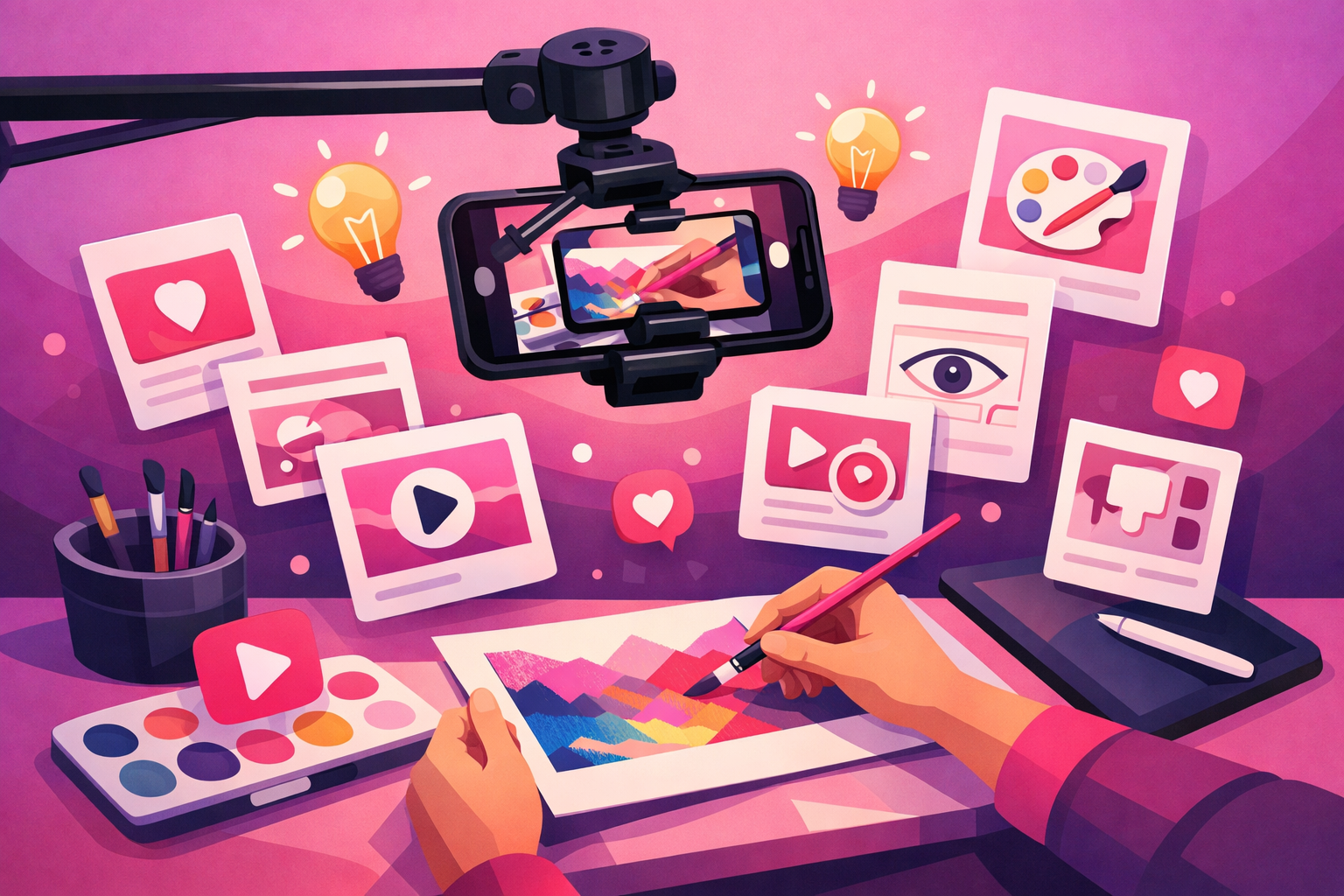
You sit down to film, prop up your phone, and your mind goes completely blank. The brushes are out, the light is good, and you still have no idea what to actually make. Every artist on TikTok hits this wall - and it's the single biggest reason promising art accounts go quiet for weeks at a time.
Here's the good news: ideas are not the bottleneck you think they are. The fastest-growing art creators in 2026 don't wait for inspiration - they run a small set of proven concept templates over and over, and slice every finished piece into half a dozen clips. Once you see the patterns, you'll never stare at a blank timeline again.
This guide is your vault: 50+ art TikTok content ideas organized into the six categories that actually grow art accounts - process and transformation, tutorials, oddly satisfying, story and personality, series and challenges, and selling. You'll also get the five hook templates that make any idea land and the capture system that keeps your pipeline full. For the bigger picture on the niche, start with our complete TikTok for artists guide, then come back here for the concepts.
The honest summary:
- The idea is only half the job - the hook in the first second decides whether anyone sees the idea at all.
- Process beats finished art every time. Your best ideas show the making, not just the made.
- One piece is many clips. A single painting can fuel a full week of content if you film everything.
- Series compound. A repeatable concept grows faster than fifty one-off videos.
What's Inside
- 1. Why Artists Run Out of Ideas (and the Fix)
- 2. The 5 Hook Templates Every Art Idea Needs
- 3. Process & Transformation Ideas (10)
- 4. Tutorial & Teaching Ideas (10)
- 5. Oddly Satisfying Ideas (8)
- 6. Story & Personality Ideas (8)
- 7. Series & Challenge Ideas (8)
- 8. Selling & Business Ideas (8)
- 9. The Capture System: Never Run Out of Ideas
- 10. Which Ideas Are Worth Promoting
- Frequently Asked Questions
1. Why Artists Run Out of Ideas (and the Fix)
Most artists treat content ideas like lightning - something that strikes when it strikes. So they post in bursts, go quiet when the spark fades, and never build the momentum the algorithm rewards. The fix is to stop waiting and start harvesting.
Here's the shift: you already generate dozens of ideas every week without noticing them. Every question in your comments, every step of your process, every mistake you fix, and every supply you reach for is a video. We call the running list of these moments your Idea Vault - and once you keep one, the blank-timeline problem disappears.
The second unlock is volume from a single piece. A finished painting isn't one post - it's the full time-lapse, a detail close-up, a mistake-and-fix, a supply breakdown, and a finished reveal. One piece, five-plus clips. That ratio is how working artists post daily without making more art.
The 50+ ideas below are organized by what they actually do for your account. Process and transformation ideas drive watch-time. Tutorials drive saves. Satisfying clips drive rewatches. Story clips build the relationship. Series multiply your reach. And selling clips turn all of it into income. Pull from every category and your feed stays varied without ever confusing the algorithm about your lane.
2. The 5 Hook Templates Every Art Idea Needs
An idea is only as good as its first second. Watch-through rate is the dominant ranking signal, and a slow intro kills even brilliant work. Before you film any concept below, drop it into one of these five hook templates - each one tells the viewer in two seconds why the next twenty are worth it.
- Result-first, then rewind. Flash the finished piece for one second, then cut to the blank surface and time-lapse the build. The backbone of process growth.
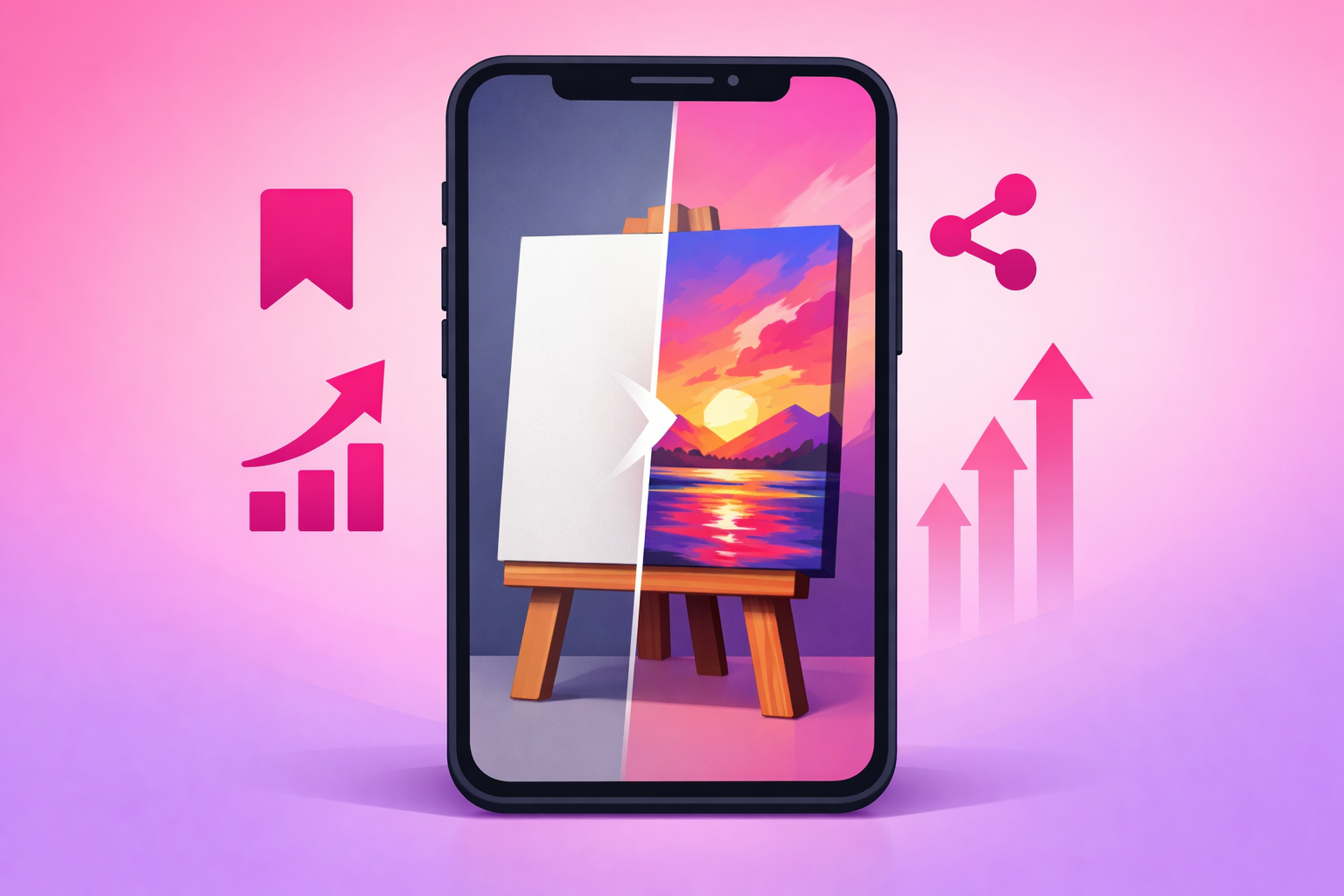
- The blank-to-wow promise. Empty page or lump of clay in frame one, the stunning result teased at the end. The before-and-after is the hook.
- The unexpected method. "I painted this with a sponge, not a brush." Curiosity about the how carries the watch-through.
- The relatable struggle. "I almost ruined this at the halfway point." Stakes and tension hold viewers to the resolution.
- The mistake call-out. "Stop doing this when you shade." Anchors the viewer in a problem they recognize, then delivers the fix.
Keep these five in front of you as you read the ideas. The concept gives you something to film; the hook is what gets it seen. For the full picture of which signals decide whether a clip travels, see our algorithm ranking factors breakdown.
3. Process & Transformation Ideas (10)
This is the engine of ArtTok. Process clips earn long watch-through, and transformations give viewers a payoff worth waiting for. Start here - these ten concepts alone can carry a new account through its first 30 posts.
- Result-first time-lapse. One second of the finished piece, then rewind to the blank surface and speed-ramp the whole build.
- Blank-to-wow transformation. Empty canvas to finished work, with the slow parts compressed and the satisfying moments slowed down.
- One-color challenge. Paint an entire piece using a single color family - a self-imposed limit that makes the process fascinating.
- Layer-by-layer reveal. Peel back each stage of a digital painting or glaze so viewers see how depth gets built.
- The thrift-flip glow-up. Refinish a thrifted frame or repaint over an old canvas. The "before" sells the "after."
- Reference photo to art. Split-screen the source photo beside your evolving piece so the likeness lands in real time.
- The halfway disaster. Show the ugly middle stage, then the rescue. The relatable struggle hook in video form.
- Speed-paint to a beat. Sync your strokes to a trending sound so the process feels choreographed.
- "Guess what this is made of." Reveal a surprising medium - resin, polymer clay, coffee, or recycled material - at the end.
- Real-time vs. final. Keep a small thumbnail of the finished piece in the corner while the live build runs underneath it.
The thread through all ten is tension and payoff: the viewer needs a reason to wait for the end. Lead with the result or a glimpse of it, then make the gap between blank and brilliant feel like something worth watching close.
4. Tutorial & Teaching Ideas (10)
Tutorials have the highest save rate of any art format, and save rate is one of the strongest quality signals on the platform. A viewer who saves your clip to try the technique later is telling the algorithm your account is worth resurfacing. Teaching also builds the trust that later converts into course and product sales.
- "How to draw X in 30 seconds." A single, contained micro-lesson on one shape, object, or feature.
- Beginner mistake fixes. "Stop doing this when you shade" - name a common error, then show the correction side by side.
- Color theory in one clip. Mix a specific color live, or show a complementary pairing that instantly improves a piece.
- "What's in my kit." A fast breakdown of the supplies you actually use - high save value and an easy affiliate tie-in.
- Technique close-up. Blending, line weight, glazing, or centering clay, shot tight so the detail is unmistakable.
- Three skill levels, same subject. Draw the same thing as a beginner, then intermediate, then advanced.
- Cheap vs. expensive supplies. Test a budget tool against a premium one and show whether the price is worth it.
- "Fixing my followers' drawings." Redraw a submitted piece with quick, teachable improvements.
- Anatomy or perspective quick-tip. One rule that fixes the mistake everyone makes - hands, eyes, foreshortening.
- "How I'd paint this now vs. as a beginner." Pair a current approach with the version you'd have made years ago.
Keep tutorials brutally specific. "How to paint clouds" is a video; "the two-brush trick that makes clouds look soft" is a clip people save and share. The narrower the promise, the higher the completion rate.
5. Oddly Satisfying Ideas (8)
Satisfying clips win on raw watch-time and rewatches - and crucially, they pull in non-artists too, which widens your reach far beyond the art community. These concepts work even when the "art" is mostly the sensory experience.
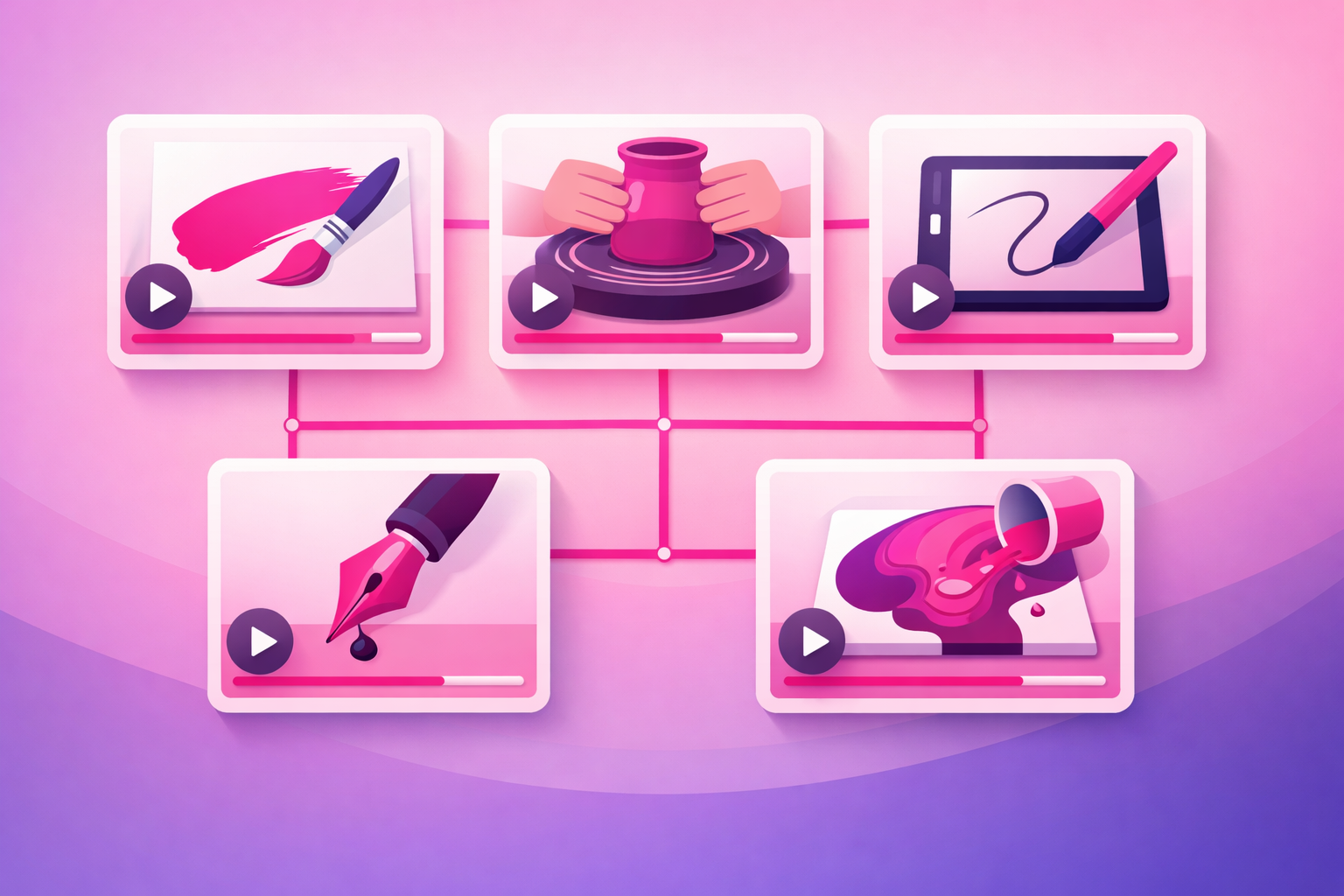
- Resin or acrylic pour. Fluid art that swirls and settles - the genre that built the satisfying lane.
- Calligraphy and hand-lettering loops. Smooth, rhythmic strokes that feel designed to be rewatched.
- Watercolor blooms. Pigment spreading into wet paper, shot close enough to see the bleed.
- Paint-mixing swirls. Combining colors on the palette until a new shade appears - oddly hypnotic on its own.
- Pottery wheel centering. Clay rising and forming under steady hands is one of the most rewatched clips on the platform.
- Marbling and suminagashi. Ink floating on water, lifted onto paper in a single satisfying pull.
- Stencil and spray reveal. Lift the stencil to expose a crisp image - a built-in payoff moment.
- Order-sealing ASMR. Wrapping, stamping, and sealing a shop order doubles as satisfying content and a subtle sales nudge.
6. Story & Personality Ideas (8)
Process gets you discovered; personality gets you followed. People follow artists, not just art - and these clips turn a one-time viewer into a fan who waits for your next post. They're also the easiest to film when you don't have a finished piece ready.
- A day in my studio. A loose vlog of how you actually work - messy desk and all.
- Your origin story. "Why I started making art" or the moment you decided to take it seriously.
- Reacting to your old art. A glow-up across months or years - instant proof that practice works.
- "Things nobody tells you about being an artist." Honest truths about pricing, rejection, or burnout.
- Answer a comment with a video. Turn a great question into a full clip and tag the commenter.
- Studio or setup tour. Show your space, your tools, and how it's organized - viewers love a peek behind the curtain.
- An honest hot take. A respectful, well-argued opinion on a trend or tool drives comments, which feed reach.
- The vulnerable post. Creative block, comparison, or a piece you almost gave up on - real stories build real loyalty.
7. Series & Challenge Ideas (8)
Here's the multiplier most artists miss: a series compounds because each new entry benefits from the saves and shares of the last one. The audience and the algorithm both learn to recognize the format. Most art accounts that cross 100K followers fast do it on the back of one breakout series.
- "Painting strangers' pets." A recurring, feel-good format with a built-in emotional payoff.
- "Drawing every [theme]." Every state, every follower's character, every color - a project people return to follow.
- A 30-day challenge. Document one piece a day; the daily cadence trains the algorithm and the audience.
- "Recreating famous art in my style." Borrow the recognition of a known piece while showing off your voice.
- Collab and duet chains. Build on another artist's clip or run a trade - their audience meets yours.
- "Guess what I'm drawing." A reveal series that turns the comment section into a guessing game.
- A themed monthly project. Inktober-style prompts give you a month of pre-planned ideas in one decision.
- "Turning random comments into art." Let viewers feed the prompts - they'll come back to see if you picked theirs.
Pick one series and commit to at least ten entries before judging it. Series are slow to ignite and then suddenly compound - the tenth episode often outperforms the first nine combined. For the broader growth framework behind this, see our complete TikTok growth strategy guide and the follower acquisition framework.
8. Selling & Business Ideas (8)
Art has an unusually short path from view to revenue - your audience often wants to own the work. These clips sell without feeling salesy because they're still content first: process, behind-the-scenes, and transparency that happens to point at a product.
- "This print just dropped." Tie a launch to the viral process clip that created demand for the piece.
- Packing-orders ASMR. Satisfying content and social proof that people actually buy your work - in one clip.
- "How I price my art." Transparency builds trust and quietly justifies your prices to future buyers.
- Commission start-to-finish. Document a custom piece from brief to delivery to show the experience of ordering.
- Shop restock or studio update. A simple "what's new in the shop" clip that gives fans a reason to check the link.
- Craft-fair or market setup. Behind-the-scenes of your booth - relatable for makers and a draw for local buyers.
- "What you get when you order." An unboxing from the maker's side, showing the packaging, the extras, and the care.
- Digital product in action. Demo a brush pack, preset, or reference kit live so viewers see the value before they buy.
The rule for selling clips: never go viral with no path to buy. A breakout process video with no shop link, no print option, and no email capture wastes the single best sales moment you'll ever get. If your goal is to sell at scale, treat your account like a storefront - our guide to TikTok e-commerce and our TikTok for small business guide cover turning followers into paying customers.
9. The Capture System: Never Run Out of Ideas
Fifty ideas are useless if you forget them by the time you pick up the camera. The artists who post consistently aren't more creative - they're more organized. Here's the simple capture system that keeps your Idea Vault full without extra effort.
- Keep one running note. Every time someone asks "how did you do that?" or "is this for sale?", that's a video - log it immediately.
- Mine your comments and bigger creators'. The questions under popular art clips are a map of what your audience already wants explained.
- Film everything, decide later. Record the full process of every piece, even when you're not sure it's post-worthy. You can't edit footage you never shot.
- Batch from one piece. Before you start a painting, decide which five clips it will become - the time-lapse, the close-up, the fix, the supplies, the reveal.
- Save a swipe file. When a hook or format stops your own scroll, screenshot it and note why it worked. Your best ideas often start as someone else's.
Pro Tip
Aim to keep at least 30 ideas in your vault at all times. When the backlog is full, you film from a position of choice instead of desperation - and it shows in the quality. Once you find the two or three formats that consistently clear your account's average completion rate, build a series around them and let selective amplification do the rest.
10. Which Ideas Are Worth Promoting
Not every idea deserves a budget. The smart play is to let all of these concepts run organically, watch which ones break out, and then amplify only the proven winners. Paid promotion does not rescue a flat clip - it pours fuel on signals the algorithm is already reading.
An art clip is ready for selective amplification when it clears your organic signal threshold:
- Save rate above 1.2% of views (tutorials and satisfying clips run higher).
- Share rate above 1.0% of views.
- Completion rate above 55% on short clips or 35% on longer ones.
- Follow rate above 0.6% of viewers - or, if you sell work, a clear spike in profile visits and shop link clicks.
Process and transformation clips tend to make the best promotion candidates because they earn saves and shares, which means paid traffic preserves the organic signal that keeps the clip traveling after the campaign ends. For artists selling prints or commissions, amplifying a proven process clip can drive followers and sales at the same time.
That selective approach is exactly what our TikTok promotion service is built around - amplifying art clips that have already proved themselves rather than spraying budget across every upload. For the technical setup of paid amplification, see our Spark Ads guide and the complete TikTok advertising guide.
Frequently Asked Questions
What kind of art content gets the most views on TikTok?
Process and transformation clips win the most views and saves because they deliver a satisfying payoff the viewer wants to watch to the end. After that, before-and-after reveals, beginner mistake-fix tutorials, and oddly satisfying clips like resin pours and calligraphy perform best. The common thread is a clear promise or visual payoff in the first second, plus a reason to save the clip - either to rewatch it or to try the technique later.
How do I come up with art TikTok content ideas every week?
Build a capture system instead of waiting for inspiration. Keep one running note of every question people ask about your work, every comment that starts with "how did you...," every step of your process, and every mistake you catch yourself fixing. Slice each finished piece into multiple clips - the full time-lapse, a detail close-up, a mistake-and-fix, and a reveal. Most working art creators keep a backlog of 30 to 50 ideas so they never sit down to a blank page.
Do you need to be a great artist to make good art content?
No. Some of the fastest-growing art accounts in 2026 are built on learning in public, beginner tutorials, oddly satisfying process, and a strong personal voice rather than gallery-level skill. A clear hook and a satisfying payoff matter far more than technical perfection. Many of the ideas in this guide - mistake fixes, supply tests, day-in-the-studio clips, and challenge series - work better when you are visibly still improving, because viewers can relate to and learn from you.
How long should an art TikTok video be?
Most high-performing art clips run 15 to 40 seconds. The hook or payoff should land in the first second or two, then the process fills the rest. Satisfying time-lapses and detailed builds can run up to 60 seconds because the process itself holds attention, but only if you front-load the finished result or a glimpse of it. Compress the slow parts with a speed-ramped time-lapse and cut anything that does not earn its place.
Should I promote my best art content ideas with paid ads?
Only after a clip proves itself organically. Let your ideas run, watch which ones clear your account average save and completion rate, then put a focused promotion budget behind those hero clips. Promoting weak clips wastes budget and can train the algorithm to treat your account as lower quality. For artists selling prints or commissions, selective amplification of a strong process clip can drive both followers and direct sales - which is exactly what services like Viryze are built for.
Got an idea that's taking off? Amplify it.
The fastest-growing artists on TikTok pair a steady stream of content ideas with selective paid amplification on the clips that break out. Viryze is built for that exact playbook - we only promote clips that have already cleared the organic signal threshold, so your budget compounds your best ideas instead of rescuing your weakest. Whether you're building an audience or selling out a print run, that's the difference between burning budget and buying real growth.
See how selective amplification worksRelated Reading
- TikTok for Artists: The Complete 2026 Guide - the full playbook for growing and monetizing an art audience.
- The Complete TikTok Algorithm Guide - the ranking signals that decide which art clips travel.
- The Complete TikTok Growth Strategy Guide - cross-niche fundamentals that apply to every art account.
- TikTok Spark Ads Guide - the format every artist should default to for amplification.
- TikTok E-commerce Guide - turning a viral process clip into print and product sales.

Head of Creator Success at Viryze
TikTok growth strategist helping creators reach their first 100K followers through data-driven promotion strategies.