Watching a piece of art come together is one of the most hypnotic things you can put on a screen, and TikTok knows it. #ArtTok has crossed tens of billions of views, process time-lapses get rewatched until they loop, and a single satisfying brushstroke, pour, or pottery pull can stop a thumb mid-scroll faster than almost any other content type. If you can make the first second of your process irresistible, TikTok will hand you an audience that follows, saves, and buys faster than most artists ever expect.
Here's the trap most artists fall into: they spend forty hours on a piece, post a single photo of the finished result, and wonder why it disappears in an hour. TikTok is not a gallery wall. It's a fast feed that rewards the making far more than the made. The finished piece is the payoff - but the process is the hook, the story, and the reason people stay.
This guide is the complete 2026 playbook: the art lanes growing fastest right now, the process-first hook style pulled from clips that crossed a million views this year, the simple setup that makes any artwork look professional on camera, the 90-day plan to take a brand-new account to its first 100K followers, how artists turn followers into print, commission, and brand income, and when paid promotion is the right move versus when it just burns budget. Pair this with our TikTok algorithm guide for the ranking-signal frame and the TikTok growth strategy guide for the cross-niche fundamentals.
The honest summary:
- Show the process, not just the result - finished-art-only accounts are the slowest growth path on the platform.
- Pick one art lane the algorithm can categorize cleanly so it knows exactly who to show your work to.
- Art has unusually direct monetization - prints, digital products, and commissions turn viewers into buyers without huge follower counts.
- Use paid promotion as selective amplification, never as a way to rescue weak posts.
What's Inside
- 1. Why Art Is Built for TikTok in 2026
- 2. The Seven Art Lanes That Grow Fastest
- 3. The Process-First Hook Style That Beats Finished-Art Posts
- 4. The Setup That Makes Your Art Look Professional on Camera
- 5. Posting Cadence Artists Can Actually Keep
- 6. The 90-Day Plan from Zero to 100K Followers
- 7. How Artists Turn Followers Into Income in 2026
- 8. When Paid Promotion Multiplies vs. Wastes Budget
- 9. Mistakes That Quietly Cap Art Accounts
- Frequently Asked Questions
1. Why Art Is Built for TikTok in 2026
Most niches have to fight for attention. Art starts with a head start, because the act of creating is inherently watchable. A first brushstroke, a clay form rising on the wheel, or a blank page filling with ink does the hook work for you. But the real reasons art punches above its weight on TikTok are more specific than "art is pretty."
First, art clips earn high save rates. Save rate is one of the strongest quality signals in the TikTok ranking system, because a save means the viewer plans to come back. Tutorials get saved by people who want to try the technique. Reference and color-theory clips get saved by other artists. Satisfying process clips get saved simply because people want to rewatch them. That keeps the algorithm pushing art content for weeks instead of hours.
Second, the audience converts to money in a way few niches match. An artist's viewers are often people who want to own the work - a print, an original, a commission, or a digital product. Unlike many creators who can only monetize through brand deals, an artist has a product the audience already wants. A view can become a paying customer the same day.
Third, art content compounds. A clean tutorial on a common technique, a satisfying process on a popular subject, or a style breakdown keeps resurfacing for months because the demand never expires. That slow decay is why art accounts that look modest at six months often look unrecognizable at eighteen - the back catalog keeps working while you sleep.
Finally, brand demand is structural. Art-supply companies, tablet and stylus makers, paint and marker brands, framing services, and print-on-demand platforms all spend heavily on creator partnerships in 2026. They want people who can show a product in action on real work in seconds - which is exactly what a good art creator already does for free.
For context on how the algorithm treats save rate, watch-time, and other ranking signals across niches, see our algorithm ranking factors breakdown.
2. The Seven Art Lanes That Grow Fastest
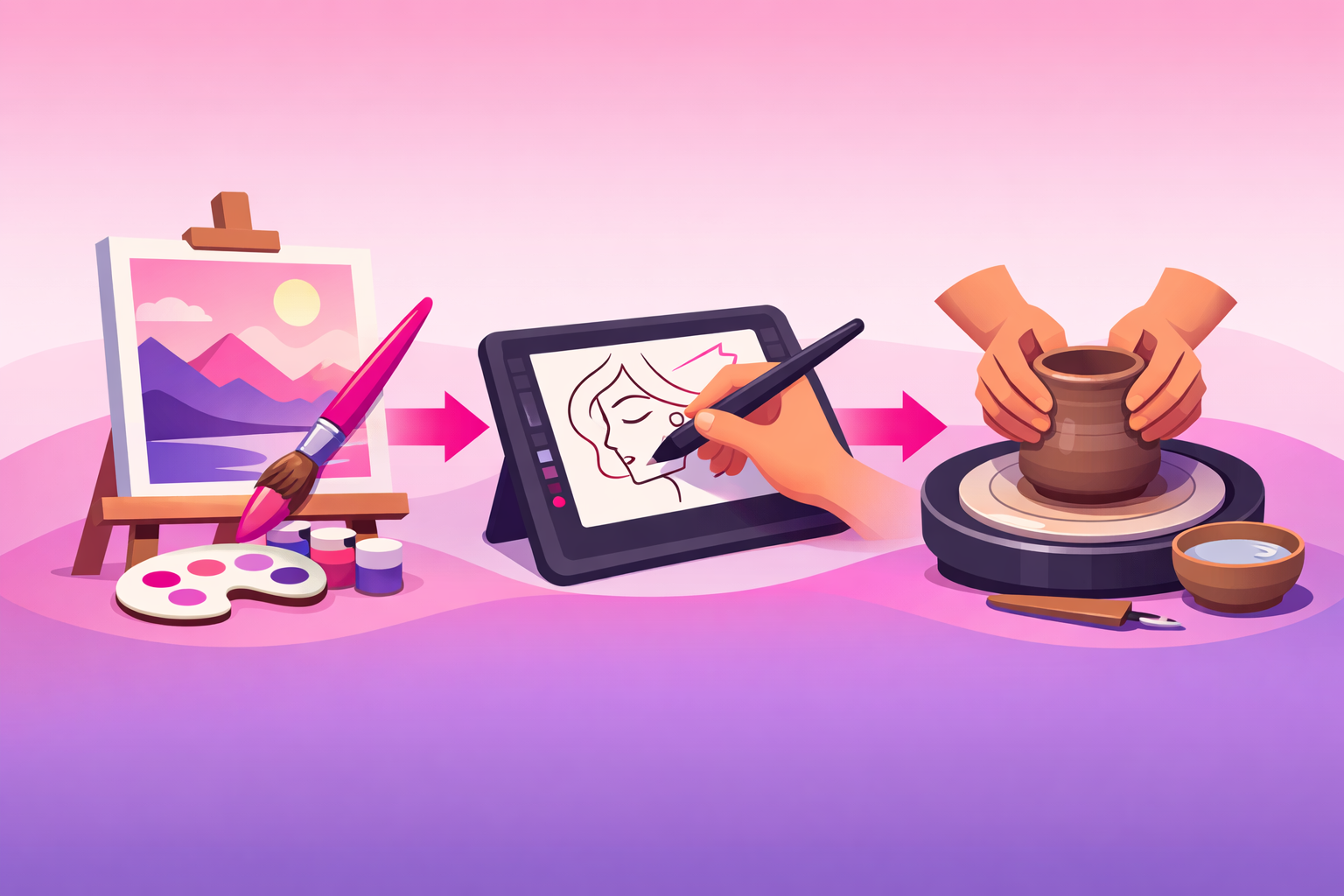
Generalist art content is the slowest growth path on TikTok. The algorithm wants to categorize your account so it can find the right audience. A watercolor clip, then a digital portrait, then a pottery video confuses the engine and the account stalls. Picking one lane - what we call Lane Lock - is the single highest-leverage decision a new art creator makes.
The seven art lanes growing fastest in 2026:
- Traditional painting and drawing. Watercolor, acrylic, oil, gouache, graphite, ink. Time-lapses of a piece coming together are endlessly rewatchable and the easiest lane to start.
- Digital art and illustration. Procreate, Photoshop, and tablet work, character design, fan art, and style breakdowns. Huge audience and the strongest digital- product pipeline.
- Oddly satisfying process. Resin, acrylic pours, fluid art, calligraphy, marbling. These clips win on pure watch-time and save rate even from non-artists.
- Ceramics and craft. Pottery, sculpture, jewelry, candle and soap making, woodworking. Tactile process plus a sellable physical product is a powerful combination.
- Teaching and tutorials. "How to draw," color theory, fixing common mistakes, supply reviews. The highest save rate of any lane and a natural bridge to courses.
- Art business and selling. Packing orders, studio vlogs, pricing your work, craft-fair prep. A fast-growing meta-lane because aspiring artists want to learn the business, not just the craft.
- Niche and themed art. Tattoo design, miniatures and models, chalk and mural work, fan communities, fantasy worldbuilding. Smaller audiences but intensely loyal and highly monetizable.
Pick the lane where you have the most genuine point of view or the most direct path to money. Digital and traditional painting have the broadest audiences. Satisfying process wins on raw watch-time. Teaching builds the deepest trust and feeds courses. Ceramics and craft pair process with a physical product you can sell. The art-business lane grows fast because it sells a dream other creators are chasing.
Once you pick a lane, stay in it for at least 30 posts before considering an adjacent topic. The algorithm needs that many data points to confidently categorize your audience.
3. The Process-First Hook Style That Beats Finished-Art Posts
Posting a single photo of a finished piece is the most common reason artists fail on TikTok. Watch-through rate is the dominant ranking signal, and a static image gives the viewer nothing to wait for. The piece might be a masterpiece, but if the first frame doesn't promise a payoff, the thumb keeps moving.
We call the fix The Reveal Tension Loop: open on the result or a glimpse of it, then rewind to the blank surface and let the viewer watch the gap close. The viewer either keeps watching to see how you got there, or saves the clip because the satisfaction is worth rewatching. Both outcomes train the algorithm to promote you.
Hook templates that consistently land for art clips:
- Result-first, then rewind. Show the finished piece for one second, then cut to the blank canvas and time-lapse the build. The backbone of process growth.
- Blank-to-wow transformation. Empty page or lump of clay in frame one, the stunning result teased at the end. The before-and-after is the entire promise.
- The unexpected technique. "I painted this with a sponge, not a brush." Curiosity about the how carries the watch-through.
- The relatable struggle. "I almost ruined this at the halfway point." Tension and stakes keep viewers to the end.
- The mistake fix. "Stop doing this when you shade." Anchors the viewer in a problem they recognize, then delivers the solution.
Every winning hook does the same job: it tells the viewer in two seconds why the next twenty are worth it. A static photo of the finished work hides that promise, and on TikTok that is fatal - even when the art itself is extraordinary.
4. The Setup That Makes Your Art Look Professional on Camera
Art is a forgiving subject - it looks good even on a phone - but a few cheap habits make the difference between "random clip" and "this account looks professional." The good news: you do not need a studio rig. Lean and consistent beats fancy and irregular every time.
The minimum setup that produces professional-feeling art content:
- An overhead phone mount. The single biggest upgrade for art content. A clamp arm or overhead tripod that locks your phone directly above the work surface gives you the clean top-down view the whole niche is built on. A $25 arm does the job.
- A current iPhone or recent Android. Sharper than most mid-range cameras at vertical 1080p, and the stabilization is good enough for handheld detail shots.
- Soft, even light. A single large softbox or a window with diffused daylight kills the harsh shadows and glare that ruin glossy paint, resin, and screen capture. Even light is what makes colors read true on camera.
- Built-in screen recording for digital artists. Procreate's time-lapse export and your phone or tablet's screen recorder are free and produce the cleanest digital process clips. No external camera needed.
- A clean, consistent setting. One desk, one corner of the studio, one recognizable backdrop. Visual consistency makes your account feel like a brand, not a camera roll.
The highest-leverage habit after the gear is the speed-ramped time-lapse: compress the slow work, slow down the satisfying moments. It is the most reliable way to make any piece - a five-minute sketch or a forty-hour painting - feel cinematic in thirty seconds. Color accuracy matters too: shoot in even light and avoid heavy filters, because buyers judge your work by how it looks on screen.
5. Posting Cadence Artists Can Actually Keep
Art content has a real production cost - finished pieces take time. The trick is that one piece can become many clips: the full time-lapse, a single-detail close-up, a mistake-and-fix, a supply breakdown, and a finished reveal. That is how working artists keep a high cadence without burning out or rushing the work.
A defensible posting rhythm by stage:
| Stage | Posts per Week | Focus |
|---|---|---|
| 0 - 10K followers | 5 - 7 | Test hooks and lane. Slice every piece into multiple clips - volume finds the format. |
| 10K - 50K followers | 4 - 6 | Double down on winning formats. Turn your best process clip into a repeatable series. |
| 50K - 250K followers | 4 - 5 | Lean into series and brand deals. Quality compounds over raw quantity. |
| 250K+ followers | 3 - 5 | Maintain cadence. Add longer-form tutorials for YouTube and direct product revenue. |
The one-piece-many-clips habit is the difference between artists who post twice a month and artists who post daily without making more art. Film everything from the start, and a single afternoon at the easel can fuel a full week of content.
6. The 90-Day Plan from Zero to 100K Followers
Art accounts that break out fast in 2026 share a recognizable pattern. Below is the 90-day plan we have seen work most reliably for new art creators, broken into three 30-day phases.
Phase 1 (Days 1-30): Lane lock and hook iteration
Post 5 to 7 clips per week, all inside one lane. Vary the hook style and the format, but never the topic. The goal is to find the two or three hook patterns that consistently clear 50% completion rate on your account. By day 30 you should be able to predict, with reasonable accuracy, whether a process clip is a keeper before you ever post it.
Phase 2 (Days 31-60): Format compounding
Take the two or three winning hook patterns and turn them into repeatable series. A series is a format the algorithm and the audience both learn to recognize - "painting strangers' pets," "one color challenge," "fixing my followers' drawings." Series compound because each new entry benefits from the saves and shares of the previous ones. Most art accounts that cross 100K followers in 90 days do it on the back of one breakout series.
Phase 3 (Days 61-90): Selective amplification
Identify the top one or two clips from phase 2 that cleared the organic signal threshold - save rate above 1.2% of views, share rate above 1.0%, completion above 55%. These are hero clips. Promote them with a focused paid amplification budget for 5 to 7 days each. Hero clip amplification at this stage routinely doubles or triples the follower curve without changing the underlying organic strategy.
For the full breakdown of how the 90-day curve maps to engagement, watch-time, and follow rate, see our complete TikTok growth strategy guide and the follower acquisition framework.
7. How Artists Turn Followers Into Income in 2026
Art has one of the most flexible income mixes on TikTok because you already have something the audience wants to own. The lane you pick shapes how you earn: a painter sells originals and prints, a digital artist sells brushes and presets, a teacher sells courses. The strongest creators stack several streams so no single brand budget or platform shift can sink them.
Seven revenue streams artists stack:
- Prints and originals. The classic art income. Print-on-demand removes the inventory risk, and a single viral process clip can sell out a print run in a day.
- Commissions. Custom portraits, pet paintings, and bespoke pieces. High ticket and easy to fill from an engaged audience - though limited by your hours.
- Digital products. Procreate brushes, presets, reference packs, printables, and templates. The highest-margin stream because you build it once and sell it forever.
- Courses and workshops. Teaching your technique to the audience you built teaching it for free. The teaching lane converts to this almost automatically.
- Memberships and Patreon. Behind-the-scenes process, exclusive tutorials, and early access. Predictable recurring revenue from your truest fans.
- Brand deals and affiliate. Art-supply, tablet, paint, and framing brands pay for in-action demos, and affiliate links on the exact supplies you use convert unusually well.
- Creator Rewards and merch. TikTok's payout on qualifying views plus apparel and goods featuring your art for accounts with a strong identity.
The standout feature of art is how short the path from view to revenue can be. An artist with 20K engaged followers and a simple print shop can out-earn a creator with 200K and nothing to sell, because the audience already wants the work. If your plan is to sell originals, prints, or digital products at scale, treat your account like a storefront - our guide to TikTok e-commerce and our TikTok for small business guide cover turning followers into paying customers.
8. When Paid Promotion Multiplies vs. Wastes Budget
Art is one of the niches where selective paid amplification produces an unusually high return. The reason is structural: process content is visually compelling, so cost per follow runs lower than in most categories, and art clips compound on saves and shares, which means paid traffic preserves the organic signal that keeps the algorithm pushing the clip after the campaign ends. For artists selling prints or commissions, that paid reach can convert directly into sales.
The bar for promoting a clip is the same as in every other niche: it has to clear an organic signal threshold first. A clip that is not earning saves and shares organically will not earn them with paid traffic - the cost-per-result climbs, the algorithm reads the low engagement, and the budget drains without compounding the account.
An art clip is ready for paid amplification when it clears:
- Save rate above 1.2% of views (satisfying-process and tutorial clips run higher).
- Share rate above 1.0% of views.
- Completion rate above 55% on short clips or 35% on longer ones.
- Follow rate above 0.6% of viewers - or, for artists selling work, a clear spike in profile visits and shop link clicks.
Artists who run selective amplification on clips that clear those thresholds typically see a cost-per-follower in the $0.20 to $0.50 range - and for those selling prints or commissions, a cost-per-sale that easily pays for itself. A clip that fails to clear the threshold should stay organic, no matter how proud you are of the piece.
That is the model our TikTok promotion service is built around - amplifying art clips that have already proved themselves rather than spraying budget across every upload. For the technical setup of paid amplification, see our Spark Ads guide and the complete TikTok advertising guide.
9. Mistakes That Quietly Cap Art Accounts
Artists rarely fail in dramatic ways - they fail by slowly capping their growth with a handful of avoidable mistakes. The pattern below is what we see most often when an account stalls between 5K and 20K followers and cannot break through.
- Posting only finished pieces. A static result gives the viewer nothing to wait for. Lead with the process and the reveal.
- Posting across too many mediums. The algorithm cannot categorize an account that mixes watercolor, digital, pottery, and resin in the same week.
- Bad lighting and color. Glare on glossy paint and washed-out screens make great work look amateur - and scare off buyers who judge by the screen.
- Long, slow intros. Forty seconds of setup before the first stroke kills watch-through. Compress the boring parts ruthlessly.
- Promoting every clip. Paid traffic on weak clips trains the algorithm to treat your account as lower quality, not higher.
- No path to buy. Going viral with no shop link, no print option, and no email capture wastes the single best sales moment you will ever get.
- Ignoring the comment section. Comments are part of the ranking signal, and replying within the first 30 minutes consistently lifts a clip's reach - especially when viewers ask "is this for sale?"
Frequently Asked Questions
Is TikTok still worth it for artists in 2026?
Yes, and for many artists it is the single best discovery channel available. #ArtTok has crossed tens of billions of views, and process content - watching a piece come together - is among the most rewatchable, saveable formats on the platform. The algorithm rewards art clips because they earn long watch-through on time-lapses and high save rates on tutorials and reference material. The catch is that posting only finished pieces grows slowly. Artists who show the process, pick a clear lane, and lead with a strong before-and-after grow far faster than accounts that only post the final result.
How long does it take an artist to reach 100K followers on TikTok?
Art is a fast-growth niche because process content is so visual and shareable. With a clear lane and 4 to 6 posts per week, most artists who break out reach 100K followers in 6 to 12 months. Satisfying-process accounts - resin, pottery, calligraphy, realistic drawing - often move faster because the content is endlessly rewatchable. Artists who land one breakout series, like a recurring transformation or a signature style reveal, sometimes get there inside 90 days.
Do you need to be a great artist to grow on TikTok?
No. Some of the fastest-growing art accounts in 2026 are built around learning in public, beginner-friendly tutorials, oddly satisfying process, and a strong personal voice rather than gallery-level skill. What matters is a clear point of view and a satisfying hook, not technical perfection. Audiences connect with artists they can relate to and learn from. Skill helps, but consistency, a clear lane, and process-first storytelling matter more for growth.
How do artists make money on TikTok?
Artists stack several streams. The most common are selling original work and prints, taking commissions, selling digital products (brushes, presets, Procreate kits, reference packs), Patreon or membership tiers, teaching through courses and workshops, art-supply brand deals and affiliate links, merch, and the Creator Rewards Program. Selling prints and digital products tends to scale best because they are not limited by your hours. The highest earners combine a product they can sell repeatedly with a steady stream of process content that drives traffic to it.
Should artists pay to promote their TikTok videos?
Only on clips that already have organic momentum. Paid promotion does not save a flat post - it amplifies signals the algorithm is already reading. The smart play is to wait until a process clip clears your account average completion rate and earns saves above roughly 1 percent of views, then put a focused promotion budget behind it. For artists selling prints or commissions, selective amplification of a strong process video can drive both followers and direct sales. Services like Viryze are built for this kind of selective amplification rather than boosting every upload.
Ready to amplify your best art clips?
The fastest-growing artists on TikTok in 2026 pair a clear organic strategy with selective paid amplification on their hero clips. Viryze is built for that exact playbook - we only promote clips that have already cleared the organic signal threshold, so your budget compounds your best work instead of rescuing your weakest. Whether you're building an audience or selling out a print run, that is the difference between burning budget and buying real growth.
See how selective amplification worksRelated Reading
- The Complete TikTok Algorithm Guide - the ranking signals that decide which art clips travel.
- The Complete TikTok Growth Strategy Guide - cross-niche fundamentals that apply to art accounts.
- TikTok Spark Ads Guide - the format every artist should default to for amplification.
- TikTok E-commerce Guide - turning a viral process clip into print and product sales.
- TikTok for Small Business - turning followers into paying customers (key for commissions and shops).

Head of Creator Success at Viryze
TikTok growth strategist helping creators reach their first 100K followers through data-driven promotion strategies.